All of David Markson’s References in The Last Novel to Walt Whitman

All of David Markson’s references in The Last Novel to Walt Whiman:

I am he that aches with amorous love.            Wrote Whitman.

Walter, leave off.

Wrote D. H. Lawrence.

Walt Whitman’s claim — never in any way verified — that he had fathered at least six illegitimate children.

Gerard Manley Hopkins, on realizing that he feels a certain kinship with Whitman:

As he is a very great scoundrel this is not a very pleasant confession.

A writer of something occasionally like English — and a man of something occasionally like genius.

Swinburne called Whitman.

Future generations will regard Bob Dylan with the awe reserved for Blake, Whitman, Picasso and the like.

Said an otherwise seemingly rational writer named Jonathan Lethem.

Before the Euro, the portrait of Yeats on Ireland’s twenty-pound note.

America’s Whitman twenty-dollar bill, when?

The Melville ten?

Twenty-five years after his death, Poe’s remains were disinterred from what had been little better than a pauper’s grave and reburied more formally.

Walt Whitman, who made the journey from Camden to Baltimore in spite of being disabled from a recent stroke, was the only literary figure to appear at the ceremonies.

Salvador Dali & Amanda Lear (French TV,1967)

I Review House of Holes, Nicholson Baker’s Ovidian Raunchfest

In his Paris Review interviewNicholson Baker says that “one of the questions House of Holes is trying to answer” is: is “there still a point to writing words about sex when you can see anything you want, and a lot of things you don’t want to see, on the Web?” The book answers a goofy, gooey, bright-hearted “yes” to this question, unfolding its pornographic vignettes in a surreal Ovidian holiday, a midsummer’s night sexfest that sails lusty and smiling over the borders of morality, social convention, and plain old biology. Baker creates an organic, oozing world where genitalia is swapped freely between lovers, where one might exchange an arm for a bigger dick, where old tattoos get fucked away, where a woman and a tree can make sweet, sweet love:

She looked out from her high-splayed vantage and she said, “I’m a treefucking woman!” Dappled sunlight shone and emptied itself onto her. She squeezed her Kegeling love muscle around the smooth, thickened branch within, and when the wind came up again all the leaves twittered and shook. The tree itself shuddered: It was having some kind of orgasm.

If it seems like I’m getting ahead of myself, citing text before outlining plot, I assure you I’m not: There really isn’t much of a plot to House of Holes. Well, if there is one, it’s something like this: Lila, a large-breasted madame runs The House of Holes, an equal-opportunity brothel/fantasy factory that can only be accessed through portals that appear in strange spaces. This pornographic Arcadia operates on slippery wet-dream logic in which strangers cheerfully and eagerly engage in all sorts of raunch. Characters of varying physical attributes screw their way through a surreal holiday. There are a few conflicts, most of which are too light to touch on (this is a light book, for sure).

Two conflicts stand out with some (slight) weight though:

First, there’s the Pornmonster, “a personification of polymorphousness unlike anything the world of human suck-fuckery has ever known.” The Pornmonster is the mutant offspring of all the bad porn slurry collected on a pornsucking mission (don’t ask). The Pornmonster is typical of Baker’s tone throughout House of Holes, and its polymorphousness embodies the book’s depictions of sexual metamorphoses. This monster is tamed through playful, loving lust, and becomes a good guy, its raw sexual energy redirected for the forces of good (i.e., good sex). This is a book full of good guys.

Second, there’s the Pearloiner, an embittered, sexually-jealous TSA agent who steals clitorises (two of our heroines are afflicted by this heinous crime). The Pearloiner is a product of post-Homeland Security draconian measures, and her inclusion is about as close to contemporary culture criticism that House of Holes approaches. Sexy fun times interest Baker more.

Like the Pornmonster, the Pearloiner finds herself redeemed at the end of the book; moral shifts of allegiance are as easy as physical transformations in House of Holes. The Pearloiner and the Pornmonster alike atone their sins with a facile simplicity that fits the ludic silliness of Baker’s book. They are invited to participate in the handjob contest that (quite literally) climaxes the book. It’s an easy, orgasmic end to an easy, orgasmic book.

In some ways, House of Holes is more remarkable for what it’s not. Most of the so-called pornographic literature (or literature of pornography, if you prefer) that I’ve read has a darker streak. (I’m thinking of Anaïs Nin, Henry Miller, de Sade,The Story of O, Alan Moore’s The Lost Girls, etc.). Holes shares Willliam Burroughs’s sense of surreal transmogrification and picaresque rambling and J.G. Ballard’s infatuation with the bizarre intersections of sex and technology, but it’s never sinister or cruel, or honestly, even disturbing.

House of Holes is a fundamentally good-natured book,” suggests Baker in his Paris Review interview, also pointing out that it’s a work of “crazy joy”—and he’s absolutely right: The book is joyous, good-natured, affable even. When Baker approaches a remotely Sadean cuckold fantasy he punctures it with a politeness that’s humorous—but he also dramatically lowers any stakes that may have been in play. In short, this is a novel of pure fun, of infinite gain and no loss (quite literally—Lose an arm? Get it back. Lose a clit? Get it back). Holes is silky and slippery and light, more ephemeral than ethereal in the end.

But shame on me. I seem to be faulting the book for not doing something it never sets out to do (namely, I seem to be faulting Holes for a lack of depravity and depth and darkness, three “d’s” the book’s rubric never sets out to register). It’s pure fantasy stuff, reminiscent of the partner-swapping exercise A Midsummer Night’s Dream (I am not saying Baker is Shakespeare) or the erotic shifts in Metamorphoses (ditto: Baker is no Ovid) or the voluptuous Victorian serial The Pearl: dreamy, and perhaps (small r) romantic, but not turbulent—sure, Holes will ruffle unwitting feathers (let’s be clear, it’s pointedly sexually graphic), but it’s unlikely to damage anyone’s soul. (If you’re worried about soul-damage, check out the editorial style-sheet for Holes, which lays out Baker’s invented porn-lexicon).

Is House of Holes a novel or a flimsy pornographic riff? Baker is less interested in ideas than he is in sensations, or rather representations of sensations (which is the most literature can do anyway, I suppose). Holes is unwilling to offer any answers or explications about the deep mysteries behind human desire, but it does pose questions about those desires, and it poses those questions with shameless glee. A fun, breezy read.

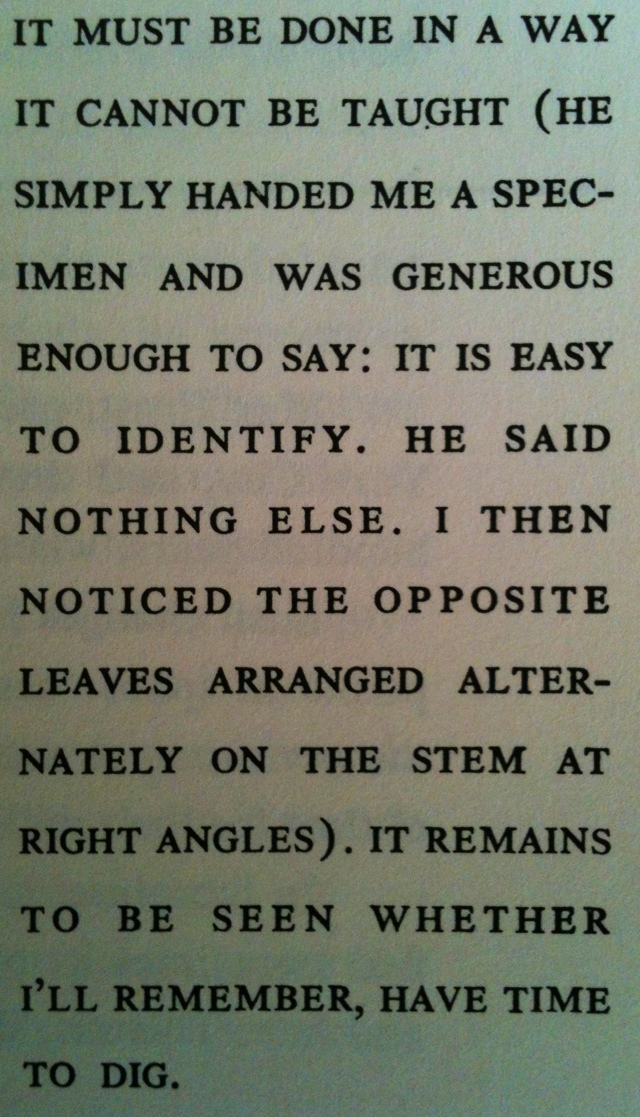
“It Must Be Done in a Way It Cannot Be Taught” — John Cage

20120228-173108.jpg

(From John Cage’s A Year from Monday).

Michel Houellebecq: “I Still Haven’t Made Up My Mind Whether Sex Is Good or Not”

Michel Houellebecq talks sex, frustration, and prostitution in his 2010 Paris Review interview:

INTERVIEWER

Of course, it was the numerous sex scenes that got you a lot of attention in the media.

HOUELLEBECQ

I’m not sure that there are such an unusual number of sex scenes in my novel.
I don’t think that’s what was shocking. What shocked people was that I
depicted sexual failure. I wrote about sexuality in a nonglorifying way. Most of all I described a basic reality: a person filled with sexual desire who can’t satisfy it. That’s what people don’t like to hear about. Sex is supposed to be positive. Showing frustrated sexual desire is obscene. But it’s also the truth. The real question is, Who is allowed to have sex? I don’t understand, for example, how teachers survive with all these alarming young girls. When women become sexual tourists, that is even more hidden, shameful, and taboo than when men do it. Just as, when a woman professor puts her hand on a student’s thigh, it’s even worse, even more unspeakable.

INTERVIEWER

A constant refrain in your novels is that sex and money are the dominant values of this world.

HOUELLEBECQ

It’s strange, I’m fifty years old and I still haven’t made up my mind whether sex is good or not. I have my doubts about money too. So it’s odd that I’m considered an ideological writer. It seems to me that I am mostly exposing my doubts. I do have certain convictions. For example, the fact that you can pay a girl, that I think is a good thing. Undeniably. An immense sign of progress.

INTERVIEWER

You mean prostitutes?

HOUELLEBECQ

Yes. I’m all for prostitution.

INTERVIEWER

Why?

HOUELLEBECQ

Because everybody wins. It doesn’t interest me personally, but I think it’s a good thing. A lot of British and Americans pay for it. They’re happy. The girls are happy. They make a lot of money.

INTERVIEWER

How do you know that the girls are happy?

HOUELLEBECQ

I talk to them. It’s very difficult because they don’t really speak English, but I talk to them.

INTERVIEWER

What about the more commonly held idea that these women are victims who are forced into these circumstances?

HOUELLEBECQ

It’s not true. Not in Thailand. It’s just stupid to have objections about it.

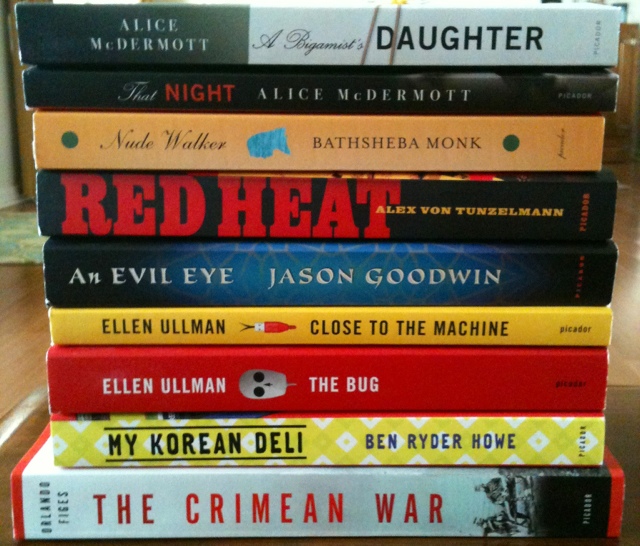
Books Acquired, 2.16.2012 — Or, Here’s What’s New from Picador This Month

20120228-173327.jpg

The kind folks at Picador sent a nice box of titles to Biblioklept World Headquarters a few weeks ago; I’ve had enough time to mull over them a bit and do something of a write-up. Here goes.

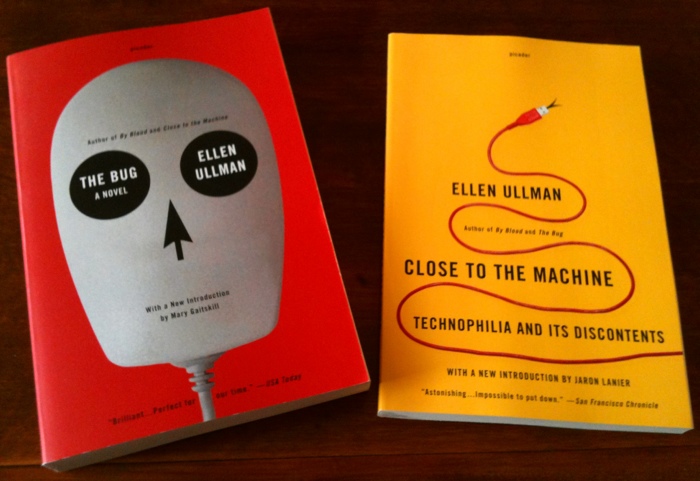
Next month, coinciding with her new novel By Blood (from FS&G), Picador re-releases (in new editions) two from Ellen Ullman:Close to the Machine and The Bug, which features a new introduction by Mary Gaitskill. Machine is a sort-of-memoir about the dawn of the tech-era; Ullman recounts her experiences as a female software engineer finding a place in the boys’ club of programming. Love these covers:

20120228-173409.jpg

The Bug, a novel is tech without the noir, cyber without the punk—something different and fresh. It reminds me of Douglas Coupland’s Microserfs only because I can’t think of what else to compare it to. Pub’s write-up:

Ellen Ullman is a “rarity, a computer programmer with a poet’s feeling for language” (Laura Miller, Salon). The Bug breaks new ground in literary fiction, offering us a deep look into the internal lives of people in the technical world. Set in a start-up company in 1984, this highly acclaimed first novel explores what happens when a baffling software flaw—a bug so teasing it is named “the Jester”—threatens the survival of the humans beings who created it.

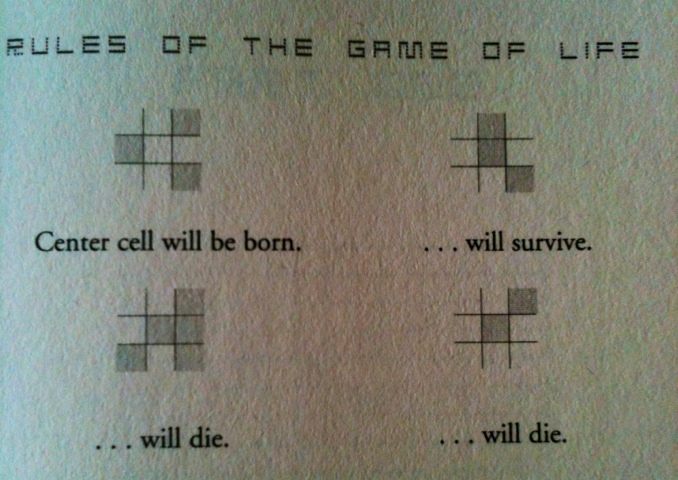
The Bug features a playfulness of the page, a willingness to examine the intersection of code and poetry. Example:

20120228-173416.jpg

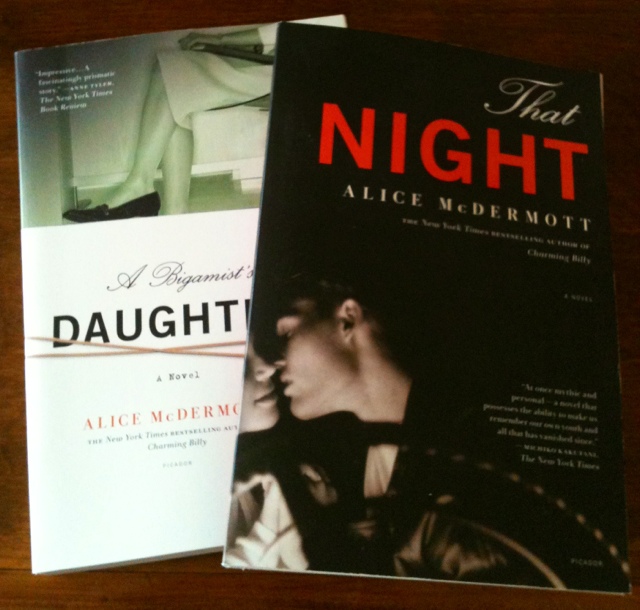
Alice McDermott also gets reissues: A Bigamist’s Daughter and That Night, which my wife picked up. That Night was a finalist for the Pulitzer and the National Book Award. It seems a little sexy and dangerous. Again, pub’s blurb:

It is high summer, the early 1960s. Sheryl and Rick, two Long Island teenagers, share an intense, all-consuming love. But Sheryl’s widowed mother steps between them, and one moonlit night Rick and a gang of hoodlums descend upon her quiet neighborhood. That night, driven by Rick’s determination to reclaim Sheryl, the young men provoke a violent confrontation, and as fathers step forward to protect their turf, notions of innocence belonging to both sides of the brawl are fractured forever. Alice McDermott’s That Night is “a moving and captivating novel, both celebration and elegy…a rare and memorable work” (The Cleveland Plain Dealer).

20120228-173424.jpg

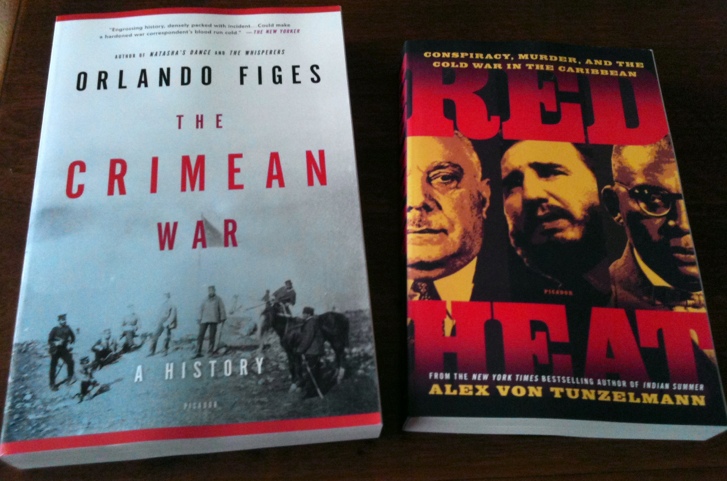
Two history books in the package: Orlando Figes’s The Crimean War and Red Heat by Alex von Tunzelmann.

20120228-173435.jpg

Here’s an excerpt from the Figes book (which is, uh, about the Crimean War):

Two world wars have obscured the huge scale and enormous human cost of the Crimean War. Today it seems to us a relatively minor war; it is almost forgotten, like the plaques and gravestones in those churchyards. Even in the countries that took part in it (Russia, Britain, France, Piedmont-Sardinia in Italy and the Ottoman Empire, including those territories that would later make up Romania and Bulgaria) there are not many people today who could say what the Crimean War was all about. But for our ancestors before the First World War the Crimea was the major conflict of the nineteenth century, the most important war of their lifetimes, just as the world wars of the twentieth century are the dominant historical landmarks of our lives.

Red Heat is not the novelization of the 1988 Schwarzenegger buddy-cop film (nor, sadly, a novelization of the 1985 Linda Blair women-in-prison film of the same name). Von Tunzelmann’s book examines the relationship between the island nations to the U.S.’s immediate south to America and Russia. Like I said, no Schwarzenegger, but plenty of strong men. From Jad Adam’s review in The Guardian:

Red Heat deftly juggles the stories of three countries – Cuba, Haiti and the Dominican Republic – and their relationship with the superpowers, where things were not as they seemed. Von Tunzelmann asserts that the political labels of the region were a sham: “democracy” was dictatorship; leaders veered to the rhetoric of the right or left according to advantage; a communist was anyone, however rightwing or nationalistic, whom the ruling regime wanted tarnished in the eyes of the US

Watch The Simpsons Game of Thrones Couch Gag

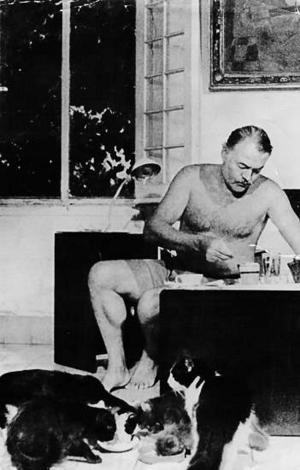
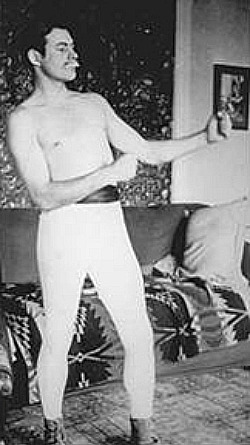
Topless Hemingway, Part VI

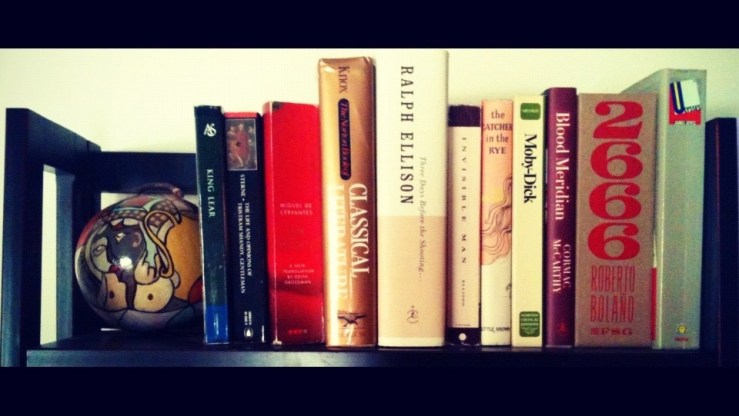
Book Shelves #10, 3.04.2012

20120304-125356.jpg

Book shelves series #10, tenth Sunday of 2012. I’m very ill today. These are some books; I own multiple copies of some of these. A painted gourd stands in as a book end. Look, I’m really ill today, these are books, I think you get the idea.

Lady with Unicorn — Raphael

Henry Miller Interview (In a Swimming Pool)

Teju Cole’s Seven-part Excursus: Aerial Bombing as the Presiding Metaphor of Our Time

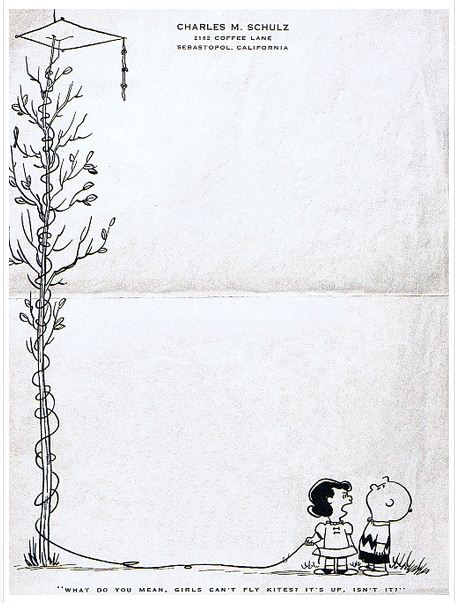
Charles Schulz’s Letterhead

(More/via).

Gaddis, Wallace, McCarthy, Cooper (Books Acquired, 3.02.3012)

20120302-173432.jpg

Picked up these four yesterday afternoon during my weekly visit to the bookshop (can’t help said visit; I live too close). Spent the afternoon reading Neal Stephenson’s introduction to David Foster Wallace’s Everything and More and a few of the pieces in All Ears, a collection of essays and interviews by Dennis Cooper. I read the interviews with Stephen Malkmus and Leonardo diCaprio. There’s something so nineties about the book.

20120302-173439.jpg

A nice afternoon of reading with a few homebrews.

Everything and More, DFW’s history of infinity, is one of the only books I haven’t read by him (I even got to read a big chunk of his rare early work Signifying Rappers years ago because a friend found it in a library book sale). Anyway, to the point: None of the DFW editions I owned, up to this point were posthumous (they were, uh humous (?))—so it was a little weird to see this on the back of the book:

20120302-173455.jpg

Finally: No, I didn’t need another copy of Cormac McCarthy’s Suttree (let me plug my review), but I’m a huge fan of these awful 1980s Vintage Contemporaries editions, so when I found a first ed. of Suttree, I couldn’t pass it up (I’m pretty sure this is the same edition DFW owned):

20120302-173509.jpg

Books Acquired, 2.28.2012

20120228-175055.jpg

Books acquired, 2.28.2012. All forthcoming from Pantheon, all hardback:

The Undead by Dick Teresi is a book about organ harvesting that claims to be funny. Publisher’s description:

Important and provocative, The Undead examines why even with the tools of advanced technology, what we think of as life and death, consciousness and nonconsciousness, is not exactly clear and how this problem has been further complicated by the business of organ harvesting.

Dick Teresi, a science writer with a dark sense of humor, manages to make this story entertaining, informative, and accessible as he shows how death determination has become more complicated than ever. Teresi introduces us to brain-death experts, hospice workers, undertakers, coma specialists and those who have recovered from coma, organ transplant surgeons and organ procurers, anesthesiologists who study pain in legally dead patients, doctors who have saved living patients from organ harvests, nurses who care for beating-heart cadavers, ICU doctors who feel subtly pressured to declare patients dead rather than save them, and many others. Much of what they have to say is shocking. Teresi also provides a brief history of how death has been determined from the times of the ancient Egyptians and the Incas through the twenty-first century. And he draws on the writings and theories of celebrated scientists, doctors, and researchers—Jacques-Bénigne Winslow, Sherwin Nuland, Harvey Cushing, and Lynn Margulis, among others—to reveal how theories about dying and death have changed. With The Undead, Teresi makes us think twice about how the medical community decides when someone is dead.

Jonathan Haidt’s The Righteous Mind. Publisher’s description:

Why can’t our political leaders work together as threats loom and problems mount? Why do people so readily assume the worst about the motives of their fellow citizens? In The Righteous Mind, social psychologist Jonathan Haidt explores the origins of our divisions and points the way forward to mutual understanding.

His starting point is moral intuition—the nearly instantaneous perceptions we all have about other people and the things they do. These intuitions feel like self-evident truths, making us righteously certain that those who see things differently are wrong. Haidt shows us how these intuitions differ across cultures, including the cultures of the political left and right. He blends his own research findings with those of anthropologists, historians, and other psychologists to draw a map of the moral domain, and he explains why conservatives can navigate that map more skillfully than can liberals. He then examines the origins of morality, overturning the view that evolution made us fundamentally selfish creatures. But rather than arguing that we are innately altruistic, he makes a more subtle claim—that we are fundamentally groupish. It is our groupishness, he explains, that leads to our greatest joys, our religious divisions, and our political affiliations. In a stunning final chapter on ideology and civility, Haidt shows what each side is right about, and why we need the insights of liberals, conservatives, and libertarians to flourish as a nation.

Daniel L. Everett’s Language: The Cultural Tool caught my fancy the most in this group; I spent two glasses of wine with it and may report more in the future. Publisher’s ‘script after the pic:

20120228-175104.jpg

A bold and provocative study that presents language not as an innate component of the brain—as most linguists do—but as an essential tool unique to each culture worldwide.

For years, the prevailing opinion among academics has been that language is embedded in our genes, existing as an innate and instinctual part of us. But linguist Daniel Everett argues that, like other tools, language was invented by humans and can be reinvented or lost. He shows how the evolution of different language forms—that is, different grammar—reflects how language is influenced by human societies and experiences, and how it expresses their great variety.

For example, the Amazonian Pirahã put words together in ways that violate our long-held under-standing of how language works, and Pirahã grammar expresses complex ideas very differently than English grammar does. Drawing on the Wari’ language of Brazil, Everett explains that speakers of all languages, in constructing their stories, omit things that all members of the culture understand. In addition, Everett discusses how some cultures can get by without words for numbers or counting, without verbs for “to say” or “to give,” illustrating how the very nature of what’s important in a language is culturally determined.

Combining anthropology, primatology, computer science, philosophy, linguistics, psychology, and his own pioneering—and adventurous—research with the Amazonian Pirahã, and using insights from many different languages and cultures, Everett gives us an unprecedented elucidation of this society-defined nature of language. In doing so, he also gives us a new understanding of how we think and who we are.

“They Told Me I Was Everything” — Orson Welles Plays King Lear

Bob Dylan LIFE Retrospective (Not-Quite-A-Book Acquired, 2.29.2012)

20120229-211910.jpg

My uncle has always aided and abetted my love for the music and mythos of Bob Dylan. He hooked me up with Anthony Scaduto’s 1972 biography Dylan, which I still consider a high point of musical biography and journalism. It’s a work that traces Dylan as a dialectical synthesis of the sources around him: Little Richard, the cold winters of Hibbing, Woody Guthrie, Charlie Chaplin, etc.

So anyway, I was pleasantly surprised (but hardly shocked) to find a copy of LIFE’s Bob Dylan retrospective in the US mails, kindly sent by my uncle. It’s crammed with pictures I’d never seen before, and the copy is surprisingly well-written (if occasionally snarky). Anyway, good stuff. I share a few pics:

20120229-211921.jpg

20120229-211928.jpg

20120229-211948.jpg

20120229-211954.jpg

20120229-212727.jpg