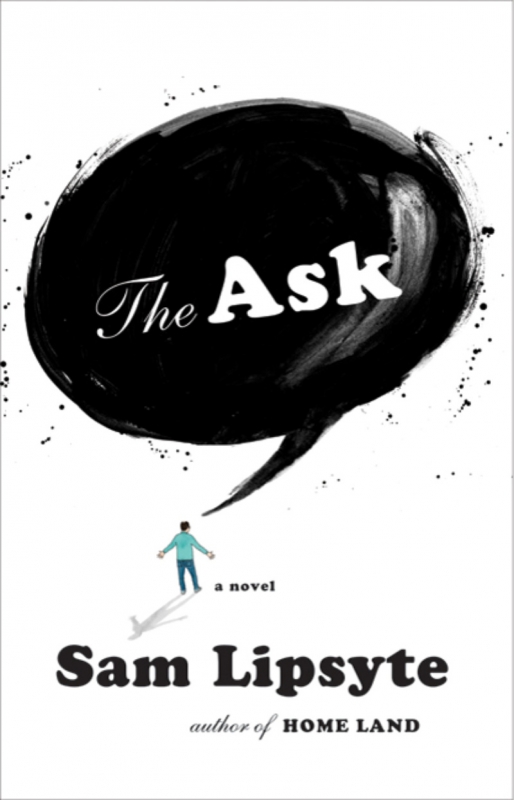
The Ask — Sam Lipsyte

I listened to the audiobook version of Sam Lipsyte’s hilarious, wistful, mean, and devastating novel The Ask last week. I invented chores and took any scenic route available when driving to get more of the book faster, frequently laughing out loud, or grimacing, or even feeling weird and shameful pangs of remorseful identification with the book’s protagonist and narrator, Milo Burke. I’m going to do my best to unpack the book’s themes–particularly the way it simultaneously eulogizes, valorizes, and mocks the American Dream–but first I need to get something out-of-the-way, a mea culpa of sorts.

As I mentioned, I listened to the book, but I don’t have a copy, so, shamefully, I can’t really quote any of Lipyste’s marvelous sentences. He is a master stylist, capable of zapping our dead modern idioms with the kind of alarming twists that highlight just how vacant language has become. Lipsyte also has a gift for rhythm, tone, and cadence, and he’s a master of the deadpan punchline. While the sentences in his last novel Home Land sometimes felt overly fussed over, straining under their own polish, The Ask showcases an effortless style that both seduces and repels. Lipsyte reads The Ask audiobook himself, yet lets the tone and cadence of his words dictate the tone and timbre of his voice. It’s all very good. And you’ll have to just take my word for all that as I have nothing to quote now (I’m sure I’ll re-review the book when I pick it up in paperback, though).

The plot is rather thin: Milo Burke, who once aspired to being a celebrated painter, now works for the grants department of a mediocre liberal arts college. His job, essentially, is to beg wealthy parents and alumni to donate massive gifts of cash to the school — this is “the ask.” Or rather, that was his job before he got fired for losing his cool with the spoiled brat daughter of a major patron. This leaves Milo moping around Queens, drinking too much, and pissing off the wife he is slowly becoming estranged from. Which is a shame, because he’s trying to be a good husband and father to his young son; despite his own shitty childhood–boozing, philandering father, emotionally absent mother–Milo is doing his best to give his family the American Dream. He’s more or less abandoned his own dreams of being a painter, and along with it, the weird faith he located in the various theorists–Marxists, feminists, deconstructionists, etc.–who informed his art school years. Much of the novel finds Milo pondering not just on the value (or lack thereof) in his liberal arts education, but also on the friends and anti-friends who he slummed with in those days. Just as the narrator of Home Land dwells on his high school days, Milo Burke can’t quit thinking about his college years in The Ask.

That past returns in the form of Purdy, a rich kid who slummed with Milo and his druggy art kid friends back in their college days. Purdy is incredibly wealthy even after the stock market crashes of the late 2000s, and has Milo specifically reinstated by the university to officiate an intended “give” (the answer to “the ask”). Purdy’s real intention though is to turn Milo into a kind of bag man, a go-between to deliver large sums of cash to Purdy’s caustically embittered illegitimate son Don, an Iraq War vet who’s lost both his legs to an IED. This arrangement thrusts Milo into Purdy’s surreal world of privilege and power, but also puts him into contact with a deranged, maimed, and deeply, deeply hurt young man who will, essentially, change the way that he examines the world and his role in it.

I’m now going to gloss over much of the book: there are many, many very funny situations, strange characters, and wonderful little insights. And now that theme I mentioned: the death of the American Dream.

Late in the novel, Milo calls America “Dead America.” Earlier in the novel, he complains that America never got to be Rome; that America is a dying, crumbling empire that never even got to revel in its hedonist excesses. Milo is keenly aware that his own white, white-collar, privileged, urban existence as a liberal-arts-educated American puts him in a position of greater material comfort than 99.9% of the rest of the people in the world, yet this fact does nothing to assuage his despair–in fact, it exacerbates it. Milo is ashamed of his despair, too-cognizant of its implications. His shame becomes a meta-, self-referential shame, and it leads to Milo essentially surrendering any power or agency he might have claimed in the universe. His liberal arts education and his own sensitivities render him feckless and bitter, always grumbling over the cosmic injustice of modern, Dead America. He is a walking, rambling critique of power, yet–as his wife likes to point out–he never does anything about the injustice he perceives. It’s only after interacting with Don that Milo begins to see an inroad to agency.

Don is, it must be said, a miserable, caustic human being, a racist blackmailer, and perennially cruel to anyone who extends a hand. He’s also performed the most real “give” in the novel–he’s lost his legs for Dead America, sacrificing his own mobility and freedom (those constituents of the dream) for the freedom of others, or at least for the illusion of other people’s freedom. Don’s toxic behavior makes him utterly repellent and thoroughly anti-heroic, but in Milo’s identification with the young man–and in Milo’s willingness to lose financial security and familial stability by essential siding with Don over Purdy– there is a glimmer (just a glimmer) of redemption and agency for Milo. Don embodies everything about America that Milo (and presumably Lipsyte) hates, yet he has also answered “the ask,” both literally and symbolically. The novel invokes then not just scathing ironic attack on the American Dream, but also a pity that reveals an intrinsic (and perhaps childish) wish to believe, a wish to make Dead America live again. The novel ends with Milo reclaiming (or maybe just claiming) some degree of agency, beginning with getting back an old war knife his father had given him, a clear symbol of paternal, phallic power (the kind that his liberal arts education told him was bad, bad, bad). And yet there’s no resolution, no pat answers–how could there be? Instead, the novel ends in another crisis–not Milo’s this time, but Don’s. But I won’t spoil that, because, hey, you’re going to read this now, aren’t you? Very highly recommended.
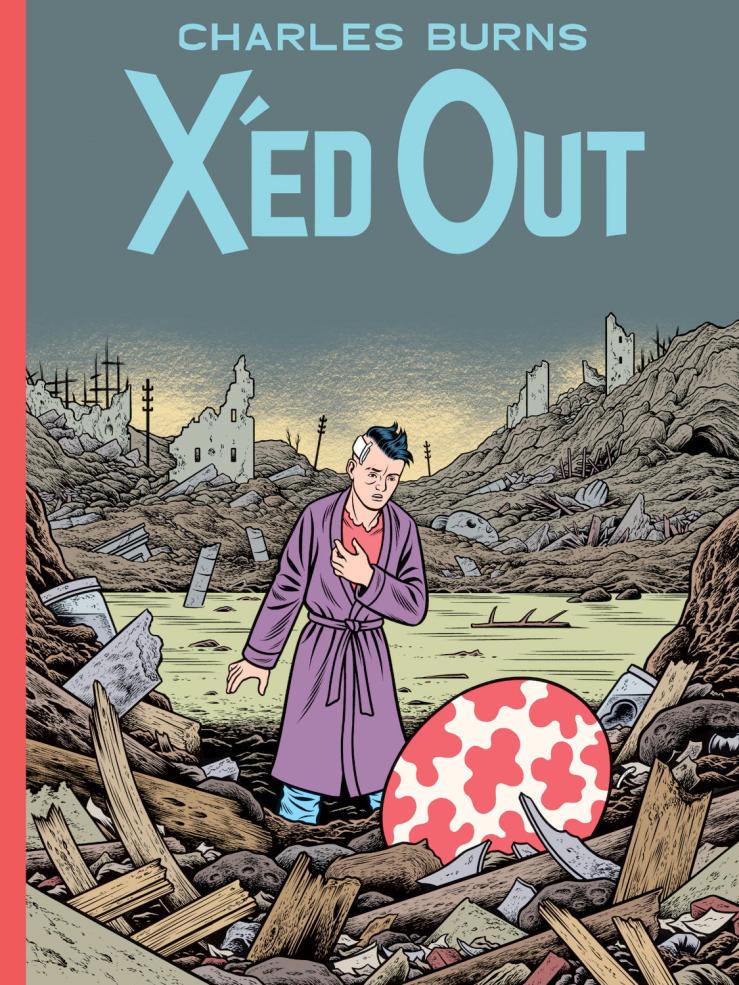
X’ed Out — Charles Burns

If you like Charles Burns, go ahead and pick up X’ed Out, the first (and very promising) entry in a new trilogy. Skip this review. You’ll probably be happier (and more unsettled) just experiencing all that vivid, glorious weirdness for yourself without any potential spoilers. If you need convincing, read on.

X’ed Out begins in a strange fever-dreamland that doesn’t immediately announce itself as such. Instead, we tentatively enter this weird world with Doug, the book’s protagonist, who, like Alice following the white rabbit, chases his (long dead) childhood cat through a crack in the wall. Doug traverses a cavernous, ruinous place, littered with murky detritus and swamped in a strange flood, to finally arrive in a bizarre desert town that approximates William Burroughs’s Interzone. Populated by mean lizards who dress like Mormon slackers and other grubby grotesques, the terrain readily recalls both Tatooine and Asian bazaars. Hapless Doug, still in pajamas, house coat, and slippers — and marked by an as-yet-unexplained head wound — soon finds himself under the guidance of a strange little diapered dwarf, who may or may not have his best interest in mind. The dreamworld unravels as Doug glances an old man — an “oldie,” as the dwarf says — who we will learn later is Doug’s father. An all of a sudden we’re back in the real world, back in waking life.

But no. That’s not right. Not “back” — we were never in the waking world to begin with. Significantly, X’ed Out begins in the Burroughsian dreamworld and then moves to a conscious, concrete reality. Burns’s dreamworld sequences explicitly reference Belgian cartoonist Hergé’s seminal Tintin comics (you can see how X’ed Out’s cover riffs on the Tintin adventure The Shooting Star here). Doug’s dream face is an expressive, stark mask, a naïve, cartoonish contrast to the bizarre nightmare to which it reacts.


from X'ed Out by Charles Burns


Doug — the waking world Doug, the “real” Doug, that is — pulls a similar mask over his more realistically drawn face later in the story when he does his “Burroughs thing” at a slummy art punk party. Alienated from the scenesters who don’t get his cut-up poetry performance, Doug takes up with Sarah, a girl from his photography class with a thing for razor blades and pig hearts. The same night they meet, he loses his girlfriend, and her crazy boyfriend goes to jail for assaulting a cop. They initiate their romance in Patti Smith records, lines of cocaine, and sick Polaroids. Ah, young love.

But all of that is in another kind of dreamworld, the past, a retreat for the “real,” contemporary Doug, who spends his few waking hours cringing in his bathrobe, poring over old photos, and eating the occasional Pop Tart. At night he eats pain pills and goes to Interzone-land, a place that seems as real and solid and valid as his past with Sarah, a past he has apparently lost. Doug bears a huge patch over half his head (significantly x-shaped in his Interzone version), and both this wound as well as the psychic trauma he’s obviously endured (and is enduring) remain unexplained throughout X’ed Out. However, Burns’s often-grisly images hint repeatedly at a past event filled with violence and loss. X’ed Out leaves us in the Interzone, with the dwarf making long-term plans for Tintinized Doug. There’s even talk of establishing residency and employment–it feels like Doug is here to stay (at least in his non-waking hours). X’ed Out ends maddeningly with a girl who visually recalls Sarah being borne by lizard men to a giant hive. The dwarf explains that she is their new queen–and like some insect queen, she is a breeder. Yuck. The ending is the biggest problem with X’ed Out, simply because it leaves one stranded, wanting more weirdness.

In Black Hole, Burns established himself as a master illustrator and a gifted storyteller, using severe black and white contrast to evoke that tale’s terrible pain and pathos. X’ed Out appropriately brings rich, complex color to Burns’s method, and the book’s oversized dimensions showcase the art beautifully. This is a gorgeous book, both attractive and repulsive (much like Freud’s concept of “the uncanny,” which is very much at work in Burns’s plot). Like I said at the top, fans of Burns’s comix likely already know they want to read X’ed Out; weirdos who love Burroughs and Ballard and other great ghastly fiction will also wish to take note. Highly recommended.

X’ed Out is available in hardback from Pantheon on October 19th, 2010.

Blood Meridian Contest Winner Announced

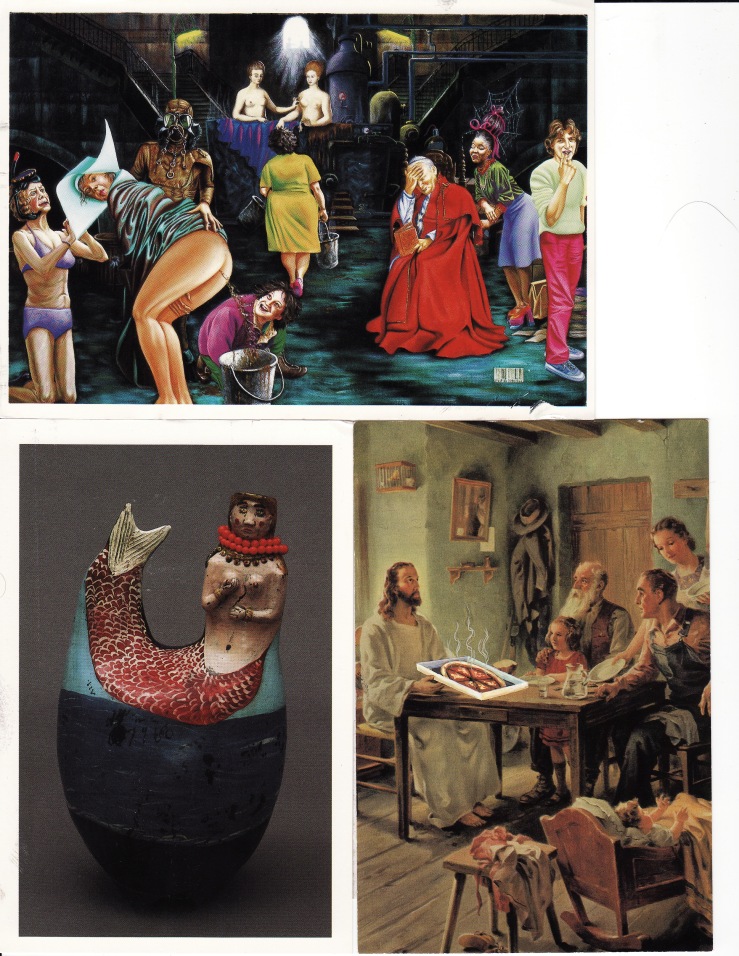
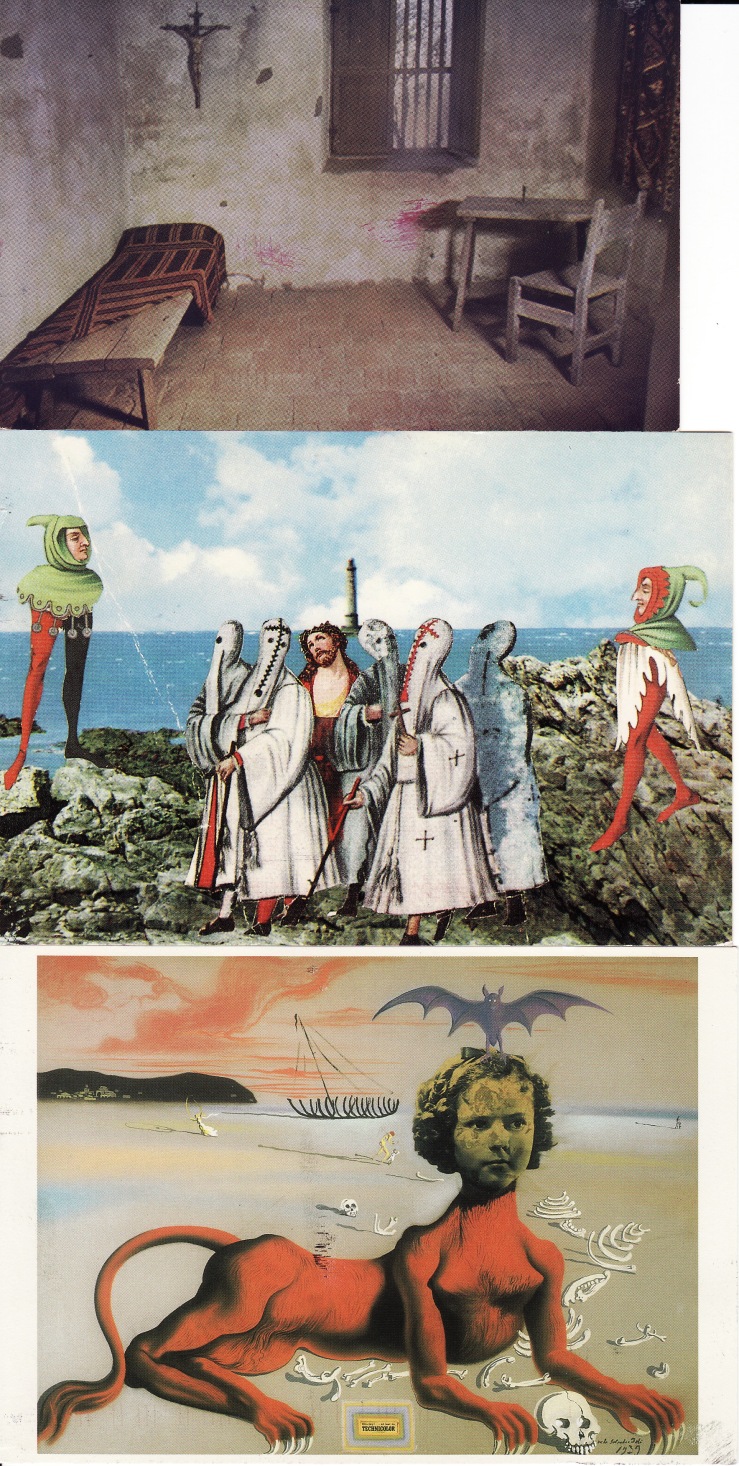
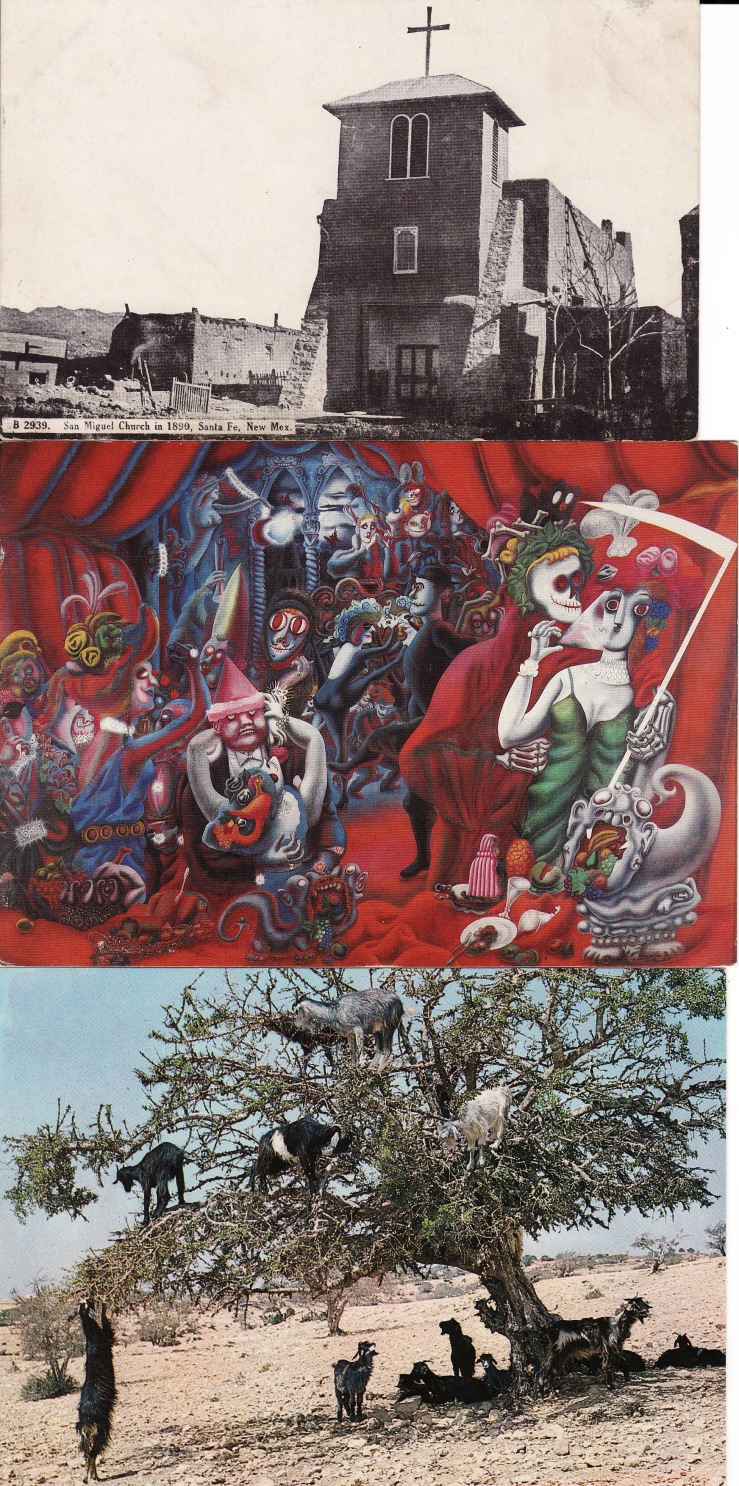
Big congratulations to Michael Cooke, a librarian from Flower Mound, Texas who is the winner of our Blood Meridian contest. Michael will receive a copy of the 25th anniversary hardback edition of Cormac McCarthy’s seminal anti-Western/awesome Western courtesy Biblioklept and Modern Library. Michael had the unfair advantage of being from Texas, and he totally cheated by sending in a baker’s dozen postcards, which was totally awesome. Cheating and being evil is the core of Blood Meridian. Each of Michael’s stark, garish, gritty, surreal, or just plain wicked postcards came with a wonderful corollary quote from the novel. The postcards come from Michael’s personal collection; he’s had some of them for years, and they’re from all over the place, several came from New Mexico, Cormac McCarthy’s chosen home. Here comes the weird–

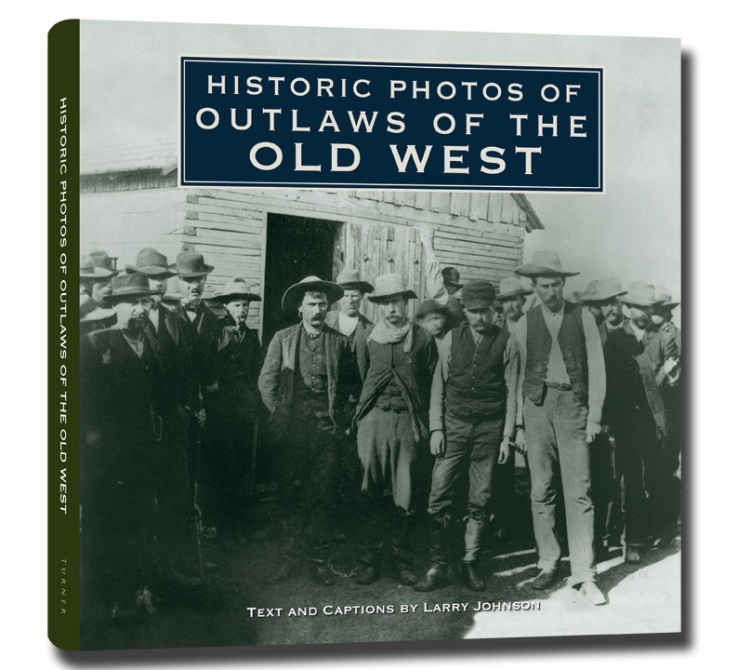
Historic Photos of Outlaws of the Old West

The romantic myth of the Western outlaw still remains central to American identity. If we are part Puritan, we also like to think of ourselves as the kind of anti-social cowboys who go out and manifest our own destiny. It’s no wonder that we have a tradition of valorizing outlaws like Billy the Kid, the Dalton gang, and Frank and Jesse James, transfiguring their bullying and theft into a kind of partisan resistance to hegemony. These men did not steal from the rich to give to the poor, yet we like to pretend that they were Robin Hoods. Turner Publishing’s new collection Historic Photos of Outlaws of the Old West presents 200 archival images of infamous (and not so famous) robbers, road agents, and rascals in the kind of gruesome detail that outlines just how awful these people really were. The Old West isn’t so romantic after all.
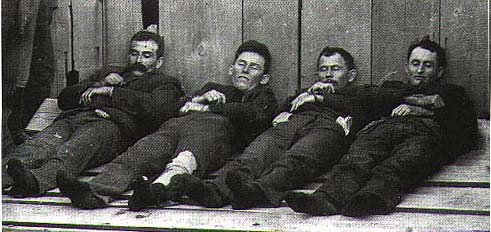
The book moves from the beginning of photography in the early 1850s to the unlikely end of an era, the 193os when the West Coast finally settled down and civilized (at least a little bit). Larry Johnson provides informative and unobtrusive text, letting the stark and often grisly photos convey the tone and emotion of the book. Simply put, this isn’t for kids. There are plenty of dead bodies, many hanging from nooses or laid out in a row, like this charmer of the Dalton gang–

Or how about Ned Christie, unfairly framed for the murder of Deputy Marshal David Maples in 1887, Oklahoma? This picture of Christie reveals that the emerging art/science of photography allowed for a certain fetishizing of the dead body–that the corpse, via mechanical reproduction, might somehow live on. Grisly.

We can see the same fascination with death in this famous image of Jesse James, who was shot in the back by Robert Ford while adjusting a picture. (Their complicated story is told in the brilliant revisionist film The Assassination of Jesse James by the Coward Robert Ford, by the way).

There are less famous but equally intriguing figures as well, like Benjamin Hodges, a black Mexican cowboy who made his living as a con artist in Dodge City. Here is the confident confidence man–

The images in Outlaws of the Old West are both fun and unsettling, and Johnson never glosses over or sugar coats the ugly truths behind these images (he even points out that, though we see the shootout at the OK Corral as a kind of archetypal battle between good vs. evil, the Earps and their pal Doc Holliday were hardly angels). The pictures in this book gel more with the imagery we find in revisionist Westerns like Cormac McCarthy’s Blood Meridian or Sam Peckinpah’s bloody films, which is another way of saying that they aren’t for the faint of heart–and I enjoy that about the volume. Check it out.

Albert Dubout’s Charming Illustrations for Don Quixote

Überblog A Journey Round My Skull has posted (another) fantastic set of illustrations for Don Quixote, this time by French cartoonist and illustrator Albert Dubout. See some of our favorites below, but check out A Journey’s post for more (including a link to all 381 images from the book)–

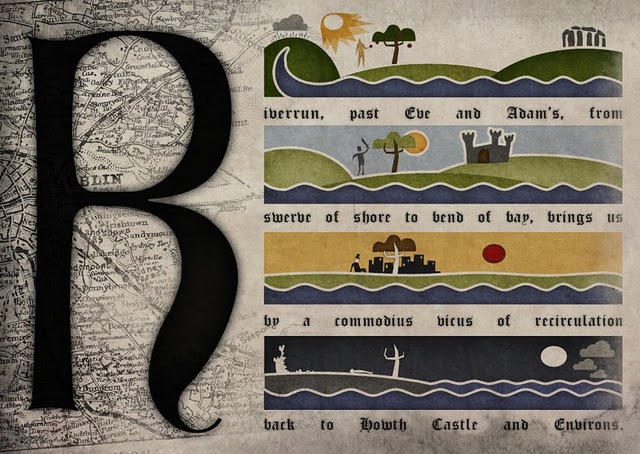
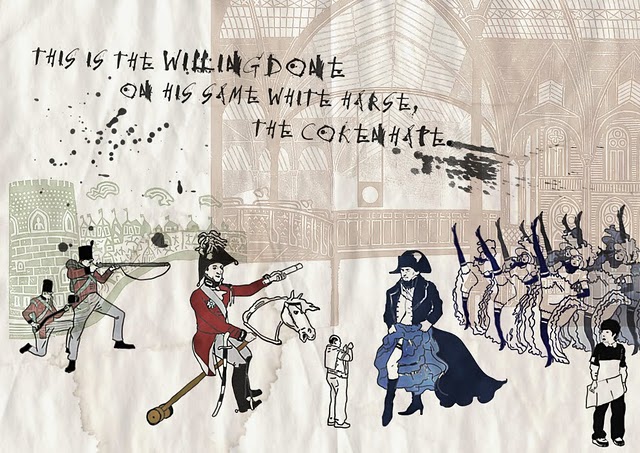
“Riverrun, past Eve and Adam’s” — Stephen Crowe Illustrates Finnegans Wake

First Line - Stephen Crowe

At Wake In Progress, Stephen Crowe has given himself the daunting task of illustrating James Joyce’s novel/linguistic black hole Finnegans Wake. It’s pretty cool stuff, and we love projects like these (see also: Six Versions of Blood Meridian and One Drawing for Every Page of Moby-Dick). Crowe’s site makes an interesting if different companion for the ongoing project at Ulysses “Seen.” Good luck to Stephen–keep them coming! (and thanks to @RhysTranter for sharing). More images–

Page 8 - Stephen Crowe
Page 19 - Stephen Crowe
Page 16 - Stephen Crowe

The Mike Hammer Novels — Mickey Spillane

Online auctions allow book-lovers to engage in what could be labeled “biblio-sharking.”  Some poor sap needs to clear out his basement to make room for a foosball table or a Jacuzzi, and readers take his books for an extraordinary profit. While the seller may hesitate to dispose of their treasures, I’ll readily pay negligible sums to compensate him for his losses.  So, if your rumpus room means more to you than fiction, please please please place your ads on Ebay.

Some poor mug did just that last week, allowing me to take home 18 detective novels for five clams and nominal shipping and handling charges.  Because anthologies were included in the package, I scored twenty-four books for about thirty cents apiece.  Ed Biblioklept, kept busy for weeks at a time supervising hooligans and future delinquents of America, has granted me permission to review one of my purchases, the New American Library’s collection of Mickey Spillane’s first three Mike Hammer novelsI, the Jury, My Gun is Quick, and Vengeance is Mine.

Spillane sold hundreds of millions of detective and spy stories during a long career, and the Hammer stories guaranteed him an interested and rabid following.  Although private dick Mike Hammer finds himself in any number of slippery situations, Spillane’s central character, rather than any individual plot twist, is what makes these stories both convincing and compelling.
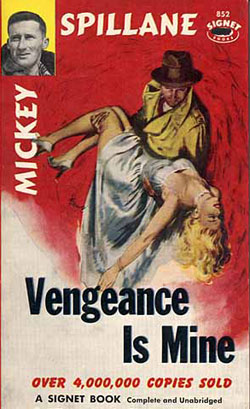
Hammer is the archetypal square-jawed detective, but he demands that you listen to his recollections of a case because he’s clever, resourceful, and vulgar. Although indelicate by today’s standards, Hammer is a tough guy for his times, beguiling dames who are used to getting just what they want, burning through decks of unfiltered Luckies, and drinking brandy for breakfast.  What’s timeless, though, is his belief that bad guys are afforded too many protections by an impotent system of justice and that once all the pieces are put together, one extraordinary man performs a public service by putting a few slugs in the guts of murderers.  In each of these stories Hammer begins unraveling the mysteries only after someone close to him has been killed.

This was the first collection of detective stories I’ve ever finished, and each page dragged me further into a black and white world filled with villains, vixens, and corrupt politicians.  The reader becomes an unpaid extra in a B-level film noir.

Hammer explained to me, a snob, the enduring popularity of the literary detective: “You’ve forgotten that I’ve been in business because I stayed alive longer than some guys who didn’t want me that way.  You’ve forgotten that I’ve had some punks tougher than you’ll ever be on the end of a gun and I pulled the trigger just to watch their expressions change.”  Mind what you think.

Howard Jacobson’s The Finkler Question Wins the Booker Prize

The Guardian and other sources report that Howard Jacobson has won the 2010 Man Booker Prize for his novel The Finkler Question. The novel, which we haven’t read, is apparently a comic piece about love, loss, Jewish identity, and male friendship. The win is perhaps something as an upset, as many folks had Tom McCarthy’s C pegged as the favorite (last week bookmaker Ladbrokes even suspended betting on the Booker after bets on C crowded out the competition). Read our review of C here.

Uncivil Society — Stephen Kotkin

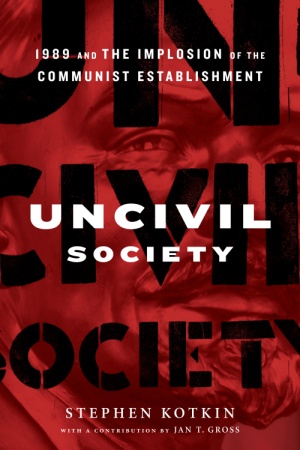
Stephen Kotkin’s Uncivil Society earned rave reviews when it debuted last year in hardback; this week Modern Library releases the trade paperback version. Uncivil Society is a revisionist history that dispels the romantic myth that a “civil society” of dissenting citizens orchestrated the fall of Eastern European Communism (and its symbol, the Berlin Wall). Rather, Kotkin (along with colleague Jan T. Gross) concisely and methodically shows that the Eastern Bloc’s demise resulted from the corruption and incompetence of the ruling class of bureaucrats and ideologues–the “uncivil society” who borrowed massively from the West to buy consumer goods they could not afford. Kotkin finds case studies in East Germany, Romania, and Poland, but his analysis extends beyond these countries to indict the Soviet model.

Kotkin’s writing is direct and precise, stuffed with concrete facts and political analysis without sacrificing narrative integrity. In other words, he takes a murky subject and illuminates it. The narrative proper is slim at under 150 pages, making the book a quick and ideal survey of a widely misunderstood time. Students and politics of history will wish to take note of Uncivil Society, a straightforward and agile read.

“By the Mouth for the Ear” — William Gass on Good Writing

More from The Paris Review’s vaults. In an interview from 1977, William Gass weighs in on the oral/aural aspects of literature–

I think contemporary fiction is divided between those who are still writing performatively and those who are not. Writing for voice, in which you imagine a performance in the auditory sense going on, is traditional and old-fashioned and dying. The new mode is not performative and not auditory. It’s destined for the printed page, and you are really supposed to read it the way they teach you to read in speed-reading. You are supposed to crisscross the page with your eye, getting references and gists; you are supposed to see it flowing on the page, and not sound it in the head. If you do sound it, it is so bad you can hardly proceed. It can’t all have been written by Dreiser, but it sounds like it. Gravity’s Rainbow was written for print, J.R. was written by the mouth for the ear. By the mouth for the ear: that’s the way I’d like to write. I can still admire the other—the way I admire surgeons, bronc busters, and tight ends. As writing, it is that foreign to me.

Three Literary Lists for 10-10-10

You may have noticed (and probably don’t care) that today is October 10, 2010, 0r 10/10/10 (or 10.10.10, or 10-10-10, or whatever iteration you prefer). But some people like lists. So, with very little thought put into the process, here are three literary lists to celebrate 10 Oct. 10–

Ten Ridiculous Character Names

1. Stephen Dedalus (A Portrait of the Artist as a Young Man and Ulysses, James Joyce. Even Stephen ponders how ridiculous and overdetermined his name is)

2. Major Major Major Major (Catch-22, Joseph Heller)

3. Bilbo Baggins (The Hobbit and The Lord of the Rings, J.R.R. Tolkien. Sure, he’s a hobbit, but “Bilbo Baggins” is still pretty much off the silly scale)

4. Brackett Omensetter (Omensetter’s Luck, William Gass)

5. Horselover Fat (VALIS, Philip K. Dick)

6. Milkman Dead (Song of Solomon, Toni Morrison)

7. Humbert Humbert (Lolita, Vladimir Nabokov)

8. Lionel Essrog (Motherless Brooklyn, Jonathan Lethem)

9. Tie:  Wang-Dang Lang/Peter Abbott/Candy Mandible/Judith Prietht/Biff Diggerance (David Foster Wallace suffers from Pynchon-fever in his début novel, Broom of the System)

10. Tie: Benny Profane/Oedipa Maas/Tyrone Slothrop/Zoyd Wheeler/Rev. Wicks Cherrycoke et al. — (Various novels by Thomas Pynchon. Yes, Pynchon should probably get his own list)

Ten Excellent Dystopian/Post-apocalyptic Novels That Aren’t Brave New World or 1984

1. Riddley Walker, Russell Hoban

2. Camp Concentration, Thomas Disch

3. A Clockwork Orange, Anthony Burgess

4. Oryx and Crake and The Year of the Flood, Margaret Atwood

5. The Hospital Ship, Martin Bax

6. Naked Lunch, William S. Burroughs

7. VALIS, Philip K. Dick

8. Ronin, Frank Miller

9. Ape and Essence, Aldous Huxley

10. The Road and Blood Meridian, Cormac McCarthy

Ten Movies Better Than or Equal to the Books On Which They Were Based

1. The Godfather

2. The Shining

3. The Thin Red Line

4. Children of Men

5. Harry Potter and the Prisoner of Azkaban

6. Trainspotting

7. No Country for Old Men

8. The Grapes of Wrath

9. There Will Be Blood

10. Jaws

“David Was A Big Sweater” — The NYT Profiles Karen Green, David Foster Wallace’s Widow

Dear Dr./Bolinas Lagoon -- Karen Green

The New York Times profiles Karen Green, David Foster Wallace’s widow. The article details Green’s new art show Sure Is Quiet at the Space Arts Center and Gallery in South Pasadena,California. The article is worth reading in full, of course (it’s actually quite moving), but here are some of Green’s own words from the piece, on Wallace and her art—

David was a big sweater, and I just remember the sweat marks on his pillow when I changed the cases.

. . .

I wanted to redirect my anger, which is useless and fuels nothing, by invading my own privacy and then covering it up.

. . .

There’s been so much chaotic conversation in my head . . . I’ve been thinking, thinking so much. I wanted to take all the chaotic stuff and make it quiet.

. . .

David could be the great artist in the household, I didn’t care . . . I’ve been accused by academic friends of not having the right dialogue with the art world — not being knowledgeable about what’s cool, what’s desirable out there right now. But I’d rather work at Starbucks and make what I want.

. . .

I kept making art because I didn’t know what else to do, and that’s what I’ve always done . . . I felt everyone else was so much more advanced in the grieving process.

. . .

I really was thinking about language, the power of it . . . The power of David’s work, for example, which meant so much to people. But when you get as sick as he was, everything loses meaning.

. . .

You can be charmed and fooled by language .  .  It doesn’t stop, but it’s never enough.

Angels — Denis Johnson

Angels, Denis Johnson’s 1983 début novel, begins as a small book about not very much and ends as a small book about pretty much everything. Johnson has a keen eye and keener ear for the kinds of marginal characters many of us would rather overlook all together, people who live and sweat and suffer in the most wretched, unglamorous, and anti-heroic vistas of a decayed America. The great achievement of the novel (beyond Johnson’s artful sentences) is in staging redemption for a few–not all, but a few–of its hopeless anti-heroes.

Take Jamie, for instance. Angels opens on this unfortunate young woman as she’s hauling her two young children onto a Greyhound bus. She’s leaving her cheating husband for relatively unknown prospects, lugging her children around like literal and symbolic baggage. Jamie should be sympathetic, but somehow she’s not. She’s someone we’d probably rather not look at, yelling at her kids while she drags on a Kool. Even she knows it. Of two nuns on the bus: “But Jamie could sense that they found her make-up too thick, her pants too tight. They knew she was leaving her husband, and figured she’d turn for a living to whoring. She wanted to tell them what was what, but you can’t talk to a Catholic.” Jamie finds a closer companion, or at least someone equally bored and equally prone to drinking and substance abuse, in Bill Houston. The ex-con, ex-navy man is soon sharing discreet boilermakers with her on the back of the bus, and she makes the first of many bad decisions in deciding to shack up with him over the next few weeks in a series of grim motels.

The bus, the bus stations, the motels, the bars–Johnson details ugly, urgent gritty second-tier cities and crumbling metropolises at the end of the seventies. The effect is simply horrifying. This is a world that you don’t want to be in. Johnson’s evocation never veers into the grotesque, however; he never risks tipping into humor, hyperbole, or distance. The poetic realism of his Pittsburgh or his Chicago is virulent and awful, and as Jamie drunkenly and druggily lurches toward an early trauma, one finds oneself hoping that even if she has to fall, dear God, just let those kids be okay. It’s tempting to accuse Johnson of using the kids to manipulate his audience’s sympathy, but that’s not really the case. Sure, there’ s a manipulation, but it veers toward horror, not sympathy. (And anyway, all good writing manipulates its audience). Johnson’s milieu here is utterly infanticidal and Jamie is part and parcel of the environment: “Jamie could feel the muscles in her leg jerk, she wanted so badly to kick Miranda’s rear end and send her scooting under the wheels, of, for instance, a truck.”

Jamie is of course hardly cognizant of the fact that her treatment of her children is the psychological equivalent of kicking them under a truck. She’s a bad mother, but all of the people in this novel are bad; only some are worse–much worse–than others. Foolishly looking for Bill Houston on the streets of Chicago, she notices that “None of these people they were among now looked at all legitimate.” Jamie is soon conned, drugged, and gang-raped by a brother and his brother-in-law; the sister/wife part of that equation serves as babysitter during the horrific scene.

And oh, that scene. I put the book down. I put the book away. For two weeks. The scene is a red nightmare, the tipping point of Jamie’s sanity, and the founding trauma that the rest of the novel must answer to–a trauma that Bill Houston, specifically, must somehow pay for, redress, or otherwise atone. The rape and its immediate aftermath are hard to stomach, yet for Johnson it’s no mere prop or tasteless gimmick. Rather, the novel’s narrative thrust works to somehow answer to the rape’s existential cruelty, its base meanness, its utter inhumanity. Not that getting there is easy.

Angels shifts direction after the rape, retreating to sun-blazed Arizona, Bill Houston’s boyhood home and home to his mother and two brothers. There’s a shambling reunion, the book’s closest moment of levity, but it’s punctuated and punctured by Jamie’s creeping insanity, alcoholism, and drug addiction. Johnson’s signature humor is desert-dry and rarely shows up to relieve the narrative tension. Jamie hazily evaporates into the background of the book as the Houston brothers, along with a dude named Dwight Snow, plan a bank robbery. Another name for Angels might be Poor People Making Bad Decisions out of Sheer Desperation. Burris, the youngest Houston, has a heroin habit to feed. James Houston is just bored and nihilistic and seems unable to enjoy his wife and child and home. On hearing about the bank robbery plan, Jamie achieves a rare moment of insight: “Rather unexpectedly it occurred to her that her husband Curt, about whom she scarcely ever thought, had been a nice person. These people were not. She knew that she was in a lot of trouble: that whatever she did would be wrong.” And of course, Jamie’s right.

The bank robbery goes wrong–how could it not?–but to write more would risk spoiling much of the tension and pain at the end of Angels. Those who’ve read Jesus’ Son or Tree of Smoke will see the same concern here for redemption, the same struggle, the same suffering. While Jesusian narratives abound in our culture, Johnson is the rare writer who can make his characters’ sacrifices count. These are people. These are humans. And their ugly little misbegotten world is hardly the sort of thing you want to stumble into, let alone engage in, let alone be affected by, let alone be moved by. But Johnson’s characters earn these myriad affections, just as they earn their redemptions. Angels is clearly not for everyone, but fans of Raymond Carver and Russell Banks should make a spot for it on their reading lists (as well as Johnson fans like myself who haven’t gotten there yet). Highly recommended.

Three by Lydia Davis

The massive new volume The Collected Stories of Lydia Davis doesn’t come out until later this month, but you can read the first three stories in the book now at Picador’s website. Read “Story,” “The Fears of Mrs. Orlando,” and “Liminal: The Little Man,” all originally published in Break It Down.