On Philip K. Dick’s novel A Maze of Death

maze

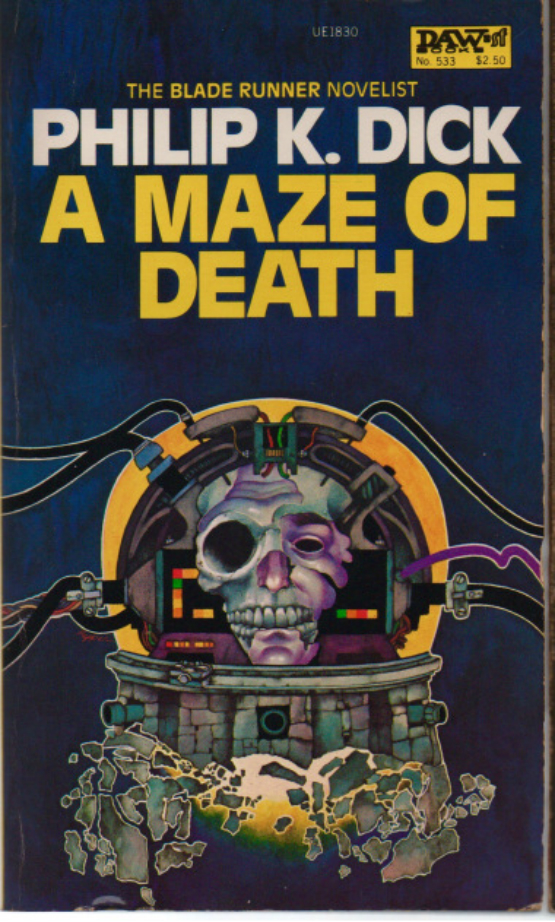
I finished Philip K. Dick’s 1970 novel A Maze of Death this afternoon. The end made me tear up a little, unexpectedly. It’s a sad end, profoundly sad in some ways, and the unexpectedness of the sadness, is, like, particularly sad.

Sad because I didn’t quite expect (hence that adverb unexpectedly) Dick to stick any kind of ending, what, after nearly 200 pages of cardboard characters wandering through a pulp fiction death maze, ventriloquized by the author to perform monologues on consciousness and perception and reality and religion and prayer and faith and afterlife and salvation and so on and so on and so on.

A Maze of Death has some strong moments and strong images—one-way space shuttles, organic 3-D printers, riffs on a deity that would necessarily absorb the concept of a non-deity, a cosmic recapitulation of Odin, space sex, etc.—but on the whole A Maze of Death peters out towards the end, its energy sapped as Dick tires of revolving through (and killing off) the cast of characters (and consciousnesses) he’s assembled in his Haunted (Space) House. The thin allegory he’s patched together crumbles. Or perhaps it was only an allegory assembled for its author’s sad delight. In any case, the whole does not cohere. But no matter.

Too, A Maze of Death suffers perhaps in comparison to its twin, Dick’s bouncier 1969 ensemble satire Ubik. Hell, Ubik probably peters out too, but it’s funnier and sharper. Still: A Maze of Death delivers a strong conclusion, a thesis statement that will resonate with anyone who’s ever envied a machine’s “Off” switch.

But book reviews aren’t supposed to start with endings, right?

What is A Maze of Death about? I mean, that’s what a book review is supposed to do, maybe? Give up some of the plot, the gist, right? The short short answer is Death. (And, like, how does consciousness mediate the ultimate promise of a life-maze that leads to Death, the apparent undoing of consciousness?). But wait, that’s not the plot, that’s like, theme, which is just a way of condensing the plot. This paragraph has gotten us nowhere. I’m going to get up off my ass and walk across the room I’m in to pick up Lawrence Sutin’s 1989 biography of PKD, Divine Invasions and crib from the “Chronological Survey and Guide” at its end. Okay, here, from the entry for Maze:

A group of colonists encounter inexplicable doings—including brutal murders—on the supposedly uninhabited planet Delmark-O. They then learn the truth of Milton’s maxim that the mind creates its own heavens and hells. … In his forward to Maze Phil cites the help of William Sarill in creating the “abstract, logical” religion posed in the novel; Sarill, in interview, says he only listened as Phil spun late-night theories.

—Okay, wait—I promise I’ll return to Sutin’s lucid summary—but Damn, that’s it right there— “Phil spun late-night theories” —much of Maze reads like a late night amphetamine rant about consciousness, man

The plots of Eye [in the Sky]Ubik, and Maze are strikingly similar: A group of individuals find themselves in a perplexing reality state and try to use each other’s individual perceptions (idios kosmos) to make sense of what is happening to them all (koinos kosmos). Only in Eye, written ten years earlier, is the effort successful. In Ubik and Maze, by contrast, individual insight and faith are the only means of piercing the reality puzzle. In Maze, Seth Morley alone escapes the dire fate of his fellow twenty-second-century Delmark-O “colonists” (who are in truth…

—Okay, wait, it looks like Sutin is eager to spoil the ending there—but honestly, the ending that I found so satisfying wasn’t the twist that Sutin goes on to describe in his summary. The ending that Dick gives to his main viewpoint character Seth Morley that I found so moving had nothing to do with plot. Sutin’s line “Morely alone escapes” echoes the actual language of Dick’s novel, which echoes the end of Moby-Dick, where Ishmael alone escapes the wreckage of the Pequod, which in turn echoes the book of Job, where a witness returns from disaster to exclaim, I only am escaped alone to tell thee. This is the core of storytelling, I suppose: witnessing, enduring, and telling again. But Dick’s Morely wants an out, an off switch, a way to break the circuit, to escape the maze. The end of the novel—am I spoiling, after I cut Sutin off for fear of spoiling? Very well, I spoil—the end of the novel posits storytelling as a kind of survival mechanism against the backdrop of the existential horror of endless and apparently meaningless space. And yet the hero Morely still wants out of the story, and Dick lets him out. Out into non-story, out into a kind of plant-like existence—life without consciousness, life without a story.

But what’s the story the others, the rest of the maze’s ensemble, create?—

There is a quaternity of gods in Maze—an admixture of Gnosticism, neo-Platonism, and Christianity; the Mentafacturer, who creates (God); the Intercessor, who through sacrifice lifts the Curse on creation (Christ); the Walker-on-Earth, who gives solace (Holy Spirit); and the Form Destroyer, whose distance from the divine spurs entropy (Satan/Archon/Demiurge)/ The tench, an old inhabitant of Delmark-O, is Phil’s “cypher” for Christ.

The “tench” is originally introduced as a kind of 3-D printer thing and I didn’t read it as a Christ figure at all, but what the hell do I know. In fact, I took the name (and figuration) to be a composite of the tensions between the characters—the allegorical forces at work in Dick’s muddy made-up late-night religion.

Anyway, I suppose you get some of the flavor of the novel there, dear reader—a mishmash of metaphysical mumbo jumbo, filtered through touches (and tenches) of space opera and good old fashioned haunted housery. A Maze of Death is a messy space horror that threatens to leave its readers unsatisfied right up until the final moments wherein it rings its sad coda, a reverberation that nullifies all its previous twists and turns in a soothing wash of emptiness. Not the best starting place for PKD, but I’m very glad I read it.

Almost no memory | A review of Kazuo Ishiguro’s The Buried Giant

In Kazuo Ishiguro’s 2015 novel The Buried Giant, a metaphysical mist engulfs sixth-century Britain, clouding the memories of all who inhabit the land. Saxons and Britons alike cannot recall their bellicose past. Against this mist, elderly Britons Axl and Beatrice seek their long-lost son. They meet a Saxon warrior who hunts an ancient she-dragon he’s vowed to slay. He’s aided by a youth, Edwin, who’s been exiled from his village after being bitten by a mythic creature. King Arthur’s aged nephew Sir Gawain lingers as a courtly protector, a figure from an already-bygone era; the mist seems to slowly rot his brain and his conscience, pushing him into paranoia and madness. There are Charonic ferrymen and awful ogres; there are mad monks and terrible pixies. A hellhound, a dragon, a poisoned goat. Rivers and mountains and crypts and villages. But most of all that mist.

Charon, Joachim Patinir

Ishiguro makes the reader experience that mist. He obscures. The action that occurs—and yes, there’s action here, measured action (often measured in a literal sense)—the action that occurs in The Buried Giant is almost always oblique, shadowed, indistinct, but also very mechanical. The memory-mist renders the world treacherous, immediate, a dark, vague place that offers its travelers no purchase of reference. Deceptive.

Forgive me for quoting at such length, but I think a longish passage here shows how and what Ishiguro is doing. Almost all of our principals are here, underground—note their procession, their movement—a constant motif in the novel, movement, single file or side by side—and the presence of a light, illumination—also a motif. Note the variety of interpretations of not knowingnot seeing, note the simple horror:

They went on into the tunnel, Sir Gawain leading, Axl following with the flame, Beatrice holding his arm from behind, and Edwin now at the rear. There was no option but to go in single file, the passage remaining narrow, and the ceiling of dangling moss and sinewy roots grew lower and lower until even Beatrice had to stoop. Axl did his best to hold the candle high, but the breeze in the tunnel was now stronger, and he was often obliged to lower it and cover the flame with his other hand. Sir Gawain though never complained, and his shape going before them, sword raised over his shoulder, seemed never to vary. Then Beatrice let out an exclamation and tugged Axl’s arm.

“What is it, princess?”

“Oh, Axl, stop! My foot touched something then, but your candle moved too quickly.”

“What of it, princess? We have to move on.”

“Axl, I thought it a child! My foot touched it and I saw it before your light passed. Oh, I believe it’s a small child long dead!”

“There, princess, don’t distress yourself. Where was it you saw it?”

“Come, come, friends,” Sir Gawain said from the dark. “Many things in this place are best left unseen.”

Beatrice seemed not to hear the knight. “It was over here, Axl. Bring the flame this way. Down there, Axl, shine it down there, though I dread to see its poor face again!”

Despite his counsel, Sir Gawain had doubled back, and Edwin too was now at Beatrice’s side. Axl crouched forward and moved the candle here and there, revealing damp earth, tree roots and stones. Then the flame illuminated a large bat lying on its back as though peacefully asleep, wings stretched right out. Its fur looked wet and sticky. The pig-like face was hairless, and little puddles had formed in the cavities of the outspread wings. The creature might indeed have been sleeping but for what was on the front of its torso. As Axl brought the flame even closer, they all stared at the circular hole extending from just below the bat’s breast down to its belly, taking in parts of the ribcage to either side. The wound was peculiarly clean, as though someone had taken a bite from a crisp apple.

“What could have done work like this?” Axl asked.

He must have moved the candle too swiftly, for at that moment the flame guttered and went out.

Ishiguro gives us mystery, interpretation, and then an incomplete, ambiguous revelation. (This is the basic structure of the novel). Beatrice never relents in her belief that she’s stumbled over a dead child. Brimming with lost children and lost parents and orphans, The Buried Giant is a novel of erasures. But an erasure leaves a trace, a violent, visceral marking into the page’s blankness. Revelation through absence.

We would have no plot, not really, without some overcoming of blankness, and Axl in particular overcomes the mist in his quest. A backstory fleshes out, in watery strokes albeit. The Buried Giant, as far as fantasy epics go, is awfully indistinct. Or rather, Ishiguro offers only mechanical and immediate glimpses into this world, a Britain on the cusp of the Middle Ages. Through Axl’s consciousness (and conscience), we see the vital precision in hand-to-hand combat, for example. Its patience, its slowness, its dependence on muscle memory. Or perhaps (dare I say) more boringly, we feel the very real peril involved in walking in the wild dark as an elderly person. The thrills in The Buried Giant come not from its sword and sorcery costumes, but from its Kafkaesque edges and gaps. This is a novel about not knowing.

And it’s here that The Buried Giant is most successful—as an evocation of not knowing. Axl and Beatrice’s quest unfolds as a series of choices and consequences severed, for the most part, from the anchor of memory. There’s an episodic vibe to the novel, a sense that it’s making itself up as it goes along. (It’s not). The novel strongly reminded me of some of the old RPGs I’d play on a Commodore 64 as a kid. The graphics weren’t great and I had to use my imagination a lot. The games were sometimes frustrating and slow. But perhaps you want a more, uh, literary comparison? Something more recent too? The Buried Giant recalls Ishiguro’s short story “A Village after Dark” a lot more than, say, A Game of Thrones or The Lord of the Rings. It’s a fantasy novel, but one that feels etiolated, its vivid colors drained. More Gustave Doré than Gustave Moreau.

While a precise indistinctness (forgive the oxymoron) is part of The Buried Giant’s program, there’s nothing indistinct about its heroes’ love for each other. Axl and Beatrice, A & B—can I say I came to love them? Or if I didn’t quite love them, I was rooting for them, say? Rooting for their survival, but specifically their survival as a they, a shared survival. Ishiguro successfully communicates their intimacy, their romance, their love, a love threatened by both the natural world and the supernatural return of lost memory. Their relationship is the heart of the novel upon which Ishiguro fixes his themes of memory, justice, vengeance, and love. Ishiguro’s commentary on those themes ultimately may feel pessimistic to many readers, particularly in the novel’s conclusion.

Excepting the ones that we love and return to and obsess over, we retain little of the novels that we read. What memories remain are kernels—the outline of a plot, a strange lingering phrase or detail, a bright or bold character, a theme, an idea, an image. It’s the love between Axl and Beatrice that I’ll likely recall most strongly from the shadows of The Buried Giant. If we can’t remember, we can at least experience.

[Editorial note: Biblioklept originally published this review in October, 2015],

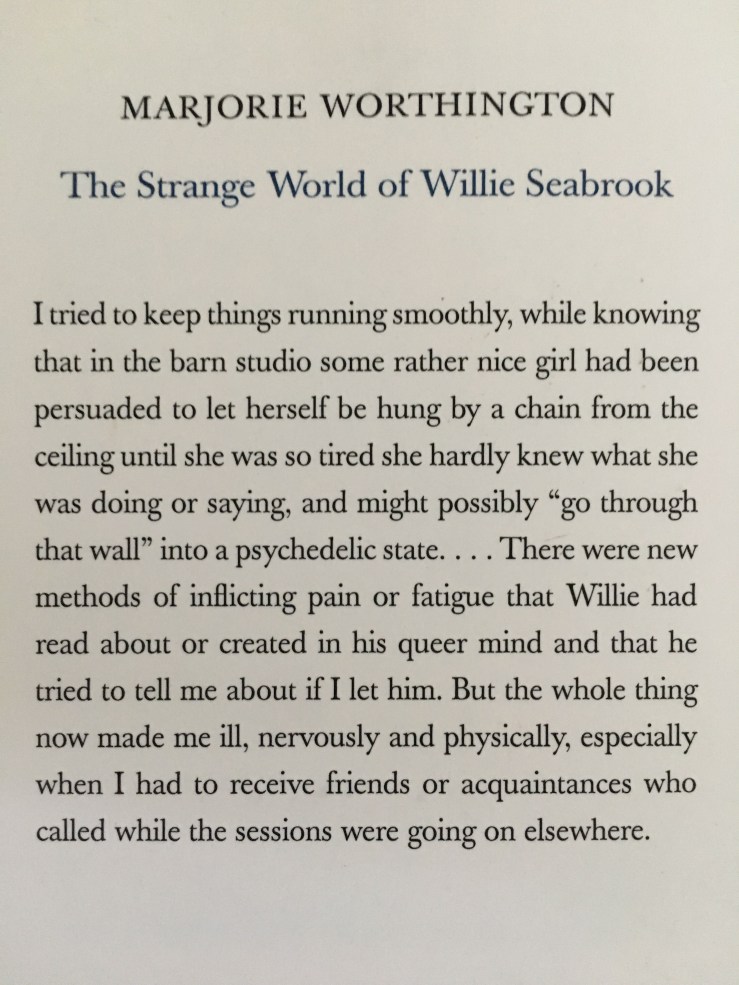
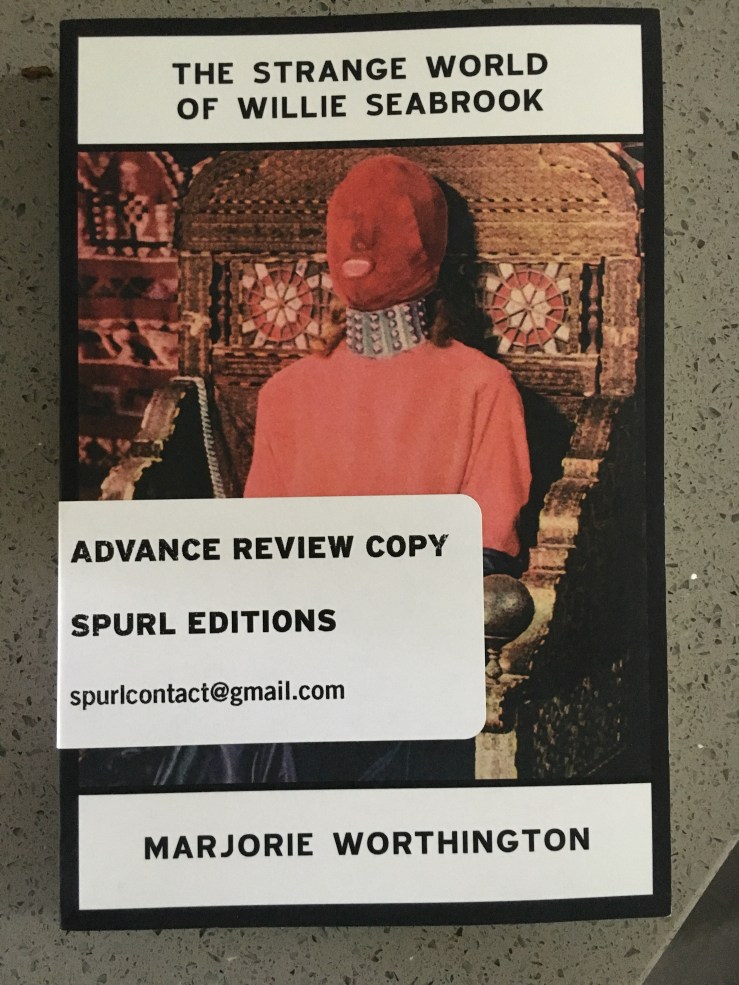
Marjorie Worthington’s The Strange World of Willie Seabrook (Book acquired 26 Sept. 2017)

Marjorie Muir Worthington’s 1966 memoir about her relationship with occultist and fellow Lost Generation weirdo William Seabrook is forthcoming in a new edition from indie Spurl. It looks fascinating. Their blurb:

This is the somber, quietly stunning account of American author Marjorie Worthington’s life and relationship with William Seabrook.

A bestselling writer on the exotic and the occult, Seabrook was an extraordinary figure from the 1920s to the 1940s who traveled widely and introduced voodoo and the concept of the “zombie” to Americans in his book The Magic Island.

In 1966, years after his death from suicide, Worthington, a novelist and Seabrook’s second wife, cast her eye on their years living in France as lost-generation expatriates; their time traveling in the Sahara desert (where Seabrook researched his book The White Monk of Timbuctoo); their friendships with Aldous Huxley, Gertrude Stein, and Michel Leiris; and the gradual erosion of their relationship.

Worthington was with Seabrook in France and later New York when his life became consumed by alcohol, and he took the drastic step of committing himself to a mental institution for a cure; though he wrote about the institution in his book Asylum, he remained an alcoholic. He was also fixated by sadistic games he played with women, which he and the surrealist Man Ray photographed, and which he later viewed as a way to initiate altered psychological states through pain.

The Strange World of Willie Seabrook is an intimate look at the complicated, torturous relationship of two writers. Seabrook was a sadist, yet to Worthington he was also enthralling; he was an alcoholic, but she believed she could protect him. Even after he had hurt her emotionally, she stayed near him. In brilliantly depicted moments of folie à deux, we watch Worthington join Seabrook in his decline, and witness the shared claustrophobic, psychological breakdown that ensues.

Brown and the Farrier | A menacingly comic vignette from Cormac McCarthy’s Blood Meridian

A self-contained episode from late in Cormac McCarthy’s Blood Meridian; this little vignette captures the book’s strange mix of menace and humor:

Noon he was red-eyed and reeking before the alcalde’s door demanding the release of his companions. The alcalde vacated out the back of the premises and shortly there arrived an American corporal and two soldiers who warned him away. An hour later he was at the farriery. Standing warily in the doorway peering into the gloom until he could make out the shape of things within.

The farrier was at his bench and Brown entered and laid before him a polished mahogany case with a brass nameplatebradded to the lid. He unsnapped the catches and opened the case and raised from their recess within a pair of shotgun barrels and he took up the stock with the other hand. He hooked the barrels into the patent breech and stood the shotgun on the bench and pushed the fitted pin home to secure the forearm. He cocked the hammers with his thumbs and let them fall again. The shotgun was English made and had damascus barrels and engraved locks and the stock was burl mahogany. He looked up. The farrier was watching him.

You work on guns? said Brown.

I do some.

I need these barrels cut down.

The man took the gun and held it in his hands. There was a raised center rib between the barrels and inlaid in gold the maker’s name, London. There were two platinum bands in the patent breech and the locks and the hammers were chased with scrollwork cut deeply in the steel and there were partridges engraved at either end of the maker’s name there. The purple barrels were welded up from triple skelps and the hammered iron and steel bore a watered figure like the markings of some alien and antique serpent, rare and beautiful and lethal, and the wood was figured with a deep red feather grain at the butt and held a small springloaded silver capbox in the toe.

The farrier turned the gun in his hands and looked at Brown. He looked down at the case. It was lined with green baize and there were little fitted compartments that held a wadcutter, a pewter powderflask, cleaning jags, a patent pewter capper.

You need what? he said.

Cut the barrels down. Long about in here. He held a finger across the piece.

I cant do that.

Brown looked at him. You cant do it?

No sir. He looked around the shop. Well, he said. I’d of thought any damn fool could saw the barrels off a shotgun.

There’s something wrong with you. Why would anybody want to cut the barrels off a gun like this?

What did you say? said Brown.

The man tendered the gun nervously. I just meant that I dont see why anybody would want to ruin a good gun like this here. What would you take for it?

It aint for sale. You think there’s something wrong with me?

No I dont. I didnt mean it that way.

Are you goin to cut them barrels down or aint ye?

I cant do that.

Cant or wont?

You pick the one that best suits you.

Brown took the shotgun and laid it on the bench. What would you have to have to do it? he said.

I aint doin it.

If a man wanted it done what would be a fair price?

I dont know. A dollar.

Brown reached into his pocket and came up with a handful of coins. He laid a two and a half dollar gold piece on the bench. Now, he said. I’m payin you two and a half dollars.

The farrier looked at the coin nervously. I dont need your money, he said. You cant pay me to butcher that there gun.

You done been paid.

No I aint.

Yonder it lays. Now you can either get to sawin or you can default. In the case of which I aim to take it out of your ass.

The farrier didnt take his eyes off Brown. He began to back away from the bench and then he turned and ran.

When the sergeant of the guard arrived Brown had the shotgun chucked up in the benchvise and was working at the barrels with a hacksaw. The sergeant walked around to where he could see his face. What do you want, said Brown.

This man says you threatened his life.

What man?

This man. The sergeant nodded toward the door of the shed.

Brown continued to saw. You call that a man? he said.

I never give him no leave to come in here and use my tools neither, said the farrier.

How about it? said the sergeant.

How about what?

How do you answer to this man’s charges?

He’s a liar.

You never threatened him?

That’s right.

The hell he never.

I dont threaten people. I told him I’d whip his ass and that’s as good as notarized.

You dont call that a threat?

Brown looked up. It was not no threat. It was a promise. He bent to the work again and another few passes with the saw and the barrels dropped to the dirt. He laid down the saw and backed off the jaws of the vise and lifted out the shotgun and unpinned the barrels from the stock and fitted the pieces into the case and shut the lid and latched it.

What was the argument about? said the sergeant.

Wasnt no argument that I know of.

You better ask him where he got that gun he’s just ruined. He’s stole that somewheres, you can wager on it.

Where’d you get the shotgun? said the sergeant.

Brown bent down and picked up the severed barrels. They were about eighteen inches long and he had them by the small end. He came around the bench and walked past the sergeant. He put the guncase under his arm. At the door he turned. The farrier was nowhere in sight. He looked at the sergeant.

I believe that man has done withdrawed his charges, he said. Like as not he was drunk.


The Radiance of Attention — Luc Tuymans

the-radiance-of-attention

The Radiance of Attention by Luc Tuymans (b. 1958)

The Hobbit reconsidered as a picaresque novel

Making a weekend trip from the east coast of Florida to its Gulf shores, my family and I listened to Nicol Williamson’s early 1970s recording of J.R.R. Tolkien’s The Hobbit. Williamson’s recording is rich and expressive, his command of each voice bringing Tolkien’s characters to life.

I first heard Williamson’s recording over twenty years ago on a series of LPs that I checked out from the library. I had probably already read The Hobbit half a dozen times by then, but Williamson’s sonorous voice—along with the music and audio production effects—added another layer to Middle Earth.

My daughter, five, already familiar with the 1977 Rankin-Bass film, had no problem keeping pace with the story (although she occasionally asked me to pause for clarification on a few finer points, such as the delicate distinctions between goblins and trolls, or just who exactly is this guy Bard who shows up all of a sudden?) My favorite part of the entire weekend was my two year old imitating Gollum, sniveling a sinister, “My precious!” while squinting gleefully.

There are few books I’ve read as many times as Tolkien’s The Lord of the Rings trilogy: I read it countless times between the ages of 11 and 15, read it again as an undergrad, then read it again–twice, I’m not ashamed to admit—when Peter Jackson’s adaptations came out. However, despite reading The Hobbit repeatedly as a kid, I’ve never really gone back to it. It traffics in a gentle folklore that seems out of square with the epic mythmaking in The Lord of the Rings, and I think that I was always unsettled by a certain discontinuity between the two books that was easier to ignore if I never went back to The Hobbit.

Memory has a way of eliding details, and books are especially susceptible to this wearing down and smoothing out. So, I remembered The Hobbit as a quest, a miniature epic with Bilbo Baggins leaving the comforts of home to find treasure guarded by the dragon Smaug. I remembered Gandalf and the thirteen dwarves invading Bilbo’s tidy hobbit hole; I remembered trolls who turn to stone; I remembered riddles with Gollum and a ring that turns its wearer invisible; I remembered Mirkwood and barrels and the mountain lair of a dragon. I vaguely remembered the Battle of Five Armies, where the enormous eagles literally swoop in and save the day, deus ex machina style.

Listening to the unabridged audio, I was struck by just how much had escaped my memory: I barely recalled the spiders of Mirkwood or the talking ravens or the part where the wargs tree the dwarves. I had completely forgotten the shapeshifter Beorn, a creature straight out of Scandinavian myth.

One of Tolkien’s original illustrations for The Hobbit

What I found most strange in revisiting The Hobbit though was its radical compression, its tendency and willingness to pivot sharply, to cast its characters about or trample them under (metaphorical and sometimes literal) foot, or throw them in dungeons or barrels or some other danger.

Whereas The Lord of the Rings progresses from the folkloric feel of The Shire through to the high-adventure sweep of Icelandic saga and ultimately to a King Jamesish condensation of near-pure archetypery (and back again, of course), The Hobbit showcases a rambling, flowing, discursive, “out of the frying pan, into the fire” rhythm.

In short, The Hobbit, as it turns out, is a picaresque novel.

And just what is a picaresque novel, and why is The Hobbit one?, you may or may not ask.

Michael Seidel offers a clear definition in his introduction to Daniel Defoe’s Moll Flanders (an excellent picaresque, by the way):

. . . the tradition of Continental picaresque, or rogue, literature . . .  became popular throughout Europe with the publication of Lazarillo de Tormes (1554) in Spain. Picarós and picarás are orphans, vagabonds, desperadoes, and reprobates trying to manipulate the conventions of a world largely determined by established family and class connections. . . . Picaresque fiction is the story of outsiders trying to get in, and the fortunes of the protagonist often depend on adaptable, protean, and duplicitous behavior as picaresque characters become who they need to be to survive.

The Hobbit is very much the story of the topsy-turvy turns of Bilbo Baggins’s identity. At the adventure’s outset, he’s a respectable—comfortable—Baggins of Bag End. Not the sort of fellow who goes on adventures. And yet he’s enlisted by Gandalf to serve as burglar for the expedition, a picaró in the making who steals a purse from a troll and never looks back.

It’s not just Bilbo’s various thefts, but also his “adaptable, protean, and duplicitous behavior” that marks him as a picaró. His scheming is evident repeatedly in the novel, whether he’s riddling with Gollum or Smaug, devising a breakout from the Elf King of Mirkwood’s dungeon, or playing the long con against the parties involved in the Battle of Five Armies. He echoes Gandalf in this way, whose talents seem to veer more toward trickery and cunning than dazzling spells or marvelous magic.

Bilbo’s picaresque turns of fortune and turns of identity are neatly summarized in a late exchange with yon dragon Smaug, who immediately calls him out as a picaró:

“You have nice manners for a thief and a liar,” said the dragon. “You seem familiar with my name, but I don’t seem to remember smelling you before. Who are you and where do you come from, may I ask?”

“You may indeed! I come from under the hill, and under hills and over the hills my paths led. And through the air, I am he that walks unseen.”

“So I can well believe,” said Smaug, “but that is hardly our usual name.”

“I am the clue-finder, the web-cutter, the stinging fly. I am chosen for the lucky number.”

“Lovely titles!” sneered the dragon. “But lucky numbers don’t always come off.”

“I am he that buries his friends alive and drowns them and draws them alive again from the water. I came from the end of a bag, but no bag went over me.”

“These don’t sound so creditable,” scoffed Smaug.

“I am the friend of bears and the guest of eagles. I am Ringwinner and Luckwearer; and I am Barrel-rider,” went on Bilbo beginning to be pleased with his riddling.

“That’s better!” said Smaug. “But don’t let your imagination run away with you!”

But imagination is of course the primary tool of the picaró, and Bilbo is no slouch: The Hobbit condemns evil, greedy Smaug when it shows the rewards of letting “your imagination run away with you.” Indeed, the entire novel is a running away, a constant deflection of stable identity, as Bilbo twists and turns his way back to The Shire.

And what happens to Bilbo? What happens to that once-stable, once-comfortable identity? We learn at the novel’s end about the queering of his identity—

. . . he had lost his reputation. It is true that for ever after he remained an elf-friend, and had the honour of dwarves, wizards, and all such folk as ever passed that way; but he was no longer quite respectable. He was in fact held by all the hobbits of the neighbourhood to be ‘queer’—except by his nephews and nieces on the Took side, but even they were not encouraged in their friendship by their elders. I am sorry to say he did not mind.

So! Queer, strange Baggins the  picaró embraces his “Took side,” his disreputable adventuring side. And still the narrative comes to a lovely cozy warm respectable ending, Bilbo’s identity transformed, sullied, illuminated, and enlarged by his picaresque adventure.

And the picaresque? Well, maybe I’ve stretched its definition a bit simply because I’m so fond of picaresque narratives these days. Maybe I’ve simply revisited a childhood classic and imposed a new viewpoint upon it. (And maybe years and years from now I’ll revisit it again with grandchildren, and find something new and different there as well. I hope).

I think what I enjoyed most about The Hobbit this time was hearing the rambling discursiveness of it all—here we have a narrative that understands the perilous and precarious position of the storyteller, he or she who might lose the thread—or worse, lose the audience!—at any damn time. So keep the story sailing, shifting, rambling out into new moods, modes, movements.

Seidel gives us a lovely definition of picaresque above, but can’t do better than Ralph Ellison who, in describing his modernist classic Invisible Man, offers us a description of the picaresque as “one of those pieces of writing which consists mainly of one damned thing after another sheerly happening.”

And this is the power of The Hobbit—which is to say the staying power of The Hobbit—its ability to evoke the imaginative force of one damned thing after another sheerly happening for generation after generation.

[Editorial note: Biblioklept originally published this review in October of 2012. I’m rerunning it today in honor of The Hobbit’s 80th anniversary. My daughter is five years older, and has since read the book on her own. She loves it.]

Campbell, Dahl, Dick, Zelazny (Books acquired, 18 Sept. 2017)

dkca5zzxcaupkfj

I returned to classes on Monday after 10 humid, uncomfortable, and often scary days “off” due to Hurricane Irma. In the slim hour and change between my last lecture and my kids’ school dismissal, I swung by my favorite used bookshop. I was worried that it might have flooded, but the waters didn’t get to the inventory (well over a million books).

I picked up a a PKD Daw edition, a mass market paperback, Deus Irae, co-authored with Roger Zelazny. I’ve been picking up pretty much any early PKD mass market ppbk; new editions of his stuff tend to be pretty boring. I had to pick between two editions:

dkbor9ovoaaprkg

I also picked up Eddie Campbell’s Alec: How to Be an Artist, which I gobbled up the other day in two sittings. There’s a pretty neat canon of graphic novels at the end, which I’ll share later this week. The cover looks like an illustration of Roberto Bolaño to me.

I also picked up two Roald Dahl books we didn’t have, Esio Trot and Danny the Champion of the World, which my kids read immediately and greedily.

The shock of dysrecognition | Philip K. Dick defines science fiction

I will define science fiction, first, by saying what sf is not.  It cannot be defined as “a story (or novel or play) set in the future,” since there exists such a thing as space adventure, which is set in the future but is not sf: it is just that: adventures, fights and wars in the future in space involving super-advanced technology. Why, then, is it not science fiction? It would seem to be, and Doris Lessing (e.g.) supposes that it is. However, space adventure lacks the distinct new idea  that is the essential ingredient. Also, there can be science fiction set in the present: the alternate world story or novel. So if we separate sf from the future and also from ultra-advanced technology, what then do we have that can  be called sf?

We have a fictitious world; that is the first step: it is a society that does not in fact exist, but is predicated on our known society; that is, our known society acts as a jumping-off point for it; the society advances out of our own in some way, perhaps orthogonally, as with the alternate world story or novel. It is our world dislocated by some kind of mental effort on the part of the author, our world transformed into that which it is not or not yet. This world must differ from the given in at least one way, and this one way must be sufficient to give rise to events that could not occur in our society—or in any known society present or past. There must be a coherent idea involved in this dislocation; that is, the dislocation must be a conceptual one, not merely a trivial or bizarre one—this  is the essence of science fiction, the conceptual dislocation within the society so that as a result a new society is generated in the author’s mind, transferred to paper, and from paper it occurs as a convulsive shock in the reader’s mind, the shock of dysrecognition.  He knows that it is not his actual world that he is reading about.

Now, to separate science fiction from fantasy. This is impossible to do, and a moment’s thought will show why. Take psionics; take mutants such as we find in Ted Sturgeon’s wonderful MORE THAN HUMAN.  If the reader believes that such mutants could exist, then he will view Sturgeon’s novel as science fiction. If, however, he believes that such mutants are, like wizards and dragons, not possible, nor will ever be possible, then he is reading a fantasy novel. Fantasy involves that which general opinion regards as impossible; science fiction involves that which general opinion regards as possible under the right circumstances. This is in essence a judgment-call, since what is possible and what is not possible is not objectively known but is, rather, a subjective belief on the part of the author and of the reader.

Now to define good  science fiction. The conceptual dislocation—the new idea, in other words—must be truly new (or a new variation on an old one) and it must be intellectually stimulating to the reader; it must invade his mind and wake it up to the possibility of something he had not up to then thought of. Thus “good science fiction” is a value term, not an objective thing, and yet, I think, there really is such a thing, objectively, as good science fiction.

I think Dr. Willis McNelly at the California State University at Fullerton put it best when he said that the true protagonist of an sf story or novel is an idea and not a person. If it is good  sf the idea is new, it is stimulating, and, probably most important of all, it sets off a chain-reaction of ramification-ideas in the mind of the reader; it so-to-speak unlocks the reader’s mind so that that mind, like the author’s, begins to create. Thus sf is creative and it inspires creativity, which mainstream fiction by-and-large does not do. We who read sf (I am speaking as a reader now, not a writer) read it because we love to experience this chain-reaction of ideas being set off in our minds by something we read, something with a new idea in it; hence the very best science fiction ultimately winds up being a collaboration between author and reader, in which both create—and enjoy  doing it: joy is the essential and final ingredient of science fiction, the joy of discovery of newness.

(in a letter) May 14,1981

From a letter by Philip K. Dick, used as the preface to The Collected Stories of Philip K. Dick, Vol. 1.

(Probably not) All of the similes in Blood Meridian

It was like…

like a wild animal

ribs like fishbones

like thin red leeches

they drank like dogs

It was like a sermon

true as a spirit level

like a string in a maze

He was bald as a stone

like rival bands of apes

silently as a bird alighting

mute as a tailor’s dummy

men or creatures like them

they buried their stool like cats

like effigies for to frighten birds

Yonder sun is like the eye of God

They rode either side like escorts

dark falls here like a thunderclap

The men looked like mud effigies.

like an army asleep on the march

their chins in the sand like lizards

like some naked species of lemur

something like a pound of powder

like a man beset with bees or madness

black waters all alight like cities adrift

like beings for whom the sun hungered

great steady suck­ing sounds like a cow

fingers spiderlike among the bolls of cotton

the fires on the plain faded like an evil dream

abdomens like the tracks of gigantic millipedes

leather wings like dark satanic hummingbirds

us behind him like the disciples of a new faith

he come along and raised me up like Lazarus.

jerking and lurching like a deputation of spastics

holding the coins cupped in her hands like a bird

the mules clambering along the ledges like goats

they labored on sideways over the sand like crabs

shambling past the fires like a balden groundsloth

whores call to him from the dark like souls in want

Men whose speech sounds like the grunting of apes

A hardlooking woman with a wiry body like a man’s.

They were shambling along the road like dumb things

our mother the earth as he said was round like an egg

The watchers looked like forms excavated from a bog.

is voice passed from him like a gift that was also needed

the old man sitting in the shrubbery soli­tary as a gnome

the parasol dipping in the wind like a great black flower

in his sleep he struggled and muttered like a dreaming dog

dragging themselves across the lot like seals or other things

an old anchorite nested away in the sod like a groundsloth

blackened and shriveled in the mud like an enormous spider

the kid behind him on the mule like something he’d captured

he had codified his threats to the one word kill like a crazed chant

the squatting houses were made of hides ranged like curious dorys

little cloven hoof-prints in the stone clever as a little doe in her going

a watered figure like the markings of some alien and antique serpent

The shadows of the smallest stones lay like pencil lines across the sand

the top of the sun rose out of nothing like the head of a great red phallus

the tent began to sway and buckle and like a huge and wounded medusa

he comes down at night like some fairybook beast to fight with the sailors

the blackened rings of the burnedout fires lay in the road like bomb-craters

Buzzards shuffled off through the chaff and plaster like enormous yardfowl

he naked bodies with their wounds like the victims of surgical experimentation

a deeper run of color like blood seeping up in sudden reaches flaring planewise

Then he waded out into the river like some wholly wretched baptismal candidate.

the barman labored over the floor toward him like a man on his way to some chore

He looked like a great clay voodoo doll made animate and the kid looked like another.

the burnt tree stood vertically in the still dawn like a slender stylus marking the hour

he looks like a raggedyman wandered from some garden where he’d used to frighten birds

the bloody stump of the shaft jutted from his thigh like a peg for hanging implements upon

The wagons drew so dry they slouched from side to side like dogs and the sand was grinding them

They crossed a vast dry lake with rows of dead volcanoes ranged beyond it like the works of enormous insects. Continue reading “(Probably not) All of the similes in Blood Meridian”

Barry Hannah in Hollywood

635610880019438411-barry-hannah-rsd-release-front-cover-artwork

“Pull Back and Reload: Barry Hannah in Hollywood,” a wonderful article by Will Stephenson, is new this week in Oxford American. The article focuses on Hannah’s time in Hollywood in the early 1980s, trying to develop a movie script called Power and Light with Robert Altman. Altman, (not-so-)fresh from making cult jam Popeye, was enchanted by Hannah’s 1980 novel Ray. The director invited Hannah to stay in his Malibu home to work on a script:

Hannah had driven out to Hollywood proudly on his Triumph motorcycle, he and Altman having settled on a meeting place, whereupon Altman was to guide him the rest of the way to his home in Malibu. But when Altman arrived, Hannah hadn’t showed. The filmmaker waited for an hour, increasingly frustrated, until he noticed, across the street, a peep show and adult video store. As Rapp remembers him putting it, Altman thought to himself, “That fucker would be just crazy enough . . .” He wandered inside the adult emporium and there found Hannah, deeply absorbed.

The article is pretty great, larded with nuggets from Hannah’s correspondence and not a few wild anecdotes. Check it out.


Hurricane Irma reading riff

img_7920

I first started getting a tad—just a tad—nervous about Hurricane Irma on Monday, September 4th. This was Labor Day. I had the day off from work, and it was a good day: beer, barbecue, swimming. Etc. Hurricane Irma was already enormous, a monstropolous beast for the record books looming in the Atlantic to eat up our beloved Florida.

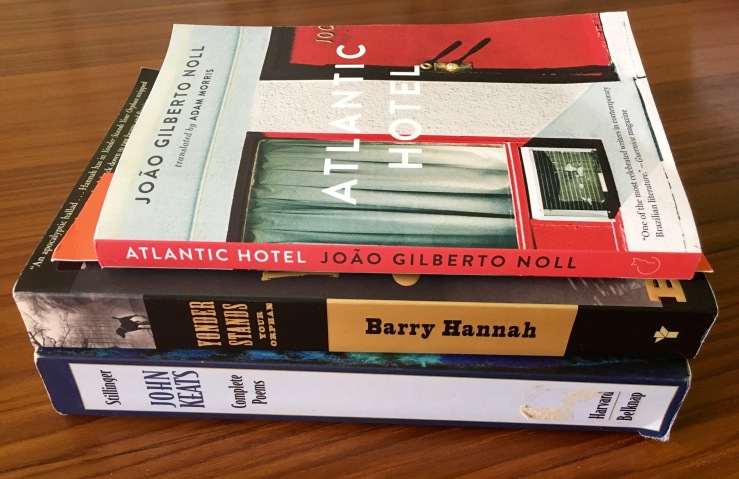
I was still reading Barry Hannah’s last novel Yonder Stands Your Orphan that day; I’d finish it up a few days later. It was excellent, full of great sentences, vignettes, riffs, rants, etc. I’d say it unraveled at the end but “unravel” implies a cohesiveness that maybe isn’t quite there—I’d have to read it again to see, and it’s worth a reread. Actually, in a sense, it coheres in that it collects a number of Hannah’s former characters into a picaresque of grotesque misadventures, hung loosely on a pimp-pornographer-outcast named Man Mortimer. Man Mortimer is the closest thing to a hero the novel has, and he’s pretty evil. Let me crib from an actual review; from Christopher Tayler’s 2001 write-up in the 2001 LRB:

The plot, such as it is, revolves around the depredations of a demonic big-city outsider called Man Mortimer, ‘a gambler, a liaison for stolen cars and a runner of whores, including three Vicksburg housewives’. Mortimer starts to take an interest in cutting people when he finds out that his sort-of girlfriend, Dee Allison – a single mother, nurse and ‘nun of apathy’ – has been unfaithful to him. Dee’s feral twin sons, meanwhile, find in a dried-up sinkhole a car containing the skeletons of Mortimer’s former lover and her child; they clean the skeletons up and take to carting them round the woods. Mortimer is initially concerned with avenging himself on Dee and reclaiming the evidence, but he soon graduates to fairly random attacks on all who cross his path – all, that is, except the poisonous Sidney Farté, who is delighted when Mortimer chops his father’s head off and replaces it with a football, since this speeds his inheritance of the family bait store.

Yonder Stands Your Orphan is often surreal and always dark; it often reminded me of David Lynch’s crime stories, with their grotesque gangsters and abject phantoms. Hell, there’s even a character named Frank Booth.

But where was I? Sorry. This riff is in part a way for me to collect the past few days into something coherent, to figure out what day it is, to prevent an unraveling. Yes, I was nervous on Labor Day, a tad. I had made a list at the beginning of that weekend of five items, chores, I mean, of which I’d accomplished four, including Clean gutters and roof. I did not complete the item I had listed as Hurricane audit.

I picked up a few flats of bottled water before my first class on Tuesday, September 5th. The shelves were already looking bare. I stopped by a Walmart and then a Lowe’s on the way home, failing to get a second gas can. Other people were starting to get a tad nervous. (Nervousness spreads like an infection).

By September 6th, it was nigh impossible to buy a generator in Jacksonville or any of its satellite cities. The college where I teach closed on Thursday, September 7th; my kids’ school closed. Everything started shutting down. There were lots of texts and calls between friends and family, basically amounting to, Should I stay or should I go? Back up plans, hotel reservations to hopefully cancel, etc.

I managed to get a generator on September 8th, which I’d crank up two days later. At this point it seemed clear, or relatively clear, that we were staying, and that family from Tampa Bay would be staying with us. September 8th was long: Trimming back suspicious branches, securing loose items from around the house’s perimeter, busting up an old playhouse that my kids really didn’t play on any more. Cooking meals that could be reheated on a grill. Rehashing plans, piling up supplies. Etc.

djogd1dvyaa_ul5

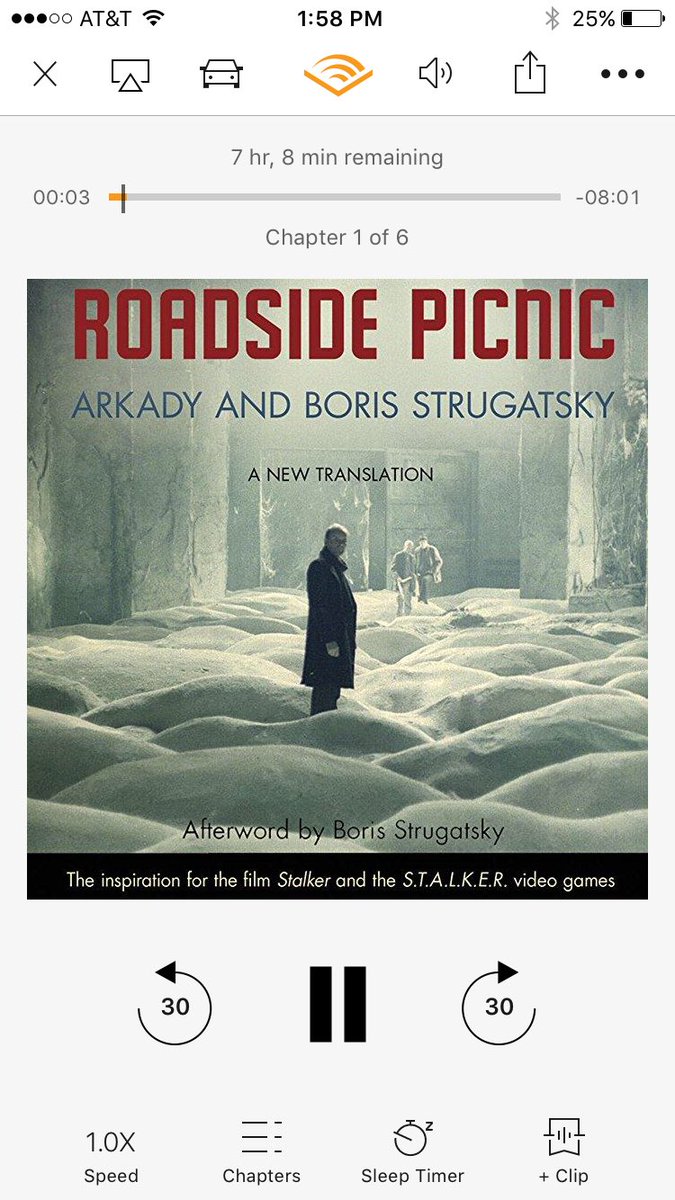
I finally got tired of listening to the radio (scaring the hell out of me) during this hurricane prep, and picked up the audiobook of Arkady and Boris Strugatsky’s Roadside Picnic, translated by Olena Bormashenko, and read by Robert Forster. I basically listened to each chapter twice over the next few days. The translation is inspiring—witty and raw, noir and smart, and Robert Forster’s narration is perfect—wry, dry, sad, and profound. I need to rewatch Tarkovsky’s Stalker now. I’m a bit ashamed that I haven’t read this one before, and I found its final moments especially moving (exhausted as I was). Highly recommended.

My evacuees arrived early September 9th. The next few days are a soggy blur. A nor’easter saturated northeast Florida; the St. Johns River was already, like, full, and the peninsula I live on (a peninsula on a peninsula), was loose. Like, not firm. Irma’s big bands started hitting the First Coast with a frank sincerity. We watched the local NFL team beat Houston’s team. There’s no symbolism or irony there. I was alternating vodka with coffee with green tea. Two twin pines lord over my house, one in the back, one in the front, maybe five decades old. They swayed and swayed, pelting fresh green pine cones onto the roof for the next 24 hours or so with an admirable consistency. By 10pm Sunday night I realized that I wouldn’t be able to sleep. We lost electrical  power, put the kids to bed. Branches started coming down, thudding with scary force, kick drums for the pine cones’ tight snare raps. Limbs like something heavier, thick bass notes. How did the kids sleep through it all?

img_7941

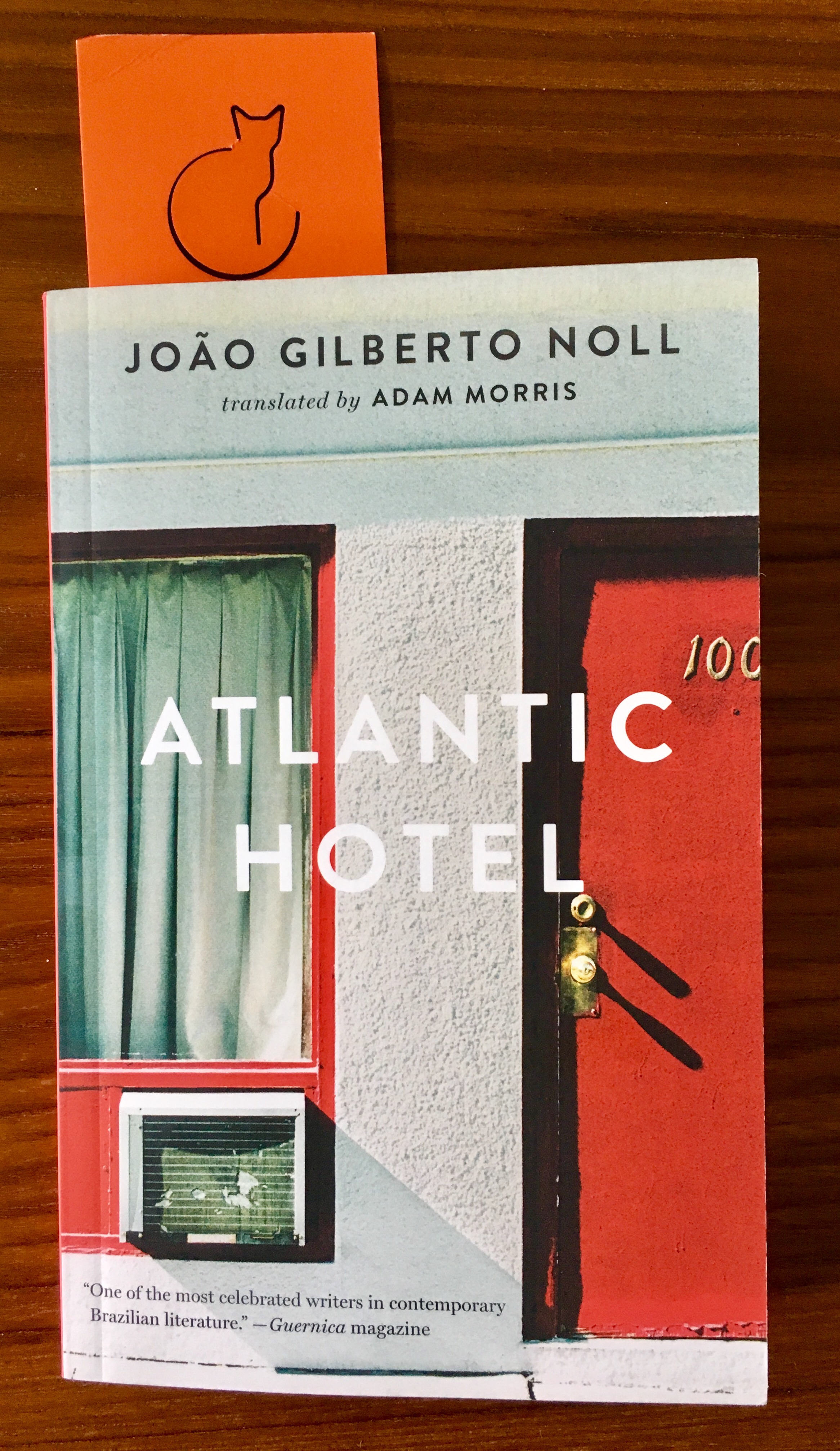
By candlelight, I read the first 66 pages of João Gilberto Noll’s novella Atlantic Hotel (English translation by Adam Morris) at some point that night. Atlantic Hotel is a picaresque nightmare, one weird horror turning into another. In a way, it was perfect reading for Irma’s approach, ominous and eerie. I also don’t know how much I registered, as I kept going out in the hard wind and slanted thick rain to put a big flashlight on my backyard, where the water kept creeping up and up, eventually getting too high for my gumboot but thankfully never spilling into my house. The feeling of reading Atlantic Hotel registered—the tone, the mood, the rhythm—but not the plot or the anonymous lead character. I’ll have to hit Reset on it.

By 3:00am the brunt of the storm cascaded over my own personal house (yes); the pine cones hailed down in a rhythm like hard rain, punctuated by larger crashes of pine limbs and other debris. For unreasonable reasons I will never know, I pulled out Keats and read Lamia with a bigass flashlight. The storm band somewhat subsided; I rested my eyes for an hour or two, then the whole thing commenced again. By nine in the morning it seemed the worst of the storm had passed, and I slept. Lamia snaked into my dreams, coiled into Irma. My son woke me up at 10:30am—a house down the street was on fire. Some asshole had cranked his generator in his garage—his closed garage!—next to his gas cans and propane tank and car. The garage burned; the car exploded, along with the other car in the driveway.

img_7930

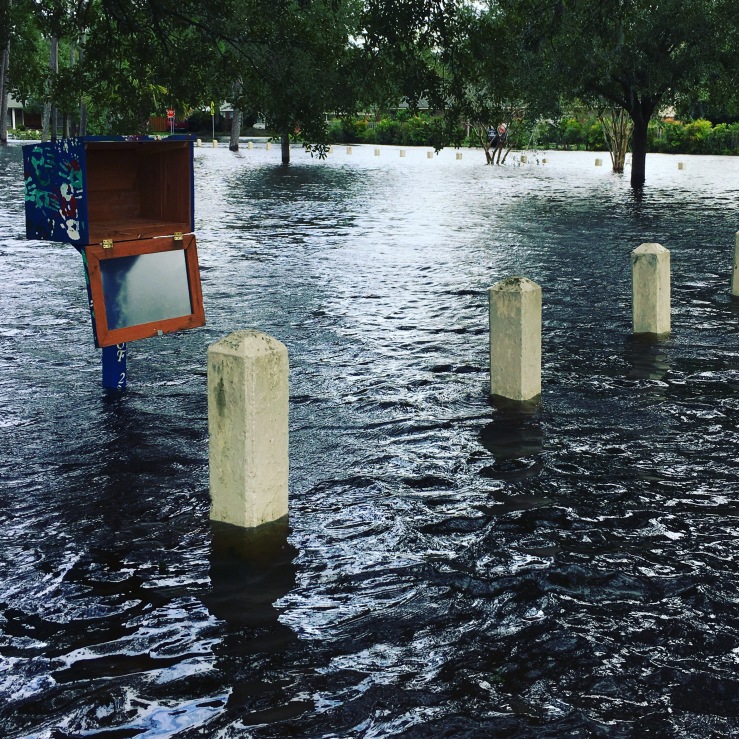
That Sunday, September 11th saw historic flooding in the urban core of Jacksonville. My kids’ school, about a third of a mile from my house, flooded. While trudging around in the late afternoon in our gumboots, happy to be free of our sweltering house for a bit, we saw two teams of Army Rangers paddle up a canal, onto the street, there to evacuate stranded old folks. Surreal. Word traveled about other locations underwater—a flooded Publix, a ruined boatyard, Memorial Park a lake. The worst rumor, to me anyway, was that my beloved used bookstore, Chamblin Bookmine, was underwater. I still can’t bring myself to go over there. I know where it is and how high the water got.

These past few days, I listened to my favorite audiobook during much of the cleanup—Richard Poe’s recording of Cormac McCarthy’s Blood Meridian. What a strange awful comfort. A tree fell on my carport and shed, but they held, sorta. My lawn is a stinking mess, the blazing sun pulling out the water in humid reeking waves. The squelch of it all is something damn else. The pine trees dropped plenty of enormous limbs, but none did real damage. Up on the roof yesterday, clearing one off, I shuddered at its size and weight. I shuddered because of course It could have been so much worse. I’m thankful.


Zombies at the bad restaurant (Barry Hannah)

Raymond suddenly knew it was time to return to the bad restaurant and then his ache for visions would be satisfied. The bad restaurant would stay when only zombies prevailed. It served food for the dead, tired fishermen and humble vacationers worsened the instant they sat down and had the bad water. Thousands like it at state lines, watering holes in the great western deserts, far flung Idaho and Maine. Their owners say, “We just couldn’t help it, we were food people. We never said good food people.”

Raymond was in the pawnshop looking at a delightful saxophone and about to buy it when the feeling hit him. What he would see and be transformed by was right next door to his own cottage, not out in the fars, the wides, the bars or churches. He put the saxophone down and within seconds saw a shadow past the shop. It was a man hobbling and slurring of the few words he could manage, and Raymond was positive it was Mimi’s old ex, what was left of him after the suicide attempt in Vicksburg, rolling and pitching up Market and the pawns to find Raymond. He went out to the walk and saw nothing but a red car leaving. And he followed it in his own. Mimi it was in Miami singing with another band for a couple of weeks. He was alone. He knew this was right. He had not eaten for two days, for no good reason. The moment was pressing.

A zombie had just waited on him in the pawnshop, a man who stood there remarking on the history of this saxophone. In apparently good health, in decent clothes and well groomed, polite, but quite obviously dead and led by someone beyond. You could look at them and know they are spaces ahead into othernewss. Not at all adolescent either, that natural Teutonic drifting or the sullenness without content. They might still be people, but unlikely.

Everything about the zombie is ravaged except his obsessions, thought Raymond, following the red car. Dead to every other touch. They simply imitate when there is movement or sound. They imitate the conversations around them to seem human to one another. He had seen them in scores from the airports to the bandstands imitating one another, mimicking the next mimicker in no time, no space, no place, no history.

The bad restaurant even had bad-food loungers and loiterers, hard to shake when they got a good imitation of you going. The restaurant with its RESTAURANT sign. Its mimicking of the dining life, yet no edible food, bad water and a weak tea to go with that. Refill that beige for you, sir? Every dish served in contempt for what used to be human. Rations for an unannounced war.

From Barry Hannah’s 2001 novel Yonder Stands Your Orphan

Dogs are in space and time (Barry Hannah)

“Most animals live a short while,” said Ulrich, “but I had a revelation. That we cannot know the intensity of their lives, which is hundreds of times more attuned than ours. They don’t talk because they don’t need speech. A dog, when it puts its head out a car window, smells almost everything in a county, a world we never even suspect and have no description for. That is why I am daft. I have flown and smelled the smells, Carl Bob. I have known life by my nose. That’s why the dog looks so ecstatic sniffing in the wind. They smell a thousand times more than we do. We could only know it as hallucinatory sense. Dogs are in space and time. We can only know one or the other, plodding, toddling. Not to mention hearing. And taste. Water is fifty times more delicious to them. We must not pity them, a cheap passive hobby. They live huge lives before they die. Watch how happy sleep is to them, and right next to waking. They live both at once. We are predators not only of meat but of essence, my friend. We want to be them because they have spoken to us without speaking and we can hardly bear their superiority.”

From Barry Hannah’s 2001 novel Yonder Stands Your Orphan.

In the passive voice, something happened, somebody was killed and so on (Barry Hannah)

The sheriff was doing a five-minute commentary on the Weekend Review on television Saturday night. Both Dee and Melanie watched.

“The world is full of middle-aged men who seek revenge. The anger passes for most when they see there is no way. The rate of incarceration is very low for first-time offenders of sixty. For some, there is a bigger engine of hate even then, running at the red line and very vigilant toward what they might consider insults or even bossiness. They aren’t just having it, the engine, like the others. They are it. They have not been aware of this, and their acts confound them. Those are ones you see on television or in the newspapers discussing sodomy, rape, kidnapping and murder in the passive voice, something happened, somebody was killed and so on, sometimes even giggling. ‘Mistakes were made, yes, when she was killed. I can’t remember, really.’ Such as that.”

From Barry Hannah’s 2001 novel Yonder Stands Your Orphan.

João Gilberto Noll’s Atlantic Hotel (Book acquired, 14 August 2017)

João Gilberto Noll’s novella Atlantic Hotel is new English translation by Adam Morris from Two Lines Press. I loved loved loved the last one I read by Noll, Quiet Creature on the Corner. Full review to come; for now, here’s Two Lines’ blurb:

Compared by critics to filmmaker David Lynch—and deeply influenced by Clarice Lispector—João Gilberto Noll is esteemed as one of Brazil’s living legends. Following the breakthrough success of last year’s Quiet Creature on the Corner, Two Lines Press now presents Noll’s career-defining work, Atlantic Hotel.

Just who narrates the dark and mysterious Atlantic Hotel? First he books a room where a murder has occurred, claiming he’s just arrived from the airport. But then he suddenly leaves, telling a cabbie he’s an alcoholic headed for detox. After that he hops on an all-night bus across Brazil, where he begins to seduce a beautiful American woman. Next he’s recognized as a soap opera actor. Then he impersonates a priest.

At length he knocks on a very wrong door in a small town: when it opens he’s looking down the barrel of a gun. He falls down unconscious, and when he awakes something terrible is happening to him…

All these beefy Caucasians with guns! (From Neal Stephenson’s novel Snow Crash)


All these beefy Caucasians with guns!  Get enough of them together, looking for the America they always believed they’d grow up in, and they glom together like overcooked rice, form integral, starchy little units.  With their power tools, portable generators, weapons, four-wheel-drive vehicles, and personal computers, they are like beavers hyped up on crystal meth, manic engineers without a blueprint, chewing through the wilderness, building things and abandoning them, altering the flow of mighty rivers and then moving on because the place ain’t what it used to be.

The byproduct of the lifestyle is polluted rivers, greenhouse effect, spouse abuse, televangelists, and serial killers.  But as long as you have that four-wheel-drive vehicle and can keep driving north, you can sustain it, keep moving just quickly enough to stay one step ahead of your own waste stream.  In twenty years, ten million white people will converge on the north pole and park their bagos there.  The low-grade waste heat of their thermodynamically intense lifestyle will turn the crystalline icescape pliable and treacherous.  It will melt a hole through the polar icecap, and all that metal will sink to the bottom, sucking the biomass down with it.

From Neal Stephenson’s prescient 1992 cyberthriller Snow Crash.

Notes on Vulture’s “100 Great Works of Dystopian Fiction” list

Did you see Vulture’s “100 Great Works of Dystopian Fiction” list? I saw it this morning, and on the whole it ain’t half bad, despite including way too many novels from the past 10 years. Lists are stupid and maybe we already live in a dystopia, but our dystopia could be way way worse and lists are stupid fun…so—my stupid thoughts on this stupid fun list. (They organized it chronologically, by the bye)—-

Gulliver’s Travels, Jonathan Swift, 1726: Good starting place, although I’m sure you could reach farther back if you wanted—Revelations, Blake, Milton, etc.

The Last Man, Mary Shelley, 1826: Never read it. The listmakers seem to have skipped Voltaire’s Candide (1759).

Erewhon, Samuel Butler, 1872: Hey, did you know that Erewhon is actually Nowhere backwards? Ooooh…far out. I really don’t remember it but I read it in school. I’m sure I would’ve thrown it on the list.

The Time Machine, H.G. Wells, 1895: Great track. Some of the best required reading ever.

“The Machine Stops,” E.M. Forster, 1909: Never read it/never heard of it.

We, Yvegny Zamyatin, 1924: The list reminded me I need to reread this one—I read it twice—in my teens and in my twenties. Good stuff. (Also reminds me that I would’ve added something by Sigizmund Krzhizhanovsky to the list—like his collection Memories of the Future).

Brave New World, Aldous Huxley, 1932: This is the guy. I mean, I think Huxley got it right here, y’know? Not that a dystopian novel needs to predict, but…anyway. I actually had a student come by during office hours just to visit, and she asked for a novel recommendation, and I gave her BNW after she told me 1984 was the last great book she’d read. If I recall correctly, the Vulture list only has one duplicate author (Margaret Atwood), but I’d also add Huxley’s often-overlooked novel Ape and Essence.

It Can’t Happen Happen Here, Sinclair Lewis, 1935: I think this is one of those ones where I know the basic plot, themes, etc., but I’m pretty sure I didn’t read it.

Swastika Night, Katharine Burdekin, 1937: An entry that I’ll admit I’ve never heard of, the sort of thing that shows the value in stupid silly fun lists. I’ll search it out.

1984, George Orwell, 1949: I guess this one is the big dawg, but I never want to reread it (unlike Huxley’s stuff). Maybe I’m missing the humor in it. Maybe the most important novel of the 20th century, whatever that means. Continue reading “Notes on Vulture’s “100 Great Works of Dystopian Fiction” list”