
Slavoj Žižek on Alfred Hitchock. From The Pervert’s Guide to Cinema (2006).
Category: Film
Raymond Carver: Dreams Are What You Wake Up From
“I’m Like a Tiger” — A Scene from If . . . .
Anemic Cinema — Marcel Duchamp
Vodpod videos no longer available.
Alejandro Jodorowsky on David Lynch’s Dune (and Other Matters)
The AV Club’s Noel Murray interviews Chilean director Alejandro Jodorowsky, he of Holy Mountain and apocalypse-Western El Topo fame. Jodorowsky famously almost adapted Frank Herbert’s Dune before David Lynch picked up that gauntlet. Here’s Jodorowsky on Lynch’s adaptation–
AVC: For a long time, you were involved with developing Dune into a feature film, before the project fell through. Did you ever see David Lynch’s Dune?
AJ: Yes, I’ve seen it. I was very scared when I saw it, because Dune was for me very important in my life. I was very sad I could not do it. When I saw that David Lynch would do it, I was very scared, because I admire him as a moviemaker, and I thought he would do well. But when I see the picture, I realize he never understood this picture. It’s not a David Lynch picture. It’s the producer who made that picture, no? Who made this horror. For David Lynch, it was a job. A commercial job. It never was that for me.
Jodorowsky’s version of Dune had entered pre-production, including early art from Jean Giraud (French comics artist Moebius). You can see some of Giraud’s character designs and storyboards here.
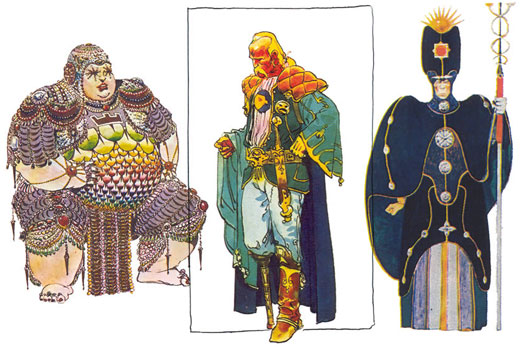
Jodorowsky famously wanted Salvador Dali to play the Emperor and Mick Jagger to play Feyd Rautha (a role that went to Sting in Lynch’s version).
Three Takes on Nosferatu
Here’s F.W. Murnau’s seminal 1922 vampire film, Nosferatu, in full, thanks to public domain laws. Nosferatu is a horrifying and beautiful example of German expressionism at its finest. Max Schreck is terrifying as the vampire Count Orlok (an adaptation of Bram Stoker’s character Dracula). Observe–
Werner Herzog’s 1979 remake is also gorgeous, but employs a more naturalistic style. Klaus Kinski plays Dracula. Two scenes–
In 2000, director E. Elias Merhige gave us the underrated gem Shadow of the Vampire, a fictionalized account of the making Murnau and his crew making the original Nosferatu. Willem Dafoe is amazing as Max Schreck–or really, as Orlok, rather, as he stays in makeup and costume for the entirety of the production. The movie is both hilarious and frightening, and at times even sadistic. It’s also of a piece with the wave of meta-textual films that surged in the last decade,like Being John Malkovich, I Heart Huckabees, and Adaptation.
RIP Satoshi Kon
Japanese filmmaker Satoshi Kon died yesterday at the young age of 47, apparently from cancer. Kon’s films included Tokyo Godfathers, Perfect Blue, Millennium Actress, and Paprika, visually stunning and emotionally resonant works that helped to prove that manga was a medium, not a genre. More here. Watch the parade scene from Paprika. Chaotic eye candy.
Russian Ark — Aleksandr Sokurov
Before I get into the details of Aleksandr Sokurov’s 2002 film Russian Ark, I implore you to stop reading my review and simply get a hold of the film and watch it. It’s a marvelous, rewarding, dreamy experience. That’s not a very convincing argument of course, but I think that the best way to see this gorgeous film is with no preconceptions, with as little information as possible–not because there are plot twists that a review might give away, but rather because the pleasure of Russian Ark is its narrative immediacy–and any review will seek to mediate that immediacy. So I’ve hemmed and hawed. If you need further convincing, read on.
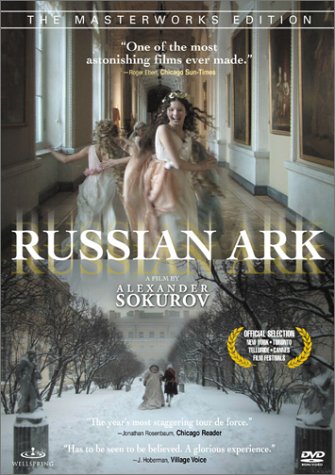
It’s hard to know where to begin, so I’ll let Don DeLillo do it for me. In his latest novella, Point Omega, his filmmaker protagonist describes it as an ideal for the kind of truth he’d like to capture in one of his own films:
There’s a Russian film, feature film, Russian Ark, Aleksandr Sokurov. A single extended shot, about a thousand actors and extras, three orchestras, history, fantasy, crowd scenes, ballroom scenes and then an hour into the movie a waiter drops a napkin, no cut, can’t cut, camera flying down hallways and around corners. Ninety-nine minutes.
That was enough for me to get hold of Russian Ark and watch it, or rather experience it (I think experience is the best verb here, corny as that sounds), but perhaps, gentle reader, you’d like some plot details. Let’s give it a shot. The film begins in darkness, with its unnamed/unseen protagonist describing the vague details of his last memory, a violent accident that he remembers little about. But before we go on, I should point out a few things: this protagonist is unseen because he is essentially the camera; his movement propels the film–is the film–and although he is his own character, he is also a surrogate for the audience. His first-person experience dictates the film, is the film, and although he has ghostly access to the characters who float through the gorgeous halls of the State Hermitage in St. Petersburg, they cannot see or hear him. There is one character who can see him however, an unnamed black-clad 19th-century French aristocrat who the protagonist comes to call “the European.” Neither the European or the protagonist understand why they are in the Hermitage or how they got there; the European is even more perplexed to find that he now speaks perfect Russian. Unlike the protagonist, the European can interact with the denizens of the Hermitage, and interact he does, by turns offending, menacing, or charming (or at least attempting to charm) the characters that the pair encounters as they drift through the ballrooms, galleries, and courtyards of this beautiful palace. Initially, the European repeatedly insults Russian culture, which he believes a pale imitation of European aesthetics. He even protests that one of the fine orchestras that they stumble upon must be manned with Italian players, as Russian musicians simply couldn’t be so skilled. But as they wander the halls, the European slowly succumbs to the rich beauty and opulence of the Hermitage; although he never states it outright, he relents his prejudice against Russian culture, and perhaps even learns a new way of seeing beauty.

And who wouldn’t be moved by the beauty here? Russian Ark functions in some way as a guided tour of the Hermitage, although that term, “guided tour” implies a stuffiness that’s antithetical to the looseness of this film. The camera lingers on a painting or statue; the protagonist offers his thoughts, the European his; perhaps an erstwhile docent steps in to explicate a point of technique or symbolism. It’s wonderful. In one stunning moment (scene would not be the right word for this movie which is of course one long scene), the European argues violently with a boy over a painting of the apostles Peter and Paul. The boy admits to knowing nothing of the scriptures, yet he’s deeply moved by the wisdom and promise that the painting connotes; the European cannot understand how the painting’s aura alone can transmit its meaning to the ignorant lad. The scene begins at 6:38 in the clip below:
The European’s clash with the boy echoes the larger (and yet subtle) clashes of the film, as characters, artworks, and musical styles of different epochs float into or burst out of or parade around in the grand rooms of the Hermitage. There’s Pushkin, Peter the Great, Catherine the Great, Anastasia. There’s an incredible scene where Tsar Nicholas I is offered an apology by the Shah of Iran for the death of an ambassador; there’s a wonderful ballroom dance that moves the European to great joy. In one of the film’s pockets of horror, a layman labors in a strange utility room building his coffin; it is the siege of Leningrad in WWII where over a million people died at the hands of the Nazis. The European, of course, has no knowledge of these events, being after his time, and the disjunction between the protagonist’s contemporary perspective of history and his own provides for a fascinating, if not wholly fleshed out, conflict.
Indeed, one of the greatest pleasures of Russian Ark is its refusal to narrativize or philosophize history beyond a first-person perspective walk through the halls of the Hermitage. The movie erupts into little pockets of exuberant joy or strange, desperate violence; sometimes the protagonist is drawn in, but just as often he’s repelled, and looks for another avenue, like a dreamer willing his own escape. To call the movie dream-like would be an understatement, and like a dream, Russian Ark‘s divergent set pieces overwhelm the senses in their rich splendor. Like the protagonist and the European, I found myself repeatedly entranced by a painting or a concert or a dance or a strange little moment, only to be interrupted by another character intruding into the frame, bearing new information, discordant news that disrupts the dream logic (while paradoxically ushering in a new set piece). Russian Ark distracts its audience, sending them inward; in contemplation, the viewer loses the thread–but is there a thread? Is real life a narrative? Are dreams even narratives? Some of my favorite moments of the film happened when my anxiety at having been distracted by some gorgeous detail was confirmed by the protagonist, who all of a sudden has lost the European, or who is startled by the bustling arrival of new people. But of course, in this film, the viewer is the protagonist.
But writing about Russian Ark is no good, not really. You have to just see it (but I already said that, right?) To quote again from DeLillo’s Point Omega, “The true life is not reducible to words spoken or written, not by anyone, ever.” Sokurov’s film collapses history and art and beauty into a beautiful, edifying, sometimes terrifying dream, a dream that, in its adherence to first-person perspective, is a marvelous approximation of true life. Highly recommended.
Rabbits — David Lynch
The Speed and Violence of Our Age
Bright Star — Campion Does Keats

So I finally got around to watching Jane Campion’s Bright Star last night, a film that quietly studies the final years of Romantic poet John Keats and his relationship with Fanny Brawne. When Keats moves next door to the Brawnes, eldest daughter Fanny, a talented seamstress and flighty flirt, soon becomes intrigued by the poet. Keats, with his love for beauty and truth, represents a world of greater depth than the wits and dandies who usually attempt to court Brawne. Their relationship is, of course, doomed from the outset. Perpetually broke Keats doesn’t have the moolah or means to properly engage Brawne in marriage, but that doesn’t stop the pair from undertaking a furtive, pensive love affair, carried out in long walks on the heath and passionate letters. Oh, and Keats gets sick and dies at 25. That shouldn’t be a spoiler if you’ve studied your Romantics properly, now should it?
Both Abbie Cornish who plays Brawne and Ben Whishaw who plays Keats are excellent in their understatement and reserve, but the standout turn in the movie comes from actor Paul Schneider (from NBC’s Parks & Recreation) who plays Keats’s bankrolling friend Charles Armitage Brown. Brown is a lesser poet whose love and envy of Keats leads him to vex Brawne and Keats’s love at every turn, plaguing them with doubt, and that enemy of Romance, Reason. Schneider invests his character with a boorish charm that never veers into the rote tropes that afflict modern romance film. It’s emblematic of the Campion’s film in a way: Bright Star has every opportunity to devolve into a mundane exercise in doomed romance or a stuffy period piece, but under Campion’s delicate care it manages to match the depth of its subject matter.
Campion wrote the screenplay, presumably using letters from the principals as her primary source. She honors her viewers’ intelligence — far too rare these days — by never cobbling her plot together with easy exposition or forced narrative developments, and it’s that sense of history that lends the film authenticity. Cornish’s Brawne is a protagonist whose personality transformations read as real, and Whishaw’s Keats is never a cartoonish mystic or a moody caricature, but a fully-drawn human. Campion also has the good judgment to let her cinematography convey her story, letting gorgeous shots of the English countryside and cloistered chambers alike convey the mood and rhythm of her story. At times, Bright Star‘s beautiful camerawork recalls Terrence Malick, another director who allows film to “happen” to the viewer as an evocative experience rather than a spoon-feeding. Campion also shows considerable restraint with the film’s wonderful score, never allowing it to color a scene unduly when her actors can do a great job on their own. Bright Star avoids all of the pitfalls that might afflict a period piece, and does a far better job handling the subject of Romantic poetry than a movie has any right to. The film is hardly for everyone (sorry guys, no Jason Statham), but it’s very, very good. Recommended.
Coraline
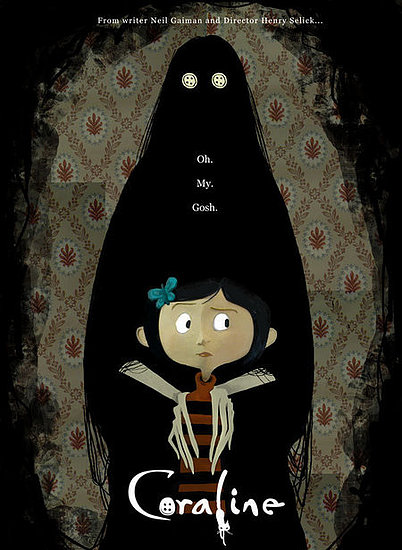
Even if Coraline didn’t have an engaging plot, well-developed characters an audience can really care about, and an especially singular sense of setting, rhythm, and movement, it would still be worth seeing in the theater for its astounding 3D visuals. Director Henry Selick (The Nightmare Before Christmas), working from Neil Gaiman‘s short novel of the same name, has created an endearing, imaginative, and often disturbing fairytale in meticulous stop-motion animation, dramatically enhanced in 3D. Selick doesn’t rest simply on the film’s amazing optical effects; rather, Coraline‘s plot and characterization are seamlessly, often dreamily (or nightmarishly) crafted through those marvelous visuals. Even when a scene veers into outright spectacle, it is always purposeful, cohesive, and forwards the logic of the plot, the story of young Coraline and her strange adventures in an alternate universe.
Bored and largely ignored by her parents who have just moved her to a country boarding house, Coraline discovers a tunnel to a world that doubles her own, replete with an “other mother” who cooks all sorts of delicious foods and loves to play games, and an “other father” who dotes on his little girl. This alternate universe also contains more glamorous versions of the boarding house’s other tenants, a circus performer who works with musical mice, and two aging actresses with a predilection for salt water taffy. The alternate world becomes a site of spectacle and wonder for Coraline, as well as the setting for some pretty mind-bending 3D set-pieces for the audience–however, like all fairy tales, Coraline always toes the line between fantasy and nightmare, joy and shocking horror. Savvy audience members will pick up on a sinister thread underlying the early scenes with Coraline’s “other mother,” a creepiness artfully balanced with the notion that this woman represents Coraline’s wish-fulfillment to be loved, adored, and entertained at all times. The reality of this fantasy world soon becomes painfully apparent to Coraline, who must go on a hero’s quest–in her own home–to save her “real” parents.
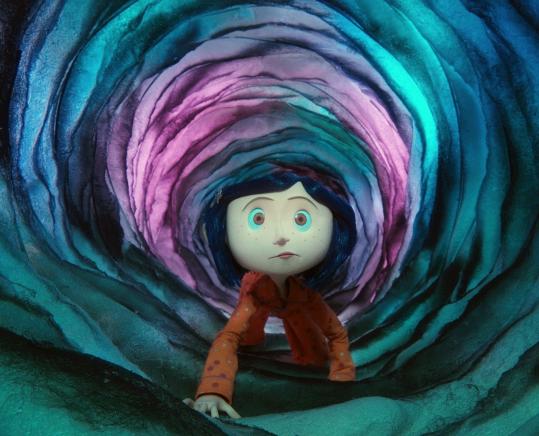
Coraline thrills at all the right moments, and at times is downright scary (although the seven year old behind me seemed unafraid; he just kept saying “Awesome!” every five minutes). The plot is rich with allusions to Alice and Wonderland and the Brothers Grimm fairy tales, and, in keeping with these sources, Coraline often exposes its dark side with little or no buffer. From frightening birthing tropes to threats of infanticidal cannibalism, Coraline always purchases its spectacular fantasy with reminders of grim, almost cruel reality. One scene in particular lays this cost literally bare; the aging actresses perform a high-wire trapeze act half-naked, their clumsy, inept bodies overexposed to every kind of peril–including the potential mockery of the audience. In an act of fantastic wish-fulfillment, the old women strip their fat, wrinkled bodies away like the husks of fruit; they emerge young women, their impossible rejuvenation the climax of a fantasy involving an intricate clash of sexuality and death. And yet Coraline repeatedly makes clear the costs of these fantasies, working its way toward a satisfying conclusion that doesn’t attempt to gloss over the erosion, corrosion, and mundane deathliness of life, but rather reconciles how a person might live happily in the “real world.” Very highly recommended.
The Discipline of DE — Gus Van Sant/William Burroughs
Gus Van Sant’s great little short film from 1978, based on William Burroughs’s essay, explains the art of DE, or “Do Easy.” Our clumsy ass has been trying too hard, apparently. The film is quite funny but also useful, and well worth watching in full. It’s also included in the latest issue of Wholphin, if thou art so moved.
Exterminate All Rational Thought: Burroughs at the Movies
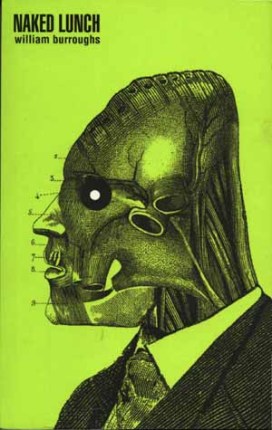
I love Naked Lunch. I love David Cronenberg. Theoretically, I should love David Cronenberg’s film adaptation of William Burrough’s psychosurreal classic. But hey, that’s rational thought for you, right? I didn’t love it in ’93 or ’94, the first time I saw it. Maybe I was too young. Maybe I just didn’t get it (but if that was the case then why did I love the book so much..?) So I watched it again as an undergrad; this was maybe ’99 or ’00. Nope. In fact, I remember thinking “Wow. This is actually pretty bad.” At that point, I was a big Cronenberg fan too. eXistenZ had just come out. eXistenZ is easily my favorite Cronenberg film, and a favorite film in general, and Naked Lunch didn’t hold up well against it or my re-reading of the Burrough’s book. But yet and still, ever the glutton for disappointment, I gave the Naked Lunch movie another shot this weekend, as part of the Biblioklept Summer of Cronenberg Film Festival. Guess what? It’s not a very good movie.
The fault of Cronenberg’s movie is not in failing to adapt the content of Burrough’s book, which is pretty much untranslatable as a narrative movie. Instead, Cronenberg attempts to weld some of the images of Naked Lunch–along with elements of other Burroughs novels such as Nova Express, The Soft Machine, and The Ticket that Exploded–into a cohesive thread using Burroughs’s biography as the overarching frame story. Burroughs’s life story is fascinating–the guy shot his wife in the head, for chrissakes–and lit junkies will love to see characters based on Kerouac and Ginsberg and Paul Bowles–but the end results simply don’t achieve or reflect the spirit of the novel. The bitter, caustic satire of Naked Lunch is almost wholly absent, replaced by wry one-liners from Peter Weller (who woodenly portrays Burroughs’s alter-ego, William Lee (an alter-ego who doesn’t appear in the novel of Naked Lunch at all, incidentally)). Cronenberg seems to underestimate his audience’s capacity for a nonlinear story, taking the loose collection of riffs, routines, and episodes that comprise Naked Lunch, and turning them into a pretty dull meditation on the nature of creativity and the suffering and alienation of the outsider-artist. Worst of all, the audience is asked to identify and sympathize with William Lee–again, this seems to be a negation of the original text.
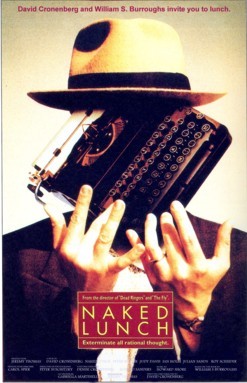
In the end, Cronenberg’s Naked Lunch is just another bad Cronenberg film (see also: his mish-mashed adaptation of J.G. Ballard’s Crash, his boring adaptation of Stephen King’s The Dead Zone). In Naked Lunch, we get the usual Cronenbergian tropes: mechanical objects that become hideously organic, bodily invasion, constant “is this real or is this a dream?” moments, and general dark creepiness. However, they simply don’t work here: Cronenberg is attempting Burroughs-icky resulting only in Cronenberg-icky. Cronenberg’s entire oeuvre is littered with flawed films, but I tend to enjoy them more for their flaws. This one was a no-go though, and I gave it three shots. But, in a way, I believe that Cronenberg deserved three viewings. You never know. Still, I doubt I’ll watch this one again.
If you haven’t seen a Cronenberg film, I suggest starting with Videodrome, A History of Violence, or eXistenZ. He also has a new movie coming out later this year, Eastern Promises starring Naomi Watts. If you haven’t read Burroughs, I suggest starting with Junkie or Queer (or just go ahead and jump into Naked Lunch).
I end with a far better review of Naked Lunch than I’ve provided here, courtesy of The Simpsons. Do you remember that episode where Bart makes a fake driver license (not the one where he’s awarded a real driver license courtesy Mayor Quimby)? And he takes Milhouse and Nelson and Martin on a road trip to the World’s Fair in Knoxville? Well, along the way the boys decide to sneak into an R-rated movie. They leave the theater disappointed; the shot reveals that they’ve just left Naked Lunch. Nelson remarks: “There’s at least two things wrong with that title.” I’ll leave it at that.
Rescue Dawn–Werner Herzog

So my uncle and I went to see Rescue Dawn, the new Werner Herzog film. Rescue Dawn is the true story of Dieter Dengler (not a porn name), an Air Force pilot who crashed his plane during a mission over Laos in 1966. Dengler was captured, held as a POW, and tortured by his captors. Dengler organized and executed a daring escape, leading the other prisoners out of the camp. In 1997 Herzog made a documentary about Dengler’s story called Little Dieter Needs to Fly. I have not seen that film.
My expectations for Rescue Dawn were high–I love Herzog’s films, which mix high adventure with a sense of naturalistic realism and psychological surrealism–and I love Christian Bale, he of American Psycho fame, who plays Dengler. I suppose my expectations were too high, because Rescue Dawn wasn’t nearly as good as I thought it would be. My uncle was also slightly disappointed. It was by no means bad, but it wasn’t nearly as good as its reviews would make it seem; additionally, it’s practically a Hollywood action movie (complete with the big happy ending in front of an assembled audience of cheering extras)–something I wouldn’t have expected from Herzog. Bale is excellent though, as is co-star Steve Zahn, and the setting and pacing of the film make for an exciting afternoon. Then again, so does Missing in Action.
I may be going a little rough on Rescue Dawn–it’s better than 99% of the schlock out there, and in a summer crowded with franchise sequels, I think that moviegoers (i.e. people who go to the movies every week) should go check it out. Chalk my disappointment up to high expectations. Netflix addicted hermits like myself should probably just wait for the DVD.
 Biblioklept