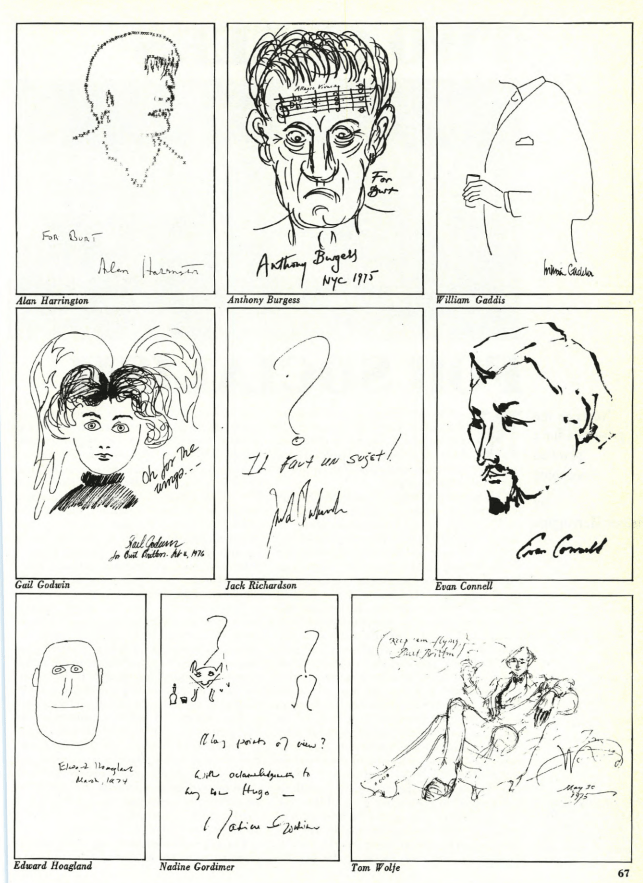
The Self-Portraits of Nine Authors

portraits

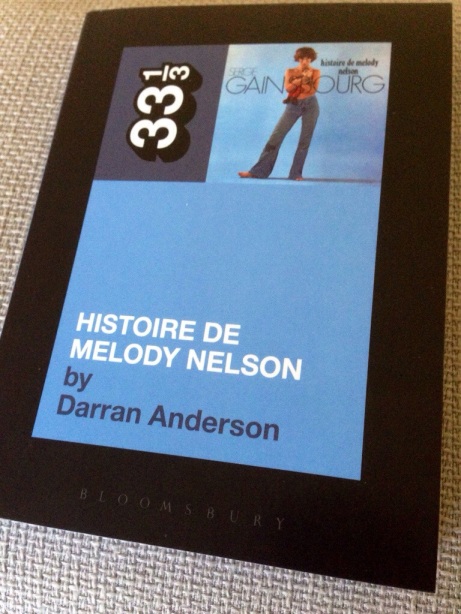
Serge Gainsbourg’s Histoire de Melody Nelson Gets the 33 1/3 Treatment (Book Acquired, 10.23.2013)

20131027-130605.jpg

Things I am a fan of: Serge Gainsbourg, Darran Anderson, and the 33 1/3 series. The 33 1/3 imprint focuses on specific albums, and the results are usually far more engaging than standard biographical fare. Histoire de Melody Nelson is the series’s latest entry; here, Darran Anderson takes on Serge Gainsbourg’s dark, moody, sexy, weird album (listen to it/see it here). I still remember the first time I heard Melody, back in college. Gainsbourg’s track with a breathy, orgasmic Brigitte Bardot “Je t’aime… moi non plus” was pretty much a party standard for my friends and me, and “Bonnie & Clyde” found its way onto plenty of mixtapes in the late ’90s. These bubblegum vamps didn’t really prepare me for Melody. I remember going to a friend’s apartment; he had just bought the album and had it playing on repeat. Dark, spacious, very short and full of strange shifts, from orchestral bombast to odd moments of quiet, the album made me feel weird. Such a weird album is a worthy topic for a book, and Anderson’s entry is a marvelous description and analysis of the artistic, cultural, and philosophical sources that Gainsbourg synthesized in Melody. Check out some of Anderson’s blog entries; they provide a compelling overview of his book:

The Origins of Melody – Nabokov’s LolitaBarbarella, Boris Vian, Sibelius, Mondo Cane.

The Avant Garde or Nothing – Gainsbourg and Vannier as innovators and a focus on their lost classics.

Initials O.G. – Serge Gainsbourg’s Hip-hop afterlife.

Connan Mockasin – Kiwi Psychedelia and the Ghost of Melody Nelson.

The book’s blurb:

Outside his native France, the view of Serge Gainsbourg was once of a one-hit wonder lothario. This has been slowly replaced by an awareness of how talented and innovative a songwriter he was. Gainsbourg was an eclectic, protean figure; a Dadaist, poète maudit, Pop-Artist, libertine and anti-hero. An icon and iconoclast.

His masterpiece is arguably Histoire de Melody Nelson, an album suite combining many of his signature themes; sex, taboo, provocation, humour, exoticism and ultimately tragedy. Composed and arranged with the great Jean-Claude Vannier, its score of lush cinematic strings and proto-hip hop beats, combined with Serge’s spoken-word poetry, has become remarkably influential across a vast musical spectrum; inspiring soundtracks, indie groups and electronic artists. In recent years, the album’s reputation has grown from cult status to that of a modern classic with the likes of Beck, Portishead, Mike Patton, Air and Pulp paying tribute.

How did the son of Jewish Russian immigrants, hounded during the Nazi Occupation, rise to such notoriety and acclaim, being celebrated by President François Mitterand as “our Baudelaire, our Apollinaire”? How did the early chanson singer evolve into a musical visionary incorporating samples, breakbeats and dub into his music, decades ahead of the curve? And what are the roots and legacy of a concept album about a Rolls Royce, a red-haired Lolita muse, otherworldly mansions, plane crashes and Cargo Cults?


“The Non-Entity” — William Carlos Williams

wcw

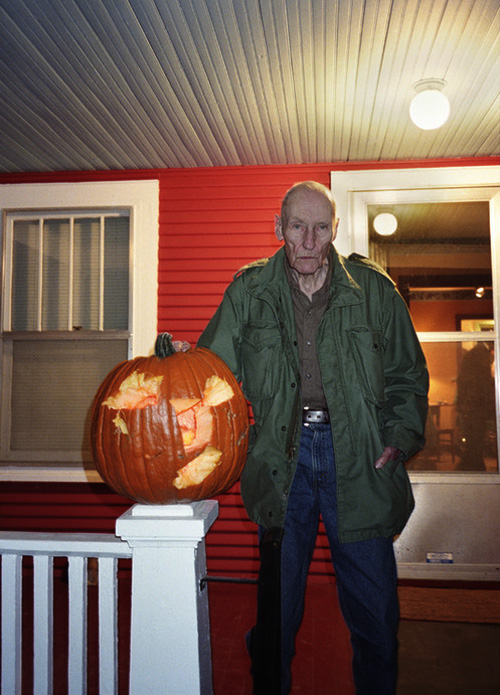
William Burroughs and His Hatchet-Carved Jack O’ Lantern

burroughs jack o lantern

(Via).

“…a face worthy of a murderer” (From Hell)

A page from Alan Moore and Eddie Campbell’s outstanding graphic novel From Hell, an encyclopedic account of the Jack the Ripper murders. In this scene, our evil protagonist Dr. Gull undergoes a transcendent experience, and appears to William Blake, inspiring The Ghost of a Flea

Blake’s The Head of the Ghost of a Flea

I pulled the image of From Hell from this fantastic detailed review by Miguel at St. Orberose (far better than my own my own meager tackle at writing about the book). Plenty more images there, along with a comprehensive analysis of (what I take to be) Moore’s best work.

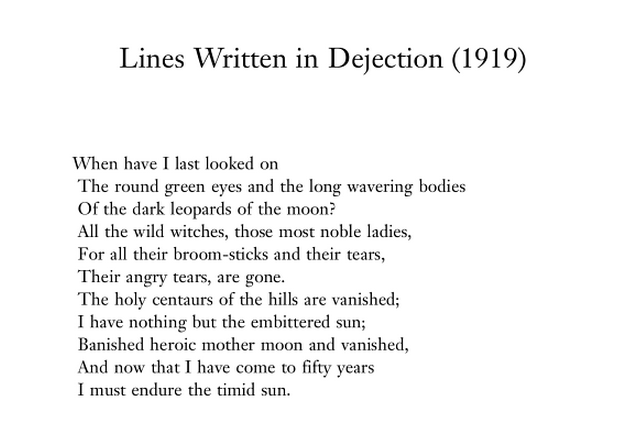
“All the wild witches” (Yeats)

yeats

See Edgar Allan Poe, D.W. Griffith’s 1909 Short Film

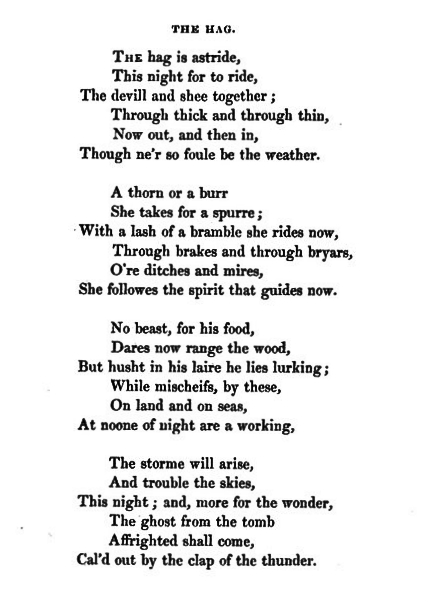
“The Hag” — Robert Herrick

the hag

The Sealed Room, D.W. Griffith’s 1909 Adaptation of Edgar Allan Poe’s “The Cask of Amontillado”


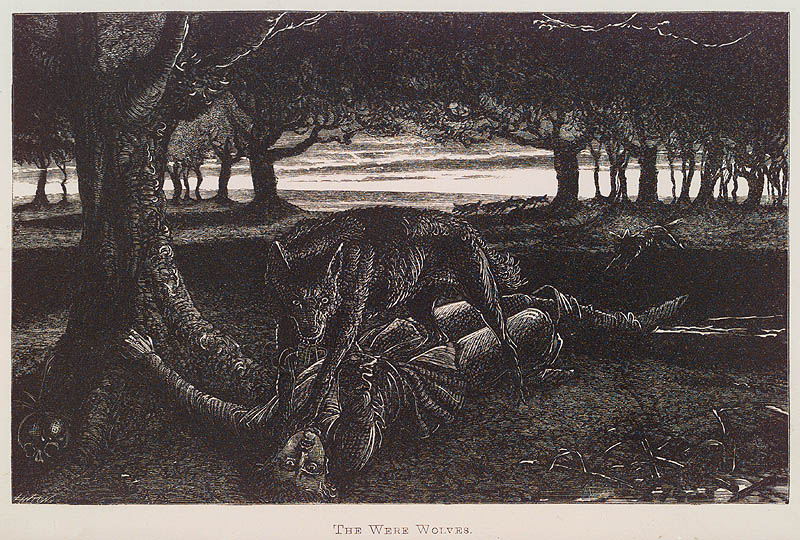
Bolaño’s Werewolves

In the first chapter of his estimable volume The Book of Were-Wolves (1865), Sabine Baring-Gould outlines his project (emphasis mine):

In the following pages I design to investigate the notices of were-wolves to be found in the ancient writers of classic antiquity, those contained in the Northern Sagas, and, lastly, the numerous details afforded by the mediæval authors. In connection with this I shall give a sketch of modern folklore relating to Lycanthropy.

It will then be seen that under the veil of mythology lies a solid reality, that a floating superstition holds in solution a positive truth.

This I shall show to be an innate craving for blood implanted in certain natures, restrained under ordinary circumstances, but breaking forth occasionally, accompanied with hallucination, leading in most cases to cannibalism. I shall then give instances of persons thus afflicted, who were believed by others, and who believed themselves, to be transformed into beasts, and who, in the paroxysms of their madness, committed numerous murders, and devoured their victims.

The first few chapters of the book recount werewolf mythology in heavily archetypal terms: we’re talking Greek and Norse stuff here, really ancient stories that tap into primal-human-animal-instinct and so forth. Then there are a few chapters on Scandinavian werewolves (and other shapeshifters) that reminded me of William Vollmann’s marvelous saga The Ice-Shirt, a book that treats warriors shifting into bears as totally standard fare. The book then tackles “The Were-Wolf in the Middle Ages,” where Baring-Gould relies heavily on monks who seem to view their subject through the heady lens of supernaturalism. Baring-Gould weaves together these culturally disparate stories, citing a strong backlist of sources, and refraining from pointing out the obvious archetypal flavor that girds these tales.

It’s in Chapter VI, “A Chamber of Horrors,” that mythology and archetype give way to a kind of terrible realism. Perhaps this is simply an effect of records-keeping, of the vague fact that narratives and terms of the early Renaissance seem so much more accessible to us than, say, the terms of Scandinavian saga. In any case, the book takes on a horrific scope: the vagaries of myth give way to dates, names, places, witnessestrialsverdicts. To go back to Baring-Gould’s intro, we see the “solid reality” under “the veil of mythology,” stripped away. Continue reading “Bolaño’s Werewolves”

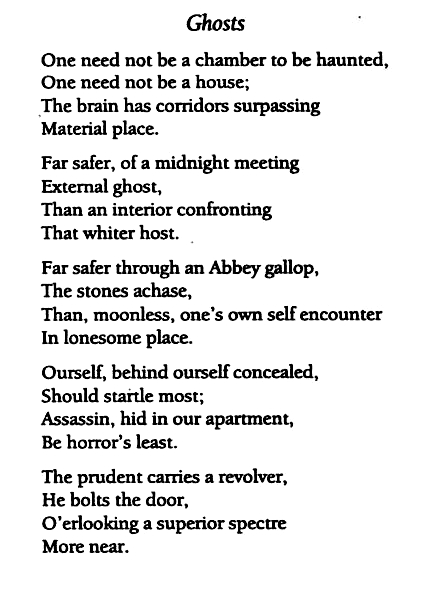
“One need not be a chamber to be haunted” — Emily Dickinson

ghosts

Riff #2 on Thomas Bernhard’s Old Masters

I’ve been trying to think of a way to talk about Bernhard’s (or, really, the translator Ewald Osers’) style and affect relative to, say, American prose traditions. I turned to some scholarship on old Bernie, and most of the articles focused on how musical forms (the fugue, sonata, etc.) frame Bernhard’s sentences (and, in some cases, the entire narrative, like The Loser). These were very welcome insights. But before I touch on that, I read a quote by the ever-excellent Deb Olin Unferth this morning that helps start a conversation about Bernhard’s style relative to American prose traditions. Here it is:

Prose can be what keeps you wanting to read. Strong prose contains conflict, even at the level of the sentence. If a sentence is pushing against itself, or if each sentence is contradicting what just came before it and you’re wondering how you can hold all these contradictory statements in your mind at once, that’s interesting to me. What you’re getting then is a complex psychology or philosophy as a result of the very sentences that you’re reading. That’s a Lishian way of looking at prose. I subscribe to it. I admire work and I strive to in my own work have that kind of pressure on the individual sentence, so that each sentence is in conflict with what’s around it in some way.

I think you could pick things out of this quote and posture Bernhard into them. Contradiction–surely. Self-imposed pressure–definitely. I would also say these qualities aren’t specific to Lish, though. So-called Lishians often default into a kind of prosody that depends on physical characteristics of sound to help move meaning within a sentence. In other words, sound thematizes presence and produces the emotional effect; and sound thematization is the affect of Lishian prose. So, for example, a sentence that evokes a sharpness and harshness would have a lot of alliterative K-sounds, or something. Diane Williams’ sentences are very proud of this prose. Look at this, from “One of The Great Drawbacks” in Vicky Swanky is a Beauty:

If left to themselves, they fight like fiends or yell out the great news and one of these girls is entirely out of danger.

Notice the alliteration and assonance in the first part of sentence on the F-sounds, the short E’s, and long I’s. From a “craft perspective,” I guess, there’s a sense that making the sounds of the words symbiotic take precedence before plot and character. Composition first depends on making the sounds interesting, and lead the other components into the story. It’s a very different set of restrictions on the writer to depend on the physical properties of language than what Bernhard is doing.

But, I think, Bernhard is one of the most musical writers I’ve ever read. There’s a quote by him somewhere that details his focus on style, and he calls it a “theoretical music.” Where Lishians want the reader to “hear” the prose in the head, Bernhard wants her to feel the consciousness of the ostensible narrator as if she were listening to music; namely, the composition of Old Masters, or Frost, or The Loser. Bernhard’s favorite technique to achieve this effect is repetition with slight variation which, if I remember correctly, is the most infantile way to describe the classical sonata.

Incidentally, he was speaking English, which I found agreeable, but then suddenly also German, very broken German, that broken German which all Englishmen speak when they believe they know German, which, however, is never the case, Reger said, the Englishman probably wanted to speak German rather than English in order to improve his German, and after all why not, when abroad one prefers to speak the foreign language unless one is a blockhead, and so in his broken German he said that he had in fact come to Austria and to Vienna solely for the White-Bearded Man, he was not interested in the museum as a whole, not in the least, he was not one for museums, he hated museums and had always only visited them reluctantly, he had only come to the Vienna Kunsthistorisches Museum in order to study the White-Bearded Man because back home he had just such a White-Breaded Man hanging over his bed in his bedroom in Wales, in actual fact the same White-Bearded Man, the Englishman said, Reger said.

I don’t think I’ve ever read a sentence by a “Lishian” that was ever this long. Where the musicality of a Lishian sentence is in the very materiality of language, Bernhard performs his music in the construction of the melody (sentence) by arranging the phrases (clauses) in this sort of point-counterpoint call and response. English calls to German, and vice versa, and we get a sense of the character within the rant; all the phrases that repeat “German” respond to Reger finding the English “agreeable” perform his total ambivalence for the Englishman. It makes me think that “Lishian” sentences still aim for a kind of story in the traditional sense, and Bernhard’s aim to stage a mind at work, a mind paralyzed (This was touched on in the Frost post). Less a story than a confession, testimony, absurd anecdote.

(Read the first riff).

Jonathan Littell’s Latest, The Fata Morgana Books (Book Acquired, 10.21.2013)

20131027-130105.jpg

The Fata Morgana Books collects four novellas from Jonathan Littell and is forthcoming from Two Line Press, a new indie specializing in publishing English language translations of some of the world’s best literature. Here is their blurb about The Fata Morgana Books, Littell’s follow up to The Kindly Ones:

Ranging from swimming pools to art galleries, from beds to battlefields, and a few mythical places, these novellas are narrated by hermaphrodites, ghosts, wanderers, and wonders. Littell here once again mixes his love of the grotesque with time-twisting narratives and ethereal protagonists. Like an Italo Calvino or a Clarice Lispector, Littell channels the emotions of loss and desire to illuminate the shadowy depths of solitude, reflection, longing, and lust.

With fleet prose and Proustian self-reflection, these stories range from chaotic airlifts to a series of bullfights under the hot sun, fatal negotiations resolved as mathematical equations, and the nine circles of Hell. Commanding and beguiling, The Fata Morgana Books rings with depth and mystery, always pushing through to explore the in-between spaces: between thoughts, between bodies, between hungers and their satisfactions, between eyes and the things they look at.

I was psyched to get a review copy of The Fata Morgana Books; Littell’s previous novel about an SS officer’s depraved undertakings, The Kindly Ones, stuck with me in a weird, gross, foul way. In my review I suggested that it was “a novel that might as well take place in the asshole, or at least the colon.”

I read the first novella in The Fata Morgana BooksEtudes, which is comprised of four stories that read like an overture for what will come. The first piece, “A Summer Sunday,” sets an unnerving and estranging tone, where pleasure seems to mingle with ennui and dread:

That Sunday, then, after the beer near the cemetery, I accompanied B. to meet our friend A. and we went out to lunch at a beautiful, somewhat isolated restaurant with a terrace only half enclosed, which allowed one to stay out in the open air without breaking police regulations too much. We ate slowly, all afternoon, lamb chops with an onion salad, and drank a bottle of red wine. Afterward, B. and I shared a cigar, too dry but a great pleasure nonetheless. Then we bought some cakes and went over for drinks on my balcony, opposite the cemetery, with the two towers at our feet. It wasn’t till the next day, reading the papers, that we realized just how bad the weekend had been. But the summer had been like that for six weeks already, and it seemed likely it would continue that way.

By “The Wait,” the next chapter of Etudes, we’ve descended into Littell’s abject terrain. More to come in a full review.

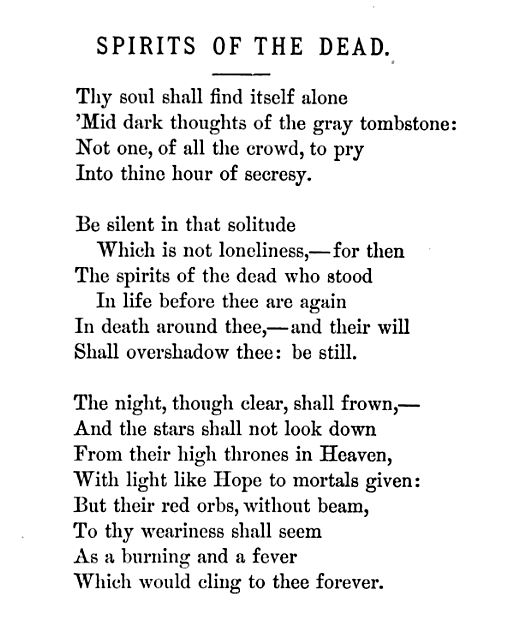
“Spirits of the Dead” — Edgar Allan Poe

spirits

“Horror Demands Laughter” | This Is Not a Review of Thomas Bernhard’s Novel Frost

The Blind Man, Albert Bloch

I.

Thomas Bernhard’s first novel Frost is (unless I’m mistaken) his longest, and of the several I’ve now read, the most taxing on the reader—bitter, caustic, depressive, nihilistic.

It’s also terribly funny, the story of a young doctor hell-bent on making a career for himself who heads to the remote village of Weng to spy on Strauch, “the painter,” on behalf of Strauch’s brother, who can presumably further the narrator’s medical career. The painter, long-estranged from his family, his health deteriorating, lives (if it can be called that) in a vile inn at the bottom of a gorge. The painter’s brother dispatches the narrator to report back in the minutest detail: “Watch the way my brother holds his stick, I want a precise description of it.”

II.

A word I learned reading Frost: “knacker.” A knacker is a person who renders, buries, or otherwise disposes of dead animals. The knacker of Weng is one of the main characters of Frost. He’s having an affair with the innkeeper, a symbolically overdetermined plot device (in a basically plotless book) that thematically ties death to hearthFrost is savagely morbid, its blank white snow the perfect canvas for Bernhard’s bloody strokes. The abject violence of his next novel Gargoyles seems refined in comparison to the brutality of Frost. The painter declares that “the abattoir is the only essentially philosophical venue. The abattoir is the classroom and the lecture hall. The only wisdom is abattoir wisdom!” Frost is an abattoir.

III.

Frost is also a stage play of sorts—like the other Bernhard novels I’ve read, it takes something of its form from the conventions drama: limited sets, just a handful of characters, and dialogue that usually veers into monologue. Through the course of the novels, these monologues (usually delivered by an obsessive, sanity-challenged older man) eventually ventriloquize the ostensible narrator/auditor, a stand-in for the reader’s own consciousness. Bernhard designs, builds, destroys, and then rebuilds these consciousnesses; when the painter of Frost declares that he has mastered “perspectivelessness . . . because I am so full of different perspectives,” he offers us a condensation of Bernhard’s analysis of first-person perspective and its attendant imaginative capacity as simultaneously creative and destructive.

IV.

Indeed, as novelist Ben Marcus points out in his review of Frost:

Bernhard is an architect of consciousness more than a narrative storyteller. His project is not to reference the known world, stuffing it with fully rounded characters who commence to discover their conflicts with one another, but to erect complex states of mind—usually self-loathing, obsessive ones—and then set about destroying them. Bernhard’s characters are thorough accomplices in their own destruction, and they are bestowed with a language that is dementedly repetitive and besotted with the appurtenances of logical thinking. The devious rationality of Bernhard’s language strives for a severe authority, and it tends to make his characters seem believable, no matter how unhinged their claims. Phrases don’t get repeated so much as needled until they yield graver meanings, with incremental changes introduced as though a deranged scientist were adding and removing substances in the performance of an experiment.

V.

I can’t do better than Marcus, and Frost is too long a performance to try. I will say: Gargoyles or The Loser are probably better starting places for those interested in Bernhard’s work. This suggestion isn’t meant to slight the book at all—but it does read a bit like a first novel, occasionally weighed down by (what I perceive to be) its authors need to say it all, all of it, here and now. Of course, Frost features prose-passages that any first-time novelist would be proud (and probably terrified) to have in their debuts; I’ve featured several on the site already.

VI.

But this isn’t really a review of Frost. A proper analysis of Bernhard would take the time to work through his language. I marked so much in Frost, highlighted so many passages that I’m not really sure how to go about synthesizing it.

My initial thought was to dodge it all by making a sarcastic post, a parody of the so-called “listicle,” those non-articles that seek to boil a work down to a digestible (and forgettable) summation of quotes, often with the intention of offering the reader a modicum of self-help (under the pretense of “wisdom”). Something like “Forty Inspiring Quotes from Thomas Bernhard’s Frost” or “Timeless Wisdom from Thomas Bernhard” or some such nonsense. Anyway, the next section, VII, comprises 40 citations from Frost, mostly excellent one-liners too good not to share. I’ve enumerated them and lumped them into one big block quote; they are listed in the order they come in the text. I think that they offer a painful and funny overview of the novel.

VII.

  1. Suddenly I heard the story of a lineman who had been asphyxiated in a snowstorm, which ended: “He never cared about anything.”
  2. It’s the same disgust I felt when I was a child and had to vomit outside the open doors of the slaughterhouse.
  3. “Nature is bloody,” he said, “but bloodiest toward her own finest, most remarkable, and choicest gifts. She grinds them down without batting an eyelid.”
  4. Is it permissible for suicide to be a sort of secret pleasure to a man?
  5. Something was splendid, and the next thing was brutal, much more brutal than the first had been splendid.
  6. “You’ll get to meet a whole series of monsters here.”
  7. “Even dreams die. Everything turns into cold. The imagination, everything.”
  8. “People who make a new person are taking an extraordinary responsibility upon themselves. All unrealizable. Hopeless. It’s a great crime to create a person, when you know he’ll be unhappy, certainly if there’s any unhappiness about. The unhappiness that exists momentarily is the whole of unhappiness. To produce solitude just because you don’t want to be alone anymore yourself is a crime.”
  9. People don’t have favorite children, they just have a lot of them.
  10. I’m sure imagination is an illness. An illness that you don’t catch, merely because you’ve always had it. An illness that is responsible for everything, and particularly everything ridiculous and malignant. Do you understand the imagination? What is imagination?
  11. “There is a pain center, and from that pain center everything radiates out,” he said; “it’s somewhere in the center of nature. Nature is built up on many centers, but principally on that pain center.”
  12. “Nothing is progressive, but nothing is less progressive than philosophy. Progress is tripe. Impossible.”
  13. Helping and mankind, the distance between those two terms.
  14. Who had the idea of letting people walk around on the planet, or something called a planet, only to put them in a grave, their grave, afterward?
  15. By and by it comes to your attention: the world around you, nothing but corruption, colossal misrule.
  16. “How everything has crumbled, how everything has dissolved, how all the reference points have shifted, how all fixity has moved, how nothing exists anymore, how nothing exists, you see, how all the religions and all the irreligions and the protracted absurdities of all forms of worship have turned into nothing, nothing at all, you see, how belief and unbelief no longer exist, how science, modern science, how the stumbling blocks, the millennial courts, have all been thrown out and ushered out and blown out into the air, how all of it is now just so much air … Listen, it’s all air, all concepts are air, all points of reference are air, everything is just air …” And he said: “Frozen air, everything just so much frozen air …”
  17. What is pain, if not pain?
  18. “I used to take sleeping pills,” he said, “and slowly boosted the number of pills I took. In the end, they had absolutely no effect on me, and I could have gulped any number of them, and still not have got to sleep. I repeatedly took such high dosages, I should have died. But I only ever vomited them up.”
  19. Everything torments me now.
  20. Man is an ideal hell to his fellow men.
  21. He was just scraps of words and dislocated phrases.
  22. Things have lost their power to disgust me.
  23. The human race was the unfruitful thing, “the only unfruitful thing in the whole world. It serves no purpose. It can’t be made into anything. It can’t be eaten. It isn’t a raw material for some process outside itself.”
  24. “Men like rats, chopped up by street sweepers’ shovels. Too many negotiations with humans have done me in.”
  25. The ruin of mankind had been a child’s dream.
  26. The food had been better than for any corpse she could remember.
  27. “The frost eats everything up,” said the painter, “trees, humans, animals, and whatever is in the trees and the humans and the animals. The blood stalls, and at great speed. You can break apart a frozen human like a piece of stale bread.”
  28. There were no real humans anymore, just death masks of real humans.
  29. The nightmarish sweat of fear, that’s the air.
  30. Truth leads downhill, points downhill, truth is always an abyss.
  31. The abattoir is the classroom and the lecture hall. The only wisdom is abattoir wisdom!
  32. You wake up, and you feel molested.
  33. Everything is barbarous kitsch.
  34. “And when I saw the grisly chopped-up animals, I had to burst out laughing, I burst out into extraordinary laughter. Do you know what that means? It means horror demands laughter!”
  35. Various venerable old families would assemble “in a spirit of megalomania, to shoot holes in nature.
  36. It’s a mistake to count on people.
  37. Every object I see hurts me.
  38.  ” . . . hopelessness … There is only one way to go, through the snow and ice into despair; past the adultery of reason.”
  39. “The world is a progressive dimming of light,.”
  40. The breeding of a human being (thinking most rigorously of himself) is the decision of the father (first and foremost) and of the mother (as well) to sponsor the suicide of their offspring, the child, the sudden premonition “of having created a new suicide.”

Run for Your Life, Charlie Brown

run_for_your_life__charlie_b_by_citizenwolfie-d4dtb6j

Run for Your Life, Charlie Brown by Dennis Davies.

“Wolf-Alice” — Angela Carter

“Wolf-Alice” by Angela Carter

Could this ragged girl with brindled lugs have spoken like we do she would have called herself a wolf, but she cannot speak, although she howls because she is lonely–yet’ howl’ is not the right word for it, since she is young enough to make the noise that pups do, bubbling, delicious, like that of a panful of fat on the fire. Sometimes the sharp ears of her foster kindred hear her across the irreparable gulf of absence; they answer her from faraway pine forest and the bald mountain rim. Their counterpoint crosses and criss-crosses the night sky; they are trying to talk to her but they cannot do so because she does not understand their language even if she knows how to use it for she is not a wolf herself, although suckled by wolves.

Her panting tongue hangs out; her red lips are thick and fresh. Her legs are long, lean and muscular. Her elbows, hands and knees are thickly callused because she always runs on all fours. She never walks; she trots or gallops. Her pace is not our pace.

Two-legs looks, four-legs sniffs. Her long nose is always a-quiver, sifting every scent it meets. With this useful tool, she lengthily investigates everything she glimpses. She can net so much more of the world than we can through the fine, hairy, sensitive filters of her nostrils that her poor eyesight does not trouble her. Her nose is sharper by night than’ our eyes are by day so it is the night she prefers, when the cool reflected light of the moon does not make her eyes smart and draws out the various fragrances from the woodland where she wanders when she can. But the wolves keep well away from the peasants’ shotguns, now, and she will no longer find them there.

Wide shoulders, long arms and she sleeps succinctly curled into a ball as if she were cradling her spine in her tail. Nothing about her is human except that she is not a wolf; it is as if the fur she thought she wore had melted into her skin and become part of it, although it does not exist. Like the wild beasts, she lives without a future. She inhabits only the present tense, a fugue of the continuous, a world of sensual immediacy as without hope as it is without despair.

When they found her in the wolf’s den beside the bullet-riddled corpse of her foster mother, she was no more than a little brown scrap so snarled in her own brown hair they did not, at first, think she was a child but a cub; she snapped at her would-be saviours with her spiky canines until they tied her up by force. She spent her first days amongst us crouched stockstill, staring at the whitewashed wall of her cell in the convent to which they took her. The nuns poured water over her, poked her with sticks to rouse her. Then she might snatch bread from their hands and race with it into a corner to mumble it with her back towards them; it was a great day among the novices when she learned to sit up on her hind legs and beg for a crust.

They found that, if she were treated with a little kindness, she was not intractable. She learned to recognize her own dish; then, to drink from a cup. They found that she could quite easily be taught a few, simple tricks but she did not feel the cold and it took a long time to wheedle a shift over her head to cover up her bold nakedness. Yet she always seemed wild, impatient of restraint, capricious in temper; when the Mother Superior tried to teach her to give thanks for her recovery from the wolves, she arched her back, pawed the floor, retreated to a far corner of the chapel, crouched, trembled, urinated, defecated–reverted entirely, it would seem, to her natural state. Therefore, without a qualm, this nine days’ wonder and continuing embarrassment of a child was delivered over to the bereft and unsanctified household of the Duke. Continue reading ““Wolf-Alice” — Angela Carter”