“The Obliterated Man” — H.G. Wells

“The Obliterated Man” by H.G. Wells

I was—you shall hear immediately why I am not now—Egbert Craddock Cummins. The name remains. I am still (Heaven help me!) Dramatic Critic to the Fiery Cross. What I shall be in a little while I do not know. I write in great trouble and confusion of mind. I will do what I can to make myself clear in the face of terrible difficulties. You must bear with me a little. When a man is rapidly losing his own identity, he naturally finds a difficulty in expressing himself. I will make it perfectly plain in a minute, when once I get my grip upon the story. Let me see—where am I? I wish I knew. Ah, I have it! Dead self! Egbert Craddock Cummins!

In the past I should have disliked writing anything quite so full of “I” as this story must be. It is full of “I’s” before and behind, like the beast in Revelation—the one with a head like a calf, I am afraid. But my tastes have changed since I became a Dramatic Critic and studied the masters—G.A.S., G.B.S., G.R.S., and the others. Everything has changed since then. At least the story is about myself—so that there is some excuse for me. And it is really not egotism, because, as I say, since those days my identity has undergone an entire alteration.

That past!… I was—in those days—rather a nice fellow, rather shy— taste for grey in my clothes, weedy little moustache, face “interesting,” slight stutter which I had caught in my early life from a schoolfellow. Engaged to a very nice girl, named Delia. Fairly new, she was— cigarettes—liked me because I was human and original. Considered I was like Lamb—on the strength of the stutter, I believe. Father, an eminent authority on postage stamps. She read a great deal in the British Museum. (A perfect pairing ground for literary people, that British Museum—you should read George Egerton and Justin Huntly M’Carthy and Gissing and the rest of them.) We loved in our intellectual way, and shared the brightest hopes. (All gone now.) And her father liked me because I seemed honestly eager to hear about stamps. She had no mother. Indeed, I had the happiest prospects a young man could have. I never went to theatres in those days. My Aunt Charlotte before she died had told me not to.

Then Barnaby, the editor of the Fiery Cross, made me—in spite of my spasmodic efforts to escape—Dramatic Critic. He is a fine, healthy man, Barnaby, with an enormous head of frizzy black hair and a convincing manner, and he caught me on the staircase going to see Wembly. He had been dining, and was more than usually buoyant. “Hullo, Cummins!” he said. “The very man I want!” He caught me by the shoulder or the collar or something, ran me up the little passage, and flung me over the waste-paper basket into the arm-chair in his office. “Pray be seated,” he said, as he did so. Then he ran across the room and came back with some pink and yellow tickets and pushed them into my hand. “Opera Comique,” he said, “Thursday; Friday, the Surrey; Saturday, the Frivolity. That’s all, I think.” Continue reading ““The Obliterated Man” — H.G. Wells”

“The Huldrefish,” A Weird Tale of the Northern Seas

THE HULDREFISH

“The Huldrefish” by Jonas Lie; Translated from Norwegian by Nisbet Bain (Illustration by Laurence Housman)

It was such an odd trout that Nona hauled in at the end of his fishing-line. Large and fat, red spotted and shiny, it sprawled and squirmed, with its dirty yellow belly above the water, to wriggle off the hook. And when he got it into the boat, and took it off the hook, he saw that it had only two small slits where the eyes should have been.

It must be a huldrefish, thought one of the boatmen, for rumour had it that that lake was one of those which had a double bottom.

But Nona didn’t trouble his head very much about what sort of a fish it was, so long as it was a big one. He was ravenously hungry, and bawled to them to row as rapidly as possible ashore so as to get it cooked.

He had been sitting the whole afternoon with empty lines out in the mountain lake there; but as for the trout, it was only an hour ago since it had been steering its way through the water with its rudder of a tail, and allowed itself to be fooled by a hook, and already it lay cooked red there on the dish.

But now Nona recollected about the strange eyes, and felt for them, and pricked away at its head with his fork. There was nothing but slits outside, and yet there was a sort of hard eyeball inside. The head was strangely shaped, and looked very peculiar in many respects.

He was vexed that he had not examined it more closely before it was cooked; it was not so easy now to make out what it really was. It had tasted first-rate, however, and that was something.

But at night there was, as it were, a gleam of bright water before his eyes, and he lay half asleep, thinking of the odd fish he had pulled up.

He was in his boat again, he thought, and it seemed to him as if his hands felt the fish wriggling and sprawling for its life, and shooting its snout backwards and forwards to get off the hook.

All at once it grew so heavy and strong that it drew the boat after it by the line.

It went along at a frightful speed, while the lake gradually diminished, as it were, and dried up.

There was an irresistible sucking of the water in the direction the fish went, which was towards a hole at the bottom of the lake like a funnel, and right into this hole went the boat.

It glided for a long time in a sort of twilight along a subterranean river, which dashed and splashed about him. The air that met him was, at first, chilly and cellar-like; gradually, however, it grew milder and milder, and warmer and warmer.

The stream now flowed along calmly and quietly, and broadened out continually till it fell into a large lake.

Beyond the borders of this lake, but only half visible in the gloom, stretched swamps and morasses, where he heard sounds as of huge beasts wading and trampling. Serpent like they rose and writhed with a crashing and splashing and snorting amidst the tepid mud and mire.

By the phosphorescent gleams he saw various fishes close to his boat, but all of them lacked eyes.

And he caught glimpses of the outlines of gigantic sea-serpents stretching far away into the darkness. He now understood that it was from down here that they pop up their heads off the coast in the dog days when the sea is warm.

The lindworm, with its flat head and duck’s beak, darted after fish, and crept up to the surface of the earth through the slimy ways of mire and marsh.

Through the warm and choking gloom there came, from time to time, a cooling chilling blast from the cold curves and winds of the slimy and slippery greenish lichworm, which bores its way through the earth and eats away the coffins that are rotting in the churchyards.

Horrible shapeless monsters, with streaming manes, such as are said to sometimes appear in mountain tarns, writhed and wallowed and seized their prey in the fens and marshes.

And he caught glimpses of all sorts of humanlike creatures, such as fishermen and sailors meet and marvel at on the sea, and landsmen see outside the elfin mounds.

And, besides, that there was a soft whizzing and an endless hovering and swarming of beings, whose shapes were nevertheless invisible to the eye of man.

Then the boat glided into miry pulpy water, where her course tended downwards, and where the earth-vault above darkened as it sank lower and lower.

All at once a blinding strip of light shot down from a bright blue slit high, high, above him.

A stuffy vapour stood round about him. The water was as yellow and turbid as that which comes out of steam boilers.

And he called to mind the peculiar tepid undrinkable water which bubbles up by the side of artesian wells. It was quite hot. Up there they were boring down to a world of warm watercourses and liquid strata beneath the earth’s crust.

Heat as from an oven rose up from the huge abysses and dizzying clefts, whilst mighty steaming waterfalls roared and shook the ground.

All at once he felt as if his body were breaking loose, freeing itself, and rising in the air. He had a feeling of infinite lightness, of a wondrous capability for floating in higher atmospheres and recovering equilibrium.

And, before he knew how it was, he found himself up on the earth again.


Portrait of Oscar Wilde — Henri de Toulouse-Lautrec

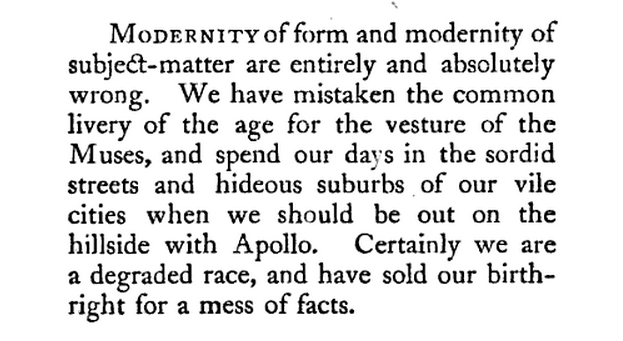
Modernity (Oscar Wilde)

modernity

“The Alchemist” — H.P. Lovecraft

“The Alchemist” by H.P. Lovecraft

High up, crowning the grassy summit of a swelling mound whose sides are wooded near the base with the gnarled trees of the primeval forest, stands the old chateau of my ancestors. For centuries its lofty battlements have frowned down upon the wild and rugged countryside about, serving as a home and stronghold for the proud house whose honoured line is older even than the moss-grown castle walls. These ancient turrets, stained by the storms of generations and crumbling under the slow yet mighty pressure of time, formed in the ages of feudalism one of the most dreaded and formidable fortresses in all France. From its machicolated parapets and mounted battlements Barons, Counts, and even Kings had been defied, yet never had its spacious halls resounded to the footstep of the invader.

But since those glorious years all is changed. A poverty but little above the level of dire want, together with a pride of name that forbids its alleviation by the pursuits of commercial life, have prevented the scions of our line from maintaining their estates in pristine splendour; and the falling stones of the walls, the overgrown vegetation in the parks, the dry and dusty moat, the ill-paved courtyards, and toppling towers without, as well as the sagging floors, the worm-eaten wainscots, and the faded tapestries within, all tell a gloomy tale of fallen grandeur. As the ages passed, first one, then another of the four great turrets were left to ruin, until at last but a single tower housed the sadly reduced descendants of the once mighty lords of the estate.

It was in one of the vast and gloomy chambers of this remaining tower that I, Antoine, last of the unhappy and accursed Comtes de C——, first saw the light of day, ninety long years ago. Within these walls, and amongst the dark and shadowy forests, the wild ravines and grottoes of the hillside below, were spent the first years of my troubled life. My parents I never knew. My father had been killed at the age of thirty-two, a month before I was born, by the fall of a stone somehow dislodged from one of the deserted parapets of the castle, and my mother having died at my birth, my care and education devolved solely upon one remaining servitor, an old and trusted man of considerable intelligence, whose name I remember as Pierre. I was an only child, and the lack of companionship which this fact entailed upon me was augmented by the strange care exercised by my aged guardian in excluding me from the society of the peasant children whose abodes were scattered here and there upon the plains that surround the base of the hill. At the time, Pierre said that this restriction was imposed upon me because my noble birth placed me above association with such plebeian company. Now I know that its real object was to keep from my ears the idle tales of the dread curse upon our line, that were nightly told and magnified by the simple tenantry as they conversed in hushed accents in the glow of their cottage hearths. Continue reading ““The Alchemist” — H.P. Lovecraft”

Nature’s Nightmare, A Study of David Foster Wallace’s Oblivion (Book Acquired, 10.12.2013)

20131013-093333.jpg

I was psyched when Greg Carlisle’s Nature’s Nightmare: Analyzing David Foster Walalce’s Oblivion showed up in the mail. (You might recall Carlisle as the author of Elegant Complexity, a study of Infinite Jest). Blurb from publisher Slideshow Media Group:

Carlisle gives an in-depth narrative analysis of each story: “Mr. Squishy,” “The Soul is Not a Smithy,” “Incarnations of Burned Children,” “Another Pioneer,” “Good Old Neon,” “Philosophy and the Mirror of Nature,” “Oblivion,” and “The Suffering Channel.” Carlisle’s methodical approach walks readers through Wallace’s thematic interests and situates Oblivion in the broader arc of Wallace’s career. Every passage of each story is analyzed in terms of 1) interrelation of narrative form and content, 2) relation of story to the theme of oblivion, 3) recurring thematic motifs in Wallace’s work, and 4) assessment of content in relation to Infinite Jest and The Pale King. The book includes nine charts that illustrate narrative devices Wallace employs throughout the stories. Jason Kottke called Elegant Complexity the reference book for Infinite Jest and now Nature’s Nightmare is the primary reference work for Oblivion.

I read the introduction and first chapter, covering “Mr. Squishy,” this weekend, and Carlisle’s perceptive analysis made me want to reread the story. Of course, I had to scan over the chapter for “Good Old Neon,” maybe my favorite Wallace story and arguably his best piece of writing. Here’s the diagram from that chapter (did I neglect to mention that there are diagrams?):

20131013-093341

Full review forthcoming.


“A Poison Tree” — William Blake

poison

The Complete Short Stories of J.G. Ballard (Third Riff: Stories of 1961)

jgb_complete_ss400

PREVIOUSLY:

Introductions + stories 1956-1959

Stories of 1960

IN THIS RIFF:

Stories published in 1961:

“Studio 5, The Stars”

“Deep End”

“The Overloaded Man”

“Mr. F Is Mr. F”

“Billennium”

“The Gentle Assassin”

1. “Studio 5, The Stars” (1961)

“Studio 5, The Stars” takes poetry as its subject and is the first story in The Complete Short Stories to focus on writing. Ballard’s tales usually concern some aspect of art, but up until now he’s been mainly concerned with music (and to a lesser extent visual art).

“Studio 5, The Stars” is the third tale in the collection set in “the crazy season at Vermilion Sands.” Our narrator is the editor of “Wave IX, an avant–garde poetry review.” Ballard constructs his story around the conceit that writing poetry has become (quite literally) a soulless, mechanical activity. Our narrator explains to his interlocutor:

I used to write a fair amount myself years ago, but the impulse faded as soon as I could afford a VT set. In the old days a poet had to sacrifice himself in order to master his medium. Now that technical mastery is simply a question of pushing a button, selecting metre, rhyme, assonance on a dial, there’s no need for sacrifice, no ideal to invent to make the sacrifice worthwhile –

Our narrator’s interlocutor is Aurora Day, a femme fatale who either is or believes she is “Melander,” an archetypal muse of poetry (invented  by Ballard, of course). Aurora is distraught over the state of poetry. And no wonder. Verse is now composed on a “VT set”:

‘Hold on,’ I told him. I was pasting down one of the Xero’s satirical pastiches of Rupert Brooke and was six lines short. I handed Tony the master tape and he played it into the IBM, set the metre, rhyme scheme, verbal pairs, and then switched on, waited for the tape to chunter out of the delivery head, tore off six lines and passed them back to me. I didn’t even need to read them.

The story can perhaps be condensed into this wonderful line:

Fifty years ago a few people wrote poetry, but no one read it. Now no one writes it either. The VT set merely simplifies the whole process.

In his introduction to the collection, Ballard insisted that he “was interested in the real future” he saw coming, not an invented one. The notion of machines recording art that no one will bother to read seems particularly resonant today. Reading “Studio 5, The Stars,” I was reminded of Kenneth Goldsmith’s recent “art” project/stunt of printing the internet. There’s also something in the VT that recalls Slavoj Žižek’s riff on VCRs, machines recording and storing films that the viewer will never actually watch.

“Studio 5, The Stars” takes aim at a commercial culture that pays lip service to the high ideals of “culture” while simultaneously insuring that “culture” can be consumed at no sacrifice—no work—on the part of the consumer.

2. “Deep End” (1961)

Humanity migrates to Mars after sucking all the resources from the Earth. “Deep End” is a brief tale (and another in the collection to feature one of Ballard’s signature images, the drained swimming pool). An ecological dystopia, “Deep End” feels like a sketch for something bigger—but it gains power from its brevity, and Ballard is content to focus his energies on just a few characters and one core idea here. The restraint pays off in the story’s nihilistic punchline, which I won’t spoil here.

The Overloaded Man

3. “The Overloaded Man” (1961)

“Faulkner was slowly going insane” is an excellent way to begin a story, and Ballard delivers on his promise. Faulkner can no longer stand his cookie-cutter life in a cookie-cutter house. To alleviate his alienation from modern living, Faulkner builds a strange defense mechanism—he learns that he can dissociate himself from objective reality:

Steadily, object by object, he began to switch off the world around him. The houses opposite went first. The white masses of the roofs and balconies he resolved quickly into flat rectangles, the lines of windows into small squares of colour like the grids in a Mondrian abstract. The sky was a blank field of blue. In the distance an aircraft moved across it, engines hammering. Carefully Faulkner repressed the identity of the image, then watched the slim silver dart move slowly away like a vanishing fragment from a cartoon dream.

How to overcome alienation in a Ballardian world? Even more radical alienation. While “The Overloaded Man” points to a nihilism even bleaker than that in “Deep End,” it also demonstrates a marked improvement in Ballard’s writing from the earlier stories in the collection. We see Ballard controlling metaphor and imagery with a much stronger command than in the first half-dozen stories of his career. He sets out his poor hero’s mechanized domestic milieu in one savage line:

Her kiss was quick and functional, like the automatic peck of some huge bottle–topping machine.

There’s perhaps a slight streak of misogyny in “The Overloaded Man,” which at its core might be described as a story of a man whose nagging wife depresses him. Any ambivalence or fear of the female body that we’ve seen so far in the collection—in the dull, bothersome wives of “The Overloaded Man” or “Escapement,” or the powerful femme fatales of “Prima Belladonna,” “Venus Smiles,” or “Studio 5, The Stars”—any such hint burns vividly in the next story in the collection.

4. “Mr. F Is Mr. F” (1961)

“Mr. F Is Mr. F” tells the story of Charles Freeman and his pregnant wife, a woman presented with an almost-bovine simplicity that quickly escalates into horror. Charles Freeman grows younger and younger until he’s eventually absorbed into the maternal body.

The story is so nakedly Freudian that even its narrator has no problem spelling out the subtext for readers slow on the uptake:

He was forty when he married Elizabeth, two or three years her junior, and had assumed unconsciously that he was too old to become a parent, particularly as he had deliberately selected Elizabeth as an ideal mother–substitute, and saw himself as her child rather than as her parental partner.

“Mr. F Is Mr. F” is, by my count, the first Ballard story that explicitly takes the human body as its major object of study. Time, of course, is the ever-present grand theme of Ballard’s work, but up until now he’s concentrated his attention on time’s impact on geology, psychology, and culture—but not the human body. The story doesn’t so much analyze a fear of the maternal body so much as it uses that trope to generate fear and abject disgust.

There’s a teleological neatness to “Mr. F Is Mr. F” that  one senses Ballard was trying to pull off in some of his stories of the late 1950s, but couldn’t quite achieve. His chops are stronger here, and, paradoxically perhaps, less slavishly beholden to Edgar Allen Poe, he actually turns in a tale worthy of his hero.

5. “Billennium” (1961)

“Billennium” sees Ballard returning to the themes of overpopulation and overcrowding that he began exploring in 1957’s “The Concentration City.” The world Ballard imagines is horrifying—moreso because his representation of it is in some ways so terribly banal:

As for the streets, traffic had long since ceased to move about them. Apart from a few hours before dawn when only the sidewalks were crowded, every thoroughfare was always packed with a shuffling mob of pedestrians, perforce ignoring the countless ‘Keep Left’ signs suspended over their heads, wrestling past each other on their way to home and office, their clothes dusty and shapeless. Often ‘locks’ would occur when a huge crowd at a street junction became immovably jammed. Sometimes these locks would last for days. Two years earlier Ward had been caught in one outside the stadium, for over forty–eight hours was trapped in a gigantic pedestrian jam containing over 20,000 people, fed by the crowds leaving the stadium on one side and those approaching it on the other. An entire square mile of the local neighbourhood had been paralysed, and he vividly remembered the nightmare of swaying helplessly on his feet as the jam shifted and heaved, terrified of losing his balance and being trampled underfoot. When the police had finally sealed off the stadium and dispersed the jam he had gone back to his cubicle and slept for a week, his body blue with bruises.

“Billennium,” like many of the stories of 1961, benefits from Ballard’s increasing restraint. While “The Concentration City” is overfreighted with too many ideas to succeed as a perfect short story, Ballard maintains a focus in “Billennium” that pays off. And if the story is predictable—and predictably nihilistic—it nevertheless offers a chilling vision of the future that could very likely come to pass.

6. “The Gentle Assassin” (1961)

“The Gentle Assassin” is basically Ballard’s mechanism to discuss the so-called “Grandfather Paradox,” a time-travel conundrum of causality and intent. The tale is as neat and tidy as “Mr. F,” but it also showcases a patience and restraint; Ballard slowly builds an ominous, ironic atmosphere before executing his narrative trick. “The Gentle Assassin” isn’t particularly memorable, and there are dozens and dozens of versions of it to be found throughout sci-fi. Still, we see here–and in the other stories of 1961—that Ballard is more confident and able in his prose and plotting.

7. On the horizon:

We’re still a long way out from the formal experimentation of “1966’s The Assassination of John Fitzgerald Kennedy Considered as a Downhill Motor Race” or 1968’s “Why I Want to Fuck Ronald Reagan,” but Ballard’s pulp fiction gets tighter—and weirder—as we go.

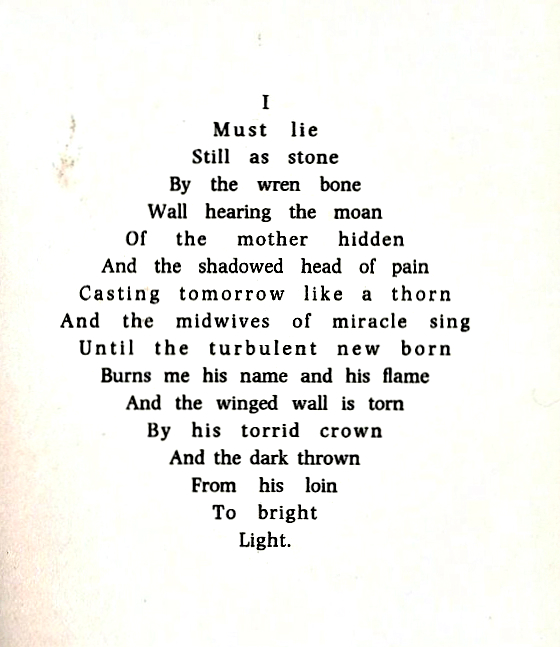
“I / Must lie” — Dylan Thomas

dt

From Dylan Thomas’s series of pattern poems, Vision and Prayer.

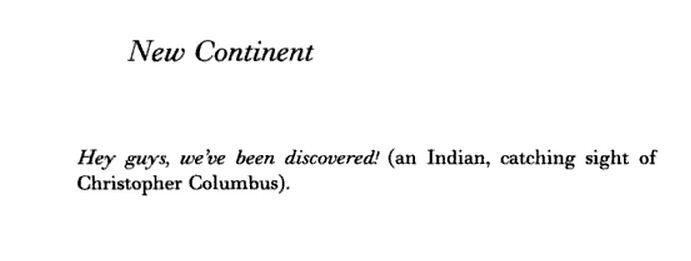
“New Continent” — Georges Perec

“People do gossip” — Sappho

sappho

“Everything human is pathetic” (Mark Twain)

human

“eavesdropping on my own thoughts” | Passage from + One-Sentence Riff on Evan Dara’s Novel The Lost Scrapbook

. . . In fact, this happens often—when I feel as if words, others’ words, have crowded mine out, and have left me no place; I do not know why, through what mechanism, this occurs, but when it does, and it is often, I find that I developed a need, an earnest yearning, for words that have not become sour and strange—that is, for words that are my own, words that are uniquely mine amid this foreign wash; and yet I find, when I look for such words—my words—none seem to be there: all of my words, upon the slightest inspection, seem so foreign to me, so much the work of others; and so I wonder how I can claim that anything that occurs in my consciousness is mine, and not the product of some othernesses; often I feel that I am not thinking so much as eavesdropping on my own thoughts, listening in on the narrative being told between othernesses—that it is the otherness thinking me; because none of it, in truth, seems to issue from me; even my unplanned cries, my most heartfelt exclamations, have been determined by others: I have noticed that it is precisely at times of highest emotion—when I am going to the deepest regions of my responses, to the deepest particularity of me—that my words, which would then seem to be at their most personal and spontaneous, are in fact at their most derivative, just pure banal cliché: oh my God!, Will you look at that!, I don’t believe it!; but where are my words, I wonder, my own thoughts?; it seems, sometimes, that I am a conduit and not a content—a transfer point, a capacitor, a pattern in waves; or, at most, I am a bricklayer, combining chunks of accepted solidity to wall out fresh perception; is this adolescent thinking?—

From Evan Dara’s novel The Lost Scrapbook.

I am really loving this book so far, this novel that moves through consciousnesses in a (yes, I’ll use that cliché that book reviewers so often grab for) dazzling performance, shifting through minds, monologues, dialogues, always a few steps (or more) ahead of its reader, beckoning though, inviting, calling its reader to participate in discussions (or performances) of art, science, politics, psychology, education, loneliness, ecology, family, fireflies, radio plays, alienation, voting trends, Chomskyian linguistics, Eisensteinian montage, theft, Walkman Personal Stereos, semiotics, one-man shows, drum sets, being ventriloquized—a novel that takes ventriloquism as not just a theme (as we can see in the citation above) but also as a rhetorical device, a novel that ventriloquizes its reader, throws its reader into a metaphorical deep end and then dramatically shifts the currents as soon as the reader has learned to swim, a novel of othernesses, a novel that offers content through conduits, patterns that coalesce through waves, a novel composed in transfer points, each transfer point announcing the limitations of first-person perspective, the perspective that the reader is logically and spiritually and psychologically beholden to—and then, perhaps, transcending (or at least producing the affective illusion of transcendence of) first-person perspective, and this (illusion of) transcendence, oh my, what a gift, what a gift . . .

“Thoreau” — Charles Ives

“Thoreau” — Charles Ives

Thoreau was a great musician, not because he played the flute but because he did not have to go to Boston to hear “the Symphony.” The rhythm of his prose, were there nothing else, would determine his value as a composer. He was divinely conscious of the enthusiasm of Nature, the emotion of her rhythms and the harmony of her solitude. In this consciousness he sang of the submission to Nature, the religion of contemplation, and the freedom of simplicity—a philosophy distinguishing between the complexity of Nature which teaches freedom, and the complexity of materialism which teaches slavery. In music, in poetry, in all art, the truth as one sees it must be given in terms which bear some proportion to the inspiration. In their greatest moments the inspiration of both Beethoven and Thoreau express profound truths and deep sentiment, but the intimate passion of it, the storm and stress of it, affected Beethoven in such a way that he could not but be ever showing it and Thoreau that he could not easily expose it. They were equally imbued with it, but with different results. A difference in temperament had something to do with this, together with a difference in the quality of expression between the two arts. “Who that has heard a strain of music feared lest he would speak extravagantly forever,” says Thoreau. Perhaps music is the art of speaking extravagantly. Herbert Spencer says that some men, as for instance Mozart, are so peculiarly sensitive to emotion … that music is to them but a continuation not only of the expression but of the actual emotion, though the theory of some more modern thinkers in the philosophy of art doesn’t always bear this out. However, there is no doubt that in its nature music is predominantly subjective and tends to subjective expression, and poetry more objective tending to objective expression. Hence the poet when his muse calls for a deeper feeling must invert this order, and he may be reluctant to do so as these depths often call for an intimate expression which the physical looks of the words may repel. They tend to reveal the nakedness of his soul rather than its warmth. It is not a matter of the relative value of the aspiration, or a difference between subconsciousness and consciousness but a difference in the arts themselves; for example, a composer may not shrink from having the public hear his “love letter in tones,” while a poet may feel sensitive about having everyone read his “letter in words.” When the object of the love is mankind the sensitiveness is changed only in degree.

But the message of Thoreau, though his fervency may be inconstant and his human appeal not always direct, is, both in thought and spirit, as universal as that of any man who ever wrote or sang—as universal as it is nontemporaneous—as universal as it is free from the measure of history, as “solitude is free from the measure of the miles of space that intervene between man and his fellows.” In spite of the fact that Henry James (who knows almost everything) says that “Thoreau is more than provincial—that he is parochial,” let us repeat that Henry Thoreau, in respect to thought, sentiment, imagination, and soul, in respect to every element except that of place of physical being—a thing that means so much to some—is as universal as any personality in literature. That he said upon being shown a specimen grass from Iceland that the same species could be found in Concord is evidence of his universality, not of his parochialism. He was so universal that he did not need to travel around the world to PROVE it. “I have more of God, they more of the road.” “It is not worth while to go around the world to count the cats in Zanzibar.” With Marcus Aurelius, if he had seen the present he had seen all, from eternity and all time forever. Continue reading ““Thoreau” — Charles Ives”

“The Yellow Chimney” — William Carlos Williams

wcw

“Memory” — Two Notes from Samuel Butler’s Note-Books

Memory

i

Memory is a kind of way (or weight – whichever it should be) that the mind has got upon it, in virtue of which the sensation excited endures a little longer than the cause which excited it.  There is thus induced a state of things in which mental images, and even physical sensations (if there can be such a thing as a physical sensation) exist by virtue of association, though the conditions which originally called them into existence no longer continue.

This is as the echo continuing to reverberate after the sound has ceased.

ii

To be is to think and to be thinkable.  To live is to continue thinking and to remember having done so.  Memory is to mind as viscosity is to protoplasm, it gives a tenacity to thought – a kind of pied à terrefrom which it can, and without which it could not, advance.

Thought, in fact, and memory seem inseparable; no thought, no memory; and no memory, no thought.  And, as conscious thought and conscious memory are functions one of another, so also are unconscious thought and unconscious memory.  Memory is, as it were, the body of thought, and it is through memory that body and mind are linked together in rhythm or vibration; for body is such as it is by reason of the characteristics of the vibrations that are going on in it, and memory is only due to the fact that the vibrations are of such characteristics as to catch on to and be caught on to by other vibrations that flow into them from without – no catch, no memory.

—From Samuel Butler’s Note-Books.

“The Story of the Tramp” — Thomas Bernhard

The STORY OF THE TRAMP

In the larch wood he ran into a tramp. His first thought had been that it might be the escaped showman, but the tramp was nothing to do with that. Not at all. The painter had been startled, because he had failed to see the tramp, and tripped over him. “Like a corpse lying in the middle of the road,” says the painter. A hypothermia victim, he had thought, and taken a step back. From the man’s clothes, he could tell he wasn’t from here. Where is he from? “Striped pants, you know, the sort that circus people wear, particularly circus directors.” Assuming the man was dead, he had tried to flip him over with his stick so that he could see his face, “because the fellow was lying facedown. It’s natural to want to see someone’s face,” said the painter. But no sooner had he applied the stick to the “dead man,” than he had emitted a scream and leaped to his feet. “Oh,” the tramp is said to have said, “I was just playing dead, I wanted to see what happened when someone comes across somebody else, lying flat on his front like a dead man, in the road, in the middle of the forest and the middle of winter.” With those words, the tramp had got up, and brushed down his pants. “If you think I’m the escaped showman, you’re mistaken, I have nothing to do with those showmen. You don’t have to worry about that. Let’s shake!” He held his hand out to the painter, and introduced himself. “He gave me such a complicated name that I was unable to remember it,” said the painter. “Then he buttoned up his coat, which must have come undone. A dignified but completely reduced appearance,” said the painter. “It could just as easily have been a trap, I mean, God knows whom I could have encountered.” That was no one’s idea of a joke, the painter had said, one did not simply play dead, that was a prank, a silly prank of the sort teenagers might indulge in, to give their parents a fright. “Just imagine if the shock had given me a heart attack!”—“Then I would have run off,” the tramp is said to have replied. Anyone could have a heart attack at any time. “Yes. Of course.”—“No involvement from any other party would have been suspected,” the tramp is supposed to have said. “Of course not,” the painter. In any case the road was full of tracks, who would have taken the trouble to trace all the different footwear. “No, of course not. If you should happen to be in financial straits,” the painter is supposed to have said, “then I must point out to you that I have no money. I am a poor man, and my situation is miserable.”—“Oh,” the tramp is supposed to have replied, “I’ve got enough money.” He was amazed that the painter should take him for a robber, was it perhaps the fault of the circus pants he was wearing. “Oh, no,” the painter is supposed to have said, “I’m an artist myself.”—“It’s remarkable how little understanding is displayed by people one would expect to have a lot of understanding,” the tramp is supposed to have said. Besides, he did not dislike the painter. “When I heard someone approaching, I lay down in the road. It was just an experiment.”—“An experiment,” the painter is supposed to have said again. “Yes, an experiment. And what happened is exactly what I thought would happen. I listened to every step you took. The way you walk, it’s as though you were on deer hooves,” the tramp said. “I had a fantastic image of you in my head as you approached. A completely fantastic image of you!” His pronunciation was a little northern, it might be that he was from Holstein or Hamburg. “A deer is coming to present itself to me,” he said, and: “That was pure poetry.” The painter: “I understand.” What profession did the tramp pursue, inquired the painter. “I am the owner of a movable theater,” he is supposed to have replied. “The way you’re dressed, one would have thought you’d just come from some rather dubious society piece,” the painter is supposed to have said. “You’re not a million miles out there,” the tramp: “I appeared in this costume three hundred times in Frankfurt am Main. Till I could stand it no longer, and ran away. You should try playing the same part in a play three hundred times, and a pretty boring play at that, a so-called George Bernard Shaw play, and you’ll go crazy too.” But he was surely a man who could live by his jokes. “Oh, I should say so too. I have always lived by my jokes.”—“And how do you propose to continue now? Since, as I am forced to assume, you are pretty much at loose ends, drifting here and there? How do you mean to continue?”—“I never asked myself that,” the tramp is said to have answered. Since he, the tramp, the theater manager, the director of a so-called movable theater, had no children, it wasn’t so very difficult to live “unto the day.” But was that entirely realistic, said the painter. Men of his (the tramp’s) type had freedom, disrepute, and humor written in their faces. “I am said to have picked up a few magic tricks from my father,” the tramp is supposed to have said, “that everyone likes. For instance how to make my head disappear. It’s very easy.” He could do a demonstration, “if the gentleman cared to see,” and the painter did care, and the tramp duly made his head disappear. “The man only extended as far as his Adam’s apple. What I say is true. It may strike you as thoroughly implausible, but it’s as true as the fact that I’m standing in front of you now. The whole appearance of that tramp … And just imagine this whole scene taking place in the middle of the larch wood, where we take the fork down into the ravine …” Then, in a trice, the tramp’s head was back in its original place. “That’s just a simple trick, making my head disappear,” said the tramp, “what’s harder is playing ball with your own legs.” Of course the painter wanted to see that magic trick as well. And suddenly the tramp’s legs came down from the sky, and he hunkered down on the ground and played ball with them, kids’ ball games. While he was playing, he said: “I’ll stop right away if you feel scared.” The painter could feel a shiver, but he still said: “No, no, I’m not scared.” He was, as you say, astounded by what was put on for him. “I have never seen such consummate magic tricks,” he said. “Now I’m too bored to go on,” the tramp is supposed to have said, and he stopped. “The thing with the head was as baffling to me as the other one, with the legs,” the painter said, “can you imagine it? Of course, as with everything, there must be some sort of knack to it!” All Paris had lain at the tramp’s feet, and if he felt like it, it would lie at his feet again, only he didn’t feel like having Paris lying at his feet again. “I’m bored.” In London he had been presented to the queen. If the gentleman would like it, he would be happy to give him the address of his movable theater. “It’s small, but exquisite,” he is supposed to have said, “and it can go into action anywhere you require.” It was the most exquisite of theaters. The most exquisite theater in the world. But one day he was fed up with magic tricks—“it’s so easy to get fed up with magic tricks”—and had turned instead to pure, true art, the sort of art that isn’t dependent on magic tricks. Now, he was sure the gentleman would love to know which was harder, to perform magic tricks of the sort he had just performed, and which were unquestionably among the best in the world, or else to act in straight theater, to put over a true art form, then, as exemplified by the theater, an art without tricks, as for instance, “playing King Lear.” They were both equally difficult, one was harder than the other, but it was a better thing to act in a play than to perform tricks, he personally found acting far more satisfying, and for that reason he had magicked up his movable theater “out of thin air,” as he said. “Though, of course that too was a stunt, a sort of trick,” said the tramp. Acting, moreover, was highly intellectual, whereas performing magic tricks wasn’t intellectual at all. Only the trick itself was. “Of course it always comes down to the audience.” And he said, supposedly: “The audiences for my magic tricks are a thousand times dearer to me than the audiences who watch me acting.” The audiences for his tricks would know right away what it was that was so astounding to them, whereas the audiences for his acting never seemed to know. “Theater audiences are invariably disappointing. Audiences for magic tricks never are.” And yet he would rather act, even though he was better suited to doing tricks. “Theater audiences don’t make me any happier than magic-trick audiences,” he said. “Audiences for magic tricks are as they are. Theater audiences are never as they are, they are always as they ought not to be, they want to be as they are not …” The audiences for magic tricks were never so stupid that they failed to realize how stupid they were, but theater audiences were, if anything, more stupid. “Most actors are so stupid they don’t even notice how stupid the audiences are. Because in general actors are even more stupid than audiences, even though an audience is infinitely stupid.” Why did he not demonstrate any more magic tricks, the painter wanted to know. “Magic tricks of themselves are not satisfying,” the tramp is supposed to have said, “but a play can be satisfying in itself.” He didn’t know, anyway, why he now preferred acting to demonstrating magic tricks. Right at the moment, he wasn’t doing one thing or the other. “But I will demonstrate my magic tricks again!” he is supposed to have said, “and Paris will lie at my feet again!” Then he supposedly asked what the quickest way down to the station was. “Go down the ravine,” the painter told him. Then: “I’d like to know at what age magic tricks of themselves are no longer satisfying.” The tramp reflected briefly and said: “That’s different in each performer’s individual case. But often the magic tricks are no longer satisfying, even before they have been mastered,” he is supposed to have said. The painter offered to accompany the tramp part of the way down the ravine. “I know my way around here,” he is supposed to have said. “You lose your footing somewhere, and you’ll break a leg. Come with me!” Before they parted, the painter asked him: “What was it that prompted you to try that silly nonsense out on me?”—“Silly nonsense?” the tramp is supposed to have answered. “You mean, playing dead in front of you? That’s a passion of mine, that’s all.” And then he suddenly disappeared. “He was as supple as you’d expect a performer of magic tricks to be,” the painter said. “I’ve never met anyone like that, who claims to be the proprietor of a ‘movable theater.’ Or do you think I’ve made up the whole story?” I think it’s true myself.

–From Thomas Bernhard’s novel Frost.