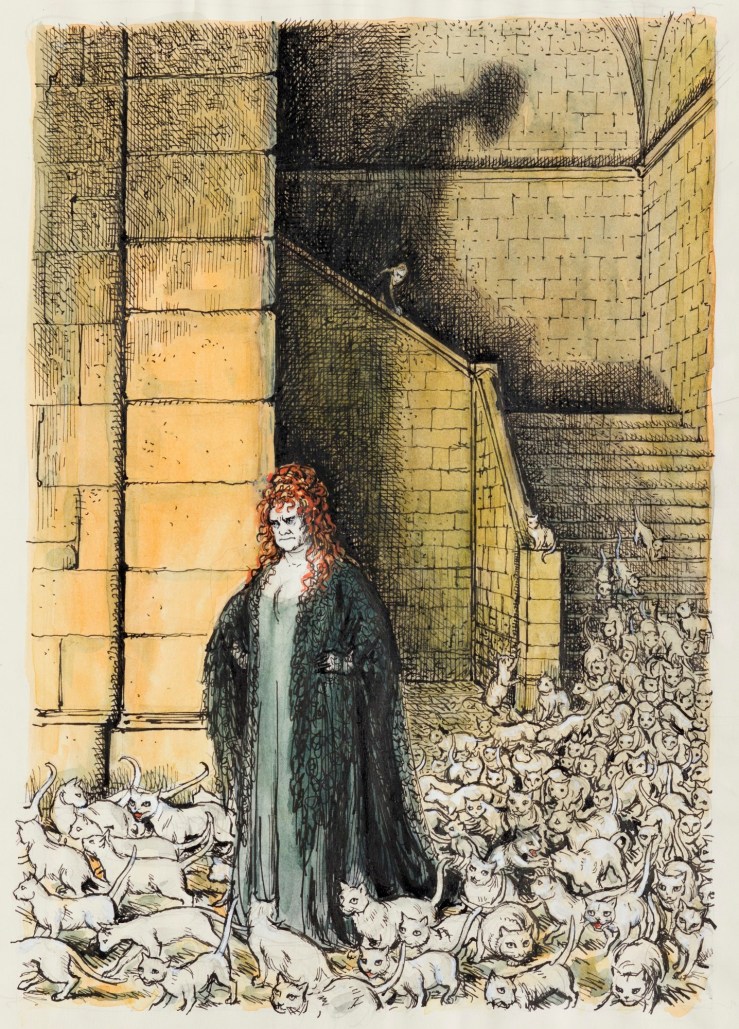
On the Way to the Doctor, 1974 by Charles W. Stewart (1915 – 2001).
Part of a series of unpublished illustrations that were to illustrate Mervyn Peake’s 1950 novel, Gormenghast. (More here.)
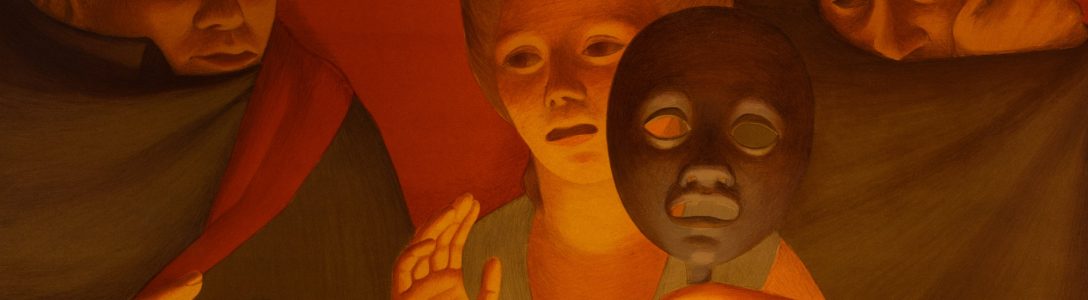
On the Way to the Doctor, 1974 by Charles W. Stewart (1915 – 2001).
Part of a series of unpublished illustrations that were to illustrate Mervyn Peake’s 1950 novel, Gormenghast. (More here.)
On Sunday, I came up with a list of 64 writers that have written novels or stories that either anticipate, reflect, or otherwise describe our zeitgeist. The first dozen or so seeds (as well as the bottom dozen or so) came rather intuitively to me, but the writers in the middle were seeded somewhat randomly. I used Twitter’s poll feature to determine the winners of Round One. In most of my polls, I included a third option, where voters could choose just to see the poll results instead of actually voting; I won’t be doing that going forward, because the data looks, if not exactly skewed, well, just a little off-putting, as in Round 1, Bracket 8 below:
My intuition is that Disch (Camp Concentration) and Walter Miller (A Canticle for Leibowitz) were either too obscure for many folks, or at least not writers very many people are passionate about.
Sinclair Lewis (It Can’t Happen Here) tied with China Miéville (Marxism, steampunk, Perdido Street Station, bold baldness) and went to a tie (I managed to misspell China Miéville’s name in both tweets)—
I was also surprised by top-ten seed Octavia Butler (Kindred, Parable of the Sower) losing to José Saramago (Blindness). I suppose I seeded Saramago too low.
Here are the results of Round One and the match-ups for Round Two:




Bracket 46 is particularly painful for me!
Poll results by tweet:
Everything Bartleby says in Herman Melville’s “Bartleby”:
“I would prefer not to.”
“I would prefer not to.”
“I would prefer not to,” said he.
“What is wanted?”
“I would prefer not to,” he said, and gently disappeared behind the screen.
“I would prefer not to.”
“I prefer not to,” he replied in a flute-like tone.
“I would prefer not to.”
“I would prefer not to.”
“I prefer not.”
“I prefer not to,” he respectfully and slowly said, and mildly disappeared.
“I would prefer not to.”
“I would prefer not to.”
“At present I prefer to give no answer,” he said, and retired into his hermitage.
“At present I would prefer not to be a little reasonable,” was his mildly cadaverous reply.
“I would prefer to be left alone here,” said Bartleby, as if offended at being mobbed in his privacy.
Upon asking him why he did not write, he said that he had decided upon doing no more writing.
“No more.”
“Do you not see the reason for yourself,” he indifferently replied.
“I have given up copying,” he answered, and slid aside.
“I would prefer not,” he replied, with his back still towards me.
“Not yet; I am occupied.”
“I would prefer not to quit you,” he replied, gently emphasizing the not.
“Sitting upon the banister,” he mildly replied.
“No; I would prefer not to make any change.”
“There is too much confinement about that. No, I would not like a clerkship; but I am not particular.”
“I would prefer not to take a clerkship,” he rejoined, as if to settle that little item at once.
“I would not like it at all; though, as I said before, I am not particular.”
“No, I would prefer to be doing something else.”
“Not at all. It does not strike me that there is any thing definite about that. I like to be stationary. But I am not particular.”
“I know you,” he said, without looking round,—”and I want nothing to say to you.”
“I know where I am,” he replied, but would say nothing more, and so I left him.
Maybe you’re bored, maybe you’re stuck inside, missing NCAA March Madness, watching the world’s madness through a screen. Maybe this will be a diversion. (I’m hoping it’s a diversion for me.)
I came up with a list of 64 writers that have written novels or stories that either anticipate, reflect, or otherwise describe our zeitgeist. (I realize now that I’ve forgotten a bunch, but, hey.) After a certain point, there wasn’t much thought put into seeding the tournament.
I’ll be doing running polls on Twitter for the next few days, starting today, with brackets 1-4 launching today.
Here are the brackets for Round 1:



This is a clipping of W.G. Rogers’ (circa 1973) review of Gravity’s Rainbow (click on the image to enlarge it). The marginal annotation is by William Gaddis:
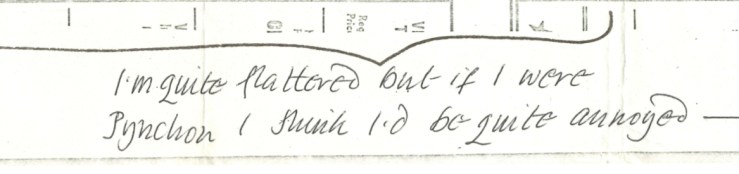
Rogers’ review of Gravity’s Rainbow is eleven paragraphs long in two columns. The final three paragraphs are devoted to a comparison with The Recognitions (this comparison takes up about three quarters of the second column). Rogers refers to Gaddis’s novel as Recognitions.
The final paragraph reads:
Gaddis could have written Gravity’s Rainbow and Pynchon could have written Recognitions [sic].That two hearts can beat as one is no proof two minds can. Would we not expect Gaddis to use his own respected name? Could there be two separate master hands? I suppose so, but…
Gaddis published his second novel J R, two years later, in 1975.
This document is part of the William Gaddis Papers collection at Washington University. I saw it earlier this morning thanks to Reddit user Signor Mantissa.
Author Wells Tower (who, come on and finish a novel or another story collection or something, please) has a nice obituary in The New Yorker today for the novelist Charles Portis. From Tower’s essay:
“Only a mean person won’t enjoy it” is something a critic once wrote about True Grit. In part, I love Portis because I feel less mean when I read him. It’s not just that his novels are gentle and funny; it’s that Portis’s books have a way of conscripting the reader into their governing virtues—punctuality, automotive maintenance, straight talk, emotional continence. Puny virtues, as Portis himself once put it, yet it is a great and comforting gift (in these days especially) to offer readers escape into a place where such virtues reign.
It’s hard to know whether Portis’s work ushered much comfort into his own life. My sense is that he was lonely. I imagine he had a fair bit in common with Jimmy Burns, described in Gringos as a “hard worker,” “solitary as a snake,” and, yes, “punctual.” Portis never married and had no children. He never published another novel after Gringos, from 1991. The closest he gets to self-portraiture comes in his short memoir “Combinations of Jacksons,” the essay published in The Atlantic. Toward the essay’s close, the author spots an “apparition” of his future self in the form of a geezer idling his station wagon alongside Portis at a traffic light in Little Rock. He wore “the gloat of a miser,” Portis writes. “Stiff gray hairs straggled out of the little relief hole at the back of his cap. . . . While not an ornament of our race, neither was he, I thought, the most depraved member of the gang.”
Read Tower’s review of Portis’s final novel Gringos here.
“Sophocles”
by
Gordon Lish
from Self-Imitation of Myself (1997)
Take egg. Boil until hard-cooked. Crack shell. Hold under running water. Remove shell. Set shell aside. Peel away white. Set white aside. Use heel of spoon to mash yolk in midsize mixing bowl. Add one teaspoon heavy cream, one tablespoon granulated sugar, one teaspoon confectioners’ sugar, three teaspoons almond extract, dash salt. Blend until blended consistency has been achieved. Set mixture aside. Take half cup shortening, two cups sifted flour, one teaspoon salt, four tablespoons ice water. Press with fork. Melt two sticks unsalted butter and fold in. Add two teaspoons vanilla extract. Shake in ground cinnamon and nutmeg to taste. Cover with dampened towel and set aside in warm, dry place. Core eight apples. Cream three bananas. Take one cup sour cream, half cup sweet cream, quarter cup molasses. Blend three tablespoons dark brown sugar with quarter cup unsalted butter. Add half teaspoon baking powder. Turn when bubbles appear. Set mixture aside. Heat bacon drippings, peanut oil, and corn oil in shallow frypan. Drain excess onto brown paper bag. Pour remainder into buttered casserole. Sprinkle with paprika. Pat dry. Remove from pan. Allow milk to “billow.” Cut in four servings of finely chopped cabbage. Put seven egg yolks, two pints buttermilk into large mixing bowl. Beat until ingredients are thoroughly moistened. Resolve butter while gradually adding sugar. Add egg mixture to hot milk in saucepan. Set aside and take two tablespoons strained orange juice and eight-ounce jar apricot preserves. Cut pecans coarsely. Pour and spoon into prepared pan. Add half cup condensed milk, half cup evaporated milk, whole cup skim milk. Cook until substance has clarified. Let cool before refrigerating. Then bring gently to boil. Stir in apples and “shave” top with well-chilled knife. Beat vigorously until thick. Set this aside. Crush four vanilla beans with curd mallet. Divide with scissors into one-inch pieces. Transfer mixture to baking tin. Core more apples. Fold in eggs. Fold in pecans. Beat until stiff. Where’s your cooked egg white? Don’t forget your cooked egg white! Cut shortening into safflower oil. Remove cabbage from double boiler. Steam and then spread until surface is crumbly. Beat with whisk. Set aside. To begin sauce, take one quart okra, two pints tomatoes, two chopped onions, salt and pepper to taste. Take off skin and slice thin. Shake until greens are engulfed. Combine and keep beating. Prepare greased sheet. Allow contents to regroup. Dice and remove grated walnuts. Mixture is “ready” when peaks appear. Set aside and boil without stirring. Is it brittle? Discard and start again if brittle. What happened to vanilla beans? Crush more vanilla beans. Take creamed bananas. Pat dry. Remove from bowl. Lift gently. Combine. Fold back towel. You dampened it, didn’t you? Didn’t you dampen it? You didn’t, you didn’t, you didn’t dampen it! You took this for a joke and didn’t fucking dampen it, did you? See the brittleness? Weren’t you warned? You were warned, weren’t you?
Take egg.
No, forget it — don’t take egg.
Go get eight pounds stewing meat.
Hack away gristle.
Hack away suet.
Rip out bone.
February 11th.–I have been measuring coal all day, on board of a black little British schooner, in a dismal dock at the north end of the city. Most of the time I paced the deck to keep myself warm; for the wind (northeast, I believe) blew up through the dock, as if it had been the pipe of a pair of bellows. The vessel lying deep between two wharves, there was no more delightful prospect, on the right hand and on the left, than the posts and timbers, half immersed in the water, and covered with ice, which the rising and falling of successive tides had left upon them, so that they looked like immense icicles. Across the water,however, not more than half a mile off, appeared the Bunker Hill Monument; and, what interested me considerably more, a church-steeple, with the dial of a clock upon it, whereby I was enabled to measure the march of the weary hours. Sometimes I descended into the dirty little cabin of the schooner, and warmed myself by a red-hot stove, among biscuit-barrels, pots and kettles, sea-chests, and innumerable lumber of all sorts,–my olfactories, meanwhile, being greatly refreshed by the odor of a pipe, which the captain, or some one of his crew, was smoking. But at last came the sunset, with delicate clouds, and a purple light upon the islands; and I blessed it, because it was the signal of my release.
Nathaniel Hawthorne’s journal entry for February 11th, 1840. From Passages from the American Note-Books.
One hot night a leopard came into my room and lay down on the bed beside me. I was half asleep and did not realize at first that it was a leopard. I seemed to be dreaming the sound of some large, soft-footed creature padding quietly through the house, the doors of which were wide open because of the intense heat. It was almost too dark to see the lithe, muscular shape coming into my room, treading softly on velvet paws, coming straight to bed without hesitation, as if perfectly familiar with its position. A light spring, then warm breath on my arm, on my neck and shoulder, as the visitor sniffed me before lying down. It was not until later, when moonlight entering through the window revealed an abstract spotted design, that I recognized the form of an unusually large, handsome leopard stretched out beside me.
The first paragraph of “A Visit” by Anna Kavan. Originally published in Julia and the Bazooka (1970); reprinted in Machines in the Head: Selected Stories of Anna Kavan, forthcoming from NYRB.

926 Years is a collaboration between Kyle Coma-Thompson and Tristan Foster. The book consists of 22 stories, each a paragraph long, and each paragraph no longer than the front and back of a 4.5″ x 7″ page. Each story is titled after a character plus the character’s age (e.g. “Chaplain Blake, age 60”; “Sebastian, age 30”; “Marty Fantastic, age 81”). (I have not done the math to see if all the ages add up to 926.) Although the characters never meet in the book’s prose, key sentences suggest that they may be connected via the reader’s imagination.
Indeed, the blurb on the back of 926 Years describes the book as “twenty-two linked stories.” After reading it twice, I don’t see 926 Years so much as a collection of connected tales, but rather as a kind of successful experimental novel, a novel that subtly and reflexively signals back to its own collaborative origin. Coma-Thompson lives in Louisville, Kentucky and Foster lives in Sydney, New South Wales. They’ve never met in person. And yet they share a common language, of course, and other common cultural forces surely shape their prose. (Melville’s Ishmael refers to Australia as “That great America on the other side of the sphere” in Ch. 24 of Moby-Dick.)
The book’s prose offers a consistency to the apparently discontinuous narrative pieces that comprise 926 Years. My first assumption was that Coma-Thompson and Foster traded narratives, but as I read and re-read, the prose’s stylistic consistency struck me more as a work of synthesis, of two writers tuning to each other and humming a new frequency. The sentences of 926 Years are predominantly short, and often fall into fragmentation, or elide their grammatical subject. Here’s an example from “Shelley Valentine, age 34”:
A flare of sansho pepper on the tongue tip. Catch the tree at the right time of year and the fruit bursts, raining peppercorns down. Maybe like the season when pistachios open, the night snapping like broken locust song. Used for seasoning eel. Sansho leaves for garnishing fish. Clap it between the hands for aroma, make a wish, the finishing touch to the perfect soup. In Korea, the unripe fruit was used for fishing. Poisonous to the smallest ones. That was cheating wasn’t it? Or was pulling up the fish all that mattered?
Eventually we can attribute these fragmented thoughts to Shelley Valentine, now well out of her magic twenties, drinking sansho-peppered gin and tonics in a “New bar, same lost , of course.” She’ll leave alone.
The characters in 926 Years move between isolation and connection, between fragmentation and re-integration. Here’s Larry Hoavis (age 47, by the way), sitting in a lawn chair in his rural backyard:
Why does it feel lonely, sitting and watching? Nature in its subtle power and monotony, pre-Internet to the core, unconscious of its enormity. No one. No one knows he’s even here. The house at his back. Divorced. His ex elsewhere, how he loved her, hurt her, himself. Why’s it beautiful, why’s it comforting, that no one knows?
Hoavis’s lonely transcendental private (and tequila-tinged) reverie of disconnection reinforces 926 Years’ themes of interconnection coupled with disintegration. In one of my favorite tales, “Lew Wade Wiley, age 55,” we learn of the “Spoiled heir of the Prudential fortune” who collects other people’s lives. He has them brought to his Boston penthouse to offer
…their worst fears, desires, the messy embarrassments of their commonalities…these he worked into undead monotone prose, the diary of Lew Wade Wiley, and so lived fuller than anyone who’d opened a newspaper to read those advertisements, wrote to that listed address, knocked at his penthouse door.
The adjective “undead” above fits into a resurrection motif that floats through 926 Years, whether it be the lifeforce of currency or the proverbial powers of cats to cheat death. Sometimes the resurrection is a kind of inspiriting force, as one character, overwhelmed by aesthetic possibility that “knocked the air out of him” experiences: “It had reminded him of a moment in a childhood that wasn’t his.”
Elsewhere, we see resurrection at a genetic level, as in “Mrs. Anderson, age 67,” whose psychologist describes to her the “cherry blossom” experiment, the results of which suggest that fear and anxiety to specific aesthetic stimuli can be passed down from generation to generation.
Reincarnation becomes both figurative and literal in the case of the lounge star Marty Fantastic, “Eighty-one-year-old darling with ten faces (one for each lift)…The plague of identities—who to be tonight, Peggy Lee, Rod Stewart, Cole Porter, Journey?” The oldest (and penultimate) character in 926 Years, Marty reflects on his own death as he gazes at his audience: “The songs of their future–what about those? They lyrics set in stone, the melodies: unknown.” The lovely little couplet suggest a complex relationship of aesthetic substance and aesthetic spirit.
The final piece in 926 Years–well, I won’t spoil it, I’ll simply say it kept me thinking, made me happy in a strange, nervous way. It features the youngest character in the book, and it points clearly if subtly to the book’s affirmation of imaginative and aesthetic possibility as a kind of crucial lifeforce. I’ll close instead with something from the book’s third tale, a little moment early on when 926 Years clicked for me:
Much as the geese and other such birds at the beginning of winter months fly south towards more temperate climates, it’s the nature of human beings to move in unconscious arrow formation as well. They take turns, leading the pack. The burden of cutting resistance through the air, something they share. Others fly, you see, in the wake; and that is why they form a V. The wake makes for easy flying, particularly at the furthest, outermost edges. The ones in the rear work less, conserve strength, eventually make their way towards the top of the V, tip of the arrow, then when it’s time and the leader has tired, assume the vanguard position. It is written into them by instinct to share the effort, burrowing southwards through the sky; that nevertheless sky we all live below.
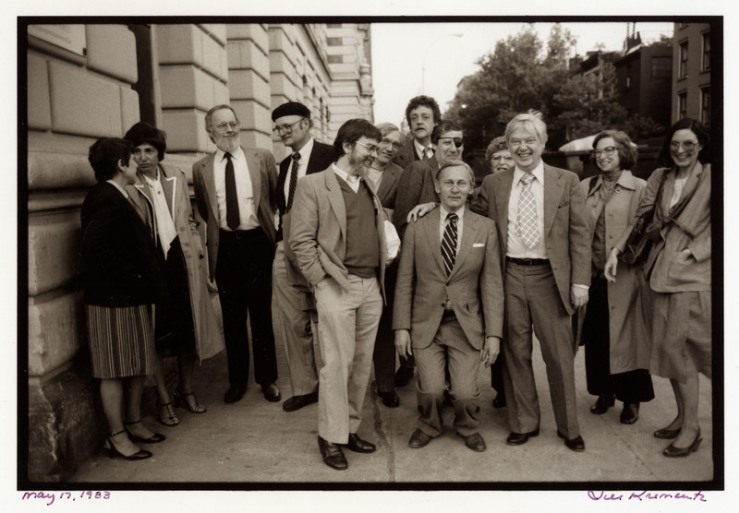
Photograph from “The Postmodernists Dinner,” 1983 by Jill Krementz (b. 1940)
From the University of Houston’s collection of Barthelme’s papers. The entry’s description:
Left to right: unidentified, unidentified, Donald Barthelme, John Barth, Robert Coover (turned), unidentified, Kurt Vonnegut, Walter Abish (with patch), William Gaddis (squatting), unidentified, William Gass, unidentified, unidentified. In 1983, Barthelme arranged a “Postmodernists Dinner” for the group of writers who were often lumped together under the “postmodernist” label. The reclusive Thomas Pynchon declined the invitation.
It would be swell if anyone could identify the women in the photograph. [Ed. note–the woman to Walter Abish’s left (behind Gass) is the artist Cecile Abish, Walter’s wife. Thanks to Terry in the comments.]
In his 2009 Barthelme biography Hiding Man, Tracy Daugherty offers the following recollection of the “Postmodernist Dinner” from novelist Walter Abish:
Around this time — in the spring of 1983 — “Donald had this idea to make a dinner in SoHo,” says Water Abish. “A major dinner for a group of writers, and he planned it very, very carefully. It was a strange event. Amusing and intriguing. He invited…well, that was the thing of it. The list. I was astounded that he consulted me but he called and said, ‘Should we invite so-and-so?’ Naturally, I did the only decent thing and said ‘Absolutely’ to everyone he mentioned. I pushed for Gaddis. Gass was there, and Coover and Hawkes, Vonnegut and his wife, Jill Krementz, who took photographs, I think. Don’s agent, Lynn Nesbit, was there. She was always very friendly. Susan Sontag was the only woman writer invited.
Daugherty continues:
Pynchon couldn’t make it. He wrote Don to apologize. He said he was ‘between coasts, Arkansas or Lubbock or someplace like ‘at.”
Abish recollects that the meal was at a very expensive restaurant, prefix, and the writers had to pay their own way. There were about 21 attendees, and Barthelme was “Very, very dour.”
Here is Pynchon’s letter declining the invite (via Jessamyn West, both on Twitter and her wonderful Donald Barthelme appreciation page):
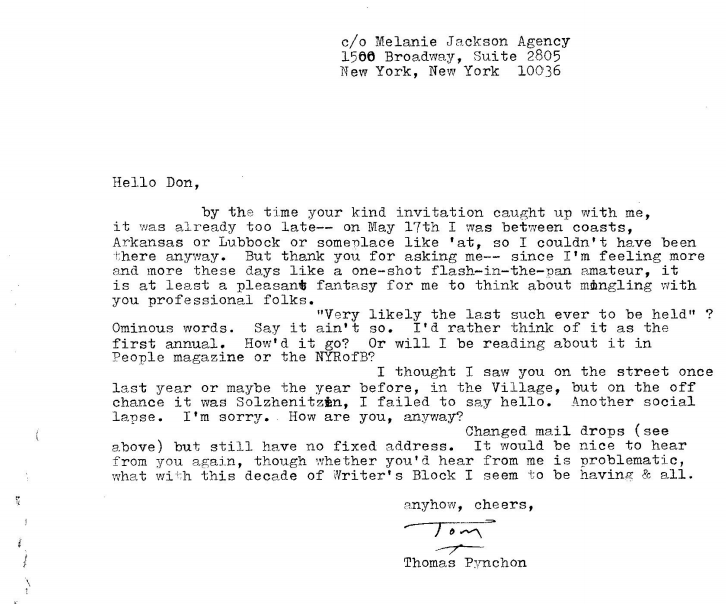
I had never seen the photograph until today when Ethelmer shared it with me on Twitter. Thanks!
There’s a little bit of terror to almost all the good stuff I recall in literature, a little bit of terror, like Heart o f Darkness. I love the ghost story. I love to go after mysteries. I think all the best stories I have ever read are very close to ghost stories. I have no interest, by the way, in Poltergeist. But I am interested in the mysterious X, the big force behind something perceived. We’re usually not privy to too many of those things ourselves. But our friends have lived them. Of course I grew up in the Vietnam era. My classmates fought the war, came back with their tales— it still works on the heads of people my age, because it was a fantastic zone, that some of the veterans can’t even acknowledge happened nowadays, you know? But there are other places you’ve been that are—Denis Johnson examines these things-zones of irreality that had not only horror, but some sweetness. The writer ought to go into these other zones and come back like a spy, and tell us something exciting. And move us. And sometimes disgust us. There’s not enough of that now.
It is a relief to turn to the honest American book about the whale. A captain wants to kill it because the last time he tried to do that it bit off his leg while escaping. He embarks with a cosmopolitan crew who don’t like home life and prefer this way of earning money. They are brave, skilful and obedient, they chase the whale round the world and get themselves all drowned together: all but the storyteller. He describes the world flowing on as if they had never existed. There are no women or children in this book, apart from a little black boy whom they accidentally drive mad.
From Alasdair Gray’s unwieldy cult classic Lanark. In this particular episode, a version of the author of the novel Lanark itself (a conjurer-king, not named Gray) discusses and describes the great national epics; he chooses Moby-Dick as the American epic. There is no listing of a Scottish national epic; presumably Gray intends his novel to fill that slot.
The more he worked the more the furious figure of God kept popping in and having to be removed: God driving out Adam and Eve for learning to tell right from wrong, God preferring meat to vegetables and making the first planter hate the first herdsman, God wiping the slate of the world clean with water and leaving only enough numbers to start multiplying again, God fouling up language to prevent the united nations reaching him at Babel, God telling a people to invade, exterminate and enslave for him, then letting other people do the same back. Disaster followed disaster to the horizon until Thaw wanted to block it with the hill and gibbet where God, sick to death of his own violent nature, tried to let divine mercy into the world by getting hung as the criminal he was. It was comical to think he achieved that by telling folk to love and not hurt each other. Thaw groaned aloud and said, “I don’t enjoy hounding you like this, but I refuse to gloss the facts. I admire most of your work. I don’t even resent the ice ages, even if they did make my ancestors carnivorous. I’m astonished by your way of leading fertility into disaster, then repairing the disaster with more fertility. If you were a busy dung beetle pushing the sun above the skyline, if you had the head of a hawk or the horns and legs of a goat I would understand and sympathize. If you headed a squabbling committee of Greek departmental chiefs I would sympathize. But your book claims you are a man, the one perfect man of whom we are imperfect copies. And then you have the bad taste to put yourself in it. Only the miracle of my genius stops me feeling depressed about this, and even so my brushes are clogged by theology, that bastard of the sciences. Let me remember that a painting, before it is anything else, is a surface on which colours are arranged in a certain order.
From Alasdair Gray’s novel Lanark.

Christmas is here, so let me recommend a Christmas novel for you: Ishmael Reed’s The Terrible Twos (1982). I read it back in unChristmasy August and dipped into it a bit again today, looking for a passage or two to share. Maybe the bit where Santa Claus starts an anti-capitalist riot in Times Square?, or where the First Lady is electrocuted while lighting the White House Christmas tree?, or where the idiot U.S. President meets Harry Truman in A Christmas Carol tour of hell? I scrounged for a big fat citation that works on its own, but I kept wanting to build a frame, set a stage, and ended up with this instead, a “review,” a recommendation. A stage setting. Of course, Ishmael Reed’s novels create their own stages, their own contexts and rhythms, and each paragraph, each sentence, each note fits into that context, blaring or humming or blasting the reader. Reed’s satire is simultaneously bitter and salty and sweet and sharp sharp sharp, the sort of strange rich dish you gobble up too fast and then, Hell!, it gives you weird dreams. For months.
But nice fat slices of Reed’s prose can be served on their own, as John Leonard’s 1982 NYT review of The Terrible Twos shows. Leonard’s review is ten paragraphs long and he quotes Reed in full for two of those paragraphs, including this one, the longest paragraph in the piece:
Two-year-olds are what the id would look like if the id could ride a tricycle. That’s the innocent side of 2, but the terrible side as well. A terrible world the world of 2-year-olds. The world of the witch’s door you knock on when your mother told you not to go near the forest in the first place. Pigs building houses of straw. Vain and egotistic gingerbread men who end up riding on the nose of a fox. Nightmares in the closet. Someone is constantly trying to eat them up. The gods of winter crave them – the gods of winter who, some say, are represented by the white horse that St. Nicholas, or St. Nick, rides as he enters Amsterdam, his blackamoor servant, Peter, following with his bag of switches and candy. Two-year-olds are constantly looking over their shoulders for the man in the shadows carrying the bag. Black Peter used to carry them across the border into Spain.
Leonard (who describes the paragraph as “a kind of jive transcendence”— I’ll settle for “transcendence”) offers up this nugget as a condensation of Reed’s themes and mythologies. The paragraph neatly conveys the central idea of Reed’s novel, that American capitalism refuses to allow its subjects to Grow Up. It’s a tidyish paragraph. Tidyish. Reed always sprawls into some new mumbo jumbo. The anarchic energy of his prose digs up old mythologies, boots skeletons out closets, and makes all the old ghosts of Western history sing and dance.
So there’s a lot going in The Terrible Twos’ not-quite 200 pages. Should I take a stab at unjumbling the plot? Okay, so: Reagan is elected president. Things are bad. Rough for, like, the people. Fast forward a few terms, to the early/mid-nineties (Reed’s future…this is a sci-fi fantasy). Former fashion model Dean Clift ascends to the Presidency. Only he’s just a puppet for his cabinet, a cabal of war-profiteering zealots secretly planning a genocidal operation that would not only destroy a nuclear-armed African nation, but also “rid America of surplus people.” Surplus = poor. After Clift’s wife dies in a freak (not-really-freak) Christmas-tree-lighting accident, his life changes, and Saint Nicholas (like, the real Santa) comes to visit him. Santa takes the President on a Dantean-cum-Dickensian trip through the hell of American past. The poor dumb idiot President transforms his soul. Hearing Truman lament the bombing of Hiroshima might do that (not that that’s the only horror that haunts this novel—but a nuclear winter is not a winter wonderland, and Reed’s characters, despite their verve, are all suffering from Cold War Blues). Clift goes on TV and advocates a Christmas Change—but too late. The conspiracy cabinet hits him with the 25th Amendment to the United States Constitution. Reed gives a history lesson to the highest office of the land, changes the man’s life, and then imprisons him in a sanatorium. Satire at its cruelest.
But hell, what am I doing here, foregrounding President Clift? Or even Santa? There’s so much more going on in The Terrible Twos: the secret sect of Nicolites who worship Saint Nick; devotees of Black Peter (a version of the Dutch tradition of “Zwarte Piet”); the North Pole syndicate; secret agents, thugs, and sundry assassins; punk rioters; a rasta dwarf (um, Black Peter). And somehow I’ve left out the novel’s semi-hapless hero, Nance Saturday…
Look, the plot—the picaresque, mumbo-jumbo, always-mutating plot of The Terrible Twos is, yes, fun—but it’s the prose, the energy, the commentary, and, yes, the prescience of the novel that makes it so engrossing and fun and terrifying. This is a book that begins: “By Christmas, 1980, the earth had had enough and was beginning to send out hints,” a book that has the American President meeting with the American Nazi Party in the Oval Office, a book that has one character comment to another, on the election of Reagan, that “It feels good to be a white man again with him in office.” The satire’s prescience is painful, but Reed’s wisdom—the ballast of this ever-shifting picaresque—anchors the commentary in a deeper condemnation: It has always been this way. Ishmael Reed seems so prescient because we keep failing the past. Same as it ever was. Thus The Terrible Twos plays out in a series of plots and schemes, retaliations and riots—but also wry comments and righteous resistance. And so if Reed’s analysis of American history is unbearably heavy, it also points towards a negation of that heavy history, towards a vision of something better.
I shall give the last words to Reed’s Santa:
Two years old, that’s what we are, emotionally—America, always wanting someone to hand us some ice cream, always complaining, Santa didn’t bring me this and why didn’t Santa bring me that…Nobody can reason with us. Nobody can tell us anything. Millions of people are staggering about and passing out in the snow and we say that’s tough. We say too bad to the children who don’t have milk….I say it’s time to pull these naughty people off their high chairs and get them to clean up their own shit. Let’s hit them where it hurts, ladies and gentlemen. In their pockets. Let’s stop buying their war toys, their teddy bears, their dolls, tractors, wagons, their video games, their trees. Trees belong in the forest.
A riot ensues.
Very highly recommended.
[Editorial note: Biblioklept ran a version of this review in December, 2017].
“The Yellow Rose”
by
Jorge Luis Borges
Translated by Andrew Hurley
It was neither that afternoon nor the next that Giambattista Marino died— that illustrious man proclaimed by the unanimous mouths of Fame (to use an image that was dear to him) as the new Homer or the new Dante—and yet the motionless and silent act that took place that afternoon was, in fact, the last thing that happened in his life. His brow laureled with years and glory, the man died in a vast Spanish bed with carven pillars. It costs us nothing to picture a serene balcony a few steps away, looking out toward the west, and, below, marbles and laurels and a garden whose terraced steps are mirrored in a rectangular pool. In a goblet, a woman has set a yellow rose; the man murmurs the inevitable lines of poetry that even he, to tell the truth, is a bit tired of by now:
Porpora de’giardin, pompa de’prato,
Gemmadi primavera, occhio d’aprile…
Then the revelation occurred. Marino saw the rose, as Adam had seen it in Paradise, and he realized that it lay within its own eternity, not within his words, and that we might speakabout the rose, allude to it, but never truly express it, and that the tall, haughty volumes that made a golden dimness in the corner of his room were not (as his vanity had dreamed them) a mirror of the world, but just another thing added to the world’s contents.
Marino achieved that epiphany on the eve of his death, and Homer and Dante may have achieved it as well.


 Biblioklept