To turn now–it’s not a different direction; it’s this whole idea of the risk of authorial absence and the risk one takes with the reader putting down the book, saying, “It’s too much trouble, I don’t know what’s going on here.” Refusing to collaborate because it’s not worth the effort. So in that light, the idea of the writer as a confidence man has always appealed to me and to many writers. When you think about it, the number of novels [wherein there is a confidence man is great; one thinks] of Melville and, oh dear, Maugham I think had one. The idea of a confidence man has a great appeal for writers because there is something of the con man in the writer, I think. He’s trying—What? What does the confidence man do?—he is working for this “willing suspension of disbelief.”
An excerpt from William Gaddis’s New York State Writers Institute reading, April 4, 1990
I downloaded the audiobook of version of William Gaddis’s first novel The Recognitions the other afternoon. The recording is 51 hours and 41 minutes long, and read by Nick Sullivan.
I am almost exactly six hours in, over halfway through the novel’s third chapter, an aural space that correlates to page 114 of my 956-page Penguin edition of the novel. In this particular moment, Wyatt Gwyon, the sorta-hero of The Recognitions, rants to his wife Esther about literary modernism. I stopped the book at that particular moment to find that particular passage in my copy of The Recognitions; it was particularly easy to find because I’d already dogeared that particular page.
I’m not sure if I dogeared that particular page when I first attempted The Recognitions in 2009 (I stalled out in the book’s second of three sections, somewhere around page 330 or so), or if I dogeared it on my second (and successful) reading in 2012. And while I’m tempted to focus on the passage I’ve just audited and then reread—a meta-moment where Wyatt raves about Modernism (even making a dig at Hemingway)—I’m more interested in making a few generalizations about the audiobook and the first chapter of The Recognitions.
So a few generalizations:
Nick Sullivan, who reads The Recognitions, is excellent. He’s expressive, and imbues the novel with a wonderful rhythm and vitality, differentiating the voices of each of the characters (no mean feat). I have audited Sullivan’s reading of Gaddis’s second novel JR, which is marvelous, and in many ways taught me to “read” that novel, which is told in almost entirely unattributed dialogue. I would strongly recommend anyone daunted by JR to read it in tandem with Sullivan’s audiobook version.
I would not, however, recommend using the audiobook of The Recognitions for a first go through (unless you intend to use the audiobook chapters after you’ve read the chapters yourself). The Recognitions simply contains a density of information unparalleled in almost any other novel I can think of). You’ll need to attend closely to it to parse the threads that matter in terms of the plot and the threads that are there to build the theme. And unless you’re a polyglot, hearing all the untranslated Latin, Spanish, Italian, and German read aloud does little for comprehension. No, I think The Recognitions is best read slowly, and ideally the reader should take the time to attend to its many allusions and motifs (Steven Moore’s online guide is invaluable here). This isn’t to say that readers need to get every damn little reference to enjoy and appreciate Gaddis’s novel—but it doesn’t hurt to try.
Still, there’ a lot in The Recognitions. The book is wonderful, a work of genius, and this is perhaps one of its faults—it suffers from First Novel Syndrome, the author cramming in all that he can, anxious that the audience Recognize Genius. Gaddis was young when it was published—just 34 (amazing). A much older Gaddis seemed to recognize this, saying the following in 1990:
So, in the work I’ve tried to do, in J R, especially the awful lot of description and narrative interference, as I see it now, in The Recognitions, where I am awfully pleased with information that I have come across and would like to share it with you-so I go on for two pages about, oh, I don’t know, the medieval Church,… the forgery, painting, theories of forgery and so forth, and descriptions, literally, of houses or landscapes. And when I got started on the second novel, which was J R, 726 pages, almost entirely my intention was to get the author out of there, to oblige the characters to create themselves and each other and their story, and all of it in dialogue
The first chapter of The Recognitions, the fruit of an author awfully pleased with information that he has come across, lays out an encyclopedic range of references to literature, art, religion, history, and every other manifestation of culture you might think of. The chapter is impossibly rich, and in some ways, the rest of the novel can never quite match it. Or rather, the rest of the novel teases out the material that Gaddis offers at its outset, threading the material into cables of plot and theme. Or maybe what I’m trying to say is, The first chapter of The Recognitions might be the best first chapter of any novel I can think of. At 62 pages, it’s almost a novella, and it can arguably stand on its own. Let me borrow my own summary of Chapter I from my 2009 write-up:
The first chapter is the best first chapter of any book I can remember reading in recent years. It tells the story of Rev. Gwyon looking for solace in the Catholic monasteries of Spain after his wife’s death at sea under the clumsy hands of a fugitive counterfeiter posing as a doctor (already, the book posits the inherent dangers of forgery, even as it complicates those dangers by asking who isn’t in some sense a phony). There’s a beautiful line Gaddis treads in the first chapter, between pain, despair, and melancholy and caustic humor, as Gwyon slowly realizes the false limits of his religion. The chapter continues to tell the story of young Wyatt, growing up under the stern care of his puritanical Aunt May, whose religious attitude is confounded by the increasingly erratic behavior of Wyatt’s often-absent father. While deathly ill, Wyatt teaches himself to paint by copying masterworks. He also attempts an original, a painting of his dead mother, but he cannot bear to finish it because, as he tells his father, “There’s something about . . . an unfinished piece of work . . . Where perfection is still possible. Because it’s there, it’s there all the time, all the time you work trying to uncover it.” This problem of originality, of Platonic perfection guides much of the novel’s critique on Modernism.
(The “novel’s critique on Modernism” — well, hey, that’s sort of how I came into this riff—stopping the audiobook six hours in to go track down pages 113-14, where Wyatt attacks Hemingway’s modern prose style). There’s more to the plot of Ch. 1, including a ritual sacrifice that’s easy to miss if you’re not paying close enough attention. There are also numerous references to pipe organs, planting the seeds of The Recognitions’ strange conclusion. But now of course is not the time to write about that conclusion; instead, I’ll conclude by remarking that I saw more of the novel’s form—including its conclusion—in its introduction than I had previously thought was there. And that’s the value in rereading a big novel—recognizing what we previously did not recognize.
“On the Pleasure Derived from Objects of Terror” (1773)
by
Anna Letitia Aikin
That the exercise of our benevolent feelings, as called forth by the view of human afflictions, should be a source of pleasure, cannot appear wonderful to one who considers that relation between the moral and natural system of man, which has connected a degree of satisfaction with every action or emotion productive of the general welfare. The painful sensation immediately arising from a scene of misery, is so much softened and alleviated by the reflex sense of self-approbation on attending virtuous sympathy, that we find, on the whole, a very exquisite and refined pleasure remaining, which makes us desirous of again being witnesses to such scenes, instead of flying from them with disgust and horror. It is obvious how greatly such a provision must conduce to the ends of mutual support and assistance. But the apparent delight with which we dwell upon objects of pure terror, where our moral feelings are not in the least concerned, and no passion seems to be excited but the depressing one of fear, is a paradox of the heart, much more difficult of solution.
The reality of this source of pleasure seems evident from daily observation. The greediness with which the tales of ghosts and goblins, of murders, earthquakes, fires, shipwrecks, and all the most terrible disasters attending human life, are devoured by every ear, must have been generally remarked. Tragedy, the most favourite work of fiction, has taken a full share of those scenes; “it has supt full with horrors”–and has, perhaps, been more indebted to its tender and pathetic parts. The ghost of Hamlet, Macbeth descending into the witches’ cave, and the tent scene in Richard, command as forcibly the attention of our souls as the parting of Jasseir and Belvidera, the fall of Wolsey, or the death of Shore. The inspiration of terror was by the antient critics assigned as the peculiar province of tragedy; and the Greek and Roman tragedians have introduced some extraordinary personages for this purpose: not only the shades of the dead, but the furies and other fabulous inhabitants of the infernal regions. Collins, in his most poetical ode to Fear, has finely enforced this idea. “Tho’ gentle Pity claims her mingled part, Yet all the thunders of the scene are thine.” The old Gothic romance and the Eastern tale, with their genii, giants, enchantments, and transformations, however a refined critic may censure them as absurd and extravagant, will ever retain a most powerful influence on the mind, and interest the reader independently of all perculiarity of taste. Thus the great Milton, who had a strong bias to these wildnesses of the imagination, has with striking effect made the stories “of forests and enchantments drear,” a favourite subject with his Penseroso; and had undoubtedly their awakening images strong upon his mind when he breaks out,
“Call up him that left half-told
The story of Cambuscan bold; &c.”How are we then to account for the pleasure derived from such objects? I have often been led to imagine that there is a deception in these cases; and that the avidity with which we attend is not a proof of our receiving real pleasure. The pain of suspense, and the irresistible desire of satisfying curiosity, when once raised, for our eagerness to go quite through an adventure, though we suffer actual pain during the whole course of it. We rather chuse to suffer the smart pang of a violent emotion than the uneasy craving of an unsatisfied desire. That this principle, in many instances, may involuntarily carry us through what we dislike, I am convinced from experience. This is the impulse which renders the poorest and most insipid narrative interesting when once we get fairly into it; and I have frequently felt it with regard to our modern novels, which, if lying on my table, and taken up in an idle hour, have led me through the most tedious and disgusting pages, while, like Pistol eating his leek, I have swallowed and execrated to the end. And it will not only force us through dulness, but through actual torture–through the relation of a Damien’s execution, or an inquisitor’s act of faith. When children, therefore, listen with pale and mute attention to the frightful stories of apparitions, we are not, perhaps, to imagine that they are in a state of enjoyment, any more than the poor bird which is dropping into the mouth of the rattlesnake–they are chained by the ears, and fascinated by curiosity. This solution, however, does not satisfy me with respect to the well-wrought scenes of aritificial terror which are formed by a sublime and vigorous imagination. Here, though we know before-hand what to expect, we enter into them with eagerness, in quest of a pleasure already experienced. This is the pleasure constantly attached to the excitement of surprise from new and wonderful objects. A strange and unexpected event awakens the mind, and keeps it on the stretch; and where the agency of invisible beings is introduced, of “forms unseen, and mightier far than we,” our imagination, darting forth, explores with rapture the new world which is laid open to its view, and rejoices in the expansion of its powers. Passion and fancy cooperating elevate the soul to its highest pitch; and the pain of terror is lost in amazement.
Hence the more wild, fanciful, and extraordinary are the circumstance of a scene of horror, the more pleasure we receive from it; and where they are too near common nature, though violently borne by curiosity through the adventure, we cannot repeat it or reflect on it, without an overbalance of pain. In the Arabian Nights are many most striking examples of the terrible joined with the marvellous: the story of Alladin, and the travels of Sinbad, are particularly excellent. The Castle of Otranto is a very spirited modern attempt upon the same plan of mixed terror, adapted to the model of Gothic romance. The best conceived, and most strongly worked-up scene of mere natural horror that I recollect, is in Smollett’s Ferdinand Count Fathom; where the hero, entertained in a lone house in a forest, finds a corpse just slaughtered in the room where he is sent to sleep, and the door of which is locked upon him. It may be amusing for the reader to compare his feelings upon these, and from thence form his opinion of the justness of my theory.
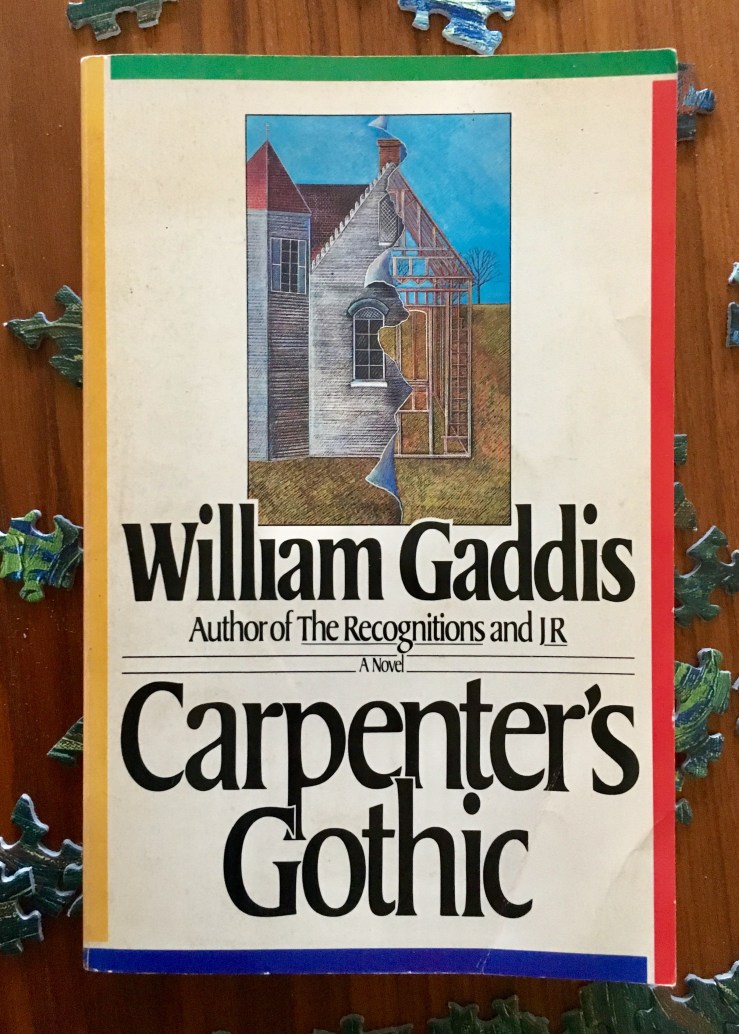
In its sixth (and penultimate chapter), William Gaddis’s 1985 novel Carpenter’s Gothic includes a rare scene. Our heroine Elizabeth Booth exits the house she spends most of the book confined in and actually looks at it from the outside. With her is the house’s owner, the mysterious Mr. McCandless:
—I’ve never really looked at it.
—At what… looking where she was looking.
—At the house. From outside I mean.
Carpenter’s Gothic is a novel of utter interiority—the reader never makes it but a few feet out of the house, and only then on rare occasions. This postmodern Gothic novel tingles with a smothering claustrophobia, its insularity underscored by continual references to other spaces outside the house. The possibility of an outside world waiting for Elizabeth is realized through dialogue with her husband Paul, her brother Billy, and mysterious Mr. McCandless, as well as the non-stop (and, from the reader’s perspective, one-sided) telephone conversations that make up so much of the novel’s material. And yet with all its references to traveling away to California, Africa, New York City, Acapulco, etc., Carpenter’s Gothic keeps Elizabeth locked away in the old house, tethered to the umbilical phone cord at the novel’s center.
McCandless is off in his own interior space—the shifting tortured howl of his own consciousness—when Elizabeth remarks that she has never really seen the house from the outside. Her observation raises him “to the surface” of concrete reality:
—Oh the house yes, the house. It was built that way yes, it was built to be seen from outside it was, that was the style, he came on, abruptly rescued from uncertainty, raised to the surface —yes, they had style books, these country architects and the carpenters it was all derivative wasn’t it, those grand Victorian mansions with their rooms and rooms and towering heights and cupolas and the marvelous intricate ironwork.
The house is built in the Carpenter Gothic style (sometimes called Rural Gothic style), which essentially amounts to an American imitation of European Gothic’s forceful elegance. McCandless continues:
That whole inspiration of medieval Gothic but these poor fellows didn’t have it, the stonework and the wrought iron. All they had were the simple dependable old materials, the wood and their hammers and saws and their own clumsy ingenuity bringing those grandiose visions the masters had left behind down to a human scale with their own little inventions, those vertical darts coming down from the eaves? and that row of bull’s eyes underneath?
McCandless, stand-in for Gaddis, performs a metatextual interpretation for the reader. The Carpenter Gothic is Carpenter’s Gothic, the American postGothic reinterpreation of the European form—namely, the Gothic novel. The materials Gaddis uses to build his book are the materials of mass media and mass textuality. He condenses high literature, lurid newspaper clippings, mail, textbook pages, scraps of illegible notes, pornographic centerfolds, and every other manner of paper into a postGothic synthesis. And not just paper, but also the telephone (always ringing) and the radio (always on, always tuned to inhuman human voices). And the television too, tuned to Orson Welles as Mr. Rochester in Jane Eyre (dir. Robert Stevenson, 1943), a film which weaves its way in and out of Elizabeth’s consciousness in the beginning of the novel, planting seeds of romance and locked rooms and secrets and fire.
But I’ve cut off McCandless, who was just about to give us another neat description of the Carpenter Gothic, which is to say another neat description of Carpenter’s Gothic:
He was up kicking leaves aside, gesturing, both arms raised embracing —a patchwork of conceits, borrowings, deceptions, the inside’s a hodgepodge of good intentions like one last ridiculous effort at something worth doing even on this small a scale, because it’s stood here, hasn’t it, foolish inventions and all it’s stood here for ninety years…
Carpenter’s Gothic is more than just a hodgepodge or patchwork; it is more than a ridiculous effort; it is more than the sum of its foolish inventions. Gaddis gives us something new, a postmodern Gothic analysis of the end of the American century.
McCandless, Gaddis’s stand-in, wants to put all the pieces together. He echoes Jack Gibbs, the (anti-)hero (and fellow Gaddis stand-in) of J R, and he prefigures the narrator of Gaddis’s last novel, Agapē Agape, who, like Gibbs, strives to stitch together something from the atomized scraps and remnants of the 20th century. Gaddis’s protagonists contend with entropy and attempt to get the detritus of the modern world “sorted and organized.” The push-pull of hope and despair drives these protagonists, but often drives them too far.
And McCandless’s reverie takes him too far, again into the interiority of his skull:
…breaking off, staring up where her gaze had fled back with those towering heights and cupolas, as though for some echo: It’s like the inside of your head McCandless, if that was what brought him to add —why when somebody breaks in, it’s like being assaulted, it’s the…
In a moment of self-speech, McCandless realizes that the Carpenter Gothic is “like the inside of [his] head,” underscoring his connection to his creator, Gaddis, as well as the connection between the house and the novel.
The (always) ringing phone punctures the scene:
—Listen! The phone had rung inside and she started up at the second ring, sank back with the third. —All I meant was, it’s a hard house to hide in…
Elizabeth’s lines here emphasize Carpenter’s Gothic’s central Gothicism—the Carpenter Gothic and Carpenter’s Gothic is a hard place to hide in. Secrets will out.
And so well where does our hodgepodge of good intentions lead?
Characteristics during the walk–Apple-trees with only here and there an apple on the boughs, among the thinned leaves, the relics of a gathering. In others you observe a rustling, and see the boughs shaking and hear the apples thumping down, without seeing the person who does it. Apples scattered by thewayside, some with pieces bitten out, others entire, which you pick up and taste, and find them harsh, crabbed cider-apples, though they have a pretty, waxen appearance. In sunny spots of woodland, boys in search of nuts, looking picturesque among the scarlet and golden foliage. There is something in this sunny autumnal atmosphere that gives a peculiar effect to laughter and joyous voices,–it makes them infinitely more elastic and gladsome than at other seasons. Heaps of dry leaves tossed together by the wind, as if for a couch and lounging-place for the weary traveller, while the sun is warming it for him. Golden pumpkins and squashes, heaped in the angle of a house till they reach the lower windows. Ox-teams, laden with a rustling load of Indian corn, in the stalk and ear. When an inlet of the sea runs far up into the country, you stare to see a large schooner appear amid the rural landscape; she is unloading a cargo of wood, moist with rain or salt water that has dashed over it. Perhaps you hear the sound of an axe in the woodland; occasionally, the report of a fowling-piece. The travellers in the early part of the afternoon look warm and comfortable as if taking a summer drive; but as eve draws nearer, you meet them well wrapped in topcoats or cloaks, or rough, great surtouts, and red-nosed withal, seeming to take no great comfort, but pressing homeward. The characteristic conversation among teamsters and country squires, where the ascent of a hill causes the chaise to go at the same pace as an ox-team,–perhaps discussing the qualities of a yoke of oxen. The cold, blue aspects of sheets of water. Some of the country shops with the doors closed; others still open as in summer. I meet a wood-sawyer, with his horse and saw on his shoulders, returning from work. As night draws on, you begin to see the gleaming of fires on the ceilings in the houses which you pass. The comfortless appearance of houses at bleak and bare spots,–you wonder how there can be any enjoyment in them. I meet a girl in a chintz gown, with a small shawl on her shoulders, white stockings, and summer morocco shoes,–it looks observable. Turkeys, queer, solemn objects, in black attire, grazing about, and trying to peck the fallen apples, which slip away from their bills.
The fourth of seven unnumbered chapters in William Gaddis’s Carpenter’s Gothic is set over the course of Halloween, moving from morning, into afternoon, and then night. Halloween is an appropriately Gothic setting for the midpoint of Gaddis’s postmodern Gothic novel, and there are some fascinating turns in this central chapter.
A summary with spoilers is not necessary here. Suffice to say that our heroine Elizabeth Booth is left alone on Halloween in the dilapidated Rural Gothic style house she and her awful husband Paul rent from mysterious Mr. McCandless. As Paul exits the house to go on one his many fruitless business trips, he notices that some neighborhood kids have already played their Halloween tricks:
He had the front door open but he stood there, looking out, looking up, —little bastards look at that, not even Halloween till tonight but they couldn’t wait… Toilet paper hung in disconsolate streamers from the telephone lines, arched and drooped in the bared maple branches reaching over the windows of the frame garage beyond the fence palings where shaving cream spelled fuck. —Look keep the doors locked, did this last night Christ knows what you’re in for tonight… and the weight of his hand fell away from her shoulder, —Liz? just try and be patient? and he pulled the door hard enough for the snap of the lock to startle her less with threats locked out than herself locked in, to leave her steadying a hand on the newel…
The kids’ Halloween antics take on a particularly sinister aspect here, set against the stark New England background Gaddis conjures. We get gloomy streamers, desolate trees, and the bald, ugly signification of one lone word: fuck. (Fuck and its iterations, along with Gaddis’s old favorite God damn, are bywords in Carpenter’s Gothic). Paul’s reading of this scene is also sinister; he underscores the Gothic motif in telling Elizabeth to “keep the doors locked” because she doesn’t know what she’s “in for tonight.” Tellingly, the aural snap of Paul’s exit shows us that Elizabeth is ultimately more paranoid about being locked in. Indeed, by the middle of the novel, we see her increasingly trapped in her (haunted) house. The staircase newel, an image that Gaddis uses repeatedly in the novel, becomes her literal support. Elizabeth spends the rest of the morning avoiding chores before eventually vomiting and taking a nap.
Then, Gaddis propels us forward a few hours with two remarkable paragraphs (or, I should say, two paragraphs upon which I wish to remark). Here is the first post-nap paragraph:
She woke abruptly to a black rage of crows in the heights of those limbs rising over the road below and lay still, the rise and fall of her breath a bare echo of the light and shadow stirred through the bedroom by winds flurrying the limbs out there till she turned sharply for the phone and dialed slowly for the time, up handling herself with the same fragile care to search the mirror, search the world outside from the commotion in the trees on down the road to the straggle of boys faces streaked with blacking and this one, that one in an oversize hat, sharing kicks and punches up the hill where in one anxious glimpse the mailman turned the corner and was gone.
What a fantastic sentence. Gaddis’s prose here reverberates with sinister force, capturing (and to an extent, replicating) Elizabeth’s disorientation. Dreadful crows and flittering shadows shake Elizabeth, and searching for stability she telephones for the time. (If you are a young person perhaps bewildered by this detail: This is something we used to do. We used to call a number for the time. Like, the time of day. You can actually still do this. Call the US Naval Observatory at 202-762-1069 if you’re curious what this aesthetic experience is like). The house’s only clock is broken, further alienating Elizabeth from any sense of normalcy. In a mode of “fragile care,” anxious Elizabeth glances in the mirror, another Gothic symbol that repeats throughout this chapter. She then spies the “straggle of boys” (a neat parallel to the “black rage of crows” at the sentence’s beginning) already dressed up in horrorshow gear for mischief night and rumbling with violence. The mailman—another connection to the outside world, to some kind of external and steadying authority—simply disappears.
Here is the next paragraph:
Through the festoons drifting gently from the wires and branches a crow dropped like shot, and another, stabbing at a squirrel crushed on the road there, vaunting black wings and taking to them as a car bore down, as a boy rushed the road right down to the mailbox in the whirl of yellowed rust spotted leaves, shouts and laughter behind the fence palings, pieces of pumpkin flung through the air and the crows came back all fierce alarm, stabbing and tearing, bridling at movement anywhere till finally, when she came out to the mailbox, stillness enveloped her reaching it at arm’s length and pulling it open. It looked empty; but then there came sounds of hoarded laughter behind the fence palings and she was standing there holding the page, staring at the picture of a blonde bared to the margin, a full tumid penis squeezed stiff in her hand and pink as the tip of her tongue drawing the beading at its engorged head off in a fine thread. For that moment the blonde’s eyes, turned to her in forthright complicity, held her in their steady stare; then her tremble was lost in a turn to be plainly seen crumpling it, going back in and dropping it crumpled on the kitchen table.
The paragraph begins with the Gothic violence of the crows “stabbing and tearing” at a squirrel. Gaddis fills Carpenter’s Gothic with birds—in fact, the first words of the novel are “The bird”—a motif that underscores the possibility of flight, of escape (and entails its opposite–confinement, imprisonment). These crows are pure Halloween, shredding small mammals as the wild boys smash pumpkins. Elizabeth exits the house (a rare vignette in Carpenter’s Gothic, which keeps her primarily confined inside it) to check the mail. The only message that has been delivered to her though is from the Halloween tricksters, who cruelly laugh at their prank. The pornographic image, ripped from a magazine, is described in such a way that the blonde woman trapped within it comes to life, “in forthright complicity,” making eye contact with Elizabeth. There’s an intimation of aggressive sexual violence underlying the prank, whether the boys understand this or not. The scrap of paper doubles their earlier signal, the shaving creamed fuck written on the garage door.
Elizabeth recovers herself to signify steadiness in return, demonstratively crumpling the pornographic scrap—but she takes it with her, back into the house, where it joins the other heaps of papers, scraps, detritus of media and writing that make so much of the content of the novel. Here, the pornographic scrap takes on its own sinister force. Initially, Elizabeth sets out to compose herself anew; the next paragraph finds her descending the stairs, “differently dressed now, eyeliner streaked on her lids and the
colour unevenly matched on her paled cheeks,” where she answers the ringing phone with “a quaver in her hand.” The scene that follows is an extraordinary displacement in which the phone takes on a phallic dimension, and Elizabeth imaginatively correlates herself with the blonde woman in the pornographic picture. She stares at this image the whole time she is on the phone while a disembodied male voice demands answers she cannot provide:
The voice burst at her from the phone and she held it away, staring down close at the picture as though something, some detail, might have changed in her absence, as though what was promised there in minutes, or moments, might have come in a sudden burst on the wet lips as the voice broke from the phone in a pitch of invective, in a harried staccato, broke off in a wail and she held it close enough to say —I’m sorry Mister Mullins, I don’t know what to… and she held it away again bursting with spleen, her own fingertip smoothing the still fingers hoarding the roothairs of the inflexible surge before her with polished nails, tracing the delicate vein engorged up the curve of its glistening rise to the crown cleft fierce with colour where that glint of beading led off in its fine thread to the still tongue, mouth opened without appetite and the mascaraed eyes unwavering on hers without a gleam of hope or even expectation, —I don’t know I can’t tell you!
Gaddis’s triple repetition of the verb burst links the phone to the phallus and links Elizabeth to the blonde woman. This link is reinforced by the notation of the woman’s “mascaraed eyes,” a detail echoing the paragraph’s initial image of Elizabeth descending the stairs with streaked eyeliner. The final identification between the two is the most horrific—Elizabeth reads those eyes, that image, that scrap of paper, as a work “without a gleam of hope or even expectation.” Doom.
Elizabeth is “saved,” if only temporarily, by the unexpected arrival of the mysterious Mr. McCandless, who quickly stabilizes the poor woman. Gaddis notes that McCandless “caught the newel with her hand…He had her arm, had her hand in fact firm in one of his.” When he asks why she is so upset, she replies, “It’s the, just the mess out there, Halloween out there…” McCandless chalks the mess up to “kids with nothing to do,” but Elizabeth reads in it something more sinister: “there’s a meanness.” McCandless counters that “it’s plain stupidity…There’s much more stupidity than there is malice in the world.” This phrase “Halloween out there” repeats three times in the chapter, suggesting a larger signification—it isn’t just Halloween tonight, but rather, as McCandless puts it, the night is “Like the whole damned world isn’t it.” It’s always Halloween out there in Carpenter’s Gothic, and this adds up to mostly malice of mostly stupidity in this world—depending on how you read it.
The second half of the chapter gives over to McCandless, who comes to unexpectedly inhabit the novel’s center. Elizabeth departs, if only for a few hours, leaving McCandless alone, if only momentarily. A shifty interlocutor soon arrives on the thresh hold of his Carpenter Gothic home, and we learn some of his fascinating background. It’s a strange moment in a novel that has focused so intently on the consciousness of Elizabeth, but coming in the novel’s center, it acts as a stabilizing force. I won’t go into great detail here—I think much of what happens when McCandless is the center of the narrative is best experienced without any kind of spoiler—but we get at times from him a sustained howl against the meanness and stupidity of the world. He finally ushers his surprise interlocutor out of his home with the following admonition: “It’s Halloween out there too.”
I went to a party and corrected a pronunciation. The man whose voice I had adjusted fell back into the kitchen. I praised a Bonnard. It was not a Bonnard. My new glasses, I explained, and I’m terribly sorry, but significant variations elude me, vodka exhausts me, I was young once, essential services are being maintained. Drums, drums, drums, outside the windows. I thought that if I could persuade you to say “No,” then my own responsibility would be limited, or changed, another sort of life would be possible, different from the life we had previously, somewhat skeptically, enjoyed together. But you had wandered off into another room, testing the effect on members of the audience of your ruffled blouse, your long magenta skirt. Giant hands, black, thick with fur, reaching in through the window. Yes, it was King Kong, back in action, and all of the guests uttered loud exclamations of fatigue and disgust, examining the situation in the light of their own needs and emotions, hoping that the ape was real or papier-mache according to their temperments, or wondering whether other excitements were possible out in the crisp, white night.
Isaac McCaslin, ‘Uncle Ike’, past seventy and nearer eighty than he ever corroborated any more, a widower now and uncle to half a county and father to no one
this was not something participated in or even seen by himself, but by his elder cousin, McCaslin Edmonds, grandson of Isaac’s father’s sister and so descended by the distaff, yet notwithstanding the inheritor, and in his time the bequestor, of that which some had thought then and some still thought should have been Isaac’s, since his was the name in which the title to the land had first been granted from the Indian patent and which some of the descendants of his father’s slaves still bore in the land. But Isaac was not one of these:-a widower these twenty years, who in all his life had owned but one object more than he could wear and carry in his pockets and his hands at one time, and this was the narrow iron cot and the stained lean mattress which he used camping in the woods for deer and bear or for fishing or simply because he loved the woods; who owned no property and never desired te since the earth was no man’s but all men’s, as light and air and weather were; who lived still in the cheap frame bungalow in Jefferson which his wife’s father gave them on their marriage and which his wife had willed to him at her death and which he had pretended to accept, acquiesce to, to humor her, ease her going but which was not his, will or not, chancery dying wishes mortmain possession or whatever, himself merely holding it for his wife’s sister and her children who had lived in it with him since his wife’s death, holding himself welcome to live in one room of it as he had during his wife’s time or she during her time or the sister-in-law and her children during the rest of his and after not something he had participated in or even remembered except from the hearing, the listening, come to him through and from his cousin McCaslin born in 1850 and sixteen years his senior and hence, his own father being near seventy when Isaac, an only child, was born. rather his brother than cousin and rather his father than either, out of the old time, the old days.
When he and Uncle Buck ran back to the house from discovering that Tomey’s Turl had run again, they heard Uncle Buddy cursing and bellowing in the kitchen, then the fox and the dogs came out of the kitchen and crossed the hall into the dogs’ room and they heard them run through the dogs’ room into his and Uncle Buck’s room then they saw them cross the hall again into Uncle Buddy’s room and heard them run through Uncle Buddy’s room into the kitchen. Where Uncle Buddy was picking the breakfast up out of the ashes and wiping it off with his apron. “What in damn’s hell do you mean,” he said “turning that damn fox out with the dogs all loose in the house?”
“Damn the fox” Uncle Buck said. “Tomey’s Turl has broke out again. Give me and Cass some breakfast quick we might just barely catch him before he gets there.” Continue reading ““Was” by William Faulkner”→
At the moment, I was heading anywhere at all for breakfast, but when I heard the desk clerk’s radio playing news that an aircraft, I assumed a sightseeing plane, had struck Tower Two of the World Trade Center, I decided to jump on the number 3 subway half a block west, and go have a look.
As I headed toward Eighth Avenue I tried calling Mark Ahearn about lunch, but my cellphone only hammered out a rapid-fire beep. Please don’t ask me how this can be true: I traveled through the busy lobby and walked for half a long block on a crowded Manhattan street and then boarded the World Trade Center subway completely unaware that I was participating in a citywide disaster, and moving toward its center.
The World Trade Center station came a few stops south of Twenty-Third Street, but we didn’t get there. After Christopher Street the train halted in the tunnel and waited, humming. It gave a screech, lurched backward slightly, and stopped again. Somehow the general news had infiltrated the sealed subterranean environment that something historically enormous was happening very nearby, and it got quiet in our compartment, and almost everybody entered into a small, desperate battle with a worthless cellphone. The train moved forward and gained speed, but began braking long before Houston Street, the next station, where it halted with several rear cars sticking out behind into the tunnel. For a tense minute, whoever spoke only whispered. Then came a shout—“Tell us what’s going on!” and others raised the same cry until we heard the conductor’s PA saying something about the tracks, the tracks…“Due to the catastrophe, this train will not go farther. Please exit out the forward cars onto the platform. Do not go onto the tracks.” We were all on our feet, maneuvering selfishly, angling for the doors. But the doors didn’t open. The engine stopped. “Open the doors! Open the doors!” The engine started. A man shouted, “Just everybody stand still!” People from the car behind had pried their way into ours, and somebody almost went down. A woman said, “Stop that, you fool!” A man in front of me pushed a teenage boy beside him. With the meat of his fist he began beating the back of the boy’s head. And I jumped into the fray, didn’t you, Harrington, like a monkey, yes you did, and got yourself an elbow in the eye. The doors to the compartment flew open and people clambered out onto the station’s platform, where a dreadlocked man in a crimson athletic suit jumped up and down on a bench as if it were a trampoline, screaming “God, see what we’re doing to each other down here.” When I came up into the street, dizzy and one-eyed, I couldn’t get my bearings. I saw only one tower standing to the south, and that one ringed with fire. I asked a man nearby—“Where are we? I can’t see the other tower.” He said, “It fell” and I said, “No it didn’t.” He didn’t argue. We stood in the middle of the street with thousands of other people, all of us motionless, like a frozen parade, all silent. I began to believe the man. We watched the flames spreading through the building’s upper stories over the course of about twenty minutes, and then the eighteen-hundred-foot structure seemed to curtsy and dip left, and then it went down.
I turned around and looked at the people behind me. I saw shocked laughter, weeping, horror, bewilderment. The young man next to me bawled at the top of his lungs. I was afraid to ask him if he had a loved one in the buildings afraid to talk to him at all, but he raised his agonized, Christly face to me and suddenly laughed, saying, “Buddy, you are working on one heck of a black eye.” We stood far from the buildings—at least a mile, I’d say—far enough that we didn’t feel the ground shake, and we heard nothing but sirens, and official-sounding voices screaming, “Get out of the street! Stay out of the street!” and others too—“They’re attacking the Capitol!—the Pentagon!—the White House!”
Cop cars and ambulances heaped with dust and chunks of concrete came at us out of the south. I started walking that direction, I don’t know why, but I soon realized I was the only person heading downtown, and then the tide of panic pressing toward me was too heavy to go against, and I turned around and let it take me north.
From Denis Johnson’s short story “Doppelgänger, Poltergeist.” Collected in The Largesse of the Sea Maiden, 2017.
I have been listening to Arkady and Boris Strugatsky’s 1972 novel The Snail on the Slope on audiobook over the last two weeks.
This new English translation is by Olena Bormashenko, who also translated Roadside Picnic and Hard to Be a God. (I listened to Roadside Picnic last year—this fantastic audiobook is read by Robert Forster—and read Bormashenko’s translation of Hard to Be a God after watching Aleksei German’s 2013 film adaptation. All are excellent). Chris Andrew Ciulla narrates the new audiobook of The Snail on the Slope and he does a very good job.
Like I said, I’ve been listening to this new translation of The Snail on the Slope for a few weeks. I should be done (the book is only 9.5 hours), but I’ve listened to most of the chapters twice, and restarted the book once, because The Snail on the Slope is fucking bonkers. The novel is a wild trip, full of bizarre transformations, failed plans, jungle swamps, marching ants, deadlings, mushrooms, foolish bureaucrats, and broken calculators—it’s abject, savage, funny, and just so fucking weird, a bizarre beast tumbling around on its own radical logic. I have about 3 hours left, but I don’t think I’ll muster a review—or a summary, I mean. Or anyway—
I mean, here’s my review: I love it. I love its strange mucky weirdness, its refusal to clearly delineate the contact points of its allegorical satire, its sheer absurdity, its utter alterity. But a summary seems too much to ask so—
Here is publisher Chicago Review Press’s blurb—
The Snail on the Slope is a neglected masterpiece by Russian science fiction greats Arkady and Boris Strugatsky, who thought of it as their “most complete and important work.” now, in a stunning translation, this tour de force is ready to be introduced to a new generation of American readers. The novel takes place in two worlds. One is the Administration, an institution run by a surreal, Kafkaesque bureaucracy whose aim is to govern the forest below. The other is the Forest, a place of fear, weird creatures, primitive but garrulous people, and violence. Peretz, who works at the Administration, wants to visit the Forest. Candide crashed in the Forest years ago and wants to return to the Administration. Their journeys are surprising and bizarre, and readers are left to puzzle out the mysteries of these foreign environments. Brilliant, enigmatic, and revelatory, The Snail on the Slope is one of the greatest literary works to come out of Soviet Russia.
The German cover (credited to Ute Osterwalder and Hans Ulrich Osterwalder) is also pretty cool—
But I promised in this blog’s headline to riff on the first paragraph, which isn’t that long, but in some ways reveals the sheer oddity of The Snail on the Slope. So here is that paragraph:
From this height, the forest looked like dappled, fluffy foam; like a gigantic, world-encompassing porous sponge; like an animal that had once lain hidden in wait, then had dozed off, becoming overgrown with coarse moss. Like a shapeless mass, hiding a face no one had ever seen.
The viewer at this height is one of the novel’s two heroes, Peretz, who dangles his feet over the forest that calls to him. I could go on about Peretz’s attraction to the unknowable forest, but let’s look instead at the similes the Strugatskys (and their translator Bormashenko) deploy here:
The forest is like
foam
a sponge
a dozing, bemossed animal
an indefinite mass with an unseen face
The utter alterity of the forest is announced at the novel’s outset. This shifting series of similes shows that the central space of The Snail on the Slope cannot have a fixed definition—it cannot even have a stable referent of similitude. Rather, the forest is ever-shifting, from the playful guise of a space of “fluffy foam” to the sinister aspect of a “shapeless mass” that hides an unknown (and unknowable) visage. The Strugatskys shuttle us from simile to simile, foregrounding one of the novel’s central themes—language has a limited purchase of reality. Peretz, a surrogate for the reader, cannot settle on a simile, which only entices him more: What is this place? What would it mean to know this place—in language? Significantly, Peretz is a linguist, but he—and the reader–have no training to properly comprehend what enfolds when The Snail on the Slope takes us into the forest. And this is the fucked up joy of the novel—one weird transformation morphs into another, similes unwinding in a stretch toward an ultimate referent that refuses to arrive on time.
A DAY OR TWO LATER, Lew went up to Carefree Court. The hour was advanced, the light failing, the air heated by the Santa Ana wind. Palm trees rattled briskly, and the rats in their nests up there hung on for dear life. Lew approached through a twilit courtyard lined with tileroofed bungalows, stucco archways, and the green of shrubbery deepening as the light went. He could hear sounds of glassware and conversation.
From the swimming pool came sounds of liquid recreation—feminine squeals, deep singlereed utterances from high and low divingboards. The festivities here this evening were not limited to any one bungalow. Lew chose the nearest, went through the formality of ringing the doorbell, but after waiting a while just walked in, and nobody noticed.
It was a gathering impossible at first to read, even for an old L.A. hand like Lew—society ladies in flapper-rejected outfits from Hamburger’s basement, real flappers in extras’ costumes—Hebrew headdresses, belly-dancing outfits, bare feet and sandals—in from shooting some biblical extravaganza, sugar daddies tattered and unshaven as street beggars, freeloaders in bespoke suits and sunglasses though the sun had set, Negroes and Filipinos, Mexicans and hillbillies, faces Lew recognized from mug shots, faces that might also have recognized him from tickets long cold he didn’t want to be reminded of, and here they were eating enchiladas and hot dogs, drinking orange juice and tequila, smoking cork-tip cigarettes, screaming in each others’ faces, displaying scars and tattoos, recalling aloud felonies imagined or planned but seldom committed, cursing Republicans, cursing police federal state and local, cursing the larger corporate trusts, and Lew slowly began to get a handle, for weren’t these just the folks that once long ago he’d spent his life chasing, them and their cousins city and country? through brush and up creek-beds and down frozen slaughterhouse alleyways caked with the fat and blood of generations of cattle, worn out his shoes pair after pair until finally seeing the great point, and recognizing in the same instant the ongoing crime that had been his own life—and for achieving this self-clarity, at that time and place a mortal sin, got himself just as unambiguously dynamited.
He gradually understood that what everybody here had in common was having survived some cataclysm none of them spoke about directly—a bombing, a massacre perhaps at the behest of the U.S. government. . . .
“No it wasn’t Haymarket.”
“It wasn’t Ludlow. It wasn’t the Palmer raids.”
“It was and it wasn’t.” General merriment.
—Thomas Pynchon’s novel Against the Day. Happy Labor Day.
It was September now, a season of rains. The gray sky above the city washed with darker scud like ink curling in a squid’s wake. The blacks can see the boy’s fire at night and glimpses of his veering silhouette slotted in the high nave, outsized among the arches. All night a ruby glow suffuses the underbridge from his garish chancel lamps. The city’s bridges all betrolled now what with old ventriloquists and young melonfanciers. The smoke from their fires issues up unseen among the soot and dust of the city’s right commerce.
Sometimes in the evening Suttree would bring beers and they’d sit there under the viaduct and drink them. Harrogate with questions of city life.
You ever get so drunk you kissed a nigger?
Suttree looked at him. Harrogate with one eye narrowed on him to tell the truth. I’ve been a whole lot drunker than that, he said.
Worst thing I ever done was to burn down old lady Arwood’s house.”
“You burned down an old lady’s house?
Like to of burnt her down in it. I was put up to it. I wasnt but ten year old.
Not old enough to know what you were doing.
Yeah.–Hell no that’s a lie. I knowed it and done it anyways.
Did it burn completely down?
Plumb to the ground. Left the chimbley standin was all. It burnt for a long time fore she come out.
Did you not know she was in there?
I disremember. I dont know what I was thinkin. She come out and run to the well and drawed a bucket of water and thowed it at the side of the house and then just walked on off towards the road. I never got such a whippin in my life. The old man like to of killed me.
Your daddy?
Yeah. He was alive then. My sister told them deputies when they come out to the house, they come out there to tell her I was in the hospital over them watermelons, she told em I didnt have no daddy was how come I got in trouble. But shit fire I was mean when I did have one. It didnt make no difference.
Were you sorry about it? The old lady’s house I mean.
Sorry I got caught.
Suttree nodded and tilted his beer. It occurred to him that other than the melon caper he’d never heard the city rat tell anything but naked truth.
A vignette from Cormac McCarthy’s Suttree—a transition scene perhaps, but one that draws Suttree and Harrogate closer, even as it underlines their differences.
…it may be urged that there is nothing a writer of fiction should more carefully see to, as there is nothing a sensible reader will more carefully look for, than that, in the depiction of any character, its consistency should be preserved. But this, though at first blush, seeming reasonable enough, may, upon a closer view, prove not so much so. For how does it couple with another requirement—equally insisted upon, perhaps—that, while to all fiction is allowed some play of invention, yet, fiction based on fact should never be contradictory to it; and is it not a fact, that, in real life, a consistent character is a rara avis? Which being so, the distaste of readers to the contrary sort in books, can hardly arise from any sense of their untrueness. It may rather be from perplexity as to understanding them. But if the acutest sage be often at his wits’ ends to understand living character, shall those who are not sages expect to run and read character in those mere phantoms which flit along a page, like shadows along a wall? That fiction, where every character can, by reason of its consistency, be comprehended at a glance, either exhibits but sections of character, making them appear for wholes, or else is very untrue to reality; while, on the other hand, that author who draws a character, even though to common view incongruous in its parts, as the flying-squirrel, and, at different periods, as much at variance with itself as the butterfly is with the caterpillar into which it changes, may yet, in so doing, be not false but faithful to facts.
If reason be judge, no writer has produced such inconsistent characters as nature herself has. It must call for no small sagacity in a reader unerringly to discriminate in a novel between the inconsistencies of conception and those of life as elsewhere. Experience is the only guide here; but as no one man can be coextensive with what is, it may be unwise in every ease to rest upon it. When the duck-billed beaver of Australia was first brought stuffed to England, the naturalists, appealing to their classifications, maintained that there was, in reality, no such creature; the bill in the specimen must needs be, in some way, artificially stuck on.
But let nature, to the perplexity of the naturalists, produce her duck-billed beavers as she may, lesser authors some may hold, have no business to be perplexing readers with duck-billed characters. Always, they should represent human nature not in obscurity, but transparency, which, indeed, is the practice with most novelists, and is, perhaps, in certain cases, someway felt to be a kind of honor rendered by them to their kind. But, whether it involve honor or otherwise might be mooted, considering that, if these waters of human nature can be so readily seen through, it may be either that they are very pure or very shallow. Upon the whole, it might rather be thought, that he, who, in view of its inconsistencies, says of human nature the same that, in view of its contrasts, is said of the divine nature, that it is past finding out, thereby evinces a better appreciation of it than he who, by always representing it in a clear light, leaves it to be inferred that he clearly knows all about it.
But though there is a prejudice against inconsistent characters in books, yet the prejudice bears the other way, when what seemed at first their inconsistency, afterwards, by the skill of the writer, turns out to be their good keeping. The great masters excel in nothing so much as in this very particular. They challenge astonishment at the tangled web of some character, and then raise admiration still greater at their satisfactory unraveling of it; in this way throwing open, sometimes to the understanding even of school misses, the last complications of that spirit which is affirmed by its Creator to be fearfully and wonderfully made.
At least, something like this is claimed for certain psychological novelists; nor will the claim be here disputed. Yet, as touching this point, it may prove suggestive, that all those sallies of ingenuity, having for their end the revelation of human nature on fixed principles, have, by the best judges, been excluded with contempt from the ranks of the sciences—palmistry, physiognomy, phrenology, psychology. Likewise, the fact, that in all ages such conflicting views have, by the most eminent minds, been taken of mankind, would, as with other topics, seem some presumption of a pretty general and pretty thorough ignorance of it. Which may appear the less improbable if it be considered that, after poring over the best novels professing to portray human nature, the studious youth will still run risk of being too often at fault upon actually entering the world; whereas, had he been furnished with a true delineation, it ought to fare with him something as with a stranger entering, map in hand, Boston town; the streets may be very crooked, he may often pause; but, thanks to his true map, he does not hopelessly lose his way. Nor, to this comparison, can it be an adequate objection, that the twistings of the town are always the same, and those of human nature subject to variation. The grand points of human nature are the same to-day they were a thousand years ago. The only variability in them is in expression, not in feature.
But as, in spite of seeming discouragement, some mathematicians are yet in hopes of hitting upon an exact method of determining the longitude, the more earnest psychologists may, in the face of previous failures, still cherish expectations with regard to some mode of infallibly discovering the heart of man.
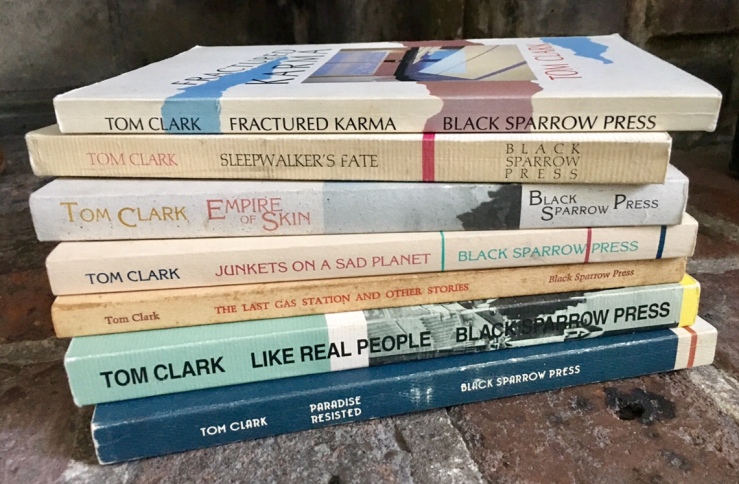
Tom Clark authored over two dozen poetry collections, many published by Black Sparrow Press. He also wrote a number of literary biographies, including a pair on Jack Kerouac, bios of Robert Creeley and Charles Olson, and a biography of John Keats called Junkets from a Sad Planet that is actually a series of poems. (But also actually a biography of Keats). Clark was the poetry editor for The Paris Review from 1963-1973 (maybe you read his interview with Allen Ginsberg there). Clark was also a blogger—an excellent blogger. He updated his blog a few hours before the car collision that killed him.
I first read Tom Clark in the middle of September, 2013. I read Fractured Karma (1990) and I had never heard of him before. I know the time specifically not because I have a good memory (I don’t), but because I wrote about it then:
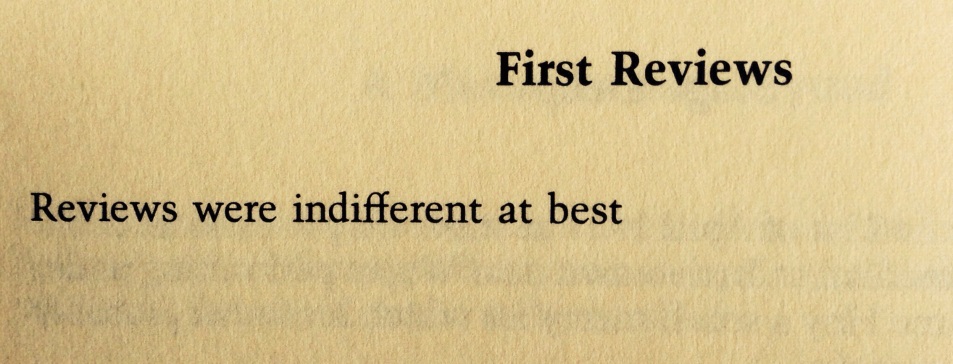
I picked up Tom Clark’s Fractured Karma two weeks ago somewhat randomly. My local bookshop had reorganized some shelves, putting all the Black Sparrow titles together. Fractured Karma must have been on top, because I don’t see how else I would’ve picked up a book with the word “karma” in the title. The book opened to this page:
That’s all there is on that page, and something about it—the form, the phrasing—cracked me up. It’s part of a long poem called “He was born blind” about the British comedy actor George Formby. The poem is amazing: I read it there in the store. It reminded me immediately of David Markson’s notecard novels—something about how Clark includes so much reality into his poem. But there’s also this perceptive (if oblique) sense of humor behind it all. I ended up devouring the book, reading the whole thing that weekend. It was one of those holy shit reading moments, frankly. Once I finish typing this I’m going to go pick my kids up and we’re going to go to the bookstore and I’m going to get another Tom Clark book and read it this weekend.
I actually did go to the bookstore after writing that post and pick up another book by Clark, Sleepwalker’s Fate (1992). The store had several books by Clark, and I wasn’t sure which one to get. I remember that the title Sleepwalker’s Fate stood out, so I picked it up and thumbed through it, and I remember reading the poem “Terminator Too” there in the store—it did something electric to me—the goofy title, the winking irony, but also the earnestness of the poem, which paraphrases a few lines from Wordsworth’s Preface to Lyrical Ballads. Here it is:
“Terminator Too” by Tom Clark—
Poetry, Wordsworth
wrote, will have no
easy time of it when
the discriminating
powers of the mind
are so blunted that
all voluntary
exertion dies, and
the general
public is reduced
to a state of near
savage torpor, morose,
stuporous, with
no attention span
whatsoever; nor will
the tranquil rustling
of the lyric, drowned out
by the heavy, dull
coagulation
of persons in cities,
where a uniformity
of occupations breeds
cravings for sensation
which hourly visual
communication of
instant intelligence
gratifies like crazy,
likely survive this age.
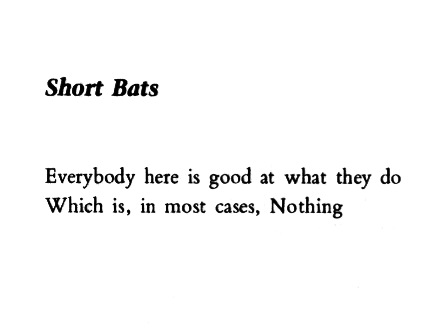
Sleepwalker’s Fate is a good starting place to read Tom Clark’s poetry, as are Fractured Karma and the collection Paradise Revisited (1984). Here’s one from Paradise Revisited:
The later poetry collection Like Real People (1995) is also pretty great. It includes this humdinger:
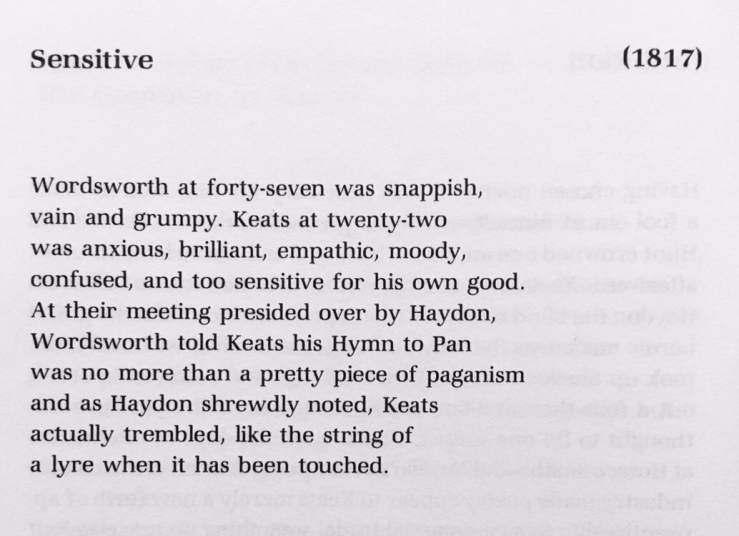
Like Real People also includes a series of autobiographical sketches and stories told in an engaging but straightforward manner. The epilogue there is particularly good—Clark mulls over what it means to write an autobiography, straining against his anxieties over framing his own life stories. Tellingly, he lards the essay with quotes and ideas from other folks. Clark’s poetry often takes on the form of translation, citation, history, or reinterpretation (as we see in “Terminator Too,” above), and works like Empire of Skin (1997) and Junkets on a Sad Planet (1994) are particularly ambitious. Empire of Skin is a series of poems that take on the history of the American fur trade through a lens critical of Manifest Destiny. Junkets on a Sad Planet is an impressionistic series of riffs on Keats’ short life (“junkets” is a pun). From Junkets—
What a lovely condensation of biography, history, and poetic anxiety!
I’ll close with one of my favorite Clark poems, “Heavy,” which discharges poetic anxiety. Clark dedicated the poem to Jack Kerouac and Charles Olson—the gods in the first line, perhaps?–figures he would later write biographies on.
Horace, a policeman, was making Rock Cornish Game Hens for a special supper. The Game Hens are frozen solid, Horace thought. He was wearing his blue uniform pants.
Inside the Game Hens were the giblets in a plastic bag. Using his needlenose pliers Horace extracted the frozen giblets from the interior of the birds. Tonight is the night of the Policemen’s Ball, Horace thought. We will dance the night away. But first, these Game Hens must go into a three-hundred-and-fifty-degree oven.
Horace shined his black dress shoes. Would Margot “put out” tonight? On this night of nights? Well, if she didn’t– Horace regarded the necks of the birds which had been torn asunder by the pliers. No, he reflected, that is not a proper thought. Because I am a member of the force. I must try to keep my hatred under control. I must try to be an example for the rest of the people. Because if they can’t trust us. . .the blue men. . .
In the dark, outside the Policemen’s Ball, the horrors waited for Horace and Margot.
Margot was alone. Her roommates were in Provincetown for the weekend. She put pearl-colored lacquer on her nails to match the pearl of her new-bought gown. Police colonels and generals will be there, she thought. The Pendragon of the Police himself. Whirling past the dais, I will glance upward. The pearl of my eyes meeting the steel gray of high rank.
Margot got into a cab and went over to Horace’s place. The cabdriver was thinking: A nice-looking piece. I could love her.
Horace removed the birds from the oven. He slipped little gold frills, which has been included in the package, over the ends of the drumsticks. Then he uncorked the wine, thinking: This is a town without pity, this town. For those whose voices lack the crack of authority. Luckily the uniform. . . Why won’t she surrender her person? Does she think she can resist the force? The force of the force?
“These birds are delicious.”
Driving Horace and Margot smoothly to the Armory, the new cabdriver thought about basketball.
Why do they always applaud the man who makes the shot?
Why don’t they applaud the ball?
It’s the ball that actually goes into the net.
The man doesn’t go into the net.
Never have I seen a man going into the net.
Twenty thousand policemen of all grades attended the annual fete. The scene was Camelot, with gay colors and burgees. The interior of the Armory had been roofed with lavish tenting. Police colonels and generals looked down on the dark uniforms, white gloves, silvery ball gowns.
“Tonight?”
“Horace, not now. This scene is so brilliant. I want to remember it.”
Horace thought: It? Not me?
The Pendragon spoke. “I ask you to be reasonable with the citizens. They pay our salaries after all. I know they are difficult sometimes, obtuse sometimes, even criminal sometimes, as we often run across in our line of work. But I ask you despite all to be reasonable. I know it is hard. I know it is not easy. I know that for instance when you see a big car, a ’70 Biscayne hardtop, cutting around a corner at a pretty fair clip, with three in the front and three in the back, and they are all mixed up, ages and sexes and colors, your natural impulse is to– I know your first thought is, All those people! Together! And your second thought is, Force! But I must ask you in the name of force itself to be restrained. For force, that great principle, is most honored in the breach and the observance. And that is where you men are, in the breach. You are fine men, the finest. You are Americans. So for the sake of America, be careful. Be reasonable. Be slow. In the name of the Father and the Son and of the Holy Ghost. And now I would like to introduce Vercingetorix, leader of the firemen, who brings us a few words of congratulation from that fine body of men.”
Waves of applause for the Pendragon filled the tented area.
“He is a handsome older man,” Margot said.
“He was born in a Western state and advanced to his present position through raw merit,” Horace told her.
The government of Czechoslovakia sent observers to the Policemen’s Ball. “Our police are not enough happy,” Colonel-General Cepicky explained. “We seek ways to improve them. This is a way. It may not be the best of all possible ways, but. . . Also I like to drink the official whiskey! It makes me gay!”
A bartender thought: Who is that yellow-haired girl in the pearl costume? She is stacked.
The mood of the Ball changed. The dancing was more serious now. Margot’s eyes sparkled from the jorums of champagne she had drunk. She felt Horace’s delicately Game Hen-flavored breath on her cheek. I will give him what he wants, she decided. Tonight. His heroism deserves it. He stands between us and them. He represents what is best in society: decency, order, safety, strength, sirens, smoke. No, he does not represent smoke. Great billowing oily black clouds. That Vercingetorix has a noble look. With whom is Vercingetorix dancing, at present?
The horrors waited outside patiently. Even policemen, the horrors thought. We get even policemen, in the end.
In Horace’s apartment, a gold frill was placed on a pearl toe.
The horrors had moved outside Horace’s apartment. Not even policemen and their ladies are safe, the horrors thought. No one is safe. Safety does not exist. Ha ha ha ha ha ha ha ha ha ha!
As among Chaucer’s Canterbury pilgrims, or those oriental ones crossing the Red Sea towards Mecca in the festival month, there was no lack of variety. Natives of all sorts, and foreigners; men of business and men of pleasure; parlor men and backwoodsmen; farm-hunters and fame-hunters; heiress-hunters, gold-hunters, buffalo-hunters, bee-hunters, happiness-hunters, truth-hunters, and still keener hunters after all these hunters. Fine ladies in slippers, and moccasined squaws; Northern speculators and Eastern philosophers; English, Irish, German, Scotch, Danes; Santa Fé traders in striped blankets, and Broadway bucks in cravats of cloth of gold; fine-looking Kentucky boatmen, and Japanese-looking Mississippi cotton-planters; Quakers in full drab, and United States soldiers in full regimentals; slaves, black, mulatto, quadroon; modish young Spanish Creoles, and old-fashioned French Jews; Mormons and Papists Dives and Lazarus; jesters and mourners, teetotalers and convivialists, deacons and blacklegs; hard-shell Baptists and clay-eaters; grinning negroes, and Sioux chiefs solemn as high-priests. In short, a piebald parliament, an Anacharsis Cloots congress of all kinds of that multiform pilgrim species, man.
As pine, beech, birch, ash, hackmatack, hemlock, spruce, bass-wood, maple, interweave their foliage in the natural wood, so these mortals blended their varieties of visage and garb. A Tartar-like picturesqueness; a sort of pagan abandonment and assurance. Here reigned the dashing and all-fusing spirit of the West, whose type is the Mississippi itself, which, uniting the streams of the most distant and opposite zones, pours them along, helter-skelter, in one cosmopolitan and confident tide.
From Herman Melville’s novel The Confidence-Man: His Masquerade.