“The Auction,” a very short story by Stephen Crane

“The Auction”

by

Stephen Crane


Some said that Ferguson gave up sailoring because he was tired of the sea. Some said that it was because he loved a woman. In truth it was because he was tired of the sea and because he loved a woman.

He saw the woman once, and immediately she became for him the symbol of all things unconnected with the sea. He did not trouble to look again at the grey old goddess, the muttering slave of the moon. Her splendours, her treacheries, her smiles, her rages, her vanities, were no longer on his mind. He took heels after a little human being, and the woman made his thought spin at all times like a top; whereas the ocean had only made him think when he was on watch.

He developed a grin for the power of the sea, and, in derision, he wanted to sell the red and green parrot which had sailed four voyages with him. The woman, however, had a sentiment concerning the bird’s plumage, and she commanded Ferguson to keep it in order, as it happened, that she might forget to put food in its cage.

The parrot did not attend the wedding. It stayed at home and blasphemed at a stock of furniture, bought on the installment plan, and arrayed for the reception of the bride and groom.

As a sailor, Ferguson had suffered the acute hankering for port; and being now always in port, he tried to force life to become an endless picnic. He was not an example of diligent and peaceful citizenship. Ablution became difficult in the little apartment, because Ferguson kept the wash-basin filled with ice and bottles of beer: and so, finally, the dealer in second-hand furniture agreed to auction the household goods on commission. Owing to an exceedingly liberal definition of a term, the parrot and cage were included. “On the level?” cried the parrot, “On the level? On the level? On the level?”

On the way to the sale, Ferguson’s wife spoke hopefully. “You can’t tell, Jim,” she said. “Perhaps some of ’em will get to biddin’, and we might get almost as much as we paid for the things.”

The auction room was in a cellar. It was crowded with people and with house furniture; so that as the auctioneer’s assistant moved from one piece to another he caused a great shuffling. There was an astounding number of old women in curious bonnets. The rickety stairway was thronged with men who wished to smoke and be free from the old women. Two lamps made all the faces appear yellow as parchment. Incidentally they could impart a lustre of value to very poor furniture.

The auctioneer was a fat, shrewd-looking individual, who seemed also to be a great bully. The assistant was the most imperturbable of beings, moving with the dignity of an image on rollers. As the Fergusons forced their way down the stair-way, the assistant roared: “Number twenty-one!”

“Number twenty-one!” cried the auctioneer. “Number twenty-one! A fine new handsome bureau! Two dollars? Two dollars is bid! Two and a half! Two and a half! Three? Three is bid. Four! Four dollars! A fine new handsome bureau at four dollars! Four dollars! Four dollars! F-o-u-r d-o-l-l-a-r-s! Sold at four dollars.”

“On the level?” cried the parrot, muffled somewhere among furniture and carpets. “On the level? On the level?” Every one tittered.

Mrs. Ferguson had turned pale, and gripped her husband’s arm. “Jim! Did you hear? The bureau—four dollars—”

Ferguson glowered at her with the swift brutality of a man afraid of a scene. “Shut up, can’t you!”

Mrs. Ferguson took a seat upon the steps; and hidden there by the thick ranks of men, she began to softly sob. Through her tears appeared the yellowish mist of the lamplight, streaming about the monstrous shadows of the spectators. From time to time these latter whispered eagerly: “See, that went cheap!” In fact when anything was bought at a particularly low price, a murmur of admiration arose for the successful bidder.

The bedstead was sold for two dollars, the mattresses and springs for one dollar and sixty cents. This figure seemed to go through the woman’s heart. There was derision in the sound of it. She bowed her head in her hands. “Oh, God, a dollar-sixty! Oh, God, a dollar-sixty!”

The parrot was evidently under heaps of carpet, but the dauntless bird still raised the cry, “On the level?”

Some of the men near Mrs. Ferguson moved timidly away upon hearing her low sobs. They perfectly understood that a woman in tears is formidable.

The shrill voice went like a hammer, beat and beat, upon the woman’s heart. An odour of varnish, of the dust of old carpets, assailed her and seemed to possess a sinister meaning. The golden haze from the two lamps was an atmosphere of shame, sorrow, greed. But it was when the parrot called that a terror of the place and of the eyes of the people arose in her so strongly that she could not have lifted her head any more than if her neck had been of iron.

At last came the parrot’s turn. The assistant fumbled until he found the ring of the cage, and the bird was drawn into view. It adjusted its feathers calmly and cast a rolling wicked eye over the crowd.

“Oh, the good ship Sarah sailed the seas,And the wind it blew all day—”

This was the part of a ballad which Ferguson had tried to teach it. With a singular audacity and scorn, the parrot bawled these lines at the auctioneer as if it considered them to bear some particular insult.

The throng in the cellar burst into laughter. The auctioneer attempted to start the bidding, and the parrot interrupted with a repetition of the lines. It swaggered to and fro on its perch, and gazed at the faces of the crowd, with so much rowdy understanding and derision that even the auctioneer could not confront it. The auction was brought to a halt; a wild hilarity developed, and every one gave jeering advice.

Ferguson looked down at his wife and groaned. She had cowered against the wall, hiding her face. He touched her shoulder and she arose. They sneaked softly up the stairs with heads bowed.

Out in the street, Ferguson gripped his fists and said: “Oh, but wouldn’t I like to strangle it!”

His wife cried in a voice of wild grief: “It—it m—made us a laughing-stock in—in front of all that crowd!”

For the auctioning of their household goods, the sale of their home—this financial calamity lost its power in the presence of the social shame contained in a crowd’s laughter.
Molly’s suitors

If he had smiled why would he have smiled?

To reflect that each one who enters imagines himself to be the first to enter whereas he is always the last term of a preceding series even if the first term of a succeeding one, each imagining himself to be first, last, only and alone whereas he is neither first nor last nor only nor alone in a series originating in and repeated to infinity.

What preceding series?

Assuming Mulvey to be the first term of his series, Penrose, Bartell d’Arcy, professor Goodwin, Julius Mastiansky, John Henry Menton, Father Bernard Corrigan, a farmer at the Royal Dublin Society’s Horse Show, Maggot O’Reilly, Matthew Dillon, Valentine Blake Dillon (Lord Mayor of Dublin), Christopher Callinan, Lenehan, an Italian organgrinder, an unknown gentleman in the Gaiety Theatre, Benjamin Dollard, Simon Dedalus, Andrew (Pisser) Burke, Joseph Cuffe, Wisdom Hely, Alderman John Hooper, Dr Francis Brady, Father Sebastian of Mount Argus, a bootblack at the General Post Office, Hugh E. (Blazes) Boylan and so each and so on to no last term.

A passage from the penultimate episode of James Joyce’s Ulysses.


The sentence is itself an odyssey | William H. Gass analyzes a sentence from Joyce’s Ulysses

Stephen Dedalus and Leopold Bloom have stopped at a cabman’s shelter, a small coffeehouse under the Loop Line Bridge, for a cuppa and a rest on their way home. And the hope that the coffee will sober Stephen up. After an appropriate period of such hospitality, Bloom sees that it is time to leave.

James Joyce. Ulysses, (1921).

To cut a long story short Bloom, grasping the situation, was the first to rise to his feet so as not to outstay their welcome having first and foremost, being as good as his word that he would foot the bill for the occasion, taken the wise precaution to unobtrusively motion to mine host as a parting shot a scarcely perceptible sign when the others were not looking to the effect that the amount due was forthcoming, making a grand total of fourpence (the amount he deposited unobtrusively in four coppers, literally the last of the Mohicans) he having previously spotted on the printed price list for all who ran to read opposite to him in unmistakable figures, coffee ad., confectionary do, and honestly well worth twice the money once in a way, as Wetherup used to remark.

Commonplaces     Narrative Events

1. to cut a long story short     authorial intervention

2. grasp the situation     subjective interpretation

3. rise to his feet     narrative action

4. don’t outstay your welcome     rationale or justification

5. first and foremost     subjective evaluation

6. good as his word     characterization

7. foot the bill promise, therefore     a prediction

8. take the wise precaution     subjective evaluation

9. mine host     authorial archness

10. parting shot     subjective evaluation

11. scarcely perceptible sign     narrative action

12. to the effect that     subjective interpretation

13. amount due is forthcoming     subjective interpretation

14. grand total     characterization

15. literally the last of the Mohicans     authorial intervention, allusion

16. previously spotted     subjective interpretation

17. all who run can read     authorial intervention, allusion

18. honestly (in this context)     subjective interpretation

19. well worth it     subjective interpretation

20. worth twice the money     subjective interpretation

21. once in a waysubjective     allusion

22. as [Wetherup] used to [remark] say     attribution

The sentence without its commonplaces:

To be brief, Bloom, realizing they should not stay longer, was the first to rise, and having prudently and discreetly signaled to their host that he would pay the bill, quietly left his last four pennies, a sum—most reasonable—he knew was due, having earlier seen the price of their coffee and confection clearly printed on the menu.

Bloom was the first to get up so that he might also be the first to motion (to the host) that the amount due was forthcoming.

The theme of the sentence is manners: Bloom rises so he and his companion will not have sat too long over their coffees and cake, and signals discreetly (unobtrusively is used twice) that he will pay the four pence due according to the menu. The sum, and the measure of his generosity, is a pittance.

The sentence is itself an odyssey, for Bloom and Dedalus are going home. They stop (by my count) at twenty-two commonplaces on their way. Other passages might also be considered for the list, such as “when others were not looking.” Commonplaces are the goose down of good manners. They are remarks empty of content, hence never offensive; they conceal hypocrisy in an acceptable way, because, since they have no meaning in themselves anymore they cannot be deceptive. That is, we know what they mean (“how are you?”), but they do not mean what they say (I really don’t want to know how you are). Yet they soothe and are expected. We have long forgotten that “to foot the bill,” for instance, is to pay the sum at the bottom of it, though it could mean to kick a bird in the face. Bloom, we should hope, is already well above his feet when he rises to them. The principal advantage of the commonplace is that it is supremely self-effacing. It so lacks originality that it has no source. The person who utters a commonplace—to cut a long explanation short—has shifted into neutral.

From William H. Gass’s essay “Narrative Sentences.” Collected in Life Sentences.

What in water did Bloom, waterlover, drawer of water, watercarrier, returning to the range, admire?

What in water did Bloom, waterlover, drawer of water, watercarrier, returning to the range, admire?

Its universality: its democratic equality and constancy to its nature in seeking its own level: its vastness in the ocean of Mercator’s projection: its unplumbed profundity in the Sundam trench of the Pacific exceeding 8000 fathoms: the restlessness of its waves and surface particles visiting in turn all points of its seaboard: the independence of its units: the variability of states of sea: its hydrostatic quiescence in calm: its hydrokinetic turgidity in neap and spring tides: its subsidence after devastation: its sterility in the circumpolar icecaps, arctic and antarctic: its climatic and commercial significance: its preponderance of 3 to 1 over the dry land of the globe: its indisputable hegemony extending in square leagues over all the region below the subequatorial tropic of Capricorn: the multisecular stability of its primeval basin: its luteofulvous bed: its capacity to dissolve and hold in solution all soluble substances including millions of tons of the most precious metals: its slow erosions of peninsulas and islands, its persistent formation of homothetic islands, peninsulas and downwardtending promontories: its alluvial deposits: its weight and volume and density: its imperturbability in lagoons and highland tarns: its gradation of colours in the torrid and temperate and frigid zones: its vehicular ramifications in continental lakecontained streams and confluent oceanflowing rivers with their tributaries and transoceanic currents, gulfstream, north and south equatorial courses: its violence in seaquakes, waterspouts, Artesian wells, eruptions, torrents, eddies, freshets, spates, groundswells, watersheds, waterpartings, geysers, cataracts, whirlpools, maelstroms, inundations, deluges, cloudbursts: its vast circumterrestrial ahorizontal curve: its secrecy in springs and latent humidity, revealed by rhabdomantic or hygrometric instruments and exemplified by the well by the hole in the wall at Ashtown gate, saturation of air, distillation of dew: the simplicity of its composition, two constituent parts of hydrogen with one constituent part of oxygen: its healing virtues: its buoyancy in the waters of the Dead Sea: its persevering penetrativeness in runnels, gullies, inadequate dams, leaks on shipboard: its properties for cleansing, quenching thirst and fire, nourishing vegetation: its infallibility as paradigm and paragon: its metamorphoses as vapour, mist, cloud, rain, sleet, snow, hail: its strength in rigid hydrants: its variety of forms in loughs and bays and gulfs and bights and guts and lagoons and atolls and archipelagos and sounds and fjords and minches and tidal estuaries and arms of sea: its solidity in glaciers, icebergs, icefloes: its docility in working hydraulic millwheels, turbines, dynamos, electric power stations, bleachworks, tanneries, scutchmills: its utility in canals, rivers, if navigable, floating and graving docks: its potentiality derivable from harnessed tides or watercourses falling from level to level: its submarine fauna and flora (anacoustic, photophobe), numerically, if not literally, the inhabitants of the globe: its ubiquity as constituting 90 percent of the human body: the noxiousness of its effluvia in lacustrine marshes, pestilential fens, faded flowerwater, stagnant pools in the waning moon.

From the penultimate episode of James Joyce’s Ulysses.

Ulysses fragment

ulysses

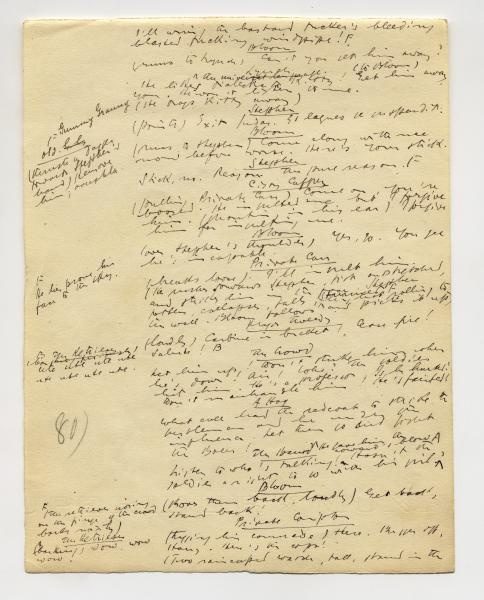
A handwritten fragment from the “Circe” episode of James Joyce’s Ulysses. Via/more.

Blog about reading Middlemarch (and wishing I was rereading Middlemarch)

Screenshot 2018-06-12 at 8.35.14 PM
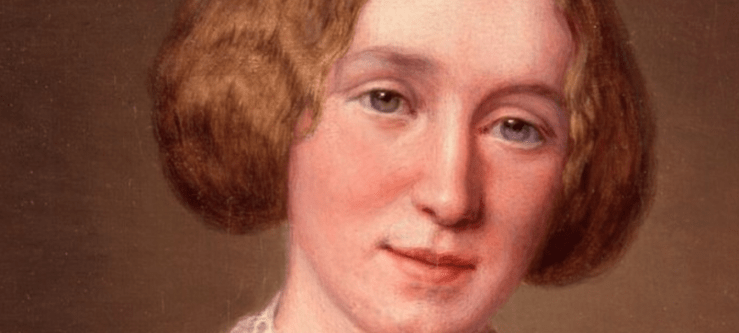
Detail of a portrait of Mary Ann Evans (George Eliot) at age 30 by François d’Albert Durade (1804–1886)

There should be a word in some language (perhaps not yet invented—word or language) to describe the feeling of Having pushed far enough into a very long novel (a novel that one has cracked into more than once) to the point that one now feels one can finally finish it.

I have felt this specific feeling a number of times in my life after finally sinking into long novels like Moby-DickGravity’s Rainbow, and Infinite Jest. There’s a sort of relief mixed into this (as-yet-unnamed?) feeling, a letting go even, where the reader (me, I mean) surrenders to the novel’s form and content. Finally freed from the idea of reading the novel, I am able to read the novel.

There are 86 numbered chapters in George Eliot’s 1872 novel Middlemarch (not counting a “Prelude” and a “Finale”). I have just finished Chapter XXXV—not exactly a half-way point, but far enough in to finally feel like the story and the style are sticking with me. I’ve been reading a public domain copy on my iPad, after having abandoned my 1977 Norton Critical Edition—the Norton’s print is too cramped (and maybe my eyes are starting to go as I approach 40). Also, the Norton annotations are useful but too intrusive for a first read. I found myself utterly distracted by the Norton footnotes after about 50 pages; switching to a footnote-free version has alleviated a lot of the anxiety I initially felt about trying to fully comprehend Eliot’s novel in its own historical context. Dispensing with the footnotes allowed me to finally sink into Middlemarch and appreciate its wonderful evocation of consciousness-in-action.

So far, my favorite character in Middlemarch is Dorothea Brooke. In part my allegiance to her is simply a matter of the fact that she initially appears to be the novel’s central character—until Eliot swerves into new narratives near the end of Book I (Book I of VIII, by the way). But beyond traditional formal sympathies, it’s the way that Eliot harnesses Dorothea’s consciousness that I find so appealing. Eliot gives us in Dorothea an incredibly intelligent yet palpably naive young woman who feels the world around her a smidge too intensely. Dorothea is brilliant but a bit blind, and so far Middlemarch most interests me in the way that Eliot evokes this heroine’s life as a series of intellectual, emotional, and aesthetic revelations. We see Dorothea seeing—and then, most remarkably, we see Dorothea seeing what she could not previously see.

There are other intriguing characters too, like Dr. Tertius Lydgate, the wastrel Fred Vincy, and the would-be-Romantic Will Ladislaw (who has like, totally smoked opium, just so you know). I’m particularly fond of Dorothea’s goofy uncle Arthur Brooke.

I won’t bother summarizing the plot thus far of the novel, which is really a bunch of plate spinning, but rather offer this sentence from the novel itself:

Scenes which make vital changes in our neighbors’ lot are but the background of our own, yet, like a particular aspect of the fields and trees, they become associated for us with the epochs of our own history, and make a part of that unity which lies in the selection of our keenest consciousness.

There’s also another self-summarizing passage a few chapters before this one, worth citing here:

Your pier-glass or extensive surface of polished steel made to be rubbed by a housemaid, will be minutely and multitudinously scratched in all directions; but place now against it a lighted candle as a centre of illumination, and lo! the scratches will seem to arrange themselves in a fine series of concentric circles round that little sun. It is demonstrable that the scratches are going everywhere impartially and it is only your candle which produces the flattering illusion of a concentric arrangement, its light falling with an exclusive optical selection. These things are a parable. The scratches are events, and the candle is the egoism of any person now absent…

Each of us is a reader reading other lives as scratches on a mirror or trees in the distance, and in our reading we incorporate them into our own consciousness, our own narrative. Middlemarch is very good at evoking this social reality.

I started this blog post by trying to describe a very specific feeling for which I don’t have a word—namely, and again: Having pushed far enough into a very long novel to the point that one now feels one can finally finish it. I suspect that this is a not-uncommon feeling. I’m not so sure though of how common the other feeling I have while reading Middlemarch is. I keep feeling (feeling, not thinking): I wish that I was rereading Middlemarch and not reading Middlemarch. If I were rereading Middlemarch I could make much more sense of those mirror scratches and those trees in the distance; if I were rereading Middlemarch, I could feel the feeling of reading Middlemarch more. There is an obvious answer to this desire, of course. I can finish reading Middlemarch. Then I can reread Middlemarch. 

Portrait of a reader driven by horror vacui

There is a fascinating feature in today’s New York Times Magazine by Jack Hitt about John Kidd, a James Joyce scholar who “disappeared” two decades ago. The article, titled “The Strange Case of the Missing Joyce Scholar,” initially focuses on Kidd’s very-public (for academia, anyway) fight with Hans Walter Gabler. Gabler claimed to have produced a corrected version of Joyce’s 1922 novel Ulysses, and Kidd delighted at picking apart his “corrected version,” exposing minute errors to the literary world. As the article progresses though, Hitt draws a compelling portrait of Kidd as a kind of highly-artistic reader of encyclopedic literature driven by extreme horror vacui, fear of the void. A couple of paragraphs from late in the essay, in which Kidd explains his translation of The Slave Isaura  (after the pair has escaped some knife-wielding thugs):

One day, Kidd and I got up early to make our way to the Brazilian Academy of Letters, where he works. Crossing a vacant square beneath an aqueduct, we suddenly realized that five men with knives were tailing us; soon, they were chasing us. Kidd, a former high school sprinter, grunted a suggestion — run! — and we poured out our best 100-yard dash to a nearby food cart. Street vendors, Kidd explained later, collect money all day and are typically armed and tough. As we sailed under the cart’s umbrella, our churrasquinho-monger stepped up beside us and glared. The thugs melted away.

Inside the refuge of the academy, Kidd keeps a permanent cubicle occupied by a big old PC and a few books. For years he has been working on the first English edition of the novel “The Slave Isaura.” Kidd is translating the 19th-century book with a few rules he felt compelled to devise. The work will be in two parts, and every word in Part 1 will have its lexicographic partner in Part 2. If “cat feet” appears in Part 1, expect “cattail” in Part 2. His sense of what pairs up can get quite intricate, but that’s part of the fun, he told me. So he maintains lists of all the possible pairings and where and whether he has used one: six foot, six foot under, footing, foothills, footloose, footprint. There is a logic to the work, and the part I read resounded with the baroque tone you might expect of a translation that will obey his other rule: It will use every word exactly once.

Already, the work is nearly twice as plump as Joyce’s “Ulysses.” Kidd was particularly excited to show me his key apparatus — the homemade thesaurus where he keeps a running crosscheck on the entirety of the English language. So far, it runs to some 3,000 pages.

“As much as humanly possible, the 19th-century dictionary of English is in here,” he told me. His translation is titled “Isaura Unbound,” and he wanted me to understand its ambition: When the book is finished, it will be a complete reordering of one entire English dictionary into a single work of art. Take that, void.

Read Philip K. Dick’s short story “The Day Mr. Computer Fell out of Its Tree”

“The Day Mr. Computer Fell out of Its Tree”

by

Philip K. Dick


He awoke, and sensed at once that something dreadful was wrong. Oh God, he thought as he realized that Mr. Bed had deposited him in a muddled heap against the wall. It’s beginning again, he realized. And the Directorate West promised us infinite perfection. This is what we get, he realized, for believing in what mere humans say.

As best he could he struggled out of his bedclothes, got shakily to his feet and made his way across the room to Mr. Closet.

“I’d like a natty sharkskin gray double-breasted suit,” he informed it, speaking crisply into the microphone on Mr. Closet’s door. “A red shirt, blue socks, and –” But it was no use. Already the slot was vibrating as a huge pair of women’s silk bloomers came sliding out.

“You get what you see,” Mr. Closet’s metallic voice came to him, echoing hollowly.

Glumly, Joe Contemptible put on the bloomers. At least it was better than nothing — like the day in Dreadful August when the vast polyencephalic computer in Queens had served up everyone in Greater America nothing but a handkerchief to wear.

Going to the bathroom, Joe Contemptible washed his face — and found the liquid which he was splashing on himself to be warm root beer. Christ, he thought. Mr. Computer is even zanier this time than ever before. It’s been reading old Phil Dick science fiction stories, he decided. That’s what we get for providing Mr. Computer with every kind of archaic trash in the world to read and store in its memory banks.

He finished combing his hair — without making use of the root beer — and then, having dried himself, entered the kitchen to see if Mr. Coffeepot was at least a sane fragment in a reality deteriorating all around him.

No luck. Mr. Coffeepot obligingly presented him with a dixie cup of soap. Well, so much for that.

The real problem, however, came when he tried to open Mr. Door. Mr. Door would not open; instead it complained tinnily: “The paths of glory lead but to the grave.”

“Meaning what?” Joe demanded, angry, now. This weird business was no longer fun. Not that it had ever been the times before — except, perhaps, when Mr. Computer had served him with roast pheasant for breakfast.

“Meaning,” Mr. Door said, “that you’re wasting your time, fucker. You’re not getting to the office today nohow.”

This proved to be true. The door would not open; despite his efforts the mechanism, controlled miles away from the polyencephalic master matrix, refused to budge.

Breakfast, then? Joe Contemptible punched buttons on the control module of Mr. Food — and found himself staring at a plate of fertilizer.

He thereupon picked up the phone and savagely attacked the numbers which would put him in touch with the local police.

“Loony Tunes Incorporated,” the face on the vidscreen said. “An animated cartoon version of your sexual practices produced in one week, including GLORIOUS SOUND EFFECTS!”

Fuck it, Joe Contemptible said to himself and rang off. Continue reading “Read Philip K. Dick’s short story “The Day Mr. Computer Fell out of Its Tree””

The nightmare has no escape (Antoine Volodine)

Several creatures wake up, semi-human and semi-animal, seated on a tribunal dais. Their memory doesn’t give them any self-knowledge, they knew nothing about the affair that they must judge, or even about the world where they’ve landed. The only landmark they have at their disposal is the individual lamp that illuminates a bit of the table before them. The darkness all around is without hope. Silence reigns, crushing, and prolongs itself. Aware that the situation must be untangled in one way or another, they all imagine being observed by their neighbors with discontent and even hatred. In reality, all share, without knowing it, a vertiginous feeling of guilt and solitude. The strangeness of the situation reinforces itself every moment; immobility grow stronger. The minutes flow, more and more painful. The only way to put an end to the unbearable seems to be to take the floor. Their voice must be heard, they must seem to take on their judiciary function competently. After having cleared its throat, the massive animal who is in the middle, and therefore assumes the need to play the role of president, opens the dossier placed in front of it and begins to read it with thundering voice. Startled by the excessive vibration of its vocal chords, painfully embarrassed by the words it pronounces, it nonetheless continues its speech. What it has before it is a prose poem, surrealist, a completely incongruous text. The creatures sitting to its left and its right have collapsed at the idea that they must now prove their existence and therefore respond. In order not to underscore its own foreignness to the world, each one to the world, each one in turn pretends to know the procedure and intervenes, masking it’s fears under an aggressive excess of confidence. The readings follow one after the other. The poems are not always of a trivial nature and, on the contrary, abound in imprecations and personal attacks;  however, they are formulated in a sufficiently obscure manner that each magistrate feels deeply implicated. The tribunal session has no end. The nightmare has no escape.

From Antoine Volodine’s short story “The Theory of the Image According to Maria Three-Thirteen.” English translation by Katina Rodgers (Dalkey, 2014).

The microfiction, which points to the abject nature of writing/speaking (and witnessing), by the titular heroine, is also a macrofiction for both the story itself, and, perhaps, Volodine’s entire post-exotic project.

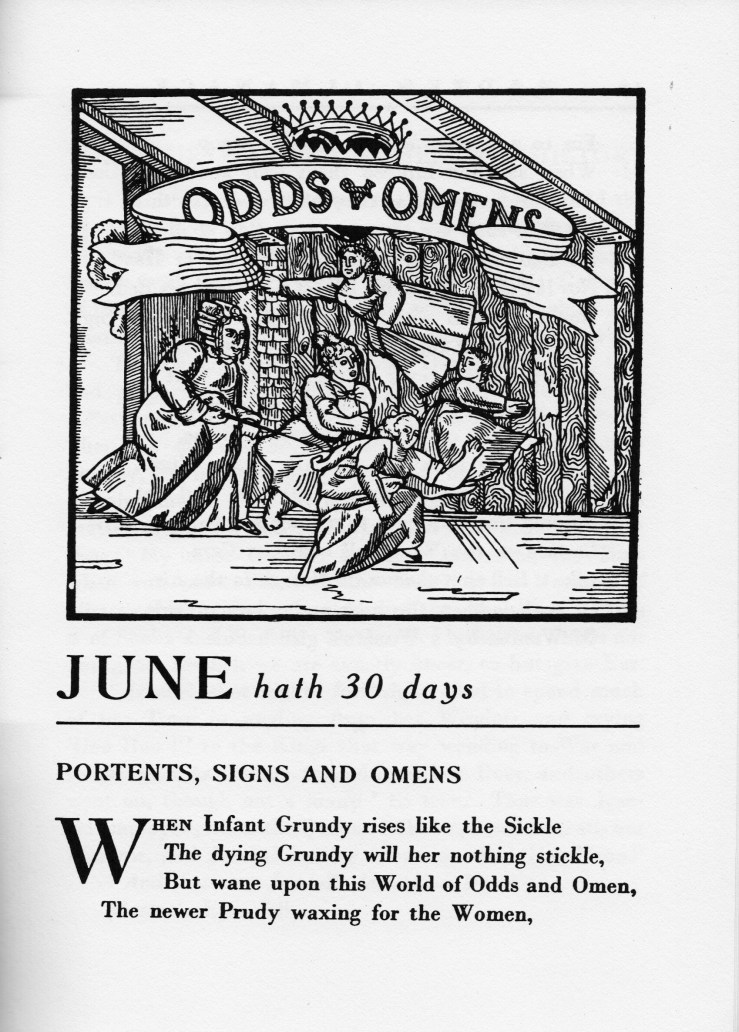
June hath 30 days | Djuna Barnes

image image

“Walter, leave off” | D.H. Lawrence on Walt Whitman

From D.H. Lawrence’s chapter on Whitman in Studies in Classic American Literature (more):

POST-MORTEM effects?

But what of Walt Whitman?

The ‘good grey poet’.

Was he a ghost, with all his physicality?

The good grey poet.

Post-mortem effects. Ghosts.

A certain ghoulish insistency. A certain horrible pottage of human parts. A certain stridency and portentousness. A luridness about his beatitudes.

DEMOCRACY! THESE STATES! EIDOLONS! LOVERS, ENDLESS LOVERS!

ONE IDENTITY!

ONE IDENTITY!

I AM HE THAT ACHES WITH AMOROUS LOVE.

Do you believe me, when I say post-mortem effects ?

When the Pequod went down, she left many a rank and dirty steamboat still fussing in the seas. The Pequod sinks with all her souls, but their bodies rise again to man innumerable tramp steamers, and ocean-crossing liners. Corpses.

What we mean is that people may go on, keep on, and rush on, without souls. They have their ego and their will, that is enough to keep them going.

So that you see, the sinking of the Pequod was only a metaphysical tragedy after all. The world goes on just the same. The ship of the soul is sunk. But the machine-manipulating body works just the same: digests, chews gum, admires Botticelli and aches with amorous love.

I AM HE THAT ACHES WITH AMOROUS LOVE.

What do you make of that? I AM HE THAT ACHES. First generalization. First uncomfortable universalization. WITH AMOROUS LOVE! Oh, God! Better a bellyache. A bellyache is at least specific. But the ACHE OF AMOROUS LOVE!

Think of having that under your skin. All that!

I AM HE THAT ACHES WITH AMOROUS LOVE.

Walter, leave off. You are not HE. You are just a limited Walter. And your ache doesn’t include all Amorous Love, by any means. If you ache you only ache with a small bit of amorous love, and there’s so much more stays outside the cover of your ache, that you might be a bit milder about it.

I AM HE THAT ACHES WITH AMOROUS LOVE.

CHUFF! CHUFF! CHUFF!

CHU-CHU-CHU-CHU-CHUFF!

Reminds one of a steam-engine. A locomotive. They’re the only things that seem to me to ache with amorous love. All that steam inside them. Forty million foot-pounds pressure. The ache of AMOROUS LOVE. Steam-pressure. CHUFF!

An ordinary man aches with love for Belinda, or his Native Land, or the Ocean, or the Stars, or the Oversoul: if he feels that an ache is in the fashion.

It takes a steam-engine to ache with AMOROUS LOVE. All of it.

Walt was really too superhuman. The danger of the superman is that he is mechanical.

Snakes nest in that mouth (Walt Whitman)

Capture

I have been observing a little Mediterranean boy from Malaga | Nathaniel Hawthorne’s journal entry for May 30th, 1840

May 30th.–. . . On board my salt-vessels and colliers there are many things happening, many pictures which, in future years, when I am again busy at the loom of fiction, I could weave in; but my fancy is rendered so torpid by my ungenial way of life that I cannot sketch off the scenes and portraits that interest me, and I am forced to trust them to my memory, with the hope of recalling them at some more favorable period. For these three or four days I have been observing a little Mediterranean boy from Malaga, not more than ten or eleven years old, but who is already a citizen of the world, and seems to be just as gay and contented on the deck of a Yankee coal-vessel as he could be while playing beside his mother’s door. It is really touching to see how free and happy he is,–how the little fellow takes the whole wide world for his home, and all mankind for his family. He talks Spanish,–at least that is his native tongue; but he is also very intelligible in English, and perhaps he likewise has smatterings of the speech of other countries, whither the winds may have wafted this little sea-bird. He is a Catholic; and yesterday being Friday he caught some fish and fried them for his dinner in sweet-oil, and really they looked so delicate that I almost wished he would invite me to partake. Every once in a while he undresses himself and leaps over-board, plunging down beneath the waves as if the sea were as native to him as the earth. Then he runs up the rigging of the vessel as if he meant to fly away through the air. I must remember this little boy, and perhaps I may make something more beautiful of him than these rough and imperfect touches would promise.

Nathaniel Hawthorne’s journal entry for May 30th, 1840. From Passages from the American Note-Books.

Gordon Lish on Tom Wolfe

Gordon Lish wrote a remembrance for The Paris Review of Tom Wolfe, who died last Sunday. A baseball mitt story, from the remembrance:

Back in the day when there was talk between Tom’s Sheila and my Barbara of the two squads going halvsies on a great big house in Hamptonia, we all were sitting around in said real estate after a Sunday brunchy fress—Tom’s sidekicks Eddie Hayes and Richard Merkin among the newspaperbound bagelbound boasters—and I just so happened to have launched myself into a rapsode bearing on my baseball-playing startlements, this before I was expelled from the school where I’d done the startling, and Tom said he had a couple of mitts, why didn’t we go on out onto the lawn and throw it around awhile, and I said, thanks but no thanks, I having been a catcher when I was doing my startling and would therefore require the glove worn by a catcher if I were to catch a ball thrown by a pitcher known to me to have been a farm-team pitcher for the Dodgers, unless it was the Yanks, whereupon Tom allowed as to how he had happened to have fetched out from the city to Hamptonia the very variety of mitt, and so he had and so we did, humping it out onto the lawn and just as humpily regrouping among the housebound, Tom mum as you’d want that no toss he’d lobbed at me could I, the be-mitted braggart, begin to handle.

Nathaniel Hawthorne’s journal entry for May 16th, 1851

May 16th.–In our walks now, the children and I find blue, white, and golden violets, the former, especially, of great size and richness. Houstonias are abundant, blue-whitening some of the pastures. They are a very sociable little flower, and dwell close together in communities,–sometimes covering a space no larger than the palm of the hand, but keeping one another in cheerful heart and life,–sometimes they occupy a much larger space. Lobelia, a pink flower, growing in the woods. Columbines, of a pale red, because they have lacked sun, growing in rough and rocky places on banks in the copses, precipitating towards the lake. The leaves of the trees are not yet out, but are so apparent that the woods are getting a very decided shadow. Water-weeds on the edge of the lake, of a deep green, with roots that seem to have nothing to do with earth, but with water only.

Nathaniel Hawthorne’s journal entry for May 16th, 1851. From Passages from the American Note-Books.

“Mothers” — William Gaddis

“Mothers” by William Gaddis

When Ralph Waldo Emerson informed—or rather, perhaps, warned us—that we are what our mothers made us, we might dismiss it as received opinion and let it go at that, like the broken clock which is right twice a day, like the self-evident answer contained in Freud’s oft-quoted query “What do women want?” when, as nature’s handmaid, she must want what nature wants which is, quite simply, More. But which woman? Whose mother, Emerson’s? A woman so in thrall to religion that we confront another dead end; or Freud’s? or even one’s own, even mine, offering an opportune bit of wisdom to those of us engaged in the creative arts, where paranoia is almost an occupational hazard: “Bill, just try to remember,” she said, “there is much more stupidity than there is malice in the world,” an observation lavish with possibilities recalling Anatole France finding the fool more dangerous than the rogue because “the rogue does at least take a rest sometimes, the fool never.”

This is hardly to see stupidity and malice as mutually exclusive: look at your morning paper, where their combined forces explode exponentially (women and children first) from Bosnia to Belfast, unlike the international “intelligence community” so self-contained in its malice-free exercises that it generally ensnares only its own dubious cast of players. Of further importance is the distinction between stupidity and ignorance, since ignorance is educable, while stupidity’s self-serving mission is the cultivation and exploitation of ignorance, as politicians are keenly aware.

How, then, might Emerson’s mother have seen herself stumbling upon Thomas Carlyle’s vision of her son as a “hoary-headed and toothless baboon”? Or Freud’s, in the gross unlikelihood of her reading the Catholic World’s review of her son’s book Moses and Monotheism as “poorly written, full of repetitions . . . and spoiled by the author’s atheistic bias and his flimsy psychoanalytic fancies”? Goethe’s Wilhelm Meister dismissed as “sheer nonsense” by the Edinburgh Review and, a good century later, the hero of Saul Bellow’s Dangling Man ridiculed as a “pharisaical stinker” in Time magazine, John Barth’s The End of the Road recommended by Kirkus Reviews “for those schooled in the waste matter of the body and the mind,” and William Faulkner’s Absalom, Absalom! shrugged off as the “final blowup of what was once a remarkable, if minor, talent” by The New Yorker magazine where, just forty years later, “a group of avant-garde critics has put forward the idea that books should be made unreadable. This movement has manifest advantages. Being unreadable, the text repels reviewers, critics, anthologists, academic literati, and other parasitical forms of life,” indicting the author of the novel J R wherein “to produce an unreadable text, to sustain this foxy purpose over 726 pages, demands rare powers. Mr. Gaddis has them.” “You’re a fool, a fool!” the distraught mother of Dostoevski’s ill-fated hero Nikolay Stavrogin cries out at the “parasitical forms of life” surrounding her. “You’re all ungrateful fools. Give me my umbrella!”

(“Mothers” is collected in The Rush to Second Place).

The distance between the terror and the comedy of the void were somehow erotic (Robert Coover)

He recognizes in all these dislocations, of course, his lonely quest for the impossible mating, the crazy embrace of polarities, as though the distance between the terror and the comedy of the void were somehow erotic—it’s a kind of pornography. No wonder the sailor asked that his eyes be plucked out! He overlays frenzy with freeze frames, the flight of rockets with the staking of the vampire’s heart, Death’s face with thrusting buttocks, cheesecake with chaingangs, and all just to prove to himself over and over again that nothing and everything is true. Slapstick is romance, heroism a dance number. Kisses kill. Back projections are the last adequate measure of freedom and great stars are clocks: no time like the presence. Nothing, like a nun with a switchblade, is happening faster and faster, and cause (that indefinable something) is a happy ending. Or maybe not.

From Robert Coover’s 1987 short story “The Phantom of the Movie Palace.”