Some pleasures overflow the conditions attending them (Don DeLillo)

He had bitten into a peach and was smelling the pit-streaked flesh. I think I smiled, recognizing my own mannerism. These peaches were a baffling delight, certain ones, producing the kind of sense pleasure that’s so unexpectedly deep it seems to need another context. Ordinary things aren’t supposed to be this gratifying. Nothing about the exterior of the peach tells you it will be so lush, moist and aromatic, juices running along your gums, or so subtly colored inside, a pink-veined golden bloom. I tried to discuss this with the faces across the table.

“But I think pleasure is not easy to repeat,” Eliades said. “Tomorrow you will eat a peach from the same basket and be disappointed. Then you will wonder if you were mistaken. A peach, a cigarette. I enjoy one cigarette out of a thousand. Still I keep smoking. I think pleasure is in the moment more than in the thing. I keep smoking to find this moment. Maybe I will die trying.”

Possibly it was his appearance that gave these remarks the importance of a world view. His wild beard covered most of his face. It started just below the eyes. He seemed to be bleeding this coarse black hair. His shoulders curved forward as he spoke and he rocked slightly at the front edge of the chair. He wore a tan suit and pastel tie, an outfit at odds with the large fierce head, the rough surface he carried.

I tried to pursue the notion that some pleasures overflow the conditions attending them. Maybe I was a little drunk.

From Don DeLillo’s novel The Names.

adriaen_coorte_-_three_peaches_on_a_stone_ledge_with_a_painted_lady_butterfly

Three Peaches on a Stone Ledge with a Painted Lady Butterfly, 1695 by Adriaen Coorte (ca. 1665–1707)

“To the Garden of the World” — Walt Whitman

img_9017

From the Heritage Press edition of Walt Whitman’s Leaves of Grass, illustrated by Rockwell Kent, 1936.

Tourism is the march of stupidity (Don DeLillo)

My life was full of routine surprises. One day I was watching runners from Marathon dodge taxis near the Athens Hilton, the next I was turning a corner in Istanbul to see a gypsy leading a bear on a leash. I began to think of myself as a perennial tourist. There was something agreeable about this. To be a tourist is to escape accountability. Errors and failings don’t cling to you the way they do back home. You’re able to drift across continents and languages, suspending the operation of sound thought. Tourism is the march of stupidity. You’re expected to be stupid. The entire mechanism of the host country is geared to travelers acting stupidly. You walk around dazed, squinting into fold-out maps. You don’t know how to talk to people, how to get anywhere, what the money means, what time it is, what to eat or how to eat it. Being stupid is the pattern, the level and the norm. You can exist on this level for weeks and months without reprimand or dire consequence. Together with thousands, you are granted immunities and broad freedoms. You are an army of fools, wearing bright polyesters, riding camels, taking pictures of each other, haggard, dysenteric, thirsty. There is nothing to think about but the next shapeless event.

From Don DeLillo’s novel The Names.


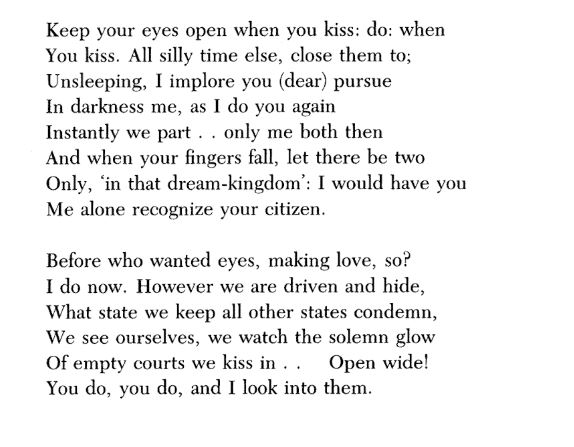
“Keep your eyes open when you kiss: do: when” — John Berryman

Capture

Read “Trilobites,” a short story by Breece D’J. Pancake

bdjp

“Trilobites”

by

Breece D’J. Pancake


I open the truck’s door, step onto the brick side street. I look at Company Hill again, all sort of worn down and round. A long time ago it was real craggy, and stood like an island in the Teays River. It took over a million years to make that smooth little hill, and I’ve looked all over it for trilobites. I think how it has always been there and always will be, least for as long as it matters. The air is smoky with summertime. A bunch of starlings swim over me. I was born in this country and I have never very much wanted to leave. I remember Pop’s dead eyes looking at me. They were real dry, and that took something out of me. I shut the door, head for the café.

I see a concrete patch in the street. It’s shaped like Florida, and I recollect what I wrote in Ginny’s yearbook: “We will live on mangoes and love.” And she up and left without me—two years she’s been down there without me. She sends me postcards with alligator wrestlers and flamingos on the front. She never asks me any questions. I feel like a real fool for what I wrote, and go into the café.

The place is empty, and I rest in the cooled air. Tinker Reilly’s little sister pours my coffee. She has good hips. They are kind of like Ginny’s and they slope nice curves to her legs. Hips and legs like that climb steps into airplanes. She goes to the counter end and scoffs down the rest of her sundae. I smile at her, but she’s jailbait. Jailbait and black snakes are two things “Won’t touch with a window pole. One time I used an old black snake for a bullwhip, snapped the sucker’s head off, and Pop beat hell out of me with it. I think how Pop could make me pretty mad sometimes. I grin.

I think about last night when Ginny called. Her old man drove her down from the airport in Charleston. She was already bored. Can we get together? Sure. Maybe do some brew? Sure. Same old Colly. Same old Ginny. She talked through her beak. I wanted to tell her Pop had died, and Mom was on the warpath to sell the farm, but Ginny was talking through her beak. It gave me the creeps.

Just like the cups give me the creeps. I look at the cups hanging on pegs by the storefront. They’re decal-named and covered with grease and dust. There’s four of them, and one is Pop’s, but that isn’t what gives me the creeps. The cleanest one is Jim’s. It’s clean because he still uses it, but it hangs there with the rest. Through the window, I can see him crossing the street. His joints are cemented with arthritis. I think of how long it’ll be before I croak, but Jim is old, and it gives me the creeps to see his cup hanging up there. I go to the door to help him in.

He says, “Tell the truth, now,” and his old paw pinches my arm.

I say, “Can’t do her.” I help him to his stool. Continue reading “Read “Trilobites,” a short story by Breece D’J. Pancake”

A review of The Paris Review’s overproduced podcast

64100a01b64641e5115c2c856d12fd7e_89081506

In his introduction to the first episode of The Paris Review Podcast, former editor Lorin Stein tells us that we’re going to hear some great writing. He then claims, “what you won’t hear is much in the way of hosting from me or anyone else. We’re just going to let the writing speak for itself, the way it always has in the magazine.” The first two parts are true—there’s plenty of great writing here from The Paris Review archive, and there’s no one hosting the pieces. The last part of Stein’s claim is the problem though: The Paris Review Podcast repeatedly refuses to simply let the writing speak for itself. Prose and poems alike are slathered in distracting and silly sound effects and busy musical cues. This is a shame, because the estimable voice talents the producers have enlisted do a marvelous job conveying the tones, mood, and rhythms of the pieces the producers have selected (most of which are excellent). Perhaps the podcast’s producers simply don’t trust their readers enough to stay engaged without all the buzzing clutter—but for me the overproduction is too much.

There are ten episodes of The Paris Review Podcast to date. I have listened to half of them: episodes 10, 1, 5, 2, and 3 (in that order). Episode 10, “The Occasional Dream,” was perhaps an unfortunate starting point, as it contains some of the most overproduced segments I heard in the series.

The problem wasn’t the first selection, a fantastic Frank O’Hara poem called “A True Account of Talking to the Sun at Fire Island” which I’d never read before. David Sedaris’s reading conveys the poem’s wit and depth, and the musical cues are only mildly intrusive, bleeding in at beginning and end. Then we get to Roberto Bolaño’s poem “When Lisa Told Me,” read by Dakota Johnson. The poem is set in a phone booth, so the producers, not trusting Bolaño’s powers of mimesis, or the auditor’s imagination (or both), include phone booth sound effects, like change dropping into a slot, buttons being punched, a dial tone. There’s also some distracting music. All of this takes away from Bolaño’s music (and Johnson’s capable reading).

By the time I got to Mary-Louis Parker reading Joy Williams’s story “Making Friends” I was dismayed. Cheesy calypso music crawls all over the story. When Williams notes a dog panting, the producers employ the sound effect of a dog panting. This is not how fiction works. In my distracted consternation, I forgot to pay attention to the story itself.

The worst offender by far though is an archival recording of John Ashberry reading his poem “Soonest Mended” which has been, for some reason I do not understand, accompanied by a new guitar composition by Steve Gunn. Gunn’s music is wonderful, his guitar evocative of fingerpickers like John Fahey and Leo Kottke, and I would be happy to listen to it on its own. Mashing it up with Ashberry’s poem adds nothing—or rather, we have subtraction by addition.

Archival recordings fare better elsewhere. In Episode 2, Jack Kerouac tells the story of the Buddha without any fussy interruptions. Kerouac’s unadorned riff showcases the podcast’s potential to present wonderful little moments, stitching them to other wonderful moments, without any overproduced impositions. Similarly, the inaugural episode, “Times of Cloud,” gives us Maya Angelou and Paris Review founder George Plimpton in conversation. The producers choose an apt moment; Angelou essentially offers a raison dêtre for The Paris Review Podcast:

I want to hear how English sounds; how Edna St. Vincent Millay heard English. I want to hear it, so I read it aloud. It is not so that I can then imitate it. It is to remind me what a glorious language it is.

The most “glorious language” in Episode 1 of The Paris Review Podcast comes from Wallace Shawn reading Denis Johnson’s classic story “Car-Crash While Hitchhiking.” A really good reader—and Wallace Shawn is a really good reader—can help us hear a story we’ve read a dozen times in a new way. It’s a testament to both Shawn’s reading and Johnson’s prose that they withstand the goofy sound effects and needless music the producers daub all over the story. Johnson’s narrator has already told us that it is raining; we do not need a canned rain shower murking up the audio.

The mimetic cloudiness of sound effects can be cheesy, but the unneeded musical cues are often the more damaging imposition. In Episode 5, Alison Fraser reads Lucia Berlin’s  “B.F. and Me,” conveying the story’s odd flirty energy with aplomb. The bluesy vamping soundtrack adds nothing though—again, it takes away from the auditor’s experience of the prose. In the same episode, Caleb Crain reads his wonderful short story “Envoy.” The tale’s strange poignant climax manages to survive the unnecessary intrusion of a heavy-handed musical cue that could easily have disrupted the ambiguities in the last few sentences. A Dorothea Lasky poem in Episode 3 begins well enough. Its imagistic contours of concrete reality unfurl without any noisy claptrap. But when the poem’s second half steers toward abstraction, the producers add a piano étude to compete with Lasky’s own music. And in the climactic moment in Raymond Carver’s “Why Don’t You Dance?” (also in Episode 3)—you know, the part where the characters, um, dance—the producers actually add a fucking country waltz.

The Paris Review Podcast perhaps suffers from an anxiety of influence. I imagine the show wishes to separate itself from The New Yorker’s no-frills Fiction Podcast, where one author reads another author’s story, and then discusses the story with New Yorker fiction editor Deborah Treisman. The Paris Review Podcast veers far more closely to the busy buzziness of Radiolab, with a dash of This American Life. I can understand the appeal there, the attempt to capture some of that ole timey radio Foley stage energy. But Radiolab is its own medium with its own formal innovations. The Paris Review is a mixtape, yes, but it’s a mixtape of poetry, prose, and interviews. A poem that John Ashberry wrote and read aloud in his own voice does not need the innovation of a contemporary guitar score. We do not need the sound of shallots simmering in a pan to convey that someone is cooking, as happens in Shelly Oria’s story “My Wife, In Converse.” We do not need a bluesy-guitar bend or the sustain of melancholy piano chords to convey the emotion that the writer has already conveyed through the language.  The effect of such impositions is like someone doing shadow puppets over an oil painting, or talking during a film, or pouring soup over a really good salad.

And yet you’ll note above that I listened to half of the podcasts. I listened while walking or driving or doing small household chores or yard chores. The stories, the poems, the interviews are quite good. There’s so much potential here. But it often seems like The Paris Review Podcast is content to present the material as an ambient backdrop, an aural texture that might compete with a commute. This is wholly unnecessary. The form is already there, embedded in the content—the language itself. And the language is best—most glorious, Angelou might say—when it is naked.


“Cadbury, the Beaver Who Lacked” — Philip K. Dick

“Cadbury, the Beaver Who Lacked”

by

Philip K. Dick


Once, long ago, before money had been invented, a certain male beaver named Cadbury lived within a meager dam which he had constructed with his own teeth and feet, earning his living by gnawing down shrubs, trees and other growth in exchange for poker chips of several colors. The blue chips he liked best, but they came rarely, generally only due in payment for some uniquely huge gnawing-assignment. In all the passing years of work he had owned only three such chips, but he knew by inference that more must exist, and every now and then during the day’s gnawing he paused a moment, fixed a cup of instant coffee, and meditated on chips of all hues, the blues included.

His wife Hilda offered unasked-for advice whenever the opportunity presented itself. “Look at you,” she customarily would declare. “You really ought to see a psychiatrist. Your stack of white chips is only approximately half that of Ralf, Peter, Tom, Bob, Jack and Earl, all who live and gnaw around here, because you’re so busy woolgathering about your goddam blue chips which you’ll never get anyhow because frankly if the blunt truth were known you lack the talent, energy and drive.”

“Energy and drive,” Cadbury would moodily retort, “mean the same thing.” But nevertheless he perceived how right she was. This constituted his wife’s main fault: she invariably had truth on her side, whereas he had nothing but hot air. And truth, when pitted against hot air in the arena of life, generally carries the day.

Since Hilda was right, Cadbury dug up eight white chips from his secret chip-concealing place — a shallow depression under a minor rock — and walked two and three-quarters miles to the nearest psychiatrist, a mellow, do-nothing rabbit shaped like a bowling pin who, according to his wife, made fifteen thousand a year and so what about it.

“Clever sort of day,” Dr. Drat said amiably, unrolling two Tums for his tummy and leaning back in his extra-heavily padded swivel chair.

“Not so very darn clever,” Cadbury answered, “when you know you don’t have it in you ever to catch sight of a blue chip again, even though you work your ass off day in and day out, and what for? She spends it faster than I make it. Even if I did get my teeth in a blue chip it’d be gone overnight for something expensive and useless on the installment plan, such as for instance a twelve million candle-power self-recharging flashlight. With a lifetime guarantee.”

“Those are darn clever,” Dr. Drat said, “those what you said there, those self-recharging flashlights.”

“The only reason I came to you,” Cadbury said, “is because my wife made me. She can get me to do anything. If she said, ‘Swim out into the middle of the creek and drown,’ do you know what I’d do?”

“You’d rebel,” Dr. Drat said in his amiable voice, his hoppers up on the surface of his burled walnut desk.

“I’d kick in her fucking face,” Cadbury said. “I’d gnaw her to bits; I’d gnaw her right in half, right through the middle. You’re damn right. I mean, I’m not kidding; it’s a fact. I hate her.”

“How much,” Dr. Drat asked, “is your wife like your mother?”

“I never had a mother,” Cadbury said in a grumpy way — a way which he adopted from time to time: a regular characteristic with him, as Hilda had pointed out. “I was found floating in the Napa Slough in a shoebox with a handwritten note reading ‘FINDERS KEEPERS.’ ”

“What was your last dream?” Dr. Drat inquired.

“My last dream,” Cadbury said, “is — was — the same as all the others. I always dream I buy a two-cent mint at the drugstore, one of the flat chocolate-covered mints wrapped in green foil, and when I remove the foil it isn’t a mint. You know what it is?”

“Suppose you tell me what it is,” Dr. Drat said, in a voice suggesting that he really knew but no one was paying him to say it.

Cadbury said fiercely, “It’s a blue chip. Or rather it looks like a blue chip. It’s blue and it’s flat and round and the same size. But in the dream I always say ‘Maybe it’s just a blue mint.’ I mean, there must be such a thing as blue mints. I’d hate like to hell to store it in my secret chip-concealing place — a shallow depression under an ordinary-looking rock — and then there’d be this hot day, see, and afterwards when I went to get my blue chip — or rather supposed blue chip — I found it all melted because it really was a mint after all and not a blue chip. And who’d I sue? The manufacturer? Christ; he never claimed it was a blue chip; it clearly said, in my dream, on the green foil wrapper –”

“I think,” Dr. Drat broke in mildly, “that our time is up for today. We might well do some exploring of this aspect of your inner psyche next week because it appears to be leading us somewhere.”

Rising to his feet, Cadbury said, “What’s the matter with me, Dr. Drat? I want an answer; be frank — I can take it. Am I psychotic?”

“Well, you have illusions,” Dr. Drat said, after a meditative pause. “No, you’re not psychotic; you don’t hear the voice of Christ or anything like that telling you to go out and rape people. No, it’s illusions. About yourself, your work, your wife. There may be more. Goodbye.” He rose, too, hippity-hopped to the door of his office and politely but firmly opened it, exposing the tunnel out.


Read the rest of “Cadbury, the Beaver Who Lacked” by Philip K. Dick

Our hearts and minds may keep themselves above moral mud-puddles | Nathaniel Hawthorne’s journal entry for February 7th, 1840

February 7th, 1840.–What beautiful weather this is!–beautiful, at least, so far as sun, sky, and atmosphere are concerned, though a poor, wingless biped is sometimes constrained to wish that he could raise himself a little above the earth. How much mud and mire, how many pools of unclean water, how many slippery footsteps, and perchance heavy tumbles, might be avoided, if we could tread but six inches above the crust of this world. Physically we cannot do this; our bodies cannot; but it seems to me that our hearts and minds may keep themselves above moral mud-puddles and other discomforts of the soul’s pathway.

Nathaniel Hawthorne’s journal entry for February 7th, 1840. From Passages from the American Note-Books.

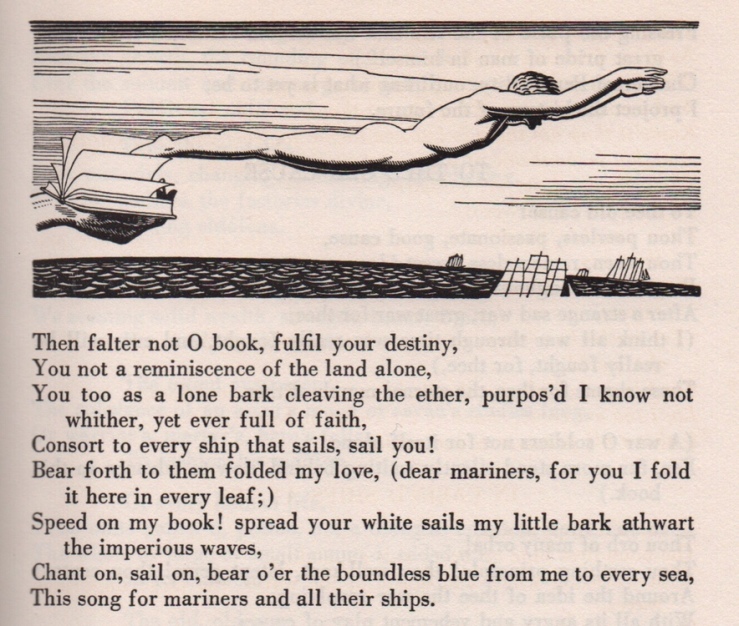
Then falter not O book

img_9015

From the Heritage Press edition of Walt Whitman’s Leaves of Grass, illustrated by Rockwell Kent, 1936.

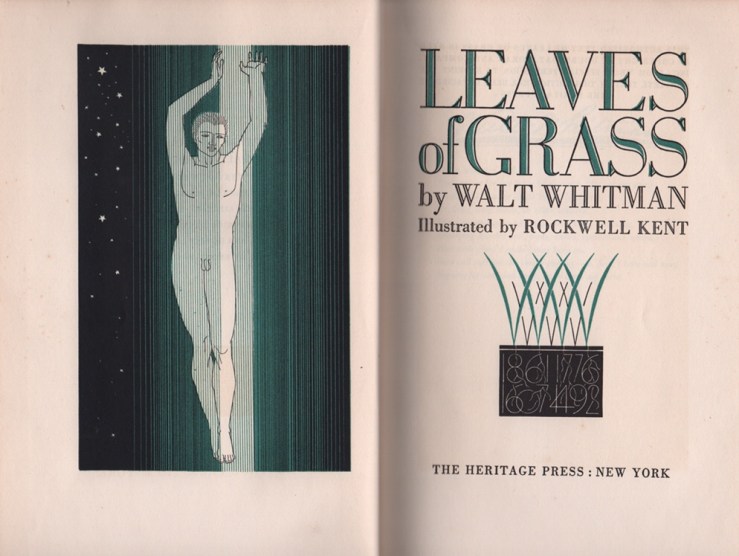
Walt Whitman’s Leaves of Grass, Illustrated by Rockwell Kent (Book acquired, 3 Feb. 2018)

img_9012

I couldn’t pass up on this illustrated Heritage Press copy of Leaves of Grass. I’m not sure of the exact date of publication, but this nice long post on the book suggests it was likely published in 1950 and designed in the mid-thirties.

img_9011

My daughter and I were browsing the poetry section of our favorite used bookshop—quite randomly actually—and she pulled this volume of Leaves of Grass downward like a lever, pretending it might open a secret passage. It didn’t open a secret passage, but when she pushed it back again, I saw Kent’s name on the spine. I love Kent’s work, and I’m a huge Whitman fan, and my copy of Leaves of Grass is literally falling apart. Plus only $10 and I had plenty of store credit…so…

img_9013

I’ll share some of the illustrations and verses over the next few months—a nice excuse to go through Leaves of Grass again.

img_9019

The scene is grey (Stephen Crane)

crane

A review of Ursula K. Le Guin’s novel The Lathe of Heaven

The City I Dream, Victor Brauner

George Orr is not well. The meek protagonist of Ursula K. Le Guin’s novel The Lathe of Heaven abuses prescription drugs in a desperate and unsuccessful attempt to stop himself from falling asleep. Orr doesn’t want to sleep because he believes that his dreams come true—that they literally alter reality—but in such a way that no one but Orr realizes that the world has changed. Orr gets caught using a “Pharmacy Card” that doesn’t belong to him, and is court-ordered to begin treatment with a sleep research psychiatrist, Dr. William Haber. Although Haber initially doesn’t believe Orr’s claim to be cursed with “effective dreams” that transform reality, he soon realizes that Orr’s dreams somehow do come true. Then, via hypnotic suggestion (and an “Augmentor” device), Haber begins wielding Orr’s gift/curse as a clumsy tool to “better” the world.

The world of The Lathe of Heaven is grim, gray, dystopian. Published in 1971 and set in Portland in the palindromic year of 2002, Le Guin’s novel is depressingly prescient. Not only does she capture the onset of seventies malaise (the ashes of hope that burned out in the sixties), she also points to a future of environmental catastrophe:

Very little light and air got down to street level; what there was was warm and full of fine rain. Rain was an old Portland tradition, but the warmth—70° F on the second of March—was modern, a result of air pollution. Urban and industrial effluvia had not been controlled soon enough to reverse the cumulative trends already at work in the mid-twentieth century; it would take several centuries for the CO2 to clear out of the air, if it ever did. New York was going to be one of the larger casualties of the Greenhouse Effect, as the polar ice kept melting and the sea kept rising…

This is also a world of urban sprawl, overpopulation, malnutrition, and total war (a clusterfuck in the Middle East, wouldn’t you know). The government is a vague and menacing presence here—vaguely totalitarian, vaguely Big Brotheresque. We learn of the “New Federal Constitution of 1984,” one of many references to Orwell’s book. (The most obvious is our passive hero’s name).

So it’s no wonder that Haber sets about to create a utopia, right? Wouldn’t you, like, try to make the world a better place if you could? Haber is repeatedly described as a “benevolent man”—Le Guin withholds the word dictator—but the central theme comes through repeatedly: Is it possible to alter reality for the greater good? Or do we simply exist in nature, a part of everything around us?

Haber’s experiments with Orr’s mind have unintended consequences. How might we, say, cure overpopulation? How about an awful plague. Orr’s “effective dreams” revise history, rewrite reality, remap consciousness. But he’s never quite able to pull off the massive tasks Haber sets for him—end racism, end war, cure the damaged ecosystem (Le Guin is extremely pessimistic on this last front). Orr is burdened with the consciousness of multiple realities, and feels deep guilt for his role in uncreation. He starts to go crazy:

“I am cracking,” he said. “You must see that. You’re a psychiatrist. Don’t you see that I’m going to pieces? Aliens from outer space attacking Earth! Look: if you ask me to dream again, what will you get? Maybe a totally insane world, the product of an insane mind. Monsters, ghosts, witches, dragons, transformations—all the stuff we carry around in us, all the horrors of childhood, the night fears, the nightmares. How can you keep all that from getting loose? I can’t stop it. I’m not in control!”

Continue reading “A review of Ursula K. Le Guin’s novel The Lathe of Heaven”

If civilization has an opposite, it is war (Ursula K. Le Guin)

Tibe spoke on the radio a good deal. Estraven when in power had never done so, and it was not in the Karhidish vein: their government was not a public performance, normally; it was covert and indirect. Tibe, however, orated. Hearing his voice on the air I saw again the long-toothed smile and the face masked with a net of fine wrinkles. His speeches were long and loud: praises of Karhide, disparagements of Orgoreyn vilifications of “disloyal factions,” discussions of the “integrity of the Kingdom’s borders,” lectures in history and ethics and economics, all in a ranting, canting, emotional tone that went shrill with vituperation or adulation. He talked much about pride of country and love of the parentland, but little about shifgrethor, personal pride or prestige. Had Karhide lost so much prestige in the Sinoth Valley business that the subject could not be brought up? No; for he often talked about the Sinoth Valley. I decided that he was deliberately avoiding talk of shifgrethor because he wished to rouse emotions of a more elemental, uncontrollable kind. He wanted to stir up something which the whole shifgrethor-pattern was a refinement upon, a sublimation of. He wanted his hearers to be frightened and angry. His themes were not pride and love at all, though he used the words perpetually; as he used them they meant self-praise and hate. He talked a great deal about Truth also, for he was, he said, “cutting down beneath the veneer of civilization.”

It is a durable, ubiquitous, specious metaphor, that one about veneer (or paint, or pliofilm, or whatever) hiding the nobler reality beneath. It can conceal a dozen fallacies at once. One of the most dangerous is the implication that civilization, being artificial, is unnatural: that it is the opposite of primitiveness… Of course there is no veneer, the process is one of growth, and primitiveness and civilization are degrees of the same thing. If civilization has an opposite, it is war. Of those two things, you have either one, or the other. Not both. It seemed to me as I listened to Tibe’s dull fierce speeches that what he sought to do by fear and by persuasion was to force his people to change a choice they had made before their history began, the choice between those opposites.

From Ursula Le Guin’s 1969 novel The Left Hand of Darkness. The bold emphases are mine—mea culpa, I couldn’t help it.

Read “P’s Correspondence,” a short story by Nathaniel Hawthorne

“P’s Correspondence”

by

Nathaniel Hawthorne


MY UNFORTUNATE FRIEND P. has lost the thread of his life, by the interposition of long intervals of partially disordered reason. The past and present are jumbled together in his mind, in a manner often productive of curious results; and which will be better understood after a perusal of the following letter, than from any description that I could give. The poor fellow, without once stirring from the little white-washed, iron-grated room, to which he alludes in his first paragraph, is nevertheless a great traveller, and meets, in his wanderings, a variety of personages who have long ceased to be visible to any eye save his own. In my opinion, all this is not so much a delusion, as a partly wilful and partly involuntary sport of the imagination, to which his disease has imparted such morbid energy that he beholds these spectral scenes and characters with no less distinctness than a play upon the stage, and with somewhat more of illusive credence. Many of his letters are in my possession, some based upon the same vagary as the present one, and others upon hypotheses not a whit short of it in absurdity. The whole form a series of correspondence, which, should fate seasonably remove my poor friend from what is to him a world of moonshine, I promise myself a pious pleasure in editing for the public eye. P. had always a hankering after literary reputation, and has made more than one unsuccessful effort to achieve it. It would not be a little odd, if, after missing his object while seeking it by the light of reason, he should prove to have stumbled upon it in his misty excursions beyond the limits of sanity.

LONDON, February 29, 1845.

MY DEAR FRIEND:

Old associations cling to the mind with astonishing tenacity. Daily custom grows up about us like a stone-wall, and consolidates itself into almost as material an entity as mankind’s strongest architecture. It is sometimes a serious question with me, whether ideas be not really visible and tangible, and endowed with all the other qualities of matter. Sitting as I do, at this moment, in my hired apartment, writing beside the hearth, over which hangs a print of Queen Victoria–listening to the muffled roar of the world’s metropolis, and with a window at but five paces distant, through which, whenever I please, I can gaze out on actual London–with all this positive certainty, as to my whereabouts, what kind of notion, do you think, is just now perplexing my brain? Why–would you believe it?–that, all this time, I am still an inhabitant of that wearisome little chamber,–that whitewashed little chamber–that little chamber with its one small window, across which, from some inscrutable reason of taste or convenience, my landlord had placed a row of iron bars–that same little chamber, in short, whither your kindness has so often brought you to visit me! Will no length of time, or breadth of space, enfranchise me from that unlovely abode? I travel, but it seems to be like the snail, with my house upon my head. Ah, well! I am verging, I suppose, on that period of life when present scenes and events make but feeble impressions, in comparison with those of yore; so that I must reconcile myself to be more and more the prisoner of Memory, who merely lets me hop about a little, with her chain around my leg.

My letters of introduction have been of the utmost service, enabling me to make the acquaintance of several distinguished characters, who, until now, have seemed as remote from the sphere of my personal intercourse as the wits of Queen Anne’s time, or Ben Jonson’s compotators at the Mermaid. One of the first of which I availed myself, was the letter to Lord Byron. I found his lordship looking much older than I had anticipated; although–considering his former irregularities of life, and the various wear and tear of his constitution–not older than a man on the verge of sixty reasonably may look. But I had invested his earthly frame, in my imagination, with the poet’s spiritual immortality. He wears a brown wig, very luxuriantly curled, and extending down over his forehead. The expression of his eyes is concealed by spectacles. His early tendency to obesity having increased, Lord Byron is now enormously fat; so fat as to give the impression of a person quite overladen with his own flesh, and without sufficient vigor to diffuse his personal life through the great mass of corporeal substance, which weighs upon him so cruelly. You gaze at the mortal heap; and, while it fills your eye with what purports to be Byron, you murmur within yourself–“For Heaven’s sake, where is he?” Were I disposed to be caustic, I might consider this mass of earthly matter as the symbol, in a material shape, of those evil habits and carnal vices which unspiritualize man’s nature, and clog up his avenues of communication with the better life. But this would be too harsh; and besides, Lord Byron’s morals have been improving, while his outward man has swollen to such unconscionable circumference. Would that he were leaner; for, though he did me the honor to present his hand, yet it was so puffed out with alien substance, that I could not feel as if I had touched the hand that wrote Childe Harold.

On my entrance, his lordship apologized for not rising to receive me, on the sufficient plea that the gout, for several years past, had taken up its constant residence in his right foot; which, accordingly, was swathed in many rolls of flannel, and deposited upon a cushion. The other foot was hidden in the drapery of his chair. Do you recollect whether Byron’s right or left foot was the deformed one? Continue reading “Read “P’s Correspondence,” a short story by Nathaniel Hawthorne”

Read Edgar Allan Poe’s “The Man of the Crowd”

SH925
Fritz Eichenberg’s illustration for Edgar Allan Poe’s “The Man of the Crowd”


“The Man of the Crowd”

by

Edgar Allan Poe


     Ce grand malheur, de ne pouvoir être seul.

              La Bruyère.

IT was well said of a certain German book that “er lasst sich nicht lesen“—it does not permit itself to be read. There are some secrets which do not permit themselves to be told. Men die nightly in their beds, wringing the hands of ghostly confessors and looking them piteously in the eyes—die with despair of heart and convulsion of throat, on account of the hideousness of mysteries which will not suffer themselves to be revealed. Now and then, alas, the conscience of man takes up a burthen so heavy in horror that it can be thrown down only into the grave. And thus the essence of all crime is undivulged.

Not long ago, about the closing in of an evening in autumn, I sat at the large bow window of the D——- Coffee-House in London. For some months I had been ill in health, but was now convalescent, and, with returning strength, found myself in one of those happy moods which are so precisely the converse of ennui—moods of the keenest appetency, when the film from the mental vision departs—the [Greek phrase]—and the intellect, electrified, surpasses as greatly its every-day condition, as does the vivid yet candid reason of Leibnitz, the mad and flimsy rhetoric of Gorgias. Merely to breathe was enjoyment; and I derived positive pleasure even from many of the legitimate sources of pain. I felt a calm but inquisitive interest in every thing. With a cigar in my mouth and a newspaper in my lap, I had been amusing myself for the greater part of the afternoon, now in poring over advertisements, now in observing the promiscuous company in the room, and now in peering through the smoky panes into the street.

This latter is one of the principal thoroughfares of the city, and had been very much crowded during the whole day. But, as the darkness came on, the throng momently increased; and, by the time the lamps were well lighted, two dense and continuous tides of population were rushing past the door. At this particular period of the evening I had never before been in a similar situation, and the tumultuous sea of human heads filled me, therefore, with a delicious novelty of emotion. I gave up, at length, all care of things within the hotel, and became absorbed in contemplation of the scene without. Continue reading “Read Edgar Allan Poe’s “The Man of the Crowd””

“I think I could turn and live with animals” — Walt Whitman

Section 32 of Walt Whitman’s “Song of Myself”

***

I think I could turn and live with animals, they are so placid and self-contain’d;
I stand and look at them long and long.

They do not sweat and whine about their condition;
They do not lie awake in the dark and weep for their sins;
They do not make me sick discussing their duty to God;
Not one is dissatisfied—not one is demented with the mania of owning things;
Not one kneels to another, nor to his kind that lived thousands of years ago;
Not one is respectable or industrious over the whole earth.

So they show their relations to me, and I accept them;
They bring me tokens of myself—they evince them plainly in their possession.

I wonder where they get those tokens:
Did I pass that way huge times ago, and negligently drop them?
Myself moving forward then and now and forever,
Gathering and showing more always and with velocity,
Infinite and omnigenous, and the like of these among them;
Not too exclusive toward the reachers of my remembrancers;
Picking out here one that I love, and now go with him on brotherly terms.

A gigantic beauty of a stallion, fresh and responsive to my caresses,
Head high in the forehead, wide between the ears,
Limbs glossy and supple, tail dusting the ground,
Eyes full of sparkling wickedness—ears finely cut, flexibly moving.

His nostrils dilate, as my heels embrace him;
His well-built limbs tremble with pleasure, as we race around and return.

I but use you a moment, then I resign you, stallion;
Why do I need your paces, when I myself out-gallop them?
Even, as I stand or sit, passing faster than you.

“Two Little Things” — Robert Walser

tw