“Rebecca,” a very short story by Donald Barthleme

“Rebecca”

by

Donald Barthelme


Rebecca Lizard was trying to change her ugly, reptilian, thoroughly unacceptable last name.

“Lizard,” said the judge. “Lizard, Lizard, Lizard, Lizard. There’s nothing wrong with it if you say it enough times. You can’t clutter up the court’s calendar with trivial little minor irritations. And there have been far too many people changing their names lately.

Changing your name countervails the best interest of the telephone comany, the electric company, and the United States goverment. Motion denied.”

Lizard in tears.

Lizard led from the courtroom. A chrysanthemum of Kleenex held under her nose.

“Shaky lady,” said a man, “are you a schoolteacher?”

Of course she’s a schoolteacher, you idiot. Can’t you see the poor woman’s all upset? Why don’t you leave her alone?

“Are you a homosexual lesbian? Is that why you never married?”

Christ, yes, she’s a homosexual lesbian, as you put it. Would you please shut your face?

Rebecca went to the damned dermatologist (a new damned dermatologist), but he said the same thing the others had said. “Greenish,” he said, “slight greenishness, genetic anomaly, nothing to be done, I’m afraid, Mrs. Lizard.”

“Miss Lizard.”

“Nothing to be done, Miss Lizard.”

“Thank you, Doctor. Can I give you a little something for your trouble?”

“Fifty dollars.”

When Rebecca got home the retroactive rent increase was waiting for her, coiled in her mailbox like a pupil about to strike.

Must get some more Kleenex. Or a Ph.D. No other way.

She thought about sticking her head in the oven. But it was an electric oven.

Rebecca’s lover, Hilda, came home late.

“How’d it go?” Hilda asked, referring to the day.

“Lousy.”

“Hmmm,” Hilda said, and quietly mixed strong drinks of busthead for the two of them.

Hilda is a very good-looking woman. So is Rebecca. They love each other–an incredibly dangerous and delicate business, as we know. Hilda has long blond hair and is perhaps a shade the more beautiful. Of course Rebecca has a classic and sexual figure which attracts huge admiration from every beholder.

“You’re late,” Rebecca said. “Where were you?”

“I had a drink with Stephanie.”

“Why did you have a drink with Stephanie?”

“She stopped by my office and said let’s have a drink.”

“Where did you go?”

“The Barclay.”

“How is Stephanie?”

“She’s fine.”

“Why did you have to have a drink with Stephanie?”

“I was ready for a drink.”

“Stephanie doesn’t have a slight greenishness, is that it? Nice, pink Stephanie?”

Hilda rose and put an excellent C & W album on the record player. It was David Rogers’s

“Farewell to the Ryman,” Atlantic SD 7283. It contains such favorites as “Blue Moon of Kentucky,” “Great Speckled Bird,” “I’m Movin’ On,” and “Walking the Floor Over You.” Many great Nashville personnel appear on this record.

“Pinkness is not everything,” Hilda said. “And Stephanie is a little bit boring. You know that.” “Not so boring that you don’t go out for drinks with her.”

“I am not interested in Stephanie.”

“As I was leaving the courthouse,” Rebecca said, “a man unzipped my zipper.”

David Rogers was singing “Oh please release me, let me go.”

“What were you wearing?”

“What I’m wearing now.”

“So he had good taste,” Hilda said, “for a creep.” She hugged Rebecca, on the sofa. “I love you,” she said.

“Screw that,” Rebecca said plainly, and pushed Hilda away. “Go hang out with Stephanie Sasser.”

“I am not interested in Stephanie Sasser,” Hilda said for the second time.

Very often one “pushes away” the very thing that one most wants to grab, like a lover. This is a common, although distressing, psychological mechanism, having to do (in my opinion) with the fact that what is presented is not presented “purely,” that there is a tiny little canker or grim place in it somewhere. However, worse things can happen.

“Rebecca,” said Hilda, “I really don’t like your slight greenishness.”

The term “lizard” also includes geckos, iguanas, chameleons, slowworms, and monitors. Twenty existing families make up the order, according to the Larousse Encyclopedia of Animal Life, and four others are known only from fossils. There are about twenty-five hundred species, and they display adaptations for walking, running, climbing, creeping, or burrowing. Many have interesting names, such as the Bearded Lizard, the Collared Lizard, the Flap-Footed Lizard, the Frilled Lizard, the Girdle-Tailed Lizard, and the Wall Lizard.

“I have been overlooking it for these several years, because I love you, but I really don’t like it so much,” Hilda said. “It’s slightly–”

“Knew it,” said Rebecca.
Rebecca went into the bedroom. The color television set was turned on, for some reason.

In a greenish glow, a film called Green Hill was unfolding.

I’m ill, I’m ill.
I will become a farmer.
Our love, our sexual love, our ordinary love!

Hilda entered the bedroom and said, “Supper is ready.”

“What is it?”

“Pork with red cabbage.”

“I’m drunk,” Rebecca said.

Too many of our citizens are drunk at times when they should be sober–suppertime, for example. Drunkenness leads to forgetting where you have put your watch, keys, or money clip, and to a decreased sensitivity to the needs and desires and calm good health of others. The causes of overuse of alcohol are not as clear as the results. Psychiatrists feel in general that alcoholism is a serious problem but treatable, in some cases. AA is said to be both popular and effective. At base, the question is one of willpower.

“Get up,” Hilda said. “I’m sorry I said that.”

“You told the truth,” said Rebecca.

“Yes, it was the truth,” Hilda admitted.

“You didn’t tell me the truth in the beginning. In the beginning, you said it was beautiful.”

“I was telling you the truth, in the beginning. I did think it was beautiful. Then.”

This “then,” the ultimate word in Hilda’s series of three brief sentences, is one of the most pain-inducing words in the human vocabulary, when used in this sense. Departed time! And the former conditions that went with it! How is human pain to be measured? But remember that Hilda, too… It is correct to feel for Rebecca in this situation, but, reader, neither can Hilda’s position be considered an enviable one, for truth, as Bergson knew, is a hard apple, whether one is throwing it or catching it.

“What remains?” Rebecca said stonily.

“I can love you in spite of–”

Do I want to be loved in spite of? Do you? Does anyone? But aren’t we all, to some degree?

Aren’t there important parts of all of us which must be, so to say, gazed past? I turn a blind eye to that aspect of you, and you turn a blind eye to that aspect of me, and with these blind eyes eyeball-to-eyeball, to use an expression from the early 1960s, we continue our starched and fragrant lives. Of course it’s also called “making the best of things,” which I have always considered a rather soggy idea for an Americal ideal. But my criticisms of this idea must be tested against those of others–the late President McKinley, for example, who maintained that maintaining a good, in not necessarily sunny, disposition was the one valuable and proper course.

Hilda placed her hands on Rebecca’s head.

“The snow is coming,” she said. “Soon it will be snow time. Together then as in other snow times. Drinking the busthead ’round the fire. Truth is a locked room that we knock the lock off from time to time, and then board up again. Tomorrow you will hurt me, and I will inform you that you have done so, and so on and so on. To hell with it. Come, viridian friend, come and sup with me.”

They sit down together. The pork with red cabbage steams before them. They speak quietly about the McKinley Administration, which is being revised by revisionist historians. The story ends. It was written for several reasons. Nine of them are secrets. The tenth is that one should never cease considering human love, which remains as grisly and golden as ever, no matter what is tattooed upon the warm tympanic page.

(Via)

“In other words, I stole from a kid” | Don DeLillo and Atticus Lish

Like ”Ratner’s Star,” a book in which Mr. DeLillo says he tried to ”produce a piece of mathematics,” ”The Names” is complexly structured and layered. It concludes with an excerpt from a novel in progress by Axton’s 9-year-old son, Tap. Inspiration for the ending came from Atticus Lish, the young son of Mr. DeLillo’s friend Gordon Lish, an editor.

”At first,” Mr. DeLillo says, ”I had no intention of using excerpts from Tap’s novel. But as the novel drew to a close I simply could not resist. It seemed to insist on being used. Rather than totally invent a piece of writing that a 9-year-old boy might do, I looked at some of the work that Atticus had done when he was 9. And I used it. I used half a dozen sentences from Atticus’s work. More important, the simple exuberance of his work helped me to do the last pages of the novel. In other words, I stole from a kid.”

Young Atticus is given ample credit in the book’s acknowledgments, but creative borrowing from life is not a new technique for Mr. DeLillo, who has been praised for his ear for dialogue. ”The interesting thing about trying to set down dialogue realistically,” he says, ”is that if you get it right it sounds stylized. Why is it so difficult to see clearly and to hear clearly? I don’t know. But it is, and in ‘Players’ I listened very carefully to people around me. People in buses. People in the street. And in many parts of the book I used sentences that I heard literally, word for word. Yet it didn’t sound as realistic as one might expect. It sounded over-refined even.”

From a 1982 profile of Don DeLillo in The New York Times

Atticus Lish’s 2014 novel Preparation for the Next Life was one of the best novels I read last year, and one of the best contemporary American novels I’ve read in ages.

If a thing can be filmed, film is implied in the thing itself (Don DeLillo)

“Film is more than the twentieth century art. It’s another part of the twentieth-century mind. It’s the world seen from inside. We’ve come to a certain point in the history of film. If a thing can be filmed, film is implied in the thing itself. This is where we are. The twentieth century is on film. It’s the filmed century. You have to ask yourself if there’s anything about us more important than the fact that we’re constantly on film, constantly watching ourselves. The whole world is on film, all the time. Spy satellites, microscopic scanners, pictures of the uterus, embryos, sex, war, assassinations, everything.”

From Don DeLillo’s novel The Names.

Iris Murdoch’s The Bell (Book acquired, 23 Feb. 2018)

img_9112

I picked up Iris Murdoch’s novel The Bell the other day. I’d put it on my 2018 Good Intentions Reading List, but somehow failed to find it at the big used bookstore I frequent. I found six copies there on Friday, all in different editions—it turns out there was another shelf of Murdoch, but higher up and to the right of where I was looking. Anyway.

How is my progress on that 2018 list, you ask? Not great. I stalled out on William Gass’s The Tunnel after about 60 pages. I usually have fun reading Gass and I wasn’t having fun; in fact, I started approaching the book as a chore, which is not what I want to be doing with my spare time. I got sidetracked with Stanisław Witkiewicz’s Narcotics (not on The List—I hope to have a review up this week), and then picked up Don DeLillo’s The Names (on The List) instead of The Tunnel. I sank into the DeLillo, which feels a bit like a smart beach read after tangling with The Tunnel’s difficult defensive barriers. I plan to dip into The Bell next, and then approach the bigger books on The List—MiddlemarchWar & Peace, uh, The Tunnel—this summer when my teaching load is a lot lighter.


Some pleasures overflow the conditions attending them (Don DeLillo)

He had bitten into a peach and was smelling the pit-streaked flesh. I think I smiled, recognizing my own mannerism. These peaches were a baffling delight, certain ones, producing the kind of sense pleasure that’s so unexpectedly deep it seems to need another context. Ordinary things aren’t supposed to be this gratifying. Nothing about the exterior of the peach tells you it will be so lush, moist and aromatic, juices running along your gums, or so subtly colored inside, a pink-veined golden bloom. I tried to discuss this with the faces across the table.

“But I think pleasure is not easy to repeat,” Eliades said. “Tomorrow you will eat a peach from the same basket and be disappointed. Then you will wonder if you were mistaken. A peach, a cigarette. I enjoy one cigarette out of a thousand. Still I keep smoking. I think pleasure is in the moment more than in the thing. I keep smoking to find this moment. Maybe I will die trying.”

Possibly it was his appearance that gave these remarks the importance of a world view. His wild beard covered most of his face. It started just below the eyes. He seemed to be bleeding this coarse black hair. His shoulders curved forward as he spoke and he rocked slightly at the front edge of the chair. He wore a tan suit and pastel tie, an outfit at odds with the large fierce head, the rough surface he carried.

I tried to pursue the notion that some pleasures overflow the conditions attending them. Maybe I was a little drunk.

From Don DeLillo’s novel The Names.

adriaen_coorte_-_three_peaches_on_a_stone_ledge_with_a_painted_lady_butterfly

Three Peaches on a Stone Ledge with a Painted Lady Butterfly, 1695 by Adriaen Coorte (ca. 1665–1707)

“To the Garden of the World” — Walt Whitman

img_9017

From the Heritage Press edition of Walt Whitman’s Leaves of Grass, illustrated by Rockwell Kent, 1936.

Tourism is the march of stupidity (Don DeLillo)

My life was full of routine surprises. One day I was watching runners from Marathon dodge taxis near the Athens Hilton, the next I was turning a corner in Istanbul to see a gypsy leading a bear on a leash. I began to think of myself as a perennial tourist. There was something agreeable about this. To be a tourist is to escape accountability. Errors and failings don’t cling to you the way they do back home. You’re able to drift across continents and languages, suspending the operation of sound thought. Tourism is the march of stupidity. You’re expected to be stupid. The entire mechanism of the host country is geared to travelers acting stupidly. You walk around dazed, squinting into fold-out maps. You don’t know how to talk to people, how to get anywhere, what the money means, what time it is, what to eat or how to eat it. Being stupid is the pattern, the level and the norm. You can exist on this level for weeks and months without reprimand or dire consequence. Together with thousands, you are granted immunities and broad freedoms. You are an army of fools, wearing bright polyesters, riding camels, taking pictures of each other, haggard, dysenteric, thirsty. There is nothing to think about but the next shapeless event.

From Don DeLillo’s novel The Names.


“Keep your eyes open when you kiss: do: when” — John Berryman

Capture

Read “Trilobites,” a short story by Breece D’J. Pancake

bdjp

“Trilobites”

by

Breece D’J. Pancake


I open the truck’s door, step onto the brick side street. I look at Company Hill again, all sort of worn down and round. A long time ago it was real craggy, and stood like an island in the Teays River. It took over a million years to make that smooth little hill, and I’ve looked all over it for trilobites. I think how it has always been there and always will be, least for as long as it matters. The air is smoky with summertime. A bunch of starlings swim over me. I was born in this country and I have never very much wanted to leave. I remember Pop’s dead eyes looking at me. They were real dry, and that took something out of me. I shut the door, head for the café.

I see a concrete patch in the street. It’s shaped like Florida, and I recollect what I wrote in Ginny’s yearbook: “We will live on mangoes and love.” And she up and left without me—two years she’s been down there without me. She sends me postcards with alligator wrestlers and flamingos on the front. She never asks me any questions. I feel like a real fool for what I wrote, and go into the café.

The place is empty, and I rest in the cooled air. Tinker Reilly’s little sister pours my coffee. She has good hips. They are kind of like Ginny’s and they slope nice curves to her legs. Hips and legs like that climb steps into airplanes. She goes to the counter end and scoffs down the rest of her sundae. I smile at her, but she’s jailbait. Jailbait and black snakes are two things “Won’t touch with a window pole. One time I used an old black snake for a bullwhip, snapped the sucker’s head off, and Pop beat hell out of me with it. I think how Pop could make me pretty mad sometimes. I grin.

I think about last night when Ginny called. Her old man drove her down from the airport in Charleston. She was already bored. Can we get together? Sure. Maybe do some brew? Sure. Same old Colly. Same old Ginny. She talked through her beak. I wanted to tell her Pop had died, and Mom was on the warpath to sell the farm, but Ginny was talking through her beak. It gave me the creeps.

Just like the cups give me the creeps. I look at the cups hanging on pegs by the storefront. They’re decal-named and covered with grease and dust. There’s four of them, and one is Pop’s, but that isn’t what gives me the creeps. The cleanest one is Jim’s. It’s clean because he still uses it, but it hangs there with the rest. Through the window, I can see him crossing the street. His joints are cemented with arthritis. I think of how long it’ll be before I croak, but Jim is old, and it gives me the creeps to see his cup hanging up there. I go to the door to help him in.

He says, “Tell the truth, now,” and his old paw pinches my arm.

I say, “Can’t do her.” I help him to his stool. Continue reading “Read “Trilobites,” a short story by Breece D’J. Pancake”

A review of The Paris Review’s overproduced podcast

64100a01b64641e5115c2c856d12fd7e_89081506

In his introduction to the first episode of The Paris Review Podcast, former editor Lorin Stein tells us that we’re going to hear some great writing. He then claims, “what you won’t hear is much in the way of hosting from me or anyone else. We’re just going to let the writing speak for itself, the way it always has in the magazine.” The first two parts are true—there’s plenty of great writing here from The Paris Review archive, and there’s no one hosting the pieces. The last part of Stein’s claim is the problem though: The Paris Review Podcast repeatedly refuses to simply let the writing speak for itself. Prose and poems alike are slathered in distracting and silly sound effects and busy musical cues. This is a shame, because the estimable voice talents the producers have enlisted do a marvelous job conveying the tones, mood, and rhythms of the pieces the producers have selected (most of which are excellent). Perhaps the podcast’s producers simply don’t trust their readers enough to stay engaged without all the buzzing clutter—but for me the overproduction is too much.

There are ten episodes of The Paris Review Podcast to date. I have listened to half of them: episodes 10, 1, 5, 2, and 3 (in that order). Episode 10, “The Occasional Dream,” was perhaps an unfortunate starting point, as it contains some of the most overproduced segments I heard in the series.

The problem wasn’t the first selection, a fantastic Frank O’Hara poem called “A True Account of Talking to the Sun at Fire Island” which I’d never read before. David Sedaris’s reading conveys the poem’s wit and depth, and the musical cues are only mildly intrusive, bleeding in at beginning and end. Then we get to Roberto Bolaño’s poem “When Lisa Told Me,” read by Dakota Johnson. The poem is set in a phone booth, so the producers, not trusting Bolaño’s powers of mimesis, or the auditor’s imagination (or both), include phone booth sound effects, like change dropping into a slot, buttons being punched, a dial tone. There’s also some distracting music. All of this takes away from Bolaño’s music (and Johnson’s capable reading).

By the time I got to Mary-Louis Parker reading Joy Williams’s story “Making Friends” I was dismayed. Cheesy calypso music crawls all over the story. When Williams notes a dog panting, the producers employ the sound effect of a dog panting. This is not how fiction works. In my distracted consternation, I forgot to pay attention to the story itself.

The worst offender by far though is an archival recording of John Ashberry reading his poem “Soonest Mended” which has been, for some reason I do not understand, accompanied by a new guitar composition by Steve Gunn. Gunn’s music is wonderful, his guitar evocative of fingerpickers like John Fahey and Leo Kottke, and I would be happy to listen to it on its own. Mashing it up with Ashberry’s poem adds nothing—or rather, we have subtraction by addition.

Archival recordings fare better elsewhere. In Episode 2, Jack Kerouac tells the story of the Buddha without any fussy interruptions. Kerouac’s unadorned riff showcases the podcast’s potential to present wonderful little moments, stitching them to other wonderful moments, without any overproduced impositions. Similarly, the inaugural episode, “Times of Cloud,” gives us Maya Angelou and Paris Review founder George Plimpton in conversation. The producers choose an apt moment; Angelou essentially offers a raison dêtre for The Paris Review Podcast:

I want to hear how English sounds; how Edna St. Vincent Millay heard English. I want to hear it, so I read it aloud. It is not so that I can then imitate it. It is to remind me what a glorious language it is.

The most “glorious language” in Episode 1 of The Paris Review Podcast comes from Wallace Shawn reading Denis Johnson’s classic story “Car-Crash While Hitchhiking.” A really good reader—and Wallace Shawn is a really good reader—can help us hear a story we’ve read a dozen times in a new way. It’s a testament to both Shawn’s reading and Johnson’s prose that they withstand the goofy sound effects and needless music the producers daub all over the story. Johnson’s narrator has already told us that it is raining; we do not need a canned rain shower murking up the audio.

The mimetic cloudiness of sound effects can be cheesy, but the unneeded musical cues are often the more damaging imposition. In Episode 5, Alison Fraser reads Lucia Berlin’s  “B.F. and Me,” conveying the story’s odd flirty energy with aplomb. The bluesy vamping soundtrack adds nothing though—again, it takes away from the auditor’s experience of the prose. In the same episode, Caleb Crain reads his wonderful short story “Envoy.” The tale’s strange poignant climax manages to survive the unnecessary intrusion of a heavy-handed musical cue that could easily have disrupted the ambiguities in the last few sentences. A Dorothea Lasky poem in Episode 3 begins well enough. Its imagistic contours of concrete reality unfurl without any noisy claptrap. But when the poem’s second half steers toward abstraction, the producers add a piano étude to compete with Lasky’s own music. And in the climactic moment in Raymond Carver’s “Why Don’t You Dance?” (also in Episode 3)—you know, the part where the characters, um, dance—the producers actually add a fucking country waltz.

The Paris Review Podcast perhaps suffers from an anxiety of influence. I imagine the show wishes to separate itself from The New Yorker’s no-frills Fiction Podcast, where one author reads another author’s story, and then discusses the story with New Yorker fiction editor Deborah Treisman. The Paris Review Podcast veers far more closely to the busy buzziness of Radiolab, with a dash of This American Life. I can understand the appeal there, the attempt to capture some of that ole timey radio Foley stage energy. But Radiolab is its own medium with its own formal innovations. The Paris Review is a mixtape, yes, but it’s a mixtape of poetry, prose, and interviews. A poem that John Ashberry wrote and read aloud in his own voice does not need the innovation of a contemporary guitar score. We do not need the sound of shallots simmering in a pan to convey that someone is cooking, as happens in Shelly Oria’s story “My Wife, In Converse.” We do not need a bluesy-guitar bend or the sustain of melancholy piano chords to convey the emotion that the writer has already conveyed through the language.  The effect of such impositions is like someone doing shadow puppets over an oil painting, or talking during a film, or pouring soup over a really good salad.

And yet you’ll note above that I listened to half of the podcasts. I listened while walking or driving or doing small household chores or yard chores. The stories, the poems, the interviews are quite good. There’s so much potential here. But it often seems like The Paris Review Podcast is content to present the material as an ambient backdrop, an aural texture that might compete with a commute. This is wholly unnecessary. The form is already there, embedded in the content—the language itself. And the language is best—most glorious, Angelou might say—when it is naked.


“Cadbury, the Beaver Who Lacked” — Philip K. Dick

“Cadbury, the Beaver Who Lacked”

by

Philip K. Dick


Once, long ago, before money had been invented, a certain male beaver named Cadbury lived within a meager dam which he had constructed with his own teeth and feet, earning his living by gnawing down shrubs, trees and other growth in exchange for poker chips of several colors. The blue chips he liked best, but they came rarely, generally only due in payment for some uniquely huge gnawing-assignment. In all the passing years of work he had owned only three such chips, but he knew by inference that more must exist, and every now and then during the day’s gnawing he paused a moment, fixed a cup of instant coffee, and meditated on chips of all hues, the blues included.

His wife Hilda offered unasked-for advice whenever the opportunity presented itself. “Look at you,” she customarily would declare. “You really ought to see a psychiatrist. Your stack of white chips is only approximately half that of Ralf, Peter, Tom, Bob, Jack and Earl, all who live and gnaw around here, because you’re so busy woolgathering about your goddam blue chips which you’ll never get anyhow because frankly if the blunt truth were known you lack the talent, energy and drive.”

“Energy and drive,” Cadbury would moodily retort, “mean the same thing.” But nevertheless he perceived how right she was. This constituted his wife’s main fault: she invariably had truth on her side, whereas he had nothing but hot air. And truth, when pitted against hot air in the arena of life, generally carries the day.

Since Hilda was right, Cadbury dug up eight white chips from his secret chip-concealing place — a shallow depression under a minor rock — and walked two and three-quarters miles to the nearest psychiatrist, a mellow, do-nothing rabbit shaped like a bowling pin who, according to his wife, made fifteen thousand a year and so what about it.

“Clever sort of day,” Dr. Drat said amiably, unrolling two Tums for his tummy and leaning back in his extra-heavily padded swivel chair.

“Not so very darn clever,” Cadbury answered, “when you know you don’t have it in you ever to catch sight of a blue chip again, even though you work your ass off day in and day out, and what for? She spends it faster than I make it. Even if I did get my teeth in a blue chip it’d be gone overnight for something expensive and useless on the installment plan, such as for instance a twelve million candle-power self-recharging flashlight. With a lifetime guarantee.”

“Those are darn clever,” Dr. Drat said, “those what you said there, those self-recharging flashlights.”

“The only reason I came to you,” Cadbury said, “is because my wife made me. She can get me to do anything. If she said, ‘Swim out into the middle of the creek and drown,’ do you know what I’d do?”

“You’d rebel,” Dr. Drat said in his amiable voice, his hoppers up on the surface of his burled walnut desk.

“I’d kick in her fucking face,” Cadbury said. “I’d gnaw her to bits; I’d gnaw her right in half, right through the middle. You’re damn right. I mean, I’m not kidding; it’s a fact. I hate her.”

“How much,” Dr. Drat asked, “is your wife like your mother?”

“I never had a mother,” Cadbury said in a grumpy way — a way which he adopted from time to time: a regular characteristic with him, as Hilda had pointed out. “I was found floating in the Napa Slough in a shoebox with a handwritten note reading ‘FINDERS KEEPERS.’ ”

“What was your last dream?” Dr. Drat inquired.

“My last dream,” Cadbury said, “is — was — the same as all the others. I always dream I buy a two-cent mint at the drugstore, one of the flat chocolate-covered mints wrapped in green foil, and when I remove the foil it isn’t a mint. You know what it is?”

“Suppose you tell me what it is,” Dr. Drat said, in a voice suggesting that he really knew but no one was paying him to say it.

Cadbury said fiercely, “It’s a blue chip. Or rather it looks like a blue chip. It’s blue and it’s flat and round and the same size. But in the dream I always say ‘Maybe it’s just a blue mint.’ I mean, there must be such a thing as blue mints. I’d hate like to hell to store it in my secret chip-concealing place — a shallow depression under an ordinary-looking rock — and then there’d be this hot day, see, and afterwards when I went to get my blue chip — or rather supposed blue chip — I found it all melted because it really was a mint after all and not a blue chip. And who’d I sue? The manufacturer? Christ; he never claimed it was a blue chip; it clearly said, in my dream, on the green foil wrapper –”

“I think,” Dr. Drat broke in mildly, “that our time is up for today. We might well do some exploring of this aspect of your inner psyche next week because it appears to be leading us somewhere.”

Rising to his feet, Cadbury said, “What’s the matter with me, Dr. Drat? I want an answer; be frank — I can take it. Am I psychotic?”

“Well, you have illusions,” Dr. Drat said, after a meditative pause. “No, you’re not psychotic; you don’t hear the voice of Christ or anything like that telling you to go out and rape people. No, it’s illusions. About yourself, your work, your wife. There may be more. Goodbye.” He rose, too, hippity-hopped to the door of his office and politely but firmly opened it, exposing the tunnel out.


Read the rest of “Cadbury, the Beaver Who Lacked” by Philip K. Dick

Our hearts and minds may keep themselves above moral mud-puddles | Nathaniel Hawthorne’s journal entry for February 7th, 1840

February 7th, 1840.–What beautiful weather this is!–beautiful, at least, so far as sun, sky, and atmosphere are concerned, though a poor, wingless biped is sometimes constrained to wish that he could raise himself a little above the earth. How much mud and mire, how many pools of unclean water, how many slippery footsteps, and perchance heavy tumbles, might be avoided, if we could tread but six inches above the crust of this world. Physically we cannot do this; our bodies cannot; but it seems to me that our hearts and minds may keep themselves above moral mud-puddles and other discomforts of the soul’s pathway.

Nathaniel Hawthorne’s journal entry for February 7th, 1840. From Passages from the American Note-Books.

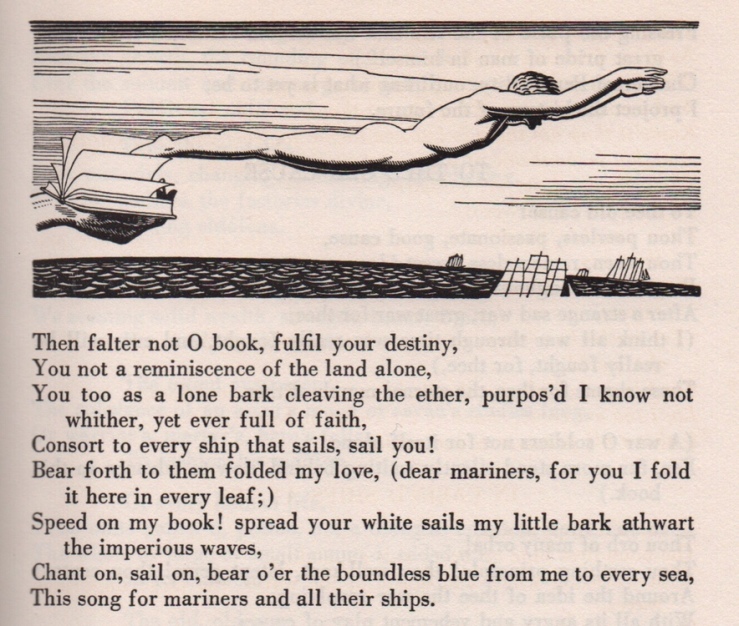
Then falter not O book

img_9015

From the Heritage Press edition of Walt Whitman’s Leaves of Grass, illustrated by Rockwell Kent, 1936.

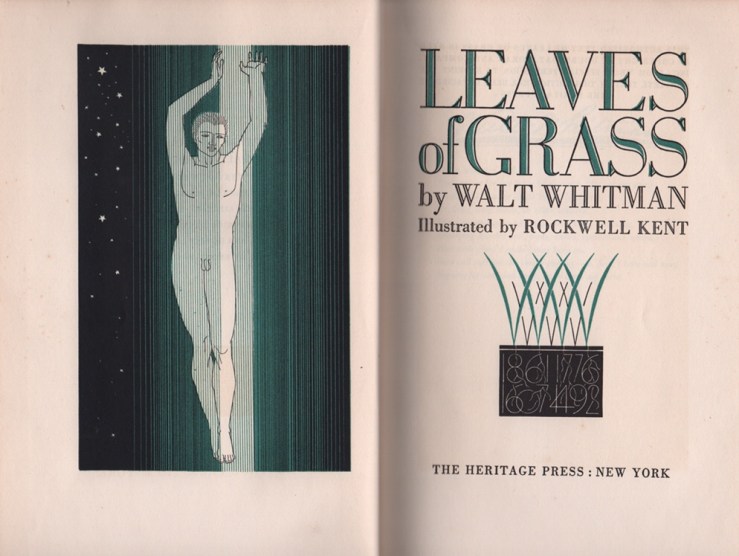
Walt Whitman’s Leaves of Grass, Illustrated by Rockwell Kent (Book acquired, 3 Feb. 2018)

img_9012

I couldn’t pass up on this illustrated Heritage Press copy of Leaves of Grass. I’m not sure of the exact date of publication, but this nice long post on the book suggests it was likely published in 1950 and designed in the mid-thirties.

img_9011

My daughter and I were browsing the poetry section of our favorite used bookshop—quite randomly actually—and she pulled this volume of Leaves of Grass downward like a lever, pretending it might open a secret passage. It didn’t open a secret passage, but when she pushed it back again, I saw Kent’s name on the spine. I love Kent’s work, and I’m a huge Whitman fan, and my copy of Leaves of Grass is literally falling apart. Plus only $10 and I had plenty of store credit…so…

img_9013

I’ll share some of the illustrations and verses over the next few months—a nice excuse to go through Leaves of Grass again.

img_9019

The scene is grey (Stephen Crane)

crane

A review of Ursula K. Le Guin’s novel The Lathe of Heaven

The City I Dream, Victor Brauner

George Orr is not well. The meek protagonist of Ursula K. Le Guin’s novel The Lathe of Heaven abuses prescription drugs in a desperate and unsuccessful attempt to stop himself from falling asleep. Orr doesn’t want to sleep because he believes that his dreams come true—that they literally alter reality—but in such a way that no one but Orr realizes that the world has changed. Orr gets caught using a “Pharmacy Card” that doesn’t belong to him, and is court-ordered to begin treatment with a sleep research psychiatrist, Dr. William Haber. Although Haber initially doesn’t believe Orr’s claim to be cursed with “effective dreams” that transform reality, he soon realizes that Orr’s dreams somehow do come true. Then, via hypnotic suggestion (and an “Augmentor” device), Haber begins wielding Orr’s gift/curse as a clumsy tool to “better” the world.

The world of The Lathe of Heaven is grim, gray, dystopian. Published in 1971 and set in Portland in the palindromic year of 2002, Le Guin’s novel is depressingly prescient. Not only does she capture the onset of seventies malaise (the ashes of hope that burned out in the sixties), she also points to a future of environmental catastrophe:

Very little light and air got down to street level; what there was was warm and full of fine rain. Rain was an old Portland tradition, but the warmth—70° F on the second of March—was modern, a result of air pollution. Urban and industrial effluvia had not been controlled soon enough to reverse the cumulative trends already at work in the mid-twentieth century; it would take several centuries for the CO2 to clear out of the air, if it ever did. New York was going to be one of the larger casualties of the Greenhouse Effect, as the polar ice kept melting and the sea kept rising…

This is also a world of urban sprawl, overpopulation, malnutrition, and total war (a clusterfuck in the Middle East, wouldn’t you know). The government is a vague and menacing presence here—vaguely totalitarian, vaguely Big Brotheresque. We learn of the “New Federal Constitution of 1984,” one of many references to Orwell’s book. (The most obvious is our passive hero’s name).

So it’s no wonder that Haber sets about to create a utopia, right? Wouldn’t you, like, try to make the world a better place if you could? Haber is repeatedly described as a “benevolent man”—Le Guin withholds the word dictator—but the central theme comes through repeatedly: Is it possible to alter reality for the greater good? Or do we simply exist in nature, a part of everything around us?

Haber’s experiments with Orr’s mind have unintended consequences. How might we, say, cure overpopulation? How about an awful plague. Orr’s “effective dreams” revise history, rewrite reality, remap consciousness. But he’s never quite able to pull off the massive tasks Haber sets for him—end racism, end war, cure the damaged ecosystem (Le Guin is extremely pessimistic on this last front). Orr is burdened with the consciousness of multiple realities, and feels deep guilt for his role in uncreation. He starts to go crazy:

“I am cracking,” he said. “You must see that. You’re a psychiatrist. Don’t you see that I’m going to pieces? Aliens from outer space attacking Earth! Look: if you ask me to dream again, what will you get? Maybe a totally insane world, the product of an insane mind. Monsters, ghosts, witches, dragons, transformations—all the stuff we carry around in us, all the horrors of childhood, the night fears, the nightmares. How can you keep all that from getting loose? I can’t stop it. I’m not in control!”

Continue reading “A review of Ursula K. Le Guin’s novel The Lathe of Heaven”

If civilization has an opposite, it is war (Ursula K. Le Guin)

Tibe spoke on the radio a good deal. Estraven when in power had never done so, and it was not in the Karhidish vein: their government was not a public performance, normally; it was covert and indirect. Tibe, however, orated. Hearing his voice on the air I saw again the long-toothed smile and the face masked with a net of fine wrinkles. His speeches were long and loud: praises of Karhide, disparagements of Orgoreyn vilifications of “disloyal factions,” discussions of the “integrity of the Kingdom’s borders,” lectures in history and ethics and economics, all in a ranting, canting, emotional tone that went shrill with vituperation or adulation. He talked much about pride of country and love of the parentland, but little about shifgrethor, personal pride or prestige. Had Karhide lost so much prestige in the Sinoth Valley business that the subject could not be brought up? No; for he often talked about the Sinoth Valley. I decided that he was deliberately avoiding talk of shifgrethor because he wished to rouse emotions of a more elemental, uncontrollable kind. He wanted to stir up something which the whole shifgrethor-pattern was a refinement upon, a sublimation of. He wanted his hearers to be frightened and angry. His themes were not pride and love at all, though he used the words perpetually; as he used them they meant self-praise and hate. He talked a great deal about Truth also, for he was, he said, “cutting down beneath the veneer of civilization.”

It is a durable, ubiquitous, specious metaphor, that one about veneer (or paint, or pliofilm, or whatever) hiding the nobler reality beneath. It can conceal a dozen fallacies at once. One of the most dangerous is the implication that civilization, being artificial, is unnatural: that it is the opposite of primitiveness… Of course there is no veneer, the process is one of growth, and primitiveness and civilization are degrees of the same thing. If civilization has an opposite, it is war. Of those two things, you have either one, or the other. Not both. It seemed to me as I listened to Tibe’s dull fierce speeches that what he sought to do by fear and by persuasion was to force his people to change a choice they had made before their history began, the choice between those opposites.

From Ursula Le Guin’s 1969 novel The Left Hand of Darkness. The bold emphases are mine—mea culpa, I couldn’t help it.