Competent and informative novels (Doris Lessing’s The Golden Notebook)

During that period of three months when I wrote reviews, reading ten or more books a week, I made a discovery: that the interest with which I read these books had nothing to do with what I feel when I read-let’s say—Thomas Mann, the last of the writers in the old sense, who used the novel for philosophical statements about life. The point is, that the function of the novel seems to be changing; it has become an outpost of journalism; we read novels for information about areas of life we don’t know-Nigeria, South Africa, the American army, a coal-mining village, coteries in Chelsea, etc. We read to find out what is going on. One novel in five hundred or a thousand has the quality a novel should have to make it a novel—the quality of philosophy. I find that I read with the same kind of curiosity most novels, and a book of reportage. Most novels, if they are successful at all, are original in the sense that they report the existence of an area of society, a type of person, not yet admitted to the general literate consciousness. The novel has become a function of the fragmented society, the fragmented consciousness. Human beings are so divided, are becoming more and more divided, and more subdivided in themselves, reflecting the world, that they reach out desperately, not knowing they do it, for information about other groups inside their own country, let alone about groups in other countries. It is a blind grasping out for their own wholeness, and the novel-report is a means towards it. Inside this country, Britain, the middle-class has no knowledge of the lives of the working-people, and vice-versa; and reports and articles and novels are sold across the frontiers, are read as if savage tribes were being investigated. Those fishermen in Scotland were a different species from the coalminers I stayed with in Yorkshire; and both come from a different world than the housing estate outside London. Yet I am incapable of writing the only kind of novel which interests me: a book powered with an intellectual or moral passion strong enough to create order, to create a new way of looking at life. It is because I am too diffused. I have decided never to write another novel. I have fifty ‘subjects’ I could write about; and they would be competent enough. If there is one thing we can be sure of, it is that competent and informative novels will continue to pour from the publishing houses. I have only one, and the least important of the qualities necessary to write at all, and that is curiosity. It is the curiosity of the journalist. I suffer torments of dissatisfaction and incompletion because of my inability to enter those areas of life my way of living, education, sex, politics, class bar me from. It is the malady of some of the best people of this time; some can stand the pressure of it; others crack under it; it is a new sensibility, a half-unconscious attempt towards a new imaginative comprehension. But it is fatal to art.

From Doris Lessing’s The Golden Notebook.
Moby-Dick (Alasdair Gray’s Lanark)

It is a relief to turn to the honest American book about the whale. A captain wants to kill it because the last time he tried to do that it bit off his leg while escaping. He embarks with a cosmopolitan crew who don’t like home life and prefer this way of earning money. They are brave, skilful and obedient, they chase the whale round the world and get themselves all drowned together: all but the storyteller. He describes the world flowing on as if they had never existed. There are no women or children in this book, apart from a little black boy whom they accidentally drive mad.

From Alasdair Gray’s unwieldy cult classic Lanark. In this particular episode, a version of the author of the novel Lanark itself (a conjurer-king, not named Gray) discusses and describes the great national epics; he chooses Moby-Dick as the American epic. There is no listing of a Scottish national epic; presumably Gray intends his novel to fill that slot.

“A Crossbreed” — Franz Kafka

“A Crossbreed”

by

Franz Kafka


I have a curious animal, half kitten, half lamb. It is a legacy from my father. But it only developed in my time; formerly it was far more lamb than kitten. Now it is both in about equal parts. From the cat it takes its head and claws, from the lamb its size and shape; from both its eyes, which are wild and flickering, its hair, which is soft, lying close to its body, its movements, which partake both of skipping and slinking. Lying on the window sill in the sun it curls up in a ball and purrs; out in the meadow it rushes about like mad and is scarcely to be caught. It flees from cats and makes to attack lambs. On moonlight nights its favorite promenade is along the eaves. It cannot mew and it loathes rats. Beside the hen coop it can lie for hours in ambush, but it has never yet seized an opportunity for murder.

I feed it on milk; that seems to suit it best. In long draughts it sucks the milk in through its fanglike teeth. Naturally it is a great source of entertainment for children. Sunday morning is the visiting hour. I sit with the little beast on my knees, and the children of the whole neighborhood stand around me.

Then the strangest questions are asked, which no human being could answer: Why there is only one such animal, why I rather than anybody else should own it, whether there was ever an animal like it before and what would happen if it died, whether it feels lonely, why it has no children, what it is called, etc.

I never trouble to answer, but confine myself without further explanation to exhibiting my possession. Sometimes the children bring cats with them; once they actually brought two lambs. But against all their hopes there was no scene of recognition. The animals gazed calmly at each other with their animal eyes, and obviously accepted their reciprocal existence as a divine fact.

Sitting on my knees, the beast knows neither fear nor lust of pursuit. Pressed against me it is happiest. It remains faithful to the family that brought it up. In that there is certainly no extraordinary mark of fidelity, but merely the true instinct of an animal which, though it has countless step-relations in the world, has perhaps not a single blood relation, and to which consequently the protection it has found with us is sacred.

Sometimes I cannot help laughing when it sniffs around me and winds itself between my legs and simply will not be parted from me. Not content with being lamb and cat, it almost insists on being a dog as well. Once when, as may happen to anyone, I could see no way out of my business problems and all that they involved, and was ready to let everything go, and in this mood was lying in my rocking chair in my room, the beast on my knees, I happened to glance down and saw tears dropping from its huge whiskers. Were they mine, or were they the animal’s? Had this cat, along with the soul of a lamb, the ambitions of a human being? I did not inherit much from my father, but this legacy is quite remarkable.

It has the restlessness of both beasts, that of the cat and that of the lamb, diverse as they are. For that reason its skin feels too tight for it. Sometimes it jumps up on the armchair beside me, plants its front legs on my shoulder, and put its muzzle to my ear. It is as if it were saying something to me, and as a matter of fact it turns its head afterwards and gazes in my face to see the impression its communication has made. And to oblige it I behave as if I had understood, and nod. Then it jumps to the floor and dances about with joy.

Perhaps the knife of the butcher would be a release for this animal; but as it is a legacy I must deny it that. So it must wait until the breath voluntarily leaves its body, even though it sometimes gazes at me with a look of human understanding, challenging me to do the thing of which both of us are thinking.

Translated by Willa and Edwin Muir.

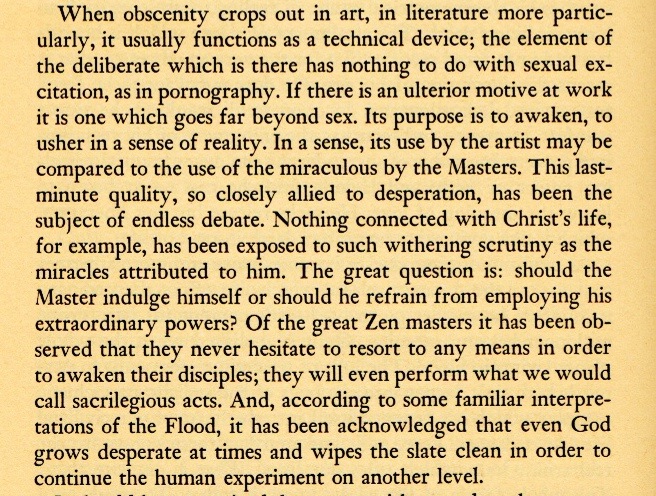
Obscenity as a technical device (Henry Miller)

20140721-162338-59018771.jpg

From “Obscenity and the Law of Reflection,” collected in Henry Miller on Writing.

Four Notes from Nathaniel Hawthorne’s Note-Books

  1. Punishment of a miser,–to pay the drafts of his heir in his tomb.
  2. A series of strange, mysterious, dreadful events to occur, wholly destructive of a person’s happiness. He to impute them to various persons and causes, but ultimately finds that he is himself the sole agent. Moral, that our welfare depends on ourselves.
  3. The strange incident in the court of Charles IX. of France: he and five other maskers being attired in coats of linen covered with pitch and bestuck with flax to represent hairy savages. They entered the hall dancing, the five being fastened together, and the king in front. By accident the five were set on fire with a torch. Two were burned to death on the spot, two afterwards died; one fled to the buttery, and jumped into a vessel of water. It might be represented as the fate of a squad of dissolute men.
  4. A perception, for a moment, of one’s eventual and moral self, as if it were another person,–the observant faculty being separated, and looking intently at the qualities of the character. There is a surprise when this happens,–this getting out of one’s self,–and then the observer sees how queer a fellow he is.

From Nathaniel Hawthorne’s American Note-Books.

“Wrong Note” — Thomas Bernhard

20140721-162337-59017776.jpg

Vollmann in His Studio


There’s a great big fat long profile of William T. Vollmann by Tom Bissell at The New Republic—it’s one of the better pieces I’ve read on an author who is more widely read about than, you know, read.

From the profile, details of a visit to Vollmann’s studio:

Half of Vollmann’s studio felt like a proper gallery, with finished pieces handsomely framed and displayed. The other half was split into what looked like a used bookstore on one side and a struggling industrial arts business on the other. I imagined Vollmann had a gallery somewhere that showed his stuff, yes? Actually, no. “I’ve had a couple of photographer friends who have shows,” Vollmann said. “Every time, they always end up impoverished.” He employs “a couple dealers” who sell his work to various institutions, but he considers his studio a “perpetual gallery.” Vollmann gets additional income from Ohio State, which has been buying Vollmann’s work and manuscripts for several years. Vollmann has no idea why Ohio State has shown such interest in his work, but he’s grateful to the institution, which has been paying the mortgage on his studio for the last decade.

He began our tour proper while a dinging train from the city’s light-rail line rumbled by, just feet from his curtained windows. Woodcuts, watercolors, ink sketches, silver-gelatin black-and-white photographs, portraits. “Gum-printing is a nineteenth-century technique,” he told me. “It’s the most permanent coloring process. But it’s slow, and toxic. … I also have this device here, which is based in dental technology. … It’s like a non-vibrating, very high-speed Dremel tool. … This was originally drawn with pen and ink, and then I had a magnesium block made with a photo resist.” Some of the pieces he showed me were complete; most were not. He estimated that he has “dozens and dozens” of pieces going at any one time.

Vollmann’s most important artistic influences are Gauguin and what he described as the “power colors” of Native American art. His other inescapable influence is the female body. The majority of Vollmann’s visual art centers upon women generally and geishas, sex workers, and those he calls “goddesses” specifically. Usually they are nude. From where I was standing I counted at least two dozen vaginas, their fleshy machinery painstakingly drawn and then painted over with a delicate red slash. Vollmann uses live models, so every vagina within sight is currently out there right now, wandering the world.

A New Yorker Short Fiction Reading List


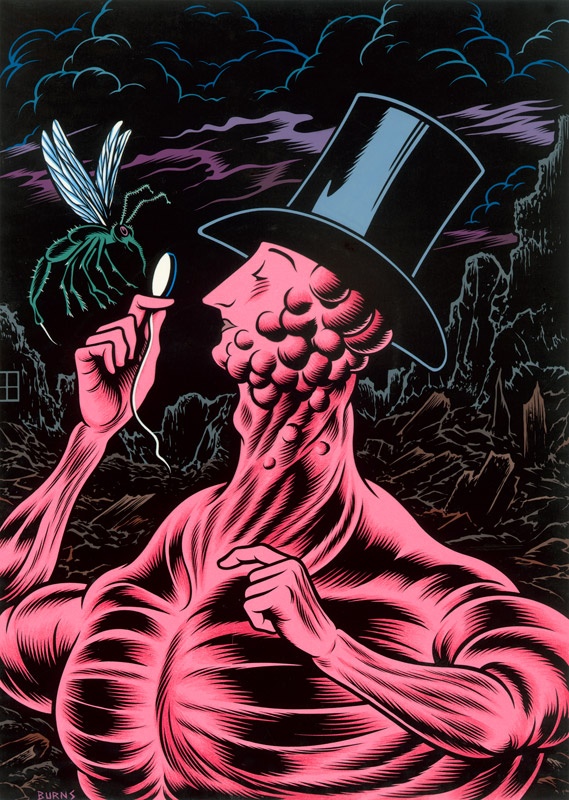
Mutant Eustace Tilley (The New Yorker's Mascot) by Charles Burns
Mutant Eustace Tilley (The New Yorker’s Mascot) by Charles Burns

As you, savvy reader, are undoubtedly already aware, The New Yorker has opened up some of its archive for the rest of the summer (to show off its website redesign, I guess).

Here’s a reading list of short fiction from the archives (admittedly, some of the stuff I wanted to put on here is still behind a paywall).

Some of the stories on the list are classics, some are pieces I’ve shared on this blog before, some are excerpts from longer works, and a few are stories I have yet to read myself.

“The Daughters of the Moon” by Italo Calvino

“Backbone” by David Foster Wallace

“1966” by Denis Johnson

“My Father Addresses Me on the Facts of Old Age” by Grace Paley

“The Insufferable Gaucho” by Roberto Bolaño

“Victory Lap” by George Saunders

“Leopard” by Wells Tower

“Gorse Is Not People” by Janet Frame

“Rough Deeds” by Annie Proulx

“Gavin Highly” — Janet Frame

Did it happen this way? The land lay like stone, and one night, all night long, rain pelted down on it the way people, they say, hammer hard on a stone to find blood. And in the morning the land was cut in two by a deep flow of creek, clotted with red weed—Gavin Highly’s creek.

But all this was a long time ago. I did not know back then that hearts could be laid out like land and cut in two by storms coming out of the sky, or that dreams could be thrown, as Gavin Highly threw the ashes of his fire or his oyster shells or his old tins and bottles or his scraps of food, deep into the dark flowing divided heart to be buried there. I did not know, and my brother did not know. We cared more about plums—ah, they were yellow and dusty blue and hung on trees, over Gavin Highly’s fence, and in the early autumn the sun burned on each plum till its tight yellow or blue dusty skin gave in and rolled up like a blind to let in more sun. The plums split and were ripe and we ate them and, if Gavin Highly caught us, all he said, in one breath, was “Hop-it-you.” I think he understood about plums.

Read the rest of Janet Frame’s story “Gavin Highly” at The New Yorker.

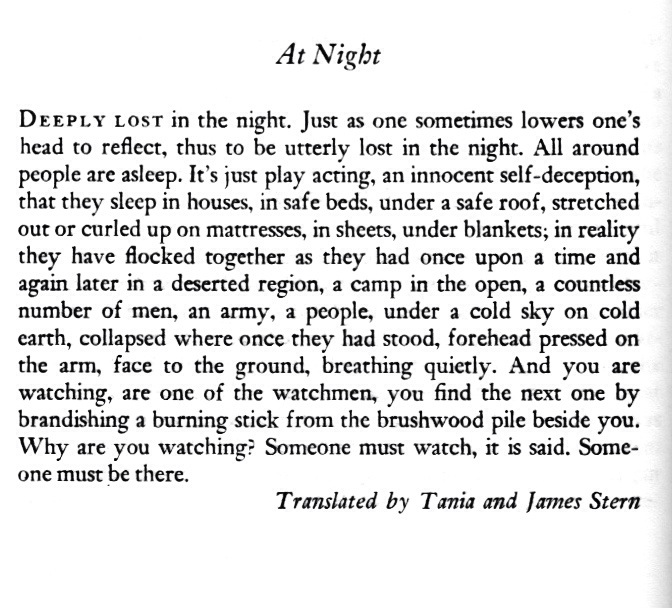
“At Night” — Franz Kafka

20140721-162337-59017116.jpg

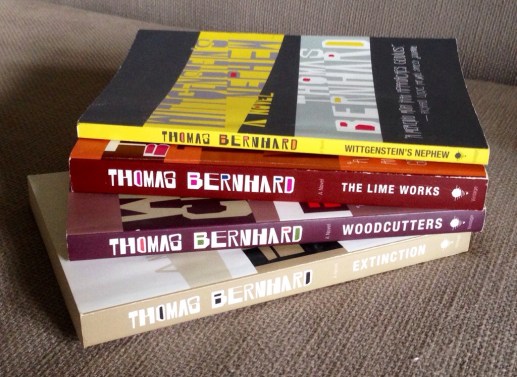
Four by Thomas Bernhard (Books Acquired, 7.15.2014)

20140716-162726-59246033.jpg

So the other week, Turner wrote, at my favorite local bookstore—a labyrinthine maze you wouldn’t believe, formed from wooden frames filled with dusty paper stacks, obstacles of boxed books, unexplored (the boxed books, not the shelves), littering the pathways (the boxed books)—just under 2 million books (all the books, shelved, and boxed), if a certain clerk is to be believed (and I believe her)—and you wouldn’t believe, and I know you wouldn’t believe because I go there often enough, me, living just a mile away, sometimes walking, briskly, or at an even pace—and with this free time on my hands, and with all these unsolicited review copies, creating a little pool of credit, of trade of etc.—I know you wouldn’t believe because I so often hear the irregular clientele remarking on their own personal disbelief, or their own befuddlement, or, more often, I see them get lost, and even then I’m enjoying that, maybe offering (mis)direction, or, more likely, intercepting the high school seniors—What are you reading? Yes? Faulkner! No! Not that edition!—And so the other week at my favorite local bookstore, I happened upon, neatly stacked in a to-be-shelved shelf, a neatly stacked stack of Thomas Bernhard novels, or, more precisely, a compliment stack of Thomas Bernhard novels, a so-called stack of novels that I did not so-call “own,” a so-called stack of Thomas Bernhard novels that I had not read, not to mention have in my own personal possession, a little series of Vintage English translation editions that could be nestled next to my own meager collection, already, yes, Gargoyles and Correction and Concrete and Yes and The Loser and The Voice Imitator and Frostbut not Old Masters, and Old Masters not in this neatly-stacked bundle (it was never a bundle), no, not Old Masters, which, Turner wrote, Chang wrote about on this so-called website, no, no not Old Masters, not in the so-called bundle, but what to begrudge, begrudge that, no, Turner thought and wrote, and then, looking back over what he had written, thought, No, this is rubbish, I must delete all this, I must erase all this and not push publish.

That long long, bloated epicene tract “The Waste Land” by Eliot (Barry Hannah)

That long long, bloated epicene tract “The Waste Land” by Eliot—the slideshow of some snug librarian on the rag—was nothing, unworthy, in the notes that every sissy throws away. I would not talk to students about it. You throw it down like pickled eggs with nine Buds and move on to giving it to the preacher’s wife on a hill while she spits on a photograph of her husband.

From Barry Hannah’s short story “Ride, Fly, Penetrate, Loiter.” Collected in Captain Maximus. (Captain Maximus is the narrator here, by the bye).

“July Stories” — Roberto Bolaño

July has been a strange month. The other day I went to the beach and I saw a woman of about thirty, pretty, wearing a black bikini, who was reading standing up. At first I thought she was about to lie down on her towel, but when I looked again she was still standing, and after that I didn’t take my eyes off her. For two hours, more or less, she read standing up, walked over to the water, didn’t go in, let the waves lap her shins, went back to her spot, kept reading, occasionally put the book down while still standing, leaned over a few times and took a big bottle of Pepsi out of a bag and drank, then picked up the book again, and, finally, without ever bending a knee, put her things away and left. Earlier the same day, I saw three girls, all in thongs, gorgeous, one of them had a tattoo on one buttock, they were having a lively conversation, and every once in a while they got in the water and swam and then they would lie down again on their mats, basically a completely normal scene, until all of a sudden, a cell phone rang, I heard it and thought it was mine until I realized it had been a while since I had a cell phone, and then I knew the phone belonged to one of them. I heard them talking. All I can say is that they weren’t speaking Catalan or Spanish. But they sounded deadly serious. Then I watched two of them get up, like zombies, and walk toward some rocks. I got up too and pretended to brush the sand off my trunks. On the rocks, I watched them talk to a huge, hideously ugly man covered in hair, in fact one of the hairiest men I’ve ever seen in my life. They knelt before him and listened attentively without saying a word, and then they went back to where their friend was waiting for them and everything went on as before, as if nothing had happened. Who are these women? I asked myself once it was dark and I had showered and dressed. One drank Pepsi. The others bowed down to a bear. I know who they are. But I don’t really know.

From Roberto Bolaño’s Between Parentheses: Essays, Articles and Speeches, 1998-2003.

Anagogical vision (Flannery O’Connor)

The kind of vision the fiction writer needs to have, or to develop, in order to increase the meaning of his story is called anagogical vision, and that is the kind of vision that is able to see different levels of reality in one image or one situation. The medieval commentators on Scripture found three kinds of meaning in the literal level of the sacred text: one they called allegorical, in which one fact pointed to another; one they called tropological, or moral, which had to do with what should be done; and one they called anagogical, which had to do with the Divine life and our participation in it. Although this was a method applied to biblical exegesis, it was also an attitude toward all of
creation, and a way of reading nature which included most possibilities, and I think it is this enlarged view of the human scene that the fiction writer has to cultivate if he is ever going to write stories that have any chance of becoming a permanent part of our literature. It seems to be a paradox that the larger and more complex the personal view, the easier it is to compress it into fiction.

From Flannery O’Connor’s essay “The Nature and Aim of Fiction.”

Three activated sensuous strokes (Flannery O’Connor)

A lady who writes, and whom I admire very much, wrote me that she had learned from Flaubert that it takes at least three activated sensuous strokes to make an object real; and she believes that this is connected with our having five senses. If you’re deprived of any of them, you’re in a bad way, but if you’re deprived of more than two at once, you almost aren’t present.

All the sentences in Madame Bovary could be examined with wonder, but there is one in particular that always stops me in admiration. Flaubert has just shown us Emma at the piano with Charles watching her. He says, “She struck the notes with aplomb and ran from top to bottom of the keyboard without a break. Thus shaken up, the old instrument, whose strings buzzed, could be heard at the other end of the village when the window was open, and often the bailiff’s clerk, passing along the highroad, bareheaded and in list slippers, stopped to listen, his sheet of paper in his hand.”

The more you look at a sentence like that, the more you can learn from it. At one end of it, we are with Emma and this very solid instrument “whose strings buzzed,” and at the other end of it we are across the village with this very concrete clerk in his list slippers. With regard to what happens to Emma in the rest of the novel, we may think that it makes no difference that the instrument has buzzing strings or that the clerk wears list slippers and has a piece of paper in his hand, but Flaubert had to create a believable village to put Emma in. It’s always necessary to remember that the fiction writer is much less immediately concerned with grand ideas and bristling emotions than he is with putting list slippers on clerks.

Now of course this is something that some people learn only to abuse. This is one reason that strict naturalism is a dead end in fiction. In a strictly naturalistic work the detail is there because it is natural to life, not because it is natural to the work. In a work of art we can be extremely literal, without being in the least naturalistic. Art is selective, and its truthfulness is the truthfulness of the essential that creates movement.

From Flannery O’Connor’s essay “The Nature and Aim of Fiction.”

Kevin Thomas Discusses His Illustrated Book Reviews with Biblioklept

Kevin Thomas’s new book Horn! (from OR Books) collects the book reviews he’s been doing for the past few years at the Rumpus. Kevin reviews new books (and occasionally reissues) in comic strip form. Over a series of emails, Kevin talked with me about his process, how he got started, the books that have stuck with him the most over the years, and his theory that The Life Aquatic with Steve Zissou is a secret remake of Three Amigos!  Find Kevin on Goodreads,Twitter, and Tumblr.

Biblioklept: You’ve been reviewing books at The Rumpus for a couple of years now in your strip Horn! How did the strip start? Did it start with The Rumpus, or before?

Kevin Thomas: I had been making these primitive autobiographical webcomics under the “Horn!” moniker for about a year when The Rumpus Book Club started. One of the selling points of the book club was that if you reviewed a book and the editors liked it, they’d publish it on the site. So I dedicated one comic a month to reviewing these books, and after the third submission was accepted, The Rumpus asked me if I wanted to make it a regular strip.

Biblioklept: What other kinds of comics did you make before that? Did you have any training or background in cartooning?

KT: No, I was trained, to put it generously, to be a composer. Before that I wanted to be a poet. I had great teachers in both of those fields, but never even thought about taking a studio art class. Maybe the fact that I hadn’t yet tried and failed at comics was what drew me to it. Continue reading “Kevin Thomas Discusses His Illustrated Book Reviews with Biblioklept”

The real world plainly bores us (William H. Gass)

Books whose blueness penetrates the pages between their covers are books which, without depriving us of the comfort of our own commode or the sight of our liberal selves, place us inside a manufactured privacy. This privacy is really not that of someone else. It must be artificial because the real world plainly bores us. Impatient, we can’t wait for nature to take its course.

When we take our textual tour through the slums, we want crime, violence, starvation, disease, not hours of just sitting around. We want the world to be the world we read about in the papers; all news. What good is my ring if the couple I am using it to spy on make love in darkness once a month, and then are quick, inept, and silent? Better rob banks. The money is always there. What good is my peek at her pubic hair if I must also see the red lines made by her panties, the pimples on her ramp, broken veins like the print of a lavender thumb, the stepped-on look of a day’s-end muff? I’ve that at home. No. Vishnu is blue in all his depictions. Lord Krishna too. Yes. The blue we bathe in is the blue we breathe. The blue we breathe, I fear, is what we want from life and only find in fiction. For the voyeur, fiction is what’s called going all the way.

The privacy which a book makes public is nevertheless made public very privately—not like the billboard which shouts at the street, or the movie whose image is so open we need darkness to cover the clad-ass and naked face that’s settled in our seat. A fictional text enters consciousness so discreetly it is never seen outdoors . . . from house to house it travels like a whore . . . so even on a common carrier I can quite safely fill my thoughts with obscene adjectives and dirty verbs although the place I occupy is thigh-sided by a parson.

We like that.

Thus between the aesthetically irrelevant demands of the reader and the aesthetically crippling personal worries of the writer, sexuality reaches literature as an idee fixe, an artifically sweetened distortion or an outright lie, while the literature itself leaks quality like a ruptured pipe.

From William H. Gass’s On Being Blue: A Philosophical Inquiry.