Eight notes on Stephen Dixon’s novel Interstate

1,  It upset me deeply, reading Stephen Dixon’s 1995 novel Interstate. It fucked me up a little bit, and then a little bit more, addicted to reading it as I was over two weeks in a new year.

2,  What is it about, Stephen Dixon’s 1995 novel Interstate? I mean, you probably won’t like it, but that wasn’t the stupid rhetorical question that led this point. (And also but maybe like, you will like it.) Interstate was a finalist for the 1995 National Book Award. It didn’t win. The NBA’s website’s one-sentence summary fucks up: “In the author’s first novel since Frog, a Finalist for the National Book Award, a father mentally replays, in eight variations, the shooting of his daughters on an interstate highway.”

3,  There is (or is it are?) one too many esses in the NBA’s summary of Stephen Dixon’s 1995 novel Interstate—there are two daughters, plural, but only one is shot, and shot tragically, awfully, fatally—and really, as its variations play out, it’s not entirely clear if anyone was shot, if anyone was even on the highway, if anyone was even real. Are all the so-called events of the novel simply (there’s no simply about it) in the narrator’s imagination? “…but there I go again, the world’s easiest and most desirable copy out, the dream,” muses the narrator at one point. Not even a dream though, it’s all just words.

4,  It’s all “just” words, and if someone told me they read and hated Stephen Dixon’s 1995 novel Interstate, I’d shrug and ask if they made it all the way through all the words and still hated it. If someone told me that they made it all the way through Interstate and found it to be a strange and unappealing writing experiment, I’d mildly agree with them, and then tell them that I loved that particular flavor and if they didn’t like that particular flavor, well, cool.

5,  If someone read all the words in Stephen Dixon’s 1995 novel Interstate and concluded that it seemed like an ambitious and highly-achieved creative writing exercise — writing experiment, rather — I’d likely initially agree and then hedge a bit before mumbling something like, I don’t think it was an exercise or experiment on the author Stephen Dixon’s part. It might make for experimental reading, but I think he absolutely knew what he was doing; this wasn’t practice or exercise — it was the real thing.

6, I have, thus far, done a lousy job, not even really a job, of describing the force of language in Stephen Dixon’s 1995 novel Interstate. Normally I’d crib a few choice passages—and to be clear, Interstate s fat and juicy with choice passages—but we are talking about long, twisty, tangled passages, sentences that go on for pages, sentences that find the predicate verb sundered for a few paragraphs from its eventual object, sentences that move us through thought, how divergent thought can be how, how imprecise, indirect, yet still sharp and often painful. An easy, lazy comparison would be to liken Dixon’s paragraphs to Thomas Bernhard’s (although Dixon denied the influence, much like William Gaddis did in his final novel)—there’s a different flavor here but our guys are working in a similar mode. (Think too of László Krasznahorkai or Gabriel García Márquez or Faulkner or Mauro Javier Cárdenas or any number of practitioners of the long paragraph). John Domini, in his contemporary review in the Portland Oregonian (reprinted in his excellent collection The Sea-God’s Herb) does a better job of describing Dixon’s style than I can do:

Characters talk themselves through backwaters of memory (sometimes creating comic relief) or sail into dreamy what-ifs, all in order to put off some looming and drear inevitability. In conversation, one may mention an important insight that he or she has to share, then spiral away through a half-dozen distractions before revealing what matters. The format feels like a natural fit to the shuttered claustrophobia of worry and loss. So do the jam-packed paragraphs, sometimes running several pages without a break. Better still, these blocks of talky phrasing flicker with light, even (every now and again) with happier possibilities.”

(Maybe I just wanted to quote that lovely phrase of Domini’s, “blocks of talky phrasing flicker with light.”)

7,  “Better still, these blocks of talky phrasing flicker with light, even (every now and again) with happier possibilities,” Domini wrote of Stephen Dixon’s 1995 novel Interstate. The last of Dixon’s eight Interstates is an unexpected gift — a happy ending, or, rather a banal ending, a plain ending, an ending without tragedy or comedy or epic heroism. An ending where everyone gets to bed in time to fit in a little light reading before shuteye. It sounds hokey when I write it out, but there’s nothing trite about the conclusion. The reader purchases this moment of catharsis from all the terror (and horrifying comedy, which I’ve neglected in this riff and will continue to neglect) — the reader purchases the cathartic conclusion from the preceding horror.

8,  I wonder how I might have reacted to Stephen Dixon’s 1995 novel Interstate if I had read it, say, when it was first published, back when I was a junior in high school. Or how would I have reacted to it ten years after that, not yet a parent? (And writing these thoughts out now, I realize that, more than anything by Bernhard or Krasznahorkai or Faulkner or the other Dixon I’ve read, Interstate most reminds me of (at least at this moment that I write) of Frank Capra’s 1946 film It’s a Wonderful Life. I’ve watched It’s a Wonderful Life once a year for the past four decades, finding it strangely different every few years — first baffling and even a bit scary, then boring, then exasperating, infuriating even, then schmaltzy, sentimental, ludicrous, and then magical, endearing, heartbreaking, perfect–I’ve veered off course, where was I?) I wonder how being a parent has colored my psychic engagement with the novel Interstate? I was not so much manipulated by the tragedy of losing a child through violent, chaotic, meaningless death but rather the more banal tragedy the novel repeatedly engages — losing a child through half-neglect, through half-listening, through selfishness, through an inability to focus on now — not really so much losing a child but losing out on connections, memories, time you’ll never get back. It fucked me up, Interstate, and I don’t think I’d like to go down its road again — but I loved it. Very highly recommended.

Revisiting Scott Tobias’s The New Cult Canon

Today was the last meeting for a Tuesday-Thursday comp class that has been, or maybe I can now say had been, a fucking grind.

One bright spot was a student professing an interest in film. A few weeks ago he told me about watching Battleship Potemkin (Eisenstein, 1925), and asked for recommendations. I rattled off titles, unsure how soaked he (and by extent, all) younger persons might be in (my notions of) the contemporary film canon. There are so many options now competing for eyeballs and earholes. We didn’t all grow up with our dad finishing a third beer and then insisting we stay up too late on a Sunday to catch the second half of For a Few Dollars More on the superstation. I suggested he work at checking off AFI’s “100 Years” list like I did back in circa 1998. “If something yanks at you, watch it again.”

But the kid wanted something stranger, and he followed up today. I rattled off titles, told him to email me, I’d send him a list, which he did, and then I did, send him a list that is — which was fun for me — and then I realized that I should really point him to film critic Scott Tobias’s series The New Cult Canon.

Back when the internet was still pretty good, Tobias wrote weekly column on a film he dared to place in his “New Cult Canon” — a continuation of film critic Danny Peary’s Cult Movies books. Tobias’s series ran at The AV Club (during the site’s glory years before capitalist hacks gutted it). Tobias’s New Cult Canon project intersected with an apparent wider access to films, whether it was your local library’s extensive DVD collection, Netflix sending you a disc through the USPS, or, y’know, internet piracy. Offbeat was now on the path, if you knew where to tread.

So for a few years, The New Cult Canon was a bit of a touchstone for me. It offered leads to new film experiences, made me revisit films I’d seen with an uncritical eye in the past through a new lens, and even aggravated with endorsements that I could never agree with. I loved The New Cult Canon column, and I was happy when Tobias revived it a few years ago on The Reveal.

But back to where I started, with the kid who wanted some film recommendations, wanted to immerse himself over the winter break (I’m pretty sure he used the verb immerse) — I didn’t follow up with an email to this link on IMDB of Tobias’s The New Cult Canon, which I’d to found to share with the kid who wanted some film recommendations–I started this blog instead.

As of now, there are 176 entries in The New Cult Canon. The first 162 were part of the series; original run at the AV Club. Coming across the original list this evening made me want to revisit the films, catch some of the ones I didn’t find or make time for before, and generally, like share.

The current media environment seems primed for ready-made cult movies. Film like, say, Late Night with the Devil (Cairnes, 2023) or Possessor (B. Cronenberg, 2020) are fun and compelling — but they also fit neatly into a specific market niche. (Where is the dad three beers deep who compels his youngan to stick it out with the second half of Under the Silver Lake (Mitchell, 2018)?

(If I review the previous paragraph, which I won’t, I’ll conclude I’m spoiled. Long live weird films.)

So let’s go:

Links on titles go to Tobias’s original write-ups. (I’d love to see a book of these.)

Arbitrary 0-10 score, based on How I Am Feeling At This Particular Moment.

The Alternate isn’t offered as a superior or inferior recommendation, just an alternate (unless it is offered as such).


  1. Donnie Darko, Richard Kelly (2001)

I love Donnie Darko. I can’t remember how I first came across it, but I had the DVD and I would make people watch it. This kind of thing is maybe embarrassing to admit now; I think Donnie Darko hit a bad revisionist patch. Especially after Southland Tales and The Box.

When the director’s cut was released in theaters, sometime around 2005, I made some friends watch it with me in the theater. They fucking hated it.

I watched it with my son earlier this year and it was not nearly as weird as I’d remembered it and he enjoyed it and so did I. He got the E.T. reference and thought Patrick Swayze was a total creep.

8.5/10

Alternate: Southland Tales, Richard Kelly, 2006. (Look for the Cannes cut online.)

2. Morvern Callar, Lynne Ramsay, 2002

I knew about Morvern Callar because of its soundtrack (which was a totally legitimate way to know about a film two or three decades ago). I didn’t search Lynne Ramsay’s film out until after Tobias’s review.

This film made my stomach hurt and I never want to see it again. (Not a negative criticism.)

I feel the same way about the other two Ramsay films I’ve seen, We Need to Talk About Kevin (2011) and You Were Never Really Here (2017).

6.5/10

Alternate: You Were Never Really Here, Lynne Ramsay, 2017.

3. Irma Vep, Olivier Assayas, 1996

Minor fun, very French, ultimately ephemeral.

6/10

Alternate: Irma Vep, Olivier Assays, 2022 — an eight-episode HBO miniseries.

4. Miami Blues, George Armitage, 1990

Miami Blues is a very strange film. Except that it’s not strange: it’s a tonally-coherent, self-contained, “pastel-colored neo-noir,” as Tobias writes—but it feels like it comes from a different world. Alec Baldwin and Jennifer Jason Leigh seem, I dunno—skinnier? Is skinnier the right word?—here. The thickness of fame doesn’t stick to them so heavily. Miami Blues is fun but also mean-spirited, vicious even. It’s also the first entry on here that I would never have watched had it not been on Tobias’s recommendation.

7.5/10

Alternate: Grosse Pointe Blank, George Armitage, 1997

5. Babe: Pig in the City, George Miller, 1998

Yeah, she thinks she’s Babe: Pig in the City.

A perfect film.

10/10

Alternate: The Road Warrior, George Miller, 1981

6. They Live, John Carpenter, 1988

Another perfect movie, and one that only gets better with the years, through no fault of its own. They Live was certainly on the list I emailed the student. Roddy Piper (a rowdy man, by some accounts), also starred in Hell Comes to Frogtown (Donald G. Jackson and RJ Kizer, 1988) the same year, a very bad film, but also maybe a cult film.

10/10

Alternate: Like literally any John Carpenter film.

7. Clerks, Kevin Smith, 1994

I hate and have always hated Clerks and every other Kevin Smith film I’ve seen. I remember renting it from Blockbuster my junior year of high school because of some stupid fucking write up in Spin or Rolling Stone and thinking it was bad cold garbage, not even warm garbage — poorly-shot, poorly-acted, unfunny. Even at (especially at?j sixteen, Smith’s vision of reality struck me as emotionally-stunted, stupid, etiolated, and even worse, dreadfully boring. I remember sitting through Chasing Amy and Dogma in communal settings, thinking, What the fuck is this cold, cold garbage?

But Tobias’s inclusion of Smith’s bad awful retrograde shit makes sense — Clerks spoke to a significant subset in the nineties, no matter how bad the film sucks.

0.5/10

Alternate: As Smith has never made an interesting film, let alone a good one, my instinct is to go to Richard Linklater’s Slacker (1990) — but that shows up later in the New Cult Canon. So, I dunno–a better film about friends and problematic weirdos: Ghost World, Terry Zwigoff, 2001

8. Primer, Shane Carruth (2004)

Let’s not end on a sour note.

I think that it was Tobias’s New Cult Canon series that hipped me to Primer, Shane Carruth’s brilliant lo-fi take on time travel. Carruth made the film for under ten grand, but it looks great and is very smart, and most of all, trusts its audience by throwing them into the deep end. (Primer is perhaps the inverse of Clerks. I hate that sentence, but I won’t delete it. They don’t belong in the same universe, these films; Primer builds its time machine out there!)

10/10

Alternate: Upstream Color, Shane Carruth, 2013

On Tove Jansson’s odd and touching illustrations for Alice’s Adventures in Wonderland

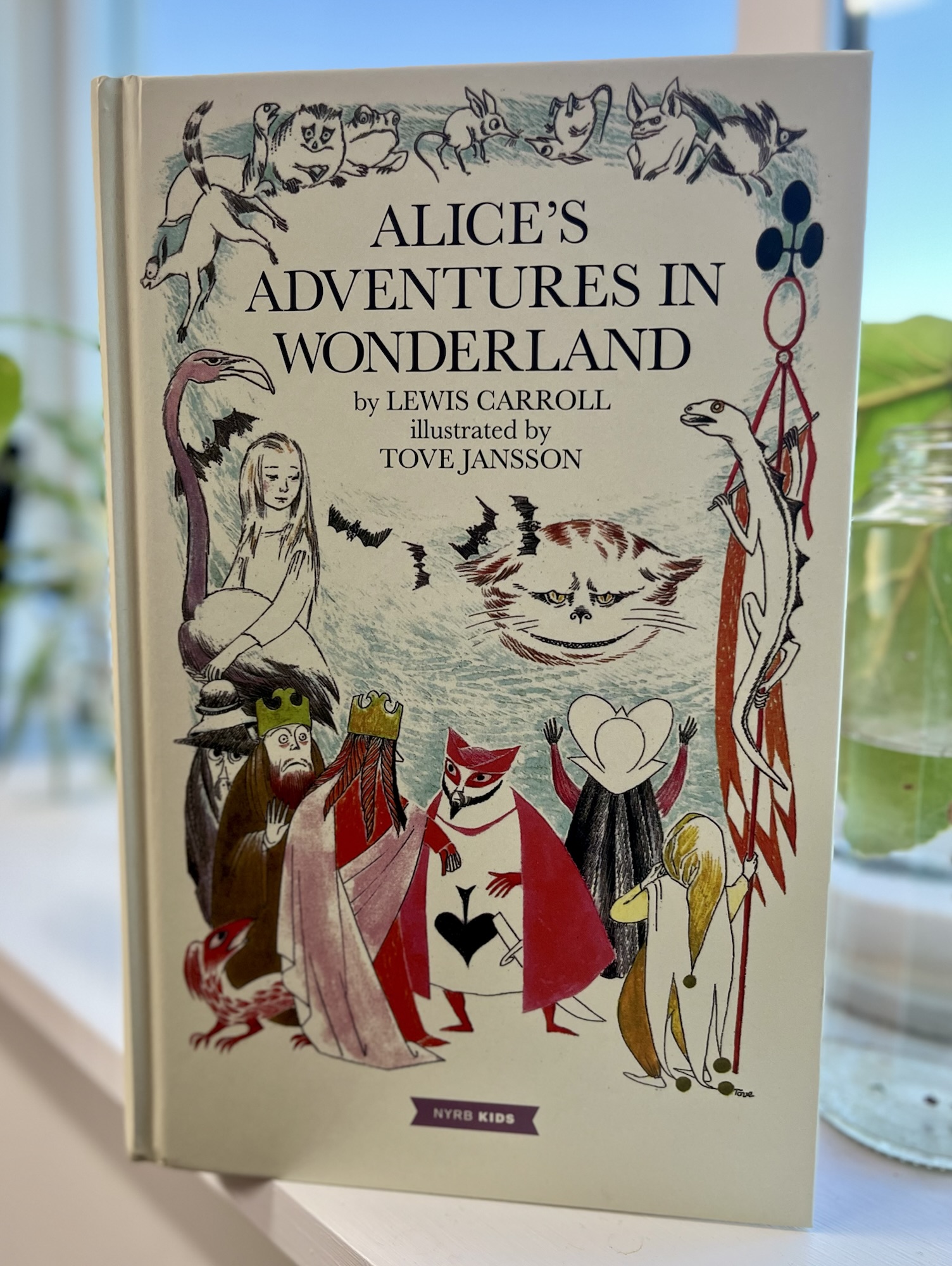
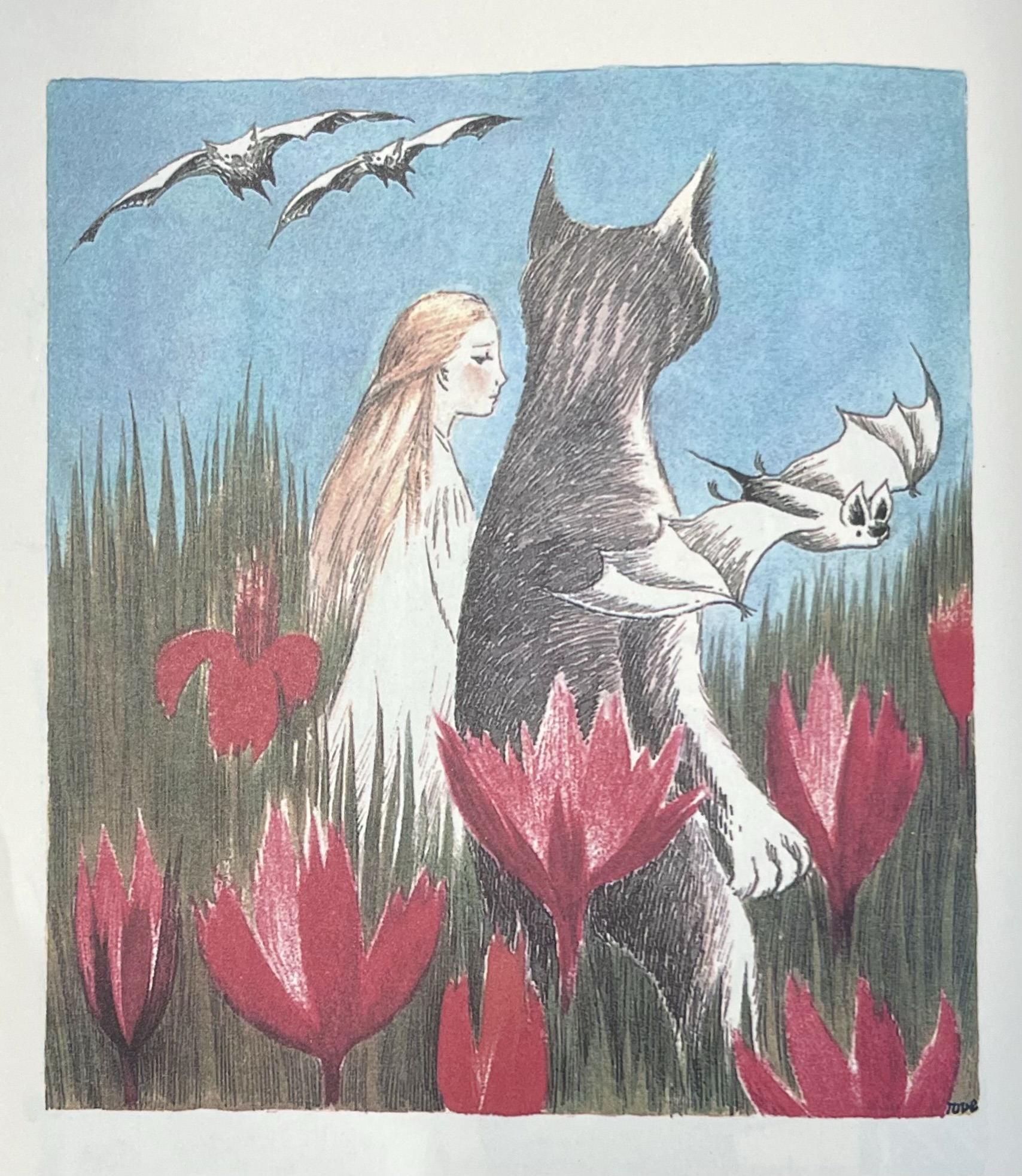
This fall–just in time for the holiday season–the NYRB Kids imprint has published an edition of Lewis Carroll’s classic Alice’s Adventures in Wonderland illustrated by the Finnish author and artist Tove Jansson. Jansson is most famous for her Moomin books, which remain an influential cult favorite with kids and adults alike. She illustrated Carroll’s Alice in 1966 for a Finnish audience; this NRYB edition is the first English-language version of the book. There are illustrations on almost every page of the book; most are black and white sketches — doodles, portraits, marginalia — but there are also many full-color full-pagers, like this odd image about a dozen pages in:

Here we have Alice and her cat Dinah, transformed into a shadowy, even sinister figure, large, bipedal. Bats float in the background, echoing Goya’s famous print El sueño de la razón produce monstruos. The image accompanies Alice’s initial descent into her underland wonderland:  “Down, down, down. There was nothing else to do, so Alice soon began talking again,” addressing Dinah, who will “miss me very much to-night, I should think!” Wonderlanding if Dinah might catch a bat, which is something like a mouse, maybe, “Alice began to get rather sleepy, and went on saying to herself, in a dreamy sort of way, ‘Do cats eat bats? Do cats eat bats?’ and sometimes, ‘Do bats eat cats?; for, you see, as she couldn’t answer either question, it didn’t much matter which way she put it.” Jansson’s red flowers suggest poppies, contributing to the scene’s slightly-menacing yet dreamlike vibe. The image ultimately echoes the myth of Hades and Persephone.

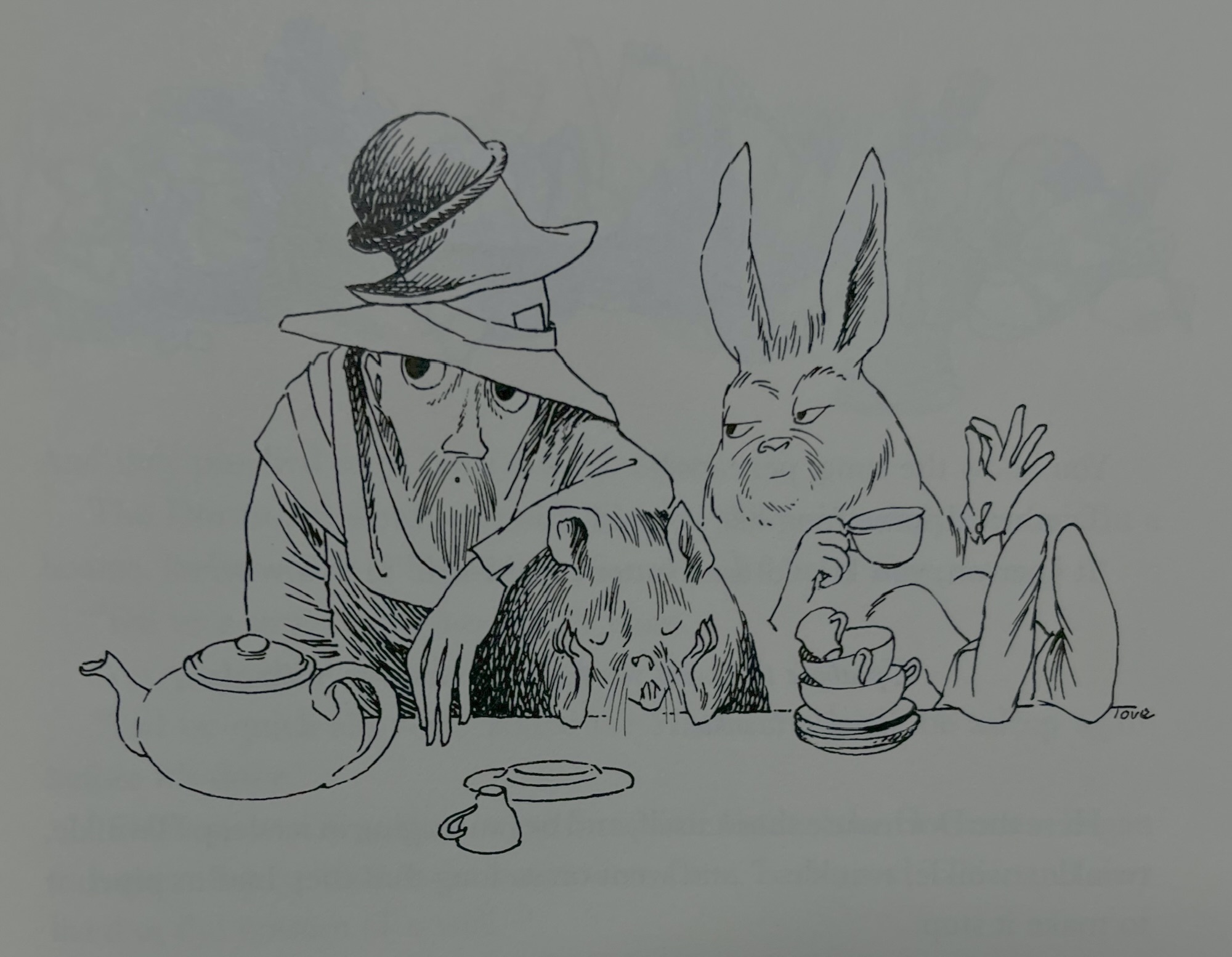
All the classic characters are here, of course, rendered in Jansson’s sensitive ink. Consider this infamous trio —

There was a table set out under a tree in front of the house, and the March Hare and the Hatter were having tea at it: a Dormouse was sitting between them, fast asleep, and the other two were using it as a cushion, resting their elbows on it, and talking over its head.

I love Jansson’s take on the Hatter; he’s not the outright clown we often see in post-Disneyfied takes on the character, but rather a creature rendered in subtle pathos. The March Hare is smug; the Dormouse is miserable.

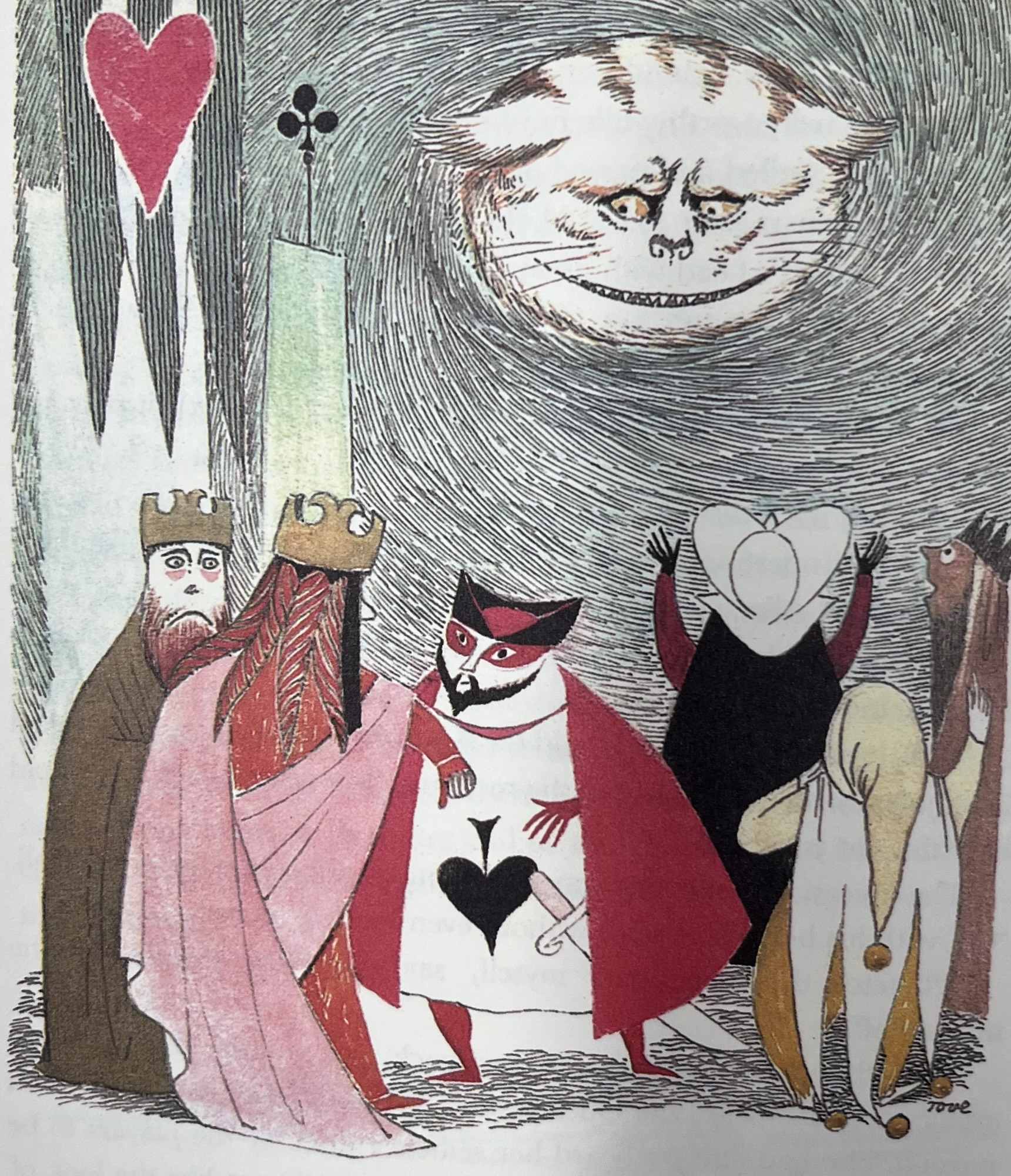
And you’ll want a glimpse of the famous Cheshire cat who appears (and disappears) during the Queen’s croquet match:

Jansson’s figures here remind one of the surrealist Remedios Varo’s strange, even ominous characters. Like Varo and fellow surrealist Leonora Carrington, Jansson’s art treads a thin line between whimsical and sinister — a perfect reflection of Carroll’s Alice, which we might remember fondly as a story of magical adventures, when really it is much closer to a horror story, a tale of being sucked into an underworld devoid of reason and logic, ruled by menacing, capricious, and ultimately invisible forces. It is, in short, a true reflection of childhood,m. Great stuff.

Donald Barthelme’s Forty Stories in reverse, Part II

Previously,

Stories 40-36

35. ” Overnight to Many Distant Cities” (Overnight to Many Distant Cities, 1983)

In Hiding Man, his 2010 Barthelme biography, Tracy Daugherty notes that Barthelme’s collection Overnight to Many Distant Cities was not particularly well-received by critics. Reviews were a mix of bafflement and derision, as Daugherty has it, which fits the tone near the end of Hiding Man: a career winding-down—Barthelme a happy father, content with a teaching gig, and committed to a new form for his stories, now pared down to spare and often oblique dialogues. Daugherty relays a detail from a rejection letter from Barthelme’s (one-time) champion at the New Yorker, Roger Angell: “Well, maybe we’ll learn to read you. It won’t be the first time that happened.”

In my estimation, Barthelme’s later stories do not diverge too radically from his earlier work. The techniques may have evolved (or devolved, if you like), but collage and pastiche are still a major mode, domestic themes prevail, and Our Bard is ever the ironist.

Barthelme sprinkles vignettes throughout Overnight to Many Distant Cities (like Hemingway’s In Our Time); its title track, coming at the end of the collection, is a travelogue in vignettes with our narrator and his family visiting places like Paris, London, Copenhagen… The story is essentially a series of anecdotes and arch asides (“Asked her opinion of Versailles, my daughter said she thought it was overdecorated”), and, as Barthelme’s wife Marion disclosed in Daugherty’s book, some of the material was directly drawn from their honeymoon in Barcelona (“In Barcelona the lights went out”). A taste:

In Stockholm we ate reindeer steak and I told the Prime Minister… That the price of booze was too high. Twenty dollars for a bottle of J&B! He (Olof Palme) agreed, most politely, and said that they financed the Army that way. The conference we were attending was held at a workers’ vacation center somewhat outside the city. Shamelessly, I asked for a double bed, there were none, we pushed two single beds together. An Israeli journalist sat on the two single beds drinking our costly whiskey and explaining the devilish policies of the Likud. Then it was time to go play with the Africans. A poet who had been for a time a Minister of Culture explained why he had burned a grand piano on the lawn in front of the Ministry. “The piano,” he said, “is not the national instrument of Uganda.”

Is it essential Barthelme? Of course not. But it’s nice enough.

34. ” The Film” (first published as “A Film” in the The New Yorker, September 26, 1970)

A nice little story that never quite transcends it’s marvelous opening lines:

Things have never been better, except that the child, one of the stars of our film, has just been stolen by vandals, and this will slow down the progress of the film somewhat, if not bring it to a halt. But might not this incident, which is not without its own human drama, be made part of the story line?

I just went back and read the last lines though, and they are also very good:

Truth! That is another thing they said our film wouldn’t contain. I had simply forgotten about it, in contemplating the series of triumphs that is my private life.

33. “110 West Sixty-First Street” (Amateurs, 1976)

An ugly tragic domestic comedy in just over a dozen paragraphs: Paul and Eugenie are trying to get over the death of their infant by going to erotic films. It doesn’t work; they take up cruelty–

“You are extremely self-righteous,” Eugenie said to Paul. “That is the one thing I can’t stand in a man. Sometimes I want to scream.”

“You are a slut without the courage to go out and be one,” Paul replied. “Why don’t you go to one of those bars and pick up somebody, for God’s sake?”

“It wouldn’t do any good,” Eugenie said.

32. “Captain Blood” (Overnight to Many Distant Cities, 1983)

So like one of my favorite things that Melville does in Moby-Dick is turn the whole thing into a drama, a play that is taking place in the narrator-cum-Ishmael’s consciousness, with Starbuck and Stubb milling and mulling on various decks, soliloquizing. And while the Captain Blood of “Captain Blood” is no Ahab, he’s still a compellingly goofy brooder:

Blood, at dawn, a solitary figure pacing the foredeck. The world of piracy is wide, and at the same time, narrow. One can be gallant all day long, and still end up with a spider monkey for a wife. And what does his mother think of him?

This isn’t Barthelme at his best—that stock was poured into Sixty Stories—but it’s still the jaunty, boyish fun flavor that I want when I dip into his stuff.

Charles Burns’ Final Cut explores the irreal reality of artistic ambition

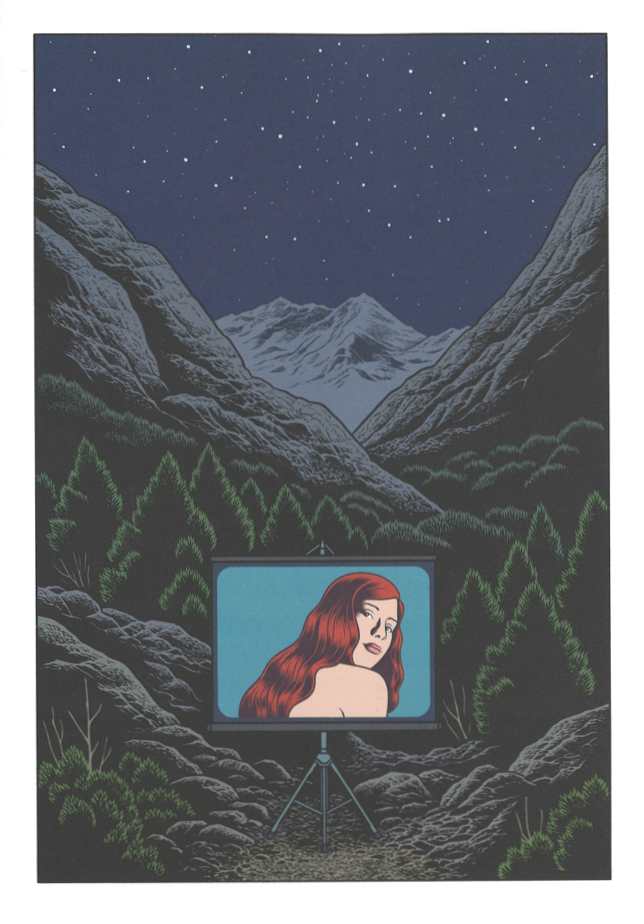
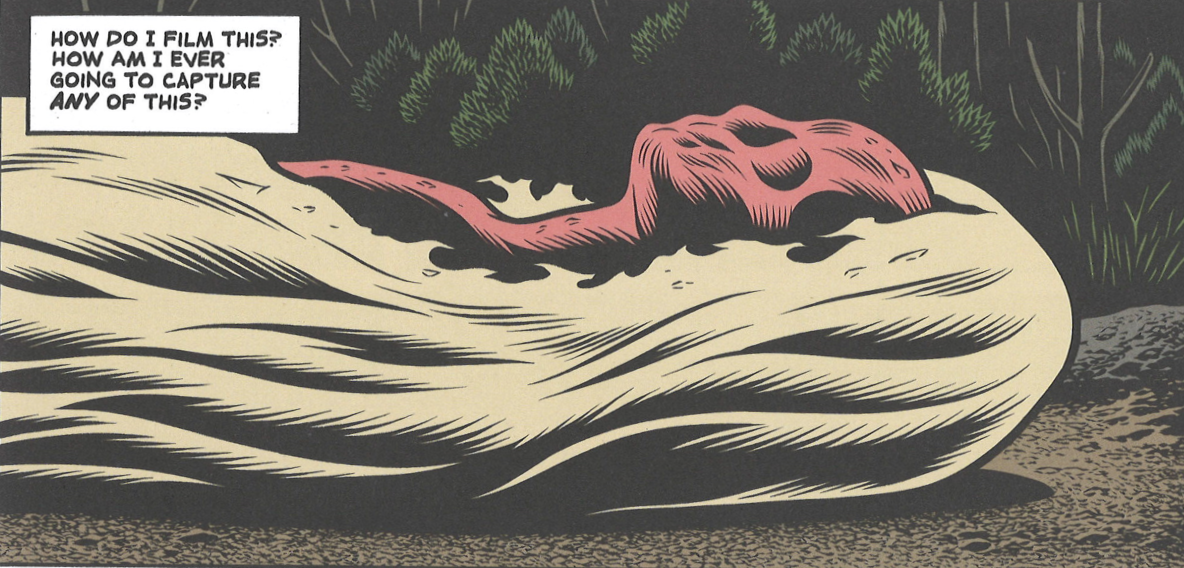
Charles Burns’ latest graphic novel Final Cut tells the story of Brian, an obsessive would-be auteur grappling with an unrealized film project. Brian hopes to assemble his film — also titled Final Cut — from footage he shoots with friends on a weekend camping trip, but the messiness of reality impinges the weird glories of his vibrant imagination. He cannot bring his vision to the screen. He cannot capture all the “fucked-up shit going on inside my head.”
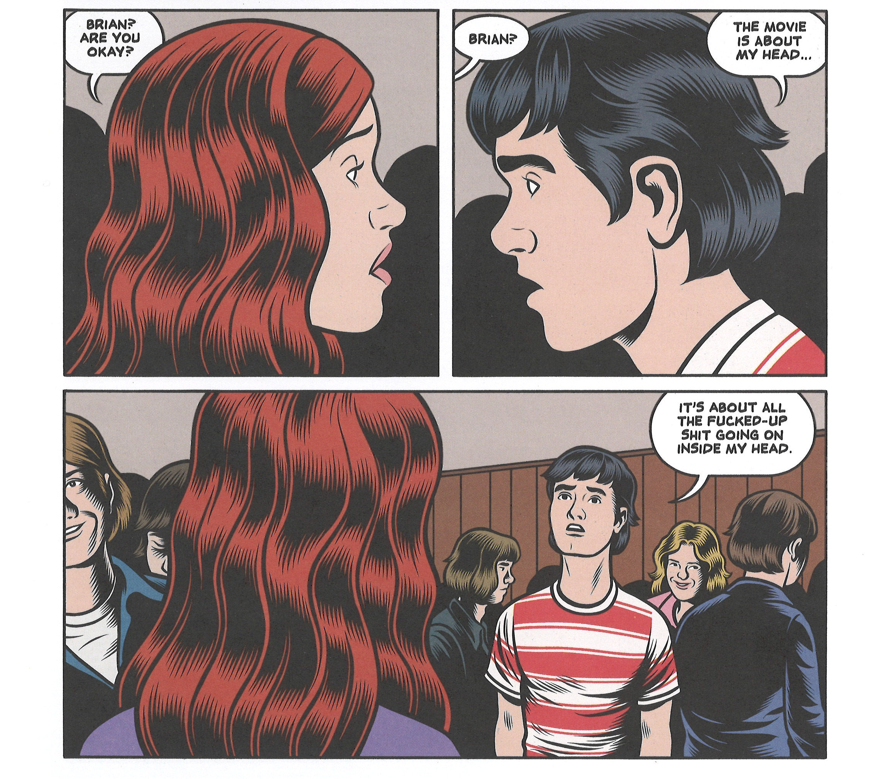
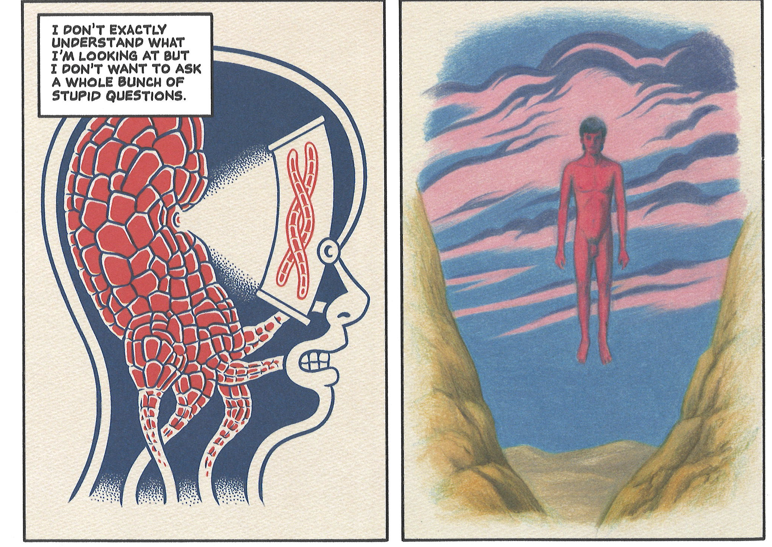
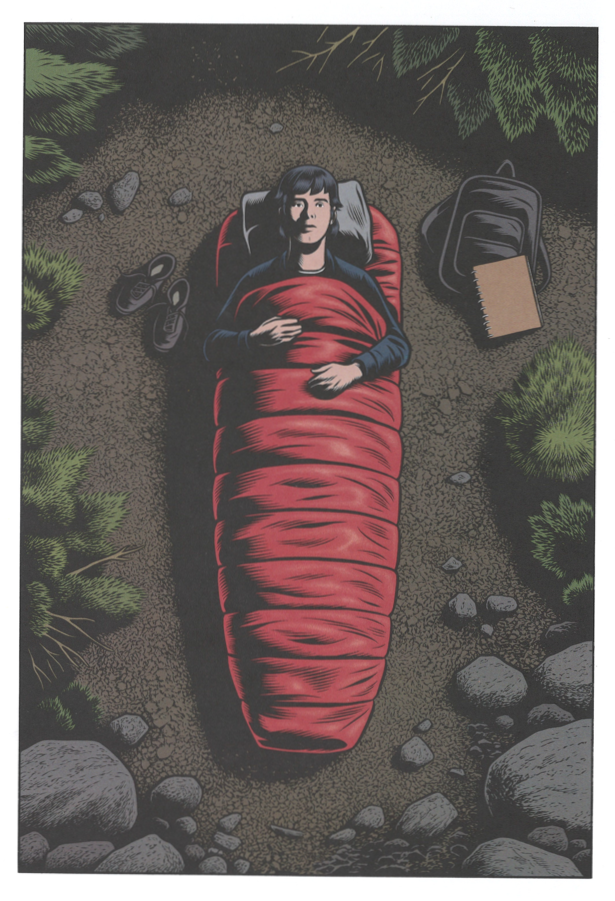
Capturing all the fucked-up shit going on inside my head is a neat encapsulation of the Artistic Problem in general. It’s not that Brian doesn’t try; if anything, he tries too hard. His best friend and erstwhile cameraman Chris is there to help him, along with his crush Laurie and their friend Tina—but ultimately, these are still kids at play. They indulge Brian’s artistic whims, but at a certain point they’d rather swim, drink, and smoke than shoot yet another scene they can’t comprehend.

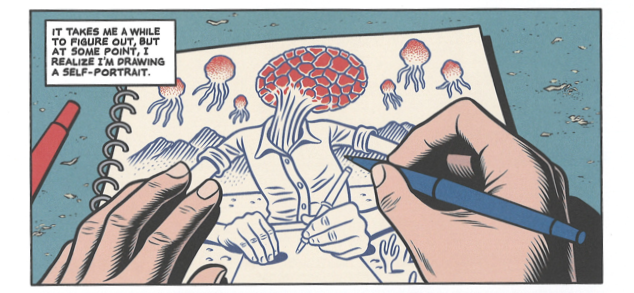
Eschewing straightforward narrative conventions, Final Cut unfolds in a blend of flashbacks, dreamscapes, and flights into Brian’s imagination. The book also gives over to Laurie’s consciousness, providing an essential ballast of realism to anchor Brian’s (and Burns’, I suppose) surrealism. Brian would have Laurie as his muse, trying to capture her in his sketchbook, in his film, and in the intense gaze of his mind’s eye. And while Laurie is fascinated by Brian’s visions, she doesn’t understand them.

The last member of Brian’s would-be acting troupe is Tina, an earthy, funny gal who drinks a bit too much. She plays foil to Brian’s ambitions; her animated spirit punctures the seriousness of his film shoot. Again, these are just kids in the woods with a camera and camping gear.

And the film itself? Well, it’s about kids camping in the woods. And an alien invasion. And pod people.

The pod-people motif dominates Final Cut. We get the teens in their larval sleeping bags, transformed into aliens in their cocoons (echoed again in Brian’s imagination and in his sketches). The motif looms larger: Can we really know who a person is? Could they be someone else entirely? Can we really ever know all the fucked-up shit going on inside their head?

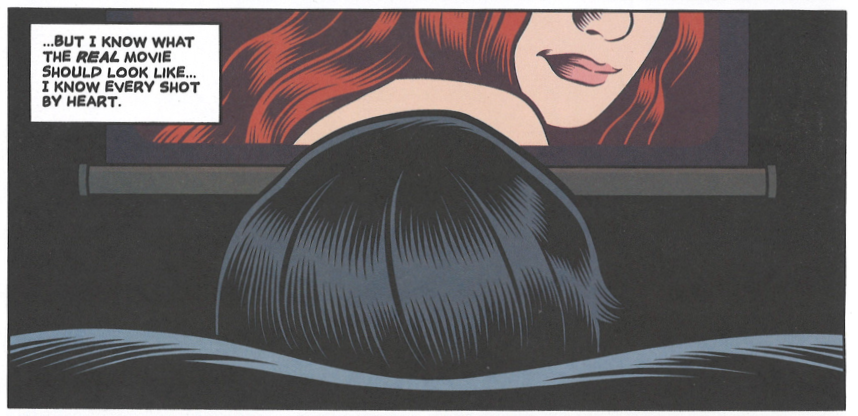
Indeed, Don Siegel’s 1956 film Invasion of the Body Snatchers is a major progenitor text for Final Cut. Brian even takes Laurie on a date to a screening of Invasion; he’s so mesmerized by the film that he weeps. Burns renders stills from the film in heavy chiaroscuro black and white, contrasting with the vibrant reds, maroons, and pinks that reverberate through the novel.

Burns recreates stills from another black and white film, Peter Bogdanovich’s 1971 coming-of-age heartbreaker The Last Picture Show. Again, Brian is obsessed with the film—or by the film, perhaps. In particular, he’s infatuated with Cybill Shepherd’s Jacy, whose character he imaginatively merges with his conception of Laurie.

While Invasion of the Body Snatchers is a science-fiction horror film, a deep sense of reality-soaked dread underpins it; The Last Picture Show is utterly real in its evocations of the emotional and physical lives of teenagers. Both films convey a maturity and balance of the fantastic with the real that Brian has not yet purchased via his own experiences, his own failures and heartbreaks. 

The maturity and balance that Brian can imagine but not execute in his Final Cut is precisely the maturity and balance that Burns achieves in his Final Cut. Simply put, Final Cut is the effort of a master performing at the heights of his power, rendered with inspired technical proficiency. It delivers on themes Burns has been exploring from the earliest days of his career.

There’s the paranoia and alienation of adolescence Burns crafted in Black Hole, here delivered in a more vibrant, cohesive, and frankly wiser book. There’s the hallucinatory trauma and repression he conveyed in the X’ed Out trilogy (collected a decade ago as Last Look, the title of which prefigures Final Cut). There’s also an absence of parental authority here, a trope that Burns has deployed since 1991’s Curse of the Molemen. (In Final Cut, Brian’s mentally-unstable mother is a dead-ringer for Mrs. Pinkster, the domestic abuse victim rescued by the child-hero of Curse of the Molemen). There’s all the sinister dread and awful beauty that anyone following Burns’ career would expect, synthesized into his most lucid exploration of the inherent problems of artistic expression.

Ultimately, in Final Cut Charles Burns crafts a portrait of the artist as a weird young man. Brian wrestles with the friction sparked from his vital imagination butting up against cold reality. His ambitious unfinished film mirrors his own incomplete journey as an artist, highlighting the clash between youthful creative fervor and the inevitable constraints of life, experience, and maturity. Burns’ themes of alienation and artistic ambition may be familiar, but Final Cut feels fresh and vibrant, the culmination of the artist’s own entanglements with the irreality of reality. Highly recommended.

Riff on some books I’m reading, have read, and should really review

Hurricane Milton passed far enough south last night to leave our city relatively untroubled. There were power outages here but not the expected flooding. Most of my anxiety was focused on my family in the Tampa Bay area, all of whom are safe; we’re just not sure about the material conditions of the things they left behind.

Milton seemed to suck the summer air out of Northeast Florida; when I got out of bed and went outside to investigate the loud THUNK that woke me up at four a.m., I was shocked at how cold the air felt. It was only about 66°, but all the humidity seemed gone, even in the cold sprinkling rain. (The THUNK was our portable basketball hoop toppling over.)

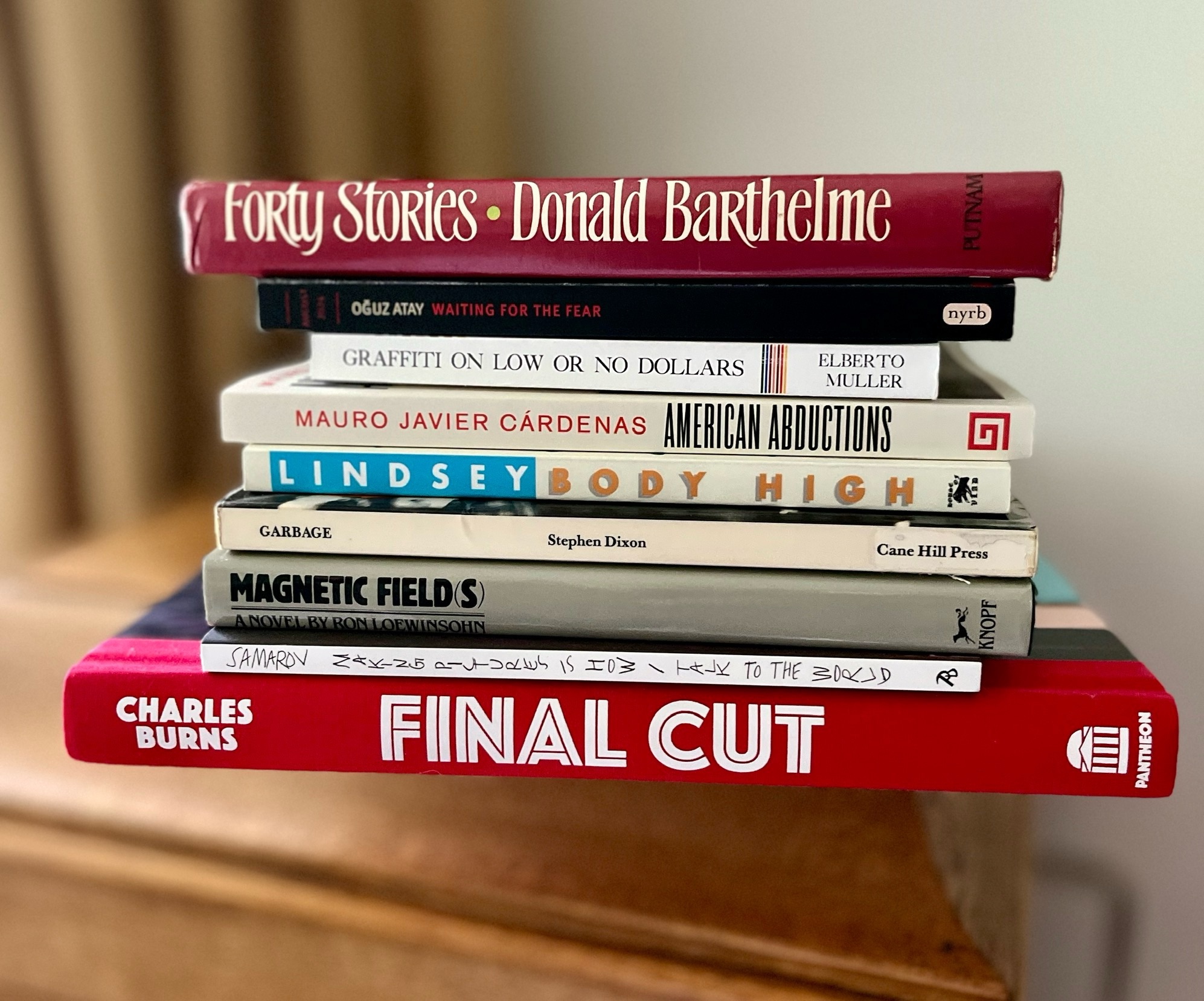
I thought I might try to knock out a review or a write-up of one of the many books I’ve finished that have stacked up as the summer has slowly transitioned to autumn. College classes have been canceled through to Tuesday. I have, ostensibly a “free” week; maybe some words, harder to cobble together for me these days, would come together, no? For the past few years I’ve focused more on reading literature with the attempt to suspend analysis in favor of, like, simply enjoying it. I realized I’d gotten into the habit of reading everything through the lens of this blog: What was I going to say about the book after reading it? I’ve been happier and read more sense freeing myself from the notion that I need to write about every fucking book I read. But the good books stack up (quite literally in a little place I have for such books); I find myself simply wanting to recommend, at some level, however facile, some of the stuff I’ve read. So forgive this lazy post, organized around a picture of a stack of books. From the top down:

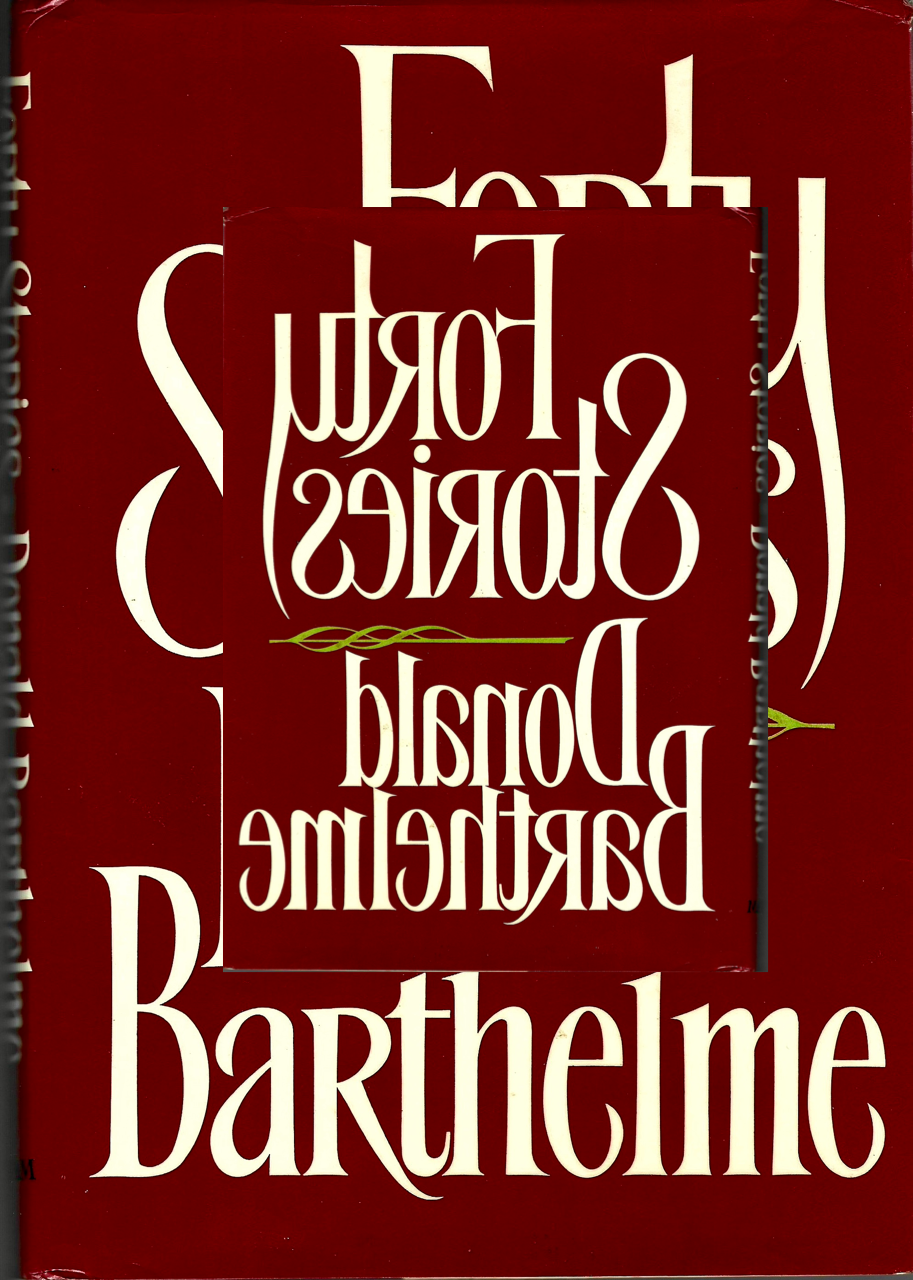
Forty Stories, Donald Barthelme

A few years ago, I read Donald Barthelme’s collection Sixty Stories in reverse order. A few days ago, a commenter left me a short message on the final installment of that series of blogs: “Now do Forty Stories.” I think I have agreed–over the past week I’ve read stories forty through thirty-five in the collection. More to come.

Waiting for the Fear, Oğuz Atay; translation by Ralph Hubbell

A book of cramped, anxious stories. Atay, via Hubbell’s sticky translation, creates little worlds that seem a few reverberations off from reality. These are the kind of stories that one enjoys being allowed to leave, even if the protagonists are doomed to remain in the text (this is a compliment). Standouts include “Man in a White Overcoat,” “The Forgotten,” and “Letter to My Father.”

Graffiti on Low or No Dollars, Elberto Muller

Subtitled An Alternative Guide to Aesthetics and Grifting throughout the United States and Canada, Elberto Muller unfolds as a series of not-that-loosely connected vignettes, sketches, and fully-developed stories, each titled after the state or promise of their setting. The main character seems a loose approximation of Muller himself, a bohemian hobo hopping freights, scoring drugs, and working odd jobs—but mostly interacting with people. It kinda recalls Fuckhead at the end of Denis Johnson’s Jesus’ Son (a book Graffiti spiritually resembles) praising “All these weirdos, and me getting a little better every day right in the midst of them.” Muller’s storytelling chops are excellent—he’s economical, dry, sometimes sour, and most of all a gifted imagist.

American Abductions, Mauro Javier Cárdenas

If I were to tell you that Mauro Javier Cárdenas’s third novel is about Latin American families being separated by racist, government-mandated (and wholly fascist, really) mass deportations, you might think American Abductions is a dour, solemn read. And yes, Cárdenas conjures a horrifying dystopian surveillance in this novel, and yes, things are grim, but his labyrinthine layering of consciousnesses adds up to something more than just the novel’s horrific premise on its own. Like Bernhard, Krasznahorkao, and Sebald, Cárdenas uses the long sentence to great effect. Each chapter of American Abductions is a wieldy comma splice that terminates only when his chapter concludes—only each chapter sails into the next, or layers on it, really. It’s fugue-like, dreamlike, sometimes nightmarish. It’s also very funny. But most of all, it’s a fascinating exercise in consciousness and language—an attempt, perhaps, to borrow a phrase from one of its many characters, to make a grand “statement of missingnessness.”

Body High, Jon Lindsey

I liked Jon Lindsey’s debut Body High, a brief, even breezy drug novel that tries to do a bit too much too quickly, but is often very funny, gross, and abject. The narrator, who telegraphs his thoughts in short, clipped sentences (or fragments cobbled together) is a fuck-up whose main income derives from submitting to medical experiments. He dreams of scripting professional wrestling storylines though, perhaps one involving his almost-best friend/dealer/protector/enabler. When his underage-aunt shows up in his life, activating odd lusts, things get even more fucked up. Body High is at its best when it’s at its grimiest, and while it’s grimy, I wish it were grimier still.

Garbage, Stephen Dixon

I don’t know if Dixon’s Garbage is the best novel I’ve read so far this year, but it’s certainly the one that has most wrapped itself up in my brain pan, in my ear, throbbed a little behind my temple. The novel’s opening line sounds like an uninspired set up for a joke: “Two men come in and sit at the bar.” Everything that unfolds after is a brutal punchline, reminiscent of the Book of Job or pretty much any of Kafka’s major works. These two men come into Shaney’s bar—this is, or at least seems to be, NYC in the gritty seventies—and try to shake him down to switch up garbage collection services. A man of principle, Shaney rejects their “offer,” setting off an escalating nightmare, a world of shit, or, really, a world of garbage. I don’t think typing this description out does any justice to how engrossing and strange (and, strangely normalGarbage is. Dixon’s control of Shaney’s voice is precise and so utterly real that the effect is frankly cinematic, even though there are no spectacular pyrotechnics going on; hell, at times Dixon’s Shaney gives us only the barest visual details to a scene, and yet the book still throbs with uncanny lifeforce. I could’ve kept reading and reading and reading this short novel; it’s final line serves as the real ecstatic punchline. Fantastic stuff.

Magnetic Field(s), Ron Loewinsohn

I ate up Loewinshohn’s Magnetic Field(s) over a weekend. It’s a hypnotic triptych, a fugue, really, with phrases sliding across and through sections. We meet first a burglar breaking into a family’s home and learn that “Killing the animals was the hard”; then a composer, working with a filmmaker; then finally a novelist. Magnetic Field(s) posits crime and art as overlapping intimacies, and extends these intimacies through imagining another life as a taboo, too-intimate trespass.

Making Pictures Is How I Talk to the World, Dmitry Samarov

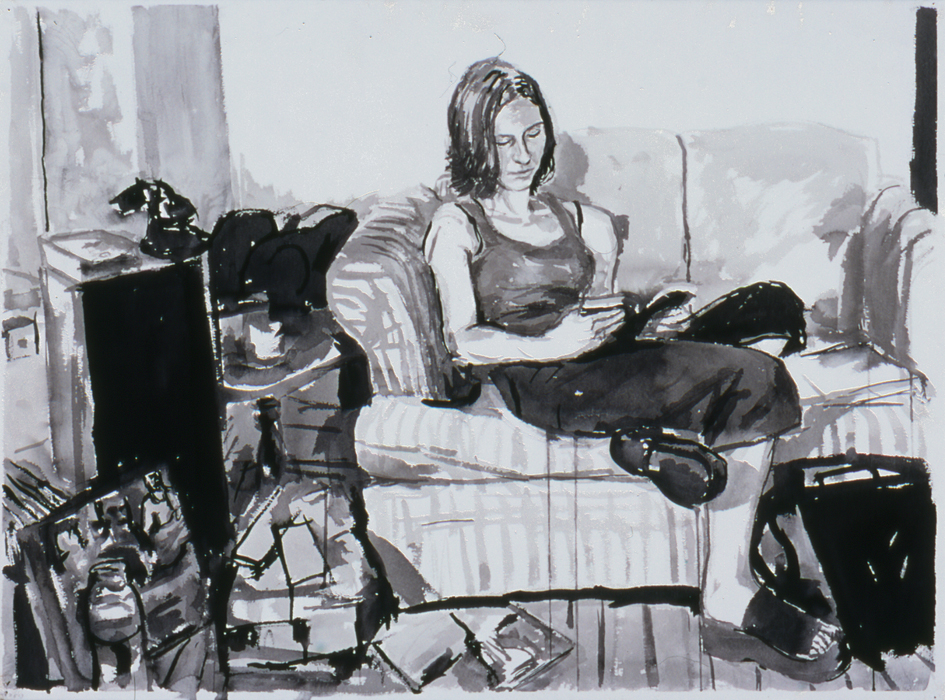
Making Pictures spans four decades of Samarov’s artistic career. Printed on high-quality color pages, the collection is thematically organized, showcasing Samarov’s different styles and genres. There are sketches, ink drawings, oils, charcoals, gouache, mixed media and more—but what most comes through is an intense narrativity. Samarov’s art is similar to his writing; there isn’t adornment so much as perspective. We get in Making Pictures a world of bars and coffee shops, cheap eateries and indie clubs. Samarov depicts his city Chicago with a thickness of life that is better seen than written about. Some of my favorite works include interiors of kitchens, portraits of women reading, and scribbly but energetic sketches of indie bands playing live. What I most appreciate about this collection though is that it showcases how outside of the so-called “art world” Samarov’s work is–and yet this is hardly the work of a so-called “outsider” artist. Samarov trained at the School of the Art Institute of Chicago, and yet through his career he has remained an independent, “not associated with an institution such as an art gallery, college, or museum,” as he writes in his book.

Beth, Dmitry Samarov, 2000

Final Cut, Charles Burns

I don’t know anything about Charles Burns’s upbringing, his youth, his personal life, and I don’t mean to speculate. However, it’s impossible not to approach Final Cut without pointing out that for several decades he’s been telling the same story over and over again—a sensitive, odd, artistic boy who is out of place even among others out of place. This is in no way a complaint—he tells the story with difference each time. And with more coherence. Final Cut is beautiful and sad and also weird enough to fit in neatly to Burns’s oeuvre. But it’s also more mature, a mature reflection on youth really, intense, still, but without the claustrophobia of Black Hole or the mania of his Last Look trilogy. There’s something melancholy here. It’s fitting that Burns employs the heartbreaking 1971 film The Last Picture Show as a significant motif in Final Cut.

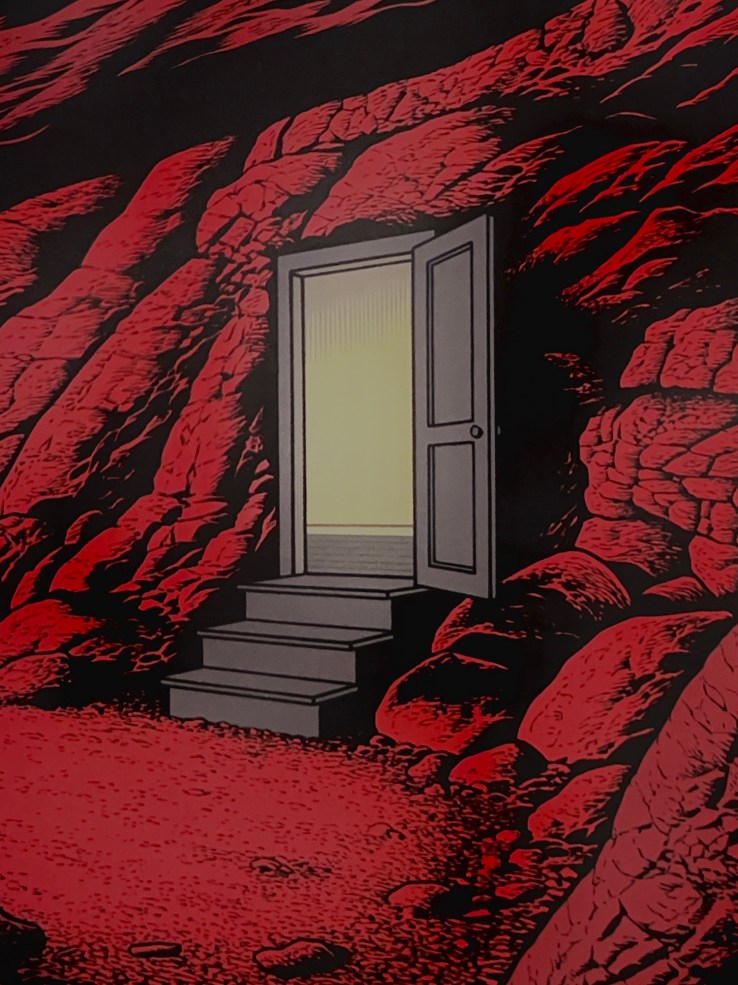
Image from Final Cut, Charles Burns, 2024

Man is doomed to constantly fabricate new agonies for himself | On Dino Buzzati’s novella The Singularity

Two years after it was first published in Italy, Dino Buzzati’s 1960 novella Il grande ritratto got its first English translation by Henry Reed under the title Larger Than Life. This year, NRYB issued a new translation of Il grande ritratto by Anne Milano Appel under the title The Singularity. This is the second new English translation of a Buzzati book from NYRB; last year saw the publication of Lawrence Venuti’s translation of Buzzati’s most famous novel, Il deserto dei Tartari, published as The Stronghold (in lieu of the more recognizable title The Tartar Steppe).

It makes sense, from both a cultural and a marketing stance, that Il grande ritratto would find new life as The Singularity, a term that refers to the hypothetical point where artificial intelligence surpasses human intelligence, which in turn triggers a dramatic existential change for humanity. AI slop abounds on the internet; misinformation replicates and mutates; we are told that the chatbots that frustrate us so frequently are an inevitable part of a future that no one seems to want. A sci-fi novel called The Singularity is pretty zeitgeisty.

The scant plot of The Singularity builds to the revelation of an artificial intelligence, part of a military science project perched high in the Italian Alps. I don’t think I’ve necessarily spoiled the grand reveal; both its title and its publisher’s blurb declare The Singularity “a startlingly prescient parable of artificial intelligence.”

Perhaps it’s this prescience that makes the central sci-fi conceit of The Singularity seem a bit dated. There’s a creakiness to Buzzati’s staging of his grand portrait of an artificial intelligence. The novella is more compelling in its initial chapters, which ignite a mood of slow-burning dread, the kind of Kafkaesque foreboding he served up in his superior novel Il deserto dei Tartari.

That slow-burn starts with a certain Professor Ismani, “who had always had an inferiority complex with respect to figures.” He and his much younger wife, the archetypal innocent Elisa (who “had not gone beyond middle school”) agree to undertake a mysterious journey up the mountain to “Experimental Camp of Military Zone 36,” where Ismani will join a scientific project he knows nothing about. As they zig and zag up the mountain, chauffeured by their military liaison, Ismani and Elisa (and the reader) gather crumbs about their destination. “So many mysteries,” a soldier tells them, at a penultimate stop. “If they at least told us what it is we’re guarding. I mean, let’s call it what it is, a kind of prison.”

In response to all this anxious foreboding, we are told that “Ismani felt the return of apprehension and dismay, the feeling of being insignificant in the face of immense, threatening things, a panic that he had once experienced in the war.” None of Ismani’s time in the war comes to bear on the narrative itself. Indeed, Ismani is thrown to the reader as a decoy; initially presented to the audience as the potential big-brain hero of a sci-fi thriller, he ends up a background ghost.

We eventually achieve the summit, where the natural splendor is overrun by the enormous complex that houses the titular singularity:

But the cliffs were no longer visible, nor could any vegetation be seen, or land, or flowing waters. Everything had been invaded and overwhelmed by a tangled succession of buildings similar to silos, towers, mastabas, retaining walls, slender bridges, barbicans, fortifications, blockhouses, and bastions, which plunged in dizzying geometries. As though a city had crashed down the sides of a ravine.

But there was an exceedingly abnormal element that gave those structures an air of enigma. There were no windows. Everything seemed hermetically sealed and blank.

From this moment, more or less, the best bits of The Singularity come not from sci-fi plotting but rather philosophical asides that add weight to the pulp narrative. Most of these are delivered by the handful of scientists who haunt the experimental camp. One of these scientists repeats the mantra, “Language is the worst enemy of mental clarity.” In their attempt to author an artificial consciousness, these scientists decreed that their singularity would have “No language,” for “Every language is a trap for the mind.”

Here in their “little kingdom, hermetically closed off and apart from the rest of the world,” the scientists have created a “machine made in our likeness” which “will read our thoughts, create masterpieces, reveal the most hidden mysteries.” Through hints, intimations, weird noises, and other creaky trappings of pulp horror, we come to learn that the singularity might not be, like, sane. As one of our (maybe not like exactly sane either) scientists declares, “before we knew it we had lost the reins, and all that was left for us to do was to record the machine’s behavior.”

In a move that would surprise no one familiar with the tropes of Gothic romance, we come to learn that the singularity’s consciousness is based on a beautiful dead woman. The whole operation is powered by a mysterious glowing egg. Indeed, The Singularity is perhaps most interesting if approached through a feminist lens. As it rushes to its climax, Elisa the innocent takes over the role of hero. She somehow learns to speak the strange “language” of the pre-lingual singularity, and through conversation, comes to understand that the singularity views herself as a desiring machine. The singularity wants a body; specifically a female body; specifically a body that can be desired by a male body and bear offspring.

Ultimately, The Singularity feels less like a novella than it does a short story stretched a bit too thin. Buzzati adroitly crafts an atmosphere of suspense and foreboding, but the characters are underdeveloped. Like a lot of pulp fiction, Buzzati’s book often reads as if it were written very quickly (and written expressly for money). Still, Buzzati’s intellect gives the book a philosophical heft, even if it sometimes comes through awkwardly in forced dialogue. Anne Milano Appel’s translation is smooth and nimble; it’s a page turner, for sure, and if it seems like I’ve been a bit rough on it in this paragraph in particular, I should be clear: I enjoyed The Singularity.

Like many of the modernist writers of the twentieth century, Buzzati intuited a future in which technology would become increasingly self-propelled, mutating unchecked in the notion of a progress wholly divorced from the needs of the human spirit. In our own era, we see con artists and hucksters banging the drum for “artificial intelligences” to “read our thoughts, create masterpieces, reveal the most hidden mysteries” for us. The results have been utter shit. Buzzati’s mad scientist isn’t so much prescient as he is simply describing the human condition then, when he declares that “man is doomed to torment himself, he doesn’t see the consolations offered to him, right there, within reach, he has to constantly fabricate new agonies for himself.” We can fabricate the agonies, but we can fight them too.

Horrors and oneiric aberrations | On Antoine Volodine’s post-exotic novel Radiant Terminus

Antoine Volodine’s novel Radiant Terminus is a 500-page post-apocalyptic, post-modernist, post-exotic epic that destabilizes notions of life and death itself. Radiant Terminus is somehow simultaneously fat and bare, vibrant and etiolated, cunning and naive. The prose, in Jeffrey Zuckerman’s English translation, shifts from lucid, plain syntax to poetical flights of invention. Volodine’s novel is likely unlike anything you’ve read before—unless you’ve read Volodine.

Radiant Terminus begins with its hero Kronauer fleeing into an irradiated wasteland. Kronauer and two of his comrades are escaping from the Orbise, the capital of the Second Soviet Union, which has been invaded by dog-headed fascists. World-wide Marxism-Leninism has fallen, and the stability of nuclear-powered self-sufficiency has collapsed into the apocalyptic promise of a “world that nuclear accidents had made unlivable for ten millennia to come.” The world is indeed increasingly unlivable, but it also has become, we will find, a place for the undying as well. “Hell is on the surface, it’s here,” one character flatly remarks, adding, “No need to dive into the core.”

But Kronauer will have to dive into the core, at least metaphorically. When one of his comrades, succumbing to radiation poison, can no longer move, Kronauer seeks help, crossing the steppe and bravely venturing into the dark forest. Born in the sanctity of the Orbise, Kronauer had been schooled to focus “on the future of Communes for workers and countrymen. His view of the world was illuminated by proletarian morality: self-sacrifice, altruism, and confrontation.” He is driven to save his comrade, but we know from the outset that hopes are slim.

What matters here is Kronauer’s essential idealism. By the end of the novel, Kronauer will suffer, wondering if he will eventually abandon the principles that underwrite his sense of self. He worries that he will eventually slip into a “total regression to primitive hunting, intelligence sidelined for instincts, and, especially, deep down, an irrepressible desire to kill, to slaughter, and to hurt, even if he couldn’t remember anymore what had brought about this nightmare.”

We enter Radiant Terminus in the midst of a nightmare that somehow only intensifies. Kronauer finds his way to what might be the prospect of aid for his comrade, the titular Radiant Terminus, a collective farm that is somehow self-sustaining despite the ever-present specter of irradiated death. Not only is Radiant Terminus out of sync with the physical reality of the post-apocalyptic world, its principles don’t fully square with the tenets of the Second Soviet Union that have guided Kronauer’s mindset:

Radiant Terminus functioned on ideological principles that didn’t match up to the collectivist norms of the Orbise, but, as far as the allocation of goods went, the end result was the same. Disdain for property was, as had been the case throughout the Second Soviet Union, commonplace in the Levanidovo. It was a place where the Party had been extinguished, where the Party no longer existed, but where the idea of reestablishing capitalism and the bourgeoisie hadn’t occurred to anyone, and besides it had to be asked just what this thing called capitalism would have looked like at Radiant Terminus, and what bourgeoisie could be called upon to oppress the working class…

We come to understand, elliptically enough, that Radiant Terminus’s apparent prosperity (or at least sustainability) is purchased in large part via sacrifices made to the village’s old nuclear reactor core, which has melted down and is kept locked away. The core is a kind of doorway to hell. The citizens of Radiant Terminus offer it gifts from the old world:

Every month, indeed, the core was fed. The heavy cover for the well was opened, and some of the bric-a-brac collected over the last season or two was knocked over the edge; just to show that people weren’t panicking and weren’t afraid of pathetic radionuclides. Tables and chairs, television sets, the tarry carcasses of cows and cowherds, tractor motors, charred schoolteachers who had been forgotten in their classrooms during the critical period, computers, remains of phosphorescent crows, moles, does, wolves, squirrels, clothes that looked perfect but had only to be shaken to set off a haze of sparks, inflated toothpaste tubes filled with constantly simmering toothpaste, albino dogs and cats, clusters of iron that continued to rumble with an inner fire, new combine harvesters that hadn’t yet been broken in and which gleamed at midnight as if they were lying in full sunlight, garden forks, hoes, axes, debarkers, accordions that spat out more gamma rays than folkloric melodies, pinewood planks that looked like ebony planks, Stakhanovites in their Sunday best with their hands mummified around their diplomas, forgotten when the event halls were evacuated. The ledgers with their pages turning day and night. Cash-register money, the copper coins clinking and shifting without anyone nearby. These were the sorts of things thrown into the void.

The Gramma Udgul was the one to handle the maneuver

We come to understand the Gramma Udgul as priestess-witch archetype; “condemned to immortality from her first interactions with nuclear reactor cores” she is both immune to the ravages of radiation and cursed by it. The Gramma Udgul has her counterpoint in Solovyei, the dominant antagonist of Radiant Terminus.

Solovyei is the “president” of Radiant Terminus, but his role is something closer to an archduke synthesized with an insane wizard. Like the Gramma Udgul, Solovyei is immortal (indeed, a century earlier, the pair were husband and wife). Solovyei rules greedily over Radiant Terminus, and warns Kronauer to stay away from his three daughters. He is an inverted King Lear; mad, yes, but also deeply capable and cunning. Solovyei seems to find metaphysical sustenance in trips to Radiant Terminus’s nuclear core, emerging from time spent there “sizzling and blackened, weighed down with radiation and opaque poems.”

The development of Solovyei as a controlling intelligence—and Kronauer’s ideological resistance to his monomania as well as his three daughters’ battle against his invasive will—forms the main plot, such as it is, of Radiant Terminus. Solovyei is the author of the “horrors and oneiric aberrations” that haunt the characters and landscape that he is both collapsing center and impossible margin of. “It was hard to determine whether he was a mutant bird, a gigantic sorcerer, or a rich farmer from Soviet or Tolstoyan times,” the narrator declares at one point.

“This necromancer of the steppes,” Kronauer calls Solovyei, and then goes on to try to find language for the metaphysical:

This awful kolkhoz matchmaker, this reviver of cadavers, this horrible shadow, this giant impervious to radiation, this shamanic authority from nowhere, this president of nothing, this vampire in the form of a kulak, this strange man sitting on a stool, this abuser, this dominating man, this sleazy man, this unsettling man, this nuclear-reactor creature, this godless and lordless hypnotizer, this manipulator…

One of the key plot points of Radiant Terminus is that Solovyei can literally resurrect the dead, but cannot reanimate them back to what we would understand as true life:

….we all became bodies inhabited by Solovyei. Who knows whether this magic muzhik hasn’t taken advantage of us being dead, and if we aren’t all puppets within a theater where the manager, the actors, and the audience are all one and the same person

Some of Volodine’s chapters seem to inhabit Solovyei’s consciousness, a space that’s somehow both murky and sharp, an intelligence feasting on the agencies of other human beings:

Our best marionettes, I say. Him or me, doesn’t matter. When he’s stuck I keep going. Zombies, deep shadows, devoted servants. The dead stuck forever in the Bardo. Dead come from the dead. Wives come from unknown mothers. Henchmen. Best puppets and best dolls.

Every character who survives in the pages of Radiant Terminus seems to be susceptible to Solovyei’s oneiric horrors. He is the dream police, the puppet master — “Who’s he?” a minor character asks. The answer: “We don’t know…But we do know that he does with us whatever he wants. We’re in his hell.”

Solovyei’s daughters are the most sympathetic of his vampiric victims. These women, forced into the same unasked-for immortality as their father, find themselves repeatedly invaded by Solovyei, who haunts their dreams and walks around in their minds. One daughter sees herself “a creature imagined, possessed, and brought to life by Solovyei. A daughter of Solovyei, a daughter for Solovyei. A female annex in Solovyei’s life: nothing more than that.” They initiate their own eruptions of opposition: violence, suicidal rejection. Writing.

Near the end of Radiant Terminus, the narrator describes the novels of Hannko Vogulian, Solovyei’s eldest daughter:

In effect, they depicted the same twilit suffering of everyone, a magical but hopeless ordinariness, organic and political deterioration, infinite yet unwished-for resistance to death, perennial uncertainty about reality, or a penal progression of thought, penal, wounded, and insane.

We have here an internal description of the novel Radiant Terminus itself. Indeed, Radiant Terminus is always self-describing and always self-deconstructing: “Everything is in the same place, as in some kind of book, if you want to go to the trouble of thinking about it. That’s the ambiguity of ubiquity and achronia,” the narrator muses. When the narrator throws out the sentence, “These are complete works for no audience,” it almost feels like an inside joke. And Volodine can’t resist metanarrative descriptions of his own so-called post-exotic project:

If a post-exotic writer had been present at the scene, he would have certainly described it according to the techniques of magical socialist realism, with flights of lyricism, drops of sweat, and the proletarian exaltation that were part of the genre. It would have been a propagandist epic with reflections on the individual’s endurance in service to the collective.

Volodine’s Radiant Terminus works in all these modes while simultaneously subverting them. The result is an astounding novel, a work that will haunt any reader willing to tune into its strange vibrations and haunted frequencies. Very highly recommended.

A review of Dinah Brooke’s excellent cult novel Lord Jim at Home

Dinah Brooke’s 1973 novel Lord Jim at Home had been out of print for five decades — and had never gotten a U.S. release — until McNally Editions republished in 2023 with a new foreword by the novelist Ottessa Moshfegh. I always save forewords until after I’ve finished a novel, so I missed Moshfegh’s implicit advice to go into Lord Jim at Home cold. She notes that the recommendation she received to read it “came with no introduction,” and that “I wouldn’t have wanted the effect of the novel to be mitigated in any way, so I’m reluctant to introduce it now.”

I am not reluctant to write about Brooke’s novel because I am so enthusiastic about it and I think those with tastes in literature similar to my own will find something fascinating in its plot and prose. However, l agree with Moshfegh’s advice that Lord Jim at Home is best experienced free from as much mitigating context as possible. I had never heard of the novel before lifting it from a bookseller’s shelf, attracted by the striking cover; I flipped it over to read a blurb parsed from Moshfegh’s foreword attesting that Brooke’s novel “was an instrument of torture. It’s that good.” The inside flap informed me that reviews upon its publication “described it as ‘squalid and startling,’ ‘nastily horrific,’ and a ‘monstrous parody’ of upper-middle class English life.” I was sold.

Lord Jim at Home is squalid and startling and nastily horrific. It is abject, lurid, violent, and dark. It is also sad, absurd, mythic, often very funny, and somehow very, very real for all its strangeness. The novels I would most liken Lord Jim at Home to, at least in terms of the aesthetic and emotional experience of reading it, are Ann Quin’s Berg, Anna Kavan’s Ice, Mervyn Peake’s Gormenghast novels, Virginia Woolf’s Mrs. Dalloway, and James Joyce’s Portrait (as well as bits of Ulysses). (I have not read Conrad’s Lord Jim, which Brooke has taken as something of a precursor text for Lord Jim at Home.)

After finishing Lord Jim at Home, I read it again by accident. At first I intended to take a few notes for a possible review, but after the first few pages I just kept reading. On a second reading, Brooke’s novel was just as strange—maybe even stranger—even if I was able to read it much more quickly, finding myself quicker to tune into the novel’s competing (and complementary) narrative registers. I found it far more precise, too, in the rhetorical development of its themes; Brooke’s styles and tones shift to capture the different ages of its hero. The novel begins in a mythical, archetypal mode and works its way through various registers, exploring the tropes of schoolboy novels, romances, war stories, adventure tales,  modernism, realism, and journalism. But despite its shifting modes, Lord Jim at Home is not a parodic pastiche. Rather, at its core, Lord Jim at Home skewers how aesthetic modes—primarily those derived from notions of class and manners—cover over abject cruelty. As Moshfegh puts it in her forward, Lord Jim at Home is “an accurate portrayal of how fucked-up people behave, artfully conveyed in a way that nice people are too polite to admit they understand.”

I’ve tried to be clear that I think it’s best to come to Lord Jim at Home without too much context—it’s best to just go with the novel’s strangeness. Below, however, I offer a more detailed discussion of the novel, its language, and some elements of the plot for those so inclined.

Answer, 2014 by Henrietta Harris

Continue reading “A review of Dinah Brooke’s excellent cult novel Lord Jim at Home”

A review of The Son of Man, Jean-Baptiste Del Amo’s novel of atavistic inter-generational violence

Jean-Baptiste Del Amo’s latest novel The Son of Man takes place almost entirely over a three seasons in a dilapidated manor somewhere in rural France, sometime near the end of the 20th century. The plot is deceptively simple: A father returns to his young wife and nine-year-old son after a six-year absence, only to immediately drag them away to his remote childhood home, a place in the mountains called Les Roches. The father desires to refurbish the ancestral manse and restore his family. Complicating matters is the mother’s new pregnancy and frequent migraines and the son’s ambivalence about his relationship with his long-absent father. As the slim novel progresses, the oppressive isolation the mother and son endure tips over into dread and then horror. The Son of Man is ultimately a novel about the atavistic transmission of violence from generation to generation.

Del Amo’s writing, conveyed in Frank Wynne’s limpid translation, is precise and cinematic. Del Amo gives us phenomena and response to that phenomena, but withholds the introspective logic of cause-and-effect or analysis that often dominates novels. Instead, he allows us to see what his characters see and to take from those sights our own interpretations. Consider the following simple passage, where, a few days after arriving at the crumbling old house, the father and mother argue:

The faint voices of the father and mother reach the boy as a confused murmur. He walks to the gable door and looks at the landscape below, at the slow, solemn, hypnotic swaying of the larches and the tall pines on the edge of the forest.

He sees the mother and father standing facing each other.

The mother stands, left hand gripping her right arm, right hand on her hip in a gesture of utter defiance. While the father is speaking, she is shaking her head as though refusing to listen to what he is saying or dismissing his words, while, for his part, the father is nodding in an attempt to convince her or make her see reason.

The father gestures wildly as he speaks, pointing to the house, the grasslands, the mountain peaks that rise into the impassive sky. When he turns towards him, the son suppresses a shudder. Blood drains from his hands, his fingers prickle with pins and needles; if the father sees him standing in the gable window, he might think he has been watching, spying on them, trying to make sense of the words carried on the wind in fits and snatches.

The son cannot fully read the signs and signals in front of him. He’s left with “fits and snatches” and gestures and movements that are, in a certain sense, part of the same material as everything else he can presently behold—the pines, the larches, the wind. And yet the boy intuits in his witnessing an “irrefutable proof of his [own] transgression, perhaps even of his [own] guilt.”

Del Amo conjures a dark, oppressive world where his titular son of man is born into a prelingual state of guilt, a strange inheritance that yields violence. We see much of the novel’s action through the son’s perspective–or not really his perspective, but rather we see the action as through a powerful invisible camera set close to the boy’s head, but never fully inside it. We see the son seeing his mother, whom he loves and understands, in his own way, and seeing his father, who is frightening and likely unknowable:

On the father’s left side, the son notices a scar tracing a line some twenty centimetres long across the skin slantwise towards the shoulder blade, as though the father had been stabbed and the blade had struck a bone and deviated its course. The scar tissue looks smooth, like the skin of a newborn baby or a burn victim.

Spellbound, the boy cannot tear his eyes away, and when the father stops to wipe his forehead with the back of his hand and light a cigarette, he sees the child staring at the scar but says nothing.

The accretion of concrete details coheres into slow burning dread. Del Amo shows us images and gives us details that allow us to infer an explanation for the father’s previous six-year absence that the son cannot yet comprehend. At the same time, we see the father and the mother each moving along separate poles of manic despair. The mother dreams of an impossible escape; the father dreams of an impossible inheritance. The father does not possess the material, tools, or skill to properly restore Les Roches: 

He seems to have decided to do battle with this plot of land whose obstructiveness is an affront, to remove anything and everything that would thwart his plan, or to give free rein, with every swing of the pickaxe, to a blind fury for reasons the child cannot fathom. …

He casts a strangely distended shadow, a vision of disproportionate limbs, an evil doppelgänger that emanates from him, dogging his steps, aping his every gesture, every swing of the axe, every throw of a stone, in a way that is monstrous and terrifying.

In time, through hints and implications, we come to understand that the father’s monomaniacal restoration project has resulted from his own terrible childhood. These hints and implications explode late in the book into a fifteen-page monologue from the father, a bitter screed like something out of a Thomas Bernhard novel. The monologue climaxes in the father’s realization that he has repeated his own awful father’s ways. He declares that buried memories are “simply waiting for someone to come and dredge them from their deep torpor, so that they can resurface and endlessly repeat the same failures, the same disasters.”

It’s true that The Son of Man emanates a startling claustrophobic horror. And yet it also glitters at times with moments of strong beauty. If Del Amo’s lucid, cinematic prose evokes something like Kubrick’s The Shining, it also is capable of something like Malick’s Days of Heaven. There are idyllic moments, such as when the boy and his mother bathe in the plunge pool under the weir of a waterfall, the rumbling of which, from a distance, the son had “first thought was the voice of the mountain.” The son also makes his own adventures into the forest, meeting a family of wild horses, one of which is missing an eye.

Through such encounters, the son achieves a brief moment of transcendence late in the novel. His fleeting epiphany balances his father’s bitter declaration that humans are “born with this void inside, this dizzying void they desperately strive to fill throughout their brief, inconsequential, pitiful time in this world, paralyzed as they are by their transience, their own absurdity, their own vanity…” For the father, this “dizzying void” is something that must be filled — “Just like you might try to fill a grave with a shovelful of earth.” 

Let us contrast the father’s dizzy void with the son’s epiphany:

He sits far away from the nimbus of soft light that radiates from the house, gazing at the inky vault where fires that existed before the world was world still shine, and feeling the presence of the earth, the vastness beneath him. Dizzily, he thinks of the lives simultaneously played out everywhere across its surface, knowing that somewhere a child is walking barefoot, another is falling asleep in a soft bed, that a dog lies dying in the dust in the shade of a sheet of metal, that a city in some far-flung country is shimmering in the darkness, that innumerable creatures are moving about, animated by this mysterious and insistent force that is life, which courses through each of them.

Puzzlingly, he can also feel the great movement – imperceptible yet vertiginous – that carries everything, including him, through time and space, all lives, human and animal, and with them the rocks, the trees, the blazing stars.

Of these moments, he will retain the memory of an epiphany, of being struck by the true nature of things, which no language, no words can communicate; but what lingers will be little more than the trace of a dream, the sense of something being granted and instantly revoked.

The beauty of the first two paragraphs sinks into the reality of the final paragraph. Epiphanies don’t last; we can catch the memories, maybe, but even then, what was granted was “instantly revoked.” We remain trapped in language, outside “the true nature of things.” Will the son then “endlessly repeat the same failures, the same disasters” as his father (and his father and his father and…)? The novel seems to suggest that this will likely be the case, even if it opens other, more optimistic avenues.

In this light, it’s difficult to interpret the novel’s mythic overture. The first fifteen pages of The Son of Man focus on a troop of prehistoric hunter-gatherers. The episode culminates in a hunt scene in which an adolescent son makes his first kill—a doe—and then seems to be fully initiated by his father, who marks him in the deer’s blood. The overture ends with the son fantasizing about “abandoning the group” and laying down in the humus to be swallowed up by the earth. This is, in a sense, a version of the same fantasy the contemporary son will have in the forest around Les Roches tens of thousands of years later. 

It’s unclear how Del Amo would have us read the prehistoric overture. On one hand, it suggests a time of idyllic balance–of humanity in, and not apart from, nature. And on the other hand, it concludes with the same desire to escape civilization that, millennia later, the father will inherit.

Perhaps a second reading of The Son of Man might yield a more conclusive answer, or a second reading of Frank Wynne’s translation of Del Amo’s previous novel, Animalia, a visceral, naturalistic, and very precise rendering of humans as animals that takes on an epic scope. English-only readers interested in Del Amo’s writing couldn’t go wrong with either of these novels, which, unless I’m mistaken, are the only two on the market in English translation. I look forward to reading more of Del Amo’s novels in the future. Until then, I highly recommend The Son of Man.

 Jean-Baptiste Del Amo’s The Son of Man is now available in the U.S. in translation by Frank Wynne from Grove Atlantic.

Selections from One-Star Amazon Reviews of J.G. Ballard’s Crash

[Editorial note: The following citations come from one-star Amazon reviews J.G. Ballard’s novel Crash. I’ve preserved the reviewers’ original punctuation and spelling. More one-star Amazon reviews.].


Honestly.

massive car wrecks

I like Ballard’s work

nearly killing his wife

I can’t wrap my brain around the idea

I don’t consider myself to be socially conservative, but

Also won’t the police be keeping track of the guy’s driving record?

I find it gross that wounds from these car wrecks would turn women on

talked extensively of the steering column, instrument panel, and bonnet

Contrary to this book’s classification as a social technological fiction,

having sex with any women he can find

and lots of masturbating

messed up fetish

hard to believe

crashing it

unrealistic

gratuitous

assigned reading

required for a college course

hated every twisted minute of it

I wish I could scrub it from my brain

one must debate the author’s motives

“Heavy Groin,” “Scarred Mouth” and “Semen” 

an obsession which could only be satisfied by having sex in car

the perverse inner workings of the author, J.G. Ballard’s, mind

automobiles, sex, and death

perverse and sick fantasies

fuel his obsession

so disturbing

Poppycock.

lewd, dark, introvert

driven by his own libido

mind is completely altered

His sexual relations were not sincere

scars and disfigurements

truly fails on all levels

conniving ways

obsessing

obsessive

minions

mangled leftovers

mere marionettes

perverse sexuality

increasingly disturbing

perverse way of thinking

hardly worth a sexual climax

It was written in 1973 and seems to take place in 1973

Just some perverts lobbing semen around car wrecks.

a radical depiction of society’s addiction to technology

It is hard for me to make a connection between cars and sex.

sexual obsession of the body stamped by the technology of the car

What’s the commentary, car wrecks are bad?

savage appetite for car crashes and victims

riddled with atrocious sexual fantasies

hard to follow and digest

void of any substance

surprisingly disgusting

spreading his semen

collision course

Elizabeth Taylor

scars and fantasies

former sports car

invalid car

braces

acid trip

scars and divots

the average reader

It elicits the response it is written to do so.

Read it for class, but would never read again.

Anyone reading this for its erotic content will be as disappointed

I understand books are written to prompt a question, to get somebody thinking. But

on a list of some guy’s “best science fiction” on the internet

I have read a number of Ballard’s works

one of the worst books I have ever read

fantasy story (not sexual fantasy)

How is it science fiction?

rancid mayonaise

dry, mechanical

Car fetish porn.

I don’t get it.

not art

not prose

junk

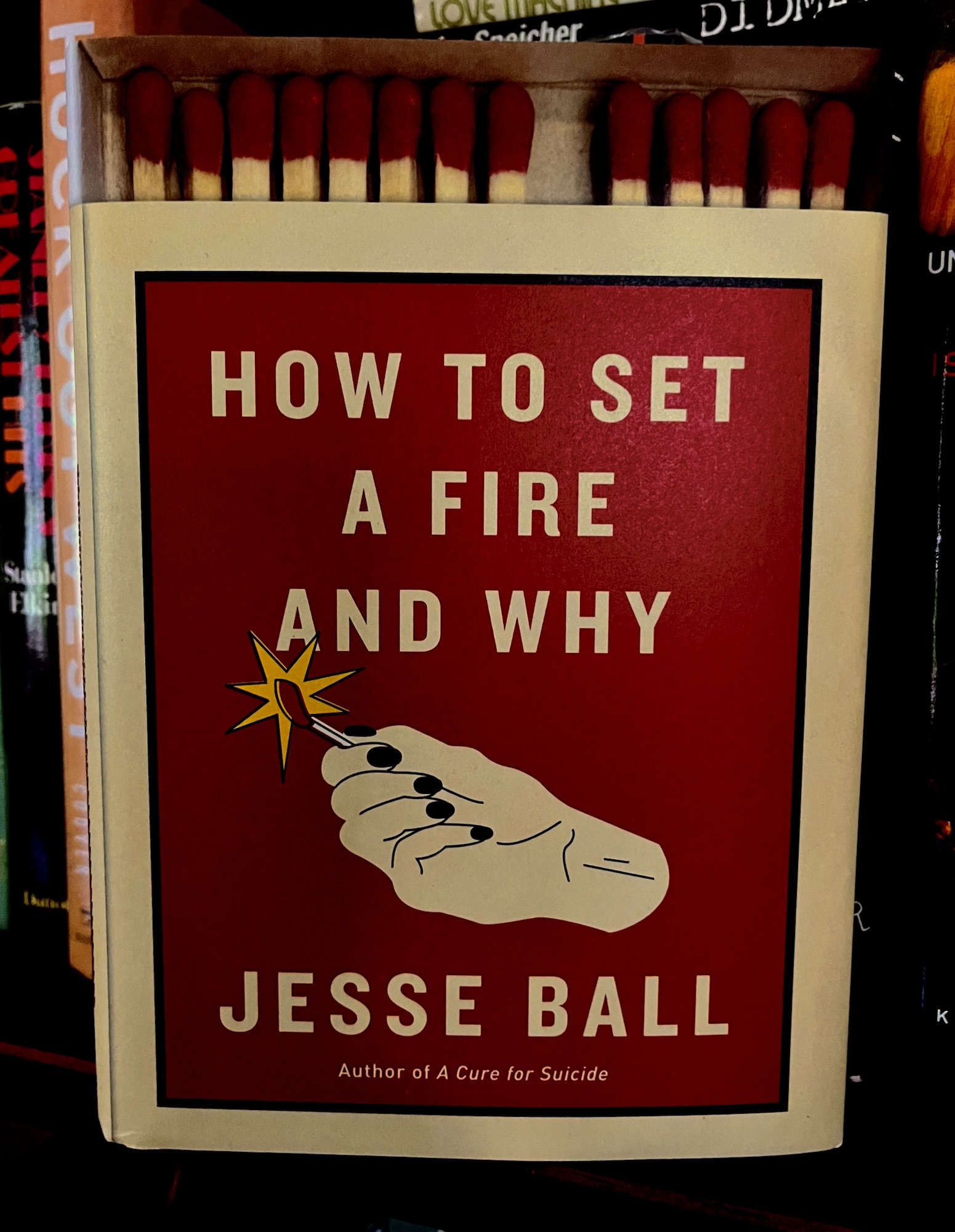
A review of Jesse Ball’s novel How to Set a Fire and Why

Jesse Ball’s 2016 novel How to Set a Fire and Why covers a few tumultuous months in the life of Lucia Stanton, anarchist daughter of anarchist parents, now living with her aging anarchist aunt after the death of her (anarchist) father and subsequent mental breakdown and institutionalization of her (anarchist) mother.

The narrative begins with the aftermath of Lucia’s expulsion from school for stabbing a classmate with a pencil. The classmate’s crime? Touching Lucia’s lighter, a capital offense. I wrote Lucia’s lighter, but she—Lucia, the first-person narrator of Jesse Ball’s 2016 novel How to Set a Fire and Why—she always refers to it as her father’s lighter: “His corpse is actually on it—I mean, not his death corpse, but his regular one, the body that falls off us all the time. It’s what I have left of him, and I treasure it.”

So Lucia’s off to a new school, trailed by rumors of graphite-based violence that don’t help her win new friends. Her poverty doesn’t help her popularity either (did I mention that she and her aunt are practicing anarchists?) But she’s in luck, sorta, because she hears that this school has a “Sonar Club”:

I’m sure that doesn’t mean anything to you. You’re wondering, why is she happy about some Sonar Club. That doesn’t sound even remotely fun. Well, I have a friend—I do—who told me about something he heard about from someone else—and what it is, is this:

Right now, there are clubs forming up all over the country. They call themselves sonar clubs, or even radio clubs—but what they are is clubs for people who want to set fires, for people who are fed up with wealth and property, and want to burn everything down.

S – O – N – A – R = A – R – S – O – N

And there’s the essential surface conflict of How to Set a Fire and Why: will Lucia, like, shift her collectivist-anarchist ideals toward something more, uh, destructive? Will she burn it all down?

The real plot of the book though is about a teenage girl going through some shit. Lucia is sharp, witty, but caustic and clearly depressed. She is also incredibly observant and very, very intelligent. Ball’s greatest strength in the novel is harnessing Lucia’s spiky but vulnerable intellect; we ride her first-person narration persuaded by her maybe-genius, but also aware of all of her blind spots. Teens know the Truth, but the Truth often blinds them to reality. Not that Lucia isn’t self-aware; consider her take on her own intellect:

My aunt says that I am naturally curious. That means that I don’t need to be taught how to learn. Some people have a disadvantage at the beginning, and they are not curious. These people have trouble learning. It seems like not being curious is the worst thing of all. Curious people aren’t necessarily good at learning what you want them to learn, though. They are too busy learning about other things.

The best bits of How to Set a Fire let Lucia riff on her observations. There’s a poignant detailed description of her father’s lighter (“My father’s is matte black and has a white dot in the center. I haven’t seen another like it”). There’s an explanation and analysis of the rules of cee-lo, which Lucia decides exploits outsiders. She praises both My Dinner with Andre and the music of Erik Satie. She makes predictions and shares their outcomes. She has sex and takes drugs. She visits her mother at the institution. She’s afraid a lot, and probably with good reason: “When I think about what my future holds, it is a bit like looking into the sun. I flinch away, or I don’t and my eyes get burned down a bit, like candles, and then I can’t see for a while.”

Most of Lucia’s observations are about people: I did not count the nouns in the novel, but I imagine people would have to be up there as one of its most common words. A representative sample might be this early simple nugget: “History is just people behaving badly.” Lucia is cynical, sure, and with good reason. How to Start a Fire often echoes the coming-of-age cynicism of The Catcher in the Rye, whose narrator was also flawed and intelligent and blind to what he could not see. (We are all of course blind to what we cannot see.) But Lucia’s not entirely unforgiving. “People aren’t all horrible. They aren’t. Sometimes you find a good one, at least for a while—even if it’s just for twenty minutes or so,” she concedes.

Lucia’s voice is the reason to read How to Start a Fire. It’s compelling and funny and persuasive and hurt. It seems authentic, and I admire the risk Ball has taken—it’s not easy to write a teenage girl who is also maybe-genius-would-be-arsonist. The plot proper of How to Start a Fire never really commits to anarchism or revolution however—sure, things happen—but we never really find out why Sonar Clubs might be taking off around the nation, let alone, like, how Lucia fits into all that. But I don’t think that’s really what Ball is doing here—I think he’s marking off a measure of time in a character’s life:

When people write books about childhood, and about being a kid—they always talk about how endless it is, and about how there is no thought of time. Everything just stretches and stretches. I think the opposite is the case. When you’re young, you feel like things are constantly ending. As soon as you get used to something, it goes away.


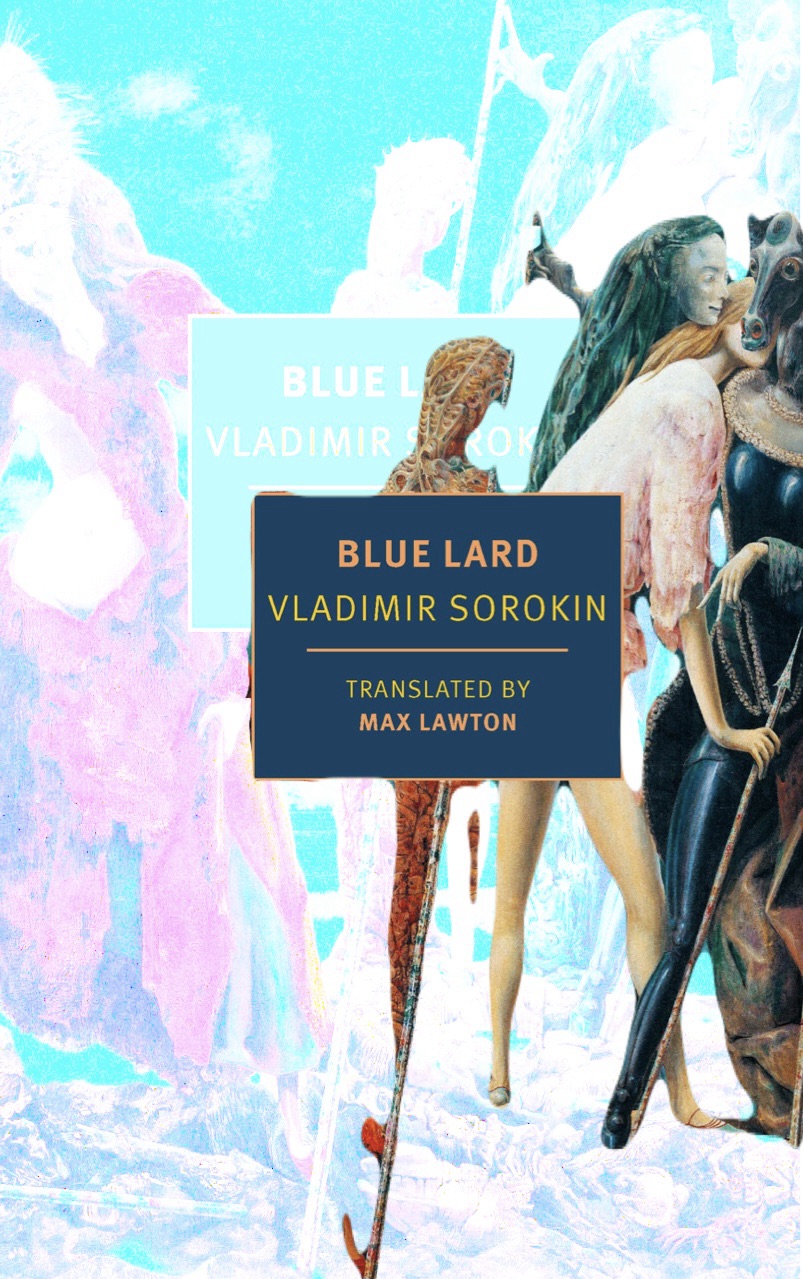
On Vladimir Sorokin’s Blue Lard, pp. 188-222 (black brows, white silk, silver belt, golden syringe)

Previously on Blue Lard…

pp. 1-47

pp. 48-110

pp. 111-61

pp. 162-87

The following discussion of Vladimir Sorokin’s novel Blue Lard (in translation by Max Lawton) is intended for those who have read or are reading the book. It contains significant spoilers; to be very clear, I strongly recommend entering Blue Lard cold.

We’d left off with the Earth-Fucker’s successfully sending an enormous frozen cherub with enormous frozen genitals backwards in time to land in the middle of the Bolshoi Theater in the Spring of 1954. The alarmed comrades in the audience are (momentarily) pacified by Joseph Stalin’s chief advisers who are in attendance, even if their Leader is not.

In our—which is to say our historical timeline as persons in this historical world, and not our timeline as in our timeline as readers of this novel—in our own timeline, both Stalin and Lavrentiy Beria, the head of his secret police, died in 1953. But the world of Blue Lard is quite different and Beria and Stalin are both quite alive.

Stalin is somehow extra-alive, ultravivid, a kind of holographic pop art caricature of himself whose bearing, attire, and aura seem to owe more to glam rock and Hollywood than drab Mao tunics. We first meet him as his lieutenants try to give him the news of the time-travelling ice cone. His private rooms are opulent pink marble, adorned with Chinese rugs, vases, and priceless art, and attended by “Uzbek governesses in silk Uzbek dresses, bloomers, and tubeteikas” — all guarded by Sisul, his “personal servant” who sleeps like a guard dog upon a carpet in front of Stalin’s rooms. And Dear Leader himself?

The leader was tall and well built with an open, intelligent face that looked as if it had been carved from ivory; his short-cropped black hair was streaked with gray, his tall forehead smoothly intersected with the beginnings of his baldness, and his beautiful, black brows smoothly arched up from his lively, penetratingly brown eyes….Stalin looked to be about fifty years old. He was dressed in a kosovorotka of white silk with a silver belt and tight pants of white velvet tucked into patent leather white ankle books lacquered boots with silver embroidery.

An aging rock star. But he still has the juice.

And no wonder Stalin is aging. When we first meet him, he is berating his sons Yakov and Vasily who are in full evening cross-dress:

A long evening dress of black velvet hugged Yakov’s thin, muscular figure; it was fastened with a diamond scorpion and emblazoned with white spots upon its wearer’s miserly bosom; his curly, chestnut-colored wig drowned in the dark-blue boa around his naked shoulders; black mesh gloves, one of which was torn, reached from his thin, feminine hands to his forearms; three rings of white gold with sapphires and emeralds and two platinum bracelets with the tiniest of diamonds decorated his hands and wrists; his thin face, with his father’s distinctive features, was covered in a thick layer of powder, which couldn’t disguise the swelling of his bruised right cheekbone; his eyes, made up with blue eyeliner, were fixed on the floor; he held a thin snakeskin handbag underneath his armpit. Vasily, short and very portly, was dressed in a beige crepe-de-chine dress with a standing collar and high shoulders cascading down to the floor in tiny ruffles and embroidered with peach-colored roses upon the bosom; a large pearl dangled from his neck along a long, thin chain; his chubby hands were squeezed into white kid gloves soiled with filth from the street; though his blond wig had lost its initial shape, there was still a mother-of-pearl comb stuck into it; his chubby neck was covered with ribbons of black silk; his puffy, painted face, with an abrasion on its chin and features that very much recalled his mother’s, also looked down at the floor; a white patent leather bag on a massive golden chain dangled down from the leader’s youngest son’s shoulder.

Perhaps I have over-quoted here–and I will do so, I fear, in a moment–but I am in love with Sorokin’s lush descriptions of opulent decadence in these scenes (captured in the blue warmth of Max Lawton’s translation). Sorokin’s not exactly crafting a satire or a parody in the alternate Soviet reality he’s ushering us through. Sure, there are satirical and parodical elements and devices, but Sorokin weaves them into something odder, something harder to recognize. It’s beautifully grotesque, and while the bruised cross-dressed half brothers’ attempts to get laid in a fine restaurant and ending up in a brawl is played for slapstick laughs, there’s also real pathos to the familial dynamic Sorokin establishes among the Stalins. And, as I promised to over-share, let me give a description of the rest of Stalin’s family when his second wife and his only daughter enter (giving the half brothers some reprieve):

Both spouse and daughter were dressed in the traditional Russian style. Alliluyeva was wearing an evening dress of apricot-colored silk with a sable fringe and a pearl necklace infiltrated by a large ruby at its lowest extremity; her beautifully styled dark-chestnut hair was fitted into a samshara cap covered in pearls; hanging from her ears shone diamonds on ruby pendants and on her chubby hands gleamed a heavy bracelet and two enchanting diamond rings that once belonged to the Empress Maria Feodorovna. Stalin’s daughter’s slim figure was beautifully enveloped in a tight whitish-grayish-lilac sundress embroidered with gold, silver, and pearl; Vesta’s head was ornamented by a pearl- and diamond-covered kokoshnik and coral threads were woven into her long black braid; dangling from her ears blued earrings of turquoise and pearl and her fingers glittered with emeralds and diamonds.

The lush decadence of the Stalin clan in the second half of Blue Lard mirrors the sordid partying of the BL-3 team way back in the future (?), in the book’s first section (perhaps the monastic Earth-Fuckers, chaste in the main, despite their moniker, mediate these depraved poles). Sorokin’s style is highly-cinematic, and the second half of Blue Lard is particularly filmic, recalling the glittery surrealism of Alejandro Jodorowsky’s The Holy Mountain. But if there’s a tinge of Jodorowsky, there’s also a big dose of Pasolini’s Salò. (Writing this now, I realize that maybe the happy (?!) medium or synthesis of this decadent filmic axis is the comedy/horror of Peter Greenaway’s The Cook, The Thief, His Wife, and Her Lover.)

Blue Lard’s Iosif Stalin exudes a glamorous depravity that’s both charismatic and menacing. Again, Sorikin crafts him into a heightened, pop art reinvention of his historical counterpart. Sorokin’s Stalin dons high-neck collars under bottle-green suits, pomades his thick black hair into a pompadour, and sports a thirty-karat emerald pendant. He’s also addicted to an unspecified substance, which he consumes in an elegant ritual involving a mobile marble column:

Atop the yellowed marble of the column, there was a thin, golden pencil case. Stalin picked it up, opened it, and took out a small golden syringe and a small ampoule. With a deft and laconic motion, he broke the ampoule, filled the syringe with the transparent liquid from the ampoule, opened his mouth, stuck the syringe under his tongue, and made an injection. He then put the syringe and the empty ampoule back into the pencil case and onto the column. This entire procedure, which had long been part of the leader’s life, described and elaborated thousands of times in dozens of world languages, captured by hundreds of film cameras, embodied in bronze and granite, painted with oil and watercolor, woven into carpets and tapestries, carved into ivory and onto the surface of a single grain of rice, glorified by poets, artists, scientists, and writers, sung in simple drinking songs by workers and peasants, was done by Stalin with such striking ease that all those present froze and lowered their eyes, as they had often done in the past.

Again, I didn’t mean to share so much of the language, but I felt myself rushing on the run of Sorokin’s long last sentence there. The decadence of Blue Lard is fun.

And Blue Lard’s fun decadence continues to ramp up as Stalin and his boys prepare for a sumptuous, sinister dinner to discuss the Earth-Fuckers’ time-travelling gift, which they bring into their dining area to observe thawing as they chow. (Meanwhile, elsewhere, Sorokin treats us (?!) to a not-quite-incestuous-but-still-disturbing-sex-scene.) Who is invited to Stalin’s special Earth-Fucker time-travelling ice-cone supper?

In addition to Molotov, Voroshilov, Beria, Mikoyan, Landau, and Sakharov, Stalin had invited Bulganin, Kaganovich, Malenkov, Prince Vasily, the sugar producer Gurinovich, the writers Tolstoy and Pavlenko, the composer Shostakovich, the painter Gerasimov, and the film director Eisenstein to dinner.

For such fine company, a fine meal must be set; again (I repeat again again), I perhaps overshare—but I’ll just lay out the appetizers here (noting that the main course Stalin’s crew will later enjoy a roast pig costumed to resemble “the Judas Trotsky”):

The table was gorgeous; Alexander I’s gold and silver tableware was laid out on a whitish-blue tablecloth, homespun in the Russian style; the abundant Russian appetizers were provocative in their variety: there was smoked eel and jellied sturgeon, venison pâté and stuffed grouse, simple sauerkraut, calf tongue and calf brain, salted mushrooms and jellied suckling pig with horseradish; a golden bear towered up in the middle of the table with a yoke over its shoulders, from which were hanging two silver buckets filled with the oily gleam of black beluga caviar and small, grayish sterlet caviar.

The dinner scene is comic and menacing, giving voices to the various Soviet luminaries and artists assembled. The filmic quality again recalls the aforementioned The Cook, The Thief, His Wife, and Her Lover, as well as the infamous dinner scene in De Palma’s The Untouchables. The violence here never reaches those limits, but it is still grotesque and climaxes in a (literal) punchline.

The night ends with the cone finally cracking, revealing “A frozen giant with monstrous genitals and a small suitcase in his lap was left sitting atop the pallet in the melted water and surrounded by chunks of ice.” Beria and Stalin share an amusing exchange about the creature’s enormous pecker (“How they must love their native soil,” Stalin muses of the Earth-Fuckers), before taking the briefcase and retiring for bed (to Beria’s apparent chagrin).

Next time on Blue Lard: The return of AAA aka Anna Akhmatova and the first appearance of Nikita Khrushchev, whose relations with Blue Lard’s version of Stalin led Russians to protest the book by throwing copies of it into a giant sculpture of a toilet—an abject pop art stunt worthy of a scene from Blue Lard itself.

A review of June-Alison Gibbons’ unsettling novel The Pepsi-Cola Addict

Fourteen-year-old Preston Wildey-King has a lot of problems. He’s on the outs with his girlfriend Peggy. His best friend Ryan always leers at him in a funny way, and Ryan’s older brothers want him to join their gang and do crimes. His older sister Erica accuses him of stealing from her. Preston’s failing at math, and his teacher might be trying to seduce him. His mother doesn’t know what to do with him.

And he’s addicted to Pepsi Cola.

This is, roughly, the premise of June-Alison Gibbons’ 1981 novel The Pepsi-Cola Addict, a raw and distressing young-adult novel that was actually written by a young adult. Gibbons was just sixteen-years-old when she wrote The Pepsi-Cola Addict and pooled her dole money with her twin sister Jennifer to have it published by a vanity press. Two years later, after a spree of petty crimes and then more serious crimes culminating in arson, Gibbons and her sister were committed to a psychiatric hospital and confined there for over a decade. The Gibbons twins’ story was detailed in a book by journalist Marjorie Wallace called The Silent Twins, later followed by a television documentary; in 2022, Wallace’s book was adapted into a feature film of the same name.

I knew nothing of the Gibbons’ sad early life when I picked up The Pepsi-Cola Addict at an indie bookstore, intrigued by the goofy title and bright pop art cover. The jacket copy informed me briefly of the Gibbon twins’ incarceration in Broadmoor psychiatric hospital and called the novel “one of the great works of twentieth-century outsider literature,” but I restrained myself from further exploring the author’s biography until after I’d read her novel (I’d recommend you do the same, reader).

It is difficult to explain how unnerving the world of The Pepsi-Cola Addict is. Gibbons grew up in Wales, the daughter of Barbadian immigrants, but she sets her novel in a version of Malibu Beach the creation of which seems informed primarily by picture postcards and pure fantasy. Preston lives in a shabby apartment in Malibu with his mother and sister. This ratty apartment is across from the beach, where he often wanders at night. He attends something called MALIBU STATE SCHOOL, which (contrary to U.S. school customs) runs year round, even in the (contrary to coastal California meteorological customs) sweltering summer heat.

Everything is more-than-slightly off in Gibbons’ setting. She anchors the plot in realistic visual detail, but the events, mediated via Preston’s bewildered consciousness, can’t square with their own apparent reality. The effect reminds one of the sinister dread the films of David Lynch often evoke from the most mundane of images—a lawn sprinkler, a Dumpster—or the fiction of Roberto Bolaño, which so frequently gnaws at the reader’s stomach, anxiously assuring him that everything could go to shit at any moment.

There’s a grittiness to Gibbons’ version of “Malibu” that belies its pop art contours, an essential griminess that finds its most repeated expression in Preston’s constantly sweating. Our hero sweats and sweats some more. And why shouldn’t he? Preston might be confronted with radical violence or unwanted sexual encounters at any time, and even if it’s not the twin axis of sex and violence coming at him, he’s always in danger of misinterpreting the language, faces, and intentions of every single person he interacts with. But he sweats nonetheless, addict that he is.

I haven’t really touched on Preston’s Pepsi addiction, although it’s definitely a problem, although no one can quite say why it’s a problem. (And, to be clear, he’s addicted to Pepsi, not Coca-Cola, as he makes very clear to Peggy during a date gone wrong (she tries to bring him a Coke)). Girlfriend Peggy has already left Preston once before because of his addiction. Preston’s sister Erica beats him up over the apparent theft of a five-dollar bill she’d saved, which she’s convinced he’s used to buy Pepsi. Preston’s mother is concerned that the Pepsi addiction prevents her boy from his studies—and indeed, he does skip class to surreptitiously sip the sweet nectar from a can he’s hidden in his gym locker.

The novel’s opening scene depicts Preston buying Pepsi in bulk, openly at a grocery store, during daylight, but as the story progresses, his purchases become more coded in furtive anxiety and sexual confusion. Consider this night scene, where a young liquor store clerk looks “somewhat lasciviously” at Preston while he purchases his cans:

He took three cans of pepsi and walked directly toward her. She looked about twenty; her large blue eyes seemed prominent from the rest of her face. Her white pinafore dress strained across her breasts as she turned to calculate money on the large till.

Preston glanced at her hands. Finding no ring on her finger, he looked closer at her. She looked back at him.

“That’ll be one dollar, two nickels please.” Feeling the touch of her hand as he handed her the money, Preston felt a quiver pass through him. He looked intently into her eyes, his excited passion aroused as he sensed a new look come about her. Immediately a hardening pain hit him between his eyes. Preston detached himself from his trance. Hot, speechless he turned and went through the open door, carrying his cans awkwardly.

By the novel’s climax, Preston’s craving for the soda has crossed into criminal territory. He helps a gang ransack a store, but only has eyes for the fizzy dark stuff:

He watched as they pulled down the shelves, scattering food onto the floor. He watched as they raided the store tills, pushing money into their pockets. Preston glanced around nervously. His eyes rested on a familiar stack standing in the corner of the store. With one move of his body Preston was over there, fighting desperately to free them from the cardboard box. His eyes dilated; he ripped off the ring, tilting the can to his lips, as the liquid ran down his chin. The pepsi cola, cool and tingling, entered his throat, like the spray of a fireman’s hose, killing the hotness of the fire.

Have I spoiled the plot’s trajectory by sharing that Preston takes part in the gang’s crime? I don’t think so. The Pepsi-Cola Addict is a picaresque novel, sure, but it also, perhaps paradoxically to the claim I made just a few words before, has clear, linear, and somewhat tragic plot.

And that plot—well, look, I have no idea whether or not Gibbons had read S.E. Hinton’s 1967 novel The Outsiders, a seminal work of American (so-called) “young adult” fiction—but it is the book that, at least in my narrow estimation, The Pepsi-Cola Addict has the most in common with. Like Hinton, Gibbons captures the ever-present anxiety of being a teenager, that time of amorphous body and amorphous mind, that time we find ourselves an outsider among outsiders. And like Hinton, Gibbons was also a teenager writing about teenagers—again, this is truly a “young adult” novel, and to read it is to be thrust into an alienating and alienated consciousness.

It is likely though that we do not immediately think of S.E. Hinton’s The Outsiders as the work of an “outsider artist,” although she likely fits the loosest definitions of that term. (The term’s originator, Roger Cardinal, didn’t really think much of the term; he wanted to use Art Brut for his book’s title, but the publisher made him go with something more “English.”) But The Outsiders was and remains controversial and still faces challenges in school libraries, even if its apparent grittiness has since been synthesized and integrated into the confines of the YA genre proper. In contrast, The Pepsi-Cola Addict truly is “outsider” (even if its author took a correspondence writing course)—the general vibe is closer to a Paul Morrissey or early John Waters film than it is the gentle realism of Francis Ford Coppola. Like Hinton’s teens, Gibbons’ adolescents have their own argot, but it is bewildering at times. Characters call frequently call each other “babe,” for example, no matter if their relationship warrants it or not. At one point, his sister demands to know where he got the “roorback” on her. Has any teen—any person, really—used the term “roorback” in slang?

I’ve neglected so much in this short book—Preston’s confused sexual/nonsexual relationships with his best friend Ryan and his teacher Ms. Rosenberg, in particular, are central to the themes of the book, and will no doubt be of great interest to many readers. I might also have made the book sound befuddling and unattractive, when, to be clear, I fucking loved it—The Pepsi-Cola Addict is odd and distressing, yes, but it’s also very well-written, somehow simultaneously naïve and sophisticated, raw and refined, resoundingly truthful and plainly artificial. It’s full of strange little flickers, images that creep into Preston’s view, never to be explored or explained, simply witnessed in a kind of anxious low-level terror. And while I’ve compared The Pepsi-Cola Addict to The Outsiders, the feeling of reading the book is much closer to, say, Ann Quin’s Berg or João Gilberto Noll’s Quiet Creature on the Corner or Kathy Acker’s Blood and Guts in High School. Obviously, this book Not For Everyone, but I think it will appeal to readers who enjoy a certain queasy, semi-surreal flavor. Finally, I think the novel can and should be enjoyed outside of any lurid interrogation of its author’s mental health and unusual background. Undoubtedly, there will be some readers drawn to Gibbons’ novel by the various Silent Twins stories out there—the film, the documentary, the book…but, to be clear, The Pepsi-Cola Addict is a strange and unsettling tale of teen angst that stands on its own as a small burning testament of adolescent creativity unspoiled by any intrusive “adult” editorial hand. Recommended.

On Vladimir Sorokin’s Blue Lard, pp. 48-110 (sheep’s fat, bourgeois voice, stuffed shark, ferret pâté)

The following discussion of Vladimir Sorokin’s novel Blue Lard (in translation by Max Lawton) is intended for those who have read or are reading the book. It contains significant spoilers; to be very clear, I strongly recommend entering Blue Lard cold.

Previously on Blue Lard… We enjoyed the first of our clone narratives, Dostoevsky-2’s  “Count Reshetovsky” (our dear correspondent Boris brag’s that the tale’s composition will yield “up to 6 kg. of blue lard”).

It is now Akhmatova-2’s turn to whip up some blue lard. Boris reports that “During the script-process, the object didn’t become at all deformed. Just heavy bleeding: vaginal and nasal.” Sorokin mixes abjection with creation. The Anna Akhmatova clone composes the song-poem “Three Nights.” I confess much of my idea of Ann Akhmatova’s poetry is informed by her sympathetic characterization in William T. Vollmann’s novel Europe Central—I’ve read fewer than a dozen of her poems, I’d guess—but nevertheless I found “Three Nights” very, very funny. Sorokin skewers Akhmatova in his parodic evocation of her earnest declaiming, perhaps lovingly, perhaps not, but with a fine ear, as telegraphed in Max Lawton’s translation. The plaintive sincerity of Akhmatova-2’s poem culminates in a riff on the old “farmer’s daughters” joke:

They rubbed sheep’s fat over his hard plow,
So that he could better plow the girls,
The three kolkhoznitsas-in-arms stripped down to their skin,
They lay down next to Comrade Akhmat.
Oh my!
Comrade Akhmat plowed them all night,
Gaptieva––three times,
Gazmanova––three times,
Khabibulina––three times.
Oh my!

Oh my! (A few pages later we’re treated (treated?) to the image of Lenin’s “heavy balls…crimson balls…shaggy balls… his hunchbacked balls.)

The clone narratives take over the text proper of Blue Lard (at least for now) and Boris’s tender letters to his tender bastard dwindle in length. (Boris does note in a letter dated 15 January that he’s reading Romance of the Three Kingdoms (attributed to Luo Guanzhong); perhaps the 14th-century historical novel , with its real-life figures and its epic sweep, signals a precursor text for Blue Lard.)

Our next clone is Platonov-3. Of all the cloned writers, Andrei Platonov was the one with whom I was most unfamiliar. That didn’t stop me from enjoying the scenario the first time I encountered it. It’s an actioner, featuring fight scenes on a train—uh, excuse me, a proletarian lumpomotive. Our hero is Bubnov, a stoker, machinist, engineer (and fighter) who takes on a new mission. The passenger who gives him this mission has to yell these new orders over “the class roar of the furnace with his bourgeois voice.” Such satirical lines riddle Platonov-3’s episode; later after digging a mass grave (I suppose such a scene shouldn’t be so slapstick, but it is), Bubnov’s comrade “got ready to say something sentimental, but was only able to growl because of the poverty of a human language that had entirely dried up in revolutionary winds.” I won’t spoil the trick of Platonov-3’s story, but it’s of a piece with Snowpiercer or The Train to Busan; one can easily reimagine Sorokin’s cloned Platonov-3’s riff as a sci-fi horror flick.

Another letter from Boris to bastard transitions to our next clone narrative, a one-act play by Chekhov-3 called “The Burial of Attis” (I should clarify that Boris includes the clone compositions in his letters). On my first reading of Blue Lard, I tuned into the depravity and linguistic difficulty of Boris’s letters. In the letter of 16 January that precedes Chekhov-3’s story, for instance, he complains that the colonel makes a pass at him while they are both drunk, tempting him to “test” some drug called “3 plus Caroline.” Boris’s letters are filled with futurese along with Chinese slang (he describes the colonel as a “hangkong mujian,” for example). A reread reveals more straightforward plotting elements–the letter of the 19th reminds us that this isn’t just a science mission but a military operation; the base is loaded with soldiers. And guns!

But on to Chekhov-3’s play, “The Burial of Attis.” The titular character is a beloved borzoi, now deceased. Attis belonged to Viktor Nikolayevich Polozov, a young aristocrat who seems to be barely maintaining his ancestral estate. He’s aided Anton, an aging footman. A former lover shows up at the burial, but he shouts her away in disgust after she declares that unlike dead people, “Dead dogs look just like dogs that are alive.” Later, an alcoholic neighbor, Dr. Schtange comes by to tie one on; in his drunkenness he urges Polozov to sell the ancestral manse: “Sell everything, sell it all! And as soon as possible! All this junk, all this decay, all this graveside garbage. A Chinese vase, a stuffed shark, these crystal goblets, what the devil are they to you?!” He does recommend keeping the weapons collection though, including a certain Mexican throwing knife. Chekhov-3’s Mexican throwing knife? Again, no spoilers, but the monologue that Polozov delivers at the end of the play is something else. A selection:

All things correspond to their names. The Chinese vase was, is, and shall always be a Chinese vase. Crystal is crystal and shall be thus until the day the moon falls to earth. You stood amidst these dead things––a living, warm-blooded man––and you alone did not correspond to your name. It wasn’t to do with the properties of your soul, not because of your decency or your wickedness, your honesty or your deceitfulness, not because of the good or the evil that was inside of you. You simply did not have a name… A person cannot have a name… They’re mere titles. We have no name. And never shall.

“There’s something M-unpleasant in this script,” muses Boris, “But I can’t figure out just what.” Something to return to later?

Nabokov-7’s “Kardosso’s Way” is up next. The clone has composed this text “in blood,” which, as Boris archly notes, “the original [Nabokov] couldn’t quite manage.” The linguistic fussiness of Nabokov-7’s composition is soaked in some of the foulest culinary abjection since Roger Mexico and Pig Bodine served snot soup, vomit vichyssoise wart waffles in Gravity’s Rainbow. “I only eat white meat!” the golddigger Svetalana exclaims before digging into a “silver dish filled with the prostates of catamites baked in grated cheese and generously sprinkled with lemon juice.” Later, “having nepresnified herself,” Svetlana “immersed her feet in a vase filled with ferret pâté.” And what to order when dining out?

The spouses never betrayed their gastronomic preferences, as they always ordered an 1889 Tokay, a swamp grass salad, the roots of elderly proletarians’ wisdom teeth, marengo made from bolonkas, parchment with toad caviar, and the menisci of third league Belarussian football players under a pile of vomit. For dessert, Svetlana would have rock crystal with whipped bull saliva or “Lair.” Having eaten their fill, they would move on to the jointer-inlaid tabernacle, wipe the prisms and trample the hamsters for forty minutes, then slide down the larded chute into the cloakroom.

The diction above is obscure, to be sure, but it’s possible to figure out what a marengo made of bolonkas might look like (you might not want to imagine what it would taste like, natch). Beyond obscurantism though, Nabokov-7 lards his narrative with terms that seem utterly alien to any known language: geobnorobdy, sodictionepresenifiedhalf-gronzezilyIn his recent interview on this blog, translator Max Lawton stated that he “worked in a few of Nabokov’s pet words,” but I’m not sure if jebraifying was one of those.

“I’m sending this one without comment,” Boris begins his letter of 18 January, referring to Pasternak-1’s 13-stanza poem “Pussy.” “You know I can’t stand Russcenities. Because of this, I offer no commentary,” he appends. I too will withhold commentary on the Pasternak pastiche, but will note that Boris’s brief letter reminds us that their experiment is part of a military operation: a certain Sgt. Prut allows him to shoot off a Cyclops-238 MC, a “slaughtersome thing” that Boris notes “could easily hew a clearing into our taiga all the way to the ocean.”

The last of the clone narratives, Tolstoy-4’s, is my favorite of the group. We get three chapters from the middle of an unnamed novel set in what seems to be 17th-century Russia. In media res, we find out that, “Having spent the whole winter in Pospelov, the old prince Mikhail Savvich found out about Boris’s duel too late, after his son’s wound had already closed up, and, along with it, so too had the whole business of his quarrel with Nesvitsky closed up and scabbed over.” So prodigal Boris returns home, where he will relax by bear hunting with his father and his father’s retainers. These scenes are richly-detailed and wonderful to walk through. Sorokin doesn’t seem to parody or skewer Tolstoy, nor does he mimic or mock him (at least to my ear)—instead the Tolstoy-4 passages evoke what I sense is a tempered if contested respect for the old master. Of all the clones, this narrative points to Sorokin’s intertextual competition with Tolstoy, which Sorokin enters into not with barbed neologisms or depraved abjection (although there is a bit of that here!), but with strange pop-fantasy eruptions. Accompanying the aristocrats and their retinue on their hunt are three “crushers,” a bizarre Cerberus troop of beasts who also seem to be men. The crushers speak in cracked, harsh voices and possess hands, yet walk leashed and lick their master’s lardshined boots. (Tatyana Tolstoya’s 2000 novel The Slynx (in English translation by Jamey Gambrell) would expand on these “crushers,” reinventing them as “degenerators,” human hybrid slaves used as beasts of burden.) Later, as Boris recuperates in a bathhouse, the wound he received in the duel reopens and one of the crushers gently licks it clean. Sorokin weaves abjection and purity in this strange bathhouse tableaux. The wound/scabbing motif here at the end of Tolstoy-4’s narrative echoes a remarkable passage from the section’s outset:

How does an awakened person differ from one who is awakened a s  i t  w e r e ? An awakened individual, that is to say, an individual who has been awakened by their conscience once and for all, has shaken off the evil of indifference to the lives of other people, as if it were a scab strongly and tightly clinging to the body, which, like a shell or suit of armor, clings to the conscience of every contemporary person living in contemporary society, which is based on the lawful oppression of certain people, the weak and the poor, by other people, the strong and the rich; this awakened individual will always evaluate all his deeds and misdeeds based on his new, young conscience, which has just awoken from its slumber. A person who is awakened, a s  i t  w e r e, shall continue to evaluate his deeds and misdeeds based not on his conscience, but on the shape of the scab of socially legitimized deception that clings to his conscience, continuing to flatter himself as before.

I would read an entire novel by Tolstoy-4; at the same time, I love that we only get three chapters, reifying Blue Lard’s apparently discontinuous structure. The writing of the section is evocative enough that we can imagine our own befores and afters if we like.

The first six clone narratives included linguistic aberrations–mechanical repetitions, scatological eruptions, perverted interludes, abject impossibilities–but the only real syntactical tic throughout Tolstoy-4’s story are three iterations of a sentence that might best be understood as “Sonya, get the hammer out of the cupboard” — although we see those words recombined, repeated, and inverted. Is this the Sonya of War and Peace? A version of Sofiya Tostoya? Is this Sonya merely (merely!) the verbal tic of cloned version of a nineteenth-century Russian realist whose erregen object is a stuffed albino panther? Does it matter?

Ahead: cocktail hour, dance party, armed combat, earthfuckers, THE SWIM, THE INDIGO PILL…

On Vladimir Sorokin’s Blue Lard, pp. 1-47 (frozen words, tender bastard, jasper casket, chicken’s word)

I first read Max Lawton’s translation of Vladimir Sorokin’s novel Blue Lard in the summer of 2022. It totally fucked me up. I was in the middle of a nice fat interview with Max at the time, ostensibly about his translation of Telluria. He sent his digital manuscript of Blue Lard and insisted I read it asap. To say it zapped me is an understatement. I’d loved the polyglossic twists and turns and the hypercolored surrealism of Telluria—and still do—but Blue Lard was something different. Reading it late into the night on my oldass iPad I’d sometimes find myself breaking into a weird sweat. Sometimes I’d disrupt my sweet wife’s sweet sleep when something Sorokin conjured made me get up out of the bed and walk around my house in the dark, agitated and anxious. I’d go back to the screen in morning’s light, maybe making a few notes, maybe reading some of its stranger passages aloud just to hear the sound Max had made from Sorokin’s prose.

By the time I got to the end, I was pretty sure I’d read a real masterpiece, some beast that had invented its own skeleton and scales, its own stripes, claws and tusks. A muscular beast distilling sci-fi tropes, Soviet history, nineteenth and twentieth-century Russian-language literature, and aesthetic taste in general into glowing pulp fiction, searing satire, something new. I was and am in love.

Max was kind enough to undertake a second interview with me; the occasion this time the red/blue NYRB publications of Blue Lard and his translation of a collection of Sorokin’s stories published under the name Red Pyramid. During that interview process, I was lucky enough again to sample some of Max’s forthcoming Sorokin translations (The Norm is particularly far out, while The Sugar Kremlin will appeal to anyone who dug Telluria). That interview needs a few edits, but it’ll run in a day or so. In it, Max suggests that when approaching Blue Lard, we should “surf its wave and not expect full comprehension.”

As a reading experience Blue Lard offers a hell of a wave: strange image after strange image; strange word after strange word; surreal sequences snaking into even more surreal sequences, often presented in the clearest of detail—pristine or sharp or ugly or beautiful, collapsing feelings and flavors and rhythms and registers. It coos and howls and jabs and tickles. It spits and prances.

When I started rereading Blue Lard—that is, reading the finished, printed NYRB edition of Max’s translation; that is reading, or rereading, in anticipation of reviewing or blogging about or riffing on or otherwise writing about Blue Lard—

—when I started rereading Blue Lard, I realized that not only am I not capable of distilling my thoughts (or maybe more accurately impressions, feelings) into a review or blog post, but also that I did not want to even approach the text in that way. There will be reviews in the proper places. I will keep Biblioklept messy.

In that spirit, I will be writing about Blue Lard in sections, none of these sections especially defined or neat or parceled out (unless that happens by chance), but rather when I am so moved or motivated to write. My goal is not to summarize, analyze, or explain Blue Lard, but rather to surf its wave, share some of its flavor, riff a little, blog a bit. And so—


Blue Lard is prefaced by two epigraphs: the first from Rabelais’ Gargantua and Pantagruel, the second from Nietzsche’s Twilight of the Idols. The epigraph from Rabelais (in Burton Raffel’s translation) finds Pantagruel tossing “handfuls of frozen words” to his companions as they travel the frozen northern sea. The words thaw and the crew can hear them—but they do not understand them. The epigraph from Nietzsche (in English translation by Kaufmann and Hollingdale) is brief enough to share in full: “There are more idols than realities in the world: that is my ‘evil eye’ upon this world; that is also my ‘evil ear.'”

Blue Lard proper is then underway. The first section might be summarized, which I said I wouldn’t be doing, as “letters n’ clones.” Pages 5-30 comprises seven letters from a certain “Boris” to his presumable lover, his “heavy little boy,” his “tender bastard,” his “divine and vile top-direct.” Not sure what the term “top-direct” might mean, nestled there in only the second sentence of the novel? Rips laowi, honey, don’t fret—fretting’s bad for your L-harmony. You don’t wanna get your M-balance out of whack (not to mention your BORBO-LIDE). If the verbiage confuses, don’t worry—I’m sure the helpful glossary in the back of the book will help you parse meaning.

Boris’s letters to his tender bastard might be encountered as a linguistic barrier to be hurdled, but again, and forgive my mixing metaphors–-surf the wave. The letters are funny, and we can quickly glean basic context from them if we just relax a little: setting (way way up there in northeast Siberia sometime in a future January–we’ll find out exactly when much later in the book, but for now, we’re several generations removed from now), characters (a cadre of scientists with a military escort), and a purpose (the cadre is harvesting a mysterious substance from a bunch of clones). But need we fuss too much with plot when Sorokin gives us such evocative imagery and characterization? Here’s our letter writer Boris describing some of the crew:

“The geneticists: Bochvar is a ruddy, prolix Russkiy with about a dozen marmalon plates around his lips, Witte is a gray German, Martha Karpenkoff is a corpulent woman with a history of TEO-Amazonianism who loves: horse-clones, old-hero-techno, aeroslalom, and conversations about M-balance.”

Do you too love horse-clones and aeroslalom?

Sorokin continues to parcel out the cloning motif in small doses. Sharing the daily dining details of their Siberian science base life, Boris reports that “Yesterday at lunch they served turkey-clone with red ants, which provoked a fit of violet nostalgia in me.” Is this food satisfactory? “The L-harmony coefficient of such a menu is between 52 and 58 units on the Gerashenko scale. Not bad, huh?” our hero informs us. A few paragraphs later he praises the sleepless clone-pigeon for its tenacity and ferocity.

And then: the clones: “There are seven objects: Tolstoy-4, Chekov-3, Nabokov-7, Pasternak-1, Dostoevsky-2, Akhmatova-2, and Platonov-3.” We will soon enjoy some of these clones blue-lard-producing narratives; Doestoevsky-2’s begins on p. 31, and hence falls into this riff—so let’s enjoy Boris’s description of our cloned author:

Dostoevsky-2.

An individual of indeterminate gender, medium height, with a pathology of the rib cage (it sticks out like a fin) and of the face (the temporal bone is fused with the nose in the shape of a saw handle). His felt cubicle is illuminated with soffit. His erregen-object is a jasper casket filled with diamond dust.

Oh! To have a jasper casket filled with diamond dust! I’m tempted to share some of the other clone’s erregen-objects, but, like: read the book. Enjoy Blue Lard’s highly-imagistic pop-art distortions. Its larder is full, crammed with improbable figments that nevertheless spring to life. It transmutes the old materials, casts the frozen words in a primal cauldron, sets them bubbling.

But before we get to the business of those marvelous clones and their drafts (let alone a “BL-business-trip,” as our Boris puts it—have I mentioned that he’s a “biophilologist,” some kind of linguist I suppose, studying that, uh, what did WS Burroughs call it?—virus from outer space was it?)—where was I?—

Before we get to the business of clones and their drafts (really, Dostoevsky-2 and his/its draft), there’s a bit of pop cinematic set piecing to attend to. Scientists and soldiers, off duty, do a bit of hard drinking in their cool arctic lair, bickering and bantering in Sorokin’s late-21st-century patois. The futurey room buzzes with Chinese slang and jabberwocky jargon. Such scenes recall the techno-militarist fantasies of late-twentieth century Hollywood films; one could mentally transpose such episodes through the lens of an imaginary James Cameron shooter, its dialogue and set design translated through Alejandro Jodorowsky’s frontal lobe.

But back to our Boris’s biophilological games—our letter writer informs us (and, uh, his “tender little boy”) that Dostoevsky-2 has successfully completed the “script-process” which should yield “up to 6 kg. of blue lard.” Hurrah! (Do not worry, surf the wave.)

We are then treated to “Count Reshetovsky,” a 14-page story by Dostoevsky-2. The clone’s tale begins with this paragraph:

At the very end of July, past two in the afternoon, during a spell of extremely rainy weather that was all too dank for summer, a shabby carriage with a removable roof, spattered in dirt from the road and harnessed to a pair of homely horses, rolled over A– Bridge and stopped on G– Street in front of the entrance to a gray, three-story home, and all of this was, to the point of extremity, as if by no means, sir, and about the chicken’s word about the chicken’s word already by no means good.

Notice those odd avian tics at the end? Fear not: our clone jerks and spins but doesn’t completely unravel. I won’t add more, except to offer up another nugget from my interview with Max: “The Dostoevsky parody was especially fun to translate, as it allowed me to indulge the worst instincts of a Dostoevsky translator. I leave it to you to figure out what that might mean.”

You don’t really have to figure it out to surf the wave. Lots more to come.

Blog about some recent reading

A few weeks ago, I picked up Anthony Kerrigan’s translation of Miguel de Unamuno’s Abel Sanchez and Other Stories based on its cover and the blurb on its back. I wound up reading the shortest of the three tales, “The Madness of Dr. Montarco,” that night. The story’s plot is somewhat simple: A doctor moves to a new town and resumes his bad habit of writing fiction. He slowly goes insane as his readers (and patients) query him about the meaning of his stories, and he’s eventually committed to an asylum. The tale’s style evokes Edgar Allan Poe’s paranoia and finds an echo in Roberto Bolaño’s horror/comedy fits. The novella that makes up the bulk of the collection is Abel Sanchez, a Cain-Abel story that features one of literature’s greatest haters, a doctor named Joaquin who grows to hate his figurative brother, the painter Abel. Sad and funny, this 1917 novella feels contemporary with Kafka and points towards the existentialist novels of Albert Camus. (I’m saving the last tale, “Saint Manuel Bueno, Martyr,” for a later day.)

I’m near the end of Iain Banks’s second novel, Walking on Glass (1985), which so far follows three separate narrative tracks: one focusing on an art student pining after an enigmatic beauty; one following an apparent paranoid-schizophrenic who believes himself to be a secret agent of some sort from another galaxy, imprisoned on earth; and one revolving around a fantastical castle where two opposing warriors, trapped in ancient bodies, play bizarre table top games while they try to solve an unsolvable riddle. I should finish later tonight, I think, and while there are some wonderful and funny passages, I’m not sure if Banks will stick the landing here. My gut tells me his debut novel The Wasp Factory is a stronger effort.

I’ve been soaking in Sorokin lately, thanks to his American translator Max Lawton, with whom I’ve been conducting an email-based interview over the past few months. Max had kindly shared some of his manuscripts with me, including an earlier draft of the story collection published as Red Pyramid. I’ve found myself going through the collection again now that it’s in print from NYRB—skipping around a bit (but as usual with most story collections, likely leaving at least one tale for the future.)

I very much enjoyed Gerhard Rühm’s Cake & Prostheses (in translation by Alexander Booth)—sexy, surreal, silly, and profound. Lovely little thought experiments and longer meditations into the weird.

I really enjoyed Debbie Urbanski’s debut novel After World. The novel’s “plot,” such as it is, addresses the end of the world: Or not the end of the world, but the end of the world of humans: Or the beginning of a new world, where consciousness might maybe could who the fuck actually can say be uploaded to a virtual after world. After World is a pastiche of forms, but dominated by the narrator [storyworker] ad39-393a-7fbc whose task is to reimagine the life of Sen Anon, one of the final humans to live and die on earth—and the last human to be archived/translated/transported into the Digital Human Archive Project. This ark will carry humanity…somewhere. [storyworker] ad39-393a-7fbc creates Sen’s archive through a number of sources, including drones, cameras, Sen’s own diary, and a host of ancillary materials. [storyworker] ad39-393a-7fbc also crafts the story, drawing explicitly on the tropes and forms of dystopian and post-apocalyptic literature. After World is thus explicitly and formally metatextual; [storyworker] ad39-393a-7fbc archives the life of Sen Anon, last witness to the old world and Urbanski archives the dystopian and post-apocalyptic pop narratives that populate bestseller lists and serve as the basis for Hollywood hits. [storyworker] ad39-393a-7fbc namechecks a number of these authors and novels, including Octavia Butler, Margaret Atwood, and Ann Leckie, while Sen Anon holds tight to two keystone texts: Mark Z. Danielewski’s House of Leaves and Emily St. John Mandel’s Station Eleven. But the end-of-the-world novel it most reminded me of was David Markson’s Wittgenstein’s Mistress. Even as it works to a truly human finale, Urbanski’s novel is spare: post-postmodern, post-apocalyptic, and post-YA. Good stuff.

Speaking of: Carole Masso’s 1991 novel Ava also strongly reminded me of Markson’s Wittgenstein’s Mistress. Its controlling intelligence is the titular Ava, dying too young of cancer. The novel is an elliptical assemblage of quips, quotes, observations, dream thoughts, and other lovely sad beautiful bits. Masso creates a feeling, not a story; or rather a story felt, intuited through fragmented language, experienced.

I continue to pick my way through Frederick Karl’s American Fictions. He is going to make me buy Joseph McElroy’s 1974 novel Lookout Cartridge.