Sunset Park — Paul Auster

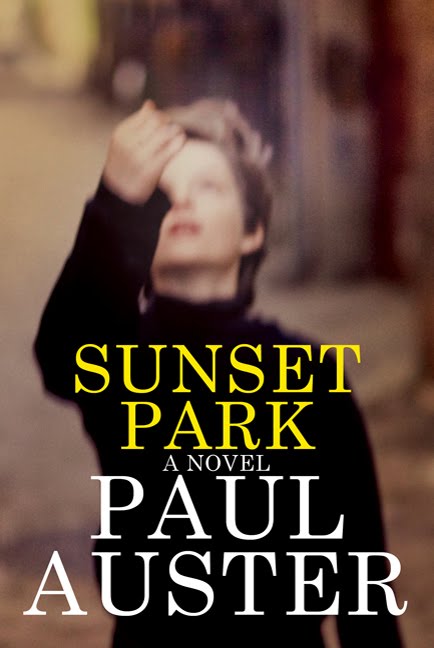
At the end of Paul Auster’s new novel Sunset Park, the narrative inhabits the mind of young protagonist Miles Heller. Riding in the back of a cab through Brooklyn, Miles’s thoughts glide through a slippery tangle of ideas. In a long sentence that runs on for almost two pages, Miles’s consciousness shifts from his own physical pain to a character in the movie The Best Years of Our Lives, a soldier named Homer who returns home with hooks for hands. This thought blends into a riff on the poet Homer, which in turn leads Miles, long estranged from his family, to figure himself a Telemachus now reunited with his father. And yet the homecoming cannot be; thoughts of Homer slip into thoughts about homelessness, his own homelessness, his friends’ homelessness, not metaphorical but literal. He then thinks about the homeless and displaced people across the country (Sunset Park is set square in the middle of the recent Great Recession), causing his mind to move back to the beginning of the novel, when he worked “trashing out” foreclosed homes in South Florida. The idea of “home” transmutes finally to “hope” as the cab crosses the Brooklyn Bridge–yet the idea (and the novel) is suspended in a strange, sad limbo.

I begin my review with Auster’s final sentence because it delineates many of Sunset Park’s themes, settings, and motifs. At its core–if such a novel can be said to have a core–Sunset Park asks its readers what “home” might mean. Is home a geographic location, a center that resonates with personal and cultural significance? Is home a place with a person you love? Can home be in your head? Is home where your family is? And, even more problematic, what exactly constitutes a family?

The founding trauma of the book, which is to say Miles’s founding trauma, is a radically ambiguous moment of violence: as a teenager, in a heated fight with his step-brother on a country road, Miles pushes the boy. At the same moment, a car flies down the road and kills him. Did Miles mean to kill his brother? At the moment of his anger, how could he not psychologically, if only temporarily, wish for the young man’s death? Did he know the car was coming? Miles cannot deal with the trauma and soon drops out of college and drops out of life. Unlike the biblical Cain, Miles’s exile is self-imposed. He breaks contact with his parents and thus breaks a family that was already twice broken; first, in his parents’ divorce and his mother’s move across the country to California; and second, in the death of his step-brother. Miles relegates himself to hard and unrewarding manual labor, wandering aimlessly around the country. It’s only after he meets a young girl named Pilar that he is able to reconstitute the idea of a family–of a self who can be in a family.

Pilar is a high school student. She is a minor. Auster does little to justify the social acceptability of Miles’s love for (and sodomy of) Pilar; instead, he repeatedly invokes the idea that other characters see the “truth” of the love by simply watching the pair. This is easily the book’s greatest weakness. Auster wants to communicate the idea that in loving Pilar, Miles is able to love a young version of himself–and thus forgive his young self (significantly, Pilar is the same age that Miles was when he pushed his step-brother)–yet the essential predatory narcissism of this “love” remains largely unremarked upon. Even Pilar’s caretaker, her oldest sister, is amenable to the romance–that is, until Miles refuses to keep bringing her high-end items that he recovers from the foreclosed homes he’s “trashing out.” Miles is again exiled, this time from his makeshift home with Pilar. He returns for the first time in seven years to New York City to stay in a squatter’s house with three other twentysomethings.

There’s a kind of silly Bohemian romanticism to the squat in Sunset Park. The project is helmed by would-be avant-jazzman, Bing Nathan, a notorious ranter who improbably subsists on funds he obtains from running his store, the Hospital for Broken Things, where he repairs typewriters and other antique artifacts. Bing thinks his friend Miles will be a perfect fit in the house–and he’s right: the other squatters love him. There’s Ellen, a skittish realtor (!) who aspires to become a pornographic painter, and Alice, an ABD trying to finish her doctoral thesis (on The Best Years of Our Lives, of course). Both women fall for Miles in different ways, although Auster’s writing never once shows why this might be.

Bing has other reasons for getting Miles back to NYC–he wants to reunite the Heller family. He’s been secretly communicating with Miles’s father Morris for years. Morris, who runs his own literary publishing house, is easily the most achieved character in Sunset Park, or at least its most realistic. Although the plot gets bogged down with his own marital difficulties (and other sundry tragedies that echo the “loss of children” theme), Morris’s narrative is the most focused and convincing section of the novel. His sad tone moves beyond melancholy but halts at bitterness, even as he reflects upon the myriad regrets of his life and the fearful future that yawns ahead (things are going badly with his wife; the publishing industry is in peril). Although Miles’s mother Mary-Lee figures less in the novel, she is also a more convincing and sympathetic character than the young people who squat in Sunset Park. Like Morris, she’s reflective, distanced enough from the young self who abandoned her only son, yet analytical enough to comprehend its traumatic effect. Mary-Lee and Morris, with their regrets and fears and hopes are far more aesthetically concrete and satisfying than the novel’s twentysomethings, who at times seem like caricatures or puppets or placeholders.

In Auster’s hands, the Sunset Park gang reflects an unrealistic idealization of youthful and artistic resistance to a predatory capitalist culture. Still, they provide him occasion for some of Sunset Park’s finest riffs, whether he’s ventriloquizing Bing (rage, rage against the lies of the man) or exploring Ellen’s enchanting perversions. Alice’s thesis on The Best Years of Our Lives (a film that somehow everyone in the book has not just seen but seen repeatedly and even analyzed) gives Auster ample material to explore how different generations face trauma, whether it’s the alienation experienced by WWII soldiers returning to a world that seems to have left them behind, or the crises of young people trying find homes in an America tottering on financial collapse.

With its ironic title, The Best Years pairs nicely with the other narrative that informs Sunset Park, Samuel Beckett’s play Happy Days-a play that Mary-Lee just happens to be performing on Broadway at the time of Miles’s return. Auster–through his erudite characters–riffs frequently and wisely on both the film and the play, and these are some of the finer moments of Sunset Park; one almost wishes that Auster would have abandoned the conceit of a novel completely and just write some kind of essay with his material. Sunset Park repeats the themes of alienation, loneliness, separation, and stasis that we find in Happy Days and The Best Years, yet it veers closer to the film’s melodrama than Beckett’s absurdity. Perhaps this is a fault of form: overloaded with characters, Sunset Park sags at times, asking its reader to care about yet another over-educated, privileged New Yorker whose artistic ambitions have stalled out. A concession to Beckett’s minimalism would have done wonders, and perhaps deflated some of Sunset Park’s murky self-seriousness.

The highlight of the novel is Auster’s syntax. His keen sentences, often unfurling for pages at a time, move from concrete to abstract, to present to past to future, to inside and outside, with a precision and skill that is admirable to say the least. Sure, he hits the occasional clunker–some of the book’s early dialog in Florida is particularly painful, as is a moment late in the book when Morris refers to his wife and friend as “the walking wounded,” a cliché that neither Morris or Auster should let slip–but there’s a smoothness of vision that unites the book from sentence to sentence.

Still, syntax is not content, and Sunset Park left me wanting something–more? Something different? I’m not sure what that something is, which is a precarious criticism at best. Auster’s vision of stasis, of limbo, of the impossibility of a real homecoming runs deeply contrary to the traditions and conventions of Western story-telling: in short, we are trained to desire and look for resolution. Auster’s observations–a continuation of Happy Days and The Best Years, in this sense–are precisely the right kind of psychological dissatisfaction we must experience for this novel to be “true” in an artistic sense. However, the aesthetic dissatisfaction I experienced at the end of the book seems of a separate nature. Chalk it up to too many characters and subplots, perhaps. In any case, Sunset Park made me think and made me feel, which is really the job of art–even if those thoughts and feelings are often negative and unpleasant. Perhaps it’s my own critical failing, but in the end I wanted a light to lead me out of the Auster’s  limbo.

Sunset Park is new in hardback this month from Henry Holt.

From Hell — Alan Moore & Eddie Campbell

Earlier this week, I pulled out From Hell with the bold intention of re-reviewing it for this site. I love Halloween and I love Alan Moore and Eddie Campbell’s epic revision of the Jack the Ripper murders, so this seemed as good an occasion as any for a reread (especially considering the “review”  I wrote back in October of 2006 is so lazy that I won’t even link to it). Alas, I misjudged or misremembered the sheer density of From Hell–so, on Halloween day, I’m still only half way through, despite staying up way past my bed time, crouching under my sheets with a quavering flashlight, scanning Moore’s erudite words and Campbell’s scratchy inks (okay, that image is an exaggeration). I’ve read it at least thrice before, so I’ll review it anyway.

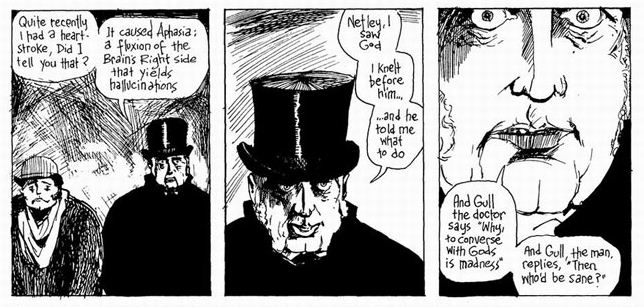
From Hell posits Sir William Gull, a physician to Queen Victoria, as the orchestrator of the Jack the Ripper murders that terrified Londoners at the end of the 19th century. Although the murders initially arise out of the need to cover up the knowledge of the existence of an illegitimate son begat by foolish Prince Albert, Victoria’s grandson. However, for Gull the murders represent much more–they are part of the continued forces of “masculine rationality” that will constrain “lunar female power.” Gull is a high-level Mason; during a stroke, he experiences a vision of the Masonic god Jahbulon, one which prompts him to his “great work”–namely, the murders that will reify masculine dominance.

One of the standout chapters in the book is Gull’s tour of London, with his hapless (and witless) sidekick Netley. In a trip that weds geography, religion, politics, and mythology, Gull riffs on a barbaric, hermetic history of London, revealing the gritty city as an ongoing site of conflict between paganism and orthodoxy, artistic lunacy and scientific rationality, female and male, left brain and right brain. The tour ends with a plan to commit the first murder. From there, the book picks up the story of Frederick Abberline, the Scotland Yard inspector charged with solving the murders. Of course, the murders are unsolvable, as the hierarchy of London–from the Queen down to the head of police–are well aware of who the (government-commissioned) murderer is. The police procedural aspects of the plot are fascinating and offer a balanced contrast with Gull’s mystical visions–visions that culminate in a climax of a sort of time-travel, in which Gull not only sees London at the end of the twentieth century, but also receives a guarantee that his murder plot has had its intended effect. From Hell takes many of its cues from the idea that history is shaped not by random events, but rather by tragic conspiracies that force people to willingly give up freedom to a “rational” authority. The book points repeatedly to the 1811 Ratcliffe Highway murders, which led directly to the world’s first modern police force. In our own time, if we’re open to conspiracy theories, we might find the same pattern in the 21st century responses to terrorism (Patriot Act, anyone?).

Although From Hell features moments of supernatural horror in Gull’s mysticism, it is the book’s grimy realism that is far more terrifying. London in the late 1880s is no place you want to be, especially if you are poor, especially if you are a woman. The city is its own character, a labyrinth larded with ancient secrets the inhabitants of which cannot hope to plumb. Despite the nineteenth century’s claims for enlightenment and rationality, this London is bizarrely cruel and deeply unfair. Campbell’s style evokes this London and its denizens with a surreal brilliance; his dark inks are by turns exacting and then erratic, concentrated and purposeful and then wild and severe. The art is somehow both rich and stark, like the coal-begrimed London it replicates. Although Moore has much to say, he allows Campbell’s art to forward the plot whenever possible. Moore is erudite and fascinating; even when one of his characters is lecturing us, it’s a lecture we want to hear. His ear for dialog and tone lends great sympathy to each of the characters, especially the unfortunate women who must turn to prostitution to earn their “doss” money. And while Abberline’s frustrations at having to solve a crime that no higher-ups want solve make him the hero of this story, Gull’s mystic madness makes him the narrative’s dominant figure. Rereading this time, I realized there is no character he reminds me of as much as Judge Holden from Cormac McCarthy’s Blood Meridian. I’m also reading Joseph Conrad’s The Secret Agent now, a book that dovetails neatly with From Hell, both in its time and setting, but also in its exploration of social unrest and duplicitous authority. Both novels feature detectives fighting a complacent system, and both novels feature a working class that threatens to erupt in socialist or anarchist rebellion.

From Hell is a fantastic starting place for anyone interested in Moore’s work, more self-contained than his comics that reimagine superhero myths, like Watchmen or Swamp Thing, and more satisfying and fully achieved than Promethea or V Is for Vendetta. Be forewarned that it is a graphic graphic novel, although I do not believe its violence is gratuitous or purposeless. Indeed, From Hell aspires to remark upon the futility and ugliness of cyclical violence, and it does so with wisdom and verve. Highly recommended.

Aurorarama — Jean-Christophe Valtat

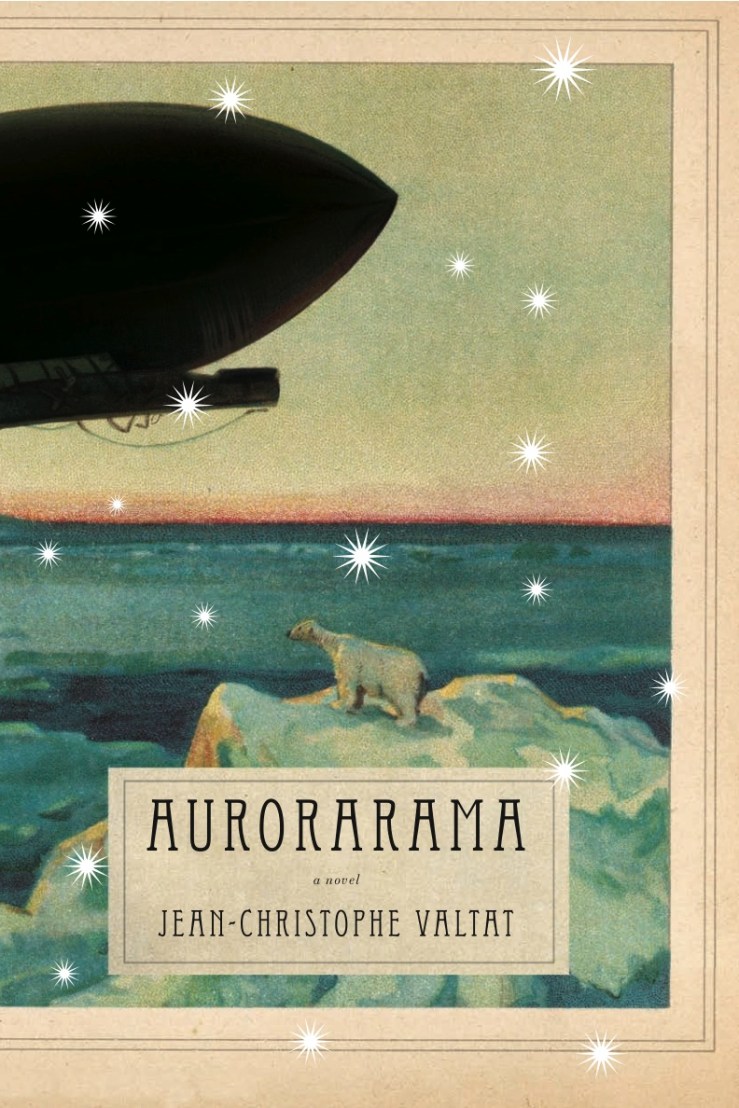
In Aurorarama, Jean-Christophe Valtat imagines an alternate world where the strange wilderness of the Arctic north has been colonized. The centerpiece of this world is New Venice, a bizarre metropolis on ice, bustling with a hodgepodge of cultures and brimming with dire conspiracies. New Venice showcases a kind of steampunk technology that surpasses its otherwise post-Victorian-era manners and mores: there are airships and pneumatic tubes, dream chambers and psychedelic drugs (lots and lots of drugs). Those drugs are part of New Venice’s underground, a subculture that also features a “Polar Pop” scene (although most of the groups seem to make art-noise-dirge-weird music, not pop). Beyond the subversive art scene, however, more sinister forces are at work in New Venice. The city lies under the shadow of a mysterious black zeppelin; a samizdat Utopian text is circling the underground, challenging the establishment’s authority–and causing the secret police, the Gentlemen of the Night, to shake down suspects left and right; the native Inuit are preparing to revolt; the secretive Scavengers have found a dead woman in a mysterious automotive sled. If this sounds awfully complex, it is. Thrown into the middle of the mess are the book’s protagonists. Duke Brentford Orsini, a reserved and idealistic man, is ostensibly the director of the city’s greenhouse–although he seems to spend most of his time juggling the various political (or, in the book’s terms, “poletical”) problems that surge and resurge in New Venice. Brentford’s levelheadedness contrasts with his friend Gabriel d’Allier’s rakish charm. Gabriel is a literature professor on the edge of collapse–not that that gets in the way of his frequent drug binges and sexual escapades. Valtat alternates his chapters between the pair, forwarding the plot via Brentford’s mounting political (and supernatural!) problems and Gabriel’s libertine snags.

Valtat’s world is as thick as polar ice, with its own history, mythology, culture, and political science. The events in Aurorarama are essentially in media res; the adventure begins at the tail-end of a previous disaster. Valtat has given himself plenty of space here to expand the story–both in sequels and prequels (a novel detailing the founding of New Venice, an event alluded to in Aurorarama, would be fascinating). Valtat also exhibits a playful sense of humor, both in the story’s plot, but also in his tone, which often plays off of stodgy Victorian tropes in humorous ways, particularly in the chapters featuring Gabriel. At the same time, Valtat’s book is quite serious, as he labors to evoke a wholly-realized, wholly-strange world. Sometimes his sentences strain under this pressure, no doubt in part because Valtat is a native French speaker; this is his first novel composed in English. The occasionally over-long or clunky phrase does not, however, detract much from the pleasures of Aurorarama, which rest rather in Valtat’s vital imagination. This is an intelligent work of speculative fiction, steeped in the tradition of Jules Verne and H.G. Wells; it also readily recalls The Difference Engine (by William Gibson and Bruce Sterling), Philip Pullman’s His Dark Materials trilogy, and even, in some of its strong imagery, the steampunk visions of Hayao Miyazaki. Recommended.

Aurorarama is new in hardback from Melville House.

Wicked River: The Mississippi When It Last Ran Wild — Lee Sandlin

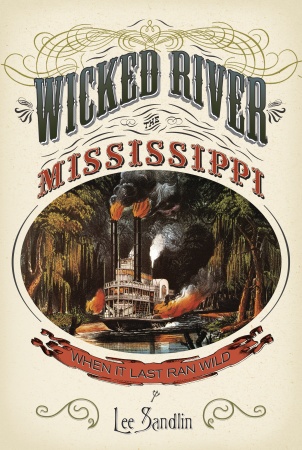
The mighty Mississippi River remains perhaps the signal geographical symbol of the United States of America. It divides our country neatly into East and West, flowing down from the industrial North to the agricultural South, and in this sense, the Mississippi is the major artery of America’s heart. We find in the Mississippi a rich mythos, one that both informs and reflects our national character. And while plenty of writers have striven to capture and express the river’s culture and character, it is Mark Twain who more or less invented our idea of the Mississippi. In his fascinating new history Wicked River, Lee Sandlin observes that, “There is a pretty much universal idea that Twain has a proprietary relationship to the Mississippi. It belongs to him, the way Victorian London belongs to Dickens or Dublin belongs to Joyce.” Sandlin’s goal in Wicked River is not to wrest the Mississippi from Twain; rather, he aims to show us the gritty turbulence swelling under Twain’s romantic myth–a myth that many Americans have come to hold as a received truth. Sandlin points out that Twain’s “Mississippi books are works of memory, even of archaeology”;  they point to a vibrant river culture in a prelapsarian past, one “with its own culture and its own language and its own unspoken rules.” Sandlin’s own book plumbs that culture, revealing strange, wild tales of river pirates and con-men, fiddlers and gamblers, road agents and robbers, politicians and drunkards, and Indians and would-be “civilizers.” Sandlin’s canny observations come from a myriad of first-hand accounts–always the sign of a legitimate history–but Wicked River is never dry or dusty, but rather brims with vigor and intensity, whether we’re learning about the earthquakes that shook up New Madrid, the tornado that smashed Natchez, the sinking of the Sultana, or the ice floe that destroyed the St. Louis Harbor. Sandlin’s writing is concise, lively, and often wry and earthy–although always grounded in fact. (One colorful passage begins, “There was one simple explanation for the wildness of river culture: everybody was drunk”). Wicked River does a marvelous job conveying the tumultuous and eclectic history of an American frontier in the nineteenth century. Recommended.
Wicked River is new in hardback this month from Pantheon.

An Obligatory Review of Jonathan Franzen’s Freedom

Do you know about the Oedipal complex? That Freudian thing? Of course you do. But if for some reason you don’t, or need a refresher, here’s a quick summary from one of my all time favorite lyricists, David Byrne: “Mom and Pop / They will fuck you up / For sure.”  That joyful nugget is from one of the last songs Talking Heads recorded, “Sax and Violins,” a great little piece on modern life that is far more entertaining (and much shorter) than Jonathan Franzen’s over-hyped new novel Freedom.

Freedom works hard to prove that Mom and Pop will fuck you up. Your family will fuck you up. Then you will fuck up your own kids. Franzen’s (boring, oh my god are they boring) characters seem bound to play out repeated variations of the Oedipal complex. Furthermore, according to Freedom, our extra-familial relationships are merely substitutions or recapitulations of our own Oedipal family dramas. Even worse, Franzen seems to suggest in Freedom that all our ideologies, our passions, our beliefs are really just formed by our “morbidly competitive” impulses, impulses born in our fucked-up, Oedipal families. (“Morbidly competitive,” by the way, is Franzen’s term).

The novel centers on one family, the Berglunds, a perfectly normal (in the upper-middle-class-white-educated sense of “perfectly normal”) fucked up family of four. I’m dispassionate about this novel, so I’ll just lazily crib a short summary from a well-written piece I’m largely simpatico with, Ruth Franklin’s review at TNR

Freedom takes place over a period of about thirty years, but its primary focus is on the George W. Bush era. When it begins, Patty and Walter Berglund, college sweethearts, are among the first wave of urban pioneers putting the gentry back into gentrification, fixing up a house in a blighted area of St. Paul that they will soon populate with their two children. The short preamble offers an overview of their lives from the perspective of their neighbors, from the time they move in as a young couple to their departure around the time the children leave for college. Patty, a former college basketball star who once made “second-team all-American,” is a mother and housewife in the newly popular liberal model: “tall, ponytailed, absurdly young, pushing a stroller past stripped cars and broken beer bottles and barfed-upon old snow. . . . Ahead of her, an afternoon of public radio, the Silver Palate Cookbook, cloth diapers, drywall compound, and latex paint; and then Goodnight Moon, then zinfandel.” She bakes cookies for the neighbors on their birthdays and opens her house to their children. But Patty’s baking and mothering cannot keep her home together: her son Joey, while still in high school, moves out to live down the street with his girlfriend Connie and her family, which happens to include the only Republican on the block. The strain that their child’s defection places on the Berglunds’ marriage is obvious to all. When they leave in the early 2000s for Washington, where Walter has a new job doing something vaguely ominous involving the coal industry, one of the neighbors remarks, “I don’t think they’ve figured out yet how to live.”

This overture sets the stage for the rest of the book, which begins and more or less ends with a ridiculously well-written journal by Patty. Patty (who is somehow a  more-than-competent novelist despite having no training) allows the audience to witness her marriage crumbling from her perspective; we are also supposed to sympathize with her because her own childhood was fucked up by her family. Also, she was date-raped, a manipulative detail that adds little to the narrative (I’d call it Nice Writing at its worst). Patty’s seemingly interminable journal eventually gives way to shorter chapters focusing on Joey and Walter. There’s also Patty and Walter’s lifelong friend, ex-punk/would-be indie rock star Richard Katz. Much of the novel revolves around Patty’s desire for Richard and Walter’s desire for Richard (no homo) and Richard’s desire for what he thinks Walter and Patty have and Walter’s desire to be desired by Patty the way that Patty desires Richard and blah blah blah. It’s one big boring circle of “morbidly competitive” Oedipal tension. Franzen spends most of his time expounding on how each character feels about how another character feels about him or her in an endless solipsistic chain that fails to enlighten or even amuse. Too much telling, not enough showing.

Freedom threatens to become interesting when it picks up the Walter narrative. Walter, a die-hard environmentalist oozing oodles of liberal guilt, is hard at work with a bevy of über-Republicans and defense contractors and Texas oil men to save the planet. Via the novel’s ever-present free indirect style, Walter goes to great, finicky pains to explain how working with these creeps will actually, like, save the ecosystem. Hey, doesn’t “eco” come from the Greek “oikos,” meaning “house”? Why yes it does! Must be some kind of parallel there–save the planet, save your house, save your fucked up family . . . Only none of that pans out; instead the section gets bogged down in a cluster of details that mingle with Walter’s increasing attraction (no, deep love and lust) for his twenty-something assistant. Meanwhile, his son Joey is growing up all wrong and fucked up, falling in with neocons who hide their war profiteering in a cloak of patriotic ideology. The democratic freedom we think we cherish is a lie; the personal freedoms we struggle to obtain–by escaping our fucked-up families–is ultimately a damning, soul-devouring curse. The American Dream is just morbid competitiveness.

If Franzen intended to write a zeitgeist novel, a How We Live Now novel, I wonder if this is this really what he thinks the spirit of our age boils down to? He gets many of the details of the last decade right, but the prose is bloodless and the characters are dull, unlikable, and unsympathetic. Of course, real people can be dull, unlikable, and unsympathetic, but that usually means that we don’t want to hang out with them, let alone read about their fears and desires for almost 600 pages. If our own families are dull, at least they are usually likable and sympathetic–at least to us, anyway (I love and like my family, in any case). Freedom feels like a novel with nothing at stake, or, perhaps, a novel where everything has already been lost, where outcomes are drawn null and void from the outset. And really, I wouldn’t mind all of that if it wasn’t so tedious. It practically buckles under its own sense of weighted importance in trying to reveal how Oedipal tension underwrites ideology. Oedipus might have been fated from the get-go, but at least there was some action and excitement in his story–some level of heroism, anyway.  And because I’ve brought up Oedipus again, I’ll indulge myself and cite Talking Heads one more time.

In “Once in a Lifetime,” probably the group’s most famous song, Byrne sings, “You may ask yourself / Well, how did I get here?” The song’s narrator wonders if he can escape time, wonders if his suburban confine is a trap or a paradise; there’s a sense of sublime ridiculousness  to it all, as if he might transcend time and space and contemporary life and take off “Into the blue again /Into silent water.” He’s trying to navigate the weird gap between suburbia and ecology, between duty and freedom. It is a song that at once recognizes the existential despair of a modern, suburban life, comments on its absurdity, and then surpasses it heroically. The song is undeniably about a figure in crisis, but that figure decides that “Time isn’t holding us / Time isn’t after us.” That figure is freer than the characters in Freedom, and freer still in his weird warp of ambiguity (a warp concretely codified in Byrne’s bizarre dance in the video). The hero of “Once in a Lifetime” transmutes existential absurdity into sound and vision; Oedipus saves his country (and provides the audience with catharsis) via his ironic, tragic self-mutilation; Patty and Walter kiss and make up. It’s a dreadfully facile ending, the worst kind of wish-fulfillment that seems wholly unsupported by the narrative preceding it.

But perhaps this is an unfair way to review a book that is apparently so important–to compare it to Oedipus Rex and a few Talking Heads songs. And I’ll admit that if Freedom had not been so wildly over-praised in the past few months, I’d probably try to find something positive to say about it. So I’ll try: Franzen is deeply intelligent, even wise, and his analysis of the past decade is perhaps brilliant. It’s also incredibly easy to read, but this is mostly because it requires so little thought from the reader. Franzen has done all the thinking for you. The book has a clear vision, a mission even, but it lacks urgency and immediacy; it is flaccid, flabby, overlong. It moans where it should howl. Nevertheless, the book is not a failure, at least not on its own terms. I believe that Franzen has written the book that he intended to write, that he has documented the zeitgeist the way that he perceives it–I just happen to find his analysis dull and his characters irredeemably uninteresting. Do not feel obligated to read Freedom.

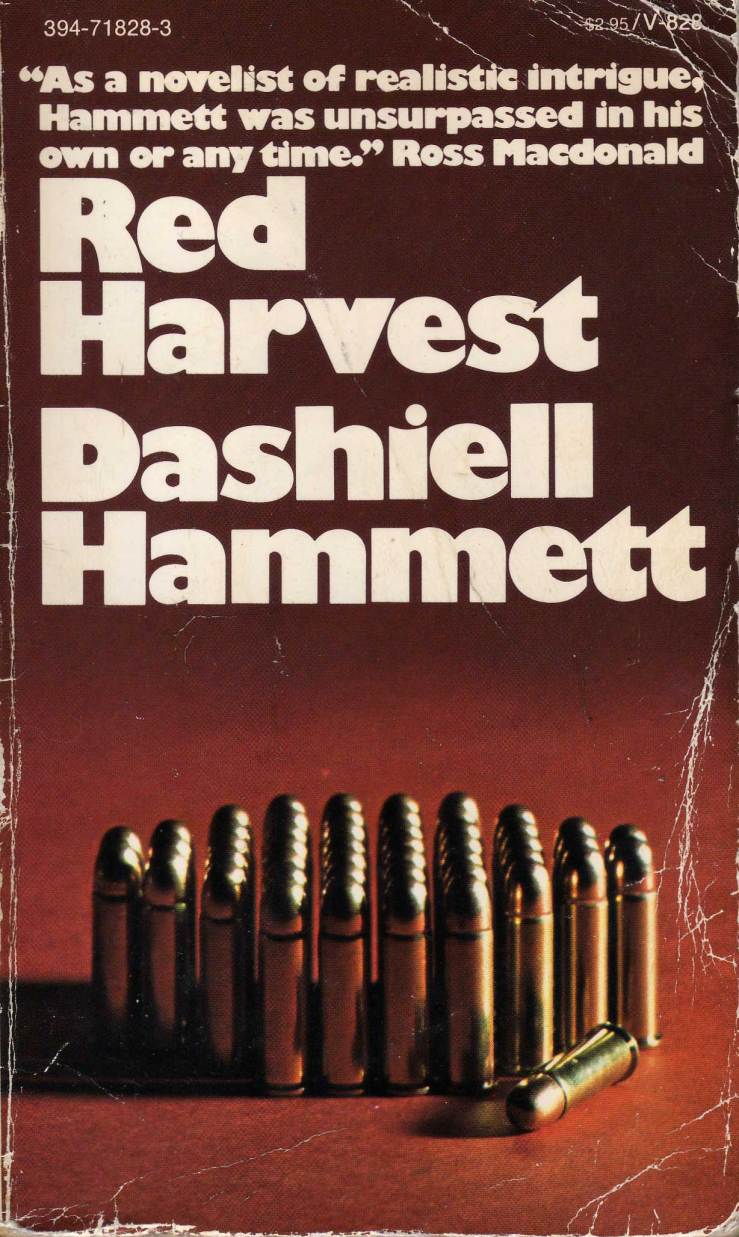
Red Harvest — Dashiell Hammett

Dashiell Hammett’s first published novel, Red Harvest, stars an unnamed dick, but the book isn’t so much a detective novel as it is an exploration of the destruction and renewal of a vice-ridden mining town named Personville.  The city boss, who serves “Poisonville” as both mayor and company president, can no longer control the strikebreakers he imported to bust up a prolonged work stoppage.  Initially retained by the editor of the daily paper to conduct background research for a developing story, the Continental Op is reluctantly hired by the mayor  to return the town to respectability.

Red Harvest is no murder mystery in the Scooby Doo sense because, unlike the Spillane novels reviewed last week, there is no particular villain to unmask.  Here, the action unfolds as the Continental Agency operative learns the personal histories of the town’s power players, assesses their motivations, and determines how best to play one set of guns against another.  The simple brilliance of this novel is Hammett’s ability to create believable characters in a handful of sentences, and then send them out to wreak mayhem against others.  Poisonville is as much a living character as Conan Doyle’s London or Bolaño’s Santa Teresa because it is so central to its citizens’ hopes, frustrations, and fears.  The detective apprehends, as bodies multiply, that the town is somehow getting the better of him.

The Continental Op might just be a stand-in for Hammet’s ideal reader.  Even though he’s privy to the same information we are, the detective is uniquely able to separate the relevant from the misleading and move the narrative forward.  He ingratiates himself with each of the opposing camps in town, analyzes their situations, and dispenses advice to their leaders based upon their own best interests.  Although the shakedowns, shootings, and betrayals were probably inevitable, the Op is the catalyst, the omnipotent narrator annihilating and rebuilding alliances.  Our detective’s actions lead to more than a dozen deaths, a prison break, riots in the street, blackmail, and his own frame-up for murder.

Rarely do writers trust their lead characters to create, and not merely experience, their own story.  I imagine that most characters, and most living human beings, aren’t capable or don’t want to always be in charge, preferring often just to passively accept whatever is foisted upon them.  Hammett’s writing in Red Harvest is so precise and inviting that those who pick it up might convince themselves, as they flip backwards twenty pages or so, that they could have played puppet-master just as easily.

The Ask — Sam Lipsyte

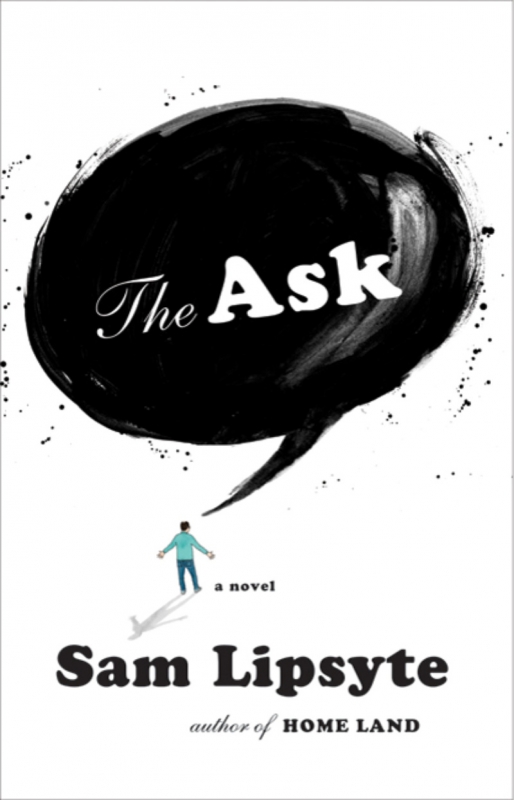
I listened to the audiobook version of Sam Lipsyte’s hilarious, wistful, mean, and devastating novel The Ask last week. I invented chores and took any scenic route available when driving to get more of the book faster, frequently laughing out loud, or grimacing, or even feeling weird and shameful pangs of remorseful identification with the book’s protagonist and narrator, Milo Burke. I’m going to do my best to unpack the book’s themes–particularly the way it simultaneously eulogizes, valorizes, and mocks the American Dream–but first I need to get something out-of-the-way, a mea culpa of sorts.

As I mentioned, I listened to the book, but I don’t have a copy, so, shamefully, I can’t really quote any of Lipyste’s marvelous sentences. He is a master stylist, capable of zapping our dead modern idioms with the kind of alarming twists that highlight just how vacant language has become. Lipsyte also has a gift for rhythm, tone, and cadence, and he’s a master of the deadpan punchline. While the sentences in his last novel Home Land sometimes felt overly fussed over, straining under their own polish, The Ask showcases an effortless style that both seduces and repels. Lipsyte reads The Ask audiobook himself, yet lets the tone and cadence of his words dictate the tone and timbre of his voice. It’s all very good. And you’ll have to just take my word for all that as I have nothing to quote now (I’m sure I’ll re-review the book when I pick it up in paperback, though).

The plot is rather thin: Milo Burke, who once aspired to being a celebrated painter, now works for the grants department of a mediocre liberal arts college. His job, essentially, is to beg wealthy parents and alumni to donate massive gifts of cash to the school — this is “the ask.” Or rather, that was his job before he got fired for losing his cool with the spoiled brat daughter of a major patron. This leaves Milo moping around Queens, drinking too much, and pissing off the wife he is slowly becoming estranged from. Which is a shame, because he’s trying to be a good husband and father to his young son; despite his own shitty childhood–boozing, philandering father, emotionally absent mother–Milo is doing his best to give his family the American Dream. He’s more or less abandoned his own dreams of being a painter, and along with it, the weird faith he located in the various theorists–Marxists, feminists, deconstructionists, etc.–who informed his art school years. Much of the novel finds Milo pondering not just on the value (or lack thereof) in his liberal arts education, but also on the friends and anti-friends who he slummed with in those days. Just as the narrator of Home Land dwells on his high school days, Milo Burke can’t quit thinking about his college years in The Ask.

That past returns in the form of Purdy, a rich kid who slummed with Milo and his druggy art kid friends back in their college days. Purdy is incredibly wealthy even after the stock market crashes of the late 2000s, and has Milo specifically reinstated by the university to officiate an intended “give” (the answer to “the ask”). Purdy’s real intention though is to turn Milo into a kind of bag man, a go-between to deliver large sums of cash to Purdy’s caustically embittered illegitimate son Don, an Iraq War vet who’s lost both his legs to an IED. This arrangement thrusts Milo into Purdy’s surreal world of privilege and power, but also puts him into contact with a deranged, maimed, and deeply, deeply hurt young man who will, essentially, change the way that he examines the world and his role in it.

I’m now going to gloss over much of the book: there are many, many very funny situations, strange characters, and wonderful little insights. And now that theme I mentioned: the death of the American Dream.

Late in the novel, Milo calls America “Dead America.” Earlier in the novel, he complains that America never got to be Rome; that America is a dying, crumbling empire that never even got to revel in its hedonist excesses. Milo is keenly aware that his own white, white-collar, privileged, urban existence as a liberal-arts-educated American puts him in a position of greater material comfort than 99.9% of the rest of the people in the world, yet this fact does nothing to assuage his despair–in fact, it exacerbates it. Milo is ashamed of his despair, too-cognizant of its implications. His shame becomes a meta-, self-referential shame, and it leads to Milo essentially surrendering any power or agency he might have claimed in the universe. His liberal arts education and his own sensitivities render him feckless and bitter, always grumbling over the cosmic injustice of modern, Dead America. He is a walking, rambling critique of power, yet–as his wife likes to point out–he never does anything about the injustice he perceives. It’s only after interacting with Don that Milo begins to see an inroad to agency.

Don is, it must be said, a miserable, caustic human being, a racist blackmailer, and perennially cruel to anyone who extends a hand. He’s also performed the most real “give” in the novel–he’s lost his legs for Dead America, sacrificing his own mobility and freedom (those constituents of the dream) for the freedom of others, or at least for the illusion of other people’s freedom. Don’s toxic behavior makes him utterly repellent and thoroughly anti-heroic, but in Milo’s identification with the young man–and in Milo’s willingness to lose financial security and familial stability by essential siding with Don over Purdy– there is a glimmer (just a glimmer) of redemption and agency for Milo. Don embodies everything about America that Milo (and presumably Lipsyte) hates, yet he has also answered “the ask,” both literally and symbolically. The novel invokes then not just scathing ironic attack on the American Dream, but also a pity that reveals an intrinsic (and perhaps childish) wish to believe, a wish to make Dead America live again. The novel ends with Milo reclaiming (or maybe just claiming) some degree of agency, beginning with getting back an old war knife his father had given him, a clear symbol of paternal, phallic power (the kind that his liberal arts education told him was bad, bad, bad). And yet there’s no resolution, no pat answers–how could there be? Instead, the novel ends in another crisis–not Milo’s this time, but Don’s. But I won’t spoil that, because, hey, you’re going to read this now, aren’t you? Very highly recommended.

X’ed Out — Charles Burns

If you like Charles Burns, go ahead and pick up X’ed Out, the first (and very promising) entry in a new trilogy. Skip this review. You’ll probably be happier (and more unsettled) just experiencing all that vivid, glorious weirdness for yourself without any potential spoilers. If you need convincing, read on.

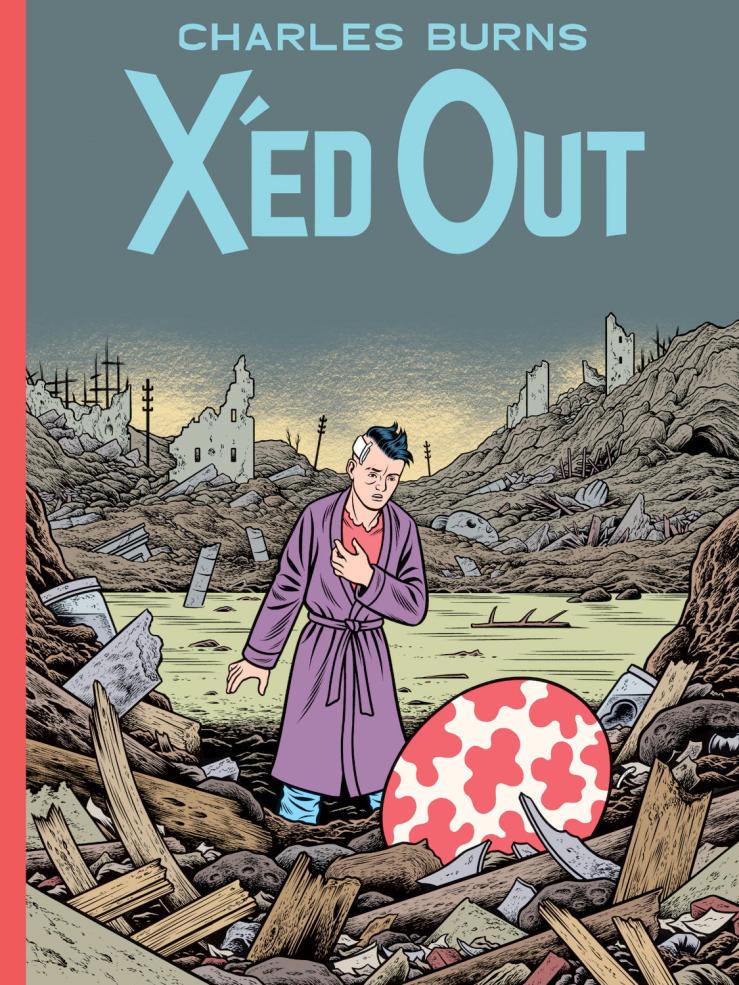
X’ed Out begins in a strange fever-dreamland that doesn’t immediately announce itself as such. Instead, we tentatively enter this weird world with Doug, the book’s protagonist, who, like Alice following the white rabbit, chases his (long dead) childhood cat through a crack in the wall. Doug traverses a cavernous, ruinous place, littered with murky detritus and swamped in a strange flood, to finally arrive in a bizarre desert town that approximates William Burroughs’s Interzone. Populated by mean lizards who dress like Mormon slackers and other grubby grotesques, the terrain readily recalls both Tatooine and Asian bazaars. Hapless Doug, still in pajamas, house coat, and slippers — and marked by an as-yet-unexplained head wound — soon finds himself under the guidance of a strange little diapered dwarf, who may or may not have his best interest in mind. The dreamworld unravels as Doug glances an old man — an “oldie,” as the dwarf says — who we will learn later is Doug’s father. An all of a sudden we’re back in the real world, back in waking life.

But no. That’s not right. Not “back” — we were never in the waking world to begin with. Significantly, X’ed Out begins in the Burroughsian dreamworld and then moves to a conscious, concrete reality. Burns’s dreamworld sequences explicitly reference Belgian cartoonist Hergé’s seminal Tintin comics (you can see how X’ed Out’s cover riffs on the Tintin adventure The Shooting Star here). Doug’s dream face is an expressive, stark mask, a naïve, cartoonish contrast to the bizarre nightmare to which it reacts.


from X'ed Out by Charles Burns


Doug — the waking world Doug, the “real” Doug, that is — pulls a similar mask over his more realistically drawn face later in the story when he does his “Burroughs thing” at a slummy art punk party. Alienated from the scenesters who don’t get his cut-up poetry performance, Doug takes up with Sarah, a girl from his photography class with a thing for razor blades and pig hearts. The same night they meet, he loses his girlfriend, and her crazy boyfriend goes to jail for assaulting a cop. They initiate their romance in Patti Smith records, lines of cocaine, and sick Polaroids. Ah, young love.

But all of that is in another kind of dreamworld, the past, a retreat for the “real,” contemporary Doug, who spends his few waking hours cringing in his bathrobe, poring over old photos, and eating the occasional Pop Tart. At night he eats pain pills and goes to Interzone-land, a place that seems as real and solid and valid as his past with Sarah, a past he has apparently lost. Doug bears a huge patch over half his head (significantly x-shaped in his Interzone version), and both this wound as well as the psychic trauma he’s obviously endured (and is enduring) remain unexplained throughout X’ed Out. However, Burns’s often-grisly images hint repeatedly at a past event filled with violence and loss. X’ed Out leaves us in the Interzone, with the dwarf making long-term plans for Tintinized Doug. There’s even talk of establishing residency and employment–it feels like Doug is here to stay (at least in his non-waking hours). X’ed Out ends maddeningly with a girl who visually recalls Sarah being borne by lizard men to a giant hive. The dwarf explains that she is their new queen–and like some insect queen, she is a breeder. Yuck. The ending is the biggest problem with X’ed Out, simply because it leaves one stranded, wanting more weirdness.

In Black Hole, Burns established himself as a master illustrator and a gifted storyteller, using severe black and white contrast to evoke that tale’s terrible pain and pathos. X’ed Out appropriately brings rich, complex color to Burns’s method, and the book’s oversized dimensions showcase the art beautifully. This is a gorgeous book, both attractive and repulsive (much like Freud’s concept of “the uncanny,” which is very much at work in Burns’s plot). Like I said at the top, fans of Burns’s comix likely already know they want to read X’ed Out; weirdos who love Burroughs and Ballard and other great ghastly fiction will also wish to take note. Highly recommended.

X’ed Out is available in hardback from Pantheon on October 19th, 2010.

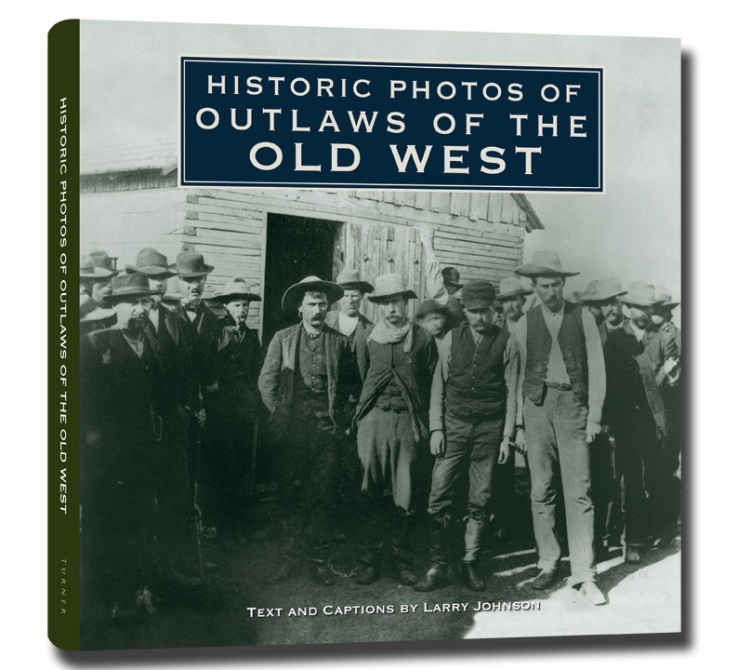
Historic Photos of Outlaws of the Old West

The romantic myth of the Western outlaw still remains central to American identity. If we are part Puritan, we also like to think of ourselves as the kind of anti-social cowboys who go out and manifest our own destiny. It’s no wonder that we have a tradition of valorizing outlaws like Billy the Kid, the Dalton gang, and Frank and Jesse James, transfiguring their bullying and theft into a kind of partisan resistance to hegemony. These men did not steal from the rich to give to the poor, yet we like to pretend that they were Robin Hoods. Turner Publishing’s new collection Historic Photos of Outlaws of the Old West presents 200 archival images of infamous (and not so famous) robbers, road agents, and rascals in the kind of gruesome detail that outlines just how awful these people really were. The Old West isn’t so romantic after all.
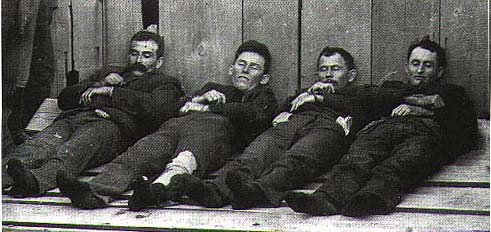
The book moves from the beginning of photography in the early 1850s to the unlikely end of an era, the 193os when the West Coast finally settled down and civilized (at least a little bit). Larry Johnson provides informative and unobtrusive text, letting the stark and often grisly photos convey the tone and emotion of the book. Simply put, this isn’t for kids. There are plenty of dead bodies, many hanging from nooses or laid out in a row, like this charmer of the Dalton gang–

Or how about Ned Christie, unfairly framed for the murder of Deputy Marshal David Maples in 1887, Oklahoma? This picture of Christie reveals that the emerging art/science of photography allowed for a certain fetishizing of the dead body–that the corpse, via mechanical reproduction, might somehow live on. Grisly.

We can see the same fascination with death in this famous image of Jesse James, who was shot in the back by Robert Ford while adjusting a picture. (Their complicated story is told in the brilliant revisionist film The Assassination of Jesse James by the Coward Robert Ford, by the way).

There are less famous but equally intriguing figures as well, like Benjamin Hodges, a black Mexican cowboy who made his living as a con artist in Dodge City. Here is the confident confidence man–

The images in Outlaws of the Old West are both fun and unsettling, and Johnson never glosses over or sugar coats the ugly truths behind these images (he even points out that, though we see the shootout at the OK Corral as a kind of archetypal battle between good vs. evil, the Earps and their pal Doc Holliday were hardly angels). The pictures in this book gel more with the imagery we find in revisionist Westerns like Cormac McCarthy’s Blood Meridian or Sam Peckinpah’s bloody films, which is another way of saying that they aren’t for the faint of heart–and I enjoy that about the volume. Check it out.

The Mike Hammer Novels — Mickey Spillane

Online auctions allow book-lovers to engage in what could be labeled “biblio-sharking.”  Some poor sap needs to clear out his basement to make room for a foosball table or a Jacuzzi, and readers take his books for an extraordinary profit. While the seller may hesitate to dispose of their treasures, I’ll readily pay negligible sums to compensate him for his losses.  So, if your rumpus room means more to you than fiction, please please please place your ads on Ebay.

Some poor mug did just that last week, allowing me to take home 18 detective novels for five clams and nominal shipping and handling charges.  Because anthologies were included in the package, I scored twenty-four books for about thirty cents apiece.  Ed Biblioklept, kept busy for weeks at a time supervising hooligans and future delinquents of America, has granted me permission to review one of my purchases, the New American Library’s collection of Mickey Spillane’s first three Mike Hammer novelsI, the Jury, My Gun is Quick, and Vengeance is Mine.

Spillane sold hundreds of millions of detective and spy stories during a long career, and the Hammer stories guaranteed him an interested and rabid following.  Although private dick Mike Hammer finds himself in any number of slippery situations, Spillane’s central character, rather than any individual plot twist, is what makes these stories both convincing and compelling.
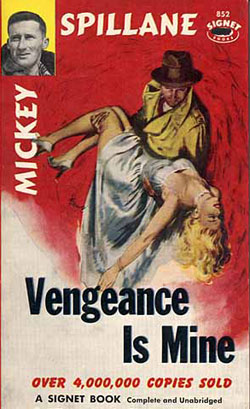
Hammer is the archetypal square-jawed detective, but he demands that you listen to his recollections of a case because he’s clever, resourceful, and vulgar. Although indelicate by today’s standards, Hammer is a tough guy for his times, beguiling dames who are used to getting just what they want, burning through decks of unfiltered Luckies, and drinking brandy for breakfast.  What’s timeless, though, is his belief that bad guys are afforded too many protections by an impotent system of justice and that once all the pieces are put together, one extraordinary man performs a public service by putting a few slugs in the guts of murderers.  In each of these stories Hammer begins unraveling the mysteries only after someone close to him has been killed.

This was the first collection of detective stories I’ve ever finished, and each page dragged me further into a black and white world filled with villains, vixens, and corrupt politicians.  The reader becomes an unpaid extra in a B-level film noir.
Hammer explained to me, a snob, the enduring popularity of the literary detective: “You’ve forgotten that I’ve been in business because I stayed alive longer than some guys who didn’t want me that way.  You’ve forgotten that I’ve had some punks tougher than you’ll ever be on the end of a gun and I pulled the trigger just to watch their expressions change.”  Mind what you think.

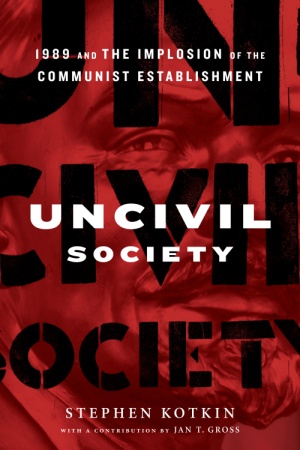
Uncivil Society — Stephen Kotkin

Stephen Kotkin’s Uncivil Society earned rave reviews when it debuted last year in hardback; this week Modern Library releases the trade paperback version. Uncivil Society is a revisionist history that dispels the romantic myth that a “civil society” of dissenting citizens orchestrated the fall of Eastern European Communism (and its symbol, the Berlin Wall). Rather, Kotkin (along with colleague Jan T. Gross) concisely and methodically shows that the Eastern Bloc’s demise resulted from the corruption and incompetence of the ruling class of bureaucrats and ideologues–the “uncivil society” who borrowed massively from the West to buy consumer goods they could not afford. Kotkin finds case studies in East Germany, Romania, and Poland, but his analysis extends beyond these countries to indict the Soviet model.

Kotkin’s writing is direct and precise, stuffed with concrete facts and political analysis without sacrificing narrative integrity. In other words, he takes a murky subject and illuminates it. The narrative proper is slim at under 150 pages, making the book a quick and ideal survey of a widely misunderstood time. Students and politics of history will wish to take note of Uncivil Society, a straightforward and agile read.

Angels — Denis Johnson

Angels, Denis Johnson’s 1983 début novel, begins as a small book about not very much and ends as a small book about pretty much everything. Johnson has a keen eye and keener ear for the kinds of marginal characters many of us would rather overlook all together, people who live and sweat and suffer in the most wretched, unglamorous, and anti-heroic vistas of a decayed America. The great achievement of the novel (beyond Johnson’s artful sentences) is in staging redemption for a few–not all, but a few–of its hopeless anti-heroes.

Take Jamie, for instance. Angels opens on this unfortunate young woman as she’s hauling her two young children onto a Greyhound bus. She’s leaving her cheating husband for relatively unknown prospects, lugging her children around like literal and symbolic baggage. Jamie should be sympathetic, but somehow she’s not. She’s someone we’d probably rather not look at, yelling at her kids while she drags on a Kool. Even she knows it. Of two nuns on the bus: “But Jamie could sense that they found her make-up too thick, her pants too tight. They knew she was leaving her husband, and figured she’d turn for a living to whoring. She wanted to tell them what was what, but you can’t talk to a Catholic.” Jamie finds a closer companion, or at least someone equally bored and equally prone to drinking and substance abuse, in Bill Houston. The ex-con, ex-navy man is soon sharing discreet boilermakers with her on the back of the bus, and she makes the first of many bad decisions in deciding to shack up with him over the next few weeks in a series of grim motels.

The bus, the bus stations, the motels, the bars–Johnson details ugly, urgent gritty second-tier cities and crumbling metropolises at the end of the seventies. The effect is simply horrifying. This is a world that you don’t want to be in. Johnson’s evocation never veers into the grotesque, however; he never risks tipping into humor, hyperbole, or distance. The poetic realism of his Pittsburgh or his Chicago is virulent and awful, and as Jamie drunkenly and druggily lurches toward an early trauma, one finds oneself hoping that even if she has to fall, dear God, just let those kids be okay. It’s tempting to accuse Johnson of using the kids to manipulate his audience’s sympathy, but that’s not really the case. Sure, there’ s a manipulation, but it veers toward horror, not sympathy. (And anyway, all good writing manipulates its audience). Johnson’s milieu here is utterly infanticidal and Jamie is part and parcel of the environment: “Jamie could feel the muscles in her leg jerk, she wanted so badly to kick Miranda’s rear end and send her scooting under the wheels, of, for instance, a truck.”

Jamie is of course hardly cognizant of the fact that her treatment of her children is the psychological equivalent of kicking them under a truck. She’s a bad mother, but all of the people in this novel are bad; only some are worse–much worse–than others. Foolishly looking for Bill Houston on the streets of Chicago, she notices that “None of these people they were among now looked at all legitimate.” Jamie is soon conned, drugged, and gang-raped by a brother and his brother-in-law; the sister/wife part of that equation serves as babysitter during the horrific scene.

And oh, that scene. I put the book down. I put the book away. For two weeks. The scene is a red nightmare, the tipping point of Jamie’s sanity, and the founding trauma that the rest of the novel must answer to–a trauma that Bill Houston, specifically, must somehow pay for, redress, or otherwise atone. The rape and its immediate aftermath are hard to stomach, yet for Johnson it’s no mere prop or tasteless gimmick. Rather, the novel’s narrative thrust works to somehow answer to the rape’s existential cruelty, its base meanness, its utter inhumanity. Not that getting there is easy.

Angels shifts direction after the rape, retreating to sun-blazed Arizona, Bill Houston’s boyhood home and home to his mother and two brothers. There’s a shambling reunion, the book’s closest moment of levity, but it’s punctuated and punctured by Jamie’s creeping insanity, alcoholism, and drug addiction. Johnson’s signature humor is desert-dry and rarely shows up to relieve the narrative tension. Jamie hazily evaporates into the background of the book as the Houston brothers, along with a dude named Dwight Snow, plan a bank robbery. Another name for Angels might be Poor People Making Bad Decisions out of Sheer Desperation. Burris, the youngest Houston, has a heroin habit to feed. James Houston is just bored and nihilistic and seems unable to enjoy his wife and child and home. On hearing about the bank robbery plan, Jamie achieves a rare moment of insight: “Rather unexpectedly it occurred to her that her husband Curt, about whom she scarcely ever thought, had been a nice person. These people were not. She knew that she was in a lot of trouble: that whatever she did would be wrong.” And of course, Jamie’s right.

The bank robbery goes wrong–how could it not?–but to write more would risk spoiling much of the tension and pain at the end of Angels. Those who’ve read Jesus’ Son or Tree of Smoke will see the same concern here for redemption, the same struggle, the same suffering. While Jesusian narratives abound in our culture, Johnson is the rare writer who can make his characters’ sacrifices count. These are people. These are humans. And their ugly little misbegotten world is hardly the sort of thing you want to stumble into, let alone engage in, let alone be affected by, let alone be moved by. But Johnson’s characters earn these myriad affections, just as they earn their redemptions. Angels is clearly not for everyone, but fans of Raymond Carver and Russell Banks should make a spot for it on their reading lists (as well as Johnson fans like myself who haven’t gotten there yet). Highly recommended.

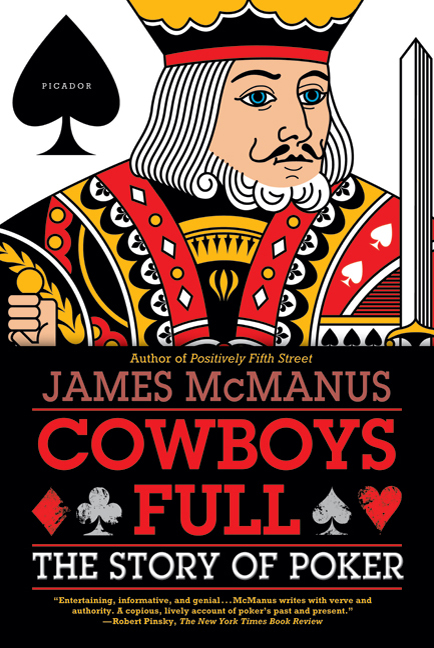
Cowboys Full – James McManus

Jim McManus’s Cowboys Full is a thorough and energetic history of poker. Or, perhaps more accurately, Cowboys Full is a history of how power, will, and guile intersect with luck to shape national destinies. McManus examines poker’s political and cultural influence, from its origins in China to the game’s explosive popularity online today. McManus delineates his program in his first chapter, “Pokerticians,” an overview of the book that details how poker has had a lasting impact on world politics. Covering the gambling habits of Presidents and generals, kings and clerics, McManus’s book makes a strong case for poker as a metaphor of power and capitalism.

This is no dry history tome, however. McManus is a professional poker player and a professional writer, and Cowboys Full reads with a vigor that approximates the energy of a good game. While American presidents and politicians dominate his narrative, there are also outlaws, cowboys, and confidence men. And writers. Lots and lots of writers. McManus draws not just from earlier histories of poker, but also from novelists like Herman Melville and Mark Twain. He prefaces each of his chapters with a quote, usually from a novel or short story or poem, and I’ll confess I warmed quickly to the book after the first two chapters led with some heavy lines from Cormac McCarthy’s Blood Meridian (McManus also quotes from No Country for Old Men and uses The Road as a visual reference point). He’s also keen on Bob Dylan.

Of course, this is a history of poker (or “The Story of Poker,” rather, as its subtitle declares), and there’s plenty of poker here–famous games, cheating scams, and today’s big names–but not so much to elicit a yawn from a non-player (or a casual player like myself). The second half of the book moves to Las Vegas, detailing the ins and outs of big tournament action. It also seeks to explain how Texas Hold ‘Em became a spectator sport by the middle of the aughties. But McManus’s book does not fetishize (or unduly valorize) the superstars (and wannabes) of big time poker, and the narrative never falls into the kind of catty tell-all tone that often marks insider stories. McManus is more concerned with philosophy and game theory.

At its core, Cowboys Full is a cultural history of poker, and like the talk at many friendly games, there’s a rambling fluidity to McManus’s narrative, a willingness to run on and overflow in disparate directions. At the same time, there’s a considerable syntactic focus: McManus is handy with punchy sentences and sharp anecdotes, and he keeps most of his chapters short and lively. This is a fun book to read. Cowboys Full is well-researched, with a helpful index and a glossary of terms, but it should not be mistaken for a didactic theory manual or a comprehensive account of everything that ever happened in poker. Instead, McManus has given us a rewarding a volume that uses its subject to enlarge our understanding of both our past and our present–and maybe our future. Recommended.

Cowboys Full is new in trade paperback this week from Picador this week.

“The Authentic American Apocalyptic Novel” — Harold Bloom on Blood Meridian

The Triumph of Death, Pieter Bruegel the Elder, c. 1562

Harold Bloom’s esteem for Blood Meridian may have done much to advance the novel’s reputation over the past decade. His essay on the book, first published in his 2000 collection How to Read and Why and later included as the preface to Random House’s Modern Library editions, makes a strong case for Blood Meridian’s canonical status. Bloom begins, in typical Bloomian fashion–the anxiety of influence is always at work–by situating McCarthy’s book against other heavies–

Blood Meridian (1985) seems to me the authentic American apocalyptic novel, more relevant even in 2000 than it was fifteen years ago. The fulfilled renown of Moby-Dick and of As I Lay Dying is augmented by Blood Meridian, since Cormac McCarthy is the worthy disciple both of Melville and of Faulkner. I venture that no other living American novelist, not even Pynchon, has given us a book as strong and memorable as Blood Meridian . . .

The Garden of Earthly Delights — Hell, Hieronymus Bosch, 1503-1504

Bloom goes  on to rate Blood Meridian over DeLillo’s Underworld, several books by Philip Roth, and even McCarthy’s own All the Pretty Horses. Indeed, Bloom proclaims Blood Meridian “the ultimate Western, not to be surpassed.” This doesn’t mean that Bloom is at home with the book’s violence; he confesses that it took him two attempts to read through its “overwhelming carnage.” Still, he makes a case for reading it in spite of its gore–

Nevertheless, I urge the reader to persevere, because Blood Meridian is a canonical imaginative achievement, both an American and a universal tragedy of blood. Judge Holden is a villain worthy of Shakespeare, Iago-like and demoniac, a theoretician of war everlasting. And the book’s magnificence–its language, landscape, persons, conceptions–at last transcends the violence, and converts goriness into terrifying art, an art comparable to Melville’s and to Faulkner’s.

Bloom repeatedly invokes Melville and Faulkner in his essay, arguing that Blood Meridian’s “high style” is one of its key strengths (unlike fellow aesthetic critic James Wood, who seems to think that McCarthy is a windbag). The trajectory of Bloom’s essay follows Melville and Shakespeare, finding in Judge Holden both a white whale (and not so much an Ahab) and an Iago. He writes–

Since Blood Meridian, like the much longer Moby-Dick, is more prose epic than novel, the Glanton foray can seem a post-Homeric quest, where the various heroes (or thugs) have a disguised god among them, which appears to be the Judge’s Herculean role. The Glanton gang passes into a sinister aesthetic glory at the close of chapter 13, when they progress from murdering and scalping Indians to butchering the Mexicans who have hired them.

I think that Bloom’s great insight here is to read the book as a prose epic as opposed to a linear novel; to see that Blood Meridian foregrounds a deeply tragic and ironic reworking of the great American myth of Manifest Destiny. While hardly a pastiche, the book is somehow a collage; a massive, deafening collage that numbs, stuns, and overwhelms with its layers of thick, bloody prose. The effect is akin to the apocalyptic paintings of Hieronymus Bosch and Pieter Bruegel. Dense and full of allusion, paintings like The Triumph of Death and The Garden of Earthly Delights surge over the senses, destabilizing narrative logic. Like Blood Meridian, these paintings employ a graphic grammar that disorients and then reorients. They are apocalyptic in all senses of the word: both revelatory and portentously conclusive. And like Blood Meridian, they showcase “a sinister aesthetic glory” (to use Bloom’s term), a terrible, awful, awesome ugliness that haunts us with repulsive beauty.

David Foster Wallace on Blood Meridian

David Foster Wallace on Cormac McCarthy’s Blood Meridian: “Don’t even ask.” From his 1999 piece in Salon, “Five direly underappreciated U.S. novels > 1960.”

James Wood (Is Wrong) on Blood Meridian

Critic James Wood wrote extensively about Cormac McCarthy’s Blood Meridian in his 2005 essay for The New Yorker, “Red Planet.” Here’s his lede–

To read Cormac McCarthy is to enter a climate of frustration: a good day is so mysteriously followed by a bad one. McCarthy is a colossally gifted writer, certainly one of the greatest observers of landscape. He is also one of the great hams of American prose, who delights in producing a histrionic rhetoric that brilliantly ventriloquizes the King James Bible, Shakespearean and Jacobean tragedy, Melville, Conrad, and Faulkner.

Wood later details McCarthy’s gift as “one of the greatest observers of landscape”–

“Blood Meridian” is a vast and complex sensorium, at times magnificent and at times melodramatic, but nature is almost always precisely caught and weighed: in the desert, the stars “fall all night in bitter arcs,” and the wolves trot “neat of foot” alongside the horsemen, and the lizards, “their leather chins flat to the cooling rocks,” fend off the world “with thin smiles and eyes like cracked stone plates,” and the grains of sand creep past all night “like armies of lice on the move,” and “the blue cordilleras stood footed in their paler image on the sand like reflections in a lake.”

Wood then goes about attempting to explain his problems with McCarthy the “ham” who produces “histrionic rhetoric” —

[McCarthy’s] prose opens its lungs and bellows majestically, in a concatenation of Melville and Faulkner (though McCarthy always sounds more antique, and thus antiquarian, than either of those admired predecessors).  . . .

It is a risky way of writing, and there are times when McCarthy, to my ear, at least, sounds merely theatrical. He has a fondness for what could be called analogical similes, in which the linking phrase “like some” introduces not a visual likeness but a hypothetical and often abstract parallel: “And he went forth stained and stinking like some reeking issue of the incarnate dam of war herself.” . . .

The danger is not just melodrama but imprecision and, occasionally, something close to nonsense. . . .

The inflamed rhetoric of “Blood Meridian” is problematic because it reduces the gap between the diction of the murderous judge and the diction of the narration itself: both speak with mythic afflatus. “Blood Meridian” comes to seem like a novel without internal borders.

So, Blood Meridian doesn’t meet the standard of Wood’s cherished “free indirect style,” where an author subtly shifts into a character’s voice. Wood craves these delicate internal borders. He can’t bear the idea that the towering figure of Judge Holden might come to ventriloquize the novel. It is worth noting here that Wood frequently extols the free indirect styles of Marcel Proust and Henry James–two authors McCarthy dismissed in a 1992 interview with The New York Times, saying “I don’t understand them . . . that’s not literature.”  Wood values a mannered precision of realism that McCarthy openly professes little interest in; rather, McCarthy uses a mythic, amplified, and at times grandiose style in Blood Meridian to explore issues of life and death. And Wood is perhaps not wrong here. At times Blood Meridian edges into bombast, although I believe McCarthy controls his language more than Wood allows. In either case, McCarthy’s language is ripe for parody, as exemplified in this clip from Wes Anderson’s 2001 film The Royal Tenenbaums

I would be happy to leave Wood’s criticism of Blood Meridian and McCarthy alone at this point. Fine, Wood doesn’t like it when McCarthy goes balls-to-the-wall; whatever. But at the end of “Red Planet” Wood turns to attacking McCarthy’s perceived failure to vindicate God’s goodness in the face of evil. Wood here (and elsewhere, always elsewhere) shows his deep conservatism. Wood necessitates that all literature reveal a platonic center, a stable, beating heart that must also be a platonic good. Here he is, griping about McCarthy’s “metaphysical cheapness”–

Like most writers committed to pessimism, McCarthy is never very far from theodicy. Relentless pain, relentlessly displayed, has a way of provoking metaphysical complaint. . . .

But McCarthy stifles the question of theodicy before it can really speak. His myth of eternal violence—his vision of men “invested with a purpose whose origins were antecedent to them”—asserts, in effect, that rebellion is pointless because this is how it will always be. Instead of suffering, there is represented violence; instead of struggle, death; instead of lament, blood.

If Wood finds only a nihilism in Blood Meridian (and the rest of McCarthy’s oeuvre) that he fundamentally disagrees with, he should simply say so. Instead, Wood demands that Blood Meridian be a theodicy and then condemns it for not being one. He shamefully attempts to hold the work to a radically subjective rubric that cannot be answered. Put another way, the failure that Wood finds in Blood Meridian is a failure to answer to a version of God–and God’s judgment–that Wood would like to believe in (or, more accurately, be comforted by).

Wood is a bully (of both authors and readers) whose criticisms rarely enlarge the works they seek to address. We see his program at work in “Red Planet,” where his aim is to deflate Blood Meridian’s giant language and not appraise it on its own terms. That the book survives–and thrives–despite Wood’s criticism is hardly surprising; that a critical conversation of Blood Meridian should include Wood is depressing.

Blood Meridian — Cormac McCarthy

Blood Meridian is a blood-soaked, bloodthirsty bastard of a book, and certainly the most violent piece of literature I’ve read outside of the Bible and certain Greek tragedies. Cormac McCarthy’s 1985 novel passes itself off as a Western–and it is a Western, to be sure–but more than anything, it’s a brutal horror story.

Set predominantly in the 1850s, Blood Meridian chronicles the westward journey of a protagonist we know only as “the kid.” After a few false starts (including getting shot, robbed, arrested, and surviving a Comanche massacre) the kid eventually meets up with John Joel Glanton‘s “expedition”–a group of men of mixed backgrounds hired by Mexican authorities to kill–and scalp–the nomadic Apache who prey upon Mexican villages. However, led by the nefarious, larger-than-life Judge Holden, Glanton’s gang quickly descends into a relentless robbing, raping, and killing spree; they savagely massacre peaceful Indian settlements along with the Mexican villages they were contracted to protect.

I could keep summarizing the book, but I don’t see the point, honestly–a mere description of the plot could never do real justice to the weight of this book. The narrative is taut and fast-paced–in fact, at points the action is so radically condensed that I had to go back and re-read sections–and there’s no shortage of the “men doing men stuff” that McCarthy is so good at detailing–but it’s really the combination of the book’s evocative imagery and philosophical pondering that hook the reader.

Most of that philosophical pondering comes from the Judge, who waxes heavy on everything from space aliens to metallurgy. In his parables and aphorisms, the Judge comes across as part-Mephistophelean, part-Nietzschean, all dark wisdom and irreverent chaos. I found myself re-reading the Judge’s speeches several times and chewing them over, trying to digest them; for me, they were the best part of a great book.

Blood Meridian, like most excellent things, is simply not for everyone, and I don’t mean that in any snobbish, elitist sense. Any reader turned off by its freewheeling violence would be justified, and I’m sure plenty of folks out there would take issue with its ambiguous conclusion. Depictions of genocidal mania that seem to end inconclusively are not for everyone, particularly when they are rife with archaisms, untranslated Spanish, and McCarthy’s signature apostrophe-free punctuation. I had two false starts with the novel, including one where, at about exactly half way through, I realized I had to go back and start the novel again. I owed it that much. And it was worth it.

Blood Meridian is literally stunning; perhaps the best analogy I can think of is going to see a really, really good band that plays really, really brutal and strange music that sorta melts your face off. After the show you’re sweaty and exhilarated and even unnerved; your ears are ringing and your chest is pounding. And then the band packs up, and the house lights go on, and they pump in music from a CD, of all things, and the music just sounds tinny and pale and blanched of life after the raw power you’ve witnessed. Reading anything else right after finishing Cormac McCarthy’s Blood Meridian, or the Evening Redness in the West is sort of like that. Highly recommended.

[Editorial note–Biblioklept originally published this review on April 6th, 2008. We’re running it again as part of a week of coverage celebrating Blood Meridian’s 25th anniversary].