Blog about Denis Johnson’s story “The Largesse of the Sea Maiden”

img_0381

I finished reading Denis Johnson’s posthumous collection of short stories The Largesse of the Sea Maiden a few weeks ago. I felt a bit stunned by the time I got to the fourth story in the collection, “Triumph Over the Grave,” which ends with these words: “It’s plain to you that at the time I wrote this, I’m not dead. But maybe by the time you read it.”

Denis Johnson died just over a year ago, of course, a fact that haunts any reading of Sea Maiden (at least for fans, and I am a fan). The collection was released just half a year after his death, and I managed to avoid reading any reviews of it. I held out on picking it up for reasons I don’t really know how to explain, but I when I finally read it, I consumed it in a greedy rush.

Anyway, since I finished the book I’ve tried a few times to put together a “review,” but each time I get some words down I find myself sprawling out all over the place, rereading bits of the stories, picking out new motifs, new questions, new parallels between Johnson’s life and the lives of his narrators. Very short review: The Largesse of the Sea Maiden is one of Johnson’s best books, a perfect gift to his readers—his own tragicomic obituary in fictional form. It’s a book about death and writing and art and commerce and regret and salvation, and each time I go back to it I find more in there than I saw the first time–more order, more threads, more design. So instead of a full long review, I’ll offer instead a series of blogs about each of the five stories in the collection. (Perhaps this form is simply an excuse to reread The Largesse of the Sea Maiden).

The first story is the title track, “The Largesse of the Sea Maiden.” First published in The New Yorker back in 2014, this long short story (it runs to not-quite 40 pages) introduces the major themes and tones of the entire collection. “Largesse” is told by a first-person narrator in ten titled vignettes. Some of the titles, like “Widow,” “Orphan,” “Farewell,” and “Memorial,” directly name the themes of both the story and the book.

The narrator of “The Largesse of the Sea Maiden” is a writer—but not a writer of literature or fiction—of art—but of commercials. Although “Largesse” shows him somewhat comfortable in his life in San Diego with his third wife, the narrator nevertheless is melancholy, even dour at times. In the beginning of the vignette “Ad Man,” he declares:

This morning I was assailed by such sadness at the velocity of life—the distance I’ve traveled from my own youth, the persistence of the old regrets, the new regrets, the ability of failure to freshen itself in novel forms—that I almost crashed the car.

(Is there a subtle nod there to one of Johnson’s most well-known stories, “Car-Crash While Hitchhiking”? I think so. If not, I find a thread).

“Ad Man” initiates the major plot trajectory of “Largesse”: Our narrator has won an award for an advertisement he wrote and directed decades ago, and he will have to return to New York City to be given the award at a special dinner. Floating through the vignettes is the ad man’s anxiety about his own legacy of work against the backdrop of the finer arts. We learn in “Accomplices” that he cares enough about the arts to object that his host has hung a Mardsen Hartley oil landscape above a lit fireplace—but he doesn’t prevent the man from burning the painting—his “property”—in a moment where Johnson subtly critiques the relationship between art and commerce. The narrator turns the burning of the painting into a new art though—storytelling.

The narrator later tells us that “looking at art for an hour or so always changes the way I see things afterward,” and “Largesse” is riddled with encounters with art and artists, like the outsider painter Tony Fido, whom the narrator meets at a gallery. The artist offers, unprompted, a scathing critique of a Edward Hopper’s painting Gas:

“You’re a painter yourself.”

“A better painter than this guy,” he said of Edward Hopper.

“Well, whose work would you say is any good?”

“The only painter I admire is God. He’s my biggest influence.”

That attribution — “he said of Edward Hopper” — is a lovely example of Johnson’s sharply-controlled wit.

Tony Fido plays a major minor role in “Largesse.” Fido tells the narrator the story of his encounter with a widow—one of several widows in both “Largesse” and Largesse, and his own suicide—Fido’s—becomes a strange moment for the narrator to realize how little he actually knows about his friend. And of course, all of these plot points give Johnson a chance to riff on the themes of death, loss and regret.

“Largesse” is loaded with thoughts on regret and forgiveness. Talking with a friend, the narrator muses that “we wandered into a discussion of the difference between repentance and regret. You repent the things you’ve done, and regret the chances you let get away.” The vignette “Farewell” stages a chance for the narrator to repent his past sins; his ex-wife, dying of cancer, calls him up to (possibly) forgive him:

In the middle of this I began wondering, most uncomfortably, in fact with a dizzy, sweating anxiety, if I’d made a mistake—if this wasn’t my first wife Ginny, no, but rather my second wife, Jennifer, often called Jenny. Because of the weakness of her voice and my own humming shock at the news, also the situation around her as she tried to speak to me on this very important occasion—folks coming and going, and the sounds of a respirator, I supposed—now, fifteen minutes into this call, I couldn’t remember if she’d actually said her name when I picked up the phone and I suddenly didn’t know which set of crimes I was regretting, wasn’t sure if this dying farewell clobbering me to my knees in true repentance beside the kitchen table was Virginia’s, or Jennifer’s.

I’ve quoted at such length because the moment is an example of Johnson’s tragicomic genius—a sick punchline that disconnects crime from punishment and punishment from forgiveness. The narrator ends up making the connections himself in the end: “after all, both sets of crimes had been the same.” And yet Johnson keeps pushing his character past reconciliation into a midnight walk to clear his conscience:

I wonder if you’re like me, if you collect and squirrel away in your soul certain odd moments when the Mystery winks at you, when you walk in your bathrobe and tasseled loafers, for instance, well out of your neighborhood and among a lot of closed shops, and you approach your very faint reflection in a window with words above it. The sign said “Sky and Celery.”

Closer, it read “Ski and Cyclery.”

“Farewell” ends on this note of a winking Mystery—on the profound insight that we are always susceptible to misreading the signs in front of us.

“The Largesse of the Sea Maiden” is very much a story about trying to put together a cohesive narrative from the strands and fragments around us. Indeed, its very form points to this—the fractured vignettes have to be pieced together by the reader. Johnson fractures not just form but tone. The deadpan, tragicomic, pathos-laden humor that’s run throughout Johnson’s oeuvre dominates in “Largesse,” yes, but there are strange eruptions of sentimental fantasy, particularly in “Mermaid,” a vignette that reads like the narrator’s own imaginative construction, and not the (often banal) reality that most of the narrative is grounded in. After receiving his award in New York, the narrator makes his way to a bar, and here conjures a scene like something from a film noir:

I couldn’t see the musician at all. In front of the piano a big tenor saxophone rested upright on a stand. With no one around to play it, it seemed like just another of the personalities here: the invisible pianist, the disenchanted old bartender, the big glamorous blonde, the shipwrecked, solitary saxophone…And the man who’d walked here through the snow…And as soon as the name of the song popped into my head I thought I heard a voice say, “Her name is Maria Elena.” The scene had a moonlit, black-and-white quality. Ten feet away at her table the blond woman waited, her shoulders back, her face raised. She lifted one hand and beckoned me with her fingers. She was weeping. The lines of her tears sparkled on her cheeks. “I am a prisoner here,” she said. I took the chair across from her and watched her cry. I sat upright, one hand on the table’s surface and the other around my drink. I felt the ecstasy of a dancer, but I kept still.”

The ecstasy here—internalized and “still”—is the ecstasy of storytelling, imagination, art. This is the gift of the mermaid, the largesse of the sea maiden. The minor moment is the real award for our ad man hero, who finds no real transcendence in commercial writing.

I’ve been using “the narrator” in this riff, but our hero has a name, which he reveals to us in the final vignette, “Whit.” It’s here that he describes the ad he’s (not exactly) famous for, an “animated 30-second spot [where] you see a brown bear chasing a gray rabbit.” The chase ends when the rabbit gives the bear a dollar bill.” Narrator Whit explains that this ad for a bank “referred, really, to nothing at all, and yet it was actually very moving.” He goes on:

I think it pointed to orderly financial exchange as the basis of harmony. Money tames the beast. Money is peace. Money is civilization. The end of the story is money.

And yet our ad man, despite his commercial interpretation of his own writing, recognizes too that this work “was better than cryptic—mysterious, untranslatable.” The word “untranslatable” is one of several clues that link the final section of “Largesse” to the final section of Walt Whitman’s long poem, Song of Myself. Whitman’s narrator (“Walt Whitman, a kosmos”) claims that he is, like the spotted hawk who swoops to disturb his reverie, “untranslatable.” Bequeathing himself to us—a gift for our good graces—he reminds us that “You will hardly know who I am,” a line that Johnson echoes in the beginning of “Whit”: “My name would mean nothing to you, but there’s a very good chance you’re familiar with my work.” And then of course, there’s the big tell—Johnson’s narrator is Bill Whitman, a pun that works on several levels. Walt Whitman’s language has seeped into the language of advertising—in a way it is the genesis of a new commercial American idiom—and here Johnson slyly pushes it back into the realm of art.

Just as the conclusion of Song of Myself builds to a self-penned elegy for its self-subject, “The Largesse of the Sea Maiden” reads like Johnson’s elegy for an alter-ego. We learn in the final paragraphs that Bill Whitman is “just shy of sixty-three” — roughly the same age as Johnson would’ve been when the story was published. (We learn that the narrator of “Doppelgänger, Poltergeist,” the final story in The Largesse of the Sea Maiden, is also the same age as Johnson. That narrator was born on “July 20, 1949.” Johnson’s birthday was July 1, 1949).

Narrator Whit reflects on his life in the story’s melancholy penultimate paragraph:

I note that I’ve lived longer in the past, now, than I can expect to live in the future. I have more to remember than I have to look forward to. Memory fades, not much of the past stays, and I wouldn’t mind forgetting a lot more of it.

However, there’s still a restlessness to his spirit, a questing desire to answer the final lines of Song of Myself, perhaps, where Whitman writes:

Failing to fetch me at first keep encouraged,
Missing me one place search another,
I stop somewhere waiting for you

The last paragraph of “The Largesse of the Sea Maiden” is Johnson’s narrator’s implicit response to these lines, and as I cannot improve upon his prose, they will be my last lines as well:

Once in a while, I lie there as the television runs, and I read something wild and ancient from one of several collections of folktales I own. Apples that summon sea maidens, eggs that fulfill any wish, and pears that make people grow long noses that fall off again. Then sometimes I get up and don my robe and go out into our quiet neighborhood looking for a magic thread, a magic sword, a magic horse.

Riff on finishing Middlemarch, George Eliot’s novel of consciousness

Screenshot 2018-06-12 at 8.35.14 PM
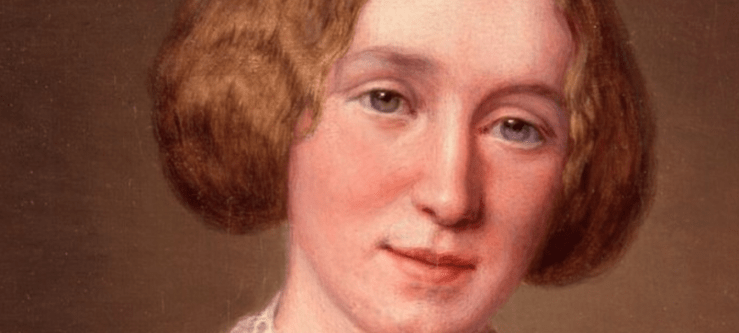
Detail of a portrait of Mary Ann Evans (George Eliot) at age 30 by François d’Albert Durade (1804–1886)

I finally finished George Eliot’s long and marvelous 1872 novel Middlemarch.

When I wrote about reading Middlemarch last month, from not-quite-the-middle of the book, I lamented that I’d rather be rereading the book than reading it. Rich and dense, it’s the kind of big book that clearly offers more on repeat readings. And yes, I will reread Middlemarch, but I’ll give it a year or three to mellow in the back of my consciousness.

Middlemarch is a novel about consciousness, and what the novel does best in my estimation is show how different kinds of consciousness mediate and are mediated by the social forces they inhabit (and are inhabited by).

(The word consciousness appears 90 times in Middlemarch. If we include similar iterations, like consciousconsciouslyunconscious, and unconsciously, the count grows to a total of 172 times. In contrast, iterations of the word conscience appear only 38 times).

Dorothea Brooke remained my favorite consciousness throughout the novel, and I missed her when she wasn’t there, when Eliot had us hovering around or even fully inhabiting another consciousness.

I’ll admit that in the final quarter of Middlemarch I found myself a bit weary of the Bulstrode disgrace plot—and yet I appreciate how Eliot inhabited that consciousness as well. Bulstrode provides Eliot a sharp tool to show how consciousness is blind, or even self-blinding—how consciousness massages conscience in order to survive. In a passage that illustrates this process, Eliot writes,

Bulstrode shrank from a direct lie with an intensity disproportionate to the number of his more indirect misdeeds. But many of these misdeeds were like the subtle muscular movements which are not taken account of in the consciousness, though they bring about the end that we fix our mind on and desire. And it is only what we are vividly conscious of that we can vividly imagine to be seen by Omniscience.

Consciousness cannot lay claim to conceiving of an absolute omniscient conscience, an absolute and ever-present moral consciousness. Too, earlier in the novel, Eliot’s narrator observes,

For the egoism which enters into our theories does not affect their sincerity; rather, the more our egoism is satisfied, the more robust is our belief.

Egoism is a central problem in Middlemarch; indeed, Eliot seems to posit egoism as the greatest threat to how individual consciousnesses navigate social reality. Here is here narrator again:

Will not a tiny speck very close to our vision blot out the glory of the world, and leave only a margin by which we see the blot? I know no speck so troublesome as self.

I cannot improve upon “no speck so troublesome as self” and will not adventure an attempt.

But back to the consciousness I liked best in Middlemarch: Dorothea.

Dorothea is a kind of genius of intention, and Eliot harnesses that genius—she shows us Dorothea’s consciousness-in-action. Eliot doesn’t just tell us what’s happening in Dorothea’s head; she makes that consciousness live in our own heads.

Dorothea’s life, like all lives, is beset with foiled plans and terrible mistakes. Still, Middlemarch grants Dorothea something of a happy ending in her marriage to Will Ladislaw, and yet refuses the conclusion of a classical comedy. There is no wedding scene. Indeed, the last time Dorothea speaks in the novel it is to reconcile with her sister Celia—a conclusion that confirms their love story the equal to that of Dorothea and Ladislaw’s love story.

Eliot’s novel is too sophisticated and too realistic for a simplistic happy or tragic conclusion, of course. In the novel’s “Finale,” the narrator reminds us that,

Every limit is a beginning as well as an ending…the fragment of a life, however typical, is not the sample of an even web.

The narrator then gives us broad details of the fates of the novel’s principal couples: Lydgate and Rosamond, skewing depressive; Mary and Fred, skewing comic; and finally Ladislaw and Dorothea. We learn of Ladislaw’s success as a reform politician and understand that Dorothea is an instrumental force in this success.

Eliot’s conclusion for this final pair skews neither comic nor tragic, but is something more complex—more realistic. Dorothea becomes a cautionary tale in the town of Middlemarch; her legacy is one of misspent potential in the eyes of society. The novel ends without indicating that any of the grand plans of Dorothea’s youth have been achieved. And yet the novel concludes with an oblique revelation about Dorothea’s misunderstood legacy.

In the second-to-final paragraph of Middlemarch, Eliot writes that,

those determining acts of [Dorothea’s] life were not ideally beautiful. They were the mixed result of young and noble impulse struggling amidst the conditions of an imperfect social state, in which great feelings will often take the aspect of error, and great faith the aspect of illusion. For there is no creature whose inward being is so strong that it is not greatly determined by what lies outside it.

Eliot refuses a simple happy ending here; her heroine is still a consciousness subject to the social forces around it. Dorothea’s great utopian ambitions are ultimately tempered by the cultural constraints her consciousness would otherwise seek to transcend.

But then the final paragraph of the novel points towards transcendence:

Her finely touched spirit had still its fine issues, though they were not widely visible. … But the effect of her being on those around her was incalculably diffusive: for the growing good of the world is partly dependent on unhistoric acts; and that things are not so ill with you and me as they might have been, is half owing to the number who lived faithfully a hidden life, and rest in unvisited tombs.

Dorothea—and, more significantly, the spirit of Dorothea—did real grand good in the world, an immeasurable good, “incalculably diffusive.” Even if she lived ultimately a “hidden life,” Eliot insists that it is people like Dorothea who have made the world better for “you and me.”

While “hidden life” and “unvisited tombs” may harbor negative connotations, these phrases are ultimately ironic: Eliot’s novel itself is the key to the hidden life of Dorothea Brooke. Middlemarch is a vivid and vivifying tomb for Dorothea, and we readers are the lucky visitors.

19 annotations on an old review of Blade Runner 2049 (Summer Film Log)

blade-runner-2049-0069

I recently rewatched Blade Runner 2049 (dir. Denis Villeneuve, 2017) on a large television screen via a streaming service, breaking the viewing of this nearly three-hour long film into two nights.

I wrote a lengthy review of Blade Runner 2049 when it came out last year. The review ran over 3,000 words. I won’t repost all of them here, but instead quote from the review and add a few notes on the experience of a second viewing. The bits from the original review are indented, like this—

Like its predecessor, Blade Runner 2049 (dir. Denis Villeneuve, 2017) is also a film about not knowing. 1

1 A second viewing reconfirms this thesis for me. The film’s final moments are ambiguous for the audience—does K live or not? How does Ana Stelline receive Deckard? The film consoles the anxiety of this ambiguity by giving us an image of K in pain but also in peace. K is reconciled to not knowing.

blade-runner-2049-1754

…K is a model Nexus-9, part of a new line of replicants created by Niander Wallace and his nefarious Wallace Corporation (Jared Leto, who chews up scenery with tacky aplomb).2

2 I get what Leto was doing more on a second viewing. His highly-artificial yet often over-dramatic style is in sharp contrast to the various replicants in the film—Ryan Gosling’s K is particularly naturalistic in comparison. Leto’s Wallace is “real,” but presents as artificial. The performance worked more for me on a second viewing.

Like its prequel, Blade Runner 2049 is detective noir, and also like the original, it often doesn’t bother to clearly spell out any plot connections between cause and effect. Hell, the film employs a symbol in the form of a (literal) shaggy dog. And while BR ’49 never feels shaggy, its expansiveness, its slowness, often drag us away from the urgency of its core plot. K’s quest moves via the film’s own aesthetic energy, and the film is at its best when it lets this aesthetic energy drive its logic.3

3 The film seemed much faster-paced on a second viewing, but that is because the first viewing taught me how to view it. The greatest reward for “knowing” the contours of the plot is that one can attend better to BR ’49’s wonderful aesthetic logic.

The first two hours of BR ’49’s nearly-three-hour run glide on the film’s own aesthetic logic, which wonderfully lays out a series of aesthetic paradoxes: Blade Runner 2049 is both vast but compressed, open but confined, bright white and neon but gray black and dull. It is bustling and cramped, brimming with a cacophony of babble and deafening noise but also simultaneously empty and isolated and mute. It is somehow both slow and fast, personal and impersonal, an art film stretched a bit awkwardly over the frame of a Hollywood blockbuster.4

4 I still agree with most of this, aside from the claim that only the first two hours “glide.” The end is much stronger than I initially gave it credit for. To wit—

The commercial blockbuster touches that BR ’49 winks at early in its plot creep up in its third act. Frankly, the film doesn’t stick its ending.5

5 I was wrong. BR ’49 totally sticks the ending.

The final hour seems driven by a logic external to the aesthetic energies that drive its first two hours—a logic that belongs to the Hollywood marketplace, a market that demands resolution, backstory—more sequels! The film’s initial expansiveness and pacing condenses, culminating in a claustrophobic climax that feels forced. A few late scenes even threaten to push the plot in an entirely different direction. For example, very late in the film we’re introduced to a revolutionary resistance movement that plans to overthrow the Fascist-Police-Corporate-Dystopian-Grubs-for-Food-Farmed-by-Slaves-and-Holy-Hell-It’s-Bad-Etc.-State. The burgeoning resistance scene feels shoehorned in by some film executive who thought The Matrix sequels were a good idea. Sure, the scene does convey a crucial piece of plot information, but reader, there are other ways to achieve such ends. 6

6 While I still feel that the resistance plot is not included as gracefully as it might be, the film is already pushing towards three hours. Furthermore, the film is not about resistance—it is about K and K’s not knowing. I also no longer believe that the “claustrophobic climax” — a truly horrifying fight that takes place under threat of drowning — is forced. (Should I also admit that I had finished my second tallboy and had a terrible need to piss, which made the water-fight all the more excruciating?)

The climactic fight simply wasn’t what I was expecting. A second viewing reveals that I totally missed BR ’49’s water motif, a kind of elemental doubling of the film’s other motif of abject tears.

One prominent clue is Vladmir Nabokov’s novel Pale Fire…One string of words that K must repeat as part of his baseline test is also key to Nabokov’s novel: “A tall white fountain.” In Pale Fire, these words are of critical importance. When the poet John Shade has a transcendent near-death experience, he sees “dreadfully distinct / Against the dark, a tall white fountain.” Later, via a newspaper story, he learns about a woman who not only has a similar near-death experience, but who also glimpses the afterlife in the same way, seeing too a “tall white fountain.” However, when Shade contacts the reporter who wrote the story, he learns that “fountain” is a misprint; the woman’s original word was mountain. The difference in a single sliding phoneme, to M, is of enormous importance to Shade. …Let’s just say that the phonemic slip from to M conveys not only a symbolic connotation, but also a key plot clue.7

7  I don’t know how prominent Pale Fire is in retrospect, but it is visible. I also have no idea if Villeneuve is intentionally playing the F-M shift in the novel against the revelation of two lost children–female and male–that becomes central to K’s understanding of (not understanding) himself.

blade-runner-2049-0125

Beyond Pale Fire, there are other literary allusions in BR ’49 worth noting… 8

8 Milton, Blake, e.e. cummingsPinocchio, and Kafka. I didn’t really spot any more on a second viewing, but I also wasn’t especially looking for any. I’m sure there are more.

In addition to its literary allusions, Blade Runner 2049 also incorporates a great number of tropes from the sci-fi films that came before it. For all its visual originality, there is very little in the film that we haven’t seen in some earlier form in another film. [However] when BR ’49 replicates old tropes it breathes new life into them, making scenes we’ve seen before look and sound wholly original.9

9 This is pretty much true.

One of the more remarkable scenes in BR ’49 is a three-way sex scene between the A.I. program-hologram Joi, her boyfriend K, and the replicant prostitute Mariette (Mackenzie Davis). Watching the scene, it hit me that Like, hey, this isn’t even the first “three-way sex scene with A.I.” that I’ve seen. Jonze’s Her [2014] offers a far more awkward version of this scene, and (I know, arguably), Ex Machina [dir. Alex Garland, 2015] is basically one long implicit three way between its three primary characters. We seem to have birthed a new sci-fi trope, folks.10

10 I’m still not sure how to process the three-way in BR ’49, which makes it one of the most interesting scenes in the film. In a way, it doesn’t haven’t to be there for the film’s plot to make sense. And yet it points towards the kind of miracle that the replicants in the film’s backstory promise.

blade-runner-2049-0875

The inclusion of an inorganic and bodiless A.I. also points BR ’49 into new and different territory, into realms beyond its parent film’s imagination.11

11 Villeneuve makes a number of aesthetic breaks from Ridley Scott’s original Blade Runner (1982), but the A.I. is perhaps the biggest pushback against any anxiety of influence. It’s an ingenious inclusion.

Joi’s relationship with K is heartbreaking and tender. As the emotional core of this bleak film, the connection between Joi and K is devastating (not to mention devastated by the Kafkaesque powers haunting the story). A simulacrum of “real” emotion is thus the most authentic emotional synapse in Blade Runner 2049. An epiphanic scene of Joi crying in the rain fairly early in the film telegraphs Rutger Hauer’s unforgettable death monologue from the parent film in a way that is simultaneously ironic, earnest, painful, and profound. The transcendent moment freezes and then shatters with one of the darker punchlines I’ve seen in a film in years—a voicemail. Someone’s always calling us out from our reveries into the real world12

12 I don’t really have an annotation here. I just wanted to include an image of the scene in this riff:

blade-runner-2049-0191

[Blade Runner 2049] caters to the male gaze in an ambiguous and unsettling way. Giant naked holograms waltz across the screen, purring solid sexuality, and if their neon forms distract our boy K from the grim grey disaster of apocalyptic LA, they are also likely to captivate certain audience members’ gazes as well.13

13 I read a bunch of takes that claim that the film is sexist and I don’t really see that, but perhaps one of the constituting conditions of sexism is an inability for a consciousness to perceive its own sexism. I don’t know though.

blade-runner-2049-1085

These spectacular but hollow holograms divert attention away from a cruel dystopian reality; they lead the male gaze away from the real story. In another surreal sequence, Villeneuve fills the screen with enormous naked female statues—naked except for their high heels, which dwarf our boy K. In BR ’49, giant naked women loom over the central protagonist, a lonely, alienated male whose authentic emotional interactions are limited to his computer.14

14 I somehow missed these giant feet on first viewing:

blade-runner-2049-0468

In time, our male protagonist finds out that he isn’t nearly as special as he hoped he might be. His attempts at an authentic life are repeatedly thwarted by the dystopian world he lives in. Hell, he can’t even get a father figure out of this whole deal. If BR ’49 critiques the male gaze, it also simultaneously engenders and perhaps ultimately privileges it in a queasy, uncanny way.15 

15 I stand by this.

I’ve failed to remark on the many wonderful set pieces in this film—an apiary in a wasteland,16

16  What an unbeelievable scene! (I’m here all night folks).

blade-runner-2049-1093

…a bizarre fight in a casino soundtracked by 20th-century pop holograms. The film has a weird energy, narcotic but propulsive, gritty but also informed by sleek Pop Art touches.17

17 The whole Las Vegas section of BR ’49 is utterly fantastic, its aesthetic logic doubling the film’s themes of artificiality and reality.

blade-runner-2049-1145

Blade Runner 2049, like its parent Blade Runner, is a film about not knowing. It proffers clues, scuttles them, and casts the very notion of knowing into doubt. It’s not just the problems of knowing reality from fiction that BR ’49 addresses. No, the film points out that to know requires a consciousness that can know, and that this consciousness is the illusion of a self-originating self-presence. Hence, to live authentically, as real boys and girls, also requires that we live under a kind of radical self-doubt. The whole point of a miracle is that it suspends radical doubt and eliminates the state of radical faith that anyone believing in (even the the belief of believing in) miracles would have to have to keep believing in (even the belief of believing in) miracles. In other words, Blade Runner 2049 is a program of radical doubt|faith, a narrative that repeatedly defers the miracle it promises. This deferral points to a future, but not an endpoint, not a direct salvation. Instead we are left with our real boy K—who, yes, am I spoiling? Damn it then I spoil!—our real boy K who becomes real the moment he reconciles himself to his own ambiguous nature: to a nature of not knowing.18

18 I think all of this holds up even more on a second viewing. One thing I noticed that I didn’t catch the first time is that Blade Runner has no opening credits or title sequence—it reserves them until after the final shot.

Do watch Blade Runner 2049 in a theater on a very big screen if you can.19

19 While I’m guessing that Blade Runner 2049’s theatrical run is done for awhile, it’s the kind of film that will likely get played on the big screen again in the future. Highly recommended.

Maps to the Stars (Summer Film Log)

uk

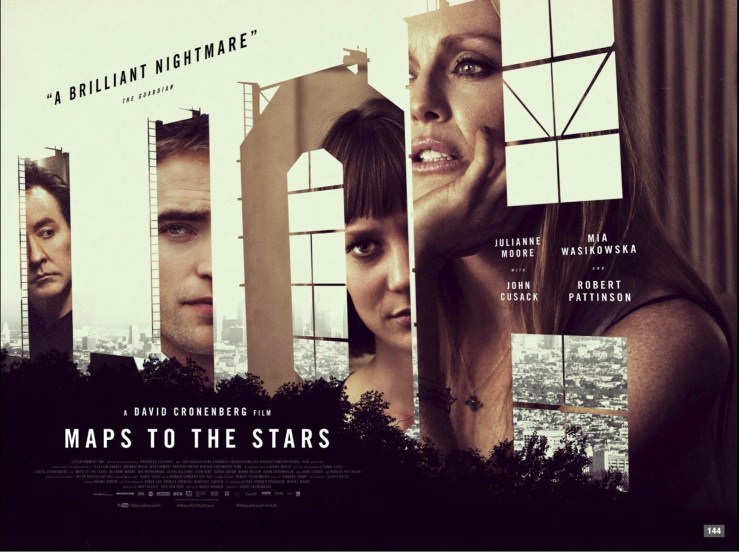
Surreal and often grotesque, David Cronenberg’s film Maps to the Stars (2014) attempts to merge a satire of the film industry with a riff on haunted Hollywood. The title, with its double meaning, suggests a cartography that might pinpoint the connections between larger-than-life screen avatars and the mythological figuration our culture has lent to them.

Maps to the Stars presents a large stage then for its host of strange characters to play upon. Center stage is the (ironically-named) Weiss family. Dr. Stafford Weiss (John Cusack) is a TV psychologist who manipulates his celebrity patients with psychobabble quackery. He’s emotionally-estranged from his wife Cristina (Olivia Williams), who plays stage-mother to their son Benjie (Evan Bird), an improbably gangly teen heartthrob trying to get his film career back on track after a stint in drug rehab. The Weiss family finds their not-so-blissful life terribly disrupted when daughter Agatha (Mia Wasikowska) shows up again after years in a mental hospital. She’s a schizophrenic with pyromaniac tendencies. Meanwhile, aging actress Havana Segrand (Julianne Moore) pines for a role playing her own mother’s role in a remake of a film called Stolen Waters. Segrand resents that her mother’s fame exceeds her own. Alleging that she was sexually abused by her mother as a child, Segrand receives treatment (in her lingerie) from Dr. Weiss. Agatha eventually takes a job as Segrand’s “chore whore,” more firmly linking the two plots. There’s also a limo driver named Jerome Fontana (Robert Pattison), who wants to both write and act in Hollywood. Oh, and a bunch of ghosts.

The various plot points double and triple each other: actors hope to gain coveted roles, family members hope to convert their pain into love and forgiveness, people try to escape their past. The film kneads themes of child predation, infanticide, ageism, Hollywood-as-vampirism, and incest into the plot, along with fire and water motifs. Throughout, characters repeat lines from Paul Éluard’s 1942 poem Liberté, as if the mantra’s force might grant them liberty from all these evils.

Cronenberg’s keen visual sensibilities are a highlight of Maps to the Stars. The film sparkles with a glossy Pop Art appeal which Cronenberg delights in griming up with occasional Cronenbergian touches. Still, Maps to the Stars, while thoroughly thematically abject, is not Cronenberg’s most visually Cronenbergian film.

The performances are very Cronenbergian though—stylized, affected, warped, weird. Mia Wasikowska and Julianne Moore are particularly good, and John Cusack leans into his role with unexpected menace. As surreal as these characters are though, there’s a ballast of reality underneath—sometimes and ultra-real reality, as when Carrie Fisher, daughter of a famous actress, plays her self in a bit role. The whole affect is unnerving.

Maps to the Star’s unnerving tone generates in part from its divergent trajectories. The film strives to be both a biting satire of Hollywood and a familial drama with mythological undertones. There’s no reason that these trajectories might intertwine successfully, but they don’t in Maps to the Stars. The tonal elements never fully cohere, and the plot careens to its climax with a pace that upsets the film’s earlier mood of slow-burning menace. The rushed ending is probably the worst part about Maps to the Stars. There’s plenty of promise in its first hour that the last 45 minutes fails to deliver. The film might have made a better limited series, even, giving Cronenberg more time to weave the threads together.

Bruce Wagner, who wrote Maps to the Stars‘ screenplay, found more room to expand in his 2012 novel Dead Stars, which ran just over 650 pages in paperback. Wagner’s novel predates the film, and is based at least in part on an earlier version of the screenplay for Maps to the Stars. (This is all a bit confusing, I know). In interviews, Wagner has rejected critics’ characterization of Maps to the Stars as a satire, declaring it rather an elegiac family melodrama. (Cronenberg himself didn’t outright reject the idea that the film was satirical though). While it’s unlikely that Wagner is being disingenuous when he claims Maps to the Stars isn’t satirical, he and Cronenberg have nevertheless produced a satire—yet one that strives to be an elegiac family melodrama, and also a take on the old haunted Hollywood stuff. And yet all this material feels pretty hollow.

The specters and doppelgangers haunting the background of Maps to the Stars remain disappointingly underexplored by the film’s end. Worse, the film suffers from a comparison to David Lynch’s far superior Mulholland Drive (2001). Lynch’s film is richer and more expansive, evoking more with far less.

Maps to the Stars also suffers from comparison to Cronenberg’s earlier work, like Videodrome (1983), The Fly (1985), and Dead Ringers (1988). In the 2000s, Cronenberg delivered a particularly strong one-two punch with a pair of his most perfect films, both starring Viggo Mortensen: A History of Violence (2005) and Eastern Promises (2007). The magic with Mortensen seemed to wear off in A Dangerous Method (2011), and Cronenberg’s next film Cosmopolis (a 2012 adaptation of Don DeLillo’s novel) was, in my estimation, unwatchable. While I think Maps to the Stars is stronger than the last two efforts, it does seem to point to a late-career slump. Here’s to hoping the next Cronenberg joint is a better deal, like the far-superior satire eXistenZ (1999) which he wrote himself. Maybe he should write the next one himself too.


How I watched it: I put it on a few nights ago on a big TV via a streaming service, late at night after a few tumblers of scotch, thinking, “Oh hey, I never watched this” but that turned out to be a false start. Rewatched on an iPad in bed with headphones in two sittings, very late at night. 

Pom Poko (Summer Film Log)

Screenshot 2018-06-21 at 11.22.54 PM

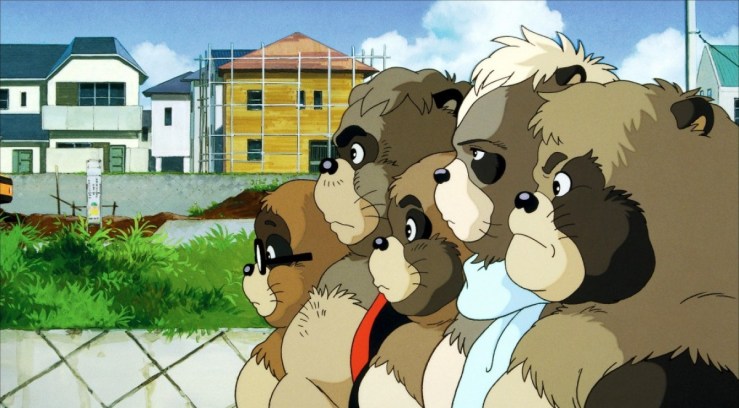
Set mostly in the outskirts of Tokyo in the early 1990s, Isao Takahata’s film Pom Poko (1994) tells the story of forest-dwelling tanuki who band together to fight a guerrilla war against the humans who are destroying their natural habitat. Some of the tanuki can shapeshift—even into human form—and the jolly, mischievous (and very human) creatures carry out their war with the land “developers” in a playful spirit that belies the existential threat that is the backdrop of this strange and wonderful film.

pompoko-1994-58-g

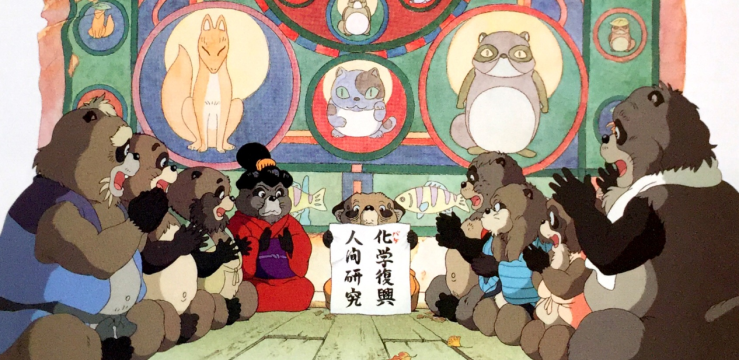
Takahata highlights the Darwinian competition between the tanuki and the humans by layering the aesthetic representation of these trickster raccoon dogs. We see the tankuki in different ways. Most of the time the film represents the tanuki in a stylized anime that’s something like a mix between ceramic tanuki effigies and, like, Disney’s funny animals.

1485147783pom_poko_1

This representation is jolly and blithe, even when the tanuki are committing sabotage or banging each other over the head for scant resources. The tanuki are most human here, hitting a sweet spot far away from the uncanny valley. We relate to them. At other times, Takahata gives us an even more stylized version of these animated raccoon dogs—they become ultracartoon, simple bubble renderings, cartoony-cartoons avatars of their own pain or delight.

pom_poko1

But what’s most affecting, at least for me, are the rare moments in the film that depict the tanuki in naturalistic imagery—the moments when Takahata reminds us that these are animals in a natural world. One is reminded of the film version of Richard Adams’ 1972 novel Watership Down (1978; dir. Martin Rosen) in these scenes.

pompoko-realistic

Takahata shifts his representations of the tanuki in Pom Poko between anthropomorphic, ultra-cartoonish, and realistic, an aesthetic gambit that points towards the film’s greatest trick—a spectacle of shape-shifting tricksterism. Larded with riffs on Japanese folklore and crammed with phantasmagoric images, Pom Poko culminates in a ghost parade that the tanuki perform as a means to scare the humans away. The episode is the climactic highlight of Pom Poko, a wonderful take on the Japanese folklore of a demon parade in which yōkai dance down the street in wild abandon.

pom-poko-5-1

Unfortunately, the demon parade gambit fails. Hunting publicity, an amusement park steals the credit. In a move that may reflect Takahata’s sense of his own aesthetic power, the tanuki master illusionists are almost as upset about this theft of credit for their masterwork as they are at the theft of their lands. Almost as upset though—of course this is film about the radical terror of impending extinction, and Takahata never refrains from underlining that central message.

For some, the thesis of Pom Poko might be a bit too on-the-nose—I mean, the film is not subtle in evoking the idea that humans are taking up too much of the earth’s natural resources. However, the film is far more subtle, and hence effective, in anthropomorphizing its funny animals in such a way that we see their problems as not unlike our own. The tanuki are very much like humans—prone to rash decision making, practical joking, stupid anger, infighting and badmouthing, and junk food. They can also cooperate when they need to…but even mutual cooperation has its limits.

Ultimately, Pom Poko is a surprisingly sad film. Like so many Studio Ghibli films, it feels like an elegy for not just another time, but another way of living. And yet it encodes that way of living into a new medium for a new time—another phantasy, another trick, another transformation.


How I watched it: I took my son to see it last Sunday. I’ve seen the film maybe ten times, and my son, who is eight, has seen it maybe three. He claims it’s his favorite Studio Ghibli film, or maybe second favorite, after Princess Nausicaa and the Valley of Wind (1984; dir. Hayao Miyazaki). Neither of us had seen Pom Poko in a theater before, and watching it on a big screen with big sound and a full crowd confirmed its aesthetic power.

Lady Bird (Summer Film Log)

ladybird_poster

In her essay “Place in Fiction,” Eudora Welty wrote that “Place in fiction is the named, identified, concrete, exact and exacting, and therefore credible, gathering spot of all that has been felt, is about to be experienced, in the novel’s progress.”

Greta Gerwig’s film Lady Bird (2017) is not a novel, nor is it a portrait of a city—but what it does do very successfully, credibly, and experientially, is illustrate the ways in which place—setting, context, community, family, home—shapes character and desire. Place in the film is ultimately the territory that we mentally and aesthetically attend—and in this sense love, to borrow the film’s thesis. Gerwig’s film makes us attend.

The primary place in Lady Bird (2017) is Sacramento, California. Titular character Lady Bird’s feelings about her hometown are neatly summed up in the film’s epigraph, a quote from Joan Didion: “Anybody who talks about California hedonism has never spent a Christmas in Sacramento.” Like Didion, Gerwig is a native of Sacramento, and a sense of that place radiates throughout Lady Bird.

Lady Bird chronicles its heroine’s senior year of high school. Christine McPherson (Saoirse Ronan) has rechristened herself “Lady Bird,” an eccentricity she seems to perceive as at odds with the tenor of the staid Catholic school she attends. Her central aim is to attend an elite East Coast college, preferably in a town buzzing with what she thinks she will recognize as “culture.” In her senior year, Lady Bird has a number of misadventures—tragic, comic, tragicomic, all very real—and grows a bit. Or doesn’t grow. Lady Bird is the memoir of a mature artist looking back on her youth. Gerwig shows that “coming of age” is something we do well after the fact, later in life when we visit the place called the past.

Lady Bird’s nascent adulthood is captured not only in the class-divides of beautiful boring Sacramento, but also in the time period the film traverses. Lady Bird is a period piece. Set in the Fall-Spring of 2002-2003, with America’s new weird wars either underway or just beginning, Lady Bird grounds itself in a cultural realism that makes it all the more relatable, even if your own senior year of high school was, say, in 1996-1997. Lady Bird must “come of age” in a fucked up world, but her experiences aren’t that different from our own, even if the ages and places aren’t the same. The exacting nature of Gerwig’s presentation of place and time—her “gathering spot of all that has been felt,” to misappropriate Welty again, reminds us of the bigger truths about how fucked up growing up is.

Gerwig gets at these truths through fiction’s regular distortions—comedic, dramatic, hyperbolic. Describing Lady Bird’s plot would make it sound like a number of teen angst films you’ve seen before. And yet Lady Bird twists its tropes repeatedly. Our heroine is the solipsistic center of her own life, but she occasionally looks a bit closer at those on its apparent margins—a gay ex-boyfriend, a bestie she deserts, a Cool Guy whose rich dad is dying of cancer. Gerwig populates her place with real people, not grotesque caricatures. It’s all quite moving if you let it be.

Lady Bird is at its most moving when portraying its central conflict between Lady Bird and her mother, (Laurie Metcalf) who implores her  not to leave home to attend a fancy East Coast school. Ronan and Metcalf are amazing in the film, and much of the credit must go to Gerwig’s screenplay and direction (Jon Brion’s score doesn’t hurt either). Gerwig never has the pair say or do anything towards each other that does not seem utterly true. Lady Bird’s father is played by Tracy Letts, whose performance anchors the conflict between mother and daughter with sweet sad realism.

Perhaps Gerwig’s greatest success in her film-memoir is that she neatly ties the narrative’s loose ends while at the same time leaving them frayed. The chaos of young adult life is simultaneously represented and reconciled through a more mature aesthetic revelation. I won’t spoil the film’s conclusion, but it is somehow devastating and happy and very real. Life is fucked up and messy.

We leave Sacramento with Lady Bird and head to a new place—named, yes, identified, possibly, but not yet fully concrete, or exact—at least not yet for our heroine. And yet from everything we’ve seen—and everything we know about our own experiences in so-called “coming of age”—we might feel some surety in that Lady Bird has found a new place, a new “gathering spot” to feel, experience, and progress within.


How I watched it: On a big TV via a streaming service with my wife, who liked it more than I did (I liked it very much!) and cried quite a bit.

Blog about reading Middlemarch (and wishing I was rereading Middlemarch)

Screenshot 2018-06-12 at 8.35.14 PM
Detail of a portrait of Mary Ann Evans (George Eliot) at age 30 by François d’Albert Durade (1804–1886)

There should be a word in some language (perhaps not yet invented—word or language) to describe the feeling of Having pushed far enough into a very long novel (a novel that one has cracked into more than once) to the point that one now feels one can finally finish it.

I have felt this specific feeling a number of times in my life after finally sinking into long novels like Moby-DickGravity’s Rainbow, and Infinite Jest. There’s a sort of relief mixed into this (as-yet-unnamed?) feeling, a letting go even, where the reader (me, I mean) surrenders to the novel’s form and content. Finally freed from the idea of reading the novel, I am able to read the novel.

There are 86 numbered chapters in George Eliot’s 1872 novel Middlemarch (not counting a “Prelude” and a “Finale”). I have just finished Chapter XXXV—not exactly a half-way point, but far enough in to finally feel like the story and the style are sticking with me. I’ve been reading a public domain copy on my iPad, after having abandoned my 1977 Norton Critical Edition—the Norton’s print is too cramped (and maybe my eyes are starting to go as I approach 40). Also, the Norton annotations are useful but too intrusive for a first read. I found myself utterly distracted by the Norton footnotes after about 50 pages; switching to a footnote-free version has alleviated a lot of the anxiety I initially felt about trying to fully comprehend Eliot’s novel in its own historical context. Dispensing with the footnotes allowed me to finally sink into Middlemarch and appreciate its wonderful evocation of consciousness-in-action.

So far, my favorite character in Middlemarch is Dorothea Brooke. In part my allegiance to her is simply a matter of the fact that she initially appears to be the novel’s central character—until Eliot swerves into new narratives near the end of Book I (Book I of VIII, by the way). But beyond traditional formal sympathies, it’s the way that Eliot harnesses Dorothea’s consciousness that I find so appealing. Eliot gives us in Dorothea an incredibly intelligent yet palpably naive young woman who feels the world around her a smidge too intensely. Dorothea is brilliant but a bit blind, and so far Middlemarch most interests me in the way that Eliot evokes this heroine’s life as a series of intellectual, emotional, and aesthetic revelations. We see Dorothea seeing—and then, most remarkably, we see Dorothea seeing what she could not previously see.

There are other intriguing characters too, like Dr. Tertius Lydgate, the wastrel Fred Vincy, and the would-be-Romantic Will Ladislaw (who has like, totally smoked opium, just so you know). I’m particularly fond of Dorothea’s goofy uncle Arthur Brooke.

I won’t bother summarizing the plot thus far of the novel, which is really a bunch of plate spinning, but rather offer this sentence from the novel itself:

Scenes which make vital changes in our neighbors’ lot are but the background of our own, yet, like a particular aspect of the fields and trees, they become associated for us with the epochs of our own history, and make a part of that unity which lies in the selection of our keenest consciousness.

There’s also another self-summarizing passage a few chapters before this one, worth citing here:

Your pier-glass or extensive surface of polished steel made to be rubbed by a housemaid, will be minutely and multitudinously scratched in all directions; but place now against it a lighted candle as a centre of illumination, and lo! the scratches will seem to arrange themselves in a fine series of concentric circles round that little sun. It is demonstrable that the scratches are going everywhere impartially and it is only your candle which produces the flattering illusion of a concentric arrangement, its light falling with an exclusive optical selection. These things are a parable. The scratches are events, and the candle is the egoism of any person now absent…

Each of us is a reader reading other lives as scratches on a mirror or trees in the distance, and in our reading we incorporate them into our own consciousness, our own narrative. Middlemarch is very good at evoking this social reality.

I started this blog post by trying to describe a very specific feeling for which I don’t have a word—namely, and again: Having pushed far enough into a very long novel to the point that one now feels one can finally finish it. I suspect that this is a not-uncommon feeling. I’m not so sure though of how common the other feeling I have while reading Middlemarch is. I keep feeling (feeling, not thinking): I wish that I was rereading Middlemarch and not reading Middlemarch. If I were rereading Middlemarch I could make much more sense of those mirror scratches and those trees in the distance; if I were rereading Middlemarch, I could feel the feeling of reading Middlemarch more. There is an obvious answer to this desire, of course. I can finish reading Middlemarch. Then I can reread Middlemarch. 

Terrible Saturday Night Double Feature: Ant-Man and The Disaster Artist (Summer Film Log)

It is possible that there is a good film hiding somewhere in the patched-together mess that is Ant-Man (2015), but I doubt it. The film had a troubled production, with original director (and producer/writer) Edgar Wright dropping out because he could see that Marvel Studios would not let him make the film he wanted to make.

I haven’t liked anything Wright has done since Shaun of the Dead (2004), and his last film Baby Driver (2017) looked so insufferable that I’ll likely never sit through it. Still: Wright’s films are his films, marked by his style, his idea of “cool,” and his idea of “humor.” I don’t think his films are particularly good, but they are nevertheless original. The version of Ant-Man that Marvel Studios gave its loyal fandom bears traces of Wright’s vision—“traces” is not the right word; it is too subtle–maybe “chunks” is the word I want: Big “chunks” of the film Wright likely intended are in Ant-Man, delivered mainly via Paul Rudd’s glib charm. And yet the chunks aren’t particularly well-integrated—or maybe it’s unclear what they are to be integrated intoAnt-Man tries to do too many things and ends up not delivering on them; or, rather, it delivers them with slick emptiness that points to the film’s utter inconsequentiality. There are plenty of examples, but none so glaring as when Michael Douglas (playing the original Ant-Man Hank Pym) reconciles a relationship with his emotionally-estranged daughter (Evangeline Lilly who will become the Wasp in the upcoming and inevitable sequel), only to have the moment punctured by Paul Rudd. The breeziness doesn’t feel comedic, but rather a bit nihilistic.

Nothing matters in Ant-Man except setting up the next Marvel Cinematic Universe film. So why not shoehorn in a scene with a flying Avenger? The film sometimes delivers aesthetically—I mean, this is a movie about a guy who shrinks, right? there should be plenty of cool imagery here—but for all its charms à la Honey, I Shrunk the Kids (1989), Ant-Man is ultimately uninterested in tapping the massive potential of a microscopic world. Even worse, the film has no interest at all in exploring the deeper philosophical implications of what it might mean for a consciousness to find its bearings in time/space fundamentally transformed. Ant-Man feels more like a product assembled by committee than an actual film, which is a shame, given all the potential in its basic story.


How I watched it: On a big TV via a streaming service, with my wife and my children, who selected it for our viewing entertainment.


The Disaster Artist (2017) is a bad movie about a bad movie. I’ll admit that the charms of The Room (2003) will forever be lost on me. That film is bad, yes, but worse, it’s boring. (I like my bad films to be not boring).

The Disaster Artist is based on a book of the same name by Greg Sestero and Tom Bissell. The book chronicles Sestero’s relationship with Tommy Wiseau, the auteur behind The Room (Wiseau and Sestero star in The Room). Director James Franco plays Wiseau and his little brother Dave Franco plays Sestero. James Franco portrays Wiseau as kind of deranged Dracula; Dave Franco plays Sestero as an earnest, empathetic, friendly hero. The Disaster Artist never questions Sestero’s account making The Room. He’s simply the Good Guy.

The Francos are not nearly as compelling as the cast around them, which is larded with ringers like Alison Brie, Sharon Stone, Nathan Fielder, Hannibal Buress, Bryan Cranston, and Seth Rogen. (Rogen’s performance as a script supervisor who ends up essentially directing The Room is probably the highlight of The Disaster Artist).

A good cast is not enough to cover over James Franco’s pedestrian direction though. He takes every possible shortcut, slathering scene after scene with cheap music, staging scenes in the most formulaic way possible, and telegraphing almost every plot point in unnecessary exposition. Franco directs the film as if he is worried your baby boomer uncle might not get what’s going on, squandering much of the weird potential that rests in a character as unique as Tommy Wiseau.

To make sure that all viewers “get it” — or at least get the idea of “getting it” — Franco frontloads the film with talking head celebrities (including Adam Scott, Kristen Bell, and Danny McBride) pretending to improvise their enthusiasm for the ironic charms of The Room.

The Disaster Artist culminates in the premiere of The Room. In Franco’s portrayal, The Room’s premiere audience attunes quickly to the absurdity of Wiseau’s wreck, adopting an ironic vision that allows them to take deep joy in watching a bad film. Franco pours sweetened laughter over the scene. The whole effect is like having someone explain an absurd joke. Who wants to have an absurd joke explained to them?

What the film never does—never even really tries to do—is get into Wiseau’s weird mind. There’s a strange and fascinating story in there, but The Disaster Artist can’t get to it, offering instead contours with no real substance. Indeed, The Disaster Artist seems a bit afraid of whatever’s going on inside Wiseau, and so instead retreats into platitudes about How Great Film Is and How Great It Is To Make Movies and etc.  The Disaster Artist is boringly competent. The Room is a bad film, but at least it’s original.


How I watched it: On an iPad with earphones, lying in bed, trying to follow up Ant-Man with something better, and ultimately finding no success.

Reviews, riffs, anti-reviews, and interviews of Jan 2018-May 2018 (and an unrelated fruit bat)

DP167067

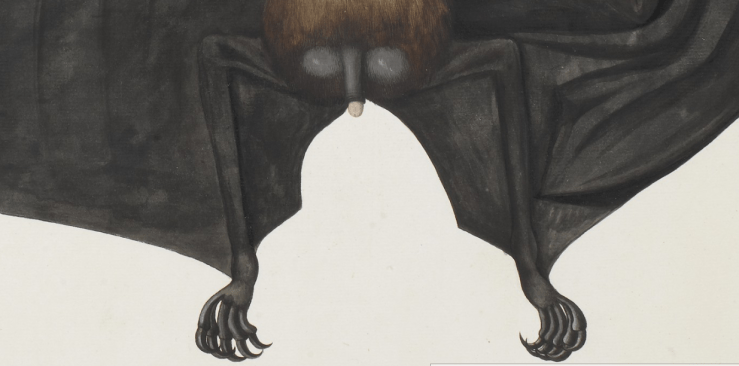
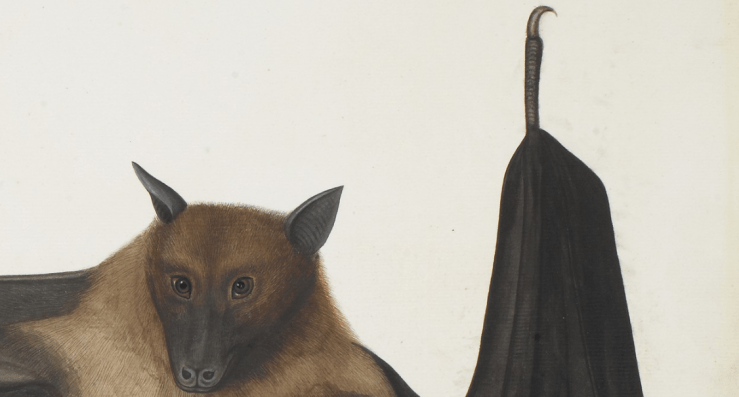
These are links to some of the longer pieces I’ve written so far this year. The painting of the great Indian fruit bat (c. 1777-1782) is attributed to Bhawani Das or one of his followers.

The Last Jedi and the anxiety of influence

A review of Paul Thomas Anderson’s film Phantom Thread

A review of Paul Kirchner’s underground comix collection Awaiting the Collapse (at The Comics Journal)

A review of The Paris Review’s overproduced podcast

A review of Stanisław Ignacy Witkiewicz’s collection Narcotics

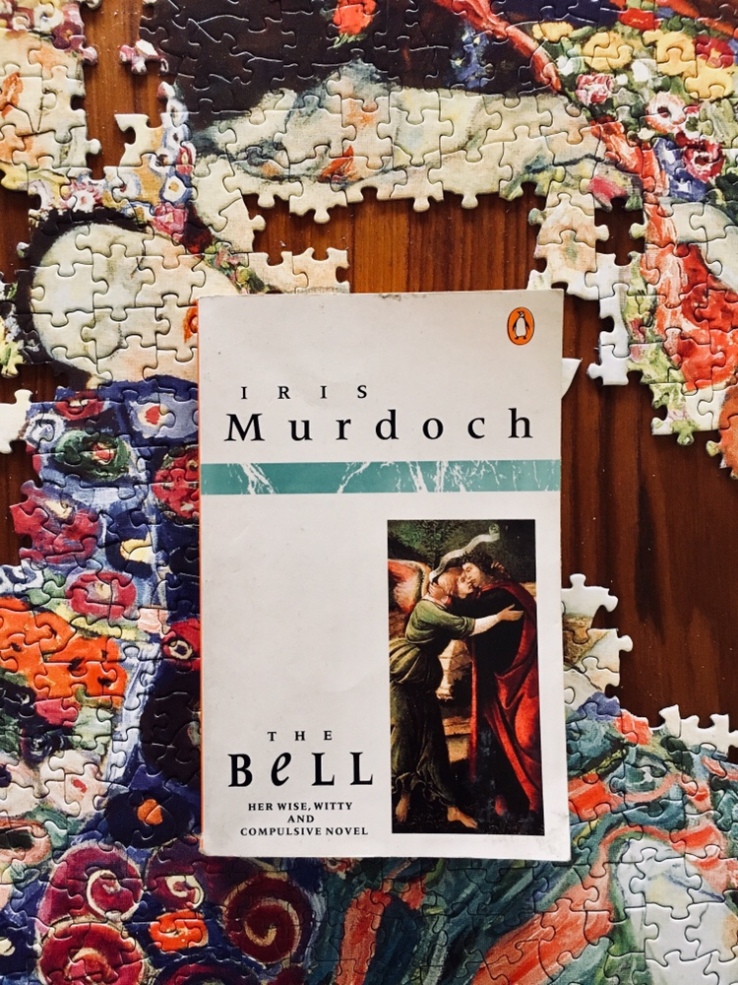
A few paragraphs on beginning Iris Murdoch’s novel The Bell

On a compelling Stephen Crane character

A review of Iris Murdoch’s novel The Bell

On a particular Gordon Lish sentence

On rereading Nathaniel Hawthorne’s The Blithedale Romance

Screenshot 2018-05-31 at 3.59.41 PM

On Goya’s painting The Straw Man

On Don DeLillo’s novel The Names

On the radical postmodernism of Ursula K. Le Guin’s short story “Schrödinger’s Cat” 

Polygamy as a metaphor in Nathaniel Hawthorne’s The Blithedale Romance

On Nathaniel Hawthorne’s “silvery veil” — and David Foster Wallace’s Madame Psychosis

An analysis of William Carlos Williams’s ekphrastic poem “The Wedding Dance in the Open Air”

A close reading of Lydia Davis’s very short story “Happiest Moment”

On a passage from Gerald Murnane’s short story “Stream System”

Something on a scene from Nathaniel Hawthorne’s The Blithedale Romance

Screenshot 2018-05-31 at 3.59.29 PM

On John Berryman’s Dream Song 265

On making a literary cocktail, the sherry cobbler

On Robert Coover’s short story “The Brother”

On Claire-Louise Bennett’s short story “Stir-Fry”

On Balthus’s portraits of young girls reading 

On the postmodern comedy-horror axis of Martin Scorsese’s The King of Comedy

An interview with the editors of Egress, a new literary magazine devoted to innovative writing

A completely subjective and thoroughly unnecessary ranking of Thomas Pynchon’s novels

Screenshot 2018-05-31 at 3.58.43 PM

Antoine Volodine’s Writers blows me away

A review of Dave Cooper’s queasy abject comic Mudbite (at The Comics Journal)

On Michael Radford’s film adaptation of 1984

Is The Running Man a good film?

On William Friedkin’s paranoid, claustrophobic horror flick Bug

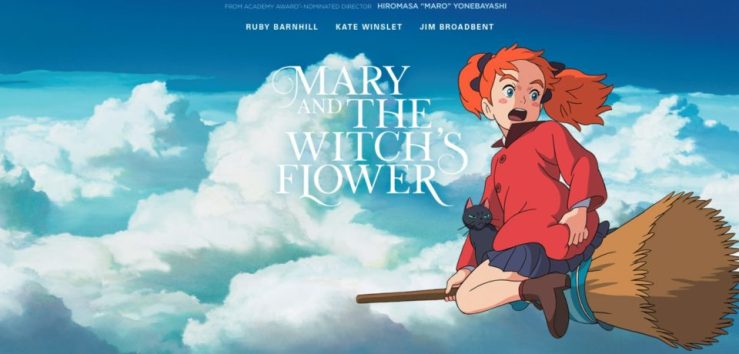
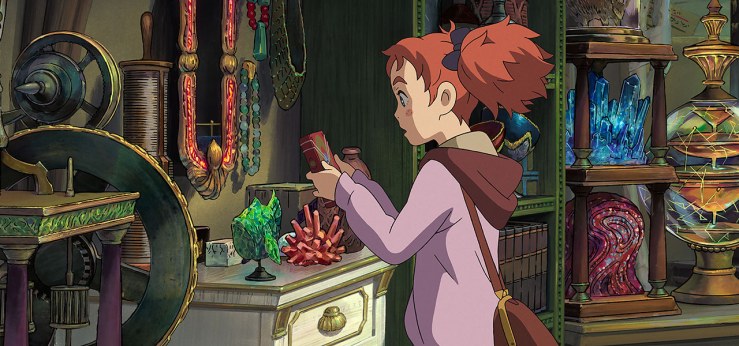
Mary and the Witch’s Flower, a love letter to Studio Ghibli from director Hiromasa Yonebayashi

On Hayao Miyazaki’s film Porco Rosso

A review of Zora Neale Hurston’s Barracoon

A review of Lady Macbeth

Screenshot 2018-05-31 at 3.59.03 PM

Lady Macbeth (Summer Film Log)

lady-macbeth-film

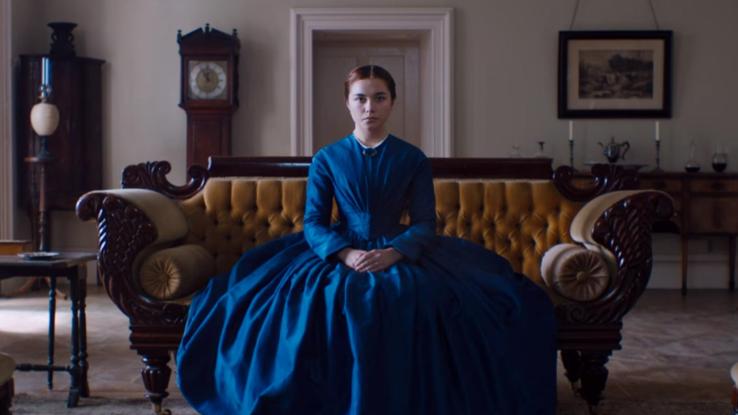
Spare, dark, cruel, and unflinching, Lady Macbeth (2016) uncoils with an austere beauty that belies its dark core. Set in rural England in 1865, the film is the story of Katherine, a young wife essentially imprisoned by her cruel father-in-law and warped husband who try to confine her inside their drafty country estate.

Katherine would rather take her freedom in the fresh chilly air of the heath, but father-in-law Boris wants her inside, preferably laboring at creating a male heir, a task made nearly impossible by her older husband Alexander’s apparent impotence. Boris and Alexander use a housemaid named Anna to monitor Katherine, and when the father and son have to depart on separate business matters, Anna is left to watch over the bored young bride.

06-lady-mackbeth-w710-h473

Katherine’s situation becomes much less boring when, only a day or two after the departure of Boris and Alexander, she discovers Anna naked in a sack suspended from the ceiling of a kennel, surrounded by jeering men. Katherine frees the maid and asserts her dominance as lady of the house, even as she has to tussle with one of the men, Sebastian. The scene is utterly Sadean, a strange mix of sexuality, violence, and the thin veneer of social mores that glosses over the id writhing under the surface. The veneer cracks. Our Lady takes up a poorly-hidden (and then not-really-hidden-at-all) affair with Sebastian. To reveal more could spoil the story, but, like, you know some of the stuff that happens in Macbeth, right? Murders and stuff?

While Lady Macbeth recalls Shakespeare’s tragedy at times, it’s actually an adaptation of Nikolai Leskov’s 1865 novella Lady Macbeth of the Mtsensk District. (I read and enjoyed an English translation by Richard Pevear and Larissa Volokhonsky a few years back). Director William Oldroyd and writer Alice Birch offer a fairly faithful adaptation of Leskov’s story, although the film’s tone is much darker and devoid of Leskov’s black humor. The film’s conclusion is also darker and more concise than Leskov’s novella’s last chapters (and better, I’d argue). Lady Macbeth’s final moments offer a chilling indictment of Victorian morality (a moral vision that continues to persist in many ways today) without the slightest concession to a mainstream audience’s desire for, say, justice. The film begins dark and strange and ends darker, stranger. Watching Lady Macbeth is a bit like having one’s stomach squeezed from the inside out.

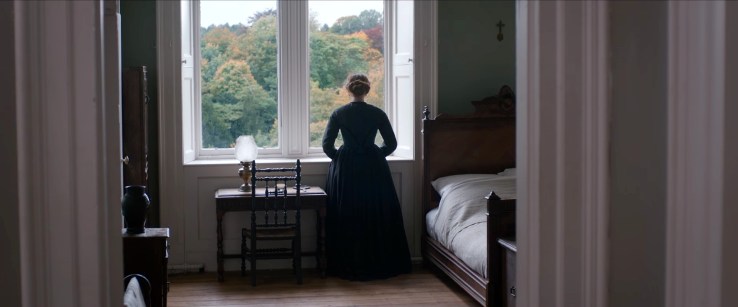
The film’s disturbing tension is not for everyone, but those folks would miss a fantastic performance by Florence Pugh, who plays Katherine with a sensitivity that is both captivating and menacing. One of the great successes of Lady Macbeth is watching Pugh perform a character who moves from emotion to impulse to action–or in some cases radical inaction—in a thoroughly naturalistic way. Oldroyd’s direction is key here; perhaps the most terrifying thing about Lady Macbeth is how natural the film feels. Cinematographer Ari Wegner seems to shoot the film almost-entirely with natural light (and occasionally gaslight), an effect that is simultaneously gorgeous and starkly unsettling. Lady Macbeth would make a perfect double feature with Sofia Coppola’s The Beguiled (2017). The film’s repetitions of interiors—often with Katherine staring out—readily recall Danish painter Vilhelm Hammershøi’s work.

lady-macbeth7

Lady Macbeth creates its own visual grammar to tell its story, deploying dialogue between characters with a spare efficiency that helps build the film’s anxious mood. Extradiagetic sound is virtually nonexistent in the film, too. A slow ominous rumbling swells up exactly three times in Lady Macbeth, matching and then intensifying the viewer’s nervous dread. The final credits play out over the sounds of birds chattily chirping. It’s all very disconcerting.

As I’ve noted (and which I hope is clear from this write-up), Lady Macbeth’s mix of strange Sadean sex and violence isn’t for everyone. It’s the kind of film that will likely disappoint or even upset many viewers—those looking for a Victorian-period romance should look elsewhere, and fans of straightforward horror might not get the tropes they crave. But folks interested in an unnerving but compelling story told on its own aesthetic terms should check this one out.


How I watched it: On a big TV via a streaming service, somewhat late at night, at least for my wife and me. My wife loved it, by the way, and best of all, she loved it despite her usual rubric—she says she doesn’t like films where “nothing good happens.” Maybe something good happens in Lady Macbeth, but the good is so wrapped up in the bad that the two are impossible to parse.

A review of Zora Neale Hurston’s Barracoon

151835599518773205

Zora Neale Hurston’s 1931 book Barracoon: The Story of the Last “Black Cargo” has finally been published. The book is based on Hurston’s 1927 interviews with Cudjo Lewis, the last known survivor of the transatlantic slave trade. Barracoon went previously unpublished due in part to Hurston’s refusal to revise the prose into a “standard” English. Hurston wrote Barracoon in a phonetic approximation of Cudjo’s voice. While this vernacular style may pose (initial) challenges for many readers, it is the very soul of the book in that it transmits Cudjo’s story in his own voice, tone, and rhythm. Hurston used vernacular diction throughout her work, but Cudjo’s voice is singular; it bears a distinctly different sound than the characters of Their Eyes Were Watching God, Hurston’s most famous novel. It is hard to conceive a more compelling version of Barracoon than this one, the one Hurston refused to compromise, with its intense, vital orality.

What is Barracoon about? I shall liberally borrow my summary from the book’s introduction, penned by Hurston scholar and biographer Deborah G. Plant:

On December 14, 1927, Zora Neale Hurston took the 3:40 p.m. train from Penn Station, New York, to Mobile, to conduct a series of interviews with the last known surviving African of the last American slaver—the Clotilda. His name was Kossola, but he was called Cudjo Lewis. He was held as a slave for five and a half years in Plateau-Magazine Point, Alabama, from 1860 until Union soldiers told him he was free. Kossola lived out the rest of his life in Africatown (Plateau). Hurston’s trip south was a continuation of the field trip expedition she had initiated the previous year.

Oluale Kossola had survived capture at the hands of Dahomian warriors, the barracoons at Whydah (Ouidah), and the Middle Passage. He had been enslaved, he had lived through the Civil War and the largely un-Reconstructed South, and he had endured the rule of Jim Crow. He had experienced the dawn of a new millennium that included World War I and the Great Depression. Within the magnitude of world events swirled the momentous events of Kossola’s own personal world.

Zora Neale Hurston, as a cultural anthropologist, ethnographer, and folklorist, was eager to inquire into his experiences. “I want to know who you are,” she approached Kossola, “and how you came to be a slave; and to what part of Africa do you belong, and how you fared as a slave, and how you have managed as a free man?” Kossola absorbed her every question, then raised a tearful countenance. “Thankee Jesus! Somebody come ast about Cudjo! I want tellee somebody who I is, so maybe dey go in de Afficky soil some day and callee my name and somebody say, ‘Yeah, I know Kossula.’”

Those final sentences should give you a quick taste of Barracoon’s central rhetorical conceit. After her own introductory chapter (which details the historical circumstances of the Clotilda’s illegal journey to West Africa), Hurston lets Cudjo inspirit the text, telling his own story in his own voice. Hurston, who spent three months with Cudjo, initially interposes herself in the story, as we see early in the book’s first chapter:

“My grandpa, he a great man. I tellee you how he go.”

I was afraid that Cudjo might go off on a tangent, so I cut in with, “But Kossula, I want to hear about you and how you lived in Africa.”

He gave me a look full of scornful pity and asked, “Where is de house where de mouse is de leader? In de Affica soil I cain tellee you ’bout de son before I tellee you ’bout de father; and derefore, you unnerstand me, I cain talk about de man who is father (et te) till I tellee you bout de man who he father to him, (et, te, te, grandfather) now, dass right ain’ it?

This brief “cutting in” is one of the last moments in the narrative that Hurston attempts to steer Cudjo in a particular direction. Instead, she befriends the old man, bringing him watermelons, hams, peaches, and other treats. These little gifts serve to frame Cudjo’s narrative as he moves from one episode to the next. Otherwise, Hurston disappears into the background, an ear for Cudjo’s voice, a witness for his story.

Cudjo’s story is astounding. He describes life in his own West African village and the terrible slaughter of his people at the hands of “de people of Dahomey,” a tribe that eventually sells Cudjo and the other young people of his village to white men. Cudjo describes his early enslavement in Alabama, which took place in secret until the Civil War, and his eventual freedom from bondage. He tells Hurston about the founding of Africatown, a community of West Africans. He describes his life after capture and slavery—his marriage, his children, his near-fatal railroad accident. Cudjo’s life and his children’s lives were incredibly difficult. They were always othered:

“All de time de chillun growin’ de American folks dey picks at dem and tell de Afficky people dey kill folks and eatee de meat. Dey callee my chillun ig’nant savage and make out dey kin to monkey.

“Derefo’, you unnerstand me, my boys dey fight. Dey got to fight all de time. Me and dey mama doan lak to hear our chillun call savage. It hurtee dey feelings. Derefo’ dey fight. Dey fight hard. When dey whip de other boys, dey folks come to our house and tellee us, ‘Yo’ boys mighty bad, Cudjo. We ’fraid they goin’ kill somebody.”

Somehow most devastating in a narrative full of devastation are the deaths of Cudjo’s children. After his daughter dies in infancy, his namesake is killed by a sheriff, a scene that resonates with terrible pain in 2018:

Nine year we hurtee inside ’bout our baby. Den we git hurtee again. Somebody call hisself a deputy sheriff kill de baby boy now.

He say he de law, but he doan come ’rest him. If my boy done something wrong, it his place come ’rest him lak a man. If he mad wid my Cudjo ’bout something den he oughter come fight him face to face lak a man. He doan come ’rest him lak no sheriff and he doan come fight him lak no man.

Another of his sons is decapitated in a railroad accident. A third son, angry with the injustice of the world, simply disappears: “My boy gone. He ain’ in de house and he ain’ on de hill wid his mama. We both missee him. I doan know. Maybe dey kill my boy. It a hidden mystery.”

Cudjo, ever the survivor, went on to outlive his wife and all of his children.  In her foreword to Barracoon, Alice Walker captures the pain and pathos of this remarkable position:

And then, the story of Cudjo Lewis’s life after Emancipation. His happiness with “freedom,” helping to create a community, a church, building his own house. His tender love for his wife, Seely, and their children. The horrible deaths that follow. We see a man so lonely for Africa, so lonely for his family, we are struck with the realization that he is naming something we ourselves work hard to avoid: how lonely we are too in this still foreign land: lonely for our true culture, our people, our singular connection to a specific understanding of the Universe. And that what we long for, as in Cudjo Lewis’s case, is gone forever. But we see something else: the nobility of a soul that has suffered to the point almost of erasure, and still it struggles to be whole, present, giving.

I cannot improve on Walker’s phrase here. Hurston brings that “nobility of soul” to life via Cudjo’s own rich language.

While Barracoon is of a piece with Hurston’s anthropological collections Mules and Men and Tell My Horse, it does not read like an autoethnography. It is rather a compelling first-person narrative. Hurston collecteed stories from Cudjo–fables, parables, games—but these are included as an appendix, a wise narrative choice as any attempt to integrate them into the main narrative would hardly be seamless. The appendix adds to the text’s richness without imposing on it, and links it to Hurston’s work as a folklorist.

I’ve noted some of the additional material already—Walker’s foreword, the appendix of folklore, as well as Plant’s introduction. Included also is an afterword by Plant that contextualizes Barracoon within Hurston’s academic career, a list of the original residents of Africatown, a glossary, a bibliography, and a lengthy compendium of endnotes. This editorial material frames the historic and academic importance of Barracoon, and will be of great interest to anyone who wishes to study the subject more. However, Cudjo’s narrative stands on its own as a sad, compelling, essential story. It’s amazing it took this long to reach a wider audience. Recommended.


Porco Rosso (Summer Film Log)

porco-rosso

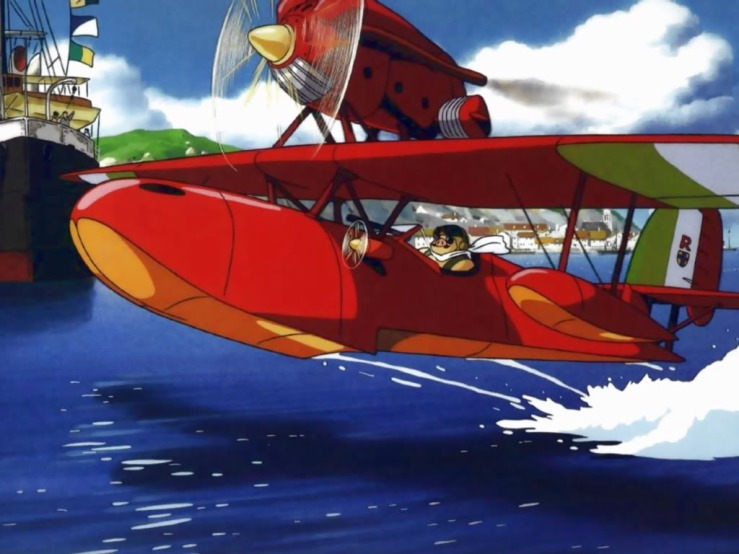
Hayao Miyazaki’s Porco Rosso (1992) is one of my favorite films, and I was able to see it last night for the first time on the big screen thanks to Studio Ghibli Fest 2018. Although I’ve seen Porco Rosso maybe a dozen times, seeing its rich, deep, bold animation on an enormous screen felt like seeing it for the first time (I also hadn’t watched the subtitled version in a while).

Porco Rosso takes place in and around various islands in the Adriatic Sea during the thin slice of years between the First and Second World Wars. Italy, like much of the world, is in the midst of a severe economic depression, and is slowly sliding into fascism. World War II is clearly on the horizon. Miyazaki pushes these problems to the margins of his film, conjuring instead a romanticized Mediterranean. However, this romantic space is always under the pressure of a coming disaster—fascism and a new war.

porcorosso5

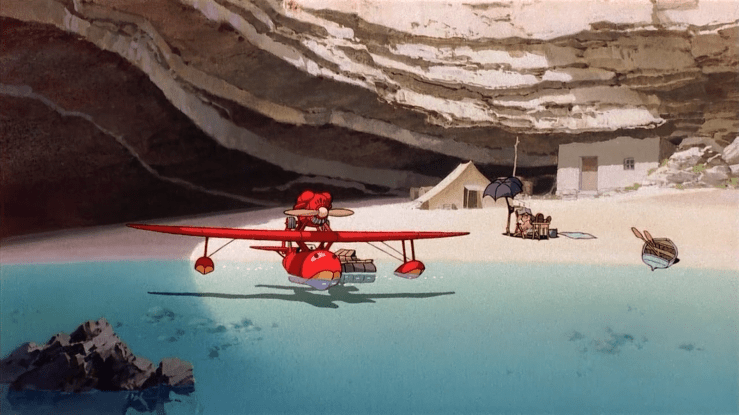
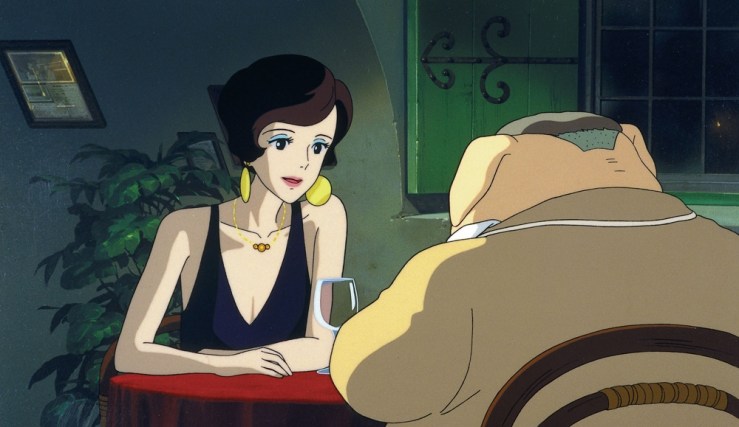
The hero of Porco Rosso is Marco Pagot (called Marco Rossolini in the American dub). Marco is an ex-military pilot, an aviation ace who fought with honor for the Italian air force in the Great War. He now spends his days drinking red wine and smoking cigarettes on a beautiful deserted island, occasionally taking jobs as a bounty hunter, retrieving hostages and other stolen goods from the nefarious and unwashed air pirates who plunder the ships of the Adriatic. Marco makes occasional concessions to civilization by taking a meal at the Hotel Adriano, a charming resort run by his oldest friend Gina. Gina is love with Marco and we come to realize Marco is in love with Gina, but he cannot come out and say this. Marco is a pig.

20130812-161255

Marco is, literally, a pig. He is the victim of a curse that the film never explicitly names or addresses, although a scene late in the film in which Marco essentially survives an attack that should have killed him—an event that gives him a dramatic glimpse of a heaven of pilots—may be a clue to the origins of Marco’s porcine curse. In any case, Marco’s pigman existence is the film’s only concession to the kind of mythical and magical fantasy that otherwise permeates Miyazaki’s canon (with the notable exception of The Wind Rises (2013), which in some ways is a sequel to Porco Rosso).

This isn’t to say that Porco Rosso isn’t a fantasy though. Miyazaki’s world of air pirates and bounty hunters, attractive hoteliers and hotshot engineers, and seaplanes dueling in a radiant sky, brims with an effervescent energy that counterbalances the grim specter of the Great War that preceded the film’s narrative action and the Second World War—and a Fascist Italy—that the narrative’s “real” time must eventually intersect. Ever the lone pig, Marco seeks to fly away from the social and historical forces that would constrain him.

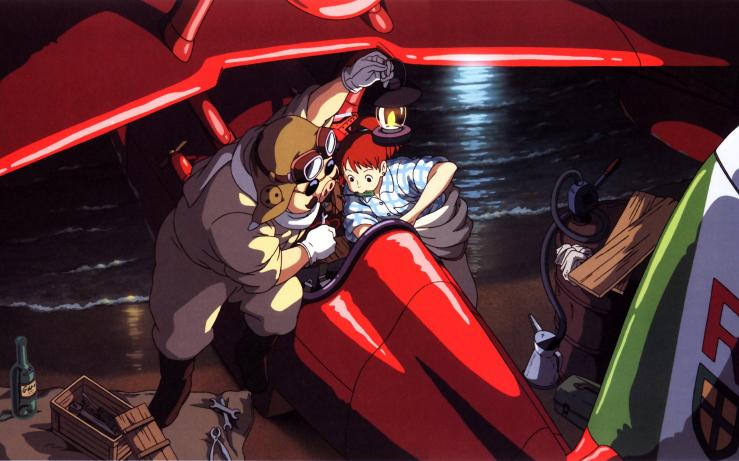
Unfortunately for Marco, luxurious isolation remains an impossibility. The air pirates hire a hotshot American to take out the damned Crimson Pig once and for all. Donald Curtis (hailing from Alabama in the Japanese version and Texas in the American) exemplifies American cockiness. His enormous jaw precedes the rest of his swaggering body, he falls in love at first sight with any beautiful woman he sees, and he’s brash and impetuous. He wants to transition to Hollywood and eventually become the President of the United States! Curtis shoots up Marco’s plane early in the film, but our porcine hero escapes to Milan, where he rebuilds his plane with the help of a whiskered mechanic named Piccolo and his charming granddaughter Fio. Fio redesigns the plane and eventually becomes Marco’s sidekick, traveling with him back to the Adriatic and helping him face Curtis and the air pirates.

2_porco_rosso

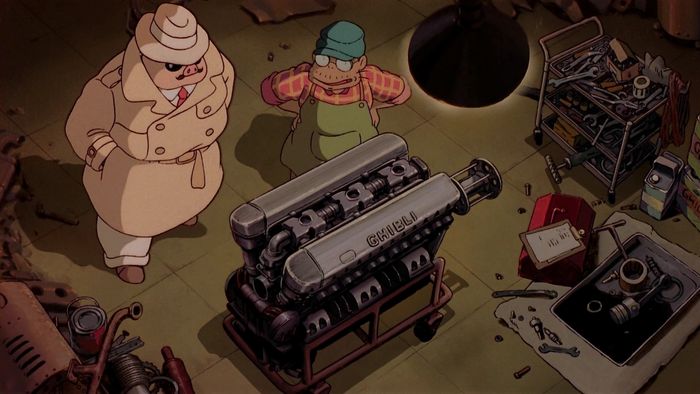
Fio, whose character design recalls Nausicaa of Nausicaä of the Valley of the Wind (1984), is another of Miyazaki’s prominent female protagonists. In some ways she is the secret hero of the film; she takes over the narration at the end, implicitly assuming Porco Rosso’s mantle. Fio has earned Marco’s trust after he is initially dubious of her ability because of her age and his sexism. Fio leads an all-female team of builders and engineers to recreate a superior version of Marco’s plane. This workshop sequence is one of the film’s finest. Miyazaki often foregrounds labor in his films, but Porco Rosso explicitly shows how a complex work—whether it’s a plane, or, y’know, a film—is never the singular work of a gifted genius, but rather the concentrated effort of a team. Miyazaki underscores the connection between the creative process of plane-building and film-making, stamping his studio’s name on Marco’s new engine. (Studio Ghibli was named after an Italian war plane, the Caproni Ca.309, which was nicknamed Ghibli—“Desert Wind”).

85268fc75512cda8cc331109c81ec95c

While in Milan, Marco realizes that the fascist secret police are after him. The Fascists in Porco Rosso (who want to conscript Marco—or take his plane) are far more ominous than Curtis. Curtis serves as an actual antagonist for Marco to face, and the fight between the two at the end of Porco Rosso, although violent, plays with a light comic touch. Miyazaki references the “gentlemen pilots” of World War I here. The Fascists, in contrast, are a spectral force lurking behind the narrative, threatening Marco’s individuality and autonomy. The film affirms itself as a comedy that resists encroaching fascism in a conclusion that sees Marco, Fio, Gina Curtis, the air pirates, and every other member of this strange Adriatic paradise working together to escape their approaching air force.

The film’s denouement is a retreat into the romantic Adriatic community, a kind of gauzy, rosy vision of an isolated paradise untouched by war or fascism. The fantasy reminds one of an island from some lost book of The Odyssey, a tranquil paradise unbothered by Trojans or Greeks. Marco—Porco—too feels like a figure from the margins of The Odyssey, a hero transfigured into a pig. The end of Porco Rosso refuses to give us a direct answer as to what happens to Porco. Does he regain his human form? Or, perhaps more importantly, is there a happy ending for Porco and Gina? The film offers a number of clues, some explicit and some implicit, but a first viewing may feel ambiguous for many viewers. However, subsequent viewings reveal a clearer picture as to what happens to Gina and Marco. Why the ambiguity then? Porco Rosso is (apart from The Wind Rises) the Miyazaki film with the strongest historicity. The historical reality of a looming World War II threatens to devour the romance of Gina and Porco—so Miyazaki and the inhabitants of his secret Adriatic world conspire to hide it. Lovely stuff.


How I watched itLast night with subtitles at my local indie cinema with full attention—and then again this afternoon, dubbed, on a large TV (via a USB drive with an .mkv file), with minor attention (I wrote this as I watched) with my daughter, who is home from school (poor dear has strep throat), and who was upset because we (that is, my family of four) were unable to watch the film as a family on Sunday afternoon, as it had sold out, and thus requested we watch it together, just now, which we did. Porco Rosso plays in select theaters one more time, by the way–on May 23rd, 2018.

Mary and the Witch’s Flower (Summer Film Log)

mary-and-the-witchs-flower-960x460

Mary and the Witch’s Flower (2017) tells the story of Mary Smith, a little girl whiling away her time in the English countryside home of her great aunt before school starts. Poor Mary is awfully bored—until she finds a rare flower called the “fly-by-night.” The fly-by-nights, which only bloom once every seven years, bestow magical properties on their user. Mary’s boredom is quickly cured when a flying broomstick whisks her away (black cat in tow) to a magical world above the clouds. She finds herself at the Endor College of Witches, where she’s taken on as a star pupil by the ominous headmistress Miss Mumblechook and her strange partner in scientific magic, Dr. Dee. They take Mary on a tour of Endor College, a visual highlight of a gorgeous film. The tour culminates in Miss Mumblechook’s office, which doubles as a museum of magical artifacts. Here, Mary—somewhat accidentally, but hey—becomes a biblioklept, stealing the headmistress’s book of master spells. Mary then reveals that her power comes from the fly-by-night flower. The film’s plot kicks into a higher gear here, as it becomes clear that Mumblechook and Dee will stop at nothing to get their clutches on the magical flowers.

marywitchesflower_gkids_launch

Mary and the Witch’s Flower is the first film from Studio Ponoc, a production company founded by Yoshiaki Nishimura, who previously worked as a producer for Studio Ghibli. Mary and the Witch’s Flower’s director Hiromasa Yonebayashi is another Studio Ghibli alum; he worked as a key animator on films like Spirited Away (2001), Howl’s Moving Castle (2004), and Ponyo (2008), before directing his own films for the studio—Arrietty (2010) and When Marnie Was There (2014).

Arrietty, while charming, felt like Miyazaki-lite—a small-scale exercise pulled off with aesthetic precision that ultimately lacked the grand emotion that underwrites all the master’s greatest films. In contrast, Mary and the Witch’s Flower isn’t so much Miyazaki-lite as Miyazaki-mega, a love letter composed under heavy anxiety of influence. The film teems with references to Miyazaki’s oeuvre, and Yonebayashi’s visual style is an homage on par with (if not surpassing) the master.

mary-witches-flower

The most immediate comparison viewers might make here is to Miyazaki’s Kiki’s Delivery Service (1989), which Yonebayashi’s film clearly echoes visually with its flying broomsticks and its prominent black cat. However, Mary and the Witch’s Flower has more in common (both in its plot, themes, tone, and visuals) with later Miyazaki films like PonyoHowl’s Moving Castle, and Spirited Away. I’m tempted to produce a laundry list here of specific comparisons, but there are simply too many—Yonebayashi delights in larding his film with characters and images that visually resemble Ghibli characters and images, painted in the bright shimmering colors of Miyazaki’s late period. There isn’t a shot in the film that doesn’t crib, even obliquely, from an earlier Ghibli film. (Hell, even composer Takatsugu Muramatsu’s soundtrack sounds like an homage to Joe Hisaishi’s work for Studio Ghibli).

These Easter eggs are most fun to find when Yonebayashi goes beyond the core films that his pastiche derives from, like when we get a shot of a city in the clouds that echoes Castle in the Sky (1986), or when a gray cat is transmuted into a creature resembling something like the gentle creatures from Totoro (1988), or when Yonebayashi’s frame lingers just a second too-long on a pigman chef who bears more than a passing resemblance to the titular hero of Porco Rosso (1992).

Yonebayashi’s melange of Miyazaki is hardly a patchwork of references though. Mary and the Witch’s Flower is rather a loving synthesis of the master’s greatest tendencies. Calling Yonebayashi a copycat simply will not do—he was a key artisan in Miyazaki’s workshop after all, and we see here the same level of technical craftsmanship that made the Ghibli films so special.

What’s missing from the film though is something harder to define. An auteur relies on a company, a workshop, a cohort of skilled artisans to help the auteur realize his or her vision. All auteurs borrow or outright steal from the artists that come before them, but the great artists conjure those ingredients into something new. They overcome their anxiety of influence and synthesize the masterworks that preceded them with their own visions, inspiriting the material with their own sense of soul. Yonebayashi’s film, as I wrote above, is a loving synthesis of Miyazaki’s most magical moments, but what’s missing is Yonebayashi’s own magic, his own vision.
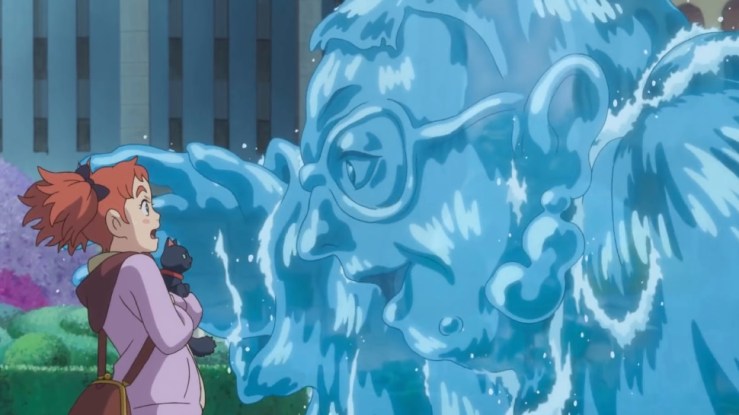
And yet there’s so much promise in the young artist. Yonebayashi is only 44; Miyazaki was around the same age when he made Castle in the Sky, the first Ghibli film, and frankly one of his weakest. Castle in the Sky is best enjoyed now as a work in retrospect, after having traced the auteur’s major themes in grander works like Spirited Away or The Wind Rises (2013). With Mary and the Witch’s Flower, Yonebayashi composed a love letter to the workshop where he honed his craft, and the film will probably be most remembered (and enjoyed) as an homage to all things Ghibli. Let’s hope that Yonebayashi’s next effort sees the young director break free from the anxiety of influence to offer us his own original vision.


How I watched it: On a big TV, rented from iTunes, with full attention, with my family. My daughter gave it a B+; my son gave it a B-.

Blog about the first half of Antoine Volodine’s Writers

img_9711

Antoine Volodine’s collection of loosely-connected stories Writers (2010; English translation by Katina Rogers, Dalkey Archive, 2014) is 108 pages. I have read the first four of the seven stories here—the first 54 pages. This is the first book by Volodine that I have read. Antoine Volodine is in fact a pseudonym, I know, but I don’t know much else about the writer. I’ve been meaning to read him for a few years, after some good folks suggested I do so, but I’ve never come across any of his books in the wild until this weekend. After I finish Writers I will read more about Volodine, but for now I am enjoying (?) how and what this book teaches me about the bigger project Volodine seems to be working towards.

That bigger project evinces in the first story in the collection, “Mathias Olbane,” which centers on the titular character, a writer who tries to hypnotize himself into a suicide attempt. Poor Mathias goes to prison for twenty-six years — “He had assassinated assassins.” Like most of the figures in Writers (so far anyway—you see by the title of this post that I am reporting from half way through, yes?) — like most of the figures in Writers, Mathias is a revolutionary spirit, resisting capitalist power and conformist order through radical violence. Before prison, Mathias wrote two books. The first, An Autumn at the Boyols’ “consisted of eight short texts, inspired by fantasy or the bizarre, composed in a lusterless but impeccable style. Let’s say that it was a collection that maintained a certain kinship with post-exoticism…” The description of the book approximates a description of Writers itself; notably, Volodine identifies his own genre as post-exoticism. Autumn at the Boyols’ doesn’t sell at all, and its sequel, Splendor of the Skiff (which “recounted a police investigation, several episodes of a global revolution, and traumatizing incursions into dream worlds”) somehow fares even worse. Mathias begins a new kind of writing in prison:

…after twenty-six years in captivity, he had forged approximately a hundred thousand words, divided as follows:

  • sixty thousand first and last names of victims of unhappineess
  • twenty thousand names of imaginary plants, mushrooms, and herbs
  • ten thousand names of places, rivers, and localities
  • and ten thousand various words that do not belong to any language, but have a certain phonetic logic that makes them sound familiar

I love the mix of tones here: Mathias Olbane’s grand work is useless and strange and sad and ultimately unknowable, and Volodine conveys this with both sinister humor and dark pathos. Once released from prison, our hero immediately becomes afflicted with a rare and incurable and painful disease. Hence, the suicide urge. But let’s move on.

The second tale in Writers, “Speech to the Nomads and the Dead,” offers another iteration of post-exotic writing, both in form and content. The story plays out like a weird nightmare. Linda Woo, isolated and going mad in a prison cell, conjures up an audience of burn victims, an obese dead man, Mongolian nomads, and several crows. She delivers a “lesson” to her auditors (a “lesson,” we learn, is one of post-exoticism’s several genres). The lesson is about the post-exotic writers themselves. She names a few of these post-exotic writers (Volodine is addicted to names, especially strange names), and delivers an invective against the modern powers that the post-exotic writers write against:

Post-exoticism’s writers…have in their memory, without exception, the wars and the ethnic and social exterminations that were carried out from one end of the 20th century to the other, they forget none and pardon none, they also keep permanently in mind the savageries and the inequalities that are exacerbated among men…

The above excerpt is a small taste of Woo’s bitter rant, which goes on for long sentence after long sentence (Volodine is addicted to long sentences). Like Mathias Olbane, Linda Woo writes in the face of futility, creating the “post-exotic word,” a word that creates an “absurd magic” that allows the post-exotic writers to “speak the world.”

Linda Woo’s name appears in the next story in Writers, “Begin-ing,” if only in passing. This story belongs to an unnamed writer, yet another prisoner. Wheelchair-bound, he is interrogated and tortured by two insane inmates who have taken over their prison, having killed their captors. The pair, Greta and Bruno Khatchatourian, are thoroughly horrific, spouting abject insanities that evoke Hieronymus Boschs’s hell. They are terrifying, and I had a nightmare the night that I read “Begin-ing.” It’s never quite clear if Greta and Bruno Khatchatourian are themselves post-exotic writers gone mad or just violent lunatics on the brink of total breakdown. In any case, Volodine affords them dialogue that veers close to a kind of horror-poetry. “We can also spew out the apocalypse,” Greta defiantly sneers. They torture the poor writer. Why?

They would like it, in the end, if he came around to their side, whether by admitting that he’s been, for a thousand years, a clandestine leader of dark forces, or by tracing for them a strategy that could lead them to final victory. … They would like above all for him to help them to drive the dark forces out from the asylum, to prepare a list of spies, they want him to rid the world of the last nurses, of Martians, of colonialists, and of capitalists in general.

The poor writer these lunatics torture turns inward to his own formative memories of first writings, of begin-ing, when he created his own worlds/words in ungrammatical misspelled scrawlings, filling notebook after notebook. Volodine unspools these memories in sentences that carry on for pages, mostly centering on the writer’s strange childhood in an abject classroom where he engages in depravities that evoke Pasolini’s Salò. And yet these memories are the writer’s comfort—or at least resistance—to the lunatics’ violence. Volodine’s prose in “Begin-ing” conjures Goya’s various lunatics, witches, demons, and dogs. It’s all very upsetting stuff.

Courtyard with Lunatics, 1794 by Francisco Goya (1746-1828)

After the depravity of “Begin-ings,” the caustic comedy of the next story “Acknowledgements” is a welcome palate cleanser. In this story’s twelve pages (I wish there were more!) Volodine simultaneously ridicules and exults the “Acknowledgements” page that often appends a novel, elevating the commonplace gesture to its own mock-heroic genre. The story begins with the the hero-writer thanking “Marta and Boris Bielouguine, who plucked me from the swamp that I had unhappily fallen into along with the bag containing my manuscript.” The “swamp” here is not a metaphor, but a literal bog the writer nearly drowned in. And the manuscript? A Meeting at the Boyols’, a title that recalls poor Mathias Olbane’s first book  An Autumn at the Boyols’. Each paragraph of “Acknowledgments” is its own vignette, a miniature adventure in the form of a thank-you note to certain parties. Most of the vignettes end in sex or death, or an escape from one of the two. “Grad Litrif and his companion Lioudmila” as well as “the head of the Marbachvili archives” (oh the names in this story!) are thanked for allowing the writer

…to access the notebooks of Vulcain Marbachvili, from which I was able, for my story Long Ago to Bed Early, to copy several sentences before the earthquake struck that engulfed the archives. My thanks to these three people, and apologies to the archivist, as I was sadly unable to locate either her name or her body in the rubble.

“Acknowledgments” is littered with such bodies—sometimes victims of disasters and plagues, and elsewhere the bodies of the married or boyfriended women the writer copulates with before escaping into some new strange circumstances (he often thanks the husbands and the boyfriends, and in one inspired moment, thanks a gardener “who one day had the presence of mind to detain Bernardo Balsamian in the orchard while Grigoria and I showered and got dressed again”). He thanks a couple who shows him their collection of 88 stuffed guinea pigs; he thanks “the leader of the Muslim Bang cell” who, during his “incarceration in Yogyakarta…forbid the prisoners on the floor from sodomizing” him; he thanks the “Happy Days” theater troupe who “had the courage” to perform his play Djann’s Awakening three times “before a rigorously empty room.” Most of the acknowledgments connect the writer’s thank-you to a specific book he’s written. I’m tempted to list them all (oh the names!), but just a few—Tomorrow the OttersEve of PandemicJournal of PandemoniumGoodbye CloudsGoodbye RomeoMlatelpopec in ParadiseMacbeth in ParadiseHell in Paradise…Without exaggeration: “Acknowledgements” is one of the funniest stories I’ve ever read.

With its evocations of mad and obscure writers, Volodine’s books strongly reminds me of Roberto Bolaño’s work. And yet reading it is not like reading an attempt to copy another writer—which Volodine is in no way doing—but rather like reading a writer who has filtered much of the same material of the 20th century through himself, and has come to some of the same tonal and thematic viewpoints—Volodine’s labyrinth is dark and weird and sinister and abject, but also slightly zany and terribly funny. More to come.


Blog about Iris Murdoch’s novel The Bell

img_9112

I have just finished Iris Murdoch’s 1958 novel The Bell. This is the first novel I have read by Murdoch and I now want to read more novels by Murdoch, which I suppose is the best praise I can offer the novel.

The Bell is set primarily in Imber House, a large old mansion in the English countryside. Imber House adjoins a Benedictine abbey; this nunnery is essentially closed off to the outside world. The residents of Imber House form a “brotherhood,” a laity of would-be acolytes who strive to find spiritual meaning in the commercial and often venal world of the postwar era. Various conflicts between these characters drive the plot of The Bell.

One of these conflicts, especially notable for a novel published in 1958, involves Michael, the leader of the Imber House community. A former schoolmaster who dreamed of joining the clergy, Michael lost his job in a small scandal for “seducing” one of his students, Nick, a teenage boy at the time. Over a decade later, circumstance brings Nick to Imber House, where his twin sister Katherine is staying. Katherine plans to join Imber Abbey; in the meantime, her family hopes that the religious solitude at Imber House will help Nick recover from his alcoholism. The conflict between Michael and Nick becomes further charged when the youngest member of Imber House, a teenager named Toby, befriends both of them.

I could go on about Michael and Nick and Toby and Katherine and etc., but the real star of The Bell is Dora Greenfield, a wonderfully complicatedly simple unassuming unpretentious flighty former art student who has recently left her demanding husband Paul. Through Murdoch’s precise free indirect style, we get to inhabit Dora’s constantly vacillating mind. Like many people, Dora does not know what she is going to do, and even when she thinks through a plan, she often ends up doing the opposite of what she had intended to do. There is a hilarious passage in the novel’s first chapter when Dora goes through a lengthy imaginative exercise about giving up her train seat to an elderly woman. Dora’s thought experiment ends like this:

She decided not to give up her seat.

She got up and said to the standing lady ‘Do sit down here, please. I’m not going very far, and I’d much rather stand anyway.’

The blank space between those sentences highlights a radical gap between contemplation and action.

The train-seat passage is one of many humorous episodes in The Bell, but Murdoch’s humor is underwritten by a deeper menacing anxiety, which can be neatly summed up in the novel’s opening sentences:

Dora Greenfield left her husband because she was afraid of him. She decided six months later to return to him for the same reason.

Those opening lines basically summarize the big thematic plot of The Bell—the conflict between controlling and ultimately abusive Paul and his much younger wife. (“She married him a little for his money,” Murdoch writes just a few paragraphs in, wedging the detail between more positive aspects of Paul’s character–the “a little” is just genius there, the slightest omission from Dora’s consciousness slipping into the third-person narrator for the briefest of moments). The opening lines of The Bell also showcase Murdoch’s rhetorical powers. Her comic precision here reverberates with a hazardous undertone.

Will Dora really return to her husband? Or will she become her own person—whatever that means? The Bell satisfies these questions with complex answers. The novel has every opportunity to veer toward pat conclusions. Murdoch fills her novel with images that suggest a conventional tragic conclusions, and then surpasses these conventions, turning them into something else. A death by drowning might be foreshadowed, but someone will learn to swim; an epiphany achieved in an art museum might not meet its achievement outside of aesthetic response; the Blakean contraries of innocence and experience might be synthesized into a new, original viewpoint. There’s something real about The Bell—it offers a realism that points outside of its own literary contours. The English novelist A.S. Byatt puts it far better than I can in her essay “Shakespearean Plot in the Novels of Irish Murdoch”:

 …The Bell seems to me arguably Miss Murdoch‘s most successful attempt at realism, emotional and social—the tones of voice of the members of the religious community are beautifully caught, the sexual, aesthetic and religious passions and confusions of the three main characters, Dora, Michael, and, to a lesser extent, Toby, are delicately analysed with the combination of intellectual grasp and sensuous immediacy of George Eliot.

Byatt’s comparison to Eliot reminds me that I had intended to read Middlemarch some time this year—but to be fair to myself, I put The Bell on the same list. I won’t be reading Middlemarch next though; The Bell, with its story of a would-be utopian community, strongly reminded me of Nathaniel Hawthorne’s The Blithedale Romance, which I haven’t read in ages. And after I read that, I’d like to read another one by Iris Murdoch. Any recommendations?

A review of Stanisław Ignacy Witkiewicz’s Narcotics

dvsfm7rvwaaoolo

“The main difficulty with Stanisław Ignacy Witkiewicz,” writes Soren Gauger in his translator’s note for Narcotics, “is that no matter what he was writing, it seems he wished he were writing something else.” Witkiewicz’s playful (and occasionally frustrating) discursive style is on vivid display in the six essays that comprise most of Narcotics (new in hardback from Twisted Spoon Press)Witkiewicz’s stylistic twists are one of the joys of Narcotics. A moralizing diatribe might veer into medical discourse; private anecdotes might shift into a rant on class theory or a patchy precis of a book about physiognomy. (All delivered in a semi-ironic-yet-wholly-sincere tone). In the case of Witkiewicz’s essay “Peyote,” we go from “Elves on a seesaw. (Comedic number)” to “A battle of centaurs turned into a battle between fantastical genitalia.” This last note is preceded by the observation that “Goya must have known about peyote.”

img_9138

“Peyote” is the most vivid and surreal of the essays in Narcotics. Unlike the other sections, this chapter most closely resembles a conventional drug diary. “Peyote” begins with Witkiewicz taking his first of seven (!) peyote doses at six in the evening and culminating around eight the following morning with “Straggling visions of iridescent wires.” In increments of about 15 minutes, Witkiewicz notes each of his surreal visions. The wild hallucinations are rendered in equally surreal language: “Mundane disumbilicalment on a cone to the barking of flying canine dragons” here, “The birth of a diamond goldfinch” there. Gauger’s translation conveys not just the wild imagery, but also the wild linguistic spirit of Witkiewicz’s prose.

img_9142

The prose in “Peyote” most closely approximates the spirit of Witkiewicz’s wonderful paintings. Narcotics includes 34 full-color reproductions of Witkiewicz’s art, which is reason enough to pick up this volume. According to Narcotics’ blurb, Witkiewicz (or Witkacy as he is commonly known) “established rules and types for his portrait work, marking the paintings and pastels with corresponding symbols and abbreviations of the substances he had either taken or, in the case of alcohol and nicotine, not taken at the time.”

For example, we see that Witkiewicz has noted that he had ingested cocaine and eucodal (a semi-synthetic opioid) in order to paint the Portrait of Michal Jagodowski (below). Narcotics includes a helpful “List of Symbols” as a glossary for the shorthand Witkiewicz used both in the text of his writings and in his paintings. (Although “her (herbata): tea” is included in the gloss, this vice regretfully does not merit its own essay).

img_9139

In addition to peyote, we get essays on nicotine, alcohol, cocaine, morphine, and ether (a list that may remind you of a certain Queens of the Stone Age jam). In “Nicotine,” Witkiewicz despairs that “A person deadened by tobacco and alcohol…seeks even more mind-numbing entertainment to relax,” whether that be the “utterly depraved cinema with its vacuous attempts at artistry,” or the “sensory narcotization through music” achieved by “station surfing” on the radio. (Even worse is “chronic and brainless dancing, that most monstrous of modern society’s unacknowledged plagues”).

In “Alcohol,” Witkiewicz concedes that “alcohol lets you perform actions at a particular moment that otherwise would not have been possible right then,” before launching into a sustained attack on alcohol as a creative crutch. His most convincing (and depressing) line here is “alcohol is boring. Anyone who has abused it even mildly knows this to be true.” (If this were a different sort of review, I might riff here a bit on the fact that I drank no fewer than three glasses of Cabernet Sauvignon while writing about Narcotics).

Witkiewicz, despite his exorbitant indulgences, is a bit of a snob—a modernist snob though. From frenzied, enthusiastic experience he warns us that “cocaine is one of the worst kinds of filth,” before plugging his cocaine novel Farewell to Autumn and offering a synopsis of one of the novel’s chapters, a so-called “cocaine orgy.” (The editors of Narcotics graciously include a brief selection from Farewell to Autumn, as well as additional essays by Witkiewicz on hygiene and other matters).

In the last two essays, Wietkiewicz hands the reins over to friends (designated drivers?). In “Morphine,” Bohdan Filipowski warns that, “before you can taste the sweets of narcotic paradises you must first be miserable, you must first travel through all manner of hell and suffering in life, only then to find yourself in addled stupefaction, which ultimately is all there is.” The essay “Ether” — a drug that packs a “powerful metaphysical wallop” is attributed to “Dr. Dezydery Prokopowicz,” a pseudonym for Wietkiewicz’s friend, poet Stefan Glass.

img_9141

The admonition that “before you can taste the sweets of narcotic paradises you must first be miserable” is pretty much the thesis for Narcotics, a book that simultaneously celebrates and reviles drug use. Misery is the byword here, a word we find repeated in in Henri Michaux’s 1956 collection Miserable Miracle. Published a quarter century after Narcotics, the two volumes share much in common. Too, Narcotics picks up some of the threads that we find in Thomas De Quincey’s Confessions of an English Opium-Eater(1821)–that foregrounding of suffering, even if it also anticipates the (exhaustive) drug literature of the 1960s, which wasn’t nearly so reticent about banging the narcotic gong. And yet Witkiewicz seems to wink at us through all the moralizing and apologia, suggesting that, yes, narcotics, are, like, bad—they are a crutch, a shortcut, a substitute for true artistic inspiration—but he also shows how utterly modern the process of consuming mind-and-body-altering substances is. Witkiewicz comprehends the dangers of narcotics. He’s out there on the ledge, dancing around a bit, his foot wagging over the precipice, while he grins and says, “Hey, don’t try this at home.”

Try this at home. Stanisław Ignacy Witkiewicz’s Narcotics, translated from the Polish by Soren Guager is new in hardback from Twisted Spoon Press. Just Say Yes.

A review of The Paris Review’s overproduced podcast

64100a01b64641e5115c2c856d12fd7e_89081506

In his introduction to the first episode of The Paris Review Podcast, former editor Lorin Stein tells us that we’re going to hear some great writing. He then claims, “what you won’t hear is much in the way of hosting from me or anyone else. We’re just going to let the writing speak for itself, the way it always has in the magazine.” The first two parts are true—there’s plenty of great writing here from The Paris Review archive, and there’s no one hosting the pieces. The last part of Stein’s claim is the problem though: The Paris Review Podcast repeatedly refuses to simply let the writing speak for itself. Prose and poems alike are slathered in distracting and silly sound effects and busy musical cues. This is a shame, because the estimable voice talents the producers have enlisted do a marvelous job conveying the tones, mood, and rhythms of the pieces the producers have selected (most of which are excellent). Perhaps the podcast’s producers simply don’t trust their readers enough to stay engaged without all the buzzing clutter—but for me the overproduction is too much.

There are ten episodes of The Paris Review Podcast to date. I have listened to half of them: episodes 10, 1, 5, 2, and 3 (in that order). Episode 10, “The Occasional Dream,” was perhaps an unfortunate starting point, as it contains some of the most overproduced segments I heard in the series.

The problem wasn’t the first selection, a fantastic Frank O’Hara poem called “A True Account of Talking to the Sun at Fire Island” which I’d never read before. David Sedaris’s reading conveys the poem’s wit and depth, and the musical cues are only mildly intrusive, bleeding in at beginning and end. Then we get to Roberto Bolaño’s poem “When Lisa Told Me,” read by Dakota Johnson. The poem is set in a phone booth, so the producers, not trusting Bolaño’s powers of mimesis, or the auditor’s imagination (or both), include phone booth sound effects, like change dropping into a slot, buttons being punched, a dial tone. There’s also some distracting music. All of this takes away from Bolaño’s music (and Johnson’s capable reading).

By the time I got to Mary-Louis Parker reading Joy Williams’s story “Making Friends” I was dismayed. Cheesy calypso music crawls all over the story. When Williams notes a dog panting, the producers employ the sound effect of a dog panting. This is not how fiction works. In my distracted consternation, I forgot to pay attention to the story itself.

The worst offender by far though is an archival recording of John Ashberry reading his poem “Soonest Mended” which has been, for some reason I do not understand, accompanied by a new guitar composition by Steve Gunn. Gunn’s music is wonderful, his guitar evocative of fingerpickers like John Fahey and Leo Kottke, and I would be happy to listen to it on its own. Mashing it up with Ashberry’s poem adds nothing—or rather, we have subtraction by addition.

Archival recordings fare better elsewhere. In Episode 2, Jack Kerouac tells the story of the Buddha without any fussy interruptions. Kerouac’s unadorned riff showcases the podcast’s potential to present wonderful little moments, stitching them to other wonderful moments, without any overproduced impositions. Similarly, the inaugural episode, “Times of Cloud,” gives us Maya Angelou and Paris Review founder George Plimpton in conversation. The producers choose an apt moment; Angelou essentially offers a raison dêtre for The Paris Review Podcast:

I want to hear how English sounds; how Edna St. Vincent Millay heard English. I want to hear it, so I read it aloud. It is not so that I can then imitate it. It is to remind me what a glorious language it is.

The most “glorious language” in Episode 1 of The Paris Review Podcast comes from Wallace Shawn reading Denis Johnson’s classic story “Car-Crash While Hitchhiking.” A really good reader—and Wallace Shawn is a really good reader—can help us hear a story we’ve read a dozen times in a new way. It’s a testament to both Shawn’s reading and Johnson’s prose that they withstand the goofy sound effects and needless music the producers daub all over the story. Johnson’s narrator has already told us that it is raining; we do not need a canned rain shower murking up the audio.

The mimetic cloudiness of sound effects can be cheesy, but the unneeded musical cues are often the more damaging imposition. In Episode 5, Alison Fraser reads Lucia Berlin’s  “B.F. and Me,” conveying the story’s odd flirty energy with aplomb. The bluesy vamping soundtrack adds nothing though—again, it takes away from the auditor’s experience of the prose. In the same episode, Caleb Crain reads his wonderful short story “Envoy.” The tale’s strange poignant climax manages to survive the unnecessary intrusion of a heavy-handed musical cue that could easily have disrupted the ambiguities in the last few sentences. A Dorothea Lasky poem in Episode 3 begins well enough. Its imagistic contours of concrete reality unfurl without any noisy claptrap. But when the poem’s second half steers toward abstraction, the producers add a piano étude to compete with Lasky’s own music. And in the climactic moment in Raymond Carver’s “Why Don’t You Dance?” (also in Episode 3)—you know, the part where the characters, um, dance—the producers actually add a fucking country waltz.

The Paris Review Podcast perhaps suffers from an anxiety of influence. I imagine the show wishes to separate itself from The New Yorker’s no-frills Fiction Podcast, where one author reads another author’s story, and then discusses the story with New Yorker fiction editor Deborah Treisman. The Paris Review Podcast veers far more closely to the busy buzziness of Radiolab, with a dash of This American Life. I can understand the appeal there, the attempt to capture some of that ole timey radio Foley stage energy. But Radiolab is its own medium with its own formal innovations. The Paris Review is a mixtape, yes, but it’s a mixtape of poetry, prose, and interviews. A poem that John Ashberry wrote and read aloud in his own voice does not need the innovation of a contemporary guitar score. We do not need the sound of shallots simmering in a pan to convey that someone is cooking, as happens in Shelly Oria’s story “My Wife, In Converse.” We do not need a bluesy-guitar bend or the sustain of melancholy piano chords to convey the emotion that the writer has already conveyed through the language.  The effect of such impositions is like someone doing shadow puppets over an oil painting, or talking during a film, or pouring soup over a really good salad.

And yet you’ll note above that I listened to half of the podcasts. I listened while walking or driving or doing small household chores or yard chores. The stories, the poems, the interviews are quite good. There’s so much potential here. But it often seems like The Paris Review Podcast is content to present the material as an ambient backdrop, an aural texture that might compete with a commute. This is wholly unnecessary. The form is already there, embedded in the content—the language itself. And the language is best—most glorious, Angelou might say—when it is naked.