Writing a novel is one of those modern rites of passage, I think, that lead us from an innocent world of contentment, drunkenness, and good humor, to a state of chronic edginess and the perpetual scanning of bank statements. By the eighteenth book, one has a sense of having bricked oneself into a niche, a roosting place for other people’s pigeons. I wouldn’t recommend it.
Shakespeare has given several allusions to the old customs associated with drinking, which have always varied in different countries. At the present day many of the drinking customs still observed are very curious, especially those kept up at the universities and inns-of-court. Alms-drink was a phrase in use, says Warburton, among good fellows, to signify that liquor of another’s share which his companion drank to ease him. So, in “Antony and Cleopatra” (ii. 7) one of the servants says of Lepidus: “They have made him drink alms-drink.”
By-drinkings.This was a phrase for drinkings between meals, and is used by the Hostess in “1 Henry IV.” (iii. 3), who says to Falstaff: “You owe money here besides, Sir John, for your diet, and by-drinkings.”
Hooped Pots.In olden times drinking-pots were made with hoops, so that, when two or more drank from the same tankard, no one should drink more than his share. There were generally three hoops to the pots: hence, in “2 Henry VI.” (iv. 2), Cade says: “The three-hooped pot shall have ten hoops.” In Nash’s “Pierce Pennilesse” we read: “I believe hoopes on quart pots were invented that every man should take his hoope, and no more.” The phrases “to do a man right” and “to do him reason” were, in years gone by, the common expressions in pledging healths; he who drank a bumper expected that a bumper should be drunk to his toast. To this practice alludes the scrap of a song which Silence sings in “2 Henry IV.” (v. 3): “Do me right, And dub me knight: Samingo.” He who drank, too, a bumper on his knee to the health of his mistress was dubbed a knight for the evening. The word Samingo is either a corruption of, or an intended blunder for, San Domingo, but why this saint should be the patron of topers is uncertain.
Rouse.According to Gifford, [972] a rouse was a large glass in which a health was given, the drinking of which, by the rest of the company, formed a carouse. Hamlet (i. 4) says: “The king doth wake to-night, and takes his rouse.” The word occurs again in the following act (1), where Polonius uses the phrase “o’ertook in’s rouse;” and in the sense of a bumper, or glass of liquor, in “Othello” (ii. 3), “they have given me a rouse already.”
Sheer Ale. This term, which is used in the “Taming of the Shrew” (Induction, sc. 2), by Sly—“Ask Marian Hacket, the fat ale-wife of Wincot, if she know me not: if she say I am not fourteen pence on the score for sheer ale”—according to some expositors, means “ale alone, nothing but ale,” rather than “unmixed ale.”
Sneak-cup. This phrase, which is used by Falstaff in “1 Henry IV.” (iii. 3)—“the prince is a Jack, a sneak-cup”—was used to denote one who balked his glass.
From Thomas Firminger Thiselton-Dyer’s indispensable volume Folk-lore of Shakespeare.
With blunt grace, Denis Johnson navigates the line between realism and the American frontier myth in his perfect novella Train Dreams. In a slim 116 pages, Johnson communicates one man’s life story with a depth and breadth that actually lives up to the book’s blurb’s claim to be an “epic in miniature.” I read it in one sitting on a Sunday afternoon, occasionally laughing aloud at Johnson’s wry humor, several times moved by the pathos of the narrative, and more than once stunned at the subtle, balanced perfection of Johnson’s prose, which inheres from sentence to paragraph to resonate throughout the structure of the book.
The opening lines hooked me:
In the summer of 1917 Robert Grainier took part in an attempt on the life of a Chinese laborer caught, or anyway accused of, stealing from the company stores of the Spokane International Railway in the Idaho Panhandle.
Three of the railroad gang put the thief under restraint and dragged him up the long bank toward the bridge under construction fifty feet above the Moyea River. A rapid singsong streamed from the Chinaman voluminously. He shipped and twisted like a weasel in a sack, lashing backward with his one free fist at the man lugging him by the neck.
The matter-of-fact violence here complicates everything that follows in many ways, because Grainier it turns out is pretty much that rare thing, a good man, a simple man who tries to make a life in the Idaho Panhandle at the beginning of the 20th century. The rest of the book sees him trying—perhaps not consciously—to somehow amend for the strange near-lynching he abetted.
Grainier works as a day laborer, felling the great forests of the American northwest so that a network of trains can connect the country. Johnson resists the urge to overstate the obvious motifs of expansion and modernity here, instead expressing depictions of America’s industrial growth at a more personal, even psychological level:
Grainier’s experience on the Eleven-Mile Cutoff made him hungry to be around other such massive undertakings, where swarms of men did away with portions of the forest and assembled structures as big as anything going, knitting massive wooden trestles in the air of impassable chasms, always bigger, longer, deeper.
Grainier’s hard work keeps him from his wife and infant daughter, and the separation eventually becomes more severe after a natural calamity, but I won’t dwell on that in this review, because I think the less you know about Train Dreams going in the better. Still, it can’t hurt to share a lovely passage that describes Grainier’s courtship with the woman who would become his wife:
The first kiss plummeted him down a hole and popped him out into a world he thought he could get along in—as if he’d been pulling hard the wrong way and was now turned around headed downstream. They spent the whole afternoon among the daisies kissing. He felt glorious and full of more blood than he was supposed to have in him.
The passage highlights Johnson’s power to move from realism into the metaphysical and back, and it’s this precise navigation of naturalism and the ways that naturalism can tip the human spirit into supernatural experiences that makes Train Dreams such a strong little book. In the strange trajectory of his life, Grainier will be visited by a ghost and a wolf-child, will take flight in a biplane and transport a man shot by a dog, will be tempted by a pageant of pulchritude and discover, most unwittingly, that he is a hermit in the woods. In Johnson’s careful crafting, these events are not material for a grotesque picaresque or a litany of bizarre absurdities, but rather a beautiful, resonant poem-story, a miniature history of America.
Train Dreams is an excellent starting place for those unfamiliar with Johnson’s work, and the book will rest at home on a shelf with Steinbeck’s naturalist evocations or Cormac McCarthy’s Border Trilogy. I have no idea why the folks at FS&G waited almost a decade to publish it (Train Dreams was originally published in a 2002 issue of The Paris Review), but I’m glad they did, and I’m glad the book is out now in trade paperback from Picador, where it should gain a wider audience. Very highly recommended.
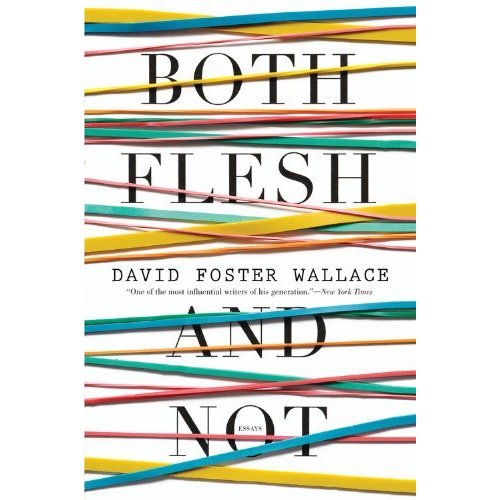
Not really news, but I somehow missed this: Both Flesh and Not has a cover, apparently, as well as a product description:
Beloved for his epic agony, brilliantly discerning eye, and hilarious and constantly self-questioning tone, David Foster Wallace was heralded by both critics and fans as the voice of a generation. BOTH FLESH AND NOT gathers 15 essays never published in book form, including “Federer Both Flesh and Not,” considered by many to be his nonfiction masterpiece; “The (As it Were) Seminal Importance of Terminator 2,” which deftly dissects James Cameron’s blockbuster; and “Fictional Futures and the Conspicuously Young,” an examination of television’s effect on a new generation of writers.
Both Flesh and Not is due around Thanksgiving this year.
What about your critics? Can you just sum up briefly what you hold against the French press?
HOUELLEBECQ
First of all, they hate me more than I hate them. What I do reproach them for isn’t bad reviews. It is that they talk about things having nothing to do with my books—my mother or my tax exile—and that they caricature me so that I’ve become a symbol of so many unpleasant things—cynicism, nihilism, misogyny. People have stopped reading my books because they’ve already got their idea about me. To some degree of course, that’s true for everyone. After two or three novels, a writer can’t expect to be read. The critics have made up their minds.
A grand duke—“Jimber-jawed Serge.”
Name: Umphadel Piluski
Gangster Salve Spitale—Saliva Spit.
Gooshoofenstein Von Beasinghausen
Meglomania McCarthy
English clubman named Cumbersom
Names Lee Spurgeon, Stoner, Mortimer, Flieshhacker, Henry P. Jacques. Borre.
Bryon Appledeck
Name for movie house “What’s at the Dementia?”
Mr. Schlchgd from Notre Dame in novel.
Beauty boy Johnston
Name Howya Bartlett
Joe Crusoe
Hummer for name
The Marquise de la Close d’Hirondelle
Tookey Ledoux
Harry Fantum
George Gratteciel
Marylyn Miller Swann, Sherlock Holmes Swann
Futility Trust Company
Name of “La Paix” changed to “Thropaca”
Grandfather called Mo’papa
These new library projects might seem to emerge from a common culture and uphold a common mission — a flurry of press coverage in late 2011 represented them as a coherent “little library” movement. But in fact they don’t. They have varied aims and politics and assumptions about what a library is and who its publics are; their collections and services differ significantly; and their forms and functions vary from one locality to another. I want to attempt here to identify a loose, and inevitably leaky, typology of “little libraries” — to figure out where they’re coming from, how they relate to existing institutions that perform similar roles, and what impact they’re having on their communities.
Extract, from my typescript descriptive of Finn Mac Cool and his people, being humorous or quasi-humorous incursion into ancient mythology: Of the musics you have ever got, asked Conan, which have you found the sweetest?
I will relate, said Finn. When the seven companies of my warriors are gathered together on the one plain and the truant clean-cold loud-voiced wind goes through them, too sweet to me is that. Echo-blow of a goblet-base against the tables of the palace, sweet to me is that. I like gull-cries and the twittering together of fine cranes. I like the surf-roar at Tralee, the songs of the three sons of Meadhra and the whistle of Mac Lughaidh. These also please me, man-shouts at a parting, cuckoo-call in May. I incline to like pig-grunting in Magh Eithne, the bellowing of the stag of Ceara, the whinging of fauns in Derrynish. The low warble of water-owls in Loch Barra also, sweeter than life that. I am fond of wing-beating in dark belfries, cow-cries in pregnancy, trout-spurt in a laketop. Also the whining of small otters in nettle-beds at evening, the croaking of small-jays behind a wall, these are heart-pleasing. I am friend to the pilibeen, the red-necked chough, the parsnip land-rail, the pilibeen mona, the bottle-tailed tit, the common marsh-coot, the speckle-toed guillemot, the pilibeen sleibhe, the Mohar gannet, the peregrine plough-gull, the long-eared bush-owl, the Wicklow small-fowl, the bevil-beaked chough, the hooded tit, the pilibeen uisce, the common Corby, the fish-tailed mud-piper, the cruiskeen lawn, the carrion sea-cock, the green-lidded parakeet, the brown bog-martin, the maritime wren, the dove-tailed wheatcrake, the beaded daw, the Galway hill-bantam and the pilibeen cathrach. A satisfying ululation is the contending of a river with the sea. Good to hear is the chirping of little red-breasted men in bare winter and distant hounds giving tongue in the secrecy of fog. The lamenting of a wounded otter in a black hole, sweeter than harpstrings that. There is no torture so narrow as to be bound and beset in a dark cavern without food or music, without the bestowing of gold on bards. To be chained by night in a dark pit without company of chessmen – evil destiny! Soothing to my ear is the shout of a hidden blackbird, the squeal of a troubled mare, the complaining of wild-hogs caught in snow.
Relate further for us, said Conan.
It is true that I will not, said Finn.
A lovely early passage from Flann O’Brien’s first novel At Swim-Two-Birds.
Chapter 1.XIV. Upon looking into my mother’s marriage settlement, in order to satisfy myself and reader in a point necessary to be cleared up, before we could proceed any farther in this history;–I had the good fortune to pop upon the very thing I wanted before I had read a day and a half straight forwards,–it might have taken me up a month;–which shews plainly, that when a man sits down to write a history,–tho’ it be but the history of Jack Hickathrift or Tom Thumb, he knows no more than his heels what lets and confounded hindrances he is to meet with in his way,–or what a dance he may be led, by one excursion or another, before all is over. Could a historiographer drive on his history, as a muleteer drives on his mule,– straight forward;–for instance, from Rome all the way to Loretto, without ever once turning his head aside, either to the right hand or to the left,- -he might venture to foretell you to an hour when he should get to his journey’s end;–but the thing is, morally speaking, impossible: For, if he is a man of the least spirit, he will have fifty deviations from a straight line to make with this or that party as he goes along, which he can no ways avoid. He will have views and prospects to himself perpetually soliciting his eye, which he can no more help standing still to look at than he can fly; he will moreover have various Accounts to reconcile: Anecdotes to pick up: Inscriptions to make out: Stories to weave in: Traditions to sift: Personages to call upon: Panegyricks to paste up at this door; Pasquinades at that:–All which both the man and his mule are quite exempt from. To sum up all; there are archives at every stage to be look’d into, and rolls, records, documents, and endless genealogies, which justice ever and anon calls him back to stay the reading of:–In short there is no end of it;–for my own part, I declare I have been at it these six weeks, making all the speed I possibly could,–and am not yet born:–I have just been able, and that’s all, to tell you when it happen’d, but not how;–so that you see the thing is yet far from being accomplished. These unforeseen stoppages, which I own I had no conception of when I first set out;–but which, I am convinced now, will rather increase than diminish as I advance,–have struck out a hint which I am resolved to follow;–and that is,–not to be in a hurry;–but to go on leisurely, writing and publishing two volumes of my life every year;–which, if I am suffered to go on quietly, and can make a tolerable bargain with my bookseller, I shall continue to do as long as I live.
Chapter XIV of the first book of Laurence Sterne’s The Life and Opinions of Tristram Shandy, Gentleman.
There’s a part in William Gaddis’s big novel The Recognitions where Basil Valentine talks about how forged paintings are always outed as fakes over time because they ultimately illustrate not the original genius of the artist, but instead show how the current zeitgeist interprets the artist. Film adaptations of books aren’t painted forgeries, but they are highly susceptible to the same critical limitations that Valentine discusses. We can see this plainly in Baz Luhrmann’s 1996 adaptation of Romeo & Juliet, a messy, vibrant, flaky film thoroughly shot-through with the aesthetic spirit of the nineties. I like Luhrmann’s R&J, despite its many, many faults. One of its great saving graces is that it seems aware of its own spectacle—it unselfconciously acknowledges itself as a product of its time, as just one of many, many adaptations of Shakespeare’s deathless work.
Lurhmann has taken a stab at F. Scott Fitzgerald’s The Great Gatsby. He’s not the first. Others attempted to turn Fitzgerald’s classic novel of the jazz age into a movie in 1926 (the film is lost), 1949 (there’s a reason you never saw it in high school), and 1974 (I’ll come back to the Redford Gatsby in a moment). Most recently, a 2000 anemic TV production featured Mira Sorvino as Daisy and Paul Rudd as a terribly miscast Nick Carraway. Up until now, high school teachers across the country who wanted to foist an adaptation on their students (and maybe free up a day or two of lesson planning) have had to choose between the 2000 A&E production or Jack Clayton’s 1974 Francis Ford Coppola-penned debacle—this is the one I was subjected to in high school. It features Robert Redford as Gatsby, Sam Waterston as Nick, and Mia Farrow as Daisy, and none of them are terrible, but the movie is dull, overly-reverential of its source material, and heavy-handed. It also looks incredibly dated now, its evocations of the 1920’s jazz age petrified in gauzy ’70s soft-focus shots. It just looks and feels very 1970s.
Judging by its trailer, Lurhmann’s Gatsby is making absolutely no play at all for timelessness. Just as his earlier mashup, 2001’s Moulin Rouge!, essentially uses the BelleÉpoque as a sounding board for transgenerational spectacle, Lurhmann’s Gatsby looks like another thoroughly interpretative gesture, a hyperkinetic, hyperstylized film that makes no bid at realism. This is what 2012 thinks 1922 should look like (or at least this is 2012’s ideal, shimmering, sexy version of 1922.) Here’s the trailer:
Overwrought, frenetic spectacle is exactly what I would expect from Luhrmann. There’s a transposition of meaning here, where Gatsby’s famous party turns into a rave of sorts, where Daisy’s phrasing of “You always look so cool” takes on anachronistic dimensions. But the trailer seems faithful (if hyperbolic) to images described in the book. By way of comparison, let’s look at the first shot in the trailer, the car full of young black people treating said car as a party scene. Here’s the text:
As we crossed Blackwell’s Island a limousine passed us, driven by a white chauffeur, in which sat three modish Negroes, two bucks and a girl. I laughed aloud as the yolks of their eyeballs rolled toward us in haughty rivalry.
“Anything can happen now that we’ve slid over this bridge,” I thought; “anything at all. . . .”
Even Gatsby could happen, without any particular wonder.
The energy of the scene is expressed—and magnified—in Luhrmann’s shot, but it’s impossible to say yet whether or not the invocation to change expressed in this citation will transfer to film.
It’s also obviously too early to make any pronouncements on the casting, although I’ll submit that you could find a worse Jay Gatsby than Leonardo DiCaprio (who I think, for the record, was great as petulant, whiny Romeo in Luhrmann’s breakthrough film). I’m not sure about Tobey Maguire as Nick Carraway, but there’s a certain, I don’t know, emptiness to him that may work well in our unreliable narrator. My big concern is Carey Mulligan, who I think is very sweet and I will admit to having a mild crush on—is she right for Daisy Buchanan, one of the meanest, most selfish creatures in literature? The other Buchanan, husband Tom, is portrayed by Joel Edgerton with a kind of seething rage here in the clip. Dude looks positively evil—cartoonishly so (which is really saying something, because Luhrmann seems to turn everything into a cartoon). Edgerton’s Tom presents as the glowering obstacle to the pure, positive love between Daisy and Gatsby. And here might be the biggest trip up with the film: The trailer seems to be advertising a love story.
Now, of course reading is an act of interpretation, a highly subjective experience dependent on any number of factors (see also: the opening paragraph to this riff). But good reading and good interpretation is generally supported by textual evidence, and the textual evidence in Gatsby reveals not so much a love story, but a bunch of nefarious creeps and awful liars who ruin the lives of the people around them with little thought or introspection. I mean, really, the principal characters are basically vile people (hence the reason your high school English teacher loved to point out Nick Carraway’s signature unreliability as a narrator—he glosses over so much evil). But again, it’s just a trailer, and trailers are made to make people buy tickets to movies, and people will pay to see a love story. We’ll have to wait for the film to assess Lurhmann’s interpretation. For now, it’s enough to suggest that the trailer achieved what it needed to—as of now, The Great Gatsby is still trending on Twitter. This is buzz; this is what a trailer is supposed to create. And if a byproduct of that buzz is to get more people reading or rereading, that can’t be a bad thing.