RIP Elmore Leonard

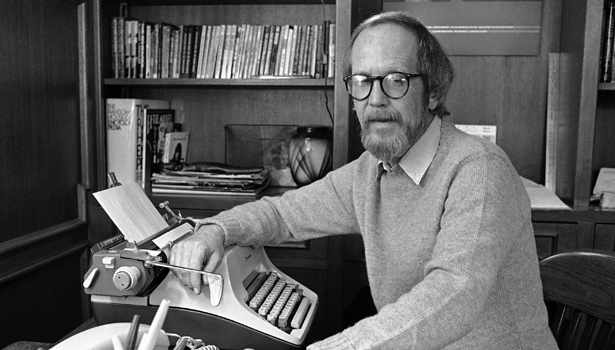
Elmore Leonard 1983

RIP Elmore Leonard, 1925 – 2013

elmore-leonard-writing-advice

“I Am Essentially Marxian” and Other Notes from F. Scott Fitzgerald’s Notebooks

  1. D. H. Lawrence great attempt to synthesize animal and emotional—things he left out. Essential pre-Marxian. Just as I am essentially Marxian.
  2. When Whitman said “Oh Pioneers” he said all.
  3. Byron’s mountains warm.
  4. Reporting the extreme things as if they were the average things will start you on the art of fiction.
  5. Work out my hard luck season—my most productive seasons, etc
  6. Conrad’s secret theory examined.He knew that things do transpire about people. Therefore he wrote the truth and transposed it to parallel to give that quality, adding confusion however to his structure. Nevertheless there is in his scheme a desire to imitate life which is in all the big shots. Have I such an idea in the composition of this book?
  7. Conrad influenced by Man Without a Country
  8. No English painting because of their putting everything into words.
  9. List of Zelda’s faults and virtues as a writer.
  10. Chapter in slow motion.
  11. Right to Pretty heroines
  12. Tie up with Faulkner—Lord Fauntleroy.

–From F. Scott Fitzgerald’s The Notebooks.

Gargoyles, Thomas Bernhard’s Philosophical Novel of Abject Madness

In its English translation, Thomas Bernhard’s 1967 breakthrough novel Verstörung received the title GargoylesVerstörung translates to something like distress or disturbance, while Gargoyles (obviously) evokes Gothic monsters. Considered together, both titles communicate this philosophical novel’s themes of abjection, decay, and madness.

Bernhard explores these themes by dividing the novel into two sections that occur over the span of the same day. In the first section, “First Page,” a country doctor takes his son on his daily rounds in rural Stryia, “a relatively large and ‘difficult’ district.” The son, a mining engineer student and aspiring scientist, is ostensibly the narrator of Gargoyles. He tells us that his father “was taking me with him for the sake of my studies.” Their journey culminates in a visit to Hochgobernitz, the gloomy castle of Prince Saurau, an insane, suicidal aristocrat who mourns his own son’s self-exile to England, where he has gone to study. While the doctor’s son remains the narrator of the book in “The Prince,” the second part of Gargoyles, Prince Saurau overwhelms the novel with the force of his monologue, a tirade that gobbles up all that comes before it. His monologue ventriloquizes the narrator’s consciousness, echoing in the young man’s skull long after he’s left the castle.

The prince’s monologue is a prototypical Bernhardian rant that will be familiar to anyone who’s read The Loser or Correction (and undoubtedly other Bernhard novels I haven’t read yet). Unlike those novels, Gargoyles offers its first section “First Page” as a point of contrast to the monologue that will come later. These episodes are short and digestible, and while hardly conventional, they are far easier to handle than the sustained intensity of the prince’s monologue. The grotesque cavalcade that the doctor and son trek through in “First Page” allows Bernhard to set out his themes — not neatly or precisely, but clearly — before the prince commences to swallow and then vomit them.

Here are the first two paragraphs of the novel:

On the twenty-sixth my father drove off to Salla at two o’clock in the morning to see to a schoolteacher whom he found dying and left dead. From there he set out toward Hüllberg to treat a child who had fallen into a hog tub full of boiling water that spring. Discharged from the hospital weeks ago, it was now back with its parents.

He liked seeing the child, and dropped by there whenever he could. The parents were simple people, the father a miner in Köflach, the mother a servant in a butcher’s household in Voitsberg. But the child was not left alone all day; it was in the care of one of the mother’s sisters. On this day my father described the child to me in greater detail than ever before, adding that he was afraid it had only a short time to live. “I can say for a certainty that it won’t last through the winter, so I am going to see it as often as possible now,” he said. It struck me that he spoke of the child as a beloved person, very quietly and without having to consider his words.

The specter of infanticide and the doctor’s resistance to it haunts the novel. We can also sense a cerebral chilliness in the narrator, who is “struck” by his father’s empathy. The doctor’s empathy repeats throughout the novel; we next see it clearly when he’s brought to attend an innkeeper’s wife assaulted in the early morning “without the slightest provocation” by one of the drunken miners who frequented her inn. Unconscious for hours before police or doctor are even called for, the woman dies. But—

It was of no importance that the innkeeper had not notified him of the fatal blow until three hours after the incident, my father said. The woman could not have been saved. The deceased woman was thirty-three, and my father had known her for years. It had always seemed to him that innkeepers treated their wives with extreme callousness, he said. They themselves usually went to bed early, having overworked themselves all day on their slaughtering, their cattle dealing, their farms. But because they thought of nothing but the business, they left their wives to take care of the taverns until the early morning hours, exposed to the male clients who drank steadily so that as the night wore on their natural brutality became less and less restrained.

As the day unfolds, the “natural brutality” that the doctor is up against evinces again and again in the various gargoyles he attends to. The rumor of the innkeeper’s wife’s murder floats in the background as a reminder of violence and brutality that bizarrely unites this community of outsiders.

Those outsiders: a bedridden, dying woman with a feeble-minded son and a murderer for a brother; a retired industrialist, living “like man and wife” with his half-sister, who devotes “himself to a literary work over which he agonized, even as it kept his mind off his inner agony”; the school teacher whose death initiates the novel; mill workers murdering exotic birds with the help of a young bewildered Turk; an insane and deformed man, the son’s age, attended to and cared for by his sister. And the prince. But I’ve rushed through so much here, so much force of language, so much terror, so much horror.

These gargoyles live, if it can be called that, in abject, isolated otherness. The doctor diagnoses it for his son:

. . . no human being could continue to exist in such total isolation without doing severe damage to his intellect and psyche. It was a well-known phenomenon, my father said, that at a crisis in their lives some people seek out a dungeon, voluntarily enter it, and devote their lives—which they regard as philosophically oriented—to some scholarly task or to some imaginative scientific obsession. They always take with them into their dungeon some creature who is attached to them. In most cases they sooner or later destroy this creature who has entered the dungeon with them, and then themselves. The process always goes slowly at first.

There is something of a warning here for the doctor’s son, who tells us at one point: “Every day I completely built myself up, and completely destroyed myself.” Like Roithamer of Correction, the son is something of a control freak (“Only through such control can man be happy and perceive his own nature”), and, like Roithamer and so many other Bernhardian figures, he has a frail (perhaps suicidal) sister who could perhaps fall prey to his idealism—who might indeed be the “creature who has entered the dungeon” with him.

There’s also the risk, one which the doctor perhaps did not account for when he set out to help his son with his “studies,” that the son might fall into the prince’s dungeon. But perhaps I’m making too much of the doctor’s empathy, of his resistance to brutality and his commitment to caring for those who repel all others. His own philosophy seems coded in misanthropy and failure. “All of living is nothing but a fervid attempt to move closer together,” he says at one point. But also: “Communication is impossible.”

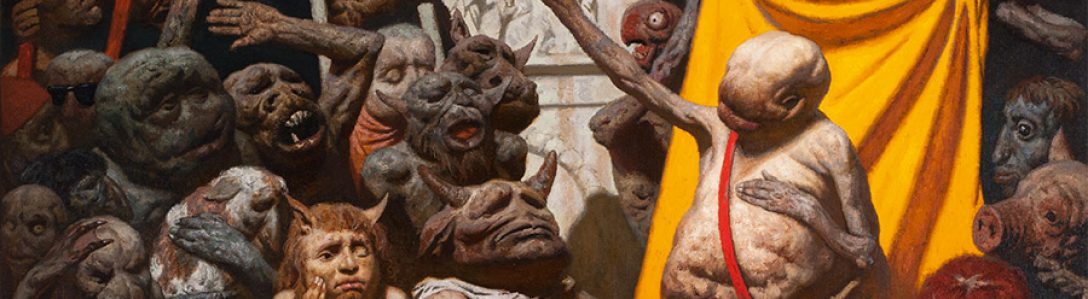
The resistance to abjection is paradoxical—as the doctor points out, the “philosophically oriented” and “imaginative scientific obsession[s]” often lead people deeper into the abyss—as the prince’s monologue will illustrate. Each of the gargoyles presented in the text offers a rare and special talent—art, music, philosophy, etc. Sussing out the novel’s treatment of the philosophies it invokes is beyond my ken, but I can’t resist lazily dropping a few names: Kant, Marx, Nietzsche, Pascal, Diederot (all on the doctor’s reading list), and Schopenhauer, whose philosophy of the will surely informs the text more than I can manage here. (From the prince’s father’s suicide note: “Schopenhauer has always been the best nourishment for me”). And while I’m lazily dropping names: Edgar Allan Poe, King Lear, Macbeth, Dostoevsky, and Francisco Goya—especially his Los caprichos, a few of which accompany this review . (And although he came after, I can’t help but read Roberto Bolaño in some of the more grotesque, horrific passages).

The levels of ventriloquizing and the layers of madness set against the novel’s depiction of radical repression lead to an abyssal paradox, perhaps best figured not in the philosophers Bernhard invokes but in the novel’s backdrop: a dark, enveloping gorge, the yawning chasm that surrounds the high walls of the castle the prince walks with his auditors. These walls are the stage from which the prince performs his monologue; their visceral dramatic emphasis derives from the abyss below. In an ironic note at the beginning of “The Prince,” the son remarks, “From here, I thought, you probably had the finest view of the entire country.”

Upon this stage, Bernhard’s main characters function as asymmetrical parallels (forgive the purposeful absurdity of this oxymoron). The father and his son the narrator are set against the prince and his absent son. In a particularly bizarre episode, the prince recounts a dream:

“But my son,” he said, “will destroy Hochgobernitz as soon as he receives it into his hands.”

Last night, the prince said, he had had a dream. “In this dream,” he said, “I was able to look at a sheet of paper moving slowly from far below to high up, paper on which my own son had written the following. I see every word that my son is writing on that sheet of paper,” the prince said. “It is my son’s hand writing it. My son writes: As one who has taken refuge in scientific allegories I seemed to have cured myself of my father for good, as one cures oneself of a contagious disease. But today I see that this disease is an elemental, shattering fatal illness of which everyone without exception dies. Eight months after my father’s suicide—note that, Doctor, after his father’s suicide, after my suicide; my son writes about my suicide!—eight months after my father’s suicide everything is already ruined, and I can say that I have ruined it. I can say that I have ruined Hochgobernitz, my son writes, and he writes: I have ruined this flourishing economy! This tremendous, anachronistic agricultural and forest economy. I suddenly see, my son writes,” the prince said, “that by liquidating the business even though or precisely because it is the best, I am for the first time implementing my theory, my son writes!” the prince said.

Note the strange layers of narration and creation here. The prince’s son, a creation of the prince, exists in the prince’s dream (another creation) where he creates a manuscript. All this creation though points to destruction—of the father, of the ancestral estate. The prince’s impulses signal self-erasure, suicide as a kind of radical return of the repressed (here, Austria’s inability to speak about, reconcile, admit its complicity in the horrors of World War 2).

The doctor contrasts with the prince, perhaps representing an order, health, and sanity that serve to sharpen and darken the abject decay of the crazed aristocrat. “My father goes to see the prince only to treat him for his insomnia,” observes the narrator, “without doing anything about his real illness . . . his madness.” But can the doctor really treat the prince’s illness?

Both fathers in their respective philosophies signal the possible paths that might be inherited by their sons (and, if you like, by allegorical extension the sons could represent Austria, or perhaps even Western Europe). How to live against the promise of suicide, against the perils of infanticide, against the kind of “natural brutality” that leads to murder, insanity, the abyss?

This problem is encoded into Bernhard’s rhetorical technique. The prince’s devastating monologue consumes the narrative, reader and narrator alike. By the end of the novel, he’s infiltrated (and perhaps infected) the narrator’s consciousness, highlighting the dramatic stakes here—of being ventriloquized, possessed by the diseases of history and authority—an illness that trends to self-destruction. It’s worth sharing a passage at some length; the following section highlights and perhaps even condenses what I take to be the core themes of Gargoyles:

“Whenever I look at people, I look at unhappy people,” the prince said. “They are people who carry their torment into the streets and thus make the world a comedy, which is of course laughable. In this comedy they all suffer from tumors both mental and physical; they take pleasure in their fatal illness. When they hear its name, no matter whether the scene is London, Brussels, or Styria, they are frightened, but they try not to show their fright. All these people conceal the actual play within the comedy that this world is. Whenever they feel themselves unobserved, they run away from themselves toward themselves. Grotesque. But we do not even see the most ridiculous side of it because the most ridiculous side is always the reverse side. God sometimes speaks to them, but he uses the same vulgar words as they themselves, the same clumsy phrases. Whether a person has a gigantic factory or a gigantic farm or an equally gigantic sentence of Pascal’s in his head, is all the same,” the prince said. “It is poverty that makes people the same; at the human core, even the greatest wealth is poverty. In men’s minds and bodies poverty is always simultaneously a poverty of the body and a poverty of the mind, which necessarily makes them sick and drives them mad. Listen to me, Doctor, all my life I have seen nothing but sick people and madmen. Wherever I look, the worn and the dying look back at me. All the billions of the human race spread over the five continents are nothing but one vast community of the dying. Comedy!” the prince said. “Every person I see and everyone I hear anything about, no matter what it is, prove to me the absolute obtuseness of this whole human race and that this whole human race and all of nature are a fraud. Comedy. The world actually is, as has so often been said, a stage on which roles are forever being rehearsed. Wherever we look it is a perpetual learning to speak and learning to walk and learning to think and learning by heart, learning to cheat, learning to die, learning to be dead. This is what takes up all our time. Men are nothing but actors putting on a show all too familiar to us. Learners of roles,” the prince said. “Each of us is forever learning one (his) or several or all imaginable roles, without knowing why he is learning them (or for whom). This stage is an unending torment and no one feels that the events on it are a pleasure. But everything that happens on this stage happens naturally. A critic to explain the play is constantly being sought. When the curtain rises, everything is over.” Life, he went on, changing his image, was a school in which death was being taught. It was filled with millions and billions of pupils and teachers. The world was the school of death. “First the world is the elementary school of death, then the secondary school of death, then, for the very few, the university of death,” the prince said. People alternate as teachers or pupils in these schools. “The only attainable goal of study is death,” he said.

Such searing nihilism here—the prince angrily mourns the grotesqueness of the world, the lack of agency of people to control their own fate, to be but players, dummies mumbling someone else’s script. And it all leads to death. For the prince, dialogue is impossible in the face of this death: “All interlocutors are always mutually pushing one another into all abysses.” But the prince, notably, is his own interlocutor; he pushes himself into abysses of his own contrivance.

Neither is love a solution for the prince:

“We face questions like an open grave about to be filled. It is also absurd, you know, for me to be talking of the absurdity,” he said. “My character can justly be called thoroughly unloving. But with equal justice I call the world utterly unloving. Love is an absurdity for which there is no place in nature.

And community?

We see in a person frailties which at once make us see the frailties of the community in which we live, the frailties of all communities, the state; we feel them, we see through them, we catastrophize them.

But is this necessarily the essential view of the novel? I don’t think it plausible to argue that the prince’s monologue be read entirely ironically, but it’s worth bearing in mind that both his auditors understand him to be mentally ill and terribly isolated. The guy is histrionic, a drama fiend holding forth on his stage. And while his acerbic misanthropy and nihilism may scorch, it’s also very, very funny. I chuckled a lot reading Gargoyles.

But yes—the prince is sincere in his pain. “We assume the spirit of the walls that surround us,” he declares near the end of the novel. He’s a a prisoner in his own gloomy castle, the dungeon he refuses to leave. He resents his son’s self-exile to London, but also longs—literally dreams for—his son to return to destroy that dungeon.

Of his family: “But probably all these creatures deserve ruthlessness more than pity.” I think that But is important here. The doctor, like the prince, also situates everyone on an axis of ruthlessness and pity. The doctor is full of cruel observations about the gargoyles he encounters. But: But he gets up, goes out, does his rounds, tries in some way to mitigate some of the “natural brutality” of the world. And he tries to show this world—and this method—to his son this as well, for his son’s “studies.” In the room of the lonely, dying woman, the son remarks of his father: “I noticed that he made an effort to stretch out the call, for all his eagerness to leave.” The son, in thrall to the prince’s monologue, perhaps fails to notice that his father also stretches out his time on the castle wall despite an eagerness to leave the prince.

By the end of the novel, we see the prince’s consciousness inhabiting the son’s thoughts:

In bed I thought: What did the prince say? “Always wanting to change everything has been a constant craving with me, an outrageous desire which leads to the most painful disputes. The catastrophe begins with getting out of bed. 

The pessimism and sheer despair here erupts into black comedy with that last line, one echoed in Bernhard’s later novel Correction: “Waking up is the always frightening minimum of existence.” If to simply get out of bed (which, of course, is where the son is as he work’s through the prince’s ideas) is to invoke and invite disaster and despair, it’s worth noting that this simple action—getting out of bed—is what the doctor performs each day, even if it means he wakes to a dead teacher, a boiled infant, a murdered wife. While hardly a beacon of optimism or hope, the doctor nonetheless figures an alternative to the prince’s abject madness. If we “assume the spirit of the walls that surround us,” the doctor understands that it’s important to leave those walls, to not seek out dungeons—and drag others into dungeons with us.

Gargoyles is by turns bleak and nihilistic. It’s also energetic, profound, and at times very, very funny. Its opening section will likely provide an accessible introduction to readers interested in Bernhard, with the prince’s monologue offering the full Bernhardian experience. Dark, cruel, and taxing, Gargoyles isn’t particularly fun reading—except when it is. Highly recommended.
“Vague longing and boredom are close akin” (Schopenhauer)

* * * * *

Goethe says somewhere that man is not without a vein of veneration. To satisfy this impulse to venerate, even in those who have no sense for what is really worthy, substitutes are provided in the shape of princes and princely families, nobles, titles, orders, and money-bags.

* * * * *

Vague longing and boredom are close akin.

* * * * *

When a man is dead, we envy him no more; and we only half envy him when he is old.

* * * * *

Misanthropy and love of solitude are convertible ideas.

* * * * *

In chess, the object of the game, namely, to checkmate one’s opponent, is of arbitrary adoption; of the possible means of attaining it, there is a great number; and according as we make a prudent use of them, we arrive at our goal. We enter on the game of our own choice.

Nor is it otherwise with human life, only that here the entrance is not of our choosing, but is forced on us; and the object, which is to live and exist, seems, indeed, at times as though it were of arbitrary adoption, and that we could, if necessary, relinquish it. Nevertheless it is, in the strict sense of the word, a natural object; that is to say, we cannot relinquish it without giving up existence itself. If we regard our existence as the work of some arbitrary power outside us, we must, indeed, admire the cunning by which that creative mind has succeeded in making us place so much value on an object which is only momentary and must of necessity be laid aside very soon, and which we see, moreover, on reflection, to be altogether vanity—in making, I say, this object so dear to us that we eagerly exert all our strength in working at it; although we knew that as soon as the game is over, the object will exist for us no longer, and that, on the whole, we cannot say what it is that makes it so attractive. Nay, it seems to be an object as arbitrarily adopted as that of checkmating our opponent’s king; and, nevertheless, we are always intent on the means of attaining it, and think and brood over nothing else. It is clear that the reason of it is that our intellect is only capable of looking outside, and has no power at all of looking within; and, since this is so, we have come to the conclusion that we must make the best of it.

Notes from “Psychological Observations.”

David Gordon Green’s Prince Avalanche Reviewed

prince-avalanche-poster

At this point, pretty much anything anyone writes about director David Gordon Green sets out to divide his early “promising” work—impressionistic, Malick-beholden films like All the Real Girls and George Washington—from more recent stoner comedies like Pineapple Express, the much-vilified-now-but-future-cult-classic Your Highness, and Green’s work on Eastbound & Down.

The critical line on Green’s latest film, Prince Avalanche, is that it synthesizes the poetic and artistic impulses of the earlier films with the commercial comedy of what came after—that, in shortGreen has found his way again. I don’t think that this is especially true.

Based on the 2011 Icelandic film Either WayPrince Avalanche floats around the barest wisp of a plot. It’s the end of the 1980s, and in the middle of wildfire-ravaged Texas, uptight Alvin (Paul Rudd) and slacker Lance (Emile Hirsch, channeling a sensitive Jack Black) paint yellow lines on the old rural roads and hammer in new signposts. They squabble, share vodka with an alcoholic truck driver, and encounter a woman whose house has burned down. We learn that Lance has scored the job because his sister is Alvin’s girlfriend—but that romantic relationship looks pretty rocky from the get-go.

Prince Avalanche is never better than its opening scenes, where Alvin and Lance wordlessly perform their duties, hammering stakes into the ground and measuring out yellow dashes. Green is confident enough to let the camera linger on his actors, and most of the memorable scenes are simple—Paul Rudd’s motions as he sets up a folding table, or Hirsch tying down equipment to the work jeep. The blasted Texas forest is beautiful, as new growth mixes with charred tree trunks in frames by turns surreal and painterly.

The story line of Prince Avalanche isn’t especially bad; it’s just not especially good, or even interesting. There’s simply too much indie dramedy quirkiness going on here, and when Green’s plotting hits familiar arc-driven beats—a climactic fight, a scene of drunken abandon—the story feels false against the pure, beautiful cinematography. The original score by postrockers Explosions in the Sky is maddeningly intrusive, buzzing with overly-detailed blips and rhythm huffs that sound at times like Tangerine Dream’s work on Risky Business. Calm down!

This is all perhaps a way of saying that the “synthesis” many critics have detected in Prince Avalanche is not particularly satisfying. It’s true that the film is smaller and more intimate than Green’s last effort, the execrable and indefensible into-the-night film The Sitter, but Prince Avalanche is just as much a product of formula as that film.

In most of his films, Green retells the same core story about a lonely young man with communication troubles who really just wants a friend (this is Paul Schneider in All the Real Girls or James Franco in Pineapple Express or Danny McBride in Your Highness). Prince Avalanche is no different, but it seems unsure of pulling off its emotional impact without all the indie-quirk baggage. It feels bloated at a scant 96 minutes and would be a far better film if, like the burned and beautiful world it depicts, it was willing to strip away more of its protective layers. (It doesn’t help that Kelly Reichardt told a similar story far better in 2006 with her film Old Joy).

Perhaps I’m being too harsh on the film—I’ll confess I wanted it to be great, something that could transcend the self-seriousness of All the Real Girls and surpass the final, perfect diner scene of Pineapple Express (the single moment where Green best combines his Malick-tinged naturalism with his sense of bromance-up-too-late humor).

Of course I could be dead wrong—I might catch the film on cable in a year and see something there that I missed the first time. Like most viewers, I had no love for Your Highness on first viewing but have since sat through it at least four times—it’s a failure, to be sure, but a compelling, bizarre failure, one that I find funnier and more self-aware each time. And the same promise that Green has always shown in all his work (okay, not The Sitter) shines brightly throughout Prince Avalanche. The final shot of the film shows us children joyfully chasing a chicken. It’s one of the finest moments in the film, and I wish Green’s lens lingered there longer—I’d like to see what happens next.

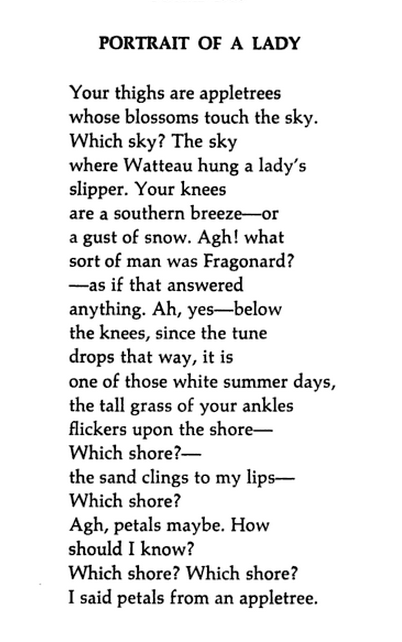
“Portrait of a Lady” — William Carlos Williams

wcw

“Genius and Virtue” — Arthur Schopenhauer

“Genius and Virtue” by Arthur Schopenhauer

When I think, it is the spirit of the world which is striving to express its thought; it is nature which is trying to know and fathom itself. It is not the thoughts of some other mind, which I am endeavouring to trace; but it is I who transform that which exists into something which is known and thought, and would otherwise neither come into being nor continue in it.

In the realm of physics it was held for thousands of years to be a fact beyond question that water was a simple and consequently an original element. In the same way in the realm of metaphysics it was held for a still longer period that the ego was a simple and consequently an indestructible entity. I have shown, however, that it is composed of two heterogeneous parts, namely, the Will, which is metaphysical in its character, a thing in itself, and the knowing subject, which is physical and a mere phenomenon.

Let me illustrate what I mean. Take any large, massive, heavy building: this hard, ponderous body that fills so much space exists, I tell you, only in the soft pulp of the brain. There alone, in the human brain, has it any being. Unless you understand this, you can go no further.

Truly it is the world itself that is a miracle; the world of material bodies. I looked at two of them. Both were heavy, symmetrical, and beautiful. One was a jasper vase with golden rim and golden handles; the other was an organism, an animal, a man. When I had sufficiently admired their exterior, I asked my attendant genius to allow me to examine the inside of them; and I did so. In the vase I found nothing but the force of gravity and a certain obscure desire, which took the form of chemical affinity. But when I entered into the other—how shall I express my astonishment at what I saw? It is more incredible than all the fairy tales and fables that were ever conceived. Nevertheless, I shall try to describe it, even at the risk of finding no credence for my tale.

In this second thing, or rather in the upper end of it, called the head, which on its exterior side looks like anything else—a body in space, heavy, and so on—I found no less an object than the whole world itself, together with the whole of the space in which all of it exists, and the whole of the time in which all of it moves, and finally everything that fills both time and space in all its variegated and infinite character; nay, strangest sight of all, I found myself walking about in it! It was no picture that I saw; it was no peep-show, but reality itself. This it is that is really and truly to be found in a thing which is no bigger than a cabbage, and which, on occasion, an executioner might strike off at a blow, and suddenly smother that world in darkness and night. The world, I say, would vanish, did not heads grow like mushrooms, and were there not always plenty of them ready to snatch it up as it is sinking down into nothing, and keep it going like a ball. This world is an idea which they all have in common, and they express the community of their thought by the word “objectivity.”

In the face of this vision I felt as if I were Ardschuna when Krishna appeared to him in his true majesty, with his hundred thousand arms and eyes and mouths. Continue reading ““Genius and Virtue” — Arthur Schopenhauer”

Don Quixote Reads a Sonnet — Gustave Doré

More at Gustave Doré’s Don Quixote


“Whenever I look at people, I look at unhappy people” (Thomas Bernhard’s Gargoyles)

“Whenever I look at people, I look at unhappy people,” the prince said. “They are people who carry their torment into the streets and thus make the world a comedy, which is of course laughable. In this comedy they all suffer from tumors both mental and physical; they take pleasure in their fatal illness. When they hear its name, no matter whether the scene is London, Brussels, or Styria, they are frightened, but they try not to show their fright. All these people conceal the actual play within the comedy that this world is. Whenever they feel themselves unobserved, they run away from themselves toward themselves. Grotesque. But we do not even see the most ridiculous side of it because the most ridiculous side is always the reverse side. God sometimes speaks to them, but he uses the same vulgar words as they themselves, the same clumsy phrases. Whether a person has a gigantic factory or a gigantic farm or an equally gigantic sentence of Pascal’s in his head, is all the same,” the prince said. “It is poverty that makes people the same; at the human core, even the greatest wealth is poverty. In men’s minds and bodies poverty is always simultaneously a poverty of the body and a poverty of the mind, which necessarily makes them sick and drives them mad. Listen to me, Doctor, all my life I have seen nothing but sick people and madmen. Wherever I look, the worn and the dying look back at me. All the billions of the human race spread over the five continents are nothing but one vast community of the dying. Comedy!” the prince said. “Every person I see and everyone I hear anything about, no matter what it is, prove to me the absolute obtuseness of this whole human race and that this whole human race and all of nature are a fraud. Comedy. The world actually is, as has so often been said, a stage on which roles are forever being rehearsed. Wherever we look it is a perpetual learning to speak and learning to walk and learning to think and learning by heart, learning to cheat, learning to die, learning to be dead. This is what takes up all our time. Men are nothing but actors putting on a show all too familiar to us. Learners of roles,” the prince said. “Each of us is forever learning one (his) or several or all imaginable roles, without knowing why he is learning them (or for whom). This stage is an unending torment and no one feels that the events on it are a pleasure. But everything that happens on this stage happens naturally. A critic to explain the play is constantly being sought. When the curtain rises, everything is over.” Life, he went on, changing his image, was a school in which death was being taught. It was filled with millions and billions of pupils and teachers. The world was the school of death. “First the world is the elementary school of death, then the secondary school of death, then, for the very few, the university of death,” the prince said. People alternate as teachers or pupils in these schools. “The only attainable goal of study is death,” he said.

—From Thomas Bernhard’s novel Gargoyles.

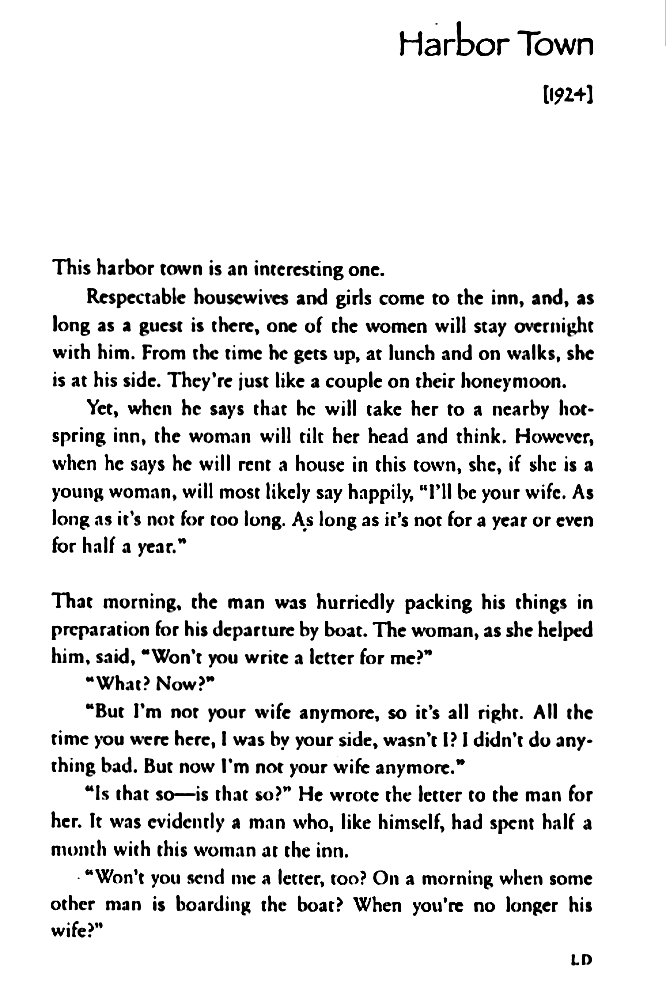
“Harbor Town” — Yasunari Kawabata

kawabata

New Trailer for Hayao Miyazaki’s Forthcoming Film, The Wind Rises

This one’s a lot more substantive than the teaser that came out earlier this year.

John Huston’s Film Adaptation of Under the Volcano (Full Film)

(Here’s my review of Malcolm Lowry’s novel Under the Volcano).

“…the Mask’s desire was to be invisible, unthreatening, transparent yet mercilessly deceptive…” / Another Pynchon Riff

Capture

IT WAS MIDAPRIL, Carnevale had been over for weeks, and Lent was coming to a close, skies too drawn and pallid to weep for the fate of the cyclic Christ, the city having slowly regained a maskless condition, with a strange dull shine on the paving of the Piazza, less a reflection of the sky than a soft glow from regions below. But the silent communion of masks was not quite done here.

On one of the outer islands in the Lagoon, which had belonged to the Spongiatosta family for centuries, over an hour away even by motor craft, stood a slowly drowning palazzo. Here at midnight between Holy Saturday and Easter Sunday began the secret counter-Carnevale known as Carnesalve, not a farewell but an enthusiastic welcome to flesh in all its promise. As object of desire, as food, as temple, as gateway to conditions beyond immediate knowledge.

With no interference from authority, church or civic, all this bounded world here succumbed to a masked imperative, all hold on verbatim identities loosening until lost altogether in the delirium. Eventually, after a day or two, there would emerge the certainty that there had always existed separately a world in which masks were the real, everyday faces, faces with their own rules of expression, which knew and understand one another—a secret life of Masks. It was not quite the same as during Carnevale, when civilians were allowed to pretend to be members of the Maskworld, to borrow some of that hieratic distance, that deeper intimacy with the unexpressed dreams of Masks. At Carnevale, masks had suggested a privileged indifference to the world of flesh, which one was after all bidding farewell to. But here at Carnesalve, as in espionage, or some revolutionary project, the Mask’s desire was to be invisible, unthreatening, transparent yet mercilessly deceptive, as beneath its dark authority danger ruled and all was transgressed.

1. Okay—I know it’s been like forever since I riffed on Thomas Pynchon’s novel Against the Day (here, “forever” = a few weeks), but I took a week off from the novel, which turned into two weeks, which is a bad habit, yes, but here we are, and I’m nearing the end of the shaggy beast. I don’t think Pynchon is going to tie all the loose threads  into some perfect picture for me, but I don’t think I’d want that anyway.

2. Where I am in the book: Cyprian, Cyprian, Cyprian. The beginning of The Great War. Just waaaaaay too much going on to even bother to begin to try to summarize.

3. Cyprian is surely the most fascinating character of Against the Day, but his somewhat late arrival in the text feels, I don’t know, lumpy or something. Something about reading such a long book—we make a kind of investment in certain plots, figures, characters, and Pynchon here sort of moves them into the background, or disappears them completely, for long, long stretches. I’m thinking about The Chums of Chance in particular, but also Lew Basnight, the Tunguska event, the Vibes vs. the Traverses, etc. Thematically it’s all there, but this stretch with Cyprian’s dark adventures, while fantastic, also feels almost like a novella shoehorned into the final chapters of an epic. This is not a complaint.

4. I’ve shared a few citations from Against the Day since my last riff, but the one above (my Kindle tells me its at the 82% mark, if that means anything to you) seems to resonate with what I take to be the major themes and motifs of the novel.

I’m thinking specifically of the final line: “But here at Carnesalve, as in espionage, or some revolutionary project, the Mask’s desire was to be invisible, unthreatening, transparent yet mercilessly deceptive, as beneath its dark authority danger ruled and all was transgressed.”

Invisible is obviously a key word in Against the Day, and the novel turns on concepts of doubling, masking, transgression, themes that the Carnevale-Carnesalve disjunction highlights (flesh vs. spirit, visible vs. invisible, etc.).

5. Actually, now that I think about it, Cyprian probably most embodies, or, rather, embodies most complexly, Pynchon’s themes of doubling, masking, and transgression. He’s his own doppelganger. (Even the name suggest a kind of bilocation — Cyprus, that ancient crossroads of East and West).

6. And —

The Carnesalve chapter culminates in a truly salacious sex scene, an S&M-fueled ménage à trois that somehow simultaneously punctures the novels structure of doubling (cause, uh, a three-way) at the same time it reinforces it (Cyprian as self-double). I’m not sure if any of this that I’m saying makes any sense at all.

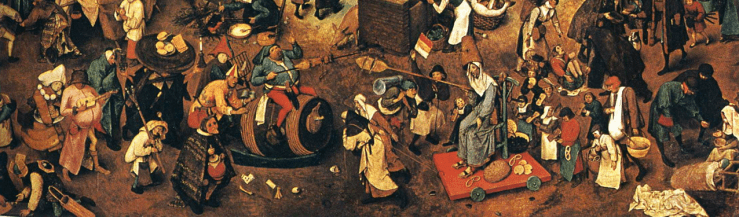
7. The image at the top of this riff is a detail from The Fight Between Carnival and Lent by Pieter Bruegel.

Six Figments from Nathaniel Hawthorne’s Note-Books

  1. A blind man on a dark night carried a torch, in order that people might see him, and not run against him, and direct him how to avoid dangers.
  2. To picture a child’s (one of four or five years old) reminiscences at sunset of a long summer’s day,–his first awakening, his studies, his sports, his little fits of passion, perhaps a whipping, etc.
  3. The blind man’s walk.
  4. To picture a virtuous family, the different members examples of virtuous dispositions in their way; then introduce a vicious person, and trace out the relations that arise between him and them, and the manner in which all are affected.
  5. A man to flatter himself with the idea that he would not be guilty of some certain wickedness,–as, for instance, to yield to the personal temptations of the Devil,–yet to find, ultimately, that he was at that very time committing that same wickedness.
  6. What would a man do, if he were compelled to live always in the sultry heat of society, and could never bathe himself in cool solitude?

Notations from Nathaniel Hawthorne’s American Note-Books.


“Foreigner” – Olga Broumas

House
Two floors
Down is stove
Down is bath kitchen music
Down is stove and the stack of logs
Up is bed and the climate the tropical
Down is desk next to stove
Around and around floors windows uncurtained
Outside is snow
Unmarked northern profound white snow
Up small woman alone
Icicles
Naked

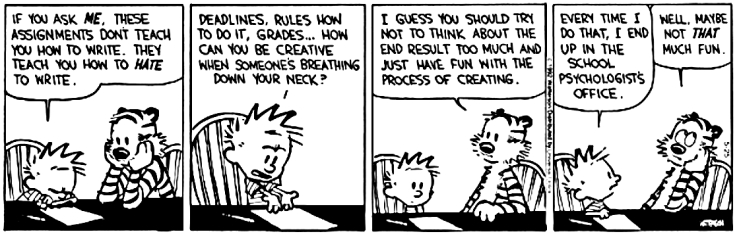
Creative writing (Calvin and Hobbes)

ch

Josh Melrod Talks to Biblioklept About His Documentary, Cartoon College

When I first read the press materials for Josh Melrod and Tara Wray’s documentary Cartoon College, I’ll admit that I was mostly interested in the prospect of seeing comix legends like Art Spiegelman, Charles Burns, Lynda Barry, Chris Ware, Scott McCloud, and Stephen Bissette discuss their craft. What Melrod and Wray deliver though is much more—an intimate and often very moving look at the lives of the young artists who attend the prestigious Center for Cartoon Studies. This is a film about passion, drive, commitment, and what it means to be an outsider.

In my review, I wrote: “Cartoon College offers an intriguing story about real people trying to do something that they love, and I enjoyed that. This is a film about the impetus, motivation, and hard, hard work that goes into the creative process. Great stuff.”

Josh was kind enough to talk to me about making the film over a series of emails.

See more at the film’s official website. Cartoon College is now available on iTunes.

Banner_Color with Laurels

Biblioklept: How did you begin the documentary Cartoon College? How did the project come about?

Josh Melrod: In 2006 my wife, then my girlfriend, Tara Wray, had just finished her first movie, Manhattan, Kansas, and was looking for her next project. She’s a huge fan of Chris Ware and she read an article about how he’d been a visiting lecturer at CCS, which had just opened a year earlier, and that was enough to get her thinking about a cartoon school documentary. She asked me if I’d consider moving to Vermont for a year–we were living in New York, and had been for a while–and I said ok. Then we had to convince James Sturm and Michelle Ollie, who founded the school, to let us film, which took several months of emails and a couple of face-to-face meetings and a trip or two to White River Junction. Once they gave us the green light we basically packed up and moved to Vermont. That was in August of 2007, and we’ve been here ever since.

Biblioklept: So you guys were shooting for like, three years? When you started did you have an idea of the kind of story you wanted to tell in Cartoon College?

JM: Our original conceit for the movie was a year in the life of a cartoon school. It was supposed to be more about the institution and how it was helping to revitalize White River Junction, which had been a town in decline for about a century. So we shot for the 2007-2008 academic year and then started working with an editor in New York that summer. It took about six months to get a rough cut put together, but when all was said and done we weren’t happy with what we had. Part of it was that the story of the school’s impact on the town didn’t quite come together–it was an arc that was unfolding too slowly to really be seen during the year we’d been filming. But we also realized that what really interested us, much more than the school itself, was documenting the creative lives of the students and witnessing these aspiring artists at a very pivotal time in their careers. We basically scrapped the rough cut, which was a pretty difficult decision, and went back to film for what turned out to be another year-and-a-half.

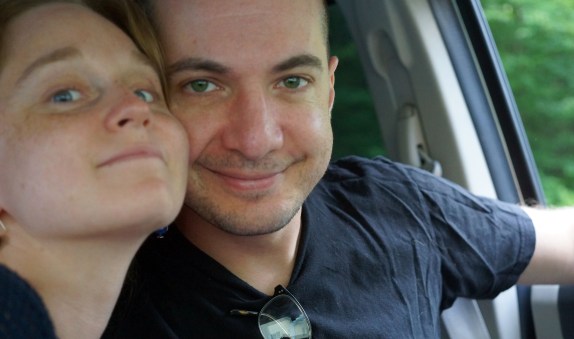
The filmmakers, Tara Wray and Josh Melrod

Biblioklept: Some of the students, like Blair Sterett and Jen Vaughn, for example, are on screen a lot more than others. Was this because they were more open to the cameras? Were there students who were reticent to talk to you?

JM: Jen is kind of a natural in front of the camera, so in a sense she was more open than some of the others. But there were only a very small handful of people during the entire production who told us they really didn’t want to be filmed. A lot of the cartoonists we spoke with are fairly introverted, and quite a few, both the younger and the more experienced artists, discussed how they express themselves best through their comics, but it doesn’t take too long for most people to begin to forget the camera is there.

Biblioklept: I like that the film is really about the career of cartooning, and that the film focuses on the arcs of these aspiring cartoonists. You’ve got all these great interviews with people like Chris Ware and Art Spiegelman and Charles Burns, but their comments ultimately work to illuminate or enrich, through their perspectives, what the students are going through. It seems like there’s a lot of restraint and wise editing on your end here. Can you talk about how you put the film together? I’m curious how intuitive the process of forming the narrative was . . .

JM: By the time we finished shooting we had something like 150 hours of footage. I don’t remember how it all broke down, but maybe forty percent was interviews. There was a lot to go through. But it was pretty clear what the character arcs were for Blair and Al and Jen. Actually, it’s kind of hard for me to remember the process in any great detail. I was just starting to work on the rough cut when Tara and I had our twins, so for the first six months of the edit I was working from around ten at night until six a.m., stopping every couple of hours to help with feedings and changing diapers, and getting a few hours of sleep here and there during the day. It’s all very blurry, and sort of miraculous that I finished the rough cut at all. My method of working was to cut the footage down from 150 hours to just 10, which is a manageable amount of material, and from there put together an assembly that had the basic structure of a movie, and then loosely refine that into a two-hour rough cut. Then I went to New York to work with another editor, Chris Branca, who came in with a ton of great ideas and further refined the story. As for the interviews serving to illuminate what the students were going through, that was pretty organic. The challenges that a person faces when they decide to become an artist are fairly universal–the self-doubt, managing your time, coming to terms with your own limitations, figuring how to make a living, etc.–so the experiences shared by the established artists were in-line with what we documented from the students.

Biblioklept: You brought up that Tara’s interest in Ware’s work kind of sparked the genesis of the documentary. Were you a fan of comics too? How much did you know about the cartooning world going into the filming process?

JM: As a kid I loved Calvin and Hobbes and Bloom County/Outland and The Far Side, but those all ended when I was in high school and I pretty much stopped reading comics at that point. Then, after Tara and I moved in together, I’d pick up some of the books she’d leave around the apartment–like Jimmy Corrigan and Hate, I remember in particular–but I knew virtually nothing about the cartooning world when we started the movie.

Biblioklept: Have you become a fan since then?

JM: I love comics, but I’m a very casual fan. I still gravitate towards non-graphic novels, and I’m not quite sure why that is. Comics certainly demand more attention from the reader, if the reader we’re talking about is me–the interplay between the pictures and the text require a level of focus that isn’t needed when you’re just reading words, although I’m not sure I ever noticed that when I was a kid–and so maybe it’s that I don’t always have the mental energy to pick up a heavy graphic novel. I am really interested in reading comics from the people in the movie–CCS graduates are doing just incredible work and a lot of the former students we followed are starting to put out books now. Katherine Roy just illustrated a book and has a couple of others coming out soon; Jen Vaughn released a book last week; Josh Rosen is going to start serializing the project he was working on while we were filming; Joe Lambert, who we interviewed but didn’t appear in the movie, although he designed the poster, made a book about Annie Sullivan and Helen Keller that’s just incredible.

Biblioklept: What kind of movie would you like to do next?

JM: I’m working on a short, a fiction movie, with a couple of guys who used to edit a literary magazine with me. It was called the Land-Grant College Review and we published for five or six years starting in about 2002. We wanted to work on something new, and I’m really interested in doing a narrative, and they’d been thinking of doing a screenplay, so that’s what we decided to do. We’re still writing, but we have some good advisers on board and the plan is to shoot next summer. And I’m in the development phase on a pair of new docs. They’re both about personalities, as opposed to being issue-based, which is a common denominator. One follows a semi-famous performer and the other involves a family on its summer vacation. It’s still pretty early to talk confidently about any of this stuff. I just have to keep plugging away and see what happens, but these are the projects I’d like to do next.

Biblioklept: The docs sound intriguing. I spent some time in the Land-Grant College Review archive just now—what a great collection of authors. Your little microfiction there is a good creepy laugh. What are you reading now?

JM: Thanks! We had a short but good run, and got to publish a lot of great writers. One of my most prized possessions is a postcard that David Foster Wallace sent me–in response to a letter I’d written asking him to send us a story–saying that he’s “just working on stuff that isn’t suitable for publication any place.”

As for what I’m reading, I just started [Erik Larson’s] The Devil In The White City, which I’d been hesitant to open for a few years since I do a lot of reading before bed and I thought it would mess with my sleep. So far so good.

Biblioklept: Have you ever stolen a book?

JM: No, never stolen a book, but I have gone a long time without paying for a book. A lot of the books on my shelf I picked out of piles left on the curb or at the recycling center near where we live now. Sometimes I like to let the universe decide what I read depending on what I find in front of me, which is how I got to read The Universe And Dr. Einstein, a lay readers guide to general relativity that I still managed not to understand.