Explore drafts of published and unpublished writings, recordings of his interviews and readings, photographs and scans of important documents and objects that have shaped his life. You will also find an essay, “My Memories of the Service,” which Gass wrote specifically for this digital exhibit.
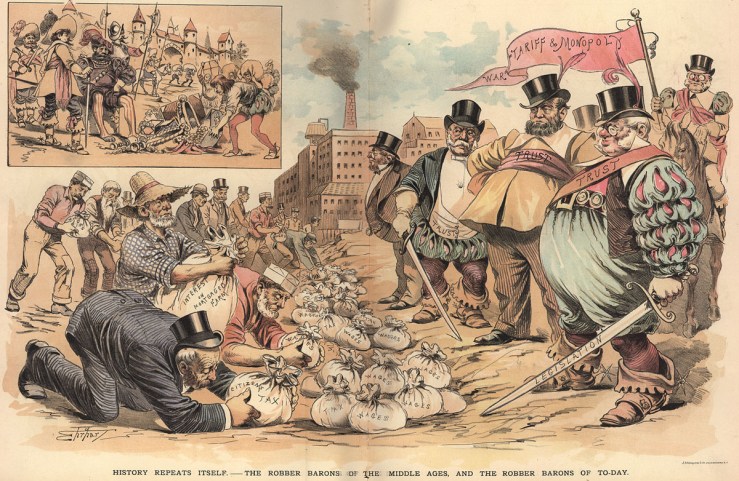
1. The passage I’ll be riffing on todayis hardly the funniest or most dazzling piece of writing I’ve encountered so far in Thomas Pynchon’s massive, shaggy novel Against the Day. However, I think this stretch of writing neatly and concisely illustrates the perspective (maybe world view is a better term; hell, we could even go with fancy-pants Weltanschauung here) of who I take to be the novel’s most prominent villain, ruthless robber baron Scarsdale Vibe.
More significantly, I think this passage illustrates the ways that Pynchon’s big novel analyzes American history and illuminates the contemporary American zeitgeist.
2. The block quote citations are continuous, although I’ll be interrupting. The passage starts at the very bottom of page 331 and goes through 334 in my hardback Penguin first edition.
3. Okay, so a bit of context:
Our scene is mostly a dialogue, or a monologue really, between Scarsdale Vibe and his Other, Foley Walker, who took Scarsdale’s place in the Civil War, took a bullet to the brain, and now, like so many of the characters in Against the Day, has special powers (he can hear voices that tell him how to invest (Scarsdale’s) money in the market).
Back at Pearl Street, the two Vibes were sitting over brandy and cigars.
“A tough one to figure, that kid,” Foley opined. “Sure hope we ain’t got another Red in the root cellar like his old man.”
The “kid” here is hero Kit Traverse, and his old man — the “Red in the root cellar” — is the recently-deceased-on-Scarsdale’s-orders Webb Traverse, the Kieselguhr Kid, enemy of the captains of industry.
Scarsdale is backing Kit in the hopes that he’ll become “the next Edison” — and not, significantly, the next Tesla.
5. (Tesla v. Edison—another set of doubles in the book.
Tesla, Serbian-American, mad magician, prophet of science, seer of the invisible, wants to provide free power for all is clearly allied (in Pynchon’s book, that is) with the unions, the Traverses, labor—the good guys.
His double, Edison: American-American, reputed idea-thief, dog-electrocuter; Edison, a hustler who sweated out idea after idea, perhaps gracelessly; Edison, whose methods and inventions could generate corporate profits.
Tesla remarked of Edison, after his death: “he had a veritable contempt for book learning and mathematical knowledge, trusting himself entirely to his inventor’s instinct and practical American sense”).
6. Note that Scarsdale wouldn’t hesitate to kill Kit:
“Our duty would be no less clear. There are hundreds of these abscesses suppurating in the body of our Republic,” an oratorical throb creeping into Scarsdale’s voice, “which must be removed, wherever they are found. No other option. The elder Traverse’s sins are documented—once they were brought to light, he was as good as lost. Should there be moral reservations, in a class war, about targeting one’s enemies? You have been in this game long enough to appreciate how mighty are the wings we shelter beneath. How immune we are kept to the efforts of these muckraking Reds to soil our names. Unless—Walker, have I missed something? you aren’t developing a soft spot.”
As Scarsdale’s was not the only voice Foley had to attend to, he erred, as usual, on the side of mollification. He held out his glowing Havana. “If you can find a soft spot, use it to put this out on.”
“What happened to us, Foley? We used to be such splendid fellows.”
“Passage of Time, but what’s a man to do?”
“Too easy. Doesn’t account for this strange fury I feel in my heart, this desire to kill off every damned socialist and so on leftward, without any more mercy than I’d show a deadly microbe.”
“Sounds reasonable to me. Not like that we haven’t bloodied up our hands already here.” Scarsdale gazed out his window at a cityscape once fair but with the years grown more and more infested with shortcomings. “I wanted so to believe. Even knowing my own seed was cursed, I wanted the eugenics argument to be faulty somehow. At the same time I coveted the bloodline of my enemy, which I fancied uncontaminated, I wanted that promise, promise unlimited.”
Foley pretended his narrowing of gaze was owing to cigarsmoke. “Mighty Christian attitude,” he commented at last, in a tone as level as he could make it.
Here we see Scarsdale’s hatred of organized labor, of anything that impedes on his profits, get tangled into the ideology that underwrites this conflict. He even cites the conflict as “a class war.” This class war interweaves into his personal life: he is usurping the coveted “bloodline of my enemy” by attempting to adopt Kit.
7. The scene then takes on a religious dimension, exploring a “Mighty Christian attitude”:
“Foley, I’m as impatient with religious talk as the next sinner. But what a burden it is to be told to love them, while knowing that they are the Antichrist itself, and that our only salvation is to deal with them as we ought.”
Pynchon’s villain here sounds like so many figures on the contemporary American Evangelical right, who repeatedly conflate their political/cultural enemies with “Antichrist” as a means to avoid the Jesusian imperative to love the Other.
8. Remember, wealthy Scarsdale—his father, really—was able to buy a deferment from the Civil War; Foley took his place:
It did not help Foley’s present mood that he had awakened that morning from a recurring nightmare of the Civil War. The engagement was confined to an area no bigger than an athletic field, though uncountable thousands of men had somehow been concentrated there. All was brown, gray, smoky, dark. A lengthy exchange of artillery had begun, from emplacements far beyond the shadowy edges of the little field. He had felt oppressed by the imminence of doom, of some suicidal commitment of infantry which no one would escape. A pile of explosives nearby, a tall, rickety wood crib of shells and other ammunition began to smolder, about to catch fire and blow up at any moment, a clear target for the cannonballs of the other side, which continued to come in, humming terribly, without pause. . . .
Foley has actually fought and been wounded and risked. He’s literally put skin in the game.
In contrast, Scarsdale Vibe was able to continue amassing and controlling wealth—just like other robber barons who bought deferments and then profited from the war (Andrew Carnegie, J.D. Rockefeller, and Jay Gould, just to name a few).
9. Note how Scarsdale, claiming “My civil war has yet to come,” pitches the conflict between capital and labor in terms of a holy war:
“I didn’t have my war then,” Scarsdale had been saying. “Just as well. I was too young to appreciate what was at stake anyway. My civil war was yet to come. And here we are in it now, in the thick, no end in sight. The Invasion of Chicago, the battles of Homestead, the Coeur d’Alene, the San Juans. These communards speak a garble of foreign tongues, their armies are the damnable labor syndicates, their artillery is dynamite, they assassinate our great men and bomb our cities, and their aim is to despoil us of our hard-won goods, to divide and subdivide among their hordes our lands and our houses, to pull us down, our lives, all we love, until they become as demeaned and soiled as their own. О Christ, Who hast told us to love them, what test of the spirit is this, what darkness hath been cast over our understanding, that we can no longer recognize the hand of the Evil One?
Note the xenophobia here, the fear that the dark Other with their “garble of foreign tongues” will try “to pull us down, our lives, all we love.” Good thing this poor rich captain of industry will fight for Real America!
10. Scarsdale, weary from carrying his White Man’s Burden:
“I am so tired, Foley, I have struggled too long in these thankless waters, I am as an unconvoyed vessel alone in a tempest that will not, will never abate. The future belongs to the Asiatic masses, the pan-Slavic brutes, even, God help us, the black seething spawn of Africa interminable. We cannot hold. Before these tides we must go under. Where is our Christ, our Lamb? the Promise?”
Seeing his distress, Foley meant only to comfort. “In our prayers—”
“Foley, spare me that, what we need to do is start killing them in significant numbers, for nothing else has worked. All this pretending—’equality,’ ‘negotiation’—it’s been such a cruel farce, cruel to both sides. When the Lord’s people are in danger, you know what he requires.”
“Smite.”
“Smite early and often.”
And there it is: The ideological veneer of demagoguery quickly gives way to the violent impulses seething underneath. Scarsdale’s Real America has no place for equality and negotiation. Just smiting.
11. And then quoth Foley:
“Hope there’s nobody listening in on this.”
I can’t help but read this as a joke, an echo (pre-echo?) of Nixonian paranoia. The direct recognition that there is a gap between intention at the core and the way that intention is represented (hidden) on the surface (in language, in gesture).
12. But Scarsdale is unafraid:
“God is listening. As to men, I have no shame about what must be done.” A queer tension had come into his features, as if he were trying to suppress a cry of delight.
“But you, Foley, you seem kind of—almost—nervous.” Foley considered briefly. “My nerves? Cast iron.” He relit his cigar, the matchflame unshaking. “Ready for anything.”
Scarsdale’s God is the god of the white man robber baron Real American capitalist, and “God is listening” not because he is omnipresent but because he is on Scarsdale’s side.
13. Foley doesn’t quite buy this resolve:
Aware of the Other Vibe’s growing reluctance to trust reports from out in the field, Foley, who usually was out there and thought he had a good grasp on things, at first resentful and after a while alarmed, had come to see little point these days in speaking up. The headquarters in Pearl Street seemed more and more like a moated castle and Scarsdale a ruler isolated in self resonant fantasy, a light to his eyes these days that was not the same as that old, straightforward acquisitive gleam. The gleam was gone, as if Scarsdale had accumulated all the money he cared to and was now moving on in his biography to other matters, to action in the great world he thought he understood but—even Foley could see—was failing, maybe fatally, even to ask the right questions about anymore.
Foley, who actually served in war, “who usually was out there,” can see that Scarsdale can only see what he wants to see—the Other Vibe lives in “a moated castle” as a “ruler isolated in self resonant fantasy,” blinded by the lights of his xenophobic ideology, which has moved beyond mere money to pursue some other greater power.
14. Foley, so far anyway, proves an important contrast, a balance even, to Scarsdale’s zealous evil. Through his eyes we can see the effects that isolation have taken on Scarsdale, who is becoming increasingly paranoid, anxious—crazy even. Scarsdale is completely divided from the men and women who create his wealth—he doesn’t understand (let alone empathize with) the average American—yet he sees himself as the God-appointed, self-created savior of America (an America with no place for equality or negotiation). The ways in which this passage diagnoses certain attitudes in contemporary American politics/big-business strikes me as so transparent that I won’t remark on them at further length. Pynchon’s novel documents the tail-end of the Gilded Age through the end of the Great War, showing us that the conflicts of the past are the conflicts of today—and tomorrow.
“Love Letter Written in a Burning Building” by Anne Sexton—
I am in a crate, the crate that was ours,
full of white shirts and salad greens,
the icebox knocking at our delectable knocks,
and I wore movies in my eyes,
and you wore eggs in your tunnel,
and we played sheets, sheets, sheets
all day, even in the bathtub like lunatics.
But today I set the bed afire
and smoke is filling the room,
it is getting hot enough for the walls to melt,
and the icebox, a gluey white tooth.
I have on a mask in order to write my last words,
and they are just for you, and I will place them
in the icebox saved for vodka and tomatoes,
and perhaps they will last.
The dog will not. Her spots will fall off.
The old letters will melt into a black bee.
The night gowns are already shredding
into paper, the yellow, the red, the purple.
The bed – well, the sheets have turned to gold –
hard, hard gold, and the mattress
is being kissed into a stone.
As for me, my dearest Foxxy,
my poems to you may or may not reach the icebox
and its hopeful eternity,
for isn’t yours enough?
The one where you name
my name right out in P.R.?
If my toes weren’t yielding to pitch
I’d tell the whole story –
not just the sheet story
but the belly-button story,
the pried-eyelid story,
the whiskey-sour-of-the-nipple story –
and shovel back our love where it belonged.
Despite my asbestos gloves,
the cough is filling me with black and a red powder seeps through my
veins,
our little crate goes down so publicly
and without meaning it, you see, meaning a solo act,
a cremation of the love,
but instead we seem to be going down right in the middle of a Russian
street,
the flames making the sound of
the horse being beaten and beaten,
the whip is adoring its human triumph
while the flies wait, blow by blow,
straight from United Fruit, Inc.
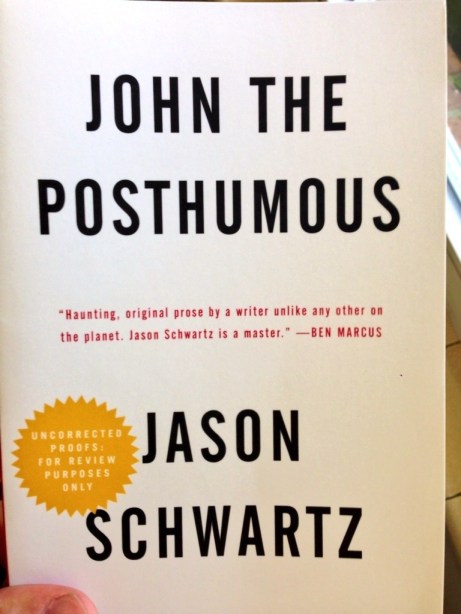
Some folks I know and whose taste I trust told me about Jason Schwartz, whose new novel (“novel” is not the right word) John the Posthumous is forthcoming from OR Books (the final cover art, which you can see via OR’s site, is much nicer than the reader copy above).
The book bears blurbs from Sam Lipsyte and Ben Marcus and Gordon Lish—so that should be enough for you. (It was enough to pique me).
What is it about? Violence. Cuckoldry. Murder. Satan. Ritual. Animals. Beds. Etc. I don’t know. I’m a little over half way through, and I keep rereading it compulsively, rereading the sentences. Schwartz’s prose approaches a dark, poetic logic of substitutions and omissions that is probably best left unexplicated, but I’ll do a write up after the Fourth of July anyway. Here’s Lish’s praise (a short story in itself):
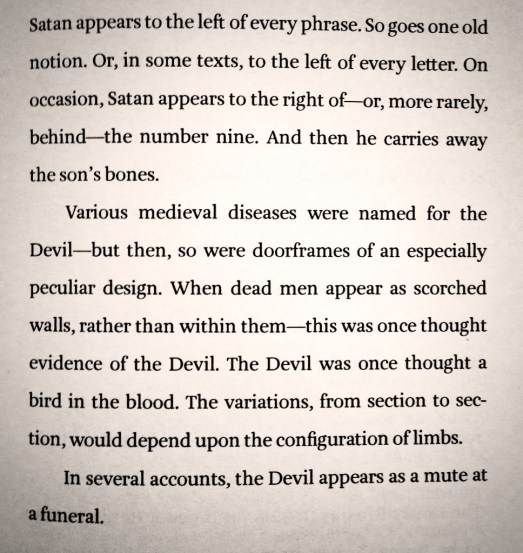
And two samples from the book (context is unimportant; or, rather everything—that is, the context of the entire book, in that the book is its own idiom, if you follow (or don’t)):
I mean, I’ve got my weird neuroses. Like I’m totally—I had this huge inferiority complex where William Vollmann’s concerned. Because he and I’s first books came out at the same time. And I even once read a Madison Smartt Bell essay, where he used me, and my “slender output,” and the inferiority of it, to talk about, you know, how great Vollmann is. And so I go around, “Oh no, Vollmann’s had another one out, now he’s got like five to my one.” I go around with that stuff. But I think, I’m trying to think of any example that …
Bell himself is an outpourer.
I think just: I haven’t read a lot of the new stuff that’s come out over the last few years. Like Steve Erickson, and Tours of the Black Clock—it’s really fucking good. I thought Bret Ellis’s first book, I thought it was very, very powerful. American Psycho—I thought he was really ill-served by his agent and publisher even letting him publish it, and those are the only two things of his that I read. But that’s, I think this is another danger: you get lavishly rewarded for that first book, and it’s gonna be very difficult for him ever to do anything else. I mean there’s gonna be part of you that just wants to do that over and over and over again, so you continue to get the food pellets of praise. It’s one more way that all this stuff is toxic.
Same risk for you?
Sure. Because whatever I do, the next thing will be very different from this. And if it gets reamed, then I’ll think: “Oh no. Maybe Infinite Jest II.” In which case, somebody needs to come and just put a bullet in my head. To be merciful. David Leavitt noose quote: Reviewers will use my first book as a noose to hang my second. I think it often is. Although the nice thing about having written an essentially shitty first book is that I’m exempt from that problem. There were a lot of people who really liked Broom of the System, but unfortunately they’re all about eleven.
From David Lipsky’s book-length interview/memoir Although Of Course You End Up Becoming Yourself; the italicized interjections are Lipsky’s.
What say of it? what say of CONSCIENCE grim, That spectre in my path? Chamberlayne’s Pharronida.
LET me call myself, for the present, William Wilson. The fair page now lying before me need not be sullied with my real appellation. This has been already too much an object for the scorn—for the horror—for the detestation of my race. To the uttermost regions of the globe have not the indignant winds bruited its unparalleled infamy? Oh, outcast of all outcasts most abandoned!—to the earth art thou not forever dead? to its honors, to its flowers, to its golden aspirations?—and a cloud, dense, dismal, and limitless, does it not hang eternally between thy hopes and heaven?
I would not, if I could, here or to-day, embody a record of my later years of unspeakable misery, and unpardonable crime. This epoch—these later years—took unto themselves a sudden elevation in turpitude, whose origin alone it is my present purpose to assign. Men usually grow base by degrees. From me, in an instant, all virtue dropped bodily as a mantle. From comparatively trivial wickedness I passed, with the stride of a giant, into more than the enormities of an Elah-Gabalus. What chance—what one event brought this evil thing to pass, bear with me while I relate. Death approaches; and the shadow which foreruns him has thrown a softening influence over my spirit. I long, in passing through the dim valley, for the sympathy—I had nearly said for the pity—of my fellow men. I would fain have them believe that I have been, in some measure, the slave of circumstances beyond human control. I would wish them to seek out for me, in the details I am about to give, some little oasis of fatality amid a wilderness of error. I would have them allow—what they cannot refrain from allowing—that, although temptation may have erewhile existed as great, man was never thus, at least, tempted before—certainly, never thus fell. And is it therefore that he has never thus suffered? Have I not indeed been living in a dream? And am I not now dying a victim to the horror and the mystery of the wildest of all sublunary visions?
I am the descendant of a race whose imaginative and easily excitable temperament has at all times rendered them remarkable; and, in my earliest infancy, I gave evidence of having fully inherited the family character. As I advanced in years it was more strongly developed; becoming, for many reasons, a cause of serious disquietude to my friends, and of positive injury to myself. I grew self-willed, addicted to the wildest caprices, and a prey to the most ungovernable passions. Weak-minded, and beset with constitutional infirmities akin to my own, my parents could do but little to check the evil propensities which distinguished me. Some feeble and ill-directed efforts resulted in complete failure on their part, and, of course, in total triumph on mine. Thenceforward my voice was a household law; and at an age when few children have abandoned their leading-strings, I was left to the guidance of my own will, and became, in all but name, the master of my own actions. Continue reading ““William Wilson” — Edgar Allan Poe”→
It was, I think, in the spring of ’94 that a slender, narrow-chested fellow in a shabby grey suit, with a soft felt hat pulled low over his eyes, sauntered into the office of the managing editor of the Nebraska State Journal and introduced himself as Stephen Crane. He stated that he was going to Mexico to do some work for the Bacheller Syndicate and get rid of his cough, and that he would be stopping in Lincoln for a few days. Later he explained that he was out of money and would be compelled to wait until he got a check from the East before he went further. I was a Junior at the Nebraska State University at the time, and was doing some work for the State Journal in my leisure time, and I happened to be in the managing editor’s room when Mr. Crane introduced himself. I was just off the range; I knew a little Greek and something about cattle and a good horse when I saw one, and beyond horses and cattle I considered nothing of vital importance except good stories and the people who wrote them. This was the first man of letters I had ever met in the flesh, and when the young man announced who he was, I dropped into a chair behind the editor’s desk where I could stare at him without being too much in evidence.
Only a very youthful enthusiasm and a large propensity for hero worship could have found anything impressive in the young man who stood before the managing editor’s desk. He was thin to emaciation, his face was gaunt and unshaven, a thin dark moustache straggled on his upper lip, his black hair grew low on his forehead and was shaggy and unkempt. His grey clothes were much the worse for wear and fitted him so badly it seemed unlikely he had ever been measured for them. He wore a flannel shirt and a slovenly apology for a necktie, and his shoes were dusty and worn gray about the toes and were badly run over at the heel. I had seen many a tramp printer come up the Journal stairs to hunt a job, but never one who presented such a disreputable appearance as this story-maker man. He wore gloves, which seemed rather a contradiction to the general slovenliness of his attire, but when he took them off to search his pockets for his credentials, I noticed that his hands were singularly fine; long, white, and delicately shaped, with thin, nervous fingers. I have seen pictures of Aubrey Beardsley’s hands that recalled Crane’s very vividly. Continue reading ““When I Knew Stephen Crane” — Willa Cather”→
The rain has stopped. The waterfall will roar like that all
night. I have come out to take a walk and feed. My body–foot,
that is–is wet and cold and covered with sharp gravel. It is
white, the size of a dinner plate. I have set myself a goal, a
certain rock, but it may well be dawn before I get there.
Although I move ghostlike and my floating edges barely graze
the ground, I am heavy, heavy, heavy. My white muscles are
already tired. I give the impression of mysterious ease, but it is
only with the greatest effort of my will that I can rise above the
smallest stones and sticks. And I must not let myself be dis-
tracted by those rough spears of grass. Don’t touch them. Draw
back. Withdrawal is always best.
The rain has stopped. The waterfall makes such a noise! (And
what if I fall over it?) The mountains of black rock give off such
clouds of steam! Shiny streamers are hanging down their sides.
When this occurs, we have a saying that the Snail Gods have
come down in haste. I could never descend such steep escarp-
ments, much less dream of climbing them.
That toad was too big, too, like me. His eyes beseeched my
love. Our proportions horrify our neighbors.
Rest a minute; relax. Flattened to the ground, my body is like
a pallid, decomposing leaf. What’s that tapping on my shell?
Nothing. Let’s go on.
My sides move in rhythmic waves, just off the ground, from
front to back, the wake of a ship, wax-white water, or a slowly
melting floe. I am cold, cold, cold as ice. My blind, white bull’s
head was a Cretan scare-head; degenerate, my four horns that
can’t attack. The sides of my mouth are now my hands. They
press the earth and suck it hard. Ah, but I know my shell is
beautiful, and high, and glazed, and shining. I know it well,
although I have not seen it. Its curled white lip is of the finest
enamel. Inside, it is as smooth as silk, and I, I fill it to perfection.
My wide wake shines, now it is growing dark. I leave a lovely
opalescent ribbon: I know this.
But O! I am too big. I feel it. Pity me.
If and when I reach the rock, I shall go into a certain crack
there for the night. The waterfall below will vibrate through
my shell and body all night long. In that steady pulsing I can
rest. All night I shall be like a sleeping ear.
To picture the predicament of worldly people, if admitted to paradise.
As the architecture of a country always follows the earliest structures, American architecture should be a refinement of the log-house. The Egyptian is so of the cavern and mound; the Chinese, of the tent; the Gothic, of overarching trees; the Greek, of a cabin.
“Though we speak nonsense, God will pick out the meaning of it,”–an extempore prayer by a New England divine.
In old times it must have been much less customary than now to drink pure water. Walker emphatically mentions, among the sufferings of a clergyman’s wife and family in the Great Rebellion, that they were forced to drink water, with crab-apples stamped in it to relish it.
Mr. Kirby, author of a work on the History, Habits, and Instincts of Animals, questions whether there may not be an abyss of waters within the globe, communicating with the ocean, and whether the huge animals of the Saurian tribe–great reptiles, supposed to be exclusively antediluvian, and now extinct–may not be inhabitants of it. He quotes a passage from Revelation, where the creatures under the earth are spoken of as distinct from those of the sea, and speaks of a Saurian fossil that has been found deep in the subterranean regions. He thinks, or suggests, that these may be the dragons of Scripture.









 Biblioklept