“The Bible as Poetry” — Walt Whitman

“The Bible as Poetry” by Walt Whitman

I suppose one cannot at this day say anything new, from a literary point of view, about those autochthonic bequests of Asia—the Hebrew Bible, the mighty Hindu epics, and a hundred lesser but typical works; (not now definitely including the Iliad—though that work was certainly of Asiatic genesis, as Homer himself was—considerations which seem curiously ignored.) But will there ever be a time or place—ever a student, however modern, of the grand art, to whom those compositions will not afford profounder lessons than all else of their kind in the garnerage of the past? Could there be any more opportune suggestion, to the current popular writer and reader of verse, what the office of poet was in primeval times—and is yet capable of being, anew, adjusted entirely to the modern?

All the poems of Orientalism, with the Old and New Testaments at the centre, tend to deep and wide, (I don’t know but the deepest and widest,) psychological development—with little, or nothing at all, of the mere esthetic, the principal verse-requirement of our day. Very late, but unerringly, comes to every capable student the perception that it is not in beauty, it is not in art, it is not even in science, that the profoundest laws of the case have their eternal sway and outcropping.

In his discourse on “Hebrew Poets” De Sola Mendes said: “The fundamental feature of Judaism, of the Hebrew nationality, was religion; its poetry was naturally religious. Its subjects, God and Providence, the covenants with Israel, God in Nature, and as reveal’d, God the Creator and Governor, Nature in her majesty and beauty, inspired hymns and odes to Nature’s God. And then the checker’d history of the nation furnish’d allusions, illustrations, and subjects for epic display—the glory of the sanctuary, the offerings, the splendid ritual, the Holy City, and lov’d Palestine with its pleasant valleys and wild tracts.” Dr. Mendes said “that rhyming was not a characteristic of Hebrew poetry at all. Metre was not a necessary mark of poetry. Great poets discarded it; the early Jewish poets knew it not.” Compared with the famed epics of Greece, and lesser ones since, the spinal supports of the Bible are simple and meagre. All its history, biography, narratives, &c., are as beads, strung on and indicating the eternal thread of the Deific purpose and power. Yet with only deepest faith for impetus, and such Deific purpose for palpable or impalpable theme, it often transcends the masterpieces of Hellas, and all masterpieces.

The metaphors daring beyond account, the lawless soul, extravagant by our standards, the glow of love and friendship, the fervent kiss—nothing in argument or logic, but unsurpass’d in proverbs, in religious ecstasy, in suggestions of common mortality and death, man’s great equalizers—the spirit everything, the ceremonies and forms of the churches nothing, faith limitless, its immense sensuousness immensely spiritual—an incredible, all-inclusive non-worldliness and dew-scented illiteracy (the antipodes of our Nineteenth Century business absorption and morbid refinement)—no hair-splitting doubts, no sickly sulking and sniffling, no “Hamlet,” no “Adonais,” no “Thanatopsis,” no “In Memoriam.”

The culminated proof of the poetry of a country is the quality of its personnel, which, in any race, can never be really superior without superior poems. The finest blending of individuality with universality (in my opinion nothing out of the galaxies of the “Iliad,” or Shakspere’s heroes, or from the Tennysonian “Idylls,” so lofty, devoted and starlike,) typified in the songs of those old Asiatic lands. Men and women as great columnar trees. Nowhere else the abnegation of self towering in such quaint sublimity; nowhere else the simplest human emotions conquering the gods of heaven, and fate itself. (The episode, for instance, toward the close of the “Mahabharata”—the journey of the wife Savitri with the god of death, Yama,

“One terrible to see—blood-red his garb,

His body huge and dark, bloodshot his eyes,

Which flamed like suns beneath his turban cloth,

Arm’d was he with a noose,”

who carries off the soul of the dead husband, the wife tenaciously following, and—by the resistless charm of perfect poetic recitation!—eventually redeeming her captive mate.)

I remember how enthusiastically William H. Seward, in his last days, once expatiated on these themes, from his travels in Turkey, Egypt, and Asia Minor, finding the oldest Biblical narratives exactly illustrated there to-day with apparently no break or change along three thousand years—the veil’d women, the costumes, the gravity and simplicity, all the manners just the same. The veteran Trelawney said he found the only real nobleman of the world in a good average specimen of the mid-aged or elderly Oriental. In the East the grand figure, always leading, is the old man, majestic, with flowing beard, paternal, &c. In Europe and America, it is, as we know, the young fellow—in novels, a handsome and interesting hero, more or less juvenile—in operas, a tenor with blooming cheeks, black mustache, superficial animation, and perhaps good lungs, but no more depth than skim-milk. But reading folks probably get their information of those Bible areas and current peoples, as depicted in print by English and French cads, the most shallow, impudent, supercilious brood on earth.

I have said nothing yet of the cumulus of associations (perfectly legitimate parts of its influence, and finally in many respects the dominant parts,) of the Bible as a poetic entity, and of every portion of it. Not the old edifice only—the congeries also of events and struggles and surroundings, of which it has been the scene and motive—even the horrors, dreads, deaths. How many ages and generations have brooded and wept and agonized over this book! What untellable joys and ecstasies—what support to martyrs at the stake—from it. (No really great song can ever attain full purport till long after the death of its singer—till it has accrued and incorporated the many passions, many joys and sorrows, it has itself arous’d.) To what myriads has it been the shore and rock of safety—the refuge from driving tempest and wreck! Translated in all languages, how it has united this diverse world! Of civilized lands to-day, whose of our retrospects has it not interwoven and link’d and permeated? Not only does it bring us what is clasp’d within its covers; nay, that is the least of what it brings. Of its thousands, there is not a verse, not a word, but is thick-studded with human emotions, successions of fathers and sons, mothers and daughters, of our own antecedents, inseparable from that background of us, on which, phantasmal as it is, all that we are to-day inevitably depends—our ancestry, our past.

Strange, but true, that the principal factor in cohering the nations, eras and paradoxes of the globe, by giving them a common platform of two or three great ideas, a commonalty of origin, and projecting kosmic brotherhood, the dream of all hope, all time—that the long trains gestations, attempts and failures, resulting in the New World, and in modern solidarity and politics—are to be identified and resolv’d back into a collection of old poetic lore, which, more than any one thing else, has been the axis of civilization and history through thousands of years—and except for which this America of ours, with its polity and essentials, could not now be existing.

No true bard will ever contravene the Bible. If the time ever comes when iconoclasm does its extremest in one direction against the Books of the Bible in its present form, the collection must still survive in another, and dominate just as much as hitherto, or more than hitherto, through its divine and primal poetic structure. To me, that is the living and definite element-principle of the work, evolving everything else. Then the continuity; the oldest and newest Asiatic utterance and character, and all between, holding together, like the apparition of the sky, and coming to us the same. Even to our Nineteenth Century here are the fountain heads of song.


The Resurrectionist (Book Acquired, 6.04.2013)

20130607-155808.jpg

20130607-155816.jpg

Matthew Guinn’s The Resurrectionist showed up in the mail a few days ago. Haven’t really had time to get into it, but the premise seems promising, and Guinn’s Southern lit bona fides also intrigue me.

Publisher W.W. Norton’s blurb:

A young doctor wrestles with the legacy of a slave “resurrectionist” owned by his South Carolina medical school.

“Dog days and the fresh bodies are arriving once again.” So begins the fall term at South Carolina Medical College, where Dr. Jacob Thacker is on probation for Xanax abuse. His interim career—working public relations for the dean—takes an unnerving detour into the past when the bones of African American slaves, over a century old, are unearthed on campus. Out of the college’s dark past, these bones threaten to rise and condemn the present.

In the middle of the nineteenth century, Dr. Frederick Augustus Johnston, one of the school’s founders, had purchased a slave for his unusual knife skills. This slave, Nemo (“no man”) would become an unacknowledged member of the surgical faculty by day—and by night, a “resurrectionist,” responsible for procuring bodies for medical study. An unforgettable character, by turns apparently insouciant, tormented, and brilliant, and seen by some as almost supernatural, Nemo will seize his self-respect in ways no reader can anticipate.

With exceptional storytelling pacing and skill, Matthew Guinn weaves together past and present to relate a Southern Gothic tale of shocking crimes and exquisite revenge, a riveting and satisfying moral parable of the South.


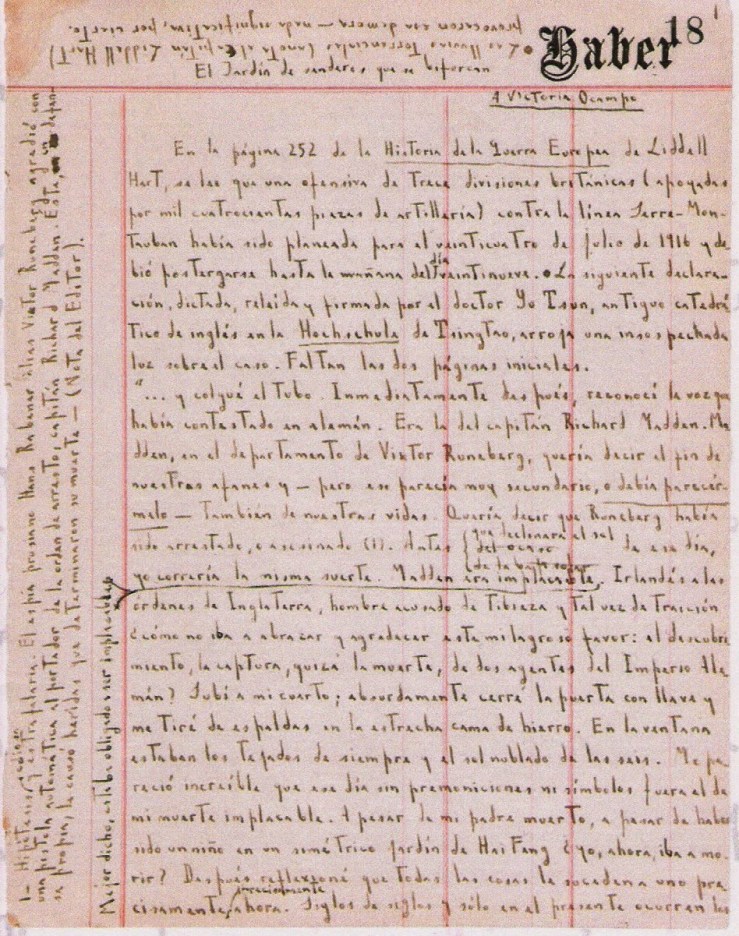
Handwritten Manuscript Page for Jorge Luis Borges’s “The Garden of Forking Paths”

borges manuscript

(Via).

Read an Excerpt from Adam Novy’s Work in Progress, The Gore and the Splatter

Hobart has published an excerpt of Adam Novy’s work in progress, The Gore and Splatter. I was a big fan of Adam’s last novel, The Avian Gospels, a dystopian take on terror and gypsies and birds. When I interviewed Adam a few years ago, he told me he was “writing a novel about the life and times of Medusa. It’s called The Gore and the Splatter. Ryan Chang got a bit more info about the novel in his interview with Adam, posted yesterday at Electric Literature:

I’m working on a novel about Perseus and Medusa before they get discovered. The early days of Perseus and Medusa. It takes place partially in mythic Greece and partially the suburb I grew up in. The characters are in the middle of mythic history. One thing about mythology I’ve always been really interested is what the characters know about their place and time in history. There’s this idea that the world is new and folks are creating meaning as they go along. Do they know they’re creating meaning? And what would it be like to be a teenager under those circumstances? Or a parent raising those teenagers, what would it be like?

I’m looking forward to this one. Until then we have the excerpt. Here is an excerpt of the excerpt:

Pentheus’s bedroom: hardly large enough to fit his mattress, a modest trunk of clothes, a wooden torso on a stick that wore his armor while he slept, and an altar to Athena. The floorplanks creaked, the roof leaked water, porous walls keened in wind. He’d let his mother and his nephews have the bedrooms with the windows. The den was also small, and too close to the kitchen for these rooms to be considered separate entities, and this house, such as it was, sat unevenly on pylons of old concrete, for the ground was a decline of dirt and sand on a rambling scrappy hillside, where any rugged vegetables that flourished in the desperate little gardens were scavengered immediately by rabbits.

The bungalow wasn’t quite dysfunctional, merely ugly, small, grotty, and way beyond the prospect of improvement. Still, the sneaky sisters Casey and Arden enjoyed their lives in an unfairly lavish home, and the house where the miraculous atrocity had happened, with the river and the tree, was nigh short of a mansion, if an ugly, nouveau, tasteless one. Perhaps whoever’d lived there had been killed for being vulgar. Pentheus had been working in a lumber yard adjacent to The Turnbull Farm—a huge, efficient version of the farm where Casey and Arden lived—when Mister Reddy heard that he was tall and took him on as his assistant. Your feet are very big, he’d said, you’ll leave a large carbon footprint. Pentheus thought he’d caught his golden opportunity, but all he got to do was walk beside the boss in heavy armor, sweat until he felt that he would rot, follow incoherent orders and let teenage girls humiliate him. And the pay was just as crappy as the lumber yard. Agave, his own mother, was a maid for Mister Turnbull. She was sixty-eight years old, but still she cooked, scrubbed the floor, washed stains from the clothes of messy children whose privilege didn’t exactly translate into manners. Pentheus and Agave paid their rent to Mister Reddy, who was Mister Turnbull’s partner, though Mister Reddy and Mister Turnbull also paid their salaries. Pentheus and his mother were little more than conduits for money as it looped its way inexorably back to whence it came. Jayden, Pentheus’s nephew, had said they were a kind of large intestine, where food was turned to shit and got excreted without their being able to enjoy it. Pentheus sometimes wished the boy was less articulate.

“The Seven Vagabonds” — Nathaniel Hawthorne

“The Seven Vagabonds” — Nathaniel Hawthorne

Rambling on foot in the spring of my life and the summer of the year, I came one afternoon to a point which gave me the choice of three directions. Straight before me the main road extended its dusty length to Boston; on the left a branch went toward the sea, and would have lengthened my journey a trifle of twenty or thirty miles, while by the right-hand path I might have gone over hills and lakes to Canada, visiting in my way the celebrated town of Stamford. On a level spot of grass at the foot of the guide-post appeared an object which, though locomotive on a different principle, reminded me of Gulliver’s portable mansion among the Brobdignags. It was a huge covered wagon—or, more properly, a small house on wheels—with a door on one side and a window shaded by green blinds on the other. Two horses munching provender out of the baskets which muzzled them were fastened near the vehicle. A delectable sound of music proceeded from the interior, and I immediately conjectured that this was some itinerant show halting at the confluence of the roads to intercept such idle travellers as myself. A shower had long been climbing up the western sky, and now hung so blackly over my onward path that it was a point of wisdom to seek shelter here.

“Halloo! Who stands guard here? Is the doorkeeper asleep?” cried I, approaching a ladder of two or three steps which was let down from the wagon.

The music ceased at my summons, and there appeared at the door, not the sort of figure that I had mentally assigned to the wandering showman, but a most respectable old personage whom I was sorry to have addressed in so free a style. He wore a snuff-colored coat and small-clothes, with white top-boots, and exhibited the mild dignity of aspect and manner which may often be noticed in aged schoolmasters, and sometimes in deacons, selectmen or other potentates of that kind. A small piece of silver was my passport within his premises, where I found only one other person, hereafter to be described.

“This is a dull day for business,” said the old gentleman as he ushered me in; “but I merely tarry here to refresh the cattle, being bound for the camp-meeting at Stamford.” Continue reading ““The Seven Vagabonds” — Nathaniel Hawthorne”

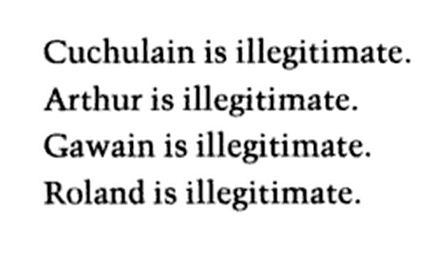
Illegitimate (David Markson)

Capture

“On Noise” — Arthur Schopenhauer

Kant has written a treatise on The Vital Powers; but I should like to write a dirge on them, since their lavish use in the form of knocking, hammering, and tumbling things about has made the whole of my life a daily torment. Certainly there are people, nay, very many, who will smile at this, because they are not sensitive to noise; it is precisely these people, however, who are not sensitive to argument, thought, poetry or art, in short, to any kind of intellectual impression: a fact to be assigned to the coarse quality and strong texture of their brain tissues. On the other hand, in the biographies or in other records of the personal utterances of almost all great writers, I find complaints of the pain that noise has occasioned to intellectual men. For example, in the case of Kant, Goethe, Lichtenberg, Jean Paul; and indeed when no mention is made of the matter it is merely because the context did not lead up to it. I should explain the subject we are treating in this way: If a big diamond is cut up into pieces, it immediately loses its value as a whole; or if an army is scattered or divided into small bodies, it loses all its power; and in the same way a great intellect has no more power than an ordinary one as soon as it is interrupted, disturbed, distracted, or diverted; for its superiority entails that it concentrates all its strength on one point and object, just as a concave mirror concentrates all the rays of light thrown upon it. Noisy interruption prevents this concentration. This is why the most eminent intellects have always been strongly averse to any kind of disturbance, interruption and distraction, and above everything to that violent interruption which is caused by noise; other people do not take any particular notice of this sort of thing. The most intelligent of all the European nations has called “Never interrupt” the eleventh commandment. But noise is the most impertinent of all interruptions, for it not only interrupts our own thoughts but disperses them. Where, however, there is nothing to interrupt, noise naturally will not be felt particularly. Sometimes a trifling but incessant noise torments and disturbs me for a time, and before I become distinctly conscious of it I feel it merely as the effort of thinking becomes more difficult, just as I should feel a weight on my foot; then I realise what it is. Continue reading ““On Noise” — Arthur Schopenhauer”

“…the amazing, world-reversing night of Fourth of July Eve 1899” (Pynchon’s Against the Day)

For years after, there were tales told in Colorado of the amazing, world-reversing night of Fourth of July Eve 1899. Next day’d be full of rodeos, marching bands, and dynamite explosions—but that night there was man-made lightning, horses gone crazy for miles out into the prairie, electricity flooding up through the iron of their shoes, shoes that when they finally came off and got saved to use for cowboy quoits, including important picnic tourneys from Fruita to Cheyenne Wells, why they would fly directly and stick on to the spike in the ground, or to anything else nearby made of iron or steel, that’s when they weren’t collecting souvenirs on their way through the air—gunmen’s guns came right up out of their holsters and buck knives out from under pants legs, keys to traveling ladies’ hotel rooms and office safes, miners’ tags, fencenails, hairpins, all seeking the magnetic memory of that long-ago visit. Veterans of the Rebellion fixing to march in parades were unable to get to sleep, metallic elements had so got to humming through their bloodmaps. Children who drank the milk from the dairy cows who grazed nearby were found leaning against telegraph poles listening to the traffic speeding by through the wires above their heads, or going off to work in stockbrokers’ offices where, unsymmetrically intimate with the daily flow of prices, they were able to amass fortunes before anyone noticed. .

A passage from Thomas Pynchon’s novel Against the Day.


“The Singing Lesson” — Katherine Mansfield

“The Singing Lesson” — Katherine Mansfield

With despair—cold, sharp despair—buried deep in her heart like a wicked knife, Miss Meadows, in cap and gown and carrying a little baton, trod the cold corridors that led to the music hall. Girls of all ages, rosy from the air, and bubbling over with that gleeful excitement that comes from running to school on a fine autumn morning, hurried, skipped, fluttered by; from the hollow class-rooms came a quick drumming of voices; a bell rang; a voice like a bird cried, “Muriel.” And then there came from the staircase a tremendous knock-knock-knocking. Some one had dropped her dumbbells.

The Science Mistress stopped Miss Meadows.

“Good mor-ning,” she cried, in her sweet, affected drawl. “Isn’t it cold? It might be win-ter.”

Miss Meadows, hugging the knife, stared in hatred at the Science Mistress. Everything about her was sweet, pale, like honey. You wold not have been surprised to see a bee caught in the tangles of that yellow hair.

“It is rather sharp,” said Miss Meadows, grimly.

The other smiled her sugary smile.

“You look fro-zen,” said she. Her blue eyes opened wide; there came a mocking light in them. (Had she noticed anything?)

“Oh, not quite as bad as that,” said Miss Meadows, and she gave the Science Mistress, in exchange for her smile, a quick grimace and passed on…

Forms Four, Five, and Six were assembled in the music hall. The noise was deafening. On the platform, by the piano, stood Mary Beazley, Miss Meadows’ favourite, who played accompaniments. She was turning the music stool. When she saw Miss Meadows she gave a loud, warning “Sh-sh! girls!” and Miss Meadows, her hands thrust in her sleeves, the baton under her arm, strode down the centre aisle, mounted the steps, turned sharply, seized the brass music stand, planted it in front of her, and gave two sharp taps with her baton for silence. Continue reading ““The Singing Lesson” — Katherine Mansfield”

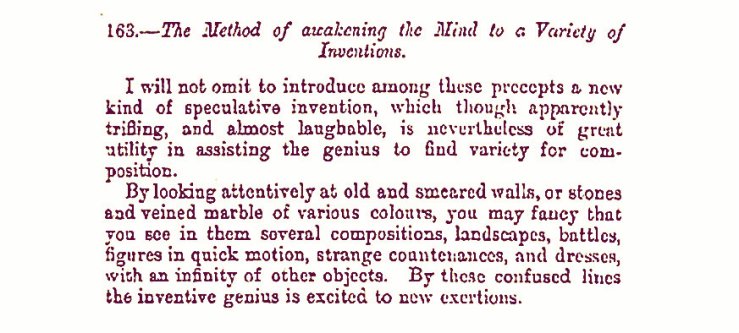
“The Method of Awakening the Mind to a Variety of Inventions” — Leonardo da Vinci

Capture

“Hawthorne and His Mosses” — Herman Melville

“Hawthorne and His Mosses” by Herman Melville

A papered chamber in a fine old farm-house–a mile from any other dwelling, and dipped to the eaves in foliage–surrounded by mountains, old woods, and Indian ponds,–this, surely is the place to write of Hawthorne. Some charm is in this northern air, for love and duty seem both impelling to the task. A man of a deep and noble nature has seized me in this seclusion. His wild, witch voice rings through me; or, in softer cadences, I seem to hear it in the songs of the hill-side birds, that sing in the larch trees at my window.

Would that all excellent books were foundlings, without father or mother, that so it might be, we could glorify them, without including their ostensible authors. Nor would any true man take exception to this;–least of all, he who writes,–“When the Artist rises high enough to achieve the Beautiful, the symbol by which he makes it perceptible to mortal senses becomes of little value in his eyes, while his spirit possesses itself in the enjoyment of the reality.”

But more than this, I know not what would be the right name to put on the title-page of an excellent book, but this I feel, that the names of all fine authors are fictitious ones, far more than that of Junius,–simply standing, as they do, for the mystical, ever-eluding Spirit of all Beauty, which ubiquitously possesses men of genius. Purely imaginative as this fancy may appear, it nevertheless seems to receive some warranty from the fact, that on a personal interview no great author has ever come up to the idea of his reader. But that dust of which our bodies are composed, how can it fitly express the nobler intelligences among us? With reverence be it spoken, that not even in the case of one deemed more than man, not even in our Saviour, did his visible frame betoken anything of the augustness of the nature within. Else, how could those Jewish eyewitnesses fail to see heaven in his glance.

It is curious, how a man may travel along a country road, and yet miss the grandest, or sweetest of prospects, by reason of an intervening hedge, so like all other hedges, as in no way to hint of the wide landscape beyond. So has it been with me concerning the enchanting landscape in the soul of this Hawthorne, this most excellent Man of Mosses. His “Old Manse” has been written now four years, but I never read it till a day or two since. I had seen it in the book-stores–heard of it often–even had it recommended to me by a tasteful friend, as a rare, quiet book, perhaps too deserving of popularity to be popular. But there are so many books called “excellent,” and so much unpopular merit, that amid the thick stir of other things, the hint of my tasteful friend was disregarded; and for four years the Mosses on the Old Manse never refreshed me with their perennial green. It may be, however, that all this while, the book, like wine, was only improving in flavor and body. At any rate, it so chanced that this long procrastination eventuated in a happy result. At breakfast the other day, a mountain girl, a cousin of mine, who for the last two weeks has every morning helped me to strawberries and raspberries,–which like the roses and pearls in the fairy-tale, seemed to fall into the saucer from those strawberry-beds her cheeks,–this delightful crature, this charming Cherry says to me–“I see you spend your mornings in the hay-mow; and yesterday I found there ‘Dwight’s Travels in New England’. Now I have something far better than that,–something more congenial to our summer on these hills. Take these raspberries, and then I will give you some moss.”–“Moss!” said I–“Yes, and you must take it to the barn with you, and good-bye to ‘Dwight.'” Continue reading ““Hawthorne and His Mosses” — Herman Melville”

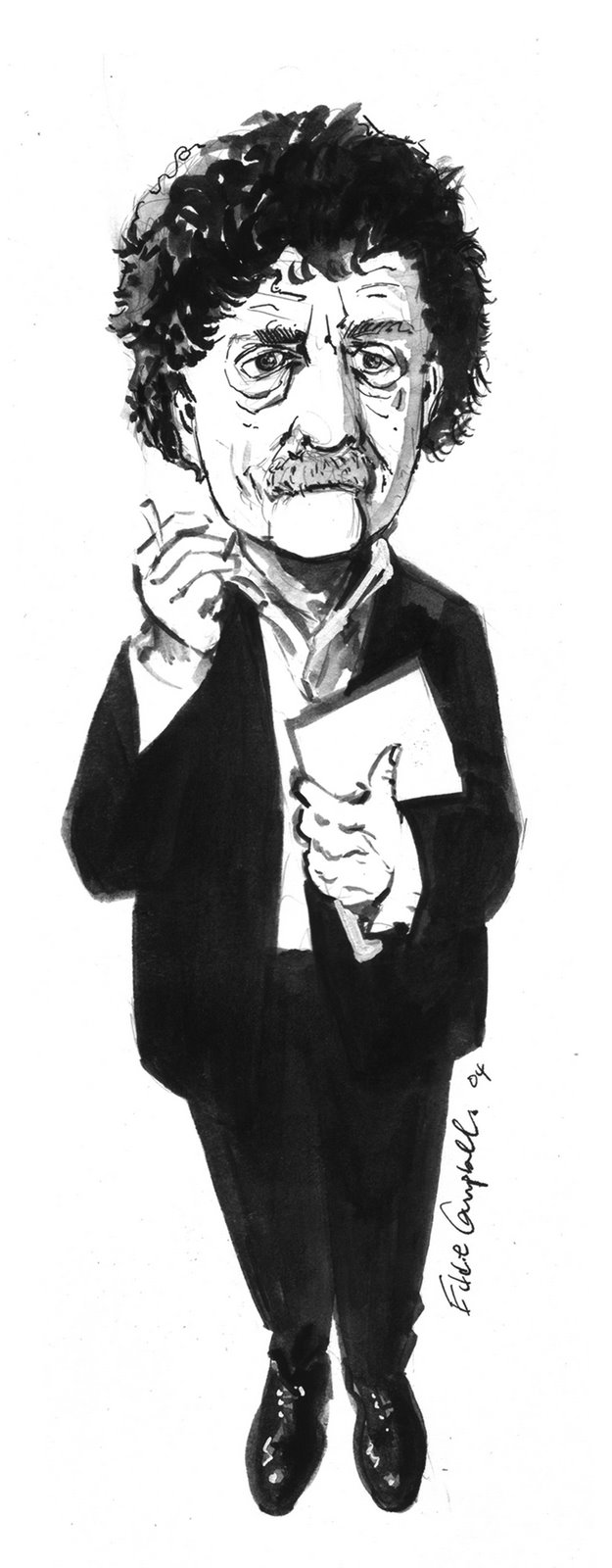
Portrait of Kurt Vonnegut — Eddie Campbell

Kurt Vonnegut

(Via).

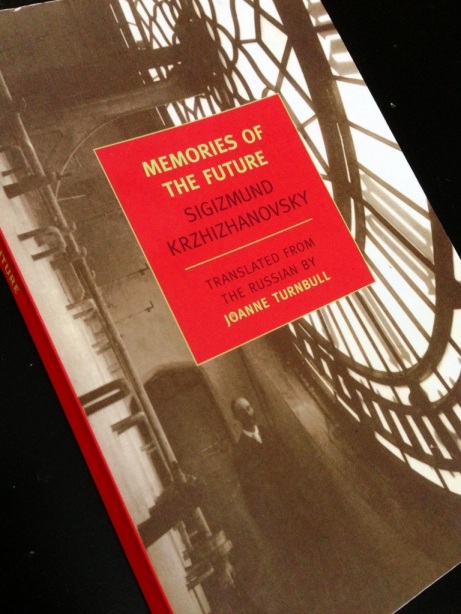
“All Our Figments and Alogisms” | The Kafkaesque, Borgesian, Phildickian Worlds of Sigizmund Krzhizhanovsky

20130602-142757.jpg

At some point I acquired the notion, probably a fair one, that comparing writers to other writers is critically lazy. At the same time, writers write after other writers, through other writers, to other writers, against other writers, in other writers, out of other writers, on top of other writers, and so on. Literature is archaeological. And if I’m honest, a lot of the time it’s the comparison to another writer that prompts my interest in a writer I haven’t read.

Let me get to what I was getting at:

Sigizmund Krzhizhanovsky: Russian, 1887-1950: His collection Memories of the Future: Seven stories in spirited translation by Joanne Turnbull: Available in English from the good folks at NYRB: It’s the sort of book that deserves its own book. Etc.

In lieu of writing that book, quite beyond my power, I’ll compare Sigizmund Krzhizhanovsky to some other writers in the hope of piquing your interest in this neglected master.

***

KAFKAESQUE

You knew I would start here.

Four years senior to Krzhizhanovsky, Mr. Kafka of Prague was our Russian writer’s contemporary (if we want to use our postmodern imaginations). I was tempted to simply type “K” for Kafka, but they are both K. Kafkaesque is invoked frequently enough to potentially sap the adjective’s potency, but consider that the same nebulous yet very real forces that shaped (warped?) Kafka (which, in turn Kafka shaped (warped) in his own writing) shaped (warped?) Krzhizhanovsky. Unseen, displaced authority, alienation, and absurdity, yes, but also humor, the line of hysteria, the constraining order that induces madness. The nightmare of modernity.

From “The Branch Line”:

“Speaking in more modern terms,” the fine print went on, “our nightmares, weighing as they do on the brain, gradually form a sort of moral ceiling that is always about to come crashing down on one’s head: some of our customer’s call this ‘world history.’ But that’s not the point. The point is the durability, unwakeability, high depressiveness, and wide availability of our nightmares: mass-market products good for all eras and classes, nighttime and daytime, moonlight and sunlight, closed eyes and open.”

BULGAKOVIAN

If Kafka was Krzhizhanovsky’s psychical contemporary, Mikhail Bulgakov (Russian, b. 1891) is his geographic one. Both men were writing through (and to some extent, against) the Russian Revolution, rendering the crowded buzz of new Moscow in manic strokes. Humming under the surface of Bulgakov’s masterpiece The Master and Margarita is the threat of disappearance, the loss of personal space, but also absurd humor. These themes run through the seven stories collected in Memories of the Future, but perhaps evince most strongly in “Quadraturin” (maybe Krzhizhanovsky’s most famous story), where furtive bachelor Sutulin obtains a samizdat device that expands his tiny apartment—ad infinitum into limitless space and terror.

From “Quadraturin”:

In their sleep and in their fear, the occupants of the quadratures adjacent to citizen Sutulin’s eighty-six square feet couldn’t make head or tail of the timbre and intonation of the cry that woke them in teh middle of the night and compelled them to rush to the threshold of the Sutulin cell: for a man who is lost and dying in the wilderness to cry out is both futile and belated: but if even so—against all sense—he does cry out, then, most likely, thus.

BORGESIAN

So much of Kafkaesque applies to Borgesian, and perhaps I’ve quickly run up against one of the central problems of comparison: The originary: The source of the source: Primary (etc.). No matter. Krzhizhanovsky’s modernism is Borgesian: Tale-telling: nested tales, circular tales, winding tales, labyrinths and mirrors, trap doors and hidden texts (motives), narrators who tell us a story as if it’s just a distraction in the middle of some bigger story we won’t get to hear—yet. Could there be a more Borgesian title than “The Bookmark,” a tale loaded with hundreds of tales. (Okay, maybe not hundreds, but still loaded with that Scheherazade programming, that infinite looping…).

From “Someone Else’s Theme”:

And an invented person makes the greatest impression, naturally, on the seemingly not-invented, real person who, upon finding his reflection in a book, feels replaced and redoubled. This person cannot forgive his feeling of double insult: here I, a real, not-invented person, shall go to my grave and nothingness in ten or twenty years, whereas this fabricated, not-real “almost I” shall go on living and living as though it were the most natural thing in the world; more unforgivable still is the awareness that someone, some author, made you up like an arithmetic problem, what’s more he figured you out, arrived at an answer over which you struggled your entire life in vain, he divined your existence without ever having met you, he penned his way into your innermost thoughts, which you tried so hard to hide from yourself. One must refute the author and vindicate oneself. At once!

HAWTHORNESQUE

It might be easy to go to Poe for a comparison: He’s famous for his tales, and Krzhizhanovsky is a tale-master—whereas Hawthorne’s estimable short stories are often overlooked because he happened to write what may or may not be The Great American Novel. But Hawthorne’s dark romantic imagination, his weird sci-fi streak, and his wry sense of humor offer a better frame of reference for Krzhizhanovsky’s contours. Krzhizhanovsky is also fond of Hawthorne’s closing gambit, the “It-was-all-a-dream-or-hey-was-it?” maneuver. Both writers practice allegorical destabilization in their deeply darkly ironic parables. Soul detectives.

From “The Branch Line”:

He knew from experience that dreams, like the thieves in the parable, come unseen, they slip under foreheads, trying to avoid the eyes, and only there—under the cranial roof, safe and sound, sprawled the brain—do they throw off their invisibility.

DOSTOEVSKIAN

Krzhizhanovsky directly invokes several Russian writers by name, including Gogol and Turgenev, but Fyodor Dostoevsky seems to pop up the most. This makes sense. Dostoevsky is Krzhizhanovsky’s parent-writer. Or maybe Raskolnikov is. Or maybe the Underground Man is. Like Dostoevsky, Krzhizhanovsky crafts alienated loners and thrusts them into absurd moral quandaries.

From “Red Snow”:

Resignation to one’s fate takes practice. Like any art. Or so citizen Shushashin maintains. He begins every day—after putting on his shoes and washing his face, before throwing on his jacket—with an exercise. Again, the expression is his. This expression works like this: he walks over to the wall, puts his back up against it and stands there in an attitude of utter resignation. For a minute or two. And that’s all. The exercise is over. He can begin to live.

O’BRIENESQUE

Flann O’Brien’s The Third Policeman channels Crime and Punishment via the dream machines of Hawthorne, Wells, Verne et al—all elements we might find in Memories of the Future. And of course O’Brien is Kafkaesque, Borgesian, etc. The stories-within-stories, the fake philosophers, the hefty strawmen, the dreams, the nightmares…Must I draw this out?

From “The Bookmark”:

‘I remember I tossed all night, my elbows bumping against the hard theme that layers our entire life. My pen, as soon as I dipped it in ink, wrote Animal Disputans. That was the title. Next came…Perhaps this doesn’t interest you?’

‘Please go on.’

‘I took the title and the first verses of my song, if you will, from an old and long-forgotten book by the Danish humorist Holberg. This book—Nicolai Klimmi Her subterraneum, I believe it’s called—describes the fantastic adventures of a traveler who winds up, I can’t remember how, inside the Earth. The traveler is astonished to find that inside the planet, as inside a hermetically sealed vessel, lives a race with its own hermetically sealed State system, way of life, culture, everything that is customary in such cases. Over time the life of these undergroundlings—once rife with wars and conflict, cut off, hidden away beneath miles of crust—sorted itself out and settled into a harmonious routine. The problems of the hermetically sealed were all solved, everything ironed out and agreed upon. But in memory of those long-ago wars, Nicolai Klimmi tells us—no, please listen, it’s rather touching—the land’s noblest and richest magnates raised animal disputans. There isn’t anything to argue about in an isolated country where everything has been determined and predetermined in saecula saculorum but these disputants were trained for the purpose, fed a special diet that irritated the liver and sublingual nerve, then pitted against one another and forced to argue till they were hoarse and foaming at the mouth—to unanimous laughter and merry halloos from the lovers of old traditions…

PHILDICKIAN

I think we can all agree that Memories of the Future could be the title of a Philip K. Dick story, right? The story of the same title (the longest in the collection, a novella, really) strongly recalls Dick, channeling him through time travel, and Phildickian themes course throughout the book: Paranoia, identity crisis, cynicism, the realization that the waking life might conceal alternative consciousness…

From “The Branch Line”:

Haven’t we managed to unify dreams? Haven’t we hoodwinked humanity with that sweet million-brain dream of brotherhood, a united dream about unity? Flags the color of poppy petals flutter above the crowds. Reality is fighting back. But its blazing suns don’t frighten the newly ascendant underground. Sleepers’ eyes are shielded by eyelids. Yesterday’s utopia has become today’s science. We’ll break the backs of facts. We’ll rout their status quos: you’ll see those status quos turn tail and run. If an ‘I’ should rise up against our ‘we’, we’ll hurl him down a well of nightmares headfirst. We’ll hide the sun behind black blots, we’ll plunge the whole world into a deep, static slumber. We’ll even put the idea of waking to sleep, and if it resists, we’ll gouge out its eyes.

BOLAÑOESQUE

While reading Memories of the Future, I sometimes pretended that Krzhizhanovsky (and his doppelganger writer-protagonists) were versions of Boris Abramovich Ansky, the dissident Russian writer who appears (via diaries and fragments) in “The Part About Archimboldi” in Roberto Bolaño’s 2666. Sure, I brought some of that metatextual layering with me, but Krzhizhanovsky’s Borgesian stories repeatedly destabilize the notion of an authoritative narrator or storyteller, like matryoshka dolls that open into eggs that open into dreams and nightmares. Like Bolaño’s work, Krzhizhanovsky’s writing skates across an abyss of horror. The Krzhizhanovskian milieu shares psychic space with the Bolañoverse—in particular, both writers seem to love to walk their characters through graveyards.

From “The Thirteenth Category of Reason”:

That’s how it always is: first you call on your friends, and then—when the hearses have delivered them—on their graves. Now my turn too has come to exchange people for graves. The cemetery where I go more and more often lies behind high crenelated walls and looks from the outside like a fortress: only when the fighters have all fallen will the gates open. You walk in—first past a chaos of crosses, then past the inner wall—to the new crossless cemetery: gone are the monumental statics of the old human sepulchers, the massive family vaults and stone angels with their penguin-like wings grazing the earth: red metal starts on thin wire stems fidget nervously in the wind.

***

By way of conclusion, I’ll submit that Krzhizhanovsky is just as notable for his divergences from the writers I’ve listed above as he is for any similarities. There are also plenty of names that could be added to the list above, and readers of Krzhizhanovsky will likely protest that I’ve failed to underscore the political underpinnings of his writing (for the record, the seven stories in Memories of the Future clearly respond to (and in many ways protest and satirize) early Soviet politics and lifestyle, but Krzhizhanovsky’s approach is coded, oblique, and in this sense, timeless).

I’ll end with with another citation from “The Thirteenth Category of Reason,” a story that plays with Kant’s twelve categories of conception. Krzhizhanovsky’s work is always dialogic; he’s always performing voices, but occasionally one slips through that I take to be a more direct version of the author’s own. Here, Krzhizhanovsky offers a possible thesis statement for his project—his desire to write outside the confines of reason, his desire to find meaning in “all our figments and alogisms”:

For you see, all those who are off (I won’t look for another definition) or, rather, out of their heads, evicted, so to speak, from all twelve Kantian categories of reason, must naturally seek refuge in a thirteenth category, a sort of logical lean-to slouched against objective obligatory thinking. Given that the thirteenth category of reason is where we entertain, in essence, all our figments and alogisms, the old gravedigger may be useful to my projected cycle of “fantastic” stories.

That projected cycle of fantastic stories is Memories of the Future.

“The Star-Child” — Oscar Wilde

“The Star-Child” by Oscar Wilde

Once upon a time two poor Woodcutters were making their way home through a great pine-forest.  It was winter, and a night of bitter cold.  The snow lay thick upon the ground, and upon the branches of the trees: the frost kept snapping the little twigs on either side of them, as they passed: and when they came to the Mountain-Torrent she was hanging motionless in air, for the Ice-King had kissed her.

So cold was it that even the animals and the birds did not know what to make of it.

‘Ugh!’ snarled the Wolf, as he limped through the brushwood with his tail between his legs, ‘this is perfectly monstrous weather.  Why doesn’t the Government look to it?’

‘Weet! weet! weet!’ twittered the green Linnets, ‘the old Earth is dead and they have laid her out in her white shroud.’

‘The Earth is going to be married, and this is her bridal dress,’ whispered the Turtle-doves to each other.  Their little pink feet were quite frost-bitten, but they felt that it was their duty to take a romantic view of the situation.

‘Nonsense!’ growled the Wolf.  ‘I tell you that it is all the fault of the Government, and if you don’t believe me I shall eat you.’  The Wolf had a thoroughly practical mind, and was never at a loss for a good argument.

‘Well, for my own part,’ said the Woodpecker, who was a born philosopher, ‘I don’t care an atomic theory for explanations.  If a thing is so, it is so, and at present it is terribly cold.’

Terribly cold it certainly was.  The little Squirrels, who lived inside the tall fir-tree, kept rubbing each other’s noses to keep themselves warm, and the Rabbits curled themselves up in their holes, and did not venture even to look out of doors.  The only people who seemed to enjoy it were the great horned Owls.  Their feathers were quite stiff with rime, but they did not mind, and they rolled their large yellow eyes, and called out to each other across the forest, ‘Tu-whit!  Tu-whoo!  Tu-whit!  Tu-whoo! what delightful weather we are having!’ Continue reading ““The Star-Child” — Oscar Wilde”

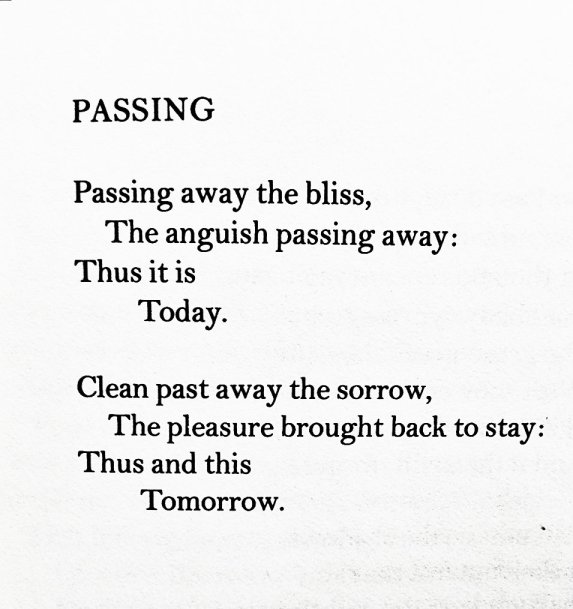
“Passing” — Christina Rossetti

passing

“Fenimore Cooper’s Literary Offenses” — Mark Twain

“Fenimore Cooper’s Literary Offenses” by Mark Twain


“The Pathfinder” and “The Deerslayer” stand at the head of Cooper’s novels as artistic creations. There are others of his works which contain parts as perfect as are to be found in these, and scenes even more thrilling. Not one can be compared with either of them as a finished whole. The defects in both of these tales are comparatively slight. They were pure works of art. 
–Professor Lounsbury


The five tales reveal an extraordinary fullness of invention. … One of the very greatest characters in fiction, Natty Bumppo… The craft of the woodsman, the tricks of the trapper, all the delicate art of the forest were familiar to Cooper from his youth up.
–Professor Matthews


Cooper is the greatest artist in the domain of romantic fiction in America.
–Wilkie Collins


It seems to me that it was far from right for the Professor of English Literature at Yale, the Professor of English Literature in Columbia, and Wilkie Collins to deliver opinions on Cooper’s literature without having read some of it. It would have been much more decorous to keep silent and let persons talk who have read Cooper.

Cooper’s art has some defects. In one place in “Deerslayer,” and in the restricted space of two-thirds of a page, Cooper has scored 114 offenses against literary art out of a possible 115. It breaks the record.

There are nineteen rules governing literary art in domain of romantic fiction — some say twenty-two. In “Deerslayer,” Cooper violated eighteen of them. These eighteen require:

1. That a tale shall accomplish something and arrive somewhere. But the “Deerslayer” tale accomplishes nothing and arrives in air.

2. They require that the episodes in a tale shall be necessary parts of the tale, and shall help to develop it. But as the “Deerslayer” tale is not a tale, and accomplishes nothing and arrives nowhere, the episodes have no rightful place in the work, since there was nothing for them to develop.

3. They require that the personages in a tale shall be alive, except in the case of corpses, and that always the reader shall be able to tell the corpses from the others. But this detail has often been overlooked in the “Deerslayer” tale.

4. They require that the personages in a tale, both dead and alive, shall exhibit a sufficient excuse for being there. But this detail also has been overlooked in the “Deerslayer” tale.

5. The require that when the personages of a tale deal in conversation, the talk shall sound like human talk, and be talk such as human beings would be likely to talk in the given circumstances, and have a discoverable meaning, also a discoverable purpose, and a show of relevancy, and remain in the neighborhood of the subject at hand, and be interesting to the reader, and help out the tale, and stop when the people cannot think of anything more to say. But this requirement has been ignored from the beginning of the “Deerslayer” tale to the end of it.

6. They require that when the author describes the character of a personage in the tale, the conduct and conversation of that personage shall justify said description. But this law gets little or no attention in the “Deerslayer” tale, as Natty Bumppo’s case will amply prove.

7. They require that when a personage talks like an illustrated, gilt-edged, tree-calf, hand-tooled, seven- dollar Friendship’s Offering in the beginning of a paragraph, he shall not talk like a negro minstrel in the end of it. But this rule is flung down and danced upon in the “Deerslayer” tale.

8. They require that crass stupidities shall not be played upon the reader as “the craft of the woodsman, the delicate art of the forest,” by either the author or the people in the tale. But this rule is persistently violated in the “Deerslayer” tale.

9. They require that the personages of a tale shall confine themselves to possibilities and let miracles alone; or, if they venture a miracle, the author must so plausibly set it forth as to make it look possible and reasonable. But these rules are not respected in the “Deerslayer” tale.

10. They require that the author shall make the reader feel a deep interest in the personages of his tale and in their fate; and that he shall make the reader love the good people in the tale and hate the bad ones. But the reader of the “Deerslayer” tale dislikes the good people in it, is indifferent to the others, and wishes they would all get drowned together.

11. They require that the characters in a tale shall be so clearly defined that the reader can tell beforehand what each will do in a given emergency. But in the “Deerslayer” tale, this rule is vacated.

In addition to these large rules, there are some little ones. These require that the author shall:

12. Say what he is proposing to say, not merely come near it.

13. Use the right word, not its second cousin.

14. Eschew surplusage.

15. Not omit necessary details.

16. Avoid slovenliness of form.

17. Use good grammar.

18. Employ a simple and straightforward style.

Even these seven are coldly and persistently violated in the “Deerslayer” tale.

Cooper’s gift in the way of invention was not a rich endowment; but such as it was he liked to work it, he was pleased with the effects, and indeed he did some quite sweet things with it. In his little box of stage-properties he kept six or eight cunning devices, tricks, artifices for his savages and woodsmen to deceive and circumvent each other with, and he was never so happy as when he was working these innocent things and seeing them go. A favorite one was to make a moccasined person tread in the tracks of a moccasined enemy, and thus hide his own trail. Cooper wore out barrels and barrels of moccasins in working that trick. Another stage-property that he pulled out of his box pretty frequently was the broken twig. He prized his broken twig above all the rest of his effects, and worked it the hardest. It is a restful chapter in any book of his when somebody doesn’t step on a dry twig and alarm all the reds and whites for two hundred yards around. Every time a Cooper person is in peril, and absolute silence is worth four dollars a minute, he is sure to step on a dry twig. There may be a hundred other handier things to step on, but that wouldn’t satisfy Cooper. Cooper requires him to turn out and find a dry twig; and if he can’t do it, go and borrow one. In fact, the Leatherstocking Series ought to have been called the Broken Twig Series. Continue reading ““Fenimore Cooper’s Literary Offenses” — Mark Twain”

Animal Disputans (Sigizmund Krzhizhanovsky)

From Sigizmund Krzhizhanovsky’s short story “The Bookmark”:

‘I remember I tossed all night, my elbows bumping against the hard theme that layers our entire life. My pen, as soon as I dipped it in ink, wrote Animal Disputans. That was the title. Next came…Perhaps this doesn’t interest you?’

‘Please go on.’

‘I took the title and the first verses of my song, if you will, from an old and long-forgotten book by the Danish humorist Holberg. This book—Nicolai Klimmi Her subterraneum, I believe it’s called—describes the fantastic adventures of a traveler who winds up, I can’t remember how, inside the Earth. The traveler is astonished to find that inside the planet, as inside a hermetically sealed vessel, lives a race with its own hermetically sealed State system, way of life, culture, everything that is customary in such cases. Over time the life of these undergroundlings—once rife with wars and conflict, cut off, hidden away beneath miles of crust—sorted itself out and settled into a harmonious routine. The problems of the hermetically sealed were all solved, everything ironed out and agreed upon. But in memory of those long-ago wars, Nicolai Klimmi tells us—no, please listen, it’s rather touching—the land’s noblest and richest magnates raised animal disputans. There isn’t anything to argue about in an isolated country where everything has been determined and predetermined in saecula saculorum but these disputants were trained for the purpose, fed a special diet that irritated the liver and sublingual nerve, then pitted against one another and forced to argue till they were hoarse and foaming at the mouth—to unanimous laughter and merry halloos from the lovers of old traditions…