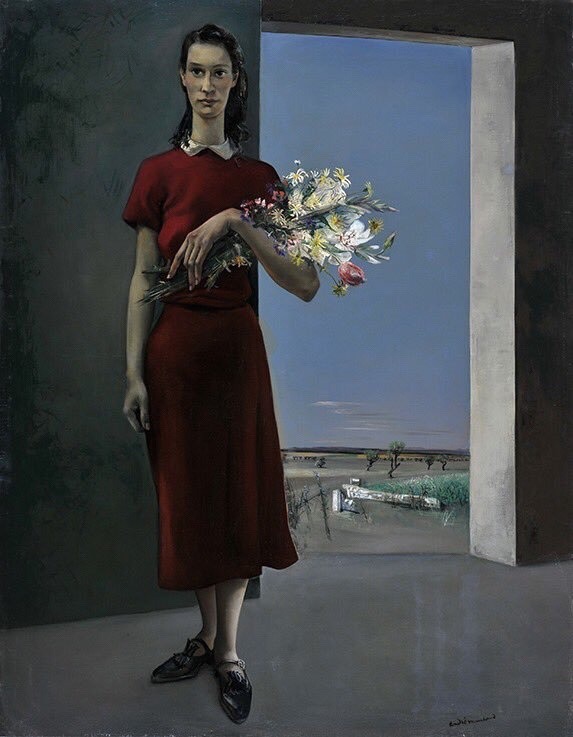
The Florist — André Marchand

7f9b32ae8a9a9540927ff8c80651f2a38424097a

The Florist, 1937 by André Marchand (1907–1997)

Read James Purdy’s short story “Summer Tidings”

“Summer Tidings”

by

James Purdy


There was a children’s party in progress on the sloping wide lawn facing the estate of Mr Teyte and easily visible from there despite the high hedge. A dozen school-aged children, some barely out of the care and reach of their nursemaids, attended Mrs Aveline’s birthday party for her son Rupert. The banquet or party itself was held on the site of the croquet grounds, but the croquet set had only partially been taken down, and a few wickets were left standing, a mallet or two lay about, and a red and white wood ball rested in the nasturtium bed. Mr Teyte’s Jamaican gardener, bronzed as an idol, watched the children as he watered the millionaire’s grass with a great shiny black hose. The peonies had just come into full bloom. Over the greensward where the banquet was in progress one smelled in addition to the sharp odour of the nasturtiums and the marigolds, the soft perfume of June roses; the trees have their finest green at this season, and small gilt brown toads were about in the earth. The Jamaican servant hardly took his eyes off the children. Their gold heads and white summer clothing rose above the June verdure in remarkable contrast, and the brightness of so many colours made his eyes smart and caused him to pause frequently from his watering. Edna Gruber, Mrs Aveline’s secretary and companion, had promised the Jamaican a piece of the ‘second’ birthday cake when the banquet should be over, and told him the kind thought came from Mrs Aveline herself. He had nodded when Edna told him of this coming treat, yet it was not the anticipation of the cake which made him so absent-minded and broody as it was the unaccustomed sight of so many young children all at once. Edna could see that the party had stirred something within his mind for he spoke even less than usual to her today as she tossed one remark after another across the boundary of the privet hedge separating the two large properties.

More absent-minded than ever, he went on hosing the peony bed until a slight flood filled the earth about the blooms and squashed onto his open sandals. He moved off then and began sprinkling with tempered nozzle the quince trees. Mr Teyte, his employer and the owner of the property which stretched far and wide before the eye with the exception of Mrs Aveline’s, had gone to a golf tournament today. Only the white maids were inside his big house, and in his absence they were sleeping most of the day, or if they were about would be indifferently spying the Jamaican’s progress across the lawn, as he laboured to water the already refreshed black earth and the grass as perfectly green and motionless as in a painted backdrop. Yes, his eyes, his mind were dreaming today despite the almost infernal noise of all those young throats, the guests of the birthday party. His long black lashes gave the impression of having been dampened incessantly either by the water from the hose or some long siege of tears.

Mr Teyte, if not attentive or kind to him, was his benefactor, for somehow that word had come to be used by people who knew both the gardener and the employer from far back, and the word had come to be associated with Mr Teyte by Galway himself, the Jamaican servant. But Mr Teyte, if not unkind, was undemonstrative, and if not indifferent, paid low wages, and almost never spoke to him, issuing his commands, which were legion, through the kitchen and parlour maids. But once when the servant had caught pneumonia, Mr Teyte had come unannounced to the hospital in the morning, ignoring the rules that no visits were to be allowed except in early evening, and though he had not spoken to Galway, he had stood by his bedside a few moments, gazing at the sick man as if her were inspecting one of his own ailing riding horses.

But Mrs Aveline and Edna Gruber talked to Galway, were kind to him. Mrs Aveline even ‘made’ over him. She always spoke to him over the hedge every morning, and was not offended or surprised when he said almost nothing to her in exchange. She seemed to know something about him from his beginnings, at any rate she knew Jamaica, having visited there three or four times. And so the women – Edna and Mrs Aveline – went on speaking to him over the years, inquiring of his health, and of his tasks with the yard, and so often bestowing on him delicacies from their liberal table, as one might give tidbits to a prized dog which wandered in also from the great estate.

The children’s golden heads remained in his mind after they had all left the banquet table and gone into the interior of the house, and from thence their limousines had come and taken them to their own great houses. The blonde heads of hair continued to swim before his eyes like the remembered sight of fields of wild buttercups outside the great estate, stray flowers of which occasionally cropped up in his own immaculate greensward, each golden corolla as bright as the strong rays of the noon sun. And then the memory came of the glimpsed birthday cake with the yellow centre. His mouth watered with painful anticipation, and his eyes again filled with tears.

Read the rest of “Summer Tidings” at Granta

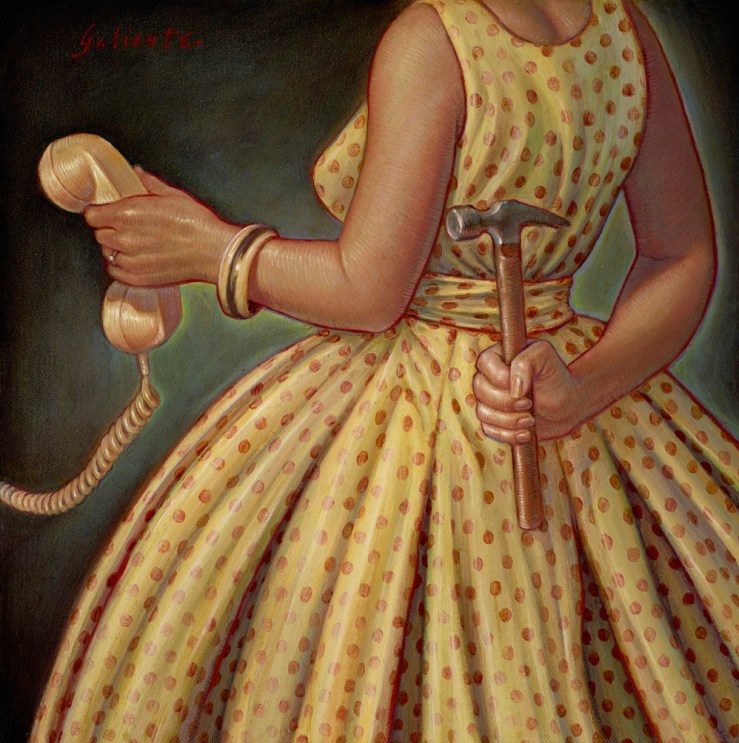
It’s for You, Dear — Danny Galieote

dg-itsforyoudear

It’s for You, Dear by Danny Galieote (b. 1968)

Blog about Anna Burns’s maybe-horror/maybe-comedy novel Milkman

img_3243

Anna Burns’s third novel Milkman won the 2018 Man Booker Prize and was reviewed in a number of prominent publications. It hardly needs my recommendation at this point, but I do recommend it: It’s artful, horrific, endearing, and troubling, a claustrophobic, unrelenting depiction of terror and paranoia. It’s also really funny.

Scattershot snippets I’d heard about Milkman indicated that the novel was “difficult” and even “confusing” or “challenging,” in large part because of the novel’s major stylistic trope—the first-person narrator refuses to ascribe clear, “stable” names to the characters in the book.

Our narrator, an eighteen-year-old woman in Northern Ireland, is referred to variously as “daughter,” “middle sister,” and “maybe-girlfriend” (among other titles) depending on whom she is interacting with. Similarly, most other characters are referred to in such terms: “oldest friend,” “third brother-in-law,” or simply “neighbour,” a nebulous catchall. (There are “named’ characters of a sort though: “chef,” “tablets girl,” “nuclear boy,” “real milkman,” and, of course, the horrific titular character “milkman.”) This narrative device might disarm some readers initially, but I found it easy to sink into our first-person narrator’s distinctive, brave, funny voice, a voice that emerges into new states of knowing and new states of consciousness as the novel unfolds.

Naming, or rather not naming is especially rhetorically significant given the setting and context of Milkman. It is the late 1970s, and the strange hot cold silent loud civil war in Northern Ireland has been going on for the entirety of our narrator’s lifetime. It has fully colonized her consciousness, shaped her language. Significantly, the conflict itself cannot be named except obliquely, nebulously. When our narrator tries to describe this zeitgeist, she employs the vague term “political problems”; her third brother-in-law replies, “Are you referring to the sorrows, the losses, the troubles, the sadnesses?”

Similarly, phrases like Protestant or Catholic are never employed, let alone anything as specific as the British army and the IRA, or unionists and nationalists. There’s just “their side” and “our side.” The sides don’t ultimately matter in Milkman. Rather this is a novel about what a constant state of their side-our side does to a person.

Our narrator, bound since birth in this state of their side-our side, has difficulty clearly communicating the central conflict of Milkman. She finds herself the strange victim of the milkman, an older married man who is a top level operative of the renouncers, anti-government paramilitaries who essentially run her district. (To be clear, he is not a real milkman. There is a real milkman though, and he’s a good guy.) Milkman stalks the narrator, creeping up next to her in his white van as she walks home reading 19th-century novels (a habit that marks her as “beyond the pale,” an outsider in her community) or waylaying her as she runs in the park. He’s a nightmare force of patriarchal ideology, a creeper at the edge, but utterly empowered.

Milkman isn’t the narrator’s only stalker. No, there’s also Somebody McSomebody, who we meet, sort of, in the novel’s astonishing opening sentence: “The day Somebody McSomebody put a gun to my breast and called me a cat and threatened to shoot me was the same day the milkman died.” Somebody McSomebody is a poseur though. He’s a pretend renouncer, a would-be hardman also inscribed in the violent ideology of the the Troubles. The narrator calls him her “amateur stalker.”

The narrator uses variations of the word “stalk” in Milkman, but this word is meant to convey meaning to us, to a readership that might now better understand the term. (This effect of an older voice imposing its wisdom on a younger perceiver persists in Milkman.) What’s clear though is that nobody, or at least nobody in authority, can help the narrator from her stalkers:

That was the way it worked. Hard to define, this stalking, this predation, because it was piecemeal. A bit here, a bit there, maybe, maybe not, perhaps, don’t know. It was constant hints, symbolisms, representations, metaphors. He could have meant what I thought he’d meant, but equally, he might not have meant anything.

Our narrator lives in a constant state of maybe, a trope underscored by her relationship with “maybe-boyfriend” (himself something of an oddball). Maybe-boyfriend is a compelling character in Milkman, and perhaps something of tragic-absurd one as well. (One of the strangest details in the novel: maybe-boyfriend and his brothers are abandoned by his parents so that they can become world champion ballroom dancers—which they do (become world champion ballroom dancers, that is.)) In a particularly strong section of the book, maybe-boyfriend, a mechanic and car enthusiast, brings home the supercharger of a Bentley and shows it off to his neighbors. The jovial atmosphere slowly slides into a tense then paranoid exchange—Bentleys are English after all—which eventually erupts into violence. It’s a remarkably controlled episode that describes the ideology of the Troubles in a way that a historical textbook never could.

Even though our narrator lives in a perpetual maybe, she still understands her community and can describe it for us. She is intelligent and perceptive, and much of the humor in Milkman evinces from moments where she gets on a rhetorical roll, as when she describes her home as “our intricately coiled, overly secretive, hyper-gossipy, puritanical yet indecent, totalitarian district.” Horror and comedy conjoin in her absurd description of a run-in with the milkman as “talking to a sinister man while holding the head of a cat that had been bombed to death by Nazis.”

Radical horror, violence, and uncertainty percolate in Milkman. Paranoia rules on all levels, but by focusing primarily on the narrator’s being stalked by milkman, Burns offers a concrete portrait of a malevolent force that might otherwise be too sinister and abstract to properly convey in a fictional novel. At the same time, our narrator is able to extrapolate beyond her concrete circumstances to other injustices—

those big ones, the famous ones, the international ones – witch-burnings, footbindings, suttee, honour killings, female circumcision, rape, child marriages, retributions by stoning, female infanticide, gynaecological practices, maternal mortality, domestic servitude, treatment as chattels, as breeding stock, as possessions, girls going missing, girls being sold and all those other worldwide cultural, tribal and religious socialisations and scandalisations, also the warnings given against things throughout patriarchal history that were seen as uncommon for a woman to do or think or say.

Milkman is full of moments like this, rhetorical flights that help weave a richer picture of our narrator’s psychic state.

Milkman also shows us how that psychic state deteriorates. Our narrator was always an outsider, reading novels while walking or going on long runs as a way to tune out reality. Our narrator is aware of this tuning-out; indeed, it is her primary practice. However, as gossip and lies spread about her and the milkman, her consciousness begins to crumble–

Thing was though, before I’d gained the understanding of what was happening, my seemingly flattened approach to life became less a pretence and more and more real as time went on. At first an emotional numbness set in. Then my head, which initially had reassured with, ‘Excellent. Well done. Successfully am I fooling them in that they do not know who I am or what I’m thinking or what I’m feeling,’ now began itself to doubt I was even there. ‘Just a minute,’ it said. ‘Where is our reaction? We were having a privately expressed reaction but now we’re not having it. Where is it?’ Thus my feelings stopped expressing. Then they stopped existing. And now this numbance from nowhere had come so far on in its development that along with others in the area finding me inaccessible, I, too, came to find me inaccessible. My inner world, it seemed, had gone away.

This is a sad, remarkable, and genuinely horrifying passage. We get the horror of un-becoming, a kind of un-becoming that we might find in many other horror-tinged feminist works, from Charlotte Perkins Gilman’s “The Yellow Wallpaper” to Margaret Atwood’s The Handmaid’s Tale to Anna Kavan’s Ice to Marge Piercy’s Woman on the Edge of Time. 

Not only is our heroine emotionally and psychologically drained, she also finds herself physically exhausted by the duress of being stalked—stalked now not only by the milkman, but also by the whispering community. No longer able to take the walks and runs that replenished her, she languishes. The horror and absurdity culminates when she is poisoned, for no real reason, by tablets girl, “our district poisoner” and must recover without the aid of professional medical care. (Nobody in the district can go to the hospital without fear of being thought an informant.)

After a serious bout of purging, the narrator recovers. While recovering, her triumvirate of “wee sisters” asks her to read them a story. Tellingly, they purloin their ma’s copy of The Exorcist. Milkman is a novel of possession and purging, of being inscribed in a preexisting symbolic order and forging a consciousness strong enough to resist and endure that order.

Milkman is a maybe-horror, but also a maybe-comedy (it even ends in a maybe-laugh), and like many strong works that showcase the intense relationship between horror and comedy (Kafka, BrazilThe King of Comedy, “Young Goodman Brown,” Twin Peaks, Goya, Bolaño, Get OutCandideCurb Your EnthusiasmFunny Games, etc.)—like many strong works that showcase the intense relationship between horror and comedy, Milkman exists in a weird maybe-space, a queasy wonderful freaky upsetting maybe-space that, in its finest moments, makes us look at something we thought we might have understood in a wholly new way.  Highly recommended.

Catherine — Jansson Stegner

0KRagGVsWD

Catherine, 2016 by Jansson Stegner (b. 1972)

Visit — Susanne Kühn

besuch12_klein-1024x549

Visit, 2012 by Susanne Kühn (b. 1969)

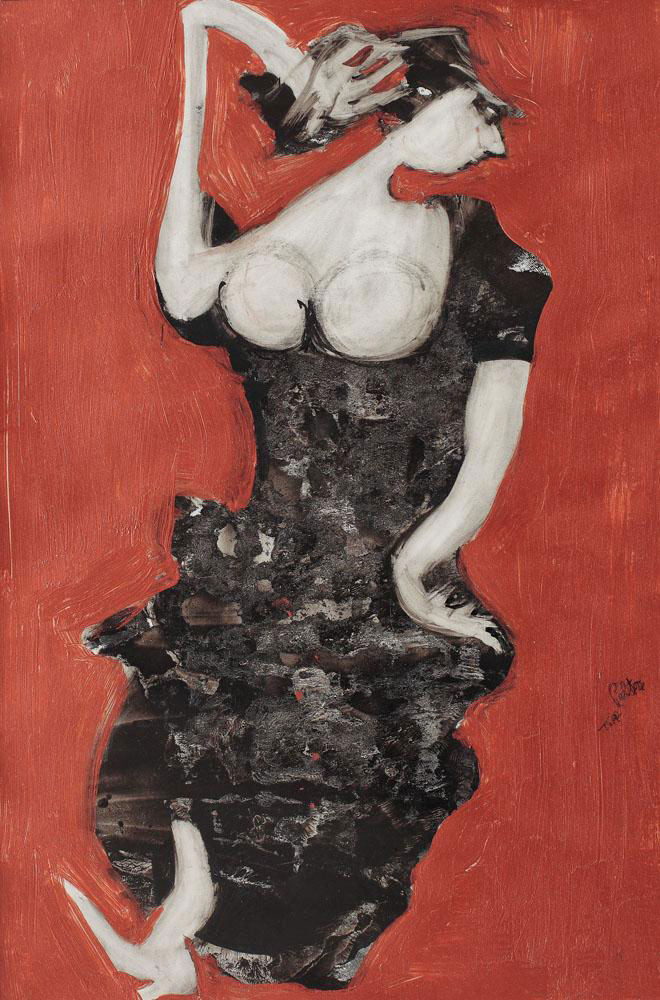
Throughout the Neighborhood — Tia Peltz

21829712

Tia Peltz (1923-1999)

Three Women in a Courtyard — Kent Monkman

km_three_women_in_a_courtyard_2018

Three Women in a Courtyard, 2018 by Kent Monkman (b. 1965)

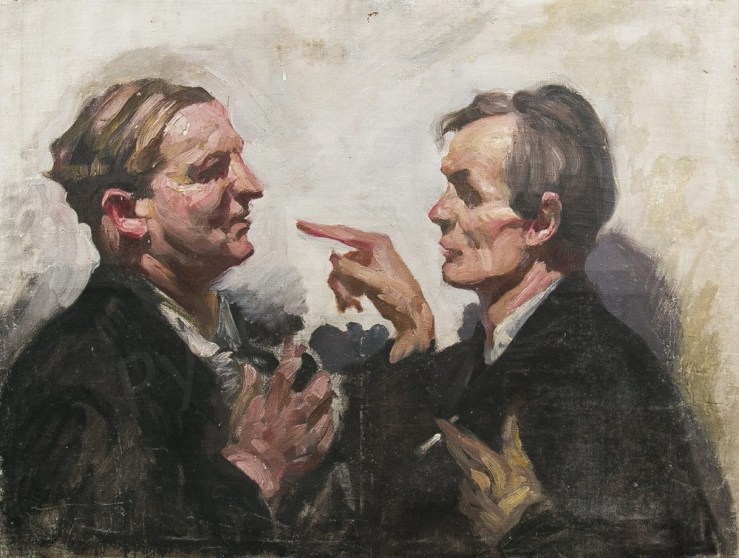
In the Intermission — Vasily Meshkov

25919890

In the Intermission, 1932 by Vasily Meshkov (1867-1946)

On the Beach — Boris Talberg

b04fc8e4ea7e

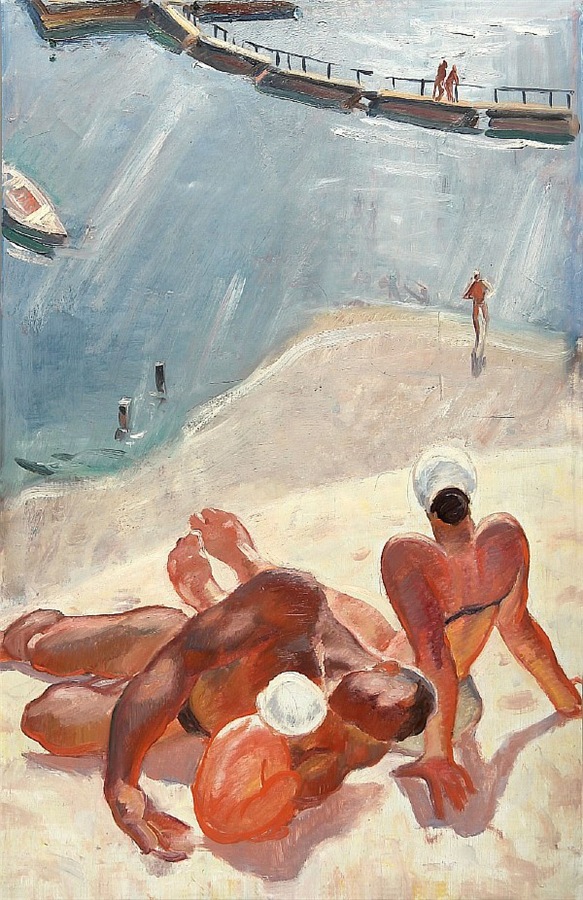
On the Beach, c. 1970s by Boris Talberg (1930-1984)

Blog about some books acquired, 17 July 2019 (and some Poe and Whitman illustrations)

img_3158

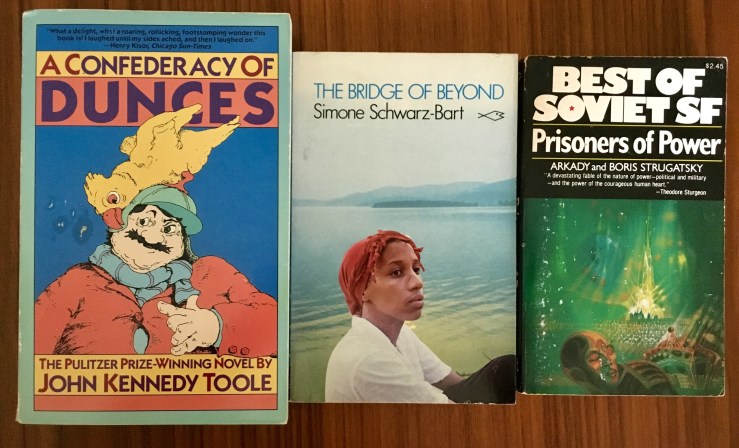
Despite having a pretty large TBR stack, I killed this afternoon’s spare hour at my favorite used bookstore. This particular bookstore is a maze of used books, labyrinthine walls of books, with ever-mutating shelves growing from the floor all the way up to the ceiling. I confess I don’t always stoop low—I get old, I get dizzy—but stooping low to look for something else (which I now misremember; I get old) I found a big fat stack of copies of John Kennedy Toole’s cult novel A Confederacy of Dunces. Which I have never read. Which was recommended to me twenty years ago when I wasn’t so old, when I was way into Vonnegut, Burroughs, Hemingway. Which was recommended to me by someone who had made me read Tom Robbins. Which was why I didn’t bother to read A Confederacy of Dunces. I’ve always sort of assumed that I’d missed my window with this one—not sure why—-like that I should’ve read it before I was thirty. Anyone, I threw it out on twitter and some smart folks gave me the go ahead. So we’ll see.

I also found a copy of The Bridge of Beyond by Simone Schwarz-Bart. Again, I wasn’t looking for this book. Actually, I found this Heinemann Caribbean Writers Series edition quite by accident, but recalled the NYRB edition (both are translated by Barbara Bray) and picked it up. I usually am not a big fan of photographs of people on covers, but I really like this one.  I’ll steal NRYB’s blurb:

This is an intoxicating tale of love and wonder, mothers and daughters, spiritual values and the grim legacy of slavery on the French Antillean island of Guadeloupe. Here long-suffering Telumee tells her life story and tells us about the proud line of Lougandor women she continues to draw strength from. Time flows unevenly during the long hot blue days as the madness of the island swirls around the villages, and Telumee, raised in the shelter of wide skirts, must learn how to navigate the adversities of a peasant community, the ecstasies of love, and domestic realities while arriving at her own precious happiness. In the words of Toussine, the wise, tender grandmother who raises her, “Behind one pain there is another. Sorrow is a wave without end. But the horse mustn’t ride you, you must ride it.”

My good luck streak of finding old massmarket paperback copies of Strugatsky brothers novels continued when I found Prisoners of Power (English translation by Helen Saltz Jacobson).

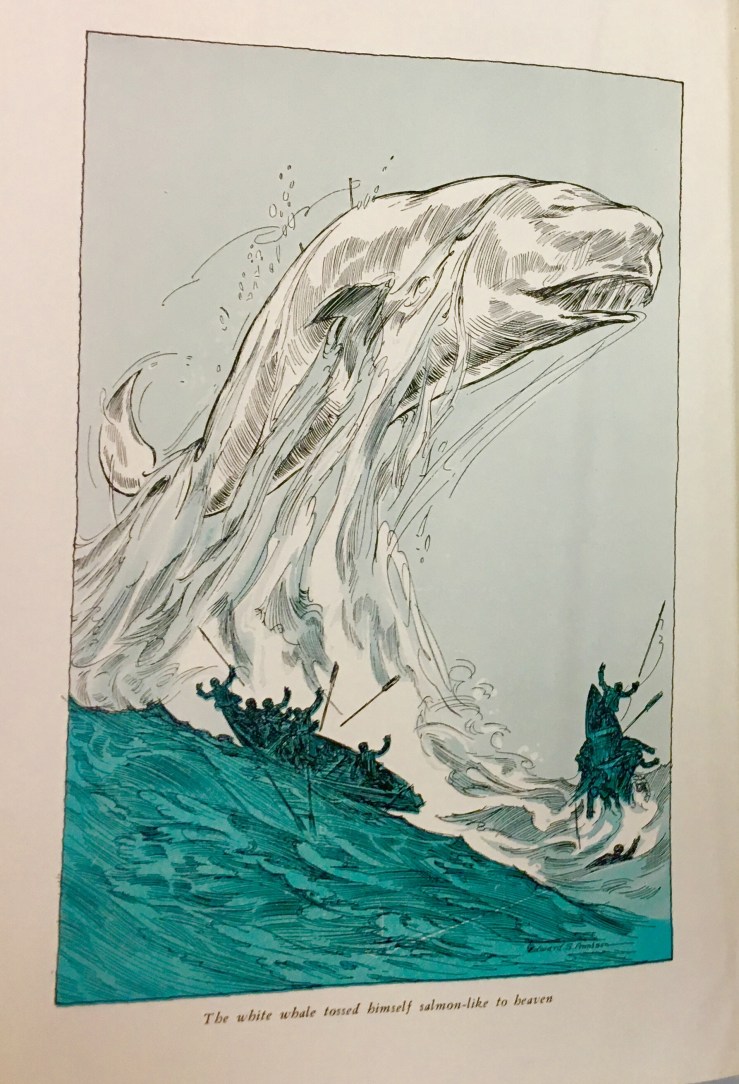
I also found myself intrigued by some large illustrated editions of Melville and Poe, although I resisted picking them up. I really love the simple design of this 1931 omnibus Romances of Herman Melville—

As far as I could tell, the publishers failed to credit the edition’s illustrator, but he signed it—Edward S. Annison.

img_3147

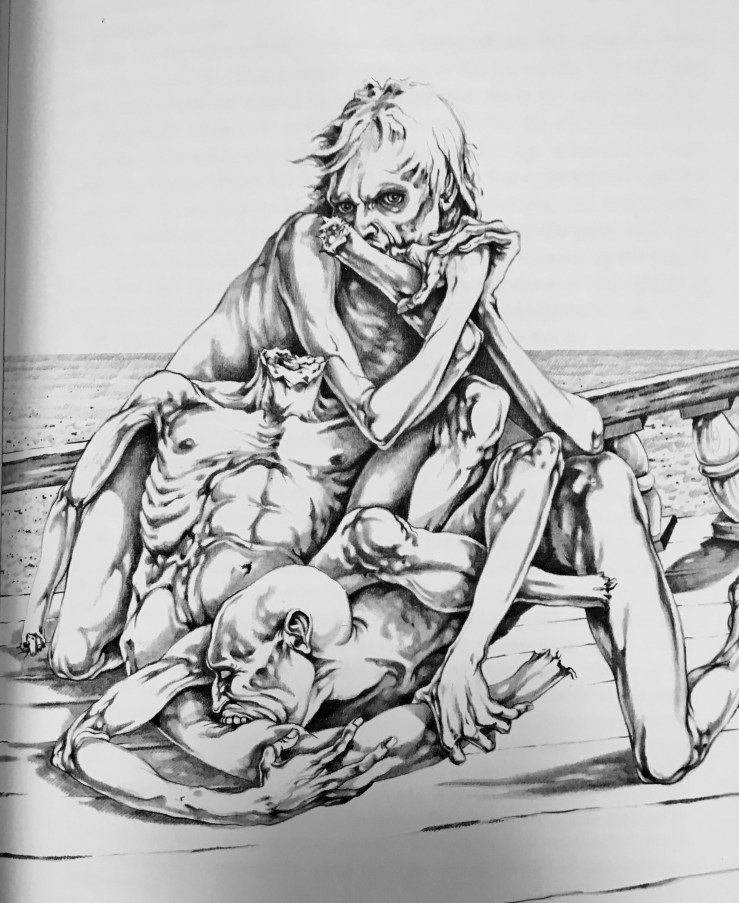
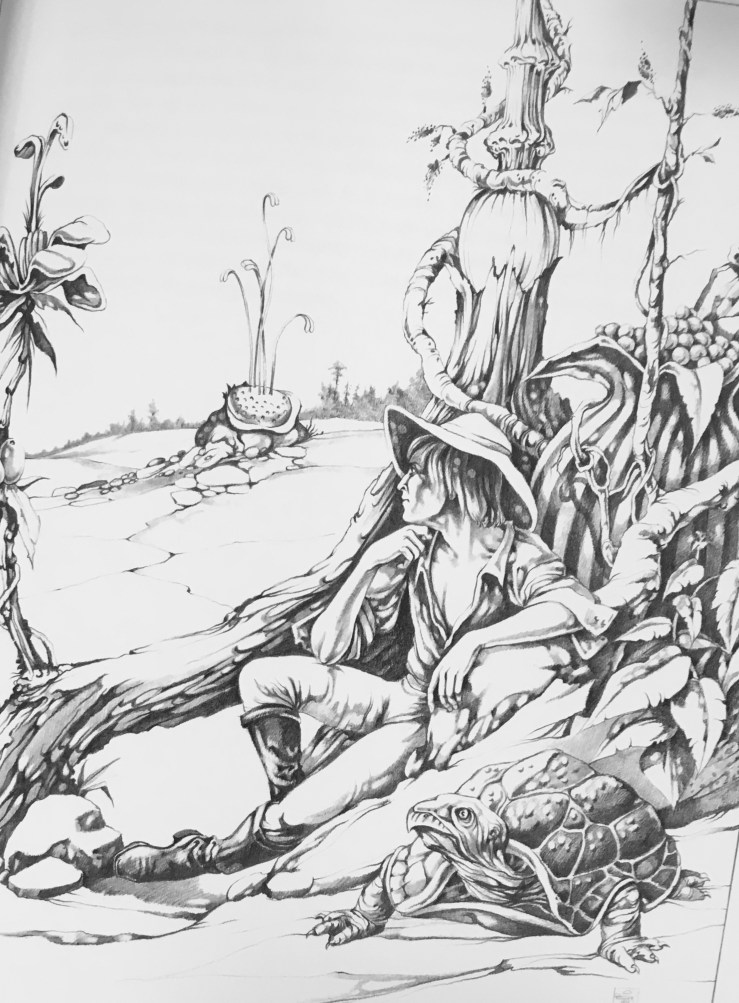
The editors of an oversized 1973 David R. Godine edition of Poe’s only novel, The Narrative of Arthur Gordon Pym did bother to name the illustrator: Gerry Hoover. Hoover’s illustrations are pretty creepy:

img_3152img_3151img_3150

Okay—maybe the last one isn’t creepy. But the tortoise’s grimacing beak is intense.

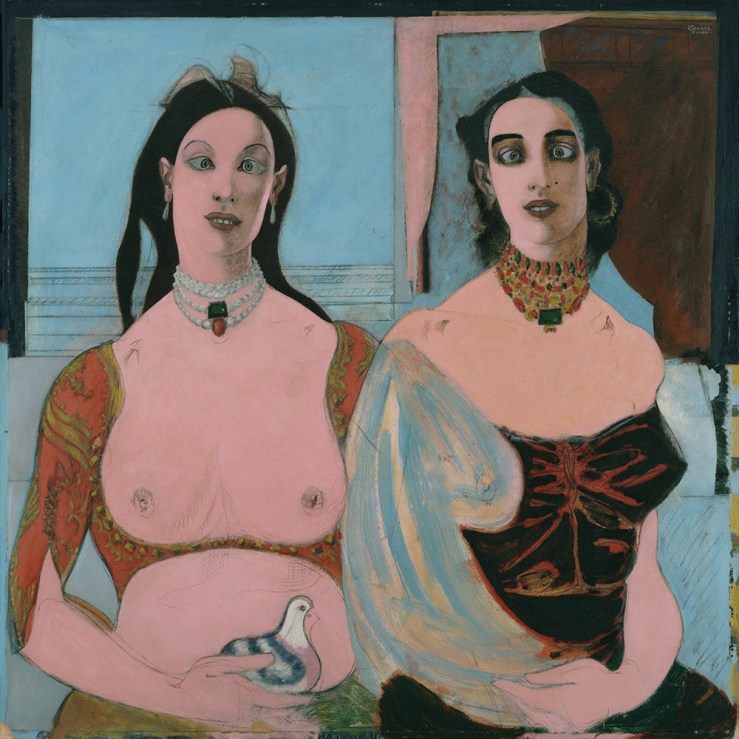
Two Sisters — John D. Graham

0_22d22d_ef10c861_orig

Two Sisters, 1944 by John D. Graham (1881–1961)

A review of Pierre Senges’ confounding novel Geometry in the Dust

img_5150-800x567

Describing Geometry in the Dust is a challenge. I’ve deleted so many openings now and my frustration is mounting: so some very basic description:

Geometry in the Dust is a novel by the French author Pierre Senges with accompanying illustrations by the Oubapo comix artist Killoffer. The novel was originally published in France (as Géométrie dans la poussière) in 2004. The English translation is by Jacob Siefring, and was published by Inside the Castle earlier this year. Geometry in the Dust is 117 pages and includes 22 black and white illustrations. The prose is set in two columns per page, with infrequent inclusions of inset notes of a smaller font obtruding into the text proper. The typeset is Venetian. The book is approximately 217cm long, 172cm tall, and 10cm thick. It weighs approximately 210 grams.

This is a lousy way to describe a book.

What is it about?, you’ll want to know. What’s the plot? Who are the characters? What’s the drama, the conflict, the themes?, you’ll insist.

So there’s a geometer.

The geometer is a first-person “I” who addresses himself to the “inheriting prince” who rules a “country of sand.” The geometer is of course also addressing himself to you the reader. In addition to being a geometer, he is also

your minister (of Economy, of Religion, of War, and also of the City, we decided). As your sole, faithful minister, your counsellor, chamberlain, and your scapegoat, having weathered many dry seasons and countless reorganizations of your cabinet, I am your confidant too, and, judging from appearances–one can say this without offending the dignity of your kingdom or its constitution, we might even call me your friend.

And so we have our characters: Geometer and his absent audience, his sultan, his reader.

And so for plot? What is our friend, our confidant doing in Geometry in the Dust? He is trying to describe the city that he and his monarch (?) have…dreamed up? Built from scratch? Proposed as a thought experiment?

(I’m not sure.)

The reality or unreality of the city in question should be dispensed with entirely of course. The city is made of words, and it exists in Geometry in the Dust through words. Our narrator implores us in the novel’s second paragraph: “do not be afraid of words!”

So our narrator the geometer tries to describe the city, this city, the sultan’s city, in words. But of course capturing a city in words is a problem—

How does one form an idea of the city, when all one has seen of it are little pieces of it brought back from voyages in trunks? how to describe a metropolis to someone who has only ever known sand and its forms through the cycle of seasons? how to speak of snow to a Moor, of cannibalism to a vegetarian Jesuit?

Measuring a city for our narrator amounts to measuring the angles of waves as they break on the shore: an impossible task. Even metaphors run dry, point in the wrong directions, and ultimately, “all of these measures will be in vain and mediocre , the descriptions will be lost in allegories.” Nevertheless, our narrator will try. 

This trying to describe the city is the plot, I suppose, such as it is. And it’s really quite marvelous, far richer and smarter and funnier than I’ve managed to capture here so far. Our geometer is observant, sharp, witty, strangely sincere, flighty and whimsical at times. He advises his prince, his reader, on the value of getting lost in the city (the only way to know it), and a lot of Geometry might amount to our narrator getting lost himself, losing us, leading us in, out, around.

“You will readily understand that a city is not composed only of itself,” he avers at one point, continuing that, “a city is composed of city, the intentions present in the city, and the difference between the city and those intentions…” Perhaps too Geometry is our narrator’s effort to measure the gaps and lacunae between split intentions, and to situate the various players that fill these gaps: black marketeers and insomniacs, calligraphers and macabre dancers, crowders and loners, musicians and animals (including “an alligator of the White Nile” to reside “in the conduits of our main sewer,” whose presence will surely “spice up the lives of your people, those incorrigible auditors of fables.” And if such an alligator can’t be find, never mind–just spread its legends. Words).

And themes?, you ask after. I don’t know. I’ve read Geometry twice now and it’s thick with themes, the basic one, I suppose (and I could be wrong) is: What is a city(This is too easy, I know). Senges’ narrator invokes and evokes every manner of archaic text, imagined or otherwise; he considers our native tendencies, the roles outsiders play, the movements of crowds, what constitutes a garden, and so forth.

Maybe a better description of Geometry is to simply look at the text itself. Here is a short chapter (go on, read it—click on it if you need a bigger version):

senses


Notice the punctuation: the semicolons, the dashes (em and en), the periods, the parentheses, the commas. Senges’ prose in Geometry is syntactically thick. Sentences, like alleys in a strange city, begin in one place and end up somewhere quite different. The interposition of jostling clauses might cause a reader to lose the subject, to drop the thread or diverge from the path (or pick your metaphor). The effect is sometimes profound, with our narrator arriving at some strange philosophical insight after piling clause upon clause that connects the original subject with something utterly outlandish. And sometimes, the effect is bathetic. In one such example, the narrator, instructing his sovereign on the proper modes of religious observance in the city, moves from a description of the ideal confessional to an evocation of Limbourg’s hell to the necessity of being able grasp a peanut between two fingers. The comical effect is not so much punctured as understood anew though when Senges’ narrator returns to the peanut as a central metaphor for the scope of a city (“there are roughly as many men in the city as peanuts in the city’s bowls”), a metaphor that he extends in clause after clause leading to an invocation of “Hop o’ my Thumb’s pebbles,” a reference to Charles Perrault fairy tale about a boy who uses riverstones to find his way home after having been abandoned in the woods by his parents. 

What is the path through Geometry in the Dust? The inset notes, as you can see in the image above, also challenge the reader’s eye, as do the twin columns, so rare in contemporary novels.

Killoffer’s illustrations also challenge the reader. They do not necessarily correspond in pagination to the sections that they (may) illustrate; rather, they seem to obliquely capture the spirit of the novel. The following image is perhaps the most literal illustration in the novel, evoking something in the passage I shared above:

killoffer

The experience of reading Geometry is confounding but also rewarding. The first time I read it, at least for the first third or so, I kept looking for all those basic signs of a novel—character, plot, clear conflict, etc. I was happy to find instead something else, something more challenging, but also something unexpectedly fun and funny. In its finest moments, Geometry evokes the essays that Borges disguised as short stories. Readers familiar with Italo Calvino and Georges Perec will find familiar notes here too, as well as those who love the absurd tangles Donald Barthelme’s sentences can take. But Senges is singular here, his own weird flavor, a flavor I enjoyed very much. Recommended. 

The Lovers — Liu Xiaodong

0_20e622_74d82e34_orig

The Lovers, 1995 by Liu Xiaodong (b. 1963)

“The Song of the Demented Priest” — John Berryman

“The Song of the Demented Priest”

by

John Berryman


I put those things there.—See them burn.
The emerald the azure and the gold
Hiss and crack, the blues & greens of the world
As if I were tired. Someone interferes
Everywhere with me. The clouds, the clouds are torn
In ways I do not understand or love.

Licking my long lips, I looked upon God
And he flamed and he was friendlier
Than you were, and he was small. Showing me
Serpents and thin flowers; these were cold.
Dominion waved & glittered like the flare
From ice under a small sun. I wonder.

Afterward the violent and formal dancers
Came out, shaking their pithless heads.
I would instruct them but I cannot now,—
Because of the elements. They rise and move,
I nod a dance and they dance in the rain
In my red coat. I am the king of the dead.

Salome Sphinx — Nikolai Kalmakov

0_a71af_ec6074a8_xl

Salome Sphinx, 1928 by Nikolai Kalmakov (1873-1955)

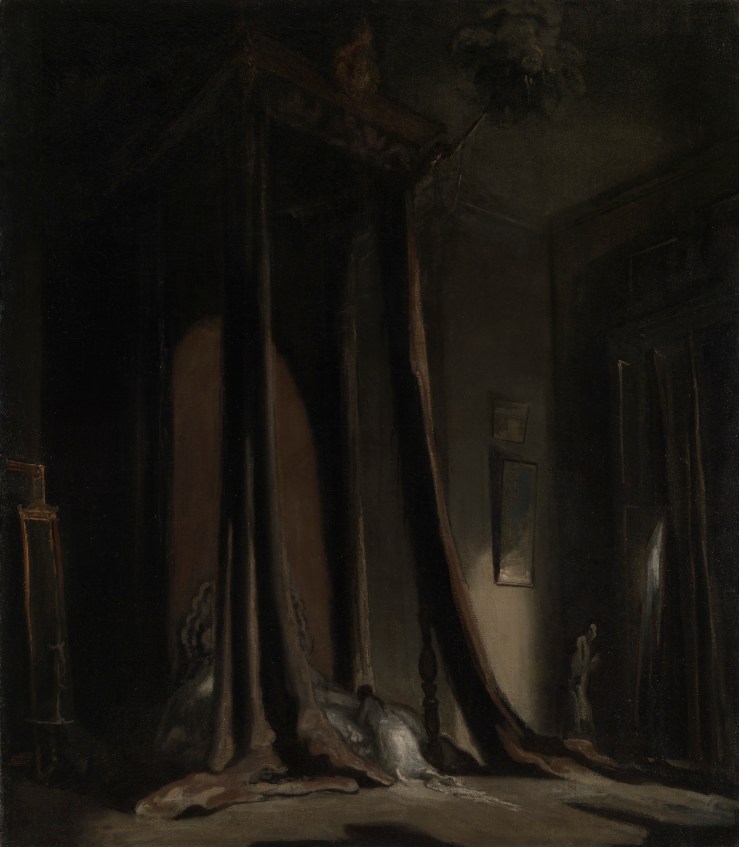
The Death Bed — James Pryde

E0848

The Death Bed, 1913 by James Pryde (1866–1941)