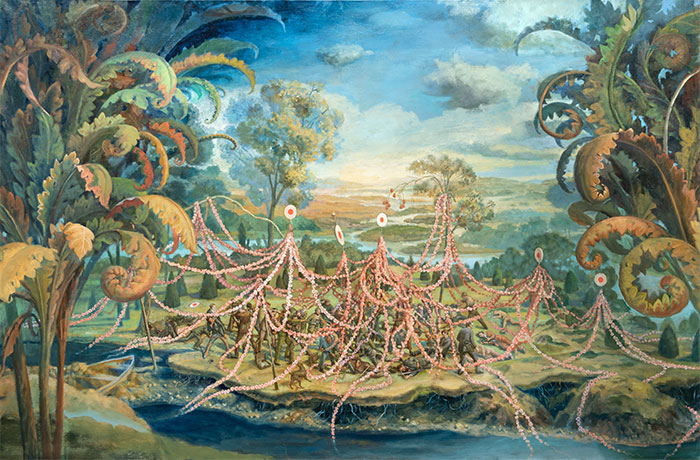
Faux Tableau — Scott Greene

Screenshot 2019-05-09 at 3.37.02 PM

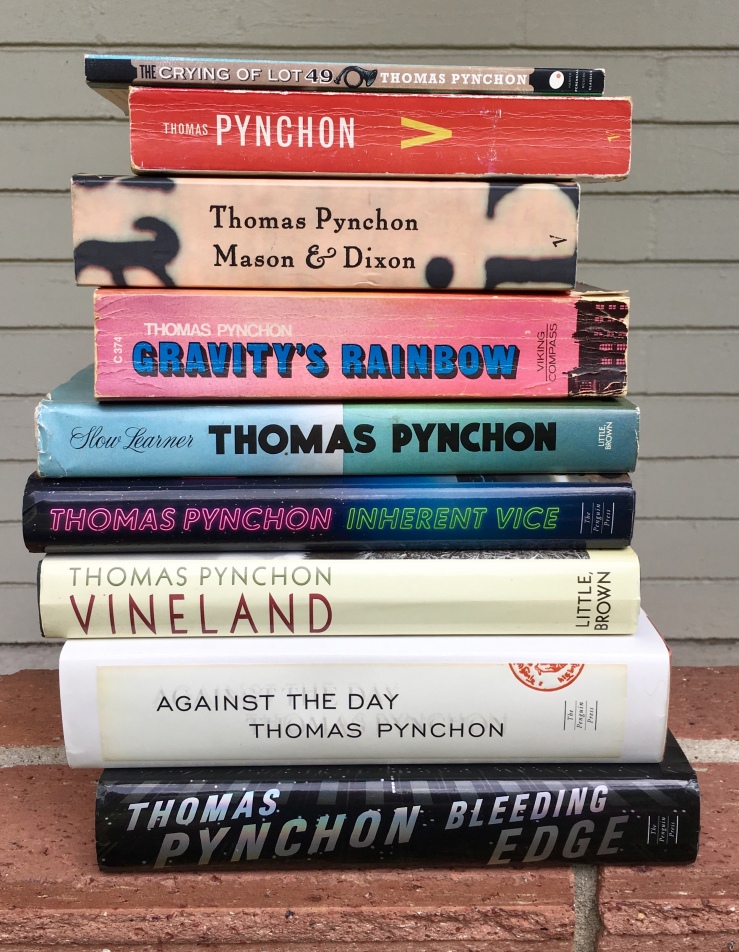
Faux Tableau, 2018 by Scott Greene

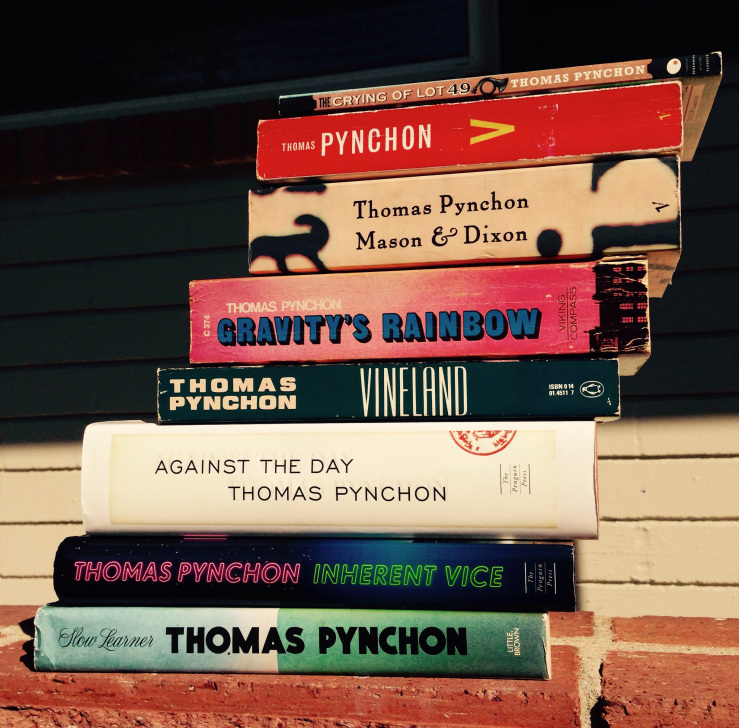
Pynchon in Public Post, 2019

img_2774

Today is the 82nd birthday of the American author Thomas Ruggles Pynchon, which a lot of jokers on the internet have turned into Pynchon in Public Day.

The spirit of Pynchon in Public Day is zany fun, and mostly centers around reading Pynchon’s works in public and spreading the muted post horn symbol from The Crying of Lot 49 around as much as possible. I am the last person in the world who will read a book in a coffee shop, but I did don my second 49 shirt today—-

66581c11-b06d-4dfe-89e3-0bc25fa0c64c

—and head to the bookstore to pick up the only Pynchon novel I don’t own, Bleeding Edge. More on that in second, but—no real recognition on the shirt today, although I’ve gotten some reactions to the other muted post horn shirt I own over the years, mostly from booksellers (not that interesting I know).

A few years ago though, wandering around downtown Los Angeles (wearing a muted post horn shirt), a stranger passing opposite me on the sidewalk hailed me with this question: “Are you the Trystero, guy?” At least that’s what I thought I said. I looked confused, asked, “What?” and he repeated — “Are you the Trystero guy?”

This particular moment struck me with a neat silly wave of minor paranoia, a Pynchonian moment, maybe—was this some kind of call sign for me to repeat, a password in a game of good fun? So I did the only thing that seemed sensible and replied, “Yes, I am the Trystero.”

The guy then proceeded to tell me that he loved my coffee. This confused me, so I told him that loved his coffee. Then he looked confused. After a few minutes on the hot July L.A. sidewalk we finally figured out a few things: He was referring to Trystero Coffee, which he showed me all about on his iPhone, and I was referring to The Crying of Lot 49, which he promised to read at the end of our exchange.

So anyway I went to the bookstore and picked up Bleeding Edge (and a few other books too, I admit). Along with Vineland, it’s the only Pynchon novel I haven’t read (despite two attempts on each). I’ll read Bleeding Edge before May 8th, 2020 though.

I started a retry of Vineland though. I had hoped to get past the farthest I remember going in—like the first 90 pages—before this post—-but I only made it through the first five chapters these past two days (through page 67). Still, I’d forgotten all about Ch. 5, the “Kahuna Airlines” chapter, which steers the book into new territory, and even though it still hasn’t hooked me yet (unlike the other Pynchons at this point), I’m starting to appreciate it for what I guess it is: Pynchon’s analysis of the eighties, of the absorption of the counterculture into culture, of nostalgia. The jokes are often hilarious and terrible, sometimes simultaneously. Pynchon sets up a Loony Tunes diner bit to deliver the execrable punchline, “Check’s in the mayo” for example. Pynchon names a lawn care company “The Marquis de Sod.” There’s a moment where protagonist Zoyd Wheeler pays for a ludicrous psychedelic party dress with “a check both he and the saleslady shared a premonition would end up taped to this very cash register after failing to clear,” a wonderful little throwaway line that shows Zoyd’s brokeassedness and empathy (and also highlights the Lebowski-Pynchon overlap, if you like). The line that’s cracked me up each time I’ve read it though is Zoyd’s daughter Prairie’s punker boyfriend being described as “the NBA-sized violence enthusiast who might or might not be fucking his daughter.” It’s just so dumb and poetic. I had also missed a few things — the night manager of Bodhi Dharma Pizza is named “Baba Havabananda,” a reference I’m thinking to Gravity’s Rainbow (“Have a banana”). There’s also a reference to the Vulcan hand salute, which shows up improbably in Pynchon’s next novel, Mason & Dixon (more on that here). And there’s the whole Bigfoot motif too, which Pynchon would echo in Inherent Vice, with Zoyd and Zuniga prefigurations of Doc Sportello and Bigfoot Bjornsen. And like every Pynchon novel, I’m sure I’ve already missed a ton of stuff.

Anyway, more on Vineland to come. In the meantime, if you haven’t read Pynchon–why not check him out?

The true paranoid for whom all is organized in spheres joyful or threatening | A passage from Thomas Pynchon’s The Crying of Lot 49

“Please,” the sailor said. “Go on now. You don’t want to stay here.” She looked in her purse, found a ten and a single, gave him the ten. “I’ll spend it on booze,” he said.
“Remember your friends,” said the arthritic, watching the ten.
“Bitch,” said the sailor. “Why didn’t you wait till he was gone?”
Oedipa watched him make adjustments so he’d fit easier against the mattress. That stuffed memory. Register A . . .
“Give me a cigarette, Ramírez,” the sailor said. “I know you got one.”
Would it be today? “Ramírez,” she cried. The arthritic looked around on his rusty neck. “He’s going to die,” she said.
“Who isn’t?” said Ramírez.
She remembered John Nefastis, talking about his Machine, and massive destructions of information. So when this mattress flared up around the sailor, in his Viking’s funeral: the stored, coded years of uselessness, early death, self-harrowing, the sure decay of hope, the set of all men who had slept on it, whatever their lives had been, would truly cease to be, forever, when the mattress burned. She stared at it in wonder. It was as if she had just discovered the irreversible process. It astonished her to think that so much could be lost, even the quantity of hallucination belonging just to the sailor that the world would bear no further trace of. She knew, because she had held him, that he suffered DT’s. Behind the initials was a metaphor, a delirium tremens, a trembling unfurrowing of the mind’s plowshare. The saint whose water can light lamps, the clairvoyant whose lapse in recall is the breath of God, the true paranoid for whom all is organized in spheres joyful or threatening about the central pulse of himself, the dreamer whose puns probe ancient fetid shafts and tunnels of truth all act in the same special relevance to the word, or whatever it is the word is there, buffering, to protect us from. The act of metaphor then was a thrust at truth and a lie, depending where you were: inside, safe, or outside, lost. Oedipa did not know where she was. Trembling, unfurrowed, she slipped sidewise, screeching back across grooves of years, to hear again the earnest, high voice of her second or third collegiate love Ray Glozing bitching among “uhs” and the syncopated tonguing of a cavity, about his freshman calculus; “dt,” God help this old tattooed man, meant also a time differential, a vanishingly small instant in which change had to be confronted at last for what it was, where it could no longer disguise itself as something innocuous like an average rate; where velocity dwelled in the projectile though the projectile be frozen in midflight, where death dwelled in the cell though the cell be looked in on at its most quick. She knew that the sailor had seen worlds no other man had seen if only because there was that high magic to low puns, because DT’s must give access to dt’s of spectra beyond the known sun, music made purely of Antarctic loneliness and fright. But nothing she knew of would preserve them, or him.

From Thomas Pynchon’s novel The Crying of Lot 49.

Thomas Pynchon’s recipe for what is arguably the first British Pizza | A passage from Mason & Dixon

“Lud wishes to know,” Whike relays at last, “Mr. Emerson’s Cousin’s Views, upon the Structure of the World.”
“A Spheroid, the last I heard of it, Sir.”
“Ahr Ahr ahr, ’ahr ahhrr!”
“ ’And I say, ’tis Flat,’” the Jesuit smoothly translates. “Why of course, Sir, flat as you like, flat as a Funnel-Cake, flat as a Pizza, for all that,— ”
“Apologies, Sir,—” Whike all Unctuosity, “the foreign Word again, was . . . ?”
“The apology is mine,— Pizza being a Delicacy of Cheese, Bread, and Fish ubiquitous in the region ’round Mount Vesuvius. . . . In my Distraction, I have reach’d for the Word as the over-wrought Child for its Doll.”
“You are from Italy, then, sir?” inquires Ma.
“In my Youth I pass’d some profitable months there, Madam.”
“Do you recall by chance how it is they cook this ‘Pizza’? My Lads and Lasses grow weary of the same Daily Gruel and Haggis, so a Mother is ever upon the Lurk for any new Receipt.”
“Why, of course. If there be a risen Loaf about . . . ?”
Mrs. Brain reaches ’neath the Bar and comes up with a Brown Batch-Loaf, rising since Morning, which she presents to “Cousin Ambrose,” who begins to punch it out flat upon the Counter-Top. Lud, fascinated, offers to assault the Dough himself, quickly slapping it into a very thin Disk of remarkable Circularity.
“Excellent, Sir,” Maire beams, “I don’t suppose anyone has a Tomato?”
“A what?”
“Saw one at Darlington Fair, once,” nods Mr.”“Brain.
“No good, in that case,— eaten by now.”
“The one I saw, they might not have wanted to eat . . . ?”
Dixon, rummaging in his Surveyor’s Kit, has come up with the Bottle of Ketjap, that he now takes with him ev’rywhere. “This do?”
“That was a Torpedo, Husband.”
“That Elecktrickal Fish? Oh . . . then this thing he’s making isn’t elecktrical?”
“Tho’ there ought to be Fish, such as those styl’d by the Neopolitans, Cicinielli. . . .”
“Will Anchovy do?” Mrs. Brain indicates a Cask of West Channel ’Chovies from Devon, pickl’d in Brine.
“Capital. And Cheese?”
“That would be what’s left of the Stilton, from the Ploughman’s Lunch.”
“Very promising indeed,” Maire wringing his Hands to conceal their trembling. “Well then, let us just . . .”
By the Time what is arguably the first British Pizza is ready to come out of the Baking-Oven beside the Hearth, the Road outside has gone quiet and the Moorland dark, several Rounds have come and pass’d, and Lud is beginning to show signs of Apprehension. “At least ’tis cloudy tonight, no Moonlight’ll be getting thro’,” his Mother whispers to Mr. Emerson.”

From Thomas Pynchon’s novel Mason & Dixon.

The extinction of the dodo | A passage from Thomas Pynchon’s Gravity’s Rainbow

saftleven_dodo
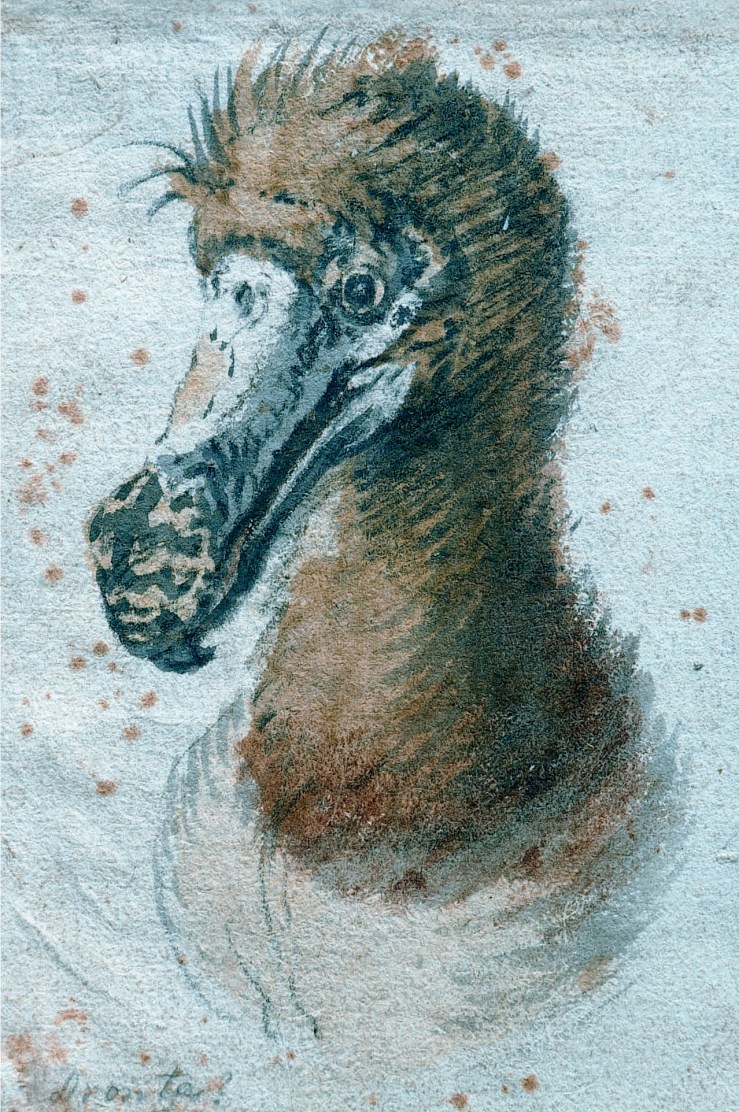
Dodo, 1638 by Cornelis Saftleven (1607-1681)

He left the dodoes to rot, he couldn’t endure to eat their flesh. Usually, he hunted alone. But often, after months of it, the isolation would begin to change him, change his very perceptions—the jagged mountains in full daylight flaring as he watched into freak saffrons, streaming indigos, the sky his glass house, all the island his tulipomania. The voices—he insomniac, southern stars too thick for constellations teeming in faces and creatures of fable less likely than the dodo—spoke the words of sleepers, singly, coupled, in chorus. The rhythms and timbres were Dutch, but made no waking sense. Except that he thought they were warning him… scolding, angry that he couldn’t understand. Once he sat all day staring at a single white dodo’s egg in a grass hummock. The place was too remote for any foraging pig to’ve found. He waited for scratching, a first crack reaching to net the chalk surface: an emergence. Hemp gripped in the teeth of the steel snake, ready to be lit, ready to descend, sun to black-powder sea, and destroy the infant, egg of light into egg of darkness, within its first minute of amazed vision, of wet downstirred cool by these south-east trades… . Each hour he sighted down the barrel. It was then, if ever, he might have seen how the weapon made an axis potent as Earth’s own between himself and this victim, still one, inside the egg, with the ancestral chain, not to be broken out for more than its blink of world’s light. There they were, the silent egg and the crazy Dutchman, and the hookgun that linked them forever, framed, brilliantly motionless as any Vermeer. Only the sun moved: from zenith down at last behind the snaggleteeth of mountains to Indian ocean, to tarry night. The egg, without a quiver, still unhatched. He should have blasted it then where it lay: he understood that the bird would hatch before dawn. But a cycle was finished. He got to his feet, knee and hip joints in agony, head gonging with instructions from his sleeptalkers droning by, overlapping, urgent, and only limped away, piece at right shoulder arms.

Continue reading “The extinction of the dodo | A passage from Thomas Pynchon’s Gravity’s Rainbow”

Three potential starting points for reading Thomas Pynchon

image1

Today is Pynchon in Public Day, so here are three books that I think may make good entry points for those interested in, but perhaps unnecessarily daunted by, Thomas Pynchon. My intuition is that many readers’ first experiences reading Pynchon may have been like mine: I read The Crying of Lot 49 as a college assignment, found it bewildering and baffling, and despite understanding almost none of it, I then attempted Gravity’s Rainbow (the key word is attempted (failed will also do in a pinch)).

Many readers start with The Crying of Lot 49 because it’s short. While I like the novel (I wrote about it here), it’s also extraordinarily dense, a box so crammed with jokes and japes that some fail to spring out at full force. Lot 49 is a much better reading experience after you’ve read more of Pynchon.

Lots of readers new to Pynchon plunge into Gravity’s Rainbow, probably because it’s famous. I love love love Gravity’s Rainbow, but along with Mason & Dixon (which may be my favorite Pynchon novel), I do not think it is a good starting place for Pynchon. Gravity’s Rainbow is a rich, ringing vortex, a seven-hundred-and-something pager that almost necessitates that its reader immediately reread it. Gravity’s Rainbow is a very funny and very tragic book, and I think it is the work of genius that its reputation suggests—but it’s also one of the few books I can think of that get put on lists of Big Difficult Novels that is, actually, Difficult.

So here are my suggestions for starting places for Pynchon.

img_2195

Against the Day, 2006.

Okay. So maybe you’re saying, Waitisn’t that one, like, really long? Reader, you’re correct. At 1,085 pages Against the Day is Pynchon’s longest novel to date. But it’s also one of his most accessible, and, most importantly, it offers a condensation of Pynchon’s Big Ideas and Big Themes. (I wrote a list of 101 possible descriptors for Against the Day, if you’re interested in a short take; I also riffed on the book at some length in a series of posts).

img_2194

V., 1963.

V. is Thomas Pynchon’s first novel. It’s also the first Pynchon novel I read and loved and (possibly) understood. Like Against the DayV. lays out many of the themes and styles (and even a character or two) that appear elsewhere Pynchon’s oeuvre. In a loose sense, V. feels like a dress rehearsal for Gravity’s Rainbow. Oh, it’s also pretty discursive—in fact, you can read chunks of it almost as short stories. In fact, here’s a good way to break into Pynchon: Get V., and read Ch. 9–it stands on its own as a long short story, the tale of Kurt Mondaugen—and colonialism, siege paranoia, dark dread, etc.

img_2197

Inherent Vice, 2009.

I’ve heard Inherent Vice dismissed as “Pynchon lite,” which may be true—I’ve read the book twice now and if its shaggy threads connect, I can’t see it (unlike, say, Gravity’s Rainbow, which resolves like a complicated math problem). Still, Inherent Vice makes a nice gateway drug to Pynchon—it’s funny and loose, and even though it rambles through an enormous cast of characters and settings, it’s ultimately far, far more contained than sprawling novels like Mason & Dixon and Gravity’s Rainbow. Paul Thomas Anderson’s film adaptation also makes an interesting visual counterpart to the novel—which it somehow simultaneously condenses and expands. Inherent Vice—the novel—also seems to me a kind of bookend or sequel to The Crying of Lot 49. (I wrote a bit about that here).

Last thought: Ignore my suggestions. Pick any novel that interests you by Pynchon and dive in. Don’t get too frustrated if you’re not sure what’s going on. A lot of the time, that’s the point of it all. Enjoy it.

[Ed. note–Biblioklept ran a version of this post on 8 May 2016].

Boy with Book — Quint Buchholz 

quint-buchholz-boy-with-book-2013

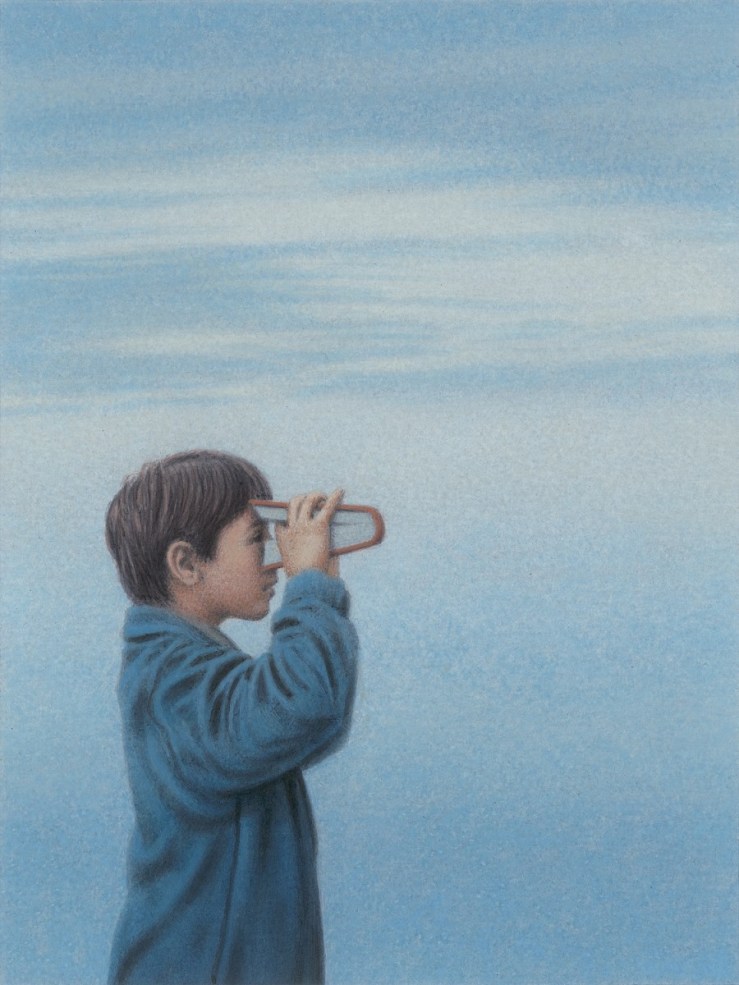
Boy with Book, 2013 by Quint Buchholz (b. 1957)

Visitation (Detail) — Pontormo

Screenshot 2019-05-06 at 8.33.30 AM.png

Visitation, 1529 by  Pontormo (1494 –1557)

“Covered Mirrors,” a very short story by Jorge Luis Borges

“Covered Mirrors”

by

Jorge Luis Borges

Translated by Andrew Hurley


Islam tells us that on the unappealable Day of Judgment, all who have perpetrated images of living things will reawaken with their works, and will be ordered to blow life into them, and they will fail, and they and their works will be cast into the fires of punishment. As a child, I knew that horror of the spectral duplication or multiplication of reality, but mine would come as I stood before large mirrors. As soon as it began to grow dark outside, the constant, infallible functioning of mirrors, the way they followed my every movement, their cosmic pantomime, would seem eerie to me. One of my insistent pleas to God and my guardian angel was that I not dream of mirrors; I recall clearly that I would keep one eye on them uneasily. I feared sometimes that they would begin to veer off from reality; other times, that I would see my face in them disfigured by strange misfortunes. I have learned that this horror is monstrously abroad in the world again. The story is quite simple, and terribly unpleasant.

In 1927, I met a grave young woman, first by telephone (because Julia began as a voice without a name or face) and then on a corner at nightfall. Her eyes were alarmingly large, her hair jet black and straight, her figure severe. She was the granddaughter and greatgranddaughter of Federalists, as I was the grandson and great-grandson of Unitarians, but that ancient discord between our lineages was, for us, a bond, a fuller possession of our homeland. She lived with her family in a big run-down high-ceiling’d house, in the resentment and savorlessness of genteel poverty. In the afternoons— only very rarely at night—we would go out walking through her neighbor-hood, which was Balvanera.  We would stroll along beside the high blank wall of the railway yard; once we walked down Sarmien to all the way to the cleared grounds of the Parque Centenario. Between us there was neither love itself nor the fiction of love; I sensed in her an intensity that was utterly unlike the intensity of eroticism, and I feared it. In order to forge an intimacy with women, one often tells them about true or apocryphal things that happened in one’s youth; I must have told her at some point about my horror of mirrors, and so in 1928 I must have planted the hallucination that was to flower in 1931. Now I have just learned that she has gone insane, and that in her room all the mirrors are covered, because she sees my reflection in them—usurping her own—and she trembles and cannot speak, and says that I am magically following her, watching her, stalking her.

What dreadful bondage, the bondage of my face—or one of my former faces. Its odious fate makes me odious as well, but I don’t care anymore.

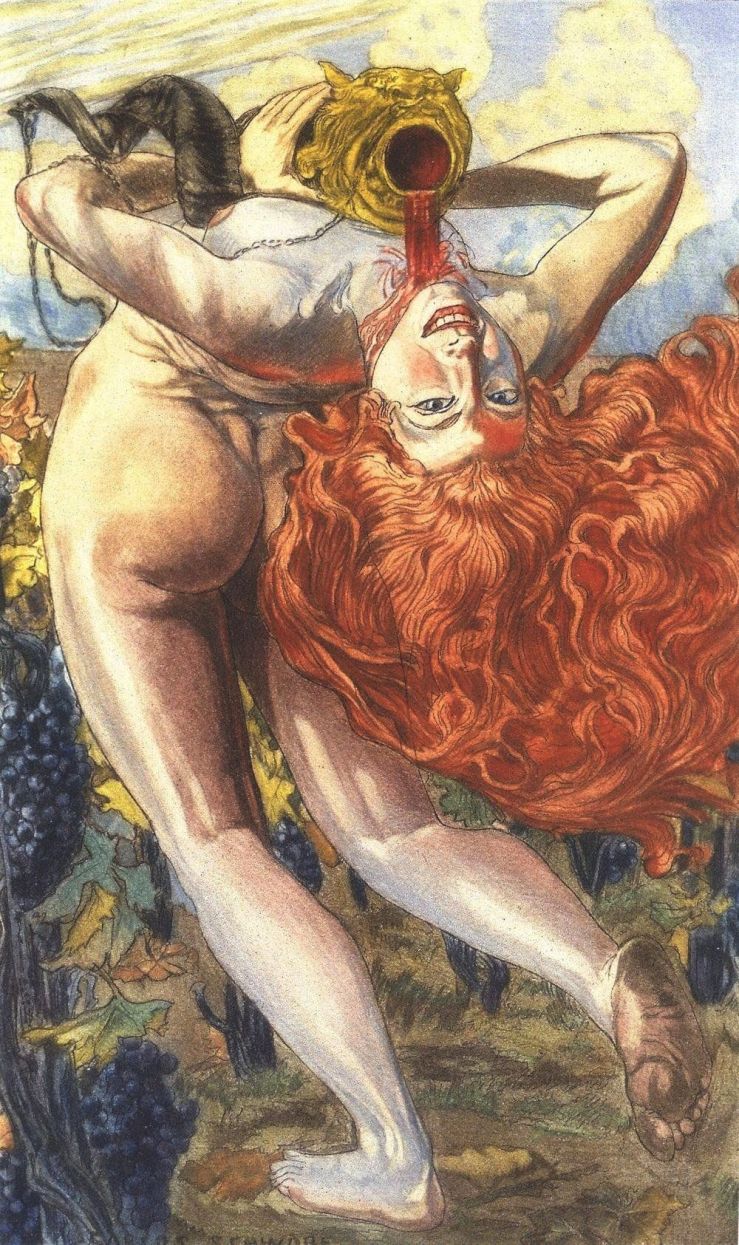
The Soul of Wine — Carlos Schwabe

fc7133811beac0416b995d5fc6f460a8

The Soul of Wine, 1900 by Carlos Schwabe (1866–1926)

Illustration for Les Fleurs du mal by Charles Baudelaire.

“The Soul of Wine”

by

Charles Baudelaire

English translation by

William Aggeler


One night, the soul of wine was singing in the flask:
“O man, dear disinherited! to you I sing
This song full of light and of brotherhood
From my prison of glass with its scarlet wax seals.

I know the cost in pain, in sweat,
And in burning sunlight on the blazing hillside,
Of creating my life, of giving me a soul:
I shall not be ungrateful or malevolent,

For I feel a boundless joy when I flow
Down the throat of a man worn out by his labor;
His warm breast is a pleasant tomb
Where I’m much happier than in my cold cellar.

Do you hear the choruses resounding on Sunday
And the hopes that warble in my fluttering breast?
With sleeves rolled up, elbows on the table,
You will glorify me and be content;

I shall light up the eyes of your enraptured wife,
And give back to your son his strength and his color;
I shall be for that frail athlete of life
The oil that hardens a wrestler’s muscles.

Vegetal ambrosia, precious grain scattered
By the eternal Sower, I shall descend in you
So that from our love there will be born poetry,
Which will spring up toward God like a rare flower!”


Blog about acquiring some books (Books acquired, 3 May 2019)

img_2751

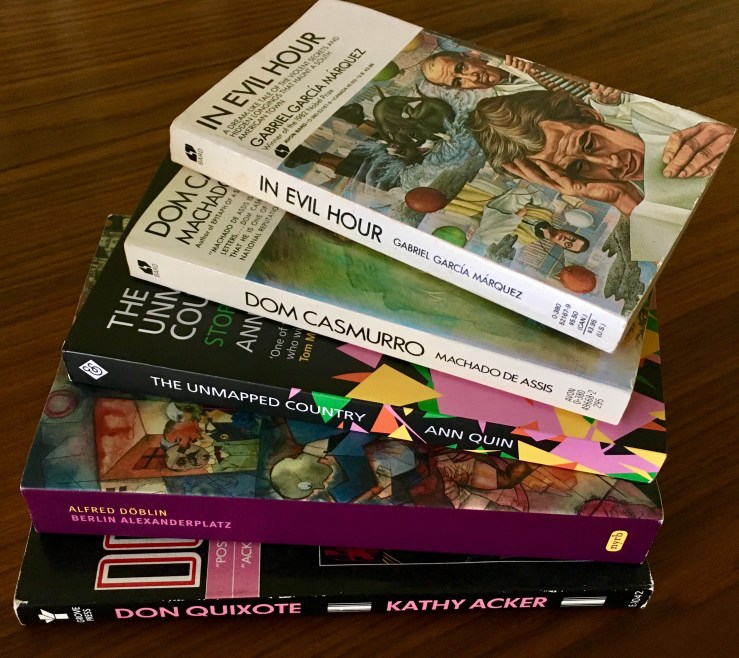
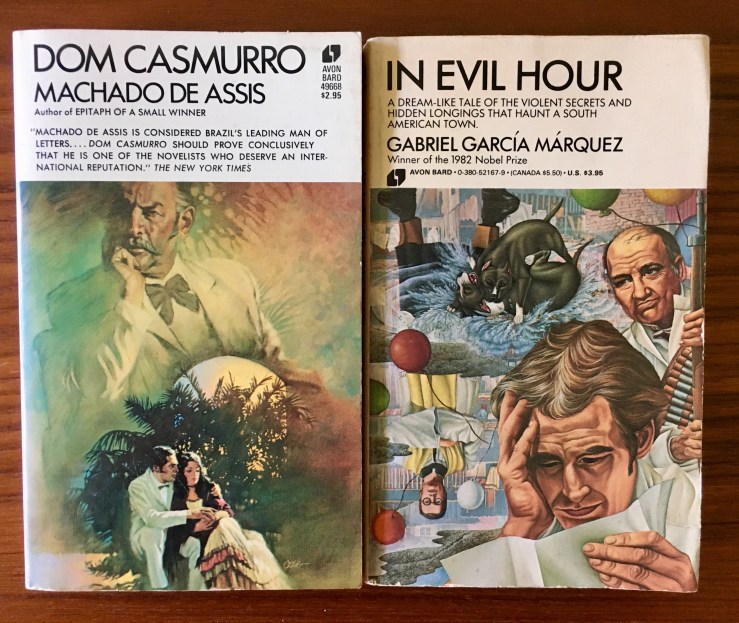
Yesterday marked both my wedding anniversary and the end of my spring semester, so I celebrated by spending a spare hour browsing my beloved used bookshop. I had dropped by last week to drop off a box of trade books—mostly old instructor editions of textbooks no longer in use—but I didn’t pick anything up. I did, however, snap a few photographs of the covers of the old 1980s Latin American authors series that Avon Bard put out. I love these covers, and have bought a few over the years.

I ended up picking up two yesterday: Gabriel Garcia Marquez’s In Evil Hour and Machado de Assis’s Dom Casmurro. The cover for Dom Casmurro is pretty bad, actually, but I want to read it.

img_2752

Near the Machado de Assis, I found a used copy of Berlin Alexanderplatz by Alfred Döblin, which I couldn’t resist. I also found a Grove edition of Kathy Acker’s Don Quixote, which I haven’t read since college.

img_2753

I also got a book in the mail. I loved Ann Quin’s novel Berg so much that I had to get more Quin, so I ordered The Unmapped Country from publisher And Other Stories. Very excited for this one.

img_2754

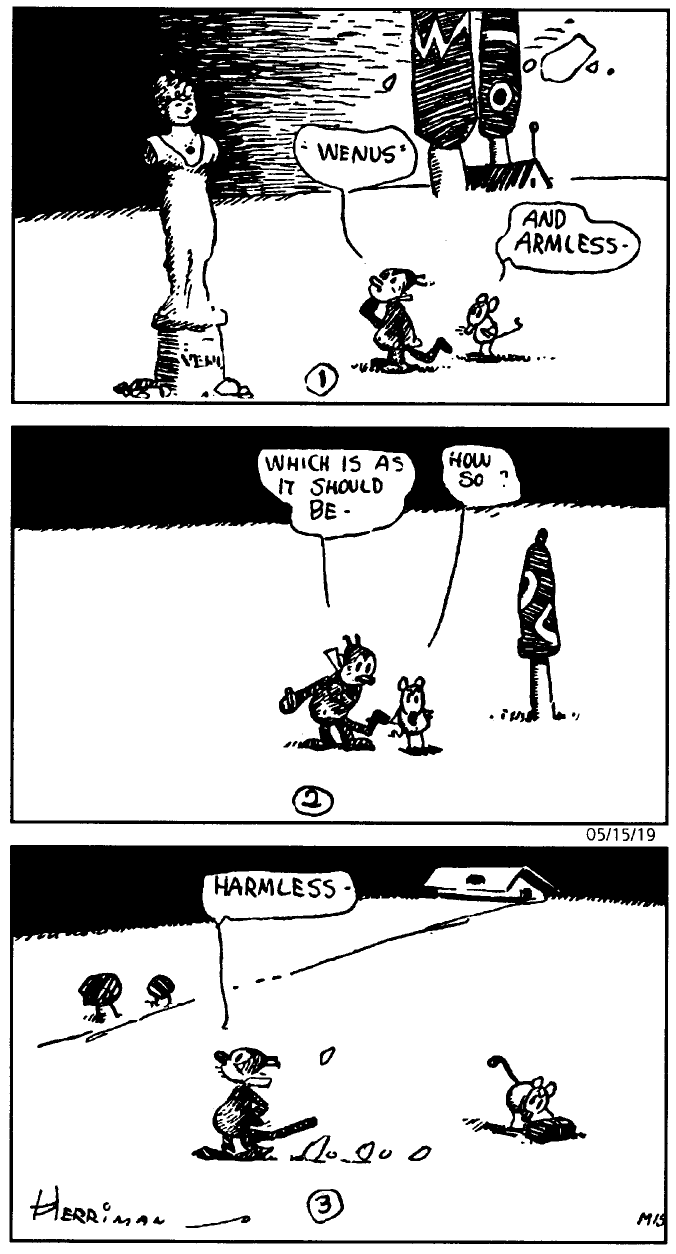
Armless (George Herriman’s Krazy Kat)

krazy-kat-19190515-s

Two Elders Seated — Jayne Holsinger

4_2_nyfa

Two Elders Seated, 2007 by Jayne Holsinger

Post script as self portrait, or, Throwing out a bunch of old magazines

img_2735

In February of 2002, three friends came to visit me and my girlfriend in our tiny apartment in Tokyo. We had been living there for just a few months, since September of 2001. I was ostensibly teaching English, but really just serving as a conversation partner for overworked salarymen, bored hobbyists, and hopeless teens. These folks were essentially being scammed by a national corporation pretending to be a school for language instruction. It was my first job out of college. I loved Tokyo and I had made a ton of friends and I was tired all the time. It was famous times for me, and I was thrilled that my friends came to share a week of it.

My friends brought with them a care package, bolstered with items from my parents and other friends. The care package included things that weren’t easy to get in Tokyo, like taco shells and NyQuil. There was a bottle of Jack Daniels that never made it to Japan. My friends drank it on the airplane, which I guess you could still do just a few months after 9/11. There was also the October 2001 issue of Harper’s Magazine.

*

Last month my dean called me into his office and explained that I would have to move out of my office. We would all have to move out of our offices; our beloved shabby building was to be gutted that summer, sooner than to be expected, and the college would not be able to store much beyond a few file cabinets and boxes of books. Take all that art home, etc. This was a stressful chore at the end of term, not just because it necessitated moving physical items at the same time I had finals to grade and students to meet with (students tend to show up to office hours a lot this time of year), but also because I had essentially been using my office as a proxy storage facility for the last decade, and it was crammed with stuff I probably needed to just, like, hell, go ahead and part with.

I filled boxes with old mass-market paperbacks that had migrated, triple-stacked, to my shelves over the years, and took them to classrooms, where students swooped on them with an eagerness that I found frankly shocking. I gave away posters and framed art, little plastic toys and boxes of permanent markers. I surrendered a green Underwood typewriter I’d lugged around for years to a student who promised to write poems on it. I ditched hard copies of over a decade of work I’d originated–lecture notes and quizzes and the like. And I shredded years and years of student work. All of this was cathartic and a little exhausting.

The materials in my office represented, in a way, more than a decade of my unwillingness to fully surrender the crap I’d accumulated over the years. My children needed their own space for their own things, and scores of cheap paperback books, a ribbonless typewriter, cheap ¥100-shop masks, Simpsons Lego figurines, and boxes and binders of papers had to go somewhere. There were shelves in my office though. Filing cabinets too. And I filled one of those filing cabinet drawers with around a hundred back issues of Harper’s Magazine that I could not bear to part with.

*

Beginning in 1998, I subscribed on and off to Harper’s for twenty years. The magazine’s journalism and short stories were a developmental influence on me, and its editorial position in the early years of Bush 2 were especially important to how I conceived of both politics and rhetoric. The book reviews—John Leonard’s in particular—were always a favorite, too, as was “Harper’s Index,” a monthly poem comprised of data.

But it was the “Readings” section of Harper’s that I loved the most. Short extracts—musings, art, poetry, petitions, found poetry, jokes, essays, letters, lists, rebukes, rejoinders, absurdities, profundities, hilarities. And art! Lots and lots of art–photography, oil painting, drawings, and so on. Harper’s “Readings” section was like a curated feed of the best content, before such a vile term as “curated feed of the best content” existed. (Please forgive me for typing “curated feed of the best content” and know that I will never forgive myself). “Readings” influenced this blog, Biblioklept, tremendously.

*

img_2730

The “Readings” section of the October 2001 issue of Harper’s Magazine does not feature any big names, other than Lucian Freud. (His painting Leigh on Green Sofa is there, but is not as intriguing as Clive Smith’s Waited, which looks like it could be a Freud painting from a previous era). The most memorable bits of this “Readings” section are a selection of excerpts from fourth graders’ essays about their experiences with their school’s rat infestation (“I saw a rat in the classroom. It was big and weird and I saw it by Sierra’s shoes. I saw it by the trash”), and this riddle:

img_2732

*

So I disposed of, by giving away or recycling or cutting up, almost every issue of Harper’s I’d accrued over the years. By “cutting up,” I mean that I cut sections out of certain issues—mostly bits from the “Readings” section, or essays, or short stories—stuff from Margaret Atwood, William Burroughs, Wells Tower, Ursula Le Guin.

I ended up keeping eleven issues, including the October 2001 issue.

*

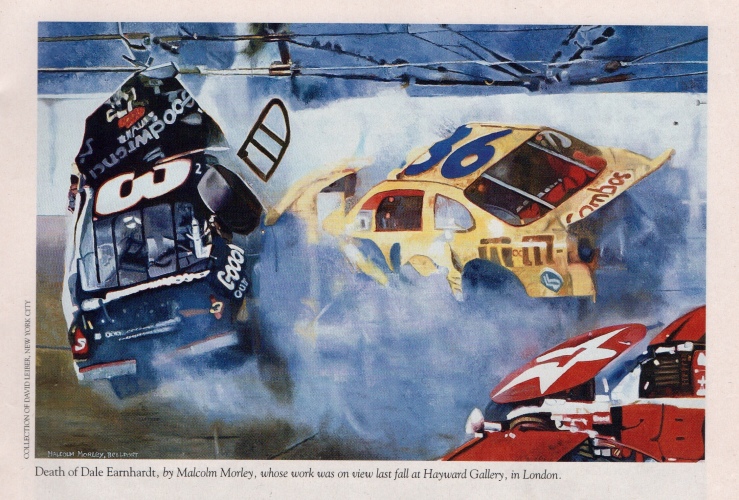
How did I decide what to keep? In some cases, I knew what I was looking for in some cases—a “Folio” section by William T. Vollmann that was later collected in Imperial, for instance, or stories and essays by old masters like William Gass and Robert Coover. Also, the double-sized June 2000 issue, the 150th Anniversary edition loaded with ringers, both in “Readings” (Barry Hannah, Gertrude Stein, Orson Welles, Mark, Twain, JL Borges) and in the magazine proper (Tom Wolfe, Russell Banks, Ha Jin, Annie Proulx). For the most part, my aim was to cut out stories or essays, but sometimes I’d end up with an issue to of-its-time to dispose of. The February 2008 of Harper’s was very 2008, for instance: David Foster Wallace, Slavoj Žižek, Malcolm Morley’s painting Death of Dale Earnhardt—
img_2734

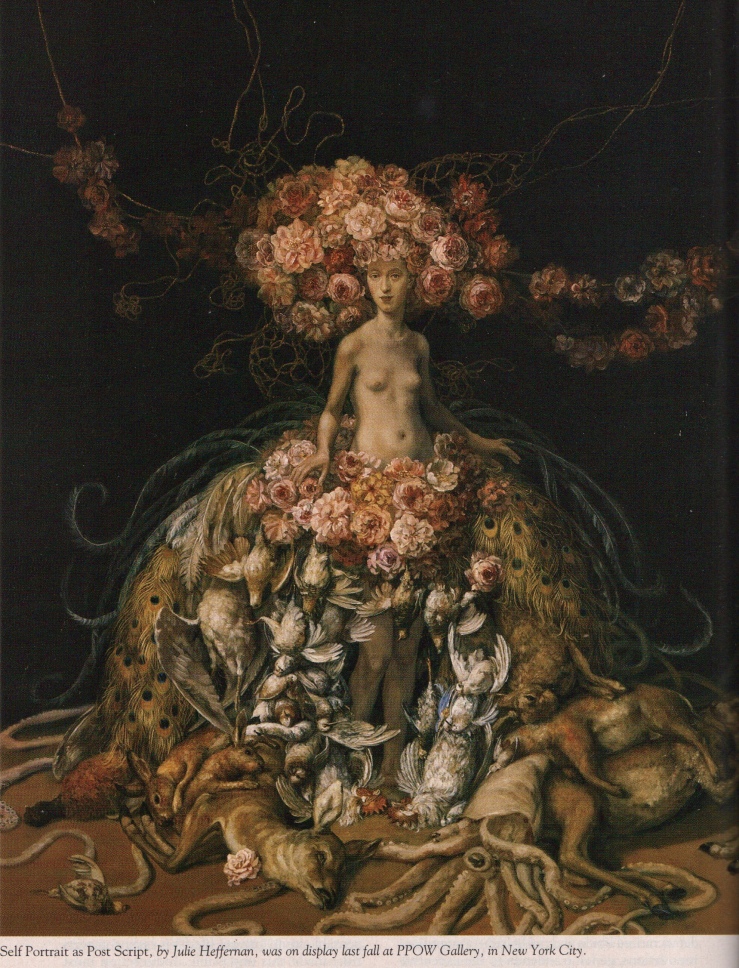
–and Ursula Le Guin’s essay “Staying Awake: Notes on the Alleged Decline of Reading.” As I went to cut out the William Gass essay on Malcolm Lowry from the January 2008 issue, I browsed the contents long enough to see a story by Ben Marcus and readings from Robert Walser and Grace Paley. There’s also a full-page image of Julie Heffernan’s painting Self Portrait as Post Script. 

*

(I have stolen and skewed the title of Julie Heffernan’s painting for the title of my own silly blog post, which is, after all, simply my own postscript, my own unnecessary, sentimental, messy afterthought on throwing out years and years of papers, an afterthought bumbling about in the semblance of a crude self portrait, a little sketch about then and now).

*
img_2736

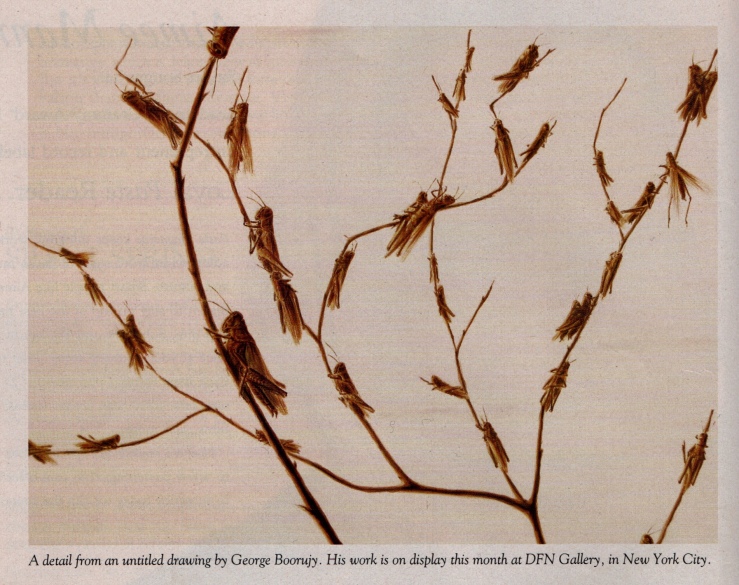
Gass’s name on the cover from an issue one year later, January 2009, saved a section memorializing David Foster Wallace, including selections from Zadie Smith, George Saunders, and Don DeLillo. (The issue also has an exhaustive triple-length “Harper’s Index” titled “A retrospective of the Bush era). A 2005 issue—again Bill Gass’s name on the cover—included a drawing by George Boorujy, who I interviewed on this site in 2012.

For the most part though, I threw issues away.

*

I did not throw out the October 2001 issue of Harper’s. I probably read it half a dozen times back in 2002. It would be a lie to say the issue is tattooed into my brain, but it’s there—like a kind of psychic residue, a blurry vibe of a weird time in my young life. I most remembered “All God’s Children Can Dance,” a short story by Haruki Marukami, an author I’ve never thought was particularly good—but I loved this story. It was the first Marukami I read and it opened with the line, “Yoshiya woke with the worst possible hangover,” and included details like riding the Marunouchi Line, the train I took every day or almost every day to work in Shinjuku to chat about my Florida lifestyle with sweating business guys and lonely housewives. The story is very Raymond Carver (it’s translated by Jay Rubin) and not especially good, I realize, as I stop to reread it now, but I love it.

The October 2001 issue of Harper’s Magazine also features a charming essay about dinosaurs as pop culture by Jack Hitt, a sad riff on Alzheimer’s by Eleanor Clooney, and a lead story about troubles in Palestine by Chris Hedges. None of these selections are particularly remarkable. What’s strange to me about the issue, I guess, is that it bears absolutely no trace whatsoever of the September 11th terrorist attacks. It’s as if the event simply had not happened yet, which it hadn’t, at least for a magazine already planned and executed weeks ahead of time. I’m guessing that the issue probably was on sale in September of 2001. So the October 2001 issue of Harper’s was already a relic when it came to me in February of 2002; the world had shifted at the time of its publication. By the time I read it the U.S. military had been in Afghanistan for four months already. They are still there today.

This publishing lag in the October 2001 issue of Harper’s seems utterly bizarre in retrospect, especially given the tenor of issues a few months later. I kept the January and March 2002 issues, both brought over by a friend who visited me in Tokyo (maybe the worst house guest I’ve ever had. We sang karaoke until 8am on my 23rd birthday). Both issues are suffused in the horror of the new normal, and both feature fantastic short fiction — “The New Female Head” by Ben Marcus in the January issue, and Adam Johnson’s “Teen Sniper,” a tale that could give George Saunders a run for his money.

*

I searched just now for links to free online versions of “The New Female Head” and “Teen Sniper,” but I couldn’t find any. If you have a subscription to Harper’s, you can read them there, online, as pdfs or as, uh, microfiche. I haven’t used the digital archive in a long time, but I recall its being clunky and somewhat hard to use. And even if it can lead you to a pdf version of, say, an old Steven Millhauser or Don DeLillo story, the online archive simply can’t replicate the stochastic reading experience of flipping through a magazine, tumbling from weird short readings to art to lists of statistics before settling down in a long feature essay (or skimming through one of Lapham’s lectures).

My subscription is lapsed now—I don’t think the magazine is as good as it used to be—but I’ll occasionally peruse an issue at the library or flick through it at the bookstore. I’m sure something on some future cover will tempt me to commit to purchasing the issue and rounding out my archive to a nice dozen issues. For now though, I’m content to skim through this old issue from October 2001, in which Lewis Lapham, in a “Notebook” column dated September 1, 2001, concludes, quite ironically, that “Fortunately we don’t live in times that try men’s souls.” And then maybe I’ll skim through some of the later issues I held on to and see how that assessment panned out.

Mayday — Julie Heffernan

heffernan

Mayday, 2018 by Julie Heffernan (b. 1956)

“Axe Handles” — Gary Snyder

“Axe Handles”
by
Gary Snyder

One afternoon the last week in April
Showing Kai how to throw a hatchet
One-half turn and it sticks in a stump.
He recalls the hatchet-head
Without a handle, in the shop
And go gets it, and wants it for his own.
A broken-off axe handle behind the door
Is long enough for a hatchet,
We cut it to length and take it
With the hatchet head
And working hatchet, to the wood block.
There I begin to shape the old handle
With the hatchet, and the phrase
First learned from Ezra Pound
Rings in my ears!
“When making an axe handle
                 the pattern is not far off.”
And I say this to Kai
“Look: We’ll shape the handle
By checking the handle
Of the axe we cut with—”
And he sees. And I hear it again:
It’s in Lu Ji’s Wên Fu, fourth century
A.D. “Essay on Literature”-—in the
Preface: “In making the handle
Of an axe
By cutting wood with an axe
The model is indeed near at hand.”
My teacher Shih-hsiang Chen
Translated that and taught it years ago
And I see: Pound was an axe,
Chen was an axe, I am an axe
And my son a handle, soon
To be shaping again, model
And tool, craft of culture,
How we go on.

Head — Gerhard Richter

7802

Head, 2005 by Gerhard Richter (b. 1932)