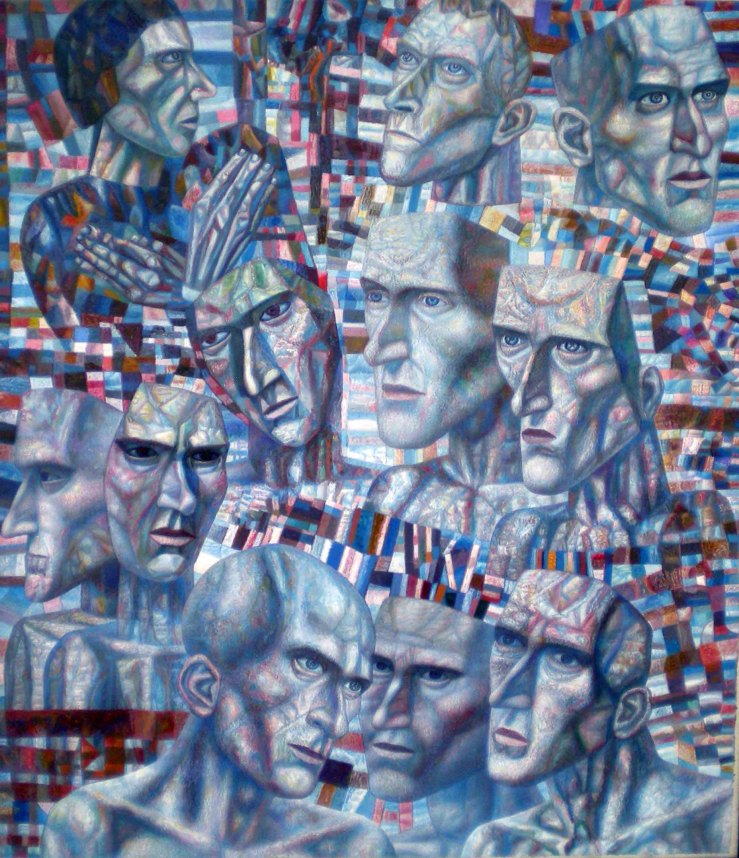
War — Patrick William Adam

tumblr_mvrh56hrfe1soqrhbo1_1280War, 1915 by Patrick William Adam (1854–1929)

“The Balloon-Hoax” — Edgar Allan Poe

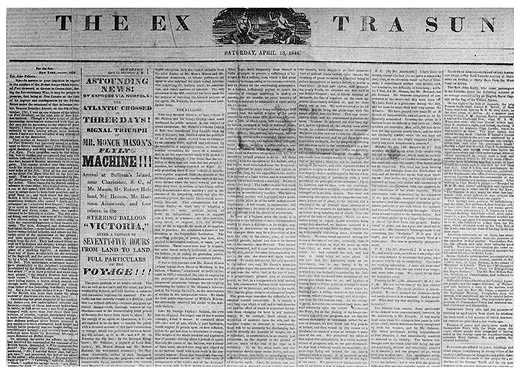
1844_sun_newspaper_story

“The Balloon-Hoax”

by

Edgar Allan Poe


THE great problem is at length solved! The air, as well as the earth and the ocean, has been subdued by science, and will become a common and convenient highway for mankind. The Atlantic has been actually crossed in a Balloon! and this too without difficulty—without any great apparent danger—with thorough control of the machine—and in the inconceivably brief period of seventy-five hours from shore to shore! By the energy of an agent at Charleston, S.C., we are enabled to be the first to furnish the public with a detailed account of this most extraordinary voyage, which was performed between Saturday, the 6th instant, at 11, A.M., and 2, P.M., on Tuesday, the 9th instant, by Sir Everard Bringhurst; Mr. Osborne, a nephew of Lord Bentinck’s; Mr. Monck Mason and Mr. Robert Holland, the well-known æronauts; Mr. Harrison Ainsworth, author of “Jack Sheppard,” &c.; and Mr. Henson, the projector of the late unsuccessful flying machine—with two seamen from Woolwich—in all, eight persons. The particulars furnished below may be relied on as authentic and accurate in every respect, as, with a slight exception, they are copied verbatim from the joint diaries of Mr. Monck Mason and Mr. Harrison Ainsworth, to whose politeness our agent is also indebted for much verbal information respecting the balloon itself, its construction, and other matters of interest. The only alteration in the MS. received, has been made for the purpose of throwing the hurried account of our agent, Mr. Forsyth, into a connected and intelligible form. Continue reading ““The Balloon-Hoax” — Edgar Allan Poe”

April / Fools

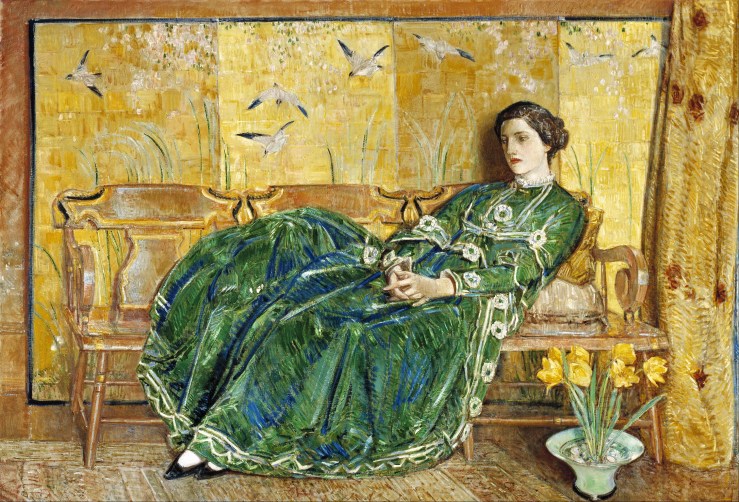
Childe_Hassam_-_April_-_(The_Green_Gown)_-_Google_Art_Project

April (The Green Gown), 1919 by Childe Hassam (1859–1935)

the-ship-of-fools-1500(1)

Ship of Fools, c. 1490–1500 by Hieronymus Bosch (c. 1450-1516)

Reviews, March 2019 (and an unrelated wombat)

Links to and brief excerpts from reviews I mustered this month (and an unrelated wombat):

I reviewed João Gilberto Noll’s short novel Lord, writing,

Lord is an abject and surreal tale of madness. Madness is perhaps not the correct term, although it does point towards Lord’s gothic and abject modes. Perhaps it’s more accurate to say that in Lord, Noll gives us a consciousness dissolving and reconstituting itself, a first-person voice shifting from one reality to the next with absurdly picaresque energy.

I also wrote about Ishmael Reed’s novel The Last Days of Louisiana Red. First grafs—

Ishmael Reed’s 1974 novel The Last Days of Louisiana Red is a sharp, zany satire of US culture at the end of the twentieth century. The novel, Reed’s fourth, is a sequel of sorts to Mumbo Jumbo (1972), and features that earlier novel’s protagonist, the Neo-HooDoo ghost detective Papa LaBas.

In Mumbo Jumbo, Reed gave us the story of an uptight secret society, the Wallflower Order, and their attempt to root out and eradicate “Jes’ Grew,” a psychic virus that spreads freedom and takes its form in arts like jazz and the jitterbug. The Last Days of Louisiana Red also employs a psychic virus to drive its plot, although this transmission is far deadlier. “Louisiana Red” is a poisonous mental disease that afflicts black people in the Americas, causing them to fall into a neo-slave mentality in which they act like “Crabs in the Barrel…Each crab trying to keep the other from reaching the top.”

I really dug Joy Williams’ debut short story Taking Care. From my review:

…enduring, patient love is unusual in Taking Care, where friendships splinter, marriages fail, and children realize their parents’ vices and frailties might be their true inheritance. These are stories of domestic doom and incipient madness, alcoholism and lost pets. There’s humor here, but the humor is ice dry, and never applied as even a palliative to the central sadness of Taking Care. Williams’ humor is something closer to cosmic absurdity, a recognition of the ambiguity at the core of being human, of not knowing. It’s the humor of two girls eating chips on a beach, unable to decide if the people they are gazing at are drowning or just having a good time.

I also reviewed Octavia Butler’s Parable of the Sower. First paragraph of the review:

Octavia Butler’s 1993 novel Parable of the Sower imagines what a radical affirmation of life might look like set against a backdrop of impending extinction. Set between 2024 and 2027, Parable of the Sower conjures  a crumbling America. Hyperinflation abounds, infrastructure is falling apart, water is scarce, environmental collapse is imminent, and the social institutions that bind the nation have all but frayed.

And I reviewed Jon McNaught’s graphic novel Kingdom for The Comics Journal.

First two paragraphs:

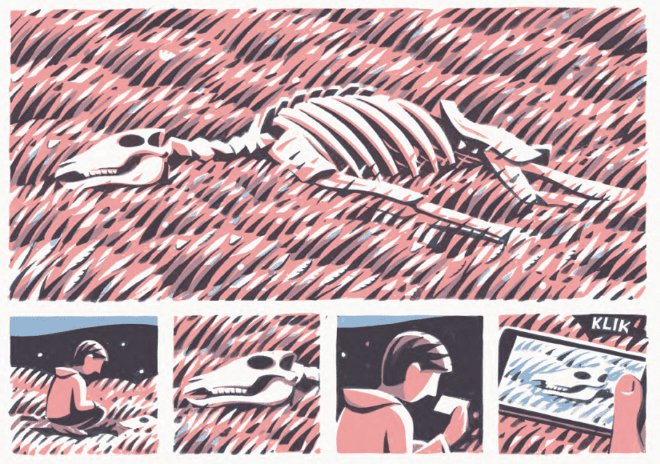
Not much happens in Jon McNaught’s latest graphic novel Kingdom. A mother takes her son and daughter to Kingdom Fields Holiday Park, a vacation lodge on the British coast. There, they watch television, go to a run-down museum, play on the beach, walk the hills, and visit an old aunt. Then they go home. There is no climactic event, no terrible trial to endure. There is no crisis, no trauma. And yet it’s clear that the holiday in Kingdom Fields will remain forever with the children, embedded into their consciousness as a series of strange aesthetic impressions. Not much happens in Kingdom, but what does happen feels vital and real.

“Life, friends, is boring,” the poet John Berryman wrote in his fourteenth Dream Songbefore quickly appending, “We must not say so / After all, the sky flashes, the great sea yearns.” In Kingdom, McNaught creates a world of flashing sky and yearning sea, natural splendor populated by birds and bats, mice and moths. In Kingdom Fields, waves crash in gorgeous dark blues, the sun rises in golden pinks, rain teems down in violet swirls, and the wind breezes through meadows of grass. It’s all very gorgeous, and the trio of main characters spend quite a bit of the novel ignoring it. The narrator of John Berryman’s fourteenth Dream Song understood the transcendental promise of nature’s majesty, yet also understood that “the mountain or sea or sky” alone are not enough for humans—that we are of nature and yet apart from it.

Promised wombat:

The Invalid – Cheyne Walk 1869, 2017 by Walton Ford (b. 1960)

pk_24007-image

(About Ford’s painting).

The Duel — Norbert Schwontkowski

b675c1fa585b49c8

The Duel, 2011 by Norbert Schwontkowski (1949-2013)

The Tree of Tongues — J.R.R. Tolkien

15tolkien4-superjumbo

The Tree of Tongues, c. 1930-37 by J.R.R. Tolkien (1892–1973).

From The Morgan Library & Museum’s exhibition “Tolkien: Maker of Middle-earth.”

Triptych — Sonia Delaunay

Triptych 1963 by Sonia Delaunay 1885-1979

Triptych, 1963 by Sonia Delaunay (1885–1979)

I wanted to film freedom and filth | Agnès Varda on making Vagabond

RIP Agnès Varda, 1928-2019

The Visionary — Serafino Macchiati

a85bce0bfda674e47375c39b9eacc7ce

The Visionary, 1904 by Serafino Macchiati (1861-1916)

Antoine Volodine interviewed at the Evergreen Review

Antoine Volodine is interviewed by Andrew Wilson at The Evergreen Review. The interview focuses on Volodine’s 1990 novel Lisbon, Last Frontier. (Wilson’s translation of the first chapter of Lisbon, Last Frontier was recently published in The Evergreen Review). The interview touches on a number of subjects, including Volodine’s invented genre, post-exoticism. From the interview:

AW: Is post-exoticism simply anti-exoticism?

AV: Yes, what’s important in post-exoticism is that it does away with exoticism. You suggested anti-exoticism, and it could just as well have been anti-exoticism, in as much as what characterizes exoticism is the absolute distinction between the metropolis and the margin, between the center and the periphery. With exoticism, there is an interest in the margins–the writer lives on the margins–but it’s all for the sake of the center. In exoticism, one describes the margins with ideas that come from the center, whereas in our books, the characters—who are dying, or perhaps already dead, who are birds, or animals, or insane—have no center, or rather it is their margin that is the center—the center no longer exists. For us, mental derangement doesn’t refer to a discourse of normality outside of it. In the books, it is present, and it is the center, it is what’s creating the world. In Lisbon, Last Frontier, it’s Ingrid Vogel who creates the world. The reader might think she’s completely mad, schizophrenic, paranoid, but, in fact, the book never refers to an outside normality, from which one could judge Ingrid’s experience. Yes, the book enters her imaginary; yes, it creates imaginary spaces for her to inhabit, but it never refers to a normality outside of her. And it’s through this precise mechanism that the books are on the margins, in the dustbin (to borrow an expression from Lisbon, Last Frontier); it’s in this way that they are dustbin literature, a literature from elsewhere, and that’s what comes into being with post-exoticism. That’s what’s important I think: a literature that doesn’t refer to normality, that doesn’t refer to the center. In that sense it’s more anti-exoticism… but of course I’m not going to change it now. It’s too late; it’s post-exoticism until the end!

Contingent — Lukifer Aurelius

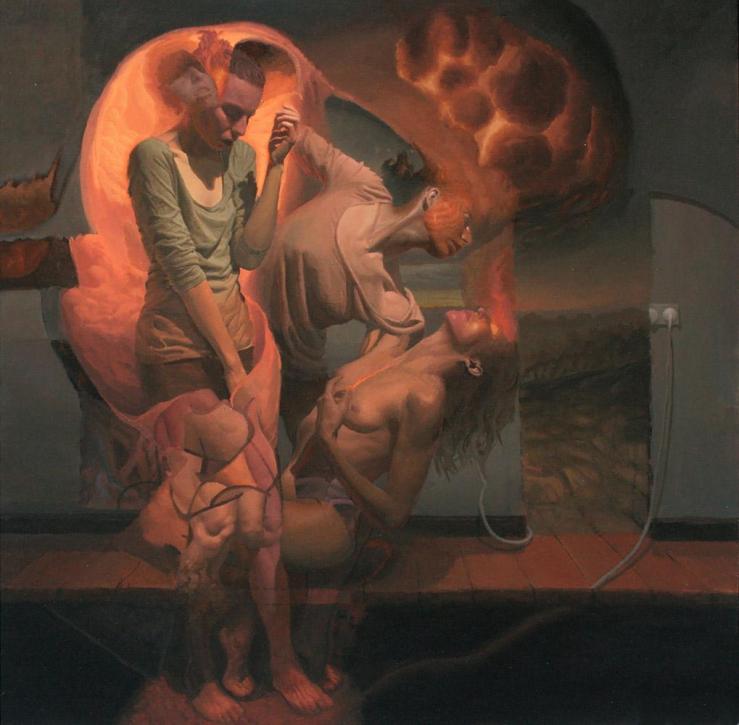
lukifer-aurelius-contingent-120cm-120cm-oil-on-aluminium-panel_1024x1024

Contingent by Lukifer Aurelius

“Points of View” — Ishmael Reed

“Points of View”

by

Ishmael Reed


The  pioneers and the indians
disagree about a lot of things
for example, the pioneer says that
when you meet a bear in the woods
you should yell at him and if that
doesn’t work, you should fell him
The indians say that you should
whisper to him softly and call him by
loving nicknames
No one’s bothered to ask the bear
what he thinks

Balanced — Suzanne Van Damme

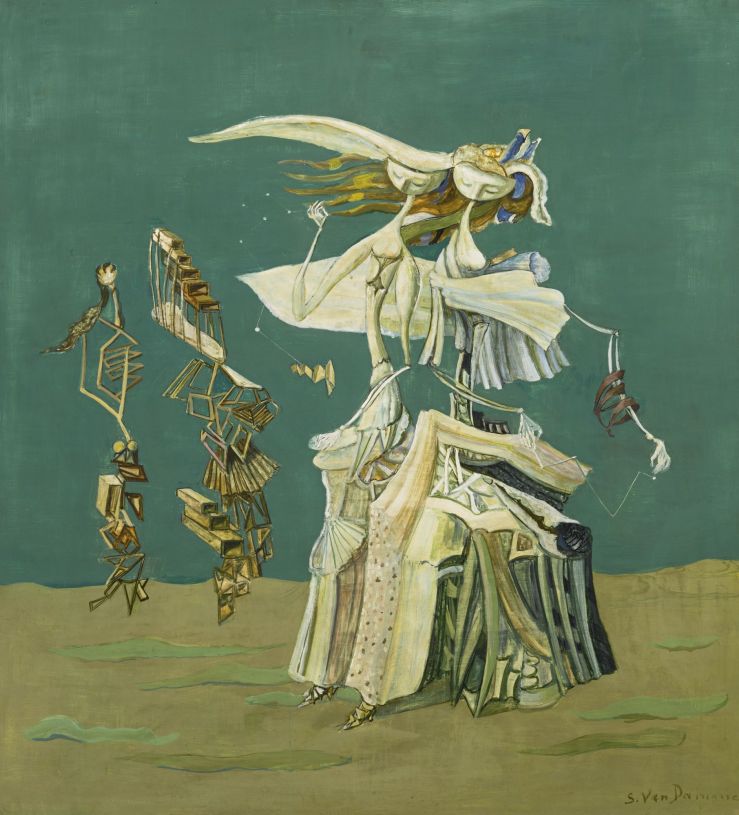
a4d040667294646a52bf7ba680309a1a

Equilibre (Balanced), 1946 by Suzanne Van Damme (1901-1986)

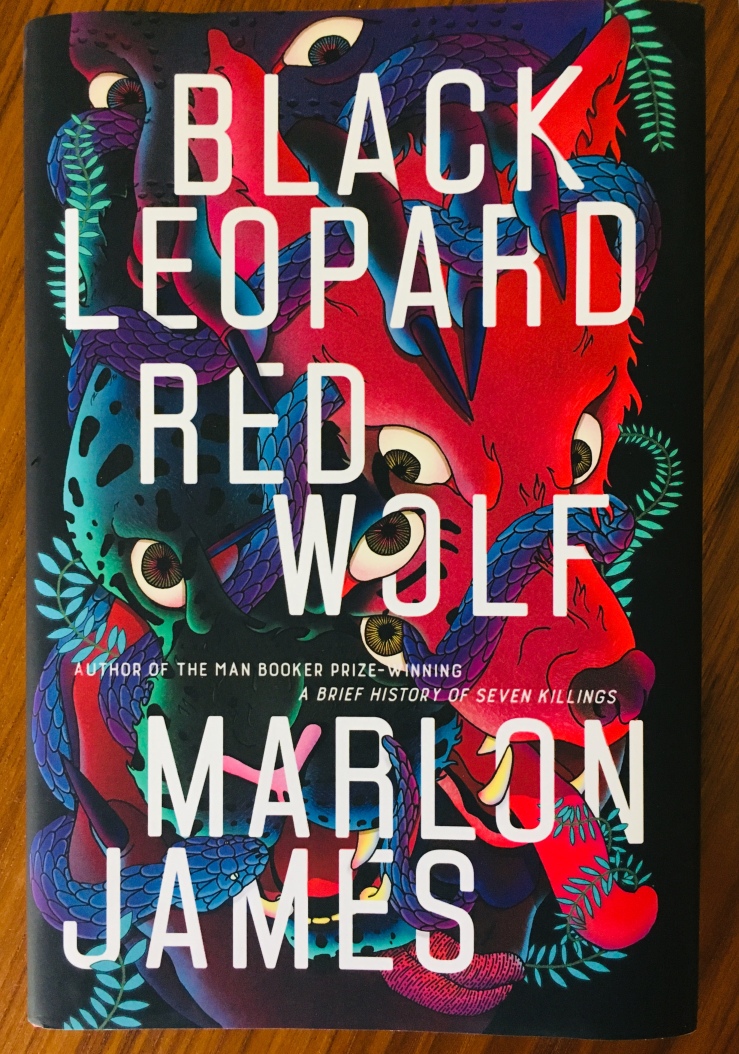
Blog about starting Marlon James’s novel Black Leopard, Red Wolf (Book acquired, 23 March 2019)

img_2496

I was skeptical about Marlon James’s new novel Black Leopard, Red Wolf when it came out earlier this year in hardback. The novel had plenty of buzz and a big blurb from Neil Gaiman on the back—two things that often turn me off. I was also a bit skeptical about some of the novel’s marketing hype. James referred to his novel as an “African Game of Thrones,” and a lot of folks ran with that tag. James has since professed in an interview that this comparison was a joke.

A friend had read something about the book and texted me questions about it, so I thought, Hey, why not go to my favorite source of literary criticism: What did people who really hated this book have to say about it? And as usual, the one-star reviews at Amazon did not disappoint. Indeed, I was a bit optimistic about Black Leopard, Red Wolf after seeing this curve:

curve

Just look at that! Amazon stats for big publisher/big buzz books tend to be suspiciously positive, but here I saw a sign of something that intrigued me—a book that a lot of people either loved or hated. And some of those one-star reviews?

Filled with gratuitous and rampant cursing, sexuality, violence and brutality. Too much even for fans of dark fantasy. I could not finish it.

…Confusing, nasty, all-over-the-place, just plain LOST. Sorry, but this needs a particular kind of person to stomach or understand.

If you don’t mind being confused and unsure of the direction of a story, this book is for you. You must have patience to read this book. 

sounds like it was written by someone on hallucinogens.

I knew at this point I wouldn’t wait for the paperback.

If James’s comparing Black Leopard, Red Wolf to Game of Thrones was a joke, it’s a pretty good one, the kind of joke that could sell a lot of copies of his novel to fantasy fans who want a plot-driven tale. From the four baffling, surreal, vivid (and often lurid) chapters I’ve read so far, Black Leopard, Red Wolf isn’t really like Game of Thrones at all. There’s an opaqueness to James’s prose, a distancing effect to the language that alienates the reader in the most wonderful way. It’s all so terribly strange! Fans of plot-centric fantasy where the author explains and explicates what’s happening will likely be very quickly bothered by what James is doing here.

So far, Black Leopard, Red Wolf is first-person narrative of a man who may or may not be named Tracker, who is telling his story—or rather, manymany stories—to someone called Inquisitor (shades of One Thousand and One Nights?). These stories flow and roil into and out of each other. The minute James lets us find our bearings a bit, we’re out into new territory—one moment fighting “Omoluzu…Roof walkers” who seem to exist on a tangential plane to our own, and not long after running through a jungle of giant trees with a shapeshifting Leopard who leads us to a village of cursed children. Black Leopard, Red Wolf overflows with energy: the novel is kinetic, bright, and sharp, but also dark, eerie, and upsetting—it’s abject, puzzling, slippery. I love it so far.

The novel completely won me over on its tenth page, with this wild episode:

I kept walking until I came to an old woman by a river with a tall stick sitting at the banks. Her hair white at the sides, her head bald at the top. Her face had lines like paths in the forest and her yellow teeth meant her breath was foul. The stories say she rises each morning youthful and beautiful, blooms full and comely by midday, ages to a crone by nightfall, and dies at midnight to be born again the next hour. The hump in her back was higher than her head, but her eyes twinkled, so her mind was sharp. Fish swam right up to the point of the stick but never went beyond.

“Why have you come to this place?” she asked.

“This is the way to Monono,” I said.

“Why have you come to this place? A living man?”

“Life is love and I have no love left. Love has drained itself from me, and run to a river like this one.”

“It’s not love you have lost, but blood. I will let you pass. But when I lay with a man I live without dying for seventy moons.”

So I fucked the crone. She lay on her back by the bank, her feet in the river. She was nothing but bones and leather, but I was hard for her and full with vigor. Something was swimming between my legs that felt like fishes. Her hand touched my chest and my white clay stripes turned into waves around my heart. I thrust in and out of her, unnerved by her silence. In the dark I felt she was getting younger even though she was getting older. Flame spread inside me, spread to the tips of my fingers and the tip of me inside her. Air gathered around water, water gathered around air and I yelled, and pulled out, and rained on her belly, her arms, and her breasts. A shudder ran through me five times. She was still a crone, but I was not angry. She scooped my rain off her chest and flicked it off in the river. At once fish leapt up and dived in, leapt up again. This was a night when dark ate the moon, but the fishes had a light within them. The fishes had the head, arms, and breasts of women.

“Follow them,” she said.

I followed them through day and night, and day again. Sometimes the river was as low as my ankle. Sometimes the river was as high as my neck. Water washed all the white from my body, leaving just my face. The fish- women, womenfish, took me down the river for days and days and days until we came to a place I cannot describe. It was either a wall of river, which stood firm even though I could push my hand through it, or the river had bent itself downward and I could still walk, my feet touching the ground, my body standing without falling.

So the narrator ejaculates on a witch, she flicks his semen into a river, and the fish who eat it turn into mermaids who lead him to the land of the dead. There, he accomplishes on of the earliest quests in this very-questy novel. Instead of my describing the quest, I’ll point you instead to the publisher’s website–you can read the full first chapter there.

Did I mention that Black Leopard, Red Wolf has maps in it?  Black Leopard, Red Wolf has maps in it.
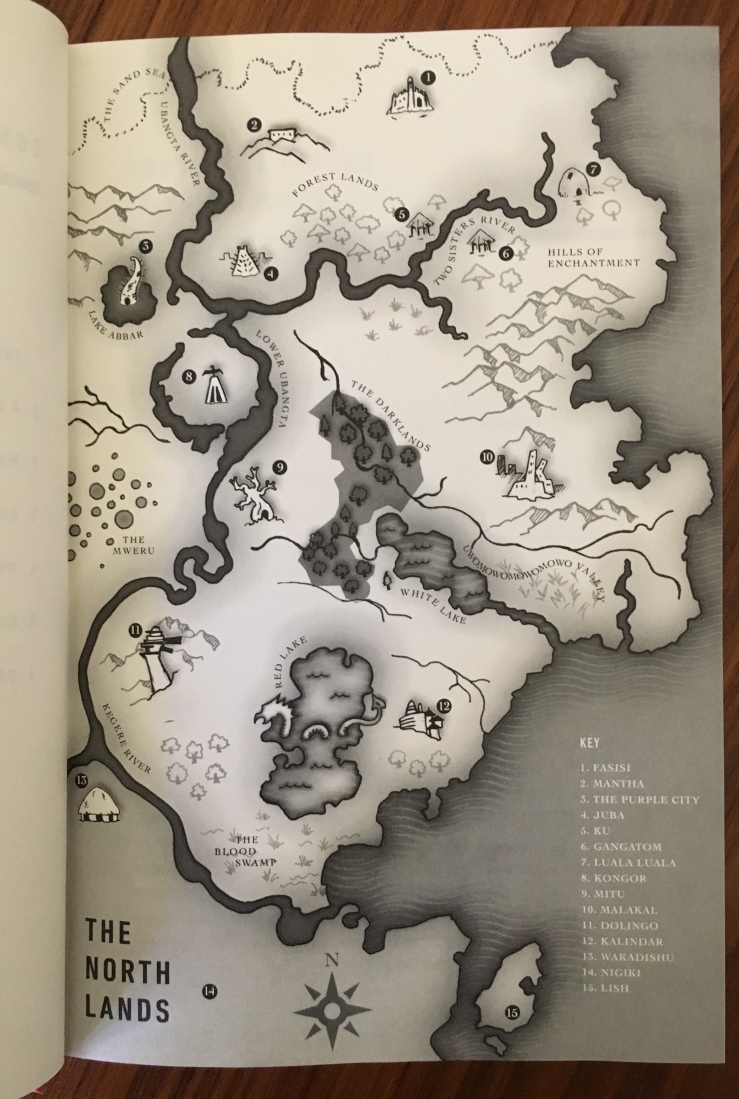
img_2497

More to come in the future. For now, I’m really digging the novel’s surreal, lurid thrusts into wild territory.
Eleven Heads — Pavel Filonov

eleven-heads-1935

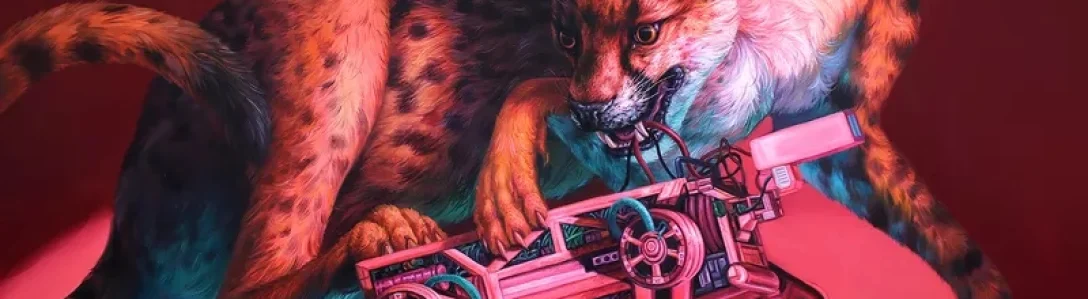
Eleven Heads, 1935 by Pavel Filonov (1883-1941)

Jon McNaught’s graphic novel Kingdom reviewed

kingdom7

My review of Jon McNaught’s newest book Kingdom is live now at The Comics Journal.

First two paragraphs:

Not much happens in Jon McNaught’s latest graphic novel Kingdom. A mother takes her son and daughter to Kingdom Fields Holiday Park, a vacation lodge on the British coast. There, they watch television, go to a run-down museum, play on the beach, walk the hills, and visit an old aunt. Then they go home. There is no climactic event, no terrible trial to endure. There is no crisis, no trauma. And yet it’s clear that the holiday in Kingdom Fields will remain forever with the children, embedded into their consciousness as a series of strange aesthetic impressions. Not much happens in Kingdom, but what does happen feels vital and real.

“Life, friends, is boring,” the poet John Berryman wrote in his fourteenth Dream Songbefore quickly appending, “We must not say so / After all, the sky flashes, the great sea yearns.” In Kingdom, McNaught creates a world of flashing sky and yearning sea, natural splendor populated by birds and bats, mice and moths. In Kingdom Fields, waves crash in gorgeous dark blues, the sun rises in golden pinks, rain teems down in violet swirls, and the wind breezes through meadows of grass. It’s all very gorgeous, and the trio of main characters spend quite a bit of the novel ignoring it. The narrator of John Berryman’s fourteenth Dream Song understood the transcendental promise of nature’s majesty, yet also understood that “the mountain or sea or sky” alone are not enough for humans—that we are of nature and yet apart from it.

Read the rest at the Comics Journal.

kingdom8

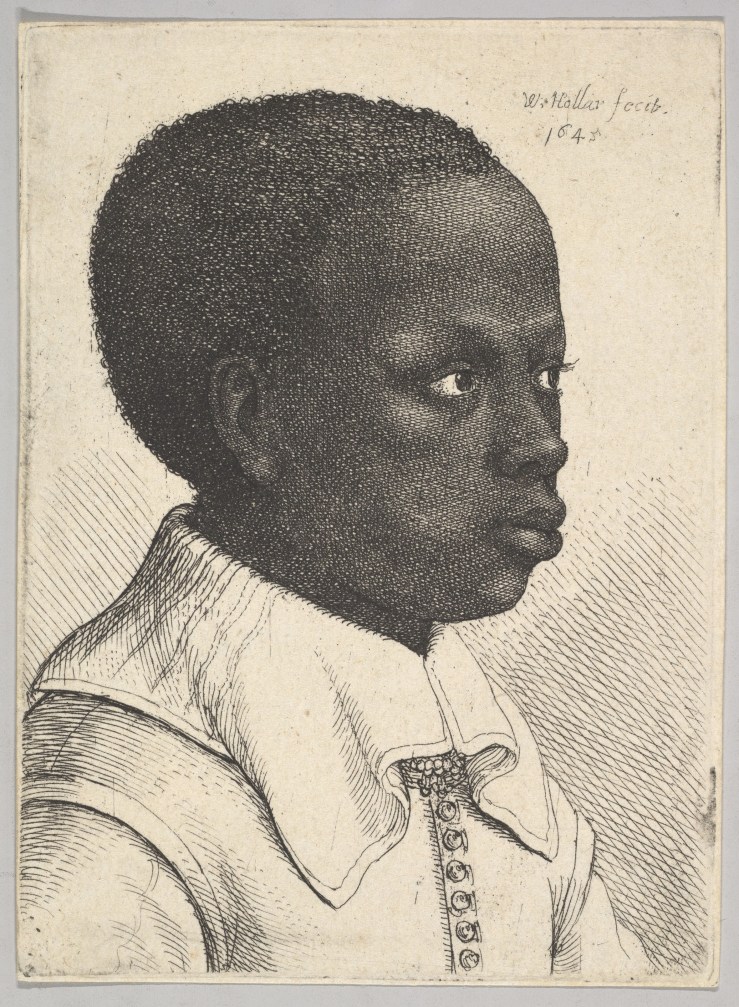
Boy in Profile — Wenceslaus Hollar

dp823969Screenshot 2019-03-26 at 3.26.06 PM

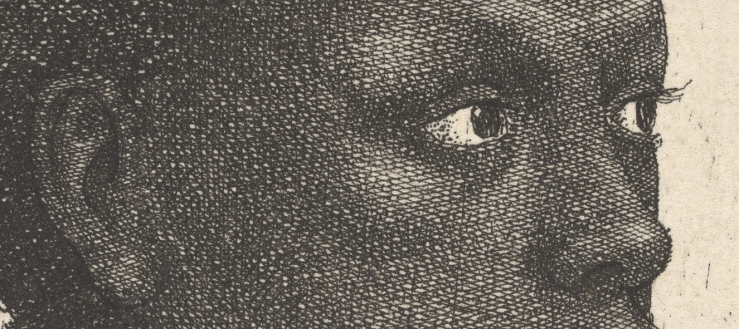
Boy in Profile, 1645 by Wenceslaus Hollar (1607–1677)