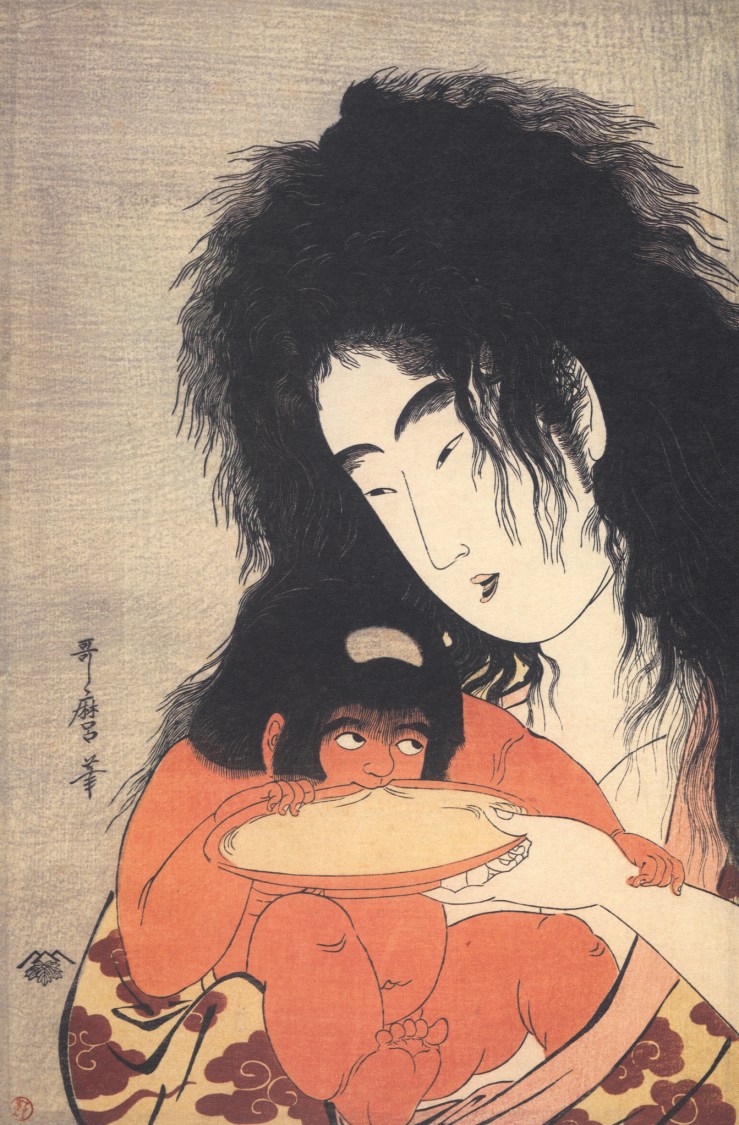
Kintaro Sakazuki with a Yama-uba, 18th century by Kitagawa Utamaro (c.1753-1806)
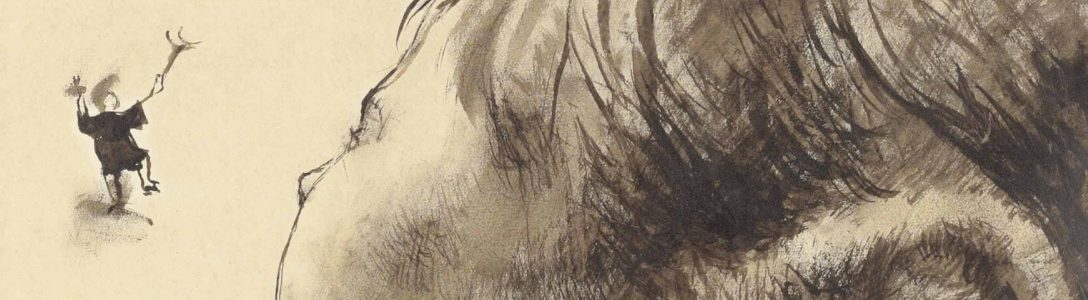
Kintaro Sakazuki with a Yama-uba, 18th century by Kitagawa Utamaro (c.1753-1806)
I enjoyed Season 3 of True Detective, and thought the season finale, which aired last night on HBO, was especially good. Like the season as a whole, this eighth episode, “Now Am Found,” was rich, sad, ironic, often menacingly sinister, and ultimately ambiguous. “Now Am Found” showed that, like the two seasons that preceded it, True Detective’s third season was ultimately not about the criminal investigation purportedly at its center. Rather, True Detective is about the people who investigate the crimes, and how the investigations impact their relationships.
Three relationships drive the third season of True Detective: the relationship between Detective Wayne Hays (Mahershala Ali) and his partner Detective Roland West (Stephen Dorff); the relationship between Hays and his girlfriend and then wife Amelia Reardon (Carmen Ejogo); and the strange relationship between iterations of Hays himself, primarily versions of himself from 1980, 1990, and 2015. Like Season 1 of True Detective, Season 3 employs multiple timelines, often to a purposefully confounding effect.
Looping timelines are part of True Detective’s DNA. In Season 1, Rustin Cohle (Matthew McConaughey) proclaims that “time is a flat circle,” paraphrasing Nietzsche’s idea of eternal recurrence. Our souls will infinitely repeat everything we have ever done or will do. Season 3 dramatizes Cohle’s proclamation via its viewpoint character, Wayne Hays, who is, to borrow a phrase of Kurt Vonnegut’s “unstuck in time.” Hays is in the early stages of a creeping dementia in the 2015 timeline, and throughout the series his consciousness veers between the years.
In 1980, Hays and West begin investigating the murder of Will Purcell and the kidnapping of his sister, Julie Purcell. Hays also meets his future wife Amelia in this investigation. In 1990, a second investigation into the Purcell case is under way; Hays and West attempt to right some of the wrongs that went down in the 1980 case. In 2015, Hays and West initiate a third Purcell investigation (not letting the fact that they are no longer police officers stand in their way). True Detective Season 3 unspools, tangles, and ties these threads into a bewildering and often thrilling tapestry, ultimately depicting a man whose mind is falling apart.
Like the episodes before it, “Now Am Found” dips freely from timeline to timeline. However, this final episode is bookended by two scenes that deviate from the main 1980-1990-2015 plotlines. The opening scene seems to be set a few years after 1990—perhaps in ’94 or ’95. Amelia is teaching English at the University of Arkansas, where Hays is now the head of campus security. In an idyllic moment that restages their initial meeting in 1980, Hays sticks his head into Amelia’s classroom to hear her read a bit of Delmore Schwartz’s poem “Calmly We Walk through This April’s Day.” This moment is the only glimpse we get of this timeline, a timeline that Amelia and Hays promise to create for themselves roughly half way through “Now Am Found.” In a scene that caps the end, or an end (there are no tidy ends in True Detective) to the 1990 timeline, Amelia and Hays agree that their relationship has been inextricably bound up in the Purcell case; their partnership’s genesis was rooted in murder and mystery. They elect to start anew, to write their own conclusion. The episode’s beginning delivers this conclusion, an ironic inversion that represents the season’s approach to linear time.
The second scene that deviates from the 1980-1990-2015 plotlines is the very last shot, which I will come to momentarily. First though, let me address the third-to-last and second-to-last scenes (which, after all, is what this blog’s title promised).
The season’s third-to-last scene comes after Hays follows one last lead as to where Julie Purcell might be. The lead comes from a vision of Amelia (prompted by reading a snippet of the true crime book she wrote about the case, which Hays has never fully read). The vision is a phantom, a ghost emanating from his own consciousness, and it directs him to write another conclusion in the Purcell case—a happy ending with a family restored. However, when Hays finally makes it to the woman whom he believes is Julie Purcell, his dementia undoes him. He calls his son, who arrives along with Hays’ daughter, to bring the old man home. Hays hands over the last clue to the Purcell case—the address he drove to—to his son, who is also a detective. The loop remains open.
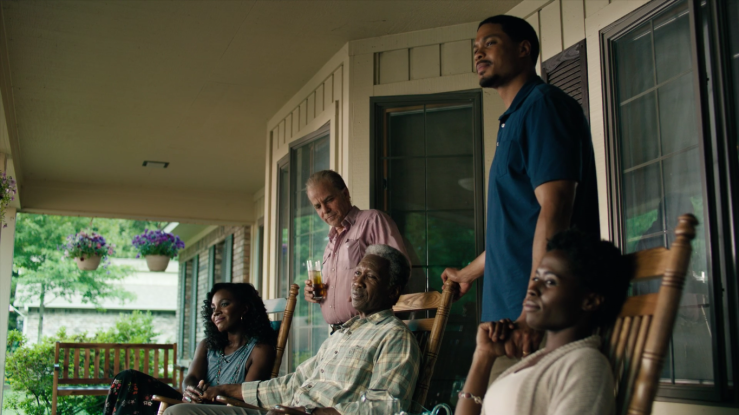
Hays and his grown children return to Hays’ son’s house. This third-to-last scene plays out as a glowing, bright fantasy of familial reconciliation, extending that reconciliation to Hays’ once-estranged partner West. The family (including West) gaze on their children from the porch, iced teas in hand, rocking softly, their hands touching. It’s almost too godddamn corny for words.
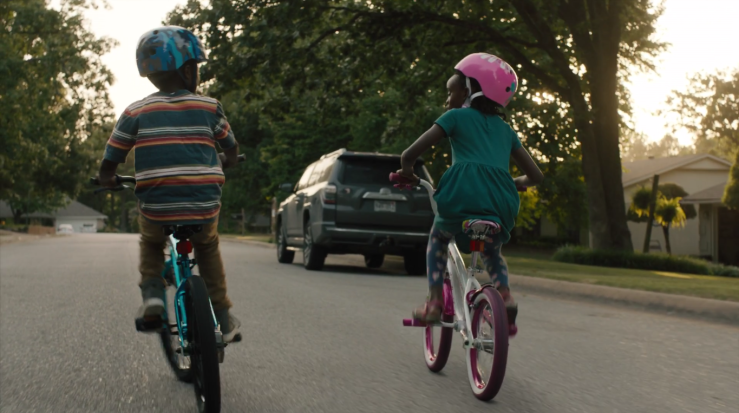
The scene swells with menace though. The sun promises to set, and we pan to a shot of Hays’ grandchildren, boy and girl on bikes. The shot echoes the first episode’s shots of Will and Julie Purcell riding their bikes into the night, into peril. Hays will never get outside of the circle in which his consciousness is circumscribed.
Through Hays’ consciousness we depart the scene entirely. In a fantastic shot, we see Hays’ face submerge into time. Mahershala Ali is excellent in True Detective Season 3, and his eyes are especially expressive, signalling shifts in consciousness, in realization and unrealization.
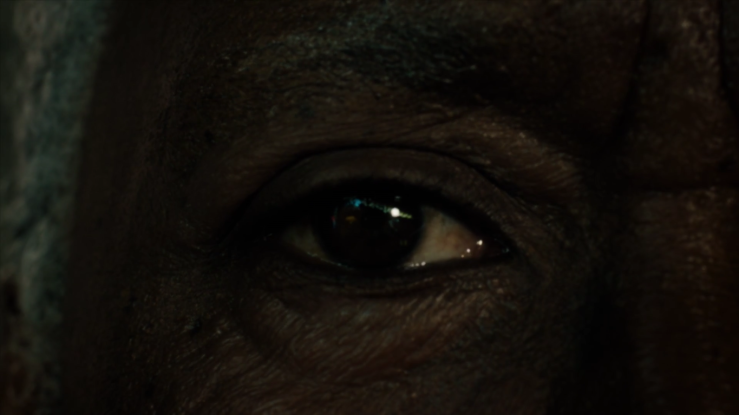
The third-to-last scene transitions to the second-to-last scene through Hays’ eyeball. We end up at the VFW bar, all the way back in 1980, to reconcile with the person missing from the family reunion depicted in 2015: Amelia.
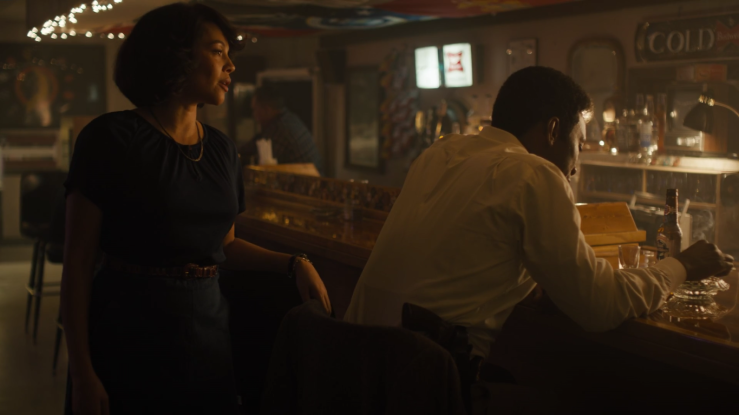
Amelia, like West, was both partner and rival to Hays. Their partnership seemed doomed after the fallout of the 1980 investigation. Amelia, also a true detective, authors an article that damns Hays’ career. This point of resentment boils throughout the season, particularly during the 1990 strands; resentment and competition are seeded into their partnership. And yet when Amelia arrives at the VFW bar, searching for a resolution, a conclusion if not a reconciliation, she opens something new in Hays, who cries before her and then asks her to marry him. The two exit into a glowing light, off to repeat their parts in a circle to which the viewers have already borne witness. This scene too is coded in subtle irony. Their new beginning will not set them free from the arc of their circle.
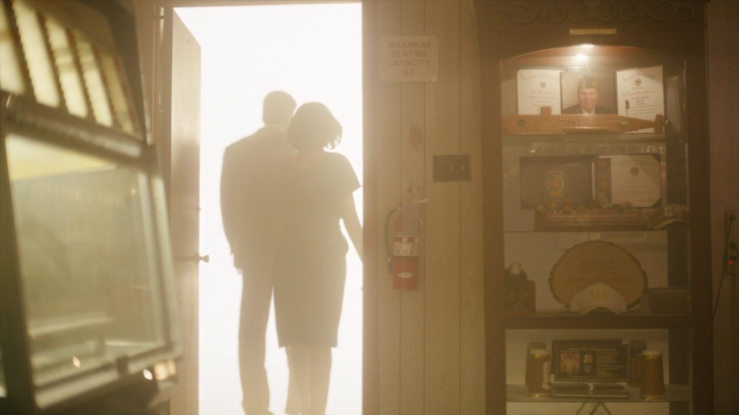
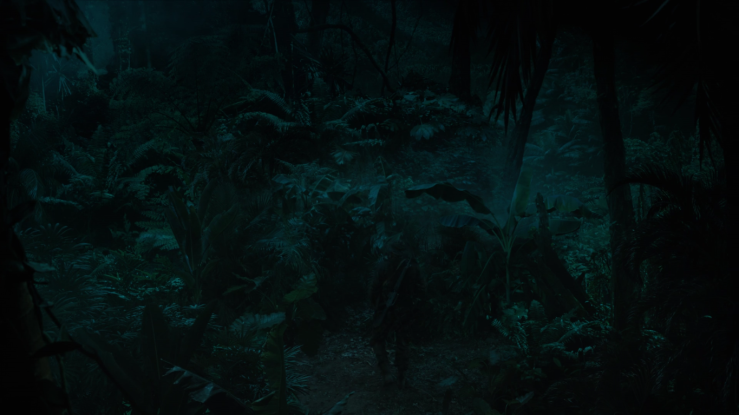
The light resolves into darkness, and we find ourselves some place utterly new yet wholly recognizable. Amelia is gone; the family is gone. This scene is Hays alone, somewhere in the jungles of Vietnam. It’s likely some time around 1965. Hays turns and looks directly toward the camera, but also, perhaps, directly at some version of himself, some version from 1980, 1990, 2015. He seems to gaze forward at the eye that gazed backward at him from half a century in the future.
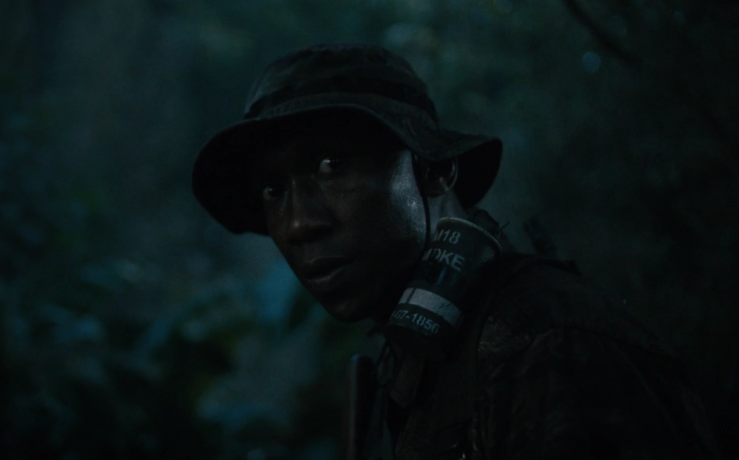
Wayne Hays then turns and walks into the enveloping jungle. He disappears. Season 3 of True Detective is over.
The moment that Hays disappears into a Vietnamese jungle is ambiguous, sure. But given True Detective’s formal thesis that “time is a flat circle,” we can also read this ending as a suggestion that Hays is bound to repeat his arc. The Vietnam War is in many ways the founding unaddressed trauma of Hays’ life, and the series in a bleakly ironic gesture puts him right back there at the ending.
The title of “Now Am Found” clearly alludes to “Amazing Grace,” but the episode’s events ironically show that Hays can never be found. True, there are momentary gestures of reconciliation, of “being found” — by his son and daughter, by Amelia, by his partner West — but Hays is a consciousness in fragments, a kind of damned loop of a person suffering through a purgatory he doesn’t fully have the language to describe, let alone communicate to another person.
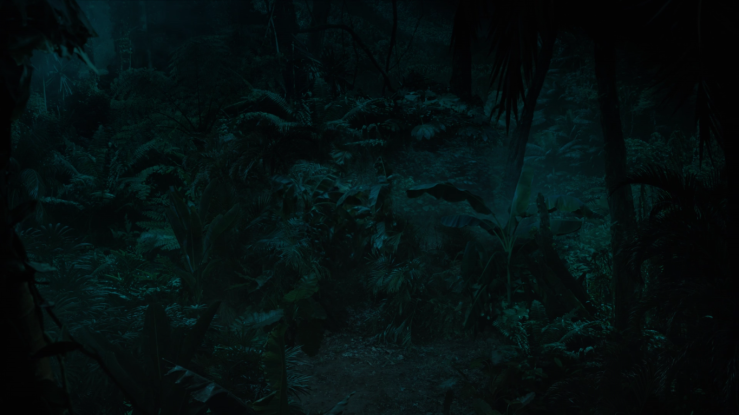
Some viewers may have found the final shot of “Now Am Found” bewildering, inexplicable, or unnecessary. I thought it was a sad, rich image that provided a vital coda for a sad, rich television show. The final image serves to reinforce the series’ trope of eternal recurrence, undoing (or, more charitably simply complicating) the episode’s opening scene, in which we saw a peaceful, happy Hays and Amelia. But if the final scene in Vietnam undoes the domestic bliss that Hays and Amelia authored for themselves, it also points to the promise of futurity, of a future that goes on and on and on.

Wheeled Through to Kind Measure, 2018 by Lynette Yiadom-Boakye (b. 1977)
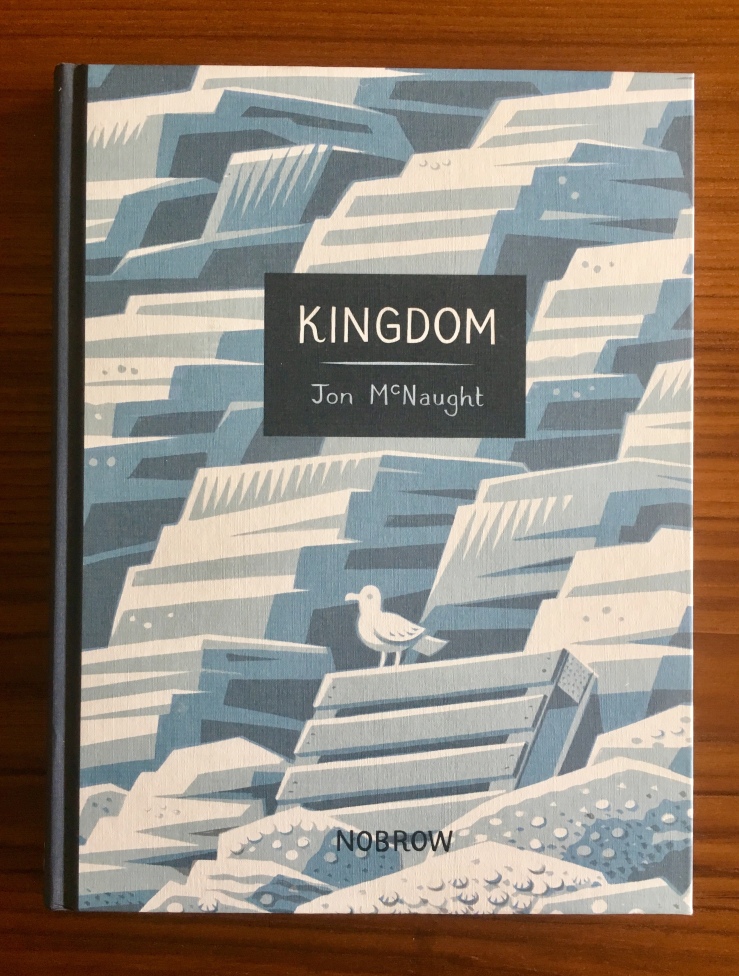
I got a physical copy of Jon McNaught’s latest graphic novel Kingdom last week. Here is publisher Nobrow’s blurb for the book, which will serve as a rough plot summary:
A family sets off for a long weekend at a caravan park on the British coast. We follow them through the familiar landscapes of a summer holiday: motorway service stations, windswept cliffs, dilapidated museums and tourist giftshops. In this atmospheric and contemplative work, Jon McNaught explores the rhythms of nature, the passing of time, and the beauty and boredom of a summer holiday.
A few weeks ago, I’d been sent a digital reader’s copy of Kingdom to review for The Comics Journal, so I’d already read it, but getting a physical copy was like reading it anew. Nobrow’s books are, in general, lovely. They look lovely, are large and colorful and printed on rich thick paper. They smell great too.
Reading Kingdom in print was a much more pleasurable aesthetic experience than reading it on an iPad. The story was the same, of course, but my eyes went across it differently, working with my fingers, lingering, moving backwards and forwards, shuffling pages. The feeling of the story came across stronger, somehow, than it did on a screen–McNaught’s themes of boredom, nature, and our ways of seeing nature resonated more when I could rub my hands on the pages themselves. I do not have a simple explanation for this. There’s an intangibility I’m pointing toward, but one that has to do with tangibility of course: reading as a tactile process.
I’m not a Luddite. I like ebooks, and I generally like to have an ebook of any novel that I’m reading so that I can read it late at night. (Digital copies also make quoting at length for reviews much easier). But I find that screens dampen or mute or hinder something of the aesthetic experience in reading highly-visual narratives, like comics and poetry.
That last phrase, “comics and poetry”—I think that that’s what McNaught does by the way. His comics are visual poems, moods, feelings, evocations of time and space bounded not in words but in sounds, not in symbols and signs but in the objects themselves. The feeling of feeling of his comics is hard to pin down: tranquil and soothing with tinges of melancholy, gentle touches of pleasant boredom, waves of recognition: recognition of spirit, of impulse, of fellow feeling: etc. We see his characters seeing the world, being in the world, and seeing themselves seeing and being in the world. And we also see them mediating that world—on screens.
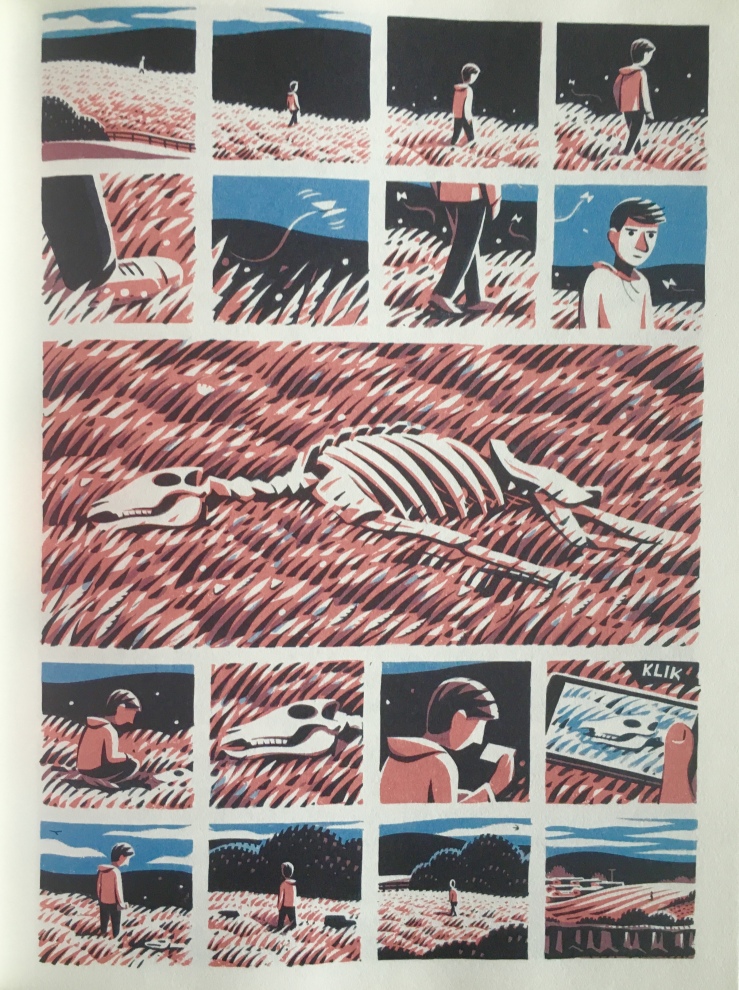 I liked Kingdom the first time I read it on a screen. I loved it the second time I read it on paper. Full review soon at The Comics Journal.
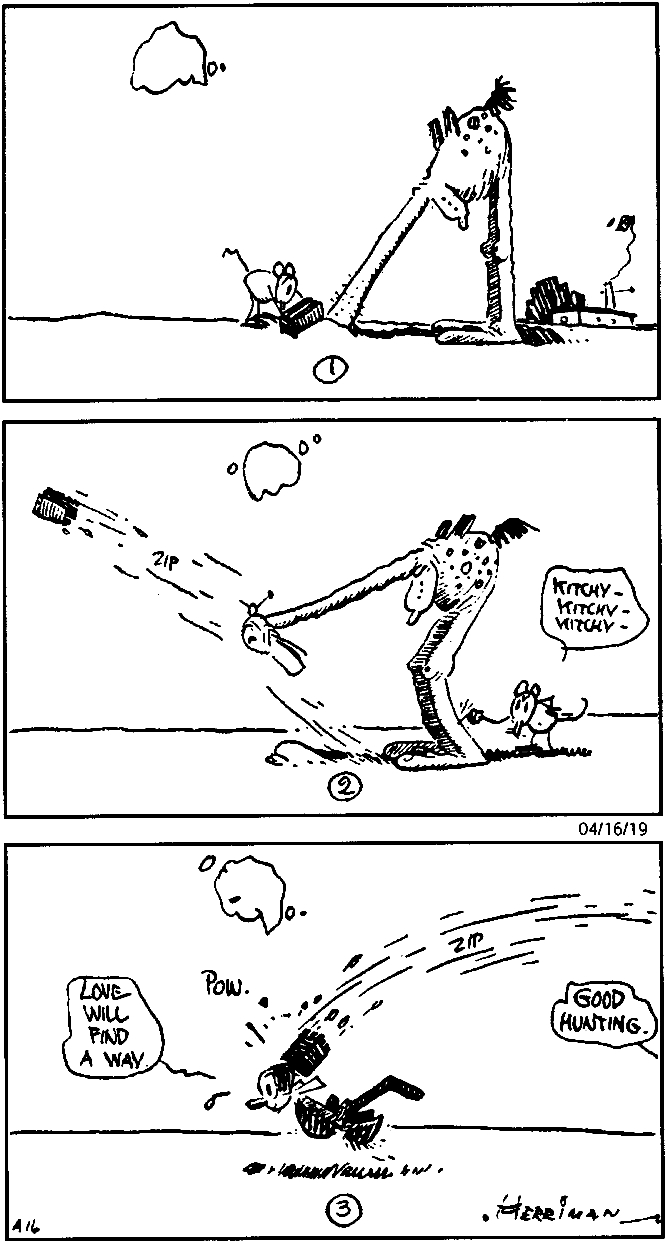

School of Beauty, School of Culture, 2012 by Kerry James Marshall (b. 1955)

Twins, 2011 by Falk Gernergross (b. 1973)
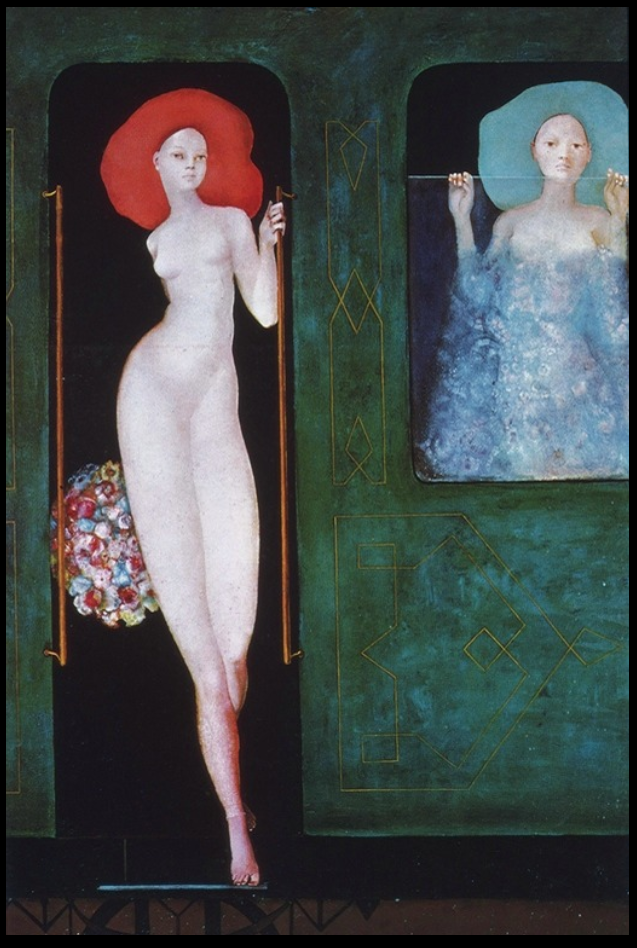
Vesper-Express, 1966 by Leonor Fini (1908-1996)

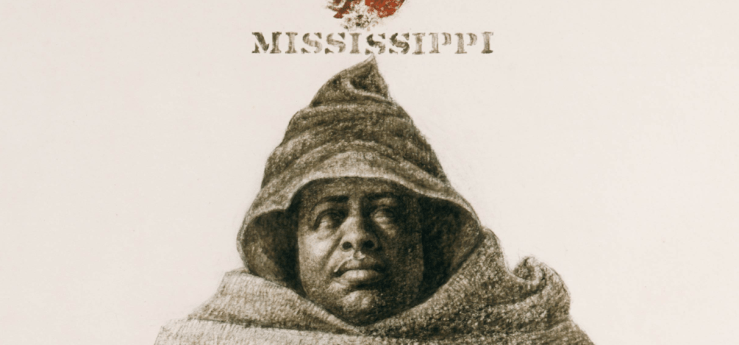
Mississippi, 1972 by Charles White (1918-1979)
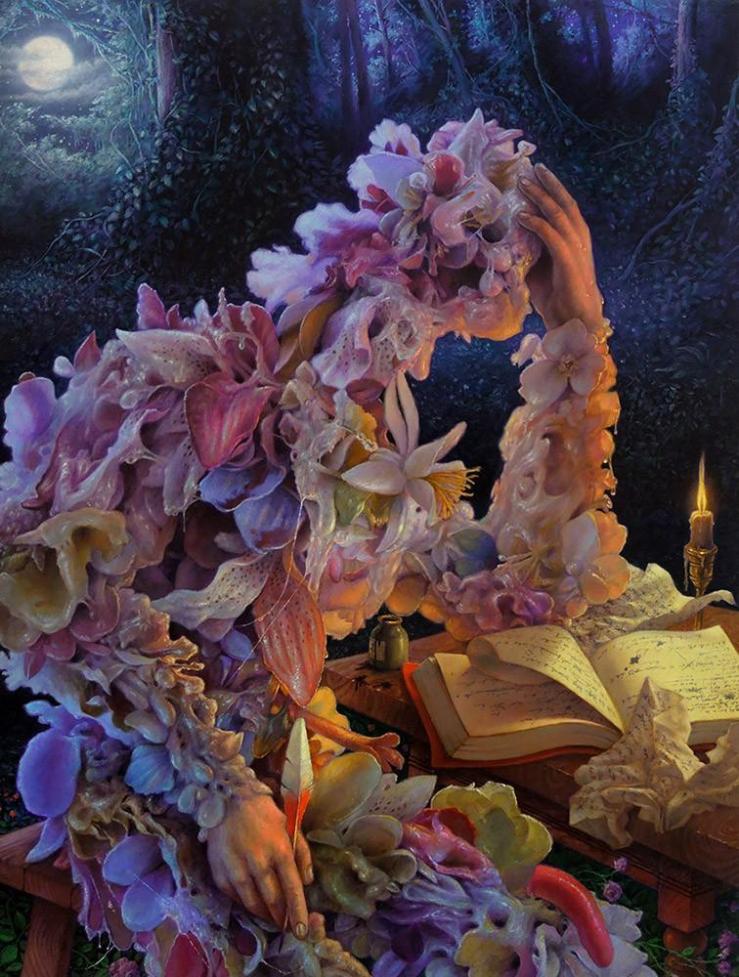
Big Dreamer with Failed Poetry by Adrian Cox (b. 1988)
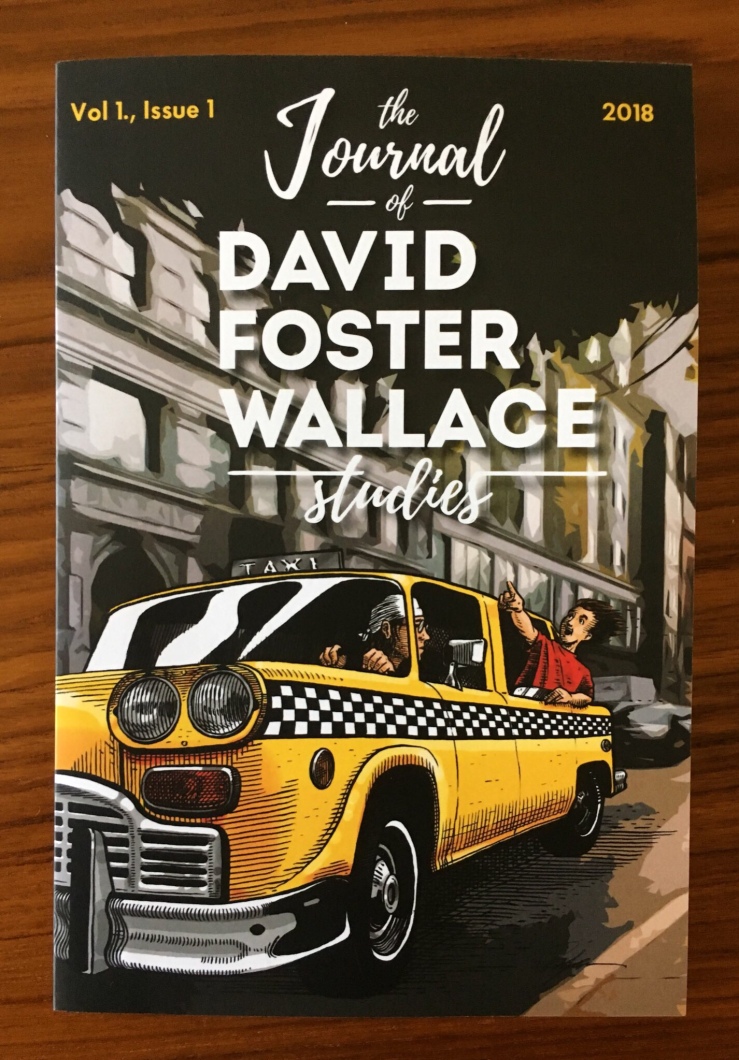
The Journal of David Foster Wallace Studies is a peer-reviewed academic journal devoted to the work of David Foster Wallace. The Journal is published by the DFW Society.
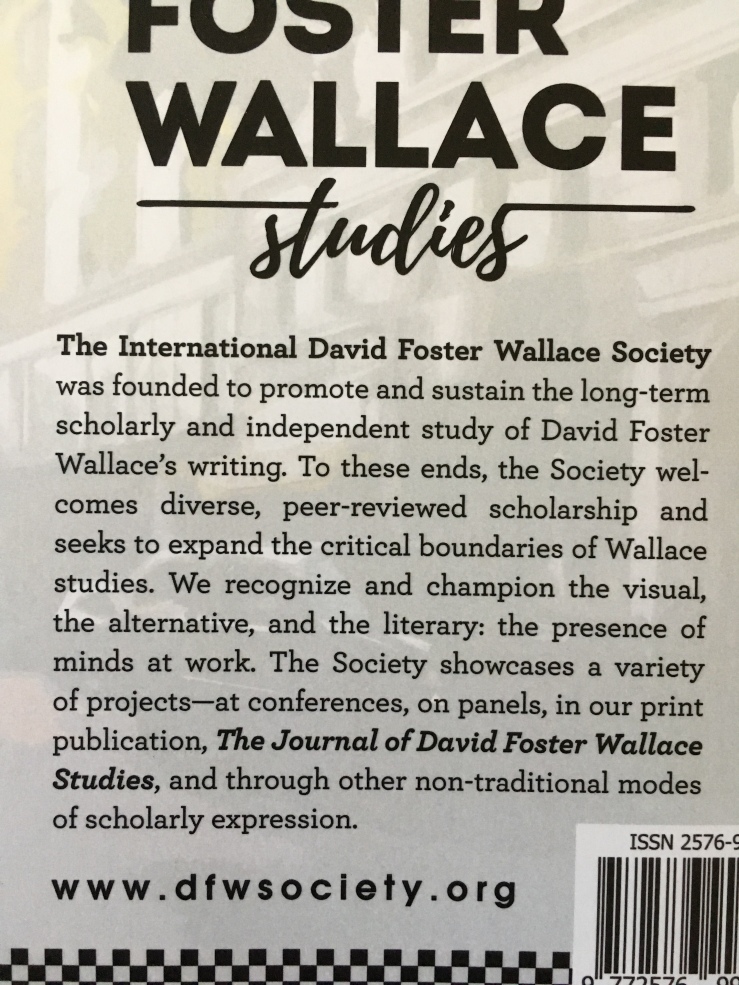
Here is the table of contents for Vol. 1, issue 1;

I enjoyed Nash’s essay on boredom and attention in The Pale King, and found Saylor’s piece on race in Wallace’s fiction—focusing on Wallace’s whiteness within the context of his overall project of literary empathy–especially interesting.
I’m glad to see the journal finally in print after a few years of chatter about its creation. Perhaps there might be a future article or two that takes on the current wave of anti-Wallace think pieces that have been floating around lately.

Aeschylus and Socrates, 1975 by Eduardo Paolozzi (1924–2005)

Origin of the Brunists is Robert Coover’s first novel. First published in 1966, this long novel tells the story of an apocalyptic religious cult that forms around the sole survivor of a mining accident. The novel begins with the Brunists prepping for the upcoming end of the world (doomsday is scheduled for the weekend). After this somewhat bewildering prologue, the novel shifts back a few months in time, to lay out the cult’s genesis, a fatal mining accident.
Origin of the Brunist’s early chapters are an engrossing and unexpectedly smooth launch into a 500+ page novel. I read the first 70 pages in one night, rapt in the weird world of West Condon, the fictional midwesternish mining town where the Brunist cult originates. I woke up the next morning and continued to read in bed. I was, and am, enthusiastic.
The second chapter of Origin of the Brunists is especially enthralling. Propulsive and engaging, the chapter zooms through the various consciousnesses of West Condon on the night of the novel’s originating disaster, the horrific mining collapse that imperils hundreds of miners. Coover inhabits the voices and minds of his characters with an easy if often grimy grace here. Evocation of consciousness has marked much of Coover’s work, from the early short story “The Brother” (1962) to his recent novel Huck Out West (2017). The man can throw his voice around. Origin of the Brunists overflows with voices. In small snatches of dialog and free-indirect speech, we get an aural and vivid picture of the miners, their children and spouses, as well as the other residents of West Condon.
The mining disaster chapter shuttles along with a filmic quality. Coover intercuts scenes of the miners escaping (or failing to escape) with a highschool basketball game, teenage lust in a parked car, and other odds and ends of West Condon life. The chapter builds in tension, reminding one of the climax of an epic movie, but one wedged unexpectedly at the narrative’s outset.
Indeed, Coover’s contest with film is something of a trademark. A signal example of this style can be found in the stories in his 1987 collection A Night at the Movies, or You Must Remember This. Stories like “The Phantom of the Movie Palace” and “Lap Dissolves” wrestle with film as a medium, deconstructing author and text, filmmakers and audiences, film reels and book pages. In the Night stories (and elsewhere, always elsewhere), Coover employs a host of metatextual techniques, dissolving one narrative into another, overlapping archetypes and synthesizing tropes, blending fables and history and commercial culture into a critique of American Pop mythology.
Coover’s metafiction always points back at its own origin, its own creation, a move that can at times take on a winking tone, a nudging elbow to the reader’s metaphorical ribs—Hey bub, see what I’m doing here? Coover’s metafictional techniques often lead him and his reader into cartoon landscapes, where postmodernly-plastic characters bounce manically off realistic contours. The best of Coover’s metafictions (like “The Babysitter,” 1969) tease their postmodern plastic into a synthesis of character, plot, and theme. However, in large doses Coover’s metafictions can tax the reader’s patience and will—the simplest example that comes to mind is “The Hat Act” (from Pricksongs & Descants, 1969), a seemingly-interminable Möbius loop that riffs on performance, trickery, and imagination. (And horniness).
I’m dwelling on Coover’s metafictional myth-making because I think of it as his calling card. And yet Origin of the Brunists bears only the faintest traces of Coover’s trademark metafictionalist moves (mostly, so far anyway, by way of its erstwhile hero, the journalist Tiger Miller). Coover’s debut reads rather as a work of highly-detailed, highly-descriptive realism, a realism that pushes its satirical edges up against the absurdity of modern American life. It reminds me very much of William Gass’s first novel Omensetter’s Luck (1966) and John Barth’s first two novels, The Floating Opera (1956) and The End of the Road (1958). (Barth heavily revised both of the novels in 1967). There’s a post-Faulknerian style here, something that can’t rightly be described as modern or postmodern. These novels distort reality without rupturing it in the way that the authors’ later works do. Later works like Barth’s Chimera (1973), Gass’s The Tunnel (1995), and Coover’s The Public Burning (1977) dismantle genre structures and tropes and rebuild them in new forms. (I might contrast here with the first novels of William Gaddis (The Recognitions, 1955), Thomas Pynchon (V., 1963), and Ishmael Reed (The Freelance Pallbearers, 1967), all of which employ postmodern and metafictional techniques right out of the gate—but that’s perhaps appropriate material for another riff).
While Origin of the Brunists doesn’t tip into Coover’s metatextual mode, it points towards his mythic style, but in a subtle, restrained way, as in this description of the moments preceding a high-school basketball game:
A ritual buzzer alerts the young athletes on the West Condon court and strikes a blurred roar from the two confronting masses of spectators. In a body, all stand. The mute patterns of run-pass-leap-thrust dissolve, congealing into two tight knots on either extremity of the court, each governed by a taut-faced dark-suited hierarch. Six young novices in black, breasts ablaze with the mark of their confession, discipline the brute roars into pulsing chants with soft loops of arm and skirt, while, at their backs, five acolytes of the invading persuasion pressed immodestly into sleek diabolic red, rattle talismans with red and white paper tails, seeking to neutralize the efficacy of the West Condon locomotive. Young peddlers circulate, selling condiments indiscriminately to all. A light oil of warm-up perspiration anoints the shoulders of the ten athletes chosen as they explode out of their respective rings to confront each other. Some of them cross themselves, some clap and cry oaths, others tweak their genitals.
These mythical touches are rare in the first section of Origin of the Brunists though. Instead, Coover seems to tease out the West Condoners’ building of their own mythology, one cobbled from the apocalyptic strands of rural American Christianity, a religion divined through signs and wonders.
Such signs have much of their origin in Ely Collins, a miner-cum-preacher who meets his fate in the disaster. In a shocking scene that plays out with frank realism, Collins loses his leg:
“It’s okay, boys,” Collins whispered up at them. “I kin take it.” And he took to praying again.
Strelchuk lifted the ax in the air and thought: Jesus! what if I miss, I’ve never swung a goddamn ax much, what if I hit the wrong leg, or—?
“Goddamn you, Mike!” Jinx screamed, losing control. “Quit messing around! This gas is knocking me out, man! We got to get us out of here!”
And while he was screaming away like that, Strelchuk came down with the ax, caught the leg right where he aimed, true and clean, just below the knee, and the blood flew everywhere, and Juliano was crying like a goddamn baby, and Bruno, his face blood-sprayed, went dumb, mouth agape, and broke away in a silent fit, but the leg was still hooked on, they couldn’t get him free. Preach was still praying to beat hell and never even whimpered. Mike raised the ax again and drove down with all the goddamn strength he had, felt the bone this time, heard the crack, felt the sickening braking of the ax in tough tissue, and he turned and vomited. He was gagging and hacking and crying and the blood was everywhere, and still that goddamn leg was hooked on. Mario ripped away Collins’ pant leg, took the wedge he had in his pocket, pressed it up against Collins’ thigh. Strelchuk whipped off his leather belt and, using it as a tourniquet against the wedge, they stopped the heavy bleeding. Pontormo whined Italian. Strelchuk grabbed up the ax once more. His hands were greasy with blood and it was wet on his chest and face. He was afraid of missing or losing hold, and the shakes were rattling him, so he took short hacking strokes, and at last it broke off. They dragged him free. And Preacher Collins, that game old sonuvabitch, he was still praying.
I’ve quoted at such length to give a sense of Coover’s meticulousness in Origin of the Brunists. The novel is thick with life, thick with voices, mimetic detail, shapes, smells, colors, sounds. West Condon feels utterly real, making the novel’s dramatic absurdities all the more pronounced. The characters tell stories, weep and pray, bury their desires. Coover’s command of character isn’t absolute, but if his West Condoners sometimes teeter on the edge of grotesquerie they are nevertheless real, or as real as words on a page can be. More to come.

In Mid-world, 2017 by Jesse Mockrin (b. 1981)

Encounter (detail), 1959 by Remedios Varo (1908-1963)

 Biblioklept