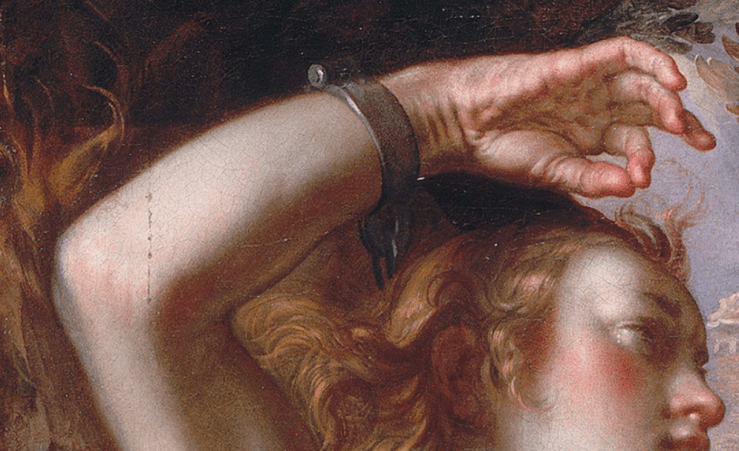
Perseus and Andromeda (detail) — Joachim Wtewael

screenshot-2017-01-07-at-5-16-10-pm

“The Hyena,” an ecstatic abject fable by Paul Bowles

“The Hyena”

by
Paul Bowles


A stork was passing over desert country on his way north. He was thirsty, and he began to look for water. When he came to the mountains of Khang el Ghar, he saw a pool at the bottom of a ravine. He flew down between the rocks and lighted at the edge of the water. Then he walked in and drank.

At that moment a hyena limped up and, seeing the stork standing in the water, said: “Have you come a long way?” The stork had never seen a hyena before. “So this is what a hyena is like,” he thought. And he stood looking at the hyena because he had been told that if the hyena can put a little of his urine on someone, that one will have to walk after the hyena to whatever place the hyena wants him to go.

“It will be summer soon,” said the stork. “I am on my way north.” At the same time, he walked further out into the pool, so as not to be so near the hyena. The water here was deeper, and he almost lost his balance and had to flap his wings to keep upright. The hyena walked to the other side of the pool and looked at him from there.

“I know what is in your head,” said the hyena. “You believe the story about me. You think I have that power? Perhaps long ago hyenas were like that. But now they are the same as everyone else. I could wet you from here with my urine if I wanted to. But what for? If you want to be unfriendly, go to the middle of the pool and stay there.”

The stork looked around at the pool and saw that there was no spot in it where he could stand and be out of reach of the hyena.

“I have finished drinking,” said the stork. He spread his wings and flapped out of the pool. At the edge he ran quickly ahead and rose into the air. He circled above the pool, looking down at the hyena.

“So you are the one they call the ogre,” he said. “The world is full of strange things.” Continue reading ““The Hyena,” an ecstatic abject fable by Paul Bowles”

The Studio Wall — Adolph von Menzel

015-adolph-von-menzel-theredlist

Some books I’ll try to read in 2017 (Presented by The Good Intentions Paving Company)

img_4855

I’m in the middle of Paul Bowles’s stories right now, and loving the weird sinister menace of it all. I’ll probably take a crack at some of his novels this year too (The Sheltering Sky next? I’ll need to pick them up).

Senges’s The Major Refutation is also on deck.

Not pictured, because it’s not out yet, is Leonora Carrington’s The Complete Stories (forthcoming in the spring from Dorothy); I’m really looking forward to this one. The NYRB is also publishing Carrington’s memoir Down Below, which looks really cool. I’ve only read the collection The Oval Lady (and that through samizdat means), so I’m happy to see Carrington’s words in print.

The Expedition of Dr. Ramsbottom, Leonora Carrington, 1961

Also not pictured because its forthcoming (from Two Lines Press) is Atlantic Hotel by João Gilberto Noll (translated by Adam Morris). I’m anxious to read more from Noll after digging his novella Quiet Creature on the Corner.

Back to the stack in the picture: I loved Ishmael Reed’s Mumbo Jumbo and The Freelance Pallbearers (which strikes me as a really under-remarked upon novel), and I plan on getting to Yellow Back Radio Broke-Down at some point this year.

I’ve had a few false starts with Arno Schmidt’s The Egghead Republic, but maybe I can knock it out in a weekend.

I’ve taken multiple cracks at the novels by Gray, Murdoch, and Hawkes in the stack…so we’ll see.

I read Leon Forrest’s There Is a Tree More Ancient Than Eden in a blur; I’d like to reread it and the other Forrest novel I picked up last month, Two Wings to Veil My Face.

I’ve read enough Pynchon now to make a better effort with Vineland…but again, we’ll see (I’m actually kind of jonesing to reread Against the Day).

(And oh I didn’t make a list like this in 2016, but I was 4 for 8 in the one I did in 2015).

Good intentions.

Paul Bowles describes a Moroccan trance dance of self-mutilation

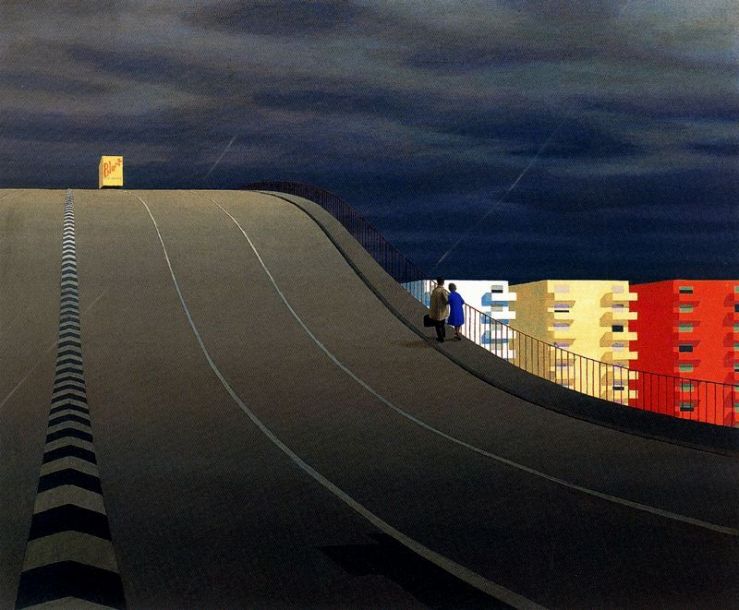
Approach to a City III — Jeffrey Smart

approach-to-a-city-iii

PK Dick’s Martian Time-Slip/Kafka regret (Books acquired and not acquired, 12.28.2016)

Two bucks.

Cover art by Darrell Sweet.

Here’s my riff on Philip K. Dick’s Martian Time-Slip.

I regret not picking up this edition of Kafka’s Amerika that same day:

img_4639

I reviewed Schocken’s latest translation of Amerika (not the one above) on Biblioklept like over eight years ago. I still have the black hardback, but I’d maybe exchange it for this beauty.

P.S. — Lotta Hannerz

p-s

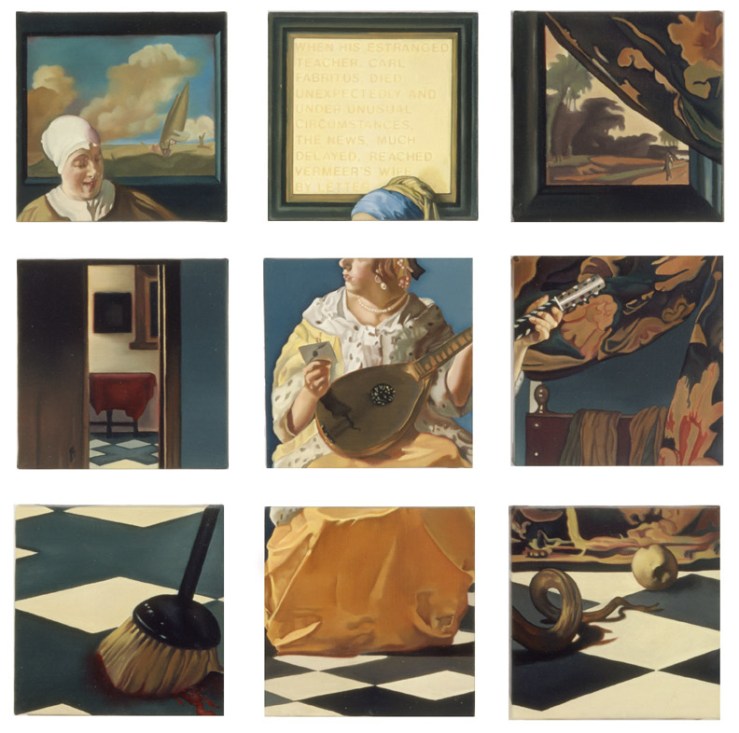
Vermeer’s Wife — Dotty Attie

368-991

The mind is a thing absolutely apart (Paul Bowles)

The only way to do anything is to have it so well rehearsed in one’s imagination that when the moment comes one does it automatically, as though for the hundredth time. Then it is all natural, and there is little likelihood of a slip-up. And there was no slip-up anywhere along the way. It was a heavy day, but not too hot because of the rain, which fell quietly as I walked down the road to the station. On the train I was not in the slightest degree perturbed: I knew there was no chance of any trouble. I kept marveling at the peculiar pleasure afforded by the knowledge that one has planned a thing so perfectly there can be no room for the possibility of failure, all the while being conscious that both the pleasure and the idea itself were completely childish, and that my conviction of success was, at the very least, ill-founded. But certain situations call forth certain emotions, and the mind is a thing entirely apart. I have cakes of soap that I bought twenty-five years ago, still in their wrappers, and I am saving them in the perfect confidence that the right day will come to unwrap each one and use it. And there are probably a hundred books downstairs in the library that I am eager to read, have been eager to read for years, yet refuse to read until the day comes, the day that says to me: This is the morning to start Villiers de L’Isle-Adam, or George Borrow, or Psichari, or someone else. Now, in my logical mind, I know quite well that these promised days are not likely ever to arrive: I shall never use those old cakes of soap that are stored in the linen closet, and I am reasonably sure of never reading Romany Rye, because it doesn’t interest me. But there is that other person, the ideal one that I ought to be, whom it does interest, and it comforts me to think that those things are there waiting for him. Certainly, the mind is a thing absolutely apart.

From Paul Bowles’s 1954 story “If I Should Open My Mouth.”

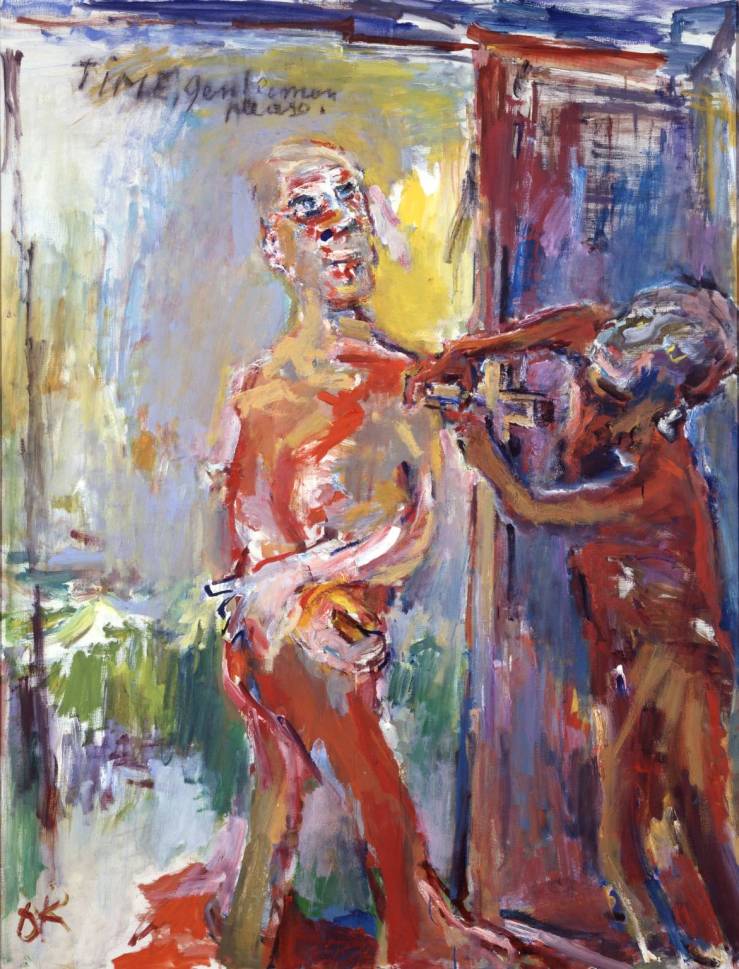
Time, Gentlemen Please — Oskar Kokoschka

Time, Gentlemen Please 1971-2 Oskar Kokoschka 1886-1980 Purchased 1986 http://www.tate.org.uk/art/work/T04876

Illuminated Shadows — Chronis Botsoglou

assets_large_t_420_53463739

Drugs won’t change you / Religion won’t change you

“Doña Faustina” — Paul Bowles

“Doña Faustina”

by

Paul Bowles


NO ONE COULD UNDERSTAND why Doña Faustina had bought the inn. It stood on one of the hairpin curves in the old highway leading up from the river valley to the

town, but the route had been made useless by the building of the new paved road. Now it was impossible to reach the inn except by climbing up a stony path over the embankment and walking several hundred feet down the old road which, no longer kept in repair, already was being washed away by the rains and strangled by the shiny vegetation of that lowland region.

On Sundays the people used to walk out from the town, the women carrying parasols and the men guitars (for this was before the days of the radio, when almost everyone knew how to make a little music); they would get as far as the great breadfruit tree and look up the road at the faded façade of the building, more than half hidden by young bamboo and banana plants, stare a few seconds, and turn around to go back. “Why does she leave the sign up?” they would say. “Does she think anyone would ever spend the night there now?” And they were quite right: no one went near the inn anymore. Only the people of the town knew that it existed, and they had no need of it.

There remained the mystery of why she had bought it. As usual when there is something townspeople cannot understand, they invented a whole series of unpleasant explanations for Doña Faustina’s behavior. The earliest and most common one, which was that she had decided to transform the place into a house of ill-repute, soon fell to pieces, for there was absolutely nothing to substantiate such a theory. No one had been seen to go near the inn for weeks, except Doña Faustina’s younger sister Carlota who arrived from Jalapa, and the old servants José and Elena, who went to market each morning and minded their business strictly enough to satisfy even the most vicious gossips. As for Carlota, she appeared occasionally at Mass, dressed in black. It was said that she had taken their father’s death very much to heart, and would probably not remove the mourning, ever.

The other suppositions evolved by the people of the town in their effort to bring light to the mystery proved as unlikely as the first. It was rumored that Doña Faustina was giving asylum to Chato Morales, a bandit whom the police of the region had been trying for months to capture, but he was caught soon afterward in a distant part of the province. Then it was said that the inn was a depository for a drug ring; this also proved to be false. The leaders of the ring, having been arrested, divulged their secrets, and the cache proved to be in a room above the Farmácia Ideal. There were darker hints to the effect that Carlota might be luring lone voyagers to the inn, where they met the fate that traditionally befalls such solitary visitors to lonely inns. But people did not take such suggestions seriously. The opinion grew that Doña Faustina had merely gone a little mad, and that her madness, having taken an antisocial turn, had induced her to retire to the outskirts of town where she could live without ever seeing anyone. To be sure, this theory was contested by certain younger members of the community who claimed that she was no more crazy than they, that on the contrary she was extremely crafty. They said that having a great deal of money she had bought the inn because of the ample lands which surrounded it, and that there in the privacy of the plant-smothered gardens and orchards she had devised all kinds of clever ways of hiding her riches. The older citizens of the town took no stock in this, however, since they clearly remembered both her husband and her father, neither of whom had evinced any unusual prowess in collecting money. And she had bought the inn for practically nothing. “Where would she have got the pesos?” they said sceptically. “Out of the trees, perhaps?” Continue reading ““Doña Faustina” — Paul Bowles”

John Berger or The Art of Looking

John Berger or The Art of Looking is a documentary biography of the late John Berger. Directed by Cordelia Dvorák and released in November, 2016.

Without publicity capitalism could not survive (John Berger)

img_4840

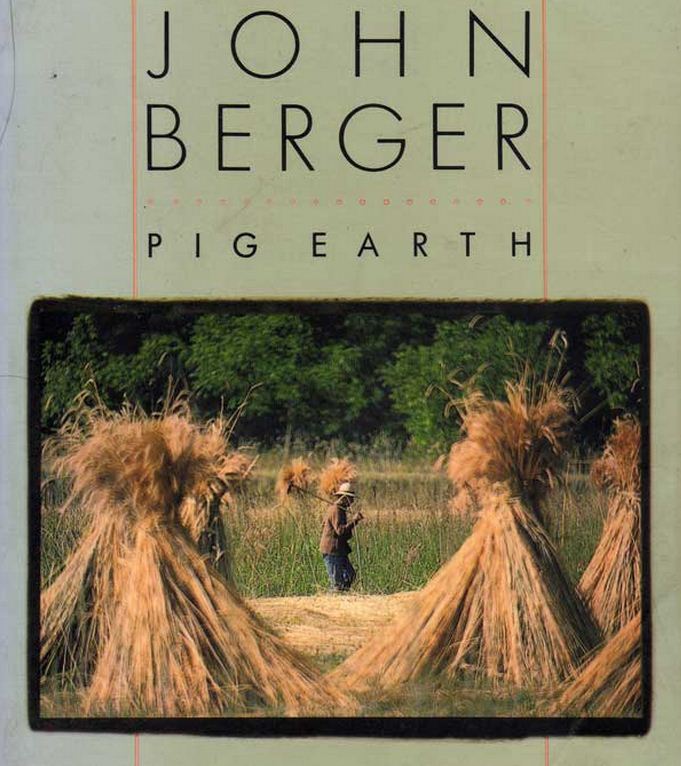
A review of John Berger’s Pig Earth

People exaggerate the changes in nature so as to make nature seem lighter. Nature resists change. If something changes, nature waits to see whether the change can continue, and it it can’t, it crushes it with all its weight!  Ten thousand years ago the trout in the stream would have been exactly the same as today.

Stasis and disruption and the relation between people and their natural and urban surroundings are the themes John Berger writes about in his 1979 collection of essays, poems and short stories, Pig Earth.  Having moved from England, where he enjoyed considerable renown as an art critic and fiction writer, to the peasant villages of the French Alps, Berger settled into his role as an active participant in rural life, not only turning hay but observing and documenting the disappearance of a way of a once-pervasive mode of life.  Pig Earth was one result of his labors, the first book of a trilogy that took some fifteen-odd years to complete, a moving but not uncritical account of humanity’s struggle to conquer nature by symbiosis.

Maybe symbiosis isn’t the proper term if we agree that humanity is part of nature’s whole, but Berger juxtaposes the frailty of humanity with the earth’s uncaring and often violent strength.  Survival for the family of the subsistence farmer depends upon that family’s ability to tend to the needs of the plant and animal world (as well as more than a little bit of luck).  In the collection’s first true story, “A Calf Remembered,” a baby cow is delivered on a dark winter’s night. Here, Berger stresses the protections that nature and man have designed to ensure the survival of a young, vulnerable animal:  mucus, barn, salt, and sense.  The human spends his night in the barn protecting his property because it provides him not only with sustenance in the forms of milk and meat, but also companionship and a sense of duty.  When daily living requires acts that might mean life or death, the conscious and the instinct converge.

He sat on a milking stool in the dark.  With his head in his hands, his breathing was indistinguishable from that of the cows. The stable itself was like the inside of an animal.  Breath, water, cud were entering it:  wind, piss, shit were leaving.

Pig Earth is a book worth studying as people attempt to make sense of a world transitioning from one type of living to another and fuss over the sources of their own limited strength and vitality. Berger may not have been looking to pioneer a slow-living locavore lifestyle, but his subjects worry about their increasing isolation from the circles of power and industry.  They fret over the pointlessness of passing their knowledge to their children who need entirely different skills to survive in the rapidly encroaching urban wage economy.  In “The Value of Money” a father refuses a tractor, branded “The Liberator” by the manufacturer, that his son has purchased for him because it will render his faithful work-horse obsolete.  This same farmer kidnaps local tax officials because they want to confiscate the products of his labor without compensation for value that he exclusively created.  Unable to make them understand their wrongdoing, he sets them free because “you can only take revenge on those who are your own.”

The final story, “The Three Lives of Lucy Cabrol,” is the lengthiest and perhaps most poignant narrative in the book. It follows the life of a bright, tenacious, physically stunted woman as she grows from young girl to town outcast.  While Berger admired much of the life in the peasant village, he would fail in his duty as critic and chronicler if he ignored its darker sides. Berger often sets the title character’s pluck against the resignation and superstition endemic to village life. When life requires struggle, most people choose to hoard.  When poor choices may lead to death or family hardship, capitulation to those in power, whether those rulers be the town’s big man or Nazi collaborators, can often seem the only obvious choice.  Lucy shows us that cowardice, no matter the circumstances, only seems easy. Pig Earth is highly recommended.

[Ed. note—Biblioklept originally published this review of Pig Earth in 2011. We run it again in appreciation of John Berger, who died today at the age of 90].