Gravity’s Rainbow — annotations and illustrations for pages 203-04

Outside, he 1 heads down toward the quay, among funseekers, swooping white birds, an incessant splat of seagull shit 2. As I walk along the Bwa-deboolong 3 with an independent air… Saluting everybody in uniform 4, getting it to a reflex 5, don’t ask for extra trouble, try for invisible 6.… bringing his arm each time a bit more stupidly to his side. Clouds now are coming up fast, out of the sea. No sign of Tantivy out here, either.

Ghosts 7 of fishermen, glassworkers, fur traders, renegade preachers, hilltop patriarchs and valley politicians go avalanching back 8 from Slothrop here, back to 1630 when Governor Winthrop came over to America on the Arbella, flagship of a great Puritan flotilla that year 9 , on which the first American Slothrop had been a mess cook or something 10 —there go that Arbella and its whole fleet, sailing backward  in formation, the wind sucking them east again, the creatures leaning from the margins of the unknown sucking in their cheeks, growing crosseyed with the effort, in to black deep hollows at the mercy of teeth no longer the milky molars of cherubs, as the old ships zoom out of Boston Harbor, back across an Atlantic whose currents and swells go flowing and heaving in reverse 11 … a redemption of every mess cook who ever slipped and fell 12 when the deck made an unexpected move, the night’s stew collecting itself up out of the planks and off the indignant shoes of the more elect 13 , slithering in a fountain back into the pewter kettle as the servant himself staggers upright again and the vomit he slipped on goes gushing back into the mouth that spilled it… 14 Presto change-o! 15 Tyrone Slothrop’s English again! 16  But it doesn’t seem to be redemption exactly that this They have in mind… . 17

He’s on a broad cobbled esplanade, lined with palms shifting now to coarse-grained black as clouds begin to come over the sun. Tantivy isn’t out on the beach, either—nor are any of the girls. Slothrop sits on a low wall, feet swinging, watching the front, slate, muddy purple, advancing from the sea in sheets, in drifts. Around him the air is cooling. He shivers. What are They doing? 18

1 The “he” here is Our Dude Tyrone Slothrop, and if anyone’s keeping count, these annotations pick up right damn exactly where the last set left off. Slothrop exits his (tampered with) room  at the Casino Hermann Goering to find his friend Tantivy Mucker-Maffick.

2 Gravity’s Rainbow is full of shit.

3 Weisenburger offers the following  gloss in A Gravity’s Rainbow Companion:
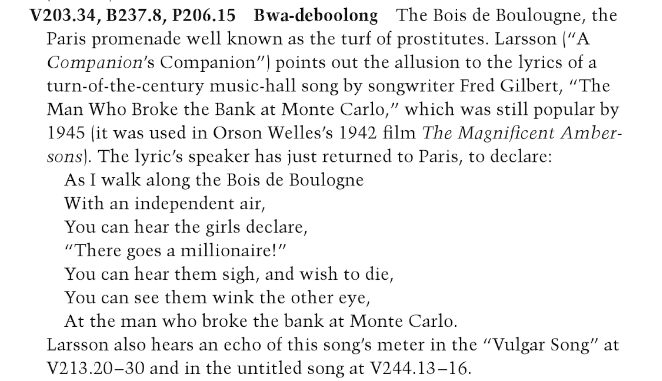
Screenshot 2016-09-22 at 8.23.26 PM.png

Weisenburger’s second “u” in “Boulougne” seems to be an error. (Or make what you will of a double-you).

Van Gogh depicted promenaders on the Bois de Boulongne in 1886, about six decades before the events in GR and about nine decades before Pynchon composed GR.

the-bois-de-boulogne-with-people-walking-1886
The Bois De Boulogne with People Walking, Vincent van Gogh, 1886

4 In Gravity’s Rainbow a uniform is a polyform. Our Boy Slothrop repeatedly changes uniforms; in this vignette, he’s donned an English soldier’s uniform—but just a few pages later he was wearing a purple toga; before that, a tacky Hawaiian shirt, and before that…well…you get the deal.

Pynchon might be suggesting that identity is contingent on circumstance, on external forces, on They—on the uniforms we have to slip on to cover over our shame. And yet many of his characters dress up to participate in shame! Gravity’s Rainbow is a carnival of shifting identities.

5 There’s that Pavlovian theme—will Slothrop break the reflex?

6 Invisible is clearly (heh heh heh) a key word for Pynchon—it permeates Gravity’s Rainbow, as well as his other texts—particularly his other big books Against the Day and Mason & Dixon. I’m tempted to riff at length on Invisible in Pynchon, but perhaps it’s better to rack up annotations and try to align them to some, uh, purpose.

For now, it’s worth noting that Slothrop’s salute and uniform are his means of camouflage, his cloak of invisibility.
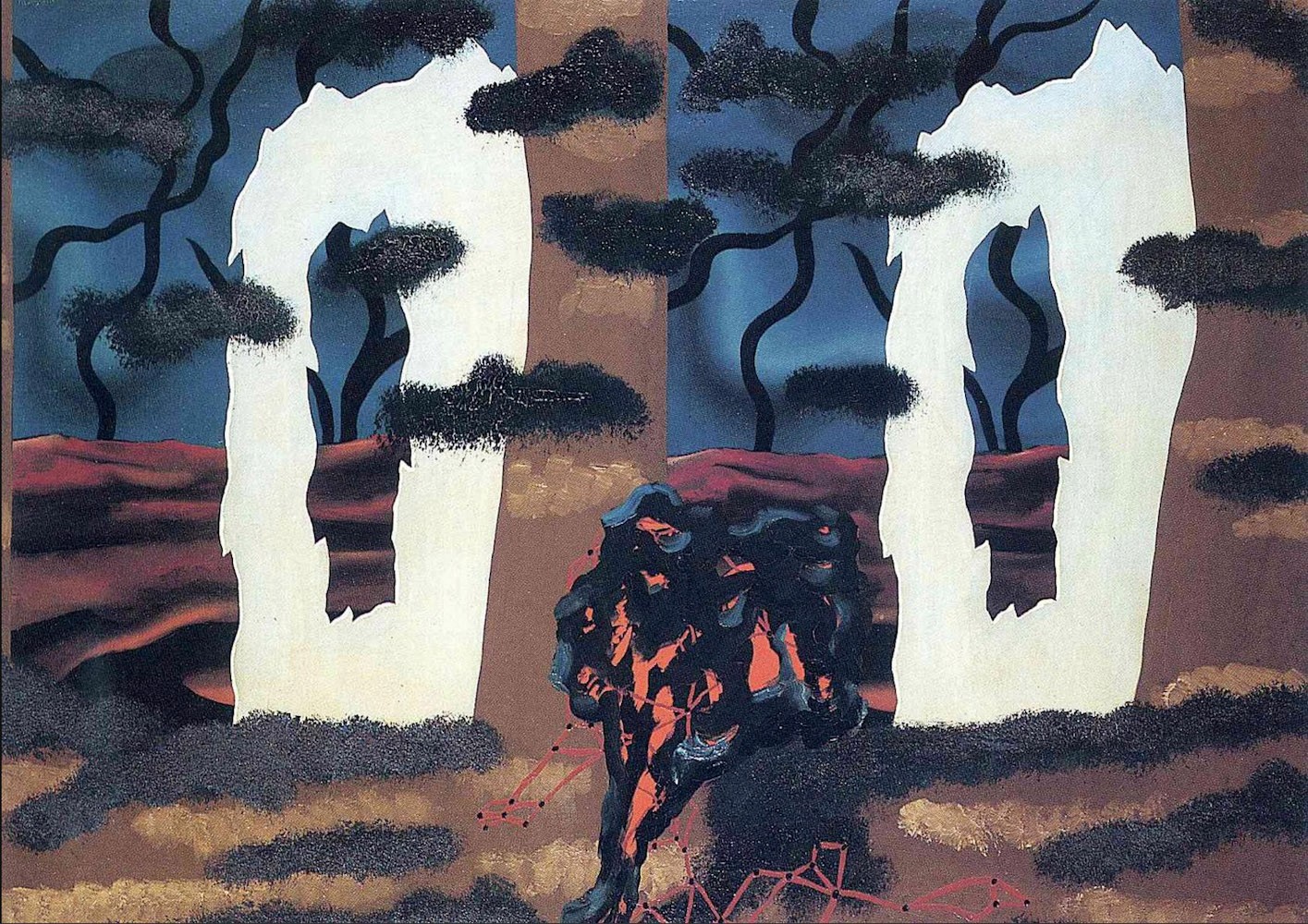
A Taste of the Invisible, Rene Magritte, 1927

7 Ghosts…invisible (?!) ghosts…what an incredible paragraph this is, one I shouldn’t molest with my grubby annotations…but… .

8 Hold on…we’re gonna do a bit of time travel here. “…avalanching back” — this is a bit of the old assy-turvy, cart-before-horse dealieness—latter-first hysteron proteron business (as Weisenburger and others note).

9 The Arbella and a trio of other ships embarked unto America in the spring of 1630 under the command of Purtitan Man John Wintrhop, He Of “City Upon A Hill” fame, a phrase that in no way (LOL) cursed New World America. Hell, it may even be that Winthrop and his gang had civilization’s best interest in heart when they made the Massachusetts Bay Colony. I’m sure religious freedom ETC. motivated them, and not, like, all that goddamn “free” land.

A postcard depicting The Arbella, printed sometime between 1930 – 1945

The poet Anne Bradstreet was on board. Something of a pre-post-modernist, riffing on writing and paranoia in “The Author to Her Book” :

Thou ill-formed offspring of my feeble brain,
Who after birth didst by my side remain,
Till snatched from thence by friends, less wise than true,
Who thee abroad, exposed to public view,
Made thee in rags, halting to th’ press to trudge,
Where errors were not lessened (all may judge).
At thy return my blushing was not small,
My rambling brat (in print) should mother call,
I cast thee by as one unfit for light,
The visage was so irksome in my sight;
Yet being mine own, at length affection would
Thy blemishes amend, if so I could.
I washed thy face, but more defects I saw,
And rubbing off a spot still made a flaw.
I stretched thy joints to make thee even feet,
Yet still thou run’st more hobbling than is meet;
In better dress to trim thee was my mind,
But nought save homespun cloth i’ th’ house I find.
In this array ‘mongst vulgars may’st thou roam.
In critic’s hands beware thou dost not come,
And take thy way where yet thou art not known;
If for thy father asked, say thou hadst none;
And for thy mother, she alas is poor,
Which caused her thus to send thee out of door.

Or maybe actually naw—not pre- or post- anything there. Just writing. And the paranoia writing entails.

10 Weisenburger and other sources point out that Pynchon’s ancestor William Pynchon was part of Winthrop’s fleet. This historical stitching suggests that Pynchon posits Slothrop as something (?) of an authorial…placeholder (?)—in any case, Pynchon and Slothrop both share Puritan ancestors. Wm Pynchon helped “settle” two places in Massachusetts—Roxbury and Springfield.

Roxbury is a the setting of one of GR’s strangest scenes, in which Slothrop descends into the abject hell of a nightclub toilet. (Around page 62 for those counting).

Pynchon kinda sorta showed up in another Springfield.

11 Hysteron proteron continued.

12 A redemption, a fall—even Pynchon’s note that Slothrop’s ancestor is a mess cook points to the novel’s abject contours.

13 Although consistently accused of willful obscurity, Gravity’s Rainbow telegraphs its central themes repeatedly. Here, we see a bobbing seasick distinction between the pure-elect and the abject-preterite.

14 And again…and gross. A sort of abject magic potion is getting worked up here, cross-Atlantic style (in-reverse)—the stew returns to the cauldron, the vomit returns to the guts. Hysteron proteron.

15 The magic words…

16 But…he was already wearing an English uniform.

17 Of course not—this They have other plans for Slothrop’s preterite soul—there is no return, no way home, no way back—no reversals.

18 Yes—What are They doing?
Tom Violence ’87

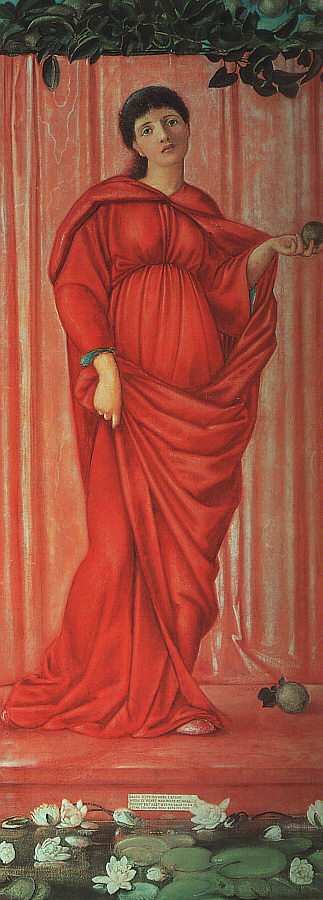
Autumn — Edward Burne-Jones

the-seasons-autumn

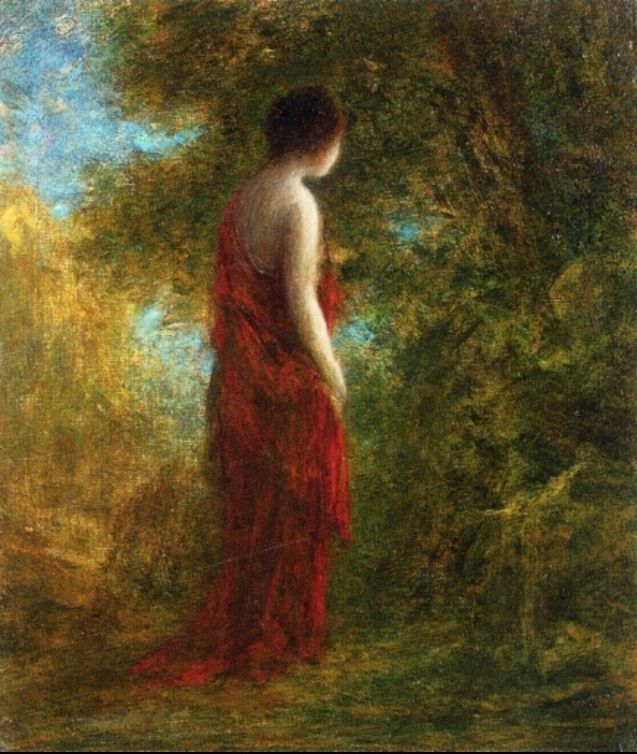
Autumn — Henri Fantin-Latour

autumn

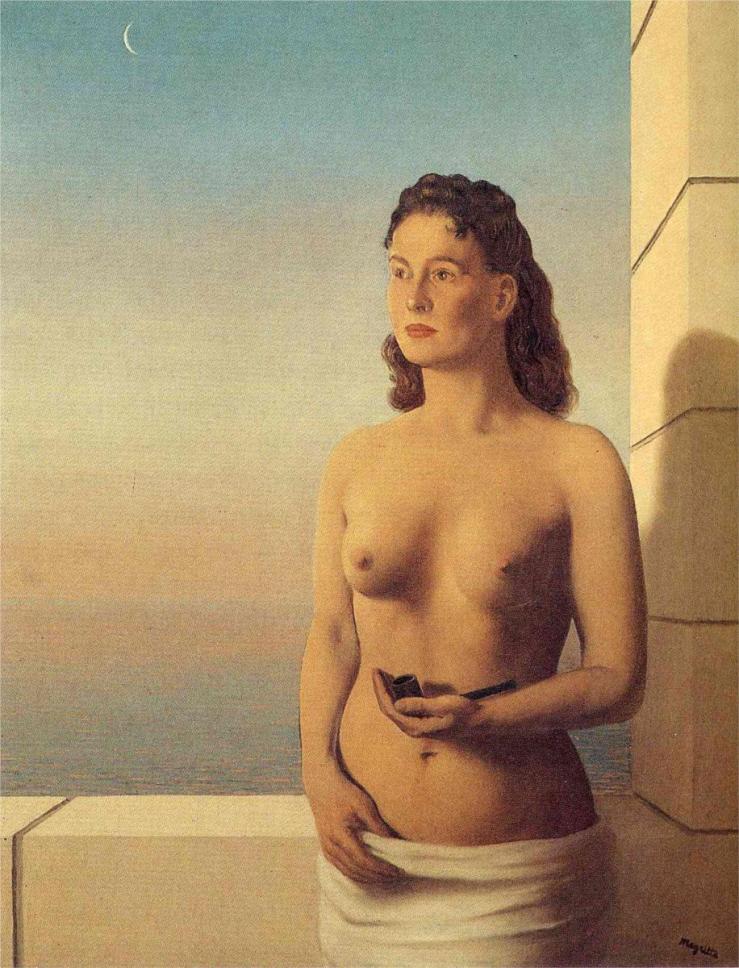
Freedom of Mind — Rene Magritte

Still Life — Francisco Oller

bodeg-n-de-guineos-jarra-y-pajuiles-1870

Gravity’s Rainbow — annotations and illustrations for page 203

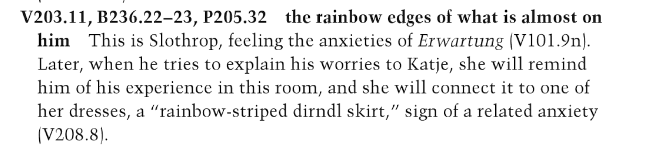
Why here? 1 Why should the rainbow edges 2 of what is almost on him be rippling most intense here in this amply coded room? say why should walking in here be almost the same as entering the Forbidden 3  itself—here are the same long rooms, rooms of old paralysis and evil distillery, of condensations and residues you are afraid to smell from forgotten corruptions, rooms full of upright gray-feathered statues with wings spread, indistinct faces in dust 4 —rooms full of dust that will cloud the shapes of inhabitants around the corners or deeper inside, that will settle on their black formal lapels, that will soften to sugar the white faces, white shirt fronts, gems and gowns, white hands that move too quickly to be seen 5 … what game do They deal 6 ? What passes are these, so blurred, so old and perfect? “Fuck you,” whispers Slothrop 7. It’s the only spell 8 he knows, and a pretty good all-purpose one at that. His whisper is baffled by the thousands of tiny rococo surfaces. Maybe he’ll sneak in tonight—no not at night—but sometime, with a bucket and brush, paint FUCK YOU in a balloon 10 coming out the mouth of one of those little pink shepherdesses there  11… .

He steps back out, backward out the door, as if half, his ventral half, were being struck in kingly radiance: retreating from yet facing the Presence feared and wanted. 12

1 Why…not?

Okay—this seems like a fair question. Let’s not be glib.

The question is Our Hero Tyrone Slothrop’s, via Pynchon’s oft-present free indirect style.

The where is the hotel room  of Our Man in the French Riviera. Slothrop is on “furlough” (not really, they—They—have his ass hard at work) at the Hermann Goering Casino.

Poor Tyrone returns to his hotel room after a picaresque run (and wardrobe shift: tacky/sexy Hawaiian shirt to purple toga to English army uniform) to find that “everything in this room is really being used for something. Different. Meaning things to Them it has never meant to us. Two orders of being…”

Two orders of being: I could riff all day (night?) on this, but I suppose we can boil it down to GR’s binary theme. (Or, for fun, because it’s Our Boy Slothrop—Visible/Invisible (“paranoia” is the gradation between that binary).

2 The fourth appearance of the word “rainbow” in GR (barring the title, colophon, etc.). Another gradation, the rainbow, between binaries. An arc, a rise, a fall.

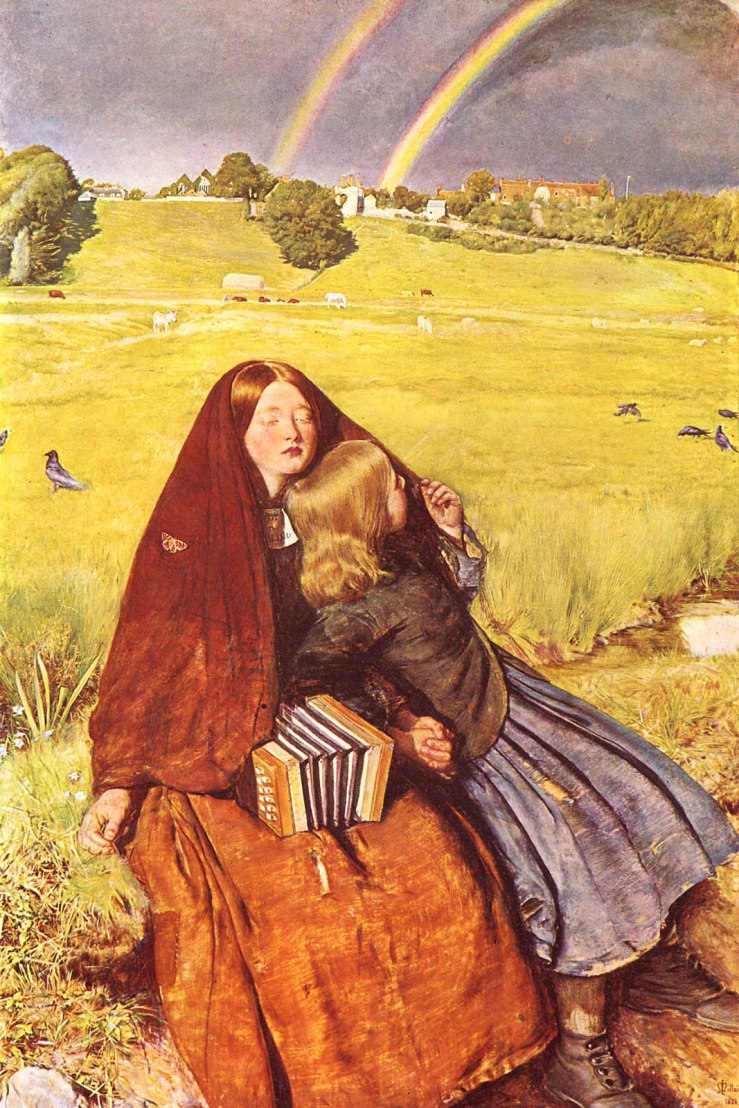
Double rainbow. Blind-sighted: False binary. Gradations:

millais-blind_girl
The Blind Girl, John Everett Millais, 1856

(And music).

Cf. Genesis 9:11-16 (King James Version):

11 And I will establish my covenant with you, neither shall all flesh be cut off any more by the waters of a flood; neither shall there any more be a flood to destroy the earth.

12 And God said, This is the token of the covenant which I make between me and you and every living creature that is with you, for perpetual generations:

13 I do set my bow in the cloud, and it shall be for a token of a covenant between me and the earth.

14 And it shall come to pass, when I bring a cloud over the earth, that the bow shall be seen in the cloud:

15 And I will remember my covenant, which is between me and you and every living creature of all flesh; and the waters shall no more become a flood to destroy all flesh.

16 And the bow shall be in the cloud; and I will look upon it, that I may remember the everlasting covenant between God and every living creature of all flesh that is upon the earth.

Cf. A Gravity’s Rainbow Companion: Sources and Contexts for Pynchon’s Novel, Steven Weisenburger:

screenshot-2016-09-19-at-7-41-44-pm

3 …the Taboo? The Abject? Another description of Gravity’s Rainbow…? Or do we just feel the meaning here? (Yes).

4 The imagery here—desiccation and paralysis, a taxidermist’s row in an old dusty museum—evokes the death|life binary.

5 The Elect (vs Preterite Slothrop). Our Dude TS has his own issues vis a vis whiteness (revisit his adventures down the toilet back during a night in Roxbury).

6 Recall we are in the Casino Hermann Goering. Recall GR’s themes of chance and fate, probability and statistics, zeroes and ones. Recall They.

7 This seems to me like another thesis statement of Pynchon’s in Gravity’s Rainbow.

Actually, fuck that hedging:fuck you to the They is Gravity’s Rainbow’s mission statement.

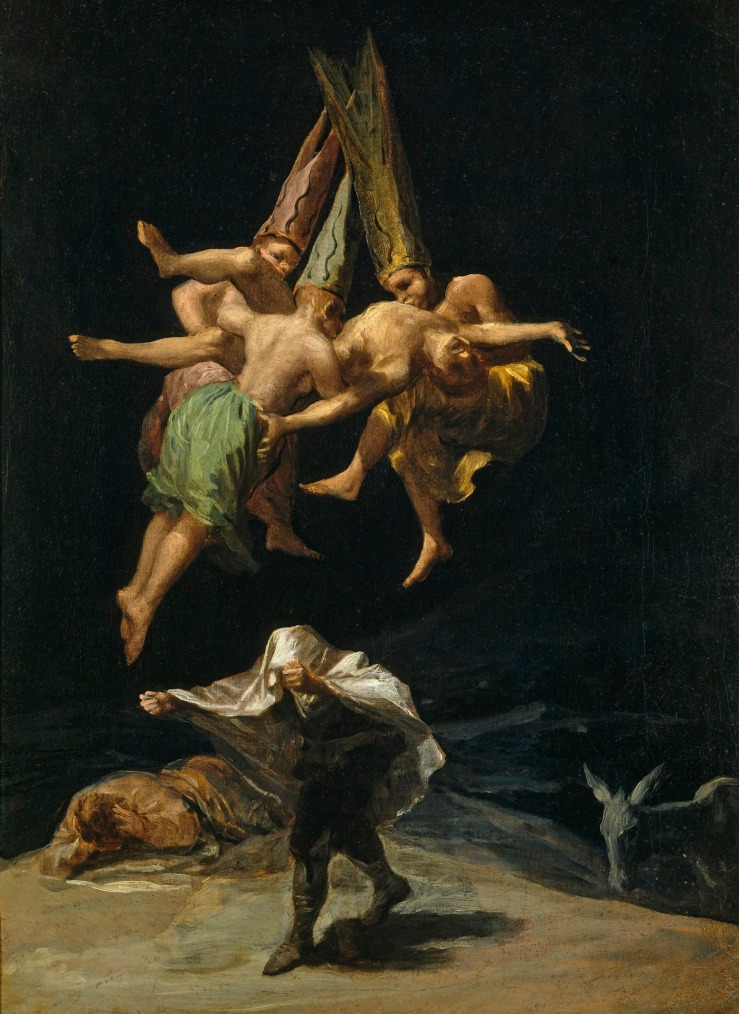
8 Gravity’s Rainbow is full of witches, and maybe Slothrop is a lazy novice.

qfa16nkmgon8ftak0ltb
Witches’ Flight, Francisco Goya, 1797-98.

9 Cf. Ch. 25 of J.D. Salinger’s 1951 novel The Catcher in the Rye:

It’s hopeless, anyway. If you had a million years to do it in, you couldn’t rub out even half the “Fuck you” signs in the world. It’s impossible.

10 Have you read Donald Barthelme’s 1968 short story “The Balloon”?

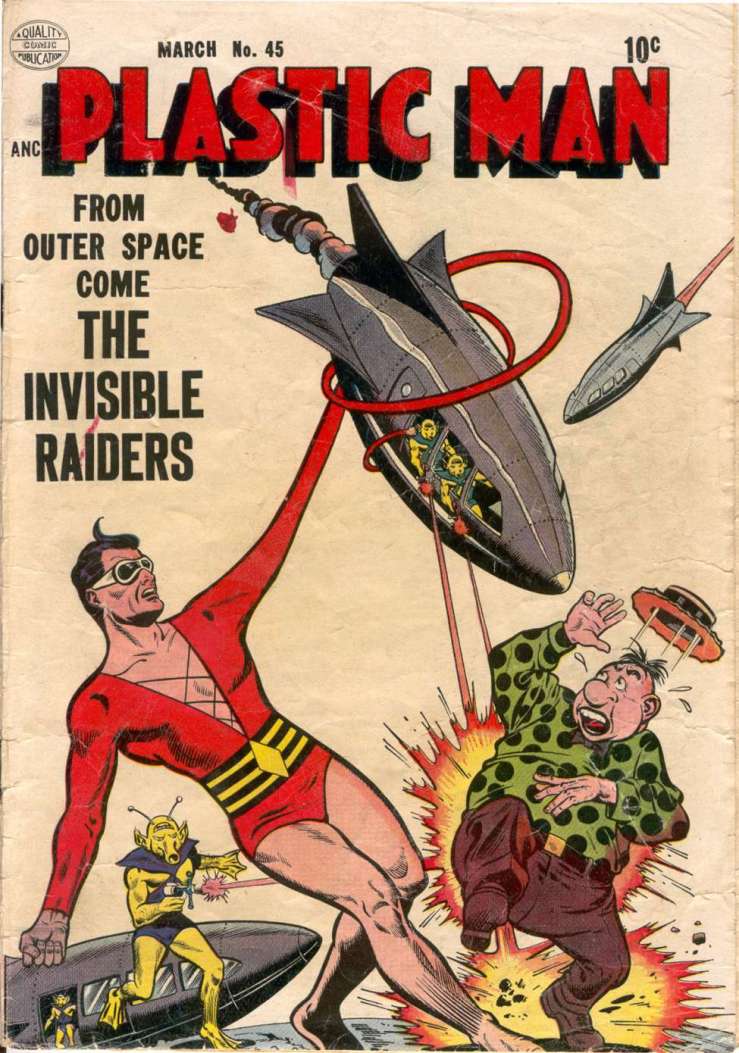
11 A fascinating image, I think. Leave the rococo knickknack of the pink shepherdess alone a moment (perhaps it suggests erotic enticement to you, pervert preterite?) and attend to just how and where Slothrop intends to append this “FUCK YOU” sign—in a comic book speech bubble. The intertextual (do I mean metatextual—it’s hard to keep up) possibilities here bubble and boil. It’s as if Slothrop would rewrite his room (“Two orders of being”) as a comic book.

A page or two later, we find Our Guy Slothrop reading an issue of Plastic Man.

0
Plastic Man #45 by Jack Cole, 1954.

12 Note here the halving of Slothrop, the text that cuts him—ventral. He’s in and out, facing a Presence but already half Absent. Is Our Savior Tyrone the one radiating the “kingly radiance” — or is he being radiated by it?—Or am I making too much of light?

Portrait of Antonietta Gonzalez — Lavinia Fontana

portrait-of-antonietta-gonzalez-1595

Circe Invidiosa — John William Waterhouse

circe-invidiosa-1892

How the summer-time flits away (Nathaniel Hawthorne’s journal entry for September 18th, 1842)

September 18th.–How the summer-time flits away, even while it seems to be loitering onward, arm in arm with autumn! Of late I have walked but little over the hills and through the woods, my leisure being chiefly occupied with my boat, which I have now learned to manage with tolerable skill. Yesterday afternoon I made a voyage alone up the North Branch of Concord River. There was a strong west-wind blowing dead against me, which, together with the current, increased by the height of the water, made the first part of the passage pretty toilsome. The black river was all dimpled over with little eddies and whirlpools; and the breeze, moreover, caused the billows to beat against the bow of the boat, with a sound like the flapping of a bird’s wing. The water-weeds, where they were discernible through the tawny water, were straight outstretched by the force of the current, looking as if they were forced to hold on to their roots with all their might. If for a moment I desisted from paddling, the head of the boat was swept round by the combined might of wind and tide. However, I toiled onward stoutly, and, entering the North Branch, soon found myself floating quietly along a tranquil stream, sheltered from the breeze by the woods and a lofty hill. The current, likewise, lingered along so gently that it was merely a pleasure to propel the boat against it. I never could have conceived that there was so beautiful a river-scene in Concord as this of the North Branch. The stream flows through the midmost privacy and deepest heart of a wood, which, as if but half satisfied with its presence, calm, gentle, and unobtrusive as it is, seems to crowd upon it, and barely to allow it passage; for the trees are rooted on the very verge of the water, and dip their pendent branches into it. On one side there is a high bank, forming the side of a hill, the Indian name of which I have forgotten, though Mr. Thoreau told it to me; and here, in some instances, the trees stand leaning over the river, stretching out their arms as if about to plunge in headlong. On the other side, the bank is almost on a level with the water; and there the quiet congregation of trees stood with feet in the flood, and fringed with foliage down to its very surface. Vines here and there twine themselves about bushes or aspens or alder-trees, and hang their clusters (though scanty and infrequent this season) so that I can reach them from my boat. I scarcely remember a scene of more complete and lovely seclusion than the passage of the river through this wood. Even an Indian canoe, in olden times, could not have floated onward in deeper solitude than my boat. I have never elsewhere had such an opportunity to observe how much more beautiful reflection is than what we call reality. The sky, and the clustering foliage on either hand, and the effect of sunlight as it found its way through the shade, giving lightsome hues in contrast with the quiet depth of the prevailing tints,–all these seemed unsurpassably beautiful when beheld in upper air. But on gazing downward, there they were, the same even to the minutest particular, yet arrayed in ideal beauty, which satisfied the spirit incomparably more than the actual scene. I am half convinced that the reflection is indeed the reality, the real thing which Nature imperfectly images to our grosser sense. At any rate, the disembodied shadow is nearest to the soul.

There were many tokens of autumn in this beautiful picture. Two or three of the trees were actually dressed in their coats of many colors,–the real scarlet and gold which they wear before they put on mourning. These stood on low, marshy spots, where a frost has probably touched them already. Others were of a light, fresh green, resembling the hues of spring, though this, likewise, is a token of decay. The great mass of the foliage, however, appears unchanged; but ever and anon down came a yellow leaf, half flitting upon the air, half falling through it, and finally settling upon the water. A multitude of these were floating here and there along the river, many of them curling upward, so as to form little boats, fit for fairies to voyage in. They looked strangely pretty, with yet a melancholy prettiness, as they floated along. The general aspect of the river, however, differed but little from that of summer,–at least the difference defies expression. It is more in the character of the rich yellow sunlight than in aught else. The water of the stream has now a thrill of autumnal coolness; yet whenever a broad gleam fell across it, through an interstice of the foliage, multitudes of insects were darting to and fro upon its surface. The sunshine, thus falling across the dark river, has a most beautiful effect. It burnishes it, as it were, and yet leaves it as dark as ever.

On my return, I suffered the boat to float almost of its own will down the stream, and caught fish enough for this morning’s breakfast. But, partly from a qualm of conscience, I finally put them all into the water again, and saw them swim away as if nothing had happened.

Nathaniel Hawthorne’s journal entry for September 18th, 1842. From Passages from the American Note-Books.

Sunday Comics

img_3626

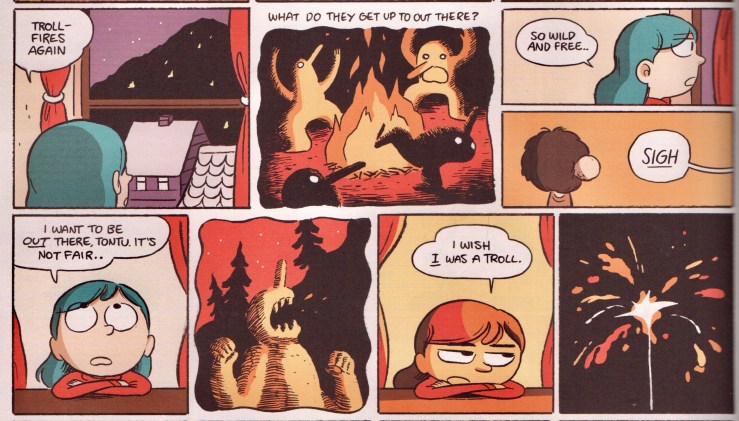
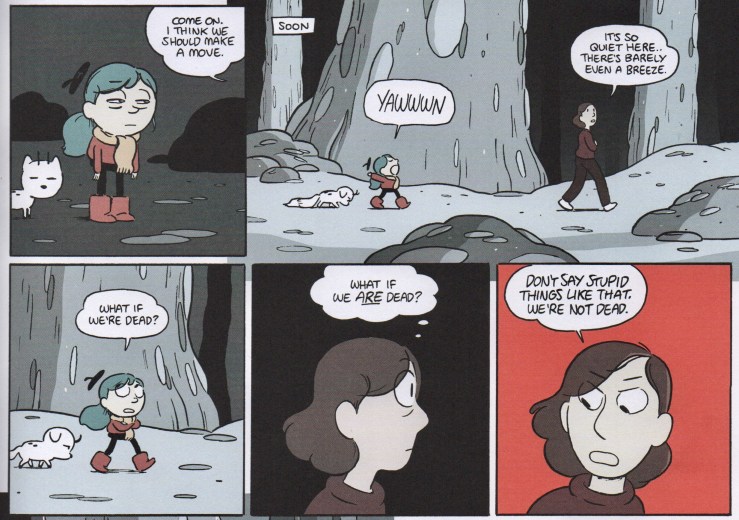
I love love love Hilda and the Stone Forest by Luke Pearson (Flying Eye/Nobrow, 2016). My kids love it too. It’s the richest, funniest, and most heartwarming Hilda book to date.

img_3628

Pearson manages to stuff The Stone Forest with miniature epics and minor gags, which he hangs on the central story of Hilda and her mother in an otherworldly (literally), uh, stone forest, where they encounter trolls and other dangers (including existential despair).

img_3629

The people I really wished I could write like were foreign, or dead, or both (Ursula K. Le Guin)

In high school I was, like many American intellectual kids, a stranger in a strange land. I made the Berkeley Public Library my refuge, and lived half my life in books. Not only American books—English and French novels and poetry, Russian novels in translation. Transported unexpectedly to college in another strange land, the East Coast, I majored in French lit and went on reading European lit on my own. I felt more at home in some ways in Paris in 1640 or Moscow in 1812 than in Cambridge, Massachusetts, in 1948.

Much as I loved my studies, their purpose was to make me able to earn a living as a teacher, so I could go on writing. And I worked hard at writing short stories. But here my European orientation was a problem. I wasn’t drawn to the topics and aims of contemporary American realism. I didn’t admire Ernest Hemingway, James Jones, Norman Mailer, or Edna Ferber. I did admire John Steinbeck, but knew I couldn’t write that way. In The New Yorker, I loved Thurber, but skipped over John O’Hara to read the Englishwoman Sylvia Townsend Warner. Most of the people I really wished I could write like were foreign, or dead, or both. Most of what I read drew me to write about Europe; but I knew it was foolhardy to write fiction set in Europe if I’d never been there.

These are the first two paragraphs of an excerpt of Ursula K. Le Guin’s introduction to her collection The Complete Orsinia; the excerpt was published in The Paris Review this week.

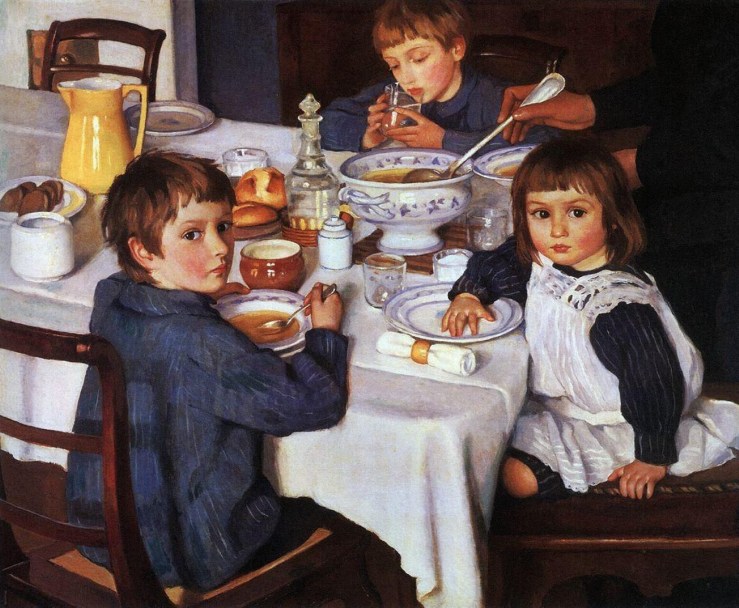
Breakfast — Zinaida Serebriakova

obed_1

Gravity’s Rainbow — annotations and illustrations for pages 148-49 | Our history is an aggregate of last moments

216292
Lotus, Chang Dai-chien, 1948

—(Quietly) 1 It’s been a prevalent notion 2. Fallen sparks 3. Fragments of vessels broken at the Creation 4. And someday, somehow, before the end, a gathering back to home. A messenger from the Kingdom, arriving at the last moment 5. But I tell you there is no such message, no such home 6—only the millions of last moments… no more. Our history is an aggregate of last moments 7.

From pages 82-83 of Thomas Pynchon’s 1973 novel Gravity’s Rainbow.

1 A stage direction. These are the final lines in a one-act play, a small (cosmically-large) tragicomedy featuring two…nerve cells. Rollo Groast of the White Visitation prefaces a page earlier:

It is part…of an old and clandestine drama for which the human body serves only as a set of very allusive, often cryptic, programme notes—it’s as if the body we can measure is a scrap of this programme found outside in the street, near a magnificent stone theater we cannot enter.

In this little play (its rough setting echoes GR’s own martial satire), a younger cell asks a senior cell if she’s ever been to the “Outer Level” and is somewhat shocked when she tells him that “sooner or later everyone out here has to go Epidermal. No exceptions.”

Is this the first episode of Gravity’s Rainbow staged as a play? I think so.

The “prevalent notion” the younger cell subscribes to is characterized in the four sentences that follow, and then rejected in the fifth, the sentence that pivots with “But.” A satire of religious hope, perhaps?—the notion of salvation, redemption, an organizing principle to arrive and tidy all the chaos?

The preterite. But also/and—

The notations on broken vessels and sparks seem to allude to the Kabbalah of Isaac Luria (1534-1572). I will not attempt a bad paraphrase of Lurianic Kabbalah here, but a basic big picture—sparks—souls, fragments of a one-soul—looking to be rectified. Pynchon, inking heavy his preterite-and-elect theme.

The deus ex machina in the last act, the game-winning Hail Mary pass, the Messiah, smiling and terrible…

6 Bummer.

Cf. the opening of Gravity’s Rainbow. From the sixth paragraph:

“You didn’t really believe you’d be saved. Come, we all know who we are by now. No one was ever going to take the trouble to save you, old fellow. . . .”

These are the first lines of dialog in the novel. (If they can be called dialog).

7 The “our” here is biological—one cell to another business—but is there more to human history? Are we more than just our cells? Are there sparks for these vessels?

The narrator here seems to superimpose an answer into the senior cell’s line here: History is simply an imposition, a psychological trick, a way to organize chaos via narrative.

Cf.  Pointsman’s lines, which I brought up in some previous annotations:

Will Postwar be nothing but ‘events,’ newly created one moment to the next? No links? Is it the end of history?

This miniature cellular drama comes after the introduction to a minor character in Gravity’s Rainbow I’ve always found intriguing: Gavin Trefoil.

Trefoil, an agent (?!) of The White Visitation, has powers:

Lately, as if all tuned in to the same aethereal Xth Programme, new varieties of freak have been showing up at “The White Visitation,” all hours of the day and night, silent, staring, expecting to be taken care of, carrying machines of black metal and glass gingerbread, off on waxy trances, hyperkinetically waiting only the right trigger-question to start blithering 200 words a minute about their special, terrible endowments. An assault. What are we to make of Gavin Trefoil, for whose gift there’s not even a name yet? (Rollo Groast wants to call it autochromatism.) Gavin, the youngest here, only 17, can somehow metabolize at will one of his amino acids, tyrosine. This will produce melanin, which is the brown-black pigment responsible for human skin color. Gavin can also inhibit this metabolizing by—it appears—varying the level of his blood phenylalanine. So he can change his color from most ghastly albino up through a smooth spectrum to very deep, purplish, black. If he concentrates he can keep this up, at any level, for weeks. Usually he is distracted, or forgets, and gradually drifts back to his rest state, a pale freckled redhead’s complexion.

I suppose I could riff all day on the symbolic/historic implications of Trefoil’s powers: His gradations of color disrupt the binary (black-white, off-on, zero-one) that a Pavlovian like Pointsman insists upon (Trefoil’s super(?!)power falls in line with Roger Mexico’s gradations between 0 and 1).

nuevos2bmutantes
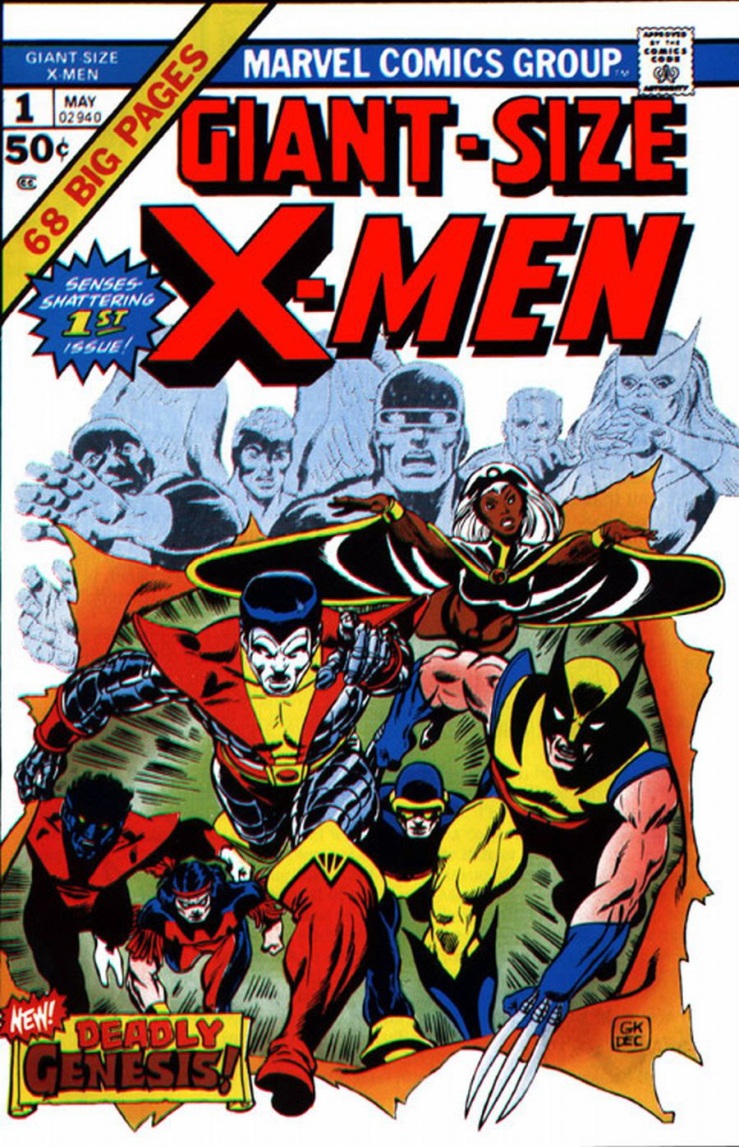
Giant-Size X-Men #1, 1975. Art by Gil Kane and Dave Cockrum, story by Len Wein.

But what really interests me here is Trefoil’s mutant powers and The White Visitation as a sort of potential comic book—I mean what I want to say here is that Pynchon points ahead to the 1975 “reboot” of Uncanny X-Men, and even The New Mutants: Post-global preterite underground weirdos with strange powers. Psychics and witches and protagonists that splinter into nothingness, after going through multiple reboots—(Plechazunga, the Pig-Hero, Rocketman, etc.). (Hell, the Pynchon X-Men team could even have Grigori the Octopus).

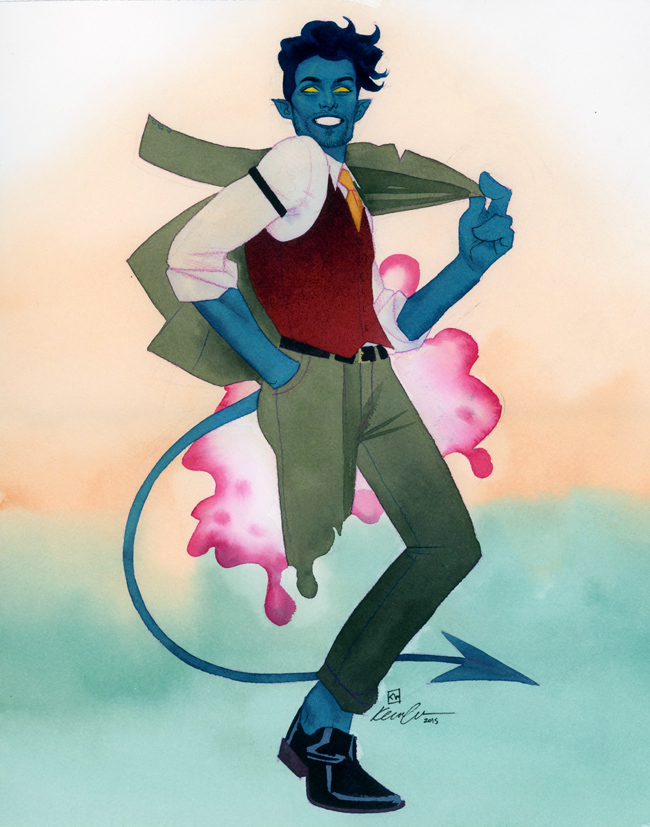
The closest X-Men comparison for Gavin Trefoil is probably the shapeshifter baddie X-Men antagonist Mystique, whose powers are obviously more pronounced than Trefoil’s. And there’s also Nightcrawler—maybe my favorite of Chris Claremont’s run on X-Men—or maybe I mean Excalibur. And also blueskinned Beast.


tumblr_nqf9yabhf91qbkgzfo1_1280
Nightcrawler, Kevin Wada, 2015

Late in the novel, Our Hero Tyrone Slothrop will help form the superish heroish team the Floundering Four (along with Myrtle Miraculous, zoot-suited Maximillian, and mechanical man Marcel). The Floundering Four will set out to battle the Paternal Peril. (Make of that what you will).

On Trefoil the Blueskin, here’s Steven Weisenburger (A Gravity’s Rainbow Companion):


trefoil

William Gass and William Gaddis at “The Writer and Religion” conference, 1994 (Audio)

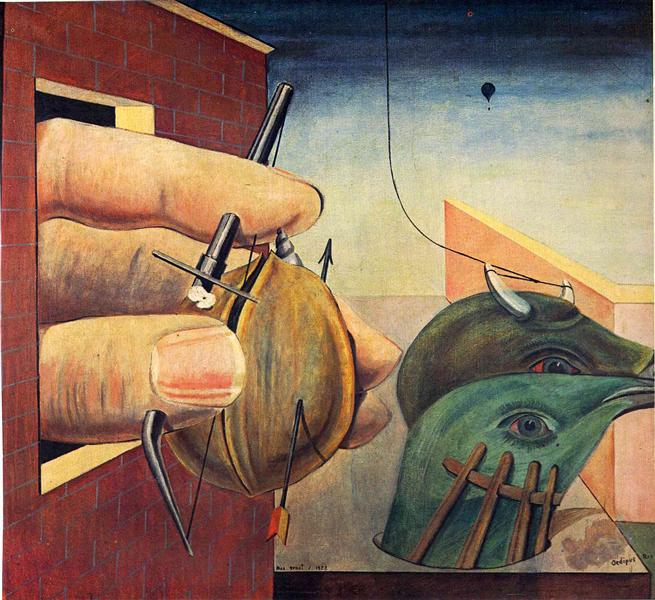
Oedipus Rex — Max Ernst

oedipus-rex-1922large

“Will there really be a morning?” — Emily Dickinson

screenshot-2016-09-16-at-5