Reading/Have Read/Should Write About

img_2997

From bottom to top:

I had to go hunt through the house for the trio of Hildafolk comics by Luke Pearson because my kids keep swapping them around. We’ve read them a bunch of times now and they are very good and sweet and charming and you can get them from NobrowHilda is going to be a Netflix series, by the way, which I told my kids and they were psyched. (They ten went on Netflix and looked for it. I had to explain production schedules).

W.D. Clarke’s White Mythology (which may or may not take its title from Derrida’s essay of the same name) is actually two novellas, Skinner Boxed and Love’s Alchemy. I finished the first novella before July 4th; Skinner Boxed is about psychiatrist Dr. Ed, who juggles a bunch of maguffins including a detached (and missing) wife, a returned bastard son, and a clinical anti-depressant trial. The novella begins with epigrams from Gravity’s Rainbow and A Christmas Carol, the latter of which it (somewhat perhaps ironically) follows. I finished the second novella Love’s Alchemy yesterday. Its tone is not as zany as that of Skinner Boxed, but both stories require the reader to put together seemingly disconnected events for the plot to “resolve” (if resolve is the right word). Good stuff.

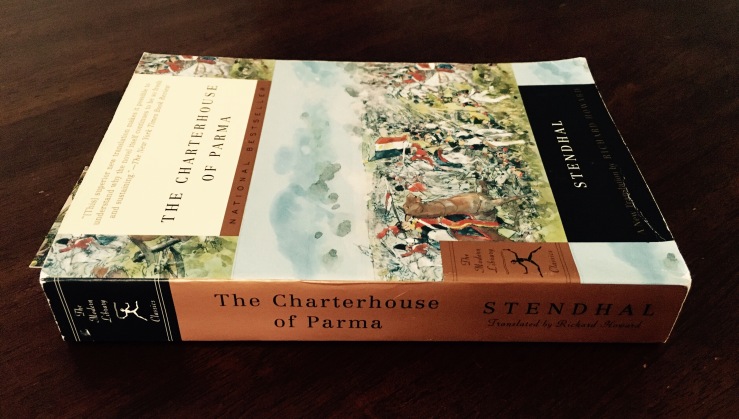
I started the Howard translation of The Charterhouse of Parma by Stendhal. I’m in Chapter 3 right now. We’ll see how it goes this time. For now, I’ll continue to trust Italo Calvino. From his “Guide for New Readers of Stendhal’s Charterhouse:

…many young people will be smitten right from the opening pages, and will be instantly convinced that this has to be the best novel ever written, recognising it as the novel they had always wanted to read and which will act as the benchmark for all the other novels they will read in later life. (I’m talking particularly about the opening chapters; as you get into it, you will find that it is a different novel, or several novels each different from the other, all of which will require you to modify your involvement in the plot; whatever happens, the brilliance of the opening will continue to influence you.)

I finished Stanley Elkin’s The Franchiser and then the novel that chronologically preceded it (and arguably birthed it), The Dick Gibson Show. I need to write a whole Thing on these two novels, but I enjoyed them, and can’t believe it took me so long to read Elkin (although I’m glad I read Pynchon, Gaddis, and Gass first). I preferred the riffing polyglossia of TDGS a bit more than The Franchiser, which occasionally seemed to let its satire tip over into a kind of bathetic melancholy. Both novels diagnose an obsession of nostalgia (or, more directly: an obsession of obsession) that continues to grip America.

Yesterday I picked up Vladislav Vančura’s novel Marketa Lazarova, new in a sharp English translation by Carleton Bulkin from Twisted Spoon Press. Twisted Spoon had sent me the book a few weeks ago, and I’d meant to read it over the week of July Fourth but drank too many beers instead. Anyway, I picked it up yesterday and read the first two chapters (50 pages—the first third, that is) gripped in wonder and laughter, and a bit of happy shock even. A strange and often violent tale of multiple kidnappings and medieval intrigues, Marketa Lazarova reminds me of Le Morte D’Arthur, Nanni Balestrini’s Sandokan (both in its evocations of brutality and in its marvelous poetic prose), Aleksei German’s film Hard to Be a God, Bergman’s film The Virgin Spring, Bolaño’s sweetly ironic narrators, and yes, hell, Game of Thrones. I’d rather be reading this book right now than writing about it in this silly blog post, actually. And no, I haven’t seen the František Vláčil film adaptation—yet.

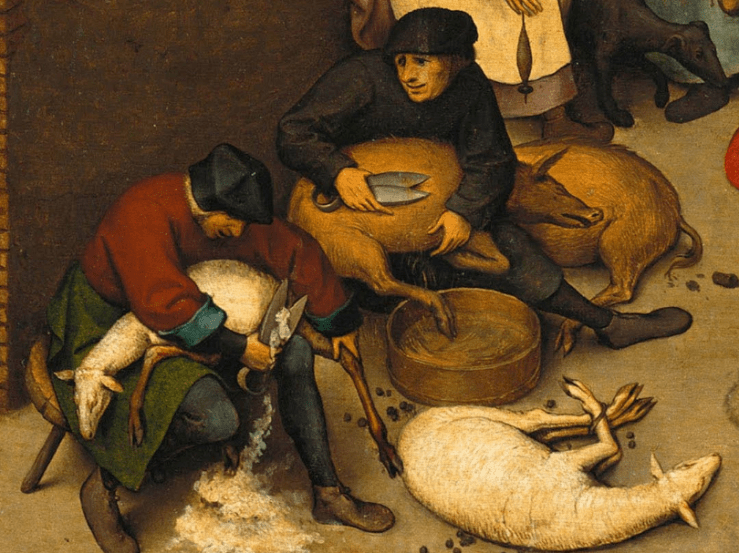
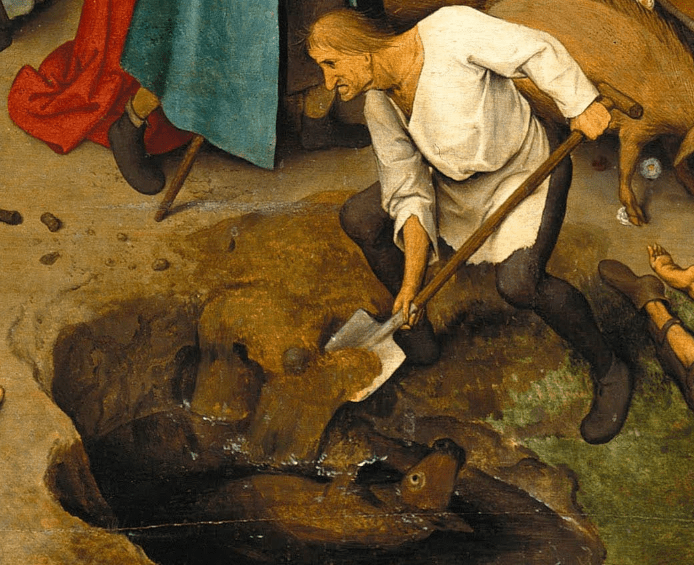
Netherlandish Proverbs (detail) — Pieter Bruegel the Elder

Screenshot 2016-06-26 at 11.05.53 AM

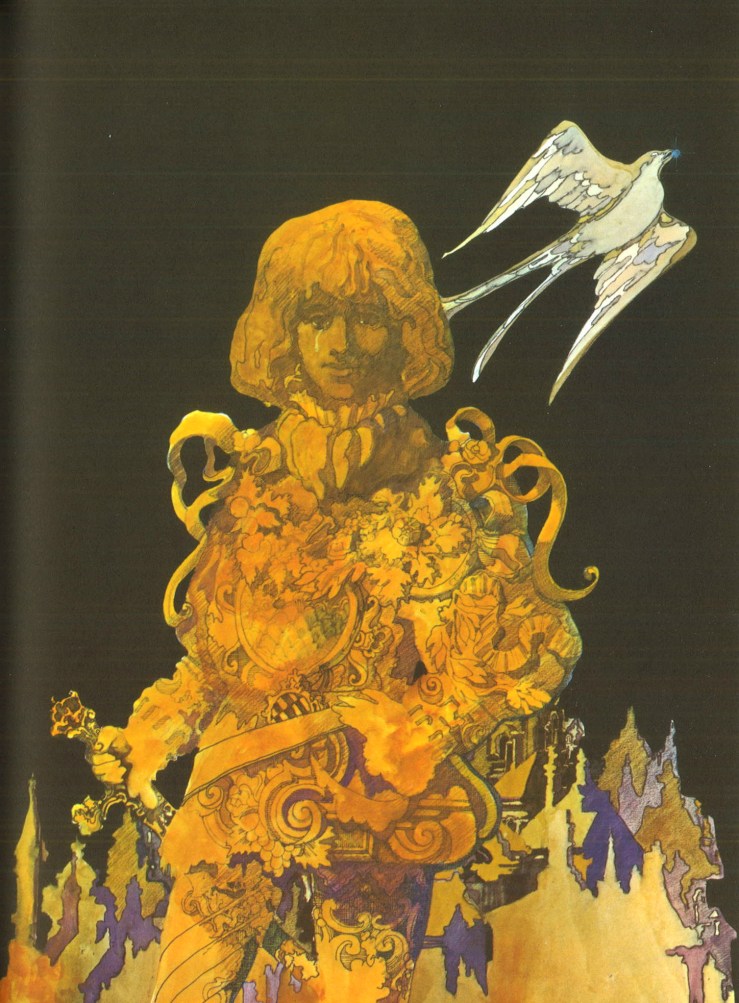
Illustration for Oscar Wilde’s “The Happy Prince” — James Hill

The Happy Prince

James Hill’s illustration for “The Happy Prince” by Oscar Wilde. From The Short Stories of Oscar Wilde, Heritage Press, 1968.


“The Happy Prince”

by

Oscar Wilde


High above the city, on a tall column, stood the statue of the Happy Prince. He was gilded all over with thin leaves of fine gold, for eyes he had two bright sapphires, and a large red ruby glowed on his sword-hilt.

He was very much admired indeed. “He is as beautiful as a weathercock,” remarked one of the Town Councillors who wished to gain a reputation for having artistic tastes; “only not quite so useful,” he added, fearing lest people should think him unpractical, which he really was not.

“Why can’t you be like the Happy Prince?” asked a sensible mother of her little boy who was crying for the moon. “The Happy Prince never dreams of crying for anything.”

“I am glad there is some one in the world who is quite happy,” muttered a disappointed man as he gazed at the wonderful statue.

“He looks just like an angel,” said the Charity Children as they came out of the cathedral in their bright scarlet cloaks and their clean white pinafores.

“How do you know?” said the Mathematical Master, “you have never seen one.”

“Ah! but we have, in our dreams,” answered the children; and the Mathematical Master frowned and looked very severe, for he did not approve of children dreaming.

One night there flew over the city a little Swallow. His friends had gone away to Egypt six weeks before, but he had stayed behind, for he was in love with the most beautiful Reed. He had met her early in the spring as he was flying down the river after a big yellow moth, and had been so attracted by her slender waist that he had stopped to talk to her.
Continue reading “Illustration for Oscar Wilde’s “The Happy Prince” — James Hill”

Escape from New York film poster — Kilian Eng

tumblr_o9shqqz7pm1qbluruo4_1280

Soap Bubbles — Berenice Abbott

dp134076

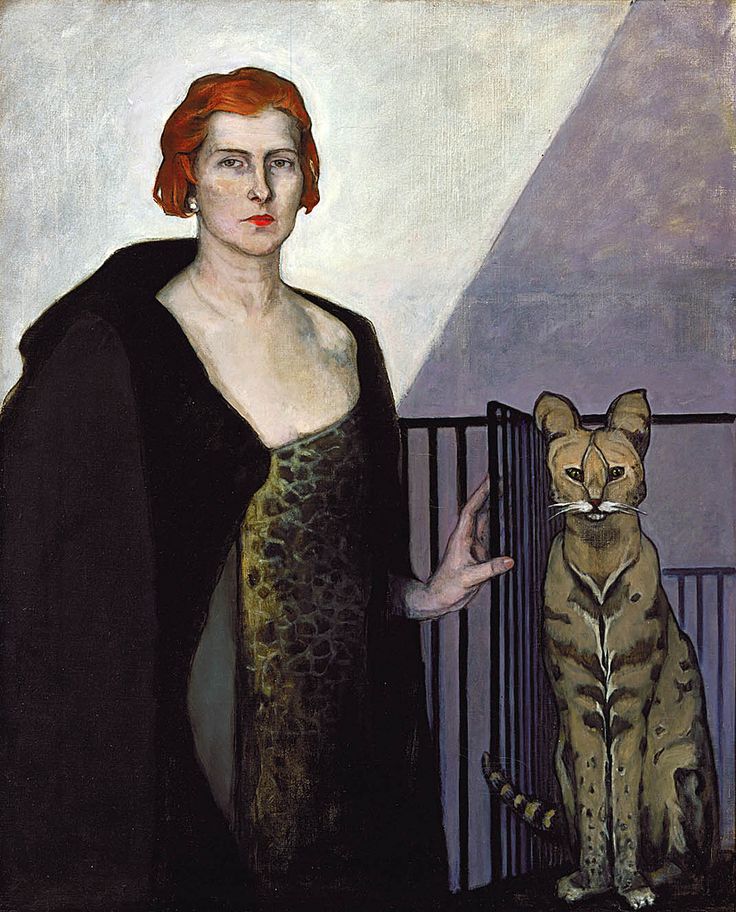
La Baronne Emile D’Erlanger — Romaine Brooks

cf24d84ec93029ab64616fb578a8b01f

Three Books

img_2987

Grendel by John Gardner. First edition hardback by Knopf (Borzoi imprint), 1971. No designer credited, but the jacket illustration is almost certainly by Emil Antonucci, whose line drawings head each chapter. The blurb on the back, by the way, is from a William H. Gass review of Gardner’s second novel The Wreckage of Agathon, which I have not read.

I usually only do scans of the fronts of books in these Three Books posts, but the clothbound book under the jacket of this edition of Grendel is too lovely not to share (it could also have fit into my three purple books post a while back):

img_2988

img_2990

Mules & Men by Zora Neale Hurston. 1978 trade paperback by Indiana University Press. No designer credited, but the cover illustration is almost certainly by Miguel Covarrubias, whose illustrations accompany the text. Mules & Men is not stuffy catalog of folklore, but rather Hurston’s own synthesis of the tales she collected (and improved upon, if not outright invented in some cases) primarily in Florida in the early 1930s. A sample tale: How the snake got poison:

Well, when God made de snake he put him in de bushes to ornament de ground. But things didn’t suit de snake so one day he got on de ladder and went up to see God. “Good mawnin’, God.” “How do you do, Snake?” “Ah ain’t so many, God, you put me down there on my belly in de dust and everything trods upon me and kills off my generations. Ah ain’t got no kind of protection at all.”

God looked off towards immensity and thought about de subject for awhile, then he said, “Ah didn’t mean for nothin’ to be stompin’ you snakes lak dat. You got to have some kind of a protection. Here, take dis poison and put it in yo’ mouf and when they tromps on you, protect yo’ self. “

So de snake took de poison in his mouf and went on back.

So after awhile all de other varmints went up to God.

“Good evenin’, God.”

“How you makin’ it, varmints?”

“God, please do somethin’ ’bout dat snake. He’ layin’ in de bushes there wid poison in his mouf and he’s strikin’ everything dat shakes de bush. He’s killin’ up our generations. Wese skeered to walk de earth.”

So God sent for de snake and tole him:

“Snake, when Ah give you dat poison, Ah didn’t mean for you to be hittin’ and killin’ everything dat shake de bush. I give you dat poison and tole you to protect yo’self when they tromples on you. But you killin’ everything dat moves. Ah didn’t mean for you to do dat.”

De snake say, “Lawd, you know Ah’m down here in de dust. Ah ain’t got no claws to fight wid, and Ah ain’t got no feets to git me out de way. All Ah kin see is feets comin’ to tromple me. Ah can’t tell who my enemy is and who is my friend. You gimme dis protection in my mouf and Ah uses it.”

God thought it over for a while then he says:

“Well, snake, I don’t want yo’ generations all stomped out and I don’t want you killin’ everything else dat moves. Here take dis bell and tie it to yo’ tail. When you hear feets comin’ you ring yo’ bell and if it’s yo’ friend, he’ll be keerful. If it’s yo’ enemy, it’s you and him.”

So dat’s how de snake got his poison and dat’s how come he got rattles.

Biddy, biddy, bend my story is end.

Turn loose de rooster and hold de hen.

img_2989

By Night in Chile by Roberto Bolaño. English translation by Chris Andrews. Trade paperback by New Directions, 2003. Cover design by Semadar Megged, who adapted a photograph by Kurt Beals. The orange in the cover doesn’t seem so vibrant in the scan I did. It’s as orange as the other two books. Oh well. The prose is vibrant, electric orange.

I wrote about By Night in Chile here.

Netherlandish Proverbs (detail) — Pieter Bruegel the Elder

Screenshot 2016-06-26 at 11.02.50 AM.png

“Exits” — Langston Hughes

Screenshot 2016-07-09 at 12

AD/BC: A Rock Opera by Matt Berry and Richard Ayoade

Dreams No. 2 — Jacob Lawrence

1986-6-95_1a

Refuse Heap (after Goya’s Dog) — Dragan Bibin

tumblr_nl8fcxqwqp1uqpzx8o1_r2_1280

Passionate extremists (From Stanley Elkin’s novel The Dick Gibson Show)

He could not depend upon his listeners; he had no notion of them. They were as faceless to him as he to them. (They didn’t even have a voice.) His panels, his Special Guests were more real. As for his listeners, he guessed they were insomniacs, cabbies, enlisted men signed out on leave at midnight driving home on turnpikes, countermen in restaurants by highways, people in tollbooths. Or he saw them in bed—they lived in the dark—lumps under covers, profiles on pillows, their skulls beside the clock radio (the clock radio had done more to change programming than even TV) while the dialogue floated above their heads like balloon talk aloft in comic strips. Half asleep, they would not follow it too closely. No, he knew little about his listeners. They were not even mysterious; they were there, but distant as the Sioux.

He knew more about the passionate extremists who used his microphones in the groundless hope of stirring those sleepers, and winning over the keepers of the booths—the wild visionaries, opponents of fluoride, palmists, astrologers, the far right and far left and far center, the dianeticians, scientologists, beatniks, homosexuals from the Mattachine Society, the handwriting analysts, addicts, nudists, psychic phenomenologists, all those who believed in the Loch Ness Monster, the Abominable Snowman and the Communist Conspiracy; men beyond the beyond, black separatists who would take over Idaho and thrive by cornering the potato, pretenders to a half-dozen thrones, Krebiozonists, people from MENSA, health-food people, eaters of weed and soups of bark, cholesterolists, poly-unsaturationalists, treasure hunters, a woman who believed she held a valid Spanish land grant to all of downtown San Francisco, the Cassandras warning of poison in the white bread and cola and barbecued potato chip, conservationists jittery about the disappearing forests and the diminishing water table (and one man who claimed that the tides were a strain on the moon), would-be reformers of a dozen industries and institutions and a woman so fastidious about the separation of church and state that she would take the vote away from nuns and clergymen, capital punishers, atheists, people who wanted the abortion laws changed and a man who thought all surgery was a sin and ought to carry the same sentence as any other assault with a knife, housewives spooked by lax Food and Drug regulations, Maoists, Esperantoists, American Nazis, neo-Jaegerists, Reichians, juvenile delinquents, crionics buffs, anti-vivisectionists, witches, wizards, chief rabbis of no less than three of the twelve lost tribes of Israel, and a fellow who claimed he died the same year Columbus discovered America.

From Stanley Elkin’s 1971 novel The Dick Gibson Show.

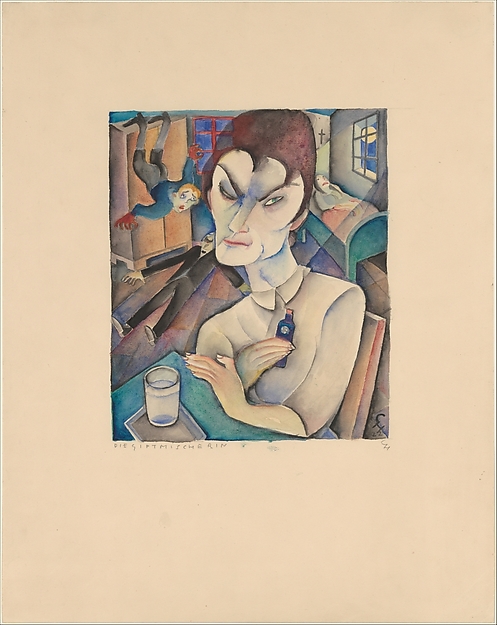
The Poison Mixer — Carry Hauser

dp266806

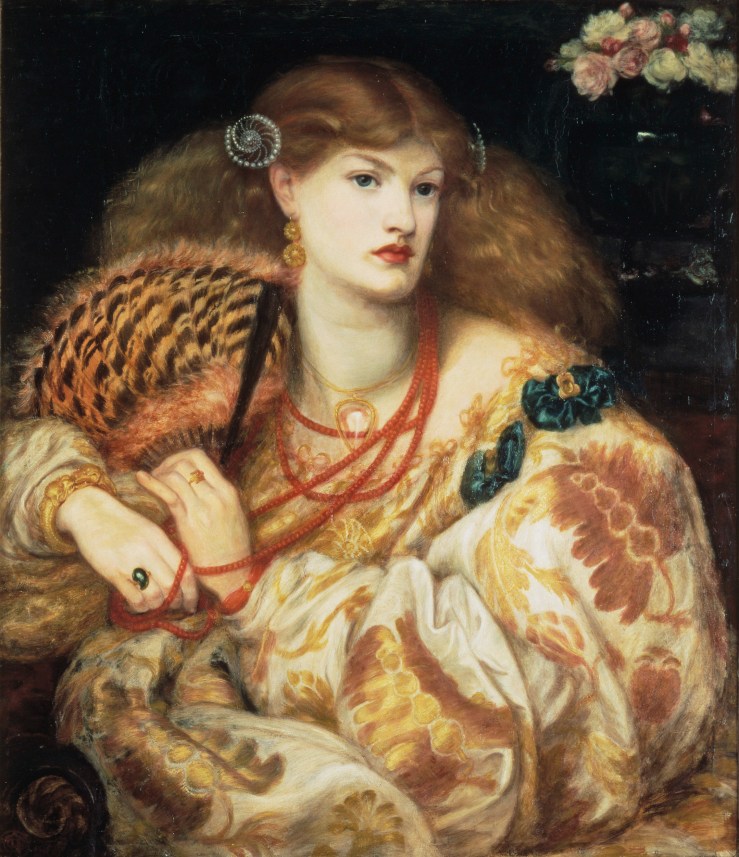
Monna Vanna — Dante Gabriel Rosetti

Dante Gabriel Rossetti: Monna Vanna, 1866.

(Another copy of) The Charterhouse of Parma (Book acquired sometime the week before last)

img_2734

I included Stendhal’s The Charterhouse of Parma in a post I wrote a few weeks ago about books I start repeatedly yet have never been able to finish. Various folks on Twitter and elsewhere told me I need to stick it out with the novel, including Jacob Siefring, who suggested I try Richard Howard’s 1999 Modern Library translation (instead of the 1925 Moncrieff translation I’d been struggling with).  Jacob wrote about this translation on his blog Bibliomanic, by the way. I’m a little over halfway through with Stanley Elkin’s novel The Dick Gibson Show and I plan to give this a shot next.

Netherlandish Proverbs (detail) — Pieter Bruegel the Elder

Screenshot 2016-06-26 at 11.25.04 AM