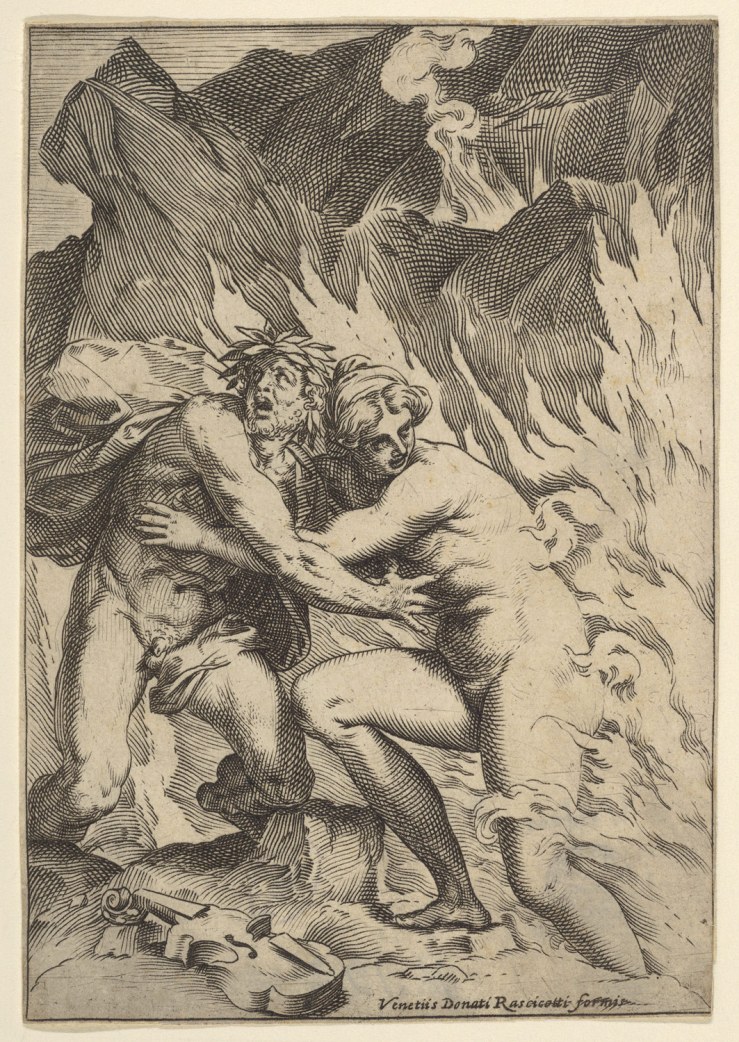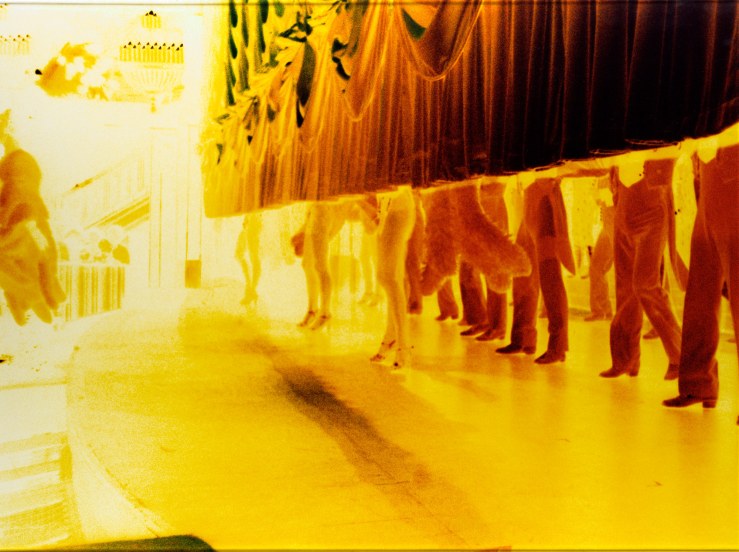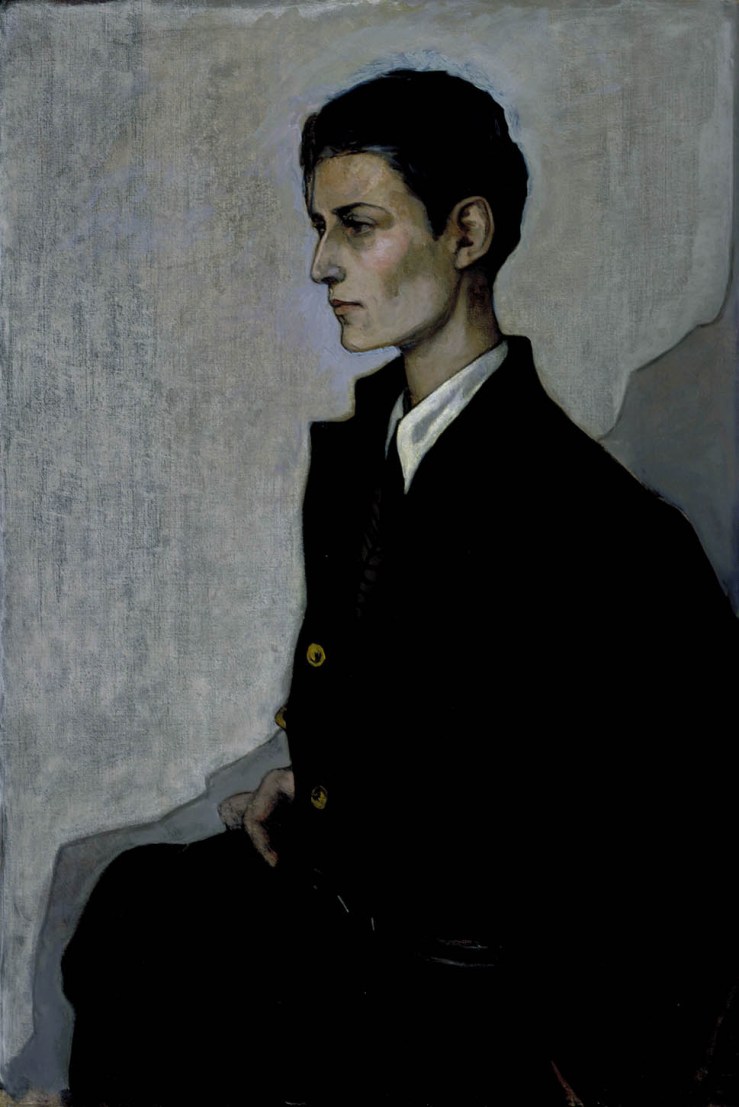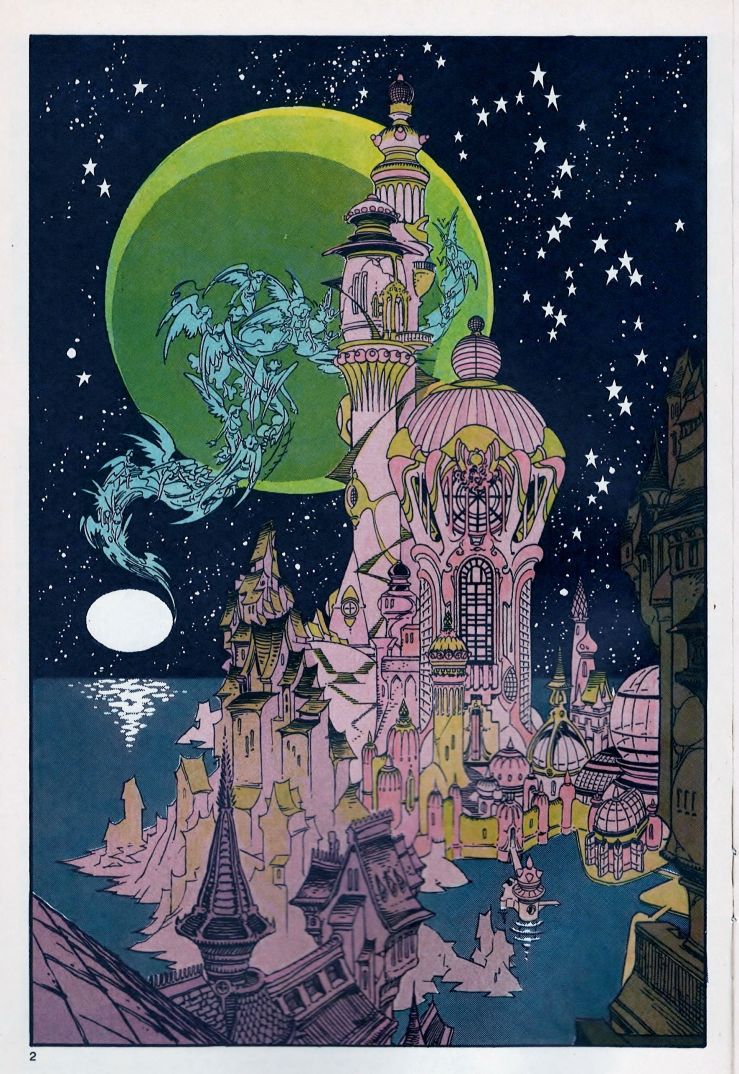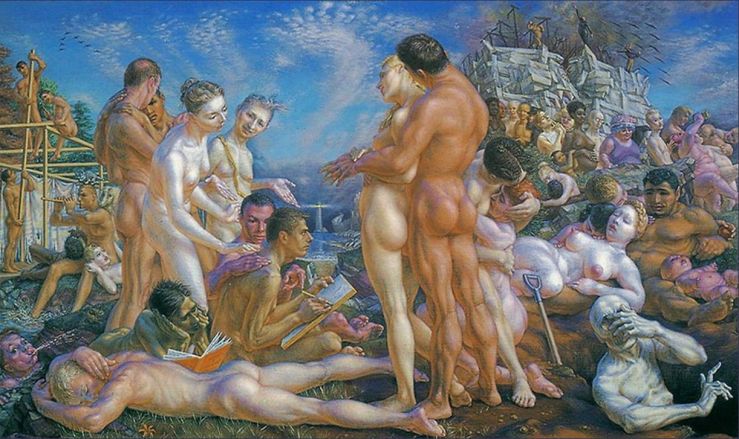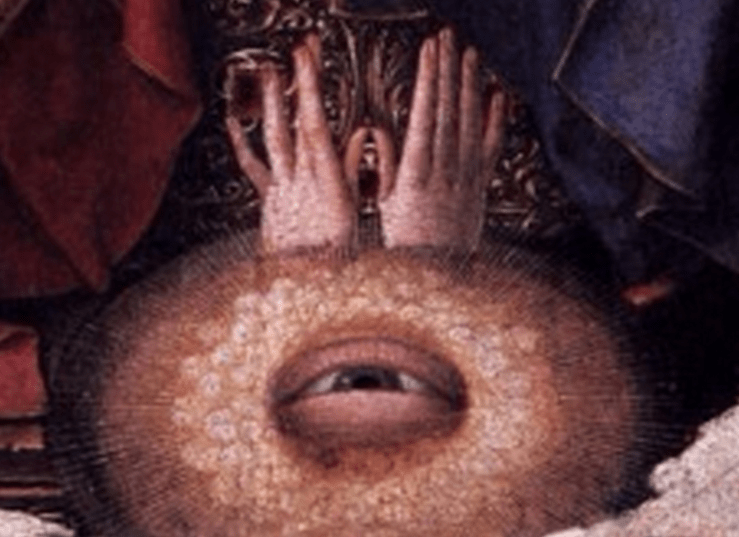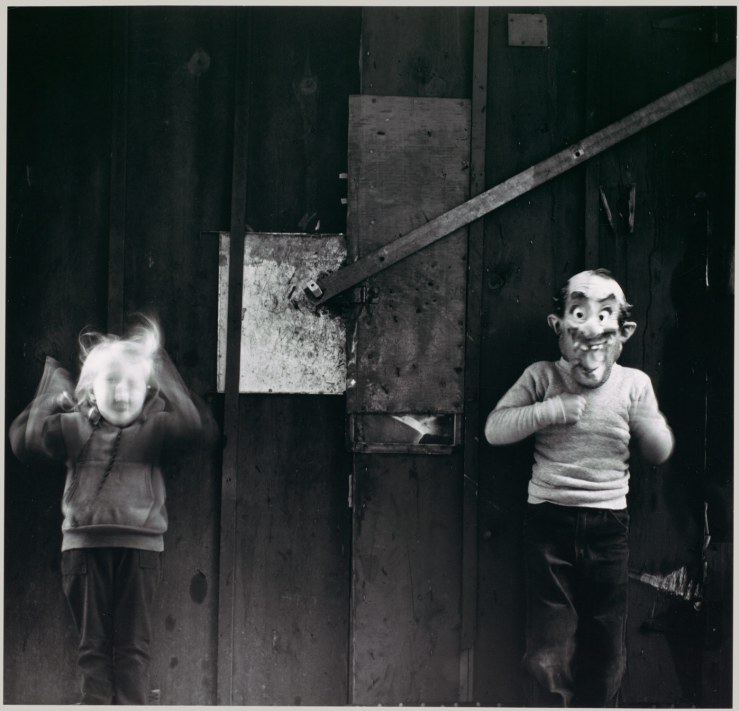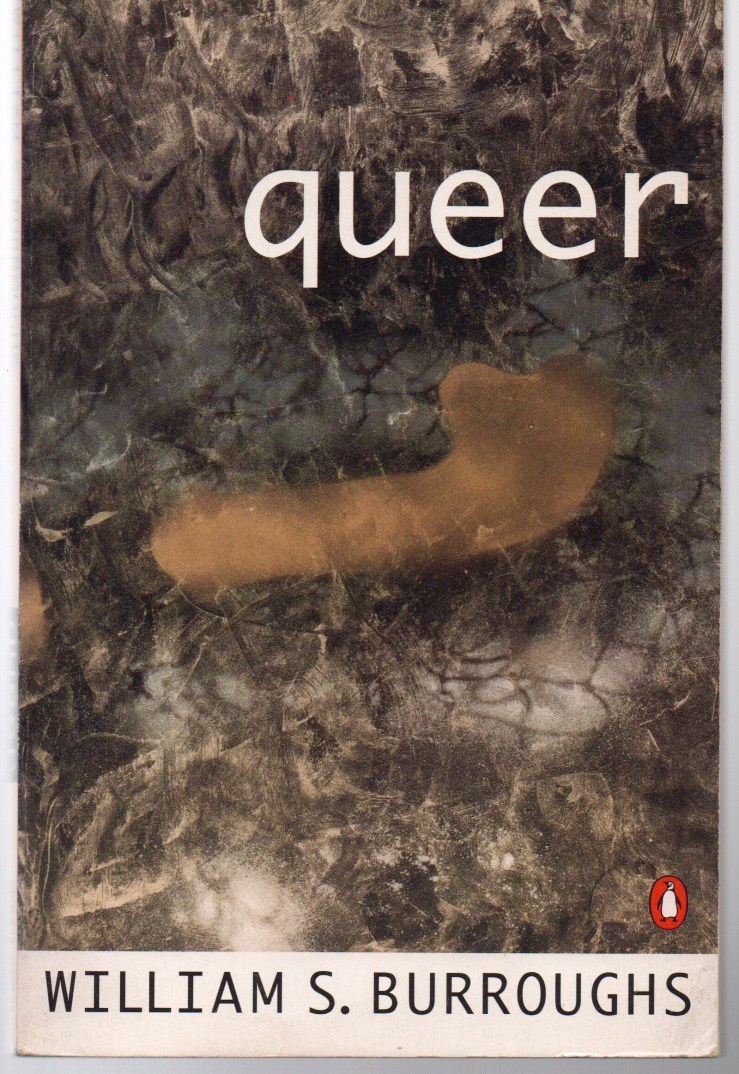
James Hill’s illustration for “The Birthday of the Infanta” by Oscar Wilde. From The Short Stories of Oscar Wilde, Heritage Press, 1968.
“The Birthday of the Infanta”
by
Oscar Wilde
It was the birthday of the Infanta. She was just twelve years of age, and the sun was shining brightly in the gardens of the palace.
Although she was a real Princess and the Infanta of Spain, she had only one birthday every year, just like the children of quite poor people, so it was naturally a matter of great importance to the whole country that she should have a really fine day for the occasion. And a really fine day it certainly was. The tall striped tulips stood straight up upon their stalks, like long rows of soldiers, and looked defiantly across the grass at the roses, and said: ‘We are quite as splendid as you are now.’ The purple butterflies fluttered about with gold dust on their wings, visiting each flower in turn; the little lizards crept out of the crevices of the wall, and lay basking in the white glare; and the pomegranates split and cracked with the heat, and showed their bleeding red hearts. Even the pale yellow lemons, that hung in such profusion from the mouldering trellis and along the dim arcades, seemed to have caught a richer colour from the wonderful sunlight, and the magnolia trees opened their great globe-like blossoms of folded ivory, and filled the air with a sweet heavy perfume.
The little Princess herself walked up and down the terrace with her companions, and played at hide and seek round the stone vases and the old moss-grown statues. On ordinary days she was only allowed to play with children of her own rank, so she had always to play alone, but her birthday was an exception, and the King had given orders that she was to invite any of her young friends whom she liked to come and amuse themselves with her. There was a stately grace about these slim Spanish children as they glided about, the boys with their large-plumed hats and short fluttering cloaks, the girls holding up the trains of their long brocaded gowns, and shielding the sun from their eyes with huge fans of black and silver. But the Infanta was the most graceful of all, and the most tastefully attired, after the somewhat cumbrous fashion of the day. Her robe was of grey satin, the skirt and the wide puffed sleeves heavily embroidered with silver, and the stiff corset studded with rows of fine pearls. Two tiny slippers with big pink rosettes peeped out beneath her dress as she walked. Pink and pearl was her great gauze fan, and in her hair, which like an aureole of faded gold stood out stiffly round her pale little face, she had a beautiful white rose.
Only a handful of novels are so perfectly simultaneously comic and tragic. Moby-Dick? Yes. Gravity’s Rainbow? Absolutely. (G R and J R, a duo published two years apart, spiritual twins, massive American novels that maybe America hardly deserves (or, rather: theses novels were/are totally the critique America deserves). I guess maybe what I’m saying is J R is the Great American Novel to Come (The Recognitions is perhaps overpraised and certainly not Gaddis’s best novel; J R is. The zeitgeist has been caught up to J R, the culture should (will) catch up).
…the product of a global attack on the commons, the great trove of air, water, plants and creatures, as well as collectively created cultural forms such as language, that have been regarded traditionally as the inheritance of humanity as a whole…capital of course depends on continuous commodification of this environment to sustain its growth.
My reading of Extinction—and hence my writing about it—is/was inextricably bound up in a viewing of Hayao Miyazaki’s 1997 eco-fable 1997 , Mononoke-hime. (The film’s title is usually rendered in English asPrincess Mononoke, but I think Spirit-Monster Wolfchild is a more fitting translation). I also linked the book to Gilgamesh and Easter. And I used this gif:
Breath (pneuma) has always been seen as a sign of life . . . Language is speech before it is anything. It is born of babble and shaped by imitating other sounds. It therefore must be listened to while it is being written. So the next time someone asks you that stupid question, “Who is your audience?” or “Whom do you write for?” you can answer, “The ear.” I don’t just read Henry James; I hear him. . . . The writer must be a musician—accordingly. Look at what you’ve written, but later … at your leisure. First—listen. Listen to Joyce, to Woolf, to Faulkner, to Melville.
I reviewed Mahendra Singh’s marvelous satire American Candide. Far better than my measly review is a long interview I did with Singh, who is just a damn genius. I’m most grateful for the final exchange of our review, which was not really a part of the official q & a type thing we were doing—rather, I was bemoaning my ability to write anything lately, and Mahendra offered me the following, which I edited into the interview:
The hidden contempt that our culture harbors towards art will drive you nuts if you think about it … so don’t think too much … write instead! And if you can’t write, read smartly. I find great solace in the classics and have devoted most of my life to trying in whatever way I can to perpetuate the classical tradition (in concealment) and create situations where young people can gain access to the eternal truths and beauty of the classical world tradition. We are living in a time of imperial decline and must preserve the best of the past as our ancestors did in similar times of trouble. The pendulum will swing the other way in a few centuries.
While the High-Rise adaptation delivers Ballardian style, that Ballardian style only points at itself, and not at our Ballardian present, our Ballardian future.
My Struggle, Book 1 by Karl Ove Knausgaard. English translation by Don Bartlett. First edition trade paperback by FS&G, 2013. Cover design by Charlotte Strick and Bill Zindel, with cover art by Bill Zindel.
My Struggle, Book 2 by Karl Ove Knausgaard. English translation by Don Bartlett. First edition trade paperback by FS&G, 2014. Cover design by Charlotte Strick; photograph by Andreas Eikseth Nygjerd.
Look at our boy Knausgaard, smokin’ away! This cover is boring but not Bad, which makes it far less interesting than the Bad Knausgaard cover which is actually very Good. The Book 2 cover (and subsequent covers in the series) are safe and “stylish”—and when I write “stylish,” I use it in the way many writers use it—thoughtlessly, blankly—stylish as a word that points vaguely to the idea of style, the zeitgeistiness of style. Etc. (Again—I encourage you to check out Zindel’s vision for the whole series).
My Brilliant Friend by Elena Ferrante. English translation by Ann Goldstein. Fifteenth printing, Europa Editions, 2015. Book design by Emanuele Ragnisco; cover photo by Anthony Boccaccio.
My Brilliant Friend is brilliant, my friend.
Its cover is awful, and the subsequent covers in the so-called Neapolitan Novels quartet are somehow worse.
A good friend who’s never steered me wrong with a reading recommendation told me to read Ferrante last year, but I didn’t—it wasn’t the hype that put me off (although the hype put me off), but the covers. I finally acquiesced to an audiobook version, and after getting a few chapters in, wanted the text. So I caved.
But my god, the cover—why?
The publisher and art director(s) claim that the Ferrante covers are bad on purpose.
An article in Quartz that I found simply by googling “Ferrante covers awful” yields this nugget:
…Sandro Ferri, Europa Editions’ publisher, says the covers were not an accident of too many cooks in the design kitchen, but rather a conscious choice. Writes Ferri in an email to Quartz, “The ‘vulgarity’ is our intention. We don’t want to make the typical ‘literary’ cover designed for an audience of ultra-sophisticated readers. … Ferrante’s novels are a mix of popular literature and highbrow, intellectual writing. We want to communicate this though our covers as well.”
And in a Slate interview, EE co-founder/publisher Sandra Ozzola again asserts that the decision for tacky covers was, um, purposeful:
From the time of our first conversation with Elena Ferrante about her intention to write this novel, we knew the book’s title and that it would be the story of a long friendship between women—and that it would conclude with a scene of a very vulgar Neapolitan wedding. The wedding and Elena’s impression of it … is an extremely important moment in the book. That’s why I intentionally searched for a photo that was “kitsch.” This design choice continued in the subsequent books, because vulgarity is an important aspect of the books, of all that Elena wants to distance herself from.
If we take a book’s cover to be where the book “begins,” where we first start to read the text, then EE’s awful kitschy crappy ugly covers signal postmodern irony—a joke on perception, the marketplace, high-low aesthetics, etc. The covers work as a kind of metatextual critique, then, as Ozzola seems to suggest above—a critique that relies on the reader’s understanding of the novel’s central character’s aesthetic viewpoint.
Well so then: Are the covers indeed ironic critiques of book-cover-aesthetics? Are we to take these covers as pop art parodies of books that traffic in romantic aspirations, that are, like, marketed to women?
Or are these covers simply designed to appeal to the very market that they would claim to ironically mock?
The have-your-cake-and-eat-it-too postmodern answer to these questions is, of course, “Yes.”
Mr Chong told The New Daily it can be dangerous to try irony on a book’s cover – especially if the joke isn’t clear to readers.
“You have to signal the irony really clearly otherwise the recipient doesn’t realise the irony,” Mr Chong said.
“You have to signal the irony really clearly” — okay, sure. But the finest satire never announces itself as such.
Chong’s new covers feature simple black-and-white photographs, and they have received praise. But in a sense, the Australian covers seem, at least to me, to echo those Knausgaard updates—safe, boring even. But I’d much rather be seen reading one of those, than, say, the original EE edition of The Story of the Lost Child, which has maybe the worst cover I’ve ever seen.
Europa Editions’ forthcoming Ferrante collection, Frantumaglia, has a great cover, by the way.
Juan Pablo Villalobos’s I’ll Sell You a Dog is forthcoming (this August) from And Other Books. English translation by Rosalind Harvey. Publisher’s blurb:
Long before he was the taco seller whose ‘Gringo Dog’ recipe made him famous throughout Mexico City, our hero was an aspiring artist: an artist, that is, till his would-be girlfriend was stolen by Diego Rivera, and his dreams snuffed out by his hypochondriac mother. Now our hero is resident in a retirement home, where fending off boredom is far more gruelling than making tacos. Plagued by the literary salon that bumps about his building’s lobby and haunted by the self-pitying ghost of a neglected artist, Villalobos’s old man can’t help but misbehave.
He antagonises his neighbours, tortures American missionaries with passages from Adorno, flirts with the revolutionary greengrocer, and in short does everything that can be done to fend off the boredom of retirement and old age . . . while still holding a beer.
A delicious take-down of pretensions to cultural posterity, I’ll Sell You a Dog is a comic novel whose absurd inventions, scurrilous antics and oddball characters are vintage Villalobos.
[Editorial note: The following citations come from one-star Amazon reviews Elena Ferrante’s novel My Brilliant Friend. I’ve preserved the reviewers’ original punctuation and spelling. I love Ferrante’s novel, by the way. More one-star Amazon reviews].
ugh
Odd book
too wordy
so violent
so bummed
Depressing
It’s a series
stupid critics
Maybe terrific
I was so board
Did outline it all
I loved this book
It simply ended!!
So many characters
Too many characters
Not so Good this time
like Twitter on steroids
angst-filled adolescence
I’m an uncultured swine
Everyone in our book club
reading it for my book club
the ending was a dirty trick
there are over 40 characters
Riddled with punctuation errors
Chick lit with no plot or substance
This book is an exercise in despair
I was looking forward to this trilogy
by far the worst book I have every read
Of course it’s a matter of personal taste
the characters were not very nice people
I consider family sagas my favorite genre
endless clusters of names, names, names
Italian names that are difficult to remember
the characters are unlikable (and confusing)
we finished it only because it was Book Club
I damned near tore out what’s left of my hair
too many characters none of whom are likable
a story of domestic violence and male dominance
This book could not have been written by a woman
the main characters are interdependent in a very sick way
Boring and couldn’t Finnish it despite raves from others.?
Just couldn’t get past the violence and disrespect of people
found myself having to look back to figure out who was who
the two central characters may have been intended to be complex and interesting (and may be across the series) they were boorish and flat
the narrator was dryly describing events, as opposed to us being shown what happens through her interaction with characters and the world around her
the struggle of two smart intelligent girls to escape their poor brutal neighborhood in vain
basically a long list of long Italian names and stereotypes
one of my favorite books is The Brothers Karamazov
Mahendra Singh is an author, illustrator and editor in Montreal. His other published books include a graphic novel version of The Hunting of the Snark, illustrations for D.A. Powell’s Cocktails, BSFA-award winner Adam Roberts’s 20 Trillion Leagues Under the Sea and Martin Olson’s NYT-best selling Adventure Time Encyclopaedia. American Candide is his first novel—read my review of it here. He was kind enough to talk with me about American Candide over a series of emails.
Biblioklept: How long have you been working on American Candide? When did you get the germ for the book?
Mahendra Singh: The Iraq War and its brazen marketing campaign got me started on American Candide. Not just the war but the hopelessness of opposing it made me realize how lightly the Enlightenment sits upon modern America. The way that people insisted upon being told what to think, it was torn from 18th-century headlines. Also, the ease with which religion fit into the war’s marketing scheme, almost like it was made for that … It’s not just the USA, of course, this is human nature throughout the world but since modern America is the equivalent of the Ancien Regime in so many ways, a riposte from the Enlightenment seemed indicated.
I had always wanted to update a classic that is only a classic because it no longer stings. Voltaire’s attacks on god, the military, imperialism and money don’t make many people squirm anymore. I wanted genuine squirm … I wanted younger readers to realize that we read the classics not because of dead white guys or because everybody-says-so but because the classics show us how little human nature changes. And once you realize that things were just as weird in the 18th-century, then you are embarked on the path of genuine free-thinking. It worked for some of the Founding Fathers so it’s actually double-plus-more patriotic than being clueless-and-proud-of-it.
I started working seriously on American Candide around the time of Hurricane Katrina (which could have been a 21st-century Lisbon Earthquake if it had happened to Boston) and the book’s first draft was done in about 3 months. I wanted to match Voltaire’s MO as best as possible:
1. Same word count
2. As close to the original plot as possible
3. Easy to read with no stylistic stuff to impede the story. Voltaire knew people don’t want to be preached to, they want to laugh and then you slip them the mickey. Hence the book can be read in three sessions (toilet, subway, opium den), I really did plan that.
After the first draft, it took several years to finish because I also freelance as an illustrator. Unlike Voltaire, I don’t live off the stock market.
Biblioklept: Was there a particular translation of Candide that you worked from or favored? Or did you read it in French, perhaps?
Mahendra Singh
MS: I used the Barnes & Noble reprint of the old Henry Morley translation, revised by Lauren Walsh. I am not too fussy about translations and this one is fine. But the number one reason I got this edition is that it features the excellent illustrations of Alan Odle, a sort of Bloomsbury precursor of Ralph Steadman. I don’t know much about him but his sense of the grotesque was unique. An inspired choice of illustrator for this text. The cover price of $4.95 also influenced my decision.
I’ve read Candide in French and Morley is a bit more turgid than The Master … Voltaire’s French is slightly flatter and lighter. My French is not very good, most Francophones freak out when they hear me mangling their mother tongue. They are more touchy about that than Anglophones, which probably explains why English is the global lingua franca, ha!
Even people who don’t speak a word of French freak out when I do so. Must be the moustache, like watching Saddam Hussein doing his cocktail party impression of Pepe le Pew. You WILL laugh.
Biblioklept: I first read Candide in Lowell Bair’s translation, with some awfully bawdy illustrations (by Sheilah Beckett) that left an indelible mark on me. The book zapped me. I was in the 10th grade and I didn’t know that such literature existed—that serious literature, like, the lit that the English teacher assigned could be like Marvel Comics, with folks dying in wild ways and then coming back to life. I want to come back to illustrations in Candide in a bit, but I’m curious about your first encounter with the book…
MS: After a bit of internet poking, I found some samples of your Candide illustrator, Sheilah Beckett, and was very impressed. That old-fashioned, fluid American draftsmanship, I love it. I did some more poking and found the first Candide I read, probably when I was about 12 years old, the Washington Square Press paperback with Zadig included, translator Tobias Smollett. I remember enjoying both stories as amazingly fast-paced ripping yarns. I was also a Gulliver’s Travels fan and Smollett must have made the connection even stronger.
My father was an English professor so our home was a bookworm’s paradise, he had a home and office library. I had read pretty widely in the classics by then and I remember sensing that there was something hidden behind the surface in Voltaire, not quite accessible to a kid and thus even more intriguing. The authorial perversity of punishing the hero and allowing the wicked to prosper without ever once doing something about it, it was very adult … but clearly not the standard-issue adult of 1960s-70s America.
That is the genius of Voltaire, when it comes to ideas AND execution, he is perpetual beta. The Enlightenment still inspires fear and loathing in most quarters, the drooling imbecility of contemporary politics and mass-media is proof positive of that.
Biblioklept: The drooling imbecility of contemporary politics and mass-media is what makes American Candide a possible book, a funny book, but also, I think, a somewhat sad book.
MS: I made a reader laugh and weep simultaneously, success at last! The original Candide was also black-humored but at least Voltaire’s readers could hope that their on-going Enlightenment was going to change things. We know nothing’s changed that much and American Candide wallows in that particular Slough of Despond. We are a drooling species of slack-jawed idiots and the more we try to clean up, the more we smear ourselves filthy.
The core message of the Enlightenment is thinking-for-yourself, as clearly and simply as possible. It’s very difficult, no matter how clever we think we are, it’s genuine hard work and we are a profoundly lazy and shiftless species. You will never get a majority of Homo sapiens to simultaneously think logically about anything (especially in voting booths). We only think in disorganized spurts, usually on our own and in the privacy of our own homes, just in case any other monkeys are snooping around, looking for easy egg-head prey.
The current American political mess is just mass cognition waxing and waning in a natural cycle, it’s not an American thing, it’s a human thing. The wicked revel in their cleverness while the mob cheers them on, despite the hurt it does them … that’s as old as the Peloponnesian War. At some point, things will improve, probably after considerable pain and suffering for those who least deserve it and most tried to get out of its way. A clinching argument to prove the suitability of god’s plan for us if you think god was made in the human image.
Life’s a bummer but perhaps after we struggle and suffer all our lives for mostly nothing in particular, we’ll die and be reborn as cute puppies or cuddly kittens. That’s what religion’s about, mostly … it is all a bit sad, I agree, but it could be even worse — what if all the rubbish inside people’s heads was actually true?
So let’s count our blessings and laugh, laugh, laugh!