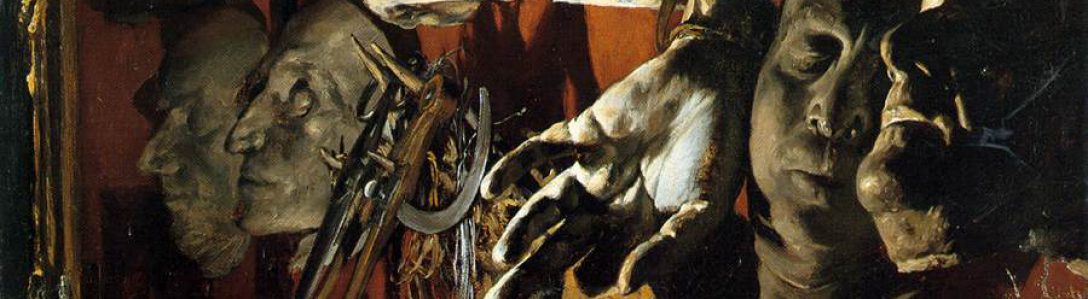
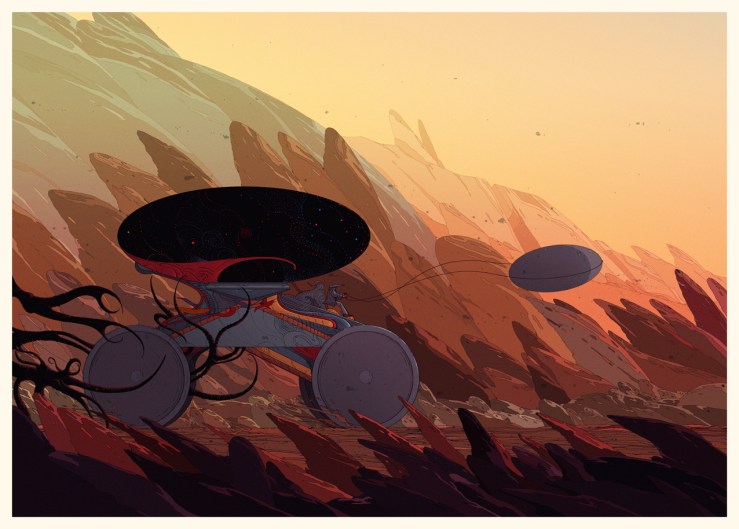
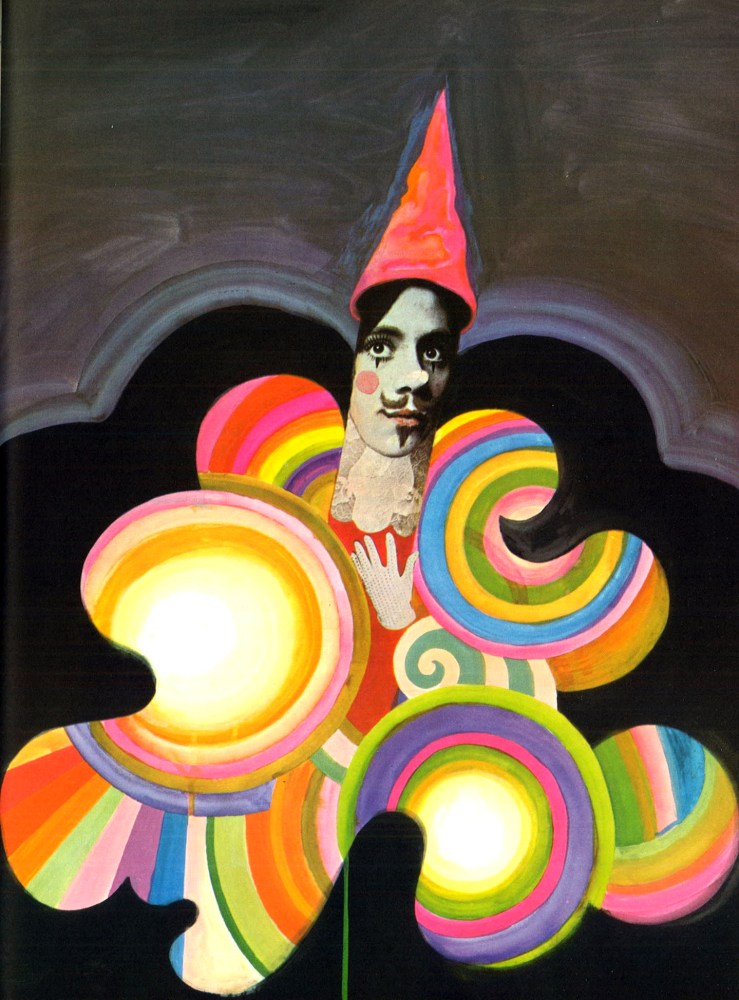
James Hill’s illustration for “The Remarkable Rocket” by Oscar Wilde. From The Short Stories of Oscar Wilde, Heritage Press, 1968.
“The Remarkable Rocket”
by
Oscar Wilde
The King’s son was going to be married, so there were general rejoicings. He had waited a whole year for his bride, and at last she had arrived. She was a Russian Princess, and had driven all the way from Finland in a sledge drawn by six reindeer. The sledge was shaped like a great golden swan, and between the swan’s wings lay the little Princess herself. Her long ermine cloak reached right down to her feet, on her head was a tiny cap of silver tissue, and she was as pale as the Snow Palace in which she had always lived. So pale was she that as she drove through the streets all the people wondered. ‘She is like a white rose!’ they cried, and they threw down flowers on her from the balconies.
At the gate of the Castle the Prince was waiting to receive her. He had dreamy violet eyes, and his hair was like fine gold. When he saw her he sank upon one knee, and kissed her hand.
‘Your picture was beautiful,’ he murmured, ‘but you are more beautiful than your picture;’ and the little Princess blushed.
‘She was like a white rose before,’ said a young Page to his neighbour, ‘but she is like a red rose now;’ and the whole Court was delighted.
For the next three days everybody went about saying, ‘White rose, Red rose, Red rose, White rose;’ and the King gave orders that the Page’s salary was to be doubled. As he received no salary at all this was not of much use to him, but it was considered a great honour, and was duly published in the Court Gazette.
When the three days were over the marriage was celebrated. It was a magnificent ceremony, and the bride and bridegroom walked hand in hand under a canopy of purple velvet embroidered with little pearls. Then there was a State Banquet, which lasted for five hours. The Prince and Princess sat at the top of the Great Hall and drank out of a cup of clear crystal. Only true lovers could drink out of this cup, for if false lips touched it, it grew grey and dull and cloudy.
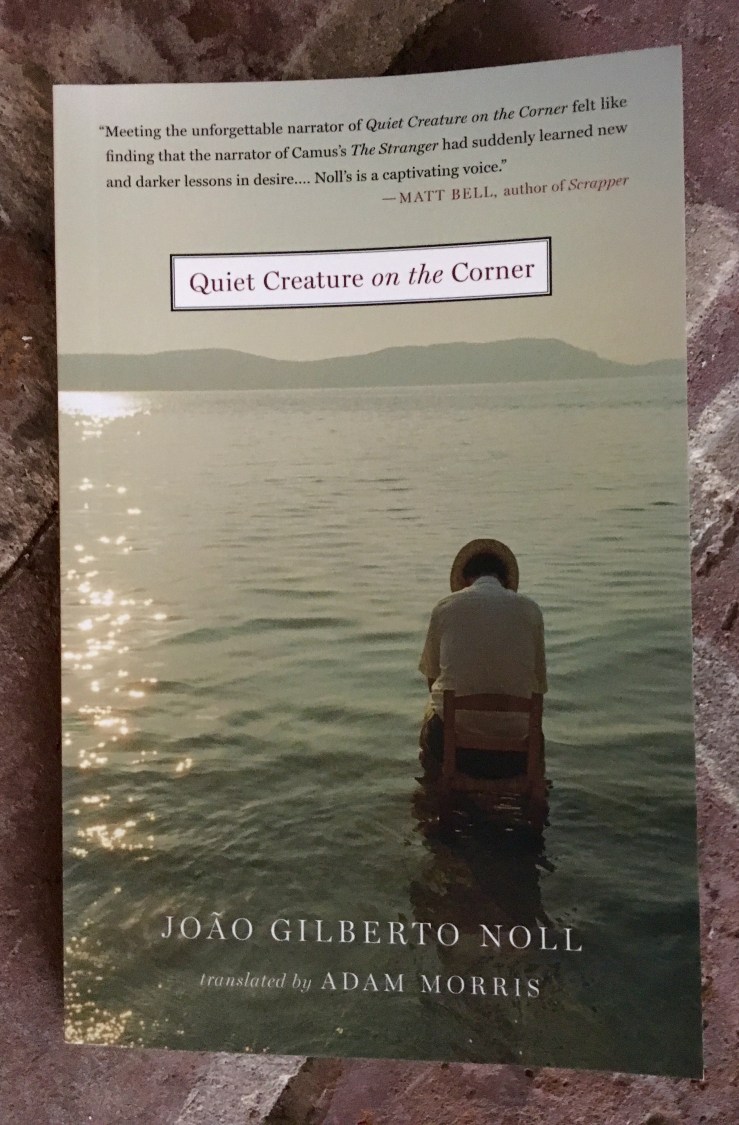
In today’s mail I found a small package from Two Lines Press containing João Gilberto Noll’s 1991 novella Quiet Creature on the Corner, freshly translated into English from Portuguese by Adam Morris.
I started into the Noll. Each sentence made me want to read the next sentence. What is it about? you ask, perhaps. Well. I’m not sure. Let’s say the style, the tone, the mood are what matters here: Dark, nightmarish, abject, kinetic, surreal. There’s a picaresque bent to Quiet Creature: one damn thing happening after another. Dare I drop the K word? Kafkaesque? Sure. (The opening pages remind me much of the opening sections of Alasdair Gray’s Lanark, for some reason—the dark dream logic). Okay, but what is it about? Gosh. Wait, there’s a blurb on the back of the book:
…Quiet Creature on the Corner throws us into a strange world without rational cause and effect, where everyone always seems to lack just a few necessary facts. The narrator is an unemployed poet who is thrown in jail after inexplicably raping his neighbor. but then he’s abruptly taken to a countryside manor where all that’s required of him is to write poetry. What do his captors really want from him?
I’ve just gotten to the countryside manor part myself, so I can’t say. I know that in the 30 pages before that all kinds of weird dark disjointed shit happens. For example, on the third page, in the novella’s sixth paragraph, our poet narrator, leaving the public library, observes that “soot was falling, and nobody could really say where it came from—in certain places so thick that you couldn’t see the other side of the street.” This is like maybe an early little metaphor of the image-logic of Quiet Creature on the Corner (I love the crunch of the title). At the end of the paragraph, the narrator goes to a pornographic film which he describes to us.
Or another example—and here is where the book zapped me. Our narrator is taken from jail to a clinic, where he is given a nice clean bed and decides to sleep, finally:
I dreamed I was writing a poem in which two horses were whinnying. When I woke up, there they were, still whinnying, only this time outside the poem, a few steps a way, and I could mount them if I wanted to.
And then, for a few pages, Quiet Creature enters into a semi-bucolic reverie, as our hero lives another life, complete with farm, kids, a wife. Hay. I apply semi- to bucolic; sinister vibes underwrite every line so far of this novella. The poet doesn’t so much wake up out of this reverie as he leaves it to walk into another dream/nightmare.
I stuck my head out the window, the postman said there was a letter for Greco. I ran down with my heart pounding. I ruled out the possibility that my parents had written to me. Was it a letter from Lila, from Nino? It was from Lila. I tore open the envelope. There were five closely written pages, and I devoured them, but I understood almost nothing of what I read. It may seem strange today, and yet it really was so: even before I was overwhelmed by the contents, what struck me was that the writing contained Lila’s voice. Not only that. From the first lines I thought of The Blue Fairy, the only text of hers that I had read, apart from our elementary-school homework, and I understood what, at the time, I had liked so much. There was, in The Blue Fairy, the same quality that struck me now: Lila was able to speak through writing; unlike me when I wrote, unlike Sarratore in his articles and poems, unlike even many writers I had read and was reading, she expressed herself in sentences that were well constructed, and without error, even though she had stopped going to school, but—further—she left no trace of effort, you weren’t aware of the artifice of the written word. I read and I saw her, I heard her. The voice set in the writing overwhelmed me, enthralled me even more than when we talked face to face: it was completely cleansed of the dross of speech, of the confusion of the oral; it had the vivid orderliness that I imagined would belong to conversation if one were so fortunate as to be born from the head of Zeus and not from the Grecos, the Cerullos. I was ashamed of the childish pages I had written to her, the overwrought tone, the frivolity, the false cheer, the false grief. Who knows what Lila had thought of me. I felt contempt and bitterness toward Professor Gerace, who had deluded me by giving me a nine in Italian. The first effect of that letter was to make me feel, at the age of fifteen, on the day of my birthday, a fraud. School, with me, had made a mistake and proof was there, in Lila’s letter.
From Elena Ferrante’s 2011 novel My Brilliant Friend. English translation by Ann Goldstein. I love this novel, and what I perhaps love most about it is how Ferrante’s narrator conveys the titular brilliance of her friend Lila. My Brilliant Friend might be summarized in one of its own sentences: “She was trying to understand, we were both trying to understand, and understanding was something that we loved to do.”
For twenty years now Berryman’s lineI conclude now I have no inner resources has been plinking around the inside of my dumb skull. The line is plinking like crazy lately, as I shuffle final exam essays into some kind of order (what order?) that might align with my ability to offer the student, the writer, some meaningful note, some suggestion for improvement, some revelatory remark. Plink plink plink. No inner resources.
It is bad to start with a complaint so I will dress up the preceding paragraph (I dress it mentally) as an apologia. (Why the hell did I decide to write about books online?!).
I’ve been reading some really great books lately, folks. People, yes, you, listen. It’s not true that I have no inner resources. I am unstuck as a reader. I’m all gummed up with what I’ve read. Well-fed. And yet I go to scribble out a, like, review and plink plink plink. Nothing.
But like I said, the reading’s been really good. From the bottom up:
Let me strongly recommend American Candide by Mahendra Singh. I recommend this book for people who enjoy laughing at tragedies that should otherwise make them weep. You can and should purchase this book from Rosarium.
Illustration to American Candide by Mahendra Singh
Above American Candide in the stack so lazily pictured above is Yuri Herrera’s neon noir novella The Transmigration of Bodies, which I also highly recommend. I managed a few words on it here.
If you were to describe Henri Michaux’s Miserable Miracle 1956 book to me, I might politely decline with a small gesture of my hand. It’s about a guy who takes mescaline and writes about the experience and he draws these pictures and then he later takes “Indian hemp” and compares it— you might say to me, you, knowing as you know that I dig weird books, but I would cut you off at with an em dash, polite but firm, Not interested in drug novels these days (and besides dude, you know that Aldous Huxley did kinda the same thing at kinda the same time). And then you, having the book with you might press it into my hand, declaring, No, look—
—and I would say Thanks and consume the book in two sittings.
And so after a few years of false starts, I finally broke through the second chapter of Stanley Elkin’s satire The Franchiser. The many years of recommendations, exhortations (and scoldings) to read The fucking Franchiser were correct and good and now appreciated, as I work my way into the novel’s rich fat middle—but I admit it was Mr. William Gass who finally sold me on a commitment. I read his introduction published elsewhere—in A Temple of Texts—and that was that.
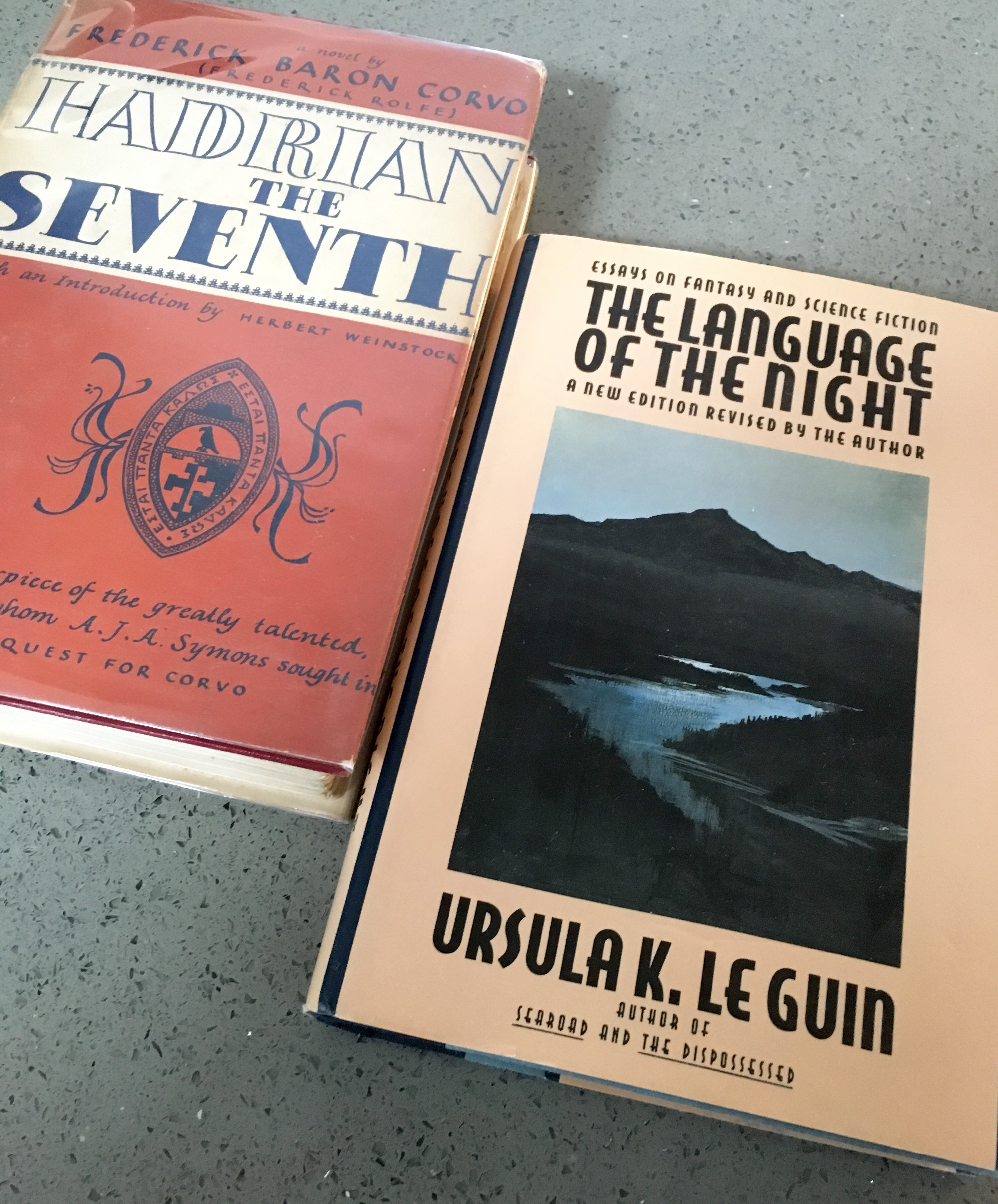
Thanks to Jon for sending me Ursula K. Le Guin’s essay collection The Language of the Night. The collection collects the collective introductions to Le Guin’s so-called Hainish collection, which I read this winter, and wrote about here. Not one of my editions featured the reflections Le Guin (or more likely her editors) called “Introductions” in later essays, and reading the Hainish intros is, in a very slight sense, like rereading those books. Lovely.
Last and never least: Tom Clark’s The Last Gas Station and Other Stories. I’ve thought often of Clark’s poems as stories pretending to be poems so maybe these are poems pretending to be stories. Or maybe I have no idea what the fuck I’m talking about. (Plink plink plink). I read most of them except for the longest one, “Incident at Basecamp,” which I will save save save for the future, an old habit, maybe a bad habit, that, to read all but one story in a collection, to maybe keep the collection afresh somehow or not wholly discovered—eh? Plink plink plink. Wag.
Last week I crammed my thoughts about the death of Prince into one of these “Three Books” posts I’ve doing each Sunday for around 30 Sundays now (I plan to do 52, if anyone cares or counts). I grabbed a bunch of purple books and scanned them, and I still have the scans saved, so today’s Three Books are, I guess, books that I deemed not-quite-purple-enough for last week’s post. My thoughts on Prince remain the same: I’m still vaguely shocked at his death and shocked at my shock at his death. I tried to write a Thing on Prince’s sexy dystopian visions, but I failed. Give me the electric chair 4 all my future crimes.
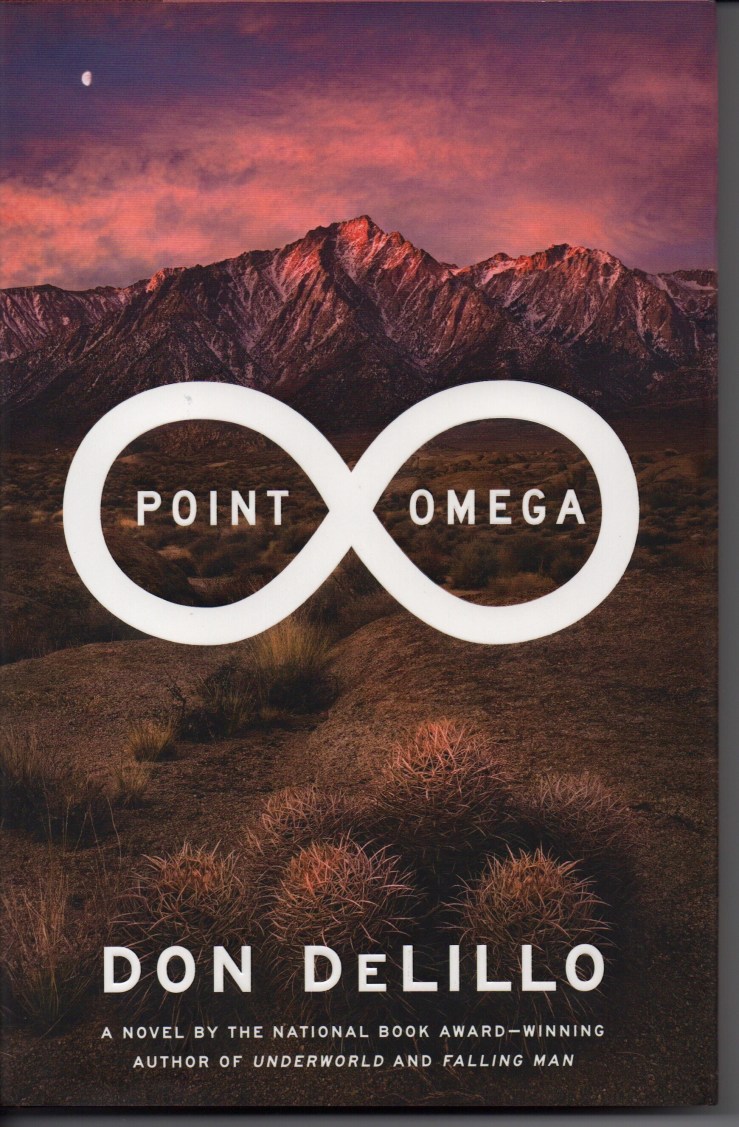
Point Omega by Don DeLillo. First edition hardback, Scribner, 2010. Jacket design by Rex Bonomelli using a photograph by Marc Adamus. I reviewed Point Omega when it came out, noting that it “is not a particularly fun book nor does it yield any direct answers, but it’s also a rewarding, engaging, and often challenging read.” The book got somewhat mixed reviews, but I think in retrospect it’s quite underrated. DeLillo wrote one of the earliest paraphrases of the Bush Wars here (without really writing a summation and without really writing a war novel), and I think about the book often—whenever I read a little digital clipping about Cheney or Wolfowitz or Rumsfeld or any of the Old Neocon Gang—and the hacks and mouthpieces who supported them.
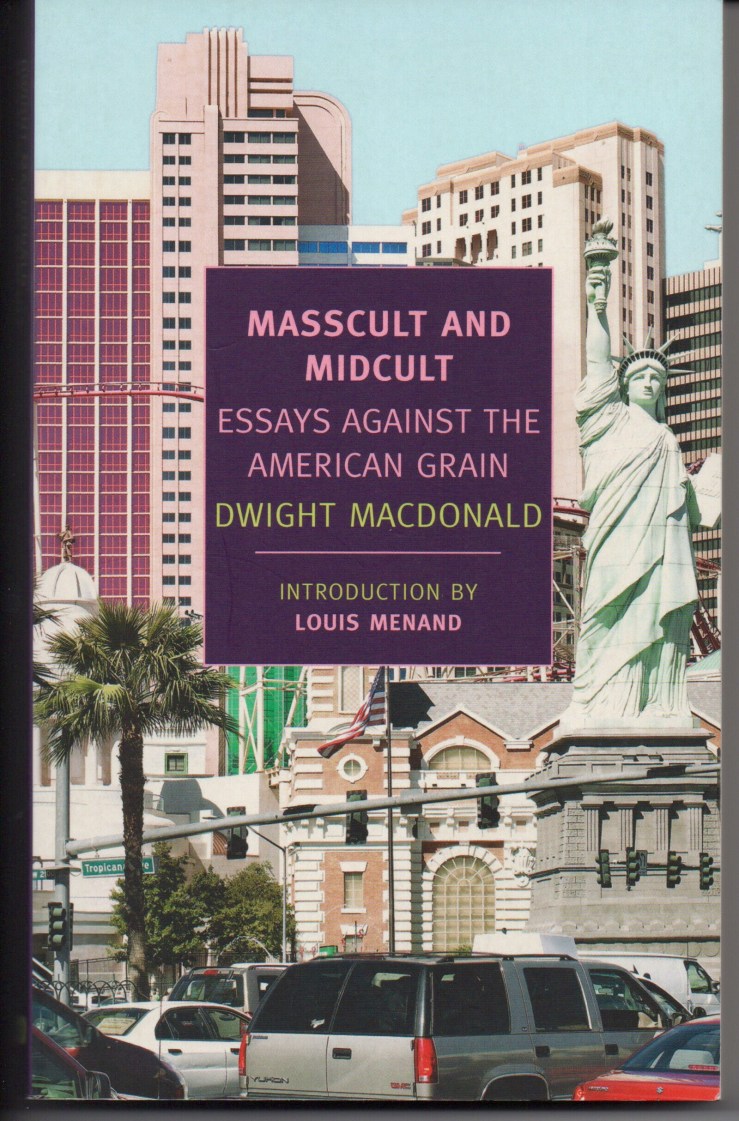
Masscult and Midcult: Essays against the American Grain by Dwight Macdonald. Edited by John Summers. Published by NYRB, 2011. Cover design by Katy Homans; the cover image is a detail of Cedric Delsaux’s photograph 88, Las Vegas Casino 1. I reviewed Masscult a few years ago. The book has some perceptive essays, and its title essay is essential cultural criticism.
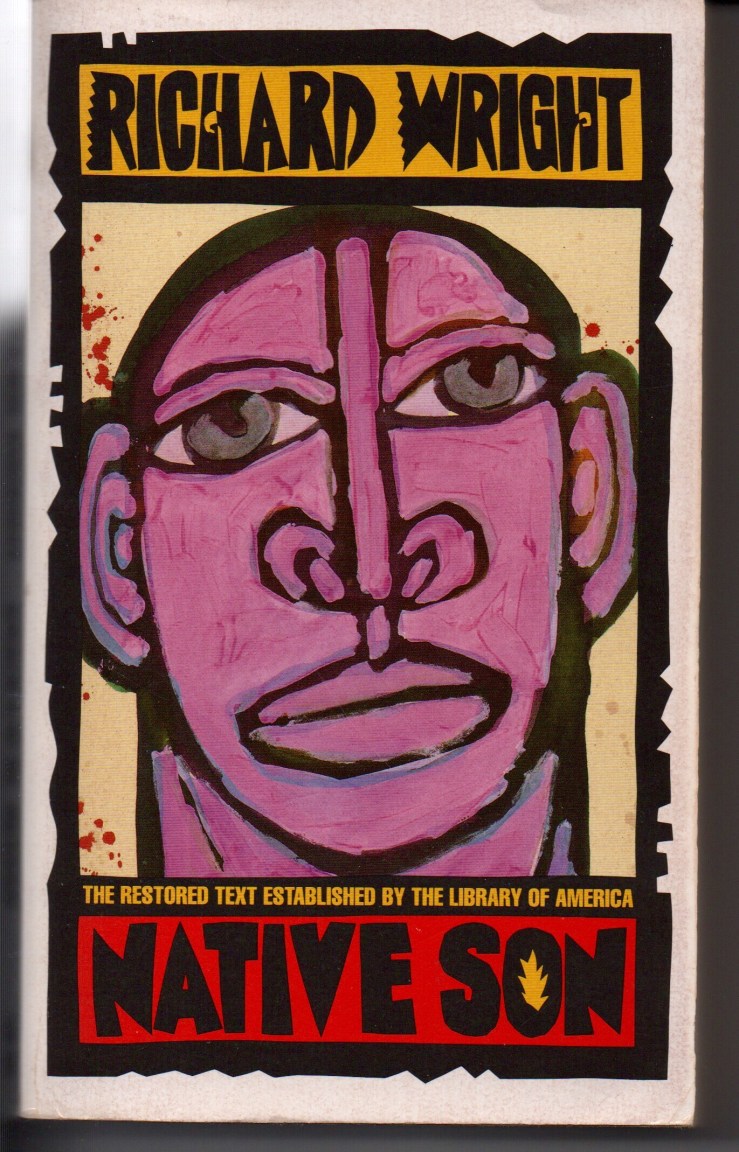
Native Son by Richard Wright. Mass market paperback edition by Harper Perennial, 1993. Cover design and illustration by David Diaz. This book was part of a class set I used years ago when I taught AP English Literature. It left with me when I left that job.





 Biblioklept