Watch Discovering Electronic Music, a 1983 Documentary about Synthesizers and Sampling

Ivan Tsarevich Riding the Grey Wolf — Viktor Vasnetsov

“The Company of Wolves” — Angela Carter

“The Company of Wolves”

by

Angela Carter

One beast and only one howls in the woods by night.

The wolf is carnivore incarnate and he’s as cunning as he is ferocious; once he’s had a taste of flesh then nothing else will do.

At night, the eyes of wolves shine like candle flames, yellowish, reddish, but that is because the pupils of their eyes fatten on darkness and catch the light from your lantern to flash it back to you–red for danger; if a wolf’s eyes reflect only moonlight, then they gleam a cold and unnatural green, a mineral, a piercing colour. If the benighted traveller spies those luminous, terrible sequins stitched suddenly on the black thickets, then he knows he must run, if fear has not struck him stock-still.

But those eyes are all you will be able to glimpse of the forest assassins as they cluster invisibly round your smell of meat as you go through the wood unwisely late. They will be like shadows, they will be like wraiths, grey members of a congregation of nightmare; hark! his long, wavering howl … an aria of fear made audible.

The wolfsong is the sound of the rending you will suffer, in itself a murdering.

It is winter and cold weather. In this region of mountain and forest, there is now nothing for the wolves to eat. Goats and sheep are locked up in the byre, the deer departed for the remaining pasturage on the southern slopes–wolves grow lean and famished. There is so little flesh on them that you could count the starveling ribs through their pelts, if they gave you time before they pounced. Those slavering jaws; the lolling tongue; the rime of saliva on the grizzled chops–of all the teeming perils of the night and the forest, ghosts, hobgoblins, ogres that grill babies upon gridirons, witches that fatten their captives in cages for cannibal tables, the wolf is worst for he cannot listen to reason.

You are always in danger in the forest, where no people are. Step between the portals of the great pines where the shaggy branches tangle about you, trapping the unwary traveller in nets as if the vegetation itself were in a plot with the wolves who live there, as though the wicked trees go fishing on behalf of their friends–step between the gateposts of the forest with the greatest trepidation and infinite precautions, for if you stray from the path for one instant, the wolves will eat you. They are grey as famine, they are as unkind as plague. Continue reading ““The Company of Wolves” — Angela Carter”

Allegorical Portrait of Dante – Agnolo Bronzino

The Artist with a Skull: Optical Illusion from the Eye Disease — Edvard Munch

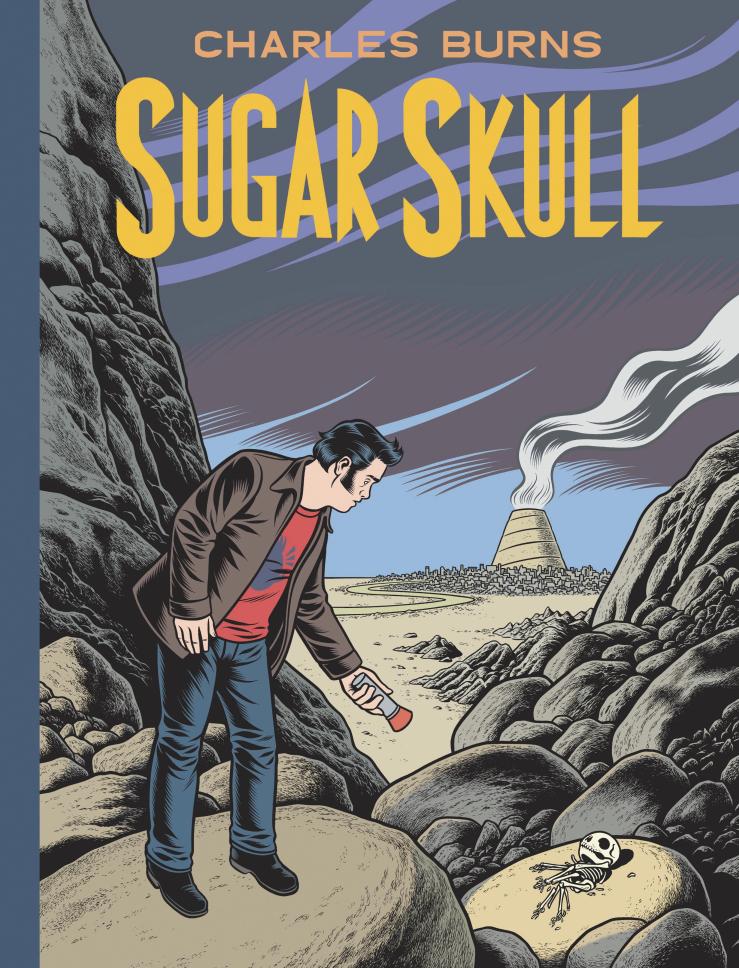
Charles Burns’s Sugar Skull Reviewed

978-0-307-90790-5

Sugar Skull concludes the trilogy that Charles Burns began four years ago with X’ed Out (I reviewed it here) and its 2012 follow-up The Hive (I reviewed it here).

In X’ed Out, Burns introduces us to his protagonist Doug, a would-be art-punk poet whose Burroughsesque sound-collage performances are misunderstood by everyone but Sarah, a troubled artist whose photographs and installations reverberate with menacing violence. We first find Doug in the aftermath of an unnamed trauma involving Sarah and her tyrannical boyfriend—a trauma that Sugar Skull must and does answer to. The trauma transports Doug from his dead father’s office, where he’s been hiding and popping pills, into a fever-dreamscape reminiscent of William Burroughs’s Interzone. In this world, Doug becomes Nitnit, his own features transmuted to the Tintin mask he wears when performing his cut-ups.

The Hive takes Doug/Nitnit even deeper into Interzone, into its subterranean caverns, gaping like tumorous wombs, while simultaneously moving the “real” Doug forward and backward in time, through his doomed relationship with Sarah and into the fallout of their split, where Doug short circuits.

Sugar Skull completes this circuit, offering readers the complete picture—and an exit out of Interzone—even as it dooms Doug/Nitnit to repeat the past. We find here the traumatic violence of love, death, begetting, and denial.

burnsxedouthive

The trilogy’s development evinces in Burns’s rich cover art. X’ed Out shows us young, skinny Doug, his head bandaged, his haircut an echo of Tintin’s cowlick. Wrapped in his dead father’s purple robe and set against utter wreckage, young Doug regards a massive egg, itself a visual echo of Tintin cover. The cover of The Hive shows us an older, heavier Doug, lost and confused in the abject uterine labyrinth of the Hive. In the lower-right corner—the same space the egg occupies on the cover of X’ed Out—lurks one of Interzone’s mutable mutants. This figure repeats in the trilogy, an amorphous being who shifts from Nitnit’s aide and familiar, to a dog stranded in a flood, to a piglet in a jar, to a massive breed-sow, to, perhaps, Doug’s father—and then Doug himself.

The figure opposite an older, fatter Doug on the cover of Sugar Skull condenses these roles into the emblem of death: it is at once the skeleton of the mutant, but also the frame of Doug’s dead father and the emblem of the symbolic infanticide at the core of the trilogy. And so we get the natural progression of life—from egg and embryo to a pink bundle of mobile cells to skeletal remains—set against an uncanny, chaotic backdrop.

Throughout the trilogy, Burns forces reader and Doug alike to navigate that chaos. The first two volumes in the series propelled the reader (and Doug, of course) through different times, different realities, sifting through the awful wreckage for clues, for a pattern, for an answer that might explain poor Doug’s trauma. By the beginning of Sugar Skull, our hero is finally equipped with a map to guide him through the underworld:
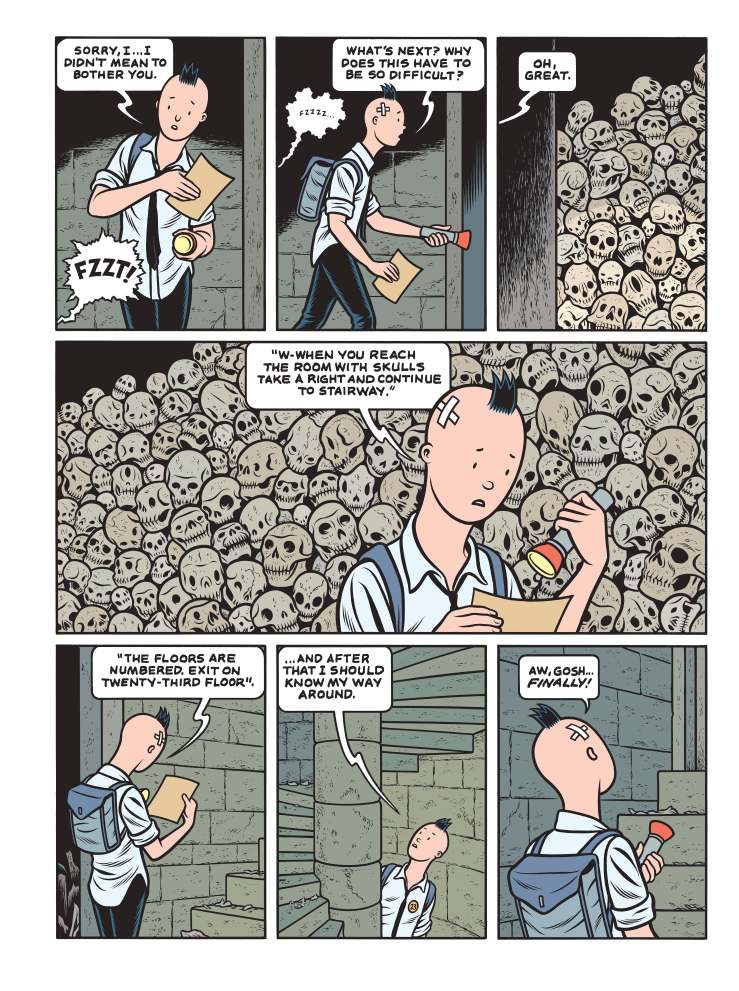
Page 10 from Burns_SUGAR SKULL“Why does this have to be so difficult?” our hero wonders. Because of repressed fear, anger, hurt—and failure. The real trauma, the secret trauma, of the trilogy is Doug’s radical failure. This failure keeps him up at night, both in waking sweat, but also in his Interzone, the fantasy world where the repressed returns, where his alter-ego Nitnit can play boy detective. And yet, as we see in Sugar Skull, Nitnit, dream warrior, is ultimately unequipped to right the wrongs of the past. He can only replay them in a dark, surreal space. The past is never dead. It’s not even past.
b a

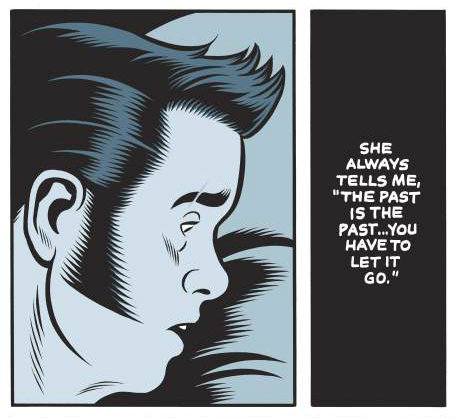
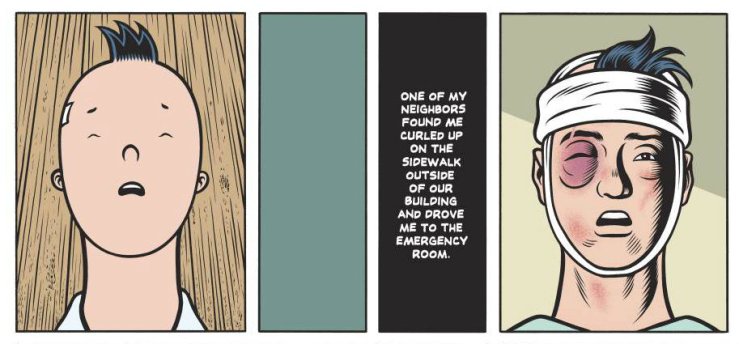
X’ed Out and The Hive point repeatedly to the specter of violence and infanticide, both through implication in the dialogue as well as intense imagery. Both novels ominously arrange events that could only lead to the head wound that our hero sustains before the trilogy begins—a head wound that may or may not be a primary cause of Doug’s excursions into irreality.
d

The infanticidal images that haunt the first two books pointed to a deeper mystery though, one beyond the physical violence Doug suffered. Those books hinted at abortion or miscarriage. But there are other ways to lose children.

Have I over shared the plot? Or am I hinting too vaguely? Reviewing my lines, it seems like I’ve said nothing at all, or perhaps dwelled on the first two books too much.

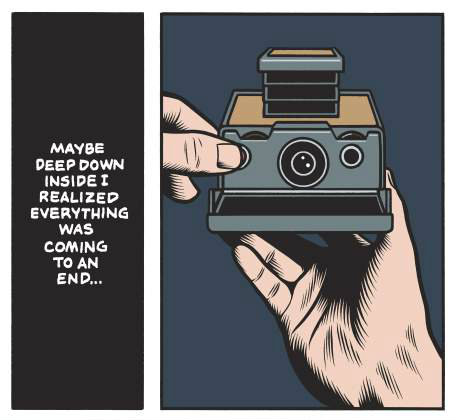
To simplify: Sugar Skull is sad and beautiful and strange and deeply human—this is not the tale of a doppelgänger’s adventures in wonderland, but rather the story of youth’s cowardice, of how we fail ourselves and others, how the versions of ourselves that we try to pin down—like Doug, who takes endless selfies with a Polaroid—are not nearly as stable as we might like them to be. Sugar Skull also explores how we cover over those instabilities and failures—I didn’t do those things; This isn’t happening to me.
c

The final moments of Sugar Skull enact a shock to stability, to sense of self. Burns fulfills a narrative promise to his readers, and to Doug—one that, if I’m honest, was not what I had predicted at all—and then sends Doug’s altered-ego Nitnit into the desert wilds. The last few pages of Sugar Skull seem to borrow as much from McCarthy’s Blood Meridian as they do from Hergés Tintin or William Burroughs.

And yet Doug passes through the wasteland to a refuge of sorts, the dream-double of two other settings that figure prominently in the trilogy, condensed into a place that is and is not. The setting mirrors Doug’s doomed double-consciousness, a consciousness condemned to repeat the same cycle, to respond again and again to the same terrifying call to nightmare-adventure.

I’ve neglected to comment on Burns’s wonderful art, mostly because I think it speaks for itself. His heavy inks and rich colors help unify the shift in styles that mark Doug’s movement between worlds. The trilogy would be worth the admission price alone just for the art, but Burns offers so much more with his storytelling. What’s perhaps most impressive is how thematically precise Burns’s images are—how panels, angles, shots, poses, gestures, and expressions repeat with difference from volume to volume. Burns uses these repeated images to subtly evoke his theme of cycles, doubles, and reiterations. In rereading we see again, recognize again—but from a different perspective.

And if Burns strands Doug/Nitnit in a loop of repetition, he also extends, perhaps, that same chance to his hero—to see again, but from a different perspective. If Sugar Skull forecloses the possibility of escape from the past, it doesn’t cut off a generative futurity. And as our protagonist awakes—again—to follow Inky into the strange wreckage of the past, many readers will feel prompted to follow the pair—again, and then again.

Sugar Skull is available now in hardback from Pantheon.
 

The monkeys had some kind of panic attack and bit me all over (Werner Herzog)

wh

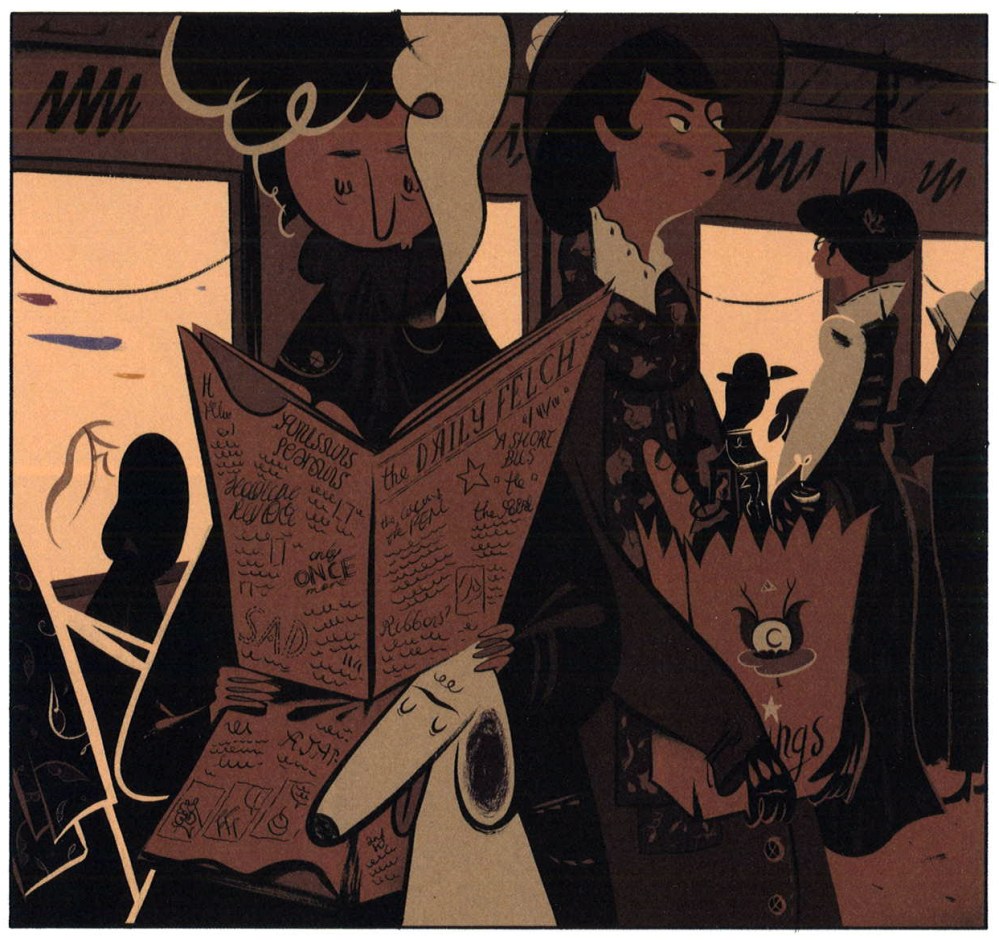
Bus Ride Two — Roman Muradov

(From Roman Muradov’s novella (In a Sense) Lost and Found).

The Short and Curlies, A Short Film by Mike Leigh

“Translation is dead. Long live translation!”

After my interview with Ilan Stavans for Biblioklept (Part 1; Part 2), I began working with him on Words in Transit: The Cultures of Translation, a year-long ‘festival’ of translation taking place at Amherst College. Events include a series of talks with translators, a Translation Film Series at the nearby cinema, a performance of monologues by ELL students, theatre and music performances, and more. Throughout the year, we are maintaining a blog devoted to translation at the Amherst College website. I will be posting excerpts from the blog here. 

Melih Levi, an Amherst student and Turkish translator, wrote this first blog post on the philosopher José Ortega y Gasset and poet Orhan Vali Kanik. Read below or check it out here. — Ryan Mihaly

Whenever I start thinking about translation as an enterprise, José Ortega y Gasset’s words come to my mind: “Translation is dead. Long live translation!” This playful maxim outlines the problems of translation in two different ways. First and foremost, it is a farewell to the practice of translation as we know it. The modern age and the technological advancements of today challenge the traditional practice of translation where translators work their way diligently through each word in a given text. Certainly, it is impossible to categorize all forms of traditional translation as one; after all, there can never be a single attitude towards translation. But if we look at how widely and deeply the print culture is influenced by the rapid technological changes of our times, it is perhaps acceptable to say that the cultures of translation, as we know it, are swiftly changing. The old ways are almost “dead.” But does this mean that there won’t be a new culture of translation in the future? Certainly not. Even if Google Translate ends up becoming a major tool in tomorrow’s translation world, a culture will develop. This is one of the ways in which Gasset’s maxim informs translation.

JoseOrtegayGasset.jpg
José Ortega y Gasset 

The second reading of Gasset’s words is perhaps more relevant and important. Gasset is thinking about the fate of literary works in general. That is, he is laying out his idea of what happens to a work when it goes through the process of translation. According to him, the work has to die before it can start to breathe again, in a different language or in a different medium. Thus, a translator is at once a gravedigger and a creator. Gasset poses a pivotal question: “Isn’t the act of translating necessarily a utopian task?”

Continue reading ““Translation is dead. Long live translation!””

“Talent” — Anton Chekhov

“Talent”

by

Anton Chekhov

AN artist called Yegor Savvitch, who was spending his summer holidays at the house of an officer’s widow, was sitting on his bed, given up to the depression of morning. It was beginning to look like autumn out of doors. Heavy, clumsy clouds covered the sky in thick layers; there was a cold, piercing wind, and with a plaintive wail the trees were all bending on one side. He could see the yellow leaves whirling round in the air and on the earth. Farewell, summer! This melancholy of nature is beautiful and poetical in its own way, when it is looked at with the eyes of an artist, but Yegor Savvitch was in no humour to see beauty. He was devoured by ennui and his only consolation was the thought that by to-morrow he would not be there. The bed, the chairs, the tables, the floor, were all heaped up with cushions, crumpled bed-clothes, boxes. The floor had not been swept, the cotton curtains had been taken down from the windows. Next day he was moving, to town.

His landlady, the widow, was out. She had gone off somewhere to hire horses and carts to move next day to town. Profiting by the absence of her severe mamma, her daughter Katya, aged twenty, had for a long time been sitting in the young man’s room. Next day the painter was going away, and she had a great deal to say to him. She kept talking, talking, and yet she felt that she had not said a tenth of what she wanted to say. With her eyes full of tears, she gazed at his shaggy head, gazed at it with rapture and sadness. And Yegor Savvitch was shaggy to a hideous extent, so that he looked like a wild animal. His hair hung down to his shoulder-blades, his beard grew from his neck, from his nostrils, from his ears; his eyes were lost under his thick overhanging brows. It was all so thick, so matted, that if a fly or a beetle had been caught in his hair, it would never have found its way out of this enchanted thicket. Yegor Savvitch listened to Katya, yawning. He was tired. When Katya began whimpering, he looked severely at her from his overhanging eyebrows, frowned, and said in a heavy, deep bass:

“I cannot marry.”

“Why not?” Katya asked softly.

“Because for a painter, and in fact any man who lives for art, marriage is out of the question. An artist must be free.” Continue reading ““Talent” — Anton Chekhov”

The Garden of Death — Hugo Simberg

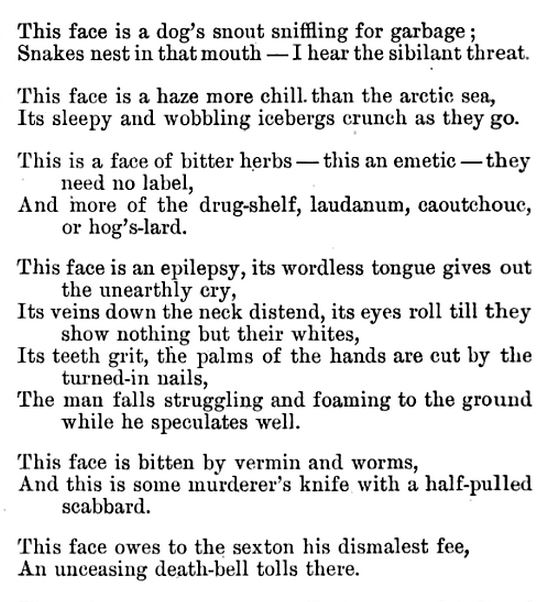
Snakes nest in that mouth (Walt Whitman)

Capture

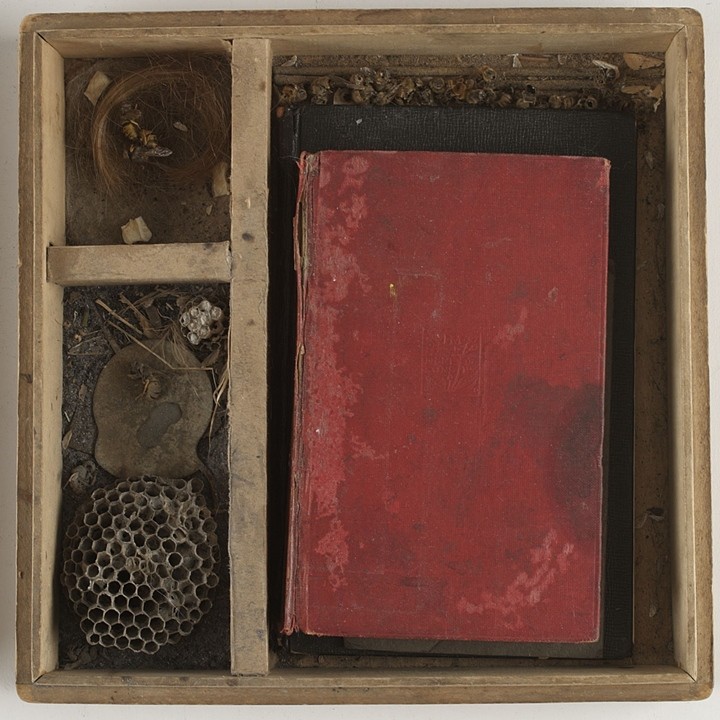
The Mystical Body Defined — David Ruhlman

3. The mystical body defined

Detail from Descent of Christ into Limbo — Bartolomé Bermejo

tumblr_n98tp0Mwrr1sdtln4o1_1280

William Friedkin Picks DVDs from the Criterion Collection Closet