Bolaño’s Werewolves

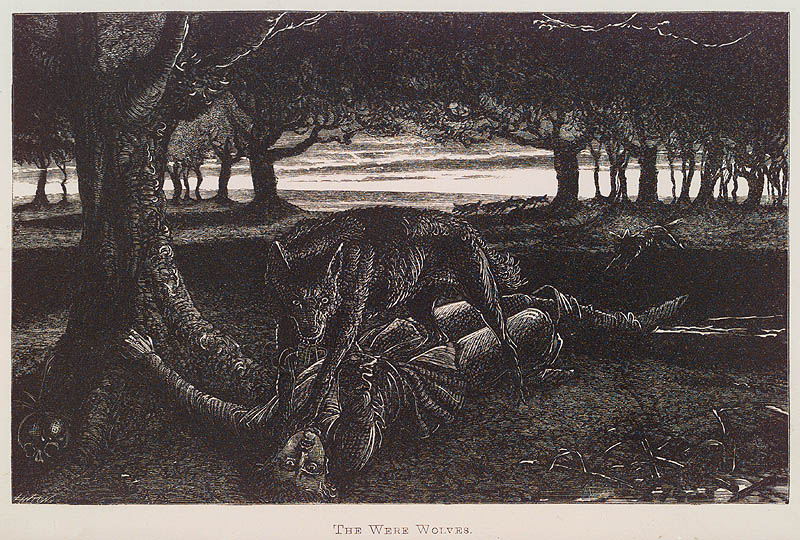
In the first chapter of his estimable volume The Book of Were-Wolves (1865), Sabine Baring-Gould outlines his project (emphasis mine):

In the following pages I design to investigate the notices of were-wolves to be found in the ancient writers of classic antiquity, those contained in the Northern Sagas, and, lastly, the numerous details afforded by the mediæval authors. In connection with this I shall give a sketch of modern folklore relating to Lycanthropy.

It will then be seen that under the veil of mythology lies a solid reality, that a floating superstition holds in solution a positive truth.

This I shall show to be an innate craving for blood implanted in certain natures, restrained under ordinary circumstances, but breaking forth occasionally, accompanied with hallucination, leading in most cases to cannibalism. I shall then give instances of persons thus afflicted, who were believed by others, and who believed themselves, to be transformed into beasts, and who, in the paroxysms of their madness, committed numerous murders, and devoured their victims.

The first few chapters of the book recount werewolf mythology in heavily archetypal terms: we’re talking Greek and Norse stuff here, really ancient stories that tap into primal-human-animal-instinct and so forth. Then there are a few chapters on Scandinavian werewolves (and other shapeshifters) that reminded me of William Vollmann’s marvelous saga The Ice-Shirt, a book that treats warriors shifting into bears as totally standard fare. The book then tackles “The Were-Wolf in the Middle Ages,” where Baring-Gould relies heavily on monks who seem to view their subject through the heady lens of supernaturalism. Baring-Gould weaves together these culturally disparate stories, citing a strong backlist of sources, and refraining from pointing out the obvious archetypal flavor that girds these tales.

It’s in Chapter VI, “A Chamber of Horrors,” that mythology and archetype give way to a kind of terrible realism. Perhaps this is simply an effect of records-keeping, of the vague fact that narratives and terms of the early Renaissance seem so much more accessible to us than, say, the terms of Scandinavian saga. In any case, the book takes on a horrific scope: the vagaries of myth give way to dates, names, places, witnessestrialsverdicts. To go back to Baring-Gould’s intro, we see the “solid reality” under “the veil of mythology,” stripped away.

An example to illustrate — “A Chamber of Horrors” begins:

In December, 1521, the Inquisitor-General for the diocese of Besançon, Boin by name, heard a case of a sufficiently terrible nature to produce a profound sensation of alarm in the neighbourhood. Two men were under accusation of witchcraft and cannibalism. Their names were Pierre Bourgot, or Peter the Great, as the people had nicknamed him from his stature, and Michel Verdung. Peter had not been long under trial, before he volunteered a full confession of his crimes. It amounted to this:–

In the interest of time and space, I’ll break from Baring-Gould’s summary of the Inquisitor General’s record of Peter the Great’s confession to quickly summarize: There are several pages detailing the ritual circumstances of Peter and Michel’s initial transmogrifications into werebeasts, including some early kills. Let’s skip ahead to some grisly details:

In one of his were-wolf runs, Pierre fell upon a boy of six or seven years old, with his teeth, intending to rend and devour him, but the lad screamed so loud that he was obliged to beat a retreat to his clothes, and smear himself again, in order to recover his form and escape detection. He and Michel, however, one day tore to pieces a woman as she was gathering peas; and a M. de Chusnée, who came to her rescue, was attacked by them and killed.

On another occasion they fell upon a little girl of four years old, and ate her up, with the exception of one arm. Michel thought the flesh most delicious. Another girl was strangled by them, and her blood lapped up. Of a third they ate merely a portion of the stomach.

One evening at dusk, Pierre leaped over a garden wall, and came upon a little maiden of nine years old, engaged upon the weeding of the garden beds. She fell on her knees and entreated Pierre to spare her; but he snapped the neck, and left her a corpse, lying among her flowers. On this occasion he does not seem to have been in his wolf’s shape. He fell upon a goat which he found in the field of Pierre Lerugen, and bit it in the throat, but he killed it with a knife.

Michel was transformed in his clothes into a wolf, but Pierre was obliged to strip, and the metamorphosis could not take place with him unless he were stark naked. He was unable to account for the manner in which the hair vanished when he recovered his natural condition.

I’ve given this example at some length as it’s a fairly representative passage. To be clear, Baring-Gould goes on for pages and pages and pages of this stuff, bringing up example after example of murderers and their victims and the villages and cities that prosecute them (you can read the book for free, if you wish—it’s in the public domain). It’s ugly and depressing, and one gets the picture that the kind of psychopathic homicidal behavior we often think of as pervasive in and native to the 20th and 21st centuries is actually far, far older. Pierre Bourgot and Michel Verdung are earlier instantiations of Henry Lee Lucas and Ottis Toole or Leopold and Loeb or any of the other partners in crime we might think of.

But not all these werewolves work in pairs. There’s the case of Jean Grenier, who gets his own chapter. A description of Grenier as a boy of about 13:

The appearance of the lad was peculiar. His hair was of a tawny red and thickly matted, falling over his shoulders and completely covering his narrow brow. His small pale-grey eyes twinkled with an expression of horrible ferocity and cunning, from deep sunken hollows. The complexion was of a dark olive colour; the teeth were strong and white, and the canine teeth protruded over the lower lip when the mouth was closed. The boy’s hands were large and powerful, the nails black and pointed like bird’s talons. He was ill clothed, and seemed to be in the most abject poverty. The few garments he had on him were in tatters, and through the rents the emaciation of his limbs was plainly visible.

Baring-Gould’s gift for detail—a gift bequeathed in part, one gathers, from trial testimonies and other criminal records—presents the ambiguity of Grenier. The boy is clearly a case of neglect who slips into madness and murder. Baring-Gould also has a gift for dialogue. Here, Grenier terrorizes some fair innocent maidens:

“Well, my maidens,” said he in a harsh voice, “which of you is the prettiest, I should like to know; can you decide among you?”

“What do you want to know for?” asked Jeanne Gaboriant, the eldest of the girls, aged eighteen, who took upon herself to be spokesman for the rest.

“Because I shall marry the prettiest,” was the answer.

“Ah!” said Jeanne jokingly; “that is if she will have you, which is not very likely, as we none of us know you, or anything about you.”

“I am the son of a priest,” replied the boy curtly.

“Is that why you look so dingy and black?”

“No, I am dark-coloured, because I wear a wolf-skin sometimes.”

“A wolf-skin!” echoed the girl; “and pray who gave it you?”

“One called Pierre Labourant.”

“There is no man of that name hereabouts. Where does he live?”

A scream of laughter mingled with howls, and breaking into strange gulping bursts of fiendlike merriment from the strange boy. The little girls recoiled, and the youngest took refuge behind Jeanne.

“Do you want to know Pierre Labourant, lass? Hey, he is a man with an iron chain about his neck, which he is ever engaged in gnawing. Do you want to know where he lives, lass? Ha., in a place of gloom and fire, where there are many companions, some seated on iron chairs, burning, burning; others stretched on glowing beds, burning too. Some cast men upon blazing coals, others roast men before fierce flames, others again plunge them into caldrons of liquid fire.”

The terrible scene continues in this vein, building dread until the poor girls (sensibly) flee.

Grenier takes off on a murderous, cannibalistic spree, before being apprehended and “sentenced . . . to perpetual imprisonment within the walls of a monastery at Bordeaux, where he might be instructed in his Christian and moral obligations.”

The monastery—the asylum—is the  kind of place where many if not most of these convicted werewolves end up. I’ve neglected to share Baring-Gould’s definition of lycanthropy, which also telegraphs part of his thesis (emphasis, again, is mine):

What is Lycanthropy? The change of man or woman into the form of a wolf, either through magical means, so as to enable him or her to gratify the taste for human flesh, or through judgment of the gods in punishment for some great offence. This is the popular definition.

Truly it consists in a form of madness, such as may be found in most asylums.

We see here that Baring-Gould’s project is to strip away the supernaturalism—indeed the glamor—of the werewolf to root out the all-too-human madness underneath.

Perhaps I’ve taken too long to connect Baring-Gould to the work of Roberto Bolaño, but I felt the need to set the stage and share some of Baring-Gould’s language, which, to be clear, I believe prefigures Bolaño’s own work in many ways. I am not suggesting that Bolaño read Baring-Gould, only that the realistic documentation of grisly murder and madness in The Book of Were-Wolves evinces throughout the Bolañoverse, particularly in 2666, from which I will draw my examples in this essay.

What Bolaño and Baring-Gould do in these books is explore madness and violence and the ways that our world tries to (or fails to) contain madness and violence.

If you’ve read 2666, you’ll likely note that Baring-Gould’s descriptions and even tone resonates strongly with “The Part About the Crimes,” a grisly catalog of murder and violence (even Baring-Gould’s chapter title “A Chamber of Horrors” seems to correspond). To be sure, both writers employ a frank, almost reportorial tone that often clashes against lucid nightmare details—there’s a heavy dose of unreality that poses as a kind of cure, almost, to the poisoned reality of mutilated bodies.

Maybe another way of approaching this is to point out how heavily the werewolves of Baring-Gould and Bolaño contrast with the glamorous, sexy werewolves of, say, True Blood or Twilight, werewolves that clearly tap into the mythos and psychology of transformation while at the same time sundering that transformative possibility away from any plain old Joe Schmo’s aptitude for grisly violence.

I’ve just referred to Bolaño’s werewolves—it’s also the title of this essay, so “just referred” is hardly accurate—so I should point out that the word werewolf never occurs in 2666.

What I want to suggest is that Bolaño’s werewolves are, in line with Baring-Gould’s, people fated to madness and violence, but also relatively normal people. These werewolves contain within them a dreadful capacity for violence.

The litany of evil in “The Part About Crimes,” as I’ve already suggested, showcases werewolf work: the mutilated bodies, the rape, the awful mystery of it all. There are even a few references to wolf transformations (of a kind). Here’s a late one:

Something ugly happened here, said the border patrol, but since there were no bodies, the whole thing was easy to write off. What did Ayala do with the bodies? According to El Tequila, he ate them, that’s how crazy and evil he was, although Haas doubted there was anyone capable of wolfing down eight illegal immigrants, no matter how demented or ravenous he might be.

I won’t torture the scene into something it’s not, but we see here the possibility—in language—of the criminal El Tequila “wolfing” down his victims in an act of cannibalism.

Or, this scene, where Epifanio Galinda, one of the few heroes of “The Part About the Crimes” believes he’s killed a wolf:

I killed a wolf, he said. Let’s see, said the police chief, and the two of them set out into the darkness again. There were no headlights visible on the highway. The air was dry but sometimes there were gusts of salty wind, as if before it made its way into the desert the air had brushed across a salt marsh. The boy looked at the lighted dashboard of the car and then he covered his face with his hands. A few yards away the police chief ordered Epifanio to pass him the flashlight and he shone it on the body of the animal lying in the road. It isn’t a wolf, said the police chief. Oh, no? Look at its coat, wolves’ coats are shinier, sleeker, not to mention they aren’t dumb enough to get themselves run over by a car in the middle of a deserted highway. Let’s see, let’s measure it, you hold the flashlight. Epifanio trained the beam on the animal as the chief laid it straight and eyeballed it. Coyotes, he said, are twenty-eight to thirty-six inches long, counting the head. What would you say this one measures? About thirty-two? asked Epifanio. Correct, said the police chief. And he went on: coyotes weigh between twenty-two and thirty-five pounds. Pass me the flashlight and pick it up, it won’t bite you. Epifanio picked up the dead animal, cradling it in his arms. How much would you say it weighs? Somewhere between twenty-six and thirty-three, maybe, said Epifanio. Like a coyote. Because it is a coyote, jackass, said the police chief.

The term coyote of course has its own associations in borderland—it’s a pejorative term for the men who smuggle immigrants into the U.S. Epifanio’s would-be wolf, symbol of predation and murder, morphs under closer analysis into another, subtler predator.

But I’m not particularly interested in literal wolves or even the metaphorical use of the word wolf in this discussion of 2666 and The Book of Were-Wolves. Again, what I think germane here is Bolaño’s ability to document the capacity of insanity and violence that lurks in each and every person—that is what the werewolf is. We can see the werewolf when we strip away what Baring-Gould calls “the veil of mythology,” the “floating superstition” that would otherwise explain away the secrets of evil.

Here’s a detail from the first few pages of 2666, from “The Part About the Critics”:

[Espinoza] also discovered that he was bitter and full of resentment, that he oozed resentment, and that he might easily kill someone, anyone . . .

The line seems almost casual so early in the text. It’s not necessarily forgettable, but it’s also not especially noteworthy—that is, until you work your way through the labyrinth of 2666 a second or third time. In a course of rereading, Espinoza’s murderous urge becomes not just a simple expression, but a genuine threat.

“The Part About the Critics” is, in some ways, the least obviously lycanthropic chapter of 2666, and hence all the more important to my (admittedly cloudy) thesis. I’m going to devote the rest of my energy solely to “Critics,” but first I’ll sweep over the rest of the book.

“The Part About Amalfitano” documents a descent into madness, and if its motif relies more on ghosts than werewolves, I’d still like to submit Marco Antonio Guerra as the worst kind of would-be werewolf, a youth primed for insane back alley violence of every stripe. He is pure Bolaño-sinister, a character from the shady margins of a Lynch film. When he tells Amalfitano that, “the human being, broadly speaking, is the closest thing there is to a rat,” his statement is all the more believable because he is, of course, a wererat.

“The Part About Fate” twins “Amalfitano,” similarly documenting descent into madness; its special werewolf—maybe more a vampire, to be fair—is Chucho Flores.

I’ve already remarked on “The Part About the Crimes.”

“The Part About Archimboldi,” with its Gothic scenes and numerous Dracula references perhaps skews more vampire again, but let’s just lump these supernatural predators together for now. Suffice to point out that Baring-Gould frequently reminds his audience  that “the were-wolf is closely related to the vampire.” He continues:

The lycanthropist falls into a cataleptic trance, during which his soul leaves his body, enters that of a wolf and ravens for blood. On the return of the soul, the body is exhausted and aches as though it had been put through violent exercise. After death lycanthropists become vampires. They are believed to frequent battlefields in wolf or hyæna shapes, and to suck the breath from dying soldiers, or to enter houses and steal the infants from their cradles.

Back to “The Part About the Critics”: The first time I read 2666, I thought of the “Critics” as a light, even romantic entry point to the novel—a sort of romantic quadrangle with ironic self-awareness. Subsequent readings reveal an extremely dark work, one that repeatedly hides its darkness, or shifts quickly away from it, as when the critic Morini reads about the Sonora killings that will figure so heavily in “Crimes” in a newspaper and only an hour later forgets the matter completely.

But that murderous violence is always there, seething under the surface, as in that early description of Espinoza, or in this description from early in the book, one of the first labyrinthine nesting doll tales, where the Swabian relates a story related to him by an old woman of a visit to Buenos Aires and her encounter with a strange ranch-hand:

 . . . the little gaucho looked up at the lady with the eyes of a bird of prey, ready to plunge a knife into her at the navel and slice up to the breasts, cutting her wide open, his eyes shining with a strange intensity, like the eyes of a clumsy young butcher, as the lady recalled, which didn’t stop her from following him without protest when he took her by the hand and led her to the other side of the house, to a place where a wrought-iron pergola stood, bordered by flowers and trees that the lady had never seen in her life or which at that moment she thought she had never seen in her life, and she even saw a fountain in the park, a stone fountain, in the center of which, balanced on one little foot, a Creole cherub with smiling features danced, part European and part cannibal, perpetually bathed by three jets of water that spouted at its feet, a fountain sculpted from a single piece of black marble, a fountain that the lady and the little gaucho admired at length . . .

Everything in that New World “part European and part cannibal.” The aesthetics of the episode devour or at least mask the little gaucho’s violence, his ability to transform into a murderous beast.

The critics who hear this story from the Swabian represent some of the old, dignified cultures of Europe—French, Italian, English, Spanish; they are erudite academics, situated above the dirty meaningless violence that litters the rest of the book.

Of course, Bolaño absolutely ridicules this notion, evoking the critics’ own dispositions to violence.

Here’s a passage that illustrates Bolaño’s lycanthropic powers. In this little episode, Pelletier and Espinoza—both in love and lust with fellow critic Norton—share a cab with her during a visit to London. I quote at some length:

And for the first few minutes, the driver, a Pakistani, watched them in his rearview mirror, in silence, as if he couldn’t believe what his ears were hearing, and then he said something in his language and the cab passed Harmsworth Park and the Imperial War Musuem, heading along Brook Drive and then Austral Street and then Geraldine Street, driving around the park, an unnecessary maneuver no matter how you looked at it. And when Norton told him he was lost and said which streets he should take to find his way, the driver fell silent again, with no more murmurings in his incomprehensible tongue, until he confessed that London was such a labyrinth, he really had lost his bearings.

Which led Espinoza to remark that he’d be damned if the cabbie hadn’t just quoted Borges, who once said London was like a labyrinth— unintentionally, of course. To which Norton replied that Dickens and Stevenson had used the same trope long before Borges in their descriptions of London. This seemed to set the driver off, for he burst out that as a Pakistani he might not know this Borges, and he might not have read the famous Dickens and Stevenson either, and he might not even know London and its streets as well as he should, that’s why he’d said they were like a labyrinth, but he knew very well what decency and dignity were, and by what he had heard, the woman here present, in other words Norton, was lacking in decency and dignity, and in his country there was a word for what she was, the same word they had for it in London as it happened, and the word was bitch or slut or pig, and the gentlemen who were present, gentlemen who, to judge by their accents, weren’t English, also had a name in his country and that name was pimp or hustler or whoremonger.

This speech, it may be said without exaggeration, took the Archimboldians by surprise, and they were slow to respond. If they were on Geraldine Street when the driver let them have it, they didn’t manage to speak till they came to Saint George’s Road. And then all they managed to say was: stop the cab right here, we’re getting out. Or rather: stop this filthy car, we’re not going any farther. Which the Pakistani promptly did, punching the meter as he pulled up to the curb and announcing to his passengers what they owed him, a fait accompli or final scene or parting token that seemed more or less normal to Norton and Pelletier, no doubt still reeling from the ugly surprise, but which was absolutely the last straw for Espinoza, who stepped down and opened the driver’s door and jerked the driver out, the latter not expecting anything of the sort from such a well-dressed gentleman. Much less did he expect the hail of Iberian kicks that proceeded to rain down on him, kicks delivered at first by Espinoza alone, but then by Pelletier, too, when Espinoza flagged, despite Norton’s shouts at them to stop, despite Norton’s objecting that violence didn’t solve anything, that in fact after this beating the Pakistani would hate the English even more, something that apparently mattered little to Pelletier, who wasn’t English, and even less to Espinoza, both of whom nevertheless insulted the Pakistani in English as they kicked him, without caring in the least that he was down, curled into a ball on the ground, as they delivered kick after kick, shove Islam up your ass, which is where it belongs, this one is for Salman Rushdie (an author neither of them happened to think was much good but whose mention seemed pertinent), this one is for the feminists of Paris (will you fucking stop, Norton was shouting), this one is for the feminists of New York (you’re going to kill him, shouted Norton), this one is for the ghost of Valerie Solanas, you son of a bitch, and on and on, until he was unconscious and bleeding from every orifice in the head, except the eyes.

When they stopped kicking him they were sunk for a few seconds in the strangest calm of their lives. It was as if they’d finally had the menage a trois they’d so often dreamed of.

Pelletier felt as if he had come. Espinoza felt the same, to a slightly different degree. Norton, who was staring at them without seeing them in the dark, seemed to have experienced multiple orgasms. A few cars were passing by on St. George’s Road, but the three of them were invisible to anyone traveling in a vehicle at that hour. There wasn’t a single star in the sky. And yet the night was clear: they could see everything in great detail, even the outlines of the smallest things, as if an angel had suddenly clapped night-vision goggles on their eyes. Their skin felt smooth, extremely soft to the touch, although in fact the three of them were sweating. For a moment Espinoza and Pelletier thought they’d killed the Pakistani. A similar idea seemed to be passing through Norton’s mind, because she bent over the cabbie and felt for his pulse. To move, to kneel down, hurt her as if the bones of her legs were dislocated.

The scene shifts from erudite literary reference to sadistic violence, with strange interruptions of very dark humor (I am ashamed that the first time I read this passage it made me laugh out loud in places—the line about Rushdie, in particular), ending in whorl that directly connects the violence to (extremely satisfying) sex. In short, it underlines the lurid, inexplicable violence (and interwoven sexuality) capable of erupting in even the most apparently staid people (think of the poor driver who would never expect expect violence “of the sort from such a well-dressed gentleman”). Bolaño’s project, like Baring-Gould’s, is to cut through the mythologies of transformation and violence to plumb the visceral nightmare of reality underneath.

Let’s return to that last part of Baring-Gould’s definition of lycanthropy: “Truly it consists in a form of madness, such as may be found in most asylums.”

Need I remark on the asylums of 2666?

The word asylum appears 43 times in the text.

The word prison 164.

Labyrinth 14.

Madness 29.

Lunatic 21.

Abyss 22.

You get the picture.

I’ll end then with a minor character of 2666, a minor werewolf I suppose, whose predation is perhaps limited to himself. In “The Part About the Critics,” we learn of the artist Edwin Johns who “cut off his painting hand” and then incorporated it into a self-portrait:

This painting, viewed properly (although one could never be sure of viewing it properly), was an ellipsis of self-portraits, sometimes a spiral of self-portraits (depending on the angle from which it was seen), seven feet by three and a half feet, in the center of which hung the painter’s mummified right hand.

Edwin Johns’s madness leads him to self-mutilation, but his violence is also bizarrely controlled and, well, artistic. It lands him in an asylum of course (where he meets some of the critics), but it also helps create his defining work, described as a kind of elliptical, abyssal spiral at the center of which is suspended the very instrument that created the work itself. Johns’s mummified hand perhaps represents a kind of purity of self, an act of self-negation that paradoxically preserves a self. It’s a transformation that leaves a pure trace (which, sundered, is impure, incomplete). It simultaneously makes and breaks Johns, confers his identity (as that artist who cut his hand off) and takes it away, pushing him into an asylum where he can presumably do no more harm to himself. And how does Johns die? We learn that he falls off a mountain — “he fell into the abyss.” Complete self-erasure, the finishing touch on his strange self-portrait.

But I seem to have jumped into my own little abyss here, or at least written myself into an ill-defined corner, one that provides no clean surface to rest my back against (in any case, I’m jumbling metaphors here).

Maybe I’m just trying to recommend Baring-Gould’s strange ghoulish book.

Maybe I’m just taking another stab at writing about 2666.

Maybe I just have werewolves on the brain.

Maybe it’s germane to all of this that I’ve been reading the books in a weird kind of tandem switch-hitting rhythm in the deep dark of night, said books nestled neatly on the low glow of my trusty Kindle.

Maybe it’s just that Baring-Gould gives us an answer to the murder-mystery 2666 is sometimes supposed to be, an answer that I perhaps like so much because I proposed it in my first review of the book.

Who killed all those women in Sonora?

Why, we all did it.

I’ve quoted Bolaño at length in this piece, so I’ll give the last words—again at some length—to Sabine Baring-Gould.

Here, he describes—but makes no attempt to explain away—the pleasure we may take in cruelty:

Startling though the assertion may be, it is a matter of fact, that man, naturally, in common with other carnivora, is actuated by an impulse to kill, and by a love of destroying life.

It is positively true that there are many to whom the sight of suffering causes genuine pleasure, and in whom the passion to kill or torture is as strong as any other passion. Witness the number of boys who assemble around a sheep or pig when it is about to be killed, and who watch the struggle of the dying brute with hearts beating fast with pleasure, and eyes sparkling with delight. Often have I seen an eager crowd of children assembled around the slaughterhouses of French towns, absorbed in the expiring agonies of the sheep and cattle, and hushed into silence as they watched the flow of blood.

The propensity, however, exists in different degrees. In some it is manifest simply as indifference to suffering, in others it appears as simple pleasure in seeing killed, and in others again it is dominant as an irresistible desire to torture and destroy.

This propensity is widely diffused; it exists in children and adults, in the gross-minded and the refined., in the well-educated and the ignorant, in those who have never had the opportunity of gratifying it, and those who gratify it habitually, in spite of morality, religion, laws, so that it can only depend on constitutional causes.

The sportsman and the fisherman follow a natural instinct to destroy, when they make wax on bird, beast, and fish: the pretence that the spoil is sought for the table cannot be made with justice, as the sportsman cares little for the game he has obtained, when once it is consigned to his pouch. The motive for his eager pursuit of bird or beast must be sought elsewhere; it will be found in the natural craving to extinguish life, which exists in his soul. Why does a child impulsively strike at a butterfly as it flits past him? He cares nothing for the insect when once it is beaten down at his feet, unless it be quivering in its agony, when he will watch it with interest. The child strikes at the fluttering creature because it has life in it, and he has an instinct within him impelling him to destroy life wherever he finds it.

Parents and nurses know well that children by nature are cruel, and that humanity has to be acquired by education. A child will gloat over the sufferings of a wounded animal till his mother bids him “put it out of its misery.” An unsophisticated child would not dream of terminating the poor creature’s agonies abruptly, any more than he would swallow whole a bon-bon till he had well sucked it. Inherent cruelty may be obscured by after impressions, or may be kept under moral restraint; the person who is constitutionally a Nero, may scarcely know his own nature, till by some accident the master passion becomes dominant, and sweeps all before it. A relaxation of the moral check, a shock to the controlling intellect, an abnormal condition of body, are sufficient to allow the passion to assert itself.

As I have already observed, this passion exists in different persons in different degrees.
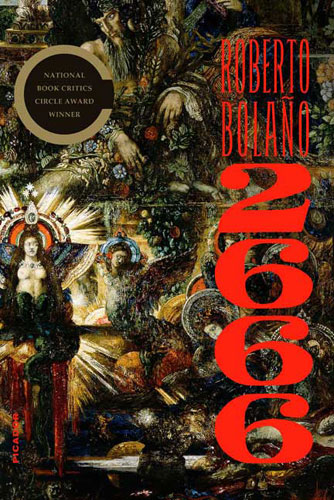
“It Sounds Like the Title of a David Lynch Film” — A Passage from Roberto Bolaño’s 2666

A passage from Roberto Bolaño’s opus 2666

The card for the Santa Teresa cybercafe was a deep red, so red that it was hard to read what was printed on it. On the back, in a lighter red, was a map that showed exactly where the cafe was located. He asked the receptionist to translate the name of the place. The clerk laughed and said it was called Fire, Walk With Me.

“It sounds like the title of a David Lynch film,” said Fate.

The clerk shrugged and said that all of Mexico was a collage of diverse and wide-ranging homages.

“Every single thing in this country is an homage to everything in the world, even the things that haven’t happened yet,” he said.

After he told Fate how to get to the cybercafe, they talked for a while about Lynch’s films. The clerk had seen all of them. Fate had seen only three or four. According to the clerk, Lynch’s greatest achievement was the TV series Twin Peaks. Fate liked The Elephant Man best, maybe because he’d often felt like the elephant man himself, wanting to be like other people but at the same time knowing he was different. When the clerk asked him whether he’d heard that Michael Jackson had bought or tried to buy the skeleton of the elephant man, Fate shrugged and said that Michael Jackson was sick. I don’t think so, said the clerk, watching something presumably important that was happening on TV just then.

“In my opinion,” he said with his eyes fixed on the TV Fate couldn’t see, “Michael knows things the rest of us don’t.”

“We all know things we think nobody else knows,” said Fate.

Sisyphus, Bolaño Style

A passage from Roberto Bolaño’s big fat novel 2666 (context unimportant)—

Archimboldi’s response surprised Bubis. In it he said that Sisyphus, once he was dead, had escaped from hell by means of a legal stratagem. Before Zeus freed Thanatos, Sisyphus asked his wife not to perform the usual funeral rites, knowing that the first thing Death would do was come for him. So when he got to hell, Hades scolded him and all the infernal lords naturally clamored to the skies or the vault of hell and tore out their hair and took offense. But Sisyphus said it was his wife’s fault, not his, and he requested permission to return to Earth to punish her.

Hades considered it: the proposal Sisyphus made was reasonable and freedom was granted to him on the condition that he stay away for only three or four days, long enough to get his just vengeance and set in motion, however belatedly, the proper funeral rites. Of course, Sisyphus jumped at the chance—not for nothing was he the craftiest man in the world—and he returned to Earth, where he lived happily to a ripe old age, and didn’t go back to hell until his body failed him.

According to some, the punishment of the rock had only one purpose: to keep Sisyphus occupied and prevent him from hatching new schemes. But at the least expected moment, Sisyphus will devise something and he’ll come back to Earth, Archimboldi ended his letter.

“The novel, so unanimously acclaimed, was called Twilight” — An Excerpt from Roberto Bolaño’s 2666

The following excerpt of Roberto Bolaño’s 2666 is more or less self-contained, or at least as self-contained as anything in that labyrinth. It’s the summary of a character named Ansky’s novel; Hans Reiter (aka Archimboldi) is reading Ansky’s diaries while hiding during the war–

The novel, so unanimously acclaimed, was called Twilight and its plot was very simple: a boy of fourteen abandons his family to join the ranks of the revolution. Soon he’s engaged in combat against Wrangel’s troops. In the midst of battle he’s injured and his comrades leave him for dead. But before the vultures come to feed on the bodies, a spaceship drops onto the battlefield and takes him away, along with some of the other mortally wounded soldiers. Then the spaceship enters the stratosphere and goes into orbit around Earth. All of the men’s wounds are rapidly healed. Then a very thin, very tall creature, more like a strand of seaweed than a human being, asks them a series of questions like: how were the stars created? where does the universe end? where does it begin? Of course, no one knows the answers. One man says God created the stars and the universe begins and ends wherever God wants. He’s tossed out into space. The others sleep. When the boy awakes he finds himself in a shabby room, with a shabby bed and a shabby wardrobe where his shabby clothes hang. When he goes to the window he gazes out in awe at the urban landscape of New York. But the boy finds only misfortune in the great city. He meets a jazz musician who tells him about chickens that talk and probably think.

“The worst of it,” the musician says to him, “is that the governments of the planet know it and that’s why so many people raise chickens.”

The boy objects that the chickens are raised to be eaten. The musician says that’s what the chickens want. And he finishes by saying:

“Fucking masochistic chickens, they have our leaders by the balls.”

He also meets a girl who works as a hypnotist at a burlesque club, and he falls in love. The girl is ten years older than the boy, or in other words twenty-four, and although she has a number of lovers, including the boy, she doesn’t want to fall in love with anyone because she believes that love will use up her powers as a hypnotist. One day the girl disappears and the boy, after searching for her in vain, decides to hire a Mexican detective who was a soldier under Pancho Villa. The detective has a strange theory: he believes in the existence of numerous Earths in parallel universes. Earths that can be reached through hypnosis. The boy thinks the detective is swindling him and decides to accompany him in his investigations. One night they come upon a Russian beggar shouting in an alley. The beggar shouts in Russian and only the boy can understand him. The beggar says: I fought with Wrangel, show some respect, please, I fought in Crimea and I was evacuated from Sevastopol in an English ship. Then the boy asks whether the beggar was at the battle where he fell badly wounded. The beggar looks at him and says yes. I was too, says the boy. Impossible, replies the beggar, that was twenty years ago and you weren’t even born yet.

Then the boy and the Mexican detective set off west in search of the hypnotist. They find her in Kansas City. The boy asks her to hypnotize him and send him back to the battlefield where he should have died, or accept his love and stop fleeing. The hypnotist answers that neither is possible. The Mexican detective shows an interest in the art of hypnosis. As the detective begins to tell the hypnotist a story, the boy leaves the roadside bar and goes walking under the night sky. After a while he stops crying.

He walks for hours. When he’s in the middle of nowhere he sees a figure by the side of the road. It’s the seaweedlike extraterrestrial. They greet each other. They talk. Often, their conversation is unintelligible. The subjects they address are varied: foreign languages, national monuments, the last days of Karl Marx, worker solidarity, the time of the change measured in Earth years and stellar years, the discovery of America as a stage setting, an unfathomable void—as painted by Dore—of masks. Then the boy follows the extraterrestrial away from the road and they walk through a wheat field, cross a stream, climb a hill, cross another field, until they reach a smoldering pasture.

In the next chapter, the boy is no longer a boy but a young man of twenty-five working at a Moscow newspaper where he has become the star reporter. The young man receives the assignment to interview a Communist leader somewhere in China. The trip, he is warned, is extremely difficult, and once he reaches Peking, the situation may be dangerous, since there are lots of people who don’t want any statement by the Chinese leader to get out. Despite these warnings, the young man accepts the job. When, after much hardship, he finally gains access to the cellar where the Chinese leader is hidden, the young man decides that not only will he interview him, he’ll also help him escape the country. The Chinese leader’s face, in the light of a candle, bears a notable resemblance to that of the Mexican detective and former soldier under Pancho Villa. The Chinese leader and the young Russian, meanwhile, come down with the same illness, brought on by the pestilence of the cellar. They shake with fever, they sweat, they talk, they rave, the Chinese leader says he sees dragons flying low over the streets of Peking, the young man says he sees a battle, perhaps just a skirmish, and he shouts hurrah and urges his comrades onward. Then both lie motionless as the dead for a long time, and suffer in silence until the day set for their flight.

Each with a temperature of 102 degrees, the two men cross Peking and escape. Horses and provisions await them in the countryside. The Chinese leader has never ridden before. The young man teaches him how. During the trip they cross a forest and then some enormous mountains. The blazing of the stars in the sky seems supernatural. The Chinese leader asks himself: how were the stars created? where does the universe end? where does it begin? The young man hears him and vaguely recalls a wound in his side whose scar still aches, darkness, a trip. He also remembers the eyes of a hypnotist, although the woman’s features remain hidden, mutable. If I close my eyes, thinks the young man, I’ll see her again. But he doesn’t close them. They make their way across a vast snow-covered plain. The horses sink in the snow. The Chinese leader sings. How were the stars created? Who are we in the middle of the boundless universe? What trace of us will remain?

Suddenly the Chinese leader falls off his horse. The young Russian examines him. The Chinese leader is like a burning doll. The young Russian touches the Chinese leader’s forehead and then his own forehead and understands that the fever is devouring them both. With no little effort he ties the Chinese leader to his mount and sets off again. The silence of the snow-covered plain is absolute. The night and the passage of stars across the vault of the sky show no signs of ever ending. In the distance an enormous black shadow seems to superimpose itself on the darkness. It’s a mountain range. In the young Russian’s mind the certainty takes shape that in the coming hours he will die on that snow-covered plain or as he crosses the mountains. A voice inside begs him to close his eyes, because if he closes them he’ll see the eyes and then the beloved face of the hypnotist. It tells him that if he closes his eyes he’ll see the streets of New York again, he’ll walk again toward the hypnotist’s house, where she sits waiting for him on a chair in the dark. But the Russian doesn’t close his eyes. He rides on.

“It Sounds Like the Title of a David Lynch Film” — A Passage from Roberto Bolaño’s 2666

A passage from Roberto Bolaño’s opus 2666

The card for the Santa Teresa cybercafe was a deep red, so red that it was hard to read what was printed on it. On the back, in a lighter red, was a map that showed exactly where the cafe was located. He asked the receptionist to translate the name of the place. The clerk laughed and said it was called Fire, Walk With Me.

“It sounds like the title of a David Lynch film,” said Fate.

The clerk shrugged and said that all of Mexico was a collage of diverse and wide-ranging homages.

“Every single thing in this country is an homage to everything in the world, even the things that haven’t happened yet,” he said.

After he told Fate how to get to the cybercafe, they talked for a while about Lynch’s films. The clerk had seen all of them. Fate had seen only three or four. According to the clerk, Lynch’s greatest achievement was the TV series Twin Peaks. Fate liked The Elephant Man best, maybe because he’d often felt like the elephant man himself, wanting to be like other people but at the same time knowing he was different. When the clerk asked him whether he’d heard that Michael Jackson had bought or tried to buy the skeleton of the elephant man, Fate shrugged and said that Michael Jackson was sick. I don’t think so, said the clerk, watching something presumably important that was happening on TV just then.

“In my opinion,” he said with his eyes fixed on the TV Fate couldn’t see, “Michael knows things the rest of us don’t.”

“We all know things we think nobody else knows,” said Fate.

Books I Am Always (Re-)Reading

Trudging through a very long book the other night–never mind the title, at least now anyway–it occurred to me that I’d rather be reading from 2666; that, at that particular moment, I’d rather re-read from “The Part About the Crimes.” I don’t know if it was the effete dullness of the first volume that made me want to pick up Bolaño’s epic, perhaps trying to zap some life into my waning eyeballs; perhaps it was just the sense that I was wasting my time with the merely good, which, after all, is mediocrity when set against genius (yes, these are subjective terms).

Anyway, I didn’t have to go looking for 2666 — I have a copy (yes, I have two) right there jammed into my nightstand, along with a few other books that I realize that I’m always reading. Furthermore, I’m always reading these books in the most discontinuous, stochastic fashion, often picking them up at random and thumbing through them. I think I use these books to clear my literary palate, to get a bad (or worse, boring) taste out of my brain, to inspire me, to suggest another book. Some of these books, like 2666 are big, fat volumes, volumes that I set close at hand in the hopes of rereading in full. Sometimes I’ve met this goal; in the case of Moby-Dick, I’ve read the book through at least three times now, and yet never tire of it. I’m always picking it up again and again, sometimes to find Elijah’s rant or to dip into Ahab’s mad monologue or perhaps just to hear Stubb comment on the proper preparation of shark steaks. Of a piece with those big novels is David Foster Wallace’s Infinite Jest, which I turn to repeatedly, reading over a riff or two at a time, perhaps still trying to figure out the ending, or some clue of the ending, perhaps trying to figure out why Hal can’t speak (you know, beyond like, a a metaphorical level).

There’s also Blood Meridian.

A book I always keep proximal is D.H. Lawrence’s Studies in Classic American Literature, which, if this were a dictatorship under Biblioklept might replace the Constitution (jaykay, Tea Partiers!). Tellingly, I’ve never managed to finish one of Lawrence’s novels (I even struggle through his much-anthologized piece, “The Rocking Horse Winner”), but I consider his dissertations on Hawthorne, Poe, and Melville indispensable (and creative in their own right). I guess I just like lit crit; Harold Bloom’s too-huge volume The Western Canon is a book I return to again and again. Sometimes I find myself throwing it to the ground, quite literally (if I’ve enjoyed a drink or two, that is), in disgust. Bloom’s battle with “The School of Resentment” can be maddening, especially when he’s so up front about essentially making Shakespeare God. Still, Shakespeare doesn’t seem like a bad God to have.

I should point out that I’ve made no attempt to read The Western Canon the whole way through; in fact, I’ve never made a single attempt to read it systematically. I just sort of pick it up, thumb through it, occasionally plumb the index. There are several books that I am always rereading in this category: Books That I Am Always Reading and Yet Have Never Finished. Foremost among these is Nietzsche’s Human, All Too Human, a book that I probably, at this point, have read in full, but never fully through. Its aphorisms beg to be read discontinuously; I think Nietzsche wet-dreamed about his fragmentary works being literally fragmented and then later found, read piecemeal against some newer, more garish culture. Or perhaps that’s just my metaphorical wet dream.

Other Books That I Am Always Reading and Yet Have Never Finished — The Life and Opinions of Tristram Shandy, Gentleman stands out, as does Finnegans Wake. Sterne’s book is such an oddity: I remember picking it up in a stack of books to be shelved at my college library, thumbing through it, bewildered, thinking that it must be contemporary with John Barth. A bit of research left me even more perplexed. Like Tristram, who can’t seem to finish his story, I can’t seem to actually finish it, but I’m okay with picking it up again and again. Similarly, Finnegans Wake strikes me as an unfinished-unfinishable volume (I do not mean this literally; I know that Joyce “finished” the book as an infinite strange loop, just as I know that the book can be read). I have an audio recording of Finnegans Wake that I like to listen to occasionally (especially while driving), as well as William York Tindall’s  guide (which is fun), but I’d rather just sort of grab the thing at random and read a page or two. I know, in an intellectual sense, that is, that I could easily read the book in a calendar year by committing to three pages a day (plus a few pages of Tindall), but I don’t think that I can read books in an intellectual sense. I think, at the risk of sounding unbearably corny, that books have to call to their readers in an emotional and perhaps even spiritual sense. Otherwise, what’s the point?

“We’ve Gotten Used to Death” — A Passage from Roberto Bolaño’s 2666

From Roberto Bolaño’s 2666, “The Part About Fate, pages 266-267:

“We’ve gotten used to death,” he heard the young man say.

“It’s always been that way,” said the white-haired man, “always.”

In the nineteenth century, toward the middle or the end of the nineteenth century, said the white-haired man, society tended to filter death through the fabric of words. Reading news stories from back then you might get the idea that there was hardly any crime, or that a single murder could throw a whole country into tumult. We didn’t want death in the home, or in our dreams and fantasies, and yet it was a fact that terrible crimes were committed, mutilations, all kinds of rape, even serial killings. Of course, most of the serial killers were never caught. Take the most famous case of the day. No one knew who Jack the Ripper was. Everything was passed through the filter of words, everything trimmed to fit our fear. What does a child do when he’s afraid? He closes his eyes. What does a child do when he’s about to be raped and murdered? He closes his eyes. And he screams, too, but first he closes his eyes. Words served that purpose. And the funny thing is, the archetypes of human madness and cruelty weren’t invented by the men of our day but by our forebears. The Greeks, you might say, invented evil, the Greeks saw the evil inside us all, but testimonies or proofs of this evil no longer move us. They strike us as futile, senseless. You could say the same about madness. It was the Greeks who showed us the range of possibilities and yet now they mean nothing to us. Everything changes, you say. Of course everything changes, but not the archetypes of crime, not any more than human nature changes. Maybe it’s because polite society was so small back then. I’m talking about the nineteenth century, eighteenth century, seventeenth century. No doubt about it, society was small. Most human beings existed on the outer fringes of society. In the seventeenth century, for example, at least twenty percent of the merchandise on every slave ship died. By that I mean the dark-skinned people who were being transported for sale, to Virginia, say. And that didn’t get anyone upset or make headlines in the Virginia papers or make anyone go out and call for the ship captain to be hanged. But if a plantation owner went crazy and killed his neighbor and then went galloping back home, dismounted, and promptly killed his wife, two deaths in total, Virginia society spent the next six months in fear, and the legend of the murderer on horseback might linger for generations. Or look at the French. During the Paris Commune of 1871, thousands of people were killed and no one batted an eye. Around the same time a knife sharpener killed his wife and his elderly mother and then he was shot and killed by the police. The story didn’t just make all the French newspapers, it was written up in papers across Europe, and even got a mention in the New York Examiner. How come? The ones killed in the Commune weren’t part of society, the dark-skinned people who died on the ship weren’t part of society, whereas the woman killed in a French provincial capital and the murderer on horseback in Virginia were. What happened to them could be written, you might say, it was legible. That said, words back then were mostly used in the art of avoidance, not of revelation. Maybe they revealed something all the same. I couldn’t tell you.

Roberto Bolaño’s Brussels Sprouts with Lemon

In Roberto Bolaño’s sprawling opus 2666 (specifically, in “The Part About Fate”), founding member of the Black Panthers/cookbook author Barry Seaman offers the following recipe during a lecture at a Detroit church–

The name of the recipe is: Brussels Sprouts with Lemon. Take note, please. Four servings calls for: two pounds of brussels sprouts, juice and zest of one lemon, one onion, one sprig of parsley, three tablespoons of butter, black pepper, and salt. You make it like so. One: Clean sprouts well and remove outer leaves. Finely chop onion and parsley. Two: In a pot of salted boiling water, cook sprouts for twenty minutes, or until tender. Then drain well and set aside. Three: Melt butter in frying pan and lightly sauté onion, add zest and juice of lemon and salt and pepper to taste. Four: Add brussels sprouts, toss with sauce, reheat for a few minutes, sprinkle with parsley, and serve with lemon wedges on the side. So good you’ll be licking your fingers, said Seaman. No cholesterol, good for the liver, good for the blood pressure, very healthy.

Biblioklept’s 777th Post Spectacular

Welcome to Biblioklept’s 777th Post Spectacular*

*Not guaranteed to be spectacular.

777 seems like a beautiful enough number to celebrate, and because we’re terribly lazy, let’s celebrate by sharing reviews of seven of our favorite novels that have been published since this blog started back in the hoary yesteryear of 2006. In (more or less) chronological order–

The Children’s Hospital–Chris Adrian — A post-apocalyptic love boat with metaphysical overtones, Adrian’s end of the world novel remains underrated and under-read.

The Road — Cormac McCarthy That ending gets me every time. The first ending, I mean, the real one, the one between the father and son, not the tacked on wish-fulfillment fantasy after it. Avoid the movie.

A Mercy — Toni Morrison –Slender and profound, A Mercy should be required reading for all students of American history. Or maybe just all Americans.

Tree of Smoke — Denis Johnson — Nobody knew we needed another novel about the Vietnam War and then Johnson went and showed us that we did. But it’s fair to say his book is about more than that; it’s an espionage thriller about the human soul.

2666 — Roberto Bolaño — How did he do it? Maybe it was because he was dying, his life-force transferred to the page. Words as viscera. God, the blood of the thing. 2666 is both the labyrinth and the minotaur.

Asterios Polyp — David Mazzucchelli — We laughed, we cried, and oh god that ending, right? Wait, you haven’t read Asterios Polyp yet? Is that because it’s a graphic novel, a, gasp, comic book? Go get it. Read it. Come back. We’ll wait.

C — Tom McCarthy — Too much has been made over whether McCarthy’s newest novel (out in the States next week) is modernist or Modernist or post-modernist or avant-garde or whatever–these are dreadfully boring arguments when stacked against the book itself, which is complex, rich, enriching, maddening.

“Prefiguration of Lalo Cura” — Roberto Bolaño

The New Yorker has published another short story by Roberto Bolaño. It’s called “Prefiguration of Lalo Cura” and it backgrounds a character from 2666, Olegario Cura Exposito (page 384, if you want to correlate things). The first paragraph:

It’s hard to believe, but I was born in a neighborhood called Los Empalados: The Impaled. The name glows like the moon. The name opens a way through the dream with its horn, and man follows that path. A quaking path. Invariably harsh. The path that leads into or out of Hell. That’s what it all comes down to. Getting closer to Hell or farther away. Me, for example, I’ve had people killed. I’ve given the best birthday presents. I’ve backed projects of epic proportions. I’ve opened my eyes in the dark. Once, I opened them by slow degrees in total darkness, and all I saw or imagined was that name: Los Empalados, shining like the star of destiny

Roberto Bolaño’s 2666 Revisited

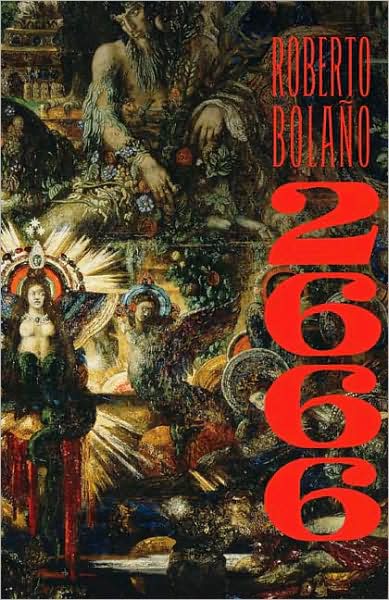
2666

Any bibliophile can attest that one of the greatest pleasures of re-reading a favorite book is that it doesn’t change. You change, but it doesn’t, and somehow, you can measure your own change against it. So when Picador’s new single-volume trade paperback edition of Roberto Bolaño’s magnum opus 2666 (out today) showed up at my doorstep a week or two ago, I was thrilled. I already own the book, but having another copy of it, for some reason–no logical reason, of course–seemed really important. It also puts 2666 in good company: I own two (or more) copies of Moby-Dick and Ulysses, and I’ve had to buy at least three copies of David Foster Wallace’s Infinite Jest (damn biblioklepts don’t return books). I bought FS&G’s triple trade paperback edition of the book at the end of last year, and I loved it loved it loved it (review here if you don’t believe me). So how does the new single-volume edition differ, you ask? Well, first off, it’s important to note the gracious similarities–Picador’s edition retains the same pagination, a trend that I hope will always continue with this book (editions of Infinite Jest have managed to keep cohesive to date as well). The new trade paperback is surprisingly supple and portable, with wider margins than the FS&G triple-job. With more room for marginalia in the cohesive package of a single volume, Picador’s edition will likely be the go-to for scholars and book clubs (it’s also about half the retail price of the FS&G editions, but just as attractive).

So, anyway, why should you read 2666 if you haven’t already? I’m going to be lazy and refer again to my original review, but I’ll also be generous and direct you to Macmillan’s resource site for 2666. The site already has plenty of great links to full reviews and interviews with Bolaño, and Picador’s publicists have assured me that they will be updating the site frequently with additional content to aid readers, including artwork and images. Also really cool — the folks at The Morning News, who host Infinite Summer, the Infinite Jest reading project, will launch a similar site for 2666 on January 1st of next year. Even though I’m pointing out all of these resource sites, I think it’s also important to note that 2666 is an incredibly readable book. Which leads back to my current re-reading–and, hopefully, to an argument why you should re-read 2666.

So I bought my original copy in San Francisco last year, on vacation, and began digging into it on the plane ride home. I read most of Part I, “The Part about the Critics” in something of a dazed post-hangover travel stupor. I was familiar with Bolaño’s epic sentences from The Savage Detectives, but I instantly liked this book better. It also seemed to defy all of my expectations–wasn’t this supposed to be an unremitting catalog of horrific murders? Anyway, I got to that part later. Fast forward ten months or so. Again, I’m on a plane, again, coming home, returning from Las Vegas, more dazed, more hungover than before, and I pick up 2666, and again, I dig into Part I. The book is a different book. Lines that made me crack up before seem sinister. I see murder where I’d seen academic squabbling. But there’s also that hope, that possibility, that force of humanity that might be Bolaño’s signature rhetorical move, and I see it too now. Upon a first reading, 2666 might seem impossibly incomplete: a book that could never end, a book that would have to keep going. And it is. It’s a cycle; it returns to itself, a series of calls and responses far richer than can be puzzled out over one, or two, (or three, or four . . . ) readings. But best of all, it’s great, greater than before. What might have seemed a fortunate fluke of a forceful voice reveals itself to be profound and measured control–Bolaño’s themes are layered like a labyrinth, but what a joyful labyrinth to traverse! Re-reading 2666 on the plane was a strange echo, doubled in the myriad echoes that I found on my re-reading. I finished most of Part I (skipping occasionally into sections of Part V, and then Part III, and so on, liberated all of a sudden), and when I got home, despite the paramount exhaustion of a long Las Vegas weekend with a few dozen friends, I collapsed in my bed and into the book, not wanting to put it down, staying up far too late reading. Again. Great stuff. Go get it if you haven’t yet, and if you’ve got it, read it again.

Javier Moreno on the Geometry of Bolaño’s Fiction

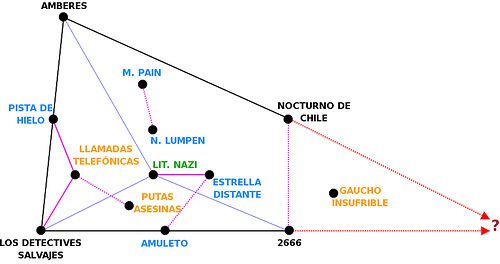
Still working through this Roberto Bolaño jag: I will finish By Night in Chile tonight or tomorrow, and I’ll get to my own thoughts on that then. For now: while looking for an interview in English with Bolaño, I came across this marvelous essay in The Quarterly Conversation–a site Biblioklept links to, oddly enough, yet I missed it (probably because it’s a few years old). In “Roberto Bolaño: A Naïve introduction to the geometry of his fictions,” Javier Moreno doesn’t really analyze or criticize or Bolaño’s oeuvre ; instead, he treats the work like a strange, maddening (and fun, beautiful) game. And if you’ve read Bolaño, you know how appropriate that approach is. Here is Moreno’s attempt to diagram Bolaño’s corpus:

triangle

That question mark represents what Moreno suggests is Bolaño’s “unreachable book,” a tome that (might) exist as the dialogic interplay of all of Bolaño’s works. Moreno concludes (more or less; concludes is really not the right word) that 2666 is that “unreachable book”; he writes:

I believe that even if Bolaño hadn’t died prematurely 2666 would still have been published posthumously. The “real” and impossible 2666 was larger and richer. My guess is that if Bolaño had lived forever 2666 would have been at the very end of the diagram, located in the vertex where the question mark is. Since he died, since he was mortal (too mortal) after all, we have to resign ourselves to the promise of a triangle and only dream of its asymptotic completion.

Consider this fragment of an interview as evidence for Moreno’s claim:

Amambay Guevara: What’s the novel you dream of writing?

Roberto Bolaño: One novel that will be called 2666.

Ricardo Bello: That novel, 2666, would it be a science fiction one? Would it be located in Latin America?

Roberto Bolaño: Partially, it will be science fiction. It will take place in the state of Sonora, north of México, and in Arizona.

I think Moreno’s essay is pretty great–it’s the sort of writing I like, and its tone is spot on for the psychology and rhythm of Bolaño’s writing. Still, I think you’d probably go crazy thinking about what’s at the end of that triangle, of some great work out there, intangible, unfinished, unclaimed, disparate. In the end, Moreno gives up on his diagram, writing:

The system doesn’t stay still. That’s the way it is. Conscious of the impossible task, I resign. I cannot capture it. I cannot shoot the video. The dots are moving as I stare at them, still puzzled, marveled by their strangeness and beauty. The diagram, after all, is just a waste of time.

I like the way his line about moving dots subtly recalls the strange ending of The Savage Detectives. Also, I’m not sure that the diagram is a waste of time. I think that what Moreno might not see (or shit, maybe he does see it, how would I know) in his own diagram is that that question mark might not be some unwritten masterpiece, but rather it might be the reader who enters into the game with Bolaño and his texts. The irony is that that is precisely what Moreno has done. And–sign of a great critic–he’s made me want to read more.

Five Favorite Fictional Fathers

Literature seems to have an ambivalence toward fatherhood that’s too complex to address in a simple blog post–so I won’t even try. But before I riff on a few of my favorite fathers from a few of my favorite books, I think it’s worth pointing out how rare biological fathers of depth and complexity are in literature. That’s a huge general statement, I’m sure, and I welcome counterexamples, of course, but it seems like relationships between fathers and their children are somehow usually deferred, deflected, or represented in a shallow fashion. Perhaps it’s because we like our heroes to be orphans (whether it’s Moses or Harry Potter, Oliver Twist or Peter Parker) that literature tends to eschew biological fathers in favor of father figures (think of Leopold Bloom supplanting Stephen Dedalus in Ulysses, or Merlin taking over Uther Pendragon‘s paternal duties in the Arthur legends). At other times, the father is simply not present in the same narrative as his son or daughter (think of Telemachus and brave Odysseus, or Holden Caulfield wandering New York free from fatherly guidance). What I’ve tried to do below is provide examples of father-child relationships drawn with psychological and thematic depth; or, to put it another way, here are some fathers who actually have relationships with their kids.

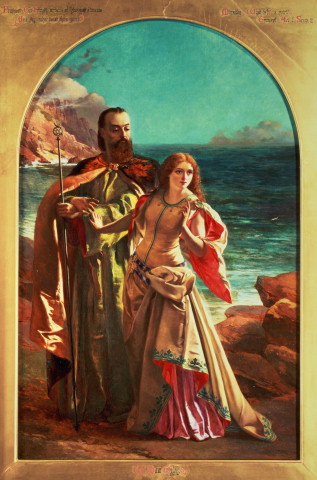
Prospero and Miranda--William Maw Egley

1. Prospero, The Tempest (William Shakespeare)

Prospero has always seemed to me the shining flipside to King Lear’s dark coin, a powerful sorcerer who reverses his exile and is gracious even in his revenge. Where Lear is destroyed by his scheming daughters (and his inability to connect to truehearted Cordelia), Prospero, a single dad, protects his Miranda and even secures her a worthy suitor. Postcolonial studies aside, The Tempest is fun stuff.

2. Abraham Ebdus, The Fortress of Solitude, (Jonathan Lethem)

Like Prospero, Abraham Ebdus is a single father raising his child (his son Dylan) in an isolated, alienating place (not a desert island, but 1970’s Brooklyn). After Dylan’s mother abandons the family, the pair’s relationship begins to strain; Lethem captures this process in all its awkward pain with a poignancy that never even verges on schlock. The novel’s redemptive arc is ultimately figured in the reconciliation between father and son in a beautiful ending that Lethem, the reader, and the characters all earn.

3. Jack Gladney, White Noise (Don DeLillo)

While Jack Gladney is an intellectual academic, an expert in the unlikely field of “Hitler studies” (and something of a fraud, to boot), he’s also a pretty normal dad. Casual reviewers of White Noise tend to overlook the sublime banality of domesticity represented in DeLillo’s signature novel: Gladney is an excellent father to his many kids and step-kids, and DeLillo draws their relationships with a realism that belies–and perhaps helps to create–the novel’s satirical bent.

4. Oscar Amalfitano, 2666 (Roberto Bolaño)

Sure, philosophy professor Amalfitano is a bit mentally unhinged (okay, more than a bit), but what sane citizen of Santa Teresa wouldn’t go crazy, what with all the horrific unsolved murders? After his wife leaves him and their young daughter, Amalfitano takes them to the strange, alienating land of Northern Mexico (shades of Prospero’s island?) Bolaño portrays Amalfitano’s descent into paranoia (and perhaps madness) from a number of angles (he and his daughter show up in three of 2666‘s three sections), and as the novel progresses, the reader slowly begins to grasp the enormity of the evil that Amalfitano is confronting (or, more realistically, is unable to confront directly), and the extreme yet vague danger his daughter is encountering. Only a writer of Bolaño’s tremendous gift could make such a chilling episode simultaneously nerve-wracking, philosophical, and strangely hilarious.

5. The father, The Road (Cormac McCarthy)

What happens when Prospero’s desert island is just one big desert? If there is a deeper expression of the empathy and bonding between a child and parent, I have not read it. In The Road, McCarthy dramatizes fatherhood in apocalyptic terms, positing the necessity of such a relationship in hard, concrete, life and death terms. When the father tells his son “You are the best guy” I pretty much break down. When I first read The Road, I had just become a father myself (my child was only a few days old when I finished it), yet I was still critical of McCarthy’s ending, which affords a second chance for the son. It seemed to me at the time–as it does now–that the logic McCarthy establishes in his novel is utterly infanticidal, that the boy must die, but I understand now why McCarthy would have him live–why McCarthy has to let him live. Someone has to carry the fire.


The Believer’s 2009 Reader Survey: (What Some Jokers Thought Were) The Best Books of 2008

200903

The new issue of The Believer showed up in my overstuffed mailbox today. It’s the film issue, featuring a DVD of short films about Jean-Luc Goddard’s travels in the U.S. My second favorite Jean-Luc! (Seriously, Alphaville is great, but it’s no ST:TNG). The issue also features The Believer‘s annual reader survey. Here are the results, from their website, with our parenthetical thoughts and links.

READER SURVEY RESULTS

  1. 2666—Roberto Bolaño (This seems pretty obvious. Go, read it, now. Not that awards mater, but it also just won the National Book Critics Circle Award for best fiction).
  2. Unlucky Lucky Days—Daniel Grandbois
  3. Lush Life—Richard Price (After hearing a great interview with Price on NPR, I really wanted to read this book–and I really don’t care for detective fiction. And I never got into The Wire. I guess it’s not really genre fiction though. I guess I should read it).
  4. The Lazarus Project—Aleksandar Hemon
  5. Netherland—Joseph O’Neill (Heard lots of good things about this, but neglected to solicit a copy).
  6. Vacation—Deb Olin Unferth (Haven’t read it. Like her short stories in McSweeney’s though).
  7. Unaccustomed Earth—Jhumpa Lahiri (Unsolicited promo copy of the new trade paperback edition showed up in the mail a few days ago. I will try to read it).
  8. Arkansas—John Brandon
  9. A Mercy—Toni Morrison (This topped my best of 2008 list only because I hadn’t read 2666 yet–to be fair, however, they’re both great, totally different books, so no real reason why one should top another).
  10. Indignation—Philip Roth (Jesus. Do people still read Philip Roth. Who knew?) Continue reading “The Believer’s 2009 Reader Survey: (What Some Jokers Thought Were) The Best Books of 2008”

2666 – Roberto Bolaño

2666

Where to start, where to start…

Do I say that the book is good, great, fantastic, a literary achievement? These words don’t seem big enough, or they seem like hackneyed clichés, ugly inadequacies. Here’s a very short review: go get the book and read it. Worried that 900 pages is too long? Don’t worry. They fly by. I read the book in less than a month, usually in forty or fifty page sittings, something I usually don’t make time to do. But hang on, I’m already off to a bad start I admit, there’s no context here, is there? Let me try again.

2666 is Chilean exile Roberto Bolaño’s posthumous magnum opus. The book comprises five sections, each focusing on a separate but often overlapping set of characters and locations. The book is, in my paperback edition (composed of three separate books) 893 pages long. The book is excellent, addictive, full of pain and pathos and humanity. Most of the sentences are very, very long. What is it about, then? There are too many answers to that question, but here goes–

There are two major, intertwined plot threads in 2666, one about a series of gruesome rapes and murders in the fictional city of Santa Teresa, Mexico, and the other concerning an obscure German writer with the improbable name Benno Von Archimboldi. These two threads weave through the labyrinth that is 2666, connecting the many themes and tropes and moods and tones of this massive novel. Bolaño’s styles shift and weave and morph throughout the book, evoking laughter and rage and pity and anticipation and overwhelming sadness. He’s very often philosophical but never abstract, lyrical but grounded, and always entertaining. Bolaño’s command of thousands of different voices is on display here, whether he’s telling the tale of an ex-Black Panther or an exiled Russian sci-fi writer, a Romanian general or a crippled Italian critic. Bolaño’s voices layer upon each other in a strange chorus; often I found myself shocked at how, 300 pages later, a different character in a different place and time will hit on the same note–a comment about semblances and reality, or graveyards, or fate and chance and choice, or mirrors, or dreams and nightmares, or giants, or insane asylums, or aliases and pseudonyms–only this new character will express this note in a new or different tone, adding to the richness and dazzling complexity of the tale. Bolaño’s voices are often framed in a series of tales like Russian nesting dolls, only, where a writer like John Barth might explicitly announce or call attention to this device, Bolaño’s storytelling has a humanistic, natural quality, a quality that provokes and calls attention to the limits of human memory and our collective capabilities to narrativize our lives. But hang on again, I’ve gotten away from plot summary, haven’t I? Do you really need a summary? Yes? Will, “It’s about everything. Life, death, all that shit,” will that not do? Okay. Another attempt, then.

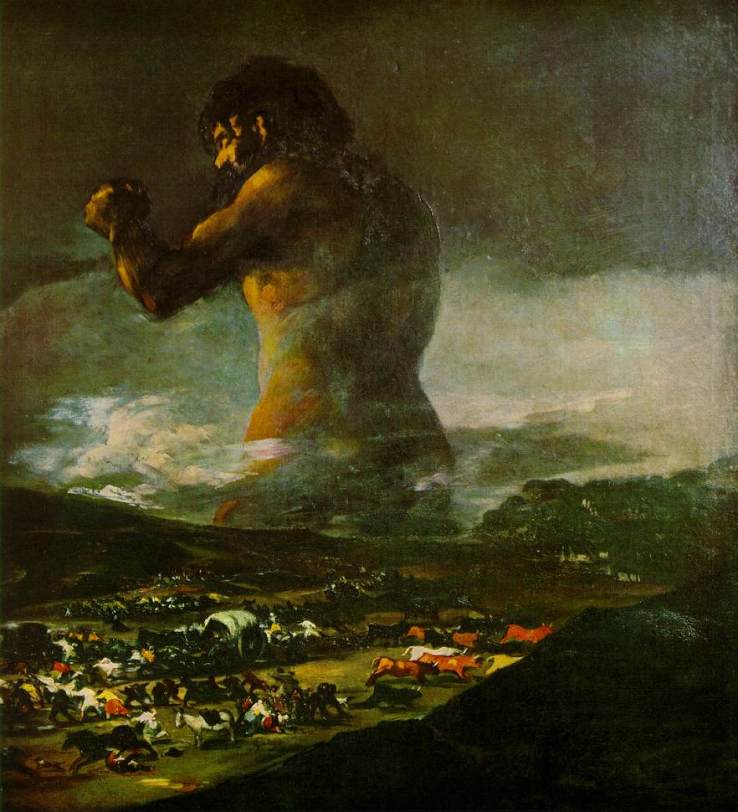
goya-colossus

The first section of 2666, “The Part About The Critics,” tells the story of four critics from four European countries who specialize in Archimboldi; in fact, two of the critics pretty much invent Archimboldi studies. Through their critical endeavors, the obscure, unphotographed writer rises to greater prominence. The four set out to find him, initiating the novel’s detective lit thread. They wind up in Santa Teresa, a city experiencing a seemingly endless slew of murders. In Santa Teresa, they meet a Chilean professor named Amalfitano, who (obviously) features heavily in the next section, “The Part About Amalfitano.” At this point, we start discover more about the unsolved rapes and murders of young women in Santa Teresa, but these crimes linger in the background, the story of Amalfitano, his ex-wife, his daughter, and a geometry book hanging from a clothes line at the fore. Amalfitano’s teenage daughter returns in the third section, “The Part About Fate.” This part of the novel details Oscar Fate, an African-American reporter who travels to Santa Teresa to cover a boxing match only a few days after the death of his mother. “The Part About Fate” builds to a rapid, grotesque, nightmarish climax, where the journalist, alien and impartial visitor, silent observer, becomes implicated in the ugly violence and grim desperation of Santa Teresa. This rhetorical move leads the reader into the longest section of 2666, “The Part About The Crimes,” in which we finally learn about the gruesome murders–hundreds and hundreds of murders–of the young women who work in the factories of Santa Teresa. The final section, “The Part About Archimboldi,” works as a partial bildungsroman, revealing the life story of the man who becomes Benno von Archimboldi. But does “The Part About Archimboldi” wrap up all the riddles, seal the deal, lead us out of the labyrinth and into the light–do we get answers? Let’s see–

Readers enthralled by the murder-mystery aspects of the novel, particularly the throbbing detective beat of “The Part About The Crimes,” may find themselves disappointed by the seemingly ambiguous or inconclusive or open-ended ending(s) of 2666. While the final moments of “The Part About Archimboldi” dramatically tie directly into the “Crimes” and “Fate” sections, they hardly provide the types of conclusive, definitive answers that many readers demand. However, I think that the ending is perfect, and that far from providing no answers, the novel is larded with answers, bursting at the seams with answers, too many answers to swallow and digest in one sitting. Like a promising, strangely familiar turn in the labyrinth, the last page of the book invites the reader back to another, previously visited corridor, a hidden passage perhaps, a thread now charged with new importance. Like Ulysses or Moby-Dick or Infinite Jest before it–and yes, yes, I would class this book with those without batting an eye–2666 is a book that demands multiple readings. Fortunately, despite its grim subject, it’s endlessly entertaining, rich with literally hundreds and hundreds of stories, stories that impel and compel you to read, read, read. But, again like Ulysses or Moby-Dick or Infinite Jest before it, 2666 is not for everyone.

arcimb1

I’ll quote from the only negative review at Amazon right now, by one Mr. Nathan King, who writes, “This is not an enjoyable/pleasurable book to read. . . . this book is a GRUESOME and HORRIFICALLY VIOLENT book. The largest section of the book is basically 300+ pages of autopsy reports. You will read the words “vaginally and anally raped” over and over and over, until it runs through your mind day and night.” King’s review is accurate in several ways, although I fundamentally disagree with his overall assessment, of course. The book’s violence will run through your mind day and night: the book is awfully affecting. One of Bolaño’s missions in the book, it seems, is to continually press on the reader a horrific assemblage of dead, raped, mutilated bodies, bodies found in Dumpsters, trash heaps, ditches, alleys; violated, nameless, unclaimed bodies. While “The Part About The Crimes ” clearly contains most of these horrors, disposable bodies litter the entire book, whether they are Jews to be executed by Nazis in WWII or young men murdered in prison while the wardens watch. Bolaño’s method then is to confront his readers with all these unsolved, perhaps unsolvable crimes, and ask how one can witness to the horrors of life without giving in to despair or madness or suicide. Callous or cynical readers, looking for a simple answer to “Whodunnit?” will miss the multiplicity of answers that Bolaño provides, which might be boiled to: We all did it. We are all responsible for these crimes.

At many points throughout the massive tome Bolaño addresses this central problem, but this passage from “The Part About Amalfitano” sums up one possible solution quite beautifully. Amalfitano, slowly going insane, wondering about existence and movement and sleep and reality, thinks–

Anyway, these ideas or feelings or ramblings had their satisfactions. They turned the pain of others into memories of one’s own. They turned pain, which is natural, enduring, and eternally triumphant, into personal memory, which is human, brief, and eternally elusive. They turned a brutal story of injustice and abuse, an incoherent howl with no beginning or end, into a neatly structured story in which suicide was always held out as a possibility. They turned flight into freedom, even if freedom meant no more than the perpetuation of flight. They turned chaos into order, even if it was at the cost of what is commonly known as sanity.

To systematize, to narrativize then, to try to put order and meaning into one’s life, or the lives around you, to witness to others’ pain by claiming it as your own, these moves then betray one’s ability to accurately, or sanely, perceive the world. It’s this great cost that Bolaño navigates in 2666, and he does so with aplomb and precision and grace.

Have I still not convinced you to read 2666? I could keep going and going, on and on, and I won’t be the only one–Bolaño’s book will be one for posterity, a great work that literary critics (much like the ones he sympathetically parodies and valorizes here) will debate over, ponder over, discuss, write about, love, and be tortured by for ages to come. At the same time, this is not a book that one should feel is only for the “literary élite” (whatever that means)–with its force and vitality and inventiveness, with its rich, detailed dream/nightmare world, 2666 is a book that you, dear reader, should read, must read. Very highly recommended.

Timothy Fadek’s Images of Juárez

juarez

I’m about 60 pages away from finishing Roberto Bolaño’s posthumous magnum opus, 2666, an astounding, shocking book that you should pick up right now and start reading, unless, of course, you hate the idea of getting hopelessly addicted to a book that coerces you to read it, that lingers in the back of your mind and gut, beckoning, calling you, even as you should be working or spending time with your family or doing errands or chores, etc. But otherwise: read it. A proper review forthcoming.

Anyway. The backbone of the plot, or, rather, the peripheral story that haunts the plot(s) of this massive, heavy novel, involves a seemingly endless string of largely unsolved murders in the fictional Mexican border city of Santa Teresa. An ugly industrial town in the Sonora Desert, Santa Teresa is a thinly disguised stand-in for Ciudad Juárez, where over the past 15 years over 400 young women have been raped and killed, their murders unsolved. While searching the gruesome real-life back story that informs Bolaño’s masterpiece, I came across Fadek’s eerie and sympathetic images of Juárez (this background story on Fadek and the Juárez photos is also quite good). Fadek aims clearly to draw attention to these underreported crimes, but his photographs also capture the doom and foreboding that looms in the blood of 2666. Those who’ve read the novel will no doubt find them evocative of the fourth book of 2666, “The Part About the Crimes,” and those who are flirting with undertaking Bolaño’s big book may find their interest redoubled. In any case, Fadek’s photojournalism is well worth a look. Great stuff.

The Savage Detectives — Roberto Bolaño

savage

I give up. I don’t know how to review The Savage Detectives.

Everyone told me I was supposed to love this book, but I didn’t. There, that’s a review. Not a good review, but there. I can’t remember a book ever taking me so long to finish or a book that I put down so often. When I truly love a book, I am moved. Often physically. Sometimes I have to stand up to read a book, I’m so moved. That’s a good book. (I never had to stand up during The Savage Detectives, although I often had to force myself to read thoroughly and not just skim). When I truly love a book, I’m a little sad and deflated when it’s over. I know a book is great if I’m compelled to go back and immediately reread sections. (Again, with Detectives, this didn’t happen). But it looks like I’m trashing the book. I shouldn’t. It has a lot going for it.

I read the first 140 pages, the journal entries of young Garcia Madero, in a blur. Funny and passionate, Madero’s voice explodes with the immediacy and intensity of youth. He joins up with the visceral realists, a group of anti-establishment poets (who no one cares about). Led by two enigmatic outsiders, Ulises Lima and Arturo Belano, the visceral realists gripe about the state of Mexican and Latin American literature, screw around, and argue with each other (no one else will listen to them). Madero paints Mexico City in the mid-1970s as vibrant, a place full of poetry and art. He becomes a biblioklept, God bless him (yet he ethically agrees not to steal from a poor old blind bookseller). He writes poems. He has sex. He runs away from home, sort of. There’s a breathless energy to Madero’s narrative that makes the book hard to put down, and the first section of The Savage Detectives, “Mexicans Lost in Mexico” culminates in one of the book’s most exciting events. Madero, Lima, and Belano help a young girl named Lupe escape from her belligerent pimp. Then, that portion of the story unresolved, the narrative shifts dramatically.

In the second section, “The Savage Detectives,” we are treated to, or subjected to, or made to endure, or made to navigate–pick your verb, please–over 450 pages of (one-sided) interviews spanning 20 years. Some of the interviewees appear consistently throughout this section, like Amadeo Salvatierra, who helps Lima and Belano in their quest to find the lost original visceral realist, Cesárea Tinajero. Other voices only pop up once to tell a weird story about Lima or Belano–or more accurately, a weird story about themselves with Lima or Belano playing bit parts. Some of these stories, like Lima’s strange time in a Tel Aviv prison, or Belano’s tenure as a national park guard in France are great; other times they are painfully tedious or repetitive (you know, like real life).

Technically, The Savage Detectives is quite an achievement. The myriad stories in the book’s main section represent the fragmented narratives that might compose a person’s life–a series of perspectives that others have about us, views that can never add up to a unified truth. The bulk of these stories are very much about poetry, art, and travel. Like Joyce’s Ulysses, Detectives is a peripatetic novel, full of specific locations and very, very explicit directions (Joyce famously claimed that were Dublin destroyed in a catastrophe, it could be rebuilt based on his novel; the same seems true for Bolaño’s Mexico City). Also like Ulysses, Detectives is an epic about the banal, ordinary things that fill our lives: jobs and eating and getting to places and having one’s friendships sour and being disappointed and so on. Lots and lots of “and so on.” This isn’t to say that there aren’t moments of heroism and adventure–saving kids from satanic caves, stow-away sea voyages, and dodging bullets from Liberian rebels make for interesting narrative peaks. However, most of the novel remains rooted in a realism that is often dreadfully visceral in its painstaking replication of just how depressing a life could be. As the seventies and eighties turn into the nineties, things get more bleak and more depressing for Lima and Belano. And it all adds up to an incomplete picture (literally; check out the last page of the book if you don’t believe me).

o_roberto-bolano

By the time we return to Madero’s journals in the third and final part of the novel, “The Sonora Desert,” the sadness and deflation of the previous section infects and tints every aspect of the narrative. Lima and Belano, with Madero and Lupe in tow, search desperately for the forgotten poet Cesárea Tinajero. Their search works as a pitiful parallel to “The Savage Detectives” section, a comment on the elusive nature of identity, and the strange disappointments that punctuate our expectations. Even the novel’s climactic ending seems understated after the monolithic middle section. And while this deflationary technique is undoubtedly a carefully considered conceit on Bolaño’s part, the payoff for the reader–this reader anyway–did not merit the effort and concentration that the book required. Or, to put it another way, after hours of time invested, I was unmoved.

As rave reviews of the English translation of his last novel 2666 begin seeping out of the critical woodwork (this month’s Harper’s has devoted a full four pages to the book), it seems that Bolaño will top most critics’ lists again this year. At over 900 pages and reportedly full of grim, bleak violence, it’s hard to imagine 2666 will be any easier to get through, and as FS&G summarily ignored our requests for a review copy, there’s no pressing obligation, I suppose. The critical praise heaped on 2666 this year will surely lead interested readers to The Savage Detectives. I think Mark Twain’s infamous note at the beginning of The Adventures of Huckleberry Finn would provide the best warning to these potential readers: “Persons attempting to find a motive in this narrative will be prosecuted; persons attempting to find a moral in it will be banished; persons attempting to find a plot in it will be shot.” While no serious critic could dismiss Bolaño’s lyrical skill and complex control of the many voices that populate Detectives, I think a number of readers–serious readers–would not be wrong for considering the tome a bit overrated.