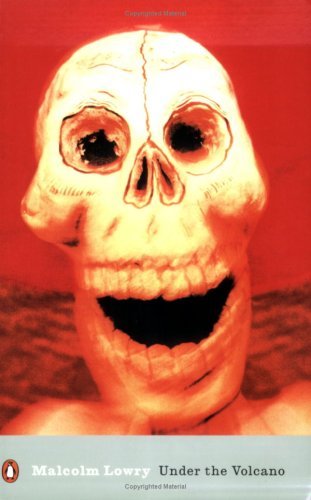
Under the Volcano — Malcolm Lowry

Most of Malcolm Lowry’s dense, depressing novel Under the Volcano takes place over the course of November 2nd, 1938, the Mexican Day of the Dead. Like a reticent, dour Virgil, Lowry guides the reader through the day’s tragic arc, floating between the minds of his novel’s three protagonists: Geoffrey Firmin, his half-brother Hugh, and Geoffrey’s estranged wife Yvonne. Geoffrey is British Consul to Mexico — ex-Consul, really, as British-Mexican relations sour against the backdrop of Spanish fascism and the rise of nationalism in Mexico — but he is almost always referred to as “the Consul,” a blackly ironic title. See, the Consul bears little authority aside from an extreme expertise on how to stay drunk (or “drunkly sober un-drunk”) 24/7. He’s ambassador to bar stools, a manager of mescal and little else (certainly not his own life; certainly not diplomatic affairs). The Consul is a wreck, an alcoholic to put Hemingway and Fitzgerald’s (and even Bukowski’s) alter-egos to shame.

After a first chapter that seems to derail all but the most patient readers, the narrative conflict arrives when Yvonne returns to Quauhnahuac, Mexico, a year after leaving (and divorcing) the Consul. She arrives to find the Consul (“Geoffrey,” as he’s called when the free indirect style inhabits her mind) drinking whiskey in a hotel bar in order to sober up (yep). It’s not immediately clear why Yvonne has returned to the Consul, but it seems that she hopes to save him from drowning in a drunken downward spiral. As the pair walks to the Consul’s house, they pass numerous advertisements for a boxing match; a child’s funeral proceeds down the avenue. These motifs of fighting, death, and futility permeate the novel.

During the walk we learn that Yvonne is not the only one concerned about the Consul’s health; his (much) younger brother Hugh has come to stay with him in the hopes of sobering him up. (Hugh employs a revolting and unsuccessful “strychnine cure”). That Hugh has also returned doubly complicates the plot. Much of Under the Volcano remains implicit, unnamed, hinted at, and this seems especially true of the implication that Yvonne cheated on the Consul with Hugh in the recent past (this implication may have been stated conclusively at some point in the novel, but I’ve only read the book once, which is perhaps like not having read it at all). What’s certainly clear is that Yvonne cheated on the Consul with a French filmmaker, Jacques Laruelle, a man whom the Consul, through sheer bizarre coincidence (but of course it isn’t sheer bizarre coincidence), spent a childhood summer with, and experience which bonded them as brothers in an Edenic holiday that eventually (inevitably) soured.

Despite her infidelities, Yvonne is generally present (I choose the verb “present” over “presented as” to highlight Lowry’s impeccable Modernist style) as a sympathetic character. Still, it is hard not to identify with the Consul (with “Geoffrey,” I suppose, if we are going to be familiar), the dark soul of this novel, and his complicated, painful feelings for Yvonne form the core of Volcano’s tragedy. He longs for her, pines for a complete life with her, yet resents her, cannot forgive her, hates her. For what? For leaving him. For betraying him. But perhaps foremost, he despises her inability to understand his alcoholism (he is particularly upset when she refuses to share a morning libation with him when they meet for the first time in a year). I’ll quote a passage at length now, one that showcases Lowry’s free indirect style, and one that reveals the strange indignities of the Consul’s sense of his own alcoholism. For context, dear reader, you must only know that Yvonne has suggested that she and the Consul might make long-term plans when he is sober “in a day or two”—

The Consul sat perfectly still staring at the floor while the enormity of the insult passed into his soul. As if, as if, he were not sober now! Yet there was some elusive subtlety in the impeachment that still escaped him. For he was not sober. No, he was not, not at this very moment he wasn’t! But what had that to do with a minute before, or half an hour ago? And what right had Yvonne to assume it, assume either that he was not sober now, or that, far worse, in a day or two he would be sober? And even if he were not sober now, by what fabulous stages, comparable indeed only to the paths and spheres of the Holy Cabbala itself, had he reached this stage again, touched briefly once before this morning, this stage at which alone he could, as she put it, “cope,” this precarious precious stage, so arduous to maintain, of being drunk in which alone he was sober! What right had she, when he had sat suffering the tortures of the damned and the madhouse on her behalf for fully twenty-five minutes on end without having a decent drink, even to hint that he was anything but, to her eyes, sober? Ah, a woman could not know the perils, the complications, yes, the importance of a drunkard’s life! From what conceivable standpoint of rectitude did she imagine she could judge what was anterior to her arrival? And she knew nothing whatever of what all too recently he had gone through, his fall in the Calle Nicaragua, his aplomb, coolness, even bravery there—the Burke’s Irish whiskey! What a world! And the trouble was she had now spoiled the moment.

The “fall in the Calle Nicaragua” the Consul references is quite literally a drunkard’s blackout (followed by the aforementioned fortifying whiskey, courtesy of a tourist), but it — falling — is perhaps the dominant motif in a novel crammed with motifs. In allegorical terms, if we want to ruin a good book (I don’t recommend this, of course), Volcano is pure Faust-stuff: end of innocence, fall of man, intractability of the human condition, ethical peril, moral inertia. While the Consul’s fall dominates the novel, Lowry brings this decline into dramatic relief in a late, climactic episode when his (anti-)heroic trio encounter a dying (dead?) man on the side of the road. Hugh tries to help, but the Darwinian venality of Mexican commonplace law makes his attempt impotent. Yvonne and the Consul are basically paralyzed.

Hugh’s attempt to save the man is a desperate call to action, an endeavor to perform some good in a world dominated by war and fascism. Hugh’s character fascinates. We learn of his past in one of the novel’s most intriguing episodes, a mini-bildungsroman that finds young Hugh working in the merchant marine as a calculated ploy to lend romance to his persona — he longs to prevail as a songwriter. He returns to find that no one cares about — has even heard — his guitar compositions; his publicity stunt fails. Although Hugh is only twenty-nine, he already seems himself as a failure, a fallen hero; he obsesses over the Battle of Ebro, daydreaming of helming a ship laden with hidden arms that he will deliver to the Loyalists who oppose the Fascists. Hugh’s greatest pain — and perhaps (only perhaps) Lowry’s greatest cruelty — is the awareness that the idealism of romantic heroism is intrinsically bound to a kind of selfish egoism. Hugh, perhaps with the visceral signal of his half-brother as a kind of radical prescience, can already see his own fall; his parts in Volcano are in a sense a constant meditation on falling. Hugh tries to save the dying man on the road, the cold double of his brother, whom he also tries to save — and yet it is all to little avail.

In Lowry’s world, in the volcano-world, there is only expulsion from the Eden. Lowry spells out this theme near the middle of his novel in a strange episode. The Consul wanders into his neighbor’s garden and reads a sign —

¿LE GUSTA ESTE JARDÍN?
¿QUE ES SUYO?
¡EVITE QUE SUS HIJOS LO DESTRUYAN!

The Consul stared back at the black words on the sign without moving. You like this garden? Why is it yours? We evict those who destroy! Simple words, simple and terrible words, words which one took to the very bottom of one’s being, words which, perhaps a final judgement on one, were nevertheless unproductive of any emotion whatsoever, unless a kind of colourless cold, a white agony, an agony chill as that iced mescal drunk in the Hotel Canada on the morning of Yvonne’s departure.

Significantly, either the sign is posted with improper punctuation, or (and?) the Consul’s translation is wrong — in either case a meaningful misreading occurs. We later receive the “proper” version of the sign: “¿Le gusta este jardín, que es suyo? ¡Evite que sus hijos lo destruyan! – “Do you like this garden that is yours? See to it that your children do not destroy it!”  The Consul’s first reading is a corruption, a cruel misreading that questions humanity’s right to happiness, and, tellingly, he connects the sign to the end of his relationship with Yvonne. The second version of the sign, while still foreboding, perhaps signals a kernel of hope in Lowry’s bleak work — the idea that a garden might be preserved, might be tended to; that children might be raised who do not kill, cheat, steal, rape, enslave, or otherwise prey on each other. Still, Lowry refuses to imagine what such a world might look like for us. Did I mention that Volcano is really, really sad?

For all its bleak, bitter bile, Volcano contains moments of sheer, raw beauty, especially in its metaphysical evocations of nature, which always twist back to Lowry’s great themes of Eden, expulsion, and death. Lowry seems to pit human consciousness against the naked power of the natural world; it is no wonder then, against such a grand, stochastic backdrop, that his gardeners should fall. The narrative teems with symbolic animals — horses and dogs and snakes and eagles — yet Lowry always keeps in play the sense that his characters bring these symbolic identifications with them. The world is just the world until people walk in it, think in it, make other meanings for it.

In many ways, Under the Volcano is an antipodal response to Joyce’s Ulysses. Both novels stream through a number of consciousnesses over the course of one day; both novels invert and subvert mythical frameworks against diurnal concerns; both novels point to the ways that the smallest meannesses — and kindnesses — can color and affect our lives. And while there are many divergences (chiefest, I believe, the spirit of redemption in Ulysses that seems entirely absent from Volcano), the greatest similarity may be their difficulty. Simply put, Lowry, like Joyce, throws his readers into the deep end. The first chapter of the novel inhabits the mind of Jacques Laruelle and takes place exactly one year after the events of the rest of the novel. It is both overture and context for all that follows, and yet it is radically alienating; indeed, it only fully makes sense after one finishes the novel and goes back and reads it again, realizing it is the rightful coda, the sad epilogue of a sad story. Lowry leads with his conclusion, show us the fall-out up front, the splinters and shards of the narrative to come. Picking up these pieces is hardly easy and never joyful, but it is a rewarding experience. Very highly recommended.
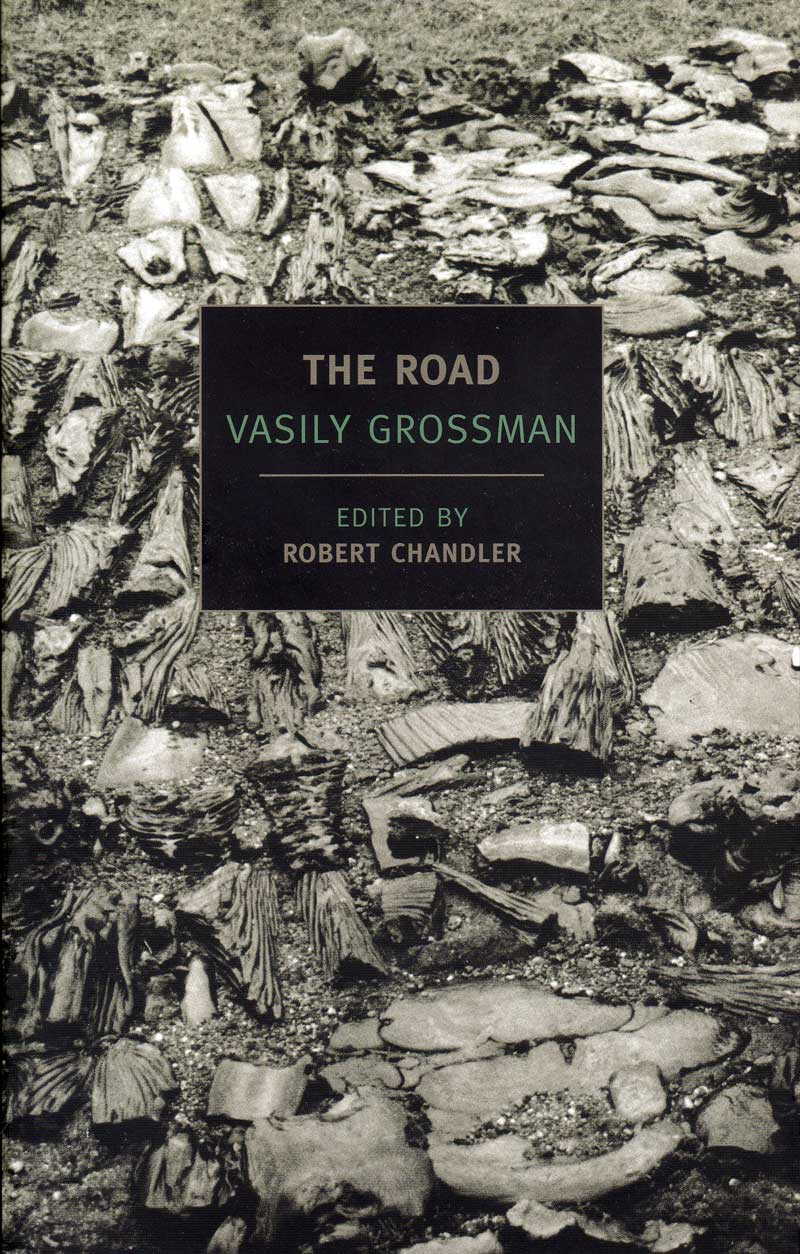
The Road — Vasily Grossman

I’d never heard of Vasily Grossman until Timothy Snyder referred to him, briefly, as a Soviet journalist who published some of the first unflinching reports of atrocities committed by Nazi soldiers and Hitler’s secret police during their conquest of eastern Europe. In Bloodlands, Snyder lauded Grossman as a reporter guided by a clear moral vision and a keen understanding of the tenuousness of human life.  A Ukrainian Jew who rhapsodized the Red Army’s defense of Stalingrad and then followed it all the way to Berlin, he built a literary career under the Soviet system before passing away with little fanfare. Although his early novels sold in the millions, at the time of his death in 1964 his reputation in his homeland was shattered, his health had deteriorated, and his final novels were blacklisted.  He could count himself lucky to have lived through a number of purges of the U.S.S.R.’s literary elite.  Edited and compiled by Robert Chandler for the impressive New York Review Books imprint, The Road collects of a number of his short stories, essays, letters, and articles in one well-curated volume, an excellent introduction to an important but neglected voice.

Organized chronologically, Grossman’s stories are separated by brief biographical notes thoughtfully included by Chandler. Although the selections fall into early, middle, and later works, it becomes clear that Grossman’s life as a man and as a writer (at least how it is presented here) can be broken up into distinct periods marked by increasing dissatisfaction with life under Soviet rule. Chandler labels the periods, from earliest to latest: “The 1930s,” The War, The Shoah,” and “Late Stories.”  The works in this collection are sad—truly sad—but throughout he returns to remembrances of love and small gestures of tenderness.  He is marked by the excesses of the totalitarian regimes he waged war upon and lived under. As a result, his writing demonstrates an appreciation of kindness that could only arise from a true comprehension of both humanity’s potential for cruelty and the limitless power of an autonomous mind.

The first short section, “The 1930s,” collects three concise stories concerning the creation and dissolution of family bonds.  “A Small Life” describes a couple that decides to foster a child from their village orphanage who ultimately finds them weird and boring, while in “In the Town of Berdichev” a rough female commander in a military unit must take a forced leave when her pregnancy makes it impossible for her to fulfill her duties to her company. She fondly remembers the father who was shot down in battle, but struggles to balance her duty to protect her child against her duty to protect her county.  Perhaps the most striking of the three stories is the last, titled “A Young Woman and an Old Woman.” The title characters are both rewarded by their state employers with a free trip to a seaside resort and share a train cabin as they journey to the coast.   They talk.  The young woman, enjoying her rise through the Soviet system, befriends the older woman who has been saddened by the surprising detention of her daughter and her own stalled professional ambitions. These two subtly drawn characters never fully understand the hidden mechanisms behind their fleeting instances of happiness. Perhaps these mechanisms have been hidden by the totalitarian state or, maybe because they’re people, they will always be doomed to wonder.

As the book transitions to its second section, Grossman seems torn between his duty as a reporter to inspire his fellow citizens to sacrifice for the greater good and his need to rail against the injustices perpetrated by warring totalitarian regimes. Like “In the Town of Berdichev,” “The Old Man” finds Grossman adopting a tone that might almost be described as propagandistic. A quiet old man, a beekeeper whose livelihood requires patience and silence, overcomes a lifetime of reticence by braining a German soldier with a shovel.  Much better is “The Old Teacher,” a story about a village’s elderly teacher, a Jew.  Distraught by what he sees as Nazi soldiers advance on his town—long simmering feuds settled by prompt denunciations, families thrown out of houses, all sorts of groveling and obsequiousness—the old man reflects on his failings and his fleeting successes.  The teacher and the town’s other Jews are forcefully marched to a ravine.  There they are made to lie down and wait for the firing squad, positioned above them on a hill, to reload.  The victims, in their last moments, see brave assertions of individual dignity, dole out small kindnesses, and console each other with the hope that others will not suffer similar fates. “The Hell of Treblinka” and “The Sistene Madonna” close this section. The former is Grossman’s terrible and moving account of the discovery of the death camp at Treblinka, written while reporting the westward march of the Soviet Red Army. The latter is an attempt to explain the power of Raphael’s rendering of The Sistene Madonna. The Madonna and her child symbolize the universal mother’s struggle to  protect a child —  a child she must relinquish to the world. For Grossman,  the mother and son are recurring historical figures who reappear wherever human life is reduced to a simple mathematical calculation: at the death camps; in blackened cities throughout Europe; in the famine-ravaged Ukraine; at Hiroshima. Freedom requires individuals to confront existential fears — “Their human strength triumphed over the violence. The Madonna walked toward the gas chamber, treading lightly on small bare feet. She carried her son over the swaying earth of Treblinka.”

The final section contains a number of staggering stories, the type you shove into a stranger’s hand with a wild look in your eye. These are stories that remind you of the masters of the form, writers like Hemingway, Chekov, Eudora Welty, and Cortazar. “The Elk” is a fantastic rumination on illness, love, and political repression. “The Road” is written from the vantage point of an Italian mule conscripted into the war on the side of the Axis powers. As he is forcefully marched through northern Africa and then the Russian steppe strapped to heavy artillery he forgets the pleasure taken from green shoots and visions of young mares. His indifference permits his survival. In “Mama,” one of Stalin’s top advisers adopts the orphaned child of parents he may have had a hand in killing. Grossman gives his readers a glance of the luxurious and precarious lives of those residing at the very top of the Soviet system. Even Isaac Babel makes an appearance (read Red Calvary if you haven’t already).

The Road brings together a number of works by an artist who deserves greater recognition. Grossman witnessed some of worst atrocities of the twentieth century, and his writing demonstrates a need to speak out against a particular brand of cruelty.  His writing in The Road is brave not only because a number of these stories could probably have led to his imprisonment, exile, or condemnation, but also because he utilizes terrible situations to illustrate humanity’s best qualities. Without being obvious, he champions mercy, understanding, and unconditional love. Beautiful stuff. Pick it up if you can.

A Few Thoughts on “Wiggle Room,” an Excerpt from David Foster Wallace’s Novel The Pale King

[Editorial note: Biblioklept originally published this post on March 3rd, 2009. We run it again today in anticipation of  the publication of David Foster Wallace’s posthumous novel, The Pale King, which is like, right around the corner].

The New Critics’ biggest contribution to literary criticism was the dictum that analysis was to be applied strictly to the text itself, without the muddying impurities of biography or any other outside knowledge influencing the reader. A context-free reading is pretty hard to come by, though, isn’t it? School syllabi are arranged around era or genre, or both; our teachers preface each novel or poem or story or essay with a nod to its relevance; a friend hands us a book because it’s “good.” We furtively flip through Tropic of Capricorn, knowing its rep; we look down our noses at abstinence vampire novels. In short, it’s hard to get to that pure reading the New Critics favor. Still, I’ve always thought it’s a pretty good strategy to put aside biographical/author psychology, and just stick to a good close reading of the text. Today, reading David Foster Wallace’s “Wiggle Room,” I was completely unable to do that.The context of Wallace’s recentish suicide hung over each page, each sentence. It was a distraction that led to a (necessary) rereading, a distraction that colored the reading–and then the rereading. A strange little voice popped into Wallace’s dense narration that kept whispering, “posthumous, unfinished novel.” But now that I’ve complicated and contextualized and complained, perhaps I should simply comment a bit on the story now.

In dense, thick sentences, Wallace relates a work morning for Lane Dean, an IRS rote examiner who detests his Sisyphean job. Like many cubicle-dwellers, Lane spends much of his day trying not to look at the clock. He also tries to use an inspirational photo of his son sparingly, so that the effect might be more intense. However, the boredom on this particular day overwhelms Lane and he “had the sensation of a great type of hole or emptiness falling through him and continuing to fall and never hitting the floor. Never before in his life up to now had he once thought of suicide.” Trying to truck through it is no good: “Lane Dean summoned all his will and bore down and did three returns in a row, and began imagining different high places to jump off of.” These thoughts of suicide are mixed with a strange humor. As Lane’s depression becomes frantic, Wallace writes, “Unbidden came ways to kill himself with Jell-O.” As Lane becomes more and more anxious, it becomes apparent that–paradoxically–his boredom literally excites him. He gets all worked up about it, about the thought of having to devote a whole lifetime to such meaningless, boring work. The scene culminates in an horrific image:

When he started to see the baby’s photo face melting and lengthening and growing a long cleft jaw and aging years in just seconds and finally caving in from old age and falling away from the grinning yellow skull underneath, he knew he was half asleep and dreaming but did not know his own face was in his hands until he heard a human voice and opened his eyes but couldn’t see who it went with and then smelled the pinkie’s rubber right under his nose.

The “human voice” that wakes up Lane is a strange cyclopean figure, an older man who delivers a weird lecture on the origins of the word “bore.” The scene is pure Wallacian, filled with plenty of erudite references and jostling with a love for etymology. It literally zaps life-force back into the text, and punctuates Lane’s boring day–which Wallace has so expertly made the reader suffer as well–with some strange, frightening fun. Wallace’s narration makes clear that the appearance of this strange man is not simply Lane going crazy from his boredom–Lane clearly cannot understand half of what the man refers to. Instead, we are given this nugget: “The phantom of the hallucination of repetitive concentration held for too long a time, like saying a word over and over until it kind of melted and got foreign.” After philosophical reflection on why the need for a word for a condition like boredom might have arisen, the episode ends with the phantom leaving and Lane looking up to see that “no time had passed at all, again.”

The emphasis on the ways a person’s soul might be bored into, how one might become bored, and what that might mean, proliferates the short text, and perhaps evokes some of the themes we’ll find in the whole of The Pale King. As the quotes I pulled suggest, the idea that boredom might feed a suicidal impulse resonates strongly in light of Wallace’s unfortunate death. But there I go again, letting context color my analysis. But if we’re only left fragments, isn’t it natural to want to pull them together, to frame them–to give them order–context? It’s hard to say and probably not worth guessing if Lane Dean and the phantom will be major parts of The Pale King or not, but as the text progressed, I found myself more and more interested. Apparently, The Pale King will be published with notes and outlines–some bits of context–perhaps giving readers a clue as to how the text was meant to progress. Who knows. A lot of readers felt thatInfinite Jest didn’t have a proper ending (not me, though). While I think that the “Wiggle Room” episode stands well on its own, I’d certainly be happy to read more about the phantom. Still, Infinite Jest was larded with lots of little vignettes that added to the whole, but it’s important to point out that there was a whole to be added to–not just a series of vignettes. I’m really hoping that, even unfinished, Wallace has left us something of substance and depth, something that narrativizes—contextualizes—its themes into a meaningful work of art.

Slavoj Žižek on Hitchcock’s Angles

Slavoj Žižek on Alfred Hitchock. From The Pervert’s Guide to Cinema (2006).

Suttree — Cormac McCarthy

In his 1992 interview with The New York TimesCormac McCarthy said, “The ugly fact is books are made out of books. The novel depends for its life on the novels that have been written.” McCarthy’s fourth novel, 1979’s Suttree is such a book, a masterful synthesis of the great literature — particularly American literature — that came before it. And like any masterful synthesis, Suttree points to something new, even as it borrows, lifts, and outright steals from the past. But before we plumb its allusions and tropes and patterns, perhaps we should overview the plot, no?

The novel rambles over several years in the life of Cornelius Suttree. It is the early 1950s in Knoxville, Tennessee, and Suttree ekes out a mean existence on the Tennessee River as a fisherman, living in a ramshackle houseboat on the edge of a shantytown. This indigent life is in fact a choice: Suttree is the college-educated son of an established, wealthy family. His choice is a choice for freedom and self-reliance, those virtues we like to think of, in our prejudicial manner, as wholly and intrinsically American. Suttree then is both Emersonian and Huck Finnian, a reflective and insightful man who finds his soul via a claim to agency over his own individuality, an individuality poised in quiet, defiant rebellion against the conforming forces of civilization. These forces manifest most pointedly in the Knoxville police, a brutal, racist organization, but we also see social constraint in the form of familial duty. One thinks of the final lines of Huckleberry Finn: “I reckon I got to light out for the Territory ahead of the rest, because Aunt Sally she’s going to adopt me and sivilize me and I can’t stand it. I been there before.”

Like Huck, Suttree aims to resist all forces that would “sivilize” him. His time on the river and in the low haunts of Tennessee (particularly the vice-ridden borough of McAnally) brings him into close contact with plenty of other outcasts, but also his conscience, which routinely mulls over its place in the world. Suttree is punctuated by–perhaps even organized by–several scenes of hallucination. Some of these psychotrips result from drunkeness, one comes from accidentally ingesting the wrong kind of mushrooms (or, the right kind, if that’s your thing), and the final one, late in the novel, sets in as Suttree suffers from a terrible illness. In his fever dream, a small nun–surely a manifestation of the guilt that would civilize us–accuses him–

Mr. Suttree it is our understanding that at curfew rightly decreed by law in that hour wherein night draws to its proper close and the new day commences and contrary to conduct befitting a person of your station you betook yourself to various low places within the shire of McAnally and there did squander several ensuing years in the company of thieves, derelicts, miscreants, pariahs, poltroons, spalpeens, curmudgeons, clotpolls, murderers, gamblers, bawds, whores, trulls, brigands, topers, tosspots, sots and archsots, lobcocks, smellsmocks, runagates, rakes, and other assorted and felonious debauchees.

The passage is a marvelous example of McCarthy’s stream-of-consciousness technique in Suttree, moving through the various voices that would ventriloquize Suttree, into the edges of madness, strangeness, and the sublimity of language. The tone moves from somber and portentous into bizarre imagery that blends humor and pathos. This is the tone of Suttree, a language that gives voice to transients and miscreants, affirming the dignity of their humanity even as it details the squalor of their circumstance.

It is among these criminals and whores, transvestites and gamblers that Suttree affirms his own freedom and humanity, a process aided by his comic foil, Gene Harrogate. Suttree meets Harrogate on a work farm; the young hillbilly is sent there for screwing watermelons. After his release, Harrogate moves to a shantytown in Knoxville. He’s the country mouse determined to become the city rat, the would-be Tom Sawyer to Suttree’s older and wiser Huck Finn. Through Harrogate’s endless get-rich-quick schemes, McCarthy parodies that most-American of tales, the Horatio Alger story. Simply put, the boy is doomed, on his  “way up to the penitentiary” as Suttree constantly admonishes. In one episode, Harrogate tries to buy arsenic from “a grayhaired and avuncular apothecary” to poison bats he hopes to sell to a hospital (don’t ask)–

May I help you? said the scientist, his hands holding each other.

I need me some strychnine, said Harrogate.

You need some what?

Strychnine. You know what it is dont ye?

Yes, said the chemist.

I need me about a good cupful I reckon.

Are you going to drink it here or take it with you?

Shit fire I aint goin to drink it. It’s poisoner’n hell.

It’s for your grandmother.

No, said Harrogate, craning his neck suspectly. She’s done dead

Suttree, unwilling father-figure, eventually buys the arsenic for the boy against his better judgment. The scene plays out as a wonderful comic inversion of William Faulkner’s “A Rose for Emily,” from which it is so transparently lifted. McCarthy borrows liberally from Faulkner here, of course, most notably in the language and style of the novel, but also in scenes like this one, or a later episode that plays off Faulkner’s comic-romantic story of a man and a woman navigating the aftermath of a flood, “Old Man.” Unpacking the allusions in Suttree surpasses my literary knowledge or skill, but McCarthy is generous, if oblique, with his breadcrumb trail. Take, for example, the following sentence: “Suttree with his miles to go kept his eyes to the ground, maudlin and muttersome in the bitter chill, under the lonely lamplight.” The forced phrase “miles to go” does not immediately present itself as a reference to Robert Frost’s famous poem, yet the direction of the sentence retreats into the history of American poetry; with its dense alliteration and haunted vowels, it leads us into Edgar Allan Poe territory. Only a few dozen pages later, McCarthy boldly begins a chapter with theft: “In just spring the goatman came over the bridge . . .” The reference to e.e. cummings explicitly signifies McCarthy’s intentions to play with literature. Later in the book, while tripping on mushrooms in the mountains, Suttree is haunted by “elves,” the would-be culprits in Frost’s poem “Mending Wall.” The callback is purposeful, but tellingly, McCarthy’s allusions are not nearly as fanciful as their surface rhetoric might suggest: the goatman does not belong in Knoxville–he’s an archaic relic, forced out of town by the police; the elves are not playful spirits but dark manifestations of a tortured psyche.

Once one spots the line-lifting in Suttree it’s hard to not see it. What’s marvelous is McCarthy’s power to convert these lines, these riffs, these stories, into his own tragicomic beast. An early brawl at a roadhouse recalls the “Golden Day” episode of Ralph Ellison’s Invisible Man; a rape victim’s plight echoes Hubert Selby’s “Tralala”; we find the comic hobos of John Steinbeck’s Cannery Row–we even get the road-crossing turtle from The Grapes of Wrath. A later roadhouse chapter replays the “Circe/Nighttown” nightmare in James Joyce’s Ulysses. Ulysses is an easy point of comparison for Suttree, which does for Knoxville what Joyce did for Dublin. Suttree echoes Ulysses’s language, both in its musicality and appropriation of varied voices, as well as its ambulatory structure, its stream-of-consciousness technique, its rude earthiness, and its size (nearly 600 pages). But, as I argued earlier, there’s something uniquely American about Suttree, and its literary appropriations tend to reflect that. Hence, we find Mark Twain, Herman Melville, Ernest Hemingway, Walt Whitman, Emerson and Thoreau, Emily Dickinson, and William Carlos Williams, to name just a few writers whose blood courses through this novel (even elegant F. Scott Fitzgerald is here, in an unexpected Gatsbyish episode late in the novel).

Making a laundry list of writers is weak criticism though, and these sources–all guilty of their own proud plagiarisms–are mentioned only as a means to an end, to an argument that what McCarthy does in Suttree is to synthesize the American literary tradition with grace and humor, while never glossing over its inherent dangers and violence. So, while it appropriates and plays with the tropes of the past, Suttree is still pure McCarthy. Consider the following passage, which arrives at the end of a drunken, awful spree, Suttree locked up for the night–

He closed his eyes. The gray water that dripped from him was rank with caustic. By the side of a dark dream road he’d seen a hawk nailed to a barn door. But what loomed was a flayed man with his brisket tacked open like a cooling beef and his skull peeled, blue and bulbous and palely luminescent, black grots his eyeholes and bloody mouth gaped tonguless. The traveler had seized his fingers in his jaws, but it was not alone this horror that he cried. Beyond the flayed man dimly adumbrate another figure paled, for his surgeons move about the world even as you and I.

Suttree’s dark vision points directly toward the language of McCarthy’s next novel, 1985’s Blood Meridian, roundly considered his masterpiece. Critics who disagree tend to point to Suttree as the pinnacle of McCarthy’s writing. I have no interest at this time in weighing the books against each other, nor do I think that doing so would be especially enlightening. For all of their sameness, they are very different animals: Suttree provides us intense access to its hero’s consciousness, where Blood Meridian always keeps the reader on the outside of its principals’ souls (if those grotesques could be said to have souls). And while Blood Meridian does display some humor, it is the blackest and driest humor I’ve ever read. Suttree is broader and more compassionate; it even has a fart joke. Blood Meridian, at least in my estimation (and many critics will contend this notion) has no flawed episodes; much of this results from the book’s own internal program–it resists love, compassion, and even human dignity. In contrast, Suttree is punctuated by two deaths the audience is meant to read as tragic, yet I found it impossible to do so. The first is the death of Suttree’s child, whom he has abandoned, along with its mother. As such, he is not permitted to take part in the funeral, observing the process rather from its edges. The second tragedy is the death of Suttree’s young lover in a landslide. The book begs us to empathize with Suttree, just as he often empathizes with the marginal figures in the novel, but ultimately these tragedies are a failed ploy. They underwrite a sublime encounter with death for Suttree, an encounter that deepens and enriches his character while paradoxically freeing him from the burdens of social duty and familial order. McCarthy is hardly alone in such a move; indeed, it seems like the signature trope of American masculine literature to me. It’s the move that Huck Finn wishes to make when he promises to light out for the Territory to escape the civilizing body of Aunt Sally; it’s the ending that Hemingway was compelled to give to Frederic Henry at the end of A Farewell to Arms; it’s all of Faulkner, with his mortification of fatherhood and the dramatic responsibility fatherhood entails. It is a cost analysis that neglects any potential benefits.

But these are small criticisms of a large, beautiful, benevolent novel, a book that begs to be reread, a rambling picaresque of comic and tragic proportions. “I learned that there is one Suttree and one Suttree only,” our hero realizes, but this epiphany is set against a larger claim. Near the end of the novel, Suttree goes to check on an old ragman who he keeps a watchful eye on. He finds the man dead, his shack robbed, his body looted. Despairing over the spectacle’s abject lack of humanity, Suttree cries, “You have no right to represent people this way,” for “A man is all men. You have no right to your wretchedness.” Here, Suttree’s painful epiphany is real and true, an Emersonian insight coded in the darkest of Whitman’s language. If there is one Suttree and one Suttree only, he is still beholden to all men; to be anti-social or an outcast is not to be anti-human. Self-hood is ultimately conditional on others and otherness. To experience the other’s wretchedness is harrowing; to understand the other’s wretchedness and thus convert it to dignity is life-affirming and glorious. Suttree is a brilliant, bold, marvelous book. Very highly recommended.

Slavoj Žižek on Children of Men


“It was a lone tree burning on the desert” — Blood Meridian’s Moral Core

Cormac McCarthy’s Blood Meridian begins as a strange, violent picaresque bildungsroman, detailing the adventures of a teenage runaway known only as “the kid.” When the Kid falls in with John Glanton’s marauders, the narrative lens expands and pulls back; Glanton’s gang essentially envelopes the Kid’s personality. The pronoun “they” dominates the Kid’s own agency, for the most part, and the massive figure of Judge Holden usurps the narrative’s voice. The effect is that the Glanton gang’s killing, raping, and scalping spree becomes essentially de-personalized, and, to a certain extent, amoralized.

The Kid, and perhaps the ex-priest Tobin and the Kid’s erstwhile partner Toadvine, are the only major characters who bear any semblance of conventional morality in the narrative. The Kid exhibits a willingness to help others early on when he agrees to stitch one of Tobin’s wounds; later, he removes an arrowhead from a wounded man when no other member of the company will (Tobin chides him for caring, declaring that the wounded man would have killed the Kid had the Kid’s efforts been unsuccessful). For most of the central narrative though, the Kid’s individual actions are consumed into the gang’s “they.” However, at the beginning of chapter 15 the narrative focuses again on the Kid, who is charged with killing a wounded man named Shelby to “spare” him from the approaching Mexican army (this is a bizarre version of mercy in Blood Meridian). Shelby pleads to live and the Kid allows it, even giving the man some water from his own canteen. After he leaves he catches up with a man named Tate whose horse is wounded. Tate remarks on the boy’s foolishness for helping him, but the Kid does so nonetheless, sharing Tate’s burden as they try to make their way back to the rest of their party. Tate is soon killed by Mexican scouts. In both cases, the outcome of the Kid’s moral actions–the will to help, to save, to preserve life–are negated by the book’s narrative outcomes, but I would argue that his intentions in the face of violence somehow secure his humanity.

His journey alone to rejoin the Glanton gang is figured as a kind of vision quest, a strange echo of Christ in the desert, perhaps. At its core–and perhaps the moral core of the book–is the following strange passage–

It was a lone tree burning on the desert. A herladic tree that the passing storm had left afire. The solitary pilgrim drawn up before it had traveled far to be here and he knelt in the hot sand and held his numbed hands out while all about in that circle attended companies of lesser auxiliaries routed forth into the inordinate day, small owls that crouched silently and stood from foot to foot and tarantulas and solpugas and vinegarroons and the vicious mygale spiders and beaded lizards with mouths black as a chowdog’s, deadly to man, and the little desert basilisks that jet blood from their eyes and the small sandvipers like seemly gods, silent and the same, in Jedda, in Babylon. A constellation of ignited eyes that edged the ring of light all bound in a precarious truce before the torch whose brightness had set back the stars in their sockets.

The burning tree alludes to YHWH’s appearance to Moses as a burning bush, and also the tree of smoke that led the Israelites through the desert. Significantly, all the strange, terrible creatures of the desert come to meet around it in a “precarious truce.” The burning tree inverts the natural, inescapable violence that dominates the novel and turns it into a solitary, singular moment of peace. When the Kid awakes–alone–the tree is merely a “smoldering skeleton of a blackened scrog.” God is not in the permanence of the object but rather in the witnessing of the event–Blood Meridian locates (a version of a) god in the natural violence of burning and consumption. There is a strong contrast here, I believe, with the book’s other version of god, the Judge’s proclamation that “War is god.” The Judge, a cunning, devilish trickster, wants to reduce (or enlarge) war to all contest of wills, to pure violence–to divorce it from any ideological structure. Yet the burning tree episode reveals natural violence divorced from ideology. The animals (and the man, the Kid) suspend their Darwinian animosities in order to witness the sublime. The episode is silent, outside of language, order, ideology. This silence is echoed in the novel’s final confrontation between the Judge and the Kid, who retorts simply “You ain’t nothin'” to the Judge’s barrage of grandiose language. While the rejoinder may not save the Kid, its rejection perhaps saves his soul (if such a thing exists in the novel, which I believe it does). So, while larger-than-life Judge Holden may dominate the novel, Cormac McCarthy has nonetheless given us another moral road to follow, should we choose to.

James Wood (Is Wrong) on Blood Meridian

Critic James Wood wrote extensively about Cormac McCarthy’s Blood Meridian in his 2005 essay for The New Yorker, “Red Planet.” Here’s his lede–

To read Cormac McCarthy is to enter a climate of frustration: a good day is so mysteriously followed by a bad one. McCarthy is a colossally gifted writer, certainly one of the greatest observers of landscape. He is also one of the great hams of American prose, who delights in producing a histrionic rhetoric that brilliantly ventriloquizes the King James Bible, Shakespearean and Jacobean tragedy, Melville, Conrad, and Faulkner.

Wood later details McCarthy’s gift as “one of the greatest observers of landscape”–

“Blood Meridian” is a vast and complex sensorium, at times magnificent and at times melodramatic, but nature is almost always precisely caught and weighed: in the desert, the stars “fall all night in bitter arcs,” and the wolves trot “neat of foot” alongside the horsemen, and the lizards, “their leather chins flat to the cooling rocks,” fend off the world “with thin smiles and eyes like cracked stone plates,” and the grains of sand creep past all night “like armies of lice on the move,” and “the blue cordilleras stood footed in their paler image on the sand like reflections in a lake.”

Wood then goes about attempting to explain his problems with McCarthy the “ham” who produces “histrionic rhetoric” —

[McCarthy’s] prose opens its lungs and bellows majestically, in a concatenation of Melville and Faulkner (though McCarthy always sounds more antique, and thus antiquarian, than either of those admired predecessors).  . . .

It is a risky way of writing, and there are times when McCarthy, to my ear, at least, sounds merely theatrical. He has a fondness for what could be called analogical similes, in which the linking phrase “like some” introduces not a visual likeness but a hypothetical and often abstract parallel: “And he went forth stained and stinking like some reeking issue of the incarnate dam of war herself.” . . .

The danger is not just melodrama but imprecision and, occasionally, something close to nonsense. . . .

The inflamed rhetoric of “Blood Meridian” is problematic because it reduces the gap between the diction of the murderous judge and the diction of the narration itself: both speak with mythic afflatus. “Blood Meridian” comes to seem like a novel without internal borders.

So, Blood Meridian doesn’t meet the standard of Wood’s cherished “free indirect style,” where an author subtly shifts into a character’s voice. Wood craves these delicate internal borders. He can’t bear the idea that the towering figure of Judge Holden might come to ventriloquize the novel. It is worth noting here that Wood frequently extols the free indirect styles of Marcel Proust and Henry James–two authors McCarthy dismissed in a 1992 interview with The New York Times, saying “I don’t understand them . . . that’s not literature.”  Wood values a mannered precision of realism that McCarthy openly professes little interest in; rather, McCarthy uses a mythic, amplified, and at times grandiose style in Blood Meridian to explore issues of life and death. And Wood is perhaps not wrong here. At times Blood Meridian edges into bombast, although I believe McCarthy controls his language more than Wood allows. In either case, McCarthy’s language is ripe for parody, as exemplified in this clip from Wes Anderson’s 2001 film The Royal Tenenbaums

I would be happy to leave Wood’s criticism of Blood Meridian and McCarthy alone at this point. Fine, Wood doesn’t like it when McCarthy goes balls-to-the-wall; whatever. But at the end of “Red Planet” Wood turns to attacking McCarthy’s perceived failure to vindicate God’s goodness in the face of evil. Wood here (and elsewhere, always elsewhere) shows his deep conservatism. Wood necessitates that all literature reveal a platonic center, a stable, beating heart that must also be a platonic good. Here he is, griping about McCarthy’s “metaphysical cheapness”–

Like most writers committed to pessimism, McCarthy is never very far from theodicy. Relentless pain, relentlessly displayed, has a way of provoking metaphysical complaint. . . .

But McCarthy stifles the question of theodicy before it can really speak. His myth of eternal violence—his vision of men “invested with a purpose whose origins were antecedent to them”—asserts, in effect, that rebellion is pointless because this is how it will always be. Instead of suffering, there is represented violence; instead of struggle, death; instead of lament, blood.

If Wood finds only a nihilism in Blood Meridian (and the rest of McCarthy’s oeuvre) that he fundamentally disagrees with, he should simply say so. Instead, Wood demands that Blood Meridian be a theodicy and then condemns it for not being one. He shamefully attempts to hold the work to a radically subjective rubric that cannot be answered. Put another way, the failure that Wood finds in Blood Meridian is a failure to answer to a version of God–and God’s judgment–that Wood would like to believe in (or, more accurately, be comforted by).

Wood is a bully (of both authors and readers) whose criticisms rarely enlarge the works they seek to address. We see his program at work in “Red Planet,” where his aim is to deflate Blood Meridian’s giant language and not appraise it on its own terms. That the book survives–and thrives–despite Wood’s criticism is hardly surprising; that a critical conversation of Blood Meridian should include Wood is depressing.

Blood Meridian — Cormac McCarthy

Blood Meridian is a blood-soaked, bloodthirsty bastard of a book, and certainly the most violent piece of literature I’ve read outside of the Bible and certain Greek tragedies. Cormac McCarthy’s 1985 novel passes itself off as a Western–and it is a Western, to be sure–but more than anything, it’s a brutal horror story.

Set predominantly in the 1850s, Blood Meridian chronicles the westward journey of a protagonist we know only as “the kid.” After a few false starts (including getting shot, robbed, arrested, and surviving a Comanche massacre) the kid eventually meets up with John Joel Glanton‘s “expedition”–a group of men of mixed backgrounds hired by Mexican authorities to kill–and scalp–the nomadic Apache who prey upon Mexican villages. However, led by the nefarious, larger-than-life Judge Holden, Glanton’s gang quickly descends into a relentless robbing, raping, and killing spree; they savagely massacre peaceful Indian settlements along with the Mexican villages they were contracted to protect.

I could keep summarizing the book, but I don’t see the point, honestly–a mere description of the plot could never do real justice to the weight of this book. The narrative is taut and fast-paced–in fact, at points the action is so radically condensed that I had to go back and re-read sections–and there’s no shortage of the “men doing men stuff” that McCarthy is so good at detailing–but it’s really the combination of the book’s evocative imagery and philosophical pondering that hook the reader.

Most of that philosophical pondering comes from the Judge, who waxes heavy on everything from space aliens to metallurgy. In his parables and aphorisms, the Judge comes across as part-Mephistophelean, part-Nietzschean, all dark wisdom and irreverent chaos. I found myself re-reading the Judge’s speeches several times and chewing them over, trying to digest them; for me, they were the best part of a great book.

Blood Meridian, like most excellent things, is simply not for everyone, and I don’t mean that in any snobbish, elitist sense. Any reader turned off by its freewheeling violence would be justified, and I’m sure plenty of folks out there would take issue with its ambiguous conclusion. Depictions of genocidal mania that seem to end inconclusively are not for everyone, particularly when they are rife with archaisms, untranslated Spanish, and McCarthy’s signature apostrophe-free punctuation. I had two false starts with the novel, including one where, at about exactly half way through, I realized I had to go back and start the novel again. I owed it that much. And it was worth it.

Blood Meridian is literally stunning; perhaps the best analogy I can think of is going to see a really, really good band that plays really, really brutal and strange music that sorta melts your face off. After the show you’re sweaty and exhilarated and even unnerved; your ears are ringing and your chest is pounding. And then the band packs up, and the house lights go on, and they pump in music from a CD, of all things, and the music just sounds tinny and pale and blanched of life after the raw power you’ve witnessed. Reading anything else right after finishing Cormac McCarthy’s Blood Meridian, or the Evening Redness in the West is sort of like that. Highly recommended.

[Editorial note–Biblioklept originally published this review on April 6th, 2008. We’re running it again as part of a week of coverage celebrating Blood Meridian’s 25th anniversary].

The Thousand Autumns of Jacob de Zoet — David Mitchell

At some point, almost every character in David Mitchell’s new novel, The Thousand Autumns of Jacob de Zoet tells a story. The book teems with storytellers and their stories, overflows with compact bildungsromans, wistful jeremiads, high adventures drawn in miniature, comic escapades, bizarre folk tales, and romantic myths, all pressed into the service of the book’s larger narrative, the story of Jacob de Zoet, a Dutchman in Shogunate era Japan. In 1799, the relative starting point for this massive novel, Japan limited economic trade with Europeans to the Dutch East India Company, who, with a few rare exceptions, were not permitted to touch Japanese soil. Instead, the Dutch were confined to the man-made isle of Dejima in the bay of Nagasaki. With its rich cultural mishmash, claustrophobic isolation, and strange hybrid nature, Dejima makes a fascinating platform for Mitchell’s tale.

Most reviews of Mitchell’s new book have squared it against his earlier novels, particularly his experimental opus Cloud Atlas (The Guardian‘s review even begins by asking “Does it matter what books a novelist has written before? Should readers need to know an author’s preceding works fully to grasp the new one?”). The reason for this is plain. By and large, Thousand Autumns is a conventional historical novel, a straightforward linear narrative that combines a forbidden love triangle story with elements of high adventure. There are good guys and bad guys, Enlightened thinkers and scheming crooks, warriors and spies, and even an evil monk who may or may not have supernatural powers. Thousand Autumns (like its main setting Dejima) is richly detailed but hermetically sealed; what leaks from that seal are its myriad stories, its capacity for storytelling. This effusion of stories also marks the novel, I believe, as something more than the conventional historical novel it is purported to be. Even more interesting though is the space the novel is occupying in a current literary debate–is The Thousand Autumns of Jacob de Zoet a postmodern novel or not? The rest of my review will discuss this issue, along with James Wood’s review at The New Yorker and Dave Eggers’s review at The New York Times. The simple answer, of course, is that it doesn’t matter whether the book is postmodern or something else–it’s a very good book, I enjoyed it very much, and you probably will too. I encourage you to read Wood’s precis, which I’ve excised here, and then pick up the book. Anyone else interested in the foolish minutiae of what may or may not make a book postmodern or post-postmodern or something else may wish to continue (or not).

Here’s James Wood, using Mitchell’s oeuvre to dither over the fact that “The serious literary novel is at an interesting moment of transition” —

If postmodernism came after modernism, what comes after postmodernism? For that is where we are. “Post-postmodernism” tends toward an infinite stutter. “After postmodernism” suggests a severance that has not occurred. We might settle for “late postmodernism,” a term that suggests the peculiar statelessness of contemporary fiction, which finds itself wandering—not unhappily—between tradition and novelty, realism and anti-realism, the mass audience and the élitist critic. Thus David Mitchell can follow a “postmodern” novel with a “traditional” comic bildungsroman, and then follow that with a conventional historical novel. It is hard to know whether this statelessness is difficult freedom or easy imprisonment, but the more ambitious contemporary fiction will often blend a bewildering variety of elements and historical techniques [. . .]

Dave Eggers, however, feels no need to look for machinations beyond straightforward storytelling. He claims that Thousand Autumns retains the

[. . .] narrative tendencies [of Mitchell’s earlier works] while abandoning the structural complexities often (and often wrongly) called postmodern. This new book is a straight-up, linear, third-person historical novel, an achingly romantic story of forbidden love and something of a rescue tale — all taking place off the coast of Japan, circa 1799. Postmodern it’s not.”

There’s a certain reticence in Eggers’s review to situate Thousand Autumns against anything but itself, including even the rest of Mitchell’s works. In contrast, Wood spends the first half of his review positioning Mitchell’s postmodernism, throughout both his novels (against each other), and as the oeuvre of one author (against other authors). For Wood, Thousand Autumns, because of “its self-enclosed quality [. . .] represents an assertion of pure fictionality.” He continues, arguing that “although the book contains no literary games, it is itself a kind of long game.” Wood would like to see in Thousand Autumns‘s discrete self-containedness a kind of literary gesture, perhaps a sort of conventional historical novel (in scare quotes) that is so conventional as to efface all signs of self-awareness (and thus erase the scare quotes around the gesture). At the same time, Wood recognizes the power of storytelling in the book, asserting that this feature is what makes it a “representative late-postmodern document.” Wood continues:

In place of the grave silence that was the great theme of early postmodernism (or late modernism, if you prefer), language announcing a postwar exhaustion, its own impossibility, as in the work of Beckett or Blanchot, there is a confident profusion of narratives, an often comic abundance of story-making. Never, when reading Mitchell, does the reader worry that language may not be adequate to the task, and this seems to me both a fabulous fortune and a metaphysical deficiency.

These last sentiments are where I strongly disagree with Wood (as perhaps my lede attests)–the greatest strength of Mitchell’s work here is the fabulous fortune of its abundant storytelling. Far from being a metaphysical deficiency, the characters in Thousand Autumns, major and minor, repeatedly transcend their social, spiritual, economic, psychological, and physical confinement via storytelling. Again and again language breaks characters away from their isolation or imprisonment, gives them access to adventure and romance–to spirit. Ultimately, Wood condemns the book for this “metaphysical deficiency,” arguing that “the reader wants a kind of moral or metaphysical pressure that is absent, and that has ceded all the ground to pure storytelling.” (In Wood’s critical body, it is always “the reader,” never “this reader”). I think that the pleasure and power of pure storytelling is its own end, and perhaps it is this recognition that leads Eggers to pronounce of the book simply that “Postmodern it’s not.” And while this declaration is ultimately a more reader-friendly take on Thousand Autumns, it’s also clear to see how the experimental nature of Mitchell’s previous work calls for Wood’s need to place the novel, to situate it against a developing canon (even if Wood chooses ultimately to deny its status).

Wood is perhaps right in his assertion that the term “post-postmodernism” leads to an “infinite stutter.” Still, post-postmodernism ultimately seems more fitting to describe Thousand Autumns than Wood’s “late postmodernism.” The Thousand Autumns of Jacob de Zoet cunningly sets the spiky traps of language and then gracefully leaps over them. Like David Foster Wallace and William Vollmann–two writers who I believe mark the beginnings of post-postmodernism–Mitchell wants to transcend postmodernism’s ironic vision, and storytelling–giving his characters voices–is a means to this end. Perhaps it is Mitchell’s earnestness in conveying the power of storytelling leads Wood to conclude Thousand Autumns “a kind of fantasy [. . .] Or, rather, it is a brilliant fairy tale; and even nightingales, as a Russian proverb has it, can’t live off fairy tales.” If, finally, Thousand Autumns is not a late postmodernist historical fiction but indeed a fairy tale, then it’s worth noting that it’s a particularly enjoyable and nourishing one. Highly recommended.

Yeah Yeah YA — New Novels from Laurence Gonzales and Simon Rich

Once upon a time, young people who were lucky enough to have the leisure to read what they wanted gravitated toward texts like Little Women, The Adventures of Tom Sawyer, and Great Expectations. These books weren’t necessarily written for or marketed to teenagers, but they found (and continue to find) a hungry audience in adolescents. The rise of the modern publishing industry saw a way to feed these voracious young readers, and Young Adult–YA–has since solidified into its own genre, complete with its own set of conventions and tropes, found in fantasies, romances, adventures, and sci-fi novels alike. YA tends to enlarge themes that predominate literature as a whole–alienation, isolation, shame, transformation, and (of course) identity. The best YA literature speaks to adolescent fear, channels it into thought experiments and fantasies that help teens to cope with their changing identities. However, YA, like any genre, puts a writer at risk of being ghettoized, of having her own work thrown in with a good many bad books. In recent years, established writers like Sherman Alexie and Nick Hornby have purposefully written YA books and worked to have their books marketed as such, but perhaps many writers don’t want to be pigeonholed into a genre by having their books directed squarely at teens.

I was thinking about this problem today when I read Michiko Kakutani’s somewhat negative review of Laurence Gonzales’s new novel Lucy in the The New York Times. I received a review copy of Lucy back in March and breezed through it in a few afternoons. It’s an enjoyable read with a preposterous plot that somehow doesn’t come across as a gimmick. The eponymous Lucy, you see, is a genetic experiment, a humanzee born of a bonobo and raised in the middle of the jungle by a (not so) mad scientist named Stone until the age of 14, when insurgents murder her erstwhile dad/creator. Lucy is summarily adopted by another scientist, Jenny Lowe, who takes her to Americaland where she learns to be a normal teen. That is, until her super-chimp powers are revealed to the good American people, who come after her, mob-persecution style. Kakutani insists on reading Gonzales’s work as a Frankenstein story, and picks at it for not explaining its science as well as Michael Crichton’s Jurassic Park. What Kakutani is failing to see is that the novel is not really about scientific hubris–it’s about how hard it is to be a teenager; specifically, it’s about how hard it is to be a teenage girl with a teenage girl body. Kakutani, apparently mistaking books for gravy, also takes Lucy to task for being “lumpy.” If Lucy lacks the finesse, explication, or subtlety that Kakutani would like it to have, then perhaps that is because she misunderstands its audience (to be fair though, Kakutani seems to frequently forget that not all books should be written to her taste).

Again at The New York Times, Tom DeHaven made a similar, if less boorish mistake, earlier this summer in his review of Simon Rich’s début novel Elliot Allagash. Here’s his lede:

If I were in the eighth grade, I’m pretty sure I’d love Simon Rich’s first novel, “Elliot Allagash.” I might even press it on my friends. (“It’s about this 13-year-old evil genius who does whatever he wants because he’s, like, a billionaire. And it’s funny. And short.”) But since more than 45 years have passed since I took up space in a middle school, I simply like it, very much — while wishing this flippant little parable about the puerility of greed had a deeper, sharper bite.

DeHaven wishes Rich’s book had a “deeper, sharper bite” — like Kakutani’s quibble with Gonzales, he wants the kind of acuity that ultimately is not best suited for the eighth and ninth grade boys who will love this book, who will press it on their friends. In my own review of Elliot Allagash, I wrote: “I don’t think that Elliot Allagash is being promoted directly as a Young Adult novel, but it will have a ready audience in the same smart crowd who dig funny, bright novels like C.D. Payne’s Youth in Revolt and Sherman Alexie’s The Absolutely True Diary of a Part-Time Indian .” But even though Elliot Allagash and Lucy aren’t being promoted by their respective publishers Random House and Knopf as YA, that doesn’t mean that they don’t have a potential audience of young adults–and it seems impossible to me that seasoned critics like Kakutani and DeHaven could be ignorant of that. Older readers might enjoy Lucy or Elliot Allagash but young readers might love them; critics shouldn’t condescend authors for not overreaching. A pretentious book is a sin and neither of these books is pretentious.

How to Read James Joyce’s Ulysses (and Why You Should Avoid “How-to” Guides Like This One)

Bloomsday, an annual celebration of James Joyce’s Ulysses, is upon us today with more excitement than ever. Even with the festivities, the book’s reputation for density, erudition, and inscrutability still daunts many readers–leading to a glut of guidebooks, summaries, and annotations. Ironically, rather than inviting first-time readers to the text, the sheer volume of these guides to Ulysses can paradoxically repel. Their very existence seems predicated on an intense need, and although some of the guides out there can be helpful, others can get in the way. This need not be. Ulysses deserves its reputation as one the best books in the English language. It generously overflows with insight into the human experience, and it’s very, very funny. And, most importantly, anyone can read it.

Here are a few thoughts on how to read Ulysses, enumerated–because people like lists:

1. Ignore all guides, lists, maps, annotations, summaries, and lectures. You don’t need them; in fact, they could easily weigh down what should be a fun reading experience. Jump right into the text. Don’t worry about getting all the allusions or unpacking all the motifs.

Pretty soon though, you’ll get to the third chapter, known as “Proteus.” It’s admittedly hard to follow. You might want a guide at this point. Or you might just want to give up. (Of course, you might be a genius and totally get what Stephen is thinking about as he wanders the beach. Good for you). If frustration sets in, I suggest skipping the chapter and getting into the rich, earthy consciousness of the book’s hero, Leopold Bloom in chapter four, “Calypso.” It’s great stuff. You can always go back to chapter three later, of course. The real key, at least in my opinion, to reading (and enjoying) Ulysses is getting into Bloom’s head, matching his rhythm and pacing. Do that and you’re golden.

I’ve already advised you, gentle reader, not to follow any guides, so please, ignore the rest of my advice. Quit reading this post and start reading Ulysses.

For those who wish to continue–

2. Choose a suitable copy of the book. The Gabler edition will keep things neat and tidy and it features wide margins for all those clever game-changing annotations you’ll be taking. Several guides, including Harry Blamire’s The New Bloomsday Book align their annotation to the Gabler edition’s pagination.

3. Make a reading schedule and stick to it. The Gabler edition of Ulysses is nearly 700 pages long. That’s a long, long book–but you can read it in just a few weeks. There are eighteen episodes in Ulysses, some longer and more challenging than others, but reading one episode every two days should be no problem. If you can, try to read one episode in one sitting each day. As the book progresses, you’ll find yourself going back to previous chapters to find the figures, motifs, and traces that dance through the book.

4. So you’ve decided you need a guide. First, try to figure out what you want from the guide. Basic plot summary? Analysis? Explication? There’s plenty out there–too much really–so take the time to try to figure out what you want from a guide and then do some browsing and skimming before committing.

The most famous might be Stuart Gilbert’s James Joyce’s Ulysses, a dour book that manages to suck all the fun out of Joyce’s work. In a lecture on Ulysses, Vladimir Nabokov warned “against seeing in Leopold Bloom’s humdrum wanderings and minor adventures on a summer day in Dublin a close parody of the Odyssey,” noting that “it would be a complete waste of time to look for close parallels in every character and every scene in the book.” Nabokov scathingly continued: “One bore, a man called Stuart Gilbert, misled by a tongue-in-cheek list compiled by Joyce himself, found in every chapter the domination of one particular organ . . . but we shall ignore that dull nonsense too.” It’s perhaps too mean to call Gilbert’s guide “nonsense,” but it’s certainly dull. Harry Blamire’s The New Bloomsday Book is a line-by-line annotation that can be quite helpful when Joyce’s stream of consciousness gets a bit muddy; Blamire’s explications maintain a certain analytical neutrality, working mostly to connect the motifs of the book but letting the reader manage meaning. Don Gifford’s Ulysses Annotated is an encyclopedia of minutiae that will get in the way of any first time reader’s enjoyment of the book. Gifford’s notes are interesting but they can distract the reader from the text, and ultimately seem aimed at scholars and fanatics.

Most of the guidebooks I’ve seen for Ulysses share a common problem: they are obtrusive. I think that many readers who want some guidance or insight to aid their reading of Ulysses, rather than moving between books (what a chore!), should listen to some of the fantastic lectures on Joyce that are available. James Heffernan’s lectures for The Teaching Company provide a great overview of the book with some analysis; they are designed to be listened to in tandem with a reading of the book. Frank Delaney has initiated a new series of podcast lectures called re:Joyce; the first lecture indicates a promising series. The best explication I’ve heard though is a series of lectures by Joseph Campbell called Wings of Art. Fantastic stuff, and probably the only guide you really need. It’s unfortunately out of print, but you can find it easily via extralegal means on the internet. Speaking of the internet–there’s obviously a ton of stuff out there. I’ll withhold comment–if you found this post, you can find others, and have undoubtedly already seen many of the maps, schematics, and charts out there.

5. Keep reading. Reread. Add time to that reading schedule you made if you need to. But most of all, have fun. Skip around. If you’re excited about Molly’s famous monologue at the end of the book, go ahead and read it. Again, the point is to enjoy the experience. If you can trick a friend into reading it with you, so much the better. Have at it.

Home Land — Sam Lipsyte

In Sam Lipsyte’s 2004 novel Home Land, minor loser Lewis Miner sends missives to his high school alumni newsletter, Catamount Notes, about his awful, sad misadventures in small-time drug use, petty copy-writing, itinerant busboyism, and chronic masturbation (he has a strong erotic disposition toward leg warmer porn. If this idea repels you (with no reciprocal attraction) this book is not for you). Miner wants to be sweet but he can be mean. He’s obsessed with the past–and who can blame him? His nickname in high school was Teabag, an appellation literally thrust upon him by the dumbest of jock-bullies. He carries this kernel of spite for years like a pebble in the sock, one that rubs up a giant blister–Miner is all blister. Writing ostensibly to his former classmates, but really just for himself, another form of masturbation:

It’s always been this way, as many of you might recall. Somebody chucks a snowball, I’m scouring the school yard for rocks. The bully just wants to shove sadness around, shake me down for spare change, I’m looking to scrape out his eye. I lack a sense of proportion. I have no sensitivity to sport. I’m the aggrieved rider on the grievous plain. I’m still pissed about the parade.

For all his anger though, Miner is an engaging, preternaturally sensitive voice. Along with his best friend/foil Gary, he muddles through a wretched life, finding solace (and an outlet for an outsized comic voice) in his letters to Catamount Notes–even if disgraced Principal Fontana won’t publish them. Despite his censorious discretion, Fontana reignites a downright silly mentorship with Miner. Fontana, a man after Holden Caulfield’s heart who calls everyone a “phony,” plays a weird father-figure to our favorite loser (even though Lewis’s own “Daddy Miner” is an ever-present terror in this tragicomedy).

Fontana, Daddy Miner, and the other characters in Home Land often feel like props rather than fully-drawn beings. Take the aforementioned Gary, for example, flush with cash after suing the hypnotherapist who convinced him that his parents sexually abused him repeatedly as part of elaborate Satanic rituals. His ridiculous past is par for course in the book. Such characters are the stock-in-trade of Home Land; they are, paradoxically, both its strength and weakness, beings who seem to speak entirely in misplaced metaphors and fucked-up aphorisms. There are too many of them for the book’s 200 pages. The fast writing never sags under the huge cast, but, nonetheless, its spine, its plot, its quick rhythm can’t bear their weight. There’s a much bigger novel here, but I don’t think I’d want to read it. Even Lipsyte’s normals are grotesques–or maybe it’s just Miner’s bilious perspective. In any case, sympathy is in short supply in Catamount country.

None of this is meant to disparage the reading experience of Home Land, which is marvelous, quick, funny, and a little bit gross (in a good way). Lipsyte crafts his sentences with a concrete, witty excellence that is near unrivaled in contemporary lit. It’s true that he sacrifices the depth of his characters here from time to time, and then includes passages that add nothing to the plot as a whole, like this one:

An older shapely woman swerved past on rollerblades. Bronzed, undulant in black Lycra, she clutched a pack of menthol cigarettes, danced on her wheels to something pumped through headphones. It was an admirable kind of ecstasy, hard-won. I wanted her for a lewd aunt.

That last line, of course, tells us so much about Lewis Miner and is also indicative of his overall method of storytelling. Not that he sees his letters to his alumni newsletter as part of a larger narrative–indeed, he’s to be forgiven all his esoterica, his mean, incisive commentary on contemporary life that doesn’t add up. Halfway through the book he tells us:

It occurs to me, Catamounts, sitting here composing this latest update, that someday, if and when the collected works of Lewis Miner ever see the light of day, some futuristic editor-type might attempt to assemble these dispatches in a certain manner, to, for example, tell a story, or else effect some kind of thematic arrangement of interwoven leitmotifs: Work, Love, Masturbation, Gary.

This would be a mistake. There are no leitmotifs. There is no story.

Miner then goes on to makes a pretty convincing case against stories (or at least against narrative arcs) and, tellingly, Home Land is better as a series of ugly, gross, hilarious anecdotes than it is as a novel with a traditional character arc. Which it is–a novel with a traditional character arc, climax, all that good stuff. Strangely, this is the book’s biggest failure. But that failure doesn’t get in the way of what is a pretty great and often very funny reading experience. Miner’s voice is a pleasure to inhabit for a while, a postmodern Falstaff heavy on the self-loathing. Home Land is a quick, easy read, a novel destined for cult-status, and Lewis Miner’s pathetic ironic braggadocio will hit home for many folks. Recommended.

Home Land is available in trade paperback from Picador.

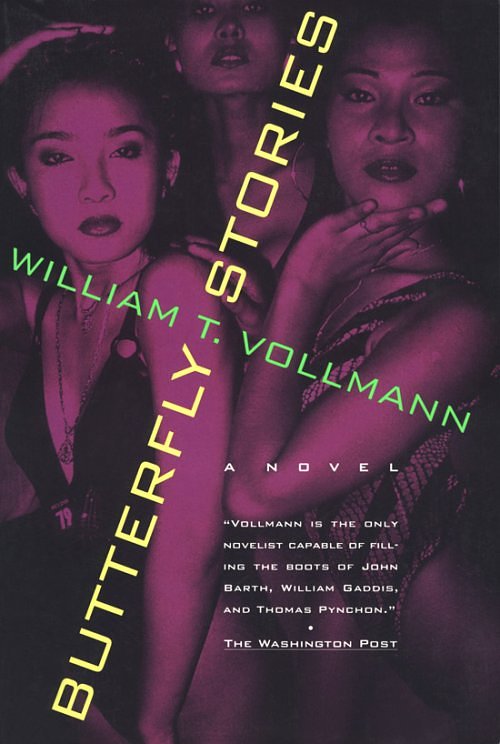
Butterfly Stories — William T. Vollmann

In his 1994 novel Butterfly Stories, William T. Vollmann explores the intense cost of unrelenting idealism. Butterfly Stories is a tragic-comic bildungsroman centered around the life of a protagonist who is almost certainly a semi-autobiographical stand-in for Vollmann. He’s never named in the text; few of the characters are. Instead, he goes by various appellations: the butterfly boy, the boy who wanted to be a journalist, the journalist, the husband. These names square with the protagonist’s painful idealism. He’s a professional alien, a traveler who reports on all the beautiful ugly poor places we Quiet (Ugly) Americans forget about (or never know of in the first place). The main set piece in Butterfly Stories takes place in Thailand and Cambodia:

Once upon a time a journalist and a photographer set out to whore their way across Asia. They got a New York magazine to pay for it. They each armed themselves with a tube of coll soft K-Y jelly and a box of Trojans. The photographer, who knew such essential Thai phrases as: very beautiful!, how much?, thank you and I’m gonna knock you around! (topsa-lopsa-lei), preferred the extra-strength lubricated, while the journalist selected the non-lubricated with special receptacle end. The journalist never tried the photographer’s condoms because he didn’t even use his own as much as (to be honest) he should have; but the photographer, who tried both, decided that the journalist had really made the right decision from a standpoint of friction and hence sensation; so that is the real moral of this story, and those who don’t want anything but morals need read no further.

I’ve quoted the passage at length because I think it delineates a good deal of Vollmann’s program very quickly: whoring-as-gonzo-journalism, a foreshadowing of the sexual grotesquerie to come, blackly ironic humor, and an uncomfortable gap between protagonist and narrator. It’s that gap between the narrator’s ironic detachment and the journalist’s earnest search for meaning–and love–in a world of violence and prostitution that made the book rewarding for me. However, I suspect many will not enjoy (perhaps even hate) this disconnect. The journalist falls in love with several prostitutes throughout the course of the novel, fixating on a Cambodian girl named Vanna in particular. His obsession with Vanna overcomes him, surpasses any rational course of action, and leads him to divorce his wife back in San Francisco in the hopes of marrying a girl he, over time, can no longer even visualize. In short, idealism tortures the protagonist; he’s in love with the idea of love. Late in the novel, he thinks (his thinking framed by the narrator, of course):

Better not to try anything than to be wicked! — That’s how most people acted, and they were probably right, dying their lumpish lives without collecting more than their share of the general blame; but he’d do whatever he was called to do . . .

And later, hallucinating in one of his STD-fueled fevers, he remembers the bully that tormented him back when he was the butterfly boy: “I’m not afraid of you anymore . . . Because I have someone whose life means more to me than mine.” The protagonist’s unrelentingly romanticized view of self-sacrifice is ultimately a defense mechanism against the world’s (equally unrelenting) Darwinian violence.

Vollmann’s milieu of disease-infested, war-torn, economically depressed lands dramatizes this conflict. The violence of the Khmer Rouge, the depravity of prostitution, and the specter of AIDS underpin the novel, and are never mere props for Vollmann, who places his protagonist in a paradoxically privileged vantage point from which to observe, investigate–or ignore–the atrocities of poverty.  The book succeeds because of the tension between the narrator’s judgmental, ironic perspective and the protagonist’s big-hearted but ultimately facile dream of a self-sacrificing love. The narrator sees–and lets us see–the ironic selfishness of the protagonist’s dream to save the world, one prostitute at a time.

Just under 300 pages and larded with the author’s spidery black-ink sketches, Butterfly Stories is one of Vollmann’s shorter and more digestible (if that word may be used) volumes. It is bleakly funny, often depressing, and filled with erudite asides on Nobel prizewinners, transvestites, and the benefits of whiskey. And benadryl. Can’t forget the benadryl. Vollmann has an astounding gift for crafting concrete sentences that burst into blistering abstraction, but he can also drift rather aimlessly at times. Does he have an editor? What other literary writer can put out a book of at least 500 pages every year? Butterfly Stories may be a good start for those interested in Vollmann but daunted by his prolific output. It will also repel many readers with its grotesque depictions of sex, which recall Henry Miller and the best of Charles Bukowksi. I liked it very much. Recommended.

BodyWorld — Dash Shaw

In the future Dash Shaw proposes in his graphic novel BodyWorld, the Second Civil War and rapid industrial growth have left most of America a concrete sprawl by 2060. An exception is Boney Borough, a (literal) green zone somewhere on the Atlantic seaboard. This small secluded town is a new Eden in an otherwise gray world. Enter Professor Paulie Panther, a fuck-up par excellence. He goes to Boney Borough as part of a freelance mission to find out about a new, strange plant he’s found there via the internet. Professor Panther, you see, is a botanist and poet, a would-be scientist who finds out about the psychopharmacological properties of plants by smoking them up in big fat joints (when he’s not too busy trying to commit suicide or stumbling around on one or more of the various drugs to which he’s addicted). Professor Panther is the perfect acerbic foil to the homogeneous folk of Boney Borough. He gets hot for teacher Jem Jewel, turns-on Peach Pearl, the small town girl who wants to go to the big city, and pisses off and confuses her dumb jock boyfriend Billy-Bob Borg. The alliterative names (along with Shaw’s sharp, cartoonish style) recall–and subvert–the classic all-Americanism of Archie comics. Professor Panther soon discovers that the mystery plant, when smoked, grants the user strange telepathic abilities–namely, users sense the “body-mind” of the bodies of others around them.

The plant’s telepathic effects allow Shaw to explore what happens within a literalized I-see-you-seeing-me-seeing-you-seeing-me (seeing-y0u-seeing-me . . .) structure. His bright Pop Art goes Cubist in psychedelic trip scenes, superimposing images to show a surreal conflation of not just the melding of two people’s pasts and presents, but those people’s perceptions of past and present. Very heady stuff–but seeing Shaw’s work is superior to my description, of course. Observe, as Panther sees Pearl seeing Panther seeing Pearl idealizing their attempt at romance:

BodyWorld is sardonically humorous in its psychoanalytic visions, guided in no small part by Professor Panther’s hilarious outsider perspective, but also tempered by Shaw’s larger project, a sci-fi satire of American exurbanist insularity. We wrote earlier this month about science fiction’s tendency to work within the dichotomy of wastelands and green zones, and Shaw’s work is no exception. His marvelous trick is to keep us within the green zone of Boney Borough the whole time and to make us identify with a waster, Panther. The greatest irony is that in this futurist vision, the zombies are the ones in the green zone.

Not everyone’s a conformist though. There are exceptions, of course, especially in the seedy Outer Rim where Panther takes up transient residence. We meet a psychotic latter-day Johnny Appleseed who certainly shares Panther’s weirdo proclivities. The episode is a marvelous spoof on the corny “origin stories” standard in Golden and Silver Age comics, with Shaw’s treatment more loving than mocking. To tell more about this weirdo might spoil the climax of Shaw’s graphic novel, and we don’t want to do that, of course, because you’re going to want to read it, aren’t you? Suffice to say that it’s part and parcel of Shaw’s program, a sweet and sour subversion of the 1950s comics and contemporary conformist groupthink politics. Shaw owes some debt to the neat precision, spacing, and rhythm of Chris Ware, as well as the haunting inks and sharp wit of Charles Burns but it would be a mistake to see this young talent as anything but original. Still, while we’re making comparisons: Richard Kelly could make a messy, sprawling treasure of a film out of BodyWorld.

You can read all of BodyWorld now at Shaw’s website, or you can do what I did and read Pantheon’s new graphic novel version (Pantheon, you will remember, brought us the David Mazzucchelli’s outstanding graphic novel Asterios Polyp). Either way, you should read it. Highly recommended.

Beatrice and Virgil — Yann Martel

Yann Martel’s Beatrice and Virgil tells the story of a writer named Henry whose follow-up novel to a surprise smash hit is rejected. He moves to a large metropolitan city, gets a dog and a cat, takes clarinet lessons, joins an amateur theater group, and slowly forgets about writing fiction altogether. One day a stranger sends Henry a short story by Gustave Flaubert called St. Julian the Hospitator.” The sender has highlighted passages about Julian’s delight in slaughtering animals and also included a few pages of an original manuscript, a Beckettian play featuring two characters, Beatrice and Virgil. There’s also a note asking for help. Intrigued, or maybe bored, Henry visits the mysterious author, an old, creepy taxidermist (also named Henry). His play features two characters, Virgil, a howler monkey, and Beatrice, a donkey, who are trying to come to terms with a series of events they call The Horrors. The taxidermist’s project reignites Henry’s passion for writing and he’s soon helping the would-be playwright with revisions, blind to the inconsistencies and gaps in the old man’s strange behavior.

Beatrice and Virgil is a page turner, engaging, propulsive, and quite easy to read. It injects the philosophical and artistic concerns of literary fiction into the frame and pacing of a book designed for broader audiences. Martel displays his keenest literary skill in the early part of the novel, flitting through the kinds of subjects that bookish nerds of a certain postmodernist bent tend to obsess over: the possibilities and challenges of writing in a particular language, the complexity of pseudonymous fame, the intellectual allure of the essay versus the power of fiction to narrativize higher truth. To address this latter problem, Henry proposes that his new book comprise two sections–a work of narrative fiction and an essay to explicate that work. Why the need for an essay? Henry proposes to write an artful, fictive account of the Holocaust. The essay, which Henry wants published on the flip side of the fiction, thus eliminating a front/back cover distinction, is meant to explicate the fiction. In many ways the first section of Beatrice and Virgil functions as counterpoint to Henry’s proposed essay, concisely addressing the problems of using anything other than historical facts to represent the Holocaust.

After Henry gets the taxidermist’s package and reads “St. Julian the Hospitator,”Beatrice and Virgil moves into a faster rhythm and continues to accelerate to its end, never sagging. At times, Martel relies on stock phrasing and overt exposition to afford this pacing. I found myself wishing a few times that he would trust his audience a bit more. Is it really necessary to directly explain the titular allusion to Dante’s Divine Comedy? He could also be a bit less free with his narrator’s everyman style of questioning, a device employed often to propel the plot, but one somewhat inconsistent with Henry’s obvious intellectual acumen. Martel’s occasional use of lazy devices of the Dan Brown school directly contrasts the more experimental or postmodern aspects of his book. There’s the book’s initial section, which reads very much like a lyric essay; there’s the exegesis of “St. Julian”; there’s the taxidermist’s play, Beatrice and Virgil; there’s the book’s final section, “Games for Gustav.” This final section comprises thirteen short epigrams written in second-person perspective. “Games for Gustav,” Henry’s Holocaust art, demands audience identification with the victims of the Holocaust. Its brevity and ambiguity correlate to the narrative’s ahistorical engagement with the Holocaust and communicate a sense of apprehension and distance toward the subject. Is that subject Martel’s or Henry’s? In a piece I wrote last month about Beatrice and Virgil and the challenges of an aesthetic response to the Holocaust, I suggested that “Henry, a young French Canadian with no Jewish roots is utterly divorced from any authentic response to the Holocaust. He could write an academic essay on the subject, or a navel-gazing bit of metafiction that dithered over storytelling itself, but he essentially already has an answer to his own question of why there are so few artistic responses to the Holocaust–that to re-imagine or re-interpret or otherwise re-frame the real events of the Holocaust in art is to, at once, open oneself to dramatic possibilities of failure.”

Is Beatrice and Virgil an authentic response to the Holocaust? I won’t accuse Martel of using the Holocaust as a mere prop in his novel; indeed, anticipation of such an accusation is precisely what leads Henry to suffer over an essay to explicate his fiction. Martel’s book is about murder, horror, and how one might witness to or otherwise narrativize murder and horror; Henry’s “Games for Gustav” is just one of those attempts to witness. The novel engenders multiple readings then. We can take Henry’s “Games” as part and parcel of Martel’s program, read them perhaps as Martel’s own attempt at poetry after Auschwitz. This reading would subscribe to a traditional narrative arc–Henry faces a challenge, endures a perilous task, and finds resolution in his art: a valid artistic response to the Holocaust is possible. I think, however, that there is another, more complicated reading available, one far more ambiguous, one that places any aesthetic response to the Holocaust under suspicion. If we scrutinize the elements of traditional narrative fiction at work in the novel, we can see multiple ironies in Henry’s “hero arc,” ironies outside of Henry’s otherwise perspicacious gaze. To write an authentic aesthetic response to the Holocaust, Henry must face some kind of deathly extreme that will license such art. But is such a licensing, a conferring of authority possible? I won’t point to spoilers here but will say that I read the novel’s climax ironically. I believe it complicates Henry’s (and perhaps Martel’s) attempt to engage the Holocaust via metaphor and artifice and calls the novel’s resolution into question.

But these matters are probably better reserved for the detailed dialogues the book will no doubt inspire. Beatrice and Virgil raises essential questions of post-postmodernity, exploring the porous boundaries between autobiography and fiction, history and myth, and the limits of allegory. Its rewards are not in its answers but in its questions.

Beatrice and Virgil is new in hardback from Spiegel & Grau on April 13, 2010.

Two Visions of Apocalypse: Margaret Atwood’s The Year of the Flood and Martin Bax’s The Hospital Ship

I finished Martin Bax’s surreal dystopian romance The Hospital Ship last night and then finished the audiobook version of Margaret Atwood’s hyperreal dystopian anti-romance The Year of the Flood today. Both books take their cues from that first apocalypse story, the story of Noah and his ark, and continue that tradition imagining a version of the end of the world. Despite their mythical-biblical origins, such books tend to get ghettoized into a certain genre of science fiction — let’s call it apocalypse fiction — despite the artistic power or literary merit of the author’s prose itself. Apocalypse books like Kurt Vonnegut’s satire Cat’s Cradle, Cormac McCarthy’s The Road, and Aldous Huxley’s Ape and Essence diverge in style, tone, and execution. It’s their subject that compels us, each vision a proposition, a promise of some kind of future, a future after the future. Many of these apocalypse books remain prescient today. However, others feel dated simply because so much of what the author wrote twenty or fifty or more years ago more or less came true. For instance, is the homogenized, greenzoned aristocracy of Brave New World who lavish in the trivial culture of the feelies and centrifugal bumblepuppy all that different from contemporary exurbanites who basically live in walled-off compounds, little homogenized townships that strive to exist outside of civic reality and history? Robert Siegel’s recent report for NPR on the The Villages, an eerie Florida compound for senior citizens, illustrates how willing people are to buy into a company-owned, company-governed greenzone. The Villages even has its own whimsical fake “history,” complete with markers and plaques. It’s like The Prisoner or something. But enough about real life. We have apocalypse lit to tell us about the present.

The heroes of Atwood’s The Year of the Flood are not, for the most part, from the corporate-controlled compounds that keep the rest of the world at bay. There’s Toby, the orphan who grows up tough yet learns the healing arts. There’s Ren, a young girl trying to find her identity wherever she can. There’s their would-be spiritual guide, Adam One, and his lieutenant/rival Zeb. They are outsiders, members of an eco-cult called The Gardeners who worship saints like Rachel Carson, Ernest Shackleton, and Sojourner Truth. Flood is the sprawling companion to Atwood’s 2003 novel, Oryx and Crake, which I enjoyed very much. Both take place in a world where the “Waterless Flood,” a SARS/mega-flu type virus brought about via genetic tinkering, has turned most people into zombie-goo. I could go and on about the world Atwood shapes here, one full of genetic modification, eco-terrorism, religious fervor, and radical disparity, but other folks have already done it. So, in the grand tradition of internet laziness, I point you to excellent reviews here and here, which do a better job explicating the plot than I’m willing to do now (and it was an audiobook, remember, so I don’t exactly have it in front of me. Mea culpa). Apocalypse lit isn’t so much predictive as it is descriptive of the contemporary world, and Atwood’s dystopian vision is no exception. Viscerally prescient, Flood paints our own society in bold, vibrant colors, magnifying the strange relationships with nature, religion, and our fellow humans that modernity prescribes. Atwood ends her book in media res, with Toby and a handful of other characters somehow still alive, ready, perhaps, to become stewards of a new world. Flood concludes tense and, in a sense, unresolved, but Atwood implies hope: Toby will lead her small group to cultivate a new Eden. Despite all the ugliness and cruelty and devastation, people can be redeemed. The audiobook rendition of The Year of the Flood is very good, employing three actors to play the three principal roles, Ren, Toby, and Adam One. There are also terribly cheesy full-band versions of the hippy-dippy songs the Gardeners like to sing on certain Saint Days that are witty as parody but ultimately distracting. Atwood’s prose sometimes relies on placeholders and stock expressions common to sci-fi and YA fiction, and her complex plot (disappointingly) devolves to a simple adventure story in the end, but her ideas and insights into what our society might look like in a few decades are compelling reading (or, uh, listening in this case). Recommended.

The doctors, specialists, sailors, and patients of the titular vessel in Martin Bax’s The Hospital Ship are afloat in their own greenzone of sorts, a moving compound that seeks to treat the troubled world. What’s the trouble with the world? No one’s sure, exactly–there’s permanent all-out-war, of course, famine perhaps, insanity for sure. There’s also a bizarre army of bureaucrats going from continent to continent crucifying men and raping women for no clear reason. The ship’s psychiatrists diagnose it “The Crucifixion Disease.” Euan, Bax’s erstwhile lead, tries to figure out how to love and how to heal in the middle of hate and extinction. Aided by the eccentric, Falstaffian Dr. Maximov Flint, Euan conducts an experimental therapy between a Moi prostitute named V and a suicidal Wall Street broker named W. He also finds a lover and partner in an American girl named Sheila. About half of The Hospital Ship comprises citations from a variety of non-fiction texts, including medical textbooks, psychiatric studies, sociology texts, travelogues, war diaries, and more. The technique is bizarre and jarring, and Bax often imitates the style of such texts, most of which linger on sex or death. There’s also an obsession with the Vietnam War, which makes sense as the book was published in 1976. There’s a lovey-hippie type vibe to the hospital ship’s personnel, and like Atwood with her Gardeners, Bax is satirical and loving to his heroes at the same time. He mocks some of the silly idealism of the movement even as he finds solace in their vision of love and healing in an apocalyptic world. Bax’s book is wholly weird, disconnected, lurching and farcical, a madcap dystopian Love Boat on peyote. I spotted it at my favorite used bookstore, intrigued first by the (now retro-)futurist font, then the name, echoing Chris Adrian’s The Children’s Hospital, another book about a hospital-as-ark. If the black-and-white collage cover art didn’t seal the deal, then the blurb from J.G. Ballard comparing Bax favorably to William Burroughs did. Burroughs is an appropriate reference point, with the sexual alienation and the medical flavor and the cut-up technique and all, but Bax’s writing is utterly Ballardian (he even directly cites Ballard among other authors–like, you know APA style in-text citations). The Hospital Ship is a cult novel which might not have a big enough cult. It definitely belongs in print again; until then, pick up a copy if you can find one.