I posted these notes on Thomas Pynchon’s 2025 novel Shadow Ticket on Biblioklept in October and November of 2025. They appear here in basically the same form.
Chapter 35 commences in “Fiume…a tattered ghost city with a sordid history of secret treaties and sellouts, edging its way through what the Fascist Italian regime calls Year Ten, continuing to collapse in on itself, unlikely to be redeemed.”
There’s a lot there, as in most of Shadow Ticket’s sentences. The Italian fascist poet Gabriele D’Annunzio marched on Fiume in 1919, claiming it post-WWI in defiance of its “Free City” status. Like the Esperanto that runs through Shadow Ticket, utopian ideals won’t last long.
The spectral language invoking an unredeemed ghost city is a theme Pynchon explored throughout Gravity’s Rainbow, the first section of which, in particular, details a preterite, apocalyptic London. I think what’s notable here is again the sense of a pretender’s “utopian intellectualism” — the fascist force’s Anno X — which tries to stabilize a dehumanizing pursuit of power within the context of the humanities. It’s a ghost town, bound for collapse, bad for the soul.
The narrator notes that Fiume was once “a major port of embarkation for the New World, bright and bustling.” What’s more utopian than a capital-en-capital double-you New World? Shadow Ticket is all about movement, particularly west-east movement, with the bilocated east-west corollary (coreality?) built in. Indeed, Pynchon will end the novel a la Huckleberry Finn with Hicks’ protege Skeet Wheeler following Huck’s move to “light out for the Territory.” But I’m jumping ahead. The bigger Thing to note here, I think is that the New World is not so new anymore. Frontiers are going to be stranger, more combustible, going forward.
I’ve focused too much on setting: Our man in Fiume is Daphne Airmont, hunting Papa Cheez. She picks up a pair of Morčić, “earrings representing a black Moor’s head in a fancy white turban,” as well as a new tune, “Daleko m’ê moj Split,” (“My Split Is Far Away from Me” — here, a reference to the singer’s hometown).
A few nights later Daphne is singing this tune “at a sympathetic room in a roadhouse on the Yugoslavian side of the line, where neighborhood musicians like to get together, tonight a C-melody sax, banjo-uke, trombone, piano, an underlying beat from snare brushes and woodblock” — I let the sentence ride out because just because (lots of ukes in Shadow Ticket, yet not a single snood). In the middle of the song, Daphne’s “joined out of somewhere by a clarinet, all too immediately recognizable as who else but Hop Wingdale.” Before the erstwhile couple retreats to more private environs to catch up, Hop “reaches for a highball glass, where he’s been keeping a couple of reeds soaking in slivovitz, drinks what’s there, pours in more.” I agree with Daphne (“That’s disgusting!”), but maybe the Drunk Pynchon blog will disagree if they ever get around to “clarinet reeds soaked in slivovitz.”
I can’t help myself: Here’s Pynchon’s mise en scène one-sentence-paragraph for the Daphne-Hop intimate reunion, in which she will find out that he’s actually a spy:
“A busy echoing interior comfortably dim with all-night cigarette and kitchen smoke, young runners who never fall asleep in and out bringing seafood fresh from the Adriatic, a continuous wind outside, down from the high limestone, a theremin of uneasiness, sliding around a narrow band of notes, in which it’s said you may come to hear repeated melodies, themes and variations, which is when you know you’re going bughouse, with only a very short period of grace to try and escape before it no longer matters.”
Pynchon is an underrated prose stylist. The rhythm here might not work for all folks, but it sings to me. There’s obviously a bustling noir quality to the cramped kitchen scene, which Pynchon drapes in mystical paranoia: the Adriatic wind (and “wind” by the by, is a byword in Against the Day, a physical yet invisible force) — the Adriatic wind becomes “a theremin of uneasiness,” a phrase that recalls “the Sombrero of Uneasiness” that makes “a chill creep across Hicks’s scalp” back in Ch. 10, back in Wisconsin, back at the Nazi bowling alley. (There was also a nod to the theremin back in Ch. 24, at the Club Hypotenuse.) The last little bit of the paragraph is a parable for paranoids perhaps — when we “hear repeated melodies, themes and variations,” we know we’re “going bughouse.”
There’s a bit of business at the end of the Daphne-Hop episode that again points to Shadow Ticket’s underinflated bagginess — I’ve pointed out in these riffs that this is a much bigger novel in my imagination, a fat wedge between between Against the Day and Gravity’s Rainbow. The narrator mentions that Daphne’s supposed-one-time-not-really-fiance “G. Rodney Flaunch has recently published How to Lose a Million and a Half and Bounce Back Smiling,” opening a potential skewering of the kind of self-helpery bullshit that grifters continue to grift on as we breathe, this very minute. It’s a blip of a bit, reminding us that Daphne is far from home (as “Daleko m’ê moj Split”has already underscored), and if it’s underdeveloped, well, William Gaddis took Carnegie to task in The Recognitions (and elsewhere).
The wrapping-things-up-too-quickly motif continues as Hicks and Daphne reunite. Daphne’s headed back home; Hicks is not. She lets him off “that Chippewa hook”; no more life debt for Hicks. Our hero asks her to convey a message to April Randazzo, who is not mentioned by name, but rather alluded to as a “grown woman, married, family to raise” — the kiddie stuff is done. It’s time to grow up. The narrator infuses their stilted, terse parting with a flood of emotion:
“What one of them should have been saying was ‘We’re in the last minutes of a break that will seem so wonderful and peaceable and carefree. If anybody’s around to remember. Still trying to keep on with it before it gets too dark…'”
The break is of course the moments between the two big wars, situated as the break between Modernity and what comes after — the atom bomb and all that.
Pynchon’s narrator then domesticates the issue in his hypothetical dialogue: “Stay, or go. Two fates beginning to diverge—back to the U.S., marry, raise a family, assemble a life you can persuade yourself is free from fear, as meanwhile, over here, the other outcome continues to unfold, to roll in dark as the end of time.” Here again is the novel’s theme of bilocation, of imagining two lives; shadow/form.
It gets darker of course, as the Second World War deserves: “Those you could have saved, could’ve shifted at least somehow onto a safer stretch of track, are one by one robbed, beaten, killed, seized and taken away into the nameless, the unrecoverable.” Hicks won’t go back east, back home to the New World. Can he rise to this challenge? Can he divert some souls to a safer stretch of track and earn a crumb of redemption?
Chapter 36 is a mess.
It is a mess because it attempts to tie up loose ends; that is the wrong metaphor, tie up loose ends — in any case a cavalcade of featured players, guest stars, and even extras show up here (in Fiume, natch), to reconfigure in new teams for the coming war. We get Hicks and Terike and Ace Lomax and Porfirio del Vasto and Zoltán von Kiss and Egon Praediger (“nose merrily aglow,” the fucking cokehead).
Anyway, they’re all in Fiume, convening at Bruno Airmont’s villa, which “dates from just after the War, when d’Annunzio’s republic was young and Fiume had a reputation as a party town, fun-seekers converging from all over, whoopee of many persuasions, wide-open to nudists, vegetarians, coke snorters, tricksters, pirates and runners of contraband, orgy-goers, fighters of after-dark hand-grenade duels, astounders of the bourgeoisie…” Pynchon twins this list with new revelers at the villa, now a scene for “night owls, freeloaders, accidental walk-ins, practitioners of esoteric arts, fearers of the dark, compulsive socializers, secret police, jewel thieves, firefly girls, drug dealers, cigarette-factory workers, tobacco smugglers…” Old boy loves lists! (What is a “firefly girl”?)
The noisy, buzzing chapter ends with Hop Wingdale offering Ace Lomax (along with “that Czechoslovakian robot” Zdeněk) a job “Escorting Jews to safety, one at a time or in truckloads.” Ace was once hired muscle — like Hicks, who started his “career” as a strikebreaker. But in Shadow Ticket we see the possibility for his changing sides. Redemption is possible. As the psychic Zoltán von Kiss suggests in Ch. 22:“even the most hopelessly ill-imagined lamp deserves to belong somewhere, to have beenawaited, to enact some return, to stand watch on some table, in some corner, as a place-keeper, a marker, a promise of redemption.”
Chapter 30 opens in “The Vienna branch of MI3b, daytime, a modest-size office decorated with a movie poster of Lilian Harvey waltzing with Willy Fritsch in Der Kongreß tanzt and an ancient map of the Hapsburg Dual Monarchy.”
Der Kongreß tanzt (The Congress Dances) is a 1931 UFA production set in Vienna, 1815 — if you want to go down the rabbit hole, maybe start with this contemporary New York Times review of the film. The Congress Dances was Weimar UFA’s tentpole shot at competing with Hollywood; later the production company would be subsumed by the Nazis. A current throughout Pynchon’s works has been something like, resist the military-industrial-entertainment complex. It’s worth noting the emphasis on dancing here, a motif in Shadow Ticket. Is dancing a form of transcendent resistance? Or is it a narcotizing agent?
The Habsburg Dual Monarchy, formed in 1867 after the Austro-Prussian War, joined two distinct nations under one emperor — a kind of bilocation — leaving ethnic and nationalist tensions unresolved. These divisions weakened the empire, contributing to the instability that helped spark World War I and, after its collapse, left a fragmented Central Europe whose resentments helped set the stage for World War II.
We are in that stage-setting right now, in that fragmented, fragmenting Central Europe, in the office of British Military Intelligence Section 3 where secret agent couple Alf and Pip Quarrender have been called before “Station chief Arvo Thorp.” Thorp informs the Quarrenders that their asset Vassily Midoff is “seeking to join a motorcycle rally in progress at the moment” — the Trans-Trianon 2000 Tour of Hungary Unredeemed that everyone’s set out on — and “that someone must be sent round” to cut off that loose end posthaste. The Quarrenders are upset — “But he was ours, Thorp…Our bloke” — but orders are orders. They do question the rationale of the orders though, wondering if it was simply “too much effort to keep all [Vassily’s] allegiances straight.” Here we have a neat little summary of how some readers may feel sussing motives and plot points from Shadow Ticket.
Codebreaker Alf gets something proximal to an “answer” when he intercepts an encrypted message floating around various intelligence agencies: Vassily “has apparently been promoted to deputy operations officer of an unacknowledged narkomat, a Blavatskian brotherhood of psychical masters and adepts located someplace out in the wild Far East.” Pynchon further underlines Shadow Ticket’s haunted themes, bringing up Stalin’s “chief crypto genius Gleb Bokii [who] is also running a secret lab specializing in the paranormal.”
But Alf can’t fully crack the code (natch), receiving “only glimpses behind a cloak of dark intention at something on a scale far beyond trivialities of known politics or history, which one fears if ever correctly deciphered will yield a secret so grave, so countersacramental, that more than one government will go to any lengths to obtain and with luck to suppress it.” In a chilly series of sentences, Alf, pushed by “some invisible power,” continues chipping at the encryption against his better judgment. But the encryption is, well, cryptic, even as it portends a future yet to come (including the ominous not that Stalin, “threatened by supernatural forces [would]probably go after Jews first.”
Alf concludes that Vassily “may have gone mad, he may in fact have crossed a line forbidden or invisible to the likes of us, thrown by some occult switchwork over onto an alternate branch line of history.” The “alternative branch line” again evokes the novel’s themes of bilocation (which I’ve tried to enumerate in previous riffs).
(The bigger Pynchonian bilocation is frequently visible/invisible, in the spiritualist-materialist sense — which perhaps finds a moral corollary in convenient/inconvenient.)
So well and anyway–the Quarrenders track down the Russian Trans-Trianon caravan and locate Vassily, but he manages to escape on a Rio-bound zeppelin painted like a watermelon, to their relief.
Graf Zeppelin over Guanabara Bay, in Rio de Janeiro, Brazil, 25 May 1930
“Hicks, Slide, and Zdeněk come rolling into a parts depot deep in the Transylvanian forest,” at the beginning of Chapter 31. (Slide is an American journalist; Zdeněk is a non-gigantic golem, if you need help keeping track.) They are on the Trans-Trianon 2000 motorcycle route, presumably tracking Hop Wingdale. Or Daphne Airmont. Or Bruno Airmont. Or…?
Here in “actual Transylvania, the vampire motherland itself,” the trio drives through “hairpin turns frequented by vengeful spirits, passages cursed by some local shaman, marsh life you wouldn’t want swarming around you after dark…And the bats of course.” According to Zdeněk these vampire bats “are the Unbreathing, who go about their business in a silence not even broken by pulsebeats.”
Slide’s brought along his Leica camera to “cover the supernatural angle,” but the pictures all end up blank: “a vampire’s allergy to silver, an ambivalence as to light itself…” I’ve foregrounded Shadow Ticket’s Gothic motifs and impulses throughout my notes. I don’t really know what I could add to, like, golems and vampires in Transylvania.
A diagram of the internal mechanisms of a Leica I camera
Noting that the Trans-Trianon 2000 motorcycle route allows for “impulses disallowed in normal society” to be acted upon, the narration then gives over to one of my favorite little bits in Shadow Ticket, a self-contained episode of “spontaneous pig rescue.” The pig in question is “a Mangalica, a popular breed in Hungary at the moment, curly-coated as a sheep, black upper half, blonde lower. And that face! One of the more lovable pig faces, surrounded by ringlets and curls.”
Mangalica piggy looking cute
Pynchon’s porcophilia is well-documented, with pigs showing favorably throughout his work–particularly in Mason & Dixon and in Gravity’s Rainbow, where Tyrone Slothrop takes on the role (and costume) of Plechazunga, the Pig-Hero, and then later wanders through the Zone with a sweet pig as his companion-guide, while the narrator sings:
“A pig is a jolly companion, Boar, sow, barrow, or gilt– A pig is a pal, who’ll boost your morale, Though mountains may topple and tilt.”
Back to Hicks: “wandering the compound one day hears a piano in the distance, recognizes the tune as ‘Star of the County Down,’ a longtime favorite of Irish drinkers he’s known.” It turns out that none other than Pip Quarrender is singing and playing the song — which she identifies as “Dives and Lazarus,”a traditional English folk song that that adapts a riff from the Gospel of Luke. Pips notes that it’s “technically it’s a Christmas carol, though uncomfortable for the average churchgoer given its rather keen element of class hostility.” We have here another bilocation, a song with two separate but real co-existing lives. (Throw in a little class warfare, too.)
Hicks then runs into Terike, who’s concerned that Ace Lomax is missing, on the run from she-knows-not-what (it’s Bruno). The chapter ends with “Zdeněk the golem [locating] Hop Wingdale en route to a Croatian guerrilla training camp near the Hungarian border.” He decides to go check it out.
We’re back to Hop Wingdale and his band in Chapter 32 begins with their tricked-out road-Pullman ominously “moving deeper into Vladboys terrain.” We learn that the “band find themselves growing less enthusiastic about the Trans-Trianon 2000 Tour of Hungary Unredeemed [as] Loose cocaine isn’t always practical on these beat-up roadbeds.” The musicians settle on enormous pills of “cocaine and morphine, known as a speedball.”
The band pulls in to a “towering wooden cylinder set in a clearing, filled with the snarling of low-displacement bike engines.” Their gig is at a Wall of Death motor cycle stunt show.
Motorcyclist Clara Lee riding the ‘Wall of Death’, Sydney Easter Show, 1938
It turns out that Ace Lomax has been stunt riding on the Wall of Death for tips. Prompted by the band, he sings a Western tune: “Things were so jake, at the O.K. Corral— / Till those Earps and Clantons came along—.” The fantasy here is of an unspoiled West which eventually succumbs to the violence of competing agencies.
Ace recognizes Hop and congratulates his being “still vertical.” He proceeds to tell the musician that Bruno Airmont had tried to get Ace to assassinate Hop, but he decided that wasn’t his gig and hit the road: “By nightfall he’s in Bratislava and slipping unnoticed in among a convoy of Trans-Trianon machinery.” In their discussion about the Wall of Death, Hop brings up motordrome physics: “Somebody said it’s safe long as you keep moving fast enough, something about centrifugal force.” We get here a repetition of one of Shadow Ticket’s major themes, neatly summed up by Stuffy Keegan back in Ch. 20: “as long as you can stay on the run, that’s the only time you’re really free.”
Ace then hits the road. He fails to check in back at the Trans-Trianon base camp, causing Terike’s cryptic road-adventuress face…to drift into disarray. She decides to light out looking for him.
The chapter ends with the narrator telling us that it turns “out that in some walled-in maze of a mountain town Ace has missed a turn…and ends up running on fumes.” He’s pursued by not only wolves but also the fascist Vladboys, “who also run this terrain in packs.” The fascist gang are on what I take to be dirt bikes, faster than Ace’s Harley. The last line, “Ace finds himself in the hands of the Vladboys,” sets up a nice opportunity for a big dramatic climactic rescue scene.
Chapter 24: Another fairly long chapter for Shadow Ticket. I’ve been over-summarizing in these notes, and maybe I’ll keep over-summarizing — at this point doing these notes has been my second reading of Shadow Ticket. I would say though, that we’ve reached a point well beyond the novel’s quick change glamour, its bilocative split — or its bait n’ switch, if you feel that way. The novel initially presents as a hardboiled noir send-up in the dark American Heartland only to pivot (or bilocate, to misapporpriate a term from Against the Day) to Central Europe where there’s preparation for a war on (moron). Hero Hicks fades, just a little, in the background; a larger cast steps up.
But Hicks is still the heart of Ch. 24, which begins at Egon Praediger’s office in Budapest, where the ICPC detective is snorting soup spoonfuls of cocaine while ranting about his inability to catch Bruno Airmont. Egon fears he’s wasting his talent “not on an evil genius but on an evil moron, dangerous not for his intellect, what there may be of it, but for the power that his ill-deserved wealth allows him to exert,which his admirers pretend is will, though it never amounts to more than the stubbornness of a child.” Oh man–wonder if that sounds like any evil moron of recent vintage? Egon would rather face off against a worthy villain, a “Dr. Mabuse or Fu Manchu,” references again underlining Shadow Ticket’s lurid pop Goth bona fides.
Hicks then runs into Terike, “just emerging from her latest run-in with the authorities over her motorcycle, a 500 cc Guzzi Sport 15″ — which more on this transport later. On the way to the bike, Hicks finds that he has somehow “percolatedthrough“ Terike, who has performed some kind of metaphysical quick change. He apports, I guess.
1937 Moto Guzzi GTS 500 with matching sidecar
For Terike, the Guzzista “is a metaphysical critter. We know, the way you’d say a cowboy knows, that there’s a fierce living soul here that we have to deal with.” As we should expect now in Ole Central Europe, this bike is spooky, and Terike is a superhero on it: “she can go straight up the sides of walls, passthrough walls, ride upside down on the overheads, cross moving water, jump ditches, barricades, urban chasms one rooftop to the next, office-building corridors to native-quarter alleyways quicker than a wink.”
Hicks rides along in the sidecar. (A bit later we’ll see a charming pig, a spirit animal, really, riding sidecar–perhaps there’s a link between Hicks and Pynchon’s other pigmen, like Seaman Bodine or Tyrone Slothrop (or the unfortunate Major Marvy.) Their mission: deliver a batch of experimental vacuum tubes “specially designed for the theremin” to “Club Hypotenuse,” a “cheerfully neon-lit” venue featuring a rotating dance floor and “not just one soloist on theremin but a half dozen, each expensively gowned tomato with more or less identical platinum bobs, waving their hands at these units and pulling music out of some deep invisibility, swooping one note to the next, hitting each one with pitch as perfect, Terike assures him, as the instrument’s reigning queen, Clara Rockmore. The joint effect of these six virtuoso cuties all going at once in close harmony is strangely symphonic.”
(Forgive me if I let the quote linger too long, the image is just too lovely.)
At Club Hypotenuse we get a bit of background on Terike, her rejection of her bourgeoisie upbringing, and recent Hungarian political struggles, before meeting yet another character, freelance foreign correspondent Slide Gearheart (he uses the alias “Judge Crater” at the bar. We last heard the name back in Ch. 18, but Crater, icon of the disappearing act, will pop up again). Slide lets Hicks in on a lead he has to cheese heiress Daphne Airmont’s whereabouts; he also gives our P.I. some advice about (not) fitting in to Hungary: “…best stick to English and there’s a chance they’ll take you for an idiot and leave you alone. It might help if you could also pretend now and then to hear voices they don’t. Idiots get respect out here, they’re believed to be in touch with invisible forces.”
But Slide’s bigger note for Hicks is a soft warning to prepare him for the reality that you can never really go home.
Chapter 25: “Things pick up a day or two later when Slide reports that Daphne has been sighted at the Tropikus nightclub, in Nagymező utca, the Broadway of Budapest.” (This is I suppose the inspiration for the use of the photograph of Nagymező Street used on the cover of the first edition of Shadow Ticket.)
Daphne sings a song and then she and Hicks dance together.
So–I have really neglected Shadow Ticket as a song and dance routine. I think if you’ve read Pynchon you’d expect it; it’s a bit more prevalent here, the singing and dancing, in Shadow Ticket I mean, then in some of the other novels, but it’s certainly what you’d expect. The songs probably deserve their own whole blog or something to deal with (which I will never do); the dancing — well the dancing — I think something I should’ve highlighted much earlier is that Hicks is a really good dancer. Like fucking excellent. He’s a magician who goes into “one of those hoofer’s trances” in the previous chapter while dancing with Terike to the theremin orchestra. That notation — of the trance state — is given for various characters in Shadow Ticket who achieve a kind of short-term perfection outside the physical realm. (It’s the drummer Pancho Caramba (and like, Pynchon, c’mon man, that’s too much, name wise) — it’s the drummer Pancho Caramba in Ch. 25 who goes “into this kind of trance” at his drum kit, enchanting his audience.)
Most of the chapter is the dance and the dance-within-the-dance between Hicks and Daphne. There are Gothic-tinged allusions to their past in Wisconsin–his saving her from the “North Shore Zombie Two-Step” of forced psychiatric hospitalization, incurring a “Chippewa hoodoo” debt as her caretaker in perpetual.
We also start to get Daphne’s backstory with Hop Wingdale, the jazz clarinetist she left home for. She’s followed Hop and his band the Klezmopolitans around Europe, but is worried that the ill-fated lovers “need to relocate before it’s all Storm Trooper chorales and three-note harmony.” Daphne again underlines Shadow Ticket’s departure point — a big ugly change is gonna come. Hop is (rightfully) worried about Papa “Bruno’s invisible hand…” though. “Awkwardly enough,” he tells Daphne, “it turns out more of your life than you think is being run on the Q.T. by none other” but her pops.
The phrase “on the Q.T.” — meaning quiet (or “on the quiet tip,” as I thought way back as a teen encountering it) — shows up a few times in Shadow Ticket. It’s phonetically doubled in the word cutie, which shows up more than a few times in Shadow Ticket.
Chapter 26: Another longish section by Shadow Ticket standards, and less breezy than the novel as a whole.
There’s a lot of Daphne-Hicks and Daphne-Hop stuff here — more bilocations, maybe? — in any case, our boy Hicks gets himself more wrapped up than he intended to. After Daphne urges him to help hunt down Hop, who’s kinda sorta left her, he reminds himself of his mantra “No More Matrimonials! Ever!”
By the end of the chapter our American idiot is wondering if “wouldn’t it be a nice turnaround to bring some couple back together again, put the matrimony back in ‘matrimonial’ for a change, instead of divorce lawyers into speedsters and limousines.” Here, I couldn’t help but think of Paul Thomas Anderson’s film revision to Pynchon’s novel Inherent Vice; PTA ties a neater bow on the narrative by letting its lead P.I. Doc Sportello restore the marriage of musician Coy Harlingen.
Anyway, we get Daphne and Hop’s origin story: “Talk about meeting cute. You’d think she’d have known better by then. It was in Chicago a few years back, still deep in her teen playgirl phase.” General gunplay shatters Daphne’s double aviation cocktail. She’s smitten with his woodwind serenades.
1917 recipe for aviation cocktail.
This chapter is chocked full of motifs and mottoes we’d expect from Shadow Ticket in particular at this point and Pynchon in general: invisibility, inconvenience, Judge Crater, “Who killed vaudeville?,” etc. It’s also pretty horny, with Hicks and Daphne finally consummating their meet cute from years gone by. Sorry if I’m breezing through.
I’m more interested in a specific exchange.
Carl Jung’s house in Kusnacht, Switzerland: VOCATUS ATQUE NON VOCATUS DEUS ADERIT — “Called or not called, the god will be there.”
Daphne hips Hicks to something she saw “once, in one of these mental fix-it shops I kept getting sent to, up on the office wall was a motto of Carl Jung—Vocatus atque non vocatus deus aderit. I said what’s this my Latin’s a little rusty, he sez that’s called or not called, the god will come.”
The end of Ch. 23, at least in my guess, seemed to obliquely reference Jung’s Answer to Job, with the narrator suggesting that a trinity can only truly operate as a whole in the form of a stealth quatro — it’s phantom fourth piece balancing out the visible trio in the foreground. The reference to Jung here is not oblique but direct and maybe I will do something more direct with it down the line.
Of course the thing that comes to save Daphne isn’t “the god” but that Big Gorilla Hicks. He notes that, “Your old pals from the rez think it’s spoze to be a critter” who shows up to save the day. In a moment of vulnerability that I take to be sincere, Daphne asks Hicks if he didn’t think that she might actually be insane and should be returned to the hospital and not set free. His reply is a repetition of one of the novel’s several theses: “You were on the run, that was enough.”
I’m quite a bit further into the novel than where I’m going to have to leave off in these notes, but there will not be any so-called spoilers/discussion of material past Chapter 14
My general take on Shadow Ticket though: This is probably Pynchon’s most accessible novel. It’s fun, funny, and breezy, but it also kinda sorta bridges Against the Day to Gravity’s Rainbow — and not just in a timeline sense, but also thematically.
Chapter 8:
Hicks’s protege Skeet brings Hicks down to the “clubhouse” under the Holton Street Viaduct. Pynchon continues to develop the glow-in-the dark horror film motif, describing, “Cobwebs of purple light from radio tubes with imperfect vacuums inside…A dozen speakers going at once…Pieces of electrical gear blinking and chirping at each other, like a lab in a movie belonging to a scientist not entirely in his right mind.”
The mad scientist monitoring all these wild signals is pretty harmless though. It’s “a kid named Drover in a set of earphones.” Drover shows off the amplified ukulele he’s crafted: “Kid out in Waukesha showed me…You want the real Tom Swift, it’s this Lester kid, calls himself Red, playing hillbilly guitar up and down Bluemound Road for nickels and dimes, drive-ins, roadhouse parking lots, gets to where he needs to be heard over the traffic, so he figured this out.”
This Lester aka Rhubarb Red is, of course, Les Paul, whose artistic and technological contributions and innovations to 20th-century popular music cannot be overstated. I think his licks sound fresh today.
Pynchon has long been concerned with the intersection of art and technology; of how a signal can cut through noise.
Skeet has brought Hicks to the “clubhouse” under the viaduct to connect with Stuffy Keegan, whose REO Speed Wagon was exploded by unknown entities in Shadow Ticket’s opening chapter. Things get very, very Pynchonian here—a U-13 submarine is prowling the depths of Lake Michigan, apparently there to pick up Stuffy. Hicks is in disbelief. Drover has a hard time picking up a human voice from the sub, and declares that, “everybody must be down below at the bowling alley.” Hicks is even more incredulous: “Bowling alley on a submarine, Drover?” — setting up an execrable/wonderful Pynchonian joke that pivots on a Jules Verne novel’s title.
The episode ends with Stuffy disappearing somewhere, although Hicks is loath to believe he left on a submarine. Chapter 8 concludes with a less-skeptical Skeet pointing out that Stuffy “Kept saying things like ‘Maybe I’m a ghost now and I’m haunting you,’” again underscoring the novel’s horror-film motif.
Chapter 9 might be summarized by its opening line: “Skeet shows up at the office next day with an out-of-town tomato who causes a certain commotion.”
This fair lady is one “Fancy Vivid” (geez Thomas); no one in the detective agency can quite believe that she wants to hire them to find disappeared Stuffy, whom she loves dearly. She’s hip to the submarine thing too: “He ever say anything to you about a submarine? …Kept wanting to know if I’d ever been on one, if I’d like to go for a ride on one. At first I thought it was some kind of sex talk.”
Like the previous chapter, this one ends with a Gothic note. Hicks goes into a reverie while looking through old files, dreams he’s “in Chicago, or something calling itself that, up North Clark, across the suicides’ bridge, deep in that part of the North Side known as The Shadows.” In this space that is “haunted to saturation by the unquiet spirits of hanged men and women, white, Negro, and American Indian,” he encounters too the spirit of Stuffy who pleads for his help. “Only a dream,” Hicks tells himself.
Chapter 10:
When we first met Hicks’s Uncle Lefty back in Ch. 4, he espoused his sympathies for Adolf Hitler; in Ch. 10, after a casserole dinner, he takes his nephew to a Nazi bar, the New Nuremberg Lanes. Hicks, as yet unaware of the bar’s fascist sympathies, nevertheless picks up on the weird vibes:
“All normal as club soda, yet somehow…toonormal, yes something is making a chill creep across Hicks’s scalp, the Sombrero of Uneasiness, as it’s known in the racket. Something here is off. A bowling alley is supposed to be an oasis of beer and sociability, busy with cheerful keglers, popcorn by the bucketful, crosscurrents of flirtation, now and then somebody actually doing some bowling. But this crowd here, no, these customers are only pretendingtobowl…”
These people are all American Nazis.
Hicks runs into Ooly Schaufl (“Going by Ulrich these days”), an old associate from his strike-breaking day. The scene underlines a theme developing in the novel: Hicks slowly starting to realize which side of the line he belongs on. The reunion is broken up by the Feds though — prohis, dry agents, in the novel’s parlance.
Hicks makes his escape. At the next casserole night, Uncle Lefty gives Hicks the plot-moving-forward tip that Pynchon has frequently deployed thus far in Shadow Ticket, telling him to check out the under-radar as-yet-unopened FBI office in Milwaukee.
Chapter 11 begins with more Gothic intentions; Hicks approaches local the local FBI headquarters, which appears something closer to a haunted house:
“On days of low winter light the federal courthouse can take on a sinister look, a setting for a story best not told at bedtime, the jagged profile of an evil castle against pale light reflected off the Lake, bell tower, archways, gargoyles, haunted shadows, Halloween all year long.”
In Shadow Ticket, the goofy Gothicism of glaring gargoyles butts up against the realer, deeper horror of encroaching fascism abroad and a burgeoning police state at home — and worse, the twisting, bundling of these forces. Hicks gets twisted into it; the feds want him to be their agent too.
Chapter 12 begins with Hicks’s boss Boynt going full tilt paranoid, Pynchonian style:
“The federals who had you in are likely just a front, OK? It’s the outfit that’s behind them, a nationwide syndicate of financial tycoons, all organized in constant touch against the forces of evil, namely everything to the left of Herbert Hoover. Worried about the next election, worried this latest Roosevelt if he gets in might decide to step out on his own, and even if he does revert to type after all, it might not be in time to stop the Red apocalypse that’s got them spooked out of what they think of as their wits.”
The outfit, the syndicate–Boynt ties the forces of right-wing capitalism to outright fascist gangsterism. He redirects his detective’s attention to the cheese heiress case, and the pair take off to the Airmont’s lawyers’ office. There, Hicks is asked if he’s “aware of the American Indian belief, referenced in depositions filed on Miss Airmont’s behalf, that once you save somebody’s life, you’re responsible for them in perpetuity?” (This routine gets brought up again and again.)
Chapter 13:
Hicks heads out to the Airmont mansion to do some recon on missing heiress Daphne. There, he picks up on chatter about “the recent Bruno Airmont Dairy Metaphysics Symposium held annually at the Department of Cheese Studies at the UW branch in Sheboygan, this year featuring the deep and perennial question, ‘Does cheese, considered as a living entity, also possess consciousness?'”
The philosophical riffing gives way to a brief overview of the Airmont cheese fortune, which was built in no small part upon the brief success of a product called “Radio-Cheez…designed to stay fresh forever, in or out of the icebox, thanks to a secret, indeed obsessionally proprietary, radioactiveingredient.”
1921 magazine advertisement for Undark, a product of the Radium Luminous Material Corporation
The narrator reminds us that this was “radium’s grand hour of popularity, when it’s still medical wisdom to seek as many ways as possible to introduce radiation into the human body—radioactive mineral water, patent radium elixirs and aphrodisiacs, radium suppositories,” before bringing up the “Radium Girls” of “nearby Ottawa, Illinois [who] were employed in painting numbers on glow-in-the-dark clock dials, licking their brushes every so often to keep them finely pointed.”
The sad story of the Radium Girls has been well documented. It is another case of real-life horror in Shadow Ticket butting up against Pynchon’s zanier play-acting theatrical horrors. The Radium Girls’ case eventually led to expanded labor protections in the United States, making them ideal Pynchonian heroes.
Cheese conspiracies develop in this chapter; we learn that “The year 1930 happened to be the 1776 of the cheese business.” Bruno Airmont, the “Al Capone of Cheese” befriends the Al Capone (“And what is it you’re the Al Capone of again?”).
At the Airmont compound we also meet G. Rodney Flaunch, “a onetime male flapper” and fiancé to departed Daphne and mom, Mrs. Vivacia Airmont.
And in Chapter 14 we finally get the backstory of Hicks and Daphne’s meet-cute. Daphne’s in disguise and on the run from “Winnetka Shores Psychopathic, a ritzy banana plantation in the neighborhood, overseen by a Dr. Swampscott Vobe, M.D. Known for a susceptibility to anything newfangled, Dr. Vobe has somehow gotten it into his head that the patients at WSP are all available to him as lab material to try out his therapy ideas on, free of charge. Drugs, electricity, rays. Dr. Vobe is specially interested in rays.”
More mad scientist Halloween-all-the-time shit. They escape via rumrunner–the boat, not the drink–and Hicks drops the heiress at an Ojibwe reservation (she claims it was her finishing school). There are more horror notes — references to werewolves and windigos — and again the note that if you save a person’s life you are forever responsible for it:
“And if I say thanks but no thanks, what happens, I get an arrow through my head?”
“You don’t have to be all that way about it either, white man.”
It’s more a family of drinks, revolving around a central theme. There are four main ways to order it: sweet, with 7 Up; sour (which is not), with sour mix or Squirt; “press” with half 7 Up and half seltzer; or seltzer only. There are regional garnish customizations using pickled vegetables — including mushrooms, asparagus, cucumbers, tomatoes, brussels sprouts and olives — that seem counterintuitive until you taste the salty, vinegar tang playing off of the spice of the bitters and the sweet thrum of the brandy. By God, our great-grandparents were on to something.
Page 628 from Zak Smith’s Pictures Showing What Happens on Each Page of Thomas Pynchon’s Novel Gravity’s Rainbow (2006)
A week before she1 left, she came out to “The White Visitation”2 for the last time. Except for the negligible rump of PISCES, the place was a loony bin again. The barrage-balloon cables3 lay rusting across the sodden meadows, going to flakes, to ions and earth4—tendons that sang in the violent nights, among the sirens wailing in thirds smooth as distant wind, among the drumbeats of bombs, now lying slack, old, in hard twists of metal ash. Forget-me-nots boil everywhere underfoot, and ants crowd, bustling with a sense of kingdom. Commas, brimstones, painted ladies coast on the thermoclines along the cliffs.5 Jessica has cut fringes since Roger saw her last, and is going through the usual anxiety—“It looks utterly horrible, you don’t have to say it. . . .”
“It’s utterly swoony,” sez Roger, “I love it.”
“You’re making fun.”
“Jess, why are we talking about haircuts for God’s sake?”6
While somewhere, out beyond the Channel, a barrier difficult as the wall of Death7 to a novice medium, Leftenant Slothrop, corrupted, given up on, creeps over the face of the Zone. Roger doesn’t want to give him up: Roger wants to do what’s right. “I just can’t leave the poor twit out there, can I? They’re trying to destroy him—”8
But, “Roger,” she’d smile, “it’s spring. We’re at peace.”9
No, we’re not. It’s another bit of propaganda. Something the P.W.E. planted10. Now gentlemen as you’ve seen from the studies our optimum time is 8 May11, just before the traditional Whitsun exodus, schools letting out, weather projections for an excellent growing season, coal requirements beginning their seasonal decline, giving us a few months’ grace to get our Ruhr interests back on their feet—no, he sees only the same flows of power, the same impoverishments he’s been thrashing around in since ’3912. His girl is about to be taken away to Germany, when she ought to be demobbed like everyone else. No channel upward that will show either of them any hope of escape13. There’s something still on, don’t call it a “war” if it makes you nervous, maybe the death rate’s gone down a point or two, beer in cans is back at last and there were a lot of people in Trafalgar Square one night not so long ago . . . but Their enterprise goes on.
The sad fact, lacerating his heart, laying open his emptiness, is that Jessica believes Them14. “The War” was the condition she needed for being with Roger. “Peace” allows her to leave him. His resources, next to Theirs, are too meager.
1 The she here, for those wishing to tune in, is Jessica Swanlake, who has decided post-War to return to her normie roots: she will choose a petite bourgeoisie life with Beaver/Jeremy, and reject Roger Mexico (and, implicitly, refuse the Counterforce and the mission to save Tyrone Slothrop).
2 Normally wouldn’t give a gloss for this, as its so late in the novel, but it’s been like eight years since I’ve done one of these, so: Pynchon Wiki gives the following description for the White Visitation:
former mental hospital located in the fictional town of Ick Regis on the coast of southern England; now part of SOE [Special Operations Executive; aka the “Firm”]; location of PISCES; D-Wing still has “loonies”; “devoted to psychological warfare”
3 I’ve read Gravity’s Rainbow like half a dozen times and rusting barrage-balloon cables is the kind of image I just keep going past, just kinda sorta like, letting my imagination fill in the details. But doing these posts makes me stop and look around a bit. A description from Keith Thomson’s website:
Barrage balloons are large balloons tethered to the ground or the deck of a ship with metal cables. They are deployed as a defense against low-level air attack, damaging aircraft on collision with the cables or, at the least, making flying in the vicinity treacherous.
1940s Barrage Balloon At The Kew Bridge Steam Museum, London. Jim Linwood.
4 Everything in the Zone is disintegrating–including Our Hero Tyrone Slothrop.
5 “Commas, brimstones, painted ladies coast on the thermoclines along the cliffs” — an absolutely gorgeous sentence, and also one we might pass over at this fragmented, surreal section of the novel as a bit of surrealist poetry.
But it’s not—these are butterflies. From Pynchon Wiki:
627.28-29 Commas, brimstones, painted ladies
Three taxa of butterflies. The Comma (Polygonia c-album) is one of the anglewings; sulfur-yellow brimstones are in the genus Gonepteryx in the family Pieridae; painted ladies are in the genus Vanessa. The Comma is named for a so-shaped white mark on the underside of its hindwing; a similarly-marked North American congener is called the Question Mark (P. interrogationis).
Cigarette card depicting a fanciful “brimstone butterfly”
6 “Can’t say it often enough–change your hair, change your life,” Inherent Vice.
7 “Wall of Death,” Richard and Linda Thompson, 1982:
Let me ride on the Wall of Death one more time / You can waste your time on the other rides / This is the nearest to being alive / Oh let me take my chances on the Wall of Death / You can go with the crazy people in the Crooked House / You can fly away on the Rocket or spin in the Mouse / The Tunnel of Love might amuse you / Noah’s Ark might confuse you / But let me take my chances on the Wall of Death
8 Every time I go through Gravity’s Rainbow, I find Slothrop’s fate more distressing and dispiriting—but also more inspiring. I think what’s important to remember here is that Roger Mexico is a numbers guy, a statistics guy—in 2024 terms, he might be a spreadsheet guy, a potential money guy. But he finds himself dedicated to Something Bigger Even If It Destroys Him, which means dedicating hope to the ever-fragmenting figure of Tyrone Slothrop, who, through his dispersal, might sow new seeds.
9 A devastating reversal of “They are in love. Fuck the war,” the lines we get from our first meeting of the failed lovers.
10 Political Warfare Executive (an iteration of Them). From Pynchon Wiki:
In 1940, MIR and Section D were combined with the War Office to form the Special Operations Executive (SOE). A “black” (sub rosa) propaganda section of SOE, created by the Foreign Office and named “Electra House,” was attached to the SOE in 1940 to become the Political Warfare Executive (PWE), charged with political and psychological warfare.
11 Thomas Ruggles Pynchon was born on 8 May 1937. Today is his 87th birthday.
If you’re the kinda weirdo who likes to celebrate Pynchon’s work and legacy, indulge in Pynchon in Public Day.
Steven Weisenburger’s 2nd’ edition of the Companion gives the following gloss on the date:
8 May, just before the traditional Whitsun exodus. Recall that part 2 ends with Pointsman and crew spending “Whitsun by the sea” (V269.26n). This traditional British holiday weekend fell on May 20 in 1945.
12 Roger Mexico “sees only the same flows of power, the same impoverishments” that he’s seen throughout the war. Unlike Jessica, he’s hep now to the knowledge that “the real business of the War is buying and selling.”
13 Pynchon here reiterates one of GR’s central themes, of the preterite vs the elect, of a “channel upward” or crashing down. The theme permeates the book, right from its opening lines. Consider the novel’s fourth sentence “The Evacuation still proceeds, but it’s all theatre.” The opening “evacuation” scene is surreal and apocalyptic, with each potential evacuee hearing an inner voice that cruelly coos, “You didn’t really believe you’d be saved. Come, we all know who we are by now. No one was ever going to take the trouble to save you, old fellow. . . .” The narrator’s very early note that “it’s all theatre” is one of Pynchon’s central diagnoses of power in GR, and one that not every character comes to fully understand. As if to underline that it’s all kayfabe, Pynchon ends GR by introducing a new character, Richard M. Zhlubb, a parody of Nixon. Zhlubb is the night manager of the Orpheus Theatre.
14 I think what finally most breaks Roger’s heart isn’t the loss of Jessica, but that “Jessica believes Them.” She’s subscribed to the theater of “war” and “peace,” an illusion that can no longer comfort Roger.
Illustration for Coleridge’s The Rime of the Ancient Mariner, Gustave Doré, 1876
Well1, if the Counterforce2 knew better what those categories3 concealed, they might be in a better position to disarm, de-penis and dismantle the Man4. But they don’t. Actually they do, but they don’t admit it. Sad but true. They are as schizoid, as double-minded in the massive presence of money, as any of the rest of us, and that’s the hard fact5. The Man has a branch office in each of our brains, his corporate emblem is a white albatross, each local rep has a cover known as the Ego, and their mission in this world is Bad Shit6. We do know what’s going on, and we let it go on7. As long as we can see them, stare at them, those massively moneyed, once in a while. As long as they allow us a glimpse, however rarely. We need that. And how they know it–how often, under what conditions. . . .8 We ought to be seeing much popular-magazine coverage on the order of The Night Rog and Beaver Fought Over Jessica While She Cried in Krupp’s Arms, and drool over every blurry photo–9
Roger must have been dreaming10 for a minute here of the sweaty evenings of Thermidor11: the failed Counterforce, the glamorous ex-rebels, half-suspected but still enjoying official immunity and sly love, camera-worthy wherever they carry on . . . doomed pet freaks.
They will use us. We will help legitimize Them12, though They don’t need it really, it’s another dividend for Them, nice but not critical. . . .
Oh yes, isn’t that exactly what They’ll do.
1 Well, hell, the last time I composed one of these silly annotations posts was way back in the unfortunate Fall of 2016, when I lost my goddamn mind for a while. I never made any notes on the novel’s final quadrant, “The Counterforce,” and never mustered any more notes when I reread GR in 2020. Over the past two weeks, I listened to George Guidall’s excellent narration in a long, long audiobook that kept me good company through some serious Spring cleaning projects. As has been the case in each of my treks through GR, I found it intensely prescient, a wonderful, terrifying diagnosis of the grand ugly 20th c. that we will never recover from.
2 I’ve read Gravity’s Rainbow all the way through six or seven times now, and each time I always find myself buoyed by the Counterforce—Pynchon’s heroic band of preterite rebels who resist the forces of Control. And every time I reread it I seem to forget that the Counterforce fails—the Counterforce (I dare not use the appropriate pronoun they, for They is the enemy of the Counterforce’s We) simply can’t stop the coming new world order of the military-industrial-entertainment complex. The short passage I’ve selected here, with Counterforce hero and one-time lover Roger Mexico as its medium, showcases one of the many reasons the Counterforce will fail.
3 Those categories refers to Pynchon’s previous paragraph, an academic spoof highlighting various “albatross nosologies”; nosology refers to the classification of diseases; the albatross is a metaphorical curse, of course.
Illustration for Coleridge’s The Rime of the Ancient Mariner, Gustave Doré, 1876
4 The Man: authority, control, They, the force, the fuzz, the cops, the heat, the money guys, the enemies of art, love, and the human soul…
5 A depressing notion, of course, and one Pynchon would return to in his 1990 follow-up to GR, Vineland, a novel that parodied the so-called counterculture of the 1960’s massive ideological failure, to, like, follow through with any true revolutionary project.
6 The economic metaphors here are appropriate. Again, fuck the money guys whose mission in this world is Bad Shit.
7 An even more depressing notion—that the double-mindedness of Counterforce consciousness includes knowing that we let the Bad Shit go on; maybe our resistant spirit curdles into a brittle apathy; maybe we overindulge in mindless pleasures; maybe we explode.
An early trial cover for GR, featuring one of its working titles, Mindless Pleasures
8 The date of publication for this post coincides with the May 6, 2024 annual Met Gala, a capitalist spectacle of wealth and fame costumed in the trappings of art. This year’s ticket is $75,000, more than the average U.S. salary. And yet it might be fair to consider that those “massively moneyed” costumed revelers at the Met Gala aren’t even really the true massively moneyed, but rather their avatars, projected on innumerable screens, avatars of mindless pleasures to distract us from all the Bad Shit the massively moneyed are up to.
9 Pynchon here plays on lurid tabloid headlines that aren’t too different from the ones we see today, reconfiguring the one-time lovers Jessica and Roger as the elect, figures of celebration. It’s all fantasy though—literally; as the next lines seem to suggest, we’ve been in Roger’s addled mind. Pynchon’s headline reminds me of Donald Barthelme’s 1964 short story “Me and Miss Mandible,” which includes a list of trashy titles about Elizabeth Taylor, Debbie Reynolds, and Eddie Fisher like “The Private Life of Eddie and Liz,” “Debbie Gets Her Man Back?” and “Eddie’s Taylor-Made Love Nest.”
I found the wartime love affair between Jessica and Roger more depressing this time than in previous reads of Gravity’s Rainbow. When we first meet them, we get one of the best lines in the novel: “They are in love. Fuck the war.” But it is the war that licenses their love; in its absence (or, really dormancy), a bureaucratizing control subsumes their ardor. They fail.
The Lovers card from the Rider–Waite tarot deck
10 The gerund dreaming here helps to foreground Roger’s current tabloid-headline-revenge-against-the-powers-that-be-fantasy as fantasy while also analeptically connecting the post-WW2 Counterforce’s nebulous mission to the fallout of the French Revolution. Dreaming also suggests that Roger is the “narrator” of this section; it also reminds me of Roger’s mentor Pirate Prentice, whose dream (of failed escape, “all theater”) initiates Gravity’s Rainbow. Pirate’s psychic power is to inhabit the fantasies of others; this is also Thomas Pynchon’s power.
11 In the second edition of his A Companion to Gravity’s Rainbow, Steven Weisenburger gives the following gloss:
If Roger Mexico is dreaming of these evenings, then his dreams contain a warning. Thermidor was the eleventh month of the French revolutionary calendar, corresponding to the period from July 19 to August 17. Moreover, it was on the eighth of Thermidor, in the French Revolution’s second year (in other words, July 27, 1794), that Robespierre, Saint-Just, and other leaders of massive redistribution of wealth and upheaval of the aristocratic order, known as the Reign of Terror, were arrested and, the next day, executed.
Weisenburger’s annotation here is a significant update from the Companion’s first edition, which essentially gives a brief definition of what Thermidor was without any greater political or historical context.
I have no idea what “one of his newspaper articles” is being referenced here. What immediately came to mind was likely “Is It Okay to Be a Luddite?” or “Nearer, My Couch, to Thee,” both of which appeared in The New York Times, and neither of which, as far as I can tell, use the phrase “Thermidorian reaction” or “Nixon.” (In “Luddite,” Pynchon does refer to the French Revolution—and also gives us a nice little summary of Roger’s complaint against Power in our little passage here: “there is now a permanent power establishment of admirals, generals and corporate CEO’s, up against whom us average poor bastards are completely outclassed”). The closest phrasing I can find to the Pynchon Wiki’s framing comes from a 2016 essay by James Liner that primarily deals with Inherent Vice. Liner writes: “Even in the Thermidor of Nixon’s 1970s, on the eve of the Reagan/Thatcher ’80s, Doc holds fast to utopian hope and the possibility of antisystemic praxis.”
Execution de Robespierre et de ses complices conspirateurs contre la liberté et l’egalité : vive la Convention nationale qui par son energie et Surveillance a delivré la Republique de ses Tyrans
12 Doomed pet freaks. The money guys will put the counterculture on the market as a Fuck You to freaks and rubes alike, icing on their cake.
Don’t legitimize their grasping at capital as culture.
We might be freaks, but We are not doomed and We are not Their pets.
“The blackmarket blights peace,” Dutch postwar propaganda poster, 1946
Don’t forget the real business of the War is buying and selling 1. The murdering and the violence are self-policing, and can be entrusted to non-professionals. The mass nature of wartime death is useful in many ways 2. It serves as spectacle, as diversion from the real movements of the War. It provides raw material to be recorded into History, so that children may be taught History as sequences of violence, battle after battle, and be more prepared for the adult world 3. Best of all, mass death’s a stimulus 4 to just ordinary folks, little fellows 5, to try ’n’ grab a piece of that Pie while they’re still here to gobble it up. The true war is a celebration of markets 6. Organic markets, carefully styled “black” 7 by the professionals, spring up everywhere. Scrip, Sterling, Reichsmarks continue to move, severe as classical ballet, inside their antiseptic marble chambers. But out here, down here among the people, the truer currencies come into being. So, Jews are negotiable. Every bit as negotiable as cigarettes, cunt, or Hershey bars. Jews also carry an element of guilt, of future blackmail, which operates, natch, in favor of the professionals. 8
From page 105 of Thomas Pynchon’s 1973 novel Gravity’s Rainbow.
1Gravity’s Rainbow is often (unjustly and unfairly) maligned as a messy, even pointless affair—but here’s our author speaking through the narrator, offering up one of the novel’s points—clearly, without equivocation.
2 Our narrator digs irony though…
3 Entropy is all—but entropy doesn’t make for good capitalism, by which our sly narrator means, Their Capitalism. The adult world needs to be organized, systematized, caused and effected.
Cf. Jack Gibbs’s rant to his erstwhile young students, early in William Gaddis’s 1975 novel of capitalism, J R:
Before we go any further here, has it ever occurred to any of you that all this is simply one grand misunderstanding? Since you’re not here to learn anything, but to be taught so you can pass these tests, knowledge has to be organized so it can be taught, and it has to be reduced to information so it can be organized do you follow that? In other words this leads you to assume that organization is an inherent property of the knowledge itself, and that disorder and chaos are simply irrelevant forces that threaten it from the outside. In fact it’s the opposite. Order is simply a thin, perilous condition we try to impose on the basic reality of chaos . . .
4 Note the not-so-oblique reference to GR’s theme of stimulus-response (and upending that response).
Not too much earlier in the narrative, dedicated Pavlovian Dr. Edward W.A. Pointsman worries about the end of cause and effect, the rise of entropy:
Will Postwar be nothing but ‘events,’ newly created one moment to the next? No links? Is it the end of history?
5…the preterite?
6 Pynchon reiterates his thesis.
7 Note that organic (entropic?) markets fall outside of Their System—y’know, Them—the Professionals—these organic (chaotic, necessary) markets must be labeled “black” (preterite?).
Here’s another Dutch propaganda poster:
“Protect them against the black market!”, Dutch propaganda poster, 1944
Page 105 of Gravity’s Rainbow “happens,” more or less, in 1944, in the middle of an extended introduction of Katje Borgesius, a Dutch double agent. (Or is that double Dutch agent?). The propaganda poster above strikes me as overtly racist, but also seems to nod to King Kong (1933, dir. Cooper and Schoedsack). Gravity’s Rainbow is larded with references to King Kong, a sympathetic but powerful force of entropy, a force against the Professionals.
Fay Wray look, 57; Fay Wray, 57, 179, 275; “You will have the tallest, darkest leading man in Hollywood,” 179; “headlights burning like the eyes of” 247; “the black scapeape we cast down like Lucifer,” 275; Mitchell Prettyplace book about, 275; “Giant ape” 276; “the Fist of the Ape,” 277; “orangutan on wheels,” 282; taking a shit, 368; “The figures darkened and deformed, resembling apes” 483; “a troupe of performing chimpanzees” 496; “on the tit with no motor skills,” 578; “Negroid apes,” 586; “that sacrificial ape,” 664; “a gigantic black ape,” 688; Carl Denham, 689; poem based on King Kong, 689; See also: actors/directors film/cinema references;
The Kong-figure in the Dutch propaganda poster seems to wear the petasos (winged hat) and wield the caduceus of Hermes or Mercury—god of thieves. But also god of the market, of commerce, merchandise, all things mercenary.
From Joseph T. Shipley’s The Origin of English Words: A Discursive Dictionary of Indo-European Roots (1984):
8 The passage as a whole, which emphasizes war as a conduit for the techne of the market (or do I have that backwards? should I note the market of techne?) echoes an earlier passage. From page 81:
It was widely believed in those days that behind the War—all the death, savagery, and destruction—lay the Führer-principle. But if personalities could be replaced by abstractions of power, if techniques developed by the corporations could be brought to bear, might not nations live rationally? One of the dearest Postwar hopes: that there should be no room for a terrible disease like charisma.
In a corporate State 1, a place must be made for innocence, and its many uses 2. In developing an official version of innocence, the culture of childhood has proven invaluable 3 . Games, fairy-tales, legends from history, all the paraphernalia of make-believe 4 can be adapted and even embodied in a physical place, such as at Zwölfkinder 5. Over the years it had become a children’s resort, almost a spa. If you were an adult, you couldn’t get inside the city limits without a child escort. There was a child mayor 6, a child city council of twelve. Children picked up the papers, fruit peelings and bottles you left in the street, children gave you guided tours through the Tierpark 7, the Hoard of the Nibelungen 8, cautioning you to silence during the impressive re-enactment of Bismarck’s elevation, at the spring equinox of 1871, to prince and imperial chancellor 9,… child police reprimanded you if you were caught alone, without your child accompanying. Whoever carried on the real business of the town—it could not have been children—they were well hidden.10
From page 419 of Thomas Pynchon’s 1973 novel Gravity’s Rainbow.
1 Pynchon, as always, diagnoses not just the past and present, but the future. The state is corporate; They — the oligarchy et al. — run the show. And conceptualizing innocence is part of running that show.
2 Cf. William Blake’s Songs of Innocence and Experience (1789). In The Marriage of Heaven and Hell (1793), Blake wrote: “Without Contraries is no progression.” Without corruption there is no innocence; without abjection there is no purity; without an elect, there is no preterite.
The Chimney Sweeper, William Blake, 1794
Blake’s Songs share much in common with Pynchon’s big novel—both argue for the preterite, pointing out the ways in which industrial technologies exploit the most vulnerable among us; both are wildly, acidly vivid; both employ metaphors of fall and ascent; both foreground the utterly real humanity of their subjects.
Blake’s “The Chimney Sweeper” (from Experience) shows in simple language how the official version of innocence can be used to enforce the dominant and exploitative order. Consider the last stanza:
And because I am happy and dance and sing,
They think they have done me no injury,
And are gone to praise God and his Priest and King,
Who make up a heaven of our misery
Blake’s chimney sweeper asserts his right to happiness, to laughter and joy. The creative impulse is a Counterforce against Them—here, the Priest and King. Yet They co-opt the dancing and joy and convert it into signs of “the official version of innocence”: a lie to cover over the utter corruption of the dominant order.
3 You’ve read Freud, right? Like, those ideas on infantile sexuality that are downright icky, and yet nevertheless reaffirmed and reinforced by the Corporate State? (Oligarchial capitalism simultaneously infantilizes and sexualizes its subjects). Gravity’s Rainbow does a lot of stuff it’s easier (less queasier) to write off as abject than to actually like, think through. But GR also shows that They infantilize and sexualize childhood in the service of control, as a way of establishing (and blurring and “defiling”) official versions of innocence.
Consider Our Poor Hero Tyrone Slothrop, whose conditioning as an infant by Laszlo Jamf (involving the mysterious MacGuffin Imipolex G) leads to erections that predict rocket strikes. (I swear that sentence makes sense).
4 “Games, fairy-tales, legends from history, all the paraphernalia of make-believecan be adapted and even embodied in a physical places” — physical places like Gravity’s Rainbow. Well, okay. I mean, we get a condensation here of Pynchon’s process, his synthesis, his grab-bag of songs and japes and jibes and jokes and tales and etcetera.
But Pynchon’s pointing out other, perhaps more nefarious and venal and corporate uses for the same cultural material he’s massaging: A fucking theme park. Like, uh, Disneyland. Or Disneyworld. Etcetera, you get it—that we—did I just write We?!—I want to say They—that They colonize and corporatize the imagination; that They gobble up the cultural material and excrete it in smooth, digestible, sanitized (yet subtly sexualized)—and consumable, marketable!—segments that we take our kids to queue up to experience in their innocence.
5 As always, Pynchon Wiki does it better than I can:
“Twelve Children” – the name evokes Jacob’s twelve sons (and the daughter who is not one of the official twelve). This pattern is self-consciously repeated in the Grimms’ tale “The Twelve Brothers”, where the boys are to die if their mother gives birth to a girl.
The camp, which is also a quasi-town, may be modelled after Theresienstadt, the Jewish town/Lager set up by the Nazis in what is now the Czech Republic. This is suggested by themes like transit, phoney children’s paradise, as well as the large orchestra, or the number 60,000 (the number of those who “passed through” Zwölfkinder as well the population of Theresienstadt at its peak). It also recalls another totalitarian institution, that of the communist “children’s towns” (large, town-like, somewhat militarized holiday camps for Young Pioneers), whose prototype was Artek in the Soviet Union. (Deutsches Jungvolk also had its summer camps.)
Further, consider Argentina’s Republic of Children, a city proportioned for children, which was created under Juan Peron’s regime and opened in 1951.
The Oedipal plot of Grimms’ “The Twelve Children” repeats throughout Gravity’s Rainbow, and I invite you to look for it lurking in Disney.
“The brothers were full of joy, and embraced her with fondest affection,” Mary Hamilton Fry, 1912
“At the entrance to the town, barring their way, stands the Midget who played the lead in Freaks. The one with the German accent. He is the town sheriff. He is wearing an enormous gold star that nearly covers his chest.”
The little person referenced is Harry Earles who played Hans in Freaks (1932; dir. Tod Browning).
7 The zoo.
8 A vast treasure hoard, such as Scrooge McDuck might dive into, or Bilbo Baggins and his pals might play upon.
The Nibelungen Hoard, as I’m sure you know, is the treasure of the Nibelungen. (You know Wagner’s Ring Cycle, eh? Or you’ve read Tolkien’s The Lord of the Rings, right?—you get the idea. The titular Nibelung is the dwarf Alberich, by the way).
The tale of that same treasure might well your wonder raise;
’T was much as twelve huge wagons in four whole nights and days
Could carry from the mountain down to the salt-sea bay,
If to and fro each wagon thrice journeyed every day.
It was made up of nothing but precious stones and gold;
Were all the world bought from it, and down the value told,
Not a mark the less thereafter were left, than erst was scored.
Good reason sure had Hagan to covet such a hoard.
Hagen Orders Servants to Sink the Hoard in the Rhine, Peter von Cornelius (1859)
In the Nibelungenlied, Hagen murders the hero Siegfried and then steals and hides the Nibelung hoard.
9 Otto von Bismarck, 1815-1898, who unified Germany through technocracy and, uh, war.
10 “…they were well hidden”: A précis of Pynchonian paranoia, perhaps.
There is that not-so-rare personality disorder known as Tannhäuserism 1. Some of us love to be taken under mountains, and not always with horny expectations 2.—Venus, Frau Holda, her sexual delights—no, many come, actually, for the gnomes 3 , the critters smaller than you, for the sepulchral way time stretches along your hooded strolls down here, quietly through courtyards that go for miles, with no anxiety about getting lost… no one stares, no one is waiting to judge you… out of the public eye… even a Minnesinger needs to be alone…4 long cloudy-day indoor walks… the comfort of a closed place, where everyone is in complete agreement about Death 5. Slothrop knows this place. Not so much from maps he had to study at the Casino 6 as knowing it in the way you know someone is there… .
Plant generators are still supplying power. Rarely a bare bulb will hollow out a region of light 7 . As darkness is mined and transported from place to place like marble, so the light bulb is the chisel that delivers it from its inertia, and has become one of the great secret ikons of the Humility, the multitudes who are passed over by God and History 8. When the Dora prisoners 9 went on their rampage, the light bulbs in the rocket works were the first to go: before food, before the delights to be looted out of the medical lockers and the hospital pharmacy in Stollen Number 1, these breakable, socketless (in Germany the word for electric socket is also the word for Mother—so, motherless too 10 ) images were what the “liberated” had to take… .
From Thomas Pynchon’s Gravity’s Rainbow, page 299. All ellipses are Pynchon’s
1Tannhäuser was a 13th-century German Minnesinger, a troubadour—a knight-poet. A bard, I guess. Is Slothrop a bard, a knight-poet—a knight-errant? Not sure. (He’ll later deny he’s on a grail-quest).
In German legend, Tannhäuser falls from grace when he discovers Venusberg, the underground home of Venus. He stays there a year, neglecting his betrothed and indulging in erotic delights. Teutonic Christian knight that he is, Tannhäuser leaves Vensuberg (Hörselberg) for Rome to beg forgiveness from Pope Urban IV, who denies him, saying absolution would be as impossible as his papal staff flowering in bloom. The staff does bloom—but not until Tannhäuser has disappeared back into the Venusian underworld (and his gal Lisaura has killed herself in grief).
Title page to ‘The Story of Venus and Tannhäuser’ Aubrey Beardsley (1895)
Cf. the sonnet on pages 532-33 of Gravity’s Rainbow:
Where is the Pope whose staff will bloom for me?
Her mountain vamps me back, with silks and scents,
Her oiled, athletic slaves, her languid hints
Of tortures transubstantiate to sky,
To purity of light-of bonds that sing,
And whips that trail their spectra as they fall.
At weather’s mercy now, I find her call
At every turn, at night’s foregathering.
I’ve left no sick Lisaura’s fate behind.
I made my last confession as I knelt,
Agnostic, in the radiance of his jewel…
Here, underneath my last and splintering wind,
No song, no lust, no memory, no guilt:
No pentacles, no cups, no holy Fool…
The Tannhäuser myth connects to Gravity’s Rainbow’s Orphean motif, and readers may take note of the hero’s descent played against the mystical “blooming” of a staff…eh, what with the sexy phallic overtones and all.
And we can use the third line of Gravity’s Rainbow here to describe the bloom on the staff: “It is too late” (3).
2“Some of us love to be taken under mountains, and not always with horny expectations” — one problem with reading Gravity’s Rainbow only once or twice is that it is too full of great sentences and you’ll likely miss them. Pynchon continues to deflate what he has inflated (only to inflate it again)—sex will give over to death—or, an un-death (an un-sex) here. Slothrop inert, underground, in the tombs.
3Cf. Pynchon’s 2006 novel Against the Day, wherein (briefly, too briefly), the heroic Chums of Chance take on “the increasingly deranged attentions of the Legion of Gnomes, the unconscionable connivings of a certain international mining cartel, the sensual wickedness pervading the royal court of Chthonica, Princess of Plutonia, and the all-but-irresistible fascination that subterranean monarch would come to exert, Circelike, upon the minds of the crew of Inconvenience [ETC.]”
4. “…out of the public eye… even a Minnesinger needs to be alone…”
5A perhaps puzzling line, if only because I think I get what everyone’s in “agreement about Death” here—Death as a kind of cozy promise that we all say “Fuck off” too in lieu of “long cloudy-day indoor walks” (and the horny expectations of underground sexbergs). I’m interested on anyone else’s ideas, of course.
6 The Casino Hermann Goering—Slothrop’s last “official” assigned post.
7 We privilege light over darkness; Pynchon inverts the image here: light is a violent “chisel”; darkness is a commodity to be mined.
The bulb becomes one of GR’s most powerful motifs, culminating in the late (and essential) episode “Byron the Bulb” (find Harold Bloom’s essay on Byron the Bulb if ye can).
“a bulb over his head burning all night long. He dreamed that the bulb was a representative of Weissmann, a creature whose bright filament was its soul” 426-27; “a theatre marquee whose sentient bulbs may have looked on […] witnesses to grave and historical encounters” 464; “The Story of” 647-55; “Someday he will know everything, and be just as impotent as before” 654; “electrical tidal wave” 665; “young Jack may have had one of them Immortal Lightbulbs then go on overhead” 688; screwed into Gustav’s kazoo hashpipe, 745
9 Laborers in the Mittelbau-Dora concentration camp who were forced to work toward producing V-2 rockets for the Nazis. Myth—Venus, gnomes, etc.—tips back into the horrific reality of slave labor. Pynchon seems to cast the Dora laborers as the preterite, grasping at their own spark of redemption by looting lightbulbs…and then reframes their preterite condition in the ironic quotation marks around “freedom.”
10 I don’t think the German word for electric socket, steckdose, corresponds so much to the word for “mother,” but maybe…it does? In any case, the etymology does seem to correspond to the concept of absence, or cavity, which permeates this episode of GR.
I looked for the root of “socket” in Josepth T. Shipley’s The Origins of English Words: A Discursive Dictionary of Indo-European Roots, and while I didn’t find anything about mothers or Venus or lightbulbs, I did find a connection to another of Gravity’s Rainbow’s big motifs: Pigs!—-
The War has been reconfiguring time and space into its own image 1. The track runs in different networks now. What appears to be destruction is really the shaping of railroad spaces to other purposes, intentions he can only, riding through it for the first time, begin to feel the leading edges of… .2
He checks in to the Hotel Nimbus 3, in an obscure street in the Niederdorf or cabaret section of Zürich. The room’s in an attic, and is reached by ladder. There’s also a ladder outside the window, so he reckons it’ll be O.K. 4 When night comes down he goes out looking for the local Waxwing rep, finds him farther up the Limmatquai, under a bridge, in rooms full of Swiss watches, clocks and altimeters 5. He’s a Russian named Semyavin. Outside boats hoot on the river and the lake. Somebody upstairs is practicing on a piano: stumbling, sweet lieder. Semyavin pours gentian brandy 6 into cups of tea he’s just brewed. “First thing you have to understand is the way everything here is specialized. If it’s watches, you go to one café. If it’s women, you go to another. Furs are subdivided into Sable, Ermine, Mink, and Others. Same with dope: Stimulants, Depressants, Psychomimetics… . What is it you’re after?”
“Uh, information?” Gee, this stuff tastes like Moxie… .
“Oh. Another one.” Giving Slothrop a sour look. “Life was simple before the first war. You wouldn’t remember. Drugs, sex, luxury items. Currency in those days was no more than a sideline, and the term ‘industrial espionage’ was unknown. But I’ve seen it change—oh, how it’s changed. The German inflation, that should’ve been my clue right there, zeros 7 strung end to end from here to Berlin. I would have stern talks with myself. ‘Semyavin, it’s only a temporary lapse away from reality 8. A small aberration, nothing to worry about. Act as you always have—strength of character, good mental health. Courage, Semyavin! Soon all will be back to normal.’ But do you know what?”
“Let me guess.”
A tragic sigh. “Information. What’s wrong with dope and women? 9 Is it any wonder the world’s gone insane, with information come to be the only real medium of exchange?”
“I thought it was cigarettes.”
“You dream.” He brings out a list of Zürich cafés and gathering spots. Under Espionage, Industrial, Slothrop finds three. Ultra, Lichtspiel, and Sträggeli 10. They are on both banks of the Limmat, and widely spaced.
“Footwork,” folding the list in an oversize zoot-suit pocket 11.
“It’ll get easier. Someday it’ll all be done by machine. Information machines. You are the wave of the future.” 12
1 If there is a central thread through these Gravity’s Rainbow annotations—and I’m not claiming that there is one—but if there is a central thread I’ve been trying to tease out, it’s that GR, despite being a complex and confounding conundrum, repeatedly clarifies its thesis. The narrator spells out another summary of the tale, this time in a dozen words.
2 The “he” here is Our Main Man Tyrone Slothrop en route to Zurich. It’s the spring of 1945, and we’re at the end of the second part of Gravity’s Rainbow, “Un Perm ‘au Casino Hermann Goering,” and riding into part three, “In the Zone.” Here, the war—excuse me, The War—is an entropy pushing out into “other purposes.”
3 Weisenburger notes in A Gravity’s Rainbow Companion that “The Nimbus appears to be a fictional hotel.”
You, dear reader, of course know that a “nimbus” is a cloud. I’ve always been partial to Magritte’s clouds.
Black Magic, Rene Magritte, 1945
“Nimbus” is also a term for the halo or aureola that often surrounds sacred or supernatural figures in artistic representation, like the rainbow that shimmers around Albion in Blake’s Albion Rose.
Albion Rose, William Blake, 1793-1796
Later, in his hot air balloon escape from Marvy’s Mothers, Slothrop and his pirate pilot Schnorp will try to hide in a cloud.
From Joseph T. Shipley’s The Origin of English Words: A Discursive Dictionary of Indo-European Roots (1984). Check his last notation (the Nibelungen are a motif in Gravity’s Rainbow):
4 As GR progresses, Our Free Agent Slothrop gets better and better at spotting means of escape (he’ll note the keys left in an unattended car later in Peenemünde, for example). A ladder up, a ladder down. Rise, ascend, escape. Repeat.
5 All devices for measuring, obviously—ones and zeroes and all that. Slothrop is a disruptive force to traditional means of measurement, natch.
The Persistence of Memory (detail), Salvador Dali, 1931
6 “French and Swiss liqueur distilled from the roots of gentian plants; also called Enzian” (Weisenburger, A Gravity’s Rainbow Companion).
Cf. Oberst Enzian, introduced on page 100—Enzian meets Slothrop a few dozen pages later and pushes Marvy from a train.
7 The inflation, the zeros…Pynchon intricately repeats his motifs, ever-threading them throughout the novel.
8 And who among us has not assured themselves that “it’s only a temporary lapse away from reality”? Semyavin’s complaint seems to be the default position of the 20th century. It’s downright quaint or naive in the 21st.
Reality is not a stable story, a progress, a culmination, but rather a entropic mess, a shuffling chaos, one big etc.
9 Nothing.
10 Weisenburger gives “Ultra, Lichtspiel, and Sträggeli” as nightclubs, and offers that Sträggeli means “‘specter,’ a ‘play of light’ (or Lichtspiel); in the same context, ‘Ultra’ refers to the very high frequency light waves in any spectrum of illumination.” Synonyms.
11 The zoot suit is another motif in GR (another kind of uniform that Slothrop dons—a non-uniform? a uniform of resistance?), and Pynchon’s evocation of the Los Angeles Zoot Suit Riots of 1943 (roughly 10 pages earlier) is a superb little number of storytelling.
Zoot Suit (1940-1942), Los Angeles County Museum of Art
The zoot suit received an unnecessary revival in the 1990s. I was then an impressionable lad in my very-late teens/early twenties, yet still had the sense to find this attire revolting. It’s possible now to see that the zoot suit revival gelled with the zeitgeist’s preference for baggy garb—hip-hop, mall goth, and skate culture clothes in particular.
12 Clearly prescient lines—both in the spring of 1945 and in 1973 when GR was published. Pynchon explores the idea of these information ideas in his 2009 novel Inherent Vice.
I love the metaphorical evocation of Slothrop as “the wave of the future” — a cliche that the narrative literalizes.
He 1 gets back to the Casino just as big globular raindrops, thick as honey, begin to splat into giant asterisks 2 on the pavement, inviting him to look down at the bottom of the text 3 of the day 4, where footnotes will explain all 5. He isn’t about to look. Nobody ever said a day has to be juggled into any kind of sense at day’s end 6. He just runs. Rain grows in wet crescendo. His footfalls send up fine flowers of water, each hanging a second behind his flight. It is flight. He comes in speckled, pied with rain, begins a frantic search through the great inert Casino, starting again with the same smoky, hooch-fumed bar, proceeding through the little theatre 7, where tonight will play an abbreviated version of L’Inutil Precauzione (that imaginary opera with which Rosina seeks to delude her guardian in The Barber of Seville) 8, into its green room where girls, a silkenness of girls 9, but not the three 10 Slothrop wants most to see, tease hair, arrange garters, glue on eyelashes, smile at Slothrop. No one has seen Ghislaine, Françoise, Yvonne. From another room the orchestra rehearses a lively Rossini tarantella. The reeds are all something like a half tone flat. At once Slothrop understands that he is surrounded by women who have lived a good fraction of their lives at war and under occupation, and for whom people have been dropping out of sight every day… yes, in one or two pairs of eyes he finds an old and European pity, a look he will get to know, well before he loses his innocence and becomes one of them… . 11
So he drifts 12 through the bright and milling gaming rooms, the dining hall and its smaller private satellites, busting up tête-à-têtes, colliding with waiters, finding only strangers wherever he looks. And if you need help, well, I’ll help you… . 13
1 The “he” here is again Our Boy Tyrone Slothrop, and again, these annotations pick up right damn exactly where the last set left off. (Do not worry. I will not be annotating the entire novel paragraph by paragraph. I hope). Slothrop returns to the Casino Hermann Goering after an unsuccessful search for his friend Tantivy Mucker-Maffick.
2 What a wonderful series of transformations here, as the phenomenological world — “rain” — is converted via simile into “honey,” which transforms again into typographical representation — “asterisks.”
3 …and then the phenomenological world—which is to say here, the phenomenological world’s representation in literature—is converted into text. This is, uh, whattayoucall it, that metafiction? Slothrop’s family, recall, made their non-fortune in paper, a fact foregrounded near his introduction. We learn the Slothrops turned the natural world into a medium for text:
…green reaches were converted acres at a clip into paper—toilet paper, banknote stock, newsprint—a medium or ground for shit, money, and the Word. (28)
Shit, money, and the Word—key themes in Gravity’s Rainbow.
4 The phrase “the day” appears like a signature note not just throughout Gravity’s Rainbow but throughout Pynchon proper.
5 “….the bottom of the text of the day, where footnotes will explain all”—well, um. Lovely to look for answers, I suppose.
6 I’ll spell the line out in full again: “Nobody ever said a day has to be juggled into any kind of sense at day’s end.” Lovely on its own, but again, a concise if incredibly oblique gloss on Gravity’s Rainbow’s own end some 556 pages from now.
7 Cf. the fourth line of the novel (page 3): “The Evacuation still proceeds, but it’s all theatre.”
8 Weisenburger’s gloss from A Gravity’s Rainbow Companion:
The opera-within-an-opera is a kind of meta-textual, self-referencing recursion—what André Gide termed a mise en abyme.
Consider, by way of example, Velázquez’s meta-paintingLas Meninas, with its blurring of frame, gaze, reflection, self-reflection, and meta-reflection.
Las Meninas (detail), Diego Velázquez, 1656
You’re undoubtedly familiar with The Murder of Gonzago, the play-within-a-play in Hamlet, which Shakespeare uses to satirize and comment on the “text” proper of his great tragedy.
The Play Scene in Hamlet, Daniel Maclise, 1842
Pynchon posits a play-within-a-play in his earlier novel The Crying of Lot 49 (1969), when he includes a summary performance of The Courier’s Tragedy.
Mise en abyme reaches a sort of apotheosis in Charlie Kaufman’s film Synecdoche, New York (2008):
9A silkenness of girls is the correct and proper term (if overlooked by some, if not most, linguistic authorities). English terms of venery are the best.
Cf. James Lipton’s An Exaltation of Larks (1968).
A Shrivel of Critics, James Lipton, 1968
10 The three…Graces? Fates? Furies?
The Three Graces, Raphael, 1504-1505
…or just Ghislaine, Françoise, and Yvonne?
11 Slothrop among the women.
What is the antecedent for the sentence-final pronoun “them”—what does the text promise Slothrop will become once he “loses his innocence”? (And how ironic is this reference to Slothrop the Innocent?)
Possible referents for the “them” included the implied antecedent “European” (later, Slothrop will become the European folk hero Plechazunga the Pig), “pairs of eyes” (not likely), and “women” (also not likely). No, the “them” to which Slothrop shall eventually be elected are those “people [who] have been dropping out of sight every day.” Slothrop the Invisible. Note that Pynchon hides the referent in a tangle.
12 “He drifts”—a key verb for Our Drifter Slothrop.
13 Slothrop alone. The final italicized line are Tantivy’s last words.
—(Quietly) 1 It’s been a prevalent notion 2. Fallen sparks 3. Fragments of vessels broken at the Creation 4. And someday, somehow, before the end, a gathering back to home. A messenger from the Kingdom, arriving at the last moment 5. But I tell you there is no such message, no such home 6—only the millions of last moments… no more. Our history is an aggregate of last moments 7.
From pages 82-83 of Thomas Pynchon’s 1973 novel Gravity’s Rainbow.
1 A stage direction. These are the final lines in a one-act play, a small (cosmically-large) tragicomedy featuring two…nerve cells. Rollo Groast of the White Visitation prefaces a page earlier:
It is part…of an old and clandestine drama for which the human body serves only as a set of very allusive, often cryptic, programme notes—it’s as if the body we can measure is a scrap of this programme found outside in the street, near a magnificent stone theater we cannot enter.
In this little play (its rough setting echoes GR’s own martial satire), a younger cell asks a senior cell if she’s ever been to the “Outer Level” and is somewhat shocked when she tells him that “sooner or later everyone out here has to go Epidermal. No exceptions.”
Is this the first episode of Gravity’s Rainbow staged as a play? I think so.
2 The “prevalent notion” the younger cell subscribes to is characterized in the four sentences that follow, and then rejected in the fifth, the sentence that pivots with “But.” A satire of religious hope, perhaps?—the notion of salvation, redemption, an organizing principle to arrive and tidy all the chaos?
3 The preterite. But also/and—
4 The notations on broken vessels and sparks seem to allude to the Kabbalah of Isaac Luria (1534-1572). I will not attempt a bad paraphrase of Lurianic Kabbalah here, but a basic big picture—sparks—souls, fragments of a one-soul—looking to be rectified. Pynchon, inking heavy his preterite-and-elect theme.
5 The deus ex machina in the last act, the game-winning Hail Mary pass, the Messiah, smiling and terrible…
6 Bummer.
Cf. the opening of Gravity’s Rainbow. From the sixth paragraph:
“You didn’t really believe you’d be saved. Come, we all know who we are by now. No one was ever going to take the trouble to save you, old fellow. . . .”
These are the first lines of dialog in the novel. (If they can be called dialog).
7 The “our” here is biological—one cell to another business—but is there more to human history? Are we more than just our cells? Are there sparks for these vessels?
The narrator here seems to superimpose an answer into the senior cell’s line here: History is simply an imposition, a psychological trick, a way to organize chaos via narrative.
Will Postwar be nothing but ‘events,’ newly created one moment to the next? No links? Is it the end of history?
This miniature cellular drama comes after the introduction to a minor character in Gravity’s Rainbow I’ve always found intriguing: Gavin Trefoil.
Trefoil, an agent (?!) of The White Visitation, has powers:
Lately, as if all tuned in to the same aethereal Xth Programme, new varieties of freak have been showing up at “The White Visitation,” all hours of the day and night, silent, staring, expecting to be taken care of, carrying machines of black metal and glass gingerbread, off on waxy trances, hyperkinetically waiting only the right trigger-question to start blithering 200 words a minute about their special, terrible endowments. An assault. What are we to make of Gavin Trefoil, for whose gift there’s not even a name yet? (Rollo Groast wants to call it autochromatism.) Gavin, the youngest here, only 17, can somehow metabolize at will one of his amino acids, tyrosine. This will produce melanin, which is the brown-black pigment responsible for human skin color. Gavin can also inhibit this metabolizing by—it appears—varying the level of his blood phenylalanine. So he can change his color from most ghastly albino up through a smooth spectrum to very deep, purplish, black. If he concentrates he can keep this up, at any level, for weeks. Usually he is distracted, or forgets, and gradually drifts back to his rest state, a pale freckled redhead’s complexion.
I suppose I could riff all day on the symbolic/historic implications of Trefoil’s powers: His gradations of color disrupt the binary (black-white, off-on, zero-one) that a Pavlovian like Pointsman insists upon (Trefoil’s super(?!)power falls in line with Roger Mexico’s gradations between 0 and 1).
Giant-Size X-Men #1, 1975. Art by Gil Kane and Dave Cockrum, story by Len Wein.
But what really interests me here is Trefoil’s mutant powers and The White Visitation as a sort of potential comic book—I mean what I want to say here is that Pynchon points ahead to the 1975 “reboot” of Uncanny X-Men, and even The New Mutants: Post-global preterite underground weirdos with strange powers. Psychics and witches and protagonists that splinter into nothingness, after going through multiple reboots—(Plechazunga, the Pig-Hero, Rocketman, etc.). (Hell, the Pynchon X-Men team could even have Grigori the Octopus).
The closest X-Men comparison for Gavin Trefoil is probably the shapeshifter baddie X-Men antagonist Mystique, whose powers are obviously more pronounced than Trefoil’s. And there’s also Nightcrawler—maybe my favorite of Chris Claremont’s run on X-Men—or maybe I mean Excalibur. And also blueskinned Beast.
Nightcrawler, Kevin Wada, 2015
Late in the novel, Our Hero Tyrone Slothrop will help form the superish heroish team the Floundering Four (along with Myrtle Miraculous, zoot-suited Maximillian, and mechanical man Marcel). The Floundering Four will set out to battle the Paternal Peril. (Make of that what you will).
On Trefoil the Blueskin, here’s Steven Weisenburger (A Gravity’s Rainbow Companion):
“The blackmarket blights peace,” Dutch postwar propaganda poster, 1946
Don’t forget the real business of the War is buying and selling 1. The murdering and the violence are self-policing, and can be entrusted to non-professionals. The mass nature of wartime death is useful in many ways 2. It serves as spectacle, as diversion from the real movements of the War. It provides raw material to be recorded into History, so that children may be taught History as sequences of violence, battle after battle, and be more prepared for the adult world 3. Best of all, mass death’s a stimulus 4 to just ordinary folks, little fellows 5, to try ’n’ grab a piece of that Pie while they’re still here to gobble it up. The true war is a celebration of markets 6. Organic markets, carefully styled “black” 7 by the professionals, spring up everywhere. Scrip, Sterling, Reichsmarks continue to move, severe as classical ballet, inside their antiseptic marble chambers. But out here, down here among the people, the truer currencies come into being. So, Jews are negotiable. Every bit as negotiable as cigarettes, cunt, or Hershey bars. Jews also carry an element of guilt, of future blackmail, which operates, natch, in favor of the professionals. 8
From page 105 of Thomas Pynchon’s 1973 novel Gravity’s Rainbow.
1Gravity’s Rainbow is often (unjustly and unfairly) maligned as a messy, even pointless affair—but here’s our author speaking through the narrator, offering up one of the novel’s points—clearly, without equivocation.
2 Our narrator digs irony though…
3 Entropy is all—but entropy doesn’t make for good capitalism, by which our sly narrator means, Their Capitalism. The adult world needs to be organized, systematized, caused and effected.
Cf. Jack Gibbs’s rant to his erstwhile young students, early in William Gaddis’s 1975 novel of capitalism, J R:
Before we go any further here, has it ever occurred to any of you that all this is simply one grand misunderstanding? Since you’re not here to learn anything, but to be taught so you can pass these tests, knowledge has to be organized so it can be taught, and it has to be reduced to information so it can be organized do you follow that? In other words this leads you to assume that organization is an inherent property of the knowledge itself, and that disorder and chaos are simply irrelevant forces that threaten it from the outside. In fact it’s the opposite. Order is simply a thin, perilous condition we try to impose on the basic reality of chaos . . .
4 Note the not-so-oblique reference to GR’s theme of stimulus-response (and upending that response).
Not too much earlier in the narrative, dedicated Pavlovian Dr. Edward W.A. Pointsman worries about the end of cause and effect, the rise of entropy:
Will Postwar be nothing but ‘events,’ newly created one moment to the next? No links? Is it the end of history?
5…the preterite?
6 Pynchon reiterates his thesis.
7 Note that organic (entropic?) markets fall outside of Their System—y’know, Them—the Professionals—these organic (chaotic, necessary) markets must be labeled “black” (preterite?).
Here’s another Dutch propaganda poster:
“Protect them against the black market!”, Dutch propaganda poster, 1944
Page 105 of Gravity’s Rainbow “happens,” more or less, in 1944, in the middle of an extended introduction of Katje Borgesius, a Dutch double agent. (Or is that double Dutch agent?). The propaganda poster above strikes me as overtly racist, but also seems to nod to King Kong (1933, dir. Cooper and Schoedsack). Gravity’s Rainbow is larded with references to King Kong, a sympathetic but powerful force of entropy, a force against the Professionals.
Fay Wray look, 57; Fay Wray, 57, 179, 275; “You will have the tallest, darkest leading man in Hollywood,” 179; “headlights burning like the eyes of” 247; “the black scapeape we cast down like Lucifer,” 275; Mitchell Prettyplace book about, 275; “Giant ape” 276; “the Fist of the Ape,” 277; “orangutan on wheels,” 282; taking a shit, 368; “The figures darkened and deformed, resembling apes” 483; “a troupe of performing chimpanzees” 496; “on the tit with no motor skills,” 578; “Negroid apes,” 586; “that sacrificial ape,” 664; “a gigantic black ape,” 688; Carl Denham, 689; poem based on King Kong, 689; See also: actors/directors film/cinema references;
The Kong-figure in the Dutch propaganda poster seems to wear the petasos (winged hat) and wield the caduceus of Hermes or Mercury—god of thieves. But also god of the market, of commerce, merchandise, all things mercenary.
From Joseph T. Shipley’s The Origin of English Words: A Discursive Dictionary of Indo-European Roots (1984):
8 The passage as a whole, which emphasizes war as a conduit for the techne of the market (or do I have that backwards? should I note the market of techne?) echoes an earlier passage. From page 81:
It was widely believed in those days that behind the War—all the death, savagery, and destruction—lay the Führer-principle. But if personalities could be replaced by abstractions of power, if techniques developed by the corporations could be brought to bear, might not nations live rationally? One of the dearest Postwar hopes: that there should be no room for a terrible disease like charisma.
Overhead, on the molded plaster ceiling, Methodist versions of Christ’s kingdom swarm: lions cuddle with lambs, fruit spills lushly and without pause into the arms and about the feet of gentlemen and ladies, swains and milkmaids. No one’s expression is quite right. The wee creatures leer, the fiercer beasts have a drugged or sedated look, and none of the humans have any eye-contact at all 1. The ceilings of “The White Visitation” aren’t the only erratic thing about the place, either. It is a classic “folly,” 2 all right. The buttery was designed as an Arabian harem in miniature, for reasons we can only guess at today, full of silks, fretwork and peepholes. One of the libraries served, for a time, as a wallow, the floor dropped three feet and replaced with mud up to the thresholds for giant Gloucestershire Old Spots to frolic, oink, and cool their summers in 3, to stare at the shelves of buckram books and wonder if they’d be good eating 4. Whig eccentricity 5 is carried in this house to most unhealthy extremes. The rooms are triangular, spherical, walled up into mazes 6. Portraits, studies in genetic curiosity, gape and smirk at you from every vantage. The W.C.s contain frescoes of Clive and his elephants stomping the French at Plassy 7, fountains that depict Salome with the head of John (water gushing out ears, nose, and mouth)8, floor mosaics in which are tessellated together different versions of Homo Monstrosus, an interesting preoccupation of the time—cyclops, humanoid giraffe, centaur repeated in all directions 9. Everywhere are archways, grottoes, plaster floral arrangements, walls hung in threadbare velvet or brocade. Balconies give out at unlikely places, overhung with gargoyles whose fangs have fetched not a few newcomers nasty cuts on the head. Even in the worst rains, the monsters only just manage to drool—the rainpipes feeding them are centuries out of repair, running crazed over slates and beneath eaves, past cracked pilasters, dangling Cupids, terra-cotta facing on every floor, along with belvederes, rusticated joints, pseudo-Italian columns, looming minarets, leaning crooked chimneys—from a distance no two observers, no matter how close they stand, see quite the same building 10 in that orgy of self-expression 11, added to by each succeeding owner, until the present War’s requisitioning. Topiary trees line the drive for a distance before giving way to larch and elm: ducks, bottles, snails, angels, and steeplechase riders they dwindle down the metaled road into their fallow silence, into the shadows under the tunnel of sighing trees. The sentry, a dark figure in white webbing, stands port-arms in your 12 masked headlamps, and you 13 must halt for him. The dogs, engineered and lethal, are watching you from the woods. Presently, as evening comes on, a few bitter flakes of snow begin to fall 14.
From pages 82-83 of Thomas Pynchon’s 1973 novel Gravity’s Rainbow.
1 This strikes me as a description of Gravity’s Rainbow.
2 An architectural folly, but another description of Gravity’s Rainbow. (Perhaps ironic. Certainly ironic. Meta-ironic).
3 Late in the novel Our Hero Tyrone Slothrop will take up the mantle of “Plechazunga, the Pig-Hero” — one of many Circean (Odyssean?) transformations.
Gustav-Adolf Mossa
4 Bibliophagy, baby. Another meta-description of the novel itself.
5 A reference to the Neo-Palladian baroque style that swept Britain in the 18th century?
6 Another description of Gravity’s Rainbow, a self-describing novel…you see where I’m going with this.
7 Clive of India is a very very minor character in Pynchon’s novel Mason & Dixon.
8 See the Solario painting above; you know this old saw of course. The femme fatale, etc. The lines of leakage from ears nose and mouth point to Gravity’s Rainbow’s themes of abjection and dissolution—of unbecoming from the inside out.
9 Another description of Gravity’s Rainbow (disputed). Monster men populated the undiscovered country. Do you know Gaspar Schott?
10 “…no two observers, no matter how close they stand, see quite the same building” — strike building and replace with novel, and we have, perhaps, another meta-description of Gravity’s Rainbow.
11 You know by this point I’m going to say that “orgy of self-expression” is another meta-description of the novel itself, right?
There is, of course, a real orgy (by which I mean non-metaphorical, orgy-orgy) later in Gravity’s Rainbow, on the Anubis.
12 …your? Wha? Whence this narrative shift?
13You!? And hold on who’s this fellow, this dark figure in white webbing (a sorta kinda oxymoron, maybe)—a sentry sure, a watcher, maybe—a statue? The martial imagery prefigures, perhaps, black and white, Enzian and Tchitcherine, the White Visitation (prefigures? This whole passage is set there!) and the Counterforce…(you’re stretching, dude).
14 Our paragraph begins with “Overhead” and ends with “begin to fall”—the descent of the rocket, the arc of the rainbow, the decline of the human condition. (And curves in other directions too).
The New York Times and dozens of other sources reported yesterday that the University of Texas acquired David Foster Wallace’s papers, including his personal library. The Harry Ransom Center at UT already has lots of Wallace’s stuff up at their site and it’s frankly astounding. There are handwritten pages from Infinite Jest, images from annotated copies of some of Wallace’s novels, including Cormac McCarthy’s Suttree and Don DeLillo’s Players, and pictures of Wallace’s dictionary with words circled like neroli, cete, and suint. Begin exploring Wallace’s archive here.
First page of a handwritten draft of Infinite Jest
DFW's dictionary
Inside cover of David Foster Wallace's annotated copy of Players by Don DeLillo.
Inside cover of David Foster Wallace's annotated copy of Suttree by Cormac McCarthy.

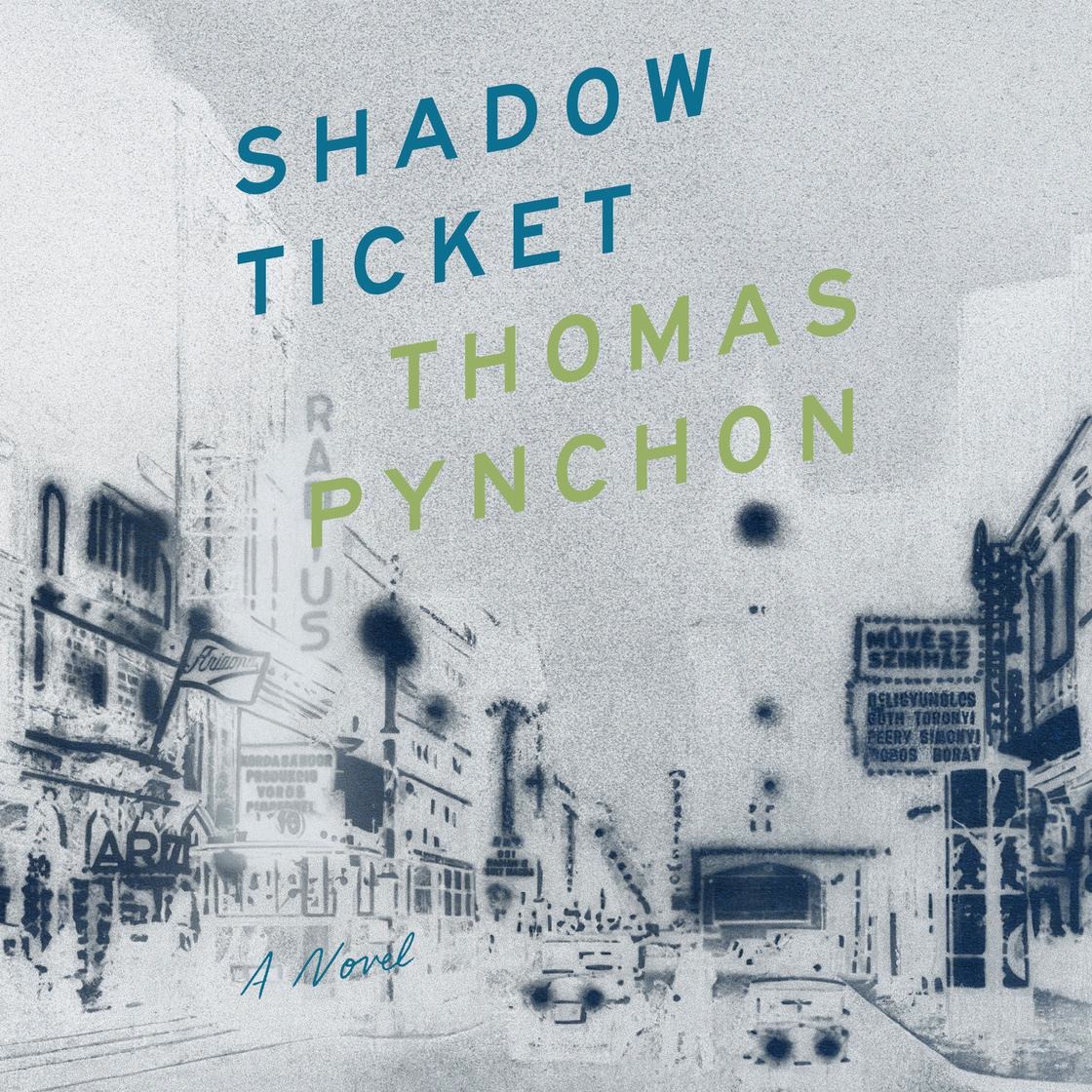
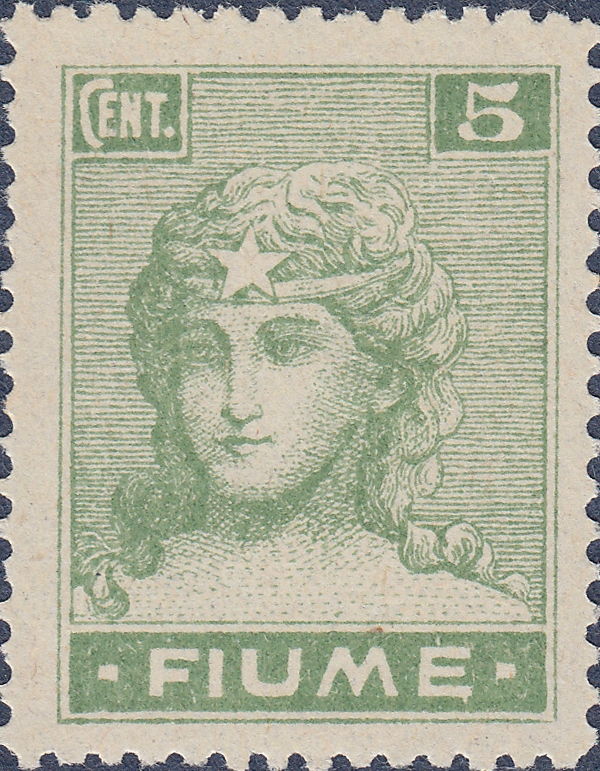


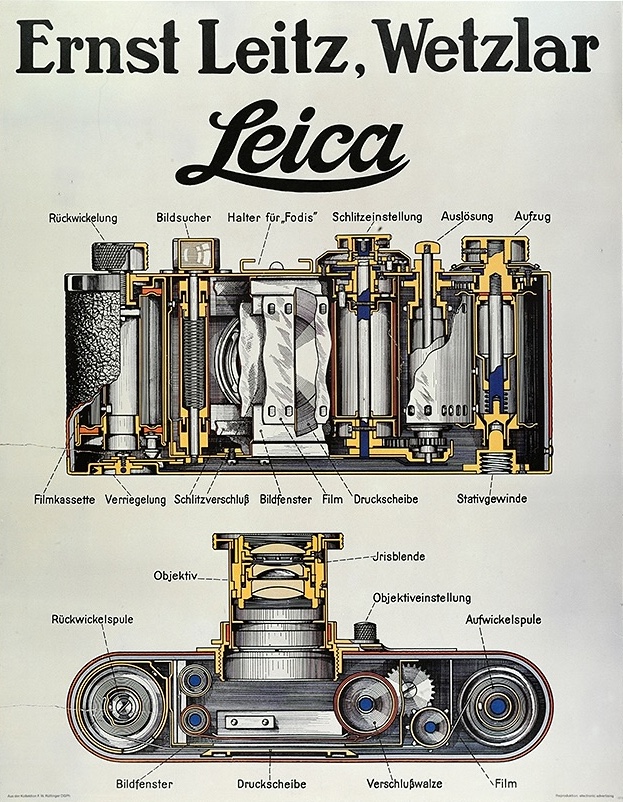

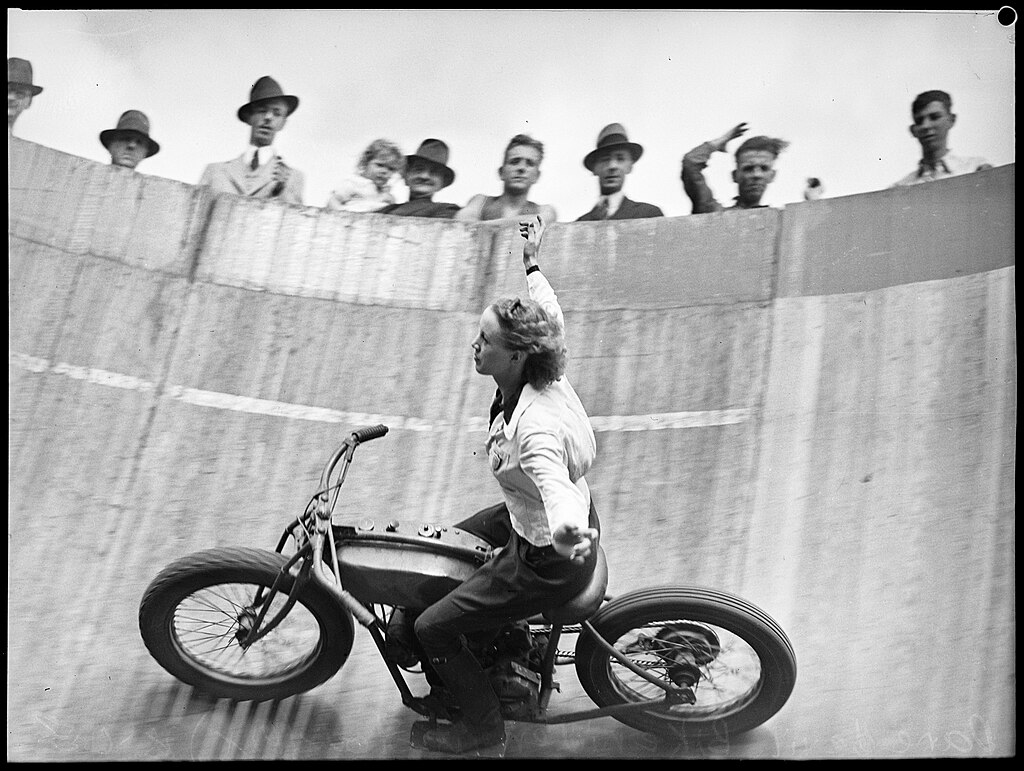
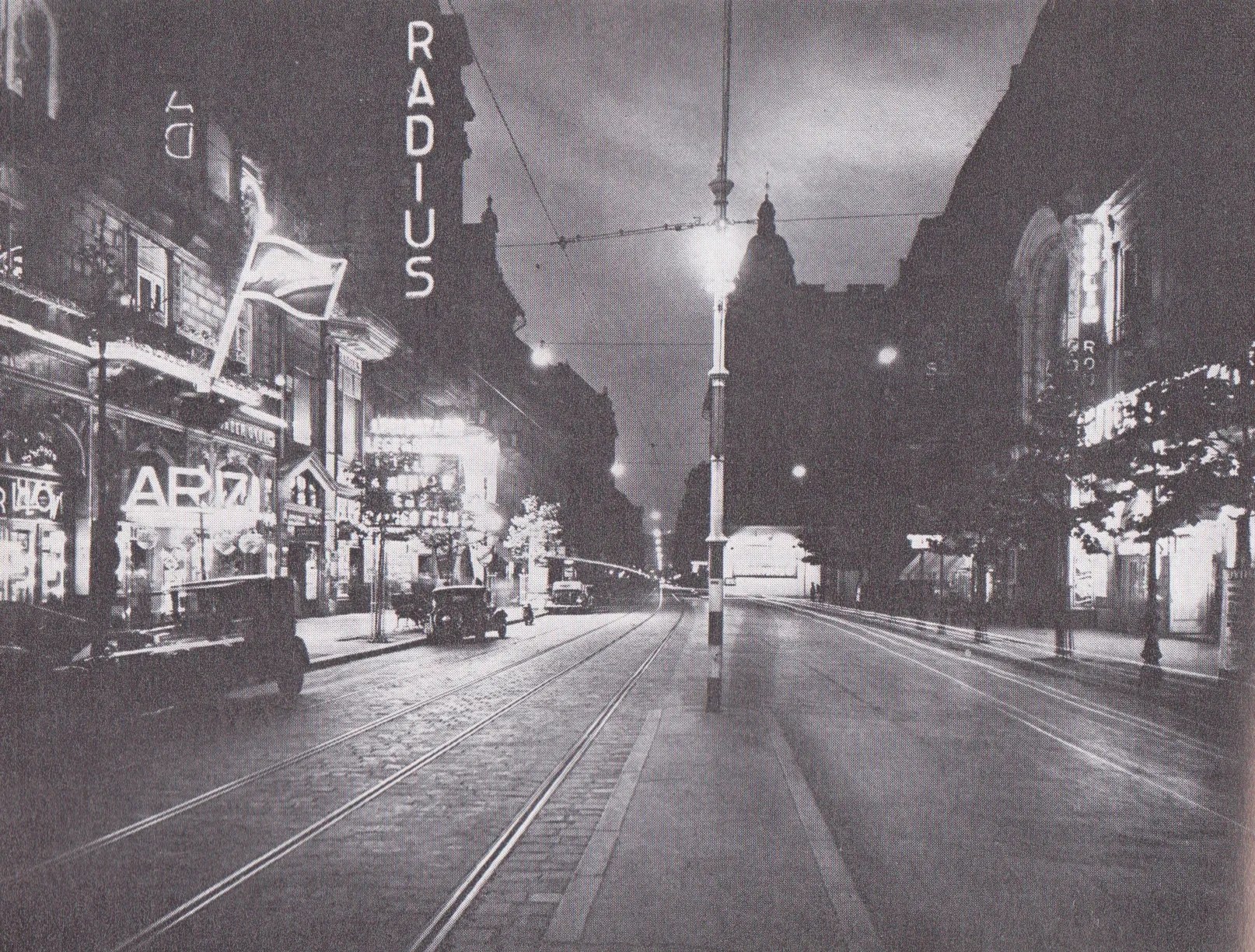

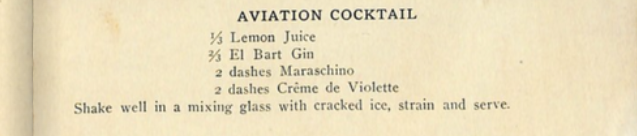

_advertisement,_1921,_retouched.png)
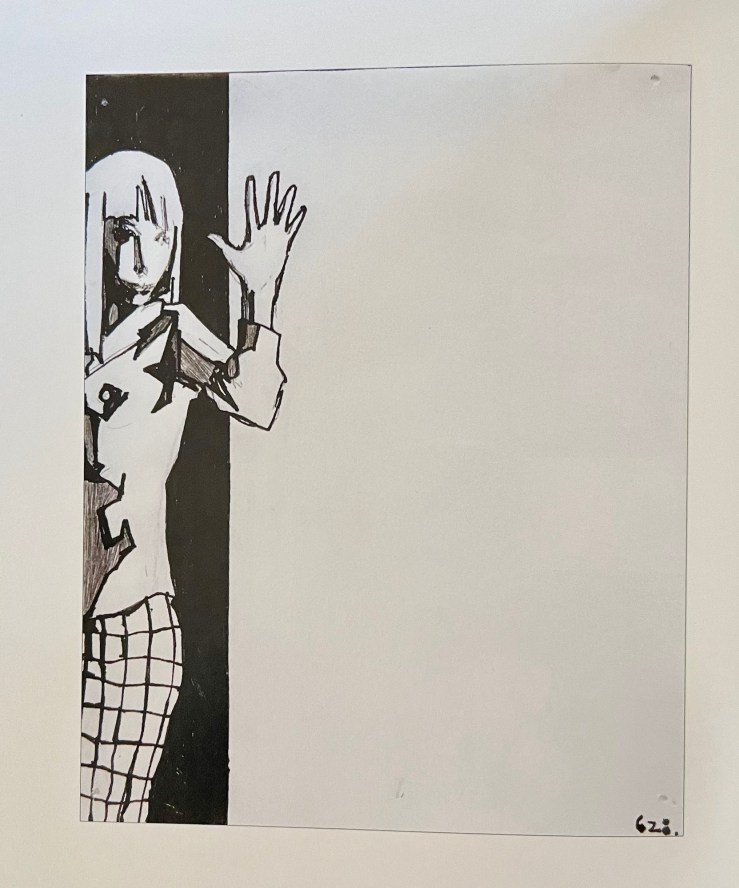

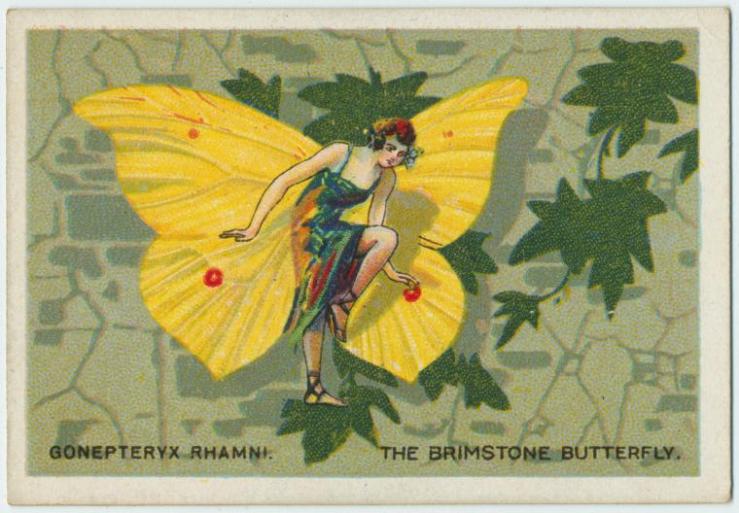
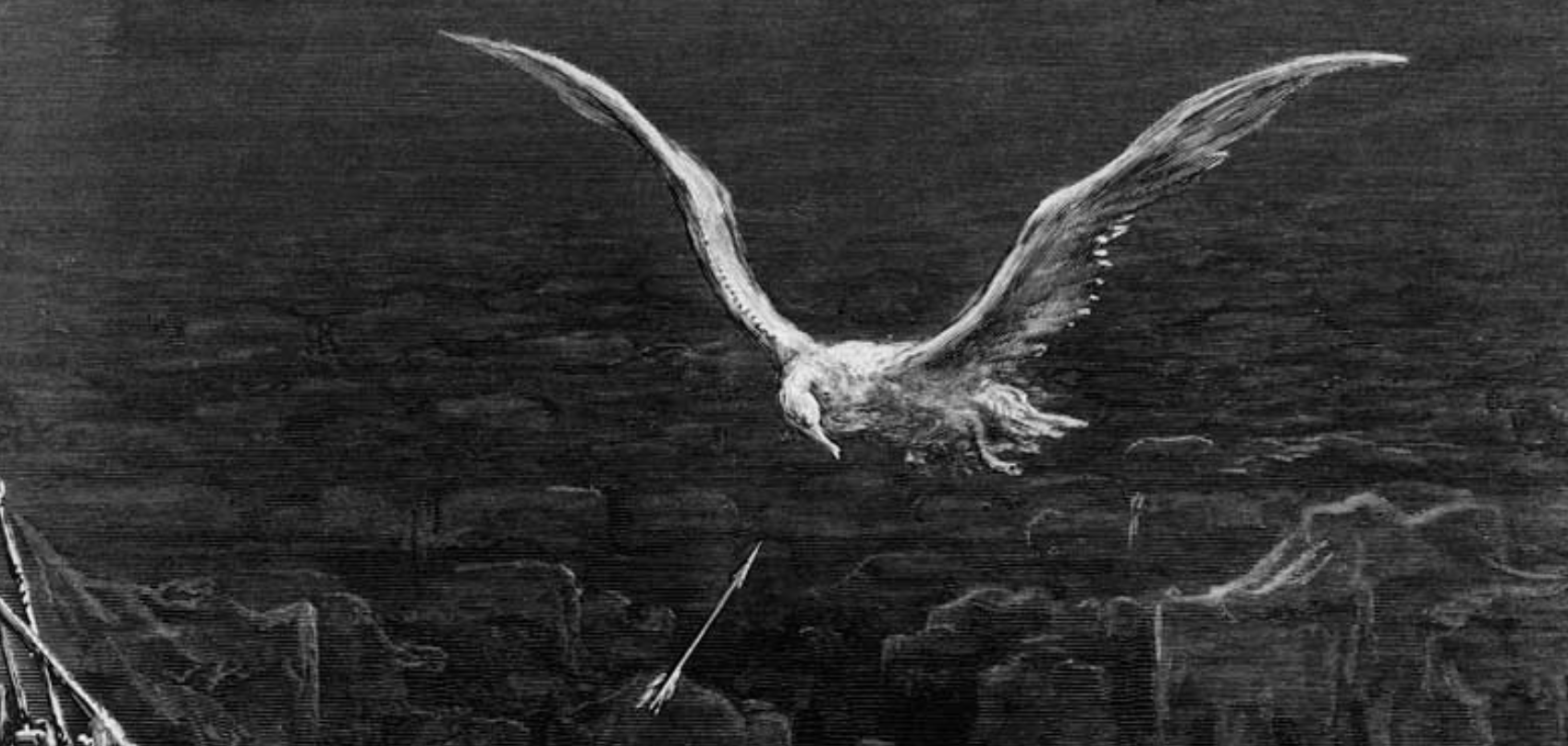
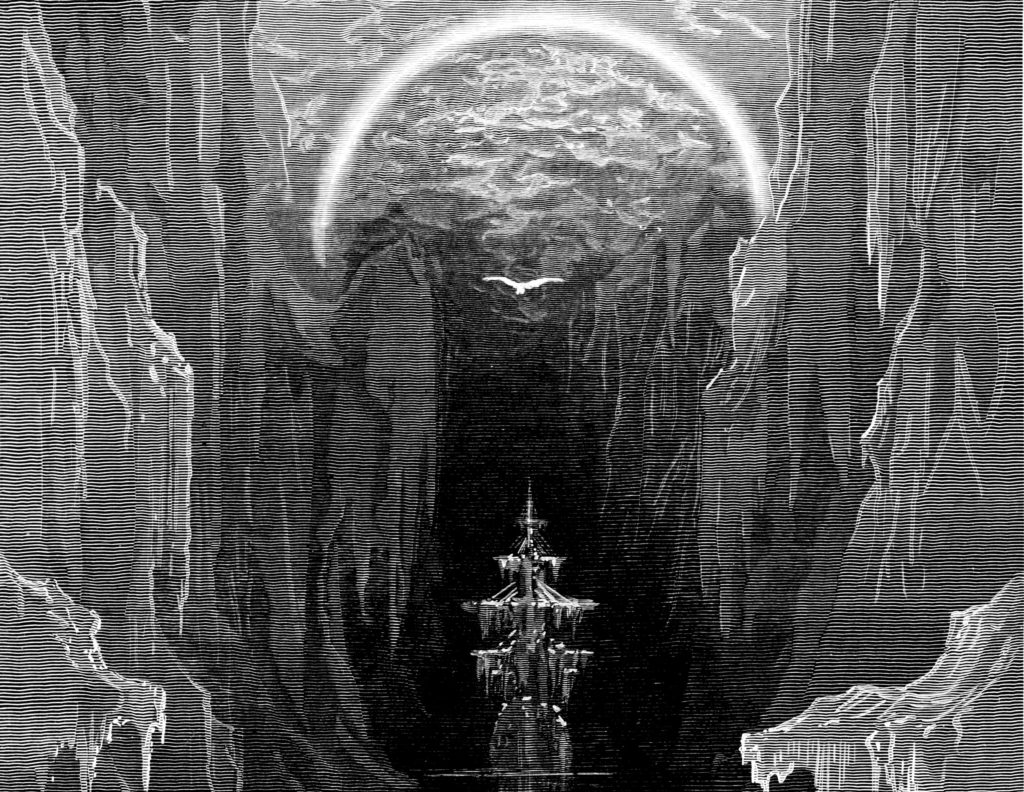

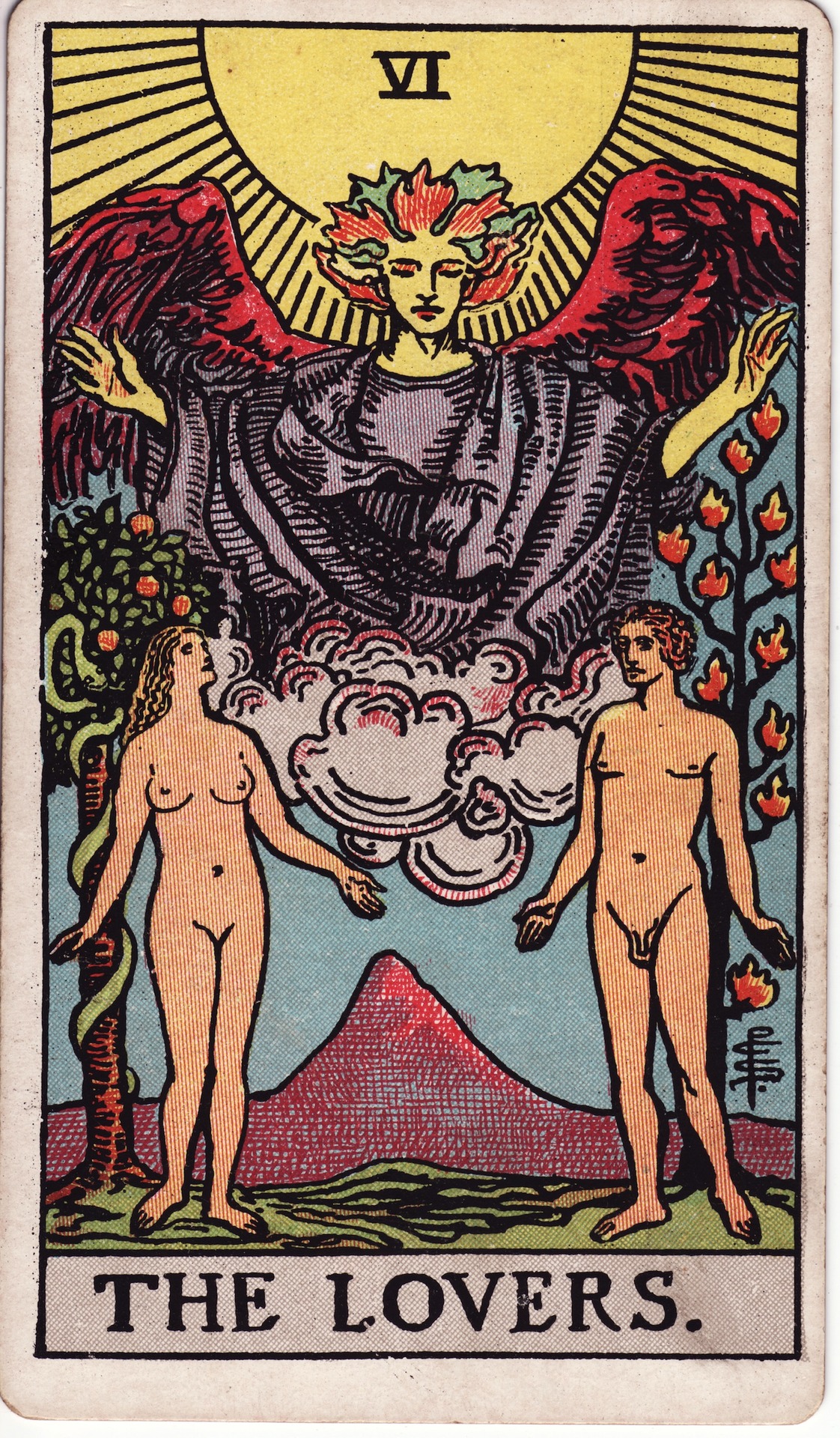
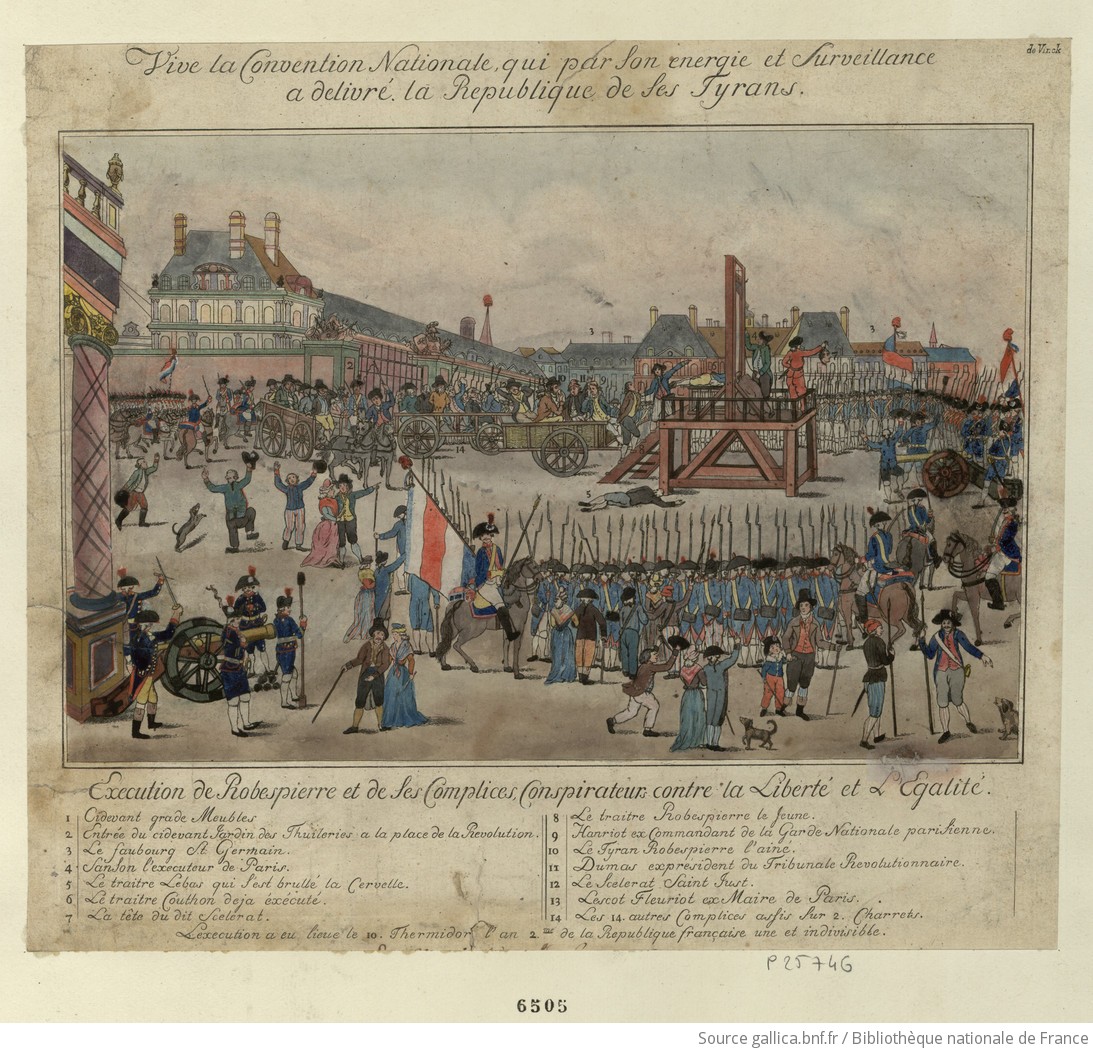


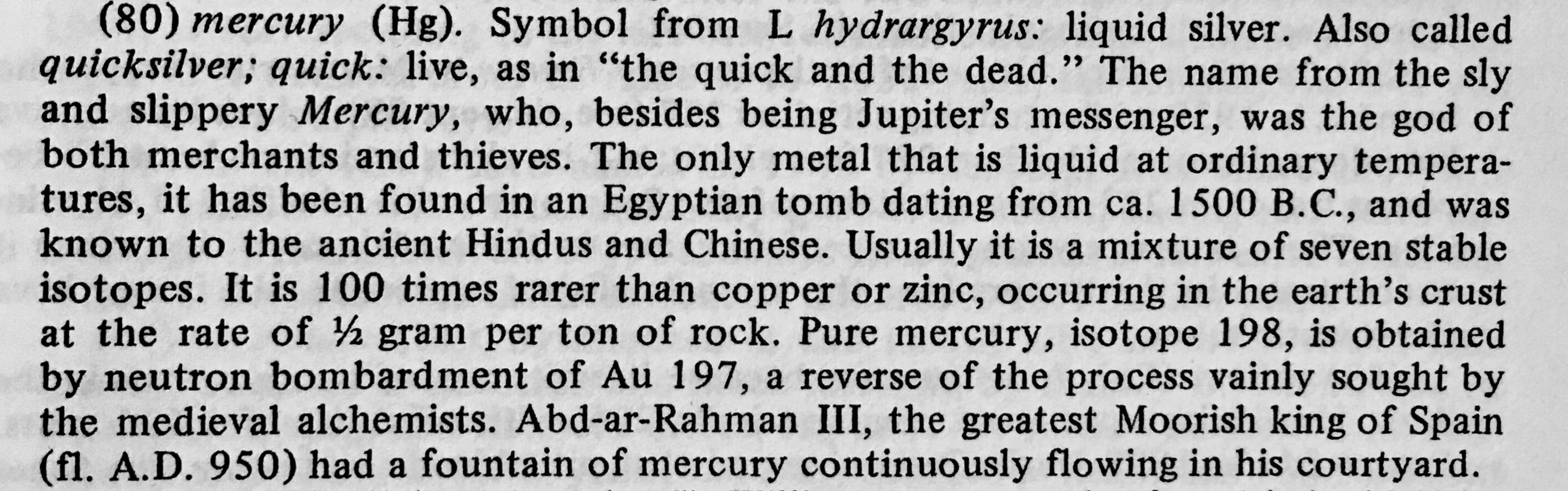


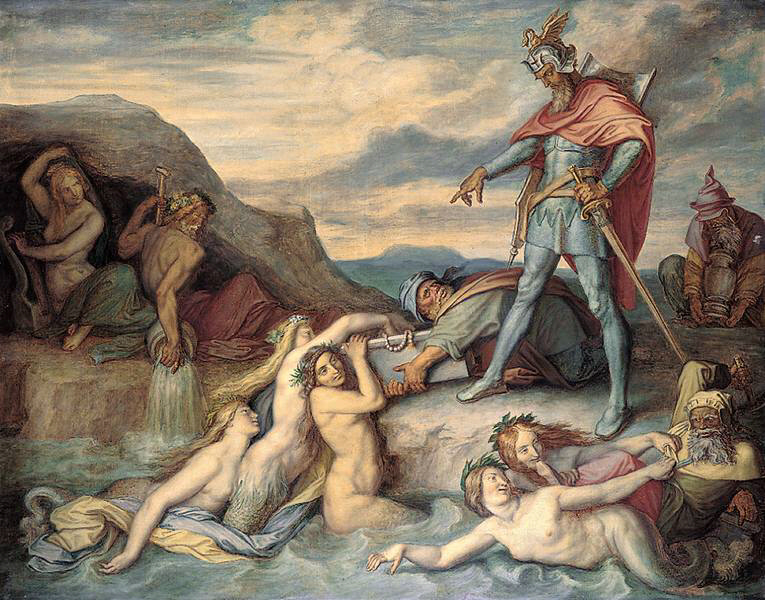


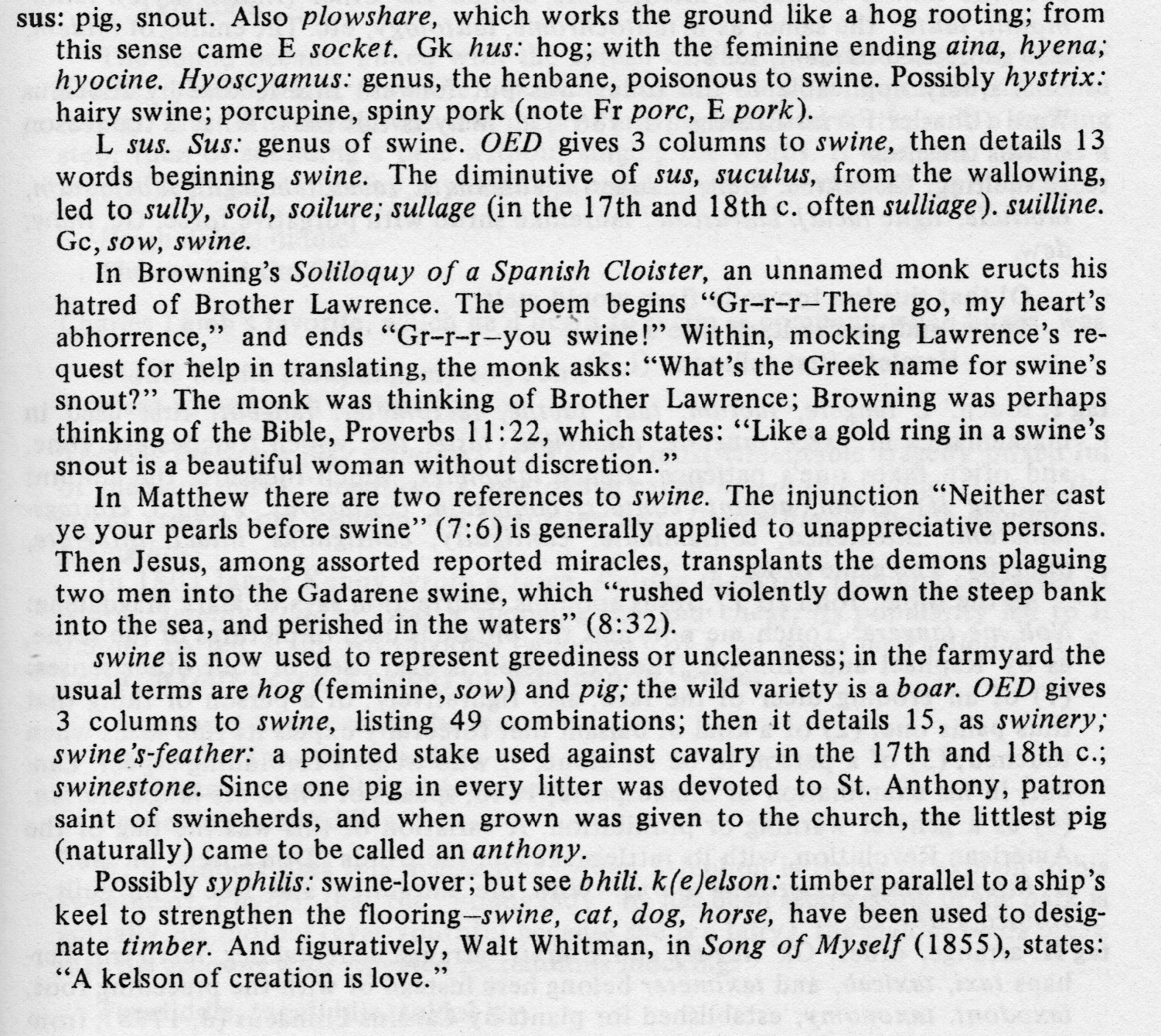


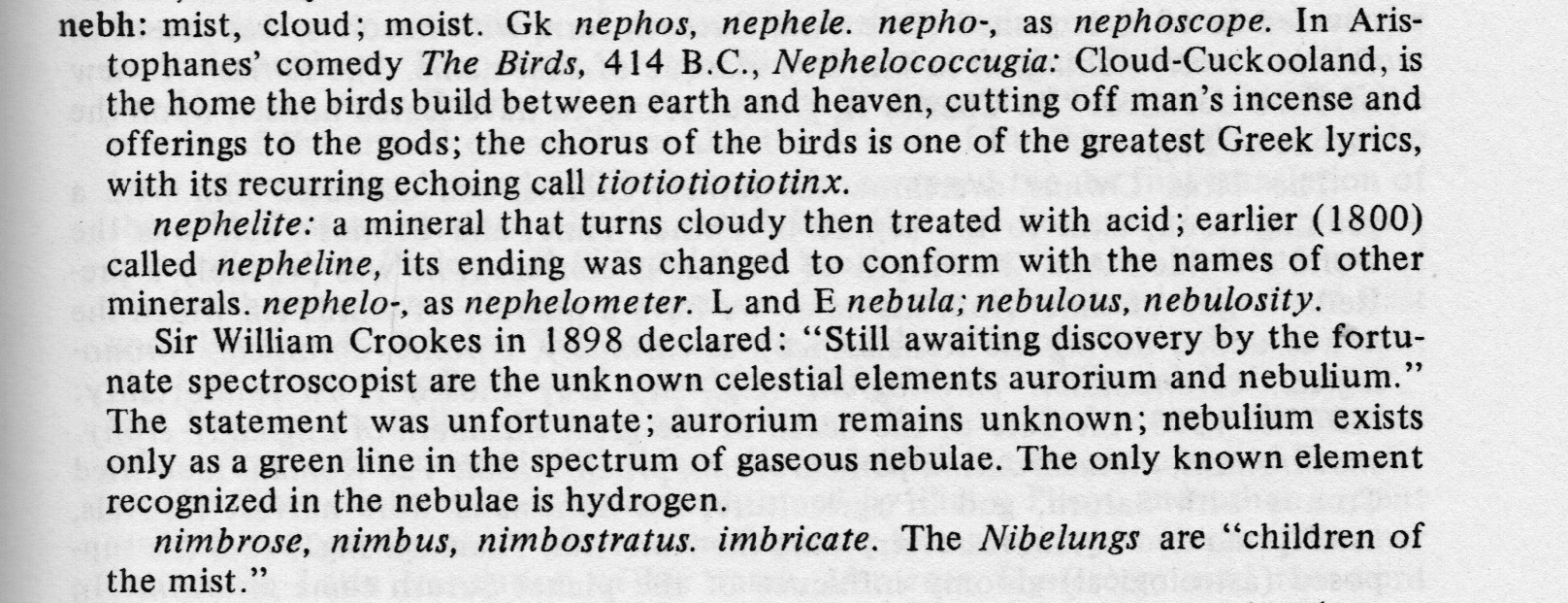


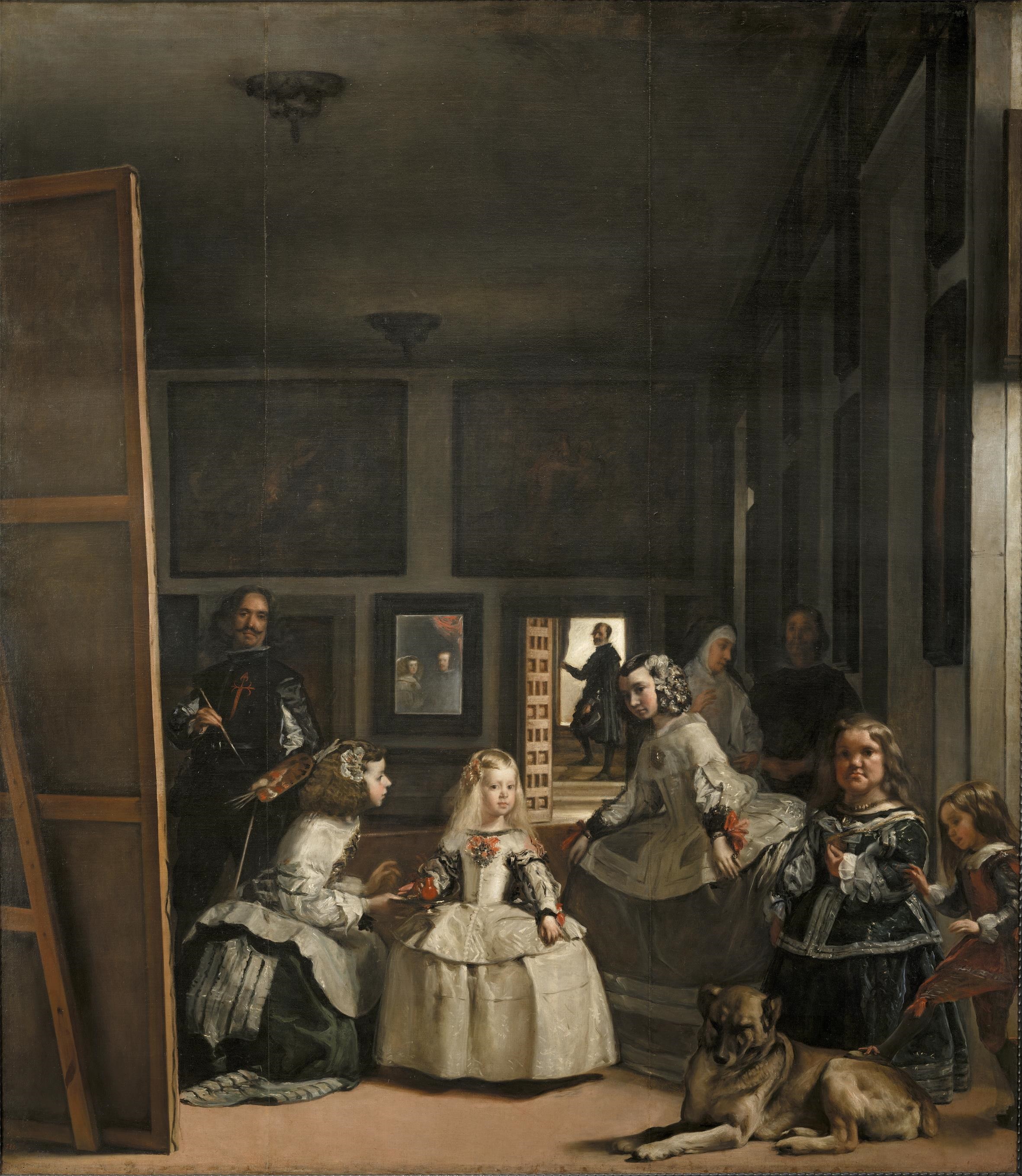








 Biblioklept