Stanley Elkin/Flann O’Brien (Book acquired and book not acquired, 23 May 2018)

img_9949

I went to my favorite local bookstore today to pick up my daughter’s sixth-grade required reading list and to offload some books I’ll never read again. I have far too many tasteful trade paperbacks that I don’t need. I try to bring three or four in on each trip and only come out with one for me (books for the kids don’t count). I picked up a copy of Stanley Elkin’s Criers and Kibitzers, Kibitzers and Criers (1966) entirely accidentally. The book was misshelved, stacked somehow on a pile of “Miscellaneous MU-” titles (I was looking for any book by Gerald Murnane, knowing that there were none there). I couldn’t pass it up—the cover, I guess, the cheap Pop appeal of its massmarketishness, and also the fact that I’m imbibing short stories like wine lately. (Murnane, Coover, Volodine).

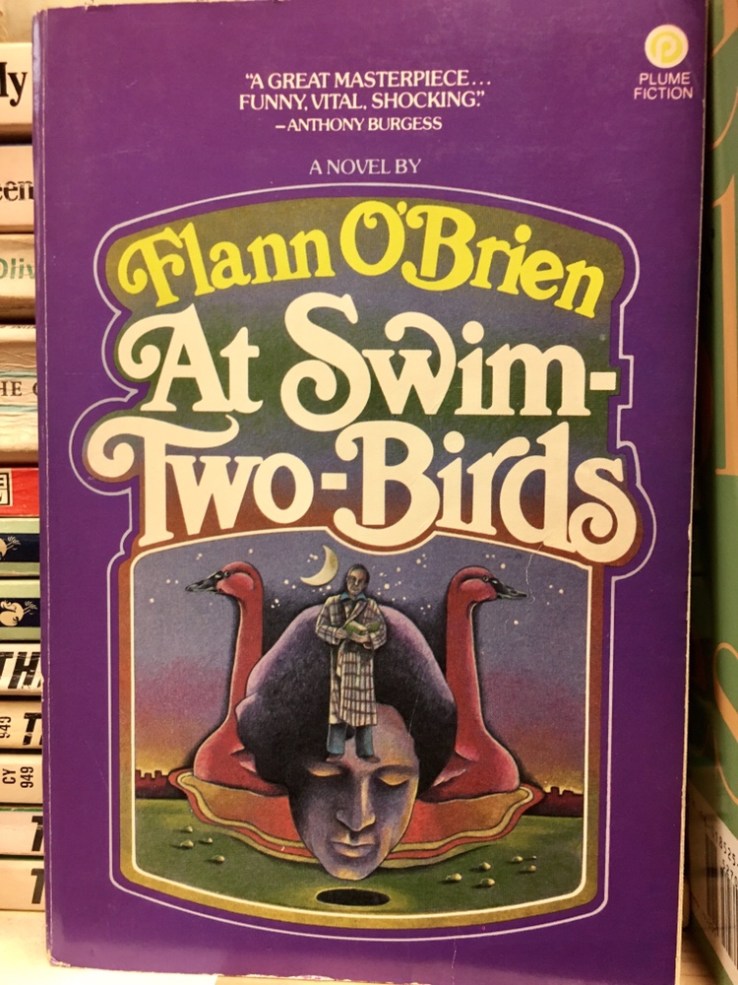
I also came across this lovely edition of Flann O’Brien’s At Swim-Two-Birds, but did not buy it, because I already own it. I love the book. The copy I have has an ugly-assed cover, unlike this beauty, which I hope some kid picks up and loses her mind over—-

img_9948

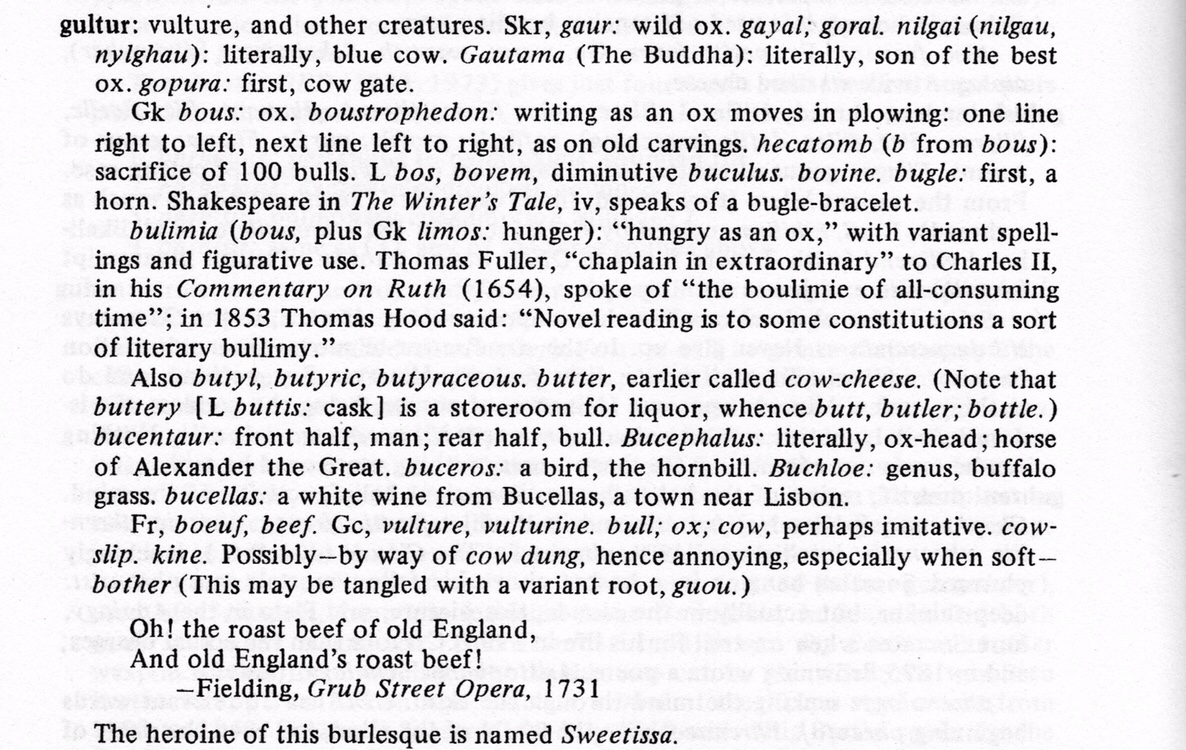
gultur: vulture, and other creatures

From Joseph T. Shipley’s The Origin of English Words: A Discursive Dictionary of Indo-European Roots.

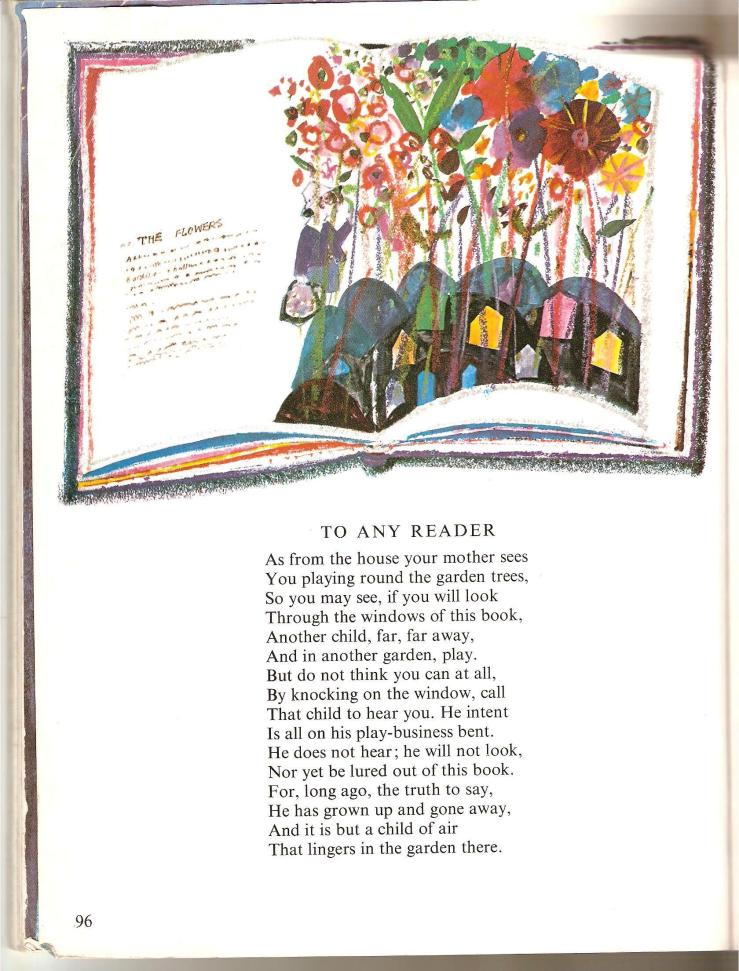
“To Any Reader” — Robert Louis Stevenson

wildsmith

The distance between the terror and the comedy of the void were somehow erotic (Robert Coover)

He recognizes in all these dislocations, of course, his lonely quest for the impossible mating, the crazy embrace of polarities, as though the distance between the terror and the comedy of the void were somehow erotic—it’s a kind of pornography. No wonder the sailor asked that his eyes be plucked out! He overlays frenzy with freeze frames, the flight of rockets with the staking of the vampire’s heart, Death’s face with thrusting buttocks, cheesecake with chaingangs, and all just to prove to himself over and over again that nothing and everything is true. Slapstick is romance, heroism a dance number. Kisses kill. Back projections are the last adequate measure of freedom and great stars are clocks: no time like the presence. Nothing, like a nun with a switchblade, is happening faster and faster, and cause (that indefinable something) is a happy ending. Or maybe not.

From Robert Coover’s 1987 short story “The Phantom of the Movie Palace.”

Blog about Blog about 3

  1. There are 30 days in April. On 1 April 2018—Easter Sunday and/or April Fool’s Day—I declared on my cursed blog that I would write something on the blog every day this month. I failed to write every day on the blog in the month of April; specifically, I did not post stuff on April 13, April 20, or April 24.
  2. (Not a reason for not posting on any of these dates but fun: April 13 was a Friday the 13th; April 20 is 4/20; April 24 is my cousin’s birthday).
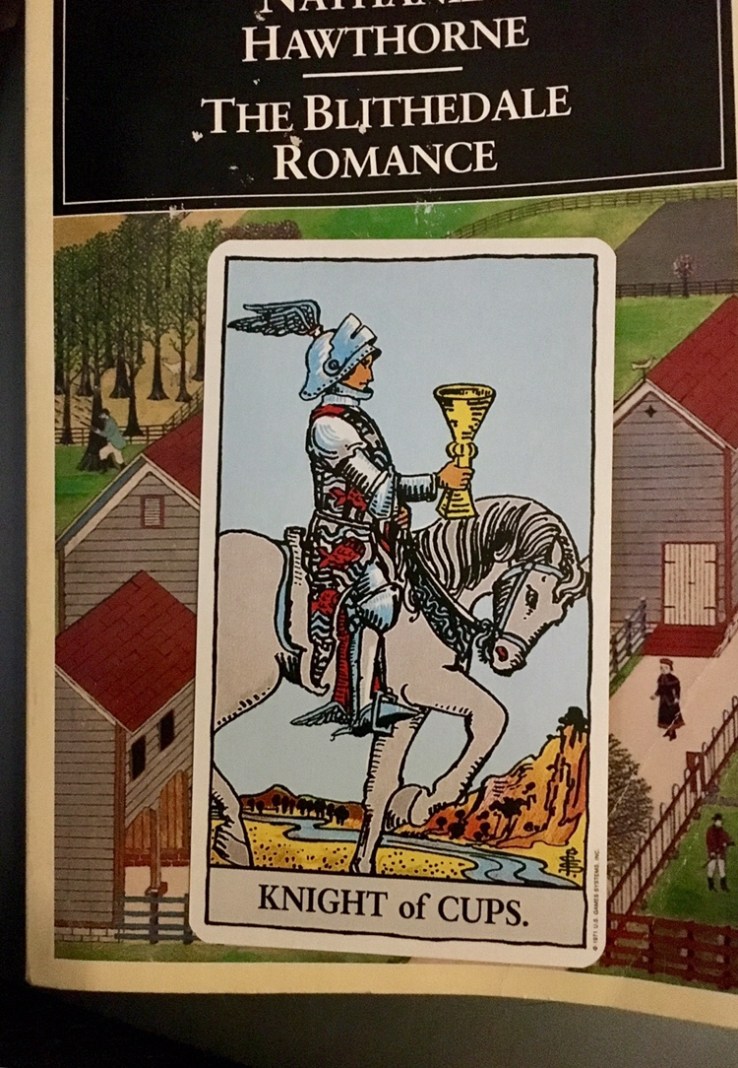
  3. On the 1 April Blog about post I specifically hunted down the Fool card in the Rider-Waite tarot deck that I keep out for fun. I always thought tarot was foolish silliness, even if I found some of the aesthetics attractive, before a third or maybe fourth rereading of Gravity’s Rainbow prompted my buying a deck for research purposes. The deck figures heavily in Pynchon’s novel, providing a mystical and indeterminate contrast to the novel’s motif of mathematical precision. At some point I start flipping a card every day—not as some kind of superstitious soothsaying totem, but rather for fun. I don’t know. I scattered some of those cards into these posts when I photographed books; every card was a card I flipped that day, aside from The Fool.
  4. This morning I flipped the Two of Wands, a card I like. I like most of the Wands suit (and generally dislike the Swords suit; the Cups are my thing though). It’s in the pic above, which is a lazy attempt at an organizing principle for this post, which is not The Last Blog about post, but the last one for April 2018. (Tomorrow is May 2018).
  5. I mean what I mean is, Trying to blog every day was rewarding but also exhausting. I was surprised at some of what I wrote, even a little tiny small bit happy with some of it, and I still have a slim deck of ideas on deck. I think I’ll try to do one or two of these a week, and at least do one on Sundays.
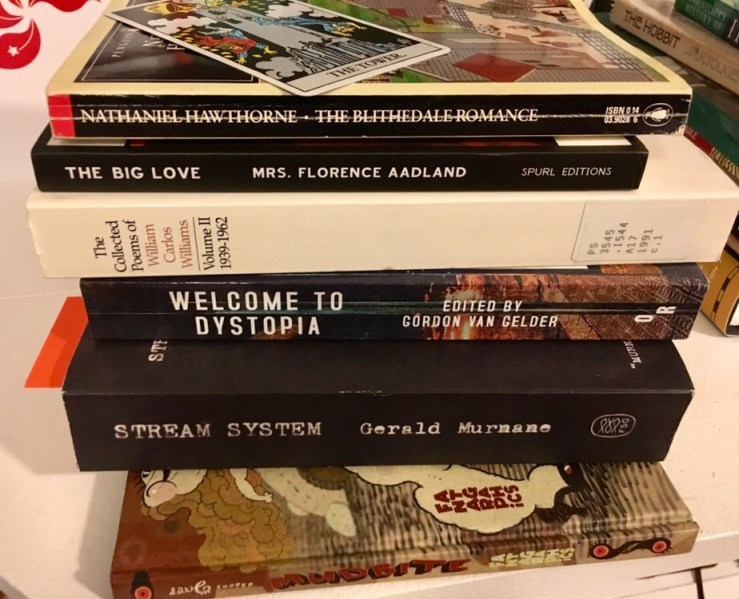
  6. So I said above (by said I mean wrote) that I used a picture as an organizing principle for this disorganized post. The pic is of a loose stack of books that I’ve read or am reading or intend to read or have maybe halfway sorta given up on. It’s a pile that needs organizing. So, from top to bottom:
  7. I reread Hawthorne’s The Blithedale Romance this month and loved it. I almost started a reread of The House of Seven Gables after reading it—and typing this out now, I realize that that’s what I’d like to read soon, actually. One of the favorite posts I did in this Blog about series was on making a cocktail Hawthorne’s narrator drinks in the novel.
  8. I picked up Players after reading DeLillo’s The Names, which I wrote about early in these Blog about posts. It’s been hanging out unattended for a few weeks and I’m sure I’ll get to it in 38 months.
  9. I said I’d finally read Middlemarch this year, but I find myself unwilling to commit after two or three chapters and am irritated with myself in my constantly transferring it from room to room without reading it or shelving it. Maybe I’m only interested in it because it is monstrous. (I love big fat monsters; make me read Middlemarch).
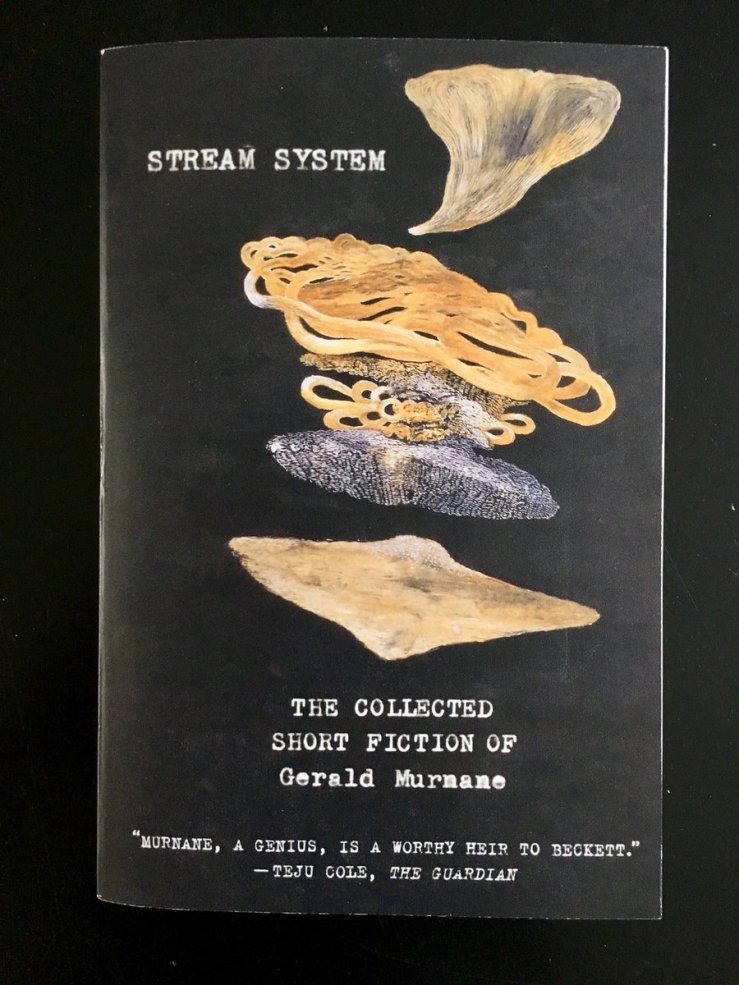
  10.  I wrote one of these Blog about posts about Gerald Murnane’s story “Stream System.” I have another thing sketched out for his story “Stone Quarry” which is like this wonderfully satirical take on metafiction. I’m mostly enjoying reading this book slowly. I hate the drive to read too fast.
  11. I read The Passion According to G.H. by Clarice Lispector maybe five or six years ago and I pulled it out the other day because I think I’d like to reread it, because that’s what I like—rereading—I mean, I’ d prefer to reread Middlemarch without all the hard labor of, like, reading it first. But then I realized I’d never actually finished it. So I need to read it so I can reread it.
  12. I got the Hob Broun in the mail today and I’m going to quit writing this stupid fucking blog and go read it now.
  13. I’ll do another one of these tomorrow if I feel like it, but not if I don’t feel like it, and if I don’t not feel like it, maybe.

Hob Broun’s Cardinal Numbers (Book acquired, 30 April 2018)

img_9613

I first heard of Hob Broun a few years ago from the literary critic David Winters, who is a fan of Broun’s work. I’ve had Broun on a list of writers I mean to read for a long time now (an actual physical list, by the way, which I keep in my wallet). However, I’ve yet to come across one of his books in a bookstore. Anyway so well—

The inaugural issue of the new literary magazine Egress has a feature on Broun, which reignited my interest in him. I’ve been emailing the editors of Egress, David Winters and Andrew Latimer, for an interview about Egress (which will post sometime in the next day or two), and David basically talked me into breaking down and buying the book online (I got it for five bucks). A snippet of our upcoming interview:

Biblioklept: I know David has been enthusiastic about Hob Broun’s writing for a few years. Broun is sort of a “writer’s writer’s writer,” if that makes sense. The first issue of Egress features a section titled “Remembering Hob Broun: 1950-1987”; in addition to remembrances from the novelist Sam Lipsyte and Kevin McMahon, who befriended Broun when they attended Reed College together in the late sixties, you include a full color selection from one of Broun’s journals. Can you describe some of the journal for readers, and talk a bit about how the Broun section came together? For readers unfamiliar with Broun, what’s the appeal?

David Winters: Broun is a ‘writer’s (writer’s) writer’ only in that he isn’t well-known–his work isn’t at all opaque or aloof. He published three books in his lifetime, the novels Odditorium (1983) and Inner Tube (1985), and the superb short story collection Cardinal Numbers (1988). While writing Inner Tube, Broun underwent emergency surgery to remove a spinal tumour. He was left paralysed from the neck down. Remarkably, he finished the novel–and wrote the stories in Cardinal Numbers–using a kind of writing-machine: an oral catheter (or ‘sip-and-puff device’) connected to a customised word processor, triggered by his breath whenever a letter flashed on the screen. This aspect of Broun’s life lends itself to mythologization: what better image of writerly dedication? At the same time, it risks obscuring what really matters: the work itself. I was delighted, then, when Kevin McMahon got in touch. Kevin’s essay only glances at Broun’s illness, giving us, instead, a vivid portrait of the man behind the myth. Best of all, Kevin sent us Broun’s personal journal. It’s an extraordinary artefact–a scrapbook of doctored magazine clippings and miniature, fragmentary narratives–unmistakably Brounian in its pulpy, screwball surreality. Broun’s journal is continuous with his fiction (Cardinal Numbers contains the manifesto-like statement, ‘modus operandi: montage, collage, bricolage’), but, unlike his fiction, it wasn’t created for public consumption. Not unlike the art of, say, Ray Johnson or Joseph Cornell, it gives us a glimpse of a private world, a game played for inscrutable reasons—what Don DeLillo calls “the pure game of making up”. Our celebration of Broun ends with a wonderful essay by Sam Lipsyte–a writer Andrew and I both revere–who captures his essence far better than either of us ever could.

Biblioklept: Which of Broun’s three books do you think is the best starting place for folks interested in his work after reading about him in Egress?

DWCardinal Numbers, without a doubtOpen Road recently reissued all three titles as e-books, but I’d recommend picking up the old Knopf hardbacks, which can be had for as little as a dollar. Another Broun novel–a previously unpublished manuscript–might be out in a year or two.

Blog about like just the sheer damn orality of Robert Coover’s short story “The Brother”

This weekend I picked up a new audiobook collection of Robert Coover short stories which has been titled Going for a Beer (presumably because “Going for a Beer” is a perfect short story).  The audiobook contains 30 stories and is read by Charlie Thurston, a more than capable as an orator.

The opening story is one of Coover’s earliest published stories. “The Brother” (1962) retells the Noah narrative from the book of Genesis. I just wrote “retells,” but that’s not really the right term. Instead of retelling the story of Noah and the ark and YHWH’s flood, Coover imagines the apocalyptic affair from the perspective of Noah’s younger brother, who narrates this tale.

Noah’s unnamed brother is an earthy, sensual fellow who loves his wife and loves his wine. His wife—a sympathetic and endearing figure—is pregnant with their first child. They’re already picking out names (“Nathaniel or Anna”). Brother Noah keeps taking the narrator from his own familial duties to help build a boat though:

right there right there in the middle of the damn field he says he wants to put that thing together him and his buggy ideas and so me I says “how the hell you gonna get it down to the water?” but he just focuses me out sweepin the blue his eyes rollin like they do when he gets het on some new lunatic notion and he says not to worry none about that just would I help him for God’s sake and because he don’t know how he can get it done in time otherwise and though you’d have to be loonier than him to say yes I says I will of course I always would crazy as my brother is I’ve done little else since I was born and my wife she says “I can’t figure it out I can’t sec why you always have to be babyin that old fool he ain’t never done nothin for you God knows and you got enough to do here fields need plowin it’s a bad enough year already my God and now that red-eyed brother of yours wingin around like a damn cloud and not knowin what in the world he’s doin buildin a damn boat in the country my God what next? you’re a damn fool I tell you” but packs me some sandwiches just the same and some sandwiches for my brother

That’s kinda-sorta the opening paragraph—although no it’s not, because the whole story is just one big paragraph, a big oral fragment really, which begins with a lower-case and keeps going in a verbal rush whose only concessions to punctuation are question marks and quotation marks. No periods or commas here folks. On the page, “The Brother” perhaps approximates the blockish brickish look of a Gutenberg Bible or even the Torah, neither of which give the reader a nice period to rest on, let alone a friendly pause between paragraphs.

“The Brother” might be typographically daunting, but the apparent thickness of verbal force on the page belies its oral charms. The story is meant to be read out loud. Hell, it’s biblical, after all—a witnessing. Read aloud, “The Brother” shows us a deeply sympathetic pair of characters, a husband and wife whose small pleasures, telegraphed in naturalistic speech, might remind the auditor of real persons living today. And yet there’s an apocalyptic backdrop here. Noah’s brother and Noah’s brother’s wife—and their unborn child, and all the unborn children—will not survive YHWH’s flood.

Coover does not paint Noah as anything but a shrugging reluctant weirdo. He’s no prophet who warns and helps his brother, but rather a defeated man:

and it ain’t no goddamn fishin boat he wants to put up neither in fact it’s the biggest damn thing I ever heard of and for weeks wee\s I’m tellin you we ain’t doin nothin but cuttin down pine trees and haulin them out to his field which is really pretty high up a hill and my God that’s work lemme tell you and my wife she sighs and says I am really crazy r-e-a-l-l-y crazy and her four months with a child and tryin to do my work and hers too and still when I come home from haulin timbers around all day she’s got enough left to rub my shoulders and the small of my back and fix a hot meal her long black hair pulled to a knot behind her head and hangin marvelously down her back her eyes gentle but very tired my God and I says to my brother I says “look I got a lotta work to do buddy you’ll have to finish this idiot thing yourself I wanna help you all I can you know that but” and he looks off and he says “it don’t matter none your work” and I says “the hell it don’t how you think me and my wife we’re gonna eat I mean where do you think this food comes from you been puttin away man? you can’t eat this goddamn boat out here ready to rot in that bastard sun” and he just sighs long and says “no it just don’t matter” and he sits him down on a rock kinda tired like and stares off and looks like he might even for God’s sake cry

Noah’s dismissing his brother’s work strikes me as utterly cruel—he makes no attempt to explain why his brother’s efforts at creating a better world are in vain. I shared the passage at length again in part because I hope you’ll read it aloud gentle reader, but also that you’ll note that maybe you didn’t note all its blasphemies—Coover’s story is larded with “my Gods” and “damns” and “goddamns,” no different than the speech of 1962, no different than the speech of 2018.

Coover gives us a narrator like us, human, earthly, driven by simple pleasures and a basic sense of love. Noah comes off like a prick. The Bible loves its heroes, but the ordinary folks don’t even get to live in the margins. There’s more morality in orality though—in conversation and communication and talk.

You don’t have to buy the audiobook though to hear “The Brother.” Here is Coover reading it himself:

Rough Animals (Book acquired, 21 April 2018)

img_9554

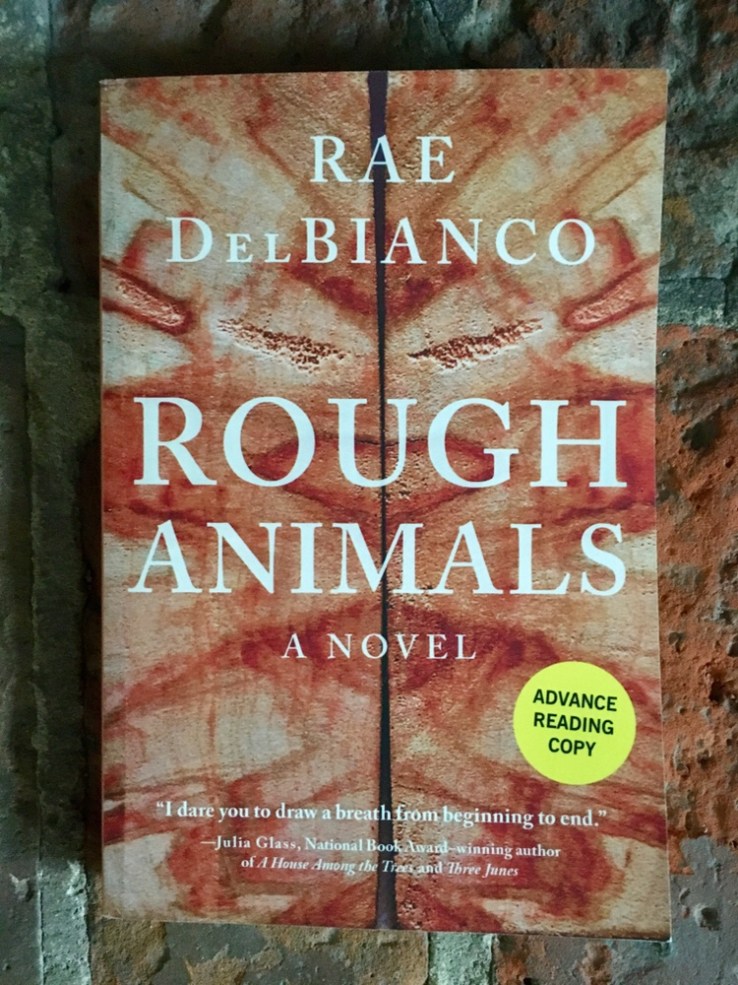
A copy of Rae DelBianco’s novel, Rough Animals, arrived at Biblioklept World Headquarters yesterday. I read the first chapter, which has the protagonist getting shot on like, the second page. This is a fast-paced book so far, its plot propelled by prose clearly influenced by Cormac McCarthy and Denis Johnson.

Here is the blurb:

​Ever since their father’s untimely death five years before, Wyatt Smith and his inseparably close twin sister, Lucy, have scraped by alone on their family’s isolated ranch in Box Elder County, Utah. That is until one morning when, just after spotting one of their bulls lying dead in the field, Wyatt is hit in the arm by a hail of gunfire that takes four more cattle with it. The shooter: a fever-eyed, fearsome girl-child with a TEC-9 in her left hand and a worn shotgun in her right. They hold the girl captive, but she breaks loose overnight and heads south into the desert. With the dawning realization that the loss of cattle will mean the certain loss of the ranch, Wyatt feels he has no choice but to go after her and somehow find restitution for what’s been lost.

Wyatt’s decision sets him on an epic twelve-day odyssey through a nightmarish underworld he only half understands; a world that pitches him not only against the primordial ways of men and the beautiful yet brutally unforgiving landscape, but also against himself. As he winds his way down from the mountains of Box Elder to the mesas of Monument Valley and back, Wyatt is forced to look for the first time at who he is and what he’s capable of, and how those hard truths set him irrevocably apart from the one person he’s ever really known and loved. Steeped in a mythic, wildly alive language of its own, and gripping from the first gunshot to the last, Rough Animals is a tour de force from a powerful new voice.

Blog about the American Arcadia (or Arcadian America?) scene in Nathaniel Hawthorne’s novel The Blithedale Romance

img_9535

I am glad I reread Nathaniel Hawthorne’s 1852 novel for many reasons. One of those reasons is because I had completely forgotten to remember a marvelous scene near the end of the novel, in Ch. XXV — “The Masqueraders.” This episode happens near the end of the chapter. Hawthorne’s stand-in Miles Coverdale has decided to return to Blithedale after spending some time out in, like, the world.

Coverdale’s return to the utopian project he half-heartedly abandoned is thoroughly coded in Hawthorne’s signature ambivalence: He notes “a sickness of the spirits kept alternating with my flights of causeless buoyancy” as he walks through the wood. Approaching the Blithedale farm, and feels an “invincible reluctance” in his return, which causes him to linger in the forest. By and by, as the lovely transitional phrase goes, Coverdale winds his way back to his “hermitage, in the heart of the white-pine tree.” (The white-pine reference strikes me as an oblique reference here to Hawthorne himself—or rather, a nod to a distinction between white pine and black hawthorn trees, alter egos).

Here in his hermitage he rests among grapes dangling in “abundant clusters of the deepest purple, deliciously sweet to the taste.” Coverdale’s hermitage is an idealized, natural—transcendental—version of Blithedale, the grapevines (a prefiguration of communication in the American parlance) a kind of perfectly polygamous knot of communal existence.

Taken up in solo-bacchanalia, Coverdale begins devouring the grapes. Always the loner, always the voyeur, he checks out the house from his arboreal perch and notes its emptiness. He decides, drunken on sweet grapes, to skulk through the woods, where he hears “Voices, male and feminine; laughter, not only of fresh young throats, but the bass of grown people.” He continues—

The wood, in this portion of it, seemed as full of jollity as if Comus and his crew were holding their revels in one of its usually lonesome glades. Stealing onward as far as I durst, without hazard of discovery, I saw a concourse of strange figures beneath the overshadowing branches. They appeared, and vanished, and came again, confusedly with the streaks of sunlight glimmering down upon them.

“Comus and his crew” — what a lovely evocation! Comus, cup-bearer and heir of Bacchus, is a figuration of erotic chaos. Hawthorne ushers his hero into a scene of pastoral American anarchy, a strange Arcadia that Walt Whitman would try to replicate in Leaves of Grass a few years later. Note the admixture of cultures here in Hawthorne’s transcendentalist Halloween:

Among them was an Indian chief, with blanket, feathers, and war-paint, and uplifted tomahawk; and near him, looking fit to be his woodland bride, the goddess Diana, with the crescent on her head, and attended by our big lazy dog, in lack of any fleeter hound. Drawing an arrow from her quiver, she let it fly at a venture, and hit the very tree behind which I happened to be lurking. Another group consisted of a Bavarian broom-girl, a negro of the Jim Crow order, one or two foresters of the Middle Ages, a Kentucky woodsman in his trimmed hunting-shirt and deerskin leggings, and a Shaker elder, quaint, demure, broad-brimmed, and square-skirted. Shepherds of Arcadia, and allegoric figures from the “Faerie Queen,” were oddly mixed up with these. Arm in arm, or otherwise huddled together in strange discrepancy, stood grim Puritans, gay Cavaliers, and Revolutionary officers with three-cornered cocked hats, and queues longer than their swords. A bright-complexioned, dark-haired, vivacious little gypsy, with a red shawl over her head, went from one group to another, telling fortunes by palmistry; and Moll Pitcher, the renowned old witch of Lynn, broomstick in hand, showed herself prominently in the midst, as if announcing all these apparitions to be the offspring of her necromantic art.

Again though, in classic Hawthorne fashion, our author hedges all bets, tempering his mythical romantic flight in skepticism, here embodied by Silas Foster, the only real farmer (real earthworker) of Blithedale:

But Silas Foster, who leaned against a tree near by, in his customary blue frock and smoking a short pipe, did more to disenchant the scene, with his look of shrewd, acrid, Yankee observation, than twenty witches and necromancers could have done in the way of rendering it weird and fantastic.

Our narrator Coverdale also spies some men “with portentously red noses…spreading a banquet on the leaf-strewn earth; while a horned and long-tailed gentleman” tuning up a fiddle. The end result:

So they joined hands in a circle, whirling round so swiftly, so madly, and so merrily, in time and tune with the Satanic music, that their separate incongruities were blended all together, and they became a kind of entanglement that went nigh to turn one’s brain with merely looking at it.

The entanglement here—which eventually explodes in riotous communal laughter—recalls the polygamous knot of grapevines that shrouded Coverdale’s hermitage.

The great laughter prompts Coverdale to explode in his own laughter, whereupon the Bacchic party sets out after him with comic-murderous intent:

“Some profane intruder!” said the goddess Diana. “I shall send an arrow through his heart, or change him into a stag, as I did Actaeon, if he peeps from behind the trees!”

Coverdale flees.

He eventually happens upon an old rotting woodpile covered in moss, where he daydreams about “the long-dead woodman, and his long-dead wife and children, coming out of their chill graves, and essaying to make a fire with this heap of mossy fuel!” — this before finally giving himself up to the Blithedale crew.

The episode strikes me very much as a sequel or reboot of Hawthorne’s 1835 story “Young Goodman Brown,” in which a Puritan naif wonders into the woods dark and deep and witnesses all the horrors of his young country made real—he sees the dark heart of his community beating naked and bloody and raw and Satanic—and it changes him forever, essentially dulling his soul unto a living death. The American Arcadia episode of Blithedale though is a bit richer in its mythos, its paganism more complex and inclusive, its perspective character more attuned to the vibrant possibilities of a transcendental community, even as he stands on its outside—and what is an outsider but the most vital secret ingredient of any community?

Blog about a devastating passage from Gerald Murnane’s story “Stream System”

dacgkouvwaazexo

The title of this blog post is Blog about a devastating passage from Gerald Murnane’s story “Stream System, but I admit that I wanted to put the word story under a bit of suspicion—rein it in with quotation marks, call it a “story.”

See, “Stream System” isn’t really a “story” — except that it is — “Stream System” is, like, a kind of biographical excerpt, less fictionalized (Yeah but how do you know that?) than the other pieces I’ve thus far read in the 2018 collection of Gerald Murnane’s fiction (“fiction”?) Stream System.

In Stream System the story “Stream System” gets a little asterisk next to its title. The initial asterisk’s twin in the footnote informs the reader:

“‘Stream System’ was written to be be read aloud at a gathering in the Department of English at La Trobe University in 1988.”

(The original campus of La Trobe University is in Melbourne, Australia, a city I visited three times as a boy between 1987 and 1991; during this time my family lived in Papua New Guinea and New Zealand (but never Australia). The city of Melbourne, Florida is 177 miles south of where I currently live, and although I have driven past it, I have never visited it).

So “Stream System” is not a fiction but a speech, a written speech, but really a “story,” I guess—a story (sort of) about Murnane’s boyhood in the southeastern Australian state of Victoria.

In any case, in titling this blog post Blog about a devastating passage from Gerald Murnane’s story “Stream System,” I found myself wanting to put quotation marks around “story,” but realizing that those quotation marks would butt up against the quotation marks of “Stream System” (quotation marks indicating, This is the title of a short work—perfectly logical quotation marks in a shared punctuation system). And well yeah so I realized that the two sets of quotation marks did not belong to the same logical system. One set of quotation marks are so-called “scare quotes”; the other set of quotation marks are simply the basic English punctuation for indicating the title of a short work—whether the work is an essay, speech, poem, or short story. Even more importantly, putting the two sets of quotation marks together looked ugly as hell.

I started with the title for the post and seem to not have gotten past it. This has been a bad start, but I’ll keep blogging.

I’m not going to summarize “Stream System” — unpacking it would be too much, like drawing a diagram of an intricate memory map. I mean, really it’s better to just read it. I’ll just say that it condenses memory into the concrete reality of place, and makes those memories bristle with sharp, strange meaning.

I just said I’ll just say, but I’ll also just say — “Stream System” is deeply unsettling: Its repetitive tics are addictive; its compulsions compel the reader along into the speaker’s reflective labyrinth. And yet for all its coercive power, Murnane’s anamnesis is also extraordinarily discomforting. Murnane’s prose never editorializes, yet its concrete prowess, its evocation of surfaces, contours, true and real details—all of this leads the reader towards an emotional epiphany that the narrator refuses to name, directly invoke, or otherwise dramatize.

And yet so but well really “Stream System” does dramatize its epiphany, or one of its epiphanies, but in this really oblique and elliptical way that walks and talks through the story’s central trauma, walks through it in such a way that it seems like the narrator has kept going, leaving the reader a bit winded and left behind, holding a stitch in his side, saying, Hey, wait, what about this, what about this really really devastating thing you just evoked?

I realize that I titled this post Blog about a devastating passage from Gerald Murnane’s story “Stream System,” but I admit that I’m not really going to write about that devastating passage—not really. Maybe I should have titled it Blog leading up to a devastating passage from Gerald Murnane’s story “Stream System” — I mean, that’s what I should have titled this post, and I could easily go back and rewrite the title and revise this whole thing. But I won’t. Here are those four paragraphs that so very much got to me:

My brother spoke to nobody but he often looked into the face of a person and made strange sounds. My mother said that the strange sounds were my brother’s way of learning to speak and that she understood the meaning of the sounds. But no one else understood that my brother’s strange sounds had a meaning. Two years after my parents and my brother and I had left the house of red bricks my brother began to speak, but his speech sounded strange.

When my brother first went to school I used to hide from him in the schoolground. I did not want my brother to speak to me in his strange speech. I did not want my friends to hear my brother and then to ask me why he spoke strangely. During the rest of my childhood and until I left my parents’ house, I tried never to be seen with my brother. If I could not avoid travelling on the same train with my brother I would order him to sit in a different compartment from mine. If I could not avoid walking in the street with my brother I would order him not to look in my direction and not to speak to me.

When my brother first went to school my mother said that he was no different from any other boy, but in later years my mother would admit that my brother was a little backward.

My brother died when he was forty-three years old and I was forty-six. My brother never married. Many people came to my brother’s funeral, but none of those people had ever been a friend to my brother. I was certainly never a friend to my brother. On the day before my brother died I understood for the first time that no one had ever been a friend to my brother.


Blog about Blog about 2

Two weeks ago, on Easter Sunday/April Fools’ Day, I wrote a blog post I titled “Blog about Blog about” declaring a goal to blog — like, to write words about something  — every day in the month of April 2018. The basic idea was to free myself from some of the anxiety that has built up into a genuine fear of writing over the past few years, which has led to me simply not to write as much as I used to.

It is now half way through the month of April and I have written fourteen (including this one) of my intended thirty posts. I failed to write on Friday the 13th.

Here are the things I’ve written about so far and my reflections on forcing myself to write about them in a fast and loose spirit:

April 2, on Iris Murdoch’s novel The Bell: I finished The Bell the day after I started the Blog about project. Had I not been doing the project, I probably would have sketched a few notes toward a review that I’d never end up actually finishing. It would hang out in the blog’s drafts folder forever. I’m strangely and probably unduly happy with what I ended up writing.

April 3, on starting a reread of Nathaniel Hawthorne’s novel The Blithedale Romance: Still reading Blithedale; the reread was inspired by The Bell (they share a kinda-similar setting). Writing about starting a book that you’ve already read is not hard.

April 4, on a particular Gordon Lish sentence: Reflecting on this one makes me realize that this is the kind of post I should be doing more of—looking closely at something small.

April 5, on Goya’s painting The Straw Man: I was very tired and did not want to write. I pulled down Robert Hughes’ biography Goya and thumbed through it, landing on a page I’d dogeared. Then I wrote the post. This method—grabbing a book somewhat at random—-also seems like a good way to write a post.

April 6, on the etymology of the word “blog”: I don’t even remember writing this one. I guess that’s why we write, to remember. I think that’s one of Socrates’ observations (or at least I think Plato wrote it down that Socrates observed this).

April 7, on Don DeLillo’s novel The Names: I often feel a bizarre and unnecessary guilt when I do not write about a novel I’ve read. I read The Names earlier this year and had intended to write about it and then didn’t. Or rather, I did write a bit about it, but I got bogged down in a kind of silly accounting of the novel’s approach to linguistics, which isn’t really what interested me about it that much anyway. The Blog about approach freed me to the extent that I didn’t even bother to quote from the novel, which is like, a bad approach to writing reviews—but a blog isn’t a review.

April 8, on Ursula K. Le Guin’s short story “Schrödinger’s Cat”: I think we read in my class that day or maybe the day before. I turned my notes into the post, sort of. Maybe that’s cheating.

April 9, on an image from Hawthorne’s The Blithedale Romance: Don’t recall writing it at all, although I recall the image, which, I don’t know. Maybe these reflections aren’t as valuable to me as I thought they would be.

April 10, on the“ The Silvery Veil” tale that’s embedded in The Blithedale Romance : I also made some connections here to Madame Psychosis, a character in David Foster Wallace’s novel Infinite Jest. I’m sure someone’s already made those connections and written about them somewhere, but most of my Google searches led me back to, like, my own blog, which says more about my search strategies than anything else I guess.

April 11, on William Carlos Williams’ ekphrastic poem “The Wedding Dance in the Open Air” (a poem about a Brueghel painting): My favorite thing in writing this was realizing how frequently Williams’ poem “The Dance” (about a Brueghel painting) is mistakenly cited as having been published in Pictures from Brueghel and Other Poems (1962). There is a poem called “The Dance” in Brueghel but it is not about a Brueghel painting. That “Dance” was published in The Wedge in 1944.

April 12, on Lydia Davis’s short story “Happiest Moment”: Again, I think the takeaway here is: Go smaller.

April 13: Didn’t write. Couldn’t get it out. Make up post? How about this picture I took of a stack of books I’m reading that I thought I might write about it and then thought, Nah…

img_9524

April 14, on Nathaniel Hawthorne’s journal of April 14, 1841—which happens to correlate with Hawthorne’s time on Brook Farm, the basis of his novel The Blithedale Romance which I’m still reading: I actually really enjoyed writing this one, although I don’t think anyone really read it. I researched mid-19th century farm equipment for almost an hour.

April 15 is today. I saw Wes Anderson’s film Isle of Dogs with my wife and kids and thought I would write about it, but then I didn’t. I wrote this post instead.

Blog about “a perfectly inextricable knot of polygamy” (in Hawthorne’s The Blithedale Romance)

img_9506

I hit Chapter XII of Nathaniel Hawthorne’s novel The Blithedale Romance this afternoon and was delighted by some lines from its first paragraph, wherein Our Narrator Coverdale retreats to a little fort he’s made in the woods:

Long since, in this part of our circumjacent wood, I had found out for myself a little hermitage. It was a kind of leafy cave, high upward into the air, among the midmost branches of a white-pine tree. A wild grapevine, of unusual size and luxuriance, had twined and twisted itself up into the tree, and, after wreathing the entanglement of its tendrils around almost every bough, had caught hold of three or four neighboring trees, and married the whole clump with a perfectly inextricable knot of polygamy.

I was deeply disappointed that the version of myself who had read this same physical copy of The Blithedale Romance almost 15 years earlier had failed to muster a single annotation on the passage (despite having left like 10,000 other scratches and loops on the yellow pages).

Hawthorne’s naturalism is fantastically naturalistically fantastical. The wild grapevine he conjures here that “married the whole clump with a perfectly inextricable knot of polygamy” is simultaneously a physical entity “wreathing” itself around the surrounding trees and at the same time a metonymy for the Bacchic spirit that pulls the souls of Blithedale into a weird marriage, an “inextricable knot of polygamy.” Hawthorne’s image points to exuberant and wild joy on one hand, but also to the thick bonds that tightly tie desire down in any moral system. The grapevine image serves as shorthand for the entire novel, underlining the push-pull tension of the narrator’s (and author’s!) conflict between Puritanism and Transcendentalism. The “inextricable knot of polygamy” is wonderfully pure in its impurity, in its radical transcendence.

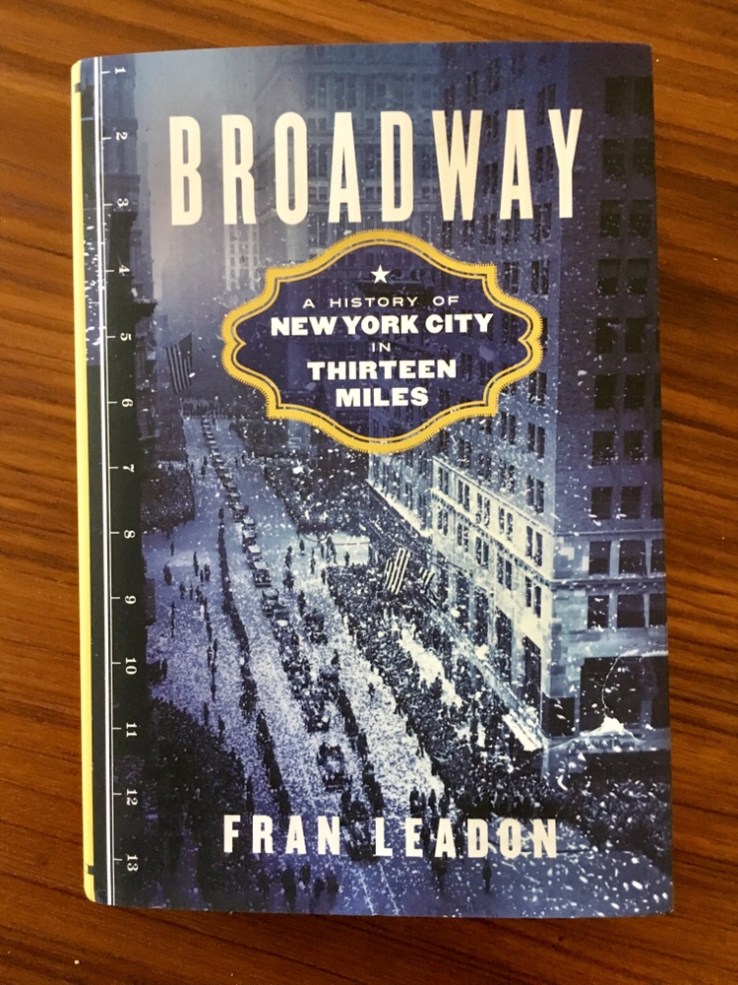
Broadway: A History of New York City in Thirteen Miles (Book acquired, 14 March 2018)

img_9397

A copy of Fran Leadon’s Broadway: A History of New York in Thirteen Miles arrived at Biblioklept World Headquarters last month, reminding me that I don’t read enough nonfiction. The book is out this month in hardback from W.W. Norton. Their blurb:

In the early seventeenth century, in a backwater Dutch colony, there was a wide, muddy cow path that the settlers called the Brede Wegh. As the street grew longer, houses and taverns began to spring up alongside it. What was once New Amsterdam became New York, and farmlands gradually gave way to department stores, theaters, hotels, and, finally, the perpetual traffic of the twentieth century’s Great White Way. From Bowling Green all the way up to Marble Hill, Broadway takes us on a mile-by-mile journey up America’s most vibrant and complex thoroughfare, through the history at the heart of Manhattan.

Today, Broadway almost feels inevitable, but over the past four hundred years there have been thousands who have tried to draw and erase its path. Following their footsteps, we learn why one side of the street was once considered more fashionable than the other; witness the construction of Trinity Church, the Flatiron Building, and the Ansonia Hotel; the burning of P. T. Barnum’s American Museum; and discover that Columbia University was built on the site of an insane asylum. Along the way we meet Alexander Hamilton, Emma Goldman, Edgar Allan Poe, John James Audubon, “Bill the Butcher” Poole, and the assorted real-estate speculators, impresarios, and politicians who helped turn Broadway into New York’s commercial and cultural spine.

Broadway traces the physical and social transformation of an avenue that has been both the “Path of Progress” and a “street of broken dreams,” home to both parades and riots, startling wealth and appalling destitution. Glamorous, complex, and sometimes troubling, the evolution of an oft-flooded dead end to a canyon of steel and glass is the story of American progress.

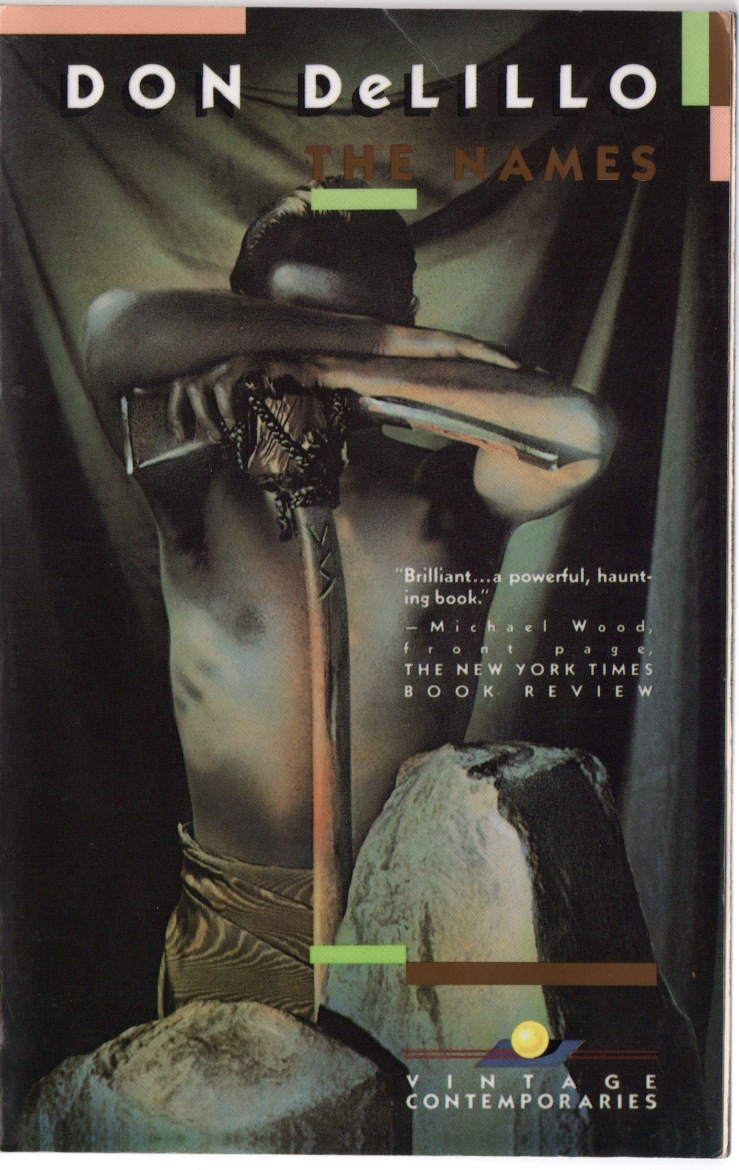
Blog about Don DeLillo’s novel The Names, which I read a few weeks ago and now only half remember

img_2722

A physical copy of Don DeLillo’s 1982 novel The Names is on a shelf a few steps away from me. Normally I’d pick it up and thumb through it before writing about it—or better yet, reread it before writing about it—or even better, simply not write about it at all. But none of that would be in the spirit of these Blog about posts.

The plot of The Names, such as I remember it, is something like this: the novel’s protagonist and narrator (whose name may or may not be named Nick—I don’t really remember) is an American operative of some kind who basically works for the CIA. This specific job description is never really clear to the American protagonist or anyone else in the novel. He moves to Greece to be closer to his wife, who has left him, and his son, a budding novelist of sorts (despite being like nine or ten), whom DeLillo based on Atticus Lish (son of Gordon Lish and now a superb novelist in his own right)  The protagonist’s estranged wife works an archaeological dig headed by an older dude named Owen (the protagonist’s son’s novel is Owen’s fictional biography). Owen, and later (or is it before—I can’t remember?!) the protagonist, encounter a weird language cult that performs ritualistic linguistic murders.

The Names’ great appeal is DeLillo’s riffs on language and meaning in a postmodern era. The language cult isn’t some socioculturally-realistic entity that draws the reader in, but rather an occasion for monologue. The novel is very much a monologue, no matter who is speaking. This may sound like a criticism as I now type it out (it does to me, anyway), but DeLillo’s monologue has a fun force to it. It’s sort of like a Derridean teledrama in novelistic form, all its pollyglossic intentions subsumed into a low dry clipped clever voice: DeLillo waxes on film; DeLillo waxes on pleasure; DeLillo waxes on Americanism; DeLillo waxes on expatriation; DeLillo waxes on globalism; DeLillo waxes on airports; DeLillo waxes on terrorism. A big takeaway from the novel for me was that DeLillo wrote his 9/11 novel two decades before the fact. No wonder he wrote Falling Man so quickly; he’d already thought through the problems.

I can’t really remember the linguistic system or philosophy or language critique in The Names, but I do remember the repetitions—the word name threads throughout, usually pointing toward a symbol, a referent, a landing strip. DeLillo also repeats the word recognition—which I take to simply be the power of name(s) (why would I use the adverb “simply” there?!). But the keyword isn’t name—I think the keyword of The Names is the world, a term that seems to refer to the absolute set of possibility (linguistic or otherwise) that Exist—a shifting, unstable, but nevertheless complete set that everyone must play within.

While its expatriation visions ring true, DeLillo doesn’t fully conjure the world in The Names, although that’s never his intention, I think. The whole affair is more oblique. Clipped is the word I used before—the novel is dry, witty, but resists being pegged as glib through its strangeness and humor.  I laughed a lot in The Names. What I think I like most though is the ending, which I still remember—I haven’t read everything by DeLillo, but I’ve read a lot, and I can’t think of another of his that sticks the ending so well. And he does it by borrowing. DeLillo cribs from the protagonist’s son’s novel—which is to say from a child’s novel—which is to say from a real child’s work, Atticus Lish’s stuff—and that cribbing is somehow the magic ingredient that makes the rest of his novel rise up. It’s a second voice (or hey, the idea of a second voice) in a monologue, and it makes a huge difference.

Blog about Iris Murdoch’s novel The Bell

img_9112

I have just finished Iris Murdoch’s 1958 novel The Bell. This is the first novel I have read by Murdoch and I now want to read more novels by Murdoch, which I suppose is the best praise I can offer the novel.

The Bell is set primarily in Imber House, a large old mansion in the English countryside. Imber House adjoins a Benedictine abbey; this nunnery is essentially closed off to the outside world. The residents of Imber House form a “brotherhood,” a laity of would-be acolytes who strive to find spiritual meaning in the commercial and often venal world of the postwar era. Various conflicts between these characters drive the plot of The Bell.

One of these conflicts, especially notable for a novel published in 1958, involves Michael, the leader of the Imber House community. A former schoolmaster who dreamed of joining the clergy, Michael lost his job in a small scandal for “seducing” one of his students, Nick, a teenage boy at the time. Over a decade later, circumstance brings Nick to Imber House, where his twin sister Katherine is staying. Katherine plans to join Imber Abbey; in the meantime, her family hopes that the religious solitude at Imber House will help Nick recover from his alcoholism. The conflict between Michael and Nick becomes further charged when the youngest member of Imber House, a teenager named Toby, befriends both of them.

I could go on about Michael and Nick and Toby and Katherine and etc., but the real star of The Bell is Dora Greenfield, a wonderfully complicatedly simple unassuming unpretentious flighty former art student who has recently left her demanding husband Paul. Through Murdoch’s precise free indirect style, we get to inhabit Dora’s constantly vacillating mind. Like many people, Dora does not know what she is going to do, and even when she thinks through a plan, she often ends up doing the opposite of what she had intended to do. There is a hilarious passage in the novel’s first chapter when Dora goes through a lengthy imaginative exercise about giving up her train seat to an elderly woman. Dora’s thought experiment ends like this:

She decided not to give up her seat.

She got up and said to the standing lady ‘Do sit down here, please. I’m not going very far, and I’d much rather stand anyway.’

The blank space between those sentences highlights a radical gap between contemplation and action.

The train-seat passage is one of many humorous episodes in The Bell, but Murdoch’s humor is underwritten by a deeper menacing anxiety, which can be neatly summed up in the novel’s opening sentences:

Dora Greenfield left her husband because she was afraid of him. She decided six months later to return to him for the same reason.

Those opening lines basically summarize the big thematic plot of The Bell—the conflict between controlling and ultimately abusive Paul and his much younger wife. (“She married him a little for his money,” Murdoch writes just a few paragraphs in, wedging the detail between more positive aspects of Paul’s character–the “a little” is just genius there, the slightest omission from Dora’s consciousness slipping into the third-person narrator for the briefest of moments). The opening lines of The Bell also showcase Murdoch’s rhetorical powers. Her comic precision here reverberates with a hazardous undertone.

Will Dora really return to her husband? Or will she become her own person—whatever that means? The Bell satisfies these questions with complex answers. The novel has every opportunity to veer toward pat conclusions. Murdoch fills her novel with images that suggest a conventional tragic conclusions, and then surpasses these conventions, turning them into something else. A death by drowning might be foreshadowed, but someone will learn to swim; an epiphany achieved in an art museum might not meet its achievement outside of aesthetic response; the Blakean contraries of innocence and experience might be synthesized into a new, original viewpoint. There’s something real about The Bell—it offers a realism that points outside of its own literary contours. The English novelist A.S. Byatt puts it far better than I can in her essay “Shakespearean Plot in the Novels of Irish Murdoch”:

 …The Bell seems to me arguably Miss Murdoch‘s most successful attempt at realism, emotional and social—the tones of voice of the members of the religious community are beautifully caught, the sexual, aesthetic and religious passions and confusions of the three main characters, Dora, Michael, and, to a lesser extent, Toby, are delicately analysed with the combination of intellectual grasp and sensuous immediacy of George Eliot.

Byatt’s comparison to Eliot reminds me that I had intended to read Middlemarch some time this year—but to be fair to myself, I put The Bell on the same list. I won’t be reading Middlemarch next though; The Bell, with its story of a would-be utopian community, strongly reminded me of Nathaniel Hawthorne’s The Blithedale Romance, which I haven’t read in ages. And after I read that, I’d like to read another one by Iris Murdoch. Any recommendations?

“White Rabbits,” a short tale by Leonora Carrington

rabbit

“White Rabbits”

by

Leonora Carrington

THE TIME has come that I must tell the events which began in 40 Pest St. The houses which were reddish-black looked as if they had survived mysteriously from the fire of London. The house in front of my window, covered with an occasional wisp of creeper, was as blank and empty looking as any plague-ridden residence subsequently licked by flames and saliv’d with smoke. This is not the way that I had imagined New York.

It was so hot that I got palpitations when I ventured out into the streets—so I sat and considered the house opposite and occasionally bathed my sweating face.

The light was never very strong in Pest Street. There was always a reminiscence of smoke which made visibility troubled and hazy—still it was possible to study the house opposite carefully, even precisely; besides my eyes have always been excellent.

I spent several days watching for some sort of movement opposite but there was none and I finally took to undressing quite freely before my open window and doing breathing exercises optimistically in the thick Pest Street air. This must have blackened my lungs as dark as the houses. One afternoon I washed my hair and sat out on the diminuitive stone crescent which served as a balcony to dry it. I hung my head between my knees ¡and watched a blue-bottle suck the dry corpse of a spider between my feet. I looked up through my lank hair and saw something black in the sky, ominously quiet for an airplane. Parting my hair I was in time to see a large raven alight on the balcony of the house opposite. It sat on the balustrade and seemed to peer into the empty window, then poked its head under its wing apparently searching for lice. A few minutes later I was not unduly surprised to see the double windows open and and admit a woman onto the balcony—she carried a large dish full of bones which she emptied onto the floor. With a short appreciative squawk, the raven hopped down and picked about amongst its unpleasant repast.

The woman, who had hemp-long black hair, wiped out the dish, using her hair for this purpose.

Then she looked straight at me and smiled in a friendly fashion. I smiled back and waved a towel. This seemed to encourage her for she tossed her head coquettishly and gave me a very elegant salute after the fashion of a queen.

“Do you happen to have any bad meat over there that you don’t need?” she called.

“Any what?” I called back, wondering if my ears had deceived me.

“Any stinking meat? Decomposed flesh … meat?”

“Not at the moment,” I replied, wondering if she was trying to be funny.

“Won’t you have any towards the end of the week? If so, I would be very grateful if you would bring it over.”

Then she stepped back into the empty window and disappeared. The raven flew away. Continue reading ““White Rabbits,” a short tale by Leonora Carrington”

Illustration for Frankenstein — Bernie Wrightson

596de571d9ea5a0f6fcb1cc0d4562bea