David Foster Wallace’s Papers, Annotations, and More

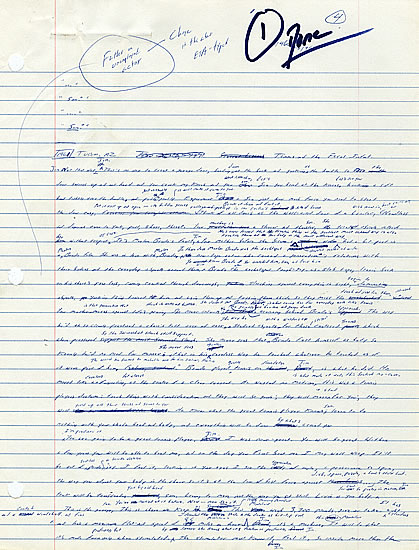
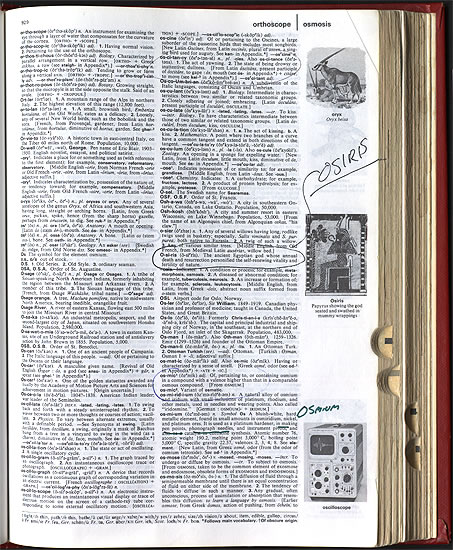
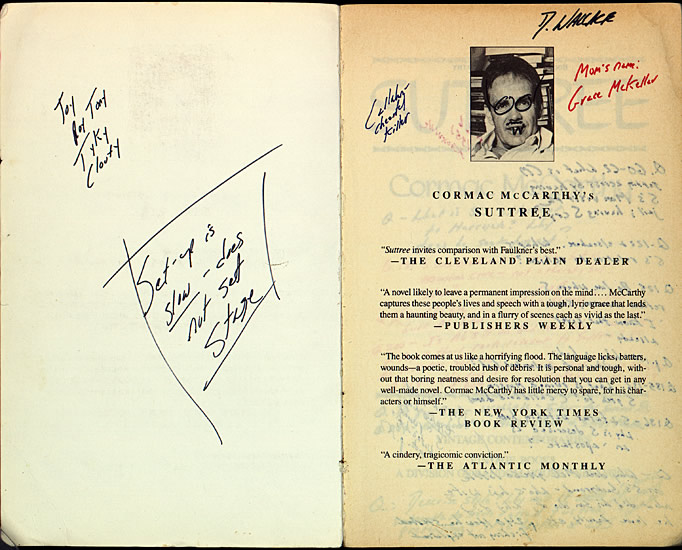
The New York Times and dozens of other sources reported yesterday that the University of Texas acquired David Foster Wallace’s papers, including his personal library. The Harry Ransom Center at UT already has lots of Wallace’s stuff up at their site and it’s frankly astounding. There are handwritten pages from Infinite Jest, images from annotated copies of some of Wallace’s novels, including Cormac McCarthy’s Suttree and Don DeLillo’s Players, and pictures of Wallace’s dictionary with words circled like neroli, cete, and suint. Begin exploring Wallace’s archive here.

First page of a handwritten draft of Infinite Jest
DFW's dictionary
Inside cover of David Foster Wallace's annotated copy of Players by Don DeLillo.
Inside cover of David Foster Wallace's annotated copy of Suttree by Cormac McCarthy.

David Foster Wallace Audio Archive Now Up

A kindly dude by the name of Ryan Walsh has launched a site called The David Foster Wallace Archive. The site collects in one place the loose mp3s that’ve been floating around the web, and includes the Brief Interviews with Hideous Men audiobook in its entirety. There are also interviews, profiles, eulogies, and more. A good starting place: an (as-yet) unpublished piece about a do-gooding boy detested by all. It’s hilarious.

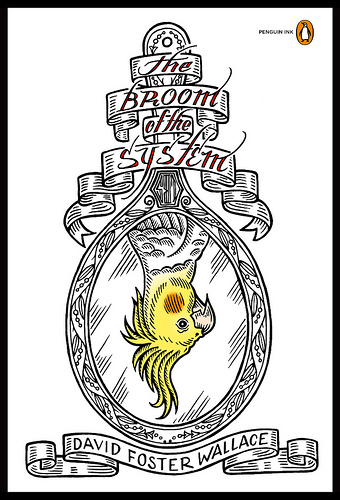
So. It’s kinda sorta Book Covers Week at Biblioklept, and, in keeping with that theme, check out this new cover for Wallace’s debut novel, The Broom of the System. The edition is part of the forthcoming Penguin Ink series and should be available this summer. Art by Duke Riley. We love it.

David Foster Wallace Reads “A Radically Condensed History of Postindustrial Life”

The audiobook of Brief Interviews with Hideous Men came out almost a year after its author, David Foster Wallace killed himself, which kinda sorta makes it strange to hear his voice read some of these tales. Here’s Wallace reading “A Radically Condensed History of Postindustrial Life,” a short short short story. As far as audiobooks goes, this collection is fantastic. There’s a great cast here, and the actors, including Bobby Canavale, Will Forte, Christopher Meloni, John Krasinski (who adapted the book into a film which I’ve, despite having had a pirate copy for several months, been too afraid to watch) intuit Wallace’s work and communicate its humor, pathos, and subtlety. The biggest treat though is hearing Wallace’s voice again.

“If We Do This as a Conversation, It Will Be Easier for Me” — David Foster Wallace

David Foster Wallace’s 2003 interview on German TV station ZDF has been viewable for awhile in its full 84 minute glory, but it’s only just now been uploaded to YouTube in more digestible and manageable 10 minute chunks.

Five Dials Publishes DFW Memorials

Via Times Flow Stemmed: issue 10 of Five Dials magazine is available for easy-breezy pdf download. The issue collects all the testimonies from the October 2008 memorial service at NYU for the recently-deceased author David Foster Wallace, including moving pieces from his sister, editor, publisher, and writers Zadie Smith, George Saunders, Don DeLillo, and Jonathan Franzen. Here’s what we wrote when we found out about DFW’s death.

The Anxiety of Influence

In her essay “The Naked and the Conflicted,” published in today’s New York Times, Katie Roiphe suggests that “we are awfully cavalier about the Great Male Novelists of the last century. It has become popular to denounce those authors, and more particularly to deride the sex scenes in their novels.” By the Great Male Novelists she is, of course, referring to Norman Mailer, John Updike, Philip Roth, and Saul Bellow. She continues: “Even the young male writers who, in the scope of their ambition, would appear to be the heirs apparent have repudiated the aggressive virility of their predecessors.” Roiphe picks a relatively slim sample of “young male writers” to prove her thesis, including David Foster Wallace, Michael Chabon, Dave Eggers, and Jonathan Franzen. Slim sample, but still, quite representative. Her big claim: “The younger writers are so self-­conscious, so steeped in a certain kind of liberal education, that their characters can’t condone even their own sexual impulses; they are, in short, too cool for sex.” Hmmm . . . Perhaps. Makes us think about how writers like Dennis Cooper, Wells Tower, Junot Díaz, or Stephen Elliott might fit into this scheme . . .

Books To Look Forward To In 2010

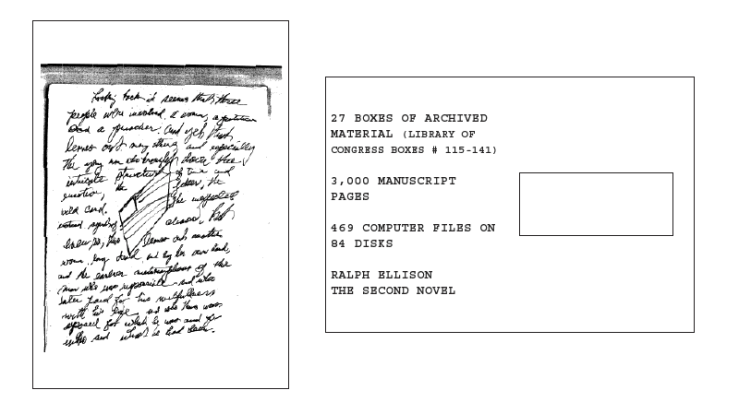
A couple of months ago, this cryptic postcard arrived in the mail:

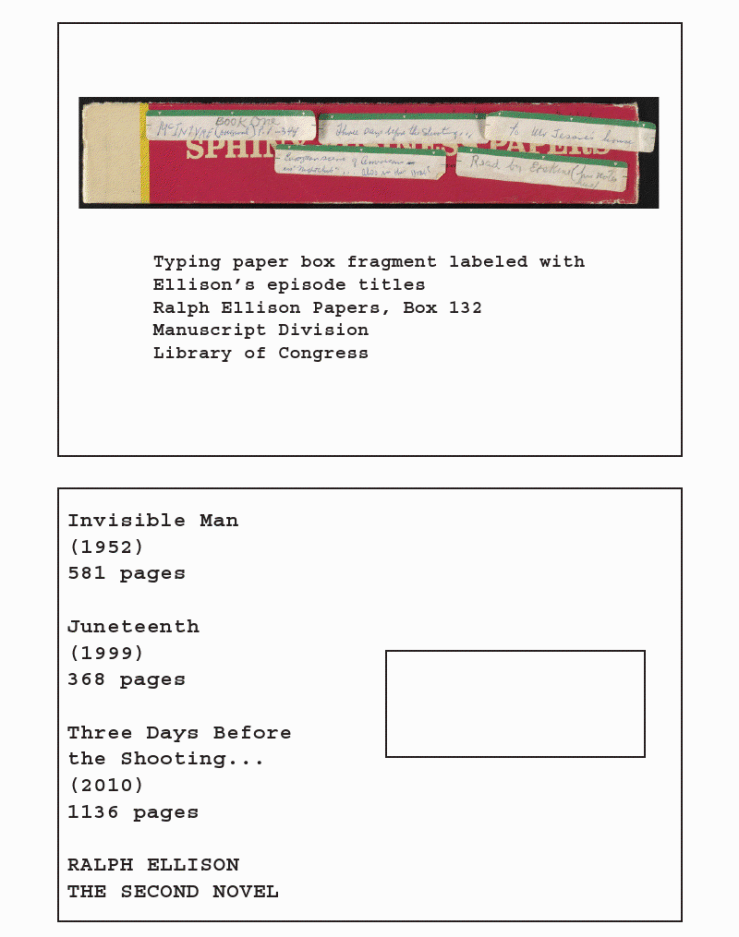
A second novel from Ralph Ellison? Wasn’t that Juneteenth, the posthumous work pieced together from thousands of pages and notes by Ellison’s literary executor, John Callahan? The one that was kinda sorta panned as a mess (or at least an incomplete vision)? A few weeks later, another postcard:

So we were still a little confused. Was Three Days Before the Shooting… a more complete version of Juneteenth, or a wholly separate novel? A week or two later, a third postcard showed up with some answers: Ralph Ellison’s Three Days Before the Shooting… is a re-edit of the material originally presented as Juneteenth back in 1999, expanded from 368 pages to 1136 pages. Hopefully, Ellison’s vision will be restored here. Modern Library plans to release Three Days Before the Shooting… in late January of 2010.

Don DeLillo‘s newest novel Point Omega (sounds like some G.I. Joe shit) will drop in early February of 2010. It’s a slim 128 pages, a novella really, which might be a nice change of pace. Here’s the cover:

Wells Towers had something of a hit this year with his collection of short stories, Everything Ravaged, Everything Burned, but maybe you didn’t read it because it was in oh-so cumbersome hardback. Thankfully, Picador will release Everything Ravaged in trade paperback in February of 2010. In the meantime, check out Chris Roth’s short adaptation of the title story:

There’s no release date yet for Jonathan Franzen‘s forthcoming novel Freedom, but it should come out next year. The novel is Franzen’s follow-up to his breakout hit, The Corrections. Can’t wait an indeterminate measure? The New Yorker published an excerpt called Good Neighborsearlier this year.

We began with a posthumous novel and will end with one: David Foster Wallace’s The Pale King may or may not come out in 2010 (some websites are citing 2011 now). We will not parse through the problems of unfinished, post-death work here but simply say we want to read it. We were intrigued by–and enjoyed–the portions of the novel that have been published thus far, and we love Wallace, and we’re greedy, and we want more.

“All That” — Another Excerpt from DFW’s The Pale King

The New Yorker recently published another excerpt from David Foster Wallace’s forthcoming posthumous novel, The Pale King. Their editors (?) are calling it “All That.” Here’s the first two paragraphs, although, if you’re a DFW fan you’ve probably already gone to the full excerpt:

Once when I was a little boy I received as a gift a toy cement mixer. It was made of wood except for its wheels—axles—which, as I remember, were thin metal rods. I’m ninety per cent sure it was a Christmas gift. I liked it the same way a boy that age likes toy dump trucks, ambulances, tractor-trailers, and whatnot. There are little boys who like trains and little boys who like vehicles—I liked the latter.

It was (“it” meaning the cement mixer) the same overlarge miniature as many other toy vehicles—about the size of a breadbox. It weighed three or four pounds. It was a simple toy—no batteries. It had a colored rope, with a yellow handle, and you held the handle and walked pulling the cement mixer behind you—rather like a wagon, although it was nowhere near the size of a wagon. For Christmas, I’m positive it was. It was when I was the age where you can, as they say, “hear voices” without worrying that something is wrong with you. I “heard voices” all the time as a small child. I was either five or six, I believe. (I’m not very good with numbers.)

The New Yorker published another excerpt from The Pale King they called “Wiggle Room” back in March, and a piece called “Good People” back in 2007. Harper’s ran another excerpt called “The Compliance Branch” last year, but you have to subscribe to read it.

Time, Space, Distortion: Falling Towards A 9/11 Literature

The_Falling_Man

In his essay In the Ruins of the Future,” published in December of 2001, Don DeLillo wrote this about the 9/11 attacks: “The writer wants to understand what this day has done to us. Is it too soon?” His question was both profound and at the same time, paradoxically utterly banal, purely rhetorical–of course it was too soon to measure the affects of the 9/11 attacks. But could the distance of time somehow sharpen or enrich perspective? DeLillo continues: “We seem pressed for time, all of us. Time is scarcer now. There is a sense of compression, plans made hurriedly, time forced and distorted.”

In retrospect–what with the Bush administration’s ludicrous invasion of Iraq and the power-grab of the Patriot Act–DeLillo’s notation of “plans made hurriedly” seems downright scary. Still, when I think back to those early days after the attacks, I remember that feeling of overwhelming shock, the paralyzing inertia that had to be overcome. DeLillo wanted–needed–to grapple with this spectacular destruction immediately. David Foster Wallace responded with similar immediacy; the caveat that prefaces his moving essay The View from Mrs. Thompson’s states that the piece was “Written very fast and in what probably qualifies as shock.” The same caveat would also apply neatly to Art Spiegelman’s big, brilliant, messy attempt at cataloging his impressions immediately post-9/11, In the Shadow of No Towers.

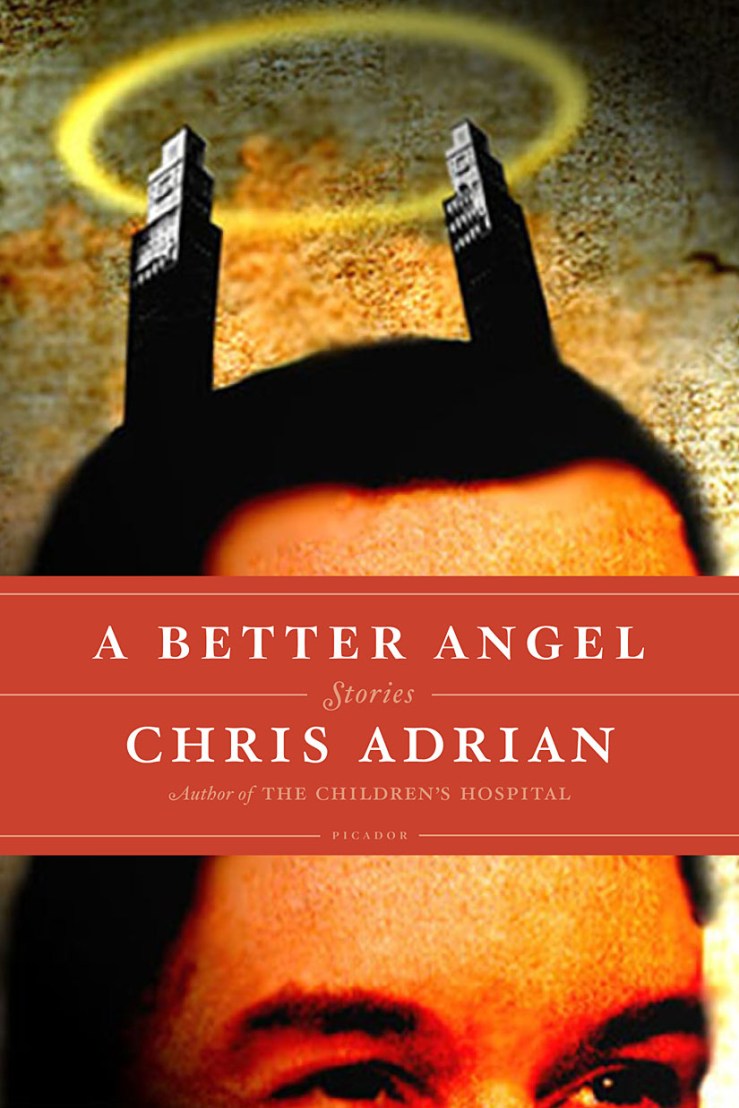
In contrast, the trio of 9/11 stories at the heart of Chris Adrian’s short story collection, A Better Angel, all employ distance and distortion–both temporal and spatial–as a means to address the disaster (or inability to address the disaster) of the attacks on the World Trade Center. Adrian’s 9/11 tales (and his works in general, really), ask how one can grieve or attest to death on such a massive, spectacular scale. In his vision, the victims of the 9/11 attacks forever haunt his protagonists, literally possessing them, demons that can’t let go, leaving the living to grieve over and over again. In “The Changeling,” for example, the grief of the attacks is literally measured in blood, as a father repeatedly maims himself as the only means to assuage the terror and confusion of his possessed son. Adrian sets one of the collection’s most intriguing tales, “The Vision of Peter Damien,” in nineteenth-century rural Ohio. This temporal distortion veers into metaphysical territory as the titular Damien, along with other children in his village, become sick, haunted by the victims of 9/11. Adrian’s strange milieu creates a bizarre cognitive dissonance for his readers, a response that DeLillo also articulated in his 2007 novel Falling Man.

DeLillo initiates the novel as a sort of creation story: “It was not a street anymore but a world, a time and space of falling ash and near night.” The demarcation of this new world recapitulates DeLillo’s initial concern with time and space, but his novel seems ultimately to suggest an inertia, a meaninglessness, or at least the hollow ambiguity of any artistic response. This stands, of course, in sharp contrast to his sense of urgency in his earlier essay. Like the performance artist in the novel who is repeatedly sighted hanging suspended from a harness, there’s a sad anonymity in the background of Falling Man: the artist hangs as static witness to disaster, but looking for comfort, or even perhaps meaning, in the gesture is impossible.

David Foster Wallace’s short story “The Suffering Channel,” (from his 2004 collection Oblivion) is in many ways a far more satisfying jab at 9/11, although, to be fair, the majority of the story’s events take place in July of 2001. The story (or novella, really; it’s 90 pages) centers around a magazine headquartered in the World Trade Center that plans to run an article–on September 10th, 2001–about a man who literally shits out pieces of art. Wallace’s critique of American culture (shit as art, commerce as style, advertising as language) is devastating against the context of the looming disaster that his characters are so oblivious too. As the novella reaches its close (culminating in the shit artist producing an original work for a live audience), we learn more about “The Suffering Channel,” a cable channel devoted to broadcasting only images of human beings suffering intense and horrible pain. Wallace seems to suggest that The Suffering Channel’s audience watches for mere schadenfreude or morbid fascination, that modern American culture so disconnects people that genuine suffering cannot be witnessed with empathy, but only as a form of spectacular, disengaged entertainment. And yet even as Wallace critiques American culture, the specter of the 9/11 attacks ironically inform his story. With our awful knowledge of what will happen the day after the shit artist article is published, we are able to see the ridiculous and ephemeral nature of the characaters’ various concerns. At the same time, Wallace’s tale reveals that empathy for suffering is possible, but also that it comes at a tremendous price.

To contrast the journalistic immediacy of pieces like “In the Ruins of the Future” and “The View from Mrs. Thompson’s” with their respective writers attempts to measure 9/11 in literary fiction is perhaps a bit unfair. Still, Wallace’s and DeLillo’s essays–at least in my opinion–transmit something of the ineffable, visceral quality of that terrible day, as well as the strange ways we sought comfort through human connection. In contrast, the distance and distortion of their literary efforts lose something. I apologize–I don’t have a word for this “something” that the essays have that the novel and novella lack (purposely, I believe). It’s not clarity, but perhaps it’s a clarity of distortion that the essays convey, the duress, or to return to Wallace’s own notation, the pieces were of course “Written very fast and in what probably qualifies as shock.” It’s that shock, I suppose, that I’m trying to name, to say that it’s still there, accessible in those early responses (I realize now I’ve unfairly neglected Spiegelman’s book, which is a great example of immediacy). And to relive that shock is important, because, as Wallace reveals in both of his pieces, the cathartic power of shared tragedy makes us human, allows us to really live, and to be thankful that we do live.

Looking over this piece, I realize that it’s overly long and really says nothing, or at least nothing much about 9/11, or literature, or whatever. But I don’t want to be negative. I highly encourage you to read (or re-read) The View from Mrs. Thompson’sand In the Ruins of the Future.” And I’ll leave it at that.

Chris Adrian, 9/11 Lit, Thomas Pynchon, Beach Reading and More

I’m about half way through two books right now: Chris Adrian’s A Better Angel, and Thomas Pynchon’s Inherent Vice. Pynchon’s latest novel–I’ll talk a little bit about it in a sec–comes out in hardback from Penguin August 4th. Picador will release the first trade paperback edition of Chris Adrian’s latest collection of short stories on August 3rd. I’m really digging A Better Angel so far, but before I talk about it, I just wanna shill for Picador. They put out really cool, great-looking books from really cool authors like Roberto Bolaño, J.G. Ballard, Denis Johnson, William Burroughs, and DJ Kool Herc, and they also have a sexy little imprint called BIG IDEAS//small books that puts out some killer jams. They’re also really nice about sending review copies. Shill shill shill. I’m a whore, but I’m an earnest whore.

Better Angel

Anyway. Back to Adrian. Just finished “The Vision of Peter Damien,” a 9/11 story set in what seems to be nineteenth century rural Ohio. Damien, and then the other children of his small rural community, catch an illness that gives them unexplained, vivid hallucinations of the 9/11 attacks on the World Trade Center towers. Adrian works in a mode of distortion throughout most of these stories so far, repeatedly employing metaphysical disruptions as well as playing with time and setting as a way of alienating his characters from each other and the reader. Adrian uses the temporal/metaphysical disruptions of “The Vision of Peter Damien” to respond to 9/11, creating an uncanny milieu for his readers. The cognitive dissonance here reminds me of other responses to 9/11, like DeLillo’s Falling Man, David Foster Wallace’s short story “The Suffering Channel,” and even Art Spiegelman’s In the Shadow of No Towers. Actually, Wallace’s essay “The View from Mrs. Thompson’s” does a really good job of capturing all the problems of witnessing to, understanding, reacting to (etc.) spectacular disaster. Adrian’s story recapitulates the same paradoxes, injecting a motif of illness and brotherhood, contagious decay and redemption that seems to run through all of the stories collected here. I don’t have a larger comment about literature’s response to 9/11 yet, but I think that it’s fascinating to watch such stories emerge and evolve. We’re still seeing the various shapes, tropes, strategies, etc. that authors will employ to tackle (or chip at, or remark upon, or even elide) such a big historical marker. Full review of A Better Angel at the end of this month.

inherent_vice

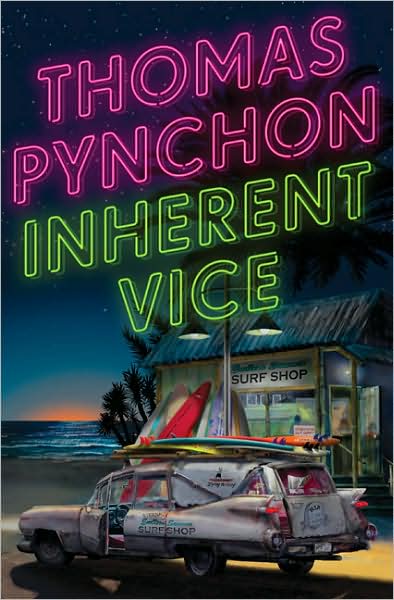
Far less serious is Pynchon’s new novel, Inherent Vice, a detective noir painted in day-glo psychedelic swirls. Doc Sportello, at the behest of his ex-, is searching for a missing real-estate billionaire in the dope-haze of late 60s/early 70s LA (it appears to be set in 1969, as there are repeated references to “living in the sixties and seventies”). Pynchon’s new novel is a hard-boiled detective mystery, a psychedelic caper, an LA story, a comment on the decline of idealism and the emergence of media-unreality at the end of the 60s (because we needed another story about the 60s!), and probably a shaggy dog tale. The cover has gotten some criticism for its decidedly unliterary look, and last March I called it “horrendous.” I take it back: the campy cover, with its neon shock and beach-as-pastoral-idyll is lovingly ironic, satire that does not announce itself as satire and is thus always open to a straight-reading. Just like Pynchon’s novel, the cover can be read as an homage to both Dashiell Hammett and Elmore Leonard (with a sly nod to all the Leonard ripoffs out there (glancing your way, Jimmy Buffett). As its cover suggests, this is a Pynchon book you can read breezily on a beach or airplane. Sure, it’s got the usual Pynchon trademarks–it’s overcrowded with zany, one-dimensional characters, it operates on a Looney Toons system of logic, it’s full of linguistic goofs–but it’s also incredibly easy to read (unlike, say, just about everything else Pynchon has ever written). It’s also a lot of fun. And to prove it’s a beach read, I’ll finish it this week at St.Augustine Beach, inebriated by strong margaritas and even stronger sun. Full review when I get back.

A Few Thoughts On DFW’s “Wiggle Room”

The New Critics’ biggest contribution to literary criticism was the dictum that analysis was to be applied strictly to the text itself, without the muddying impurities of biography or any other outside knowledge influencing the reader. A context-free reading is pretty hard to come by, though, isn’t it? School syllabi are arranged around era or genre, or both; our teachers preface each novel or poem or story or essay with a nod to its relevance; a friend hands us a book because it’s “good.” We furtively flip through Tropic of Capricorn, knowing its rep; we look down our noses at abstinence vampire novels. In short, it’s hard to get to that pure reading the New Critics favor. Still, I’ve always thought it’s a pretty good strategy to put aside biographical/author psychology, and just stick to a good close reading of the text. Today, reading David Foster Wallace’s “Wiggle Room,” I was completely unable to do that.The context of Wallace’s recentish suicide hung over each page, each sentence. It was a distraction that led to a (necessary) rereading, a distraction that colored the reading–and then the rereading. A strange little voice popped into Wallace’s dense narration that kept whispering, “posthumous, unfinished novel.” But now that I’ve complicated and contextualized and complained, perhaps I should simply comment a bit on the story now.

In dense, thick sentences, Wallace relates a work morning for Lane Dean, an IRS rote examiner who detests his Sisyphean job. Like many cubicle-dwellers, Lane spends much of his day trying not to look at the clock. He also tries to use an inspirational photo of his son sparingly, so that the effect might be more intense. However, the boredom on this particular day overwhelms Lane and he “had the sensation of a great type of hole or emptiness falling through him and continuing to fall and never hitting the floor. Never before in his life up to now had he once thought of suicide.” Trying to truck through it is no good: “Lane Dean summoned all his will and bore down and did three returns in a row, and began imagining different high places to jump off of.” These thoughts of suicide are mixed with a strange humor. As Lane’s depression becomes frantic, Wallace writes, “Unbidden came ways to kill himself with Jell-O.” As Lane becomes more and more anxious, it becomes apparent that–paradoxically–his boredom literally excites him. He gets all worked up about it, about the thought of having to devote a whole lifetime to such meaningless, boring work. The scene culminates in an horrific image:

When he started to see the baby’s photo face melting and lengthening and growing a long cleft jaw and aging years in just seconds and finally caving in from old age and falling away from the grinning yellow skull underneath, he knew he was half asleep and dreaming but did not know his own face was in his hands until he heard a human voice and opened his eyes but couldn’t see who it went with and then smelled the pinkie’s rubber right under his nose.

The “human voice” that wakes up Lane is a strange cyclopean figure, an older man who delivers a weird lecture on the origins of the word “bore.” The scene is pure Wallacian, filled with plenty of erudite references and jostling with a love for etymology. It literally zaps life-force back into the text, and punctuates Lane’s boring day–which Wallace has so expertly made the reader suffer as well–with some strange, frightening fun. Wallace’s narration makes clear that the appearance of this strange man is not simply Lane going crazy from his boredom–Lane clearly cannot understand half of what the man refers to. Instead, we are given this nugget: “The phantom of the hallucination of repetitive concentration held for too long a time, like saying a word over and over until it kind of melted and got foreign.” After philosophical reflection on why the need for a word for a condition like boredom might have arisen, the episode ends with the phantom leaving and Lane looking up to see that “no time had passed at all, again.”

The emphasis on the ways a person’s soul might be bored into, how one might become bored, and what that might mean, proliferates the short text, and perhaps evokes some of the themes we’ll find in the whole of The Pale King. As the quotes I pulled suggest, the idea that boredom might feed a suicidal impulse resonates strongly in light of Wallace’s unfortunate death. But there I go again, letting context color my analysis. But if we’re only left fragments, isn’t it natural to want to pull them together, to frame them–to give them order–context? Its hard to say and probably not worth guessing if Lane Dean and the phantom will be major parts of The Pale King or not, but as the text progressed, I found myself more and more interested. Apparently, The Pale King will be published with notes and outlines–some bits of context–perhaps giving readers a clue as to how the text was meant to progress. Who knows. A lot of readers felt that Infinite Jest didn’t have a proper ending (not me, though). While I think that the “Wiggle Room” episode stands well on its own, I’d certainly be happy to read more about the phantom. Still, Infinite Jest was larded with lots of little vignettes that added to the whole, but it’s important to point out that there was a whole to be added to–not just a series of vignettes. I’m really hoping that, even unfinished, Wallace has left us something of substance and depth, something that narrativizes–contextualizes–its themes into a meaningful work of art.

“Wiggle Room” — David Foster Wallace

david_foster_wallace_20080915

According to this morning’s New York Times, David Foster Wallace’s posthumous–and unfinished–novel The Pale King will be published next year by Little, Brown. The New Yorker has published an excerpt called “Wiggle Room.” Here’s the first three sentences, just in case you need your literary appetite whetted:

Lane Dean, Jr., with his green rubber pinkie finger, sat at his Tingle table in his chalk’s row in the rotes group’s wiggle room and did two more returns, then another one, then flexed his buttocks and held to a count of ten and imagined a warm pretty beach with mellow surf, as instructed in orientation the previous month. Then he did two more returns, checked the clock real quick, then two more, then bore down and did three in a row, then flexed and visualized and bore way down and did four without looking up once, except to put the completed files and memos in the two Out trays side by side up in the top tier of trays, where the cart boys could get them when they came by. After just an hour the beach was a winter beach, cold and gray and the dead kelp like the hair of the drowned, and it stayed that way despite all attempts.

The Best Books of 2008

We read many, many books this year, but most of the books we read–especially the very best ones–were not published this year. And as usual, we’re always playing catch up. Case in point: we finally finished Roberto Bolaño’s much-lauded-in-2007 hit The Savage Detectives just last month, and despite feeling that it was kinda overrated we couldn’t help picking up his much-lauded-in-2008 hit 2666 at Green Apple Books in San Francisco this weekend (sidebar that will not surprise any San Francisco reader: San Francisco has the best book shops. Sick). So, we will spend at least the first part of 2009 getting through that massive tome.

Bar none, the best book we read in 2008 was Cormac McCarthy’s masterpiece Blood Meridian, published back in 1985. So good we read it twice, and so should you. We also loved loved loved Philip Pullman’s Nietzschean sci-fi trilogy His Dark Materials. Finally, we must highly recommend E.L. Doctorow’s novel Ragtime, which we finally got around to reading this year (last week, so, no review). This book is great, and you will wonder why you haven’t read it before now. A somewhat neglected classic. But. Let us move on.

a-mercy

There were a couple of fantastic highlights in 2008, of course, most notably Toni Morrison’s A Mercy, a novel on which we cannot heap enough praise. In a time of overstuffed, overlong novels, A Mercy is rich and complex yet lean at just over 170 pages, and, as many critics and reviewers have pointed out, the novel serves as a touching counterpoint for her 1988 masterpiece Beloved.

violence

We also loved–and frequently returned to–Slavoj Žižek’s Violence, a work of cultural criticism that managed to be fun and infuriating and serious and frivolous at the same time. Too often reviewers fall back on hackneyed phrases like “thought provoking,” but Žižek’s work really is provoking, often to the point of confrontation. Like Plato, Nietzsche, and Derrida before him, Žižek is the gadfly, the upsetter, the spoiler. He has earned his haters.

The Paris Review Interviews, Volume III and The O. Henry Prize Stories collections were also sublime–great interviews, great stories, lovely tasty morsels. Ralph Ellison, William Carlos Williams, Stephen Millhauser–what’s not to love? We also really were digging Mark Reibstein and Ed Young’s sumptuous children’s book, Wabi Sabi. You’d think a book that included a haiku on each page would be cheesy or cloying or too precious, but no. Great stuff.

wabi-sabi

We’d also be remiss not to give props (again) to Wendell Berry’s essay “Faustian Economics,” published in the May, 2008 issue of Harper’s. Berry’s piece is beautiful and sad and timely, and everyone should read it. It was one of the best things we read all year. Speaking of Harper’s, the latest issue includes–along with a touching memorial to critic John Leonard, who died last month–the remarks of those who spoke (including Zadie Smith and Don DeLillo) at David Foster Wallace’s memorial service this October. Wallace’s suicide was and is awful, and remarking on it in a “Best of 2008” section seems tacky, but we can’t help it. We love his work and are sad that there won’t be any more, or at least much more, or at least any “finished” work from the man, but, as George Saunders puts it in his portion of the memorial: “In time–but not yet–the sadness that there will be no new stories from him will be replaced by a deepening awareness of what a treasure we have in the existing work.” So, if we remark on DFW here, it is only because he was one of the best, and he died this year, and in some sense, we need to remark on it yet again, despite having written too much already.

But let’s not end on a sad or sour note. Plenty of great reads in 2008, and surely we neglected a tome or three in this rehash, but hey, we’re human, we err, etc. We look forward to more reading in 2009, and perhaps, improbably (we lie to ourselves, who doesn’t though?) we may actually defeat that stack of books by the bed, on the night stand, on the coffee table.

DFW Memorialized, Homer Endorses Obama, Sarah Palin Is Never in on the Joke, and Hope for a New Zeitgeist

So let’s just say we’re too anxious around here to run a proper book review, okay? I promise to have reviews of new books up after Election Day. In the meantime–

Great, thorough, and touching essay by David Lipsky at Rolling Stone: “The Lost Years and Last Days of David Foster Wallace.” Check it out. Also, there are plenty of online accounts of the DFW memorial last week at NYU’s Skirball Center, but I thought Andy Battaglia’s eyewitness account was pretty moving.

Also–

It leaked a few weeks ago, but it was nice to see Homer Simpson endorse Obama on this year’s Treehouse of Horror episode–

(The best part of the episode was the Mad Men parody, though).

Speaking of election humor, Sarah Palin continues to be a comedy goldmine. How could she be so readily duped by a French Canadian pretending to be President Sarkozy? She’s fucking stupid, that’s how. I’m reminded of her appearance on SNL a few weeks ago–unjustifiably lauded–where she smirked along as if she were actually in on the joke, and not being simply mocked.

Speaking of ignorance and ugliness, the aughties in America have been culturally and politically awful. Beginning with the one-two punch of the 2000 election debacle and the nightmare of the 9/11 attacks, this past decade has been an embarrassing series of disastrous blunders for the United States government, coupled with a spike in civic apathy at home. The results: our stock has fallen in the rest of the world’s eyes and a large portion of Americans have found solace and even pride in ignorance and xenophobia (what else could explain the ascendancy of an ignoramus like Palin?)

And for all the great things that I’ve experienced in my personal life this past decade (marriage, fatherhood), the idea of another decade like the aughties–selfish and cruel and ignorant–seems miserable. The Bush administration–and the American people who supported them–has been working hard to usher in a New Dark Age. Yet in the past few days I’ve seen some of my cynicism fall away, as I see friends and acquaintances and complete strangers excited about the prospect of change for this country. Watching Obama in Cleveland tonight, I found myself moved and excited and hopeful, not just for Tuesday, or for a new President in January, but for a whole new spirit in this country, one that embraces progressive ideals and puts them into action.

No Conclusion Could Be More Horrible than Solipsism

Okay. This is it. I promise.

This is the last post (for now, anyway, of course, I mean of course it’s not going to be the last post on him, of course) about David Foster Wallace. I’ll get back to reviews and whatnot next week. Swear. But I need to transition here, comment on the past week, move on–

–I’ve always despised the word closure. It’s a pop-psychobabble concept used to denote a social-cultural imposition of order and telos upon an individual’s right to experience the world (and all the loss and violence and ugliness experiencing the world entails) as ambiguous and chaotic and open-ended. But I guess in all likelihood, for anyone who’s endured personal tragedy, there must be some comfort in organizing the loss, fitting it into the narrative of their life, etc. This is the traditional project of literature, is it not–turning loss and tragedy into a plot, into something meaningful and productive? (At least that’s what Aristotle said . . .)–

But I’m already off to a rambling start. I’ve spent the past week obsessing over eulogies and elegies, memories and anecdotes, notes and ephemera (an no real information). I’ve read old reviews that angered me. Trolls have gotten my goat. I’ve realized that the easiest charge for an anonymous dick to make about an author they haven’t bothered to read is that that author is overrated. I’ve felt the slightest sting of jealousy that I never got to hear DFW read personally. I’ve been derailed, permanently it seems, or at least for quite a while, from Roberto Bolaño’s novel The Savage Detectives (this is particularly painful, as I was over 200 pages in to the thing). I’ve initiated a third attempt at a second complete reading of Infinite Jest. I’ve spent every lunch of my work week discussing po-mo lit with the only colleague of mine who’s actually read Wallace. He made me get a copy of Gaddis’s The Recognitions: when the hell will I have time to read it? It’s like, a 1000 pages long!

Most of all, though, I’ve felt shocked; shocked in a thoroughly Wallacian way; shocked in a way-too self-aware mode of shocked behavior: I’m shocked and saddened at how shocked and saddened I am. I did not know that I had the capacity to feel so upset about the death of someone who I did not know, and I feel silly, even embarrassed about this shock, even as I write about it here, publicly, for no real reason. This is the worst kind of solipsism of course. But right now, I feel unable to comment on how Wallace translated the pain and loneliness of life into the language of empathy–all while pointing out how such empathy was, like, impossible (it’s all just language, y’know?). Wallace’s writing always went beyond the sort of navel-gazing and arch irony often identified with other writers of postmodern meta-fiction–he always communicated with his audience. He once stated that “no conclusion could be more horrible than solipsism” (he was referring to his hero Wittgenstein here, arguing that language was a “game” to be played, and thus required more than one “player”; hence, something must exist beyond one’s own mind–there is connection, something beyond the self). If Wallace realized this, that communication, and thus community was possible, at least in his fiction (much of it, yes, is very dark, even morose at times), why did he kill himself? This seems an unproductive question to ask. I take it back (even while I leave it there).

It is maddening. The question arises again and again: “Did he leave a note?” Did David Foster Wallace write something, you ask, that might tell us why he killed himself? Ahem. Ahem. “The Depressed Person.” “Good Old Neon.” James Orin Incandenza aka Himself (and all the other characters who attempt, explicitly or tacitly, to off themselves in IJ). The answer to the question, then, is he left a lot of notes. But none of them will satisfy. None of them will explicate. They can’t (that was the whole point of Infinite Jest, the point missed by critics who thought the book had no conclusion). And it is maddening. And it provides no closure. But at least we have the books, the words, the ideas. Thanks.

An Intellectual Seed Crystal Dropped into the Supersaturated Solution of American Motorsports

Of all the David Foster Wallace obituaries and appreciations floating around the internet–many of them moving and insightful–today’s feature at The Onion, “NASCAR Cancels Remainder Of Season Following David Foster Wallace’s Death” strikes me as the strangest. The conceit of the piece, that NASCAR drivers are keenly attuned, even motivated by the literary world, is frankly some of the basest, dumbest, most obvious irony ever, and possibly the kind of contrived situation at which Wallace might’ve cringed. Yet there’s something sweet in The Onion elegy’s clumsiness. Consider this analysis of Infinite Jest they attribute to Greg Biffle:

I first read Infinite Jest in 1998 when my gas-can man gave me a copy when I was a rookie in the Craftsman Truck Series, and I was immediately struck dumb by the combination of effortlessness and earnestness of his prose. Here was a writer who loved great, sprawling, brilliantly punctuated sentences that spread in a kind of textual kudzu across the page, yet in every phrase you got a sense of his yearning to relate and convey the importance of every least little thing.

Well said. Or Jimmie Johnson‘s beautiful critique of DFW’s style:

David Foster Wallace could comprehend and articulate the sadness in a luxury cruise, a state fair, a presidential campaign, anything. But empathy, humanity, and compassion so strong as to be almost incoherent ran through that same sadness like connective tissue through muscle, affirming the value of the everyday, championing the banal yet true, acknowledging the ironic as it refused to give in to irony.

And so well here we are then–an ironic piece acknowledging Wallace’s ability to acknowledge and yet resist irony in his own work. The Onion simply can’t unpack the thoroughly Wallacian conundrum that results. But what I think they do is better–they eulogize a writer I think they love in the only way the mission of their site allows. And unlike their previous jibes at Wallace, “Girlfriend Stops Reading David Foster Wallace Breakup Letter at Page 20,” and the Weekender edition pictured above, it seems that The Onion staffers are too sad to make the piece funny–which, I think, is appropriate.

Death of the Author

“[O]nce I’m done with the thing, I’m basically dead, and probably the text’s dead: it becomes simply language, and language lives not just in but through the reader” — David Foster Wallace, quoted in Marshall Boswell’s Understanding David Foster Wallace

In the quote above, DFW illustrates why, when writing at his best, he was able to transcend the cold irony and post-modern goofiness of forbears (and, to some extent, contemporaries) like DeLillo and Pynchon. Wallace understood language as a game, and understood that the game was cooperative. He knew that it wasn’t enough to be clever–readers need to care about that cleverness. If the author is dead, and the text is dead, then the language has to live on through voices, through perspectives, through a series of interior identifications: this is where DFW excelled and dazzled. The myriad voices that lard Infinite Jest testify the power of walking in another’s shoes and seeing through another pair of eyes–in caring for the other. This is the power of literature, and this is why Wallace was such a powerful writer. And this is why we’ll miss him so much.

Wallace’s work went past the post-modern (counter)tradition of meta-textuality and self-referentiality, and commented–sometimes with a painful awareness and acuity–on the emotional deadening produced by contemporary irony and consumerist culture. His characters weren’t just placeholders to be pushed around in the hopes of proving a point, but real, achieved voices who lived through the reader. DFW’s project was not to simply repeat the postmodern realization of the indecidability of textuality, but to work through that realization into a new realm of connection and meaning and identification with his readers despite a cold, ironic, and sometimes meaningless world. In both his groundbreaking fiction and his brilliant essays, DFW delivered what matters the most in any piece of writing–subjects and characters you care about (often despite yourself). Postmodernist thought declares there’s nothing outside the text, a supposition many contemporary authors explore and expound upon in chilly irony or silly wordplay. Even when he was negotiating problems of meaning, signification, and communication in the face of alienation, fragmentation, and despair, David Foster Wallace gave us fully-realized worlds populated with characters we could care about.

There are any number of reports out there right now that mischaracterize DFW as an author who hid behind wordplay and irony. Consider Guy Adams ridiculous lead in The Independent: “For a writer who elevated irony to an art form, and whose infinite jesting co-existed with an all-too-apparent dark side, it felt grimly appropriate that David Foster Wallace should have chosen suicide as the means by which to end his own life story.” Did it feel “grimly appropriate”? Why? What was “grimly appropriate,” about David Foster Wallace’s suicide, Guy? Adams reinforces both his ignorance of his subject as well as his lack of literary understanding with this tidbit: “For all his natural ability, and occasional brilliance, Wallace never lived-up to the fullness of his talent, or the haunting reach of his possibilities.” Adams’s dismissive-yet-inflated rhetoric is exactly the kind of verbal posturing that needs to be shouted down right now by those who’ve actually read Wallace and can testify that his brilliance was anything but “occasional.” And that, I guess, is my only real goal here. Adams is wrong. It’s not true that “Wallace never lived-up to the fullness of his talent”–that phrase doesn’t even mean anything. Who measured the fullness of Wallace’s talent? When did that measurement take place, and in what units was said-talent measured? The measure of DFW’s talent can only be assessed by actually reading his work, and that’s what you should do–especially if you’ve been putting it off. Our author may be dead, but he lives on in a language game played with his readers via the act of reading, and this is a game where everyone stands to win.