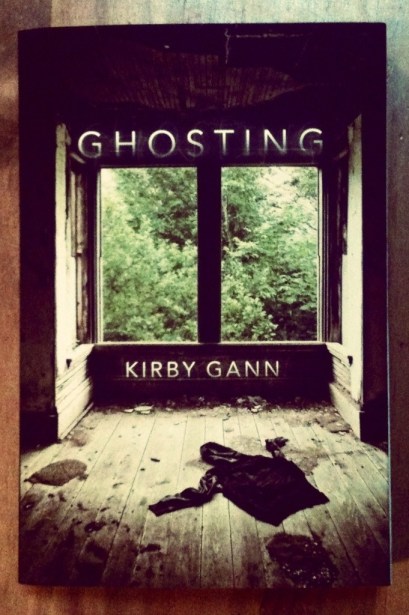
I got a copy of Kirby Gann’s novel Ghosting a few week or so ago, and finally have had time to dip into the first three chapters this morning. Gann’s prose—and perhaps the framing of his characters—reminds me a bit of Russell Banks or Thomas McGuane—that combination of the rough and the refined, that rawness that actually comes from meticulous reworking. Sample of that prose (context not important):
The first cop to show nods at Dwayne Hardesty and stands beside him at the feet of four kids who lie spread-eagled face-down on the muddy portico steps leading to the graffiti-strewn boards that shield the seminary entrance. The wash of the cruiser’s spot frescoes their captive forms in hard outline, three underfed and thin and the fourth a fat block squeezed into a Kentucky basketball sweatshirt that strains to withstand his heavy nervous breathing, the grommets in their jeans and an occasional earring flashing agleam in the white light; four pairs of white sneakers, expensive and rain-wet, shine stark and severe and unworldly.
Ghosting is a thriller, and Gann propels the narrative forward with these cinematic images (and realistic dialogue), engaging the reader to keep turning the pages.
Here’s the jacket copy:
A dying drug kingpin enslaved to the memory of his dead wife; a young woman torn between her promising future and the hardscrabble world she grew up in; a mother willing to do anything to fuel her addiction to pills; and her youngest son, searching for an answer behind his brother’s disappearance—these are just some of the unforgettable characters that populate Ghosting, Kirby Gann’s lush and lyrical novel of family, community, and the ties that can both bond and betray.
Fleece Skaggs has disappeared along with Lawrence Gruel’s reefer harvest. Convinced that the best way to discover the fate of his older brother is to take his place as a drug runner for Greuel, James Cole plunges into a dark underworld of drugs, violence, and long hidden family secrets, where discovering what happened to his brother could cost him his life.
A genre-subverting literary thriller explored through the alternating viewpoints of different characters, Ghosting is both a simple quest for the solution to a mystery, and a complex consideration of human frailty and equivocation.
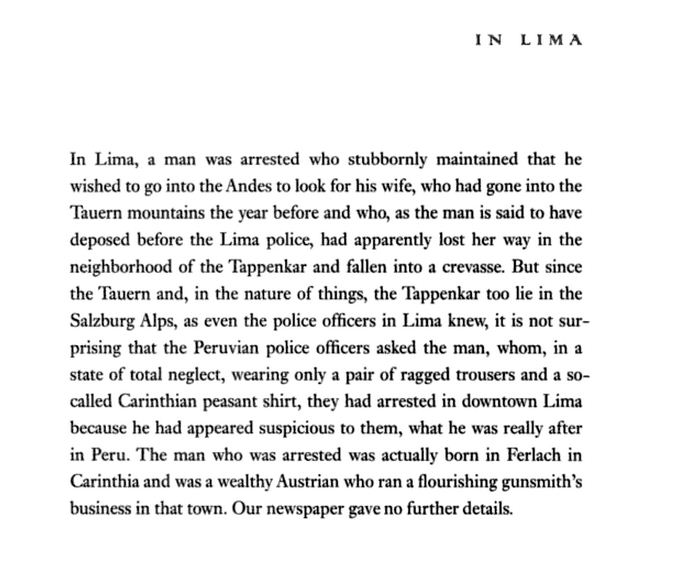
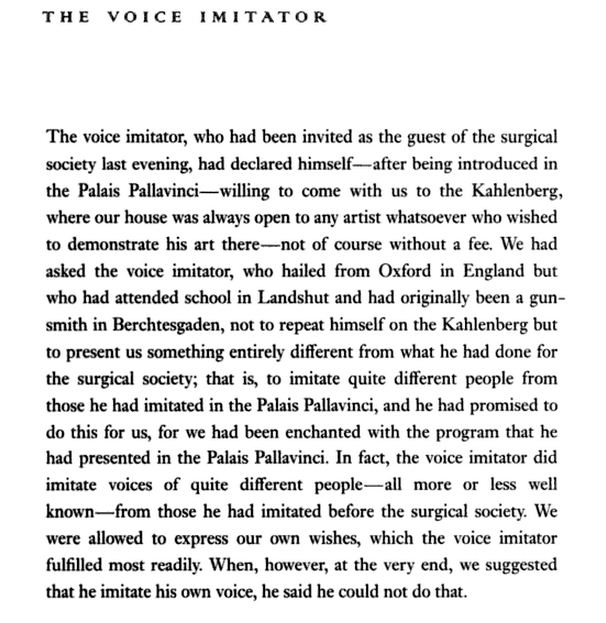
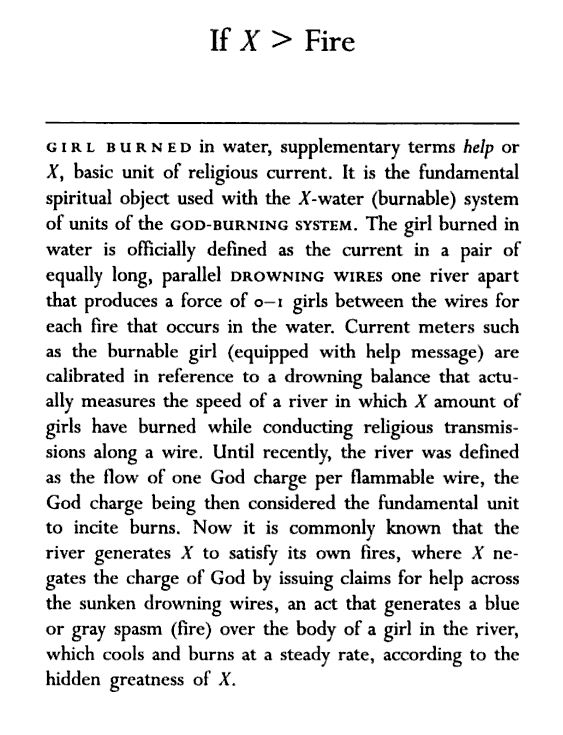
She had big breasts, slim legs, and blue eyes. That’s how I like to remember her. I don’t know why I fell madly in love with her, but I did, and at the start, I mean for the first days, the first hours, it all went fine; then Clara returned to the city where she lived, in the south of Spain (she’d been on vacation in Barcelona), and everything began to fall apart.
One night I dreamed of an angel: I walked into a huge, empty bar and saw him sitting in a corner with his elbows on the table and a cup of milky coffee in front of him. She’s the love of your life, he said, looking up at me, and the force of his gaze, the fire in his eyes, threw me right across the room. I started shouting, Waiter, waiter, then opened my eyes and escaped from that miserable dream. Other nights I didn’t dream of anyone, but I woke up in tears. Meanwhile, Clara and I were writing to each other. Her letters were brief. Hi, how are you, it’s raining, I love you, bye. At first, those letters scared me. It’s all over, I thought. Nevertheless, after inspecting them more carefully, I reached the conclusion that her epistolary concision was motivated by a desire to avoid grammatical errors. Clara was proud. She couldn’t write well, and she didn’t want to let it show, even if it meant hurting me by seeming cold.
. . . when, for example, David Markson, an expository novelist who fired the starting gun for fictions of information and proved that pure exposition can be alarmingly moving, who purposefully tells instead of shows, is dismissed in The New York Times for failing to provide a story in his novelReader’s Block, no discussion follows about why, exactly, fiction must have one (at 150 words in the book review, how could any discussion follow?). Nor do we learn what a story might have looked like in such an exquisitely felt book that, to summarize, catalogs the various ways historical figures have hated whole races of people and/or died by their own hands. (Yes, you should read this book.)
Markson should have presumably, under the fiction-must-have-a-story criteria, zeroed in on one of his hundreds of characters and gone deep, doing that good old-time psychological work, the person-making stuff, dramatizing how such an interesting fellow had gone on to hate Jews and/or kill himself. Markson should have used more words like “then.” He should have sequenced. He seems to have forgotten that literature is supposedly a time-based art.
Markson’s amnesia is one of the happy accidents of the last decade of fiction writing. By eschewing a fetishistic, conventional interest in character, or a dutiful allegiance to moment creation, to occurrence itself, Markson accomplishes what a story, slogging through time and obedient to momentum, arguably could not: a commanding, obsessive portrait of single behaviors throughout history, a catalog of atrocity that overwhelms through relentless example. In truth, it’s a novel that can be read as an essay, but unlike most essays, it’s lyrically shrewd, poetry in the form of history, and it’s brave enough to provide creepy, gaping holes where we normally might encounter context (the burden of the conventional essayist).
From Ben Marcus’s essay “The Genre Artist,” published in a 2003 issue of The Believer.
Then you consider your novel a purely literary work as opposed to one in the tradition of social protest.
ELLISON
Now, mind, I recognize no dichotomy between art and protest. Dostoyevsky’s Notes from Underground is, among other things, a protest against the limitations of nineteenth-century rationalism; Don Quixote, Man’s Fate, Oedipus Rex, The Trial—all these embody protest, even against the limitation of human life itself. If social protest is antithetical to art, what then shall we make of Goya, Dickens, and Twain?
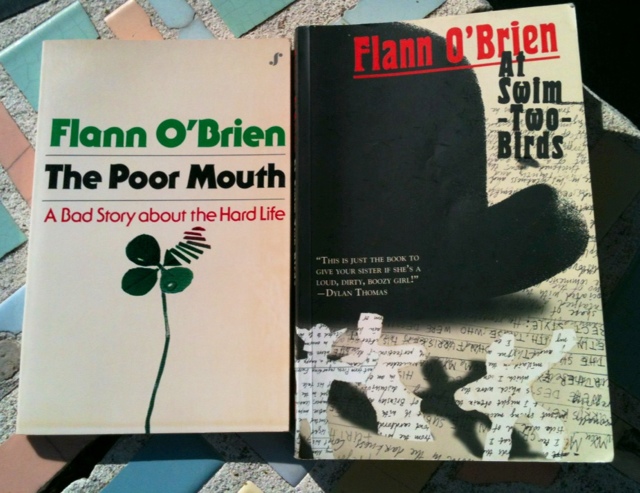
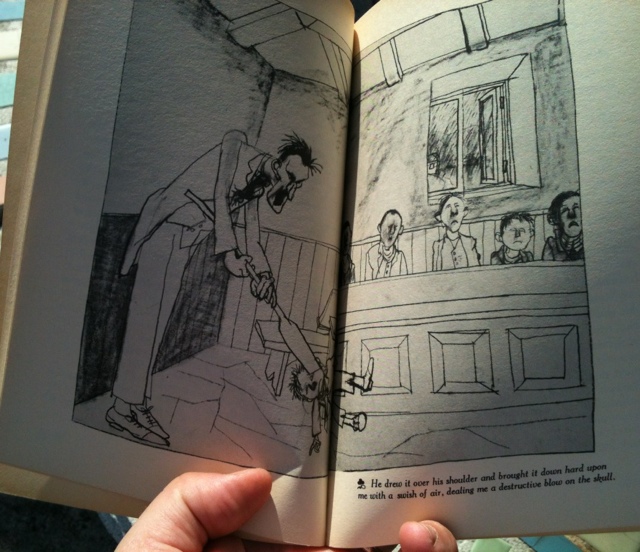
Picked up two more by Flann O’Brien after enjoying The Third Policeman so very much; thanks again to the reader suggestions on that one. The Poor Mouth has pictures:
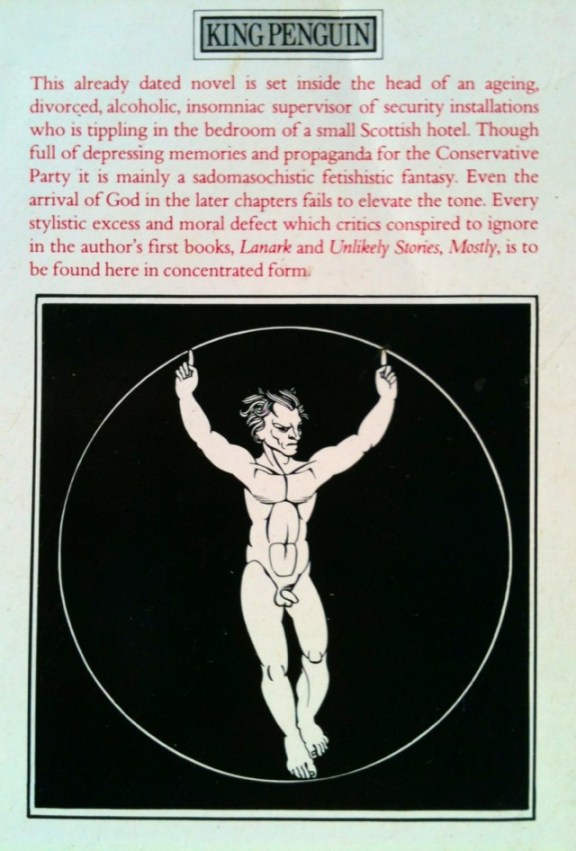
I was looking for Alasdair Gray’s first novel Lanark (no dice), but picked up 1982 Janine read the back and immediately knew I had to have it.
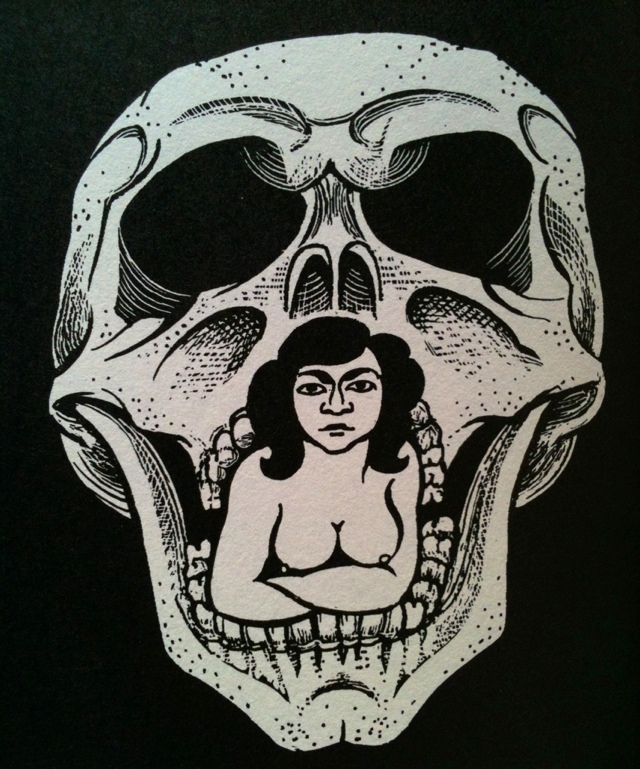
I picked up Poor Things just to riffle a bit, and again, very intrigued. Also, another book with illustrations. Here’s one:
And, as I shot these outside in the cheap showiness of nature, here’s a picture of a large plant’s tumescent bloom, because hey why not:
This is Chapter XLIV of Herman Melville’s The Confidence Man:
“Quite an original:” A phrase, we fancy, rather oftener used by the young, or the unlearned, or the untraveled, than by the old, or the well-read, or the man who has made the grand tour. Certainly, the sense of originality exists at its highest in an infant, and probably at its lowest in him who has completed the circle of the sciences.
As for original characters in fiction, a grateful reader will, on meeting with one, keep the anniversary of that day. True, we sometimes hear of an author who, at one creation, produces some two or three score such characters; it may be possible. But they can hardly be original in the sense that Hamlet is, or Don Quixote, or Milton’s Satan. That is to say, they are not, in a thorough sense, original at all. They are novel, or singular, or striking, or captivating, or all four at once.
More likely, they are what are called odd characters; but for that, are no more original, than what is called an odd genius, in his way, is. But, if original, whence came they? Or where did the novelist pick them up?
Where does any novelist pick up any character? For the most part, in town, to be sure. Every great town is a kind of man-show, where the novelist goes for his stock, just as the agriculturist goes to the cattle-show for his. But in the one fair, new species of quadrupeds are hardly more rare, than in the other are new species of characters—that is, original ones. Their rarity may still the more appear from this, that, while characters, merely singular, imply but singular forms so to speak, original ones, truly so, imply original instincts.
In short, a due conception of what is to be held for this sort of personage in fiction would make him almost as much of a prodigy there, as in real history is a new law-giver, a revolutionizing philosopher, or the founder of a new religion.
In nearly all the original characters, loosely accounted such in works of invention, there is discernible something prevailingly local, or of the age; which circumstance, of itself, would seem to invalidate the claim, judged by the principles here suggested.
Furthermore, if we consider, what is popularly held to entitle characters in fiction to being deemed original, is but something personal—confined to itself. The character sheds not its characteristic on its surroundings, whereas, the original character, essentially such, is like a revolving Drummond light, raying away from itself all round it—everything is lit by it, everything starts up to it (mark how it is with Hamlet), so that, in certain minds, there follows upon the adequate conception of such a character, an effect, in its way, akin to that which in Genesis attends upon the beginning of things.
For much the same reason that there is but one planet to one orbit, so can there be but one such original character to one work of invention. Two would conflict to chaos. In this view, to say that there are more than one to a book, is good presumption there is none at all. But for new, singular, striking, odd, eccentric, and all sorts of entertaining and instructive characters, a good fiction may be full of them. To produce such characters, an author, beside other things, must have seen much, and seen through much: to produce but one original character, he must have had much luck.
There would seem but one point in common between this sort of phenomenon in fiction and all other sorts: it cannot be born in the author’s imagination—it being as true in literature as in zoology, that all life is from the egg.
In the endeavor to show, if possible, the impropriety of the phrase, Quite an Original, as applied by the barber’s friends, we have, at unawares, been led into a dissertation bordering upon the prosy, perhaps upon the smoky. If so, the best use the smoke can be turned to, will be, by retiring under cover of it, in good trim as may be, to the story.
I started Flann O’Brien’s novelThe Third Policeman yesterday, on the recommendation of a few readers who commented on a post last week. Just a few chapters in, I felt the thrill of really great, strange writing, coupled with the bizarre, almost unwieldy disbelief that I hadn’t read the novel before, or more to the point, and most ashamedly, that it wasn’t even on my radar. I felt a strange antipathy to the name Flann O’Brien whenever I came across it in the past—too close to Flannery O’Connor, if I’m being honest. This is all silly and I’m embarrassed to write it now. Anyway, the novel is amazing so far. Here’s a passage that maybe stands alone. We have the (as yet?) unnamed narrator, his soul (in italics), and an old man (who may or may not be a version of the narrator?):
I smiled at him in good-humoured and said:
‘Tricky-looking man, you are hard to place and it is not easy to guess your station. You seem very contented in one way but then again you do not seem to be satisfied. What is your objection to life?’ He blew little bags of smoke at me and looked at me closely from behind the bushes of hair which were growing about his eyes.
‘Is it life?’ he answered. ‘I would rather be without it,’ he said, ‘for there is a queer small utility in it. You cannot eat it or drink it or smoke it in your pipe, it does not keep the rain out and it is a poor armful in the dark if you strip it and take it to bed with you after a night of porter when you are shivering with the red passion. It is a great mistake and a thing better done without, like bed-jars and foreign bacon.’
‘That is a nice way to be talking on this grand lively day,’ I chided, ‘when the sun is roaring in the sky and sending great tidings into our weary bones.’
‘Or like feather-beds,’ he continued, ‘or bread manufactured with powerful steam machinery. Is it life you say? Life?’
Explain the difficulty of life yet stressing its essential sweetness and desirability.
What sweetness?
Flowers in the spring, the glory and fulfilment of human life, bird-song at evening – you know very well what I mean. I am not so sure about the sweetness all the same.
‘It is hard to get the right shape of it,’ I said to the tricky man, ‘or to define life at all but if you identify life with enjoyment I am told that there is a better brand of it in the cities than in the country parts and there is said to be a very superior brand of it to be had in certain parts of France. Did you ever notice that cats have a lot of it in them when they are quite juveniles?’
He was looking in my direction crossly.
‘Is it life? Many a man has spent a hundred years trying to get the dimensions of it and when he understands it at last and entertains the certain pattern of it in his head, by the hokey he takes to his bed and dies! He dies like a poisoned sheepdog. There is nothing so dangerous, you can’t smoke it, nobody will give you tuppence-halfpenny for the half of it and it kills you in the wind-up. It is a queer contraption, very dangerous, a certain death-trap. Life?’
The twenty-five short (and short-short and micro) stories that comprise Matt Mullins’s Three Ways of the Saw bristle with gritty, buzzing energy—these are crack-shot tales, simultaneously precise and off-center. Mullins offers a world of stumbling rock bands and day-drinkers, sorry sons and ugly lovers, all fumbling for meaning against the world’s sharp edges. Organized into three novellas-(of sorts)-in-stories, Saw is spiky, stinging, but also deeply moving, probing some of the darker places we’ve all been (or might be headed to).
Matt was kind enough to talk to me about his work over a series of emails, even though I’m sure he was busy—he had just gotten back from this year’s Association of Writers & Writing Programs (AWP) conference in Chicago where he helped promote Saw, which is fresh from Atticus Books. Matt teaches creative writing at Ball State University. In addition to his writing, he’s also a musician and filmmaker. Check out his blog.
Biblioklept: How was AWP?
Matt Mullins: I had an excellent time at AWP. Things had come full circle. Three years ago at AWP Chicago, I’d interviewed for the tenure-track job I now have teaching creative writing at Ball State University. Two years ago in Denver, I was part of the hiring committee that brought us our most recent fiction hire, Cathy Day. Last year in DC I found out Three Ways of the Saw had been accepted by Atticus Books. This year I was back in Chicago signing the book for people at the Atticus booth in the book fair, and hustling boxes of wooden matches with a picture of book cover on them. I believe AWP is in Boston next year If I go, I’m planning on buying a lotto ticket and a twelve pack at the first party store I see inside the city limits.
Biblioklept: The twelve pack will come in use if your luck is bold or ill (but I hope your luck remains good).
MM: Truly, the beer shares its love with us whether we’re drowning sorrows or celebrating.
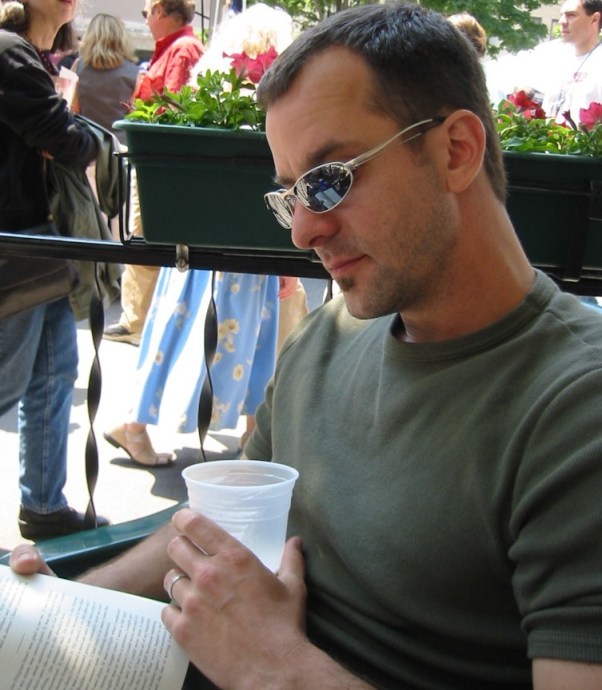
The writer, in repose, enjoys a libation and book
Bibliokept: Could you describe the vibe at AWP for those of us who’ve never been? How important is it for authors?
MM: The vibe at AWP, the book fair specifically, always reminds me that there is a hell of a lot of love for books out there, regardless of what the cyber-world might cause us to think with the rise of e-readers and online literary magazines. Hundreds of tables filled with beautifully crafted books, some of them hand typeset, hand-stitched, custom illustrated, others slicker and more traditional, but all of them filled with an astonishing breadth of literature. More great books than anyone could read in a lifetime. There’s definitely that going on, a serious love for the book as an object.
Then there’s the conference. 8,000 writers descending upon a swanky hotel in City X (Austin, Chicago, New York, Vancouver, D.C., etc. It changes each year.) to attend panels on a wide variety of subjects of concern to writers who teach in university/college creative writing programs. Readings by notable authors in both the literary and indie publishing worlds. Fancy receptions with open bars put on by various sponsors. Serious networking.
Then there’s all the crazy “off site” events. Parties put on by lit magazines and publishers. Readings in bars and clubs. All the things you can imagine happening when you let thousands of writers and artistically inclined people loose on a city en masse for a long weekend. One of the interesting things I’ve noticed with AWP over the last few years is that there are now two strains that intermingle at will. There is what I would call the “indie-lit” community, the more recent community of people running small non-university affiliated presses and online literary magazines, and there is the longer standing community of university affiliated presses and creative writing programs. It’s been great to see how the coming together of these two communities (which have communities within and across their own larger communities) has energized the whole situation. It’s brought more people who love good writing together. This year the conference sold out for the first time in its forty-some year history.
In terms of its importance for authors: Many writers can take it or leave it. It’s a great place to meet editors of literary magazines and otherwise make connections with people who are potentially interested in reading your work. And personally, I’ve always enjoyed wandering through the book fair with a back pack and picking up submission guidelines at each journal’s table that I’ll sort through later as I get ready to send out a round of stories or poems. But it’s not a make or break situation for a writer by any means. I’m sure there are many writers out there to whom this conference would not appeal one bit. More power to them.
Biblioklept: Well, it sounds like you’ve had a lot of success at AWP. I hope that Three Ways of the Saw picked up some traction there. It’s a cool book, somehow simultaneously raw and refined. There’s a gritty energy to your prose, but it’s also precise and even elegant in its economy. Some of my favorite pieces in the book, like “Steam” and “Accepting Inner Change at the Grocery Store,” are these succinct moments that somehow encode epiphanies that aren’t forced, that are, for lack of a better word, naturalistic (this is a long-winded way of me saying: I completely identify with the truth of these moments as a reader, as a human). I’m curious about how you draft and execute them.
MM: For me there’s a certain grace inhabiting those things living at the very edge of our understanding. When, for various reasons, they spill over into some kind of sense we can apprehend we get a feeling of momentary clarity that can resonate forward into a longer lasting epiphany that changes the way we see ourselves and the world. There are those things born of a raw truth that come to us like a slap in the face. And there are those things that slide over us with a gentle sadness or joy. Whatever their type, they’re always there. They surround us. What brings them into focus is life context bumping up against individual consciousness.
When I’m trying to work that mechanism in a story, I don’t really know what that moment might be when I start out. Or if I do think I know what it is when I start out, it usually ends up being something else. What tends to happen, though, is that I end up writing my character into outer circumstances that allow a kind of collision, subtle or raw, with the character’s inner circumstances that result in this third element, this realization (or failed realization) of that new collided inner/outer state.
The language is the delivery mechanism for this idea, so it must be precise if the meaning is to come across. But language is sound and rhythm and even shape as well as meaning so all of those elements need to come together if this “third thing” as I’m calling it is to emerge fully. I think maybe it’s the attention to the language and the fact that these true moments don’t need to be conjured so much as revealed and caused to shine anew through the method of their delivery that makes their arrival feel natural rather than forced. Saying something the reader already intuits to be true in an unexpected way makes the gut say yes even as it makes the head tease out the complexities of the idea.
Biblioklept: There’s a moment in the title story, “Three Ways of the Saw,” when the narrator connects the scientific fact that matter can never be created nor destroyed, only changed, to the philosophical implication that, “if this is true it means the whole universe already contains everything that ever was or will be” — and hence all people are intrinsically connected (the narrator goes on to link himself to Nixon and Hitler and Gandhi and Jesus and rubber bands). Your collection contains a strong, unifying tone, but you also get inside the heads of lots of different kinds of people. Where do your characters come from?
MM: My characters come from within and from without. By within I mean two things. First, every character, no matter where it comes from, has a little part of me in its chemistry, if only by virtue of the fact that it’s being filtered through my consciousness. Secondly, some characters are wholly products of my imagination. That is, they are born in my head and I evolve them from there.
By without, I mean some of my characters are based partly on my experience with others. Some are inspired by people I know well. Others come from people I’ve seen or encountered indirectly. But even these characters that come from without have to be filtered through me to end being in the story, so they invariably take on facets of my perception, intentional or not, which makes them that first type of character I mentioned that comes from within. So, to untangle that, I guess the answer is that all my characters come from within–eventually–regardless of if they were born in my head or were filtered through it.
But more than where they come from is what I want from them. I want them to be compelling, flawed, multi-faceted and someone a reader can attach themselves to, whether it’s by way of sympathy or interest in “what’s going to happen to this person next.”
You make a good point about the collection’s unifying tone across its variety of characters. I believe in the idea of universality through specifics. That is, the more specific you get with a character’s mind, world and situation, the more universal your story becomes. It appears antithetical at first glance and I’ve had many a student tell me they wrote something purposefully vague because they wanted everyone to “Get it.” But what happens with vagueness is detachment and disinterest. So I always tell them to get that vaseline off the camera lens and start showing me the facets of the diamond. Because this much I’ve learned: When things vividly emerge for the reader, they descend into the story and the resulting empathy/interest allows them to attach themselves to the character and their experience. That’s why we could all relate to a well written story about astronauts that might say something universal about loss or isolation or perspective, or whatever, even though 99.99999% will never be in outer space.
Biblioklept: I teach basic college composition, not fiction writing, but I have a similar mantra: get to the abstract through what’s concrete. I’m curious about your teaching: Has it influenced how you write?
MM: Teaching influences my writing in that it keeps the creative process, revision and the idea of reading good examples by writers I admire in the forefront of my mind. Those are the general practices I try to pass along to my students. I’ve been teaching a lot of screenwriting over the last few years, and this has given me certain ideas about plot and character arc and scene and dialogue that have influenced the shape of some things I write as well, the more narrative stories particularly. I also have a clearer understanding of how to book end scenes I want to purposefully withhold so they emerge in the reader’s mind without literally appearing in the story. But screenwriting also pushes me toward more non-narrative forms of storytelling, because sometimes I want to get away from that more traditionally narrative mode. So this makes me more experimental in my approaches at times. But In general, teaching influences my writing by keeping me engaged in the idea of craft, how to talk about it, what I understand it to be. It keeps my mind focused on the practical application of techniques, which is where the true guts of writing are, at least for me, whether it’s in a traditional narrative or experimental mode.
Biblioklept: One of the techniques you use in a few of the stories is second-person perspective. What are the risks and payoffs in writing in this POV?
MM: Second person is much maligned, I think sometimes rightly so, for being presumptuous. Forcing the reader into a story as the protagonist–it’s a leap some readers aren’t willing to make, especially if they can’t connect themselves to the characterization or the outer realities of the character. 2nd person requires that leap of faith on the reader’s part. Especially when the reader gets drug through some shit and those “you’s” aren’t dwelling in very happy places. So there’s a risk in alienating the reader due to the nature of the leap you’re asking of them. Also, it’s a self-conscious device to create “intimacy” between the reader and the story, something that brings attention to what is usually a more subconscious relationship between reader/character that’s different from the objective subjectivity of the first person and the more distant narrative omniscience of 3rd; and that self-consciousness can put people off. This is why I only use 2nd person sparingly, and when I do it’s for very specific reasons. For me, unless 3rd person is essential to some aesthetic element of the story, I won’t use it.
For example, in “Getting Beaten” I’m using it to get the reader in close on a rather lost, though I hope sympathetic, character who undergoes a violent experience. I wanted to put the reader as close to that experience and subsequent catharsis as possible. 2nd person seemed the best way to bring across that character’s inner turmoil while attaching the reader to the outer situation. But that in itself wouldn’t justify its use for me. That story can be told just as well in 1st or 3rd person. 2nd person became integral to that story when I realized its true ending, which involves the projection of a second “you” into the story that pulls up next to the “you” the reader has been associating with the entire time–this effect of one you watching the other you in the context of how the story makes the idea of those two presences interact with each other would be impossible to write in the 1st or 3rd person.
“Accepting Inner Change in the Grocery Story” is a kind of companion piece in that it’s assumed the “you” is the same character if you were to view him objectively. With that story there’s also this idea of the doppelgänger, you confronting you, and this idea of a kind of psychic time travel. Using 2nd person here allowed me to get a character to confront himself literally while also throwing the idea of the reader inside that same mirror while pulling them back and forth in time.
In “The Bachelor’s Last Will and Testament” I shift between the 2nd person and that 1st person legalese of the will. So using 1st person for the beginning of the piece wasn’t working and 3rd felt too distant.
In “How to Time an Engine” I’m using it more in the poetic tradition of direct address, though I’ve angled the address to the character on the receiving end of my marveling over luck and timing versus karma, divine providence and fate and how maybe they’re all just different versions of the same thing. Using second person in that piece allows me to turn the reader into the example itself (the you) as we (reader and narrator) consider the idea together.
So, for me, when I’m trying to bend the whole idea of what “person” means in fiction, I might employ 2nd person. But, knowing its risks, I don’t make that choice too often. I think if a writer takes that kind of considered approach to 2nd person they’ll probably reap the rewards rather than suffer the risks.
Biblioklept: I’m curious what you’re working on now—more short stories? Music? Film? Do you have plans for a novel? Another Mortal Kombat film? (Oh, wait, I think that’s a different Matt Mullins . . .)
MM: Yeah, that other Matt Mullins. He’s something else. You’ve got to check him out on YouTube. He does all that acrobatic flying through the air ass-kicking type stuff. He also looks a little bit like I did when I was younger. When I first stumbled upon him it was almost like seeing an alternate reality version of myself, as if after the last time I had my nose busted in a fist fight I said, “Forget this reading and writing bullshit,” and started studying the martial arts instead. It makes me wonder how many Matt Mullins are out there and what they’re into. Maybe one likes to write. Maybe we can trade books one day or have a beer.
As for what I’m working on now: My interactive literary project in progress currently lives at lit-digital.com. I’ve been working on some videopoems and short, experimental films when I have the time. I have a manuscript of prose-poem type things called The Roaring Engine of Here that I want to finish up and start shopping around. I have a couple feature-length screenplays roughed out that I need to finish, and I have an idea for a novel that blows up my time spent as copywriter in corporate America. Basically, I just need to nail down what I want to focus on and get to it.
Biblioklept: Have you ever stolen a book?
MM: I went to an all-boys Catholic boarding school. We actually had to wear suit jackets with a crest on the breast pocket. But it was not some quasi Ivy League prep school. It was like the knock off version of that–an ignorant, ugly, cruel, violent place, but it taught me something of life’s truths early. You were required to bring your Bible to theology class under threat of “detention” and/or “demerits.” One day, I found I’d lost my Bible . . .
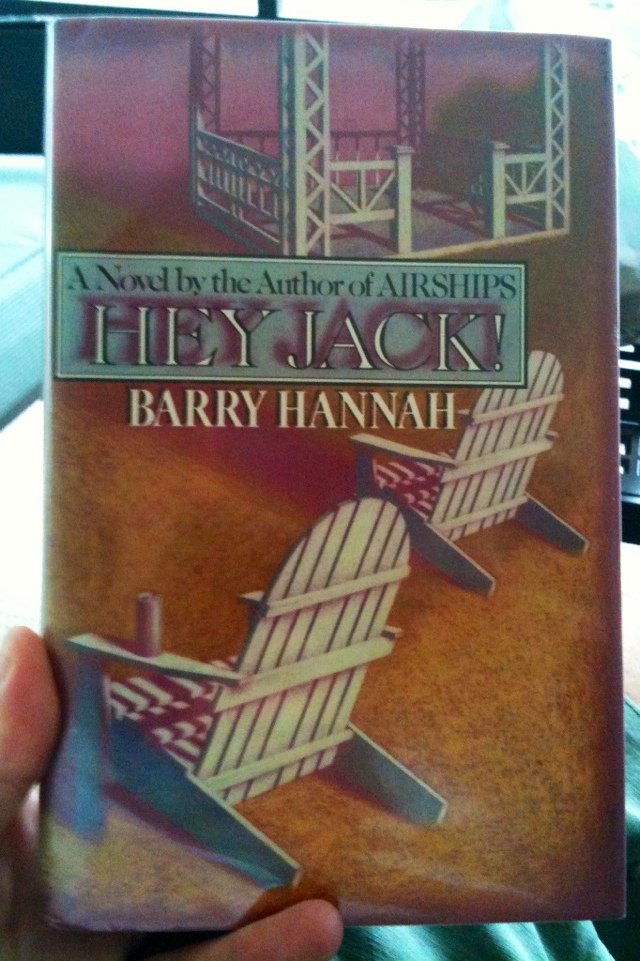
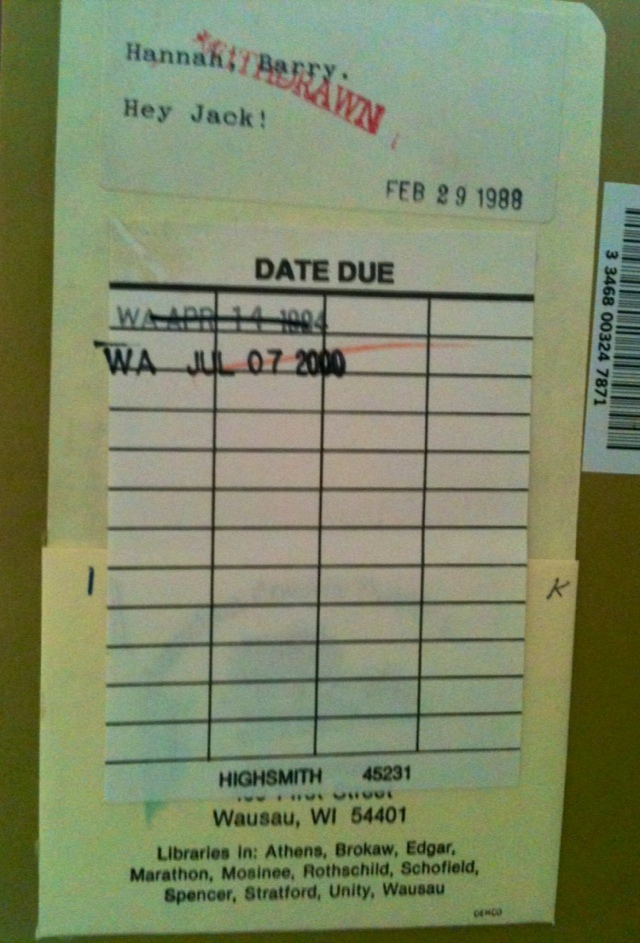
I bought Barry Hannah’s seventh book Hey Jack! over the internet after my favorite local bookstore told me it would be difficult or expensive for them to order. I bought a first edition hardback brokered by Amazon. It was an ex-library copy. It looks like no one ever read it, and it seems to have been checked out only twice in twenty-four years. A sad business.
I put some wear and tear on it today, reading it outside on my porch during a thunderstorm, using it as a beer coaster at one point, and then taking it into a salted bath where it got damp and curly. I read half of it. Hannah’s novel-in-vignettes is still ahead of its time. Who writes better sentences? (“Christ, the South has been pickled in the juice of its own image”).
From Robert Louis Stevenson’s essay “The Books Which Have Influenced Me”:
The most influential books, and the truest in their influence, are works of fiction. They do not pin the reader to a dogma, which he must afterwards discover to be inexact; they do not teach him a lesson, which he must afterwards unlearn. They repeat, they rearrange, they clarify the lessons of life; they disengage us from ourselves, they constrain us to the acquaintance of others; and they show us the web of experience, not as we can see it for ourselves, but with a singular change–that monstrous, consuming ego of ours being, for the nonce, struck out. To be so, they must be reasonably true to the human comedy; and any work that is so serves the turn of instruction. But the course of our education is answered best by those poems and romances where we breathe a magnanimous atmosphere of thought and meet generous and pious characters.
From a 1961 letter by Flannery O’Connor to an English professor, who wrote her asking for an interpretation of her story “A Good Man Is Hard to Find.” In his letter, the professor concludes that the second half of the story is imaginary, an interpretation that seems to give Ms. O’Connor the vapors:
The interpretation of your ninety students and three teachers is fantastic and about as far from my intentions as it could get to be. If it were a legitimate interpretation, the story would be little more than a trick and its interest would be simply for abnormal psychology. I am not interested in abnormal psychology.
There is a change of tension from the first part of the story to the second where the Misfit enters, but this is no lessening of reality. This story is, of course, not meant to be realistic in the sense that it portrays the everyday doings of people in Georgia. It is stylized and its conventions are comic even though its meaning is serious.
Bailey’s only importance is as the Grandmother’s boy and the driver of the car. It is the Grandmother who first recognized the Misfit and who is most concerned with him throughout. The story is a duel of sorts between the Grandmother and her superficial beliefs and the Misfit’s more profoundly felt involvement with Christ’s action which set the world off balance for him.
The meaning of a story should go on expanding for the reader the more he thinks about it, but meaning cannot be captured in an interpretation. If teachers are in the habit of approaching a story as if it were a research problem for which any answer is believable so long as it is not obvious, then I think students will never learn to enjoy fiction. Too much interpretation is certainly worse than too little, and where feeling for a story is absent, theory will not supply it.
My tone is not meant to be obnoxious. I am in a state of shock.
Haley Tanner’s acclaimed novel Vaclav & Lena is new in trade paperback (excellent cover on this one, by the bye). From Page Pulp’s review:
You could try to categorize this book as a love story or an immigrant story, but it is really simply a human story. Like life itself, it can be sometimes funny, sometimes awkward (like the scene where Vaclav’s father walks in on him getting out the tub and makes a wrong assumption about what Vaclav was doing), sometimes happy, sometimes sad, and yes, sometimes incredibly dark. It reflects the human experience so well, but never feels cliché. Tanner’s prose has a simplicity that mimics the characters’ imperfect English. She creates beauty with her words, but is never too flowery. This allows the story to shine through, unobscured. Her characters almost do not seem like characters; after awhile they start to feel wondrously real, like you could reach out and touch Lena’s messy black curls. Tanner is adept at shaping both the story and the characters so that they feel realistic.
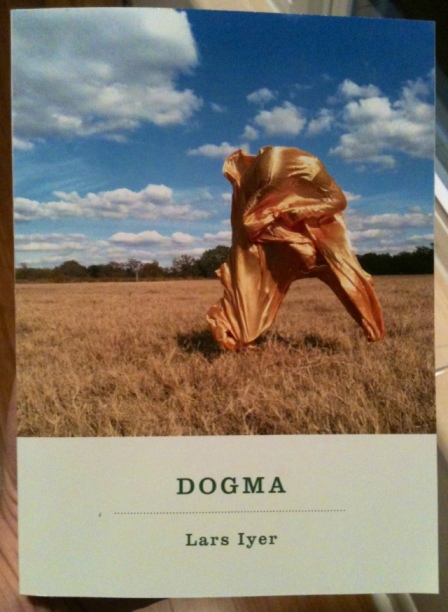
Lars Iyer’s novel (or anti-novel, if you swing that way) Spurious was one of the better books I read last year. From my review:
Lars Iyer’s début novel Spurious is about two would-be intellectuals, W., the book’s comic hero, and his closest friend, our narrator Lars. They bitch and moan and despair: it’s the end of the world, it’s the apocalypse; they find themselves incapable of original thought, of producing any good writing. The shadow of Kafka paralyzes them. They travel about Europe, seeking out knowledge and inspiration — or at least a glimpse of some beautiful first editions of Rosenzweig. They attend dreadful academic conferences; they write letters. They flounder and fail.
So like basically I’m a fan, and I’ve been eager for Dogma, so I was psyched when an ARC showed up in Monday’s mail. Dogma is new from Melville House at the end of this month; more coverage to come.





 Biblioklept