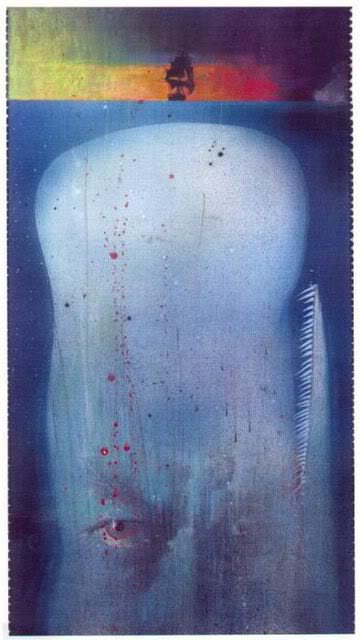
“No more my splintered heart and maddened hand were turned against the wolfish world” (Moby-Dick)

As I sat there in that now lonely room; the fire burning low, in that mild stage when, after its first intensity has warmed the air, it then only glows to be looked at; the evening shades and phantoms gathering round the casements, and peering in upon us silent, solitary twain; the storm booming without in solemn swells; I began to be sensible of strange feelings. I felt a melting in me. No more my splintered heart and maddened hand were turned against the wolfish world. This soothing savage had redeemed it. There he sat, his very indifference speaking a nature in which there lurked no civilized hypocrisies and bland deceits. Wild he was; a very sight of sights to see; yet I began to feel myself mysteriously drawn towards him. And those same things that would have repelled most others, they were the very magnets that thus drew me. I’ll try a pagan friend, thought I, since Christian kindness has proved but hollow courtesy. I drew my bench near him, and made some friendly signs and hints, doing my best to talk with him meanwhile. At first he little noticed these advances; but presently, upon my referring to his last night’s hospitalities, he made out to ask me whether we were again to be bedfellows. I told him yes; whereat I thought he looked pleased, perhaps a little complimented.

From Chapter 10 of Herman Melville’s Moby-Dick.

Some Books I Plan to Read in 2013

20121228-105736.jpg

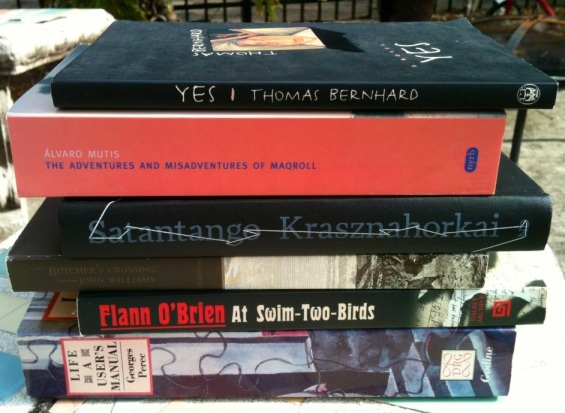
There are only a handful of forthcoming titles that I know about right now that I’m looking forward to reading next year: story collections from Sam Lipsyte (The Fun Parts) and George Saunders (Tenth of December), and a new novel from William Gass called Middle C. I’m also hoping Keith Ridgway’s Hawthorn and Child will finally get a US release, because I’d like to read it too.

There are a few newish books that I didn’t read in 2012 that I’ll try to catch up to this year—Ben Marcus’s The Flame Alphabet, László Krasznahorkai’s Satantango, and Laurent Binet’s HHhH.

I do not currently possess any of these books.

I also look forward to reading Evan Lavender-Smith’s From Old Notebooks, back in print again from Dzanc (who I am sure will get the copy I ordered to me any day now).

At the top of my list though are the books I’m currently reading: Alvaro Mutis’s Maqroll novellas and Flann O’Brien’s At Swim-Two-Birds.

Stuff I’ve been saying I’ll read for a few years now that I hope to get to:

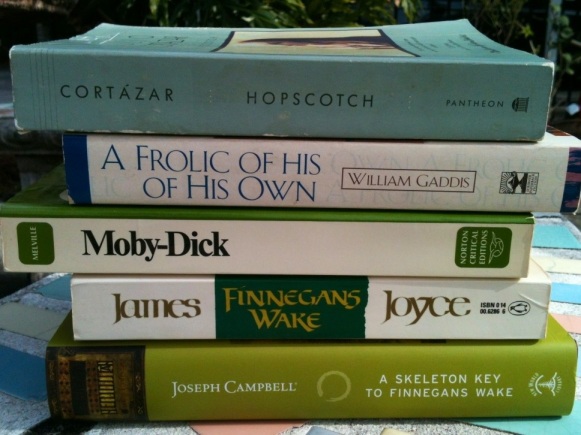
Cortazar’s Hopscotch, John Williams’s Butcher’s Crossing, Gombrowicz’s Ferdydurke, and, at the top of the heap, Georges Perec’s Life A User’s Manual.

20121228-111213.jpg

I have a few books by Thomas Bernhard that I’ll probably get into this year (when I feel called to a misanthropic monologue), and I’ll gobble up anything else by Barry Hannah that I can get my mitts on. I read William Gaddis’s “big books” last year, but I still haven’t read A Frolic of His Own, which I’ve heard is superior to Carpenter’s Gothic.

I’ll reread Moby-Dick this year (or at least listen to William Hootkins’s brilliant audio version) and I’ll probably end up rereading some book that I hadn’t planned to at all (this happened with 2666 and The Savage Detectives this year—who knows? I haven’t read Gravity’s Rainbow since college, and I haven’t reread Infinite Jest in full, and I’d love to go through Suttree again . . . ).

I dipped my toe into Finnegans Wake this year—I’ve found reading it on the Kindle late at night and then going through Joseph Campbell’s Skeleton Key the next morning is rewarding—and I’ll probably keep at it in 2013. Maybe I’ll make it to chapter 3.

But enough of my rambling—What books do you, dear reader, look forward to in 2013?

Reading Chris Ware’s Building Stories / It All Happened So Fast

20121213-185225.jpg

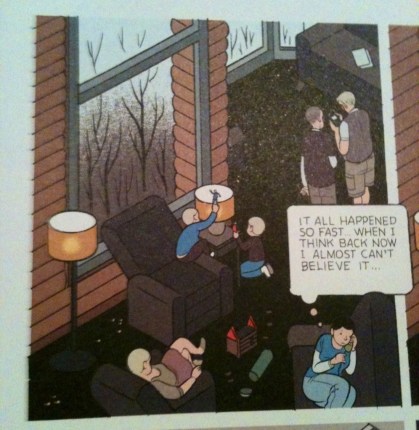
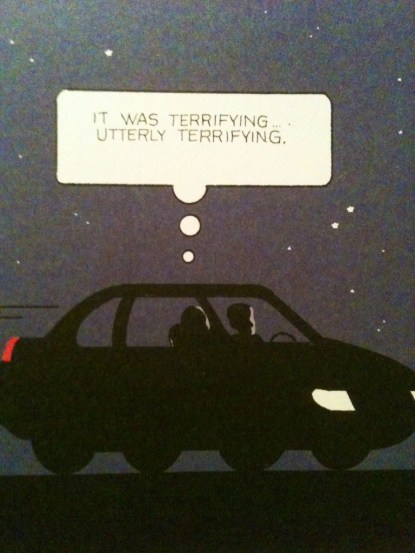
As seems to be the case more often than not in this series of write-ups on reading Chris Ware’s Building Stories, I’ve taken the title from the first line of the first panel (below); you can see the scale of this chapter in folded broadside in the pic above (which also reveals the heart of this episode).

20121213-185234.jpg

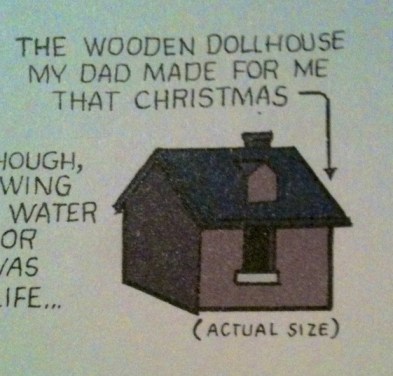
This particular episode focuses again on Lonely Girl/Married Mom/The Amputee, who has slowly emerged as the protagonist of Ware’s novel. Here, she deals with the news of her father’s illness, an event that brings her back to her childhood home repeatedly. The motif of homes and buildings evinces again too, of course—it’s a subtle but omnipresent device in Building Stories:

20121213-185305.jpg

20121213-185312.jpg

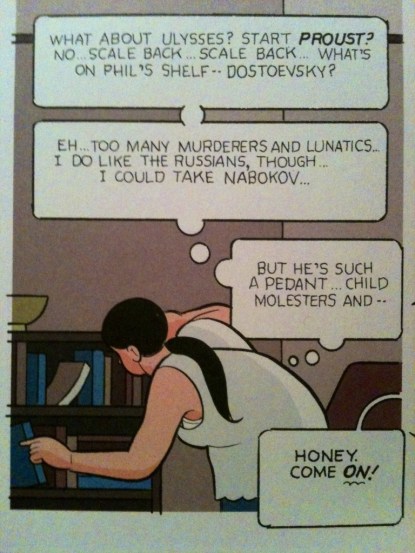
And as always, Ware’s genius shows in the way he conveys so much truth in the smallest detail. Below he illustrates Lonely Girl’s disconnected relationship with her architect husband in just a panel:

20121213-185243.jpg

“It All Happened So Fast” is a fair name for this chapter—Ware’s panels illustrate the way that our lives (and the narrativizing of those lives) can become radically compressed, how our memories fail us, how seemingly trivial details anchor themselves to the emotional strata of our personalities even as concrete fact slips away. Still, another title could come from this panel:

20121213-185256.jpg

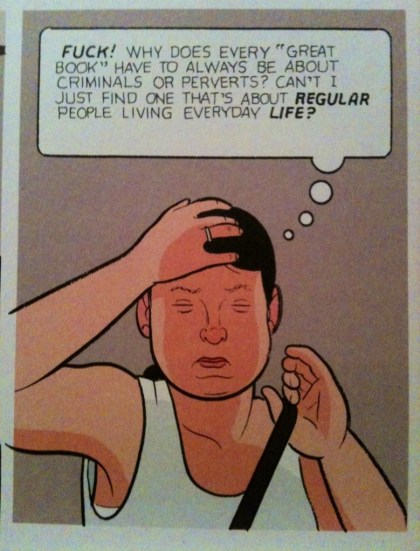
I’ll close this out by offering three panels that strike me as so utterly real, so wonderfully truthful, that I won’t bother to comment further:

20121213-185321.jpg

20121213-185328.jpg

20121213-185336.jpg

The Problems of Bartleby

20121112-120230.jpg

What are the problems of Herman Melville’s story “Bartleby, the Scrivener: A Story of Wall Street”?

This question seems like a bad starting place.

Let me share an anecdote instead.

—I was in the tenth grade the first time I read “Bartleby.”

At the time, I thought I was a teacher’s dream—a sharp reader, someone who loved English class, someone with opinions about the texts we read. Lots and lots of opinions. In retrospect, I realize that I was a nightmare for poor Ms. Hall, a wonderful teacher who I’m sure dreaded our meetings (there were like 15 guys in the class, all unruly).

Simply put, I didn’t want to do things her way.

So she gave me a copy of Billy Budd, Sailor and Other Stories and told me to read “Bartleby,” suggesting that there was something I might learn from it.

I don’t know if backfired is exactly the right term for the results of this experiment. I do know that “Bartleby” offered me a brilliant retort—a literary allusion!—to refuse any task I didn’t feel like undertaking in 10th grade English:

“I would prefer not to.”

—While we’re here—

“I would prefer not to”

So, this is clearly one of the problems of “Bartleby,” if not the core problem condensed into one utterance: Why would? Why the conditional?

Consider, vs. I prefer not to, a constative (or maybe even performative) utterance.

But Bartleby “would prefer not to.”

Contrast this with the imperative must that the narrator employs:

At the expiration of that period, I peeped behind the screen, and lo!
Bartleby was there.

I buttoned up my coat, balanced myself; advanced slowly towards him, touched his shoulder, and said, “The time has come; you must quit this place; I am sorry for you; here is money; but you must go.”

“I would prefer not,” he replied, with his back still towards me.

“You must.”

He remained silent.

Now I had an unbounded confidence in this man’s common honesty. He had frequently restored to me sixpences and shillings carelessly dropped upon the floor, for I am apt to be very reckless in such shirt-button affairs. The proceeding then which followed will not be deemed extraordinary.

“Bartleby,” said I, “I owe you twelve dollars on account; here are thirty-two; the odd twenty are yours.—Will you take it?” and I handed the bills towards him.

These brief lines perhaps serve to summarize Melville’s tale.

We see here the basic plot—our titular scrivener will not leave the lawyer’s office after weeks of refusing (although refusing is not quite the right word) to work.

We also see here what I take to be the theme of “Bartleby,” the strange ethical position Bartleby’s (conditional) would prefer not to places the narrator’s (imperative) must set against the moral backdrop of do unto others: namely, an impossible ethical position for a Wall Street lawyer especially and most of us in general.

And “Bartleby,” as you’ll no doubt recall, is in some ways Melville trying to work out the problems of Matthew 25:35-39—

For I was an hungred, and ye gave me meat: I was thirsty, and ye gave me drink: I was a stranger, and ye took me in:

Naked, and ye clothed me: I was sick, and ye visited me: I was in prison, and ye came unto me.

Then shall the righteous answer him, saying, Lord, when saw we thee an hungred, and fed thee? or thirsty, and gave thee drink?

When saw we thee a stranger, and took thee in? or naked, and clothed thee?

Or when saw we thee sick, or in prison, and came unto thee?

Perhaps our narrator tries to do these things—tries to feed and clothe and help this stranger Bartleby—but he can’t. Because Bartleby won’t give him an agency to relate to.

Because Bartleby’s utterance “I would prefer not to” denies the performative or constantive or declarative—indeed, it suspends or disrupts its own conditionality, the relation of the subject to its predicate verb.

Or consider one of Bartleby’s only other lines: “What is wanted?” His grammar again suspends agency, disrupts the notion of a stable I (let alone objective case me) that the narrator can interface with, dictate to, interrogate, see his own narcissistic reflection in).

—Hang on though, I was telling an anecdote. It was about the first time I read “Bartleby,” when I was fourteen or fifteen. This is the book:

20121112-150751.jpg

I stole it of course, or never returned it. Yes, that’s duct tape on its side. It is more or less falling apart. Here’s the back, barcode and all.

20121112-150740.jpg

Over the years, like many readers, I returned many times to “Bartleby,” reading it again in high school, then in college, then in grad school. I read it unassigned too, of course—when I read Kafka and it recalled itself to me, and when I read Moby-Dick for the first time. I read it when compelled. And then I read it with my own students. (I read most of the other stuff in the collection too, of course — Billy Budd and then later (why so much later?!) Benito Cereno).

I scrawled through so much of the book that my annotations are basically worthless, virtually everything underlined or circled:

20121112-151659.jpg

So we butt up against the problems of “Bartleby”—the problems of interpretation. How to figure an eponymous “hero” who is no more than a phantom, a trace, a lack? How to hash out a narrator who presents himself in relatively admirable terms and yet is so clearly an ethical failure? Why oh why would Bartleby prefer not to? Is the story a tragedy or a comedy? Does it present a world with rules, codes, ethics, or is all absurd here—nihilistic even? Is Bartleby a Christ figure? An ascetic monk? A ghost? Is the story just about Melville’s own anger over the poor reception of Pierre? How much of contemporary transcendentalist thought can we find in the story?

—Slight shift:

The kind people of Melville House were sporting enough to send a copy of “Bartleby” my way. The book is part of their HybridBooks project; these books offer “digital illuminations” along with traditional (uh, paper) books.

I’d requested a HybridBook—any one of them, really—because I now read about half the time on a Kindle Fire—so I was particularly interested in what a “hybrid” had to offer. What is the reading experience like?

First, the book itself is part of Melville House’s Art of the Novella series—beautiful, minimal design with French flaps. I read it on my porch the afternoon it arrived, enjoying its pristine, white, unmarked pages. Then, I checked out the “Digital Illuminations.”

The illuminations are available in several device-specific options, all easy to download with the QRC that comes with the book. I read most of the illuminations on my Kindle, but I also put them on my iPhone and my laptop. I had originally intended this post to be specifically about the digital illuminations, but hell, “Bartleby” is just too damn freighted a read for me at this point. Anyway, there’s a lot of good stuff in there, including “The Transcendentalist” by Ralph Waldo Emerson, selections from Jonathan Edwards and Joseph Priestly, Thoreau’s “Civil Disobedience,” and several excerpts from Melville himself, including letters, other books, and reviews. What I found must, uh, illuminating was “Of Some of the Sources of Poetry Amongst Democratic Nations” from Democracy in America by Alexis de Tocqueville. There are also illustrations, including a map; there’s even a recipe for ginger nuts. I wish that MH had included a digital copy of the book though. From a practical, concrete standpoint, I found it easier to switch between the free public domain version of “Bartleby” on my Kindle and MH’s illuminations than it would have been to pick up the physical book.

Now, to shift back (perhaps):

Do the digital illuminations help to answer or solve or address some of the problems of “Bartleby,” some of the issues posed above?

Should they?

—I suppose the hedging answer is yes and no.

The additional material illuminates some of the philosophical, political, historical, and even personal context for “Bartleby.” The material is edited with minimal intrusion, but with enough explication to clearly connect the various selections to Melville’s story. If I’m reading with my teacher hat on (this is a metaphor; there is no literal hat), I’d say you probably couldn’t do better than what Melville House has put together here. The digital illuminations provide a strong foundation for an informed reading, a range of texts that speak (obliquely or otherwise) to “Bartleby.”

Does it all add up to a deeper or richer understanding of “Bartleby”?

Should it?

—Well. No. And then no.

I mean, would we want a series of essays that would provide the missing pieces that would allow us to puzzle out “Bartleby”? Could we even trust such pieces, let alone trust ourselves to trust such pieces? Isn’t this strange uncertainty why “Bartleby” endures—and endures apart from Moby-Dick or Billy Budd, strange texts themselves, but also not nearly as confounding?

“Bartleby” simultaneously wriggles and plays dead; it burns with apparent wit but then reminds us that we might not be in on the joke. It is Kafkaesque thirty years before Kafka was even born. It shakes off its allegorical idiom the minute we think we might limn its contours. It makes us read it again because we cannot pin it down.

—But maybe you want to pin it down, tickle it, torture it, make it solve its problems (or at least respond, damn it!).

And maybe I claimed that “Bartleby” was about something—that it was about ethical relations, about duty to one’s fellows—especially when a fellow isn’t a fellow but rather the trace of a fellowthe idea of a fellowa ghost.

So, look, here’s a take on it:

The narrator—let’s call him Lawyer—Lawyer, see he’s a dick, in the parlance of our times. He’s a dick because he doesn’t know that he’s a dick, which is one of the constituting factors of the ontological state of being a dick. He also does not want to see himself as being a dick (this is another factor in the ontological state of being a dick). He wants to see himself as a good guy, this Wall Street dickhead, but Bartleby won’t let him do that. Bartleby won’t even let him see himself at all: Bartleby doesn’t reflect back. He prefers not to.

Our Lawyer, see, he’s all buttoned up, he’s snug (these are his words). He tells us upfront that he possesses “a profound conviction that the easiest way of life is the best”; he repeatedly points out the way that people are “useful” to him (or to others). He sees no possibility of an ethics outside of usefulness; on top of that, he cannot see that he cannot see any possibility of an ethics based on anything but “usefulness” (or the negative economy of obstruction figured in Bartleby).

And ah Bartleby, ah humanity: One time model employee, once apparently free from the eccentricities that plague the Lawyer’s other scriveners, Turkey and Nippers. Machinelike.

Bartleby mechanically completes large quantities of copies without comment or complaint.  But when asked to simply read in unison with Lawyer and his scriveners, Bartleby replies: “I would prefer not to.” Bartleby will not read with others—he is literally not on the same page as his colleagues.

Lawyer confronts Bartleby with his noncompliance; Bartleby repeats his mantra. Fuck mantra though because it’s not a mantra. It’s only repeated for Lawyer, to Lawyer, really, who can’t schematize/name/pin down Bartleby’s response. In fact, I would prefer not to so startles Lawyer that he says he’s  “unmanned” by the words. So he rationalizes Bartleby’s odd response, internalizes it, paraphrases it, if you like.

And then Bartleby ceases to even do his copying work. Oh the anarchy! But wait, there’s not even anarchy. There’s not even protest. There’s just big nothing. But not even big nothing—instead the smallest nothing (which proves that big nothing is possible).

So Lawyer attempts to “help” Bartleby. Lawyer believes doing so is his “Christian duty.” And to know that this duty has been met, Lawyer needs Bartleby to be his echo. But Bartleby’s I prefer not to denies this narcissistic exchange. He empties his I of ego (shades of Emerson’s Transparent Eyeball).

Confused, Lawyer tries to pay off Bartleby. When that doesn’t work, Lawyer actually packs up and moves to a new office. But even here he can’t cut off Bartleby. The office’s landlord comes to Lawyer to remove Bartleby.

And when Bartleby refuses to leave the office he is taken to “the Tombs”—prison.

Here, Lawyer tries to provide comfort for Bartleby (hearken ye back to Matthew 25:35-39). He arranges for Bartleby to receive good food in the prison. Bartleby prefers not to eat though, and dies curled up in the fetal position during a visit by Lawyer.

Lawyer is the first reader of Bartleby. But like many readers of “Bartleby,” he is confused.

Lawyer’s confusion results from his need for safety—for ease, for comfort, for a snug, buttoned-upness—and that safety is bought through an affirmation of first-person experience: namely, in the affirmation of the self in the other. That security is bought through assimilating another person’s first-person perspective. But Bartleby is empty of I, of self, of ego.

Bartleby would prefer not to: He will not be ventriloquized: He will not echo: He will not read from the same script: He will not be “of use,” as Lawyer puts it.

So Bartleby dissipates and dissolves: He goes down in the Tombs: a ghost, and impossibility, presence coupled with absence.

— And the epilogue:

We all recall the epilogue, yes?

Lawyer offers up “one little item of rumor,” a morsel, a “vague report . . . that Bartleby had been a subordinate clerk in the Dead Letter Office at Washington.” The idea tears the narrator up inside: “Dead letters! does it not sound like dead men?”

For Lawyer, Bartleby is a dead letter, a failed letter.

Did Melville worry that “Bartleby” would be a failed letter? That it would not find an audience? That his work would not be delivered? If he did, it seems too then that Bartleby’s negations foreclose or reject this concern. Not sure of how to wrap up this riff, I’ll retreat to the safety of my title.

We find the final problems (in basic narrative chronology, that is) of “Bartleby” in its final line. Has Lawyer learned from his experience? Can he empathize, finally feel something for Bartleby beyond the confines of a perceived ethical duty? Is Bartleby a place holder for all humanity? Or is Bartleby in opposition to humanity? What does it mean—-

Ah Bartleby! Ah humanity!

?

Chris Ware on DFW’s Novel The Pale King

Crippled Robot painting by Chris Ware

Cartoonist/graphic novelist/chronicler of shame and despair Chris Ware wrote about his favorite books for Foyles bookstore. The list includes UlyssesMoby-Dick, and works by cartoonists like Lynda Barry and Ivan Brunetti. Here’s what Ware wrote about David Foster Wallace’s posthumous novel The Pale King:

The first great novel of the 21st century uses the sinister beauty of the American Tax Code as a springboard from which to launch into a genuinely serious discussion of the origins and importance of civic responsibility amidst the hazy, blurred stupidity of a country in quick decline. Contrary to many reviews, I don’t think it’s about boredom, and it’s certainly not boring. Another posthumous editor-to-manuscript resuscitation, the book hangs heavy with the clotted spectre of Wallace’s suicide, which makes the writing glow all the more painfully through it.

Malcolm Lowry’s “Big Books,” as Reported by David Markson


From “Malcolm Lowry: A Remininiscence,” the final chapter of David Markson’s Malcolm Lowry’s Volcano, a study of Under the Volcano:

His big books, however, would at the moment remain these: Moby-DickBlue Voyage, the Grieg, Madame Bovary, Conrad (particularly The Secret Agent), O’Neill, Kafka, much of Poe, Rimbaud, and of course Joyce and Shakespeare. The Enormous Room is a favorite, as is Nightwood. Kierkegaard and Swedenborg are the philosophers most mentioned, and in another area William James and Ouspensky. Also Strindberg, Gogol, Tolstoy.

Lifting a Maupassant from the shelf (nothing has been said of the man before this): “He is a better writer than you think.”


Moby-Dick Illustration — Bill Sienkiewicz

Moby-Dick Illustration — Tony Millionaire

Misunderstanding with Queequeg

(Via/more).

“A Squeeze of the Hand” — Herman Melville

“A Squeeze of the Hand”

That whale of Stubb’s, so dearly purchased, was duly brought to the Pequod’s side, where all those cutting and hoisting operations previously detailed, were regularly gone through, even to the baling of the Heidelburgh Tun, or Case.

While some were occupied with this latter duty, others were employed in dragging away the larger tubs, so soon as filled with the sperm; and when the proper time arrived, this same sperm was carefully manipulated ere going to the try-works, of which anon.

It had cooled and crystallized to such a degree, that when, with several others, I sat down before a large Constantine’s bath of it, I found it strangely concreted into lumps, here and there rolling about in the liquid part.  It was our business to squeeze these lumps back into fluid.  A sweet and unctuous duty!  No wonder that in old times this sperm was such a favorite cosmetic.  Such a clearer! such a sweetener! such a softener; such a delicious mollifier!  After having my hands in it for only a few minutes, my fingers felt like eels, and began, as it were, to serpentine and spiralize.

As I sat there at my ease, cross-legged on the deck; after the bitter exertion at the windlass; under a blue tranquil sky; the ship under indolent sail, and gliding so serenely along; as I bathed my hands among those soft, gentle globules of infiltrated tissues, woven almost within the hour; as they richly broke to my fingers, and discharged all their opulence, like fully ripe grapes their wine; as.  I snuffed up that uncontaminated aroma,— literally and truly, like the smell of spring violets; I declare to you, that for the time I lived as in a musky meadow; I forgot all about our horrible oath; in that inexpressible sperm, I washed my hands and my heart of it; I almost began to credit the old Paracelsan superstition that sperm is of rare virtue in allaying the heat of anger; while bathing in that bath, I felt divinely free from all ill-will, or petulance, or malice, of any sort whatsoever.

Squeeze! squeeze! squeeze! all the morning long; I squeezed that sperm till I myself almost melted into it; I squeezed that sperm till a strange sort of insanity came over me; and I found myself unwittingly squeezing my co-laborers’ hands in it, mistaking their hands for the gentle globules.  Such an abounding, affectionate, friendly, loving feeling did this avocation beget; that at last I was continually squeezing their hands, and looking up into their eyes sentimentally; as much as to say,—Oh! my dear fellow beings, why should we longer cherish any social acerbities, or know the slightest ill-humor or envy!  Come; let us squeeze hands all round; nay, let us all squeeze ourselves into each other; let us squeeze ourselves universally into the very milk and sperm of kindness.

Would that I could keep squeezing that sperm for ever!  For now, since by many prolonged, repeated experiences, I have perceived that in all cases man must eventually lower, or at least shift, his conceit of attainable felicity; not placing it anywhere in the intellect or the fancy; but in the wife, the heart, the bed, the table, the saddle, the fire-side; the country; now that I have perceived all this, I am ready to squeeze case eternally.  In thoughts of the visions of the night, I saw long rows of angels in paradise, each with his hands in a jar of spermaceti.

Now, while discoursing of sperm it behooves to speak of other things akin to it, in the business of preparing the sperm whale for the try-works.

First comes white-horse, so called, which is obtained from the tapering part of the fish, and also from the thicker portions of his flukes.  It is tough with congealed tendons—a wad of muscle—but still contains some oil.  After being severed from the whale, the white-horse is first cut into portable oblongs ere going to the mincer.  They look much like blocks of Berkshire marble.

Plum-pudding is the term bestowed upon certain fragmentary parts of the whale’s flesh, here and there adhering to the blanket of blubber, and often participating to a considerable degree in its unctuousness.  It is a most refreshing, convivial, beautiful object to behold.  As its name imports, it is of an exceedingly rich, mottled tint, with a bestreaked snowy and golden ground, dotted with spots of the deepest crimson and purple.  It is plums of rubies, in pictures of citron.  Spite of reason, it is hard to keep yourself from eating it.  I confess, that once I stole behind the foremast to try it.  It tasted something as I should conceive a royal cutlet from the thigh of Louis le Gros might have tasted, supposing him to have been killed the first day after the venison season, and that particular venison season contemporary with an unusually fine vintage of the vineyards of Champagne.

There is another substance, and a very singular one, which turns up in the course of this business, but which I feel it to be very puzzling adequately to describe.  It is called slobgollion; an appellation original with the whalemen, and even so is the nature of the substance.  It is an ineffably oozy, stringy affair, most frequently found in the tubs of sperm, after a prolonged squeezing, and subsequent decanting.  I hold it to be the wondrously thin, ruptured membranes of the case, coalescing.

Gurry, so called, is a term properly belonging to right whalemen, but sometimes incidentally used by the sperm fishermen.  It designates the dark, glutinous substance which is scraped off the back of the Greenland or right whale, and much of which covers the decks of those inferior souls who hunt that ignoble Leviathan.

Nippers.  Strictly this word is not indigenous to the whale’s vocabulary.  But as applied by whalemen, it becomes so.  A whaleman’s nipper is a short firm strip of tendinous stuff cut from the tapering part of Leviathan’s tail:  it averages an inch in thickness, and for the rest, is about the size of the iron part of a hoe.  Edgewise moved along the oily deck, it operates like a leathern squilgee; and by nameless blandishments, as of magic, allures along with it all impurities.

But to learn all about these recondite matters, your best way is at once to descend into the blubber-room, and have a long talk with its inmates.  This place has previously been mentioned as the receptacle for the blanket-pieces, when stript and hoisted from the whale.  When the proper time arrives for cutting up its contents, this apartment is a scene of terror to all tyros, especially by night.  On one side, lit by a dull lantern, a space has been left clear for the workmen.  They generally go in pairs,—a pike-and-gaffman and a spade-man.  The whaling-pike is similar to a frigate’s boarding-weapon of the same name.  The gaff is something like a boat-hook.  With his gaff, the gaffman hooks on to a sheet of blubber, and strives to hold it from slipping, as the ship pitches and lurches about.  Meanwhile, the spade-man stands on the sheet itself, perpendicularly chopping it into the portable horse-pieces.  This spade is sharp as hone can make it; the spademan’s feet are shoeless; the thing he stands on will sometimes irresistibly slide away from him, like a sledge.  If he cuts off one of his own toes, or one of his assistants’, would you be very much astonished?  Toes are scarce among veteran blubber-room men.

“A Squeeze of the Hand” is Chapter 94 of Herman Melville’s novel Moby-Dick.

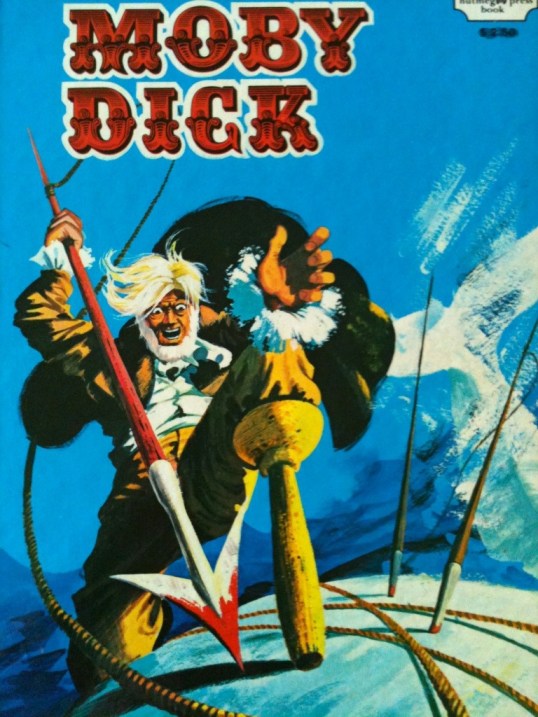
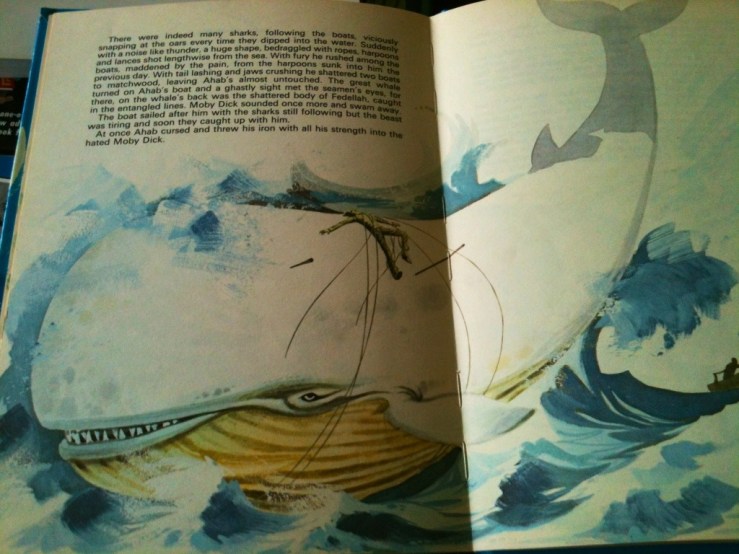
Moby Dick (Unhyphenated Kids Book Acquired 6.30.2012)

20120716-124132.jpg

I picked this one up a few weeks ago to add to a small collection of Moby-Dick adaptations. It’s especially weird: I can’t find the name of an illustrator or author anywhere (it doesn’t even mention Herman Melville!). The adaptation is also kinda weird, lingering on the gold piece scene. Anyway. Some of the pics are cool, I guess.

20120716-124139.jpg

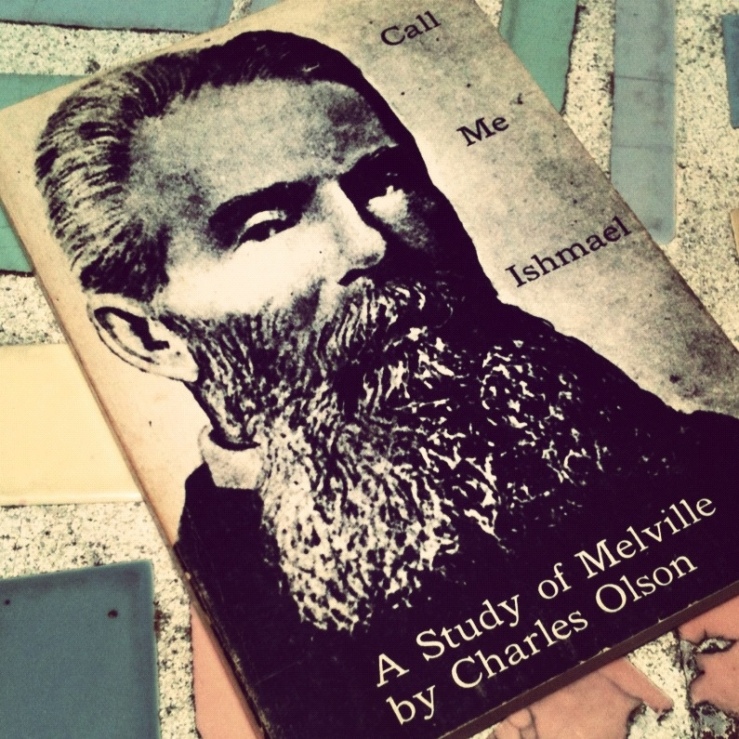
“Half Horse Half Alligator” — I Review Charles Olson’s Inimitable Melville Study, Call Me Ishmael

20120616-141629.jpg

The classical Greeks understood that literature is a form of competition. The eminent literary critic Harold Bloom folded a bit of Freudian psychology into this insight, describing the “anxiety of influence” that lurks beneath the impetus to write, the motivation to enter into an agon with the history of letters, to Oedipally assassinate—or at least assimilate—one’s literary forebears. To put this another way: What does it take to write after, say, The Odyssey? How does one answer to The Book of Job? The gall to write after Don Quixote, after Shakespeare, after Dostoevsky, after George Eliot . . .

What about Moby-Dick? What are the possibilities of even writing about Moby-Dick? (One thinks here of Ishmael’s own futile attempts to measure whales). How could Melville write after Job? After Lear? After Moby-Dick? How did Melville assimilate the texts that presented the strongest anxieties of influence in his opus? Could Melville survive the wreckage of The Pequod? These are the questions that poet-critic Charles Olson tackles—sometimes directly, sometimes obliquely, and always with brisk, sharp language—in Call Me Ishmael, his study of Melville and Moby-Dick.

Here’s one answer to my list of questions. It comes early in Olson’s book:

The man made a mess of things. He got all balled up in Christ. He made a white marriage. He had one son die of tuberculosis, the other shoot himself. He only rode his own space once—Moby-Dick. He had to go fast, like an American, or he was all torpor. Half horse half alligator.

Melville took an awful licking. He was bound to. He was an original, aboriginal. A beginner. It happens that way to the dreaming men it takes to discover America . . . Melville had a way of reaching back through time until he got history pushed back so far he turned time into space. He was like a migrant backtrailing to Asia, some Inca trying to find a lost home.

We are the last “first” people. We forget that. We act big, misuse our land, ourselves. We lose our own primary.

Melville went back, to discover us, to come forward. He got as far as Moby-Dick.

This passage illustrates Olson’s forceful, often blunt prose, the kind of language that cracks directly at Melville’s own impossible prose in Moby-Dick. I think here of the critic James Wood’s notation in his essay “Virginia Woolf’s Mysticism” that

The writer-critic, or poet-critic, has a competitive proximity to the writers she discusses. The competition is registered verbally. The writer-critic is always showing a little plumage to the writer under discussion. If the writer-critic appears to generalize, it is because literature is what she does, and one is always generalizing about oneself.

Olson may generalize as he shows a little plumage to master Melville, cutting through huge swaths of history and making poetic leaps into strange similes, but Call Me Ishmael is ultimately keenly attenuated to detail, to the processes of Melville’s constructions at the historical, economic, psychological, religious, and, yes, literary level. Although a slim 119 pages in my 1947 City Lights edition, Call Me Ishmael nevertheless vividly conveys the sources Melville synthesized to create Moby-Dick.

The book begins with an unsourced account of the whaleship Essex, attacked and destroyed by a sperm whale in the Pacific in 1820, a year after Melville’s birth. Olson trusts his readers to connect The Essex to The Pequod. Unlike so much literary scholarship, Olson’s Ishmael doesn’t torture every element of the text into overwrought explications. He provides an overview of the importance of whaling-industry-as-world’s-fuel source in a chapter that reads more like a prose poem than a stuffy history book, and then, in a chapter appropriately titled “Usufruct,” offers up entries from Melville’s own journals as primary evidence of the material that led to Moby-Dick. Olson rarely sticks his nose in here, letting the reader synthesize the selections.

Olson then plumbs Moby-Dick’s literary roots, delving into Shakespeare, particularly Lear and Antony and Cleopatra. He attends to Melville’s own annotations to Shakespeare, and then points out Melville’s literary/political condensation:

As the strongest force Shakespeare caused Melville to approach tragedy in terms of the drama. As the strongest social force America caused him to approach tragedy in terms of democracy.

It was not difficult for Melville to reconcile the two. Because of his perception of America: Ahab . . .

Ahab is the FACT, the Crew the IDEA. The Crew is where what America stands for got into Moby-Dick. They’re what we imagine democracy to be. They’re Melville’s addition to tragedy as he took it from Shakespeare. He had to do more with the people than offstage shouts in a Julius Caesar. This was the difference a Declaration of Independence made.

The Shakespeare section of Call Me Ishmael marvels: Olson’s perceptive powers simultaneously enlighten and make seemingly-familiar territory dark, strange. He then moves into a discussion of post-Moby Melville, a man perhaps crushed by his own achievement—not by any financial success, no, definitely no, but the metaphysical success. Like a Moses, Melville had found the god he so desperately needed:

Melville wanted a god. Space was the First, before time, earth, man. Melville sought it: “Polar eternities” behind “Saturn’s gray chaos.” Christ, a Holy Ghost, Jehovah never satisfied him. When he knew peaces it was with a god of Prime. His dream was Daniel’s: the Ancient of Days, garment white as snow, hair like the pure wool. Space was the paradise Melville was exile of.

When he made his whale he made his god. Ishmael once comes to the bones a Sperm whale pitched up on land. They are massive, and his struck with horror at the “antemosaic unsourced existence of the unspeakable terrors of the whale.”

When Moby-Dick is first seen he swims a snow-hill on the sea. To Ishmael he is the white bull Jupiter swimming to Crete with ravished Europa on his horns: a prime, lovely, malignant white.

Olson agrees with an 1856 journal entry by Nathaniel Hawthorne that he cites at length: Melville “can neither believe, nor be comfortable in his unbelief.” In Olson’s analysis, after having found god-in-the-whale, Melville plummets into an existential crisis. He gives over to his inner-alligator, torpid, enervated, numb, but still fierce and potent and monstrous. “He denied himself in Christianity,” writes Olson, linking the downward spiral of Melville’s career and family life to this religion.

To this end, Olson is too dismissive of Melville’s later work; when he can find nothing of the “old Melville” to praise in Benito Cereno, Bartleby, or Billy Budd, it’s almost as if he’s willfully ignoring evidence that contradicts his thesis. These are marvelous books, and if they can’t win a contest against Moby-Dick, it’s worth pointing out that little of what’s been written after that book can.

And yet we can write after Melville; we can even write on Melville. The will and vitality of Olson’s forceful, intelligent prose opens a way, or at least exemplifies a way. At the same time, paradoxically, a reading of Call Me Ishmael seems to foreclose the need, if not the possibility, of reading another study of Moby-Dick. This statement is not meant to be a knock against Melville scholarship. Here’s the thing though: life is short, time is limited, and if one plans to read a book about Moby-Dick, it should be Olson’s Call Me Ishmael. It’s great, grand stuff.

Charles Olson on Herman Melville: “When he made his whale he made his god”

From Charles Olson’s study Call Me Ishmael:

Melville wanted a god. Space was the First, before time, earth, man. Melville sought it: “Polar eternities” behind “Saturn’s gray chaos.” Christ, a Holy Ghost, Jehovah never satisfied him. When he knew peaces it was with a god of Prime. His dream was Daniel’s: the Ancient of Days, garment white as snow, hair like the pure wool. Space was the paradise Melville was exile of.

When he made his whale he made his god. Ishmael once comes to the bones a Sperm whale pitched up on land. They are massive, and his struck with horror at the “antemosaic unsourced existence of the unspeakable terrors of the whale.”

When Moby-Dick is first seen he swims a snow-hill on the sea. To Ishmael he is the white bull Jupiter swimming to Crete with ravished Europa on his horns: a prime, lovely, malignant white.

And I Only Am Escaped Alone to Tell Thee About Ridley Scott’s Prometheus

Prometheus, a big summer popcorn flick is the latest from Ridley Scott, the visionary auteur who gave us Kingdom of HeavenBody of Lies, Robin Hood, and G.I. Jane.  Okay, forgive the sarcasm—Scott is also responsible for some fine films, including Blade Runner and Alien, which Prometheus is most decidedly a prequel to, despite the early incoherent maybe-it-is-maybe-it-isn’t buzz from the studio. I list some of Scott’s recent (and not-so-recent) films as a reminder of what many film fans might be happy to overlook: Ridley Scott may have a keen sense of style and a competent grasp on storytelling and emotion, but he’s essentially a hired gun who happens to make better-than-average genre flicks. Prometheus is another entry in his middling non-canon.

Obligatory plot summary (no spoilers):

At the end of the 21st century, two archaeologists find a series of apparent star maps at ancient sites. Positing these maps as an invitation from “Engineers” — clearly, an alien species who created human life (how they make this inductive leap is never made quite clear) — the archaeologists head to the outer limits of the universe in the spaceship Prometheus. Along for the ride are a host of expendables, a skeptical Captain Janek (Idris Elba), ice-queen/corporate rep Vickers (Charlize Theron), and David (Michael Fassbender), an android who has apparently mastered Proto-Indo-European, the language these alien astronauts presumably speak (again, why this should be is never explicated). The Prometheus’s crew follow the star maps to an Earth-like moon and land near a giant temple, where they discover the remains of the Engineers, as well as some vases filled with black ooze. Being reasonable folks, they break quarantine and bring samples back on the Prometheus (recall now how Ripley tries so hard to prevent Dallas from bringing Kane back aboard the Nostromo in Alien). All proverbial hell breaks loose, and Prometheus begins to rack up a predictable body count as it slowly settles on archaeologist Shaw (played by an excellent Noomi Rapace) as its heroine.

Along the way, Prometheus gloms clumsily on to questions about creation and origin, but these questions lack real depth. The filmmakers rely heavily on clichés, hackneyed dialogue, and overdetermined images to present their creation theme, and the effect is largely divorced from the visceral spirituality we might otherwise associate with such a grand subject. Fassbender’s android is perhaps the clearest symbol of creation, a robot boy with daddy issues. (David’s creator Weyland, portrayed by Guy Pearce, foots the bill for space exploration because, of course, he’s searching for immortality. Quick aside: Why in the fuck is Pearce, a man in his forties, cast as a dying elderly man?). While Fassbender does a marvelous job as David the android, his performance retreads familiar territory (nods to Data and HAL 9000). David’s motivations are never entirely clear, and while some may argue this makes for a more interesting film, the lack of clarity is ultimately part of the film’s deflections. In Prometheus, the refusal to telegraph clear meaning isn’t subtle ambiguity, it’s the mark of empty spectacle, of filmmakers who aren’t entirely sure if they have a thesis or not.

This isn’t to say that there aren’t some fantastic moments in Prometheus. The film is beautiful, the designs impeccable, and Noomi Rapace’s Shaw emerges as an enthralling heroine, a final girl to rival Ripley. The film is at its finest when it focuses its energies on Shaw, as in a bizarre alien-abortion scene, probably the most thrilling segment of Prometheus. However, most of the marginal plots fail to coalesce. Charlize Theron’s Vickers could just as easily have been written out of the film, for example. Also, we’re told at the beginning that there are 17 crew members on Prometheus, but the body count here is so nebulous that it becomes impossible to keep track of who’s dead and who’s alive, let alone care. Ultimately, it’s the mishmash of mythologies that muddies Prometheus: Is this Pandora’s Box? Pinocchio? The Fountain of Youth? Genesis? The Book of Revelation?

Prometheus is all contours and surfaces, roomy, spacious, and slick. Near the end of the film, when one character, dying, announces “There is nothing . . .” it feels like a fairly concise summary of the film’s spiritual program. I suppose I’ve devoted so many words to Prometheus simply because I fear that it’s one of those popcorn flicks like Avatar or Inception that people will try to pretend are deep or meaningful or clever. In his glowing review, Roger Ebert suggests Prometheus is “all the more intriguing because it raises questions about the origin of human life and doesn’t have the answers.” Ebert’s analysis fails to leave out that the film doesn’t even try to answer—at best, it offers a smug shrug, a winking nihilism, pure cinematic spectacle as a substitution for meaning, gussied up in the robes of inquiry.

There is a moment though when Prometheus manages to synthesize its elegant bombast with the existential questions it wishes to pose. The end of the movie—yes, there are potential spoilers ahead—follows the same curve of self-annihilation that we see in Alien, with Ripley, final girl, safe but traumatized, a survivor who may now bear witness. In what I take to be the grandest shot in the film, a terrified Shaw gazes up at the alien spacecraft as it crashes down. The spacecraft recalls an ouroboros, the snake that eats its own tail, symbol of self-reflexivity, death-in-birth: it recalls too, both thematically and physically, the shapes of the reptilian aliens that haunt the rest of the Alien franchise. Watching the wreckage of ships, I was instantly reminded of the final chapter of Moby-Dick. In the epilogue, Ishamael tells us, “The Drama’s Done. Why then here does any one step forth? – Because one did survive the wreck.” The chapter begins with a quote from Job: “And I only am escaped alone to tell thee.” Whether or not Prometheus is actively alluding to Moby-Dick is beside the point. What both narratives do well is explore the capacity for survival, illustrating what it means to witness catastrophe on a cataclysmic scale. While Prometheus hardly explores its metaphysical questions with the depth or aplomb of Melville, it does tap into the same impulse that makes Alien such a great film, illustrating the Darwinian competition that underwrites existence.

If it seems I’ve been too hard on Prometheus, it was not my intention to declare it a bad or stupid or graceless film—again, it’s a good summer popcorn flick, filled with spectacle and thrills. I should point out that my wife and I caught the matinée, had a nice dinner, and then came home and watched AlienPrometheus actually does a remarkable job of answering to some of the mysterious imagery that dominates the planetoid scenes in that film, but it ultimately suffers by comparison with Alien. Prometheus is too antiseptic and spacious, with none of the gritty, grimy, cramped corners that makes Scott’s earlier film so scary and paranoia-inducing. Prometheus also lacks the naturalistic performances and dialogue of Alien, which I suppose is more an issue of how much film has changed since the 1970s than anything else. On the whole though, Prometheus isn’t a bad summer flick—it just can’t live up to its marketing buzz, let alone its own metaphysical posturing.

Nathaniel Hawthorne on Herman Melville: “He can neither believe, nor be comfortable in his unbelief”

Melville, as he always does, began to reason of Providence and futurity, and of everything that lies beyond human ken, and informed me that he “pretty much made up his mind to be annihilated”; but still he does not seem to rest in that anticipation; and, I think, will never rest until he gets hold of a definite belief.

It is strange how he persists — and has persisted ever since I knew him, and probably long before — in wandering to-and-fro over these deserts, as dismal and monotonous as the sand hills amid which we were sitting. He can neither believe, nor be comfortable in his unbelief; and he is too honest and courageous not to try to do one or the other.

If he were a religious man, he would be one of the most truly religious and reverential; he has a very high and noble nature, and better worth immortality than most of us.

From Nathaniel Hawthorne’s journal entry for November 20, 1856; I encountered the quote in Charles Olson’s study of Melville, Call Me Ishmael.


Book Shelves #16, 4.15.2012

20120415-113741.jpg

Book shelves series #16, sixteenth Sunday of 2012.

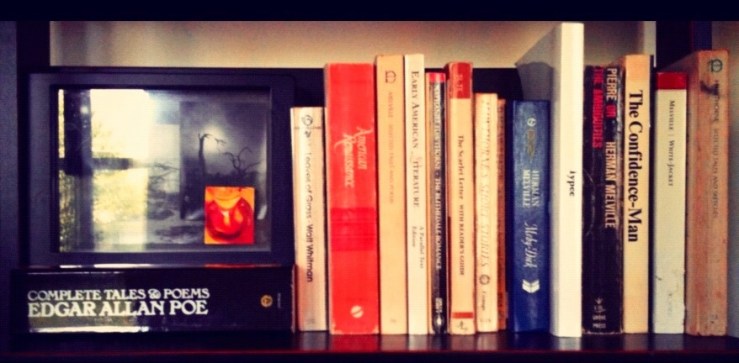
It’s hard to photograph books, and using an iPhone 3gs probably doesn’t help. Lots of glare. Anyway: This shelf houses mostly Melville, with some Hawthorne, Poe, and Whitman, as well as some critical works on the American Renaissance movement. (Henry James and F.O. Matthiessen). I have other versions of a lot of these books, including a fraternal twin in my office, a bit bulkier (Emerson, Dickinson, Thoreau, etc.), although these days I’m apt to go to the Kindle for American Renaissance stuff. Here’s a better angle, perhaps:

20120415-113756.jpg

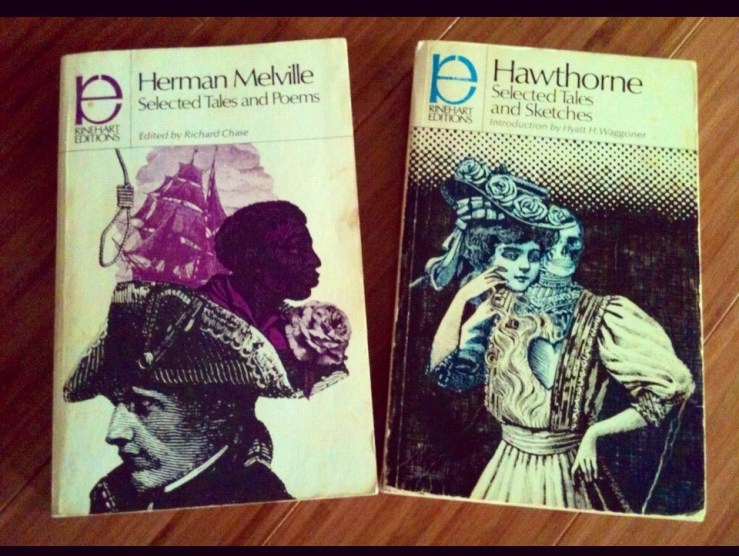
The version of Typee is bizarre: no colophon, no publisher info, just text. I love these midcentury Rinehart Editions of Hathorne and Melville stuff:

20120415-113807.jpg

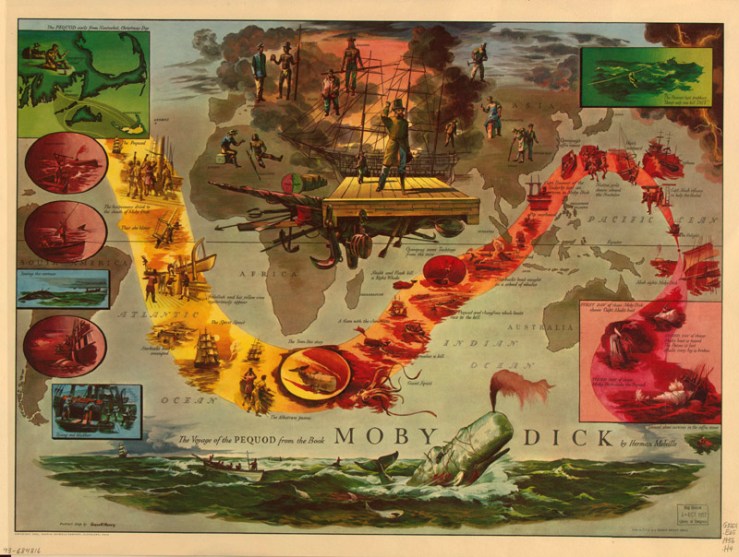
Voyage of the Pequod — A Map of Moby-Dick by Everett Henry