Post-postmodern Satire and More Juggalo Wonder

Two weeks ago, I wrote a piece about the Insane Clown Posse and Juggalo culture where I argued that ICP’s project, so heavily distorted in the tropes and defenses of postmodernity, is essentially resistant to ironic satire and even parody. My piece was prompted largely by ICP’s newest video, Miracles,” a mawkish, sweetly dumb anthem brought to life as a mutant Spencer’s Gifts blacklight poster. A day or two after I posted, a friend sent me Daniel O’Brien’s article in Cracked, Learn Your Motherf#@kin’ Science: A Textbook for Juggalos.O’Brien’s piece seeks to correct ICP’s notion that “rainbows,” “giraffes,” and “magnets” are somehow unexplainable “miracles”; he uses Juggalo vernacular to address the myriad questions (and misapprehensions) expressed in “Miracles.” O’Brien juxtaposes Juggalo-speak against the schema of school texts to point out that “Miracles” is insanely, almost heroically stupid. He does this to be funny, of course, but I think that there’s a sense of exasperation to his parody. It buckles under the strain of mocking something already so radically open to an ironic viewpoint as to render said viewpoint null and void.

About a week after O’Brien and I ran our pieces on “Miracles,” Saturday Night Live attempted another parody of ICP (see my first post for more on their first attempt). Here’s their spoof of “Miracles”:

Again, it’s not very funny. There’s no insight or satirical value, no allegorical leap–it’s just an ironic viewpoint. But what else could it be? What’s left to a satirist when his subject is literally a clown in oversized shorts rapping about the magical mysteries of magnets? In her review of the episode at AV Club, Claire Zullkey wondered, “if SNL should get much credit for a near line-by-line parody of an Insane Clown Posse video that is already ridiculous and ironic,” and Annie Wu at TV Squad noted that “it quickly became obvious that the real Insane Clown Posse video was funnier. Sorry, ‘SNL,’ but no matter how hard you try, you cannot top unintentional ICP hilarity.”

But are ICP unintentional? As I argued in my previous post, they clearly tap into authenticity or “realness” in their project, both in their music and in their connection to their fans, the Juggalos. At the same time, this authenticity is bolstered by commonplace idioms and tropes of postmodernism–code names, fictional personas, costumes, make-up, self-invented mythos, argot, and a keen emphasis on self-referentiality. These postmodern defenses render the question of intentionality radically ambiguous. This is why the old techniques of satire and parody do not hold up very well against ICP: the realness of the thing in itself transcends the ironic viewpoint. Cracked did a much better job with this video:

It’s hardly hilarious, but its mash-up technique actually surpasses ironic-viewpoint-as-parody: there’s some real commentary here. The mash-up artist juxtaposes two “real” sources–a Glade Plug-in ad and clips from the original “Miracles” video and the result is genuine satire. What’s being mocked though isn’t the inanity of the Insane Clown Posse, but the larger inanity of mass commercial culture itself, in which people are encouraged to lose critical perspective, to be reduced to a child-like state of wonder by a fucking air freshener, a consumer product. The satire works by pointing out that the ICP video isn’t really any dumber than most other commercials–it’s just so brazenly over-the-top that we notice its inanity. Indeed “Miracles” calls attention to its inanity. It’s self-aware (perhaps). In any case, this juxtaposition of “the real” shows us that successful post-postmodern satire will not invoke an ironic viewpoint, but rather call attention to the limits of an ironic viewpoint. The “loudness” of ICP’s stupidity is so extreme that we take an ironic view, but what of the far-more subtle stupidities of Glade Plug-in commercials and their ilk? If “Miracles” is to be instructive, let us learn from its distortions, for what it distorts is really just part and parcel of 21st century American culture. It is a priori irony. It is meta-criticism. But it need not be instructive. It can simply be enjoyed for (whatever) it is.

Denis Johnson’s Nobody Move and the Pleasures of Postmodern Crime Fiction

There’s an admirable precision to Denis Johnson’s Nobody Move, a dark and funny crime caper originally serialized in Playboy over four months in 2008, now available in trade paperback from Picador. Johnson limits himself to a handful of characters, a span of a few days, and four fifty-page segments to tell his story. Johnson’s economy resonates from his tight plotting and structure down to his cool, concise sentences. He works in noir archetypes, to be sure–there’s the hard-luck loser in over his head, the femme fatale with a troubled past (and present), the sadistic thug and his moll, and the sinister mastermind. Johnson’s feat here is to present all of this in a manner that’s simultaneously invigorating to the genre but also a confirmation of its pleasures.

Consider Johnson’s erstwhile protagonist, Jimmy Luntz. The name alone seems to tell us everything about this guy, a lousy gambler who spends much of his time on the run. He owes money to the wrong guys, and when a gorilla appropriately named Gambol comes to collect, Luntz makes the mistake of shooting but not killing him. Johnson traffics in immediacy in Nobody Move–there’s not a lot of backstory or dwelling on psychological motivation, thankfully–but he does offer up the occasional nugget, like this one:

Early in his teens Luntz had fought Golden Gloves. Clumsy in the ring, he’d distinguished himself the wrong way–the only boy to get knocked out twice. He’d spent two years at it. His secret was that he’d never, before or since, felt so comfortable or so at home as when lying on his back listening to the far-off music of the referee’s ten-count.

And that’s all the personal history we really need about Luntz. It’s the gaps in the story that are so engaging, that force the reader to play the role of detective in this crime story. To this end, Johnson starts the story in media res, with Luntz leaving a disappointing competition performance of his barbershop chorus. He spends much of the novel’s first half still in his white tux. The novel’s end — well, I won’t spoil the end, of course — but let’s just say that the end of the novel finds our characters poised for further nefarious adventures. But there I go, getting ahead of myself. A little more on plot: Gambol, wounded by Jimmy, finds himself being nursed by a woman named Mary. Their nascent relationship is one of the highlights of the book, funny and cruel, a bizarre study in unlikely romance. Meanwhile, Jimmy hooks up with Anita Desilvera, a dark-eyed bombshell with a serious drinking problem and a series of upcoming court dates. They complicate their problems by going on the lam together. Gambol eventually comes looking for Jimmy (he wants to literally eat his testicles) and drama and danger ensue.

Denis Johnson is arguably among the best living American writers today, having produces no fewer than two masterpieces (Tree of Smoke, one of my favorite books of the past ten years, and Jesus’ Son, one of my favorite books ever). So when he wrote a genre fiction piece under a deadline for Playboy, many critics and readers wondered what he was up to. Was he serious? How serious were we supposed to take the work? Did he need the money? The book itself offers some answers. Nobody Move is fantastic as a genre exercise, witty, dark, lean, and hard-boiled, transcending the bad or formulaic writing that can plague the genre’s novels but never trying to transcend its tropes. Put another way, Johnson here demonstrates that he can master a genre that is not his, and that he can do it under the constraints of space and time. That’s quite a feat, if you think about it, especially if you compare Nobody Move to Thomas Pynchon’s recent genre exercise, Inherent Vice, or the detective-centered works of Jonathan Lethem like Motherless Brooklyn and Gun, With Occasional Music. Pynchon’s work is in many ways a covert, loving goof on the genre, but it’s still more or less a “Thomas Pynchon” book. Lethem likes the idea of writing crime noir, but he wants to subvert it, mash it up with sci-fi, see it as a form of post-modern allegory. Roberto Bolaño is almost painfully aware of this in his fiction–his narrator in Distant Star gets to play at being a detective for a bit, but finds that it’s not nearly as fun as he would like it to be. The Savage Detectives views literature and art as a crime scene to puzzle out. And 2666 . . . well, you know about 2666 (hang on wait, you don’t know about 2666? You should really get that taken care of). Or take James Ellroy’s postmoderinst crime fiction, which owes, unwittingly or not, as much to Don DeLillo as it does to Raymond Chandler. These are all great writers, of course. But I think contrasting what they are trying to do with what Johnson is trying to do is instructive.

There’s a purity to Nobody Move, to its utter willingness to simply be what it is–and many folks won’t like that; they may even accuse Johnson of slumming. Perhaps they think it’s easy to write a tight, funny crime novel. Perhaps they know it’s not, and they think that Johnson is being solipsistic, or even mercenary. In any case, Nobody Move will probably stand outside of Johnson’s canon. And that’s unfair. Cinematic and highly visual, it recalls some of the Coen brothers’ finest work, like Blood Simple and The Man Who Wasn’t There, and even Tarantino’s Jackie Brown (minus the messy sprawl). Perhaps the best thing about Nobody Move–other than the sheer pleasure of reading it over a few afternoons, of course–is that it might motivate readers to pick up Jesus’ Son or even Tree of Smoke. For many readers, especially young readers, genre is a vital gateway to what many of us prejudicially call “more serious” literature. So pick up Nobody Move, read it, love it, and then pass it on to someone who needs to know about Denis Johnson. Recommended.

Nobody Move is available in trade paperback from Picador on April 24, 2010.

Self-Ironizing Anti-Satiric Culture and a Juggalo’s Sense of Wonder

Last year, Saturday Night Live ran an unfunny parody of an infamous viral video. SNL sought to mock the 2009 Gathering of the Juggalos Infomercial which advertised the tenth anniversary spectacular for that venerable event. The Gathering of the Juggalos is an annual outdoor music and culture festival initiated by and starring Insane Clown Posse. The best way to (try to) understand it is to watch the infomercial. You can watch the infomercial and SNL‘s parody at Current, which I suggest you do now. Done? Okay.

SNL‘s parody is not funny, it is merely observational; that is to say, it doesn’t ever approach satire. It is unfunny mimicry of something far funnier. There is no topping the riotous authenticity of the thing in itself. The original Juggalo infomercial’s joyful exuberance resists SNL‘s ironic aims–it can’t really be satirized. It is beyond kitsch, and eventually even schadenfreude. It does not seem real. Can the ICP enterprise be in earnest, though? Take their new video “Miracles,” for example–are these guys for real? Take a few minutes to watch this. I insist. (NB: Lyrics NSFW).

The video, apparently directed by Lisa Frank, communicates a sincere adoration and sense of wonder and possibility in a world of shit that’ll shock your eyelids, like: long neck giraffes, pet cats and dogs, fucking shooting stars and fucking rainbows, UFOs, crows, ghosts, moms, kids . . . you know, pure motherfucking magic. There’s a paradox in Shaggy 2 Dope and Violent J in full malevolent get-up vamping in front of rainbows and stars and expressing anger at scientists who would dare to explain how fucking magnets work. Even more perplexing, earlier this year, ICP released the trailer for their Western film, Big Money Rustlas the deadly tale of debauchery, hedonism, and family love set in a small town of Mudbug. Again, I insist you watch the trailer. (NB: Language NSFW).

How might one go about satirizing that? It already seems framed as a parody of a parody. It’s anti-satiric. It self-ironizes. But again: How sincere are ICP?

Thomas Morton’s “In the Land of the Juggalos” (Vice magazine), the authoritative, in-depth investigation into the 2007 Gathering, reveals a close-knit culture of rejects reveling in “the worst aspects of goth, punk, gangsta rap, rave, nu-metal, and real metal to create a sub-culture so universally repulsive as to forestall any attempts at outside involvement.” Equally good, and more immediately accessible is Derek Erdman’s photo essay documenting the 2009 Gathering–the one advertised in the promo video. His marvelous, grotesque photos show a sincere audience, eager members of the Psychopathic Records “family.” Take a few minutes to suck it all in. These people are serious in their Juggaloness. But again, what of ICP themselves? They can’t be art-pranksters or scammers, can they? They are clearly serious about ICP as a money-making enterprise but what about as a form of art or cultural commentary? Can they be serious about the absurd sentimental content of “Miracles” or their woefully dumb Western film? Are they for real?

There is a radical authenticity about ICP’s project. It’s an autochthonous monster engendering a legion of mutant fans. Yet it also seems potently aware of its position. ICP/Juggalo culture strikes me as a form of ritual theater assuring a sense of belonging and even meaning in life to a group of people who choose to see themselves as outcast or othered. It is inconceivable to suggest that they are wholly or even partly unaware of how others see them; indeed, awareness of how others perceive them is exactly what gives meaning to being a down-assed ninja, a true Juggalo. They see you seeing them (seeing you seeing them).

Hence a condition of post-postmodernity, of a ludic and labyrinthine culture that produces subcultures resistant to irony, to parody, to the defenses of Modernism and the techniques of postmodernism. If we contrast the gap between SNL’s parody and the real thing, we might be led to what I think David Shields is trying to describe in his book Reality Hunger, a situation where the narrative techniques of modernity (and their counterparts in postmodernism) are no longer tenable forms of discourse and analysis in an increasingly technologically mediated world.

Experiment: Imagine that you wish to satirize (or parody) Walmart. Envision the details and observations you will use to mock the behemoth, its customers, its gross place in America. Then go to a Walmart. You are trumped. Hyperbole and irony are beyond you. There is no way to top the thing in itself. You are left merely with a set of observations, not insights. An ironic viewpoint does not cease to exist, but it can’t be supported via the traditional methods of Modernism or postmodernism. Contrast South Park‘s Walmart satire with the website People of Walmart. The former attempts to justify an ironic viewpoint through the logic of satire and mimesis. The latter is an ironic viewpoint of an objective reality. It’s not even parody. It’s “real.”

And this is why SNL’s Juggalo spoof signals the limits of parody and cultural parody’s satirical, mimetic aims. Like People of Walmart, it’s just an ironic viewpoint of an objective reality. The postmodern distortions of ICP (their clown paint, their mythos, their argot, their identities, their Faygo) and the surreal, trashy carnival of the Gathering present an objective reality radically open to a host of ironic semiotic machinations delivered in an earnestness that trumps satire. ICP have already done the work for you. Their world hosts ironic oppositions; their nihilistic anthem “Fuck the World” directly contradicts the sugary magical wonder of “Miracles.” The weird identity-symbiosis they share with their fans is wholly defined by radical otherness and alienation. If you take the time to wade through comment boards on ICP related videos, news, and articles (you shouldn’t do that, btw, dear reader), you’ll find a fierce hatred of Juggalos–a fierce hatred that paradoxically defines and confers identity upon the Juggalo. This is a priori irony. ICP’s aesthetic identity resists mockery, renders mockery moot. A recent internet video, “The Juggalo News,” attempts to satirize Juggalo culture. It’s mildly amusing but ultimately offers no insight. It’s failed satire.

Far better to dispense with pointless parody and enjoy ICP’s works for whatever they are. Re-watch “Miracles.” Around 1:09 or so Violent J raps: “I fed a fish to a pelican at Frisco bay / It tried to eat my cell phone” and Shaggy responds: “He ran away,” kicking a leg back and thrusting an arm forward in a pose evocative of Superman to illustrate the action of his bosom companion’s narrative. This is more precious than gold, Shaggy’s gesture, a miracle in “Miracles,” and I will take it as an earnest gift. ICP has brought me some measure of joy, and yes, tears (of laughter) in my time, so I do thank them.

Wag’s Revue Issue 5 Out

The newest issue of the stylish and savvy online literary magazine, Wag’s Revue is out new this week. In addition to art, poetry, audio clips, and short fiction, the issue features a really cool essay by Robert Moor about Robert Coover’s groundbreaking hypertext exercise, The Hypertext Hotel. Fittingly, the essay is itself an exercise in ludic hyperlinked indeterminancy. Good stuff.

Hiding Man — Tracy Daugherty

Hiding Man, Tracy Daugherty’s excellent and insightful biography of Donald Barthelme begins with a fascinating anecdote. Daugherty, a student of Bartheleme’s, is told to “Find a copy of John Ashbery’s Three Poems, read it, buy a bottle of wine, go home, sit in front of the typewriter, drink the wine, don’t sleep, and produce, by dawn, twelve pages of Ashbery imitation.” We’re not sure if that sounds like fun homework or not, but it does signal both Barthelme’s imaginative trajectory as well as Daugherty’s intimacy with his subject. Elsewhere in his introduction, he notes that “it’s wrong to think of Don as a victim of neglect. He was, rather, a connoisseur of it.” In short, Daugherty argues that Barthelme was a “Hiding Man,” an artist of structured subtlety who remains under-appreciated and misunderstood.

Daugherty’s book is at once a well-researched biography, a work of cultural and literary criticism, and a writerly affair–that is, its written with a novelist’s fine ear. He weaves Barthelme’s personal life with the man’s stories against the backdrop of a rapidly changing society, weighing Barthelme’s themes and methods along with a shift in literature, art, film, and culture. The book is most interesting when Daugherty situates Barthelme’s writing along/against other writers, particularly the other authors at the forefront of the so-called post-modernist movement. In one late episode, Barthelme organized what has come to be known as “The Postmodern Dinner,” inviting literary giants like William Gaddis, William Gass, John Barth, Kurt Vonnegut, Robert Coover, and Susan Sontag to a fancy SoHo restaurant (Thomas Pynchon politely declined the invite). By 1983, postmodernism had fallen out of favor in lieu of minimalism; Barthelme wasn’t the only writer at the dinner who we might–even now–see as a “victim of neglect.” Many of these writers were attacked (and continue to be attacked) as verbal tricksters, hacks playing at a literary shell game. But, as Daugherty makes very clear in Hiding Man, Barthelme was deeply concerned with matters of meaning and art and philosophy and life and love. He was, like most postmodernists (and Modernists, and post-postmodernists), simply willing to remove some of the strictures that bound distinctions of high and low culture, all as a means of getting closer to a core of truth and perception–not as a means of displacing or denying it. He was an artist.

Hiding Man both begins and ends with an assignment. Daugherty invites Barthelme to read at Oregon State University in early 1989, six months before his death. After the reading, in a moment of utter poignancy, Barthelme asks his former pupil, “Did I do okay for you?” As Barthelme gets in a taxi to leave he gives Daugherty one final assignment: “Write a story about a genius.” Daugherty gets more than a passing grade on this one. Recommended.

Hiding Man is new this month in trade paperback from Picador.

The Recognitions (Part I) — William Gaddis

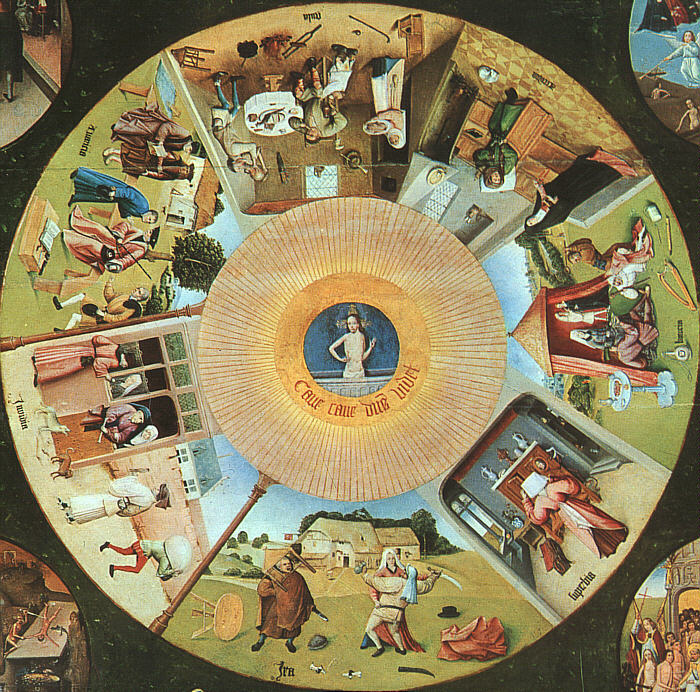
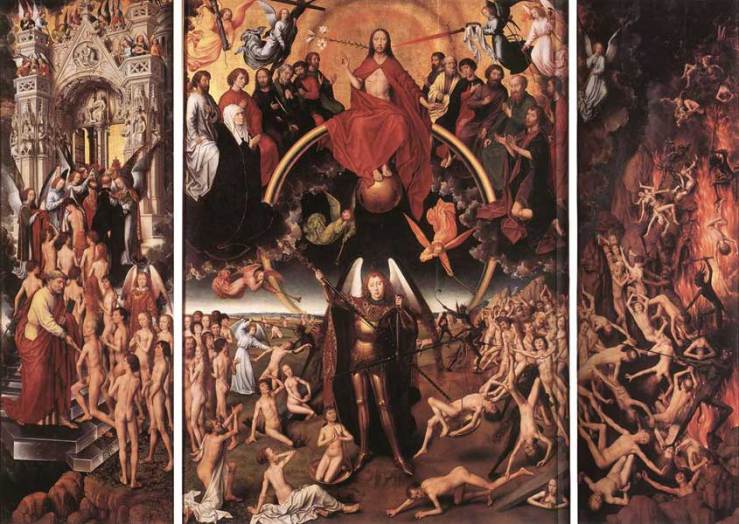
In William Gaddis‘s massive first novel, The Recognitions, Wyatt Gwyon forges paintings by master artists like Hieronymous Bosch, Hugo van der Goes, and Hans Memling. To be more accurate, Wyatt creates new paintings that perfectly replicate not just the style of the old masters, but also the spirit. After aging the pictures, he forges the artist’s signature, and at that point, the painting is no longer an original by Wyatt, but a “new” old original by a long-dead genius. The paintings of the particular artists that Wyatt counterfeits are instructive in understanding, or at least in hoping to understand how The Recognitions works. The paintings of Bosch, Memling, or Dierick Bouts function as highly-allusive tableaux, semiotic constructions that wed religion and mythology to art, genius, and a certain spectacular horror, and, as such, resist any hope of a complete and thorough analysis. Can you imagine, for example, trying to catalog and explain all of the discrete images in Bosch’s triptych, The Garden of Earthly Delights? And then, after creating such a catalog, explaining the intricate relationships between the different parts? You couldn’t, and Gaddis’s novel is the same way. I’ve finished the first of the novel’s three parts, 277 of 956 pages, and I’m going to go out on a limb and guess that the Gaddis has structured the novel as a triptych. The first part, like Bosch’s painting, The Seven Deadly Sins, is comprised of seven sections.

bosch16
The Seven Deadly Sins – Hieronymous Bosch

Early in The Recognitions, teenage Wyatt copies The Seven Deadly Sins–his father owns the original, a painted table top he purchased in Europe. Wyatt replaces the original with his own and gets away with this strange crime–no small feat considering the genius of his father, the Rev. Gwyon, a New England priest who, after the death of his wife at sea, comes to reject the austere puritanism of his order and embrace (much to the consternation of his dwindling congregation) a pluralistic religious world view. In one of many stunning passages centering on Gwyon and religion, the congregation is “stirred with indignant discomfort after listening to the familiar story of virgin birth on December twenty-fifth, mutilation and resurrection, to find they had been attending, not Christ, but Bacchus, Osiris, Krishna, Buddha, Adonis, Marduk, Balder, Attis, Amphion, or Quetzalcoatl.” This series of substitutions enacts a chain of recognitions, and, in a sense, compartmentalizes much of the thematic material of the novel: What is it to be a hero, a redeemer, a savior? What is originality, and how does one recognize it? Who originates whom? What does it mean to create? How is art separate from religion? Clearly, these are not simple questions, and The Recognitions is not a simple book.

Triptych with the Martyrdom of St. Hippolytus -- Dierck Bouts and Hugo van der Goes
Triptych with the Martyrdom of St. Hippolytus — Dierck Bouts and Hugo van der Goes

In order to pose (and perhaps offer varying answers to) these questions, Gaddis employs daring, richly detailed prose, larded with esoteric (and not so esoteric) references to mythology, religion, art, music, and literature. Like the discrete sections of Bosch’s Sins, each of the chapters of the first section of The Recognitions has its own distinct idiom, comportment, and rhythm; yet, even as Gaddis’s approaches seem discontinuous from chapter to chapter, these coalesce to a larger picture.

The first chapter is the best first chapter of any book I can remember reading in recent years. It tells the story of Rev. Gwyon looking for solace in the Catholic monasteries of Spain after his wife’s death at sea under the clumsy hands of a fugitive counterfeiter posing as a doctor (already, the book posits the inherent dangers of forgery, even as it complicates those dangers by asking who isn’t in some sense a phony). There’s a beautiful line Gaddis treads in the first chapter between pain, despair, and melancholy and caustic humor, as Gwyon slowly realizes the false limits of his religion. The chapter continues to tell the story of young Wyatt, growing up under the stern care of his puritanical Aunt May, whose religious attitude is confounded by the increasingly erratic behavior of Wyatt’s often-absent father. While deathly ill, Wyatt teaches himself to paint by copying masterworks. He also attempts an original, a painting of his dead mother, but he cannot bear to finish it because, as he tells his father, “There’s something about . . . an unfinished piece of work . . . Where perfection is still possible. Because it’s there, it’s there all the time, all the time you work trying to uncover it.” This problem of originality, of Platonic perfection guides much of the novel’s critique on Modernism.

memling_oordeel
The Last Judgment – Hans Memling

Wyatt studies but ultimately rejects the ministry, opting instead to become an artist. The second chapter finds him in Paris, attempting to sell his original work. The chapter is a bravura shift into the sounds, sights, and consciousness of another world, another distinct mythology–ex-patriot Paris, Hemingway’s Paris, Woolf’s Paris. Gaddis shows a heavy debt to James Joyce‘s innovations in Ulysses here (and throughout the book, of course), although it would be a mistake to reduce the novel to a mere aping of that great work. Rather, The Recognitions seems to continue that High Modernist project, and, arguably, connect it to the (post)modern work of Pynchon, DeLillo, and David Foster Wallace. (In it’s heavy erudition, numerous allusions, and complex voices, the novel readily recalls both W.G. Sebald and Roberto Bolaño as far as I’m concerned). By the third chapter we find Wyatt married, quite unhappily, producing hack work, copies he lets his boss put his name on. The chapter is painful and often ugly, as we see his marriage disintegrate. In this chapter he meets Recktall Brown, the Mephistophelean business man who will arrange Wyatt’s future career as a counterfeiter of original paintings. As the chapter ends, Wyatt is no longer referred to by his name, a device that continues throughout the rest of part one (and perhaps the whole book). It’s as if he’s lost something intrinsic, some core originality in exchange for the ability to “become” the artist he is emulating. Wyatt now disintegrates into the background of the narrative, and is exchanged for a young Harvard grad named Otto. Otto follows Wyatt around like a puppy, writing down whatever he says, absorbing whatever he can from him, and eventually sleeping with his wife. Otto is the worst kind of poseur; he travels to Central America to finish his play only to lend the mediocre (at best) work some authenticity, or at least buzz. He fakes an injury and cultivates a wild appearance he hopes will give him artistic mystique among the Bohemian Greenwich Villagers he hopes to impress. In the fifth chapter, at an art-party, Otto, and the reader, learn quickly that no one cares about his play–everyone’s busy making their own original art. Gaddis’s evocation of a Village party in the late forties/early fifties here is wonderful, fly-on-the-wall stuff. His rhetoric captures the buzzing musicality of a raucous house party, and even if his mockery of the assembled artists, critics, and wannabes is savage, it’s also loving. Gaddis has an astute ear for the mid-twentieth century, where gossip infiltrates debate on aesthetics, and commercials punctuate classical scores on the radio.

Wyatt (unnamed) returns for the seventh (and longest) chapter of part one. He’s been very successful at his work, although he seems not to care at all for the money he’s making. Instead, he seems obsessed with channeling these ancient masters, for only in this pre-modern world is originality possible. Of course, the levels of irony are confounding here: Wyatt’s only access to originality is to pretend to be another person. The originality of the paintings he creates is subject to the condition that they be not original to him (their creator) but to another. While this attack on Modernity–namely, that originality is impossible–is severe, it’s also worth noting that Gaddis’s writing enacts originality, even as it cobbles together disparate sources. This is what makes the novel such an addictive pleasure to read. While I cannot make any final claims about a novel before finishing it, I will go out on another limb and suggest that those who already own this novel and have not yet made a crack at it for fear of its massive size and allusive structure should go ahead and take it up: it’s dark, erudite, sad, and very, very funny. It’s also not that hard to read, and if the allusions get too dense, there’s always Steven Moore‘s fantastic resource, A Reader’s Guide to William Gaddis’s The Recognitions, now available in its entirety online. Have at it. More when I finish Part II.

Inherent Vice — Thomas Pynchon

inherent_vice

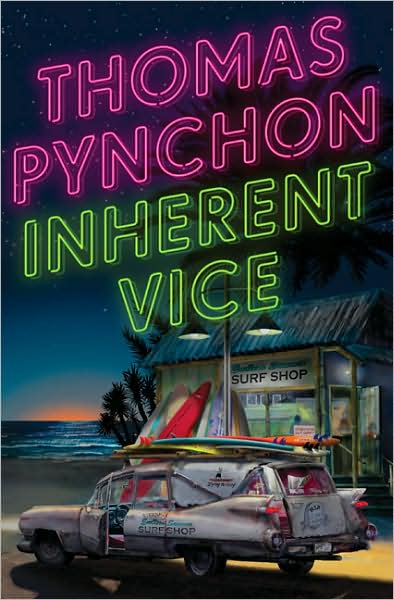
Thomas Pynchon’s latest novel, Inherent Vice is a detective-fiction genre exercise/parody set in a cartoonish, madcap circa-1970 L.A. redolent with marijuana smoke, patchouli, and paranoia. Navigating this druggy haze is private detective Doc Sportello, who, at the behest of his ex-girlfriend, searches for a missing billionaire in a plot tangled up with surfers, junkies, rock bands, New Age cults, the FBI, and a mysterious syndicate known as the Golden Fang–and that’s not even half of it. At a mere 369 pages, Inherent Vice is considerably shorter than Pynchon’s last novel Against the Day, not to mention his masterpieces Gravity’s Rainbow and Mason & Dixon, and while it might not weigh in with those novels, it does bear plenty of the same Pynchonian trademarks: a strong picaresque bent, a mix of high and low culture, plenty of pop culture references, random sex, scat jokes, characters with silly names (too many to keep track of, of course), original songs, paranoia, paranoia, paranoia, and a central irreverence that borders on disregard for the reader. And like Pynchon’s other works, Inherent Vice is a parody, a take on detective noir, but also a lovely little rip on the sort of novels that populate beaches and airport bookstores all over the world. It’s also a send-up of L.A. stories and drug novels, and really a hate/love letter to the “psychedelic 60s” (to use Sportello’s term), with much in common with Pynchon’s own Vineland (although comparisons to Elmore Leonard, Raymond Chandler, The Big Lebowski and even Chinatown wouldn’t be out of place either).

While most of Inherent Vice reverberates with zany goofiness and cheap thrills, Pynchon also uses the novel as a kind of cultural critique, proposing that modern America begins at the end of the sixties (the specter of the Manson family, the ultimate outsiders, haunts the book). The irony, of course–and undoubtedly it is purposeful irony–is that Pynchon has made similar arguments before: Gravity’s Rainbow locates the end of WWII as the beginning of modern America; the misadventures of the eponymous heroes of Mason & Dixon foreground an emerging American mythology; V. situates American place against the rise of a globally interdependent world. If Inherent Vice works in an idiom of nostalgia, it also works to undermine and puncture that nostalgia. Feeling a little melancholy, Doc remarks on the paradox underlying the sixties that “you lived in a climate of unquestioning hippie belief, pretending to trust everybody while always expecting be sold out.” In one of the novel’s most salient passages–one that has nothing to do with the plot, of course–Doc watches a music store where “in every window . . . appeared a hippie freak or a small party of hippie freaks, each listening on headphones to a different rock ‘n’ roll album and moving around at a different rhythm.” Doc’s reaction to this scene is remarkably prescient:

. . . Doc was used to outdoor concerts where thousands of people congregated to listen to music for free, and where it all got sort of blended together into a single public self, because everybody was having the same experience. But here, each person was listening in solitude, confinement and mutual silence, and some of them later at the register would actually be spending money to hear rock ‘n’ roll. It seemed to Doc like some strange kind of dues or payback. More and more lately he’d been brooding about this great collective dream that everybody was being encouraged to stay tripping around in. Only now and then would you get an unplanned glimpse at the other side.

If Doc’s tone is elegiac, the novel’s discourse works to undercut it, highlighting not so much the “great collective dream” of “a single public self,” but rather pointing out that not only was such a dream inherently false, an inherent vice, but also that this illusion came at a great price–one that people are perhaps paying even today. Doc’s take on the emerging postmodern culture is ironized elsewhere in one of the book’s more interesting subplots involving the earliest version of the internet. When Doc’s tech-savvy former mentor hips him to some info from ARPANET – “I swear it’s like acid,” he claims – Doc responds dubiously that “they outlawed acid as soon as they found out it was a channel to somethin they didn’t want us to see? Why should information be any different?” Doc’s paranoia (and if you smoked a hundred joints a day, you’d be paranoid too) might be a survival trait, but it also sometimes leads to this kind of shortsightedness.

Intrinsic ironies aside, Inherent Vice can be read straightforward as a (not-so-straightforward) detective novel, living up to the promise of its cheesy cover. Honoring the genre, Pynchon writes more economically than ever, and injects plenty of action to keep up the pace in his narrative. It’s a page-turner, whatever that means, and while it’s not exactly Pynchon-lite, it’s hardly a heavy-hitter, nor does it aspire to be. At the same time, Pynchon fans are going to find plenty to dissect in this parody, and should not be disappointed with IV‘s more limited scope (don’t worry, there’s no restraint here folks–and who are we kidding, Pynchon is more or less critic-proof at this point in his career, isn’t he?). Inherent Vice is good dirty fun, a book that can be appreciated on any of several different levels, depending on “where you’re at,” as the hippies in the book like to say. Recommended.

Inherent Vice is available from Penguin August 4th, 2009.

The Penelopiad – Margaret Atwood

thepenelopiad

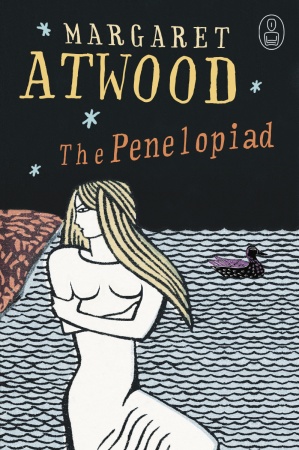
The Odyssey has long been my go-to example for phallocentric literature in the high school classes I teach. The story of wily Odysseus and his crew wandering the high seas for a decade after the Trojan War prototypifies a literature of masculine fantasy full of adventure, intrigue, and romance. While Odysseus explores the world, bedding nymphs and witches and having every kind of adventure with his boys, his wife Penelope is at home, faithful and chaste, raising kid Telemachus and keeping the would-be usurpers at bay. In short, the story of Odysseus licenses an entire tradition of phallocentric literature wherein the clever protagonist is able to duck familial and social duty and have a great adventure in the process. Think of Huck lighting out for the territory. Same deal. Not that there’s anything wrong with that. But as Margaret Atwood saliently demonstrates in The Penelopiad, her reworking of The Odyssey, there’s always another side to that story of masculine escape–and a price to that adventure, as well.

As its title suggests, The Penelopiad tells the story from the perspective of Penelope, a plain but clever girl, who–like Odysseus–must learn to live by her wits. Atwood, working from several myths, details Penelope’s divine parentage (she’s half-naiad), and her upbringing as a young maid in her father’s home. In an early key scene, Penelope’s father supposedly (the details are fuzzy, she admits) tries to murder her by drowning her, after learning that she will weave his shroud. This infanticide echoes the story of Oedipus, and also serves as a dominant motif throughout the story (it’s also twinned with a motif of eating meat–Penelope remarks at one point that she is just “meat” to be eaten). As the story progresses, young, shy Penelope slowly transforms from a naive gal with a chip on her shoulder about her preternaturally beautiful cousin, Helen, into a woman as wily as Odysseus himself. Atwood treats us to Penelope’s inner thoughts on all sorts of subjects, and even though Penelope claims to love Odysseus, it’s repeatedly clear how angry she is at not only him, but also her son.

While Penelope’s story is dominant, Atwood is very concerned with Penelope’s twelve maids, orphaned servants slain by Odysseus and Telemachus after Odysseus’ return. The maids serve as a chorus, interjecting their voice in short chapters written in a variety of styles, ranging from epic poetry to sea shanties to short skits. One of the most fascinating choral sections plays as an anthropological seminar, in which Atwood’s maids suggest that the real story of Odysseus and Penelope is in fact the displacement of a matriarchy by a wandering warrior. There’s also an inspired court scene where Odysseus is tried for killing the suitors, and the maids sue for justice.

Ultimately, Atwood paints the maids, poor orphans and slaves, as the real victims in this ancient tale. While Penelope complains that she is treated as “meat,” Atwood makes it clear that it’s really the maids who are treated as mere flesh to be consumed–slaves forced to clean, bodies subjected to repeated rapes. And while Penelope repeatedly expresses sorrow and dismay for the murder of the maids, complaining that their deaths were a result of tragic miscommunication, the maids have a different story to tell–one that ironizes much of what Penelope has to say. As the story progresses, we are frequently reminded by Penelope herself that she is a liar and storyteller on par with Odysseus and because of this insight we begin to realize that there might be something to some of the slanderous rumors she’s been protesting in her narrative. It would’ve been simple for Atwood to give Penelope a straightforward and strong voice, a voice that communicated the virtue classically identified with Penelope along with a feminist slant of insight. Instead, Atwood’s Penelope is far more complex and human, gossipy and spiteful, sympathetic and ripe for contempt. The Penelopiad ironizes not only The Odyssey (and the phallocentric literary tradition after it), but also itself; its a book that complicates our notions of history, memory, and identity, and it does so in ways both playful and profound. Highly recommended.

Death of the Author

“[O]nce I’m done with the thing, I’m basically dead, and probably the text’s dead: it becomes simply language, and language lives not just in but through the reader” — David Foster Wallace, quoted in Marshall Boswell’s Understanding David Foster Wallace

In the quote above, DFW illustrates why, when writing at his best, he was able to transcend the cold irony and post-modern goofiness of forbears (and, to some extent, contemporaries) like DeLillo and Pynchon. Wallace understood language as a game, and understood that the game was cooperative. He knew that it wasn’t enough to be clever–readers need to care about that cleverness. If the author is dead, and the text is dead, then the language has to live on through voices, through perspectives, through a series of interior identifications: this is where DFW excelled and dazzled. The myriad voices that lard Infinite Jest testify the power of walking in another’s shoes and seeing through another pair of eyes–in caring for the other. This is the power of literature, and this is why Wallace was such a powerful writer. And this is why we’ll miss him so much.

Wallace’s work went past the post-modern (counter)tradition of meta-textuality and self-referentiality, and commented–sometimes with a painful awareness and acuity–on the emotional deadening produced by contemporary irony and consumerist culture. His characters weren’t just placeholders to be pushed around in the hopes of proving a point, but real, achieved voices who lived through the reader. DFW’s project was not to simply repeat the postmodern realization of the indecidability of textuality, but to work through that realization into a new realm of connection and meaning and identification with his readers despite a cold, ironic, and sometimes meaningless world. In both his groundbreaking fiction and his brilliant essays, DFW delivered what matters the most in any piece of writing–subjects and characters you care about (often despite yourself). Postmodernist thought declares there’s nothing outside the text, a supposition many contemporary authors explore and expound upon in chilly irony or silly wordplay. Even when he was negotiating problems of meaning, signification, and communication in the face of alienation, fragmentation, and despair, David Foster Wallace gave us fully-realized worlds populated with characters we could care about.

There are any number of reports out there right now that mischaracterize DFW as an author who hid behind wordplay and irony. Consider Guy Adams ridiculous lead in The Independent: “For a writer who elevated irony to an art form, and whose infinite jesting co-existed with an all-too-apparent dark side, it felt grimly appropriate that David Foster Wallace should have chosen suicide as the means by which to end his own life story.” Did it feel “grimly appropriate”? Why? What was “grimly appropriate,” about David Foster Wallace’s suicide, Guy? Adams reinforces both his ignorance of his subject as well as his lack of literary understanding with this tidbit: “For all his natural ability, and occasional brilliance, Wallace never lived-up to the fullness of his talent, or the haunting reach of his possibilities.” Adams’s dismissive-yet-inflated rhetoric is exactly the kind of verbal posturing that needs to be shouted down right now by those who’ve actually read Wallace and can testify that his brilliance was anything but “occasional.” And that, I guess, is my only real goal here. Adams is wrong. It’s not true that “Wallace never lived-up to the fullness of his talent”–that phrase doesn’t even mean anything. Who measured the fullness of Wallace’s talent? When did that measurement take place, and in what units was said-talent measured? The measure of DFW’s talent can only be assessed by actually reading his work, and that’s what you should do–especially if you’ve been putting it off. Our author may be dead, but he lives on in a language game played with his readers via the act of reading, and this is a game where everyone stands to win.

Violence — Slavoj Žižek

Slavoj Žižek describes Violence as “six sideways glances” examining how our preoccupation with subjective violence (that is, the personal, material violence that we can see so easily in crime, racism, etc.) masks and occludes our understanding of the systemic and symbolic violence that underwrites our political, economic, and cultural hierarchies. Žižek believes that a dispassionate “step back enables us to identify a violence that sustains our very efforts to fight violence and promote tolerance,” and that a rampant “pseudo-urgency” to act instead of think currently (detrimentally) infects liberal humanitarian efforts to help others. This is where the fun comes in. Žižek delights here in pointing out all the ways in which we fool ourselves, all the ways in which we believe we’ve gained some kind of moral edge through our beliefs and actions.

I use the words “fun” and “delight” above for a reason: Violence is fun and a delight to read. Žižek employs a rapid, discursive method, pulling examples from contemporary politics, psychoanalysis, films, poetry, history, jokes, famous apocryphal anecdotes, and just about every other source you can think of to illustrate his points. And while it would be disingenuous to suggest that it doesn’t help to have some working knowledge of the philosophical tradition and counter-traditions to best appreciate Violence, Žižek writes for a larger audience than the academy. Yet, even when he’s quoting Elton John on religion or performing a Nietzschean reading of Children of Men, Žižek’s dalliances with pop culture always occur within the gravest of backdrops. Within each of Violence‘s six chapters, there’s a profound concern for not only the Big Questions but also the big events: Žižek frequently returns to the Iraq War, the 9/11 attacks, and the Israeli-Palestinian conflict as major points of consideration. This concern for contemporary events, and the materiality of contemporary events, is particularly refreshing in a work of contemporary philosophy. Undoubtedly some will pigeonhole Žižek in the deconstructionist-psychoanalytical-post-modernist camp (as if it were an insult, of course)–he clearly has a Marxist streak and a penchant for Lacanian terminology. Yet, unlike many of the writers of this philosophical counter-tradition, Žižek writes in a very clear, lucid manner. There’s also a great sense of humor here, as well as any number of beautiful articulations, like this description of the “dignity and courage” of atheism:

[A]theists strive to formulate the message of joy which comes not from escaping reality, but from accepting it and creatively finding one’s place in it. What makes this materialist tradition unique is the way it combines the humble awareness that we are not masters of the universe, but just a part of a much larger whole exposed to contingent twists of fate, with a readiness to accept the heavy burden of responsibility for what we make out of our lives. With the threat of unpredictable catastrophe looming from all sides, isn’t this an attitude needed more than ever in our own times?

I’m inclined to answer, “Yes.” Highly recommended.

Violence, part of the new BIG IDEAS // small books series from Picador Books, is available August 1st.

Underworld — Don DeLillo

Don DeLillo’s Underworld explores American culture and psyche throughout–and immediately after–the Cold War era. The book centers loosely on waste management exec Nick Shay, but diverges in constant achronological loops, employing dozens of different voices and viewpoints in order to handle a variety of themes and subjects that are, frankly, too massive to get a grip on. At all times though, Underworld seems aware of this inability to document its subject’s vastness, but, like Ishmael in Moby-Dick who attempts to systemize the unknowable whales, the characters in Underworld nevertheless try and try again to find order and meaning in a paranoid and increasingly disconnected world. The real center of the book is a baseball, the ball pitched by Brooklyn Dodger Ralph Branca to New York Giant Bobby Thomson, who won the game in a hit known as “The Shot Heard ‘Round the World.” However, this ball, this center, is repeatedly transferred, deferred, shifted, and even characters who claim to own the “real” ball understand that the validity or “realness” of the home run ball is always under question. DeLillo seems to suggest that finding fixed, stable meaning is an illusion; the best that people can hope for is to find solace in their family and friends in open, honest relationships.

By the time DeLillo had published Underworld in 1997, he had already established himself as a canonized saint of the American postmodern literary tradition, yet Underworld, in its massive size and scope (it weighs in at over 800 pages) seems primed to be the author’s “big book,” destined to fit neatly in the new canon of large and long American postmodern novels next to John Barth’s The Sot-Weed Factor, Robert Coover’s The Public Burning, Thomas Pynchon’s Gravity’s Rainbow, and David Foster Wallace’s Infinite Jest. Underworld utilizes nearly every postmodernist trope, including a nonlinear plot, myriad, discursive voices, and a willingness to engage historical figures. The novel also manages to contain a bulk of themes and devices DeLillo has employed throughout his body of work: find here the paranoid alienation of The Names, the shadow of assassination-as-spectacle from Libra, the intersection of art, violence, economics, and politics of Mao II, and the exploration of the new American religion, consumerism, that underpinned White Noise.

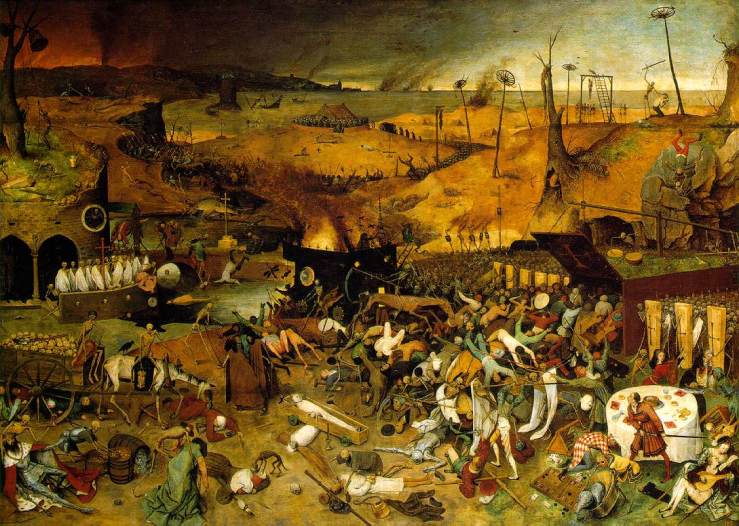
Ultimately, all of Underworld‘s themes–garbage, art, war, insulation, paranoia, drugs, death, secrets, baseball, identity, etc.–threaten to crush the narrative under their sheer weight. Unlike Pynchon, Barth, Coover, and DFW, DeLillo is rarely playful or even fun; most of the humor here serves to alienate rather than connect the reader to the characters. The book is masterfully written, and any number of the little vignettes, like the sad life of the Texas Highway Killer, or the Space-Age compartmentalization of a 1950s suburban family, expertly delineate DeLillo’s handling of concepts and motifs. However, the book’s prologue, “The Triumph of Death” (the title alludes to Bruegel’s painting), an account of the 1951 Dodgers-Giants pennant game is easily the most passionate, intense, and engaging moment of the novel. This assessment isn’t meant to suggest that the remaining 700 pages or so of Underworld aren’t as rewarding, they just aren’t as fun. Underworld is probably a work of genius, and the sum of its many, many parts do add up to more than the corpus, only that sum will probably leave a lot of readers feeling cold.

Koinonia, Praxis, Heterotopia, and Other Ten Dollar Words

Lacking the lexicon to describe your aporia? Need the right words to negotiate a particularly difficult text? Try the Dictionary of Postmodern Terms then. Fun for solipsists, sophists, and psychoanalysts of all ages.

Noam Chomsky, Intellectual Elitism, Po-Mo Gibberish, More Attacks on Deconstruction, and Bad Writing Revisited

While doing some background research for an upcoming Graduate Symposium I’ll be participating in later this month (more on that in the future), I somehow stumbled upon this post from Noam Chomsky in which the famous linguist/activist attacks post-modernism and its heroes. In this email/posting Chomsky criticizes what he views as “a huge explosion of self- and mutual-admiration among those who propound what they call “theory” and “philosophy,”” as little beyond “pseudo-scientific posturing.” Immediately, my thoughts jumped to the discussion of the Sokal Hoax I posted a few weeks back. Chomsky continues his affront to post-structuralism, arguing, much like Sokal, that the major figures of this movement–Derrida, Lacan, Foucault, Kristeva, etc.–obfuscate their arguments with an incoherent vocabulary rife with misused and misapplied scientific terminology. Chomsky on Derrida:

“So take Derrida, one of the grand old men. I thought I ought to at least be able to understand his Grammatology, so tried to read it. I could make out some of it, for example, the critical analysis of classical texts that I knew very well and had written about years before. I found the scholarship appalling, based on pathetic misreading; and the argument, such as it was, failed to come close to the kinds of standards I’ve been familiar with since virtually childhood. Well, maybe I missed something: could be, but suspicions remain […]”

Ouch!

But Chomsky’s not done yet:

“Some of the people in these cults (which is what they look like to me) I’ve met: Foucault (we even have a several-hour discussion, which is in print, and spent quite a few hours in very pleasant conversation, on real issues, and using language that was perfectly comprehensible — he speaking French, me English); Lacan (who I met several times and considered an amusing and perfectly self-conscious charlatan, though his earlier work, pre-cult, was sensible and I’ve discussed it in print); Kristeva (who I met only briefly during the period when she was a fervent Maoist); and others. Many of them I haven’t met, because I am very remote from from these circles, by choice, preferring quite different and far broader ones […] I’ve dipped into what they write out of curiosity, but not very far, for reasons already mentioned: what I find is extremely pretentious, but on examination, a lot of it is simply illiterate, based on extraordinary misreading of texts that I know well (sometimes, that I have written), argument that is appalling in its casual lack of elementary self-criticism, lots of statements that are trivial (though dressed up in complicated verbiage) or false; and a good deal of plain gibberish.”

Illiterate gibberish? Charlatan? Cults ? (This is a really common charge leveled at psychoanalysis in particular, and when one considers that both the work of Freud and Lacan was carried on by their respective daughters, there may be some validity to the claim. Still…)

Double-ouch!

Two things:

First, as a linguist, Chomsky is searching for an underlying, “universal grammar” or deep structure, a core pattern that underpins/organizes/generates all human languages. In this sense, Chomsky is searching for an ideal, a foundation. This method is in direct opposition to deconstruction, which as I understand it, seeks to decenter and disrupt all metaphysical anchors. I will never forget the class in transformational syntax I took at the University of Florida with Mohammed Mohammed (or MoMo, as we affectionately were permitted to call him). The class was a split grad/undergrad section, and MoMo scared away all of the undergrads in the first session, with the exception of myself and another student. After that point, he was always very kind to us (the undergrads) and cruel to the grads. MoMo was a Palestinian; he identified as a Jordanian refugee. He was a devout Chomskyian (cultishly so, perhaps). Derrida spoke at UF while I was in this class. I didn’t really understand what Derrida’s lecture was about, but it was very long and his English accent wasn’t so great. The next day in class, MoMo savaged Derrida for the entirety of the period on points both specific and general, most of it over our heads. It was a true rant, one of the best I’ve ever witnessed, culminating in (and I quote): “He’s full of shit!”

So Derrida certainly provoked MoMo, a strict Chomskyian–and why not? If you spend your academic career and your adult life searching for something that another person says you could never find, wouldn’t you be upset? (I believe that more than anything MoMo was upset over Derrida’s reception at UF, which was rock-starish to say the least). For MoMo, Derrida was a phony, a pied-piper misleading the children from the real issues.

Which brings me to point two–Chomsky is primarily a political figure, and really a pragmatist at heart. The core of his argument is not so much that po-mo writing is high-falutin’ nonsense, but rather that it ultimately serves no practical purpose. Here is where I would strongly disagree. The people that Chomsky attacks and their followers are re-evaluating the canon and the very notion of received wisdom. Chomsky attacks them for “misreading the classics”–but just what are the classics, and whose value systems created the notion that the classics were indeed “classic”? If Derrida & co. appear to “misread,” it is because they seek to recover the marginalized knowledge that has been buried under a sediment of givens as “truth.” Yes, the post-modern movement might have elitist tendencies, and yes, the subjects and themes of their work might not have much to do on the surface with the plight of a refugee (cf. MoMo in Jordan in 1948)…but the goal is actually in line with Chomsky’s goal–to make people question the powers that structure their lives.

I do agree, as I’ve said before, that post-modern writing often comes off as so-much sophistry and hogwash (I admit to plenty of this myself), that in some sense it relies too heavily on a coded vocabulary that seems unaccessible to the untrained eye, and that all too often an air of self-congratulation, an atmosphere of winks and nods replaces an environment of real thinking and debate. But my real take is this: any philosophy that could shake MoMo into discomposure is good. MoMo is a brilliant man and his class was fascinating, but to have seen him that day–his feathers so ruffled, his foundations tested–so infuriated over ideas–that was a beautiful thing. Right then, I knew there must be something to Derrida, something I wanted to figure out. And that’s what the best of these writers do–they infuriate us by provoking the truths that we are so sure that we hold in ourselves. They destabilize our safe spaces. They don’t allow for easy answers; they rebuke tradition. And if this approach falls into the norm in academia, becomes lazy and sedimentary, undoubtedly someone will come along and call “bullshit” on it, thus reigniting debate, questions, language. Nietzsche speaks of language as a series of hardened metaphors, language as petrified lava, sedimentary givens. This is the goal of deconstruction: to get that lava flowing again.


The Sokal Hoax, Friedrich Nietzsche, Attacks on Deconstruction, and More Bad Writing

NYU physics professor Alan Sokal wrote a paper entitled “Transgressing the Boundaries: Towards a Transformative Hermeneutics of Quantum Gravity” which was published in 1996 in Duke University’s Social Text, a cultural studies journal. The same day the article was published–with no peer review, incidentally–Sokal announced in Lingua Franca that the whole thing was a hoax, a collection of nonsense, buzzwords, and jargon, making liberal use of recontextualized quotes. Sokal’s intention was to provoke the postmodern tendencies of humanities professors, whom he viewed as having a poor understanding of the science they critiqued.

Now, anyone who has spent any time in any university’s cultural studies department or English department (they tend to be the same thing nowadays) knows that postmodernism is all the rage: the dominant thinkers tend to be of the deconstructionist/post-structuralist school of thought–Derrida, Kristeva, Deleuze, Foucault, Butler, and so on. The major goal of deconstructive analysis is to disrupt the traditional, metaphysical groundings that have been accepted as “natural” to philosophy–to free up marginalized and subjugated areas of thought and break through the layers of sedimentary “givens.” In this sense, deconstruction takes a major queue from the philosophy of Friedrich Nietzsche. In many ways Nietzsche provided not only some of the major questions that initiate a deconstructive philosophy, but also a model for how those ideas would be presented in writing.

Nietzsche’s writing is poetic and often ironically self-reflexive. In his essay “On Truth and Lie in an Extra-Moral Sense,” he makes the claim that all language is an anthropomorphic jumble of metaphors, that concepts are only constructed upon other concepts, all understood through an anthropocentric viewpoint that is impossible to abandon. Nietzsche’s writing contains this awareness; he frames his argument in a series of illustrative metaphors and similes, arguing that language does not permit people to reach the true essence of “the thing in itself”; rather, concepts are the “fractured echo[es]” of the ego seeking recognition—deceptions and illusions. In Nietzsche’s view, science can only build on these empty metaphors and therefore all scientific, empirical knowledge is a house of cards waiting to collapse. Nietzsche prefers an irrational, intuitive, liquid approach to life—a “playing with seriousness”: by abandoning stoic, static reasoning, one will gain “illumination, cheer, and redemption.” This joyful disruption is one starting point for the deconstructionists who Sokal attacked in his hoax.

Sokal obviously disagrees with Nietzsche: as a physicist, Sokal clearly values empirical, rational thought. But his real disagreement is with his perception of an abusive misuse of scientific and mathematic terminology by humanities professors. Sokal views the majority of post-modern theorists as perpetrators of hogwash, arrogant elitists who obfuscate their hollow ideas in jargon.

Okay. Now. So. Is Sokal right? Is there a tendency in humanities departments toward obscurantism with elitist undertones? Absolutely. However, I see this as the academic byproduct of the writers under attack, the detritus of myriad misunderstandings and misreadings. Nobody’s perfect, obviously. I disagree that certain of the writers Sokal attacks–Julia Kristeva in particular (a hero of mine, whose writing I find to be both wonderfully lucid and poetically profound)–are purposefully difficult. Most of the deconstructionists mentioned above take their lead from Nietzsche, and thus employ a strange, elliptical, roundabout and often poetic strategy to their writing. The deconstructionist methodology itself is an affront to easy readings–simply put, it’s meant to make you think. Furthermore, philosophy, for most of us, is not beach reading.

Interestingly, and perhaps ironically, Sokal’s gesture is an essentially postmodern move, a deconstructive move–a challenge to the new establishment of academic humanities and cultural studies. Even his use of recontextualized quotes is an affirmation of Derrida’s concept of iterability. The greatest value of the hoax is that it reinforces the tenets of deconstruction: to upset the places we feel are comfortable and safe, prompting constant re-examination of our aims and goals. Sokal’s hoax initiates a dynamic rethinking of the way we write and the way we read. Who are we writing for? How are we presenting our ideas? Do we understand what we are saying? More than anything, Sokal’s hoax calls attention to the constant need for peer review, for academia to question itself, its products, its institutions.

Dave Eggers on Infinite Jest

ij.jpg

Last week Little Brown published a new edition of David Foster Wallace’s Infinite Jest featuring a new introduction by Dave Eggers. You can read the whole introduction here (thanks to Bob Tomorrowland for sending me the link).

Eggers’ intro weighs in on the current “readability” debate in contemporary fiction. In his 2002 essay “Mr. Difficult,” Jonathan Franzen (author of The Corrections) attacked “difficult fiction,” focusing on writers like William Gaddis and Thomas Pynchon, whom Franzen views as “Status” writers who don’t really care about their audience. Franzen posits that “Contract” writers (like himself) take a more humanist, social approach. In his intro, Eggers avers that DFW’s work denies these classifications; the content of DFW’s work may be complex and weighty and downright philosophical, but DFW’s tone and his humor and his pathos ultimately allow for an accessible, fun read.

This blog has previously come out against Franzen’s argument: biblioklept is a fan of both the difficult and the more accessible–and the work of authors like Eggers and DFW prove that Franzen’s types are empty models. It’s too bad for Franzen that Gravity’s Rainbow and Ulysses require more work on the part of the reader than say, Stephen King or Tom Clancy. The Bible and Shakespeare and Moby-Dick and Gabriel García Márquez also require work from the reader, and no one could make a legitimate argument for removing them from the literary canon. One day, Infinite Jest will take its place in that same canon, alongside the work of Pynchon, John Barth and Don DeLillo–all authors whose work requires some effort on the part of the reader.

Eggers disscusses the effort required to read Infinite Jest, noting that it’s not a book you can simply put down and come back to a few weeks later. From my own IJ reading experience, I know this to be true: I made three attempts before finally getting into it; once I was “into” it, I was addicted, reading well past my bedtime, lugging the large object around on the Tokyo subway, reading snatches during my lunch break. IJ made me laugh loudly, it made me cry a few times; I even found myself so excited that I had to stand up during the climactic fight between Don Gately and the mysterious guys in Hawaiian shirts. When I finished the book, I immediately started re-reading it, sifting through its dense language for added meaning. And one day (month), when I have the time, I plan on reading it in its entirety again.

If you have any interest in this book, read Eggers’ foreward–he does a much better job selling this book than I could. I will say that this book is a favorite of mine, and that if you put the time and effort into it, you won’t be disappointed.

Lydia Cabrera–Afro-Cuban Tales

afro-cuban-tales.jpg

In a sublime synthesis of traditional folklore and imagistic surrealism, Lydia Cabrera’s Afro-Cuban Tales questions the normative spaces occupied by bodies. Deriving from animist tradition, her characters exist in an impossible multiplicity of spaces, being at once animals and plants, humans and gods. Cabrera’s characters endure trials of biological identity and social co-existence, and through these problems they internalize authority, evince taboos, and create a social code. Cabrera’s trickster characters provoke, challenge, or otherwise disrupt the symbolic order of this code. In “Bregantino Bregantín,” a story that recalls Freud’s primal horde theory, as well as the work of more contemporary theorists such as Julia Kristeva and Judith Butler,  narcissist Bull kills all the males of his kingdom and takes all the women for himself.  The sadistic titular turtle of “Papa Turtle and Papa Tiger” uses the power of his dead friend’s antlers to shame, torment, and torture the other animals of his community. And in the magical realism of “Los Compadres,” Capinche seeks to put the horns on his best friend Evaristo by sleeping with his wife–a transgression that ends in necrophilia. This union of sex and death, creation and destruction is the norm in Cabrera’s green and fecund world; the trickster’s displacements of order invariably result in reanimation, transformation, and regeneration—the drawing, stepping-over, and re-drawing of boundaries. A couple of days, Bob hipped me to this really cool Run Wrake short film called Rabbit. While not directly related to Afro-Cuban Tales, this film nonetheless captures the book’s key themes and motifs of death and resurrection, transformation and language, and the trickster’s power to disrupt social and familial codes. Highly recommended.

Girl With Curious Hair–David Foster Wallace

dfw.gif

Scott Martin was kind enough to loan me this book. Did he know that it would forever change the way I read? It was the first semester of my freshman year in college, and I was slowly reaching beyond stuff like Henry Miller, Wm Burroughs and Franz Kafka. David Foster Wallace’s short story collection Girl With Curious Hair introduced me to a whole new world of writing. Reading DFW is like having a very witty friend tell you a moving and funny story over a  few beers. He’s hilarious, thought-provoking, and not nearly as hard to read as people seem to think (by the way, simply googling “David Foster Wallace” will yield several vitriolic essays by people who think that DFW is somehow duping his readers. He’s not. These people don’t know a good story when they read one.)

Girl features “real people” like Alex Trebek, David Letterman, and Lyndon Johnson as characters, but constantly destabilizes any realism these figures might lend to the story. The novella included in this collection, Westward the Course of Empire Takes Its Way, alludes directly to John Barth’s Lost in the Funhouse (another book I’ve loaned out and never gotten back). Westward takes a critical but humorous look at how culture is commodified: the plot centers around a reunion for everyone who has ever acted in a McDonald’s commercial. At the reunion, plans are revealed for a series of real-life “Funhouses,” based on the work of “Dr. Ambrose” (Barth’s stand-in in Westward).

Girl with Curious Hair is probably the best starting point for anyone interested in DFW but daunted by 1000 pages of Infinite Jest (IJ is yet another one I loaned out and never got back). Girl‘s stories have a little more ‘pop’ to them than DFW’s latest collection, Oblivion, and Girl tends to be easier to find used than DFW’s other collections, Brief Interviews with Hideous Men (actually a better collection, in my opinion) and A Supposedly Fun Thing I’ll Never Do Again (a collection of hilarious essays and nonfiction).

To sum up: if you still haven’t read DFW go consume this book; when you’re done you’ll be left wondering: “What other good stuff have I been missing out on?”