Roberto Bolaño on William Burroughs

Here’s Roberto Bolaño on William Burroughs (from New Directions’ forthcoming collection of Bolaño’s essays, newspaper columns, and other ephemera Between Parentheses)—

For some of those of my generation, William Burroughs was the affectless man, the shard of ice that never melted, the eye that never closed. They say he possessed every vice there was, but I think he was a saint who attracted all the sinners in the world because he was gracious and unwise enough never to shut his door. Literature, his livelihood for the last thirty years, interested him, but not too much, and in that regard he was like other classic American figures who focused their efforts on observing life or on experience. When he talked about what he read one got the impression that he was remembering vague stretches of time in prison.

Bolaño the Biblioklept

The New York Review of Books has published an excerpt of Roberto Bolaño’s essay “Who Would Dare?” It’s from the forthcoming collection, Between Parentheses: Essays, Articles and Speeches (1998–2003) (translated by Natasha Wimmer; published by New Directions). A sample—

The books that I remember best are the ones I stole in Mexico City, between the ages of sixteen and nineteen, and the ones I bought in Chile when I was twenty, during the first few months of the coup. In Mexico there was an incredible bookstore. It was called the Glass Bookstore and it was on the Alameda. Its walls, even the ceiling, were glass. Glass and iron beams. From the outside, it seemed an impossible place to steal from. And yet prudence was overcome by the temptation to try and after a while I made the attempt.

The first book to fall into my hands was a small volume by [the nineteenth century erotic poet] Pierre Louÿs, with pages as thin as Bible paper, I can’t remember now whether it was Aphrodite or Songs of Bilitis. I know that I was sixteen and that for a while Louÿs became my guide. Then I stole books by Max Beerbohm (The Happy Hypocrite), Champfleury, Samuel Pepys, the Goncourt brothers, Alphonse Daudet, and Rulfo and Areola, Mexican writers who at the time were still more or less practicing, and whom I might therefore meet some morning on Avenida Niño Perdido, a teeming street that my maps of Mexico City hide from me today, as if Niño Perdido could only have existed in my imagination, or as if the street, with its underground stores and street performers had really been lost, just as I got lost at the age of sixteen.

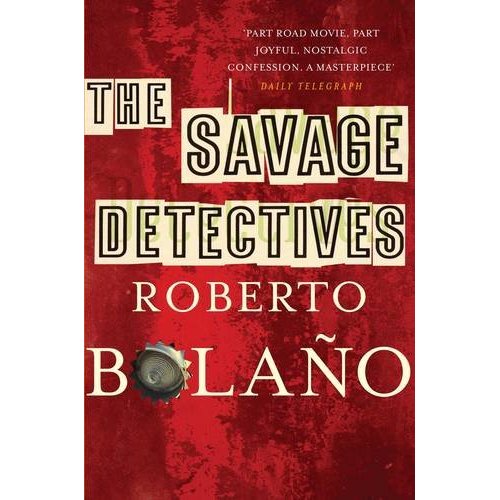
“We Never Saw the Shooters” — A Passage from Roberto Bolaño’s Novel The Savage Detectives

A late passage from our favorite section of Roberto Bolaño’s novel The Savage Detectives–

It was then, when there was nothing left to do, when we had already written and photographed everything imaginable, that someone proposed that a few of us take a trip to the interior. Most, of course, turned down the offer. A Frenchman from Paris Match accepted. So did an Italian from Reuters, and me. The trip was organized by one of the guys who worked in the kitchen at the Center and who, besides making a few bucks, wanted to have a look at his town, which he hadn’t been back to in six months, even though it was only fifteen or twenty miles from Monrovia. During the trip (we were in a dilapidated Chevy driven by a friend of the cook, armed with an assault rifle and two grenades) the cook told us that he was ethnic Mano and his wife was ethnic Gio, friends of the Mandingo (the driver was Mandingo) and enemies of the Krahn, whom he accused of being cannibals, and that he didn’t know whether his family was dead or alive. Shit, said the Frenchman, we should go back. But we were already halfway there and the Italian and I were happy, using up the last of our film.
And so, without crossing a single checkpoint, we passed through the town of Summers and the hamlet of Thomas Creek, the Saint Paul River occasionally appearing to our left and other times lost from sight. The road was bad. At times it ran through the forest, what may have been old rubber plantations, and at times along the plain. From the plain one could guess at more than see the gently sloping hills rising in the south. Only once did we cross a river, a tributary of the Saint Paul, over a wooden bridge in perfect condition, and the only thing presenting itself to the camera’s eye was nature, nothing I would call lush, or even exotic, so I don’t know why it reminded me of a trip I made as a boy to Corrientes, but I even said as much, I said to Luigi: this looks like Argentina, saying it in French, which was the language in which the three of us communicated, and the guy from Paris Match looked at me and said that he hoped it only looked like Argentina, which frankly disconcerted me, because I wasn’t even talking to him, was I? and what did he mean? that Argentina was even wilder and more dangerous than Liberia? that if the Liberians were Argentinians we would’ve been dead by now? I don’t know. In any case his remark completely broke the spell for me and I would have liked to have it out with him then and there, but I know from experience that kind of argument gets you nowhere, and anyway the Frenchman was already annoyed by our majority decision not to go back and he had to let off steam somehow, not being satisfied by his constant grumbling about the poor black guys who just wanted to make a few dollars and see their families again. So I pretended not to have heard him, although mentally I wished him a monkey fucking, and I kept talking to Luigi, explaining things that until that moment I thought I’d forgotten, I don’t know, the names of the trees, for example, which to me looked like the old Corrientes trees and had the same names as the Corrientes trees, although they obviously weren’t the Corrientes trees. And I guess my enthusiasm made me seem brilliant, or in any case much more brilliant than I am, and even funny, to judge by Luigi’s laughter and the occasional laughter of our companions, and it was in an atmosphere of relaxed camaraderie, excluding the Frenchman Jean-Pierre, of course, who was increasingly sulky, that we left behind those ever so Corrienteslike trees and entered a treeless stretch, only brush, bushes that were somehow sickly, and a silence split from time to time by the call of a solitary bird, a bird that called and called and received no answer, and then we started to get nervous, Luigi and I, but by then we were too close to our goal to turn back, and we kept going.
The shots began soon after the village came into sight. It all happened very fast. We never saw the shooters and the firing didn’t last longer than a minute, but by the time we came around the bend and were in Black Creek proper, my friend Luigi was dead and the arm of the guy who worked at the center was bleeding and he was whimpering quietly, crouched under the passenger seat.
We too had automatically dropped to the floor of the Chevy.
Continue reading ““We Never Saw the Shooters” — A Passage from Roberto Bolaño’s Novel The Savage Detectives”

“The novel, so unanimously acclaimed, was called Twilight” — An Excerpt from Roberto Bolaño’s 2666

The following excerpt of Roberto Bolaño’s 2666 is more or less self-contained, or at least as self-contained as anything in that labyrinth. It’s the summary of a character named Ansky’s novel; Hans Reiter (aka Archimboldi) is reading Ansky’s diaries while hiding during the war–

The novel, so unanimously acclaimed, was called Twilight and its plot was very simple: a boy of fourteen abandons his family to join the ranks of the revolution. Soon he’s engaged in combat against Wrangel’s troops. In the midst of battle he’s injured and his comrades leave him for dead. But before the vultures come to feed on the bodies, a spaceship drops onto the battlefield and takes him away, along with some of the other mortally wounded soldiers. Then the spaceship enters the stratosphere and goes into orbit around Earth. All of the men’s wounds are rapidly healed. Then a very thin, very tall creature, more like a strand of seaweed than a human being, asks them a series of questions like: how were the stars created? where does the universe end? where does it begin? Of course, no one knows the answers. One man says God created the stars and the universe begins and ends wherever God wants. He’s tossed out into space. The others sleep. When the boy awakes he finds himself in a shabby room, with a shabby bed and a shabby wardrobe where his shabby clothes hang. When he goes to the window he gazes out in awe at the urban landscape of New York. But the boy finds only misfortune in the great city. He meets a jazz musician who tells him about chickens that talk and probably think.

“The worst of it,” the musician says to him, “is that the governments of the planet know it and that’s why so many people raise chickens.”

The boy objects that the chickens are raised to be eaten. The musician says that’s what the chickens want. And he finishes by saying:

“Fucking masochistic chickens, they have our leaders by the balls.”

He also meets a girl who works as a hypnotist at a burlesque club, and he falls in love. The girl is ten years older than the boy, or in other words twenty-four, and although she has a number of lovers, including the boy, she doesn’t want to fall in love with anyone because she believes that love will use up her powers as a hypnotist. One day the girl disappears and the boy, after searching for her in vain, decides to hire a Mexican detective who was a soldier under Pancho Villa. The detective has a strange theory: he believes in the existence of numerous Earths in parallel universes. Earths that can be reached through hypnosis. The boy thinks the detective is swindling him and decides to accompany him in his investigations. One night they come upon a Russian beggar shouting in an alley. The beggar shouts in Russian and only the boy can understand him. The beggar says: I fought with Wrangel, show some respect, please, I fought in Crimea and I was evacuated from Sevastopol in an English ship. Then the boy asks whether the beggar was at the battle where he fell badly wounded. The beggar looks at him and says yes. I was too, says the boy. Impossible, replies the beggar, that was twenty years ago and you weren’t even born yet.

Then the boy and the Mexican detective set off west in search of the hypnotist. They find her in Kansas City. The boy asks her to hypnotize him and send him back to the battlefield where he should have died, or accept his love and stop fleeing. The hypnotist answers that neither is possible. The Mexican detective shows an interest in the art of hypnosis. As the detective begins to tell the hypnotist a story, the boy leaves the roadside bar and goes walking under the night sky. After a while he stops crying.

He walks for hours. When he’s in the middle of nowhere he sees a figure by the side of the road. It’s the seaweedlike extraterrestrial. They greet each other. They talk. Often, their conversation is unintelligible. The subjects they address are varied: foreign languages, national monuments, the last days of Karl Marx, worker solidarity, the time of the change measured in Earth years and stellar years, the discovery of America as a stage setting, an unfathomable void—as painted by Dore—of masks. Then the boy follows the extraterrestrial away from the road and they walk through a wheat field, cross a stream, climb a hill, cross another field, until they reach a smoldering pasture.

In the next chapter, the boy is no longer a boy but a young man of twenty-five working at a Moscow newspaper where he has become the star reporter. The young man receives the assignment to interview a Communist leader somewhere in China. The trip, he is warned, is extremely difficult, and once he reaches Peking, the situation may be dangerous, since there are lots of people who don’t want any statement by the Chinese leader to get out. Despite these warnings, the young man accepts the job. When, after much hardship, he finally gains access to the cellar where the Chinese leader is hidden, the young man decides that not only will he interview him, he’ll also help him escape the country. The Chinese leader’s face, in the light of a candle, bears a notable resemblance to that of the Mexican detective and former soldier under Pancho Villa. The Chinese leader and the young Russian, meanwhile, come down with the same illness, brought on by the pestilence of the cellar. They shake with fever, they sweat, they talk, they rave, the Chinese leader says he sees dragons flying low over the streets of Peking, the young man says he sees a battle, perhaps just a skirmish, and he shouts hurrah and urges his comrades onward. Then both lie motionless as the dead for a long time, and suffer in silence until the day set for their flight.

Each with a temperature of 102 degrees, the two men cross Peking and escape. Horses and provisions await them in the countryside. The Chinese leader has never ridden before. The young man teaches him how. During the trip they cross a forest and then some enormous mountains. The blazing of the stars in the sky seems supernatural. The Chinese leader asks himself: how were the stars created? where does the universe end? where does it begin? The young man hears him and vaguely recalls a wound in his side whose scar still aches, darkness, a trip. He also remembers the eyes of a hypnotist, although the woman’s features remain hidden, mutable. If I close my eyes, thinks the young man, I’ll see her again. But he doesn’t close them. They make their way across a vast snow-covered plain. The horses sink in the snow. The Chinese leader sings. How were the stars created? Who are we in the middle of the boundless universe? What trace of us will remain?

Suddenly the Chinese leader falls off his horse. The young Russian examines him. The Chinese leader is like a burning doll. The young Russian touches the Chinese leader’s forehead and then his own forehead and understands that the fever is devouring them both. With no little effort he ties the Chinese leader to his mount and sets off again. The silence of the snow-covered plain is absolute. The night and the passage of stars across the vault of the sky show no signs of ever ending. In the distance an enormous black shadow seems to superimpose itself on the darkness. It’s a mountain range. In the young Russian’s mind the certainty takes shape that in the coming hours he will die on that snow-covered plain or as he crosses the mountains. A voice inside begs him to close his eyes, because if he closes them he’ll see the eyes and then the beloved face of the hypnotist. It tells him that if he closes his eyes he’ll see the streets of New York again, he’ll walk again toward the hypnotist’s house, where she sits waiting for him on a chair in the dark. But the Russian doesn’t close his eyes. He rides on.

The Paris Review Will Publish Roberto Bolaño’s The Third Reich; Read an Excerpt Now

Beginning with its next issue, The Paris Review will serialize Roberto Bolaño’s “lost manuscript,” The Third Reich. The Wall Street Journal’ Speakeasy blog has a (very short) excerpt. An excerpt of that excerpt–

“Poor man,” I heard Hanna say.

I asked to whom she was referring; I was told to take a closer look without being obvious about it. The rental guy was dark, with long hair and a muscular build, but the most noticeable thing about him by far was the burns—I mean burns from a fire, not the sun—that covered most of his face, neck, and chest, and which he displayed openly, dark and corrugated, like grilled meat or the crumpled metal of a downed plane.

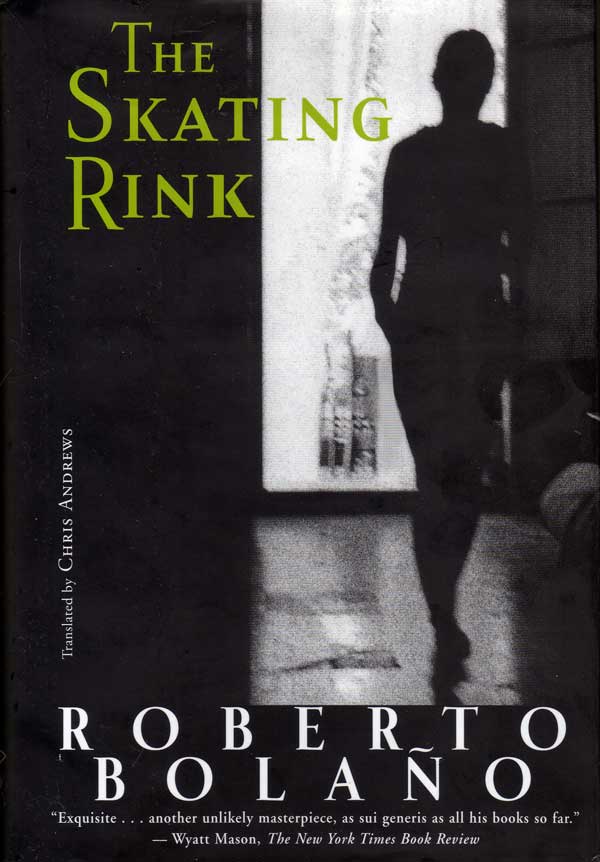
The Skating Rink — Roberto Bolaño

The Skating Rink was the first novel Roberto Bolaño published, a murder mystery in Spanish, all the way back in 1993.  It’s a short novel, but full of devices and ideas that readers will recognize from the late Chilean master’s later and better-known works. Characters who populate the novel recount events as if speaking extemporaneously to a reporter or a detective and discuss ideas and themes that the author would return to again and again:  obsession, alienation, lack of national identity, underappreciated poets, homelessness, and homicide.  The Skating Rink is a brief novel at 179 sharp and engaging pages. It wouldn’t be incorrect to call it a minor novel, but it would be a mistake to consider it merely a warm-up for the more intricate routines that the writer would perfect in the future.

The novel is about the construction and existence of a clandestine ice rink built in a deserted mansion on the cliffs of a seaside resort town in Catalonia, Spain. Erected to please Nuria Marti, a beautiful figure skater cut from the Spanish Olympic team, the rink and its inspiration are reserved and glacial while the locals who populate the seasonally bustling city are, with varying degrees of success, just trying to hold everything together. When the body of an itinerant singer is discovered in the middle of the ice deep within the labyrinthine halls of the decaying house, everything the characters have strained to preserve begins to fall apart.

The book is narrated by three men who represent different strata of Spanish society. Enric Rosquelle is an outwardly arrogant bureaucrat in charge of the city’s various social service agencies whose desperate need for love leads him to embezzle the funds  in order to build the skating facility for the athlete he knows will never return his feelings. Gaspar Heredia is an illegal Chilean immigrant who works in a campground for tourists and falls for a homeless woman who never relinquishes the kitchen knife she keeps tucked in her jeans.  Remo Moran, a legal arrival from Chile, has enjoyed success as a businessman and as a poet and is anxious about his own precarious sexual relationship with Nuria. Each man is more or less aware of his shortcomings and they utilize similar Bolañesque (Bolañan?) digressions to explain their motivations and feelings. They come to know and discuss each other in their retelling of events and so become interesting, sympathetic, and full characters.  Enric is jealous of Remo and suspicious that South Americans in general trade in filth and drugs.  Gaspar relies on his old friend Remo for his job and secretly watches Enric coaching Nuria.

The sense of loneliness and the failure to take advantage of fleeting opportunities are palpable. In a number of places, the narrative and the novel’s setting evoke a Wong Kar-wai movie. In slow motion, men follow women through cobblestone streets, not quite able to grasp that thing they desire. Hang-gliders dance in the sky and while everyone else is watching the fliers against the cool blue sky, we’re being told about how she’s just disappeared through a door down a side street. Solitary women stroll up cliff-side highways while our narrators limp behind. I almost expect Gaspar to sit down next to Tony Leung while cellos or Chinese versions of well-known pop tunes play from a nearby jukebox.  Unlike Wong Kar-wai though, Bolaño sees the single-minded pursuit of unrequited love as pathological and often a precursor to violence. The men in The Skating Rink, like any number of other men who populate Bolaño’s novels, are unable to resist the wills of the women they love or submit to personally or professionally. Two men here are willing to sublimate their own wishes for those of Nuria, whose choice of profession illustrates her own desire to overcome the normal limitations of geography, climate, and national history. As they seek her favor, they find themselves acting in unfamiliar ways, on uncertain paths and  unconcerned with appearance or ethics.

Like most of Bolaño’s work, endings (and beginnings and middles) are ambiguous. Readers are left unsure as to what has actually happened and the murder remains (I think) unsolved.  The Skating Rink could serve as an easy introduction to the writer’s more complex creations because it deals with time and plot in a relatively conventional manner. The characters get to say proper good-byes and reflect on the things that have happened to them. Like a standard mystery, most of the knots have been untangled.  But because real understanding sits just outside of consciousness, this reader is still waiting for the feeling that my task is complete. There are occasional missteps, like when Bolaño compares an elderly woman’s voice to a locker room, but passages lodge in your head like slow songs on repeat in dark comfortable places. Like those jams, The Skating Rink might be a masterpiece or something to be forgotten when something better comes along.  It’s short, so listen to it a couple times and decide for yourself.

“It Sounds Like the Title of a David Lynch Film” — A Passage from Roberto Bolaño’s 2666

A passage from Roberto Bolaño’s opus 2666

The card for the Santa Teresa cybercafe was a deep red, so red that it was hard to read what was printed on it. On the back, in a lighter red, was a map that showed exactly where the cafe was located. He asked the receptionist to translate the name of the place. The clerk laughed and said it was called Fire, Walk With Me.

“It sounds like the title of a David Lynch film,” said Fate.

The clerk shrugged and said that all of Mexico was a collage of diverse and wide-ranging homages.

“Every single thing in this country is an homage to everything in the world, even the things that haven’t happened yet,” he said.

After he told Fate how to get to the cybercafe, they talked for a while about Lynch’s films. The clerk had seen all of them. Fate had seen only three or four. According to the clerk, Lynch’s greatest achievement was the TV series Twin Peaks. Fate liked The Elephant Man best, maybe because he’d often felt like the elephant man himself, wanting to be like other people but at the same time knowing he was different. When the clerk asked him whether he’d heard that Michael Jackson had bought or tried to buy the skeleton of the elephant man, Fate shrugged and said that Michael Jackson was sick. I don’t think so, said the clerk, watching something presumably important that was happening on TV just then.

“In my opinion,” he said with his eyes fixed on the TV Fate couldn’t see, “Michael knows things the rest of us don’t.”

“We all know things we think nobody else knows,” said Fate.

Books I Am Always (Re-)Reading

Trudging through a very long book the other night–never mind the title, at least now anyway–it occurred to me that I’d rather be reading from 2666; that, at that particular moment, I’d rather re-read from “The Part About the Crimes.” I don’t know if it was the effete dullness of the first volume that made me want to pick up Bolaño’s epic, perhaps trying to zap some life into my waning eyeballs; perhaps it was just the sense that I was wasting my time with the merely good, which, after all, is mediocrity when set against genius (yes, these are subjective terms).

Anyway, I didn’t have to go looking for 2666 — I have a copy (yes, I have two) right there jammed into my nightstand, along with a few other books that I realize that I’m always reading. Furthermore, I’m always reading these books in the most discontinuous, stochastic fashion, often picking them up at random and thumbing through them. I think I use these books to clear my literary palate, to get a bad (or worse, boring) taste out of my brain, to inspire me, to suggest another book. Some of these books, like 2666 are big, fat volumes, volumes that I set close at hand in the hopes of rereading in full. Sometimes I’ve met this goal; in the case of Moby-Dick, I’ve read the book through at least three times now, and yet never tire of it. I’m always picking it up again and again, sometimes to find Elijah’s rant or to dip into Ahab’s mad monologue or perhaps just to hear Stubb comment on the proper preparation of shark steaks. Of a piece with those big novels is David Foster Wallace’s Infinite Jest, which I turn to repeatedly, reading over a riff or two at a time, perhaps still trying to figure out the ending, or some clue of the ending, perhaps trying to figure out why Hal can’t speak (you know, beyond like, a a metaphorical level).

There’s also Blood Meridian.

A book I always keep proximal is D.H. Lawrence’s Studies in Classic American Literature, which, if this were a dictatorship under Biblioklept might replace the Constitution (jaykay, Tea Partiers!). Tellingly, I’ve never managed to finish one of Lawrence’s novels (I even struggle through his much-anthologized piece, “The Rocking Horse Winner”), but I consider his dissertations on Hawthorne, Poe, and Melville indispensable (and creative in their own right). I guess I just like lit crit; Harold Bloom’s too-huge volume The Western Canon is a book I return to again and again. Sometimes I find myself throwing it to the ground, quite literally (if I’ve enjoyed a drink or two, that is), in disgust. Bloom’s battle with “The School of Resentment” can be maddening, especially when he’s so up front about essentially making Shakespeare God. Still, Shakespeare doesn’t seem like a bad God to have.

I should point out that I’ve made no attempt to read The Western Canon the whole way through; in fact, I’ve never made a single attempt to read it systematically. I just sort of pick it up, thumb through it, occasionally plumb the index. There are several books that I am always rereading in this category: Books That I Am Always Reading and Yet Have Never Finished. Foremost among these is Nietzsche’s Human, All Too Human, a book that I probably, at this point, have read in full, but never fully through. Its aphorisms beg to be read discontinuously; I think Nietzsche wet-dreamed about his fragmentary works being literally fragmented and then later found, read piecemeal against some newer, more garish culture. Or perhaps that’s just my metaphorical wet dream.

Other Books That I Am Always Reading and Yet Have Never Finished — The Life and Opinions of Tristram Shandy, Gentleman stands out, as does Finnegans Wake. Sterne’s book is such an oddity: I remember picking it up in a stack of books to be shelved at my college library, thumbing through it, bewildered, thinking that it must be contemporary with John Barth. A bit of research left me even more perplexed. Like Tristram, who can’t seem to finish his story, I can’t seem to actually finish it, but I’m okay with picking it up again and again. Similarly, Finnegans Wake strikes me as an unfinished-unfinishable volume (I do not mean this literally; I know that Joyce “finished” the book as an infinite strange loop, just as I know that the book can be read). I have an audio recording of Finnegans Wake that I like to listen to occasionally (especially while driving), as well as William York Tindall’s  guide (which is fun), but I’d rather just sort of grab the thing at random and read a page or two. I know, in an intellectual sense, that is, that I could easily read the book in a calendar year by committing to three pages a day (plus a few pages of Tindall), but I don’t think that I can read books in an intellectual sense. I think, at the risk of sounding unbearably corny, that books have to call to their readers in an emotional and perhaps even spiritual sense. Otherwise, what’s the point?

“Twain Is the Day, Melville the Night” — Roberto Bolaño on U.S. Writers

The following excerpt comes from Raul Schenardi’s 2003 interview with Roberto Bolaño, conducted at the Turin Book Fair just months before the author’s death. The interview is written in Italian (although I’m not sure if it was conducted in Italian). The translation work is the result of two programs (Google Translate and Babel Fish) and a few dictionaries; I also used this Spanish translation as a second source for comparison.

. . .  in all Latin American writers is an influence that comes from two main lines of the American novel, Melville and Twain. [The Savage] Detectives no doubt owes much to Mark Twain. Belano and Lima are a transposition of Huckleberry Finn and Tom Sawyer. It’s a novel that follows the constant movement of the Mississippi. . . . I also read a lot of Melville, which fascinates me. Indeed, I flirt with the belief that I have a greater debt to Melville than Twain, but unfortunately I owe more to Mark Twain. Melville is an apocalyptic author. Twain is the day, Melville  the night — and always much more impressive at night. In regard to modern American literature, I know it poorly. I know just up to the generation previous to Bellow. I have read enough of Updike, but do not know why; surely it was a masochistic act, as each page Updike brings me to the edge of hysteria. Mailer I like better than Updike, but I think as a writer, a prose writer, Updike is more solid. The last American writers I’ve read thoroughly and I know well are those of the “Lost Generation,” Hemingway, Faulkner, Scott Fitzgerald, Thomas Wolff.

“We’ve Gotten Used to Death” — A Passage from Roberto Bolaño’s 2666

From Roberto Bolaño’s 2666, “The Part About Fate, pages 266-267:

“We’ve gotten used to death,” he heard the young man say.

“It’s always been that way,” said the white-haired man, “always.”

In the nineteenth century, toward the middle or the end of the nineteenth century, said the white-haired man, society tended to filter death through the fabric of words. Reading news stories from back then you might get the idea that there was hardly any crime, or that a single murder could throw a whole country into tumult. We didn’t want death in the home, or in our dreams and fantasies, and yet it was a fact that terrible crimes were committed, mutilations, all kinds of rape, even serial killings. Of course, most of the serial killers were never caught. Take the most famous case of the day. No one knew who Jack the Ripper was. Everything was passed through the filter of words, everything trimmed to fit our fear. What does a child do when he’s afraid? He closes his eyes. What does a child do when he’s about to be raped and murdered? He closes his eyes. And he screams, too, but first he closes his eyes. Words served that purpose. And the funny thing is, the archetypes of human madness and cruelty weren’t invented by the men of our day but by our forebears. The Greeks, you might say, invented evil, the Greeks saw the evil inside us all, but testimonies or proofs of this evil no longer move us. They strike us as futile, senseless. You could say the same about madness. It was the Greeks who showed us the range of possibilities and yet now they mean nothing to us. Everything changes, you say. Of course everything changes, but not the archetypes of crime, not any more than human nature changes. Maybe it’s because polite society was so small back then. I’m talking about the nineteenth century, eighteenth century, seventeenth century. No doubt about it, society was small. Most human beings existed on the outer fringes of society. In the seventeenth century, for example, at least twenty percent of the merchandise on every slave ship died. By that I mean the dark-skinned people who were being transported for sale, to Virginia, say. And that didn’t get anyone upset or make headlines in the Virginia papers or make anyone go out and call for the ship captain to be hanged. But if a plantation owner went crazy and killed his neighbor and then went galloping back home, dismounted, and promptly killed his wife, two deaths in total, Virginia society spent the next six months in fear, and the legend of the murderer on horseback might linger for generations. Or look at the French. During the Paris Commune of 1871, thousands of people were killed and no one batted an eye. Around the same time a knife sharpener killed his wife and his elderly mother and then he was shot and killed by the police. The story didn’t just make all the French newspapers, it was written up in papers across Europe, and even got a mention in the New York Examiner. How come? The ones killed in the Commune weren’t part of society, the dark-skinned people who died on the ship weren’t part of society, whereas the woman killed in a French provincial capital and the murderer on horseback in Virginia were. What happened to them could be written, you might say, it was legible. That said, words back then were mostly used in the art of avoidance, not of revelation. Maybe they revealed something all the same. I couldn’t tell you.

Our Favorite Book Covers of 2010

We know you’re not supposed to judge a book by its cover and blah blah blah, but really, c’mon, aesthetic sensibilities go a long way. Here are a some of our favorite covers for books published in 2010.

Has Melville House made a book that’s not really really good looking? This NY indie not only put out some of our favorite reading of 2010, they also put out some of the best designed books of the year. Books like Jean-Christophe Valtat’s Aurorarama and Mahendra Singh and Lewis Carroll’s The Hunting Carroll evince a diverse aesthetic range unified by simple and attractive designs. We absolutely love the cover for Tao Lin’s Richard Yates; the visual non sequitur dovetails nicely with the book’s arbitrary name.

In fact, it’s a trio of forthcoming books from Melville House that prompted this post. In January, they’ll release the first in a series of books by Nobel winning German author Heinrich Böll. The first three books, which arrived at Biblioklept World Headquarters yesterday, are beautiful, simple, and elegant.

We’ve started The Clown; a review of the book’s guts forthcoming. Another book with a cool cover that we haven’t read yet is Adam Ross’s Mr. Peanut. We know someone on Twitter pointed out that skulls are the smiley faces of this decade but we can’t remember who gets credit, so let’s just pretend you heard that witticism here first.


We haven’t read Adam Levin’s mammoth début The Instructions yet, but a copy arrived today, and man is it beautiful. McSweeney’s knows how to do a hardback right–why encumber a book with a dusty dust jacket that’s going to get in the reader’s way when some gold embossing will do much nicer? Our copy is white but we couldn’t find an image of a white one on the internet, so here’s a blue one because Jesus Christ we’re not about to start photographing books now, are we?

We like both covers for Tom McCarthy’s C, but maybe we’re biased here because we loved the book so much.

We also love the cover of Charles Burns’s X’ed Out.

Picador’s British edition of Roberto Bolaño’s Nazi Literature in the Americas is somehow playful and deadly serious at the same time (just like the book).

Another one on the posthumous tip: We’re not big into tattoos but we can’t help digging this cover for David Foster Wallace’s The Broom of the System.

How Roberto Bolaño Handled Criticism

From Roberto Bolaño’s July, 2003 interview with Mexican Playboy, collected in The Last Interview and Other Conversations

Every time I read that someone has spoken badly of me I begin to cry, I drag myself across the floor, I scratch myself, I stop writing indefinitely, I lose my appetite, I smoke less, I engage in sport, I go for walks on the edge of the sea, which by the way is less than 30 meters from my house, and I ask the seagulls, whose ancestors ate the fish who ate Ulysses: Why me? Why? I’ve done you no harm.


The Savage Detectives — Roberto Bolaño

Roberto Bolaño’s “other” masterwork The Savage Detectives has been previously reviewed on this website, but my view is that the previous writeup was unfair and premature.  Perhaps those of us who love this book are not “serious” readers.

The plot was accurately diagrammed in the earlier post. The Savage Detectives is made up of three sections. The first section consists of the diary of seventeen year-old Visceral Realist poet Juan Garcia Madero, his record of his literary ambition and dawning appreciation of beauty and words. The second, lengthy section is a series of interviews, seemingly conducted by a single, unknown interviewer in an attempt to uncover the history of the Visceral Realist movement, a group of iconoclastic poets that lived in Mexico City in the early part of the 1970s. The third section revisits Garcia Madero’s diary as he and Arturo Belano and Ulises Lima, the nominal leaders of the Visceral Realists, scour the unforgiving Sonora desert in search of their own lost heroes.

Bolaño revisits familiar themes in this novel by asking what drives people to create, and what happens to those people when the things they create are pushed, like themselves, to the margins of society.  Garcia Madero’s drive to write forces him to confront his everyday existence as he attempts to shed his innocence.  He loses friends, quits school, moves in with a waitress, falls in love, has his heart broken.  He writes when he eats, he writes when he should be doing something else, he writes about writing.  He assumes that he and his comrades are on the verge of fame and that others are aware that everything the Visceral Realists do is bold and profound.  Why then, Bolaño asks, is Garcia Madero satisfied with reading his poems to others when he dreams of placing his work in well-regarded anthologies?  What happens when we realize that immortality is ultimately an illusion?  Where does the spirit go when the ghost leaves only a sheet behind?

The answers to the questions posed in the first book are addressed in the second, but there is no sense that the unknown interviewer is close to mythologizing the Visceral Realists in the same manner as the scholars who made a hero of Hans Reiter in the first book of 2666.  At least at the time the interviews were conducted, the Visceral Realists’ body of work is unknown to most, but to those with knowledge of their oeuvre, the Visceral Realists are remembered as hacks or kids from the wrong side of the tracks who preferred the commission of petty misdemeanors to dedication to their craft.  The reality, as usual, is located somewhere in the middle. The Visceral Realists are shown to be like any other group of talented, excitable and intelligent young people because they’re bound to be disappointed.  Their failure of their movement can be blamed on their own choices as well as on barriers erected by those ensconced in the Mexican literary establishment whose notions of where ideas ought to come from are not easily refuted.  Especially by those demanding entry to their small but exclusive club.

Mr. Biblioklept’s first review was essentially right when he stated that The Savage Detectives “is an epic about the banal, ordinary things that fill our lives: jobs and eating and getting to places and having one’s friendships sour and being disappointed and so on.”  Yes, sadness pervades the book.  The Visceral Realists put down their pens, or they move to America, or they run and hide from the things that they cannot control at home.  The Visceral Realists succumb to disease, lose their minds, attempt to cope, and they die.  An early friend of Arturo Belano’s recounts–

I imagined him lost in a white space, a virgin space that kept getting dirtier and more soiled despite his best efforts, and even the face I remembered grew distorted, as if while I was talking to his sister his features melded into what she was describing, ridiculous feats of strength, terrifying, pointless rites of passage into adulthood so distant from what I thought would become of him.

Although the young poets suffer defeat, they enjoy small but significant triumphs, the most important of which is the existence of the book being argued about in this space.  For Bolaño, whose business is the veneration of creators and their creation, the perseverance of the questions raised by the mere existence of the Visceral Realists and their permanent embodiment in a physical object capable of transmission in perpetuity is the ultimate victory. If the author is right that “the search for a place to live and a place to work [is] the common fate of all humanity,” then the young poets transitioning to adulthood don’t fare so poorly.  Most of them, despite their backgrounds, become citizens with some stake in the places they live.  They find work, they have children, they find adventure.  Some, like Arturo Belano, continue to write at an immense personal cost.  A man without a country, he’s the shadow who forms the substance of the book and allows his alter ego to demonstrate his remarkable narrative powers.

But what makes The Savage Detectives a complete work is that, like the characters of Borges and Cortazar, who so many in this novel profess to admire, the poets realize, sometimes too late, that brief and startling connections between people are always possible and love may be found anywhere.  La Maga and Oliviera meet on strange bridges in Paris, condemned men revisit their lives in the moment between gunshot and blackness, and poor, unlettered poets will continue to read, and despite derision and hardship, will continue to express their own vision of hope and possibility.

Roberto Bolaño Explains the Good Thing About Stealing Books

From Roberto Bolaño’s July, 2003 interview with Mexican Playboy, collected in The Last Interview and Other Conversations

The good thing about stealing books–unlike safes–is that one can carefully examine their contents before perpetrating the crime.

The Best Books We Read in 2010 That Were Published Before 2010

The best books that we read in 2010 that were published before 2010:

Nazi Literature in the Americas by Roberto Bolaño (2008, English translation) — Bolaño’s fake encyclopedia of right-wing writers is a tragicomic crash course in misanthropy, failure, and fated violence. Francisco Goldman’s blurb on the back of the book is spot on–the book is a “key cosmology to Bolaño’s literary universe.” Nazi Literature is like an index for the Bolañoverse–creepy, steeped in dread, deeply, caustically funny, and bitterly poignant.

Butterfly Stories by William T. Vollmann (1993) Adventures in the Southeast Asian sex trade. Bleakly funny, often depressing, and filled with erudite asides on Nobel prizewinners, transvestites, and the benefits of whiskey and benadryl. Plenty of grotesque sex. Not for everyone. In fact, not for most people.

The Friends of Eddie Coyle by George V. Higgins (1970) — Higgins throws his audience into the deep end of gritty urban Boston on the wrong side of the sixties in this crime noir classic. There’s little exposition to spell out Coyle’s intricate and fast-paced plot, but there is plenty of machine-gun dialogue, rendered very true and very raw. Higgins trusts the reader to sort out the complex relationships between hustlers and dupes, cops and finks from their conversations alone. The imagery is straight out of a Scorcese film, and like that director, Higgins has a wonderful gift for showing his audience action without getting in the way.

Home Land (2004) and Venus Drive (2000) by Sam Lipsyte — Is there a better stylist working today than Lipsyte? Does anyone write better sentences? Of course, sentences alone don’t matter much if you don’t have a story worth telling, and both Homeland and Venus Drive deliver. They are seething, funny, poignant books, with characters tipped toward some redemption, awful or otherwise, despite their myriad sins.

Steps by Jerzy Kosinski (1968) — One of the many small vignettes that comprise Steps begins with the narrator going to a zoo to see an octopus that is slowly killing itself by consuming its own tentacles. The piece ends with the same narrator discovering that a woman he’s picked up off the street is actually a man. In between, he experiences sexual frustration with a rich married woman. The piece is less than three pages long. You will either hate or love this book.

Cloud Atlas (2004) and Black Swan Green (2006) by David MitchellCloud Atlas is a postmodern puzzle piece of six nested narratives (each a smart take on some kind of genre fiction), informed by Nietzsche’s idea of eternal recurrence; Black Swan Green (which for some reason we forgot to review here) is a funny and heartwarming coming-of-age story of a boy who copes with his terrible stutter and his parents’ crumbling marriage in early 1980’s England. The books have little in common save their brilliance–which seems kinda sorta unfair. It also seems unfair that Mitchell put them out so quickly. Damn him.

Angels by Denis Johnson (1983) — Angels begins as a small book about not very much and ends as a small book about pretty much everything. Johnson has a keen eye and keener ear for the kinds of marginal characters many of us would rather overlook all together, people who live and sweat and suffer in the most wretched, unglamorous, and anti-heroic vistas of a decayed America. The great achievement of the novel (beyond Johnson’s artful sentences) is in staging redemption for a few–not all, but a few–of its hopeless anti-heroes.

Suttree by Cormac McCarthy (1979) — A beautiful, rambling riff on American literature — Suttree picks up on Emerson and Twain, Faulkner and Whitman, and flows into a new, wild territory that is pure McCarthy. Is it his best novel? Could be. Read it.

Roberto Bolaño’s Brussels Sprouts with Lemon

In Roberto Bolaño’s sprawling opus 2666 (specifically, in “The Part About Fate”), founding member of the Black Panthers/cookbook author Barry Seaman offers the following recipe during a lecture at a Detroit church–

The name of the recipe is: Brussels Sprouts with Lemon. Take note, please. Four servings calls for: two pounds of brussels sprouts, juice and zest of one lemon, one onion, one sprig of parsley, three tablespoons of butter, black pepper, and salt. You make it like so. One: Clean sprouts well and remove outer leaves. Finely chop onion and parsley. Two: In a pot of salted boiling water, cook sprouts for twenty minutes, or until tender. Then drain well and set aside. Three: Melt butter in frying pan and lightly sauté onion, add zest and juice of lemon and salt and pepper to taste. Four: Add brussels sprouts, toss with sauce, reheat for a few minutes, sprinkle with parsley, and serve with lemon wedges on the side. So good you’ll be licking your fingers, said Seaman. No cholesterol, good for the liver, good for the blood pressure, very healthy.

“Self Portrait at Twenty Years” — Roberto Bolaño

“Self Portrait at Twenty Years,” a poem by Roberto Bolaño, from Laura Healy’s translation of The Romantic Dogs

I set off, I took up the march and never knew
where it might take me. I went full of fear,
my stomach dropped, my head was buzzing:
I think it was the icy wind of the dead.
I don’t know. I set off, I thought it was a shame
to leave so soon, but at the same time
I heard that mysterious and convincing call.
You either listen or you don’t, and I listened
and almost burst out crying: a terrible sound,
born on the air and in the sea.
A sword and shield. And then,
despite the fear, I set off, I put my cheek
against death’s cheek.
And it was impossible to close my eyes and miss seeing
that strange spectacle, slow and strange,
though fixed in such a swift reality:
thousands of guys like me, baby-faced
or bearded, but Latin American, all of us,
brushing cheeks with death.