“On Freedom to Write” — Don DeLillo

freedom

“Excellent People” — Anton Chekhov

“Excellent People” by Anton Chekhov

ONCE upon a time there lived in Moscow a man called Vladimir Semyonitch Liadovsky. He took his degree at the university in the faculty of law and had a post on the board of management of some railway; but if you had asked him what his work was, he would look candidly and openly at you with his large bright eyes through his gold pincenez, and would answer in a soft, velvety, lisping baritone:

“My work is literature.”

After completing his course at the university, Vladimir Semyonitch had had a paragraph of theatrical criticism accepted by a newspaper. From this paragraph he passed on to reviewing, and a year later he had advanced to writing a weekly article on literary matters for the same paper. But it does not follow from these facts that he was an amateur, that his literary work was of an ephemeral, haphazard character. Whenever I saw his neat spare figure, his high forehead and long mane of hair, when I listened to his speeches, it always seemed to me that his writing, quite apart from what and how he wrote, was something organically part of him, like the beating of his heart, and that his whole literary programme must have been an integral part of his brain while he was a baby in his mother’s womb. Even in his walk, his gestures, his manner of shaking off the ash from his cigarette, I could read this whole programme from A to Z, with all its claptrap, dulness, and honourable sentiments. He was a literary man all over when with an inspired face he laid a wreath on the coffin of some celebrity, or with a grave and solemn face collected signatures for some address; his passion for making the acquaintance of distinguished literary men, his faculty for finding talent even where it was absent, his perpetual enthusiasm, his pulse that went at one hundred and twenty a minute, his ignorance of life, the genuinely feminine flutter with which he threw himself into concerts and literary evenings for the benefit of destitute students, the way in which he gravitated towards the young—all this would have created for him the reputation of a writer even if he had not written his articles.

He was one of those writers to whom phrases like, “We are but few,” or “What would life be without strife? Forward!” were pre-eminently becoming, though he never strove with any one and never did go forward. It did not even sound mawkish when he fell to discoursing of ideals. Every anniversary of the university, on St. Tatiana’s Day, he got drunk, chanted Gaudeamus out of tune, and his beaming and perspiring countenance seemed to say: “See, I’m drunk; I’m keeping it up!” But even that suited him. Continue reading ““Excellent People” — Anton Chekhov”

George Saunders on Jangly Sentences and the Intentional Fallacy

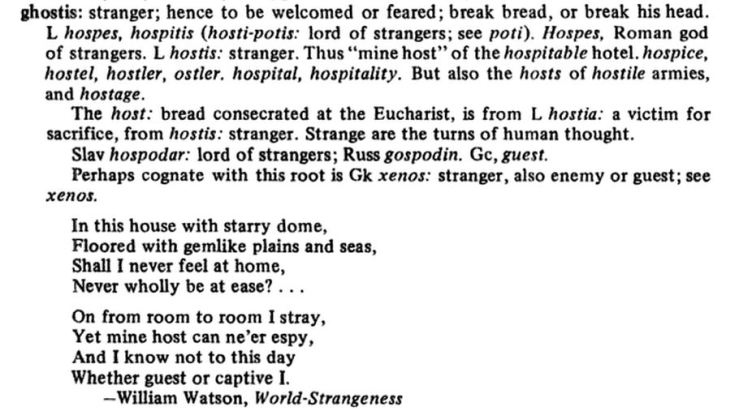
ghostis: stranger, hence to be welcomed or feared; break bread, or break his head. (Etymology)

Capture

(From The Origins of English Words: A Discursive Dictionary of Indo-European Roots by Joseph T. Shipley)

George Washington’s Rules of Civility

(Non-manuscript, more legible version).

Robert Downey Sr. Shares Screenwriting Advice; Picks Out Some Films

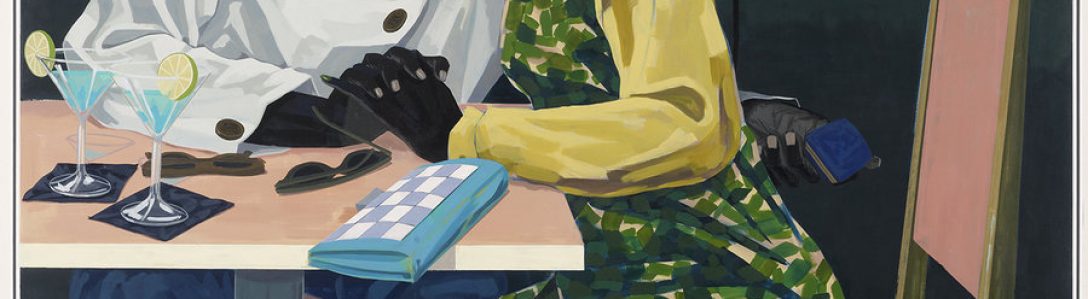
“Letter of Advice and Apology to a Young Burglar” — Hilaire Belloc

“Letter of Advice and Apology to a Young Burglar” — Hilaire Belloc


My dear Ormond,

Nothing was further from my thoughts. I had imagined you knew me well enough—and, for the matter of that, all your mother’s family—to judge me better. Believe me, no conception of blaming your profession entered my mind for a moment. Whether there be such a thing as “property” in the abstract I should leave it to metaphysicians to decide: in practical affairs everything must be judged in its own surroundings.

It was not upon any musty theological whimsy that I wrote; the definition of stealing or “theft”—I care not by what name you call it—is not for practical men to discuss. Nor was I concerned with the ethical discussion of burglary (to give the matter its old legal and technical title); it was lack of judgment, sudden actions due to nothing but impulse, and what I think I may call “the speculative side” of a burglar’s life.

You have not, as yet, any great responsibilities. No one is dependent upon you—you have but yourself to provide for; but you must remember that such responsibilities will arrive in their natural course, and that if you form habits of rashness or obstinacy now they will cling to you through life. We are all looking forward to a certain event when Anne is free again; in plain English, my boy, we know your loyal heart, and we shall bless the union; but I should feel easier in my mind if I saw you settled into one definite branch of the profession before you undertook the nurture of a family.

Adventure tempts you because you are brave, and something of a poet in you leads you to unusual scenes of action. Well, Youth has a right to its dreams, but beware of letting a dangerous Quixotism spoil your splendid chances.

Take, for example, your breaking into Mr. Cowl’s house. You may say Mr. Cowl was not a journalist, but only a reviewer; the distinction is very thin, but let it pass. You know and I know that the houses of none in any way connected with the daily Press should ever be approached. It is plain common sense. The journalist comes home at all hours of the night. His servant (if he keeps one) is often up before he is abed. Do you think to enter such houses unobserved? Continue reading ““Letter of Advice and Apology to a Young Burglar” — Hilaire Belloc”

Margaret Atwood on Hiding Exposition from the Reader


theNewerYork #2 Reviewed

20130106-104720.jpg

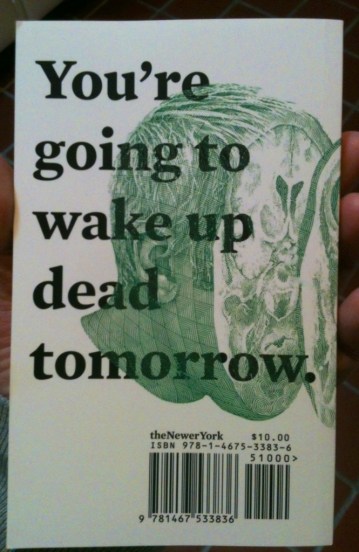
TheNewerYork is a new little magazine or journal or whatever you want to call it, featuring short fiction, poetry, art, lists, labels, fake reviews, and other stuff. Issue #2, clocking in at just over 80 pages fits neatly into a man’s jacket pocket and can be read in queues or at red lights or in between other readings or discreetly during end of semester faculty meetings. (I’m pretty sure you could read it in other occasions but I didn’t). You can see the front cover above; here’s the back cover, featuring this worrisome promise:

20130106-105947.jpg

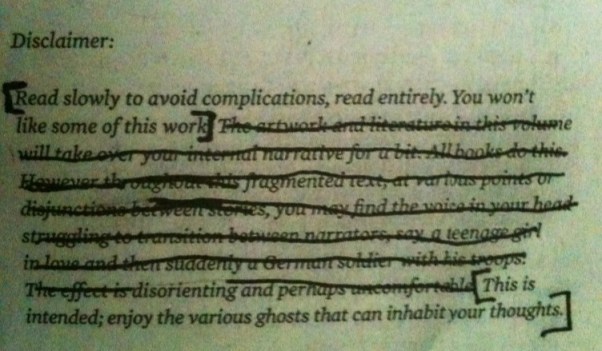
Maybe the best way to summarize (what I take to be) theNewerYork’s aesthetic/literary mission is to show off the issue’s disclaimer (which is preceded by a fancy Foucault quote):

20130106-105653.jpg

“You won’t like some of this work” seems like a fair warning, but theNewerYork is more hit than miss, starting with its excellent opener, ‘The Thank You War” by Elliot L. Ackerman, a four-paragraph flash that tackles how would-be patriotic citizens bungle human relationships with returning soldiers. Also very good is Jamie Grefe’s list “Over Thirteen,” which is a lovely little horror story that makes meaningful use of the reader’s imagination. Another list, Bruce Harris’s “Nearly A Dozen Things Sherlock Holmes Never Said” made me laugh (sample: “Watson, you’re right.”)

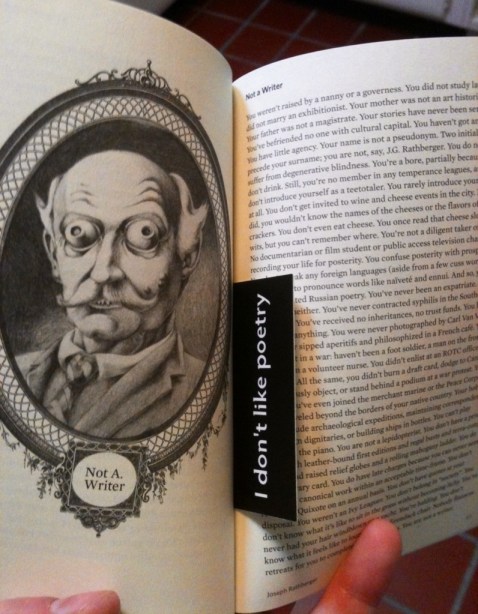
One of my favorite pieces in the volume is “Not a Writer” by Joseph Rathberger (indexed as “A Put Down”). You can see it below, filling up a page; you can also see the art that precedes it and the nifty bookmark that comes with the issue:

20130106-104746.jpg

Most of the art in the issue is black and white and all of it is varied (in style and in quality). Here is Food Poop by Shaina Yang:

20130106-104753.jpg

TheNewerYork’s willingness to showcase experimentation in what goes on paper for people to look at and read is both a strength and a weakness. Most of the pieces succeed, even when they shouldn’t (why is a Google translation from “Baby Got Back” from English to Latin and then back into English so funny?). The pieces in the issue that don’t succeed fail on their own terms: half-formed or poorly executed ideas, the occasionally gimmicky experiment, and, thankfully more rarely, pieces that feel too imitative. But like I said, most of the texts in theNewerYork’s second issue succeed, which is to say they entertain or amuse or baffle or occasionally move the reader. What I like most about theNewerYork is its spirit, which is daring and experimental without the heavy robes of irony that often cloak these sorts of operations. A promising beginning.

“The Model Millionaire” — Oscar Wilde

“The Model Millionaire” by Oscar Wilde

Unless one is wealthy there is no use in being a charming fellow. Romance is the privilege of the rich, not the profession of the unemployed. The poor should be practical and prosaic. It is better to have a permanent income than to be fascinating. These are the great truths of modern life which Hughie Erskine never realised. Poor Hughie! Intellectually, we must admit, he was not of much importance. He never said a brilliant or even an ill-natured thing in his life. But then he was wonderfully good-looking, with his crisp brown hair, his clear-cut profile, and his grey eyes. He was as popular with men as he was with women, and he had every accomplishment except that of making money. His father had bequeathed him his cavalry sword, and a History of the Peninsular War in fifteen volumes. Hughie hung the first over his looking-glass, put the second on a shelf between Ruff’s Guide and Bailey’sMagazine, and lived on two hundred a year that an old aunt allowed him. He had tried everything. He had gone on the Stock Exchange for six months; but what was a butterfly to do among bulls and bears? He had been a tea-merchant for a little longer, but had soon tired of pekoe and souchong. Then he had tried selling dry sherry. That did not answer; the sherry was a little too dry. Ultimately he became nothing, a delightful, ineffectual young man with a perfect profile and no profession. Continue reading ““The Model Millionaire” — Oscar Wilde”

Read “The Honored Dead,” a Story by Breece D’J. Pancake

“The Honored Dead” by Breece D’J. Pancake

Watching little Lundy go back to sleep, I wish I hadn’t told her about the Mound Builders to stop her crying, but I didn’t know she would see their eyes watching her in the dark. She was crying about a cat run down by a car—her cat, run down a year ago, only today poor Lundy figured it out. Lundy is turned too much like her momma. Ellen never worries because it takes her too long to catch the point of a thing, and Ellen doesn’t have any problem sleeping. I think my folks were a little too keen, but Lundy is her momma’s girl, not jumpy like my folks.

My grandfather always laid keenness on his Shawnee blood, his half-breed mother, but then he was hep on blood. He even had an oath to stop bleeding, but I don’t remember the words. He was a fair to sharp woodsman, and we all tried to slip up on him at one time or another. It was Ray at the sugar mill finally caught him, but he was an old man by then, and his mind wasn’t exactly right. Ray just came creeping up behind and laid a hand on his shoulder, and the old bird didn’t even turn around; he just wagged his head and said, “That’s Ray’s hand. He’s the first fellow ever slipped on me.” Ray could’ve done without that because the old man never played with a full deck again, and we couldn’t keep clothes on him before he died.

I turn out the lamp, see no eyes in Lundy’s room, then it comes to me why she was so scared. Yesterday I told her patches of stories about scalpings and murders, mixed up the Mound Builders with the Shawnee raids, and Lundy chained that with the burial mound in the back pasture. Tomorrow I’ll set her straight. The only surefire thing I know about Mound Builders is they must have believed in a god and hereafter or they never would have made such big graves.

Continue reading “Read “The Honored Dead,” a Story by Breece D’J. Pancake”

Reflections — John William Godward

“Stone Is Not Stone” — Carson McCullers

“Stone Is Not Stone” by Carson McCullers–

There was a time when stone was stone
And a face on the street was a finished face.
Between the Thing, myself and God alone
There was an instant symmetry.
Since you have altered all my world this trinity is twisted:

Stone is not stone
And faces like the fractioned characters in dreams are incomplete
Until in the child’s inchoate face
I recognize your exiled eyes.
The soldier climbs the glaring stair leaving your shadow.
Tonight, this torn room sleeps
Beneath the starlight bent by you.

“He was an aphorism writer” (Thomas Bernhard)

He was an aphorism writer, there are countless aphorisms of his, I thought, one can assume he destroyed them, I write aphorisms, he said over and over, I thought, that is a minor art of the intellectual asthma from which certain people, about all in France, have lived and still live, so-called half philosophers for nurses’ night tables, I could also say calendar philosophers for everybody and anybody, whose sayings eventually find their way onto the walls of every dentist’s waiting room; the so-called depressing ones are, like the so-called cheerful ones, equally disgusting.

From Thomas Bernhard’s novel The Loser.


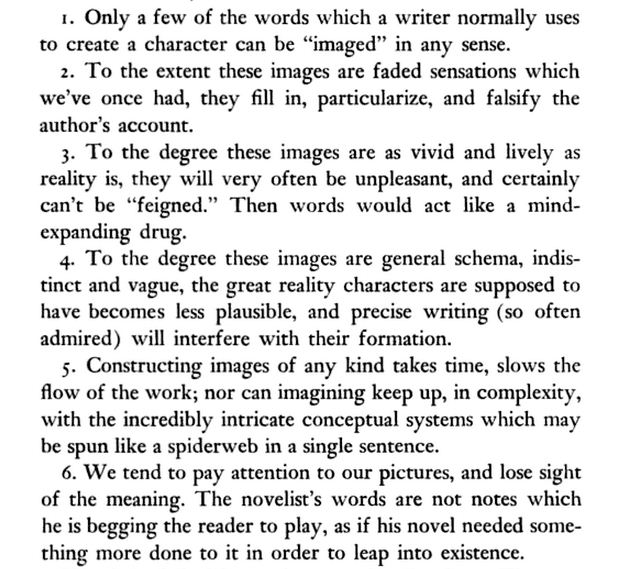
William H. Gass on Character and Images

From William H. Gass’s essay “The Concept of Character in Fiction.”

“I’m Searching” — Clarice Lispector

The opening paragraph to Clarice Lispector’s novel The Passion According to G.H.

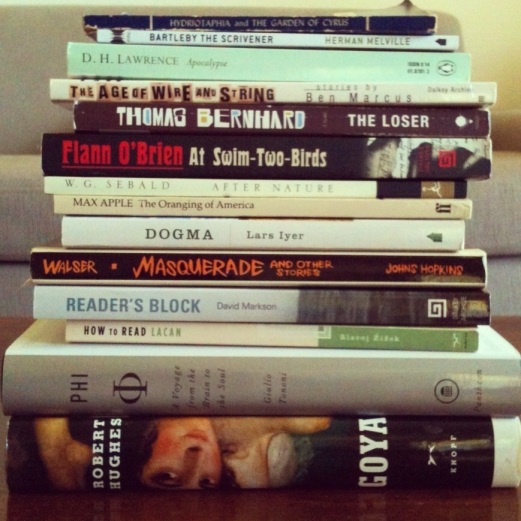
Books I’ve Read All or Most of in the Past Eight Months and Failed to Write About

20121108-160535.jpg