Smiles of a Summer Night — Ingmar Bergman (Full Film)

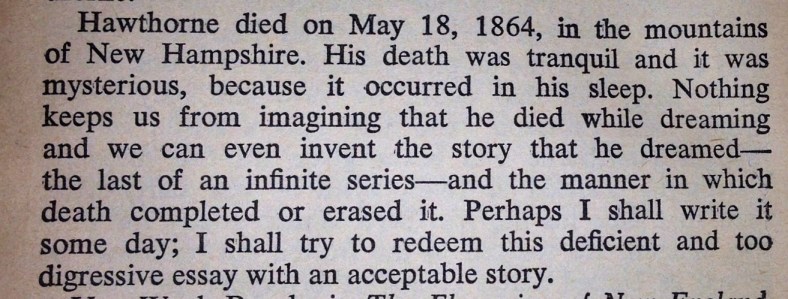
Borges Citation (Hawthorne)

20130731-180920.jpg

Study for Holiday — Jeffrey Smart

Sandokan, Nanni Balestrini’s Poetic Examination of Criminal Brutality

Nanni Balestrini’s novella Sandokan, in English translation from Melville House, tells the story of the rise of the Camorra crime syndicate in the small, poverty-stricken cities around Naples. Balestrini’s unnamed narrator occupies a fascinating insider-outsider perspective: one one hand, he, unlike many of his peers, does not join the gang, or “clan,” as its called–in fact, their behavior repulses him. On the other hand, he’s a native of the small town where Francesco Schiavone (aka Sandokan), Antonio Bardellino, and their henchman rule mercilessly, an eye-witness to the brutality and inhumanity of organized crime. The narrator is a sensitive young man who delineates clearly how the crime cartel was able to achieve such economic prosperity and power in the 70s, 80s, and 90s, detailing the various rackets the clan imposed upon the town, like stealing elections, peddling drugs, and manipulating the agribusiness that is the main source of income for average Neapolitan peasants. The narrator also explores why these small towns fall so easily into the terror of organized crime. The main reason: boredom stemming from little or nothing to do.

Balestrini’s narrator’s description of the Camorra is systematic, detailing the awful history and brutal practices of the syndicate in spare, concrete terms. His explications of the clan’s violence is not so much thrilling as  it is ugly, as the narrator always shows how “normal people” (his words) are cheated, killed, or otherwise harmed by the Camorra. The narrator’s tone is often journalistic but never clinical; he always shows what’s at stake for the “normal people,” how they are affected by these crimes. At times the narrator is wryly funny, a tone that results in large part from his observation that the townspeople, the people he grew up around, begin to normalize the violence. It becomes part of their daily lives and affects them so directly that it becomes casual, and the sensitive narrator is one of only a few not to bow to it, ignore it, or take part in it–yet the violence and crime is so overwhelming that to live with it is to live with absurdity. Balestrini employs a punctuation-free rhetorical style in Sandokan that captures the breathless energy and frustration of the narrator. While many readers might balk at the lack of commas, periods, or semi-colons, I found the technique quite liberating. It enhances the immediacy of the narrator’s voice, the rushed sense of importance to his tale. It also promotes sustained readings of the text–I read most of Sandokan in three enthralled sittings.

Sandokan has its cinematic twin in the 2008 film Gomorra, directed by Matteo Garrone. The film, like the book, illustrates the affect that crime has on a range of “normal people,” mostly occupants of a housing project outside of Naples. As in Sandokan, the ordinary citizens find that they have no choice but to choose between sides as an absurd, petty gang war ravages their already decimated landscape. Where Balestrini’s punctuation-free rhetoric allows readers closer access to his narrator’s pathos-driven story, Garrone lets his camera wander freely over the grim landscape without ever imposing any clear narrative structure. It is not until the film’s final third that the five disparate stories he tells coalesce, and even then, it remains unclear who is on whose side. What is clear is that the violence and crime is quickly stealing–and killing–another generation.

In an age where violence is sensationalized and glamorized, particularly in gangster films and TV shows (do I really need to list them?), Sandokan and Gomorra both lay bare the Darwinian cost of crime. In both narratives, the violence is mundane and inescapable, meaningless yet awful, and very, very dark. Neither narrative is didactic in the least–or even hopeful, for that matter–but their is an implicit suggestion that if only there were some alternative to the Camorra–libraries, social clubs, movie houses–there might be another prospect for the young people in this area.

I highly recommend both Sandokan and Gomorra. As an end note, I’d love to see more of Nanni Balestrini’s work come into English translation, perhaps via Antony Shugaar and Melville House, who’ve done a lovely job here.

[Ed. note: Biblioklept published a version of this review in January of 2010]


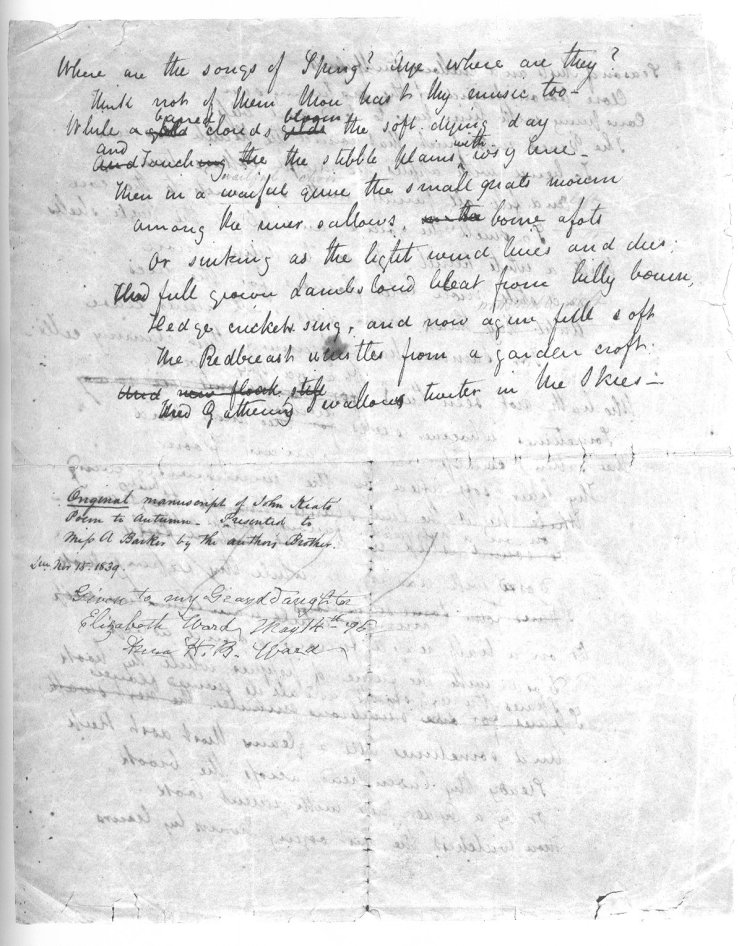
John Keats’s Handwritten Manuscript for “To Autumn”

John_Keats_-_To_Autumn_Manuscript_2_unrestored

(Read the poem).

“Elegy” — Jorge Luis Borges

elegy

Young Woman in Kimono, Reading — Emile Bernard

Unloved (Peanuts)

unloved

Borges Citation

20130730-103923.jpg

Suttree, Cormac McCarthy’s Grand Synthesis of American Literature

In his 1992 interview with The New York Times, Cormac McCarthy said, “The ugly fact is books are made out of books. The novel depends for its life on the novels that have been written.” McCarthy’s fourth novel, 1979’s Suttree is such a book, a masterful synthesis of the great literature — particularly American literature — that came before it. And like any masterful synthesis, Suttree points to something new, even as it borrows, lifts, and outright steals from the past. But before we plumb its allusions and tropes and patterns, perhaps we should overview the plot, no?

The novel rambles over several years in the life of Cornelius Suttree. It is the early 1950s in Knoxville, Tennessee, and Suttree ekes out a mean existence on the Tennessee River as a fisherman, living in a ramshackle houseboat on the edge of a shantytown. This indigent life is in fact a choice: Suttree is the college-educated son of an established, wealthy family. His choice is a choice for freedom and self-reliance, those virtues we like to think of, in our prejudicial manner, as wholly and intrinsically American. Suttree then is both Emersonian and Huck Finnian, a reflective and insightful man who finds his soul via a claim to agency over his own individuality, an individuality poised in quiet, defiant rebellion against the conforming forces of civilization. These forces manifest most pointedly in the Knoxville police, a brutal, racist organization, but we also see social constraint in the form of familial duty. One thinks of the final lines of Huckleberry Finn: “I reckon I got to light out for the Territory ahead of the rest, because Aunt Sally she’s going to adopt me and sivilize me and I can’t stand it. I been there before.”

Like Huck, Suttree aims to resist all forces that would “sivilize” him. His time on the river and in the low haunts of Tennessee (particularly the vice-ridden borough of McAnally) brings him into close contact with plenty of other outcasts, but also his conscience, which routinely mulls over its place in the world. Suttree is punctuated by–perhaps even organized by–several scenes of hallucination. Some of these psychotrips result from drunkeness, one comes from accidentally ingesting the wrong kind of mushrooms (or, the right kind, if that’s your thing), and the final one, late in the novel, sets in as Suttree suffers from a terrible illness. In his fever dream, a small nun–surely a manifestation of the guilt that would civilize us–accuses him–

Mr. Suttree it is our understanding that at curfew rightly decreed by law in that hour wherein night draws to its proper close and the new day commences and contrary to conduct befitting a person of your station you betook yourself to various low places within the shire of McAnally and there did squander several ensuing years in the company of thieves, derelicts, miscreants, pariahs, poltroons, spalpeens, curmudgeons, clotpolls, murderers, gamblers, bawds, whores, trulls, brigands, topers, tosspots, sots and archsots, lobcocks, smellsmocks, runagates, rakes, and other assorted and felonious debauchees.

The passage is a marvelous example of McCarthy’s stream-of-consciousness technique in Suttree, moving through the various voices that would ventriloquize Suttree, into the edges of madness, strangeness, and the sublimity of language. The tone moves from somber and portentous into bizarre imagery that blends humor and pathos. This is the tone of Suttree, a language that gives voice to transients and miscreants, affirming the dignity of their humanity even as it details the squalor of their circumstance.

It is among these criminals and whores, transvestites and gamblers that Suttree affirms his own freedom and humanity, a process aided by his comic foil, Gene Harrogate. Suttree meets Harrogate on a work farm; the young hillbilly is sent there for screwing watermelons. After his release, Harrogate moves to a shantytown in Knoxville. He’s the country mouse determined to become the city rat, the would-be Tom Sawyer to Suttree’s older and wiser Huck Finn. Through Harrogate’s endless get-rich-quick schemes, McCarthy parodies that most-American of tales, the Horatio Alger story. Simply put, the boy is doomed, on his  “way up to the penitentiary” as Suttree constantly admonishes. In one episode, Harrogate tries to buy arsenic from “a grayhaired and avuncular apothecary” to poison bats he hopes to sell to a hospital (don’t ask)–

May I help you? said the scientist, his hands holding each other.

I need me some strychnine, said Harrogate.

You need some what?

Strychnine. You know what it is dont ye?

Yes, said the chemist.

I need me about a good cupful I reckon.

Are you going to drink it here or take it with you?

Shit fire I aint goin to drink it. It’s poisoner’n hell.

It’s for your grandmother.

No, said Harrogate, craning his neck suspectly. She’s done dead

Suttree, unwilling father-figure, eventually buys the arsenic for the boy against his better judgment. The scene plays out as a wonderful comic inversion of William Faulkner’s “A Rose for Emily,” from which it is so transparently lifted. McCarthy borrows liberally from Faulkner here, of course, most notably in the language and style of the novel, but also in scenes like this one, or a later episode that plays off Faulkner’s comic-romantic story of a man and a woman navigating the aftermath of a flood, “Old Man.” Unpacking the allusions in Suttree surpasses my literary knowledge or skill, but McCarthy is generous, if oblique, with his breadcrumb trail. Take, for example, the following sentence: “Suttree with his miles to go kept his eyes to the ground, maudlin and muttersome in the bitter chill, under the lonely lamplight.” The forced phrase “miles to go” does not immediately present itself as a reference to Robert Frost’s famous poem, yet the direction of the sentence retreats into the history of American poetry; with its dense alliteration and haunted vowels, it leads us into Edgar Allan Poe territory. Only a few dozen pages later, McCarthy boldly begins a chapter with theft: “In just spring the goatman came over the bridge . . .” The reference to e.e. cummings explicitly signifies McCarthy’s intentions to play with literature. Later in the book, while tripping on mushrooms in the mountains, Suttree is haunted by “elves,” the would-be culprits in Frost’s poem “Mending Wall.” The callback is purposeful, but tellingly, McCarthy’s allusions are not nearly as fanciful as their surface rhetoric might suggest: the goatman does not belong in Knoxville–he’s an archaic relic, forced out of town by the police; the elves are not playful spirits but dark manifestations of a tortured psyche.

Once one spots the line-lifting in Suttree it’s hard to not see it. What’s marvelous is McCarthy’s power to convert these lines, these riffs, these stories, into his own tragicomic beast. An early brawl at a roadhouse recalls the “Golden Day” episode of Ralph Ellison’s Invisible Man; a rape victim’s plight echoes Hubert Selby’s “Tralala”; we find the comic hobos of John Steinbeck’s Cannery Row–we even get the road-crossing turtle from The Grapes of Wrath. A later roadhouse chapter replays the “Circe/Nighttown” nightmare in James Joyce’s Ulysses. Ulysses is an easy point of comparison for Suttree, which does for Knoxville what Joyce did for Dublin. Suttree echoes Ulysses’s language, both in its musicality and appropriation of varied voices, as well as its ambulatory structure, its stream-of-consciousness technique, its rude earthiness, and its size (nearly 600 pages). But, as I argued earlier, there’s something uniquely American about Suttree, and its literary appropriations tend to reflect that. Hence, we find Mark Twain, Herman Melville, Ernest Hemingway, Walt Whitman, Emerson and Thoreau, Emily Dickinson, and William Carlos Williams, to name just a few writers whose blood courses through this novel (even elegant F. Scott Fitzgerald is here, in an unexpected Gatsbyish episode late in the novel).

Making a laundry list of writers is weak criticism though, and these sources–all guilty of their own proud plagiarisms–are mentioned only as a means to an end, to an argument that what McCarthy does in Suttree is to synthesize the American literary tradition with grace and humor, while never glossing over its inherent dangers and violence. So, while it appropriates and plays with the tropes of the past, Suttree is still pure McCarthy. Consider the following passage, which arrives at the end of a drunken, awful spree, Suttree locked up for the night–

He closed his eyes. The gray water that dripped from him was rank with caustic. By the side of a dark dream road he’d seen a hawk nailed to a barn door. But what loomed was a flayed man with his brisket tacked open like a cooling beef and his skull peeled, blue and bulbous and palely luminescent, black grots his eyeholes and bloody mouth gaped tonguless. The traveler had seized his fingers in his jaws, but it was not alone this horror that he cried. Beyond the flayed man dimly adumbrate another figure paled, for his surgeons move about the world even as you and I.

Suttree’s dark vision points directly toward the language of McCarthy’s next novel, 1985’s Blood Meridian, roundly considered his masterpiece. Critics who disagree tend to point to Suttree as the pinnacle of McCarthy’s writing. I have no interest at this time in weighing the books against each other, nor do I think that doing so would be especially enlightening. For all of their sameness, they are very different animals: Suttree provides us intense access to its hero’s consciousness, where Blood Meridian always keeps the reader on the outside of its principals’ souls (if those grotesques could be said to have souls). And while Blood Meridian does display some humor, it is the blackest and driest humor I’ve ever read. Suttree is broader and more compassionate; it even has a fart joke. Blood Meridian, at least in my estimation (and many critics will contend this notion) has no flawed episodes; much of this results from the book’s own internal program–it resists love, compassion, and even human dignity. In contrast, Suttree is punctuated by two deaths the audience is meant to read as tragic, yet I found it impossible to do so. The first is the death of Suttree’s child, whom he has abandoned, along with its mother. As such, he is not permitted to take part in the funeral, observing the process rather from its edges. The second tragedy is the death of Suttree’s young lover in a landslide. The book begs us to empathize with Suttree, just as he often empathizes with the marginal figures in the novel, but ultimately these tragedies are a failed ploy. They underwrite a sublime encounter with death for Suttree, an encounter that deepens and enriches his character while paradoxically freeing him from the burdens of social duty and familial order. McCarthy is hardly alone in such a move; indeed, it seems like the signature trope of American masculine literature to me. It’s the move that Huck Finn wishes to make when he promises to light out for the Territory to escape the civilizing body of Aunt Sally; it’s the ending that Hemingway was compelled to give to Frederic Henry at the end of A Farewell to Arms; it’s all of Faulkner, with his mortification of fatherhood and the dramatic responsibility fatherhood entails. It is a cost analysis that neglects any potential benefits.

But these are small criticisms of a large, beautiful, benevolent novel, a book that begs to be reread, a rambling picaresque of comic and tragic proportions. “I learned that there is one Suttree and one Suttree only,” our hero realizes, but this epiphany is set against a larger claim. Near the end of the novel, Suttree goes to check on an old ragman who he keeps a watchful eye on. He finds the man dead, his shack robbed, his body looted. Despairing over the spectacle’s abject lack of humanity, Suttree cries, “You have no right to represent people this way,” for “A man is all men. You have no right to your wretchedness.” Here, Suttree’s painful epiphany is real and true, an Emersonian insight coded in the darkest of Whitman’s language. If there is one Suttree and one Suttree only, he is still beholden to all men; to be anti-social or an outcast is not to be anti-human. Self-hood is ultimately conditional on others and otherness. To experience the other’s wretchedness is harrowing; to understand the other’s wretchedness and thus convert it to dignity is life-affirming and glorious. Suttree is a brilliant, bold, marvelous book. Very highly recommended.

[Ed. note—Biblioklept originally published a version of this review on November 27, 2010].


A Sunshine Holiday — William Blake

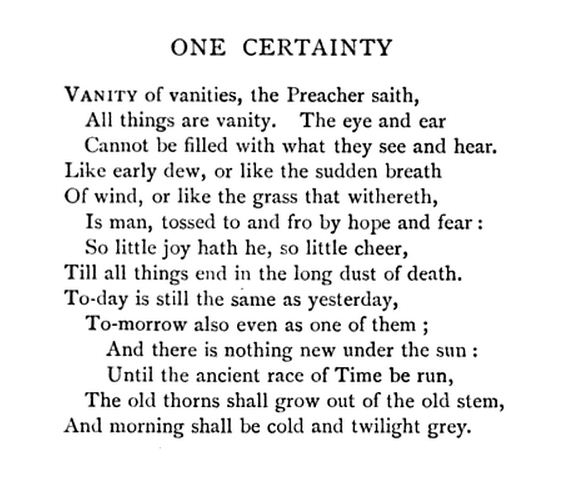
“One Certainty” — Christina Rossetti

3cr

Woman Reading — Francisc Sirato

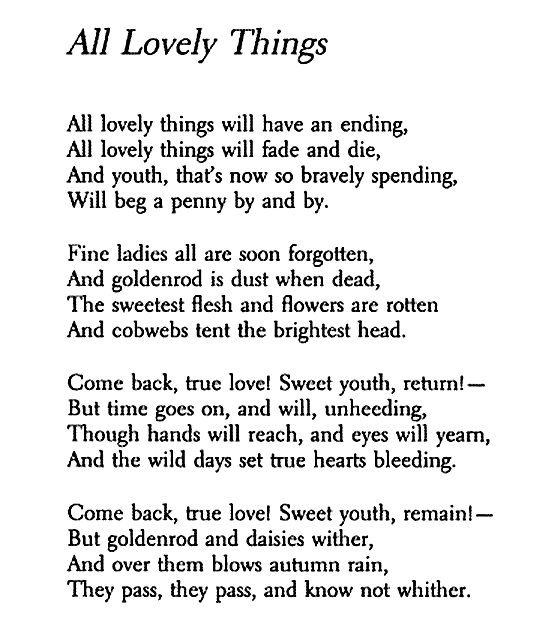
“All Lovely Things” — Conrad Aiken

aiken

Hegel’s Holiday — Rene Magritte

Airships, Barry Hannah’s Cult Classic of Violent Humor

In his 1978 collection Airships, Barry Hannah sets stories in disparate milieux, from the northern front of the Civil War, to an apocalyptic future, to the Vietnam War, to strange pockets of the late-twentieth century South. Despite the shifts in time and place, Airships is one of those collections of short stories that feels somehow like an elliptical, fragmentary novel. There are the stories that correspond directly to each other — the opener “Water Liars,” for instance, features (presumably, anyway), the same group of old men as “All the Old Harkening Faces at the Rail.” The old men love to crony up, gossip, tell tall tales. An outsider spoils the fun in “Water Liars” by telling a truth more terrible than any lie; in “Harkening,” an old man shows off his new (much younger) bride. These stories are perhaps the simplest in the collection, the homiest, anyway, or at least the most “normal” (whatever that means), yet they are both girded by a strange darkness, both humorous and violent, that informs all of Airships.

We find that humor and violence in an outstanding trio of Civil War stories (or, more accurately, stories set during the Civil War). The narrator of “Dragged Fighting from His Tomb,” a Confederate infantryman relates a tale of heroic slaughter with a hypberbolic, phallic force. Observe—

I knew the blueboys thought they had me down and were about ready to come in. I was in that position at Chancelorsville. There should be about six fools, I thought. I made the repeater, I killed four, and the other two limped off. Some histrionic plumehead was raising his saber up and down on the top of a pyramid of crossties. I shot him just for fun. Then I brought up another repeater and sprayed the yard.

Later, the narrator defects, switches to the Union, and claims he kills Jeb Stuart, a figure that towers over the Civil War tales. The narrator of “Dragged Fighting” hates Stuart; the narrator of “Knowing He Was Not My Kind Yet I Followed” is literally in love with the General. In contrast to the narrator of “Dragged Fighting,” the speaker in “Knowing” — an avowed “sissy” whom the other soldiers openly detest — hates the violence and madness of war—

We’re too far from home. We are not defending our beloved Dixie anymore. We’re just bandits and maniacal. The gleam in the men’s eyes tells this. Everyone is getting crazier on the craziness of being simply too far from home for decent return. It is like Ruth in the alien corn, or a troop of men given wings over the terrain they cherished and taken by the wind to trees they do not know.

He despairs when he learns of Jeb Stuart’s death. In the final Civil War story, “Behold the Husband in His Perfect Agony,” a Union spy is given the task to communicate news of Stuart’s death through enemy lines. Rather than offering further explication, let me instead point you, dear reader, to more of Hannah’s beautiful prose, of which I have not remarked upon nearly enough. From “Behold the Husband” —

Isaacs False Corn, the Indian, the spy, saw Edison, the Negro, the contact, on the column of an inn. His coat was made of stitched newspapers. Near his bare feet, two dogs failed earnestly at mating. Pigeons snatched at the pieces of things in the rushing gutter. The rains had been hard.

The short, descriptive passage rests on my ears like a poem. Hannah, who worked with Gordon Lish, evinces in his writing again and again that great editor’s mantra that writing is putting one sentence after another.

Although set in the Vietnam War, “Midnight and I’m not Famous Yet” seems an extension of the Civil War stories. In it, an officer from a small Southern town goes slowly crazy from all the killing, yet, like the narrator of “Dragged Fighting,” he presents himself as a warrior. Above all though, he laments that the war has robbed him of some key, intermediary phase of his late youth, a phase he can’t even name—

The tears were out of my jaws then. Here we shot each other up. All we had going was the pursuit of horror. It seemed to me my life had gone straight from teen-age giggling to horror. I had never had time to be but two things, a giggler and a killer.

This ironic sense of a “pursuit of horror” pervades Airships, particularly in the collection’s most apocalyptic visions. “Eating Wife and Friends” posits an America where food shortages and material scarcity leads people to eating leaves and grass — and then each other. In “Escape to Newark,” the environment is wildly out of balance—

In August it’s a hundred fifty degrees. In December it’s minus twenty-five and three feet of snow in Mississippi. In April the big trees explode.

A plan is made to “escape” these conditions via a rocket, but of course there’s not enough fuel to get past Newark. In Airships, modes of flight are transcendent but ultimately transient. Gravity’s pull is heavy stuff.

Just as Hannah’s war stories are not really war stories, his apocalypse tales are really about human relationships, which he draws in humor, pathos, and dark cynicism. In “Green Gets It,” an old man repeatedly attempts his suicide, only to fail again and again. His suicide note, written to his daughter, is scathing and shocking and sad and hilarious and wise–

My Beloved Daughter,

Thanks to you for being one of the few who never blamed me for your petty, cheerless and malign personality. But perhaps you were too busy being awful to ever think of the cause. I hear you take self-defense classes now. Don’t you understand nobody could take anything from you without leaving you richer? If I thought rape would change you, I’d hire a randy cad myself. I leave a few dollars to your husband. Bother him about them and suffer the curse of this old pair of eyes spying blind at the minnows in the Hudson.

Your Dad,

Crabfood

Although Hannah explores the darkest gaps of the soul in Airships, he also finds there a shining kernel of love in the face of waste, depravity, violence, and indifference. This love evinces most strongly perhaps in Airships trio of long stories. These tales, which hover around 30 pages, feel positively epic set against the other stories in the collection, which tend to clock in between five and ten pages. The first long story, “Testimony of Pilot,” details the development of a boyhood friendship over a few decades. It captures the strange affections and rivalries and unnameable bonds and distances that connect and disconnect any two close friends. The second of the long tales is “Return to Return,” a tragicomic Southern drama in the Oedipal vein (with plenty of tennis and alcoholism to boot). As in “Testimony of Pilot,” Hannah finds some measure of redemption, or at least solace, for his characters in their loving friendship, yet nothing could be more unsentimental. The final long story, which closes the collection, is “Mother Rooney Unscrolls the Hurt,” a daring work of stream of consciousness that seems to both respond to — and revise — Katherine Anne Porter’s “The Jilting of Granny Weatherall.” The story concludes (and of course concludes the volume) with a vision of love that corresponds to the imagery of The Pietà, a kind of selflessness that ironically confirms the self as an entity that exists in relation to the pain of others.

I could keep writing of course — I’ve barely touched on Hannah’s surrealism, a comic weirdness that I’ve never seen elsewhere; it is Hannahesque, I suppose. Nor have I detailed Hannah’s evocations of regular working class folk, fighting and drinking and divorcing and raising children (not necessarily in that order). Airships is a world too rich and fertile to unpack in just one review, and I’ve already been blathering too long, I fear, when what I really want  to do is just outright implore you, kind reader, to find it and start reading it immediately. Very highly recommended.

[Editorial note: Biblioklept published a version of this review on March 20th, 2011]

“The Romance of an Ugly Policeman” — P.G. Wodehouse

“The Romance of an Ugly Policeman” by P.G. Wodehouse

Crossing the Thames by Chelsea Bridge, the wanderer through London finds himself in pleasant Battersea. Rounding the Park, where the female of the species wanders with its young by the ornamental water where the wild-fowl are, he comes upon a vast road. One side of this is given up to Nature, the other to Intellect. On the right, green trees stretch into the middle distance; on the left, endless blocks of residential flats. It is Battersea Park Road, the home of the cliff-dwellers.

Police-constable Plimmer’s beat embraced the first quarter of a mile of the cliffs. It was his duty to pace in the measured fashion of the London policeman along the front of them, turn to the right, turn to the left, and come back along the road which ran behind them. In this way he was enabled to keep the king’s peace over no fewer than four blocks of mansions.

It did not require a deal of keeping. Battersea may have its tough citizens, but they do not live in Battersea Park Road. Battersea Park Road’s speciality is Brain, not Crime. Authors, musicians, newspaper men, actors, and artists are the inhabitants of these mansions. A child could control them. They assault and batter nothing but pianos; they steal nothing but ideas; they murder nobody except Chopin and Beethoven. Not through these shall an ambitious young constable achieve promotion.

At this conclusion Edward Plimmer arrived within forty-eight hours of his installation. He recognized the flats for what they were—just so many layers of big-brained blamelessness. And there was not even the chance of a burglary. No burglar wastes his time burgling authors. Constable Plimmer reconciled his mind to the fact that his term in Battersea must be looked on as something in the nature of a vacation.

Continue reading ““The Romance of an Ugly Policeman” — P.G. Wodehouse”