‘There’s something very interesting about civics and selfishness, and we get to ride the crest of it. Here in the US, we expect government and law to be our conscience. Our superego, you could say. It has something to do with liberal individualism, and something to do with capitalism, but I don’t understand much of the theoretical aspect—what I see is what I live in. Americans are in a way crazy. We infantilize ourselves. We don’t think of ourselves as citizens—parts of something larger to which we have profound responsibilities. We think of ourselves as citizens when it comes to our rights and privileges, but not our responsibilities. We abdicate our civic responsibilities to the government and expect the government, in effect, to legislate morality. I’m talking mostly about economics and business, because that’s my area.’
Perseus was the son of Danae, who was the daughter of a king. And when Perseus was a very little boy, some wicked people put his mother and himself into a chest, and set them afloat upon the sea. The wind blew freshly, and drove the chest away from the shore, and the uneasy billows tossed it up and down; while Danae clasped her child closely to her bosom, and dreaded that some big wave would dash its foamy crest over them both. The chest sailed on, however, and neither sank nor was upset; until, when night was coming, it floated so near an island that it got entangled in a fisherman’s nets, and was drawn out high and dry upon the sand. The island was called Seriphus, and it was reigned over by King Polydectes, who happened to be the fisherman’s brother.
This fisherman, I am glad to tell you, was an exceedingly humane and upright man. He showed great kindness to Danae and her little boy; and continued to befriend them, until Perseus had grown to be a handsome youth, very strong and active, and skilful in the use of arms. Long before this time, King Polydectes had seen the two strangers—the mother and her child—who had come to his dominions in a floating chest. As he was not good and kind, like his brother the fisherman, but extremely wicked, he resolved to send Perseus on a dangerous enterprise, in which he would probably be killed, and then to do some great mischief to Danae herself. So this bad-hearted king spent a long while in considering what was the most dangerous thing that a young man could possibly undertake to perform. At last, having hit upon an enterprise that promised to turn out as fatally as he desired, he sent for the youthful Perseus.
The young man came to the palace, and found the king sitting upon his throne.
“Perseus,” said King Polydectes, smiling craftily upon him, “you are grown up a fine young man. You and your good mother have received a great deal of kindness from myself, as well as from my worthy brother the fisherman, and I suppose you would not be sorry to repay some of it.”
“Please your Majesty,” answered Perseus, “I would willingly risk my life to do so.”
“Well, then,” continued the king, still with a curving smile on his lips, “I have a little adventure to propose to you; and, as you are a brave and enterprising youth, you will doubtless look upon it as a great piece of good luck to have so rare an opportunity of distinguishing yourself. You must know, my good Perseus, I think of getting married to the beautiful Princess Hippodamia; and it is customary, on these occasions, to make the bride a present of some far-fetched and elegant curiosity. I have been a little perplexed, I must honestly confess, where to obtain anything likely to please a princess of her exquisite taste. But, this morning, I flatter myself, I have thought of precisely the article.”
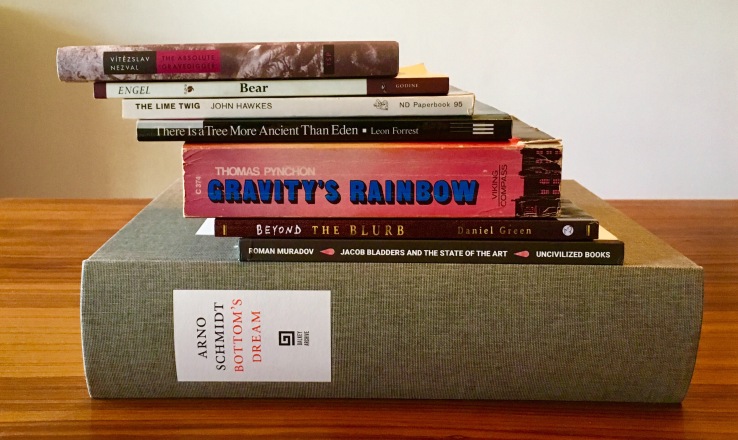
It’s easier to work from what’s outside of me lately, so I’ve been doing these Gravity’s Rainbow annotations; I “finished” (not the right verb) a third reading this weekend and then dipped back into it again—this time in the middle. I was thinking of doing a “how to read Gravity’s Rainbow” post but that seems fucking pretentious. I love the book though.
This stack looks big, but it’s not really—most of the other books there are slim volumes I worked into my reread of Gravity’s Rainbow. Little breaks, of a sort.
But not that big book at the bottom.
That big book at the bottom, Bottom’s Dream? Hm. Not sure about this guy. It’s too big to read. I mean physically. It’s unwieldy, uncomfortable, uncurlupwithable. I can’t get a rhythm going there.
Daniel Green’s Beyond the Blurb will also get a review, sort of, soon (the book is a critical survey of literary criticism, making a review of it especially difficult to me). I have n interview with Green in the works.
Not pictured here because it’s an e-book is Scott Esposito’s The Missing Books. Esposito’s book is a continuing project, a “curated directory of books that do not exist, but should.” I read it in one sitting and was frankly jealous that I hadn’t written it.
Leon Forrest’s There Is a Tree More Ancient Than Eden is a novel I read in a blur, a kind of fever dream postmodern pastiche, a narrative unstuck in time and yet wholly about a specific time and place and past and consciousness. I need to read it again; like so many so-called “experimental” novels, a first reading is highly impressionistic but also confusing. Forrest throws you in the deep end. The prose is liquid, viscous, and you’re swimming around for edges, contours to grab onto. Just a marvelous strange read, and it deserves better than I’m giving it here—I mean, I think the novel deserves way more attention, and I’ll attend to it again.
Vítězslav Nezval’s 1937 poetry collection The Absolute Gravedigger is new in English translation by Stephan Delbos and Tereza Novická (Twisted Spoon Press). I hadn’t read Nezval before now, but I did see Jaromil Jireš’s film adaptation of his novel Valerie and Her Week of Wonders; if you know it, you’ll perhaps have an idea of some of Gravedigger’s rich dark weird flavor. There’s something of Bosch or Goya in the spare poems—somehow simultaneously bleak but vivid, morose but witty. The cityscapes, the entropy, the impressionistic details here all melded into my Pynchon-addled brain with the immediate post-War Zone of Gravity’s Rainbow: broken bits of civilization twitching into new combinations of reality.
Marian Engel’s Bear is this wonderfully lucid story of a bibliographer who goes to a remote island to document the contents (and library) of an old semi-famous house. Engel’s sentences are too good; there’s something fresh and restorative about the prose that echoes the plot, which is both simple and bizarre. Also, the bibliographer has a sexual relationship with a bear.
I read the first half of John Hawkes’s The Lime Twig over two short plane rides. I might have finished it, but I had to read every paragraph twice. I haven’t picked it up since the election on Tuesday. Maybe this post will motivate me to pick it up. Here’s Flannery O’Connor’s so very accurate blurb from the back cover:
You suffer The Lime Twig like a dream. It seems to be something that is happening to you, that you want to escape from but can’t. The reader even has that slight feeling of suffocation that you have when you can’t wake up and some evil is being worked on you.
In a corporate State 1, a place must be made for innocence, and its many uses 2. In developing an official version of innocence, the culture of childhood has proven invaluable 3 . Games, fairy-tales, legends from history, all the paraphernalia of make-believe 4 can be adapted and even embodied in a physical place, such as at Zwölfkinder 5. Over the years it had become a children’s resort, almost a spa. If you were an adult, you couldn’t get inside the city limits without a child escort. There was a child mayor 6, a child city council of twelve. Children picked up the papers, fruit peelings and bottles you left in the street, children gave you guided tours through the Tierpark 7, the Hoard of the Nibelungen 8, cautioning you to silence during the impressive re-enactment of Bismarck’s elevation, at the spring equinox of 1871, to prince and imperial chancellor 9,… child police reprimanded you if you were caught alone, without your child accompanying. Whoever carried on the real business of the town—it could not have been children—they were well hidden.10
From page 419 of Thomas Pynchon’s 1973 novel Gravity’s Rainbow.
1 Pynchon, as always, diagnoses not just the past and present, but the future. The state is corporate; They — the oligarchy et al. — run the show. And conceptualizing innocence is part of running that show.
2 Cf. William Blake’s Songs of Innocence and Experience (1789). In The Marriage of Heaven and Hell (1793), Blake wrote: “Without Contraries is no progression.” Without corruption there is no innocence; without abjection there is no purity; without an elect, there is no preterite.
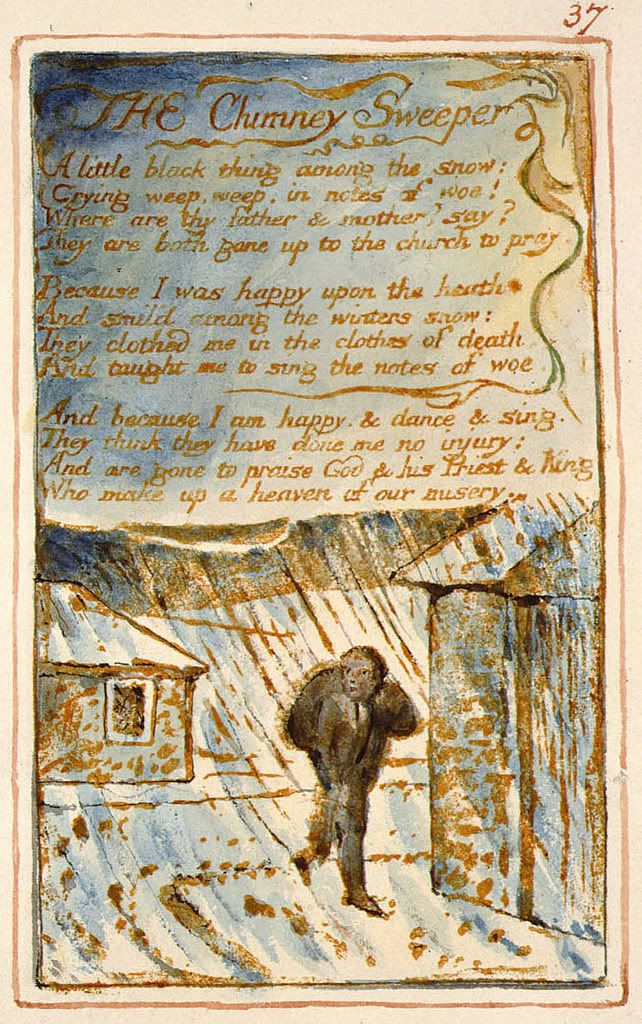
The Chimney Sweeper, William Blake, 1794
Blake’s Songs share much in common with Pynchon’s big novel—both argue for the preterite, pointing out the ways in which industrial technologies exploit the most vulnerable among us; both are wildly, acidly vivid; both employ metaphors of fall and ascent; both foreground the utterly real humanity of their subjects.
Blake’s “The Chimney Sweeper” (from Experience) shows in simple language how the official version of innocence can be used to enforce the dominant and exploitative order. Consider the last stanza:
And because I am happy and dance and sing,
They think they have done me no injury,
And are gone to praise God and his Priest and King,
Who make up a heaven of our misery
Blake’s chimney sweeper asserts his right to happiness, to laughter and joy. The creative impulse is a Counterforce against Them—here, the Priest and King. Yet They co-opt the dancing and joy and convert it into signs of “the official version of innocence”: a lie to cover over the utter corruption of the dominant order.
3 You’ve read Freud, right? Like, those ideas on infantile sexuality that are downright icky, and yet nevertheless reaffirmed and reinforced by the Corporate State? (Oligarchial capitalism simultaneously infantilizes and sexualizes its subjects). Gravity’s Rainbow does a lot of stuff it’s easier (less queasier) to write off as abject than to actually like, think through. But GR also shows that They infantilize and sexualize childhood in the service of control, as a way of establishing (and blurring and “defiling”) official versions of innocence.
Consider Our Poor Hero Tyrone Slothrop, whose conditioning as an infant by Laszlo Jamf (involving the mysterious MacGuffin Imipolex G) leads to erections that predict rocket strikes. (I swear that sentence makes sense).
4 “Games, fairy-tales, legends from history, all the paraphernalia of make-believecan be adapted and even embodied in a physical places” — physical places like Gravity’s Rainbow. Well, okay. I mean, we get a condensation here of Pynchon’s process, his synthesis, his grab-bag of songs and japes and jibes and jokes and tales and etcetera.
But Pynchon’s pointing out other, perhaps more nefarious and venal and corporate uses for the same cultural material he’s massaging: A fucking theme park. Like, uh, Disneyland. Or Disneyworld. Etcetera, you get it—that we—did I just write We?!—I want to say They—that They colonize and corporatize the imagination; that They gobble up the cultural material and excrete it in smooth, digestible, sanitized (yet subtly sexualized)—and consumable, marketable!—segments that we take our kids to queue up to experience in their innocence.
5 As always, Pynchon Wiki does it better than I can:
“Twelve Children” – the name evokes Jacob’s twelve sons (and the daughter who is not one of the official twelve). This pattern is self-consciously repeated in the Grimms’ tale “The Twelve Brothers”, where the boys are to die if their mother gives birth to a girl.
The camp, which is also a quasi-town, may be modelled after Theresienstadt, the Jewish town/Lager set up by the Nazis in what is now the Czech Republic. This is suggested by themes like transit, phoney children’s paradise, as well as the large orchestra, or the number 60,000 (the number of those who “passed through” Zwölfkinder as well the population of Theresienstadt at its peak). It also recalls another totalitarian institution, that of the communist “children’s towns” (large, town-like, somewhat militarized holiday camps for Young Pioneers), whose prototype was Artek in the Soviet Union. (Deutsches Jungvolk also had its summer camps.)
Further, consider Argentina’s Republic of Children, a city proportioned for children, which was created under Juan Peron’s regime and opened in 1951.
The Oedipal plot of Grimms’ “The Twelve Children” repeats throughout Gravity’s Rainbow, and I invite you to look for it lurking in Disney.
“The brothers were full of joy, and embraced her with fondest affection,” Mary Hamilton Fry, 1912
“At the entrance to the town, barring their way, stands the Midget who played the lead in Freaks. The one with the German accent. He is the town sheriff. He is wearing an enormous gold star that nearly covers his chest.”
The little person referenced is Harry Earles who played Hans in Freaks (1932; dir. Tod Browning).
7 The zoo.
8 A vast treasure hoard, such as Scrooge McDuck might dive into, or Bilbo Baggins and his pals might play upon.
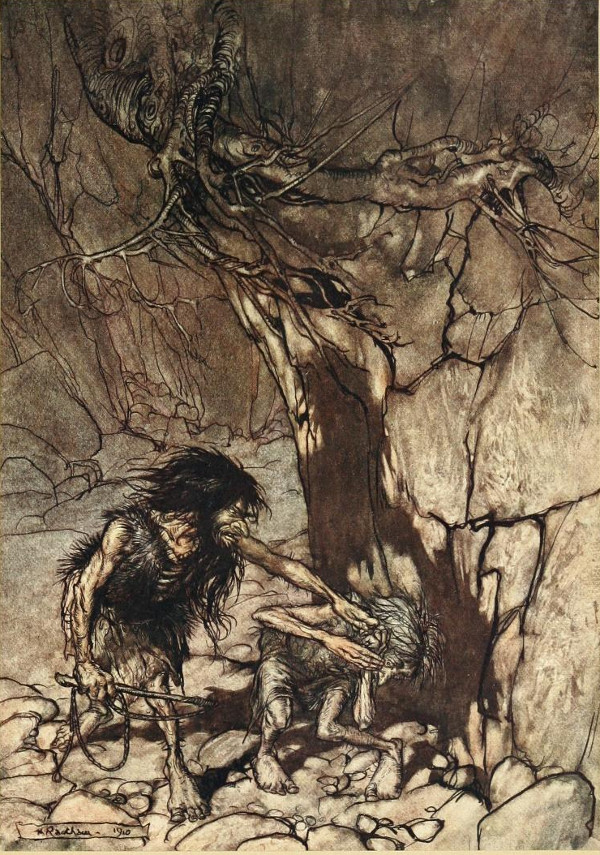
The Nibelungen Hoard, as I’m sure you know, is the treasure of the Nibelungen. (You know Wagner’s Ring Cycle, eh? Or you’ve read Tolkien’s The Lord of the Rings, right?—you get the idea. The titular Nibelung is the dwarf Alberich, by the way).
The tale of that same treasure might well your wonder raise;
’T was much as twelve huge wagons in four whole nights and days
Could carry from the mountain down to the salt-sea bay,
If to and fro each wagon thrice journeyed every day.
It was made up of nothing but precious stones and gold;
Were all the world bought from it, and down the value told,
Not a mark the less thereafter were left, than erst was scored.
Good reason sure had Hagan to covet such a hoard.
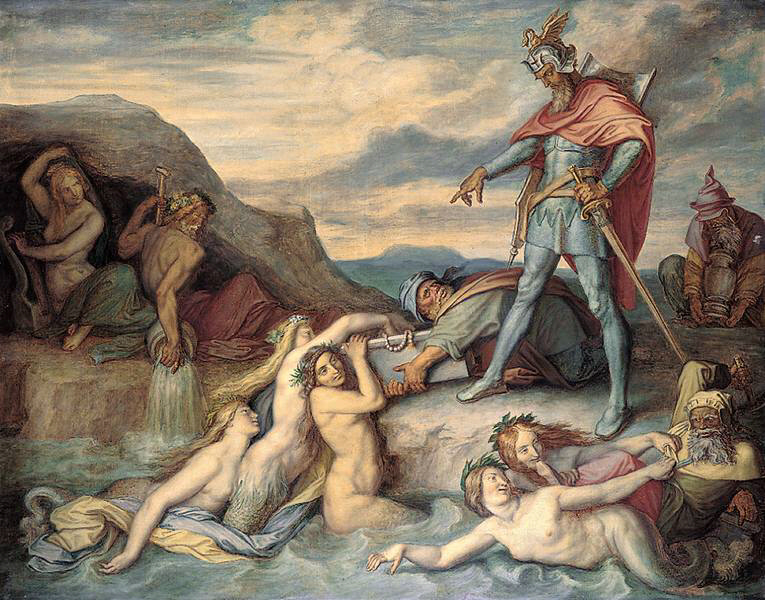
Hagen Orders Servants to Sink the Hoard in the Rhine, Peter von Cornelius (1859)
In the Nibelungenlied, Hagen murders the hero Siegfried and then steals and hides the Nibelung hoard.
9 Otto von Bismarck, 1815-1898, who unified Germany through technocracy and, uh, war.
10 “…they were well hidden”: A précis of Pynchonian paranoia, perhaps.







 Biblioklept