Bowles/Oyono/Reed (Books acquired, 30 May 2017)

img_6303

Books and reality are fused (Philip K. Dick)

…I can say with all truthfulness that for me the moment of greatest understanding in which I knew spiritual reality at last came in connection with emergency root-canal irrigation, two hours in the dentist chair. And twelve hours drinking bourbon-bad bourbon at that-and simply reading Dante without listening to the stereo or eating-there was no way I could eat-and suffering, and it was all worth it; I will never forget it. I am no different, then, from Timothy Archer. To me, too, books are real and alive; the voices of human beings issue forth from them and compel my assent, the way God compels our assent to world, as Tim said. When you have been in that much distress, you are not going to forget what you did and saw and thought and read that night; I did nothing, saw nothing, thought nothing; I read and I remember; I did not read Howard the Duck or The Fabulous Furry Freak Brothers or Snatch Comix that night; I read Dante’s Commedia, from Inferno through Purgatorio, until at last I arrived in the three colored rings of light … and the time was nine A.M. and I could get into my fucking car and shoot out into traffic and Dr. Davidson’s office, crying and cursing the whole way, with no breakfast, not even coffee, and stinking of sweat and bourbon, a sorry mess indeed, much gaped at by the dentist’s receptionist.

So for me in a certain unusual way-for certain unusual reasons-books and reality are fused; they join through one incident, one night of my life: my intellectual life and my practical life came together-nothing is more real than a badly infected tooth-and having done so they never completely came apart again. If I believed in God, I would say that he showed me something that night; he showed me the totality: pain, physical pain, drop by drop, and then, this being his dreadful grace, there came understanding … and what did I understand? That it is all real; the abscessed tooth and the root-canal irrigation, and, no less and no more…

From Philip K. Dick’s 1982 novel The Transmigration of Timothy Archer.

Errors on Whitman (Jorge Luis Borges)

whitman

Never was there more hollowness at heart than at present (Walt Whitman)

I say we had best look our times and lands searchingly in the face, like a physician diagnosing some deep disease. Never was there, perhaps, more hollowness at heart than at present, and here in the United States. Genuine belief seems to have left us. The underlying principles of the States are not honestly believ’d in, (for all this hectic glow, and these melodramatic screamings,) nor is humanity itself believ’d in. What penetrating eye does not everywhere see through the mask? The spectacle is appaling. We live in an atmosphere of hypocrisy throughout. The men believe not in the women, nor the women in the men. A scornful superciliousness rules in literature. The aim of all the littérateurs is to find something to make fun of. A lot of churches, sects, &c., the most dismal phantasms I know, usurp the name of religion. Conversation is a mass of badinage. From deceit in the spirit, the mother of all false deeds, the offspring is already incalculable. An acute and candid person, in the revenue department in Washington, who is led by the course of his employment to regularly visit the cities, north, south and west, to investigate frauds, has talk’d much with me about his discoveries. The depravity of the business classes of our country is not less than has been supposed, but infinitely greater. The official services of America, national, state, and municipal, in all their branches and departments, except the judiciary, are saturated in corruption, bribery, falsehood, mal-administration; and the judiciary is tainted. The great cities reek with respectable as much as non-respectable robbery and scoundrelism. In fashionable life, flippancy, tepid amours, weak infidelism, small aims, or no aims at all, only to kill time. In business, (this all-devouring modern word, business,) the one sole object is, by any means, pecuniary gain. The magician’s serpent in the fable ate up all the other serpents; and money-making is our magician’s serpent, remaining to-day sole master of the field.

From Walt Whitman’s Democratic Vistas (1871).

Monomania — Theodore Géricault

1200px-The_mad_woman-Theodore_Gericault-MBA_Lyon_B825-IMG_0477Screenshot 2017-05-31 at 8.03.12 AM

La Monomane de l’envie (Monomania: Portrait of an Excessively Jealous Woman), c. 1819–22 by Theodore Géricault  (1791-1824)

Wounded Man in a Bed-Sitting Room — Robin Ironside

Wounded Man in a Bed-Sitting Room, 1951 by Robin Ironside (1912-1965)

Mike Watt does Finnegans Wake

Mike Watt and Adam Harvey adapted the “Shem the Penman” episode of James Joyce’s Finnegans Wake for the Waywords and Meansigns project. Raymond Pettibon provided an illustration.

Check it out.

Aberrant by Marek Šindelka (Book acquired, 25 May 2017)

Aberrant is the début novel by Czech author Marek Šindelka. It’s new in English translation by Nathan Fields from Twisted Spoon Press, and features artwork by Petr Nikl. It’s pretty far out stuff. First pages:

Twisted Spoon’s blurb:

The remarkable debut novel from Marek Šindelka, already the recipient of his country’s major literary awards for poetry (Jiří Orten Prize) and prose (Magnesia Litera), Aberrant is a multifaceted work that mixes and mashes together a variety of genres and styles to create a heady concoction of crime story, horror story (inspired by the Japanese tradition of kaidan), ecological revenge fantasy, and Siberian shamanism. Nothing is what it seems. What appears to be human is actually a shell occupied by an alien spirit, or demon, and what appears to be an unassuming plant is an aggressive parasite that harbors a poisonous substance within, or manifests itself as an assassin, a phantom with no real substance who pursues his victims across Europe and through a post-apocalyptic Prague ravaged by floods. The blind see, and the seeing are blind. Plants behave like animals, and animals are symbionts with plants. Through these devices, Šindelka weaves a tale of three childhood friends, the errant paths their lives take, and the world of rare plant smuggling — and the consequences of taking the wrong plant — to show the rickety foundation of illusions on which our relationship to the environment, and to one another, rests. It is a world of aberrations, anomalies, and mistake

The Finding of Medusa — Edward Burne-Jones

The Finding of Medusa, 1888-1892 by Edward Burne-Jones (1833–1898)

Medusa — Jacek Malczewski

medusa

Medusa, 1900 by Jacek Malczewski (1854-1929)

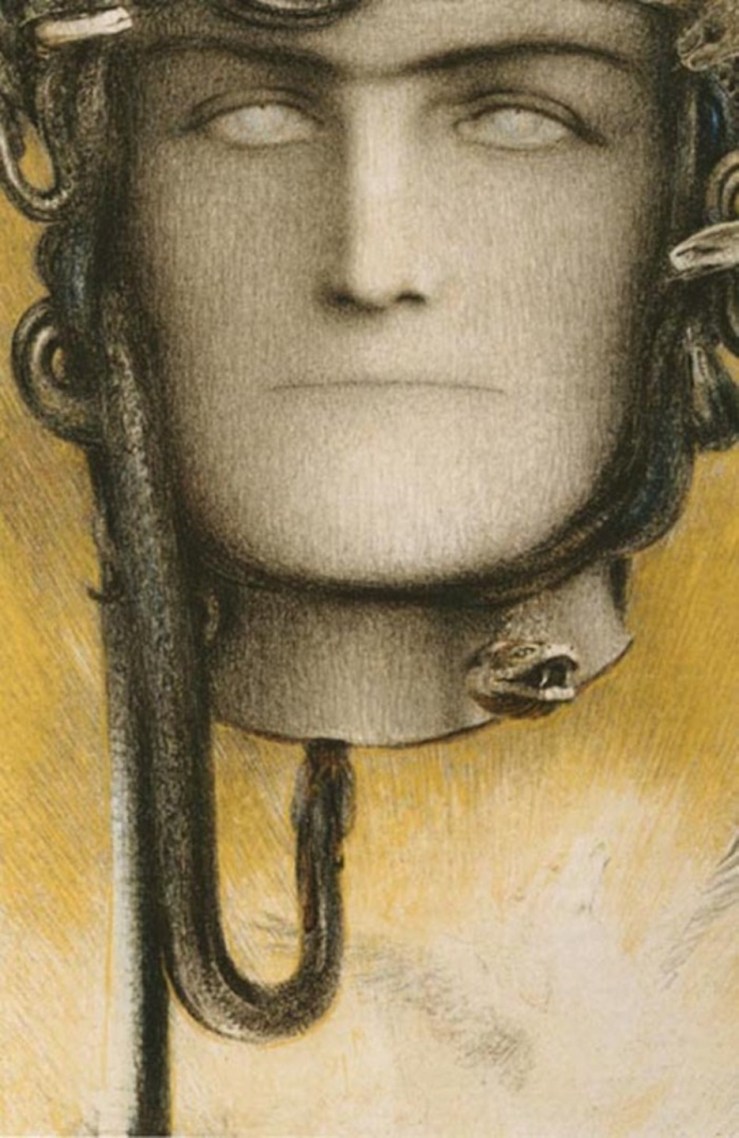
The Blood of Medusa — Fernand Khnopff

12

The Blood of Medusa1898 by Fernand Khnopff (1858-1921)

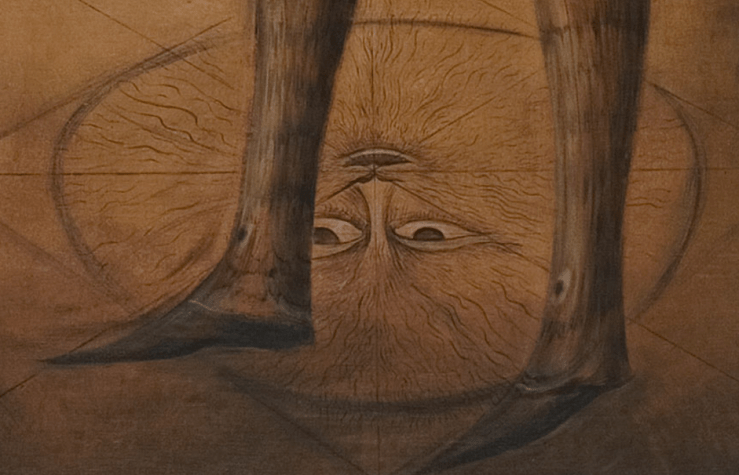
I Wanted to Be a Bird — Leonora Carrington

Carrington_Queria-ser-pajaro_PRINTScreenshot 2017-05-28 at 12.11.50 PMScreenshot 2017-05-28 at 12.11.27 PMScreenshot 2017-05-28 at 12.10.56 PMScreenshot 2017-05-28 at 12.09.29 PMScreenshot 2017-05-28 at 12.12.01 PMScreenshot 2017-05-28 at 12.10.26 PM

Quería ser Pájaro (I Wanted to Be a Bird), 1960 by Leonora Carrington (1917–2011)

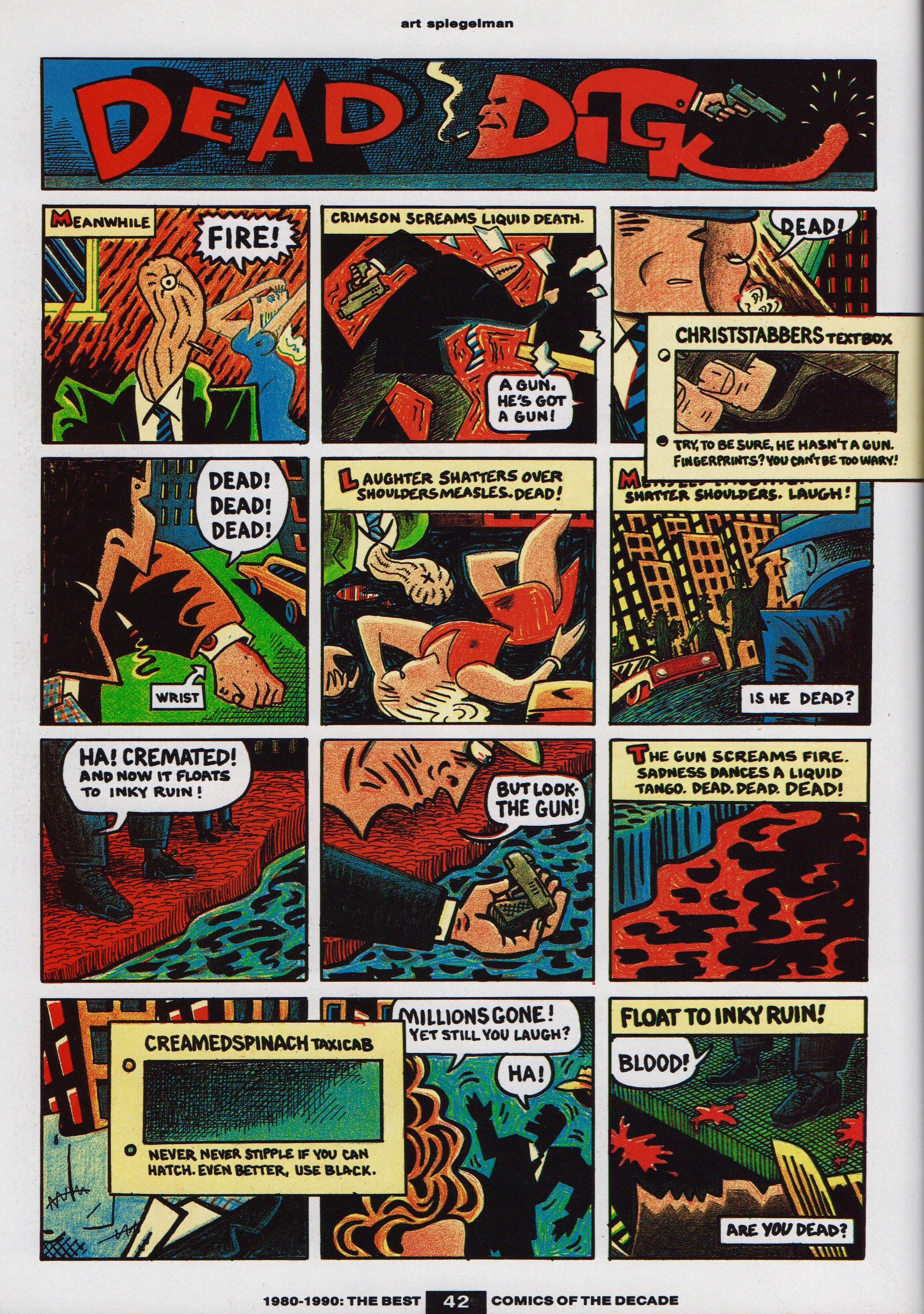
Sunday Comics 

“Dead Dick” by Art Spiegelman, 1989. From The Best Comics of the Decade: 1980-1990, Vol. 1, Fantagraphics Books, 1990. Originally published in RAW vol. 2, #1, 1989.

Disinformation (Philip K. Dick)

 It is like information theory; it is noise driving out signal. But it is noise posing as signal so you do not even recognize it as noise. The intelligence agencies call it disinformation, something the Soviet Bloc relies on heavily. If you can float enough disinformation into circulation you will totally abolish everyone’s contact with reality, probably your own included.

From Philip K. Dick’s 1982 novel The Transmigration of Timothy Archer.

“A Poem About Baseballs” by Denis Johnson

“A Poem About Baseballs” by Denis Johnson–
 
for years the scenes bustled
through him as he dreamed he was
alive. then he felt real, and slammed
awake in the wet sheets screaming
too fast, everything moves
too fast, and the edges of things
are gone. four blocks away
a baseball was a dot against
the sky, and he thought, my
glove is too big, i will
drop the ball and it will be
a home run. the snow falls
too fast from the clouds,
and night is dropped and
snatched back like a huge
joke. is that the ball, or is
it just a bird, and the ball is
somewhere else, and i will
miss it? and the edges are gone, my
hands melt into the walls, my
hands do not end where the wall
begins. should i move
forward, or back, or will the ball
come right to me? i know i will
miss, because i always miss when it
takes so long. the wall has no
surface, no edge, the wall
fades into the air and the air is
my hand, and i am the wall. my
arm is the syringe and thus i
become the nurse, i am you,
nurse. if he gets
around the bases before the
ball comes down, is it a home
run, even if i catch it? if we could
slow down, and stop, we
would be one fused mass careening
at too great a speed through
the emptiness. if i catch
the ball, our side will
be up, and i will have to bat,
and i might strike out.
The Exiled — Arturo Nathan

exiled

L’esiliato (The Exiled), 1928 by Arturo Nathan (1891-1944)

Denis Johnson’s Train Dreams is a perfect novella

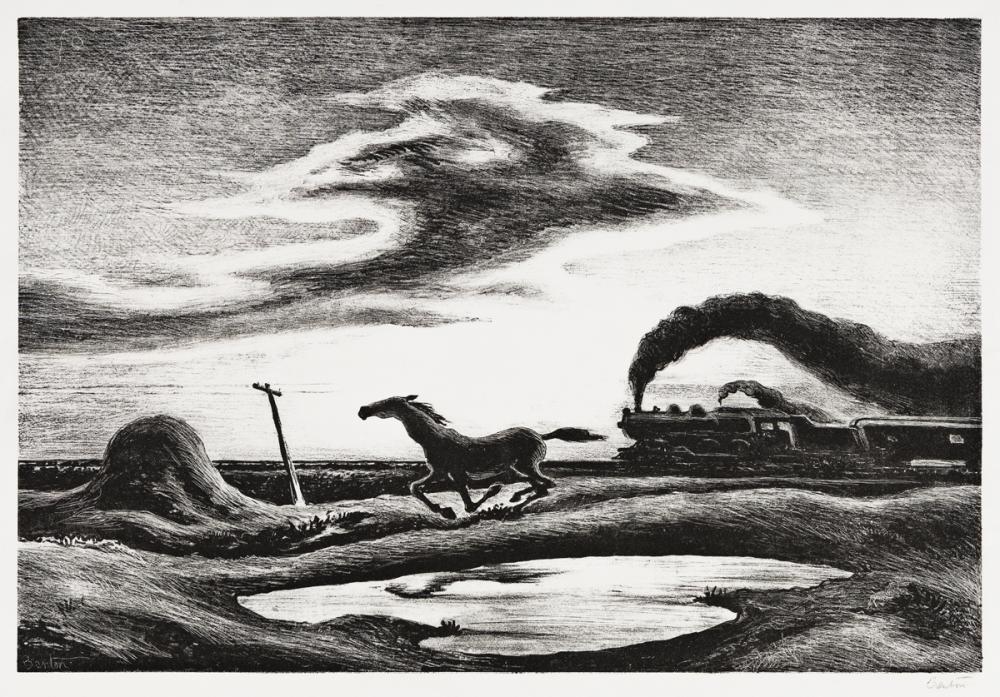
The Race, 1942 by Thomas Hart Benton (1889-1975)

With blunt grace, Denis Johnson navigates the line between realism and the American frontier myth in his perfect novella Train Dreams. In a slim 116 pages, Johnson communicates one man’s life story with a depth and breadth that actually lives up to the book’s blurb’s claim to be an “epic in miniature.”  I read it in one sitting on a Sunday afternoon, occasionally laughing aloud at Johnson’s wry humor, several times moved by the pathos of the narrative, and more than once stunned at the subtle, balanced perfection of Johnson’s prose, which inheres from sentence to paragraph to resonate throughout the structure of the book.

The opening lines hooked me:

In the summer of 1917 Robert Grainier took part in an attempt on the life of a Chinese laborer caught, or anyway accused of, stealing from the company stores of the Spokane International Railway in the Idaho Panhandle.

Three of the railroad gang put the thief under restraint and dragged him up the long bank toward the bridge under construction fifty feet above the Moyea River. A rapid singsong streamed from the Chinaman voluminously. He shipped and twisted like a weasel in a sack, lashing backward with his one free fist at the man lugging him by the neck.

The matter-of-fact violence here complicates everything that follows in many ways, because Grainier it turns out is pretty much that rare thing, a good man, a simple man who tries to make a life in the Idaho Panhandle at the beginning of the 20th century. The rest of the book sees him trying—perhaps not consciously—to somehow amend for the strange near-lynching he abetted.

Grainier works as a day laborer, felling the great forests of the American northwest so that a network of trains can connect the country. Johnson resists the urge to overstate the obvious motifs of expansion and modernity here, instead expressing depictions of America’s industrial growth at a more personal, even psychological level:

Grainier’s experience on the Eleven-Mile Cutoff made him hungry to be around other such massive undertakings, where swarms of men did away with portions of the forest and assembled structures as big as anything going, knitting massive wooden trestles in the air of impassable chasms, always bigger, longer, deeper.

Grainier’s hard work keeps him from his wife and infant daughter, and the separation eventually becomes more severe after a natural calamity, but I won’t dwell on that in this review, because I think the less you know about Train Dreams going in the better. Still, it can’t hurt to share a lovely passage that describes Grainier’s courtship with the woman who would become his wife:

The first kiss plummeted him down a hole and popped him out into a world he thought he could get along in—as if he’d been pulling hard the wrong way and was now turned around headed downstream. They spent the whole afternoon among the daisies kissing. He felt glorious and full of more blood than he was supposed to have in him.

The passage highlights Johnson’s power to move from realism into the metaphysical and back, and it’s this precise navigation of naturalism and the ways that naturalism can tip the human spirit into supernatural experiences that makes Train Dreams such a strong little book. In the strange trajectory of his life, Grainier will be visited by a ghost and a wolf-child, will take flight in a biplane and transport a man shot by a dog, will be tempted by a pageant of pulchritude and discover, most unwittingly, that he is a hermit in the woods. In Johnson’s careful crafting, these events are not material for a grotesque picaresque or a litany of bizarre absurdities, but rather a beautiful, resonant poem-story, a miniature history of America.

Train Dreams is an excellent starting place for those unfamiliar with Johnson’s work, and the book will rest at home on a shelf with Steinbeck’s naturalist evocations or Cormac McCarthy’s Border Trilogy. I have no idea why the folks at FS&G waited almost a decade to publish it (Train Dreams was originally published in a 2002 issue of The Paris Review), but I’m glad they did, and I’m glad the book is out now in trade paperback from Picador, where it should gain a wider audience. Very highly recommended.

[Ed. note: Biblioklept originally published this review in May of 2012.]