CHECK THE RECORD / CHECK THE RECORD / CHECK THE GUY’S TRACK RECORD

RIP Mark E. Smith, 1957-2018

A review of Ursula K. Le Guin’s novel The Lathe of Heaven

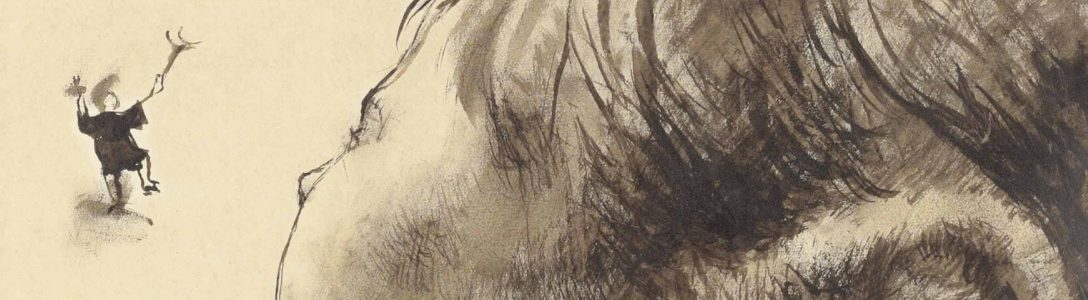
The City I Dream, Victor Brauner

George Orr is not well. The meek protagonist of Ursula K. Le Guin’s novel The Lathe of Heaven abuses prescription drugs in a desperate and unsuccessful attempt to stop himself from falling asleep. Orr doesn’t want to sleep because he believes that his dreams come true—that they literally alter reality—but in such a way that no one but Orr realizes that the world has changed. Orr gets caught using a “Pharmacy Card” that doesn’t belong to him, and is court-ordered to begin treatment with a sleep research psychiatrist, Dr. William Haber. Although Haber initially doesn’t believe Orr’s claim to be cursed with “effective dreams” that transform reality, he soon realizes that Orr’s dreams somehow do come true. Then, via hypnotic suggestion (and an “Augmentor” device), Haber begins wielding Orr’s gift/curse as a clumsy tool to “better” the world.

The world of The Lathe of Heaven is grim, gray, dystopian. Published in 1971 and set in Portland in the palindromic year of 2002, Le Guin’s novel is depressingly prescient. Not only does she capture the onset of seventies malaise (the ashes of hope that burned out in the sixties), she also points to a future of environmental catastrophe:

Very little light and air got down to street level; what there was was warm and full of fine rain. Rain was an old Portland tradition, but the warmth—70° F on the second of March—was modern, a result of air pollution. Urban and industrial effluvia had not been controlled soon enough to reverse the cumulative trends already at work in the mid-twentieth century; it would take several centuries for the CO2 to clear out of the air, if it ever did. New York was going to be one of the larger casualties of the Greenhouse Effect, as the polar ice kept melting and the sea kept rising…

This is also a world of urban sprawl, overpopulation, malnutrition, and total war (a clusterfuck in the Middle East, wouldn’t you know). The government is a vague and menacing presence here—vaguely totalitarian, vaguely Big Brotheresque. We learn of the “New Federal Constitution of 1984,” one of many references to Orwell’s book. (The most obvious is our passive hero’s name).

So it’s no wonder that Haber sets about to create a utopia, right? Wouldn’t you, like, try to make the world a better place if you could? Haber is repeatedly described as a “benevolent man”—Le Guin withholds the word dictator—but the central theme comes through repeatedly: Is it possible to alter reality for the greater good? Or do we simply exist in nature, a part of everything around us?

Haber’s experiments with Orr’s mind have unintended consequences. How might we, say, cure overpopulation? How about an awful plague. Orr’s “effective dreams” revise history, rewrite reality, remap consciousness. But he’s never quite able to pull off the massive tasks Haber sets for him—end racism, end war, cure the damaged ecosystem (Le Guin is extremely pessimistic on this last front). Orr is burdened with the consciousness of multiple realities, and feels deep guilt for his role in uncreation. He starts to go crazy:

“I am cracking,” he said. “You must see that. You’re a psychiatrist. Don’t you see that I’m going to pieces? Aliens from outer space attacking Earth! Look: if you ask me to dream again, what will you get? Maybe a totally insane world, the product of an insane mind. Monsters, ghosts, witches, dragons, transformations—all the stuff we carry around in us, all the horrors of childhood, the night fears, the nightmares. How can you keep all that from getting loose? I can’t stop it. I’m not in control!”

Continue reading “A review of Ursula K. Le Guin’s novel The Lathe of Heaven”

If civilization has an opposite, it is war (Ursula K. Le Guin)

Tibe spoke on the radio a good deal. Estraven when in power had never done so, and it was not in the Karhidish vein: their government was not a public performance, normally; it was covert and indirect. Tibe, however, orated. Hearing his voice on the air I saw again the long-toothed smile and the face masked with a net of fine wrinkles. His speeches were long and loud: praises of Karhide, disparagements of Orgoreyn vilifications of “disloyal factions,” discussions of the “integrity of the Kingdom’s borders,” lectures in history and ethics and economics, all in a ranting, canting, emotional tone that went shrill with vituperation or adulation. He talked much about pride of country and love of the parentland, but little about shifgrethor, personal pride or prestige. Had Karhide lost so much prestige in the Sinoth Valley business that the subject could not be brought up? No; for he often talked about the Sinoth Valley. I decided that he was deliberately avoiding talk of shifgrethor because he wished to rouse emotions of a more elemental, uncontrollable kind. He wanted to stir up something which the whole shifgrethor-pattern was a refinement upon, a sublimation of. He wanted his hearers to be frightened and angry. His themes were not pride and love at all, though he used the words perpetually; as he used them they meant self-praise and hate. He talked a great deal about Truth also, for he was, he said, “cutting down beneath the veneer of civilization.”

It is a durable, ubiquitous, specious metaphor, that one about veneer (or paint, or pliofilm, or whatever) hiding the nobler reality beneath. It can conceal a dozen fallacies at once. One of the most dangerous is the implication that civilization, being artificial, is unnatural: that it is the opposite of primitiveness… Of course there is no veneer, the process is one of growth, and primitiveness and civilization are degrees of the same thing. If civilization has an opposite, it is war. Of those two things, you have either one, or the other. Not both. It seemed to me as I listened to Tibe’s dull fierce speeches that what he sought to do by fear and by persuasion was to force his people to change a choice they had made before their history began, the choice between those opposites.

From Ursula Le Guin’s 1969 novel The Left Hand of Darkness. The bold emphases are mine—mea culpa, I couldn’t help it.

On Ursula K. Le Guin’s Hainish novels


img_1190

“Are we not Men?”

— The Island of Dr. Moreau, H.G. Wells (1896)

“A country, a people…Those are strange and very difficult ideas.”

— Four Ways to Forgivenss, Ursula K. Le Guin (1995)

—Each of the novels in Ursula K. Le Guin’s so-called Hainish cycle obliquely addresses Wells’s question by tackling those strange and very difficult ideas of “a country, a people.” The best of these Hainish books do so in a manner that synthesizes high-adventure sci-fi fantasy with dialectical philosophy.

—What am I calling here “the best”? Well—

The Left Hand of Darkness

Planet of Exile/City of Illusions (treat as one novel in two discursive parts)

The Dispossessed

—(How oh how oh how dare I rank The Dispossessed—clearly a masterpiece, nay?—so low on that little list? It’s too dialectical, maybe? Too light on the, uh, high adventure stuff, on the fantasy and romance and sci-fi. Its ideas are too finely wrought, well thought out, expertly cooked (in contrast to the wonderful rawness of Rocannon’s World, for example). None of this is to dis The Dispossessed—it’s probably the best of the Hainish books, and the first one casual readers should attend to. (It was also the first one I read way back when in high school)).

—The novels in Le Guin’s so-called Hainish cycle are

Rocannon’s World (1966)

Planet of Exile (1966)

City of Illusions (1967)

The Left Hand of Darkness (1969)

The Dispossessed (1974)

The Word for World is Forest (1976)

Four Ways to Forgiveness (1995)

The Telling (2000)

—Okay, so I decided to include For Ways to Forgiveness in the above list even though most people wouldn’t call it a “novel” — but its four stories (novellas, really) are interconnected and tell a discrete story of two interconnected planets that are part of the Hainish world. And I pulled a quote from it above. So.

—I read, or reread, Le Guin’s so-called Hainish cycle close to the chronological order proposed by the science fiction writer Ian Watson. I don’t necessarily recommend this order.

—(I keep modifying “Hainish cycle” with “so-called” because the books aren’t really a cycle. Le Guin’s world-building isn’t analogous to Tolkien’s Middle Earth or Faulkner’s Yoknapatawpha County. (Except when her world-building is analogous). But let us return to order).

Le Guin on the subject:

People write me nice letters asking what order they ought to read my science fiction books in — the ones that are called the Hainish or Ekumen cycle or saga or something. The thing is, they aren’t a cycle or a saga. They do not form a coherent history. There are some clear connections among them, yes, but also some extremely murky ones. And some great discontinuities (like, what happened to “mindspeech” after Left Hand of Darkness? Who knows? Ask God, and she may tell you she didn’t believe in it any more.)

OK, so, very roughly, then:

Rocannon’s World, Planet of Exile, City of Illusions: where they fit in the “Hainish cycle” is anybody’s guess, but I’d read them first because they were written first. In them there is a “League of Worlds,” but the Ekumen does not yet exist.

—I agree with the author. Read this trilogy first. Read it as one strange book.

—(Or—again—pressed for time and wanting only the essential, read The Dispossessed and The Left Hand of Darkness—but you already knew that, no?).

Continue reading “On Ursula K. Le Guin’s Hainish novels”

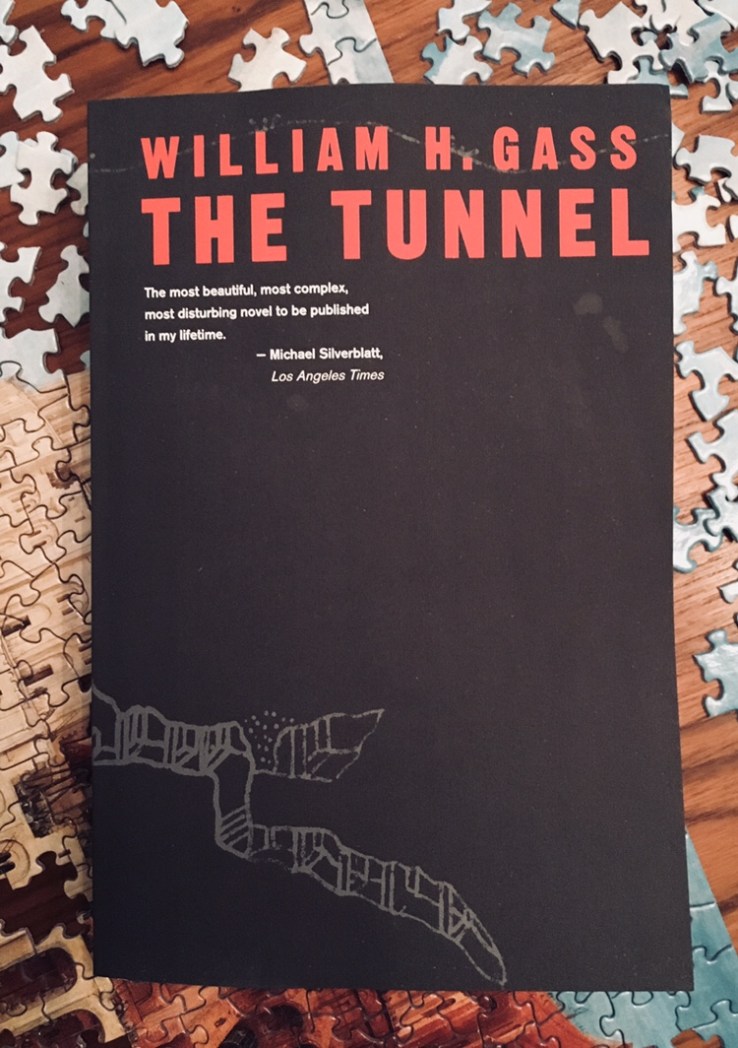
William H. Gass’s The Tunnel (Book acquired, 22 Jan. 2018)

img_8960

The great late great William H. Gass’s very big novel The Tunnel was one of four books I put on my 2018 Good Intentions Reading List that I didn’t previously own. (I did check it out from the library a few years back and download the audiobook—read by Gass himself–but I didn’t make a big dent). I ordered it from my favorite bookstore and it came in yesterday. The Tunnel is one of three Great Big Books I plan to (attempt to) read this year, including Middlemarch and some novel called War & Peace. I’ll probably start The Tunnel first.

Here are two selections from The Tunnel:

img_8962

An Invocation to the Muse

O brood O muse upon my mighty subject like a holy hen upon the nest of night.
O ponder the fascism of the heart.
Sing of disappointments more repeated than the batter of the sea, of lives embittered by resentments so ubiquitous the ocean’s salt seems thinly shaken, of let-downs local as the sofa where I copped my freshman’s feel, of failures as frequent as first love, first nights, last stands; do not warble of arms or adventurous deeds or shepherds playing on their private fifes, or of civil war or monarchies at swords; consider rather the slightly squinkered clerk, the soul which has become as shabby and soiled in its seat as worn-out underwear, a life lit like a lonely room and run like a laddered stocking.
Behold the sagging tit, the drudge-gray mopped-out cunt-corked wife, stale as yesterday’s soapy water or study the shiftless kind, seedy before any bloom, thin and mean as a weed in a walk;
Smell the grease that stands rancid in the pan like a second skin, the pan aslant on some fuel-farting stove, the stone in its corner contributing what it can to the brutal conviviality of close quarters,
Let depression like time-payments weigh you down; feel desperation and despair like dust thick in the rug and the ragged curtains, or carry puppy pee and plate-scrapings, wrapped in the colored pages of the Sunday paper, out to the loose and blowing, dog-jawed heap in the alley;
Spend your money on large cars, loud clothes, sofa-sized paintings, excursions to Hawaii, trinkets, knicknacks, fast food, golf clubs, call girls, slimming salons, booze;
Suffer shouting, heat rash, chilblains, beatings, betrayal, guilt, impotence, jail, jealousy, humiliation, VD, vermin, stink.
Sweat through a St. Louis summer and sing of that.
O muse, I cry, as loudly as I can, while still commanding a constricted scribble, hear me! help me! but my nasty echo answers: one muse for all the caterwauling you have called for! where none was in that low-life line of work before?
It’s true. I’ll need all nine for what I want to do—perhaps brand new—all nine whom Hesiod must have frigged to get his way, for he first spoke their secret names and hauled their history by the snout into his poem. For what I want to do …
Which is what—exactly? to deregulate Descartes like all the rest of the romancers? to philosophize while performing some middle-age adultery? basically enjoying your anxieties like raw lickker when it’s gotten to the belly? I know—you want to make the dull amazing, you want to Heidegger some wholesome thought, darken daytime for the TV, grind the world into a grain of Blake.
O, I deny it! On the contrary! I shall not abuse your gift. I pledge to you, if you should choose me, not to make a mere magician’s more of less, to bottle up a case of pop from a jigger of scotch. I have no wish to wine water or hand out loaves and fishes like tickets on a turkey. It is my ambition to pull a portent—not a rabbit but a raison d’être—from anything—a fish pond, top hat, fortune cookie—you just name it—a prophecy in Spengler’s fanciest manner, a prediction of a forlorn future for the world from—oh, the least thing, so long as it takes a Teutonic tone—a chewed-over, bubble-flat wad of baseball gum, say, now hard and sour in the street, with no suggestion of who the player’s picture was, impersonal despite its season in someone’s spit, like a gold tooth drawn from a Jew’s jaw.
Misfits, creeps, outcasts of every class; these are my constituents—the disappointed people—and if I could bring my fist down hard on the world they would knot together like a muscle, serve me, strike as hard as any knuckle.
Hey Kohler—hey Koh—whistle up a wind. Alone, have I the mouth for it? the sort of wind I want? Imagine me, bold Kohler, calling out for help—and to conclude, not to commence—to end, to bait, to 30, stop, leave off, to hush a bye forever … to untick tock.

I Wake to Sleep — Dina Brodsky

waketosleepwebsite-1024x1002

I Wake to Sleep by Dina Brodsky (b. 1981)

Read “P’s Correspondence,” a short story by Nathaniel Hawthorne

“P’s Correspondence”

by

Nathaniel Hawthorne


MY UNFORTUNATE FRIEND P. has lost the thread of his life, by the interposition of long intervals of partially disordered reason. The past and present are jumbled together in his mind, in a manner often productive of curious results; and which will be better understood after a perusal of the following letter, than from any description that I could give. The poor fellow, without once stirring from the little white-washed, iron-grated room, to which he alludes in his first paragraph, is nevertheless a great traveller, and meets, in his wanderings, a variety of personages who have long ceased to be visible to any eye save his own. In my opinion, all this is not so much a delusion, as a partly wilful and partly involuntary sport of the imagination, to which his disease has imparted such morbid energy that he beholds these spectral scenes and characters with no less distinctness than a play upon the stage, and with somewhat more of illusive credence. Many of his letters are in my possession, some based upon the same vagary as the present one, and others upon hypotheses not a whit short of it in absurdity. The whole form a series of correspondence, which, should fate seasonably remove my poor friend from what is to him a world of moonshine, I promise myself a pious pleasure in editing for the public eye. P. had always a hankering after literary reputation, and has made more than one unsuccessful effort to achieve it. It would not be a little odd, if, after missing his object while seeking it by the light of reason, he should prove to have stumbled upon it in his misty excursions beyond the limits of sanity.

LONDON, February 29, 1845.

MY DEAR FRIEND:

Old associations cling to the mind with astonishing tenacity. Daily custom grows up about us like a stone-wall, and consolidates itself into almost as material an entity as mankind’s strongest architecture. It is sometimes a serious question with me, whether ideas be not really visible and tangible, and endowed with all the other qualities of matter. Sitting as I do, at this moment, in my hired apartment, writing beside the hearth, over which hangs a print of Queen Victoria–listening to the muffled roar of the world’s metropolis, and with a window at but five paces distant, through which, whenever I please, I can gaze out on actual London–with all this positive certainty, as to my whereabouts, what kind of notion, do you think, is just now perplexing my brain? Why–would you believe it?–that, all this time, I am still an inhabitant of that wearisome little chamber,–that whitewashed little chamber–that little chamber with its one small window, across which, from some inscrutable reason of taste or convenience, my landlord had placed a row of iron bars–that same little chamber, in short, whither your kindness has so often brought you to visit me! Will no length of time, or breadth of space, enfranchise me from that unlovely abode? I travel, but it seems to be like the snail, with my house upon my head. Ah, well! I am verging, I suppose, on that period of life when present scenes and events make but feeble impressions, in comparison with those of yore; so that I must reconcile myself to be more and more the prisoner of Memory, who merely lets me hop about a little, with her chain around my leg.

My letters of introduction have been of the utmost service, enabling me to make the acquaintance of several distinguished characters, who, until now, have seemed as remote from the sphere of my personal intercourse as the wits of Queen Anne’s time, or Ben Jonson’s compotators at the Mermaid. One of the first of which I availed myself, was the letter to Lord Byron. I found his lordship looking much older than I had anticipated; although–considering his former irregularities of life, and the various wear and tear of his constitution–not older than a man on the verge of sixty reasonably may look. But I had invested his earthly frame, in my imagination, with the poet’s spiritual immortality. He wears a brown wig, very luxuriantly curled, and extending down over his forehead. The expression of his eyes is concealed by spectacles. His early tendency to obesity having increased, Lord Byron is now enormously fat; so fat as to give the impression of a person quite overladen with his own flesh, and without sufficient vigor to diffuse his personal life through the great mass of corporeal substance, which weighs upon him so cruelly. You gaze at the mortal heap; and, while it fills your eye with what purports to be Byron, you murmur within yourself–“For Heaven’s sake, where is he?” Were I disposed to be caustic, I might consider this mass of earthly matter as the symbol, in a material shape, of those evil habits and carnal vices which unspiritualize man’s nature, and clog up his avenues of communication with the better life. But this would be too harsh; and besides, Lord Byron’s morals have been improving, while his outward man has swollen to such unconscionable circumference. Would that he were leaner; for, though he did me the honor to present his hand, yet it was so puffed out with alien substance, that I could not feel as if I had touched the hand that wrote Childe Harold.

On my entrance, his lordship apologized for not rising to receive me, on the sufficient plea that the gout, for several years past, had taken up its constant residence in his right foot; which, accordingly, was swathed in many rolls of flannel, and deposited upon a cushion. The other foot was hidden in the drapery of his chair. Do you recollect whether Byron’s right or left foot was the deformed one? Continue reading “Read “P’s Correspondence,” a short story by Nathaniel Hawthorne”

Missionaries — Bridget Tichenor

tumblr_ndisy4tmz21rtynt1o7_r2_1280

Missionaries, 1965 by Bridget Tichenor (1917-1990)

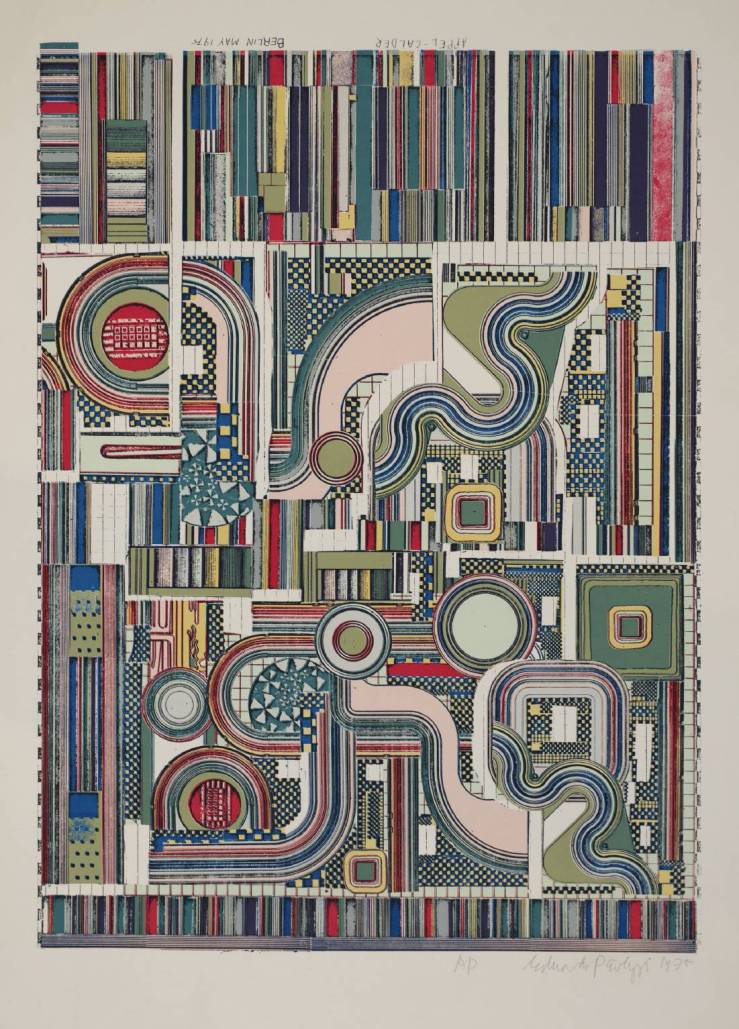
Appel-Calder — Eduardo Paolozzi  

Appel-Calder 1975 by Sir Eduardo Paolozzi 1924-2005

Appel-Calder, 1975 by Eduardo Paolozzi (1924–2005)

Lady in Yellow Dress — Max Kurzweil

lady-in-yellow-1899

Lady in Yellow Dress, 1899 by Max Kurzweil (1867-1916)

The Box — Pierre-Auguste Renoir

the-box-1874hd

The Box, 1874 by Pierre-Auguste Renoir (1841-1919)

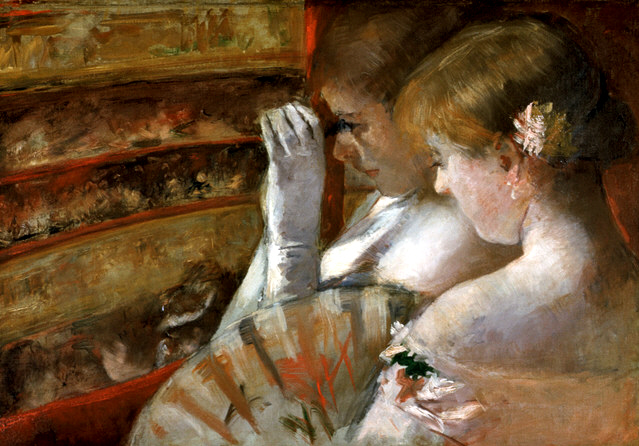
In the Box — Mary Cassatt

in-the-box

In the Box, 1879 by Mary Cassatt (1844-1926)

In the Box — Paul Klee

a77b27c0e3114595febfc2ea77d1ffd3-paul-klee-the-box

In the Box, 1908 by Paul Klee (1879-1940)

Don Quixote — Amadeo de Souza-Cardoso

amadeo_de_souza-cardoso_-_dom_quixote

Don Quixote, 1914 by Amadeo de Souza-Cardoso (1887-1918)

Read Edgar Allan Poe’s “The Man of the Crowd”

SH925
Fritz Eichenberg’s illustration for Edgar Allan Poe’s “The Man of the Crowd”


“The Man of the Crowd”

by

Edgar Allan Poe


     Ce grand malheur, de ne pouvoir être seul.

              La Bruyère.

IT was well said of a certain German book that “er lasst sich nicht lesen“—it does not permit itself to be read. There are some secrets which do not permit themselves to be told. Men die nightly in their beds, wringing the hands of ghostly confessors and looking them piteously in the eyes—die with despair of heart and convulsion of throat, on account of the hideousness of mysteries which will not suffer themselves to be revealed. Now and then, alas, the conscience of man takes up a burthen so heavy in horror that it can be thrown down only into the grave. And thus the essence of all crime is undivulged.

Not long ago, about the closing in of an evening in autumn, I sat at the large bow window of the D——- Coffee-House in London. For some months I had been ill in health, but was now convalescent, and, with returning strength, found myself in one of those happy moods which are so precisely the converse of ennui—moods of the keenest appetency, when the film from the mental vision departs—the [Greek phrase]—and the intellect, electrified, surpasses as greatly its every-day condition, as does the vivid yet candid reason of Leibnitz, the mad and flimsy rhetoric of Gorgias. Merely to breathe was enjoyment; and I derived positive pleasure even from many of the legitimate sources of pain. I felt a calm but inquisitive interest in every thing. With a cigar in my mouth and a newspaper in my lap, I had been amusing myself for the greater part of the afternoon, now in poring over advertisements, now in observing the promiscuous company in the room, and now in peering through the smoky panes into the street.

This latter is one of the principal thoroughfares of the city, and had been very much crowded during the whole day. But, as the darkness came on, the throng momently increased; and, by the time the lamps were well lighted, two dense and continuous tides of population were rushing past the door. At this particular period of the evening I had never before been in a similar situation, and the tumultuous sea of human heads filled me, therefore, with a delicious novelty of emotion. I gave up, at length, all care of things within the hotel, and became absorbed in contemplation of the scene without. Continue reading “Read Edgar Allan Poe’s “The Man of the Crowd””

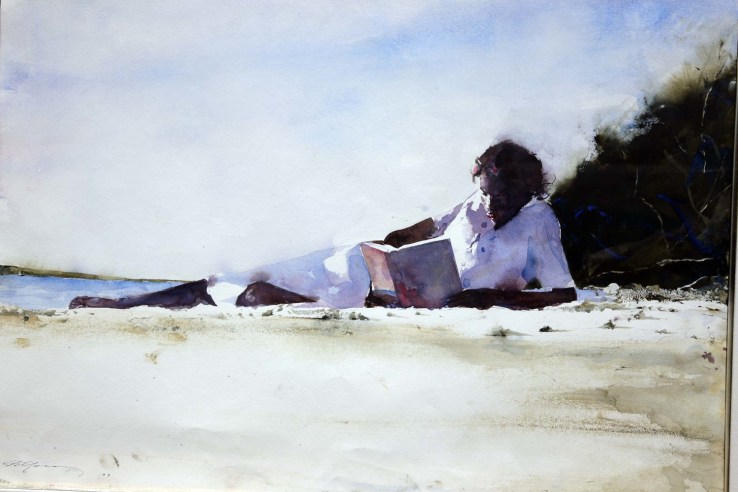
Reading, Whale Point — Stephen Scott Young

6k8c5239

Reading, Whale Point, 2000 by Stephen Scott Young (b. 1957)

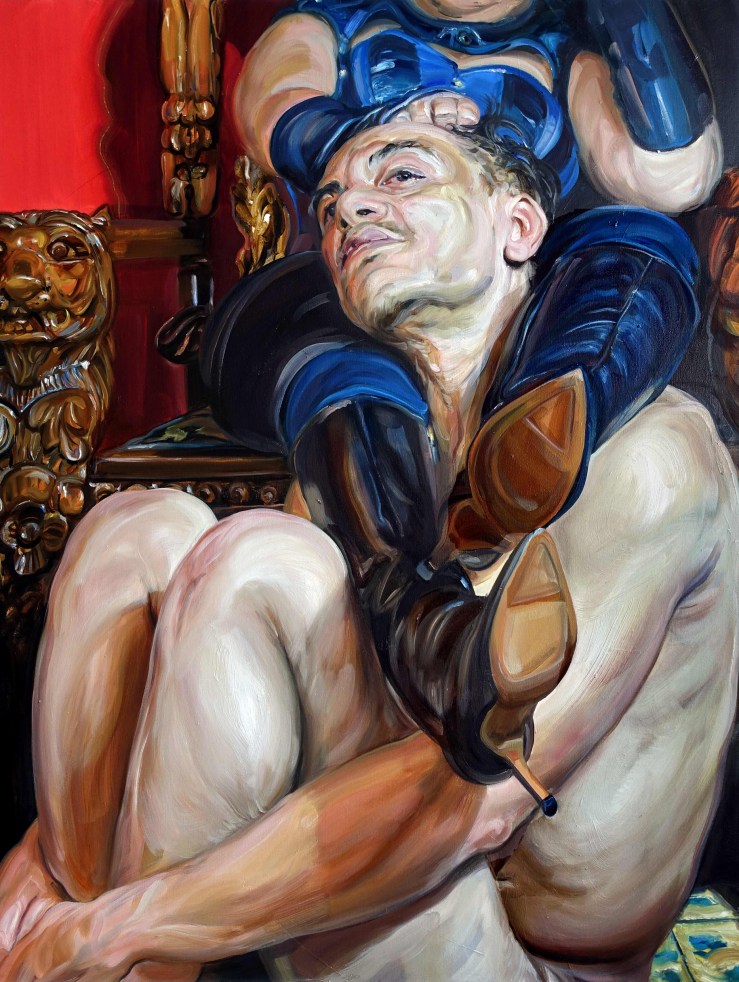
Domina I / Domina III — Natalie Frank

domina_i

domina_iii

Domina I and Domina III, 2017 by Natalie Frank (b. 1980)