Bad trip | Blog about Rudolph Wurlitzer’s cult novel Nog

img_5165

I don’t know man.

I think I should have loved Nog, Rudolph Wurlitzer’s 1969 cult novel.

Nog is druggy, abject, gross, and shot-through with surreal despair, a Beat ride across the USA. Wurlitzter’s debut novel is told in a first-person that constantly deconstructs itself, then reconstructs itself, then wanders out into a situation that atomizes that self again.

Nog reads like a hallucinatory accounting of the American literature before it, starting with a narrator who aims for transcendentalism, but is “wrenched out of two months of calm” by the sight of a young woman walking the beach:

There was something about her large breasts under her faded blue tee shirt, the quick way she bent down, her firm legs in their rolled-up white jeans, her thin ankles – it was her feet, actually; they seemed for a brief, painful moment to be elegant.

Right in the first paragraph, Wurlitzer announces themes of travel (feet) and weird oedipal angles (those “large breasts”) that will pulsate throughout the novel. The image of the young lady zaps our narrator:

I had to pull out, I thought, I was beginning to notice things, lists were forming, comparisons were on the way. And now I don’t have the octopus.

Nog is larded with comparisons and lists and octopuses (or octopi, if you prefer—our (un-)helpful narrator points out both are acceptable). The narrator lists beaches, lakes, and rivers, a motif of travel and horizons that underscores the novel’s surreal critique of Manifest Destiny. The octopuses fit more neatly with Nog’s pscyhosphere of bodies wrangling bodies, possessed limbs wriggling willy-nilly, groping, prodding, promising. Wurlitzer uses similes and metaphors that repeatedly compare both people and situations to squid or octopuses, and also evokes the image without naming it in imagery (including a really gross menage a trois).

I have not described the plot of Nog yet. Describing the plot would not be impossible, I guess, but it would involve typing out most of the novel. Nog is a surreal picaresque fueled on All Of The Drugs and All Of The Sex, both a product and critique of the End Of The Sixties that birthed it. (Forgive all that capitalization.) Here is the slim blurb from indie Two Dollar Radio, which republished the novel a decade ago:

In Wurlitzer’s signature hypnotic and haunting voice, Nog tells the tale of a man adrift through the American West, armed with nothing more than his own three pencil-thin memories and an octopus in a bathysphere.

Nog is certainly a surreal Western, one organized around three memories that Our Hero keeps reinventing (memories often anchored by an octopus).

There are characters, of course, but the characterization is vague, hazy, slip-sliding. Wurlitzer sticks to Narrator and his foils Meridith and Lockett for the most part. The pair are Ur-Parents and Ur-Partners who his narrator fucks, fucks over, and gets fucked over by. At times, the narrator—who may or may not be Nog his damnself—even becomes iterations of Meridith or Lockett. In an effort to share Wurlitzer’s prose style in Nog, here is a paragraph from late in the novel that comes close to summarizing it, but not really summarizing it, due to its surreal aporia:

I’m not cold or warm. I might be approaching both. I don’t remember when I’ve last fallen asleep. I’m not asleep or awake. I first met Meridith over a jar of artichoke hearts. But it’s Lockett now… There’s no possibility of an erection. The supermarket was crowded. The colors were warm. Lockett’s hands moved easily over the frozen-meat packages, slipping them into his army overcoat. We discovered each other stealing. I had four jars of artichoke hearts in my pocket. Lockett kept me from being busted. He straightened me out. He sold me a doctor’s bag and gave me connections.

“There’s no possibility of an erection” ! — of course Thomas Pynchon blurbed Nog. Wurlitzer’s novel is an unmediated riff on Manifest Destiny’s ugly horniness (or is it hornyness — Wurlitzer and other authorities won’t sing on this matter). There are buffalo shoots, rapes, and all that westward expansion. But by the Space Age Nineteen-Sixties, where were the borders? As the narrator comments/laments:

Nothing for it but to plunge on to the manufactured end. The Pacific is gone.

No place to go but into the surreal.

But Nog also exemplifies everything wrong with the late sixties—a kind of self-indulgent, (literally-)masturbatory psychoromp that frequently tests the patience of its audience. (By “its audience” I mean “me.”)

Nog is dark and foul, poisonous, an indictment of the End Of A Big Dream (forgive my capitalization). It’s not fun, nor did I find it funny—maybe because I read it right after Charles Wright’s much funnier novel The Wig (1966), a novel that collapses the horror and humor of the Dream Of The Sixties (eh, capitalization) into something far sharper, funnier, surrealer, and ecstaicer (or is it ecstackier—authorities diverge on this matter).

Or maybe I didn’t dig Nog the way I wanted to because I read it during The Weirdest Spring Break Of My Life, in the quarantine that we’re all going through, uncomforted by its abject digressions, its plasticity, its refusal to mean in a healthy, wholesome, unvirused way.

Maybe I should read it again, in Healthier Times.

Nog for now reads a bit-too-disturbing, which I guess is actually Good, according to the traditional rubric that I’ve used to measure novels—the whole disturb the comfortable model, right? Maybe I’m disturbed, anxious, agoraphobic, hypochondriac. But this is a Bad Trip.

Nog reads like a bad trip right to its end. Near the novel’s end, our narrator (who may-or-may-not-be Nog, or Lockett — or locket or lock it) takes a bad trip on a ship to “the manufactured end” — to Manifest Destiny Done Run Out. Here’s the authoritarian captain:

“The main thing,” he says, “is to be obedient for a long time, and in one and the same direction. Keep to the same space. Don’t try to go to new ports. Eight hundred Chinese were imported to build a railroad alongside the Canal. They committed suicide when they were deprived of their opium. They strangled or hanged themselves or sat down on the beach and waited for the tide to drown them. Let that be a lesson to you. Be kind to her.”

I have no idea what to make of the captain’s advice to the narrator. On one hand, it seems antithetical to the spirit of the novel—of movement, of going in new directions and mooring in new ports. At the same time, it highlights the cruelty of the American Project of Manifest Destiny (goddamn dude, all those Capital Letters!) as a kind of murder-suicide.

Or maybe I just want to end on those words:

Be kind to her.



Butterfly Stories — Falk Gernergross

Screenshot 2020-01-11 at 10.31.40 AM

Butterfly Stories, 2012 by Falk Gernergross (b. 1973)

Blog about some recent reading (Spring break/quarantine (?) edition)

img_5159

Left to right:

I used interlibrary loan to check out a copy of Clifford Mead’s Thomas Pynchon: A Bibliography. It’s pretty neat, and includes some photos of Our Reclusive Favorite that I’d never seen before, like this one:

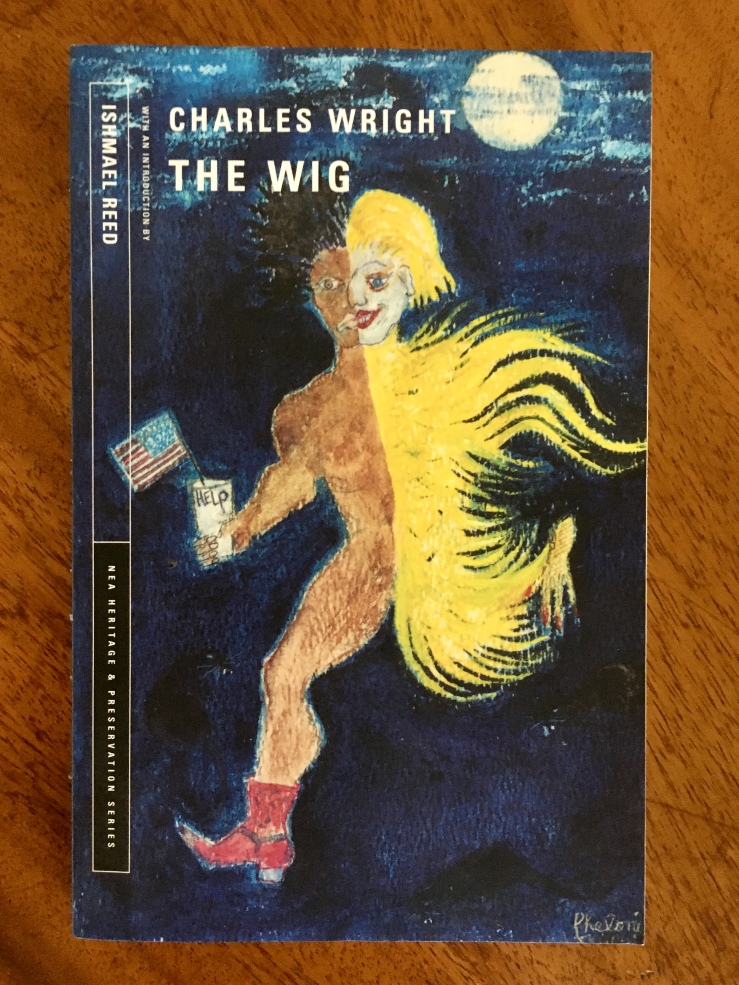
I read Charles Wright’s 1966 novel The Wig last weekend. The novel is amazing—a picaresque, burlesque, Black black comedy that made me want to reread Invisible Man and read all the Ishmael Reed that I’ve left unread. And more Charles Wright. The energy of The Wig enraptured me; Wright’s cartoon vision of 1960’s Harlem is poised just on the edge of horror. I loved loved loved this novel, and aim for a full review sometime this week.

To its right is The Complete Gary Lutz, which I’ve been nibbling at for a few months. It’s like a rich cheese block or a lovely single malt—not something to inhale all at once, but wonderful in moderation.

I’ve also been picking through Escape Velocity: A Charles Portis Miscellany, mostly reading the journalism at the front end. (I’m saving the play, Delray’s New Moon for…I don’t know…like a quarantine or something?)

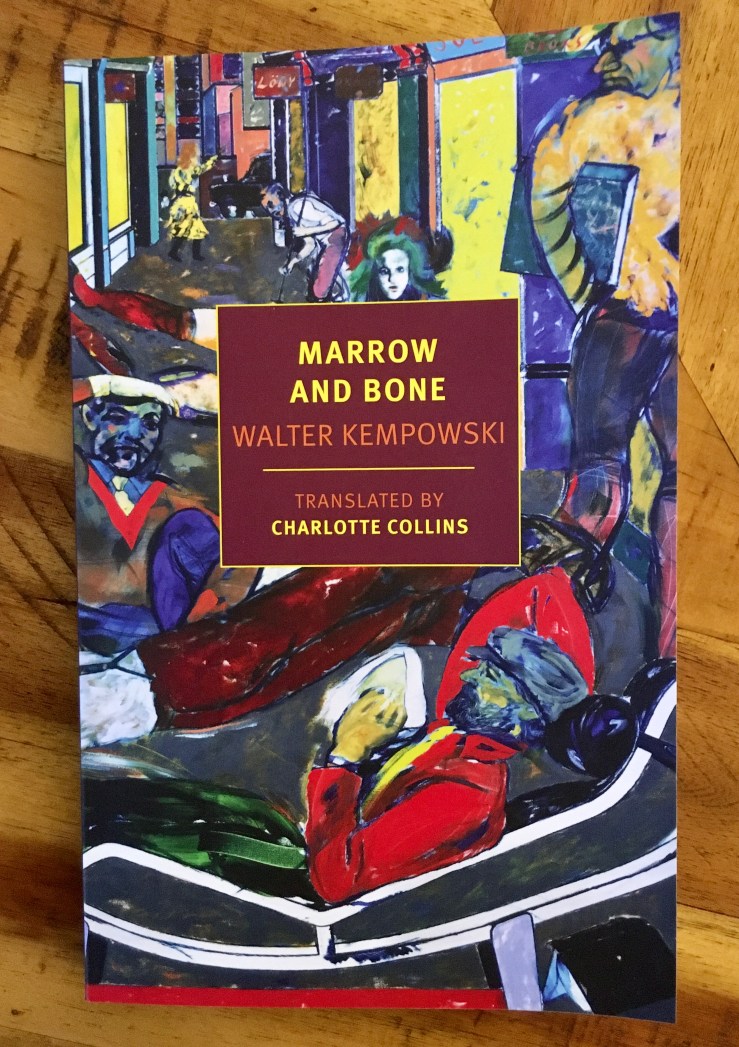
This afternoon, I dipped into Marrow and Bone, Walter Kempowski’s satirical road novel set in Germany and Poland right before the fall of the Berlin Wall. Charlotte Collins’s translation renders Kempowski’s prose as frank, funny, and often ironic.

I’m a little over halfway through Rudolph Wurlitzer’s 1969 cult classic Nog. The novel is far more abject and despair-inflected than I had imagined, and so far, anyway, the despair and abjection isn’t leavened with any humor that’s registered with me. I dig the absurdity, but I’ve got to admit that the book isn’t working for me. I wanted to love it—-blurbed by Pynchon, right? features an imaginary octopus, right?—but something’s missing for me. (The vague something in the previous sentence is humor—there are maybe some jokes or japes I’m missing, to be fair, but…) The book’s strengths bleed over with its weaknesses. Wurlitzer does an admirable job portraying a consciousness dissolving and resolving, only to desire to not desire consciousness at all, only static, Buddhist peace. Nog is essentially a narrative voice, a howl disintegrating in on itself, bubbling down, and revivifying itself via verbal goo to speak anew. There are Big Western Themes, too—Wurlitzer’s critique of America’s favorite myth of Manifest Destiny is subtle but sharp. The novel’s druggy haze recalls William Burroughs or Allen Ginsberg, but a bit more focused. It so far makes me think of better novels by João Gilberto Noll, though. I very much love two films that Rudolph Wurlitzer wrote: Two-Lane Blacktop (1971; dir. Monte Hellman) and Pat Garrett and Billy the Kid (1973; dir. Sam Peckinpah). I’d love to see two others he wrote: America (1986; dir. Robert Downey Sr.) and Walker (1987; dir. Alex Cox).

Nog also has some really gross sex scenes.

(I think I might be enjoying Wurlitzer’s debut novel more if I hadn’t read The Wig immediately before it.)

The last two skinny volumes there on the right are new joints from Sublunary Editions. Vik Shirley’s Corpses is like a thirty-paragraph prose-poem, part comic, part morbid.  The blurb for Jessica Sequeira’s A Luminous History of the Palm describes the tract:

This little book can be read as a series of small portraits through time, all of which include a palm tree. Or it can be read as a revolutionary tract. The palm is a symbol traced through history, a hidden portal to intimate moments that bring geographies and situations to life. A vital presence, it coaxes out vitality. It’s everywhere once you start to look, a secret joyful emblem.

To the right of Palms is a pothos plant that was formerly thriving on the window sill of my office. Our college’s spring break starts tomorrow, but I wasn’t sure if we’d be coming back after it, so I brought my plants home. It turns out we’ll come back, sans students. I brought my textbooks home too, but I forgot my copy of  S.D. Chrostowska’s novel The Eyelid, which I’d brought to work to snack on. So it isn’t in this blog, except it is.

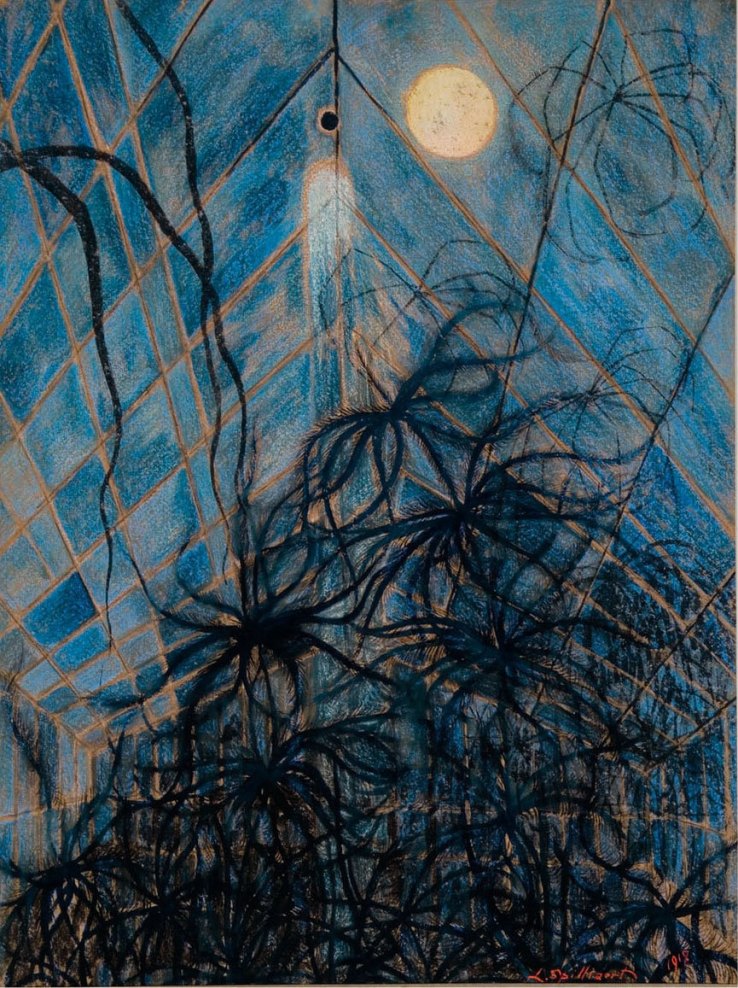
Hothouses I — Léon Spilliaert

xjony6jtvuqnxaphryqf

Hothouses I, 1917 by Léon Spilliaert (1881–1946)

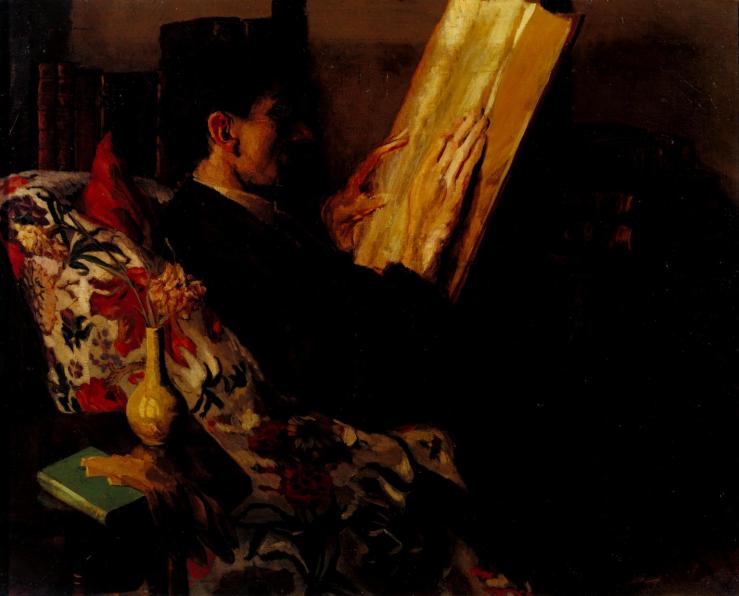
Lytton Strachey. Verso: Crime and Punishment — Duncan Grant

Lytton Strachey. Verso: Crime and Punishment c.1909 by Duncan Grant 1885-1978

Lytton Strachey. Verso: Crime and Punishment, c. 1909 by Duncan Grant (1885–1978)

Sleep outside at night and not take fright

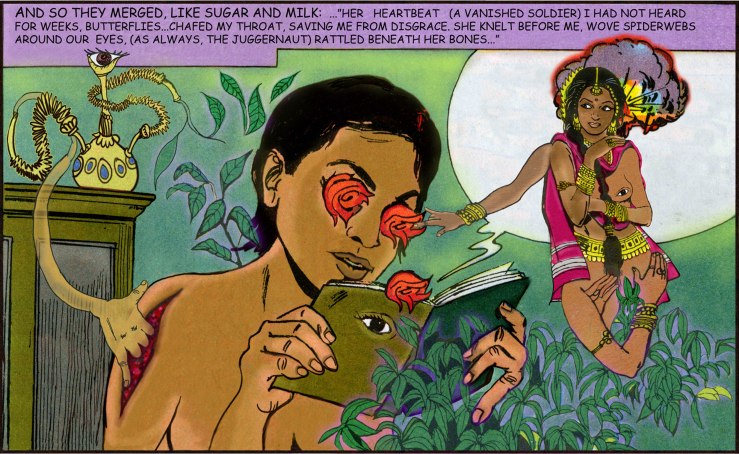
Sugar and Milk — Chitra Ganesh

11.-sugar-and-milk-26-x-41.5-trimmedcomp

Sugar and Milk, from Her Nuclear Waters by Chitra Ganesh (b. 1975)

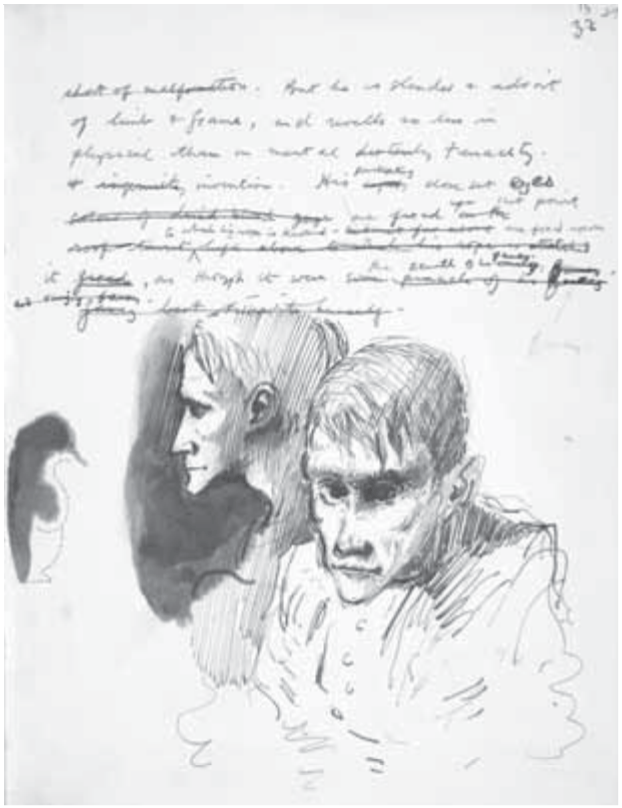
Two Studies for Steerpike — Mervyn Peake

steerpike

“Abecedary” — Tom Disch

“Abecedary”

by

Tom Disch


A is an Apple, as everyone knows.
But B is a …. What do you suppose?
A Bible? A Barber? A Banquet? A Bank?
No, B is this Boat, the night that it sank.
C is its Captain, and D is its Dory,
While E – But first let me tell you a story.
There once was an Eagle exceedingly proud
Who thought it would fly, in the Form of a cloud —
Yes, E is for Eagle, and F is for Form,
And G is the Grass that got wet in the storm
When the cloud that the Egale unwisely became
Sprinkled our hero and all of his fame
Over ten acres of upland plateau.
So much for that story. Now H. Do you know?
H is the Hay that was made from the Grass,
And I’s the Idea of going to Mass,
Which is something that only a Catholic would do.
Jews go to Synagogue. J is a Jew.
K is for Kitchen as well as for Kiss,
While L is for all of the black Licorice
You can eat in an hour without feeling ill.
M is for Millipede, Millet, and Mill.
The first is an insect, the second a grain,
The third grinds the second: it’s hard to explain
Such a process to children who never have seen it —
So let’s go to the country right now! YEs, I mean it.
We’re leaving already, and N is the Night
We race through to reach it, while P is the Plight
Of the people (Remember?) who sailed in that Boat
That is still, by a miracle, somehow afloat!
(Oh dear, I’ve just nocied I’ve overlooked O:
O’s an Omission and really should go
In that hole – do you see it? – between N and P.
No? It’s not there now? Dear O, pardon me.)
Q is the Question of how far away
A person can travel in one single day,
And whether it’s worth it, or might it be better
To just stay at home and write someone a letter?
R’s are Relations, a regular swarm.
Now get out of the car – we’ve arrived at their farm!
S is the Sight of a Thanksgiving feast,
And T is the Turkey, which must weight at least
Thirty pounds. U is Utopia. V …
V simply Vanishes – where, we can’t see –
While W Waves from its Westernmost isle
And X lies exhausted, attempting to smile.
There are no letters left now but Y and then Z.
Y is for You, dear, and Z is for me.

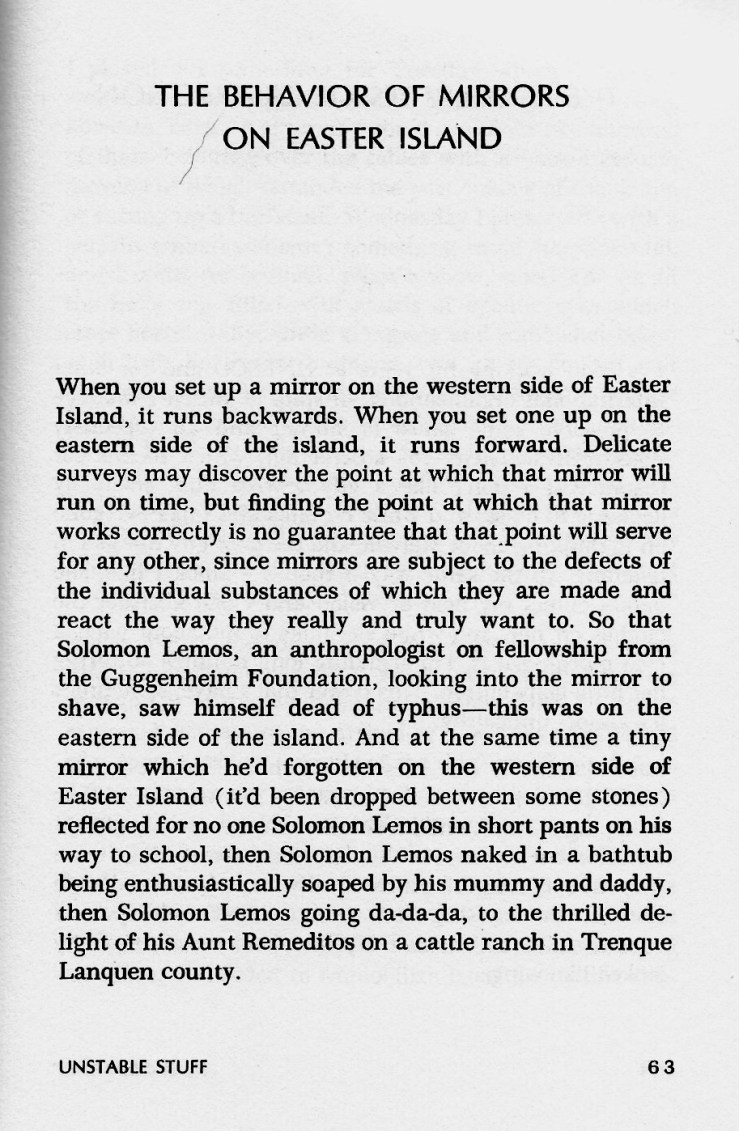
“The Behavior of Mirrors on Easter Island” — Julio Cortázar

2020-03-06_151902_3

(English translation by Paul Blackburn)

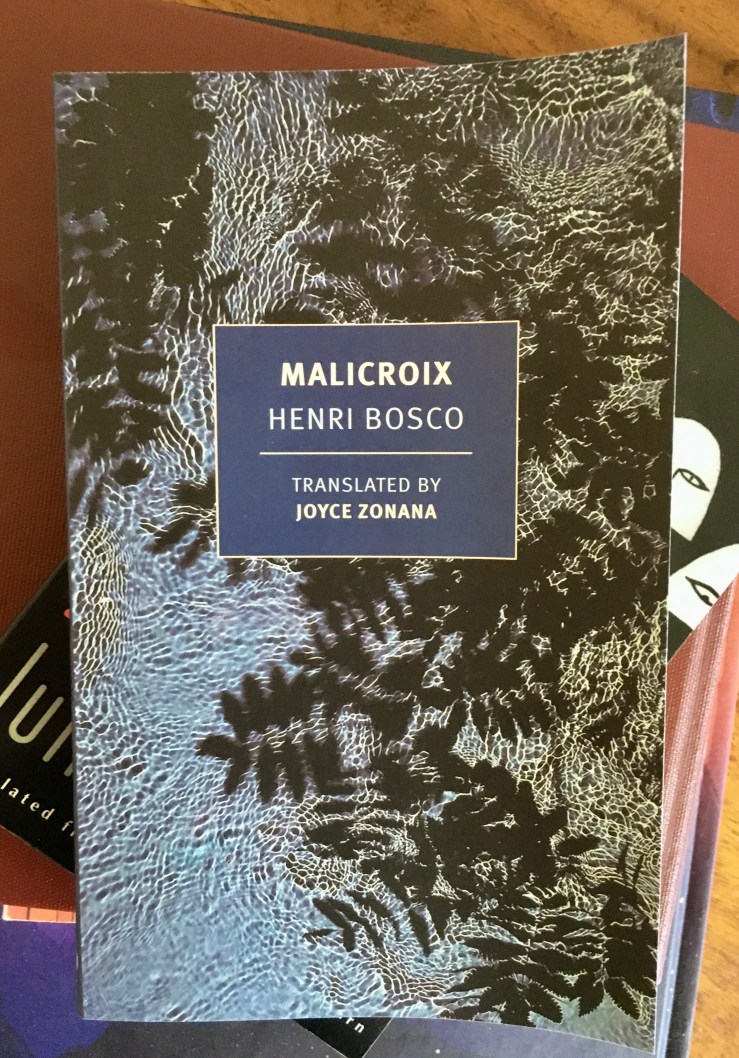
Henri Bosco’s Malicroix (Book acquired, 9 March 2020)

img_5152

Henri Bosco’s novel Malicroix (in English translation by Joyce Zonana) is one of NYRB’s new titles. Their blurb:

Henri Bosco, like his contemporary Jean Giono, is one of the regional masters of modern French literature, a writer who dwells above all on the grandeur, beauty, and ferocious unpredictability of the natural world. Malicroix, set in the early nineteenth century, is widely considered to be Bosco’s greatest book. Here he invests a classic coming-of-age story with a wild, mythic glamour.

A nice young man, of stolidly unimaginative, good bourgeois stock, is surprised to inherit a house on an island in the Rhône, in the famously desolate and untamed region of the Camargue. The terms of his great-uncle’s will are even more surprising: the young man must take up solitary residence in the house for a full three months before he will be permitted to take possession of it. With only a taciturn shepherd and his dog for occasional company, he finds himself surrounded by the huge and turbulent river (always threatening to flood the island and surrounding countryside) and the wind, battering at his all-too-fragile house, shrieking from on high. And there is another condition of the will, a challenging task he must perform, even as others scheme to make his house their own. Only under threat can the young man come to terms with both his strange inheritance and himself.

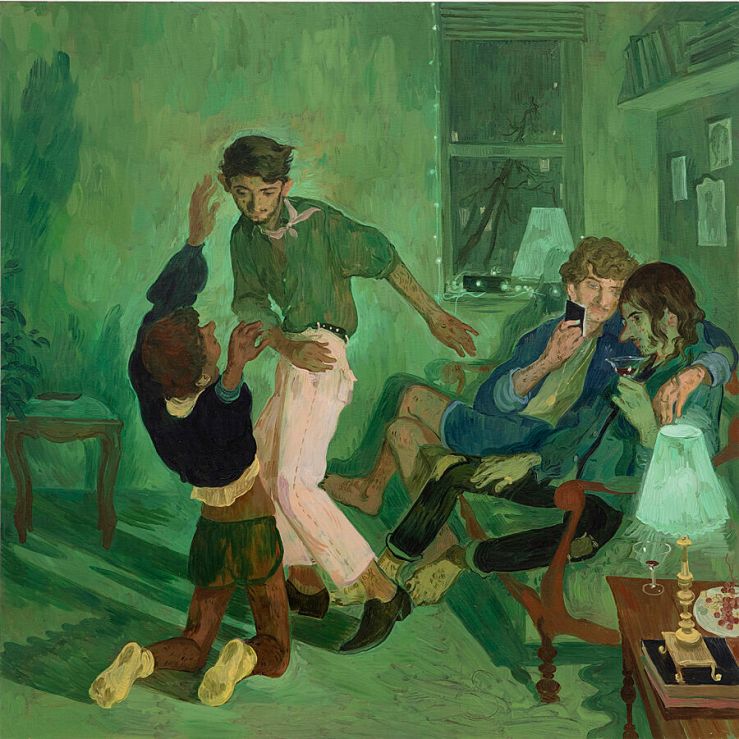
Four Friends — Salman Toor

large_four_friends_

Four Friends, 2019 by Salman Toor (b. 1983)

It hadn’t been murder, the courts decided. It was only a happening | From Charles Wright’s novel The Wig

I remembered Abraham Lincoln, who had died for me. I remembered the Negro maid who had walked from Grapetree, Mississippi, to Cold Spring Harbor, Long Island, and was flogged for being too maidenly fair. I remember the young man who, competing for the title “Blacker the Berry, Sweeter the Juice,” was killed during an avant-garde happening in a Washington Mews carriage house. The killing did not take place during a Black Mass, as was first reported. The Negro youth had committed a sexual outrage, according to Confidential Magazine in its exclusive interview with the hostess and the hostess, who were famous for their collection of Contemporary Stone Art. Their sexual safaris were legendary too. Inspired by childhood tales of lynchings (ah, the gyrations the moans, the sweat, the smell of fresh blood, the uncircumcised odor), the couple had explored Latin rice-and-bean delights, European around-the-world-scootee-roots, Near Eastern lamb, flip-flop, and it’s-all-in-the-family.

Hoping to avoid the press, which arrived by helicopter, fifty miles from shore, exhausted, jaded, they returned to their native land on a luxury liner but in steerage class, with seventy pieces of Louis Vuitton luggage.

“It was off-season,” the hostess had jokingly told reporters. The host added with great dignity: “We are returning to our native land, where fornication is pure and simple. We’re returning to the womb of nature.” They went into seclusion in their Greenwich Village carriage house until the night of the celebrated “happening,” the night that was to reestablish their worldly reputation. The gleaming, white-toothed young Negro with the rough but carefully-combed kinky hair (if one ran one’s hand through his hair, one trembled and saw Venus and Mars) displayed a rosebud instead of a penis! The effrontery—a Negro and nipped in the bud! Certainly a shock that could drive anyone to murder, only it hadn’t been murder, the courts decided. It was only a happening.

From Charles Wright’s fantastic 1966 novel The Wig. 

img_5057

Untitled (Orange Pants) — Kerry James Marshall

marshall_orangepants

Untitled (Orange Pants), 2014 by Kerry James Marshall (b. 1955)

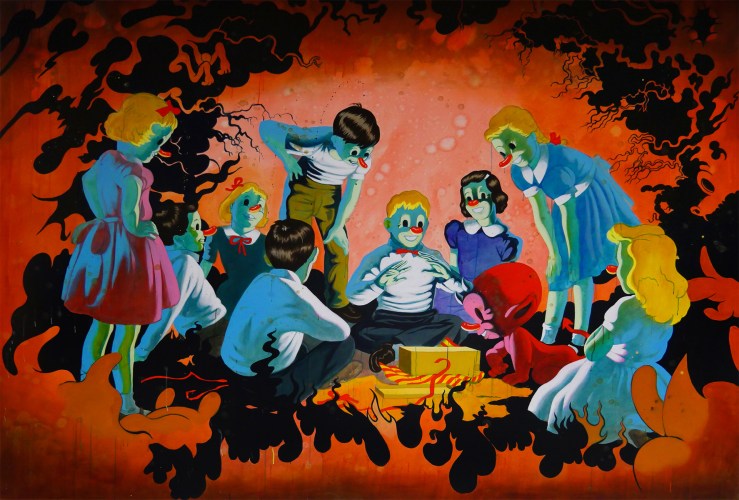
The Gift — Victor Castillo

victor-castillo-the-gift-low

The Gift, 2017 by Victor Castillo (b. 1973)

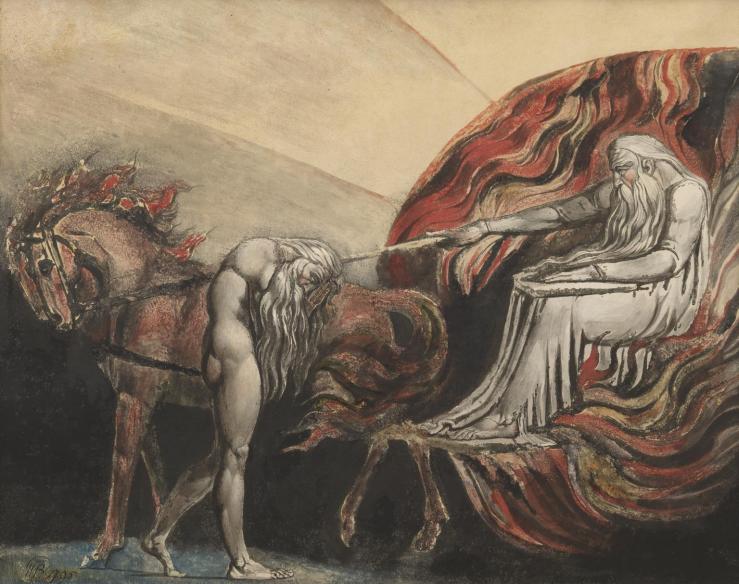
God Judging Adam — William Blake

God Judging Adam 1795 by William Blake 1757-1827

God Judging Adam, 1795 by William Blake (1757-1827)

Walter Kempowski’s Marrow and Bone (Book acquired, sometime in February 2020)

img_5060

Walter Kempowski’s Marrow and Bone is new from NYRB in English translation by Charlotte Collins. NYRB’s blurb:

West Germany, 1988, just before the fall of the Berlin Wall: Jonathan Fabrizius, a middle-aged erstwhile journalist, has a comfortable existence in Hamburg, bankrolled by his furniture-manufacturing uncle. He lives with his girlfriend Ulla in a grand, decrepit prewar house that just by chance escaped annihilation by the Allied bombers. One day Jonathan receives a package in the mail from the Santubara Company, a luxury car company, commissioning him to travel in their newest V8 model through the People’s Republic of Poland and to write about the route for a car rally. Little does the company know that their choice location is Jonathan’s birthplace, for Jonathan is a war orphan from former East Prussia, whose mother breathed her last fleeing the Russians and whose father, a Nazi soldier, was killed on the Baltic coast. At first Jonathan has no interest in the job, or in dredging up ancient family history, but as his relationship with Ulla starts to wane, the idea of a return to his birthplace, and the money to be made from the gig, becomes more appealing. What follows is a darkly comic road trip, a queasy misadventure of West German tourists in Communist Poland, and a reckoning that is by turns subtle, satiric, and genuine. Marrow and Bone is an uncomfortably funny and revelatory odyssey by one of the most talented and nuanced writers of postwar Germany.