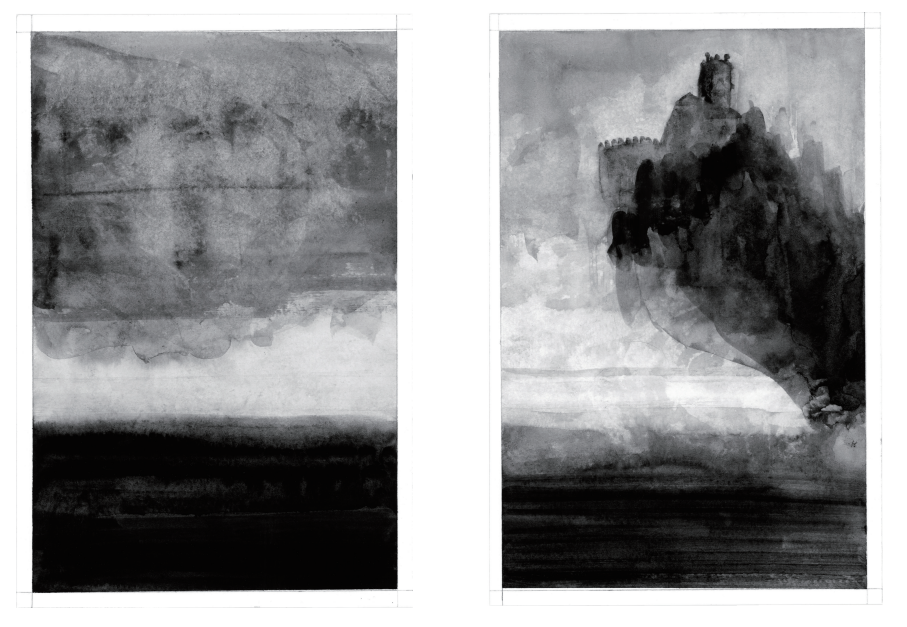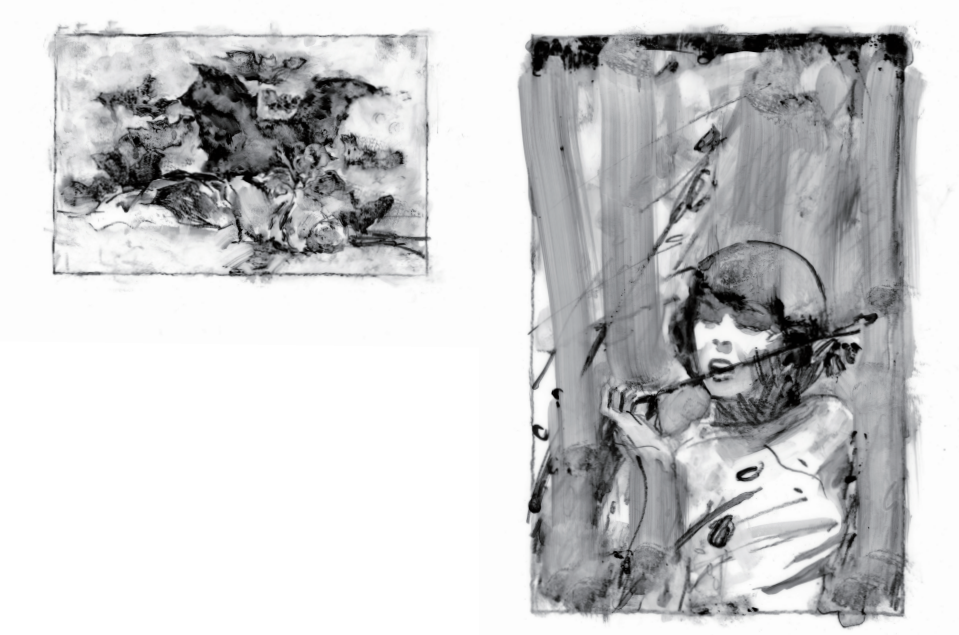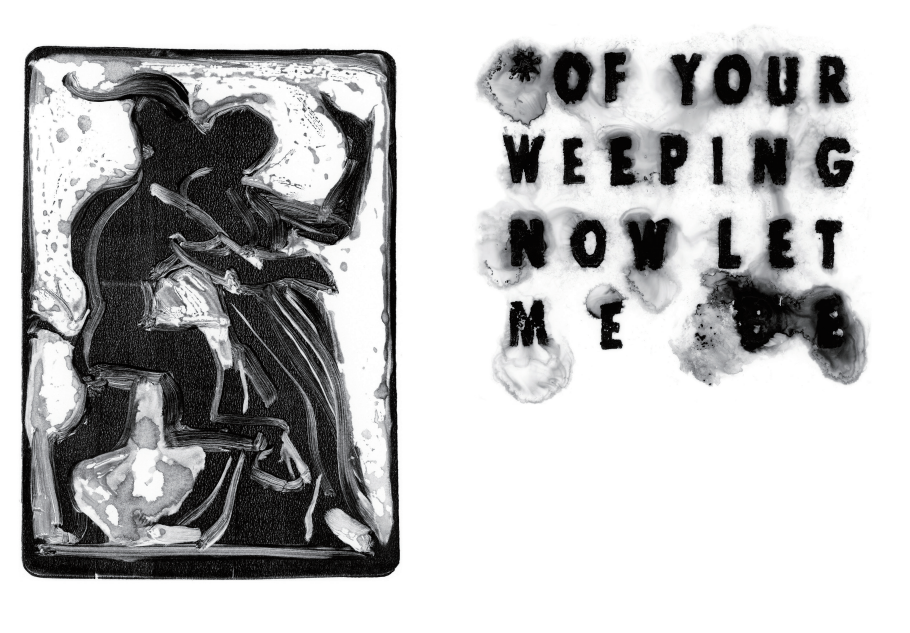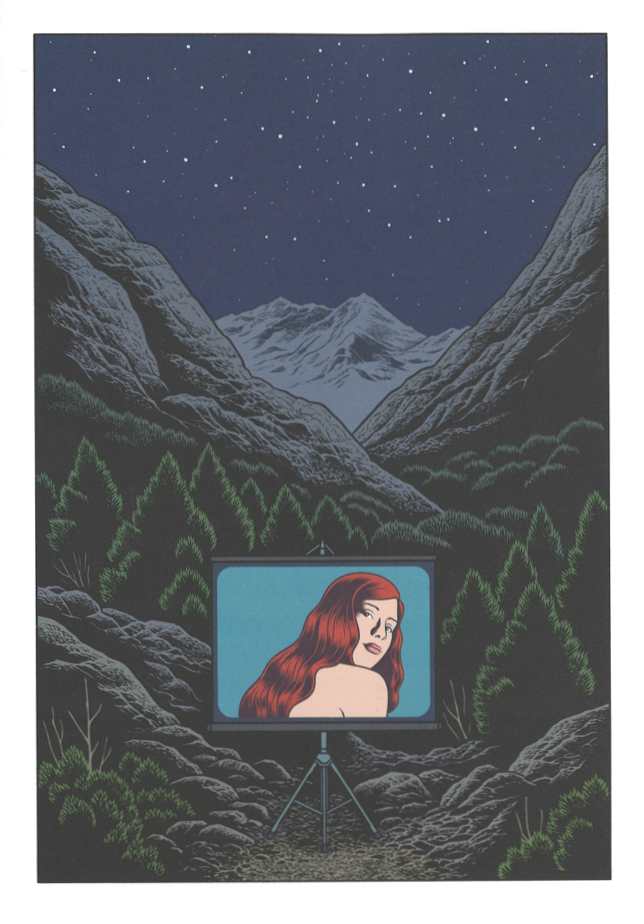
Let me tell you about the nap

2025 was in several ways one of the more fucked up and challenging years of my life. (This sentiment might be familiar to you and yours and many others.) But it was the year I finally learned to take a nap, thanks in part to an anecdote shared by the late novelist Philip Roth.

I have always been jealous of folks who can sleep on planes, in cars, on buses and far more jealous of people who can, like, choose to take a nap. I have envied people like my wife or my daughter or son or brother, who can just, like, conk out for twenty minutes and arise revived. It’s hard enough for me to fall asleep for six or seven or eight hours. As a child I remember reading that Napoleon Bonaparte was very good at taking cat naps, particularly before battles. I don’t know why but this factoid, true or false, made a huge impression on me as a kid. Napping has always seemed like a hidden key to focusing one’s energies.

I couldn’t nap but I was great at staying up for days at a time, particularly in my twenties. I also learned how to make my mind stop, to shut the whole thing down, but that wasn’t napping; it was passing out. None of this was or is healthy behavior.

Late last year a good friend of mine told me he’d picked up most of Philip Roth’s novels at an estate sale or a garage sale or some such. He’d been zipping through them and What do you think of Roth? he asked and I replied something like, I tried — it was Portnoy’s Complaint which I lifted from the Barnes & Noble when I was fifteen and then a few years later the first fifty pages of American Pastoral and all of The Human Stain and then giving up on The Plot Against America. And that was more or less it.

But maybe a year or two before this friend recommended my trying Roth, I’d read on the goddamned website Twitter an excerpt from a Philip Roth interview that stuck with me, primarily because of my desire to become a napper. It was a little screenshot, an excerpt from a 2013 puff piece with NPR celebrating Roth’s becoming an octogenarian. Here is the nap nugget:

Now that he’s not working every day, though, Roth says he’s savoring a gentler pleasure: naps. “Let me tell you about the nap,” he laughs. “It’s absolutely fantastic. When I was a kid, my father was always trying to tell me how to be a man, and he said to me, I was maybe 9, and he said to me, ‘Philip, whenever you take a nap, take your clothes off, put a blanket on you, and you’re going to sleep better.’ Well, as with everything, he was right. … Then the best part of it is that when you wake up, for the first 15 seconds, you have no idea where you are. You’re just alive. That’s all you know. And it’s bliss, it’s absolute bliss.”

My friend’s recommendation to return to Roth recalled this bit of advice and I started to practice it this year, now in my late forties. It has worked for me (or maybe my body has just gotten so old that all the cells and systems and such have agreed to allow consciousness to pause for twenty minutes on a Thursday afternoon). I think Roth’s dad’s advice works because it involves a commitment to the nap. Natural nappers like my lovely wife can shut it down on a couch with the second half of Gillian Armstrong’s 1994 adaptation of Little Women on the teevee, or drift off for a postprandial half-time siesta like an uncle after some ham and turkey and Pinot noir. Natural nappers are blessed; some of us have to work for it though.

I’ve added a few moves to Roth’s simple repertoire — shutting the door, closing the blinds, putting my phone in a different room. The hardest bit though, at first, was consciousness itself, some parcel of images and words and sounds intervening in blips in my mind’s eye when I tried to shut it all down. I remember as a kid being told to count sheep, or count numbers, to visualize the sheep or the numbers.

This bad count the sheep advice led me to realize that my mind stacks images on each other; or, not really stacks images so much as holds images — that when I’m not focused on external sensory input, like, when I’m supposed to be turning off, going to sleep, my mind’s eye (for lack of a better metaphor) has decided to rustle through my imagination and memory to layer visual (and to a much lesser extent, auditory) sensations in thick bundles. My trick this year has been to relax into the image bundle without attempting to make it cohere; I try to feel the blanket on my skin. I think I’ve gotten better at breathing, too.

I like napping. I have taken it up as a midlife hobby. It has made my life better in exactly the kind of way I had hoped it would — a small, minor, gift I thought would never be mine. Maybe I’ll even reach that bliss Roth mentions. But I’m fine without it.

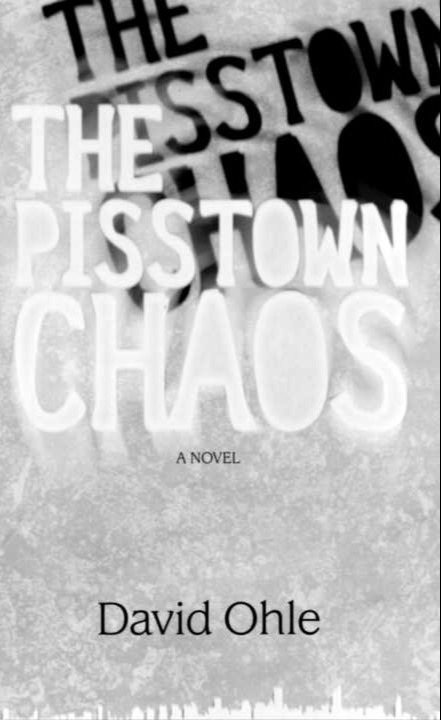
The Pisstown Chaos, David Ohle’s post-convenience novel of abject gags and grotesque japes

Let’s get the obvious out of the way first: The Pisstown Chaos is an improbably perfect and beautiful name for a novel. If you don’t like the title, The Pisstown Chaos isn’t for you. It is a foul, abject, hilarious, zany vaudeville act, a satire of post-apocalyptic literature, an extended riff on American hucksterism. It’s very funny and will make most readers queasy.

The author of The Pisstown Chaos is David Ohle. The novel was published in 2008; it is the second of three “sequels” to Ohle’s 1972 cult classic Motorman. You do not have to have read Motorman or The Age of Sinatra (2004) to “understand” The Pisstown Chaos. (But you’ll probably want to dig into those if you dig The Pisstown Chaos’s uh pungent urinous ammonia bouquet)

Moldenke, hero of Motorman, is a bit player in The Pisstown Chaos, a walk on, a song-and-dance man with no songs or dances. A storyteller. He’s a zombie, too — a “stinker” in the novel’s parlance — adorned in “black rags and a wide-brimmed white hat,” sporting “an inch-long tube of flesh protruding from just below his ear [which] had the general appearance and shape of an infant’s finger, but lacked a nail. In the end of the tube, a small hole leaked a clear, gelatinous fluid.”

Moldenke, we are to infer, is one of the “Victims of the Pisstown parasite…thought of as dead, but not enough to bury. Gray haggard, poorly dressed, they lay in gutters, sat rigidly on public benches, floated along canals and drank from rain-filled gutters.” He may or may not be centuries old.

It’s not clear how far into the future we are in the Ohleverse (it doesn’t really matter). After “the Great Forgetting,” and multiple and ongoing Chaoses, the world has regressed, or progressed, or really mutated, into a dusty, wet, gross, nasty post-infrastructure reality. You might read The Pisstown Chaos as a slapstick zombie Western.

The Reverend Hooker presides over this wonderfully abject world. Hooker’s loose theocratic federation revolves elliptically around a “shifting” scheme. Nothing is permanent, everything is moving, plates spinning on poles. Folks receive their shifting papers and must relocate from, say, a cozy cottage to a prison camp. Or they might end up paired with a new concubine or some such.

That’s the fate of Mildred Balls, née Mildred Vink, who meets Jacob Balls on the road to Witchy Toe. The pair meet cute and get on famously. (And who wouldn’t; after all, suave Jacob Balls was the inventor of  the “finely-grained, yellow-tinged powder” known as “Jake” — a kind of post-apocalyptic Bud Light.) Optimistic Jacob is optimistically optimistic of all the shifting, attesting his belief that “in any culture, when boredom and apathy take hold, the currency is debased and the decline is irreversible…What could be more of a tonic than a random redistribution of the populace?” Mildred is less convinced: “The whole scheme is idiotic.”

The Pisstown Chaos focuses on the Balls clan — primarily an older Mildred and her young adult grandkids, Roe and Ophelia. There are stinkers and imps, shifting folk consuming urpflanz, willy, and Jake on their way via Q-ped to Indian Apple or Bum Bay. Reverend Hooker is always lurking in the margins, too, before taking over the narrative’s final pages in a mock apotheosis that brought a stupid smile to my face.

Ohle’s narrative isn’t exactly a picaresque, but it runs on the same energy. Each chapter opens with a series of frank excerpts from the Pisstown rag, the City Moon. Here’s one update of news you need:

A fondness for pickled lips has led to the arrest of a Kootie Fiyo, a stinker known to be a trader in tooth gold and a vicious biter. Fiyo was just leaving the impeteria in South Pisstown when two Guards entered. The proprietor said, “That stink can eat more imp lips than I can heap in front of him. “

The City Moon is not just a source for the goods on a stinker’s glimpse of pickled imps’ lips, but also a gloss on the undead (or un-undead’s) physiology:

What then is a final-stage stinker’s life like? It has been described by scientists as showing a poverty of sensation and a low body temperature. In their nostrils is the persistent odor of urpmilk. The membrane which lines their mouth is extremely tough and is covered with thick scales. They like to touch fur and drink their own urine. Because they have been known to go without food for as long as eighteen years, we can assume that their sense of time passing is also very different from our own.

The Stinker Problem is likely the signature event of whatever century we are in. There’s probably an icky metaphor or allegory somewhere in there, but I find myself disinterested in that end of the novel. But still: Consider Mildred–who wants to find a “cure” for stinkerism–in charge of a crew of stinkers who, after their daily labors, commit “to walking in circles and searching the ground.” But these are not geologists peering into the navel of the world: “‘No, Miss,’ Spanish Johnny said, ‘We like to get dizzy and faint. It’s the way we have fun.'” We’ve all been there.

Mildred’s granddaughter Ophelia commands much of the narrative, shifting about her stations in life. Her domestic comedy with servants Red and Peters is a class-conscious comic delight. Our Miss Madame goes through a series of abject slapstick routines with the Help (including an enema gag that uh, gag me yeah). Here’s a foul episode in the life of Ophelia Balls:

She walked carefully from slippery stone to slippery stone until she got to the potting shed, then blew out the candle. She tried the door and found it locked. Wiping the dirty door-glass, she looked in at Peters, lying on the peat pile with his pants pulled down, fanning his rear with a handful of straw. Red, sitting beside him in Mildred Balls’s underwear, combed Peters’s coarse hair with a tortoise-shell comb. Peters’s cheeks were flushed, his eyes half-closed. When Ophelia entered, the scene seemed all the more lurid for the dim lantern and its flicker.

“I hope you don’t take any offense,” Red said, “but I’ve just mated with Peters here.”

Peters sat up. “I was quietly potting geraniums when that idiot stepped out of a dark corner and made advances, clumsy, lewd advances, with his big willy sticking out. I tried, but I couldn’t resist him.”

“Is that true, Red, that he put up resistance?”

“He lies like a rug. He clearly indicated he wanted me to sex him good and sex him hard.”

Ophelia saw the pointlessness of going any further with the inquiry. “All is forgiven. Let’s move past this.”

“I’ll serve the swan,” Red said.

If I’ll serve the swan isn’t your kinda punchline, The Pisstown Chaos ain’t your cup of Jake. It’s a rich, smelly, gross novel, fun, funny, fueled with 19th-century inventions viewed through piss-colored glasses, aimed at the apocalyptic future. It’s smoked imp-meat served with urpsmoke, a vaudeville buzz against the zombies in the gutter. When I was a kid we held our breath when we passed cemeteries. There are other ceremonies, other totems, but warding off the dead remains a concern.

I have neglected the Balls scion, young Roe, who eventually finds himself attending the Reverend Hooker. Late in the novel, Roe Balls prepares an enema for the theocrat; Hooker then delivers a sermon:

“I’ll warm up the bathroom right away, sir, and get the enema bag ready.”

Once Roe had firmly inserted the hose, the Reverend sat on the pot and closed his eyes. “There, that’s it, Roe. It’s in well enough.”

“Shall I leave you alone now, sir?”

“No. Don’t leave. Let me sermonize a little. I’ll tell you a story, a story with a lesson. In the days when all men were good, they had miraculous power. Lions, mountains, whales, jellyfish, hagfish, birds, rocks, clouds, seas, moved quietly from place to place, just as men ordered them at their whim and fancy. But the human race at last lost its miraculous powers through the laziness of a single man. He was a woodman in the Fertile Crescent. One morning he went into the forest to cut firewood for his master’s hearth. He sawed and split all day, until he had a considerable stack of hickory and oak. Then he stood before the pile and said, ‘Now, march off home!’ The great bundle of wood at once got up and began to walk, and the woodman tramped on behind it. But he was a very lazy man. Now, why shouldn’t I ride instead of galloping along this dusty road, he said to himself, and jumped up on the bundle of wood as it was walking in front of him and sat down on top of it. As soon as he did, the wood refused to go. The woodman got angry and began to strike it fiercely with his axe, all in vain. Still the wood refused to go. And from that time the human race had lost its power.”

“That certainly explains everything I’ve ever wondered about, sir.”

“You may clean me now.”

“Yes, sir.”

The punchlines accumulate after the Rev. Hooker’s fable — young Roe’s deadpan line “That certainly explains everything I’ve ever wondered about, sir” made me laugh aloud when I read it, and the following asswipe line is too much — but I think we have here in the fable a key to the novel. Not the key, but a key.

In the Rev’s woodman’s fable, humans once wielded Promethean power over the world. But that power’s contingent; it exists only when humans move with the world, attentive to its rhythms and limits. When the woodman attempts to ride the wood and make it a convenience instead of walking alongside it, cooperation collapses. S’all she wrote.

Ohle’s chaotic, grotesque world echoes his some-time collaborator William Burroughs’ alien abjection. It will also be comfortingly/nauseatingly familiar (familiar?!) with anyone who digs David Cronenberg’s corporeal horrors. The Pisstown Chronicles will also appeal to weirdos who dig the abject fictions of Vladmir Sorokin, José Donoso, and Antoine Volodine.

The Pisstown Chaos is not a novel for everyone, but there’s a certain type of reader who will love wading through its abject humor, grotesque imagery, and absurdist chaos. Ohle’s post-convenience world grunts and howls; it’s dark, vivid, gross, and hilarious. That scent will linger. Highly recommended.

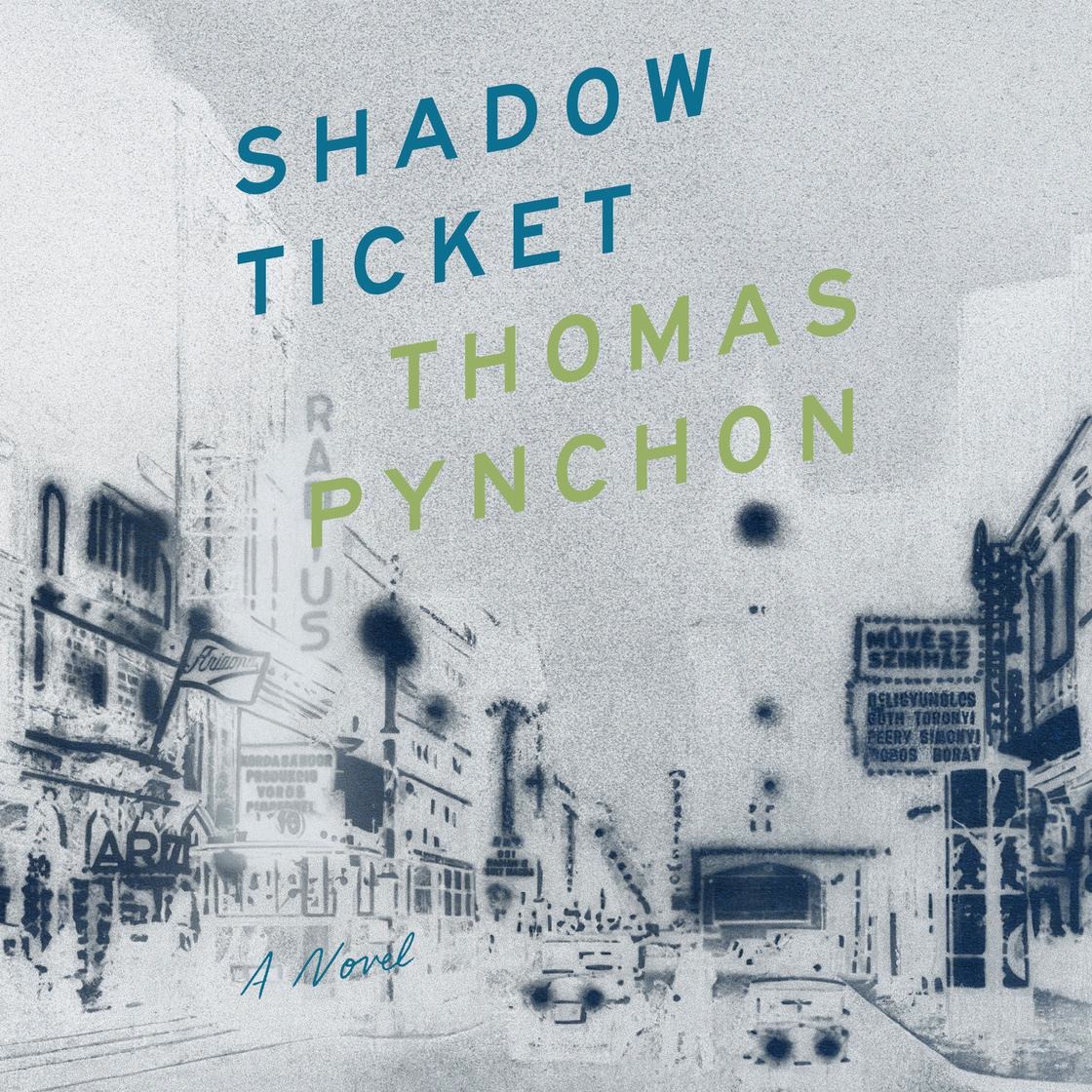
Notes on Thomas Pynchon’s novel Shadow Ticket


I posted these notes on Thomas Pynchon’s 2025 novel Shadow Ticket on Biblioklept in October and November of 2025. They appear here in basically the same form.


Let’s start with the epigraph:

“Supernatural, perhaps. Baloney…perhaps not.”

Bela Lugosi,
in The Black Cat (1934) Continue reading “Notes on Thomas Pynchon’s novel Shadow Ticket”

Denis Johnson’s Train Dreams is a perfect novella

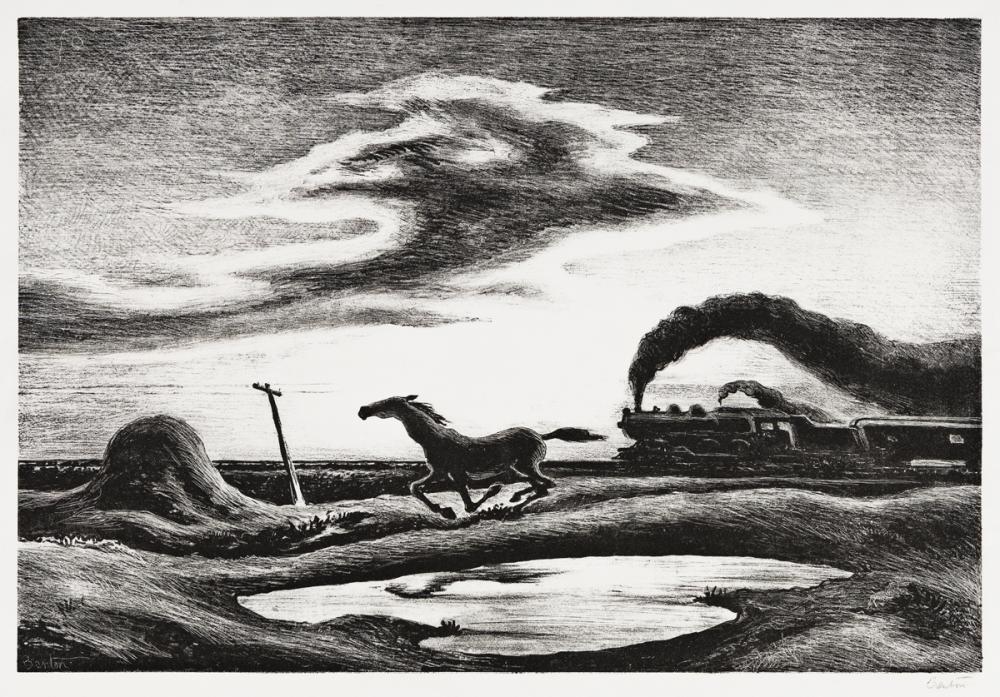
The Race, 1942 by Thomas Hart Benton (1889-1975)

With blunt grace, Denis Johnson navigates the line between realism and the American frontier myth in his perfect novella Train Dreams. In a slim 116 pages, Johnson communicates one man’s life story with a depth and breadth that actually lives up to the book’s blurb’s claim to be an “epic in miniature.”  I read it in one sitting on a Sunday afternoon, occasionally laughing aloud at Johnson’s wry humor, several times moved by the pathos of the narrative, and more than once stunned at the subtle, balanced perfection of Johnson’s prose, which inheres from sentence to paragraph to resonate throughout the structure of the book.

The opening lines hooked me:

In the summer of 1917 Robert Grainier took part in an attempt on the life of a Chinese laborer caught, or anyway accused of, stealing from the company stores of the Spokane International Railway in the Idaho Panhandle.

Three of the railroad gang put the thief under restraint and dragged him up the long bank toward the bridge under construction fifty feet above the Moyea River. A rapid singsong streamed from the Chinaman voluminously. He shipped and twisted like a weasel in a sack, lashing backward with his one free fist at the man lugging him by the neck.

The matter-of-fact violence here complicates everything that follows in many ways, because Grainier it turns out is pretty much that rare thing, a good man, a simple man who tries to make a life in the Idaho Panhandle at the beginning of the 20th century. The rest of the book sees him trying—perhaps not consciously—to somehow amend for the strange near-lynching he abetted.

Grainier works as a day laborer, felling the great forests of the American northwest so that a network of trains can connect the country. Johnson resists the urge to overstate the obvious motifs of expansion and modernity here, instead expressing depictions of America’s industrial growth at a more personal, even psychological level:

Grainier’s experience on the Eleven-Mile Cutoff made him hungry to be around other such massive undertakings, where swarms of men did away with portions of the forest and assembled structures as big as anything going, knitting massive wooden trestles in the air of impassable chasms, always bigger, longer, deeper.

Grainier’s hard work keeps him from his wife and infant daughter, and the separation eventually becomes more severe after a natural calamity, but I won’t dwell on that in this review, because I think the less you know about Train Dreams going in the better. Still, it can’t hurt to share a lovely passage that describes Grainier’s courtship with the woman who would become his wife:

The first kiss plummeted him down a hole and popped him out into a world he thought he could get along in—as if he’d been pulling hard the wrong way and was now turned around headed downstream. They spent the whole afternoon among the daisies kissing. He felt glorious and full of more blood than he was supposed to have in him.

The passage highlights Johnson’s power to move from realism into the metaphysical and back, and it’s this precise navigation of naturalism and the ways that naturalism can tip the human spirit into supernatural experiences that makes Train Dreams such a strong little book. In the strange trajectory of his life, Grainier will be visited by a ghost and a wolf-child, will take flight in a biplane and transport a man shot by a dog, will be tempted by a pageant of pulchritude and discover, most unwittingly, that he is a hermit in the woods. In Johnson’s careful crafting, these events are not material for a grotesque picaresque or a litany of bizarre absurdities, but rather a beautiful, resonant poem-story, a miniature history of America.

Train Dreams is an excellent starting place for those unfamiliar with Johnson’s work, and the book will rest at home on a shelf with Steinbeck’s naturalist evocations or Cormac McCarthy’s Border Trilogy. I have no idea why the folks at FS&G waited almost a decade to publish it (Train Dreams was originally published in a 2002 issue of The Paris Review), but I’m glad they did, and I’m glad the book is out now in trade paperback from Picador, where it should gain a wider audience. Very highly recommended.

[Ed. note: Biblioklept originally published this review in May of 2012. I still haven’t seen the Clint Bentley-directed film adaptation.]

Paul Thomas Anderson’s One Battle After Another is a frenetic, vital reimagining of Thomas Pynchon’s Vineland

Paul Thomas Anderson’s One Battle After Another takes Thomas Pynchon’s 1990 novel Vineland and sets it ablaze, reshaping its abstract paranoia and fractured narrative into something both deliriously immediate and ominously timeless.

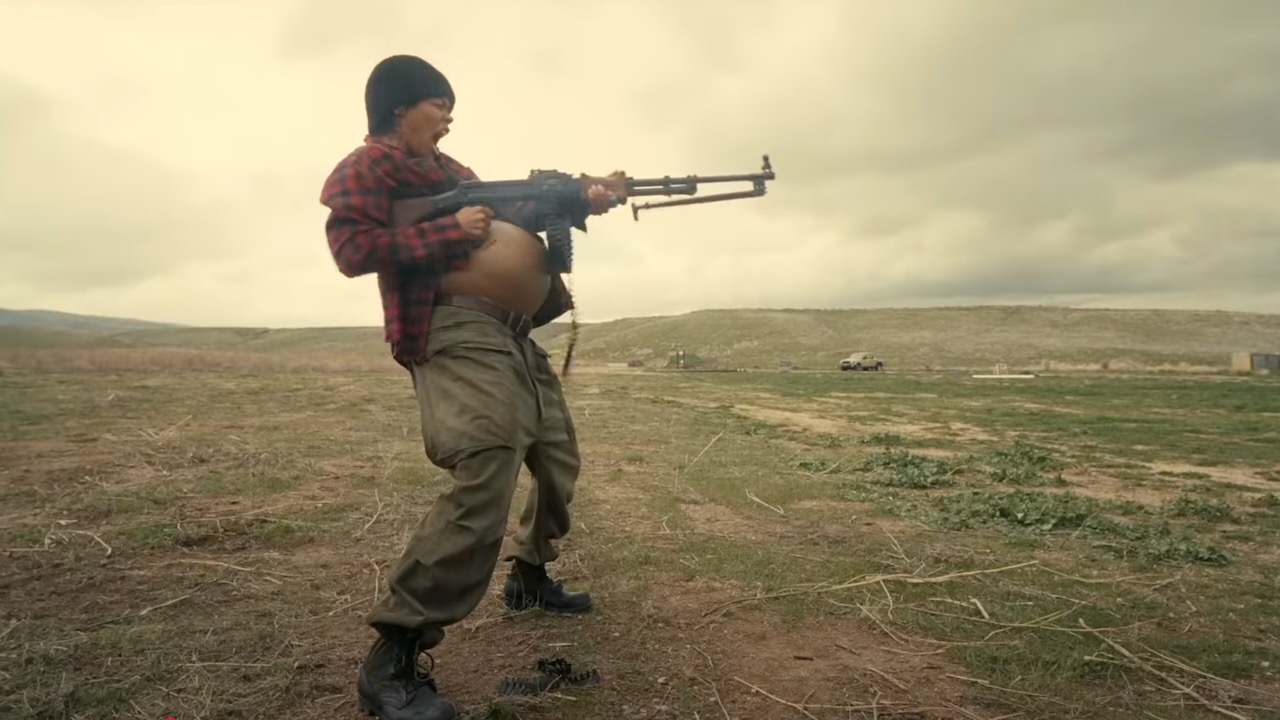
The bones of Pynchon’s original are still present: a family broken by state violence; a daughter growing up without a mother; a father caught between shame and reluctant resistance. In PTA’s feverish recasting of Vineland, Zoyd Wheeler becomes Bob Ferguson (Leonardo DiCaprio), a former “Rocket Man” revolutionary burning out the past in a haze of weed smoke. Frenesi Gates is reimagined as Perfidia Beverly Hills (Teyana Taylor), a revolutionary addicted to the sexual thrill of power. Prairie Wheeler morphs into Willa (Chase Infiniti — and like wow jeez that’s a Pynchonian name the young actress has there, isn’t it?). And villainous Brock Vond is warped into Colonel Lockjaw (Sean Penn), a grotesque embodiment of authoritarian menace. Timelines collapse into themselves, Reagan-era dread transposes into our own disturbed now. Vineland is set in 1984; in One Battle After Another, PTA shows that we’ve never really moved on from that dystopian year. PTA condenses Vineland’s sprawling flashbacks and absurd digressions into an action-forward narrative that’s far more linear yet equally dizzying. The result is enthralling.

The film’s plot might be distilled simply from its title. One Battle After Another follows the trajectory of most of Pynchon’s fiction: individual resistance to authoritarian evil. In PTA’s film, that resistance takes the form of the French 75, a loose clandestine revolutionary group to which Bob and his partner Perfidia once belonged. There’s really no retiring for French 75 agents though, and soon Willa is tangled in the same web her parents sought to sunder in their radical actions. Penn’s maniacal Colonel Lockjaw hunts her down. She’s on the run, and so is papa Bob.

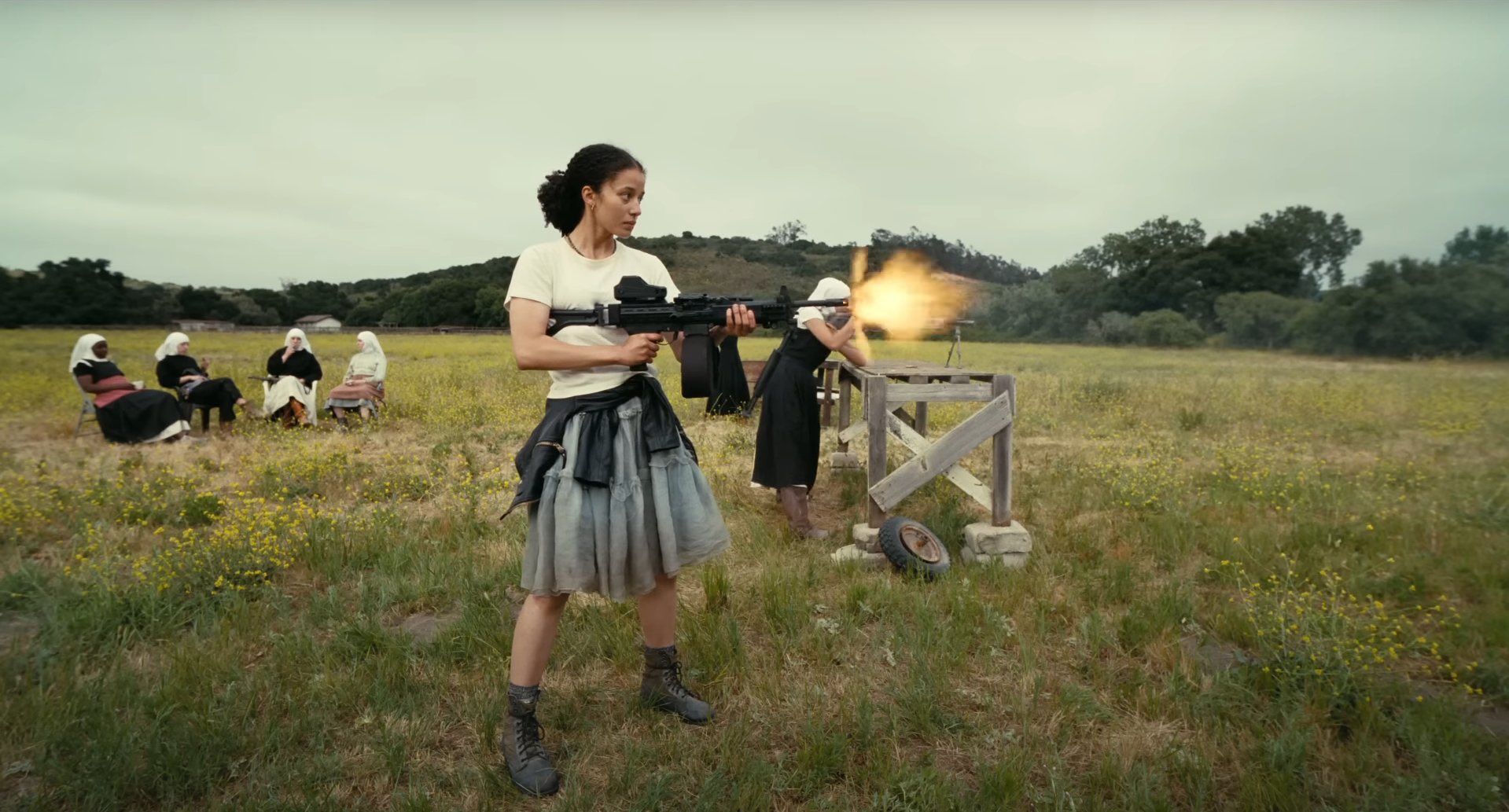
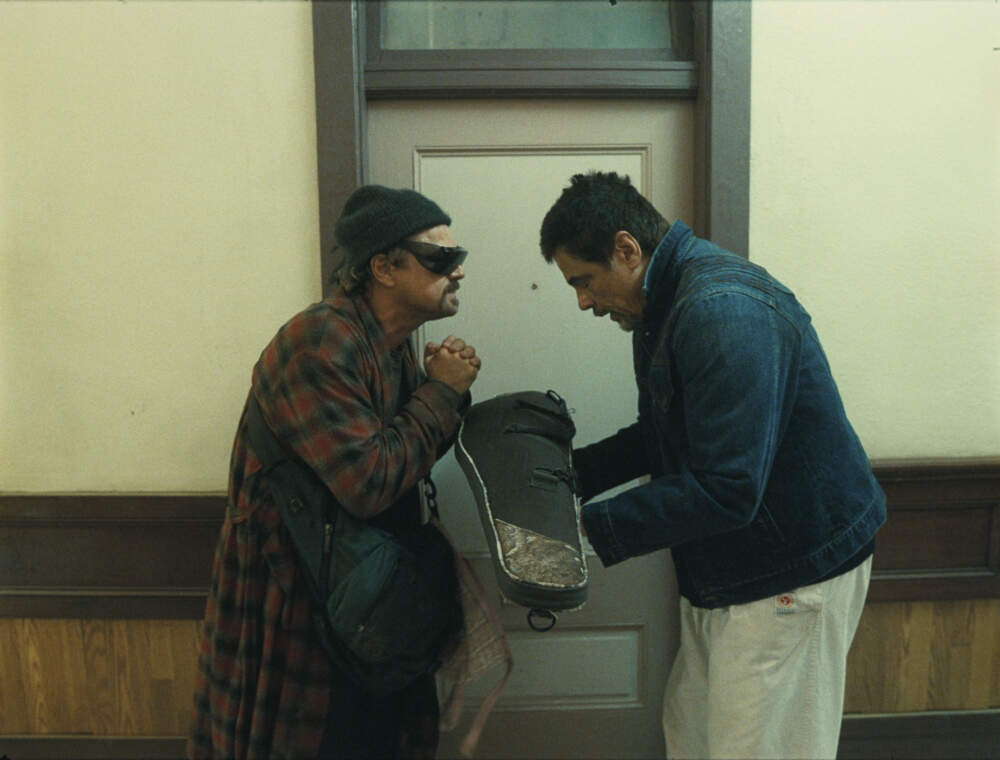
Pynchon’s novels frequently contrast Us vs Them systems — preterite vs. elect; misfits vs. authoritarians; freaks vs. the Man. And like Pynchon’s work, One Battle After Another shows the invisible overlapping and hierarchical confusions these Us/Them systems engender. The French 75’s sympathies directly correlate with the values of the immigrant community in Baktan Cross, the fictional sanctuary city Bob and Willa take refuge in. The de facto leader of these immigrants, Francisco (Benicio Del Toro), aids Bob in his fevered search for Willa. Francisco’s zen calm offers a counterbalance to Bob’s mania. Another Us group are the Sisters of the Brave Beaver (One Battle After another is crammed with Pynchonian vagina jokes), weed-growing nuns who offer Willa a brief safe harbor.

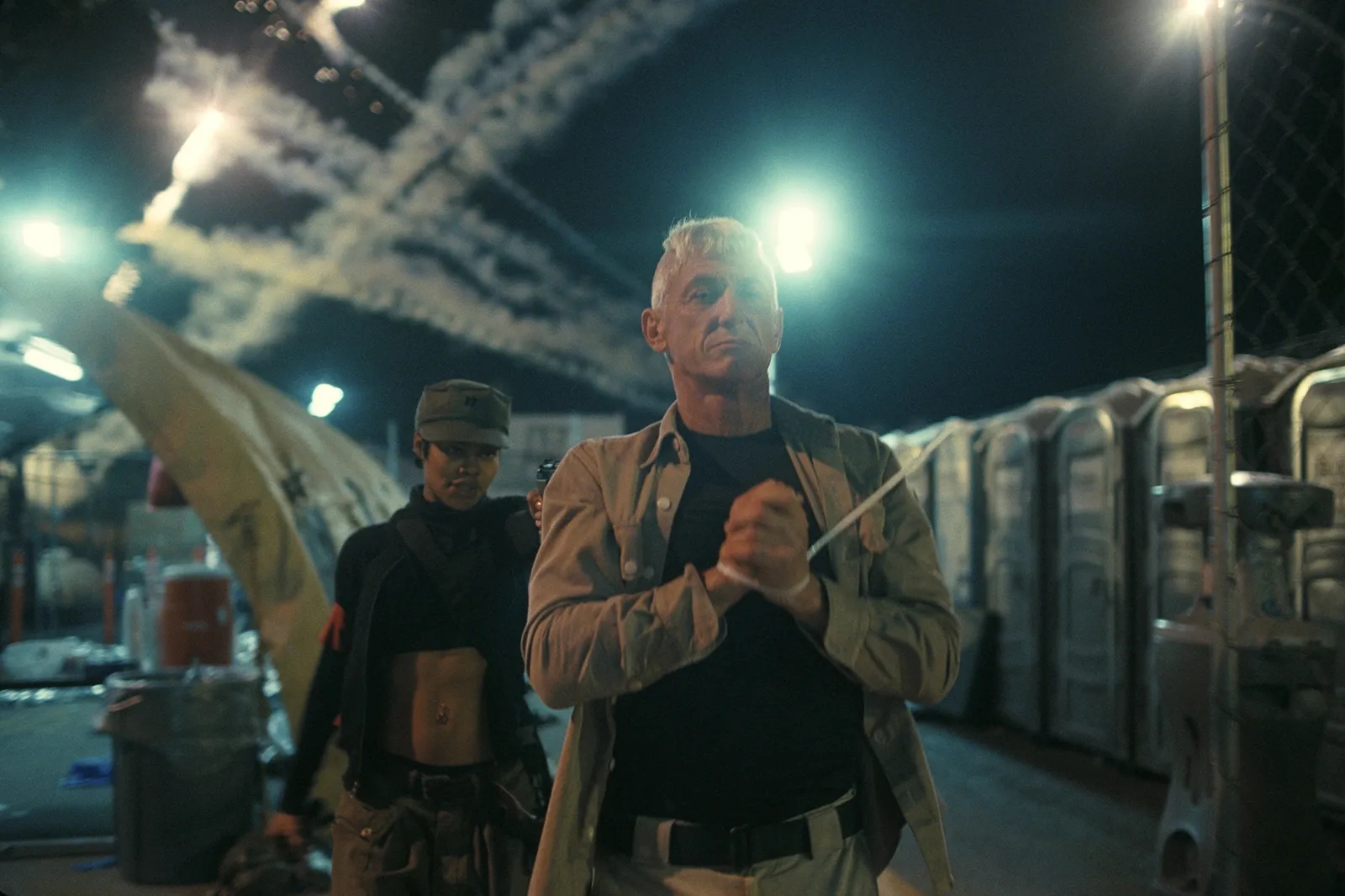
These disparate pockets of rebellion resist the tyranny of the modern racist capitalist system, embodied by Colonel Lockjaw and the military forces he commands (seemingly without any government oversight). We first meet Lockjaw running a migrant detention center — one of many timely PTA updates to Vineland — and his weird, forced, masochistic machismo plays out on the screen with a mix of menace and despair. For all his power and evil though, there’s yet another Them he isn’t part of. That would be the Christmas Adventurers Club, a shadowy cabal of elites on a racist mission to rid the world of “freaks.” Lockjaw would do quite literally anything to become a member of this club; his drive to to become even more Them propels the narrative while showing that Us-Them systems rely on hierarchies to perpetuate oppression.

One Battle After Another zigzags through a whirlwind of absurdity, suffocating paranoia, and frantic action. The film balances chaotic humor with a darker exploration of the emotional impulses that underlie power and attraction. Colonel Lockjaw’s obsessive fixation on Perfidia (arguably the film’s closest connection to Vineland) underscores the irrational power dynamics of obsession and control. PTA frames their relationship—along with Lockjaw’s obsession with Willa—as a twisted mirror reflecting the power imbalances that define both the personal and the political in Us-Them systems. PTA’s films have always explored systems of exploitation that grind people down and the outsiders who try to navigate them; One Battle After Another is, thus far, his most sustained, howling effort in this vein.

The film is gorgeous, too, as fans would expect from PTA. Michael Bauman’s cinematography conveys frenzied energy without sacrificing cohesion or clarity. There are several outstanding set pieces, including a beautiful sequence in which Bob does his best to keep up with a trio of skateboarders traversing rooftops at night, their figures silhouetted against the flames of a riot below. The film’s climactic three-car chase scene is particularly magnificent, its every twist and turn symbolizing not just physical pursuit, but deeper spirals of control, conflict, and paranoia. It made me physical ill. (That’s high praise.)

And while, yes, One Battle After Another is a bona fide action film, it’s still larded with strange little morsels that we’d expect from a PTA film — the image of Lockjaw licking his comb before taking it to his hair, his face contorted in anxious hope, or Bob, in his threadworn bathrobe, shoplifting a pair of cheap sunglasses. (Parenthetically, while the bathrobe is on my mind — Battle plays as a sinister inversion to The Big Lebowski. I will file the pair away for a future double feature.) One of the film’s funniest moments comes from Willa, who, despite being apparently subjugated by Lockjaw, nevertheless delivers the kind of crushing blow that can only come from a teen: “Why is your shirt so tight?” Indeed, Chase Infiniti’s portrayal of Willa is a revelation. In a movie crammed with paranoia and plot twists, she imbues in Willa a kind of moral force. She’s not an anchor exactly, because nothing is steady here. But maybe she’s the string you follow through the labyrinth.

One Battle After Another is almost three hours long, but it never drags, thanks to the tight direction and enthralling plot. Long-time PTA collaborator Jonny Greenwood’s score also keeps the film moving at a quick pace. The score is ever-present — something that usually irritates me in a film — but here the music provides emotional cohesion. It’s also just really fucking pretty.  Frenetic drumming and altered pianos meet up with swelling strings that suggest sirens, banshees. Take “Mean Alley,” for example, which initially greets the ear as if the guitar is out of tune, but then coheres into beautiful dissonance. And although Greenwood’s wall-to-wall score leaves little room for the needle drops we might expect from a PTA joint, the film deploys Tom Petty’s “American Girl” in a moment of transcendent bliss that brought a tear to my eye.

Pynchon has always soundtracked his novels. Pynchonwiki gives close to 400 musical references for Vineland, but I don’t think any of these tracks ended up in One Battle After Another. My giving this data is a weak way of transitioning to the sentence, This is a film inspired by Vineland, not an adaptation of it. And while PTA captures the soul of the book, the vibe, or spirit, or whatever you like to call it, is decidedly different: darker, edgier, uglier. He captures the same strange humor and frustration of Vineland, but it’s amplified here with a chaotic energy that matches our current moment.

It’s also instructive to compare One Battle After Another to PTA’s earlier Pynchon adaptation, Inherent Vice. While Inherent Vice was a hazy sunsoaked journey through the disorienting aftereffects of the muddled sixties, One Battle After Another feels darker, more urgent, as if the timeline of history has compressed itself into an unyielding present. Both films deal with the fracturing of the American dream, but One Battle After Another does so with a sharper edge, drawing clearer political parallels. In some ways, PTA’s Inherent Vice is closer to Pynchon’s Vineland in tone and theme, less angular, more forgiving.

With both of his Pynchon films, PTA foregrounds a sweet final note, a belief in love as a sustaining force against Them. To borrow my favorite lines from Pynchon’s opus Gravity’s Rainbow: “They are in love. Fuck the war.” In his adaptation of Inherent Vice, PTA pulled a loose thread from the novel to neatly weave back into a prettier picture. He allows Doc Sportello to restore the heroin-addicted musician Coy to his family. One Battle offers a similarly fractured, imperfect restoration of family, a rewriting of rat-sins answered on the ghost of radio waves. He cleans up Pynchon’s messiness, but doesn’t sacrifice the deep danger that underwrites radical love.

One Battle After Another feels dangerously prescient, or, more accurately, a diagnosis of the big ugly now. In PTA’s Inherent Vice, there was an underlying fractured partnership between Us and Them; weirdo Doc Sportello tried to find some kind of brotherhood of man with The Man, Detective Bigfoot. No humanity can be extended to Lockjaw — not even from the club that will refuse him. They are unforgiving of any perceived impurity. The themes of mass surveillance, state violence, and detention resonate deeply in today’s climate. The recent death of Assata Shakur—possibly one inspiration for Perfidia Beverly Hills—adds a haunting layer to the film’s exploration of systemic oppression, the ways in which the state seeks to control and erase voices of resistance. The political urgency is palpable, and will undoubtedly alienate a large section of the genpop normies that Warner Brothers has heavily advertised the film to. Some folks will always root for Them.

But fuck Them. One Battle After Another is a triumph, a dizzying, chaotic masterpiece that never loses its grip on the present—one battle after another, all too real, all too important. See it on the biggest screen you can.

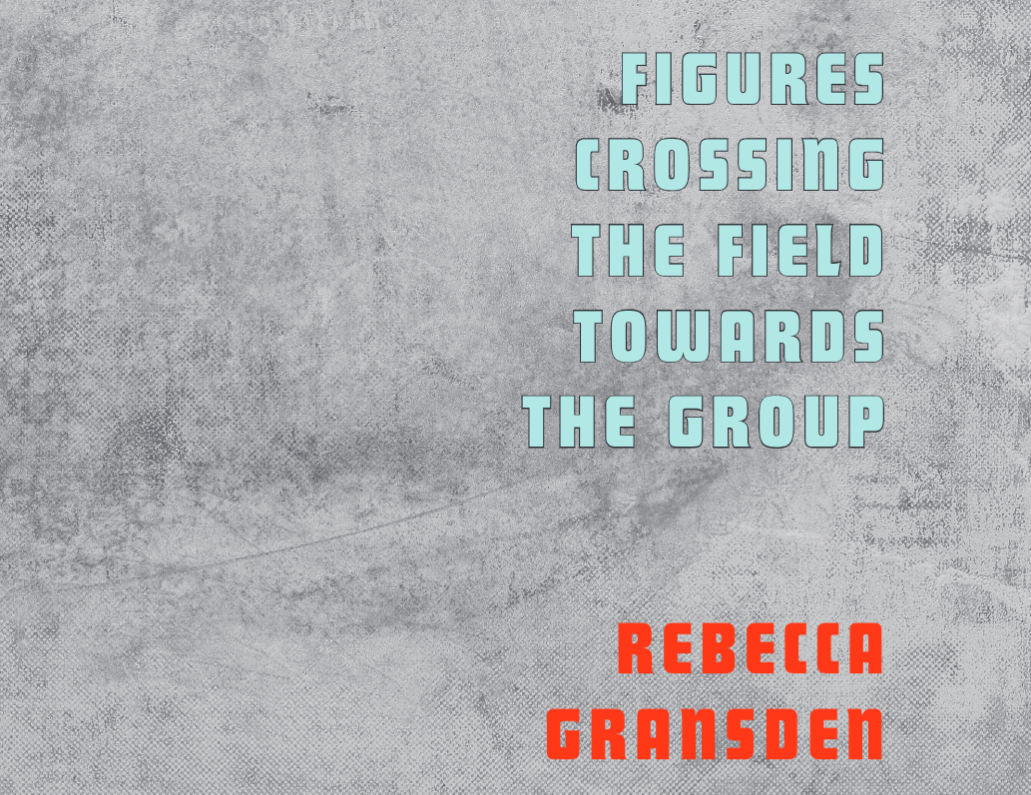
A review of Rebecca Gransden’s novella Figures Crossing the Field towards the Group

In Rebecca Gransden’s novella Figures Crossing the Field Towards the Group, an unidentified blight spreads from the south of England, driving refugees northward. Our hero, a girl named Flo, walks north through this ruined England on a quest to find her lost twin brother. In her strange journey, Flo encounters scattered figures who spill fragmented stories in broken voices. This England is barren, etiolated, and foul. Gransden conjures this apocalyptic barrenness in oblique and elliptical language. Most of the narration in Figures Crossing the Field Towards the Group slips out in clipped single-syllable beats, as if the world itself has been pared down to bone. The book’s end-times aren’t explosions or spectacle but the exhausted rhythms of a world already gone, the voice itself a survivor stumbling forward, blunt and breathless. What remains is not plot so much as the scraping of words against ruin.

And yet, within that scraped-down ruin, Gransden finds a strange fullness: stark fields and broken voices bloom with uncanny images, fleeting surges of feeling, flashes of lyric intensity that make the blasted landscape thrum with life even as it crumbles. Consider this passage, in which our hero Flo encounters a band of freed apes:

Howls eke out through branch and twig, and bods slink down the fell trunks, climb in shift shads on the broke build roof, a mess of swol leaves and wet spikes. Lab apes crawl and tick, their mugs stretch flesh, their heads bolt. Freed by the flee, and left to lone, their house fell in and they, shy and of wound nerve, did peek to the wood, and then run out and claim the trees. They stay near to where they know, fear keeps them so. One ape chomps on a bat, its legs kick as it dies. Most of the lab apes have one eye, a square patch of bald skin, a rash and some scabs.

Figures propels forward with a loose, picaresque energy, its moody, elliptical atmosphere stretched across an almost shapeless structure. It’s best not to look for causality here; things just happen. This isn’t post-apocalyptic fiction. The apocalypse is underway. And Gransden’s language drifts on the fumes of that apocalypse. I often found myself reading lines aloud, even repeatedly, in gnarly little loops: “Town rats puff with nits in their ruffs” is a simultaneously abject and beautiful image. Or consider this lovely little passage:

A shock of white moth wings sings from the shrubs, makes Flo step back and near fall. White flies round her like a snow storm, and moth dust fills the small grove. A film forms on dark leaves and the air smells of old nests. Moths brush her,just close to push a soft stroke on her face. Small round white moths, small white moth round.

The monosyllabic narrative style that dominates Figures may challenge or, more frankly, irritate some readers. I found it hypnotic. Gransden’s characters are not bound to single syllables though. When Flo talks to someone she encounters (an insane royalist, say, or a man sacrificing his body as food to tiny furry beasts), they speak in normal, multi-syllabic dialogue. More fascinating is a solitary chapter that divides the novella in halves. “Public Information Dreams” reads almost like its own Ballardian short story. Told in a clinical, detached style, the chapter gives an incomplete picture of observations made from afar on two children, Kid P and Kid Q. A taste:

Observer: 35

Day: 163

10:37:45 am — Kid Q exits property by back door (3b) and moves to end of garden. Weather is bright sunshine, occasional cloud shadows. No occlusion. Kid Q walks back and forth between end of garden and house, carrying objects. Objects observed to be recording equipment as previously noted (ID476). Kid Q collects the objects together on an empty patch of lawn behind the garden shed. The patch of lawn is square and is mostly unseen from the house. It ends at an overgrown fence, approx. 6ft tall that marks the perimeter boundary of the property’s rear. Beyond the rear fence are fields but the garden is not visible from this location due to the density of the foliage (full description and photographs of the layout of the property and garden are included in additional notes, at this time in the process of compilation). Kid Q assembles the recording equipment. Video camera on tripod is situated in the corner behind the shed and arranged to point across the lawn square diagonally, taking in as much of the space as possible.

10:52:13 am — Kid P exits house by the open back door (3b). Observed to have a listless demeanour. Kid P joins Kid Q. Kid Q and Kid P engage in long conversation (see transcript).

Are Kid Q and Kid P Flo and her brother? If you care, this book probably isn’t for you.

Too, Gransden refuses to settle Flo’s quest—or the apocalypse itself—into any final meaning. The ruined England she describes is not a backdrop but a language, one that stutters, doubles back, and opens fissures rather than closing them. Flo walks north, chasing the shadow of her brother, but whether she finds him, or whether there is anything left to find, hardly matters. What matters is the walking, the scraping of words across ruin, the pulse of strange life inside the waste. Figures Crossing the Field Towards the Group dwells in that space where endings blur into continuations, where survival is indistinguishable from loss, and where language itself flickers like the last light left to see by. Strange, gnarly, alive–great stuff.

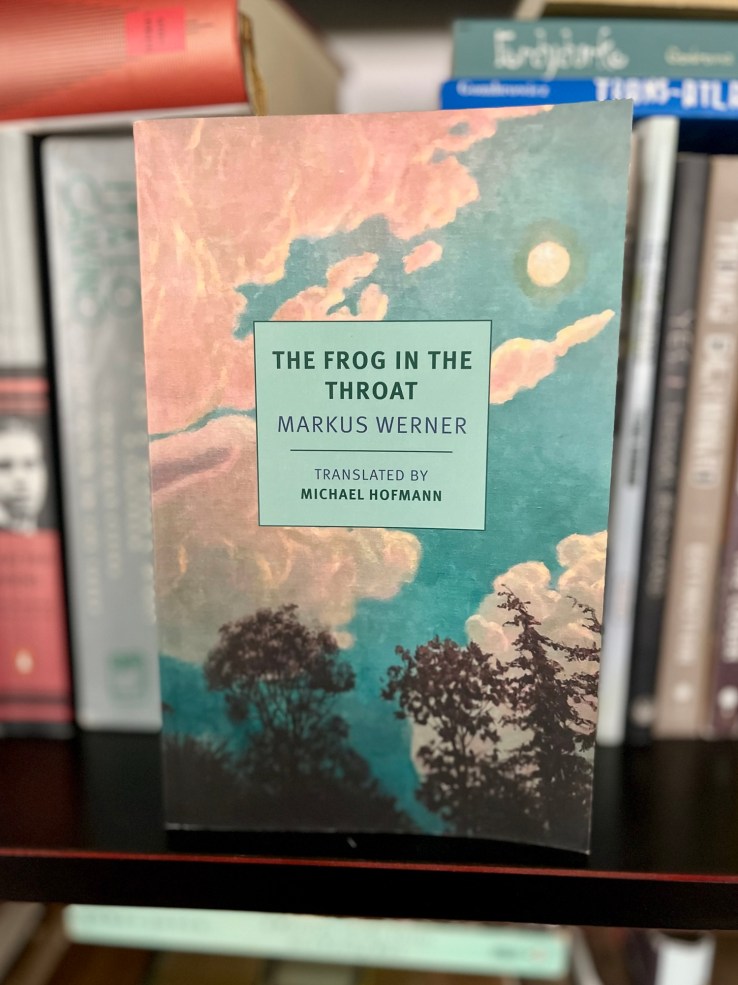
A put-upon frogman with too little oxygen vs. his angry father in Markus Werner’s novel The Frog in the Throat

The hero of Markus Werner’s 1985 novel The Frog in the Throat is Franz Thalmann, a disgraced, divorced, defrocked clergyman, who lives ashamed and diminished, yet nevertheless resilient in a philosophical recalculation of his life. There’s a major complication to Franz’s reevaluation though: the memory (or ghost?) of his stern father Klement turns up as a literal (or is it just metaphorical?) frog in his throat. Klement presents as a tragicomic, pestering apparition who ventriloquizes his son—and the novel—with rural grumbles. He milks cows, rants against modernity, and accuses Franz of having betrayed the world he was born into. In Michael Hofmann’s translation, Werner’s prose is crisp, dryly mortified and quietly savage: intimate cruelty turned into a dark, pinprick comedy about guilt, family, and the stubbornness of provincial life.

The voices of son and father drive The Frog in the Throat. These voices collide in bursts that never find harmony. There are ten punchy chapters: Thalmann the Younger takes the odd chapters; Daddy Klement narrates the even ones. Franz’s chapters are philosophical, discursive, and given to a choppy, aphoristic rhythm. (Franz does, however, declare at one point, “Well. I’m not a philosopher, am I. I’m a put-upon frogman with too little oxygen.) Klement’s sections are denser and earthier, but, for all their ravings and rantings, somehow easier to digest. The voices prickle and stick, evoking that ancient tale, a failure to communicate. This is not a duet, not a dialogue.

Franz, helming the novel’s odd chapters, takes the lead. Here’s childhood, adolescence, nascent adulthood, distilled into fragments:

Obedience. Belief. Suffering. Instructions followed. Expectations fulfilled. Said yes and please and thank you and three bags full, sir. Controlled stray impulses. Cleaned teeth, ditto ears. Swilled elderberry syrup. Studied the Good Book. Knew mastery and eventually self-mastery. Did what was dinned into me, and eventually started doing some dinning of my own. Shoveled snow. Madonnified women. Got in shape. Fiddled. Suffered. Was afraid. Could barely stand Father’s glower. Rarely laughed. Prayed. Fed swine. Visited libraries. Mucked out the cowshed. Dogmas, apologias, ethics. Kissed Helen. Struggled for purity. Homiletics, catechesis, liturgy. Forswore eggs. Was afraid. Was good. Marriage. Ministry.

Franz betrays Helen not in a torrid tryst or a meaningful long-term affair with an extramarital soulmate. It’s a one-off, an almost comically ordinary lapse. It’s not a fling; it’s a thing that happens—and yet it detonates his life, initiating an existential crisis in Franz-as-preacher:

Once it’s been understood that our existential crisis is first and foremost a crisis of our senses, then in spite of metaphysical obfuscations we can see the therapy: The extension and promotion of sensuality. An expansion of the realm of the senses. Humanity will only have a future if we are successful in establishing a new Age of Tulips. The individual sets aside his gloom as soon as he feels his body is a house of joy. A precondition for this is moral enfeeblement, because morality has seen its role for thousands of years as an impediment to French kisses. To put it briefly: Traditional morality impedes sensuality.

Franz’s desire for sensuality is undercut by an intellectual airiness, a quippiness of the spirit. Our man is full of aphorisms:

Castrate the fathers, gag the mothers.

and

I say again, gladly: Happiness is remote.

and

Cleared out the attic, threw all the rubbish away. My concern: The head empty of rubbish and without level crossing attendant will produce badness.

and

Humor, though. Almost eludes description. Strangely adorable bastard child of love and wistfulness.

You can throw a small dart in this short book and find a nice line from Franz. (I plucked most of these from very early in the novel, before too much of the (non)plot develops.)

But back to our Franz’s claim that “Traditional morality impedes sensuality” and thus human joy requires “moral enfeeblement” — a problem for a one-time theologian.

In contrast, Franz’s father Klement expresses an earthy sensuality in each of his chapters; he milks his cows and reflects on their udders, their calfing, their literal breeding. His bovine reflections drift into memories of his family, sketching out the often painful history of his children. We also come to see that, like his son, Klement is an outsider. He doesn’t quite fit in at the local pub. The other patrons can’t comprehend his contempt for the modern world.

Some of the finest moments in The Frog in the Throat happen when Franz wanders into a theme that Klement, grumbling from the cowshed, will half-pick up on in the next chapter—less a conversation than a comic game of misheard telephone. These echoes and prefigurations create a thematic tone, however discordant. Take for instance middle-aged Franz, feeling as if he’ll never really mature:

I’ll be fifty soon and I wonder what being grown-up will feel like. Was I grown-up when I turned twenty-two? For a bet, then, I ate a coffee cup. No problem. My stomach was equal to the challenge. Today, I poke at my sauerkraut. An un-grown-up way of behaving, only confirming one’s suspicion that being grown-up, like everything else, is a passing condition.

And a chapter later, Klement confirms Franz’s intuition:

People remain a mystery, you can read a hundred books and you’ll be no closer to understanding them, that’s my view, and when I was younger, I always used to think: When I’m older, I’ll work it out. You see, when you’re young, you see old fellows with white hair, and you think: They may be old and knackered, but they have experience of life, they’re not floundering like us, and maybe they have wisdom. And suddenly you’re old and gray yourself, and you realize that’s all you are, old and gray and just as clueless as you ever were, and so I say: No one’s got the secret. I often think we should view everything from above, we should look down on the world from way up high, and who knows what we would see, what connections, what never-guessed bridges and linkages, or then again maybe not. What a tangled mess, what a confused jumble, I don’t know.

Perhaps the two preceding passages might give a prospective reader the incorrect impression that The Frog in the Throat is a dour novel; it is not. It is often quite funny and quite moving. It’s easy to identify with Franz’s groping questions, and as the book progresses, we come to see under Klement’s anger a wounded pathos. Perhaps the father’s name is not ultimately ironic; perhaps there is a mercy in his haunting his son. Maybe Franz sees the past with new eyes (or, rather ears) through his father’s visitation. But I’m inclined to agree with translator Michael Hofmann in his introduction, when he suggests that “reconciliation is out of the question, but equally there is no possibility of not laughing.”

Synthesis between father and son was never the goal of this novel, let alone a metaphysical coherence. Rather, Werner seems to express his own literary ambitions most directly near the end of the novel, when his antihero Franz declares his admiration for novels that

…are subversive, making clear that their authors, in writing them, did so to avoid doing something far worse…the books that crackle subtly, the semi-house-trained powder kegs of books, the incautious, unconsidered, and if you like erroneous ones…

I’m not sure that The Frog in the Throat is a powder keg, but it does crackle subtly.

I have perhaps overshared Werner’s prose in this review. The truth is I just really loved the way his sentences stack up. And I must again applaud translator Michael Hofmann’s work here; his new  translation of Alfred Döblin’s 1929 novel Berlin Alexanderplatz was one of my favorite reads in recent memory. So I’ll share one last stack of sentences, again from a Franz section. It’s a passage I dogeared, perhaps thinking it exemplary of the novel’s sharp pacing and shifts between pathos and dark humor:

In the morning I’m miserable, at night I’m scared, and during the day I am at pains not to attract attention, putting one foot in front of the other, forming sentences, combing my hair, leaving tips for the waitstaff and buying five tomatoes and answering the telephone in my best and brightest voice, reading this and that in the newspaper, not killing myself, showering regularly. And I give advice to people and listen to them and feel moved by their confidence in me. I sit around, I drink, I brood, I pat myself down for flaws and find many and each evening I say: Starting tomorrow I’m going to get a grip on myself.

—but really it’s that last clause there hanging from the colon that I most connect to. For tomorrow, I too will get a grip on myself.

Highly recommended.


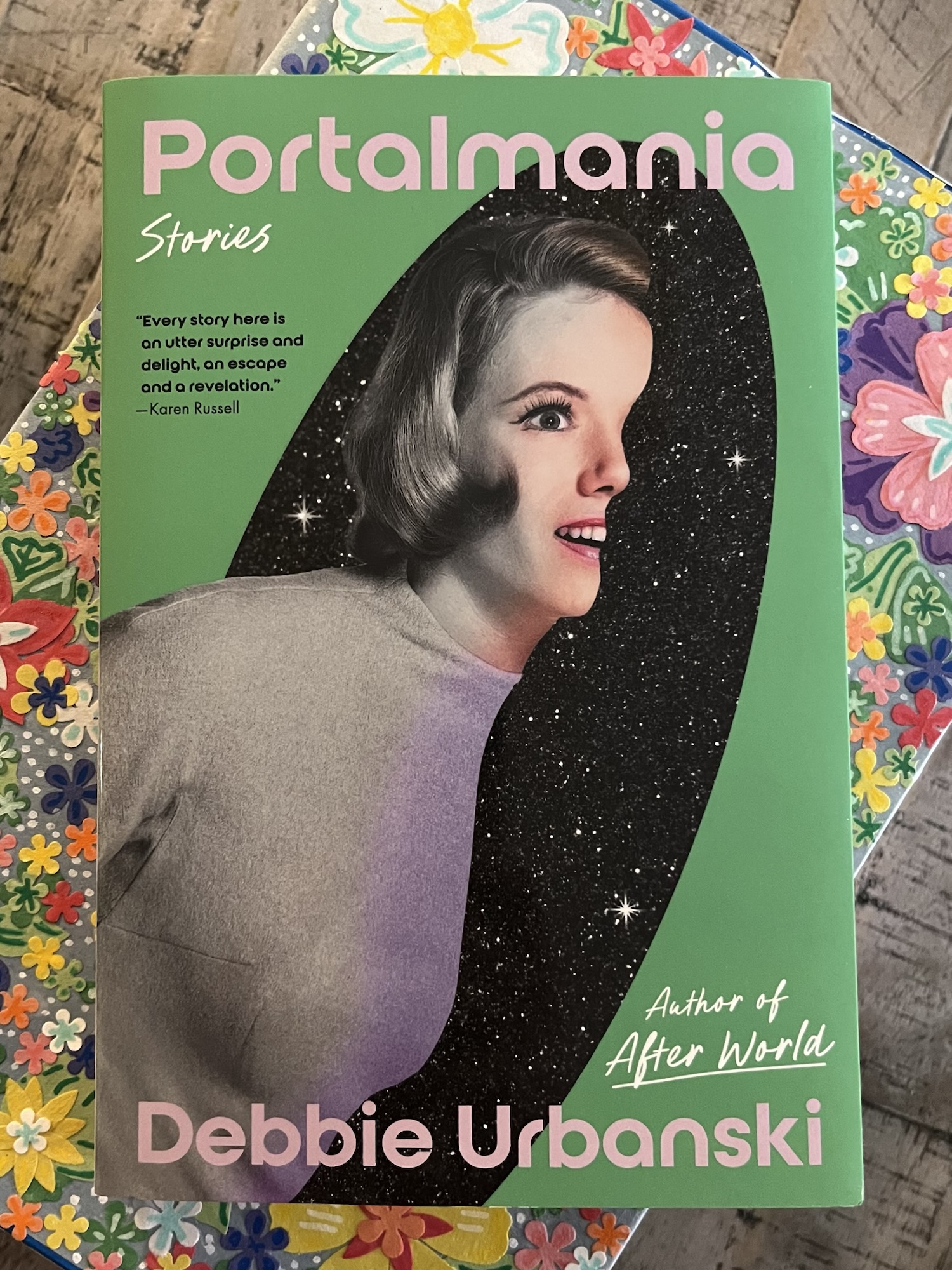
Thirteen ways of looking at a portal | A review of Debbie Urbanski’s Portalmania

Debbie Urbanski’s new collection Portalmania is a metatextual tangle of science fiction, fantasy, and horror where portals don’t offer escape so much as expose the fractures beneath family, love, and identity. Her characters navigate asexuality, neurodivergence, and the quiet violence of domestic life against an uneasy backdrop of porous reality. At any moment a portal might appear, or a mutation might take hold, or, a wife might sell her daughter to a witch to assassinate her husband. Nothing is stable in Portalmania.

There are nine stories in Portalmania. Or maybe there are ten stories. Or eleven. Or maybe thirteen. If there are thirteen stories, maybe I could riff on that Wallace Stevens poem for my review titles (that would be too fucking precious and obnoxious though, wouldn’t it).

There are nine or ten or eleven or thirteen discrete “stories” in Portalmania, depending on how you want to count or what you want to count as a discrete story. But this need to count, or, more precisely, to pin down what-something-is-and-is-not, runs counter to the spirit of Portalmania, whose heroes push back on the definitions that are literal placeholders, linguistic lines that bind identities.

Perhaps the biggest through-line of the nineteneleventhirteen stories in Portalmania is the big ole question: What is love? In the story “How to Kiss a Hojacki,” a character puts the problem succinctly, writing a note to her husband: “We need to redefine love.

The opening story, “The Promise of a Portal,” helps to establish a realistic world punctured by magical sci-fi. In “Promise,” we come to understand portals as personal escape hatches away from the humdrum domesticity of family life. “I think you can love people–children, mothers–and still want to leave them,” the hero of the story muses. These same portals pop up throughout the collection, creating continuity so that the nine (or are we saying thirteen? I misremember) stories here read more like a loose, discontinuous novel.

The second story, “How to Kiss a Hojacki,” also introduces a sci-fi conceit that repeats in the collection. In this story women transform into “Wonderfuls” — “Hojackis,” “Smith-Smiths,” or “Tangers” — asexual beings who must fight for their autonomy against a reactionary Trumpian politician who campaigns on interring them in camps.

“Hojacki” hovers around the viewpoint of a husband who is becoming increasingly resentful and sexually frustrated with his changing wife. He is unwilling to even try to redefine love: “having sex is how people love each other,” he contends. “Hojacki” is most fascinating when set in context against the stories at the back end of Portalmania, which deal far more directly with themes of asexuality, sexual coercion, and marital rape. While it would be a stretch to say Urbanski depicts the husband sympathetically, her rendering is nevertheless nuanced enough to be later deconstructed in far more visceral detail in stories like “The Dirty Golden Yellow House,” “Hysteria,” and “Some Personal Arguments in Support of the BetterYou (Based on Early Interactions).”

“The Dirty Golden Yellow House” is the strongest piece in Portalmania. It rewrites “How to Kiss a Hojacki” (and reimagines Charlotte Perkins Gilman’s “The Yellow Wall-Paper”) from the perspective of an asexual writer trapped in a marriage marked by marital rape and emotional coercion. “Yellow House” combines elements of fairy tales and Gothic horror with the more prosaic forms of the essay and the internet forum to yield a harrowing story. “Yellow House” also quickly registers as a metatextual tale, a self-deconstructing narrative that pauses early to take would-be critics to task:

Certain reviewers and readers have already started complaining about my recent stories, both their thematic similarities and their very specific view of relationships. I have examples. From one reviewer: Other than the overt political addition to the obvious social metaphors which helps extend this to novelette length, this [one of my stories] is exactly like the same author’s [another one of my stories] in being an overlong underplotted offputtingly narrated story of a repugnant asexual wife and a repugnant husband and their repugnant relationship. From another reviewer: It [one of my stories] is probablsending a message about something—menopause maybe?… I have no clue what the ending is supposed to mean.From a reader: My takeaway is that the story [one of my stories] was an exercise in catharsis for the author, and has no real value as a morality tale beyond—

My past self slams her (our?) body against the window glass. Has she not been clear enough. Here is what she expects in my writing: revenge, on me, on him, on them, on the structure of the story itself, and if I ever consider not placing her at the bloody heart of whatever I write, she will do this to me. She acts out what she will do to me. There is so much blood.

Angry, self-aware, and emotionally scorching, “Yellow House” nevertheless offers sparks of mean humor. The narrator observes that her “neighbors staked colorful rainbow signs into their front yard: WE BELIEVE LOVE IS LOVE AND KINDNESS IS EVERYTHING.” While the sentiment of the sign might be progressive, the tautology “love is love” is reductive and unhelpful in a book where redefining what love is is the (de)central problem. 

Another highlight of the collection is “LK-32-C,” a triptych of stories about a troubled child’s fantasy world. (We might count “LK-32-C” as three stories, not one; each section has its own title.) The narratives in “LK-32-C” seem to run in concurrent yet divergent directions, where fantasy punctures reality or vice versa. In one such topsy-turvy moment, a distraught mother dreams up a magical totem of familial security: “if anyone questioned whether or not there was some love here, she could have pointed to that sphere.”

And again, in “The Portal,” fantasy punctures reality and metatextuality punctures the narrative. Our narrator interrupts building her fantasy world to tell us that,

I do realize that, as an author, I’m not supposed to let my other worlds become utopias. At least, that was one successful writer’s advice to me when I told him I was working on this story. He explained that when portal worlds are utopias, it’s like a flashing neon sign that says lazy writing. If we want such fantastic places to be believable (and who doesn’t want their writing to be believed?), they have to possess a substantial dark side.

Our author-hero’s rejoinder points out that the dark side is the absence of the utopia: “What if I’m trying to create an untroubled and pleasant world that might haunt someone for as long as they could remember it?” We’re always looking for that perfect portal.

Not everything in Portalmania works. “How to Kiss a Hojacki” has a great premise but its collapse into a political satire is dissatisfying. “Long May My Land Be Bright” is the weakest link in the collection. Its central conceit is that there are literal rifts in the USA, which create two separate antithetical political-cultural realities. It’s not that I’m not sympathetic to the sentiment here, it’s just that I think the metaphor should be pushed even further, to more absurd places.

I’m also not sure how I feel about Urbanski’s decision to include a tenth chapter in her book titled “Story Notes.” By the time I got to the (ostensibly)-last story “The Portal,” I was having a really hard time keeping all the New Criticism, death-of-the-author, grad-school reading training stuff out of my head. With its constant metatextual interruptions and its deeply– personal themes, it became very, very difficult not to read Portalmania as in part a work of autofiction. So the notion of “Story Notes” both intrigued and repelled me. Here is how “Story Notes” begins:

One of the indisputably vital roles of the modern reader is to tease out what is autobiographically true for the fiction writer versus what that writer made up in their stories. What is fiction after all if not a porthole into the author’s private life? So allow me to get this out of the way: Everything you’ve read in Portalmania (or will read, depending on your preferred order) actually happened to me. The portals, the lack of portals, the witches, the monsters, the ghosts, the murders, the space travel of beloved family members—every story in this collection is a factual account of my own experience. And now that you know this, I can spend the remaining space of these notes discussing whatever I want.

And I suppose she does discuss whatever she wants in the notes.

If we are counting “Story Notes” as a story, there are ten stories in Portalmania. If we keep reading after “Story Notes,” there is a final piece, “Coda” an unlisted hidden track of sorts. I love the decision to put this last, brief, and strong piece after “Story Notes.” “Coda” revisits the themes of Portalmania and concludes by pointing to “a terrifying and wide-open future,” which is what I suppose we can all expect as we fumble toward our own redefinition of love, storytelling, and escape. Good stuff.

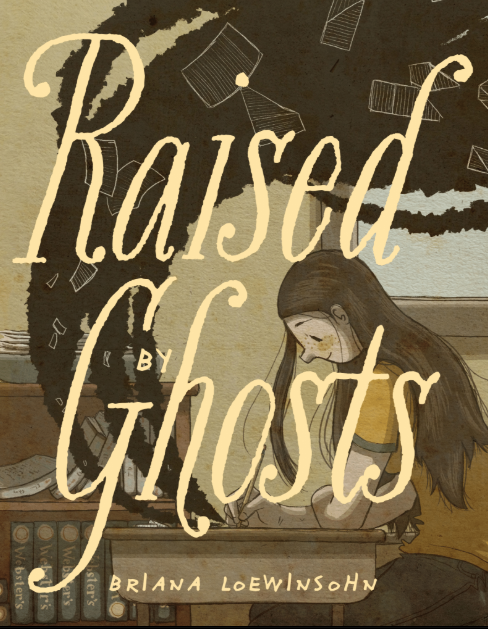
Briana Loewinsohn’s graphic novel Raised by Ghosts turns absence into haunting art

A decade ago I finally tossed out most of the contents of an old shoebox crammed with high-school nostalgia. Notes from ex-girlfriends, summer postcards, flyers from local shows, a handful of choice mixtapes. Some Polaroids. Our stupid band’s stupid lyrics, which we usually forgot or simply abandoned live. There was even a pair of fat shoelaces. The pain of return always hits me hard at such times, and I got dizzy. That box was crammed the scraps of an older life.

The preceding paragraph is an unfair opening to a review of Briana Loewinsohn’s excellent graphic memoir Raised by Ghosts. Reading Raised by Ghosts felt like opening that old shoebox: painful, dizzying, beautiful. Loewinsohn is one of usone of us to borrow a chant from Tod Browning’s Freaks. “Sometimes I feel like I am an alien at this school…But there are other aliens here,” protagonist Briana writes in her diary.

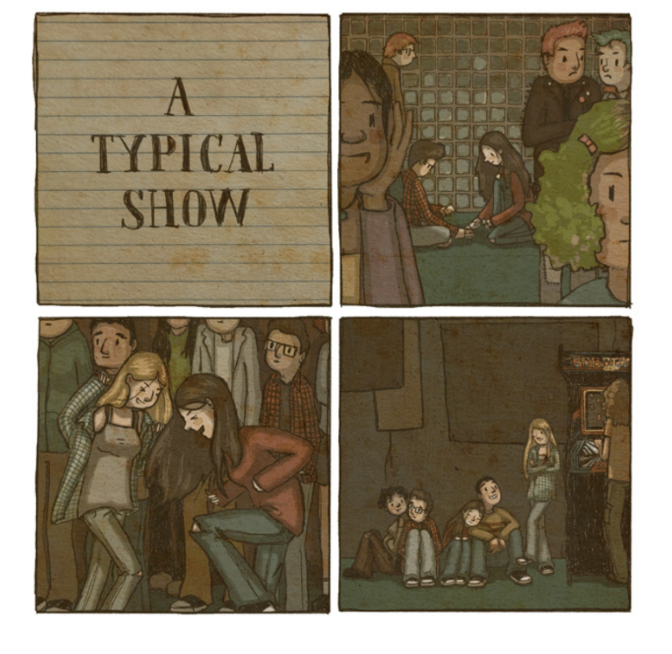
Raised by Ghosts covers Briana’s seven rough years through middle and high school. These are the gay nineties. The narrator, like Loewinsohn herself, is about my age, which makes reading Raised by Ghosts an eerie act of self-recognition. It’s not a conventional memoir—it doesn’t hold your hand or deliver a clean, linear narrative. Instead, it moves like memory does: in flashes, in vignettes, in small sensory moments that coalesce into something greater than the sum of their parts. Everything here feels true. We have here the relics of a teenage moondream, those little ghosts of the past that flicker through memory like frayed photos freed from the rubberbanded bundle in an old Converse box. Briana’s adolescence unfurls as an ebb and flow of loneliness and acceptance among fellow weirdos. She finds her people, but never quite makes the scene; she dances at the live show but finds as much fun in playing cards in the back.

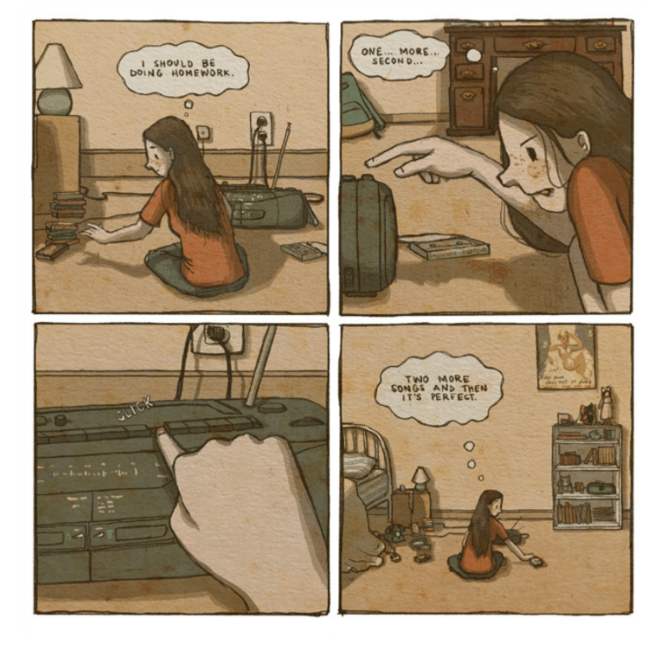
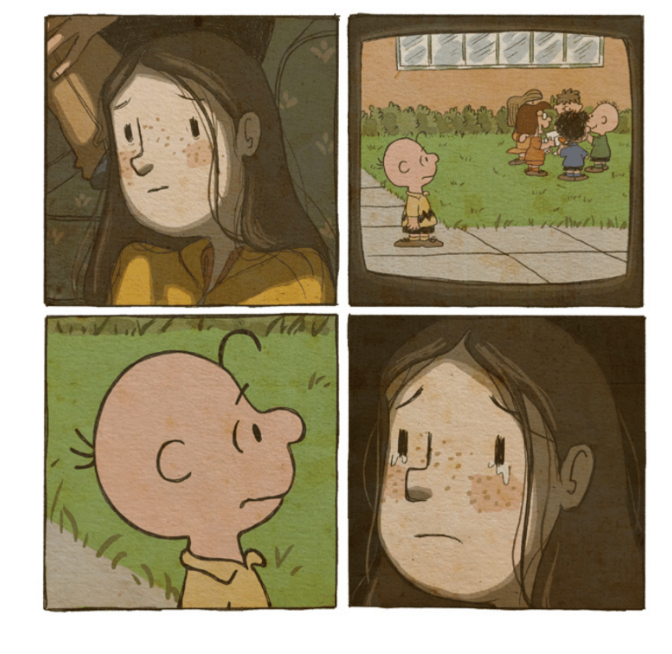
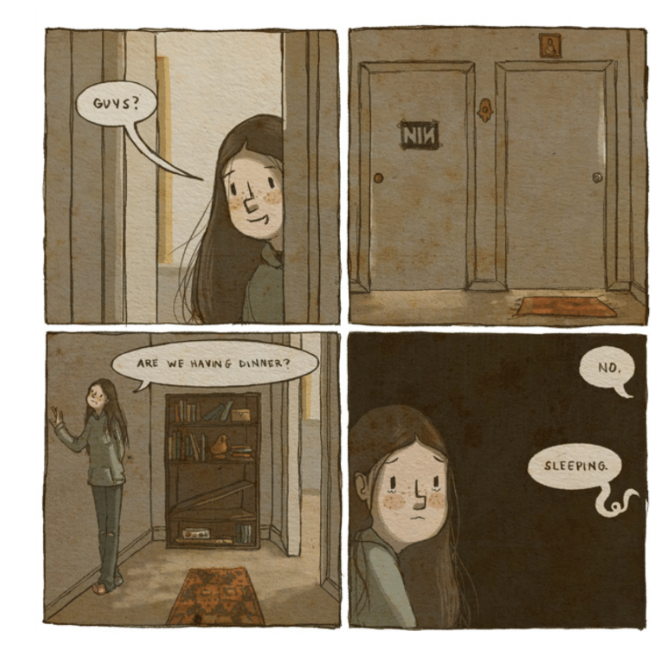
Loewinsohn’s art conveys Raised by Ghosts’ emotional weight. Soft, muted tones in drab olive and rust hues fill square panels that often resemble fading Polaroids. Candids and close-ups capture the messiness of high school. Briana is a sympathetic and endearing character, her sensitivity registering in ways she cannot understand herself, as when she skips out on a living-room VHS double feature. Oliver Stone’s Natural Born Killers would be way too much after the tragedy of You’re a Good Man, Charlie Brown.

Loewinsohn includes full handwritten pages to accompany the traditional comic strips in Raised by Ghosts. These handwritten pages serve as a kind of diary, but often take on subtle visual changes that suggest other media. Often, the handwritten pages mimic the form of the long notes bored Briana composes in class to pass to friends. A passage composed on graph paper praises the note-writing skills of a particular friend; the technique suggests this friend prefers squares to lines. A passage on a brown paper lunch bag reflects on how Briana’s father always takes the time to write her name in detailed, expressive lettering. The variations of handwritten pages enrich the narrative and subtly inform us of Briana’s artistic development.

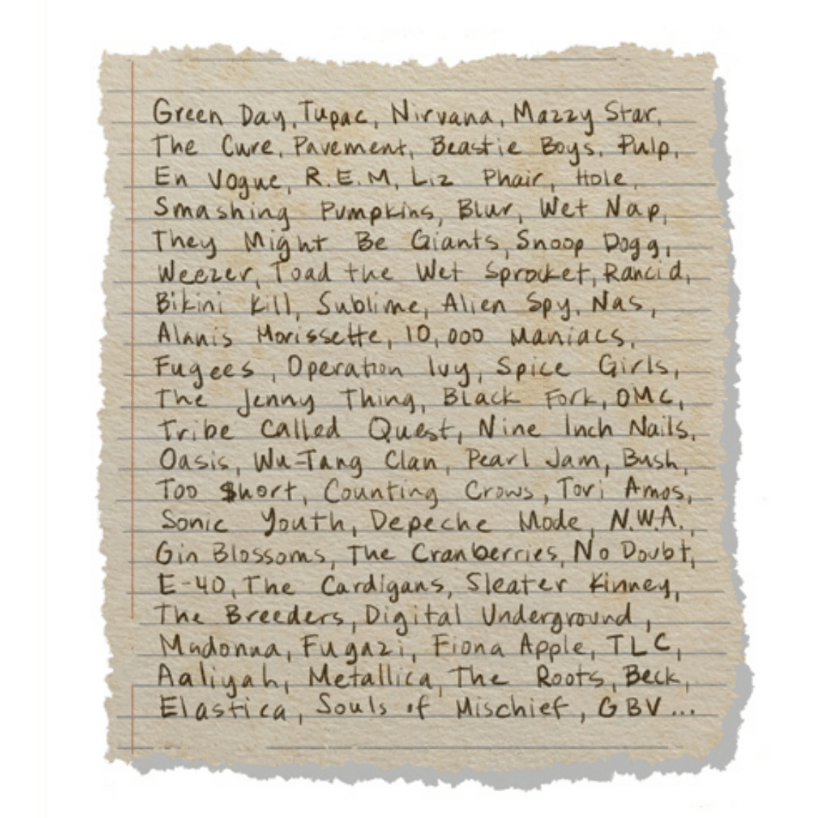
My favorite of the handwritten passages though is simply a list of bands scrawled on lined paper. When I got to that page, about a third of the way into Raised by Ghosts, I was already persuaded by the book–but the page of band names seemed so utterly true, so beautiful and banal. We used to do that, I thought, and: Why did we used to do that? knowing the answer has no good intellectual answer.

But let’s get to the ghosts. Loewinsohn never “shows” us Briana’s parents, yet the picture we get of them is hardly incomplete: a distant, detached mother and a father in arrested development. “I would say I was raised in an AA meeting,” Briana remarks of her mother, noting that it’s often hard for single mothers to find childcare. Of her father’s abode: “My pop’s house is a combination of Indiana Jones’ office, Pee Wee’s playhouse, and an opium den. I am kinda like a roommate here.”

Briana’s parents exist in Raised by Ghosts the way memories of the absent often do—fragmented, elusive, more felt than seen. Loewinsohn never lets them fully materialize, yet their presence, or lack thereof, shapes Briana’s interactions with her world. Neither parent offers Briana guidance. She’s a latchkey kid left to cobble her own sense of belonging among friends, music, and the small rituals of adolescence. In the absence of stability, she builds meaning from mixtapes, handwritten notes, and fleeting moments of connection.

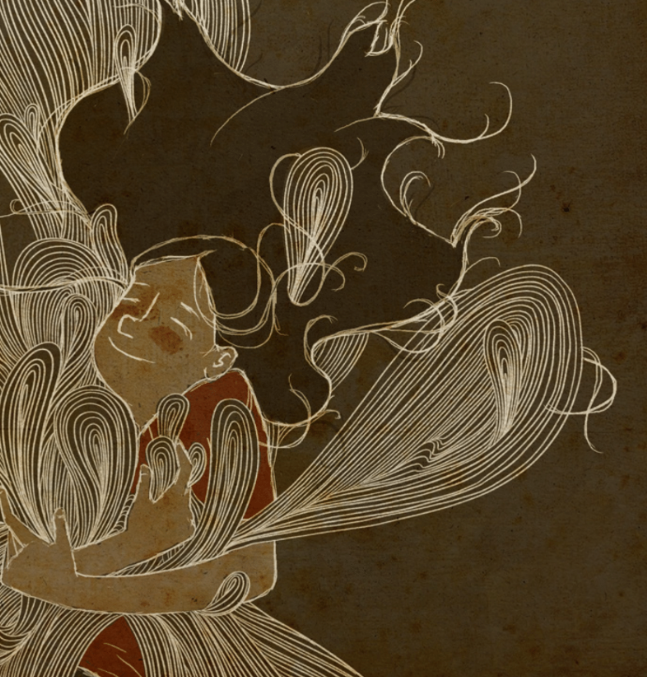
And art. The memoir climaxes in a moment of transformation—an act of self-possession and, ultimately, self-creation. Throughout Raised by Ghosts, Briana moves through a world shaped by absence, by the ghosts of parents who are physically present but emotionally distant. Yet, in the book’s remarkable penultimate sequence, she steps beyond that absence, beyond memory’s hazy grip, into a space that is entirely her own. The panels swirl into a dreamscape of shifting lines—formless and chaotic at first—until Briana gathers them together, lassoing meaning from the void. It is a moment of artistic alchemy, where creation becomes a form of agency, a way to shape her own narrative rather than just mimic one. When she carries those lines from dream to waking life, the transition is profound: she is no longer just a kid collecting relics of meaning from the world around her—she is an artist, making meaning herself.

Publisher Fantagraphics labels Raised by Ghosts as a “young adult graphic novel,” and teenagers will likely identify with Briana’s story—the loneliness, the search for belonging, the quiet acts of self-definition. They may also feel a strange twinge of envy for a world that no longer exists. Being a latchkey kid could be lonely, but it was not without its freedoms. Those of us who were teenage weirdos in the nineties will see in Loewinsohn’s memoir not a young adult novel, but rather a reflective elegy composed by a mature artist in control of her talent. Raised by Ghosts lingers like the echo of an old song in your dim memory — you know the one, right? It’s a memoir about growing up in the margins, about finding meaning in scraps and silence, about turning absence into something tangible. It haunts, in the very best way.

Maggie Umber’s Chrysanthemum Under the Waves blends horror, surrealism, and poetic fragmentation into a haunting vision of the uncanny

Maggie Umber calls the nine pieces collected in Chrysanthemum Under the Waves “comics,” so I will call them comics too. The term “comics” has long encompassed a wide range of visual storytelling techniques, resisting attempts to confine it to rigid structures, and Chrysanthemum Under the Waves shows the form’s expansive potential, blending horror, surrealism, and poetic fragmentation to tap into the alienation, paranoia, and repression that lurks under the surface of everyday life.

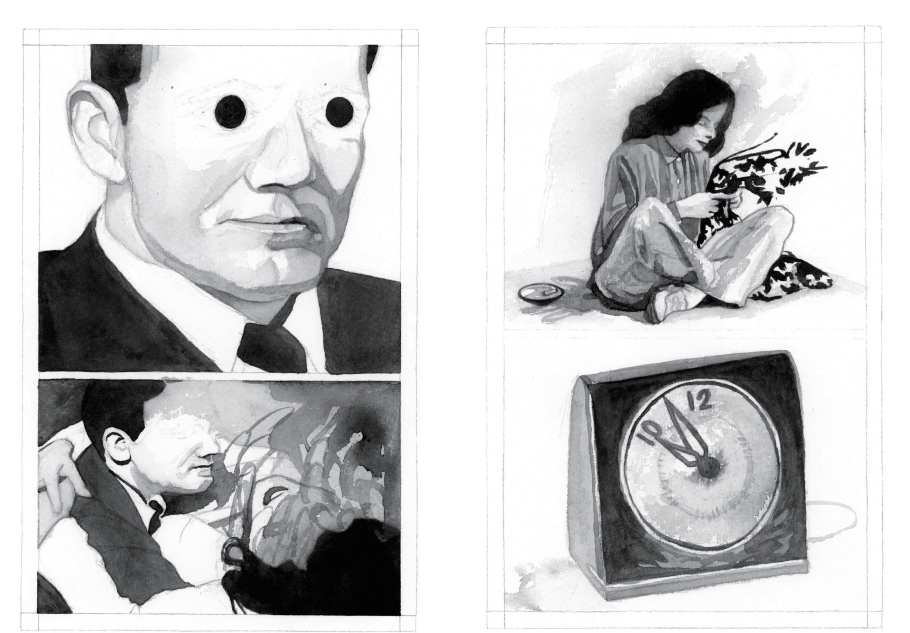
The stories here resist conventional narrative logic, which will likely confound any reader expecting something traditional. Umber eschews the common building blocks of the medium: there are no speech bubbles, no thought balloons, no panels stacking up into a coherent sequence. In fact, the few pages that use multiple panels feel like an anomaly. Most of the work in Chrysanthemum is confined to single, expansive images. Yet, these full-page spreads do not recall the bombastic splash pages of Jack Kirby or other Golden Age comics. Instead, they underscore the inherent incompleteness of storytelling. No artwork, no story, can ever present a full picture of reality—there are always gaps, always gutters. And in these gaps, dread and unease fester.

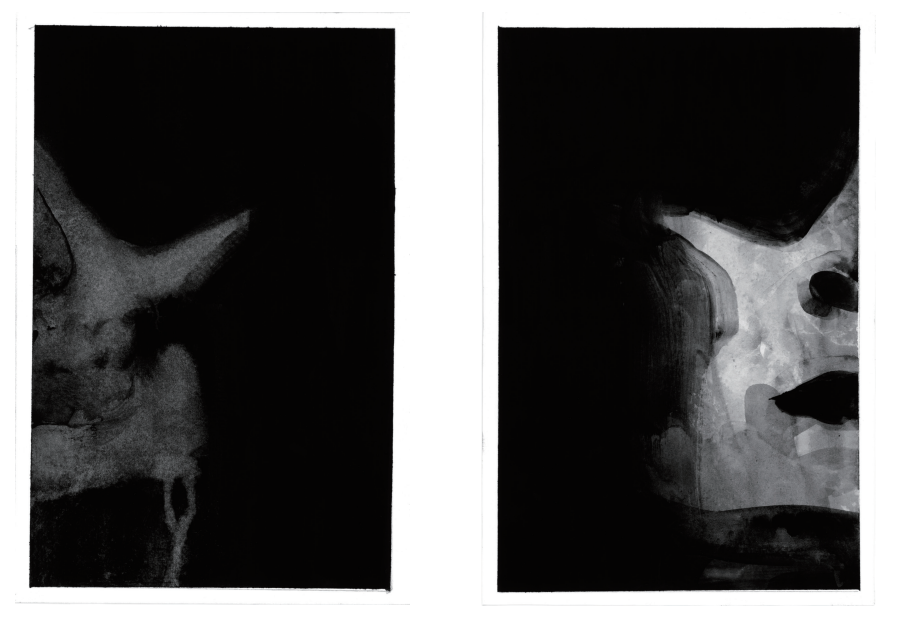
Umber’s comics aren’t so much about exploring the fragmentation of storytelling; rather, they showcase it as an aesthetic choice. It’s a choice that generates a palpable tension, a constant refusal to return to any resolution. There is no resolving tonic chord here. The uncanny permeates these pages—not in the sense of something foreign intruding upon the familiar, but as if the familiar itself has been subtly warped. Maybe this horror is “real,” maybe it’s not—but what is certain is its presence. The world Umber paints is one of perpetual strangeness, captured in black-and-white, shaded with grays. Pen and ink, printmaking, and watercolor all blur together in a form that makes us feel the unease before we can even articulate it.

And while Umber’s work is refreshing in its uniqueness, it is by no means sui generis, but rather part of  a clear tradition. As Umber notes in her introduction, Chrysanthemum started as a one-off “adaptation” of Shirley Jackson’s 1949 story “The Tooth.” If you have read “The Tooth” (and if you haven’t, do yourself a favor and resolve that problem) — if you have read “The Tooth,” you will likely recognize the uncanny unease that permeates Chrysanthemum. In her intro, Umber identifies James Harris as the agent of this unease: “James Harris snuck up on me when I was distracted by other things.” James Harris is a strange character who wanders in and out of not only “The Tooth,” but several of the other stories in Jackson’s The Lottery. Indeed, the original subtitle of The Lottery was not and Other Stories, but rather The Adventures of James Harris. This is the James Harris of the 17th century ballad “The Daemon Lover”; he is also the oblique star of Chrysanthemum Under the Waves. Look and you will find him in each of Umber’s tales, sliding like a shadow in and out of panels and gaps.

You will find so much more there as well–there are direct allusions to Goya’s Caprichos and Black Paintings, as well as nods to Toulouse-Lautrec and Sylvia Plath. There’s also a strong echo of Jackson’s American Gothic precursors and successors: Nathaniel Hawthorne, Edgar Allan Poe, Emily Dickinson, David Lynch, Kathy Acker — and, far less famously, Jason Schwartz. Chrysanthemum Under the Waves most reminded me of Schwartz’s prose-poem John the Posthumous, so much so that I read it again to confirm my notion.

I’ve failed to remark so far on the apparent plots of the tales here. I found myself arrested by the ominous vibes in my first readings, and I still could not pin down a summary. At the same time, I feel that Umber clearly knows “what’s happening” in her stories, even if she keeps that information in the gaps and margins, out of the panel, but still, maybe, hidden in the pictures. The lead story, “Those Fucking Eyes,” is a collision of horror and beauty, twisting the artist’s gaze  into something self-possessed and austere. “Rine” plays with fragmentation and distortion while evoking a ghostly presence. We get a gentleman caller, a broken bridge, a bouquet of flowers that flickers between reality and illusion. “Intoxicated” takes on a Gothic Toulouse-Lautrec aesthetic, unraveling into surreal rage and rejection. “The Devil Is a Hell of a Dancer” retells the “James Harris” ballad; it’s the first time written language infiltrates one of the stories.

The title track, “Chrysanthemum” is a surreal noir fantasia punctured by a cup of coffee, with daemon lover James Harris hovering menacingly in the background. It seems to reinterpret Shirley Jackson as does the aforementioned “The Tooth” — itself a revision of Charlotte Perkins Gilman’s suffocating 1892 classic, “The Yellow Wall-Paper.” The shortest comic, “There Is Water” unfolds like a koan, enigmatic and meditative. Standout “The Witch” returns to Goya but also channels the American Gothic vein. The piece might be a nightmare one of Hawthorne’s characters endures. There are clouds, castles, dreams, doors, flickering horror. Is that a witch burning? And do the flames morph into a glimpse of Goya’s Saturn, only to resolve into the shadowed face of a woman? Shadows and erasures pulse through the imagery. It is both the strongest and longest piece in the collection. The book ends with “The Rock,” another riff on the the ballad “James Harris.” It’s a fitting end, conclusive but elusive. What remains rattles: unsettled, open, and always strange.
Chrysanthemum Under the Waves is a haunting, layered work that defies easy categorization. Umber’s pieces blend literary, artistic, and Gothic influences into a unique vision that expands the possibilities her chosen medium’s conventions. With its distinctive style and  careful attention to space and detail, Chrysanthemum Under the Waves is a compelling read. Highly recommended.

Eight notes on Stephen Dixon’s novel Interstate

1,  It upset me deeply, reading Stephen Dixon’s 1995 novel Interstate. It fucked me up a little bit, and then a little bit more, addicted to reading it as I was over two weeks in a new year.

2,  What is it about, Stephen Dixon’s 1995 novel Interstate? I mean, you probably won’t like it, but that wasn’t the stupid rhetorical question that led this point. (And also but maybe like, you will like it.) Interstate was a finalist for the 1995 National Book Award. It didn’t win. The NBA’s website’s one-sentence summary fucks up: “In the author’s first novel since Frog, a Finalist for the National Book Award, a father mentally replays, in eight variations, the shooting of his daughters on an interstate highway.”

3,  There is (or is it are?) one too many esses in the NBA’s summary of Stephen Dixon’s 1995 novel Interstate—there are two daughters, plural, but only one is shot, and shot tragically, awfully, fatally—and really, as its variations play out, it’s not entirely clear if anyone was shot, if anyone was even on the highway, if anyone was even real. Are all the so-called events of the novel simply (there’s no simply about it) in the narrator’s imagination? “…but there I go again, the world’s easiest and most desirable copy out, the dream,” muses the narrator at one point. Not even a dream though, it’s all just words.

4,  It’s all “just” words, and if someone told me they read and hated Stephen Dixon’s 1995 novel Interstate, I’d shrug and ask if they made it all the way through all the words and still hated it. If someone told me that they made it all the way through Interstate and found it to be a strange and unappealing writing experiment, I’d mildly agree with them, and then tell them that I loved that particular flavor and if they didn’t like that particular flavor, well, cool.

5,  If someone read all the words in Stephen Dixon’s 1995 novel Interstate and concluded that it seemed like an ambitious and highly-achieved creative writing exercise — writing experiment, rather — I’d likely initially agree and then hedge a bit before mumbling something like, I don’t think it was an exercise or experiment on the author Stephen Dixon’s part. It might make for experimental reading, but I think he absolutely knew what he was doing; this wasn’t practice or exercise — it was the real thing.

6, I have, thus far, done a lousy job, not even really a job, of describing the force of language in Stephen Dixon’s 1995 novel Interstate. Normally I’d crib a few choice passages—and to be clear, Interstate s fat and juicy with choice passages—but we are talking about long, twisty, tangled passages, sentences that go on for pages, sentences that find the predicate verb sundered for a few paragraphs from its eventual object, sentences that move us through thought, how divergent thought can be how, how imprecise, indirect, yet still sharp and often painful. An easy, lazy comparison would be to liken Dixon’s paragraphs to Thomas Bernhard’s (although Dixon denied the influence, much like William Gaddis did in his final novel)—there’s a different flavor here but our guys are working in a similar mode. (Think too of László Krasznahorkai or Gabriel García Márquez or Faulkner or Mauro Javier Cárdenas or any number of practitioners of the long paragraph). John Domini, in his contemporary review in the Portland Oregonian (reprinted in his excellent collection The Sea-God’s Herb) does a better job of describing Dixon’s style than I can do:

Characters talk themselves through backwaters of memory (sometimes creating comic relief) or sail into dreamy what-ifs, all in order to put off some looming and drear inevitability. In conversation, one may mention an important insight that he or she has to share, then spiral away through a half-dozen distractions before revealing what matters. The format feels like a natural fit to the shuttered claustrophobia of worry and loss. So do the jam-packed paragraphs, sometimes running several pages without a break. Better still, these blocks of talky phrasing flicker with light, even (every now and again) with happier possibilities.”

(Maybe I just wanted to quote that lovely phrase of Domini’s, “blocks of talky phrasing flicker with light.”)

7,  “Better still, these blocks of talky phrasing flicker with light, even (every now and again) with happier possibilities,” Domini wrote of Stephen Dixon’s 1995 novel Interstate. The last of Dixon’s eight Interstates is an unexpected gift — a happy ending, or, rather a banal ending, a plain ending, an ending without tragedy or comedy or epic heroism. An ending where everyone gets to bed in time to fit in a little light reading before shuteye. It sounds hokey when I write it out, but there’s nothing trite about the conclusion. The reader purchases this moment of catharsis from all the terror (and horrifying comedy, which I’ve neglected in this riff and will continue to neglect) — the reader purchases the cathartic conclusion from the preceding horror.

8,  I wonder how I might have reacted to Stephen Dixon’s 1995 novel Interstate if I had read it, say, when it was first published, back when I was a junior in high school. Or how would I have reacted to it ten years after that, not yet a parent? (And writing these thoughts out now, I realize that, more than anything by Bernhard or Krasznahorkai or Faulkner or the other Dixon I’ve read, Interstate most reminds me of (at least at this moment that I write) of Frank Capra’s 1946 film It’s a Wonderful Life. I’ve watched It’s a Wonderful Life once a year for the past four decades, finding it strangely different every few years — first baffling and even a bit scary, then boring, then exasperating, infuriating even, then schmaltzy, sentimental, ludicrous, and then magical, endearing, heartbreaking, perfect–I’ve veered off course, where was I?) I wonder how being a parent has colored my psychic engagement with the novel Interstate? I was not so much manipulated by the tragedy of losing a child through violent, chaotic, meaningless death but rather the more banal tragedy the novel repeatedly engages — losing a child through half-neglect, through half-listening, through selfishness, through an inability to focus on now — not really so much losing a child but losing out on connections, memories, time you’ll never get back. It fucked me up, Interstate, and I don’t think I’d like to go down its road again — but I loved it. Very highly recommended.

Charles Burns’ Final Cut explores the irreal reality of artistic ambition

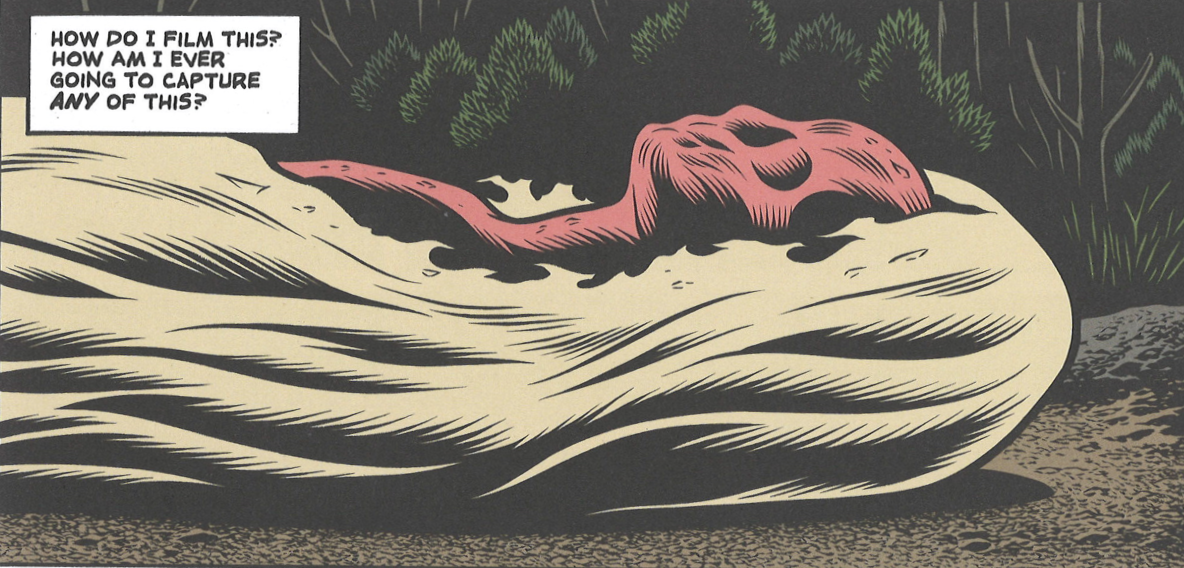
Charles Burns’ latest graphic novel Final Cut tells the story of Brian, an obsessive would-be auteur grappling with an unrealized film project. Brian hopes to assemble his film — also titled Final Cut — from footage he shoots with friends on a weekend camping trip, but the messiness of reality impinges the weird glories of his vibrant imagination. He cannot bring his vision to the screen. He cannot capture all the “fucked-up shit going on inside my head.”
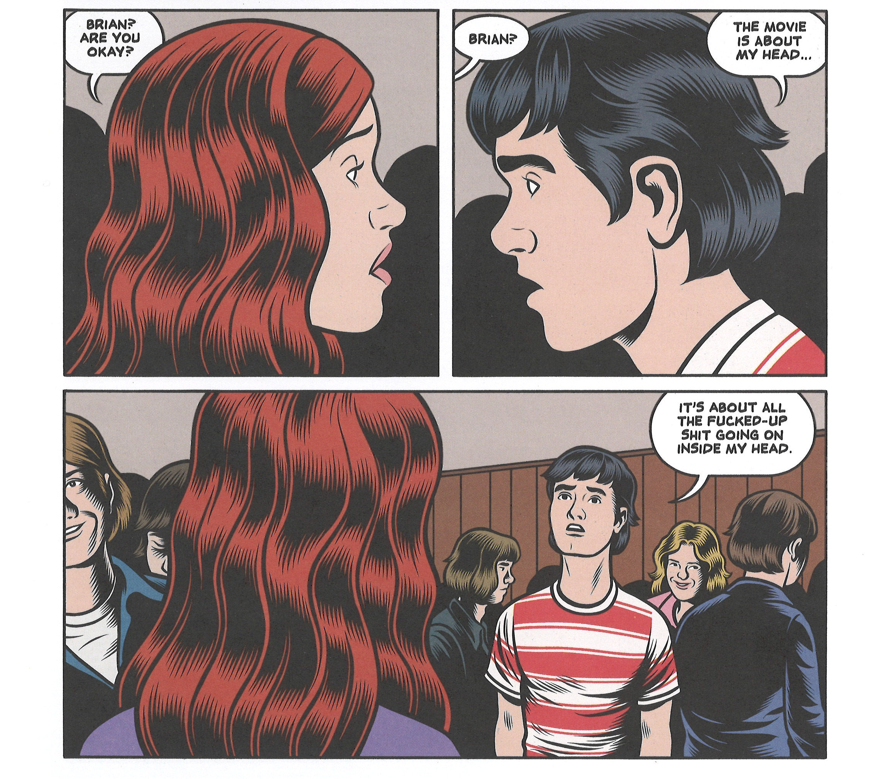
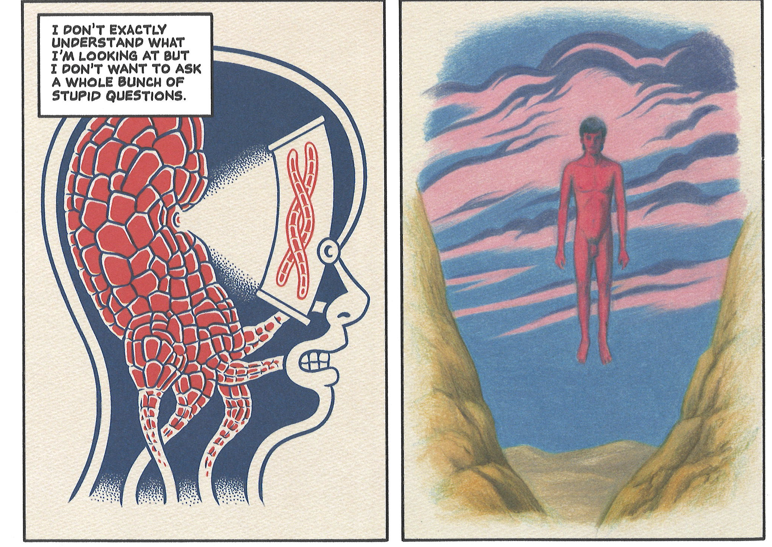
Capturing all the fucked-up shit going on inside my head is a neat encapsulation of the Artistic Problem in general. It’s not that Brian doesn’t try; if anything, he tries too hard. His best friend and erstwhile cameraman Chris is there to help him, along with his crush Laurie and their friend Tina—but ultimately, these are still kids at play. They indulge Brian’s artistic whims, but at a certain point they’d rather swim, drink, and smoke than shoot yet another scene they can’t comprehend.

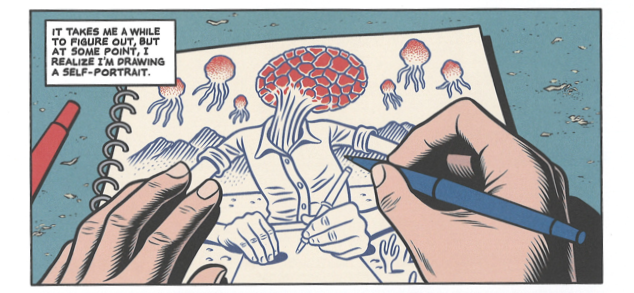
Eschewing straightforward narrative conventions, Final Cut unfolds in a blend of flashbacks, dreamscapes, and flights into Brian’s imagination. The book also gives over to Laurie’s consciousness, providing an essential ballast of realism to anchor Brian’s (and Burns’, I suppose) surrealism. Brian would have Laurie as his muse, trying to capture her in his sketchbook, in his film, and in the intense gaze of his mind’s eye. And while Laurie is fascinated by Brian’s visions, she doesn’t understand them.

The last member of Brian’s would-be acting troupe is Tina, an earthy, funny gal who drinks a bit too much. She plays foil to Brian’s ambitions; her animated spirit punctures the seriousness of his film shoot. Again, these are just kids in the woods with a camera and camping gear.

And the film itself? Well, it’s about kids camping in the woods. And an alien invasion. And pod people.

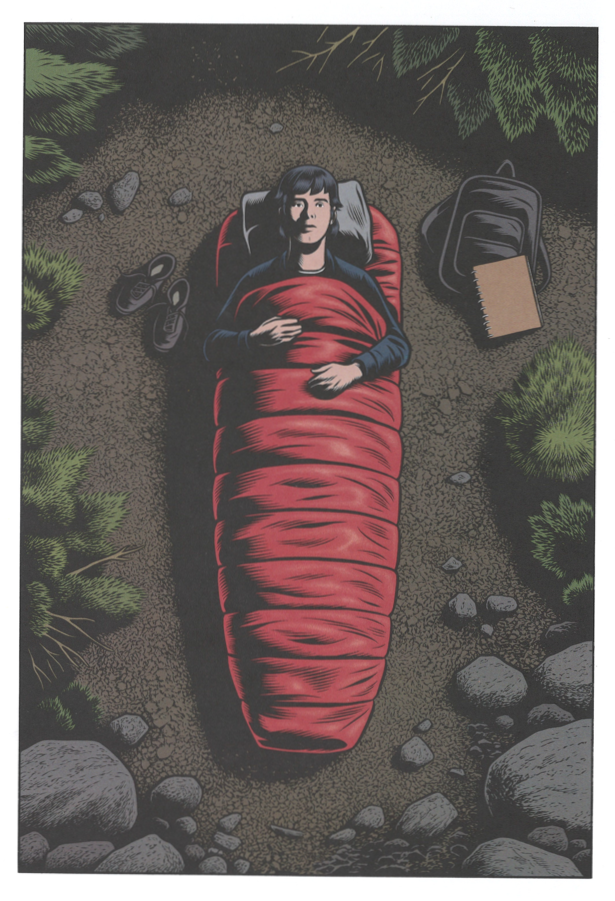
The pod-people motif dominates Final Cut. We get the teens in their larval sleeping bags, transformed into aliens in their cocoons (echoed again in Brian’s imagination and in his sketches). The motif looms larger: Can we really know who a person is? Could they be someone else entirely? Can we really ever know all the fucked-up shit going on inside their head?

Indeed, Don Siegel’s 1956 film Invasion of the Body Snatchers is a major progenitor text for Final Cut. Brian even takes Laurie on a date to a screening of Invasion; he’s so mesmerized by the film that he weeps. Burns renders stills from the film in heavy chiaroscuro black and white, contrasting with the vibrant reds, maroons, and pinks that reverberate through the novel.

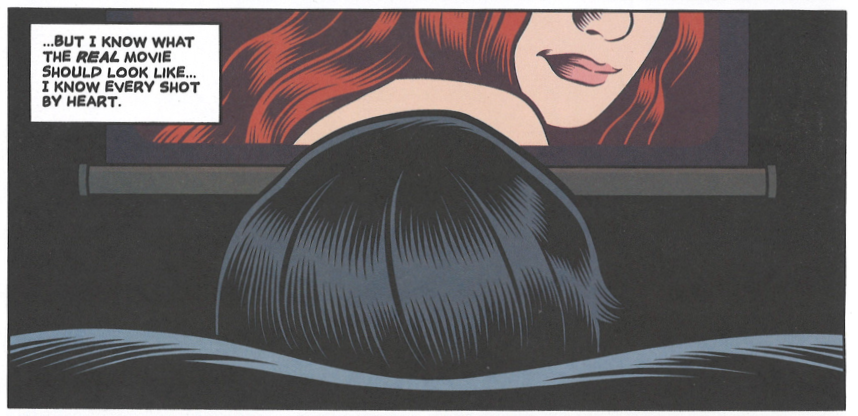
Burns recreates stills from another black and white film, Peter Bogdanovich’s 1971 coming-of-age heartbreaker The Last Picture Show. Again, Brian is obsessed with the film—or by the film, perhaps. In particular, he’s infatuated with Cybill Shepherd’s Jacy, whose character he imaginatively merges with his conception of Laurie.

While Invasion of the Body Snatchers is a science-fiction horror film, a deep sense of reality-soaked dread underpins it; The Last Picture Show is utterly real in its evocations of the emotional and physical lives of teenagers. Both films convey a maturity and balance of the fantastic with the real that Brian has not yet purchased via his own experiences, his own failures and heartbreaks. 

The maturity and balance that Brian can imagine but not execute in his Final Cut is precisely the maturity and balance that Burns achieves in his Final Cut. Simply put, Final Cut is the effort of a master performing at the heights of his power, rendered with inspired technical proficiency. It delivers on themes Burns has been exploring from the earliest days of his career.

There’s the paranoia and alienation of adolescence Burns crafted in Black Hole, here delivered in a more vibrant, cohesive, and frankly wiser book. There’s the hallucinatory trauma and repression he conveyed in the X’ed Out trilogy (collected a decade ago as Last Look, the title of which prefigures Final Cut). There’s also an absence of parental authority here, a trope that Burns has deployed since 1991’s Curse of the Molemen. (In Final Cut, Brian’s mentally-unstable mother is a dead-ringer for Mrs. Pinkster, the domestic abuse victim rescued by the child-hero of Curse of the Molemen). There’s all the sinister dread and awful beauty that anyone following Burns’ career would expect, synthesized into his most lucid exploration of the inherent problems of artistic expression.

Ultimately, in Final Cut Charles Burns crafts a portrait of the artist as a weird young man. Brian wrestles with the friction sparked from his vital imagination butting up against cold reality. His ambitious unfinished film mirrors his own incomplete journey as an artist, highlighting the clash between youthful creative fervor and the inevitable constraints of life, experience, and maturity. Burns’ themes of alienation and artistic ambition may be familiar, but Final Cut feels fresh and vibrant, the culmination of the artist’s own entanglements with the irreality of reality. Highly recommended.

Man is doomed to constantly fabricate new agonies for himself | On Dino Buzzati’s novella The Singularity

Two years after it was first published in Italy, Dino Buzzati’s 1960 novella Il grande ritratto got its first English translation by Henry Reed under the title Larger Than Life. This year, NRYB issued a new translation of Il grande ritratto by Anne Milano Appel under the title The Singularity. This is the second new English translation of a Buzzati book from NYRB; last year saw the publication of Lawrence Venuti’s translation of Buzzati’s most famous novel, Il deserto dei Tartari, published as The Stronghold (in lieu of the more recognizable title The Tartar Steppe).

It makes sense, from both a cultural and a marketing stance, that Il grande ritratto would find new life as The Singularity, a term that refers to the hypothetical point where artificial intelligence surpasses human intelligence, which in turn triggers a dramatic existential change for humanity. AI slop abounds on the internet; misinformation replicates and mutates; we are told that the chatbots that frustrate us so frequently are an inevitable part of a future that no one seems to want. A sci-fi novel called The Singularity is pretty zeitgeisty.

The scant plot of The Singularity builds to the revelation of an artificial intelligence, part of a military science project perched high in the Italian Alps. I don’t think I’ve necessarily spoiled the grand reveal; both its title and its publisher’s blurb declare The Singularity “a startlingly prescient parable of artificial intelligence.”

Perhaps it’s this prescience that makes the central sci-fi conceit of The Singularity seem a bit dated. There’s a creakiness to Buzzati’s staging of his grand portrait of an artificial intelligence. The novella is more compelling in its initial chapters, which ignite a mood of slow-burning dread, the kind of Kafkaesque foreboding he served up in his superior novel Il deserto dei Tartari.

That slow-burn starts with a certain Professor Ismani, “who had always had an inferiority complex with respect to figures.” He and his much younger wife, the archetypal innocent Elisa (who “had not gone beyond middle school”) agree to undertake a mysterious journey up the mountain to “Experimental Camp of Military Zone 36,” where Ismani will join a scientific project he knows nothing about. As they zig and zag up the mountain, chauffeured by their military liaison, Ismani and Elisa (and the reader) gather crumbs about their destination. “So many mysteries,” a soldier tells them, at a penultimate stop. “If they at least told us what it is we’re guarding. I mean, let’s call it what it is, a kind of prison.”

In response to all this anxious foreboding, we are told that “Ismani felt the return of apprehension and dismay, the feeling of being insignificant in the face of immense, threatening things, a panic that he had once experienced in the war.” None of Ismani’s time in the war comes to bear on the narrative itself. Indeed, Ismani is thrown to the reader as a decoy; initially presented to the audience as the potential big-brain hero of a sci-fi thriller, he ends up a background ghost.

We eventually achieve the summit, where the natural splendor is overrun by the enormous complex that houses the titular singularity:

But the cliffs were no longer visible, nor could any vegetation be seen, or land, or flowing waters. Everything had been invaded and overwhelmed by a tangled succession of buildings similar to silos, towers, mastabas, retaining walls, slender bridges, barbicans, fortifications, blockhouses, and bastions, which plunged in dizzying geometries. As though a city had crashed down the sides of a ravine.

But there was an exceedingly abnormal element that gave those structures an air of enigma. There were no windows. Everything seemed hermetically sealed and blank.

From this moment, more or less, the best bits of The Singularity come not from sci-fi plotting but rather philosophical asides that add weight to the pulp narrative. Most of these are delivered by the handful of scientists who haunt the experimental camp. One of these scientists repeats the mantra, “Language is the worst enemy of mental clarity.” In their attempt to author an artificial consciousness, these scientists decreed that their singularity would have “No language,” for “Every language is a trap for the mind.”

Here in their “little kingdom, hermetically closed off and apart from the rest of the world,” the scientists have created a “machine made in our likeness” which “will read our thoughts, create masterpieces, reveal the most hidden mysteries.” Through hints, intimations, weird noises, and other creaky trappings of pulp horror, we come to learn that the singularity might not be, like, sane. As one of our (maybe not like exactly sane either) scientists declares, “before we knew it we had lost the reins, and all that was left for us to do was to record the machine’s behavior.”

In a move that would surprise no one familiar with the tropes of Gothic romance, we come to learn that the singularity’s consciousness is based on a beautiful dead woman. The whole operation is powered by a mysterious glowing egg. Indeed, The Singularity is perhaps most interesting if approached through a feminist lens. As it rushes to its climax, Elisa the innocent takes over the role of hero. She somehow learns to speak the strange “language” of the pre-lingual singularity, and through conversation, comes to understand that the singularity views herself as a desiring machine. The singularity wants a body; specifically a female body; specifically a body that can be desired by a male body and bear offspring.

Ultimately, The Singularity feels less like a novella than it does a short story stretched a bit too thin. Buzzati adroitly crafts an atmosphere of suspense and foreboding, but the characters are underdeveloped. Like a lot of pulp fiction, Buzzati’s book often reads as if it were written very quickly (and written expressly for money). Still, Buzzati’s intellect gives the book a philosophical heft, even if it sometimes comes through awkwardly in forced dialogue. Anne Milano Appel’s translation is smooth and nimble; it’s a page turner, for sure, and if it seems like I’ve been a bit rough on it in this paragraph in particular, I should be clear: I enjoyed The Singularity.

Like many of the modernist writers of the twentieth century, Buzzati intuited a future in which technology would become increasingly self-propelled, mutating unchecked in the notion of a progress wholly divorced from the needs of the human spirit. In our own era, we see con artists and hucksters banging the drum for “artificial intelligences” to “read our thoughts, create masterpieces, reveal the most hidden mysteries” for us. The results have been utter shit. Buzzati’s mad scientist isn’t so much prescient as he is simply describing the human condition then, when he declares that “man is doomed to torment himself, he doesn’t see the consolations offered to him, right there, within reach, he has to constantly fabricate new agonies for himself.” We can fabricate the agonies, but we can fight them too.

Horrors and oneiric aberrations | On Antoine Volodine’s post-exotic novel Radiant Terminus

Antoine Volodine’s novel Radiant Terminus is a 500-page post-apocalyptic, post-modernist, post-exotic epic that destabilizes notions of life and death itself. Radiant Terminus is somehow simultaneously fat and bare, vibrant and etiolated, cunning and naive. The prose, in Jeffrey Zuckerman’s English translation, shifts from lucid, plain syntax to poetical flights of invention. Volodine’s novel is likely unlike anything you’ve read before—unless you’ve read Volodine.

Radiant Terminus begins with its hero Kronauer fleeing into an irradiated wasteland. Kronauer and two of his comrades are escaping from the Orbise, the capital of the Second Soviet Union, which has been invaded by dog-headed fascists. World-wide Marxism-Leninism has fallen, and the stability of nuclear-powered self-sufficiency has collapsed into the apocalyptic promise of a “world that nuclear accidents had made unlivable for ten millennia to come.” The world is indeed increasingly unlivable, but it also has become, we will find, a place for the undying as well. “Hell is on the surface, it’s here,” one character flatly remarks, adding, “No need to dive into the core.”

But Kronauer will have to dive into the core, at least metaphorically. When one of his comrades, succumbing to radiation poison, can no longer move, Kronauer seeks help, crossing the steppe and bravely venturing into the dark forest. Born in the sanctity of the Orbise, Kronauer had been schooled to focus “on the future of Communes for workers and countrymen. His view of the world was illuminated by proletarian morality: self-sacrifice, altruism, and confrontation.” He is driven to save his comrade, but we know from the outset that hopes are slim.

What matters here is Kronauer’s essential idealism. By the end of the novel, Kronauer will suffer, wondering if he will eventually abandon the principles that underwrite his sense of self. He worries that he will eventually slip into a “total regression to primitive hunting, intelligence sidelined for instincts, and, especially, deep down, an irrepressible desire to kill, to slaughter, and to hurt, even if he couldn’t remember anymore what had brought about this nightmare.”

We enter Radiant Terminus in the midst of a nightmare that somehow only intensifies. Kronauer finds his way to what might be the prospect of aid for his comrade, the titular Radiant Terminus, a collective farm that is somehow self-sustaining despite the ever-present specter of irradiated death. Not only is Radiant Terminus out of sync with the physical reality of the post-apocalyptic world, its principles don’t fully square with the tenets of the Second Soviet Union that have guided Kronauer’s mindset:

Radiant Terminus functioned on ideological principles that didn’t match up to the collectivist norms of the Orbise, but, as far as the allocation of goods went, the end result was the same. Disdain for property was, as had been the case throughout the Second Soviet Union, commonplace in the Levanidovo. It was a place where the Party had been extinguished, where the Party no longer existed, but where the idea of reestablishing capitalism and the bourgeoisie hadn’t occurred to anyone, and besides it had to be asked just what this thing called capitalism would have looked like at Radiant Terminus, and what bourgeoisie could be called upon to oppress the working class…

We come to understand, elliptically enough, that Radiant Terminus’s apparent prosperity (or at least sustainability) is purchased in large part via sacrifices made to the village’s old nuclear reactor core, which has melted down and is kept locked away. The core is a kind of doorway to hell. The citizens of Radiant Terminus offer it gifts from the old world:

Every month, indeed, the core was fed. The heavy cover for the well was opened, and some of the bric-a-brac collected over the last season or two was knocked over the edge; just to show that people weren’t panicking and weren’t afraid of pathetic radionuclides. Tables and chairs, television sets, the tarry carcasses of cows and cowherds, tractor motors, charred schoolteachers who had been forgotten in their classrooms during the critical period, computers, remains of phosphorescent crows, moles, does, wolves, squirrels, clothes that looked perfect but had only to be shaken to set off a haze of sparks, inflated toothpaste tubes filled with constantly simmering toothpaste, albino dogs and cats, clusters of iron that continued to rumble with an inner fire, new combine harvesters that hadn’t yet been broken in and which gleamed at midnight as if they were lying in full sunlight, garden forks, hoes, axes, debarkers, accordions that spat out more gamma rays than folkloric melodies, pinewood planks that looked like ebony planks, Stakhanovites in their Sunday best with their hands mummified around their diplomas, forgotten when the event halls were evacuated. The ledgers with their pages turning day and night. Cash-register money, the copper coins clinking and shifting without anyone nearby. These were the sorts of things thrown into the void.

The Gramma Udgul was the one to handle the maneuver

We come to understand the Gramma Udgul as priestess-witch archetype; “condemned to immortality from her first interactions with nuclear reactor cores” she is both immune to the ravages of radiation and cursed by it. The Gramma Udgul has her counterpoint in Solovyei, the dominant antagonist of Radiant Terminus.

Solovyei is the “president” of Radiant Terminus, but his role is something closer to an archduke synthesized with an insane wizard. Like the Gramma Udgul, Solovyei is immortal (indeed, a century earlier, the pair were husband and wife). Solovyei rules greedily over Radiant Terminus, and warns Kronauer to stay away from his three daughters. He is an inverted King Lear; mad, yes, but also deeply capable and cunning. Solovyei seems to find metaphysical sustenance in trips to Radiant Terminus’s nuclear core, emerging from time spent there “sizzling and blackened, weighed down with radiation and opaque poems.”

The development of Solovyei as a controlling intelligence—and Kronauer’s ideological resistance to his monomania as well as his three daughters’ battle against his invasive will—forms the main plot, such as it is, of Radiant Terminus. Solovyei is the author of the “horrors and oneiric aberrations” that haunt the characters and landscape that he is both collapsing center and impossible margin of. “It was hard to determine whether he was a mutant bird, a gigantic sorcerer, or a rich farmer from Soviet or Tolstoyan times,” the narrator declares at one point.

“This necromancer of the steppes,” Kronauer calls Solovyei, and then goes on to try to find language for the metaphysical:

This awful kolkhoz matchmaker, this reviver of cadavers, this horrible shadow, this giant impervious to radiation, this shamanic authority from nowhere, this president of nothing, this vampire in the form of a kulak, this strange man sitting on a stool, this abuser, this dominating man, this sleazy man, this unsettling man, this nuclear-reactor creature, this godless and lordless hypnotizer, this manipulator…

One of the key plot points of Radiant Terminus is that Solovyei can literally resurrect the dead, but cannot reanimate them back to what we would understand as true life:

….we all became bodies inhabited by Solovyei. Who knows whether this magic muzhik hasn’t taken advantage of us being dead, and if we aren’t all puppets within a theater where the manager, the actors, and the audience are all one and the same person

Some of Volodine’s chapters seem to inhabit Solovyei’s consciousness, a space that’s somehow both murky and sharp, an intelligence feasting on the agencies of other human beings:

Our best marionettes, I say. Him or me, doesn’t matter. When he’s stuck I keep going. Zombies, deep shadows, devoted servants. The dead stuck forever in the Bardo. Dead come from the dead. Wives come from unknown mothers. Henchmen. Best puppets and best dolls.

Every character who survives in the pages of Radiant Terminus seems to be susceptible to Solovyei’s oneiric horrors. He is the dream police, the puppet master — “Who’s he?” a minor character asks. The answer: “We don’t know…But we do know that he does with us whatever he wants. We’re in his hell.”

Solovyei’s daughters are the most sympathetic of his vampiric victims. These women, forced into the same unasked-for immortality as their father, find themselves repeatedly invaded by Solovyei, who haunts their dreams and walks around in their minds. One daughter sees herself “a creature imagined, possessed, and brought to life by Solovyei. A daughter of Solovyei, a daughter for Solovyei. A female annex in Solovyei’s life: nothing more than that.” They initiate their own eruptions of opposition: violence, suicidal rejection. Writing.

Near the end of Radiant Terminus, the narrator describes the novels of Hannko Vogulian, Solovyei’s eldest daughter:

In effect, they depicted the same twilit suffering of everyone, a magical but hopeless ordinariness, organic and political deterioration, infinite yet unwished-for resistance to death, perennial uncertainty about reality, or a penal progression of thought, penal, wounded, and insane.

We have here an internal description of the novel Radiant Terminus itself. Indeed, Radiant Terminus is always self-describing and always self-deconstructing: “Everything is in the same place, as in some kind of book, if you want to go to the trouble of thinking about it. That’s the ambiguity of ubiquity and achronia,” the narrator muses. When the narrator throws out the sentence, “These are complete works for no audience,” it almost feels like an inside joke. And Volodine can’t resist metanarrative descriptions of his own so-called post-exotic project:

If a post-exotic writer had been present at the scene, he would have certainly described it according to the techniques of magical socialist realism, with flights of lyricism, drops of sweat, and the proletarian exaltation that were part of the genre. It would have been a propagandist epic with reflections on the individual’s endurance in service to the collective.

Volodine’s Radiant Terminus works in all these modes while simultaneously subverting them. The result is an astounding novel, a work that will haunt any reader willing to tune into its strange vibrations and haunted frequencies. Very highly recommended.

A review of Dinah Brooke’s excellent cult novel Lord Jim at Home

Dinah Brooke’s 1973 novel Lord Jim at Home had been out of print for five decades — and had never gotten a U.S. release — until McNally Editions republished in 2023 with a new foreword by the novelist Ottessa Moshfegh. I always save forewords until after I’ve finished a novel, so I missed Moshfegh’s implicit advice to go into Lord Jim at Home cold. She notes that the recommendation she received to read it “came with no introduction,” and that “I wouldn’t have wanted the effect of the novel to be mitigated in any way, so I’m reluctant to introduce it now.”

I am not reluctant to write about Brooke’s novel because I am so enthusiastic about it and I think those with tastes in literature similar to my own will find something fascinating in its plot and prose. However, l agree with Moshfegh’s advice that Lord Jim at Home is best experienced free from as much mitigating context as possible. I had never heard of the novel before lifting it from a bookseller’s shelf, attracted by the striking cover; I flipped it over to read a blurb parsed from Moshfegh’s foreword attesting that Brooke’s novel “was an instrument of torture. It’s that good.” The inside flap informed me that reviews upon its publication “described it as ‘squalid and startling,’ ‘nastily horrific,’ and a ‘monstrous parody’ of upper-middle class English life.” I was sold.

Lord Jim at Home is squalid and startling and nastily horrific. It is abject, lurid, violent, and dark. It is also sad, absurd, mythic, often very funny, and somehow very, very real for all its strangeness. The novels I would most liken Lord Jim at Home to, at least in terms of the aesthetic and emotional experience of reading it, are Ann Quin’s Berg, Anna Kavan’s Ice, Mervyn Peake’s Gormenghast novels, Virginia Woolf’s Mrs. Dalloway, and James Joyce’s Portrait (as well as bits of Ulysses). (I have not read Conrad’s Lord Jim, which Brooke has taken as something of a precursor text for Lord Jim at Home.)

After finishing Lord Jim at Home, I read it again by accident. At first I intended to take a few notes for a possible review, but after the first few pages I just kept reading. On a second reading, Brooke’s novel was just as strange—maybe even stranger—even if I was able to read it much more quickly, finding myself quicker to tune into the novel’s competing (and complementary) narrative registers. I found it far more precise, too, in the rhetorical development of its themes; Brooke’s styles and tones shift to capture the different ages of its hero. The novel begins in a mythical, archetypal mode and works its way through various registers, exploring the tropes of schoolboy novels, romances, war stories, adventure tales,  modernism, realism, and journalism. But despite its shifting modes, Lord Jim at Home is not a parodic pastiche. Rather, at its core, Lord Jim at Home skewers how aesthetic modes—primarily those derived from notions of class and manners—cover over abject cruelty. As Moshfegh puts it in her forward, Lord Jim at Home is “an accurate portrayal of how fucked-up people behave, artfully conveyed in a way that nice people are too polite to admit they understand.”

I’ve tried to be clear that I think it’s best to come to Lord Jim at Home without too much context—it’s best to just go with the novel’s strangeness. Below, however, I offer a more detailed discussion of the novel, its language, and some elements of the plot for those so inclined.

Answer, 2014 by Henrietta Harris

Continue reading “A review of Dinah Brooke’s excellent cult novel Lord Jim at Home”

A review of The Son of Man, Jean-Baptiste Del Amo’s novel of atavistic inter-generational violence

Jean-Baptiste Del Amo’s latest novel The Son of Man takes place almost entirely over a three seasons in a dilapidated manor somewhere in rural France, sometime near the end of the 20th century. The plot is deceptively simple: A father returns to his young wife and nine-year-old son after a six-year absence, only to immediately drag them away to his remote childhood home, a place in the mountains called Les Roches. The father desires to refurbish the ancestral manse and restore his family. Complicating matters is the mother’s new pregnancy and frequent migraines and the son’s ambivalence about his relationship with his long-absent father. As the slim novel progresses, the oppressive isolation the mother and son endure tips over into dread and then horror. The Son of Man is ultimately a novel about the atavistic transmission of violence from generation to generation.

Del Amo’s writing, conveyed in Frank Wynne’s limpid translation, is precise and cinematic. Del Amo gives us phenomena and response to that phenomena, but withholds the introspective logic of cause-and-effect or analysis that often dominates novels. Instead, he allows us to see what his characters see and to take from those sights our own interpretations. Consider the following simple passage, where, a few days after arriving at the crumbling old house, the father and mother argue:

The faint voices of the father and mother reach the boy as a confused murmur. He walks to the gable door and looks at the landscape below, at the slow, solemn, hypnotic swaying of the larches and the tall pines on the edge of the forest.

He sees the mother and father standing facing each other.

The mother stands, left hand gripping her right arm, right hand on her hip in a gesture of utter defiance. While the father is speaking, she is shaking her head as though refusing to listen to what he is saying or dismissing his words, while, for his part, the father is nodding in an attempt to convince her or make her see reason.

The father gestures wildly as he speaks, pointing to the house, the grasslands, the mountain peaks that rise into the impassive sky. When he turns towards him, the son suppresses a shudder. Blood drains from his hands, his fingers prickle with pins and needles; if the father sees him standing in the gable window, he might think he has been watching, spying on them, trying to make sense of the words carried on the wind in fits and snatches.

The son cannot fully read the signs and signals in front of him. He’s left with “fits and snatches” and gestures and movements that are, in a certain sense, part of the same material as everything else he can presently behold—the pines, the larches, the wind. And yet the boy intuits in his witnessing an “irrefutable proof of his [own] transgression, perhaps even of his [own] guilt.”

Del Amo conjures a dark, oppressive world where his titular son of man is born into a prelingual state of guilt, a strange inheritance that yields violence. We see much of the novel’s action through the son’s perspective–or not really his perspective, but rather we see the action as through a powerful invisible camera set close to the boy’s head, but never fully inside it. We see the son seeing his mother, whom he loves and understands, in his own way, and seeing his father, who is frightening and likely unknowable:

On the father’s left side, the son notices a scar tracing a line some twenty centimetres long across the skin slantwise towards the shoulder blade, as though the father had been stabbed and the blade had struck a bone and deviated its course. The scar tissue looks smooth, like the skin of a newborn baby or a burn victim.

Spellbound, the boy cannot tear his eyes away, and when the father stops to wipe his forehead with the back of his hand and light a cigarette, he sees the child staring at the scar but says nothing.

The accretion of concrete details coheres into slow burning dread. Del Amo shows us images and gives us details that allow us to infer an explanation for the father’s previous six-year absence that the son cannot yet comprehend. At the same time, we see the father and the mother each moving along separate poles of manic despair. The mother dreams of an impossible escape; the father dreams of an impossible inheritance. The father does not possess the material, tools, or skill to properly restore Les Roches: 

He seems to have decided to do battle with this plot of land whose obstructiveness is an affront, to remove anything and everything that would thwart his plan, or to give free rein, with every swing of the pickaxe, to a blind fury for reasons the child cannot fathom. …

He casts a strangely distended shadow, a vision of disproportionate limbs, an evil doppelgänger that emanates from him, dogging his steps, aping his every gesture, every swing of the axe, every throw of a stone, in a way that is monstrous and terrifying.

In time, through hints and implications, we come to understand that the father’s monomaniacal restoration project has resulted from his own terrible childhood. These hints and implications explode late in the book into a fifteen-page monologue from the father, a bitter screed like something out of a Thomas Bernhard novel. The monologue climaxes in the father’s realization that he has repeated his own awful father’s ways. He declares that buried memories are “simply waiting for someone to come and dredge them from their deep torpor, so that they can resurface and endlessly repeat the same failures, the same disasters.”

It’s true that The Son of Man emanates a startling claustrophobic horror. And yet it also glitters at times with moments of strong beauty. If Del Amo’s lucid, cinematic prose evokes something like Kubrick’s The Shining, it also is capable of something like Malick’s Days of Heaven. There are idyllic moments, such as when the boy and his mother bathe in the plunge pool under the weir of a waterfall, the rumbling of which, from a distance, the son had “first thought was the voice of the mountain.” The son also makes his own adventures into the forest, meeting a family of wild horses, one of which is missing an eye.

Through such encounters, the son achieves a brief moment of transcendence late in the novel. His fleeting epiphany balances his father’s bitter declaration that humans are “born with this void inside, this dizzying void they desperately strive to fill throughout their brief, inconsequential, pitiful time in this world, paralyzed as they are by their transience, their own absurdity, their own vanity…” For the father, this “dizzying void” is something that must be filled — “Just like you might try to fill a grave with a shovelful of earth.” 

Let us contrast the father’s dizzy void with the son’s epiphany:

He sits far away from the nimbus of soft light that radiates from the house, gazing at the inky vault where fires that existed before the world was world still shine, and feeling the presence of the earth, the vastness beneath him. Dizzily, he thinks of the lives simultaneously played out everywhere across its surface, knowing that somewhere a child is walking barefoot, another is falling asleep in a soft bed, that a dog lies dying in the dust in the shade of a sheet of metal, that a city in some far-flung country is shimmering in the darkness, that innumerable creatures are moving about, animated by this mysterious and insistent force that is life, which courses through each of them.

Puzzlingly, he can also feel the great movement – imperceptible yet vertiginous – that carries everything, including him, through time and space, all lives, human and animal, and with them the rocks, the trees, the blazing stars.

Of these moments, he will retain the memory of an epiphany, of being struck by the true nature of things, which no language, no words can communicate; but what lingers will be little more than the trace of a dream, the sense of something being granted and instantly revoked.

The beauty of the first two paragraphs sinks into the reality of the final paragraph. Epiphanies don’t last; we can catch the memories, maybe, but even then, what was granted was “instantly revoked.” We remain trapped in language, outside “the true nature of things.” Will the son then “endlessly repeat the same failures, the same disasters” as his father (and his father and his father and…)? The novel seems to suggest that this will likely be the case, even if it opens other, more optimistic avenues.

In this light, it’s difficult to interpret the novel’s mythic overture. The first fifteen pages of The Son of Man focus on a troop of prehistoric hunter-gatherers. The episode culminates in a hunt scene in which an adolescent son makes his first kill—a doe—and then seems to be fully initiated by his father, who marks him in the deer’s blood. The overture ends with the son fantasizing about “abandoning the group” and laying down in the humus to be swallowed up by the earth. This is, in a sense, a version of the same fantasy the contemporary son will have in the forest around Les Roches tens of thousands of years later. 

It’s unclear how Del Amo would have us read the prehistoric overture. On one hand, it suggests a time of idyllic balance–of humanity in, and not apart from, nature. And on the other hand, it concludes with the same desire to escape civilization that, millennia later, the father will inherit.

Perhaps a second reading of The Son of Man might yield a more conclusive answer, or a second reading of Frank Wynne’s translation of Del Amo’s previous novel, Animalia, a visceral, naturalistic, and very precise rendering of humans as animals that takes on an epic scope. English-only readers interested in Del Amo’s writing couldn’t go wrong with either of these novels, which, unless I’m mistaken, are the only two on the market in English translation. I look forward to reading more of Del Amo’s novels in the future. Until then, I highly recommend The Son of Man.

 Jean-Baptiste Del Amo’s The Son of Man is now available in the U.S. in translation by Frank Wynne from Grove Atlantic.

A review of Jesse Ball’s novel How to Set a Fire and Why

Jesse Ball’s 2016 novel How to Set a Fire and Why covers a few tumultuous months in the life of Lucia Stanton, anarchist daughter of anarchist parents, now living with her aging anarchist aunt after the death of her (anarchist) father and subsequent mental breakdown and institutionalization of her (anarchist) mother.

The narrative begins with the aftermath of Lucia’s expulsion from school for stabbing a classmate with a pencil. The classmate’s crime? Touching Lucia’s lighter, a capital offense. I wrote Lucia’s lighter, but she—Lucia, the first-person narrator of Jesse Ball’s 2016 novel How to Set a Fire and Why—she always refers to it as her father’s lighter: “His corpse is actually on it—I mean, not his death corpse, but his regular one, the body that falls off us all the time. It’s what I have left of him, and I treasure it.”

So Lucia’s off to a new school, trailed by rumors of graphite-based violence that don’t help her win new friends. Her poverty doesn’t help her popularity either (did I mention that she and her aunt are practicing anarchists?) But she’s in luck, sorta, because she hears that this school has a “Sonar Club”:

I’m sure that doesn’t mean anything to you. You’re wondering, why is she happy about some Sonar Club. That doesn’t sound even remotely fun. Well, I have a friend—I do—who told me about something he heard about from someone else—and what it is, is this:

Right now, there are clubs forming up all over the country. They call themselves sonar clubs, or even radio clubs—but what they are is clubs for people who want to set fires, for people who are fed up with wealth and property, and want to burn everything down.

S – O – N – A – R = A – R – S – O – N

And there’s the essential surface conflict of How to Set a Fire and Why: will Lucia, like, shift her collectivist-anarchist ideals toward something more, uh, destructive? Will she burn it all down?

The real plot of the book though is about a teenage girl going through some shit. Lucia is sharp, witty, but caustic and clearly depressed. She is also incredibly observant and very, very intelligent. Ball’s greatest strength in the novel is harnessing Lucia’s spiky but vulnerable intellect; we ride her first-person narration persuaded by her maybe-genius, but also aware of all of her blind spots. Teens know the Truth, but the Truth often blinds them to reality. Not that Lucia isn’t self-aware; consider her take on her own intellect:

My aunt says that I am naturally curious. That means that I don’t need to be taught how to learn. Some people have a disadvantage at the beginning, and they are not curious. These people have trouble learning. It seems like not being curious is the worst thing of all. Curious people aren’t necessarily good at learning what you want them to learn, though. They are too busy learning about other things.

The best bits of How to Set a Fire let Lucia riff on her observations. There’s a poignant detailed description of her father’s lighter (“My father’s is matte black and has a white dot in the center. I haven’t seen another like it”). There’s an explanation and analysis of the rules of cee-lo, which Lucia decides exploits outsiders. She praises both My Dinner with Andre and the music of Erik Satie. She makes predictions and shares their outcomes. She has sex and takes drugs. She visits her mother at the institution. She’s afraid a lot, and probably with good reason: “When I think about what my future holds, it is a bit like looking into the sun. I flinch away, or I don’t and my eyes get burned down a bit, like candles, and then I can’t see for a while.”

Most of Lucia’s observations are about people: I did not count the nouns in the novel, but I imagine people would have to be up there as one of its most common words. A representative sample might be this early simple nugget: “History is just people behaving badly.” Lucia is cynical, sure, and with good reason. How to Start a Fire often echoes the coming-of-age cynicism of The Catcher in the Rye, whose narrator was also flawed and intelligent and blind to what he could not see. (We are all of course blind to what we cannot see.) But Lucia’s not entirely unforgiving. “People aren’t all horrible. They aren’t. Sometimes you find a good one, at least for a while—even if it’s just for twenty minutes or so,” she concedes.

Lucia’s voice is the reason to read How to Start a Fire. It’s compelling and funny and persuasive and hurt. It seems authentic, and I admire the risk Ball has taken—it’s not easy to write a teenage girl who is also maybe-genius-would-be-arsonist. The plot proper of How to Start a Fire never really commits to anarchism or revolution however—sure, things happen—but we never really find out why Sonar Clubs might be taking off around the nation, let alone, like, how Lucia fits into all that. But I don’t think that’s really what Ball is doing here—I think he’s marking off a measure of time in a character’s life:

When people write books about childhood, and about being a kid—they always talk about how endless it is, and about how there is no thought of time. Everything just stretches and stretches. I think the opposite is the case. When you’re young, you feel like things are constantly ending. As soon as you get used to something, it goes away.