A Too Many Cooks Riff, Focusing on The Killer, Who Is There Right from the Beginning

If you haven’t yet seen Too Many Cooks, Casper Kelly’s short film for Adult Swim, here it is:


Too Many Cooks compels and rewards/punishes its audience not because of its comedic elements, but rather for its horror. Kelly has made one of the finest little horror films I’ve ever seen.

The central techniques of Too Many Cooks–repetition, collage, and genre parody—are fairly obvious and wonderfully synthesized. The film relies on an understanding that its audience has a particular way of seeing. The intended audience of Too Many Cooks has:

1) An understanding and acceptance of the postmodern tradition of repeating a punchline (or set-up) past the point of humor. And–

2) A particular ironic vision that delights in seeing commercial TV genre conventions of yore skewered.

Too Many Cooks succeeds by disrupting both ways of seeing. Its audiovisual repetitions (oh my lord the song!) become insane tics in a horror story that the viewer did not expect to happen—despite a number of early clues.

In his essay “The Philosophy of Composition,” Edgar Allan Poe suggests that when “men speak of Beauty, they mean, precisely, not a quality, as is supposed, but an effect.” Let us substitute “Horror” for “Beauty” (Poe would not mind, I think) and we have a fair description of what the filmmakers behind Too Many Cooks have created: A short piece of art that, by its arrangement, editing, of particulars—including its audience’s preconceptions—creates the effect of horror.

That horror emanates from the secret protagonist of Too Many Cooks, a mad-eyed killer who haunts the film first from its peripheries before eventually overtaking it. (He bears a slight resemblance to the philosopher Slavoj Žižek).

The Killer is the organizing principle of Too Many Cooks. He’s right there from the beginning, a specter whose agency throughout the piece subverts audience expectations. It’s not the uber-Father (who begat too many Cooks) who is the film’s central figure, but the infanticidal Killer.

Here is the first time we see The Killer, just 20 seconds in. He’s there on the right, sweater-vested (like a dad):

2

And then a few seconds later, lurking on the Brady/Cosby/Bundy stairs, still obscure:

a

The Killer next shows up about 90 seconds in; this is, unless I’m wrong, the first time we see his visage. It’s also the moment when Too Many Cooks’s early joke on corny nineties sitcom intros really starts to wear thin—the filmmakers offer us repeated images of cooks as if to underscore the tedious point.

90secs

And there’s The Killer in the second family photo:2andhalf

Continue reading “A Too Many Cooks Riff, Focusing on The Killer, Who Is There Right from the Beginning”

Haruki Murakami’s Colorless Tsukuru Tazaki and His Years of Pilgrimage Reviewed

I should probably start with a confession: I’m not a big Haruki Murakami fan.

I’ve tried.

I’ve probably abandoned The Wind-Up Bird Chronicle more than any other book (save maybe Proust). I lost interest somewhere in the first 100 pages of Kafka on the Shore, despite finding the premise intriguing. I’ve enjoyed a few of Murakami’s short stories over the years—or maybe found them technically impressive—but none more than the first one I read back in 2001 or 2002 in an issue of Harper’s (I was living in Tokyo at the time, and the main character took the same train I did everyday, the Marunouchi Line).

want—or rather at one point I really tried—to like Murakami’s fiction, but I just don’t. It leaves me cold.

Which is odd, I think, because the themes and tones—dark ambiguity, strange disappearances, unresolved mysteries, etc.—these are the themes I enjoy most in fiction.

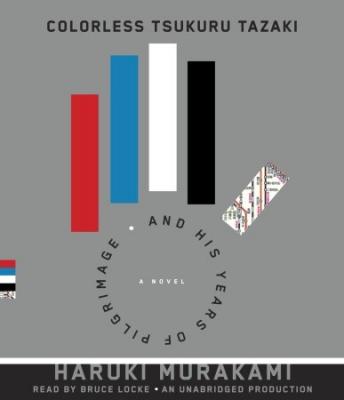
9780804166744When the kind folks at Audible offered me a review opportunity, I thought I’d take another shot at Murakami. His new novel Colorless Tsukuru Tazaki and His Years of Pilgrimage is short enough, I reasoned, for me to, y’know, not abandon it. So I listened to Random House Audio’s production (10 hours, unabridged), reading sections against a copy of the book I checked out from the library. (English translation is by frequent Muarkami translator Philip Gabriel).

There were some fine, creepy moments, but on the whole, I was left cold. The novel is technically impressive (did I already use that term?—What I mean is that Murakami is masterful at activating the sensuous strokes that make the words real for the reader—the book is stuffed with the tiny details that are, y’know, mimetic, and these mimetic details bring vitality to Murakami’s frequent metaphysical digressions—when Tsukuru feels a pain in his back, for instance, this physical sensation is not merely a placeholder for a psychological or spiritual hurt, but the very locus of metaphysical disjunction that Murakami wants to explore in the novel—but hang on, I seem to be riffing unfocused in a parenthetical aside, before I have even addressed that basic question review readers want satisfied up front: What is the book about?).

What is the book about?

Before I get to that, I have to address the performance in the audiobook by Bruce Locke, who reads the dialogue (and Tsukuru’s inner-monologues) with a mild Japanese accent. This accent clashes with the affectless intonation that Locke uses to read the exposition. It makes no logical sense at all why Japanese characters would speak to each other in this way. The audience is smart enough to realize that they are reading a book in translation—why make the characters speak to each other in stereotypical accents? The choice is unfortunate, problematic and distracting.

Okay, but:

What is the book about?

Reader, in the acme of laziness—a laziness I will attribute to my lack of enthusiasm to the novel—here is a synopsis of Colorless Tsukuru that I jacked from Wikipedia:

In this Bildungsroman of the realist kind (hints of the author’s magical realism are left to dreams and tales), the third-person narrative follows the past and present of Tsukuru Tazaki, a man who wants to understand why his life was derailed sixteen years ago.

In the early 1990s in his home town of Nagoya, the young Tsukuru was a fan of train stations. In high school, the two boys and two girls that were his four best friends all had a color as part of their surnames, leaving him the “colorless” one of their “orderly, harmonious community”. But one day in 1995, during his second year in college, his friends abruptly cut all relationships with him. That never-explained, Kafkaesque ostracism left him feeling suicidal then guilty “as an empty person, lacking in color and identity”; and when his only college friend vanished the next semester, he felt “fated to always be alone”.

Now in 2011’s Tokyo, the 36-year-old engineer Tazaki works for a railroad company and builds stations. His new girlfriend Sara spurs him “to come face-to-face with the past, not as some naive, easily wounded boy, but as a grown-up” and seek his former friends to mend the relationships and find out why they rejected him, because she won’t commit to him unless he can move past that issue. And so he will visit them one by one, first back in Nagoya, then in rural Finland, on a quest for truth and a pilgrimage for happiness.

That’s actually a pretty nice little summary—hey, there’s even some analytic commentary! Kafkaesque indeed!

What’s missing from the summary—besides the seemingly-endless metaphorically-overdetermined scenes of Tsukuru swimming that Murakami insists on inserting—what’s missing from the summary is what I take to be a key scene, a story-within-a-story that Tsukuru’s college friend tells him about a pianist who travels around with a bag (which may or may not contain human fingers). The pianist explains to his audience-of-one (Tsukuru’s college friend’s father, if that matters) that he has chosen to die in the place of another person. This metaphysical conceit haunts the rest of the novel, but remains unresolved. (The theme of death and the specter of severed fingers returns again in the novel’s most compelling passage, an extended grotesque vignette featuring fingers floating in formaldehyde).

Much of Colorless Tsukuru remains unresolved. I’d be fine with that if it worked, but I don’t think it does here. (I’m reminded of a joke I read on Twitter years ago: That we know it’s literary fiction if at the end the character is waiting for something). The prose, while brilliant at times in its mimesis, is often clunky and almost always repetitive. This is a repetitive novel. This novel repeats its scenes repetitively. There’s a lot of repetition here.

But you just don’t get Murakami, man, you may reply, dear reader, and that may be true. (Although I do have a penchant for ambiguous, morbid, sinister fiction in translation). I try to assess a novel on what the writer is trying to do, and Murakami—here and elsewhere—feels like a writer supremely adept at creating what Jonathan Lethem called the “furniture” of the novel, the mimetic space in which the characters can come to life. And yet the life force of the characters—their spirit, if I may—seems tepid, clichéd—boring. In the end, I just don’t care. I guess I just don’t get Murakami, man.

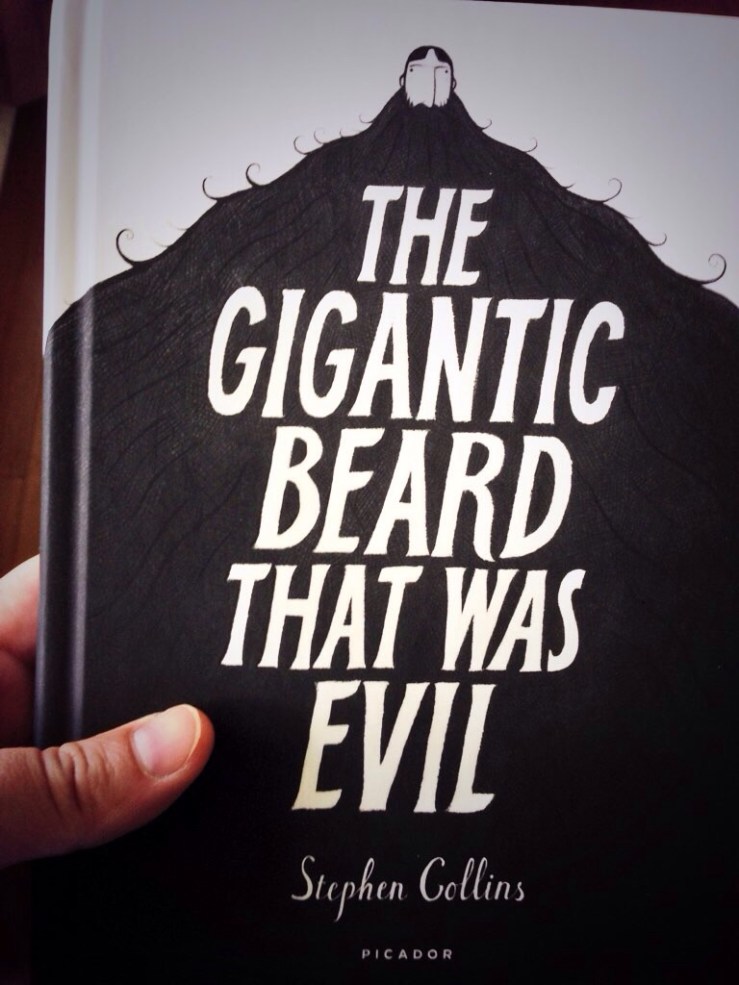
Stephen Collins’s Allegorical Fable The Gigantic Beard That Was Evil Reviewed

IMG_3543

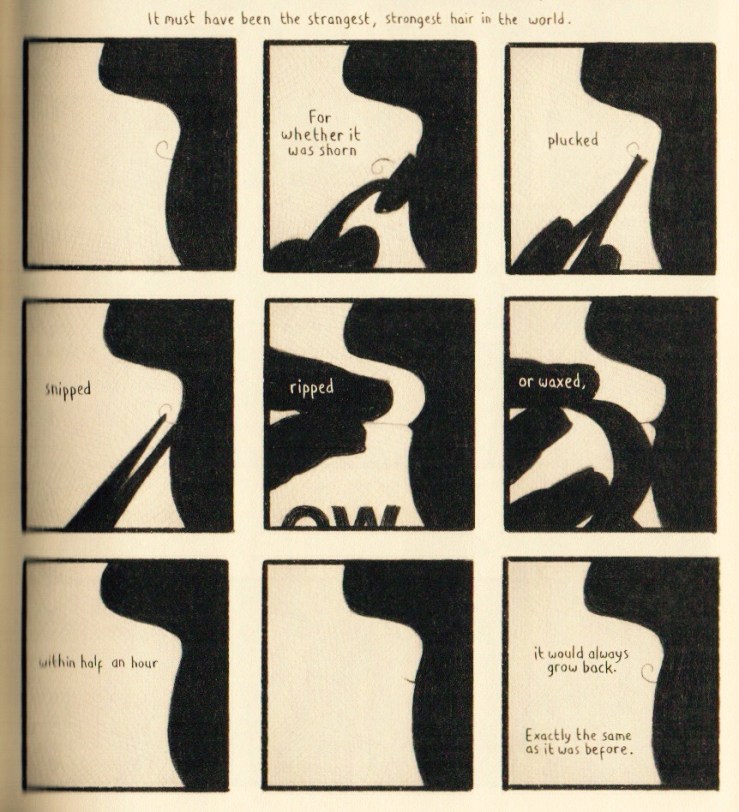
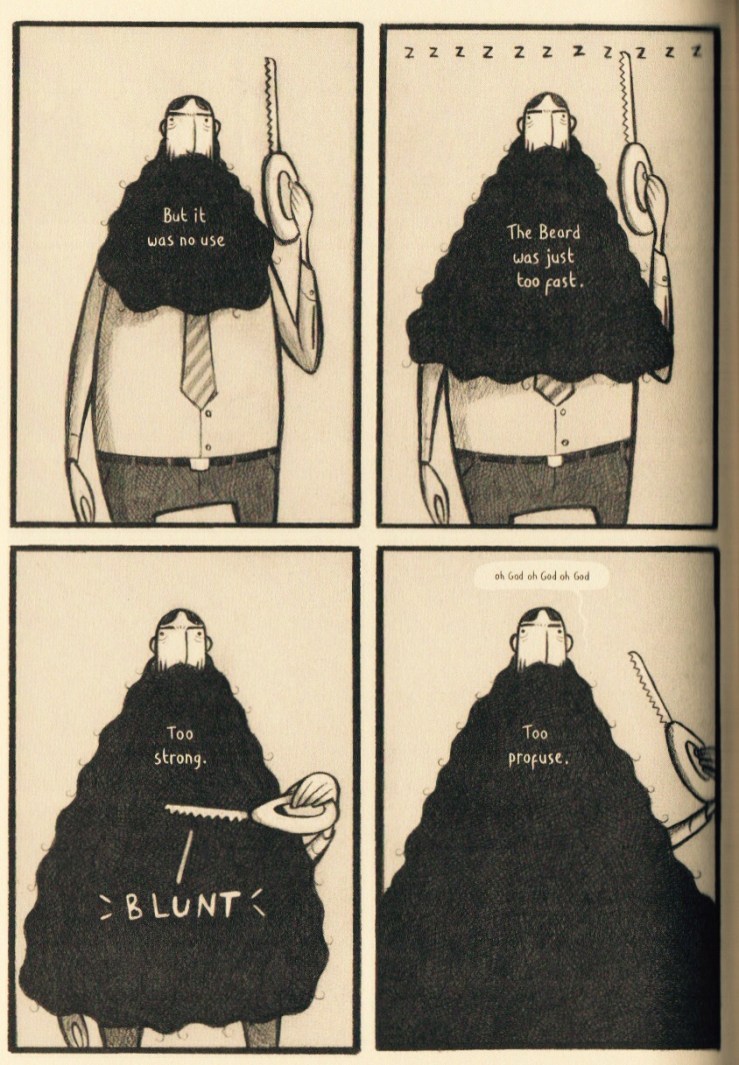
Stephen Collins’s début graphic novel The Gigantic Beard That Was Evil tells the story of Dave, an especially average (forgive the oxymoron) guy in the neat-and-tidy island of Here, a place where conformity rules and difference is unthinkable. Dave fits like a cog into his tidy world until a beard erupts from his face, severing him from society.

IMG_3865.JPG

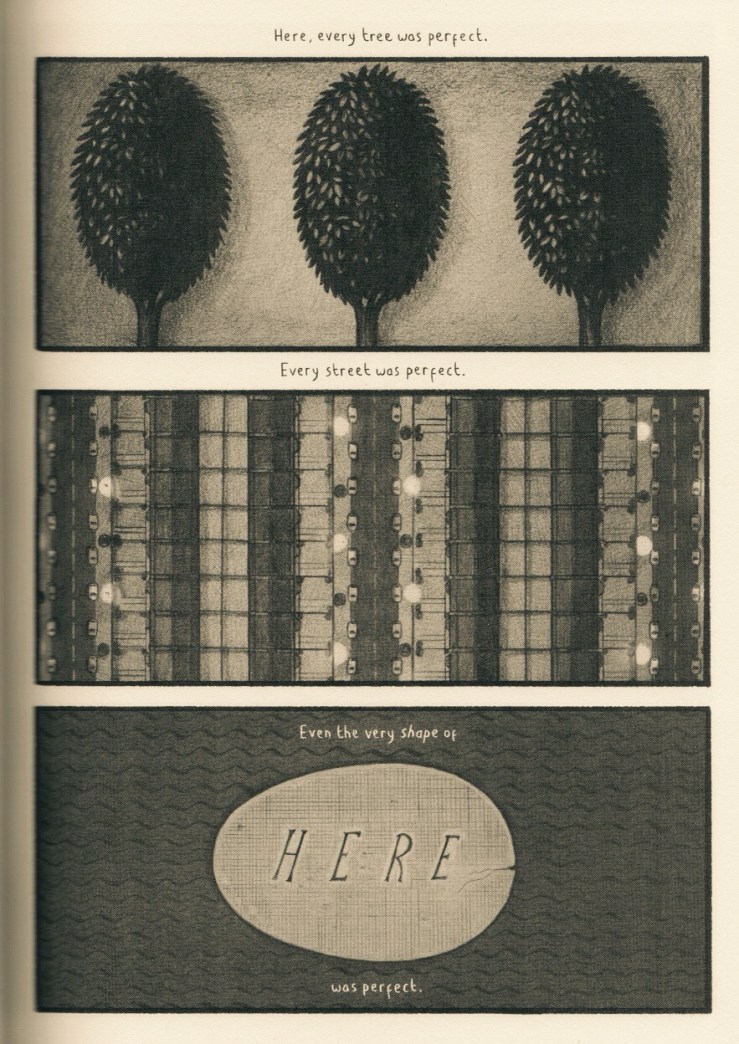
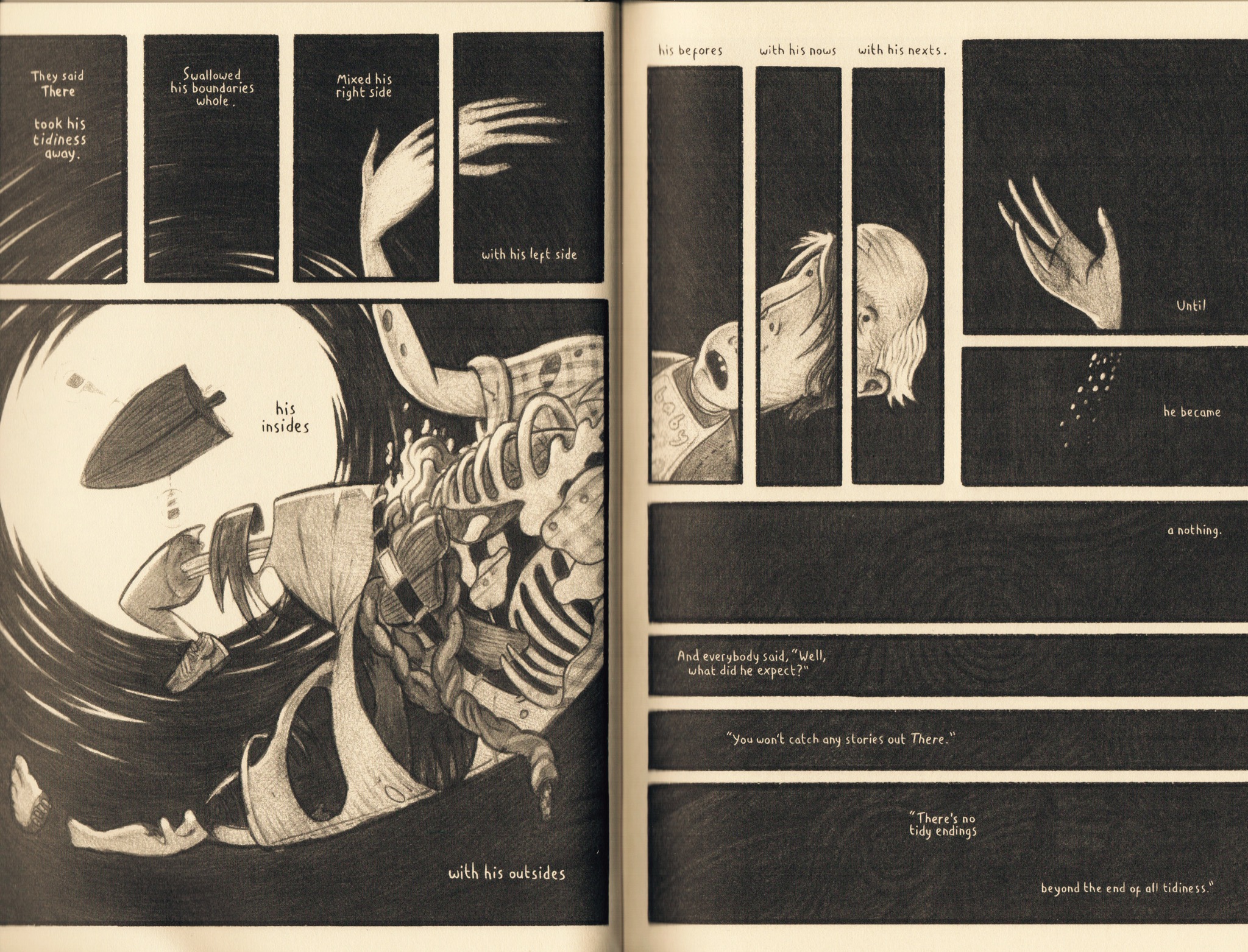
Despite its neat and tidy contours, an omnipresent dread of otherness gestates in the egg-shaped isle of Here. That dread manifests in the fabled land of There. Dave’s psyche is haunted by There; its very existence threatens both body and mind. Collins renders this anxiety in a remarkable series of panels that concretize Dave’s nightmare of otherness:

IMG_3873

Dave’s nightmare highlights his subconscious realization that there cannot be a Here without a There. The realization leaves him abject, torn, and destabilized, even before his beard appears. When the first hairs do arrive, Dave’s interior existential crisis spills outward, his messy difference oozing out to disrupt and upset the tidy normalcy of Here.

IMG_3867.JPG

Poor Dave.

IMG_3871.JPG

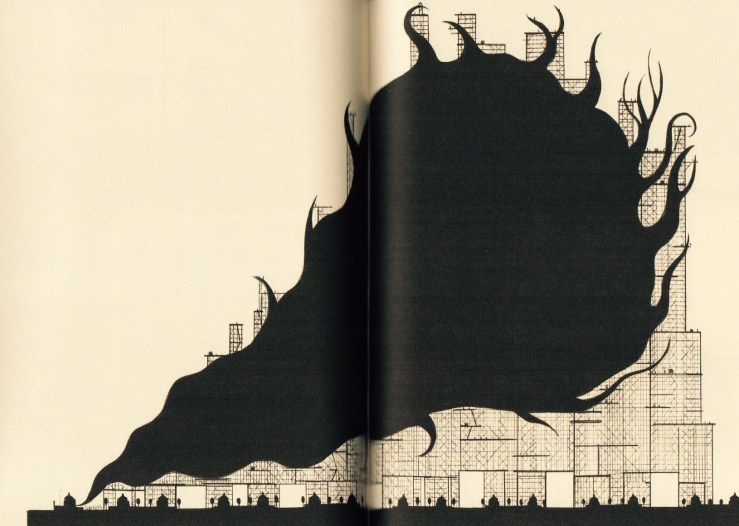
The beard quickly becomes a national emergency requiring enormous resources. Police, military, the media, and eventually the entire society become entangled in the crisis. United against a common foe, the citizens of Here are nevertheless distracted, letting their grooming habits slip. Things become less tidy. In their battle against the beard, they overlook the greater war on weird.

IMG_3868.JPG

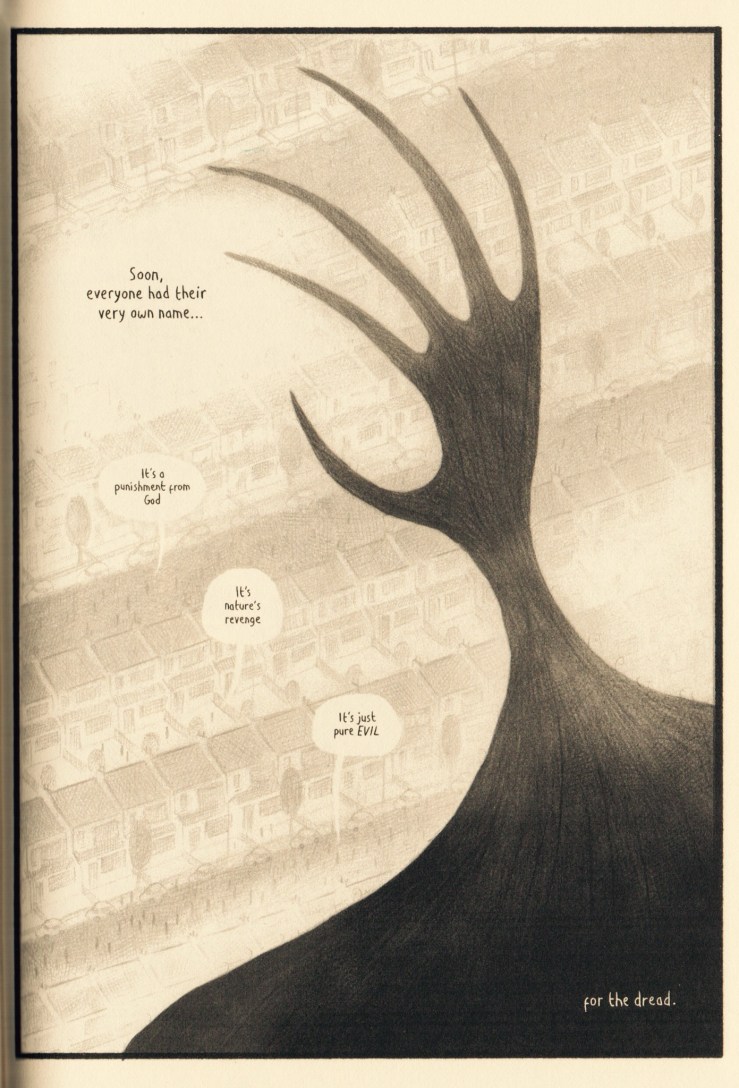
The Gigantic Beard That Was Evil is an allegorical fable. Collins attacks conformity and fear of otherness, but also depicts just how complex and horrifying otherness can be. While the island of Here is clearly a stand-in for England, Collins’s satire of xenophobia and the dangers of groupthink will resonate pretty much everywhere. All kinds of 21st-century anxieties writhe under the text: fear of immigration, the collapse of cultural homogeneity, ecological devastation—the end of a particular way of life. The angry mob castigating poor Dave call him a terrorist, but they are the authors of their own terror.

IMG_3874

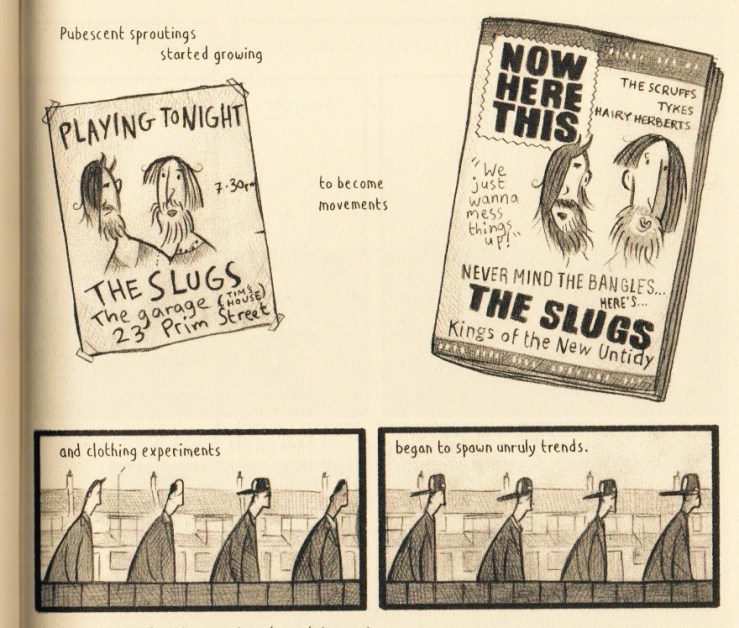
In an unexpected and rewarding fourth act, Collins examines the aftermath of what comes to be known as “The Beard Event.” The Untidiness that happened while the citizens of Here were distracted dealing with Dave becomes the new normal. Fits of nonconformity inevitably become trends, then commodities.

IMG_3869.JPG

The Beard Event eventually becomes “A story many times retold and resold,” complete with its own museum (enter through the gift shop). Collins offers a clear depiction of difference—how it’s first feared, then resisted and attacked, and eventually absorbed and recycled.

I’ve tried to offer enough of Collin’s words and art to convey a sense of his simple but refined style. His lines are often gentle and always precise, his subtle shading all the color this tale needs. The Gigantic Beard That Was Evil succeeds visually on the strength of Collins’s pacing and panel design. Collins seamlessly integrates his prose into the panels, moving the story along in a lilt of rhymes and non-rhymes evocative of Edward Gorey or Roald Dahl. Collins nimbly avoids the potential pitfalls of preachiness or meaningless absurdity here, leading to a confident and convincing début. I look forward to more. Great stuff.

The Gigantic Beard That Was Evil is now available in the United States in hardback and ebook from Picador.

Phantoms and Ghosts in DFW’s Novel The Pale King (Ghost Riff 2)

a

The narrator of David Foster Wallace’s posthumous novel The Pale King assures us at one point that “phantoms are not the same as real ghosts.”

Okay.

So what’s a phantom then, at least in the universe of The Pale King?

Phantom refers to a particular kind of hallucination that can afflict rote examiners at a certain threshold of concentrated boredom.

The “rote examiners” are IRS agents who perform Sisyphean tasks of boredom. They are also placeholders for anyone who works a boring, repetitive job.

(We might even wax a bit here on the phrase rote examiner—the paradox in it—that to examine should require looking at the examined with fresh eyes, a fresh spirit—a spirit canceled out by the modifier rote).

In The Pale King, phantoms visit the rote examiners who toil in wiggle rooms. The “phantoms are always deeply, diametrically different from the examiners they visit,” suggesting two simultaneous outcomes: 1) an injection of life-force, a disruption of stasis that serves to balance out the examiner’s personality and 2) in the novel’s own language, “the yammering mind-monkey of their own personality’s dark, self-destructive side.”

In one scene, desperate Lane Dean contemplates suicide on the job, until he’s visited by a phantom.

“Yes but now that you’re getting a taste, consider it, the word. You know the one.”

The word is boredom, and the phantom proceeds to give a lecture on its etymology:

Word appears suddenly in 1766. No known etymology. The Earl of March uses it in a letter describing a French peer of the realm. He didn’t cast a shadow, but that didn’t mean anything. For no reason, Lane Dean flexed his buttocks. In fact the first three appearances of bore in English conjoin it with the adjective French, that French bore, that boring Frenchman, yes? The French of course had malaise, ennui. See Pascal’s fourth Pensée, which Lane Dean heard as pantsy.

(Thank you, narrator—who are you?!—for mediating the phantom’s speech and Dean’s misauditing of that speech). Continue reading “Phantoms and Ghosts in DFW’s Novel The Pale King (Ghost Riff 2)”

Doré’s Ghost of Banquo (Ghost Riff 1)

It’s the disconcerting incompleteness of Gustave Doré’s The Spectrum Appearance of Banquo at Macbeth’s Feast that, paradoxically, creates the full, troubling effect of the picture.

“Enter Ghost of Banquo, and sits in Macbeth’s place” (Act 3, Sc. 4)—thus the stage directions from Shakespeare (or the actors who wrote down his words from memory)—and thus Banquo, draped, robed, sullen, taciturn, a marble effigy—but no, lifelike—no?

The Macbeths, shocked—Doré stages Lady M as a shadowy echo/support for Lord M—teeter aslant, Lord M’s left hand braced on the chairback that divides the painting—their faces, the Macbeths’ faces, wholly enshadowed (not wholly; Lady M’s nose peeks out in white silhouette); Lord M’s whole head a gravid mass of dark crowned with an incomplete crown, a broken circle.

Banquo’s eyes: Chilly, stern, accusatory, sad. And over them, thy gory locks. Do they shake at Lord Macbeth?

In The Life and Reminiscences of Gustave Doré, Blanche Roosevelt claims to have “seen no less than six sketches of Macbeth at the banquet, when confronted by Banquo’s ghost.” The biographer continues: “Doré was so original that it was almost impossible for him to repeat himself, even designedly.”

There seems here a condensation of repetitions. Doré’s control is to let loose control: Banquo’s robes are mummy wrappings unraveling: unraveling Lord Macbeth’s consciousness, even, I suppose. Squiggles, pulses, suggesting phantom movement, energy without depth. They unwind from his firm, marble visage—the look, the gory locks that shake, the chin that nods.

Cousin Ross has called out Banquo for his absence, which “lays blame upon his promise,” and of course this is Shakespeare’s big trick, the trick that Doré captures so well here—that Banquo is the most startlingly present absence, the most impossible absence, the absence that proves the radical uncertainty of presence, the present absence that haunts Macbeth, that silently affirms future ghostliness, attesting mutely that “charnel-houses and our graves must send Those that we bury back,” that “our monuments Shall be the maws of kites.”

David Mitchell’s New Novel The Bone Clocks Falls Far Short of His Best Work

IMG_3700

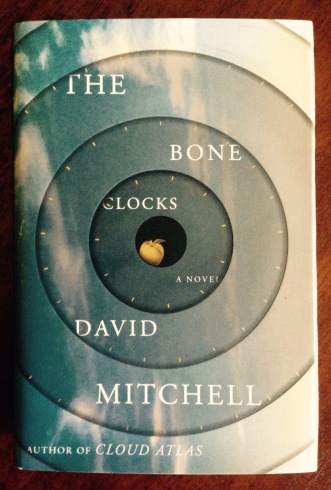
David Mitchell’s latest novel The Bone Clocks is 624 pages in hardback, its sprawling metaphysical plot jammed into six overlapping sections that move through six decades and several genres. Any number of critical placeholders might be applied here: Sweepingambitious, genre-skeweringkaleidoscopic (I stole that last one from the book jacket). Or, perhaps we prefer our descriptors more academic? Okay: Postmodernmetatextualmetacritical, polyglossic. With The Bone Clocks, Mitchell has used these functional, formal postmodernist techniques to string together a few good novellas with some not-so-good novellas into a novel that’s not bad—but also not particularly good.The Bone Clocks is just okay. It fills space, it fills time. But unlike Mitchell’s previous stronger novels—Black Swan Green and Cloud Atlas in particular—The Bone Clocks fills without nourishing.

The Bone Clocks opens in 1984 with “A Hot Spell,” introducing us to the novel’s ostensible subject, Holly Sykes, a fifteen year-old who runs away from home. This section also introduces us to Mitchell’s consistent idiom here, a first-person present tense narration that forces the plot forward like an engine. When Mitchell needs to deliver any background information, the narrator simply trots out old memories, or a character politely shows up to dump exposition. The exposition-dumping is particularly egregious in the novel’s final sections.

Our heroine Holly Sykes helps out with some of that exposition early on, filling in some of the contours we’ll need to understand if we want to suss out the Big Metaphysical Plot of The Bone Clocks: There are “the radio people,” voices that contact Holly, um, telepathically; there are the strange figures of Marinus and Constantin; there is the drama of Holly’s deep-souled, old-souled little brother Jacko, who ominously makes her memorize a labyrinthine map in the book’s early pages (foreshadowing!):

The one Jacko’s drawn’s actually dead simple by his standards, made of eight or nine circles inside each other.

“Take it,” he tells me. “It’s diabolical.”

“It doesn’t look all that bad to me.”

“ ‘Diabolical’ means ‘satanic,’ sis.”

“Why’s your maze so satanic, then?”

“The Dusk follows you as you go through it. If it touches you, you cease to exist, so one wrong turn down a dead end, that’s the end of you. That’s why you have to learn the labyrinth by heart.”

Christ, I don’t half have a freaky little brother.

“Right. Well, thanks, Jacko. Look, I’ve got a few things to—” Jacko holds my wrist. “Learn this labyrinth, Holly. Indulge your freaky little brother. Please.” That jolts me a bit.

See how young Holly doesn’t quite cotton that Jacko has, like, responded to her by using the same phrase she thought but didn’t say aloud? Mitchell has a talent for crafting characters like this—characters who can’t see their own blind spots, characters utterly naïve to how we see them. Mitchell excelled at this technique in Black Swan Green, whose narrator Jason Taylor describes for us what he cannot name or fully understand. Holly’s 1984 narrative often feels like a rewrite of Black Swan Green. Jason actually shows up—sort of—in The Bone Clocks; his cousin Hugo Lamb, a minor character in Black Swan Green, narrates the section after young Holly’s story.

Hugo Lamb’s “Myrrh Is Mine, Its Bitter Perfume” propels us to 1991. Lamb is a charming, conniving con man. If young Holly echoes Adam Ewing of Mitchell’s superior novel Cloud Atlas in her naïve innocence (she does), then Hugo Lamb echoes Cloud Atlas’s genius con man, Robert Frobisher. Indeed, most of the central narrators in The Bone Clocks read like familiar repetitions of characters from Cloud Atlas. I enjoyed Frobisher’s plotting and scheming, and I enjoyed it again in Lamb, a sympathetic rake. I was digging The Bone Clocks all through his section, despite feeling vaguely worried that Mitchell was not exactly doing much to flesh out The Big Metaphysical Plot that would have to hold this thing together.

Continue reading “David Mitchell’s New Novel The Bone Clocks Falls Far Short of His Best Work”

Charles Burns’s Sugar Skull Reviewed

978-0-307-90790-5

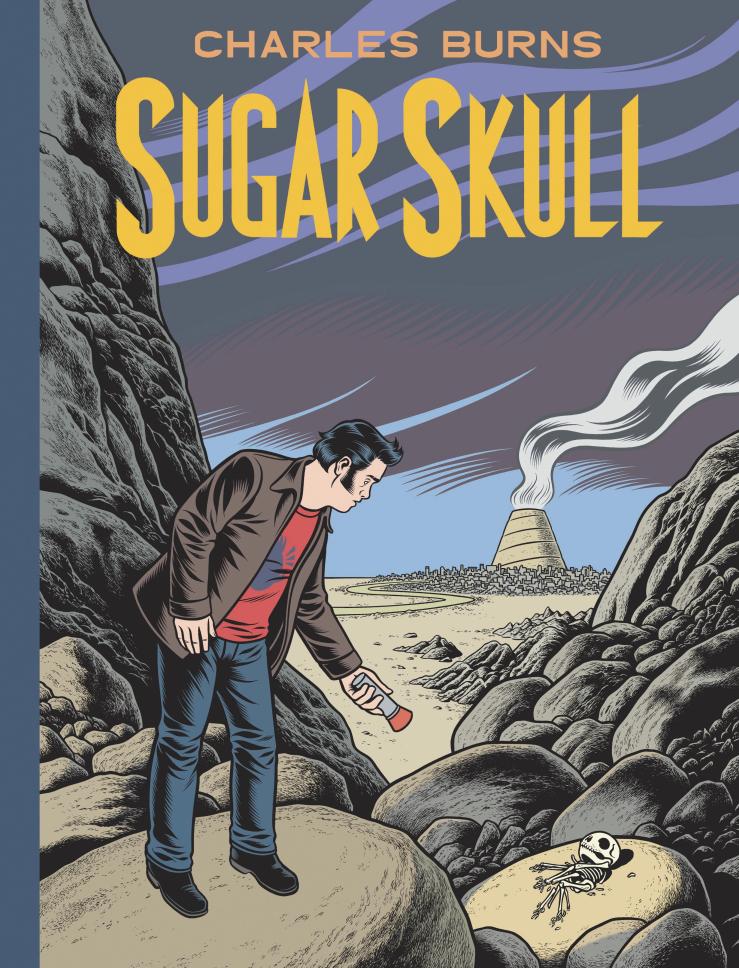
Sugar Skull concludes the trilogy that Charles Burns began four years ago with X’ed Out (I reviewed it here) and its 2012 follow-up The Hive (I reviewed it here).

In X’ed Out, Burns introduces us to his protagonist Doug, a would-be art-punk poet whose Burroughsesque sound-collage performances are misunderstood by everyone but Sarah, a troubled artist whose photographs and installations reverberate with menacing violence. We first find Doug in the aftermath of an unnamed trauma involving Sarah and her tyrannical boyfriend—a trauma that Sugar Skull must and does answer to. The trauma transports Doug from his dead father’s office, where he’s been hiding and popping pills, into a fever-dreamscape reminiscent of William Burroughs’s Interzone. In this world, Doug becomes Nitnit, his own features transmuted to the Tintin mask he wears when performing his cut-ups.

The Hive takes Doug/Nitnit even deeper into Interzone, into its subterranean caverns, gaping like tumorous wombs, while simultaneously moving the “real” Doug forward and backward in time, through his doomed relationship with Sarah and into the fallout of their split, where Doug short circuits.

Sugar Skull completes this circuit, offering readers the complete picture—and an exit out of Interzone—even as it dooms Doug/Nitnit to repeat the past. We find here the traumatic violence of love, death, begetting, and denial.

burnsxedouthive

The trilogy’s development evinces in Burns’s rich cover art. X’ed Out shows us young, skinny Doug, his head bandaged, his haircut an echo of Tintin’s cowlick. Wrapped in his dead father’s purple robe and set against utter wreckage, young Doug regards a massive egg, itself a visual echo of Tintin cover. The cover of The Hive shows us an older, heavier Doug, lost and confused in the abject uterine labyrinth of the Hive. In the lower-right corner—the same space the egg occupies on the cover of X’ed Out—lurks one of Interzone’s mutable mutants. This figure repeats in the trilogy, an amorphous being who shifts from Nitnit’s aide and familiar, to a dog stranded in a flood, to a piglet in a jar, to a massive breed-sow, to, perhaps, Doug’s father—and then Doug himself.

The figure opposite an older, fatter Doug on the cover of Sugar Skull condenses these roles into the emblem of death: it is at once the skeleton of the mutant, but also the frame of Doug’s dead father and the emblem of the symbolic infanticide at the core of the trilogy. And so we get the natural progression of life—from egg and embryo to a pink bundle of mobile cells to skeletal remains—set against an uncanny, chaotic backdrop.

Throughout the trilogy, Burns forces reader and Doug alike to navigate that chaos. The first two volumes in the series propelled the reader (and Doug, of course) through different times, different realities, sifting through the awful wreckage for clues, for a pattern, for an answer that might explain poor Doug’s trauma. By the beginning of Sugar Skull, our hero is finally equipped with a map to guide him through the underworld:
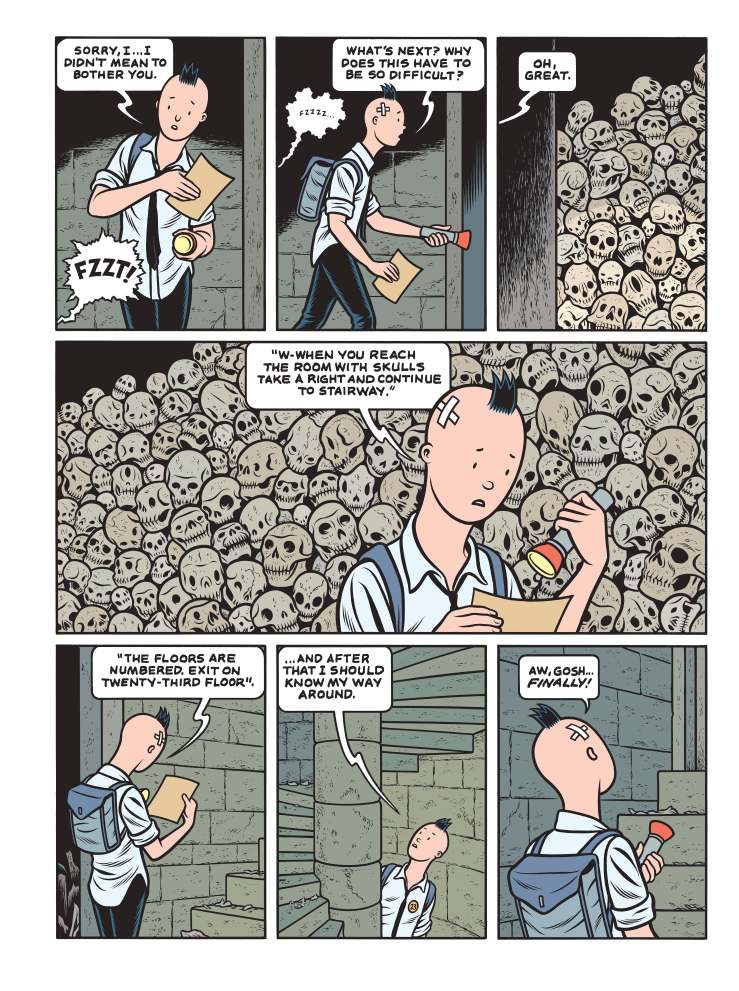
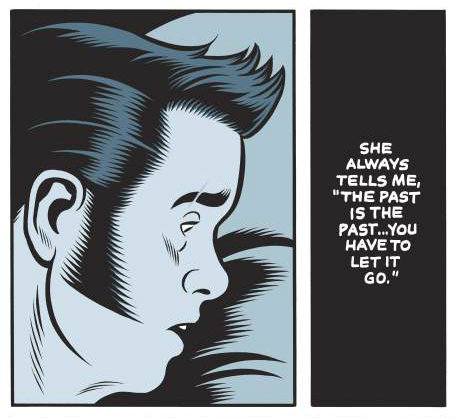
Page 10 from Burns_SUGAR SKULL“Why does this have to be so difficult?” our hero wonders. Because of repressed fear, anger, hurt—and failure. The real trauma, the secret trauma, of the trilogy is Doug’s radical failure. This failure keeps him up at night, both in waking sweat, but also in his Interzone, the fantasy world where the repressed returns, where his alter-ego Nitnit can play boy detective. And yet, as we see in Sugar Skull, Nitnit, dream warrior, is ultimately unequipped to right the wrongs of the past. He can only replay them in a dark, surreal space. The past is never dead. It’s not even past.
b a

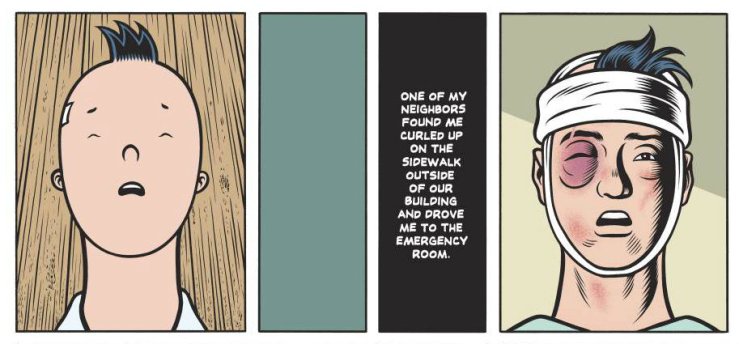
X’ed Out and The Hive point repeatedly to the specter of violence and infanticide, both through implication in the dialogue as well as intense imagery. Both novels ominously arrange events that could only lead to the head wound that our hero sustains before the trilogy begins—a head wound that may or may not be a primary cause of Doug’s excursions into irreality.
d

The infanticidal images that haunt the first two books pointed to a deeper mystery though, one beyond the physical violence Doug suffered. Those books hinted at abortion or miscarriage. But there are other ways to lose children.

Have I over shared the plot? Or am I hinting too vaguely? Reviewing my lines, it seems like I’ve said nothing at all, or perhaps dwelled on the first two books too much.

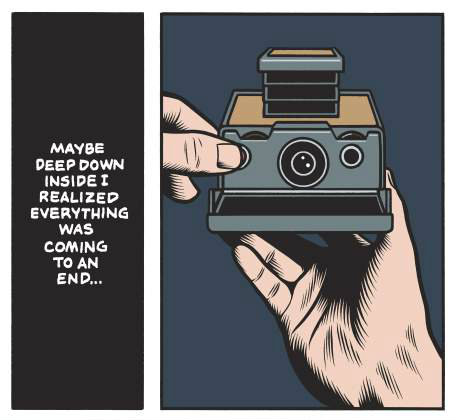
To simplify: Sugar Skull is sad and beautiful and strange and deeply human—this is not the tale of a doppelgänger’s adventures in wonderland, but rather the story of youth’s cowardice, of how we fail ourselves and others, how the versions of ourselves that we try to pin down—like Doug, who takes endless selfies with a Polaroid—are not nearly as stable as we might like them to be. Sugar Skull also explores how we cover over those instabilities and failures—I didn’t do those things; This isn’t happening to me.
c

The final moments of Sugar Skull enact a shock to stability, to sense of self. Burns fulfills a narrative promise to his readers, and to Doug—one that, if I’m honest, was not what I had predicted at all—and then sends Doug’s altered-ego Nitnit into the desert wilds. The last few pages of Sugar Skull seem to borrow as much from McCarthy’s Blood Meridian as they do from Hergés Tintin or William Burroughs.

And yet Doug passes through the wasteland to a refuge of sorts, the dream-double of two other settings that figure prominently in the trilogy, condensed into a place that is and is not. The setting mirrors Doug’s doomed double-consciousness, a consciousness condemned to repeat the same cycle, to respond again and again to the same terrifying call to nightmare-adventure.

I’ve neglected to comment on Burns’s wonderful art, mostly because I think it speaks for itself. His heavy inks and rich colors help unify the shift in styles that mark Doug’s movement between worlds. The trilogy would be worth the admission price alone just for the art, but Burns offers so much more with his storytelling. What’s perhaps most impressive is how thematically precise Burns’s images are—how panels, angles, shots, poses, gestures, and expressions repeat with difference from volume to volume. Burns uses these repeated images to subtly evoke his theme of cycles, doubles, and reiterations. In rereading we see again, recognize again—but from a different perspective.

And if Burns strands Doug/Nitnit in a loop of repetition, he also extends, perhaps, that same chance to his hero—to see again, but from a different perspective. If Sugar Skull forecloses the possibility of escape from the past, it doesn’t cut off a generative futurity. And as our protagonist awakes—again—to follow Inky into the strange wreckage of the past, many readers will feel prompted to follow the pair—again, and then again.

Sugar Skull is available now in hardback from Pantheon.
 

“The Absence of Any Purpose Is the Starting Point for My Work” | An Interview with Roman Muradov

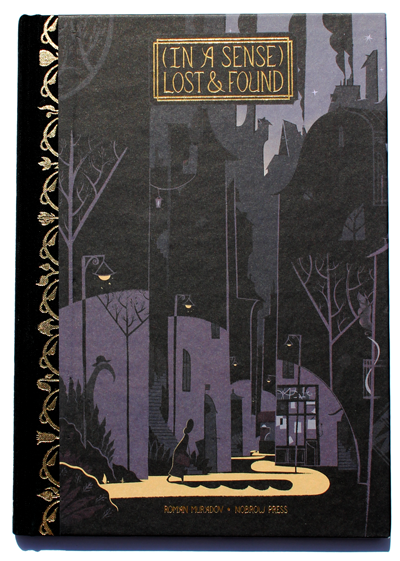
I’ve been a fan of Roman Muradov’s strange and wonderful illustrations for a while now, so I was excited late this summer to get my hands on his début graphic novella, (In a Sense) Lost and Found (Nobrow Press). In my review, I wrote: “I loved Lost and Found, finding more in its details, shadowy corners, and the spaces between the panels with each new reading.” The book is a beauty, so I was thrilled when Roman agreed to discuss it with me over a series of emails. We also discussed his influences, his audience, his ongoing Yellow Zine projects, his recent cover for Joyce’s Dubliners, and his reaction to some of the confused Goodreads reviews his novella received. Check out Roman’s work at his website. You won’t be disappointed.

inasense400photo

Biblioklept: When did you start working on (In a Sense) Lost and Found? Did you always have the concept kicking around?

Roman Muradov: The idea came to me in 2010 in the form of the title and the image of a protracted awakening. I wrote it as a short story, which had a much more conventional development and actually had some characters and plot movements, all of them completely dropped one by one on the way to the final version apart from the basic premise. I didn’t have a clear understanding of what was to be done with that premise, but the idea kept bothering me for some time, until I rewrote it a few times into a visual novella when Nobrow asked me if I wanted to pitch them something. Since then it went through several more drafts and even after everything was drawn and colored I had to go back and edit most of the dialogues, which is a nightmarish task in comics, since it involved re-lettering everything by hand.

Biblioklept: When you say you wrote it as a short story, I’m intrigued—like, do you mean as a sketch, or a set of directions, or as a tale with imagery? Part of the style of the book (and your style in general) is a confidence in the reader and the image to work together to make the narrative happen. When you were editing the dialogues, were you cutting out exposition, cues, contours?

RM: No, I mean a traditional pictureless short story. I was struggling with forms at the time and didn’t feel confident with any of them. In a way this still persists, because my comics are often deliberately deviating from the comics form, partially in my self-published experiments. The story itself was still ambiguous, I never considered showing what she lost, or how. With time I edited down all conversation to read as one self-interrupting monologue.

Biblioklept: I want to circle back to (In a Sense) Lost and Found, but let’s explore the idea that your work intentionally departs from the conventions of cartooning. When did you start making comics? What were the early comics that you were reading, absorbing, understanding, and misunderstanding?

RM: I came to comics pretty late; I only discovered Chris Ware & co around 2009. As a child I spent one summer drawing and writing little stories, ostensibly comics, then I stopped for a couple of decades. I’m not really sure why I started or stopped. In general my youth was marked by extraordinary complacency and indifference. I followed my parents’ advice and studied petroleum engineering, then worked as a petroleum engineer of sorts for a year and a half, then quit and decided to become an artist. I still feel that none of these decisions were made by me. Occasionally certain parts of my work seem to write themselves and I grow to understand them much later, which is weird.

Biblioklept: Was Ware a signal figure for you? What other comic artists did you find around that time?

Ware, Clowes & Jason were the first independent cartoonist I discovered and I ended up ripping them off quite blatantly for a year or so. Seth was also a big influence, particularly his minute attention to detail and his treatment of time, the way he stretches certain sequences into pages and pages, then skips entire plot movements altogether. Reading Tim Hensley’s Wally Gropius was a huge revelation, it felt like I was given permission to deviate from the form. Similarly, I remember reading Queneau’s “Last Days” in Barbara Wright’s translation, and there was the phrase “the car ran ovaries body” or something like that, and I thought “oh, I didn’t know this was allowed.”

saladface

Biblioklept: Your work strikes me as having more in common with a certain streak of modernist and postmodernist prose literature than it does with alt comix. Were you always reading literature in your petroleum engineer days?

RM: That’s certainly true, nowadays I’m almost never influenced by other cartoonists. I wasn’t a good reader until my mid-twenties, certainly not back in Russia. I stumbled upon Alfred Jarry (not in person) while killing time in the library, and then it was a chain reaction to Quenau, Perec and Roussel, then all the modernists and postmodernists, particularly Kafka, Joyce, Nabokov and Proust.

Biblioklept: How do you think those writers—the last four you mention in particular—influence your approach to framing your stories?

RM: From Nabokov I stole his love for puzzles and subtle connections, a slightly hysterical tone, his shameless use of puns and alliteration, from Kafka–economy of language and a certain mistrust of metaphors–it always seems to me that his images and symbols stretch into an infinite loop defying straightforward interpretation by default, from Joyce and Proust the mix of exactitude and vagueness, and the prevalence of style over story, the choreography of space and time. I should’ve say “I’m in the process of stealing,” I realize that all of these things are far too complex, and I doubt that I’ll ever feel truly competent with any of these authors as a reader, let alone as a follower.

Biblioklept:(In a Sense) Lost and Found begins with a reference to Kafka’s Metamorphosis, and then plunges into a Kafkaesque—to use your phrasing—“infinite loop defying straightforward interpretation.” How consciously were you following Kafka’s strange, skewed lead?

RM: I wanted the reference to be as obvious as possible, almost a direct copy, as if it’s placed there as an act of surrender–I’m not going to come up with a story, here’s one of most famous opening lines that you already know. Usually I know the beginning and the ending and I often downplay their importance, so that the work becomes focused mostly on the process and so that readers don’t expect any kind of resolution or satisfactory narrative development. In the password scene the phrases are copied directly from Eliot’s Wasteland, which itself refers to Paradise Lost in these passages. It’s a bit like a broken radio, shamelessly borrowing from the narrator’s visual and literary vocabulary, the way it happens in a dream.

premise_0022_22.psd Continue reading ““The Absence of Any Purpose Is the Starting Point for My Work” | An Interview with Roman Muradov”

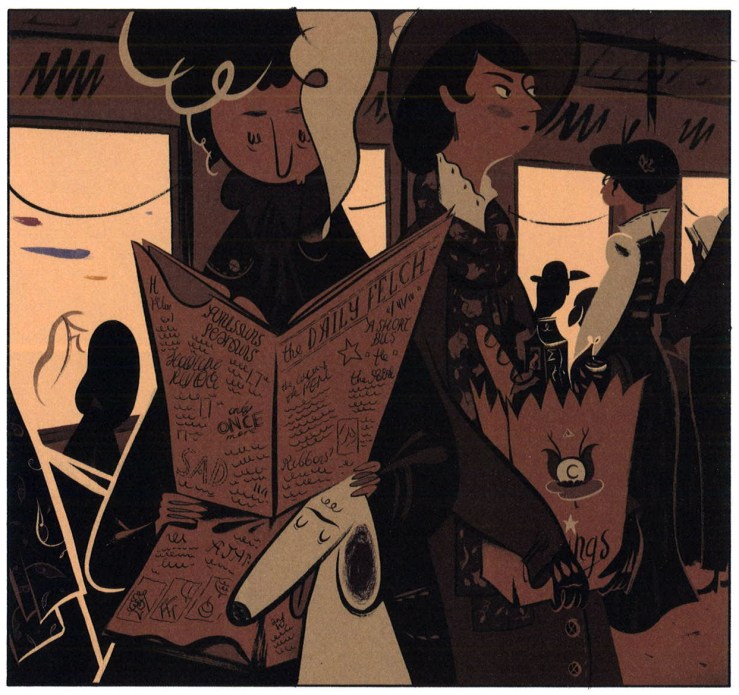
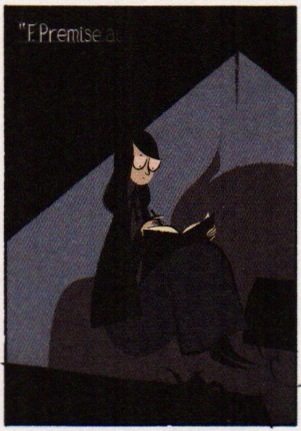
Roman Muradov’s Enigmatic Graphic Novella (In a Sense) Lost and Found Reviewed

If you regularly read The New York Times or The New Yorker, you’ve probably already seen Roman Muradov’s compelling illustrations. If you’re a fan, you also know about his strange and wonderful Yellow Zine comics (and if you don’t know them, check out his adaptation of Italo Calvino).

Muradov’s début graphic novella (In a Sense) Lost and Found was released recently by Nobrow Press, and it’s a beauty—rich, imaginative, playful, and rewarding. And it smells good.

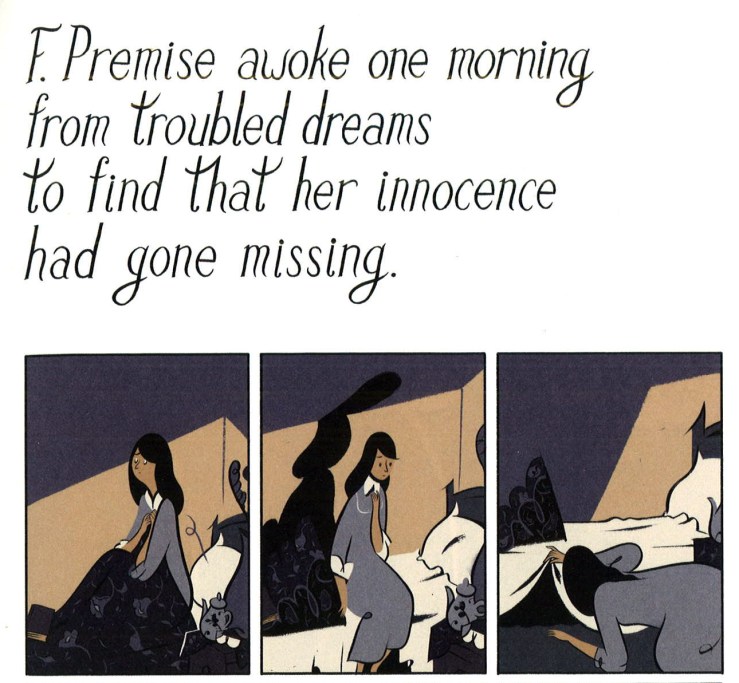
(In a Sense) Lost and Found begins with a nod to Kafka’s Metamorphosis:

8

Although we’re told by the narrative script that our heroine F. Premise (faulty premise?) “awoke,” the surreal world Muradov creates in Lost and Found suggests that those “troubled dreams” continue far into waking hours. The story runs on its own internal dream-logic, shifting into amorphous spaces without any kind of exposition to guide the reader who is, in a sense, as lost as the protagonist becomes at times on her Kafkaesque quest.

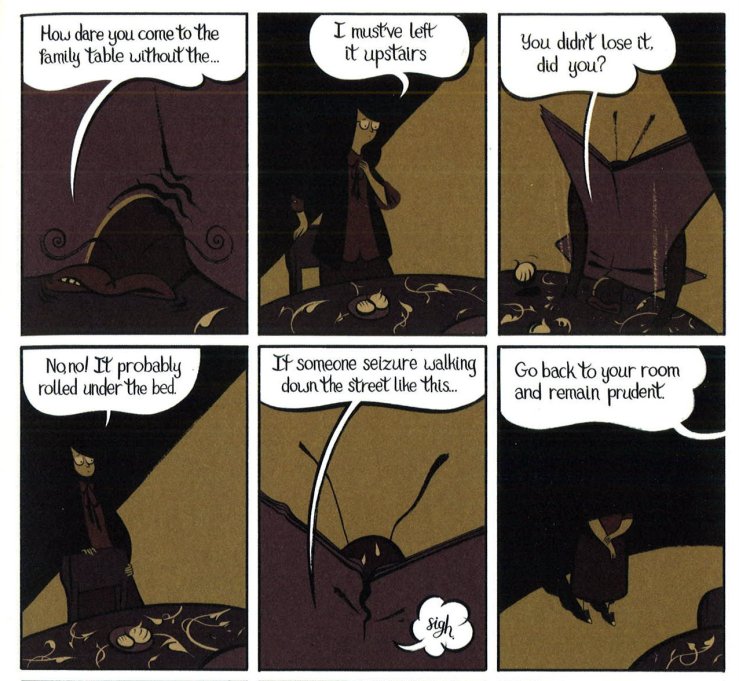
What is F. Premise’s mission? To regain her innocence, perhaps, although only the initial narrative script and the punning title allude to “innocence.” The characters seem unable or unwilling to name this object; each time they mention it, their speech trails off elliptically, as we see when Premise’s father (?) confronts her at the breakfast table:

6

Muradov’s imagery suggests Kafka’s bug again—the father’s antennae poke over the broadsheet he’s reading (the book is larded with readers), his strange mouth sagging out under it. Even more Kafkaesque though is Muradov’s refusal to reveal the father’s face, the face of authority, who sends his daughter back up to her room where she must remain locked away.

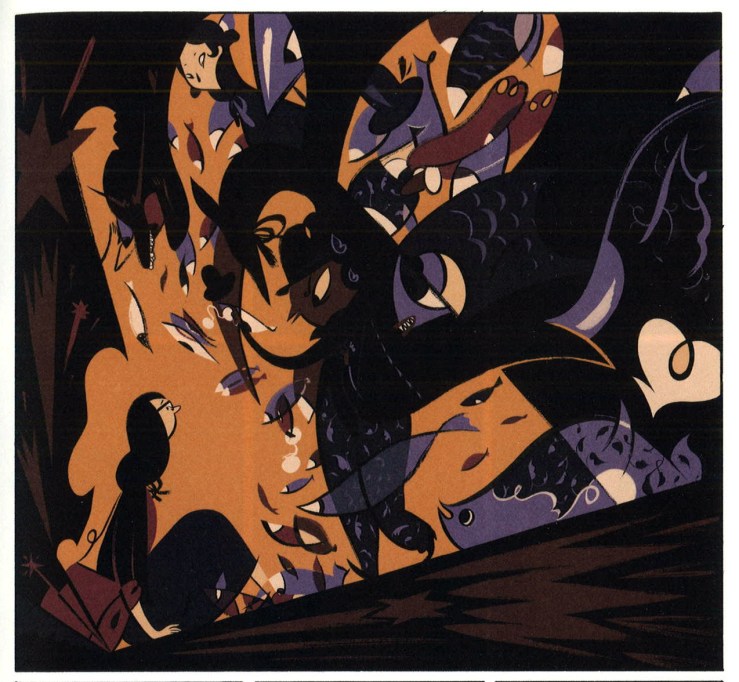
She sneaks out of course—would there be an adventure otherwise?—and it turns out that faceless father is right: F. Premise falls (literally) under the intense gaze of the community. F. Premise is startlingly present to others now by virtue of her absent virtue.

5

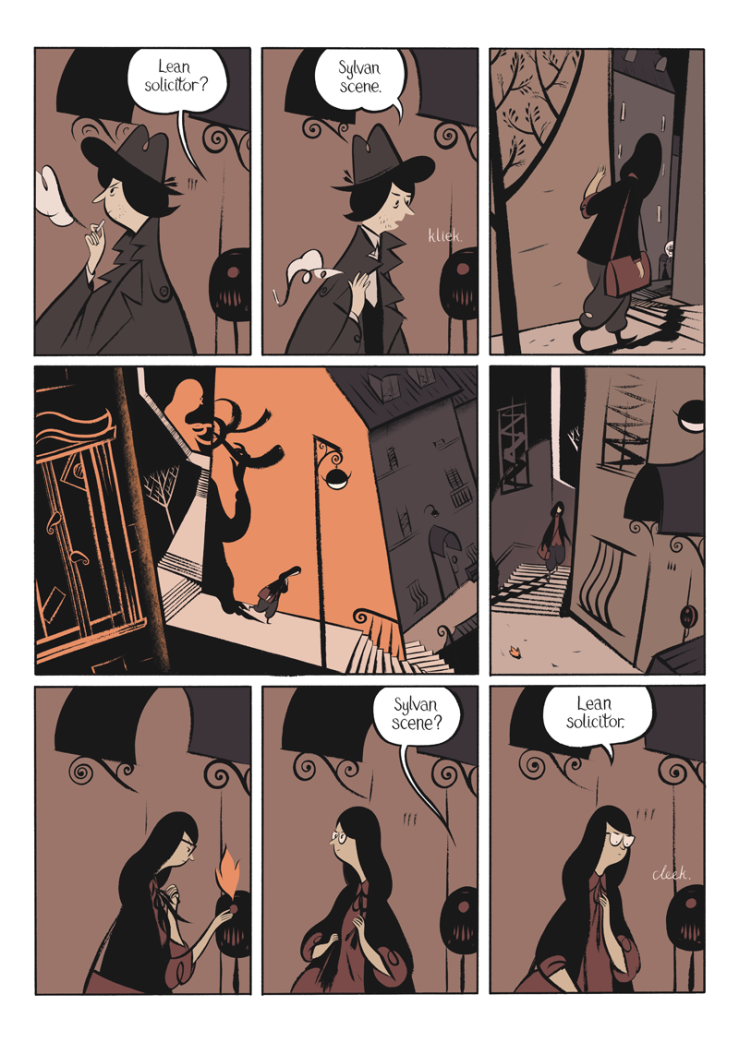
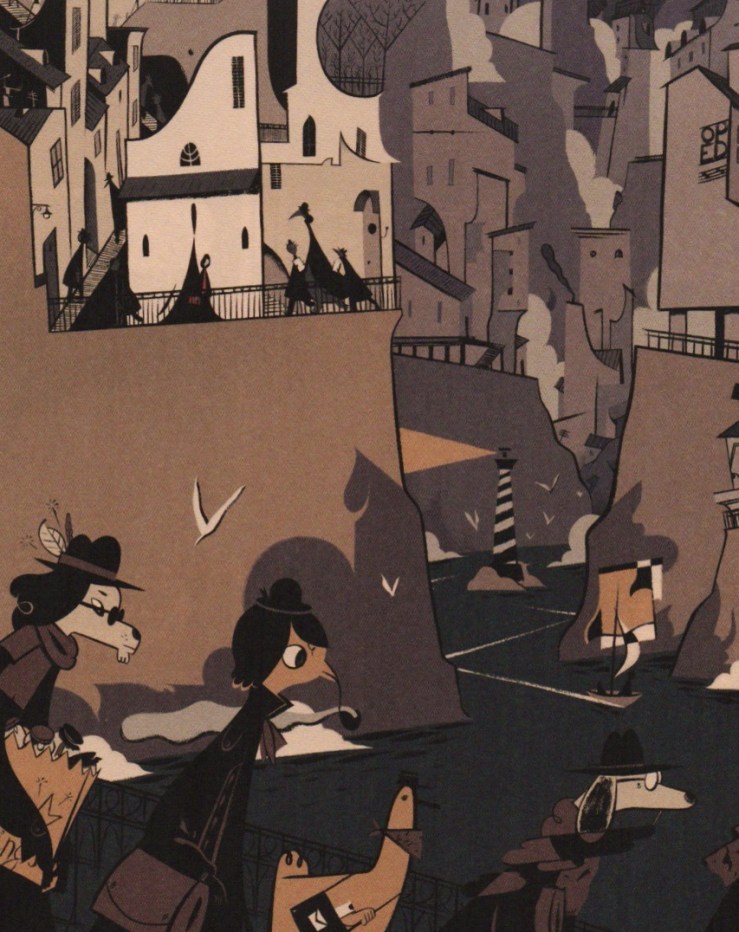
Muradov uses traditional nine-panel grids to tell his story, utilizing large splashes sparingly to convey the intensity of key moments in the narrative. The book brims with beautiful, weird energy, rendered in intense color and deep shadow. Muradov’s abstractions—pure shapes—cohere into representative objects only to fragment again into abstraction. (Perhaps I should switch “cohere” and “fragment” here—I may have the verbs backwards).

The art here seems as grounded in a kind of post-cubism as it does in the work of Muradov’s cartooning forebears. In the remarkable passage below, for example, our heroine moves from one world to another, her form nearly disappearing into complete abstraction by the fifth panel (an image that recalls Miró), before stabilizing again (if momentarily) in the sixth panel.

2

It’s in that last panel that F. Premise returns to her adopted home (of sorts)—a bookstore, of course. Earlier, the kindly owner of the bookstore loans her a pair of old plus-fours, and all of a sudden her identity shifts—or rather, the community shifts her identity, their penetrating gaze no longer trying to screw her to a particular preconception. Identity in Lost and Found is as fluid and changeable as the objects in Muradov’s haunting illustrations.

I have probably already belabored too much of the plot. Suffice to say that our heroine’s quest takes strange turns, makes radical shifts, she descends up and down and into other worlds. Embedded in the journey is a critique of nostalgia, of the commodification of memory (or, more accurately, the memory of memory). Is our innocence what we thought it was? Can we buy it back like some mass-produced object?

IMG_3292

As I noted before, Lost and Found is stuffed with images of readers. There’s something almost Borgesian in the gesture, as if each background character might be on the threshold (if not right in the middle of) their own adventures.

3

It’s in the book’s final moments though that we see a move from reading to writing: Our heroine F. Premise picks up the pen and claims agency, writes her own life. She is indeed the narrative voice after all, the imposing script that, like some all-knowing hand, guided us into the narrative in the first place, only to disappear until the end.

IMG_3293

I loved Lost and Found, finding more in its details, shadowy corners, and the spaces between the panels with each new reading. My only complaint is that I wish it were longer. The book is probably not for everyone—readers looking for a simple comic with an expository voice that will guide them through a traditional plot should probably look elsewhere. But readers willing to engage in Muradov’s ludic text will be rewarded—and even folks left scratching their heads will have to admit that the book is gorgeous, an aesthetic experience unto itself. And it smells good. Highly recommended.


What’s got into you? | Ventriloquism in Doris Lessing’s novel The Golden Notebook

In Doris Lessing’s novel The Golden Notebook, Marion Portmain, a housewife neglected by her husband, resolves that she will begin to live her life with the aim of helping other people. Marion believes that this change is a major breakthrough in her life, a moment to claim agency for herself and to find her own authentic voice in a world where she has been silenced and ignored.

She asks her friend, the book’s protagonist Anna Wulf for the address of an imprisoned South African political activist:

‘Do you remember that black leader, the African man you used to know? Mathews, or something like that?’

This was not at all what Anna had expected. ‘You don’t mean Tom Mathlong?’Marion had actually taken out a notebook and was sitting with a poised pencil.

Marion has taken up her own notebook, a parallel to the colored notebooks that Anna keeps to impose some semblance of order—or at least to contain—the chaos of modernity.

Anna protests Marion’s request; she implicitly condescends Marion’s naïvety and myopic worldview:

‘But Marion…’ Anna looked at Marion, trying to make contact with the woman she had been talking to only a few minutes before. She was met by a gaze from brown eyes glazed with a guilty but happy hysteria. Anna went on, firmly: ‘It’s not a nice organized prison like Brixton or somewhere like that. It’s probably a shack in the bush, hundreds of miles from anywhere, about fifty political prisoners, and very likely they don’t even get letters. What did you think?—that they had visiting days and rights and things like that?’

And here is where the scene becomes particularly intriguing for me, as Anna begins to break down the various sources that ventriloquize Marion’s “new” consciousness: 

Marion pouted and said: ‘I think that’s an awfully negative attitude to take about the poor things.’

Anna thought: negative attitude is Tommy’s—echoes from the Communist Party; but poor things is all Marion’s—probably her mother and sisters give old clothes to charities.

For Anna, Marion’s (attempt at) a new outlook is merely the weak synthesis of the language of Marion’s stepson’s communism with the stock-phrases of her aristocratic family’s noblesse oblige. Anna does not accept Marion’s “transformation” as authentic, but rather the product of tuning in new voices. 

As Marion continues, Anna analyzes her speech, her unvoiced comments interposed in parentheses that name the news sources from which Marion has “clipped” her thoughts:

‘I mean,’ said Marion happily, ‘it’s a continent in chains, well, isn’t it?’ (Tribune, thought Anna; or possibly the Daily Worker.) ‘And measures ought to be taken immediately to restore the Africans’ faith in justice if it is not already too late.’ (The New Statesman, thought Anna.) ‘Well at least the situation ought to be thoroughly gone into in the interests of everybody.’ (The Manchester Guardian, at a time of acute crisis.) ‘But Anna, I don’t understand your attitude. Surely you’ll admit there’s evidence that something’s gone wrong?’ (The Times, editorializing a week after the news that the white administration has shot twenty Africans and imprisoned fifty more without trial.)

‘Marion, what’s got into you?

This scene responds to an earlier section of The Golden Notebook (I wrote before about it here) in which Anna’s note-book becomes pure collage: She no longer writes in her own “original” language, but rather cuts fragments from newspapers and pastes them directly into her diary. The section highlights (and rhetorically demonstrates) the novel’s theme of the disintegration of language, meaning, and order—one of the central problems of postmodernist literature.

Anna’s question to Marion at the end of the passage I’ve cited — “What’s got into you?” — is a banal commonplace, yet utterly sincere, authentic—-and all the more authentic for its underlying irony: Anna has already decided what’s “got into” Marion (The Tribune, The Daily Worker, etc.). 

Lessing’s passage here underscores just how susceptible we are to not-knowing, just at the moment when we feel most confident in our belief. Marion feels wholly authentic here, feels her way-of-seeing as rich, full, clear, alive—but it’s this very feeling of clarity that blinds her from seeing herself (seeing herself) parroting back the stock language of the sources that have infiltrated her consciousness.

Anna is far more attuned to her own self-blindness; indeed, her color-coded notebooks are a means to account for the discursive narratives that might try to give shape to the messiness of consciousness. In one extended episode, Anna attempts to write a complete narrative of a particular day, but as she repeatedly notes, her awareness of her project leads to such a heightened self-consciousness that every observation she makes about the day is placed under radical suspicion—she sees that she sees herself seeing (herself), but, intuiting her consciousness’ structure, also understands that there are ways in which she cannot see herself seeing (herself).

Can Anna’s realization of the limitations of first-person-perspective help to free her? I have not yet finished the novel, but so far, Lessing depicts the question as a deep, painful struggle. Anna grapples with a disintegrating sense of self, a self that can identify (and cut out and paste and record and document) the voices that have “got into” her, even as those voices destabilize her identity.

The Inhumanity Museum


Scissors, Richard Diebenkorn

Near the end of the first cycle-section of Doris Lessing’s novel The Golden Notebook, protagonist Anna Wulf abandons the pretense of personal narrative in favor of pastiche, collage, clipping. Our heroine cuts and pastes material directly from the newspapers she’s been reading into her blue notebook:

[At this point the diary stopped, as a personal document. It continued in the form of newspaper cuttings, carefully pasted in and dated.]

March, 50

The modeller calls this the ‘H-Bomb Style’, explaining that the ‘H’ is for peroxide of hydrogen, used for colouring. The hair is dressed to rise in waves as from a bomb-burst, at the nape of the neck. Daily Telegraph.

July 13th, 50

There were cheers in Congress today when Mr Lloyd Bentsen, Democrat, urged that President Truman should tell the North Koreans to withdraw within a week or their towns would be atom-bombed. Express.

July 29th, 50

Britain’s decision to spend £100 million more on Defence means, as Mr Attlee has made clear, that hoped-for improvements in living standards and social services must be postponed. New Statesman.

Aug. 3, 50

America is to go right ahead with the H Bomb, expected to be hundreds of times more powerful than the atom bombs. Express.

The passages continue for pages in the same vein until:

30th March 2nd H-BOMB EXPLODED. Express.

This section of The Golden Notebook fits neatly into what I’ve come to think of as the Inhumanity Museum. The writer clips from the newspaper and passes those fragments to the author, who tosses them to the speaker, the narrator, a character, perhaps—and asks: What to do with these? Can you believe this? Are there even words for this? 

Which is the appeal to the writer, I think, of clippings that belong to the Inhumanity Museum: That the journalist telegraphs (plainly, simply, succinctly) what the novelist may deem ineffable.

I’ve appropriated the term the Inhumanity Museum from William H. Gass’s novel Middle C:

The gothic house he and his mother shared had several attic rooms, and Joseph Skizzen had decided to devote one of them to the books and clippings that composed his other hobby: the Inhumanity Museum. He had painstakingly lettered a large white card with that name and fastened it to the door. It did not embarrass him to do this, since only he was ever audience to the announcement. Sometimes he changed the placard to an announcement that called it the Apocalypse Museum instead. The stairs to the third floor were too many and too steep for his mother now. Daily, he would escape his sentence in order to enter yesterday’s clippings into the scrapbooks that constituted the continuing record:

Friday June 18, 1999

Sri Lanka. Municipal workers dug up more bones from a site believed to contain the bodies of hundreds of Tamils murdered by the military. Poklek, Jugoslavia. 62 Kosovars are packed into a room into which a grenade is tossed. Pristina, Jugoslavia. It is now estimated that 10,000 people were killed in the Serbian ethnic-cleansing pogram..

There is more

Tomato and Knife, Richard Diebenkorn

I’m still not sure exactly how the Inhumanity Museum fits into Middle C’s tale of fraud and music. Maybe it’s just Gass’s excuse to unload some of the material he’s been clipping for years. (Maybe I need to reread Middle C).

Here is Gass, in a 2009 interview, discussing William Gaddis (the emphasis is mine): 

We were very close, even though we spent most of our time apart. I really had the warmest… We had great times. We both had the same views: Mankind, augh hsdgahahga!!!!. And he would read the paper and make clippings out of it. He was always saying, “Did you read…!?” We would both exalt in our gloom.

“Mankind [unintelligible]!” Ha! Continue reading “The Inhumanity Museum”

Riff on Aronofsky’s Noah

1. Noah continues director Darren Aronofsky’s streak of making films that I will never watch more than once.

2. (The film is new on DVD &c.; I dutifully missed in the theater).

3. (Although I did see Aronofsky’s first feature Pi in the theater—at my university’s student union. I liked the claustrophobic paranoia of Pi, but the film was also silly, histrionic even, and I did not understand the film’s handling of metaphysics—mostly because the film does not understand its own metaphysical vision).

4. (Noah, for its part, does seem to understand its own metaphysical vision; or, rather, it understands a version of its own metaphysical vision).

5. Aronofsky’s Noah takes place in a post-apocalyptic landscape: Cities are failing, the world is barren, dry, the ground seems to be comprised of basalt and ash. The people in his Prediluvian world use a mishmash of technologies, some of which seem fairly advanced (strip-mining, metallurgy, advanced textiles, etc.)—but these technologies also seem stymied, stuck, abortive last grasps at progress. Noah looks at times like a Mad Max film, or even Hillcoat’s adaptation of The Road.

6. Aronofsky’s Noah is a post-apocalyptic pre-apocalypse film.

7. Aronofsky’s Noah attempts an answer to both Adam and Eve’s expulsion from Eden and Cain’s murder of Abel.

8. Aronofsky’s Noah foregrounds the radical infanticide at the heart of the flood myth. 

9. From A. Samuel Kimball’s The Infanticidal Logic of Evolution and Culture:

. . . when he promises never again to subject the world to such destruction, God memorializes the irreversibility of his massively -cidal violence and binds the future that will transpire to the futurity that will now never come to pass. Indeed, God destroys an infinite number of futures with the respective deaths of the Flood’s victims, for whom the waters of the Flood will never stop flooding, never cease obliterating the future. When he ratifies his promise in the covenant with Noah and his descendants, God inscribes the future reproductivity of the Noahic lineage in the limitless infanticidism of the Flood.

10. Aronofsky’s Noah gains most, if not all, of its moral tension in depicting Noah’s attempt to negate the future reproductivity of the Noahic lineage.

11. Should humanity be allowed to exist after The Flood? is Noah’s (and Noah’s) central question. Aronofsky’s answer to this question is, I think, ultimately ambiguous. While Noah’s own infanticidal violence (an extension of his attempt to prevent his sons from begetting offspring) is suspended (by love!), Aronofsky represents this suspension with ambivalence. Noah, drunk in a cave, invites us to look on his naked failure. 

12. Aronofsky’s Noah is most successful as a kind of failed boilerplate color-by-numbers summer-popcorn-big-budget-action flick. It’s just too weird to fully adhere to its formula, but it hangs together by the formula nonetheless, jostling, uneasy. 

13. Aronofsky’s Noah features giant fallen angels encased in rock. These golems are probably the signal special effect of the film, and a sore reminder of the pervasive influence of the special effects battle sequences in Peter Jackson’s Lord of the Rings

14. This was easily my favorite sequence of Noah:

15. (And yet that sequence still suffers from a kind of queasy supernatural cheesiness that infects Aronofsky’s work).

16. After watching the film, I sought reviews, which led me quickly to John Nolte’s paranoid (and unintentionally hilarious) take on the film at the right-wing website Breitbart. Nolte clearly enjoyed the film and he repeatedly praises its techniques, production values, and acting, but condemns it as “blasphemous” in depicting God as “some kind of tree-hugger.” “Aronofsky is the anti-Michelangelo,” Nolte declares, “a master craftsman using his talents to a dishonest and wicked end.” That wicked end is “using the story of Noah to twist Christianity into something it is not…[Noah is] a genius piece of propagandizing that is sure to lead many away from God under the mistaken belief that through left-wing environmentalism they are coming closer to Him.”

Nolte’s strident praise/condemnation is hilarious and hyperbolic.

Does he actually believe that this movie is aesthetically affecting enough to motivate any kind of change in belief?

17. (Reviews like Nolte’s are important to me because they help to remind me of the subjectivity of aesthetic experience. He saw a completely different film (with his completely different eyes) than I did).

18. My favorite Aronofsky film, and the only one that I would consider watching again, is The Fountain. I think that The Fountain might be a kind of precursor film to Noah, a trial-run even, although I have no evidence for this claim.

19. I started this riff with the claim that I have no desire to rewatch Aronofsky’s films, and that Noah continues this pattern. Aronofksy is an auteur, and like most auteurs, I’m sure rewatching his films would enrich an understanding of the themes and problems he’s trying to address. However, I find his films repulsive, by which I mean the opposite of compelling. I have never wanted to exit a fictional world as much as I wanted to escape Requiem for a Dream. I found The Wrestler depressing and empty. I’m afraid if I watch Black Swan again it will turn out that Aronofsky was actually not attempting to make a comedy about psychosis, but was rather actually serious about his melodrama’s tragic scope.

20. Noah isn’t repulsive, but it isn’t great either. Flawed doesn’t even begin to describe the film—yes, it survives its own competing impulses of spectacle-bombast and introspective-character-study, but never synthesizes them. It’s unclear who the film is for. The film resolves in a moment of supposed-uplift, positing “love” –of offspring– as a solution, but it also binds that solution/blessing in the cursing of offspring.

Both of these moments feel wholly inauthentic. In the end, what remains is the bitter aftertaste of Noah’s contempt—and his anxiety at failing to create a utopia devoid of humans.

Bob Schofield Discusses The Inevitable June and His Sad-Cartoon-Apocalypse Aesthetic

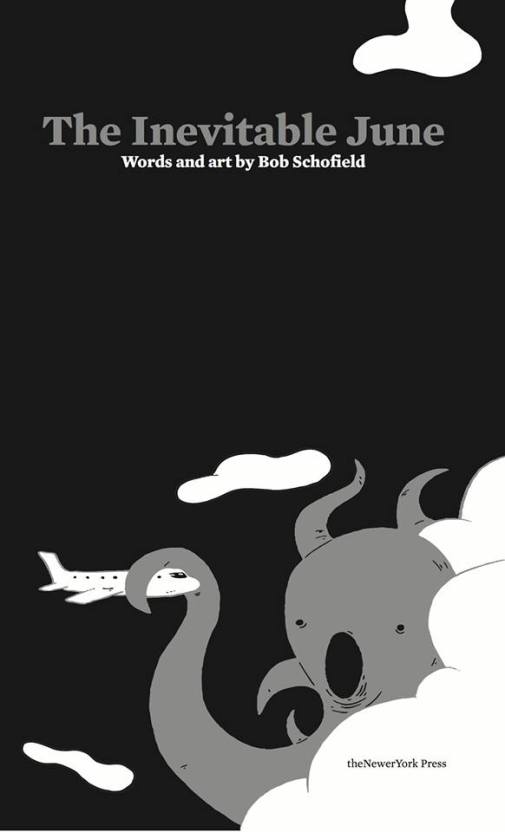
Bob Schofield is a writer and artist. He first showed up on my radar when theNewerYork sent me a digital file of his book The Inevitable June, which I described as “the kind of thing that we need more of; not a gimmick or a hybrid, but something new.” I’m still not sure what the book is, but I dig it. Bob was kind enough to talk to me over a series of emails about his work. Read some of Bob’s work at his website. Read my review of The Inevitable June here. Read our discussion below.

Biblioklept: What is The Inevitable June?

Bob Schofield: The Inevitable June is a collection of 30 surreal short prose pieces, one for every day in June, intercut with black and white illustrations. The drawings don’t always correspond to the text, and there isn’t really much of a coherent “story” per se, but there is certainly momentum and direction. The book definitely goes somewhere, though I’m not sure where exactly that “somewhere” is.

I kind of just wanted to build a little world that mirrored my imagination. A kind of scale-model. So I wanted it to be a little cold and sad and spooky and, hopefully, also fun. Like some kind of weird, floppy theme park made of bound paper squares.

Biblioklept: How did you compose that “scale-model”? Did you have an outline from the outset?

Schofield: There were a few structural “rules” I came up with, and the rest I sort of made up as I went. Like I knew I’d have thirty pieces total, and they’d all be titled for successive days in June. It’s funny, a lot of the momentum in the book just comes from that progression of calendar days. I guess we’re just culturally wired to feel like we’re going somewhere when we see those days slide by. But in the book it’s all relatively arbitrary, and if you were to take the days away as titles, things would feel a lot more meandering.

Photograph of Bob Schofield by Alex Broadwell

My other big structural decision was to start every piece with “This morning,” which would become a kind of refrain throughout the book. I kind of thought of it a bit like a dinner bell, indicating one course of the meal was over, and we were moving on to the next.

Then as I was writing all the individual pieces, I’d cherry pick certain images and phrases I liked, and then be sure to repeat them later on. That way the reader’s brain would kind of light up as they recognized parts of a pattern, even though the pattern wasn’t really saying anything specific. I think that kind of thing is important when you don’t have a more familiar storytelling structure to rely on. You need to give the reader something to hold on to.

And for myself as writer, all these patterns and rules gave me just as much of an anchor. It meant I wasn’t just spinning off into some sort of insane, incomprehensible word soup. I’d always be aware that I’d have to wrap things up at some point, and move on to the next “day.”

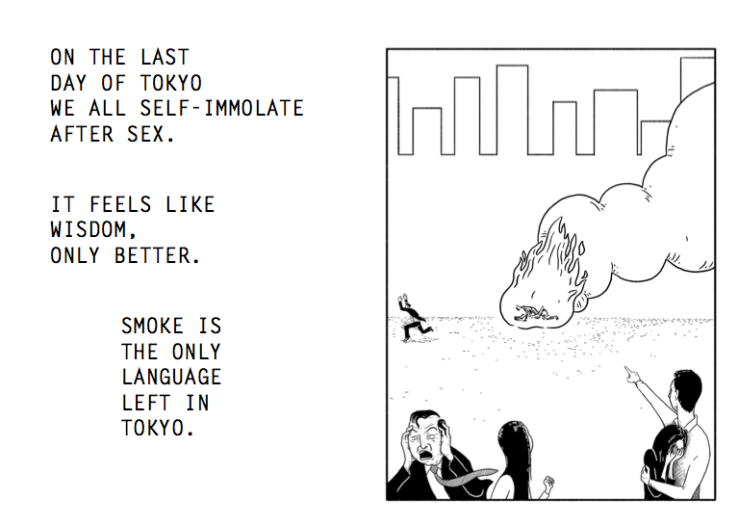
Biblioklept: Your book The Last Days of Tokyo shares some of the anchoring features you mention—beginning each page with the phrase “On the last day of Tokyo,” for example, and the image of a salaryman fleeing in horror, his face an echo of Munch’s The Scream.

1 Continue reading “Bob Schofield Discusses The Inevitable June and His Sad-Cartoon-Apocalypse Aesthetic”

Under the Skin Riff

IMG_2027

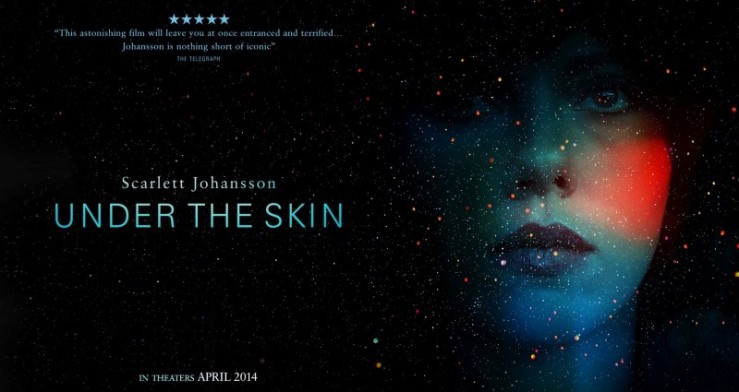
1. I hadn’t read a review of Under the Skin until after I watched it, but I had gleaned an idea of it based on taglines and posters—something like “Scarlett Johansson as a sexy alien seducing men in Scotland.”

2. That is not what the film is.

3. Under the Skin is an aesthetic experience. Now, this phrase, aesthetic experience, this phrase is extremely pretentious, and the way I’ve used it here also strikes me as pretentious, and even worse, not particularly clear. Any film could be described as an aesthetic experience. Films are, after all, simply light and sound.

4. Under the Skin is best experienced as light and sound—as aesthetic.

5. I’ve neglected to mention the film’s director, Jonathan Glazer, who directed another film I love, Sexy Beast.

6. For Under the Skin, Glazer adapted Michel Faber’s novel of the same name. I haven’t read the book, but a cursory cruise over its Wikipedia page suggests that Glazer dissolved most of the plot, keeping just the frame, or the idea of a frame for his film.

7. What I liked most about Under the Skin: The film is not really about anything. The film just happens. 

8. Point 7 is a terrible description! Of course the film is about something—but its themes and motifs are overdetermined and underexplained—or not explained at all.

9. There is very little dialogue in the film—no exposition or explanation for what’s happening, let alone a conversation that might guide the audience to how to think or feel about what’s happening.

10. (Okay: This is not entirely true, but it is mostly true. There is a key conversation, if it can be called that, between Johansson’s unnamed character and a man with a deformed face). 

11. The bits of dialogue that do evince often seem unscripted and random. The men Johansson’s character picks up speak in thick Scottish accents, their voices often obscured behind a din of traffic, buzz of music, or the thick glass windows of the van she drives around in. 

12. (A favorite moment of auditory distortion in Under the Skin: In a domestic scene, in a kitchen, cleaning up, a man turns on his radio and just-barely tunes in a station. Deacon Blue’s “Real Gone Kid” plays through a hazy crackle. Lovely).

13. The sound mixing in the film is beautiful—waves crashing, the clip-clop of horse hooves on a high road, the wind blowing heavy through tall evergreens—these auditory cues mix in with Mica Levi’s creepy, lush score, which channels Krzysztof Komeda’s work and Bernard Herrmann’s Psycho score through Portishead and Loveless

Scarlett Johansson Under the Skin

14. Sound and light—those shots: Cinematographer Daniel Landin is the secret star of the film. Every shot is gorgeous, painterly, and if Glazer often allows a scene to linger just past an acceptable threshold, it’s because he’s in love with the film’s dark beauty. 

15. (And/or: Glazer lets his shots linger so long to provoke the viewer into a kind of hypnotic discomfort).

16. The film’s early visual references to Kubrick’s 2001 are a bit on-the-nose—too on-the-nose, too expected. As the film progresses, the shots take their cues not from Kubrick’s sci-fi classic, but his most painterly film, Barry Lyndon

17. (Under the Skin also reminded me of Upstream Color, Moon, The Man Who Fell to Earth, Tree of Life, and Morvern Callar).

18. The film is best enjoyed, as I’ve said, as an aesthetic experience, art, if that’s the word you like. I think that viewers who attempt to impose their own narrative logic on the film will attune their energy to the wrong frequency. Let the aesthetic happen.

19. (The beach sequence in this film is one of the best scenes I’ve watched in a long, long time).

20. I have completely and purposefully neglected to mention anything about the plot, because I do not think the plot, in the sense of plot-as-arrangement-of-action matters to the film. The film’s aesthetic is the plot.

21. And Under the Skin’s aesthetic is the film’s theme. This film is about seeing, hearing. Touch, taste, smell.

You can boil that down to whichever theory floats your boat—the male gaze, alienation, othering, sexual subversion, radical feminism, etc.—but I think that imposing any schema, any deep reading here, may be a way of anesthetizing the film’s aesthetic.

22. Highly recommended.


Kevin Thomas Discusses His Illustrated Book Reviews with Biblioklept

Kevin Thomas’s new book Horn! (from OR Books) collects the book reviews he’s been doing for the past few years at the Rumpus. Kevin reviews new books (and occasionally reissues) in comic strip form. Over a series of emails, Kevin talked with me about his process, how he got started, the books that have stuck with him the most over the years, and his theory that The Life Aquatic with Steve Zissou is a secret remake of Three Amigos!  Find Kevin on Goodreads,Twitter, and Tumblr.
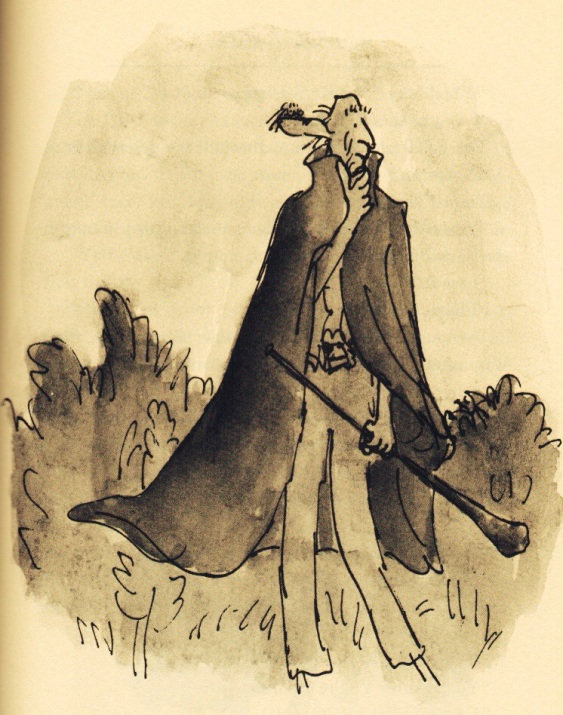
Biblioklept: You’ve been reviewing books at The Rumpus for a couple of years now in your strip Horn! How did the strip start? Did it start with The Rumpus, or before?

Kevin Thomas: I had been making these primitive autobiographical webcomics under the “Horn!” moniker for about a year when The Rumpus Book Club started. One of the selling points of the book club was that if you reviewed a book and the editors liked it, they’d publish it on the site. So I dedicated one comic a month to reviewing these books, and after the third submission was accepted, The Rumpus asked me if I wanted to make it a regular strip.

Biblioklept: What other kinds of comics did you make before that? Did you have any training or background in cartooning?

KT: No, I was trained, to put it generously, to be a composer. Before that I wanted to be a poet. I had great teachers in both of those fields, but never even thought about taking a studio art class. Maybe the fact that I hadn’t yet tried and failed at comics was what drew me to it. Continue reading “Kevin Thomas Discusses His Illustrated Book Reviews with Biblioklept”

Snowpiercer Riff

snowpiercer-hong-kong-poster

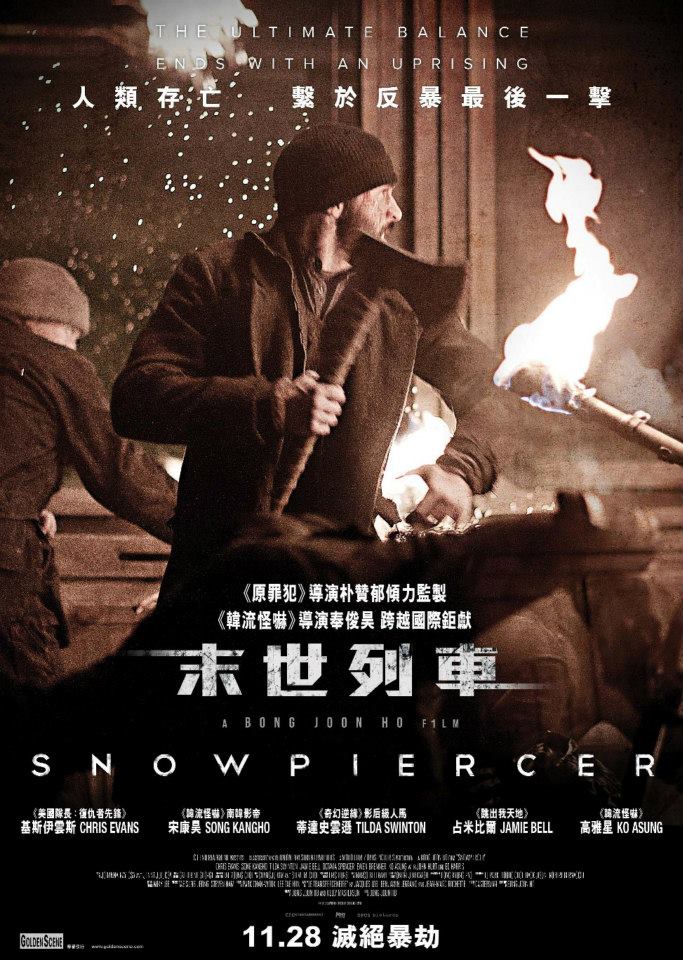
1. Snowpiercer, 2013, directed by Bong Joon Ho and produced by Park Chan Wook, is a sci-fi dystopian set on a mega-train, where the vestiges of humanity survive, protected from the new ice age outside. The plot involves the third-class passengers’ revolt against the elites who enjoy a privileged life at the head of the train. Etc.

2. You’ve seen this movie before, read this book before. You’ve played this video game.

3. Metropolis, Soylent Green12 MonkeysHalf-Life 2The Time Machine, the MaddAddam trilogy, Children of Men, BioShockZardozLogan’s Run, Brave New World, BrazilThe City of Lost ChildrenBad Dudes, Die HardThe Polar Express, etc.

4. Points 2 and 3 are lazy writing, and Snowpiercer deserves better. Although the film is not especially original, it does have a clear point of view, its own aesthetics, and an engaging, energetic rhythm, powered by strong (if purposefully cartoonish) performances from its cast.

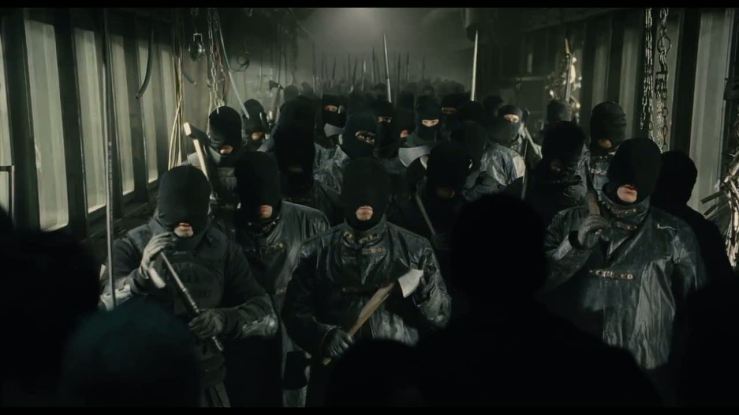
5. Snowpiercer is essentially structured like a video game. The heroes, a rebel alliance led by Chris Evans (Captain America, looking like The Edge from U2 for half the film), clear each train car—each game board—before moving on to the next challenge. An early standout scene involves a fight with a band of ninjas who for some reason ritually slaughter a fish before battle (the scene echoes the famous hammer hallway fight in Old Boy, a film directed by Snowpiercer producer Chan Wook Park). 

snowpiercer-trailer-2

6. The simple narrative structure of Snowpiercer allows the filmmakers to highlight the plot’s allegorical dimension. Highlight is the wrong verb: What I mean to say is hammer. Snowpiercer is not especially subtle in its critique of capitalism, with the engine that powers the train as a metaphor for capitalism itself—the engine determines the form of the train which in turn shapes the form of the society that must live in the train.

7. At Jacobin, Peter Frase offers a strong argument that the film challenges the entire system of capitalism and ultimately advocates transcendence of the system—not internal revolution.

8. While I think Frase’s essay offers a compelling analysis, I think that he simply wants the film to be better than it is. Snowpiercer, despite an apparent subversive streak, is still a Hollywoodish spectacle of violence and noise. It cannot transcend its own tropes (it can’t even revolutionize them). The vision of transcendence it offers is a rhetorical trick; not only that, it’s a stale trick, one that we can find at the end of any number of dystopian fictions: The exit door, the escape hatch, the way out.

9. I want to talk about that exit door—the end of the film: so major spoilers ahead. Continue reading “Snowpiercer Riff”

The BFG, Roald Dahl’s Love Letter to His Lost Daughter

20140706-210704-76024020.jpg

Roald Dahl’s 1982 children’s classic The BFG begins with a dedication to the author’s daughter: “For Olivia: 20th April 1955 — 17th November 1962.”

If I had noticed the dedication when I first read The BFG as a child, I certainly didn’t think about it then. The slim sad range of those dates would have meant nothing to me, eager as I was to dig into a book about child-eating giants, secure in my own childish immortality. However, when I started reading the book with my daughter, the dedication howled out to me, thoroughly coloring the lens through which I read.

Had Olivia Twenty Dahl not died from measles encephalitis at only seven, had she continued to live to be alive now, she would be approaching her sixtieth birthday. But because she died as a seven-year-old little girl, she remained a seven-year-old little girl to me, the reader, who saw her spirit under every page. 

I believe she remained a seven-year-old little girl for Dahl as well—at least in the imaginative world of The BFG where she is recast as the hero Sophie. Reading The BFG, it was impossible for me not to immediately connect Sophie to Olivia, those names with their Greek roots and their long O‘s. It was also impossible for me not to connect these two girls to my own daughter Zoe, who is also seven.

(Parenthetically, I’ll admit that biographical interpretation of literature is often a terrible practice—especially when combined with a touch of reader-response criticism—and that what I am doing here is not something I think advisable, let alone commendable. And yet the central affective power for me in reading The BFG—as an adult to my little girl—rests in my inescapable intuition that Dahl wrote the book to make his daughter live again, to live forever). Continue reading “The BFG, Roald Dahl’s Love Letter to His Lost Daughter”