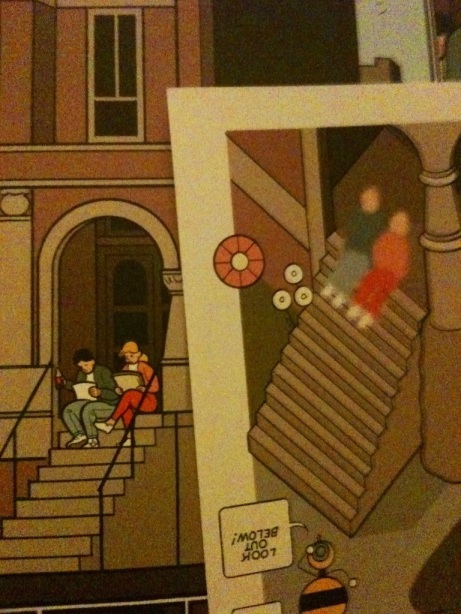
Reading Chris Ware’s Building Stories / Big Four Panel Board Book

Continuing reading Chris Ware’s Building Stories; also, continuing the ad hoc naming of its “chapters”: let’s call this one the Big Four Paneled Board Book.

It’s big. Shown here in relation to a local brew (clearly the best way to illustrate scale):

20121116-170448.jpg

It’s difficult to describe how each chapter enriches the story of Building Stories. There’s something Borgesian about Ware’s novel—not in the sense that it’s something that Borges would have written—what I mean to suggest is it’s like something out of a Borges story—winding, maze-like, self-referential, but not solipsistic. Building Stories doesn’t come with a set of instructions, so the reader has to interact with it in a random way. What’s really thrilling and emotionally impactful is the way that each piece deepens the story and develops each character a little bit more.

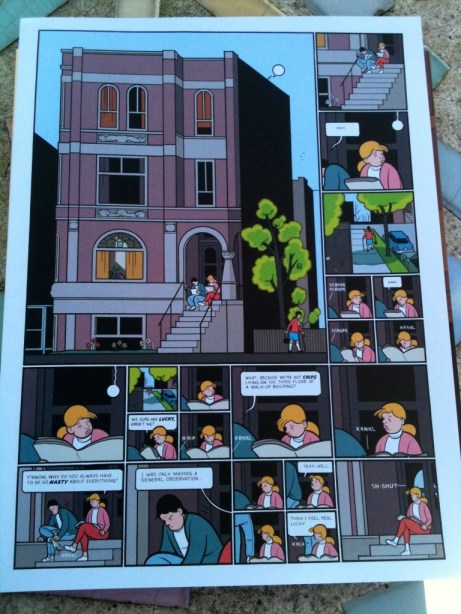
In the forked path I’ve been following, Lonely Girl (this is the building’s name for her; we might also call her the Would-be Writer, The Diarist, or, perhaps, The Amputee) emerges as the central character, and she gets the lead story in the Big Four Panel Board book. She’s looking for a companion, so she places an ad:

20121116-170502.jpg

This tiny little square says so much: Ware wastes no space. Lonely Girl’s personal ad is in some ways a metonymy of Building Stories (and Ware’s oeuvre all together): it combines ironic, self-aware humor with a stark and devastating sense of loneliness.

Lonely Girl shows up as a character in the lives of her downstairs neighbors, the Sour Couple. The soda-swilling boyfriend wonders how she might have lost her leg. In some ways he serves as audience surrogate here—I doubt we’ll get the full story. (The boyfriend also entertains other fantasies about Lonely Girl’s body).

20121116-170509.jpg

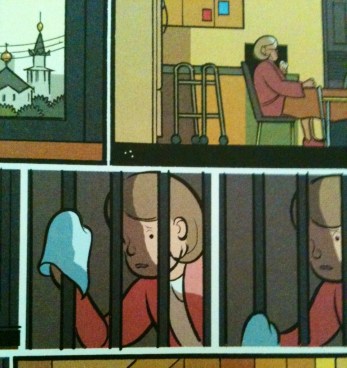
Of course, the Lonely Landlady also gets her panel. We see more of her stunted life, her mother (and the building itself) a proverbial albatross around her neck. Ware uses the size and scope of the Big Book to optimum advantage; he knows that the book is so big (and his panels so small) that the reader simultaneously sees everything and comprehends nothing. Ware employs lines that crisscross from section to section, often running through narrative elements we’ve yet to engage, or sometimes tracing over what we’ve already seen. The effect is not disorienting, though—rather, Ware uses the visual space to show the ways in which his characters and narratives cross, abut, or fail to connect.

20121116-170524.jpg

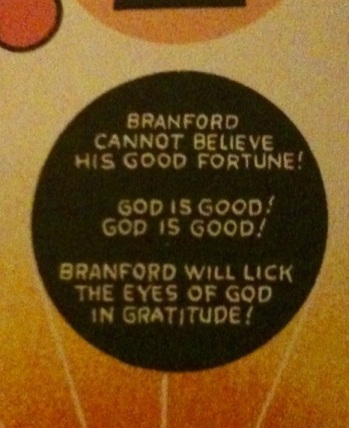
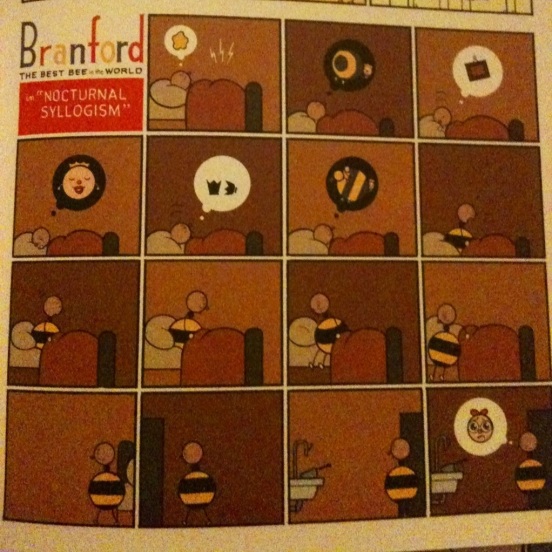
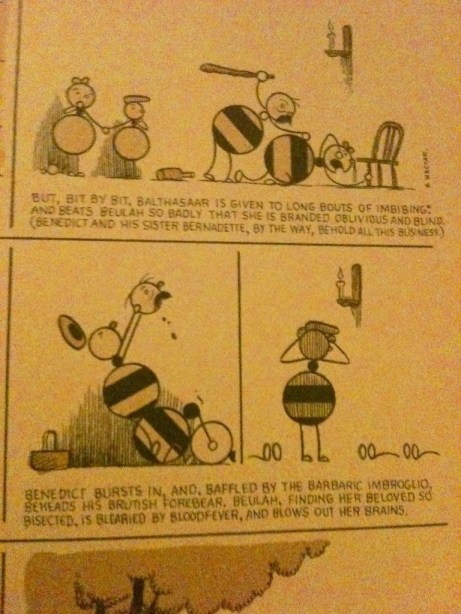
The Big Book’s theme is in fact about cross-pollination, about the ways that different strands intersect, conmingle, blend (or fail to). It’s appropriate then when our old friend Branford the bee arrives:

20121116-170533.jpg

More to come.


The Problems of Bartleby

20121112-120230.jpg

What are the problems of Herman Melville’s story “Bartleby, the Scrivener: A Story of Wall Street”?

This question seems like a bad starting place.

Let me share an anecdote instead.

—I was in the tenth grade the first time I read “Bartleby.”

At the time, I thought I was a teacher’s dream—a sharp reader, someone who loved English class, someone with opinions about the texts we read. Lots and lots of opinions. In retrospect, I realize that I was a nightmare for poor Ms. Hall, a wonderful teacher who I’m sure dreaded our meetings (there were like 15 guys in the class, all unruly).

Simply put, I didn’t want to do things her way.

So she gave me a copy of Billy Budd, Sailor and Other Stories and told me to read “Bartleby,” suggesting that there was something I might learn from it.

I don’t know if backfired is exactly the right term for the results of this experiment. I do know that “Bartleby” offered me a brilliant retort—a literary allusion!—to refuse any task I didn’t feel like undertaking in 10th grade English:

“I would prefer not to.”

—While we’re here—

“I would prefer not to”

So, this is clearly one of the problems of “Bartleby,” if not the core problem condensed into one utterance: Why would? Why the conditional?

Consider, vs. I prefer not to, a constative (or maybe even performative) utterance.

But Bartleby “would prefer not to.”

Contrast this with the imperative must that the narrator employs:

At the expiration of that period, I peeped behind the screen, and lo!
Bartleby was there.

I buttoned up my coat, balanced myself; advanced slowly towards him, touched his shoulder, and said, “The time has come; you must quit this place; I am sorry for you; here is money; but you must go.”

“I would prefer not,” he replied, with his back still towards me.

“You must.”

He remained silent.

Now I had an unbounded confidence in this man’s common honesty. He had frequently restored to me sixpences and shillings carelessly dropped upon the floor, for I am apt to be very reckless in such shirt-button affairs. The proceeding then which followed will not be deemed extraordinary.

“Bartleby,” said I, “I owe you twelve dollars on account; here are thirty-two; the odd twenty are yours.—Will you take it?” and I handed the bills towards him.

These brief lines perhaps serve to summarize Melville’s tale.

We see here the basic plot—our titular scrivener will not leave the lawyer’s office after weeks of refusing (although refusing is not quite the right word) to work.

We also see here what I take to be the theme of “Bartleby,” the strange ethical position Bartleby’s (conditional) would prefer not to places the narrator’s (imperative) must set against the moral backdrop of do unto others: namely, an impossible ethical position for a Wall Street lawyer especially and most of us in general.

And “Bartleby,” as you’ll no doubt recall, is in some ways Melville trying to work out the problems of Matthew 25:35-39—

For I was an hungred, and ye gave me meat: I was thirsty, and ye gave me drink: I was a stranger, and ye took me in:

Naked, and ye clothed me: I was sick, and ye visited me: I was in prison, and ye came unto me.

Then shall the righteous answer him, saying, Lord, when saw we thee an hungred, and fed thee? or thirsty, and gave thee drink?

When saw we thee a stranger, and took thee in? or naked, and clothed thee?

Or when saw we thee sick, or in prison, and came unto thee?

Perhaps our narrator tries to do these things—tries to feed and clothe and help this stranger Bartleby—but he can’t. Because Bartleby won’t give him an agency to relate to.

Because Bartleby’s utterance “I would prefer not to” denies the performative or constantive or declarative—indeed, it suspends or disrupts its own conditionality, the relation of the subject to its predicate verb.

Or consider one of Bartleby’s only other lines: “What is wanted?” His grammar again suspends agency, disrupts the notion of a stable I (let alone objective case me) that the narrator can interface with, dictate to, interrogate, see his own narcissistic reflection in).

—Hang on though, I was telling an anecdote. It was about the first time I read “Bartleby,” when I was fourteen or fifteen. This is the book:

20121112-150751.jpg

I stole it of course, or never returned it. Yes, that’s duct tape on its side. It is more or less falling apart. Here’s the back, barcode and all.

20121112-150740.jpg

Over the years, like many readers, I returned many times to “Bartleby,” reading it again in high school, then in college, then in grad school. I read it unassigned too, of course—when I read Kafka and it recalled itself to me, and when I read Moby-Dick for the first time. I read it when compelled. And then I read it with my own students. (I read most of the other stuff in the collection too, of course — Billy Budd and then later (why so much later?!) Benito Cereno).

I scrawled through so much of the book that my annotations are basically worthless, virtually everything underlined or circled:

20121112-151659.jpg

So we butt up against the problems of “Bartleby”—the problems of interpretation. How to figure an eponymous “hero” who is no more than a phantom, a trace, a lack? How to hash out a narrator who presents himself in relatively admirable terms and yet is so clearly an ethical failure? Why oh why would Bartleby prefer not to? Is the story a tragedy or a comedy? Does it present a world with rules, codes, ethics, or is all absurd here—nihilistic even? Is Bartleby a Christ figure? An ascetic monk? A ghost? Is the story just about Melville’s own anger over the poor reception of Pierre? How much of contemporary transcendentalist thought can we find in the story?

—Slight shift:

The kind people of Melville House were sporting enough to send a copy of “Bartleby” my way. The book is part of their HybridBooks project; these books offer “digital illuminations” along with traditional (uh, paper) books.

I’d requested a HybridBook—any one of them, really—because I now read about half the time on a Kindle Fire—so I was particularly interested in what a “hybrid” had to offer. What is the reading experience like?

First, the book itself is part of Melville House’s Art of the Novella series—beautiful, minimal design with French flaps. I read it on my porch the afternoon it arrived, enjoying its pristine, white, unmarked pages. Then, I checked out the “Digital Illuminations.”

The illuminations are available in several device-specific options, all easy to download with the QRC that comes with the book. I read most of the illuminations on my Kindle, but I also put them on my iPhone and my laptop. I had originally intended this post to be specifically about the digital illuminations, but hell, “Bartleby” is just too damn freighted a read for me at this point. Anyway, there’s a lot of good stuff in there, including “The Transcendentalist” by Ralph Waldo Emerson, selections from Jonathan Edwards and Joseph Priestly, Thoreau’s “Civil Disobedience,” and several excerpts from Melville himself, including letters, other books, and reviews. What I found must, uh, illuminating was “Of Some of the Sources of Poetry Amongst Democratic Nations” from Democracy in America by Alexis de Tocqueville. There are also illustrations, including a map; there’s even a recipe for ginger nuts. I wish that MH had included a digital copy of the book though. From a practical, concrete standpoint, I found it easier to switch between the free public domain version of “Bartleby” on my Kindle and MH’s illuminations than it would have been to pick up the physical book.

Now, to shift back (perhaps):

Do the digital illuminations help to answer or solve or address some of the problems of “Bartleby,” some of the issues posed above?

Should they?

—I suppose the hedging answer is yes and no.

The additional material illuminates some of the philosophical, political, historical, and even personal context for “Bartleby.” The material is edited with minimal intrusion, but with enough explication to clearly connect the various selections to Melville’s story. If I’m reading with my teacher hat on (this is a metaphor; there is no literal hat), I’d say you probably couldn’t do better than what Melville House has put together here. The digital illuminations provide a strong foundation for an informed reading, a range of texts that speak (obliquely or otherwise) to “Bartleby.”

Does it all add up to a deeper or richer understanding of “Bartleby”?

Should it?

—Well. No. And then no.

I mean, would we want a series of essays that would provide the missing pieces that would allow us to puzzle out “Bartleby”? Could we even trust such pieces, let alone trust ourselves to trust such pieces? Isn’t this strange uncertainty why “Bartleby” endures—and endures apart from Moby-Dick or Billy Budd, strange texts themselves, but also not nearly as confounding?

“Bartleby” simultaneously wriggles and plays dead; it burns with apparent wit but then reminds us that we might not be in on the joke. It is Kafkaesque thirty years before Kafka was even born. It shakes off its allegorical idiom the minute we think we might limn its contours. It makes us read it again because we cannot pin it down.

—But maybe you want to pin it down, tickle it, torture it, make it solve its problems (or at least respond, damn it!).

And maybe I claimed that “Bartleby” was about something—that it was about ethical relations, about duty to one’s fellows—especially when a fellow isn’t a fellow but rather the trace of a fellowthe idea of a fellowa ghost.

So, look, here’s a take on it:

The narrator—let’s call him Lawyer—Lawyer, see he’s a dick, in the parlance of our times. He’s a dick because he doesn’t know that he’s a dick, which is one of the constituting factors of the ontological state of being a dick. He also does not want to see himself as being a dick (this is another factor in the ontological state of being a dick). He wants to see himself as a good guy, this Wall Street dickhead, but Bartleby won’t let him do that. Bartleby won’t even let him see himself at all: Bartleby doesn’t reflect back. He prefers not to.

Our Lawyer, see, he’s all buttoned up, he’s snug (these are his words). He tells us upfront that he possesses “a profound conviction that the easiest way of life is the best”; he repeatedly points out the way that people are “useful” to him (or to others). He sees no possibility of an ethics outside of usefulness; on top of that, he cannot see that he cannot see any possibility of an ethics based on anything but “usefulness” (or the negative economy of obstruction figured in Bartleby).

And ah Bartleby, ah humanity: One time model employee, once apparently free from the eccentricities that plague the Lawyer’s other scriveners, Turkey and Nippers. Machinelike.

Bartleby mechanically completes large quantities of copies without comment or complaint.  But when asked to simply read in unison with Lawyer and his scriveners, Bartleby replies: “I would prefer not to.” Bartleby will not read with others—he is literally not on the same page as his colleagues.

Lawyer confronts Bartleby with his noncompliance; Bartleby repeats his mantra. Fuck mantra though because it’s not a mantra. It’s only repeated for Lawyer, to Lawyer, really, who can’t schematize/name/pin down Bartleby’s response. In fact, I would prefer not to so startles Lawyer that he says he’s  “unmanned” by the words. So he rationalizes Bartleby’s odd response, internalizes it, paraphrases it, if you like.

And then Bartleby ceases to even do his copying work. Oh the anarchy! But wait, there’s not even anarchy. There’s not even protest. There’s just big nothing. But not even big nothing—instead the smallest nothing (which proves that big nothing is possible).

So Lawyer attempts to “help” Bartleby. Lawyer believes doing so is his “Christian duty.” And to know that this duty has been met, Lawyer needs Bartleby to be his echo. But Bartleby’s I prefer not to denies this narcissistic exchange. He empties his I of ego (shades of Emerson’s Transparent Eyeball).

Confused, Lawyer tries to pay off Bartleby. When that doesn’t work, Lawyer actually packs up and moves to a new office. But even here he can’t cut off Bartleby. The office’s landlord comes to Lawyer to remove Bartleby.

And when Bartleby refuses to leave the office he is taken to “the Tombs”—prison.

Here, Lawyer tries to provide comfort for Bartleby (hearken ye back to Matthew 25:35-39). He arranges for Bartleby to receive good food in the prison. Bartleby prefers not to eat though, and dies curled up in the fetal position during a visit by Lawyer.

Lawyer is the first reader of Bartleby. But like many readers of “Bartleby,” he is confused.

Lawyer’s confusion results from his need for safety—for ease, for comfort, for a snug, buttoned-upness—and that safety is bought through an affirmation of first-person experience: namely, in the affirmation of the self in the other. That security is bought through assimilating another person’s first-person perspective. But Bartleby is empty of I, of self, of ego.

Bartleby would prefer not to: He will not be ventriloquized: He will not echo: He will not read from the same script: He will not be “of use,” as Lawyer puts it.

So Bartleby dissipates and dissolves: He goes down in the Tombs: a ghost, and impossibility, presence coupled with absence.

— And the epilogue:

We all recall the epilogue, yes?

Lawyer offers up “one little item of rumor,” a morsel, a “vague report . . . that Bartleby had been a subordinate clerk in the Dead Letter Office at Washington.” The idea tears the narrator up inside: “Dead letters! does it not sound like dead men?”

For Lawyer, Bartleby is a dead letter, a failed letter.

Did Melville worry that “Bartleby” would be a failed letter? That it would not find an audience? That his work would not be delivered? If he did, it seems too then that Bartleby’s negations foreclose or reject this concern. Not sure of how to wrap up this riff, I’ll retreat to the safety of my title.

We find the final problems (in basic narrative chronology, that is) of “Bartleby” in its final line. Has Lawyer learned from his experience? Can he empathize, finally feel something for Bartleby beyond the confines of a perceived ethical duty? Is Bartleby a place holder for all humanity? Or is Bartleby in opposition to humanity? What does it mean—-

Ah Bartleby! Ah humanity!

?
Reading Chris Ware’s Building Stories / Untitled Wordless Loop

20121109-140907.jpg

Continuing this project:

I’ve thus far titled the pieces I’ve been reading of Chris Ware’s Building Stories in a rather ad hoc fashion, but this entry is a wordless affair.

It continues the story of the “lonely girl,” the “cripple” who is the primary narrator of September 23rd, 2000.

Here, we see her raising her daughter in a series of wordless, precise panels that span roughly a decade.

Building Stories’s brilliance derives in large part from its precision and economy—Ware tells a story on every page, a chapter in every small panel:

20121109-140920.jpg

I’m a parent (my daughter is five, my son is two), and so much of this untitled piece struck me as utterly real and authentic—so true in the details.

There’s a moment when our mother looks up to see her daughter reading—silently, to herself—that is bittersweet, a kind of gentle heartbreak:

20121109-140926.jpg

There’s a fine line between the precise evocation of emotion and sentimental schlock, but Ware never comes close to treading it here—he’s always firmly on the side of the real.

And yet this doesn’t come at the expense of evocations of wonder, as we can see in the panels below:

20121109-140934.jpg

As I’ve suggested a few times already, Building Stories is a sort of  Möbius strip; this particular comic nearly literalizes this metaphor.

It begins with our mother drifting from sleep to waking memory, and ends thusly, a strange loop documenting how fast and how slow life changes.

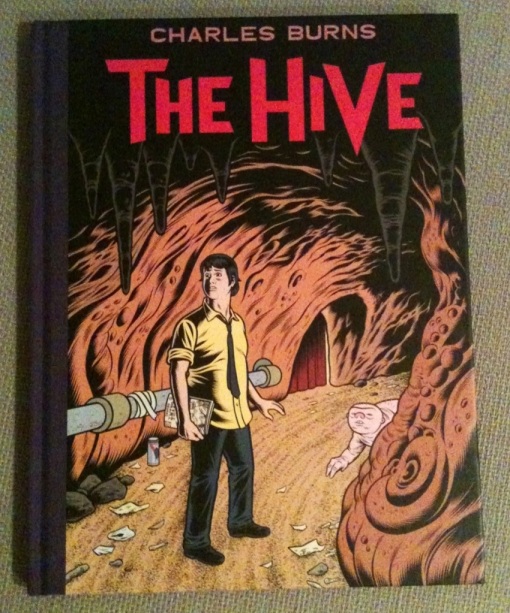
Charles Burns Enriches His Wonderfully Weird Trilogy with The Hive

20121104-183159.jpg

In X’ed Out, Charles Burns created a rich and strangely layered world focusing on Doug, a confused and injured young man. In his parents’ suburban basement, Doug parcels out the last of his late father’s painkillers, slipping from haunted memories of his relationship with Sarah into fevered nightmares of abject horror and then into a wholly other world, a realm that recalls William Burroughs’s Interzone. In this alien world, Doug takes on the features of Nitnit (an inversion of Tintin), the alter-ego he adopts when performing spoken word cut-ups as the opening act for local punk rock bands. What made X’ed Out so compelling (apart from Burns’s thick, precise illustration, of course), was the sense that this Interzone was a reality equal to Doug’s own “real world” — that it was somehow more real than Doug’s dreams.

20121104-165518.jpg

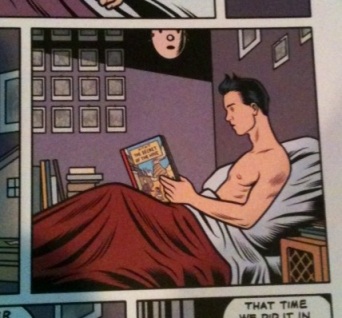
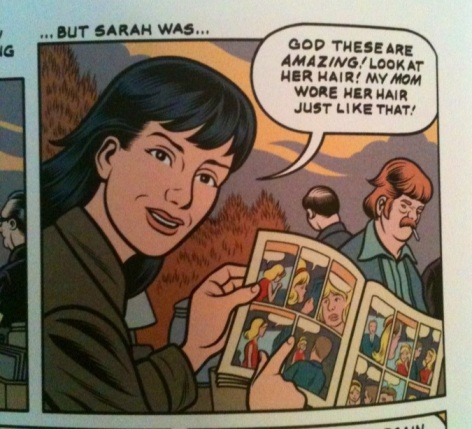
The Hive (part two of the proposed trilogy) deepens the richness and complexity of the world Burns has imagined. The title refers to a location in Interzone. Doug (or Nitnit) has found employment in The Hive as a kind of mail clerk or janitor. His primary role though is secret librarian, catering to the reading needs of the breeders of The Hive. One breeder seems to be a version of Doug’s ex-girlfriend; the other is a double of Sarah, who asks Doug/Nitnit to bring her romance comics—which he does—only he skips a few issues. These missing issues stand in for the information Doug (and Burns) withholds from the reader, the missing fragments that have been x’ed out.

20121104-165548.jpg

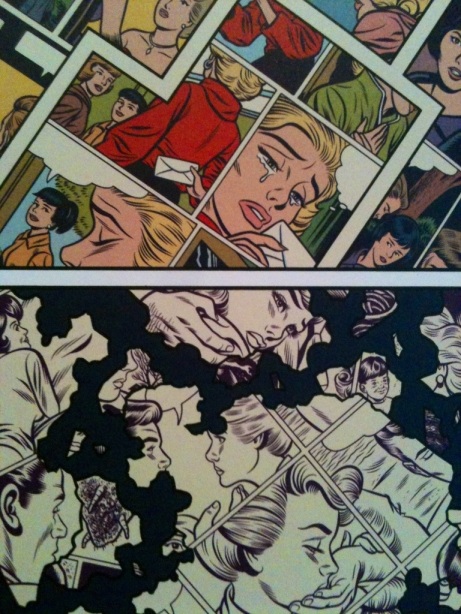
Burns uses romance comics as a framing or organizing device, a motif linking the disparate worlds of his narrative. In the “real world” — which is to say the world of Doug’s memory — we learn that he buys a stack of old romance comics for Sarah on their first date.

20121104-165537.jpg

Throughout the narrative, Burns plays his characters against the extreme, often hysterical dramas of 1950s and ’60s romance comics; his strong lines and heavy inks readily recall the early works of Simon and Kirby, but more precise and careful—something closer to Roy Lichtenstein, only more sincere, more emotional.

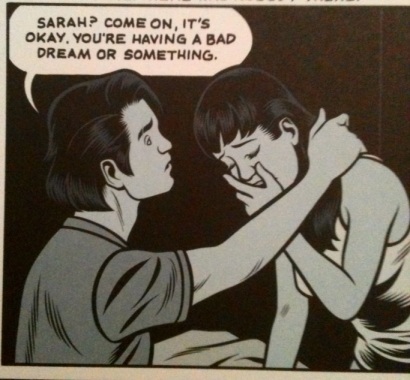
In The Hive, we learn more about Doug’s troubled relationship with Sarah, who has problems out the proverbial yingyang (not the least of which is a violent psychopathic ex-boyfriend).

20121104-165554.jpg

Burns weaves the story of Sarah and Doug’s relationship into the fallout of Doug’s father’s death—a death Doug was completely shuttered to, we realize. Doug’s drug-dreams dramatize the missing pieces of these narratives, and the Interzone set-pieces propel the mystery aspects of the narrative forward, as Doug’s alter-ego plumbs the detritus of his psychic fallout. Through the metatextual motif of reading-comic-books-as-detective-works, Burns explores themes of trauma, abjection, and distance. Images of pigs and cats, freaks and punks, portals and holes litter The Hive.

20121104-165603.jpg

Burns has always been a perfectionist of dark lines and strange visions, and his last full graphic novel Black Hole was a triumph of atmosphere and mood. With the first two entries of his trilogy, however, Burns has showed a significant maturation in storytelling, characterization, and dialogue. I often thought parts of Black Hole seemed forced or rushed (no doubt because Burns faced daunting production troubles during the decade he worked on the novel—including his original publisher Kitchen Sink folding). With X’ed Out and now The Hive we can see a more patient artist, working out an emotionally complex and compelling story in rich, symbolic layers.

I reread X’ed Out and then read The Hive in one greedy sitting; then I went through The Hive again, more slowly, more attendant to its details and nuances. We had to wait two years between X’ed Out and The Hive—and it was worth the two year wait. So if we must wait another two years—or more—for the final entry, Sugar Skull, so be it.

Reading Chris Ware’s Building Stories / September 23rd, 2000

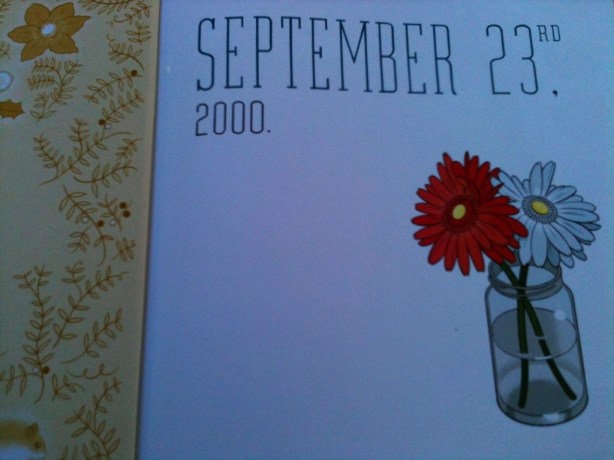
20121101-205324.jpg

September 23rd, 2000 is one of the longer pieces in Chris Ware’s box set, Building Stories. Part of the joy and frustration of Building Stories is its free form—the possibility of reading one piece before another, of getting one tale or perspective before another. I started with Branford, which seems in retrospective a fairly neutral opening—it introduces many of the themes that develop in Building Stories but none of the major characters. I then read I just met, which introduces a couple suffering a sour relationship.

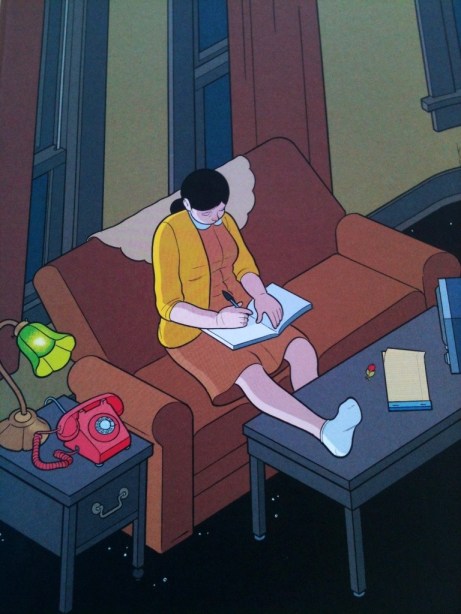
September introduces (to me, anyway), two major “new” (again, “new” to me; these characters appear central in other books and pamphlets of the collection and obliquely in others): The “lonely girl,” a would-be artist sporting a prosthetic leg, and the “old lady,” landlord of the building. Most of September takes the form of lonely girl’s diary entries.

20121101-205339.jpg

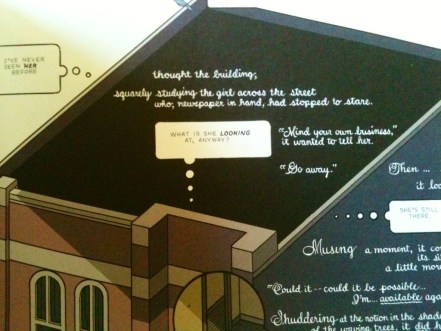
I noted two characters (again, new to me), but the building itself also gets a voice and prominent role in September; its thoughts and memories frame the narrative:

20121101-205351.jpg

September frames the repetitions, the loops, the patterns that undoubtedly will resurface throughout Building Stories. We get access to the characters dreams, which seem to overlap and echo each other—and then repeat in real life, albeit in other forms. The landlady, recalling her youth, seems to echo the loneliness and despair of the lonely girl, as well as the pain of the woman in the sour relationship. We see that the building has in fact been a kind of prison for her, preventing her from forming real relationships:

20121101-205408.jpg

Other echoes are more subtle—a close up of a bee, for instance, either foreshadows or calls back to (or both, of course) Branford, the Best Bee in the World.

20121101-205429.jpg

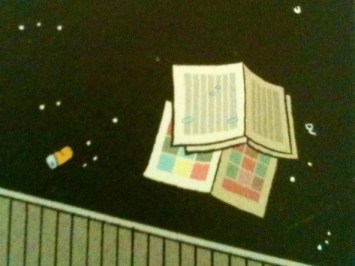
We can see the Branford episode again, here in the tiny detail of a soda can, a major setting for that episode. I was more fascinated by the newspaper though, particularly the colorful squares of a comics section, a reference Ware’s medium and perhaps a visual suggestion of Building Stories itself. The detail is tiny, but meaningful:

20121101-205421.jpg

In a later part of September, we see a direct reference to the end of I just met:

20121101-205436.jpg

I imagine that there were other references, call backs, and echoes in September that I won’t get until later.

The story—well, it’s beautiful, a perfect short story, self-contained but thematically resonant with the larger project. The ending is so damn sweet and perfect that it brought a little tear to my eye. And yet: Was that the ending? Of course not. The sense of rhetorical resolution—that is to say the so-called happy ending—will almost surely be punctured, deflated, or otherwise complicated by one of the next texts I read. More to come.

I Review The Mundane History of Lockwood Heights, a Chapbook by Allen Kechagiar

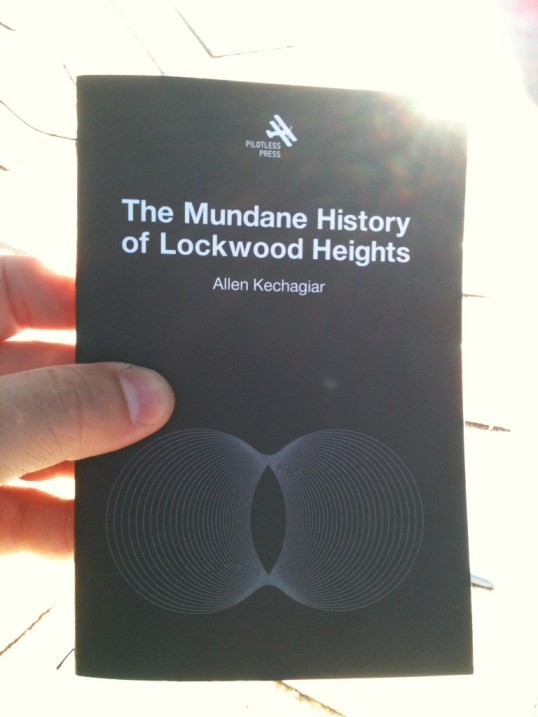
20121029-143421.jpg

“The Mundane History of Lockwood Heights” is a lovely little chapbook, new from Pilotless Press, an Athenian  outfit (uh, Greek, not Georgian) that  knows how to put together an aesthetically-pleasing text. “Lockwood Heights” is their first release. It’s by Allen Kechagiar, who, full disclosure, I’ve been email-friendly with for a several years now.

What’s “Lockwood Heights” about?

An unnamed narrator, a young man, returns to his hometown in California, the titular Lockwood Heights, “another far station, another dead end valley prone to fire, another far suburb with no other cause than the profit it would generate for its contractors.” With little going for it in a depressed economy, the citizens of Lockwood Heights allow porn production to become their town’s raison d’etre. Studios move in and the girls of Lockwood Heights soon find they can essentially auction off their virginity on camera:

They struggle to keep their virginity intact (or at any rate their parents struggle to keep it so) and hope that they will be chosen as the royal heir’s queen consort. Here, at Lockwood Heights, we had our very own race: at its finish line there was no prince to greet the winners, but a whole menagerie, or more accurately a bestiary, comprising of artificially tanned Californian would-have-beens, barely legal girls with gigantic strap-ons, transvestites and hermaphrodites, midgets and giants, obese, anorexic, effeminate, silicon-enhanced or not, all of them with a ticket to her body, standing in a metaphorical queue. A body that wasn’t hers to control anymore. The studio owned it from then on, through the unwritten contracts of promised fame that is rarely delivered.

They were also called the Treasurers or The Knights Who Say No. Their motto was non numquam. Their herald was a locked gate.

The various histories of these girls fill most of “The Mundane History of Lockwood Heights,” and as the narrator often uses the first-person plural “we” (that is, the high school boys), the story sometimes takes on a melancholy and wistful tone similar to Eugenides’s The Virgin Suicides. These are the finest moments of “Heights,” compact and precise narratives that relate the sad (and sometimes not-so-sad) lives of these girls who make porn (or, in some cases, refuse to).

It’s not just the girls of Lockwood Heights who sell their bodies on film—our protagonist comes home to sell all he has left, his “twin virginity” to be lost for a director who is sometimes called the Stanley Kubrick of porn. Scenes of the narrator meeting the casting director, his costar, and other workers on the film’s production are interspersed with the girl stories, as well as the backdrop of the narrator’s homecoming. His father has died, his mother is absent, and a strange little ersatz closet has been constructed in one of the house’s corridors. The interrelationship between these three elements is not as fully developed as it could be; I found myself wanting more. I also wanted more of the strange, aphoristic asides the narrator occasionally offers, like this one:

When we sleep we do not live in the full sense of the word. We rehearse death. Our dreams, the fallout of our daily lives, can only be remembered. They cannot be lived.

When they happen, we do not exist.

In its best moments (and there are plenty of those), “Heights” commands the reader’s attention with its bizarre mix of pathos and the pathetic, with sharp humor that threatens to tip into something more sinister. The southern California exurb Kechagiar crafts recalls the slightly off dystopias of George Saunders—the kind of place we wish were more removed from our immediate reality. “The Mundane History of Lockwood Heights” feels like the starting point of something bigger, more expansive, more detailed—and I’d want to read that something. Recommended.

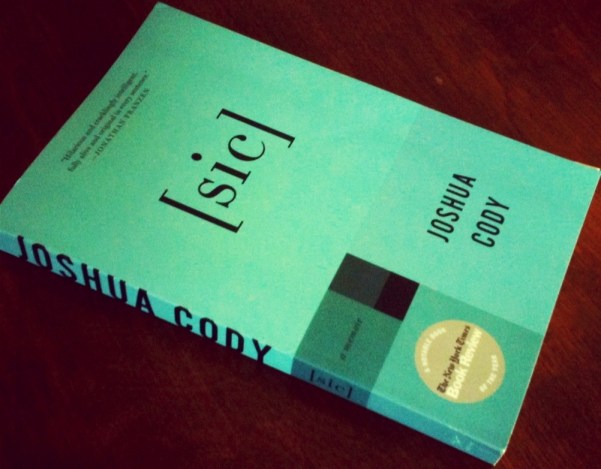
I Didn’t Like Joshua Cody’s Memoir [sic]

20121023-160233.jpg

Joshua Cody’s memoir [sic] showed up at Biblioklept World Headquarters a few weeks ago and despite my prejudices, I coasted through it over a few afternoons.

Those prejudices:

1) It’s a memoir.

2) There’s a Jonathan Franzen blurb on the cover.

3) The title [sic] is an unbearably too-clever pun (and this from a guy who loves puns).

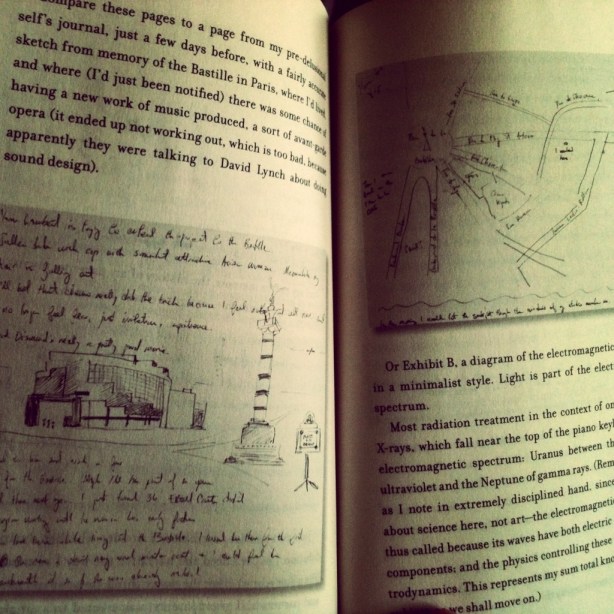
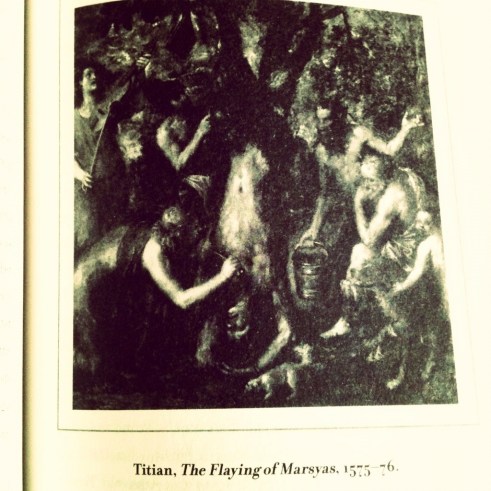
The first thing I noticed about [sic] were the pictures : paintings, maps, charts, sketches, lists, collages, other texts, and so on interspersed throughout the text. I like pictures in books.

20121023-160240.jpg

The way that Cody uses these illustrations at first reminded me of  W.G. Sebald, who employed pictures in novels like Austerlitz and The Rings of Saturn in an oblique, documentary approach.

Cody is less oblique than Sebald, and perhaps flippant too. He doesn’t namecheck Sebald, at any rate, unlike David Byrne, who openly admitted to following Sebald’s path in his 2008 memoir Bicycle Diaries. (Cody does namecheck David Byrne though).

Then I edged my way into the plot, such as it is. I’ll lazily let publisher W.W. Norton summarize:

Joshua Cody, a brilliant young composer, was about to receive his PhD when he was diagnosed with an aggressive form of cancer. Facing a bone marrow transplant and full radiation, he charts his struggle: the fury, the tendency to self-destruction, and the ruthless grasping for life and sensation; the encounter with beautiful Ariel, who gives him cocaine and a blow job in a Manhattan restaurant following his first treatment; the detailed morphine fantasy complete with a bride called Valentina while, in reality, hospital staff are pinning him to his bed.

Moving effortlessly between references to Don Giovanni and the Rolling Stones, Ezra Pound and Buffalo Bill, and studded with pages from his own diaries and hospital notebooks, [sic] is a mesmerizing, hallucinatory glimpse into a young man’s battle against disease and a celebration of art, language, music, and life.

20121023-160248.jpg

As Norton’s summary suggests, Cody’s memoir is highly discursive and playful, loaded with references to art, music, and literature. Digressions on figures like David Foster Wallace, Orson Welles, or Alexander Theroux lard the book—indeed, they often seem to edge out the story Cody intends to tell, his cancer memoir. He seems reticent to fully engage his own feelings, instead layering reference upon reference. These references become insufferable at times—are we supposed to care that Cody met David Lynch and would like to be his friend, or that Cody briefly studied ancient Greek? Cody is so busy trying to impress the reader that he forgets to express meaning.

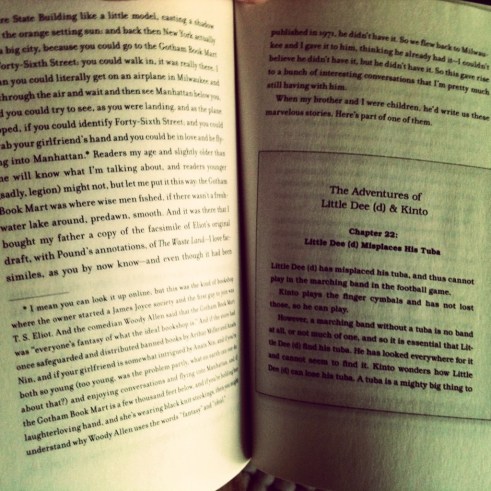
We see this reticence, this turning away from, here over two pages: Cody moves from a story about buying a facsimile copy of Pound’s notes on the original draft of The Wasteland to a lengthy footnote that manages to name drop James Joyce, T.S. Eliot, Woody Allen, Anaïs Nin, and Henry Miller (in just two sentences!) and then into a facsimile reproduction of one of the stories his brother would write for him as a child:

20121023-160254.jpg

The big problem with Cody’s memoir is that it never feels particularly real. I enjoy discursive referential postmodernism as much as the next fella, but [sic] often fails to cohere around a central idea, let alone an emotion. When Cody describes dating a stripper/dominatrix, it feels like a party trick, an inflated anecdote—there’s no emotional core, no contemplative connection to his illness. Other sexual episodes read like a parody of Henry Miller.

As its title suggests, [sic] is a dodge, a bait-and-switch, an evasion. Cody is clearly very clever—but a dazzling display of cleverness can’t sustain a narrative.

Reading Chris Ware’s Building Stories / I just met

Continuing kinda sorta where we left off

Not sure of the name of this episode, but I’ll refer to it as I just met, a phrase that repeats twice in a huge headlinish font that seems to suggest, y’know, title:

20121021-201130.jpg

I just met uses a few pages to tell the story of a deteriorating relationship—what happens when two twenty-somethings turn into two mid-to-late-thirtysomethings?

The comic opens with an establishing shot of what I take to be the building in Building Stories; we also get a glimpse of what I assume will be another character, the beehive, and a few other details that surely will attach themselves to these panels in future readings. We also get the general bitter tone of the couple’s relationship:

20121021-201139.jpg

He was one of those dudes who was once in a band; she was one of those chicks who thought guys in bands were cool.

The romance of their initial hookup is summed up neatly in the pic below; knowing Ware’s spare, precise style, the trash on the floor seems to scream symbolic detail!

20121021-201147.jpg

The hurt and disappointment in I just met unfolds over just a few painful pages—painful mostly in their concrete reality.

We know who these people are, even if we’re lucky enough not to be them.

Just as in  Branford, the Best Bee in the World , which I read earlier (although, to be clear again, there are no reading directions or prescriptions for Building Stories), there’s a theme of eternal recurrence, of mistakes playing out again and again in a painful, recursive loop.

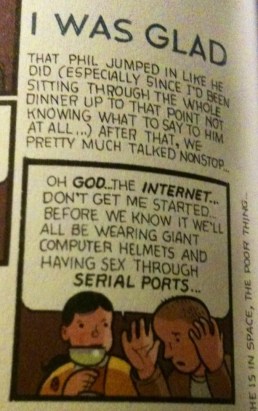
Just when Ware threatens to overstate the mundane repetitions his principals suffer, he pulls off a daring and effective move, transposing his characters into the psychic collective memory of a future that’s in many ways already familiar. The effect is simultaneously jarring and oddly reassuring—the promise that our capacity for human connection and deep empathy will never buckle under the threat of drastic technological change, but also suggesting that the cost of maintaining this emotional constant is deep, ugly pain.

20121021-201154.jpg

Reading Chris Ware’s Building Stories / Branford, the Best Bee in the World

Chris Ware’s latest collection Building Stories comprises fourteen comics of different shapes, sizes, and formats. I wrote about opening the box a few days ago, and I’ll (try to) write about reading each of the pieces.

I started with Brandford, the Best Bee in the World, the tragicomic existential dilemma of a bee:

20121018-204455.jpg

In an opening segment freighted with peril, our hero Branford finds himself “trapped in a box of hard air,” in a predicament that makes “the water run fast out of the holes in the front of his face.” When he does find a way out, he takes at as a sign of redemption from the Almighty:

20121018-204549.jpg

Branford, now free to return home to his wife and family, promises God to quit lusting after the queen bee.

Easier said than done—even if his erotic dreams are interrupted with the domestic problems of crooked picture frames, broken vases, and burnt dinners:

20121018-204517.jpg

Branford solves his domestic trouble by going out into the world to provide pollen for his family, even if it means suffering an existential breakdown of identity, one that causes him to flashback to his beeblooded past.

The flashback episode introduces heavy alliteration that continues throughout the rest of the narrative. Framed as a 19th century comic strip, it combines zany humor with horrific familial violence and suicidal despair, an unnerving, bizarre combination that carries over throughout the comic:

I won’t spoil anymore of Branford, other than pointing out that its narrative arcs in a strange loop. And even as its narrative doubles back into itself, it also points out, metatextually calling to another volume of Building Stories: here, see Branford to the right (and upside down) to a larger comic with no name.

20121018-204502.jpg

I took the visual overlap as a prompt to read the comic on the left next. How did I start with Branford and not one of the other comics? It was on top.

I Riff on Dostoevsky’s Novel Crime and Punishment

Self-portrait in Hell, Edvard Munch

1. Dostoevsky’s Crime and Punishment—

Did I read it before? In high school? Not in college, not in grad school, I’m certain of that.

That I could have read Notes from Underground in full three times, but not Crime and Punishment—how?

I vaguely recall wandering into Crime and Punishment as a young man. All those Russian names though. My attention was on other matters.

And so reading Crime and Punishment this month I repeatedly felt a strange anger or shame at all my younger selves for lacking the attention or the will or the discipline to stick it out . . . and these words, attentiondisciplinewill, they don’t seem like the right words, because the book compels, commands, rewards . . .

2. You are familiar with the plot of course:

Our hero, our anti-hero, young Raskolnikov murders a pawnbroker, an old woman; in the rush of the crime, he fails to close the door, and the pawnbroker’s innocent sister sees him. So he murders her too. The rest of the novel deals with the psychological fall out of this crime. Sure, there’s a sister and a mother, a failed marriage plot, a detective, a friend, and a love interest, a prototypical hooker with a heart of gold, etc.—but that’s it. That’s the plot.

3. What impels Raskolnikov to murder the pawnbroker?

Perhaps I shouldn’t answer here. Perhaps it’s better to suggest you just read the book if you haven’t yet—because is not this the driving question?

(Oh you’ve read the book? I’ll continue then).

4. Raskolnikov murders the pawnbroker not because he is an indigent student in need of funds. He murders her to test his theory—or rather, he murders her to test his place within the scheme of his theory.

The Murderer, Edvard Munch

5. Raksolnikov’s idea:

I maintain that all great men or even men a little out of the common, that is to say capable of giving some new word, must from their very nature be criminals—more or less, of course. Otherwise it’s hard for them to get out of the common rut; and to remain in the common rut is what they can’t submit to, from their very nature again, and to my mind they ought not, indeed, to submit to it. . . . I only believe in my leading idea that men are in general divided by a law of nature into two categories, inferior (ordinary), that is, so to say, material that serves only to reproduce its kind, and men who have the gift or the talent to utter a new word. . . . The first category, generally speaking, are men conservative in temperament and law-abiding; they live under control and love to be controlled. To my thinking it is their duty to be controlled, because that’s their vocation, and there is nothing humiliating in it for them. The second category all transgress the law; they are destroyers or disposed to destruction according to their capacities. The crimes of these men are of course relative and varied; for the most part they seek in very varied ways the destruction of the present for the sake of the better. But if such a one is forced for the sake of his idea to step over a corpse or wade through blood, he can, I maintain, find within himself, in his conscience, a sanction for wading through blood . . .

Raskolnikov believes that “extraordinary men” have the right, the duty, even, to transgress law—even to the extremes of murder (even mass murder) in order to bring about a new word, a new idiom, a new philosophy, a new paradigm, a new zeitgeist, even a New Jerusalem.

Raskolnikov wants to know if he is one of these “extraordinary men.”

6. But Raskolnikov, like Macbeth or a figure out of Poe, is plagued by doubt, misgiving—and more than a touch of insanity and egomania.

His instability and his psychological and moral dilemma is summed up neatly in only the second chapter of the book:

“And what if I am wrong,” he cried suddenly after a moment’s thought. “What if man is not really a scoundrel, man in general, I mean, the whole race of mankind—then all the rest is prejudice, simply artificial terrors and there are no barriers and it’s all as it should be.”

7. The word or an iteration of the word psychology appears 25 times in the Constance Garnett translation I read.

Crime and Punishment was published in 1866, when Sigmund Freud was ten years old.

(I am not naively/stupidly suggesting that Freud invented psychology, by the way. I’m just riffing).

8. What Crime and Punishment does so well:

Harnesses the intellect of its protagonist Raskolnikov, shows us his fevered mind in revolution, shifts us through his moods and dilemmas and despairs and strange joys.

9. And it’s not just the interior of Rakolnikov’s skull we get such access to—Dostoevsky gives our lead a marvelous, taunting foil in the detective Porfiry, a loyal and empathetic counterpoint in friend Razumikhin, a despicable enemy in the poseur Luzhin, and a dark-future forecast in Svidrigaïlov.

Each of these characters represent viewpoints and attitudes about psychology and morality without ever falling into being mere allegorical sketches or mouthpieces for Dostoevsky’s ideas.

10. Dostoevsky—unlike certain contemporary novelists I’ll neglect to name—doesn’t tell us that his character is brilliant (or troubled, or confounded, or fucked up). And he goes beyond showing us—he actually lets us experience the character’s psychology.

11. A marvelous, frightening episode that illustrates point 10:

Raskolnikov’s horse dream.

Despair, Edvard Munch

12. This isn’t to say that Dostoevsky’s handling of characterization is flawless.

His women appear less fully-realized than his men, as if he perhaps cannot inhabit their minds so fully or exercise their brains, their souls, their voices.

Raskolnikov’s sister Dunya, for example, is a bold, more perfect, more more moral, more stable version of her brother, a woman who seems able to withstand conflict, disappointment, and misfortune with ease—too much ease. Raskolnikov’s mother, in contrast, is something of an idealized blank—not just a mother, but the mother figure: nonjudgmental, loving—her character summed up in her hugging her son and forgiving him for what she cannot forgive

It’s the depiction of Raskolnikov’s love interest Sonia that I find most troubling though. Dostoevsky renders her an unsubtle merging of the Virgin Mary with Mary Magdalene. Her alcoholic father forces her into prostitution to save the family, but she never appears bitter or angry or even upset. Dostoevsky rarely affords her a speaking role, and in her biggest scene she reads the entire parable of Lazarus. Sure, she makes the words her own, but she’s being ventriloquized. The strings show. She’s pure symbolism, really, and stands in stark contrast to the dark, flawed humanity of Raskolnikov.

13. Re: Point 12 above: If Dostoevsky shows a certain weakness in his depiction of women, he perhaps compensates in other areas. For example, Luzhin’s roomate Andrey Semyonovitch, a utopian socialist, serves as a mouthpiece for emerging feminist ideas. And if Dostoevsky mocks would-be reformers in his novel, it’s not always with vitriol, but sometimes with understanding, and even perhaps love. After all, this is Raskolnikov’s pretension—to be a reformer of others, to step over the line of law, to be a great man.

14. But Raskolnikov is a failed reformer, or at least is unable to live with his trespass, his sin. Crime and Punishment’s epilogue emphasizes the Jesusian theme of the possibility of resurrection, even as it subdues or complicates that possibility.

We get the final image of Raskolnikov “mechanically” taking up Sonia’s copy of the New Testament; he doesn’t open it to read, but instead reflects on the possibility of a new life with Sonia, a life that “would cost him great striving, great suffering.” Dostoevsky does not let his protagonist off the hook, even as he offers the reader a final comforting vision of “the gradual renewal of a man, the story of his gradual regeneration, of his passing from one world into another, of his initiation into a new unknown life.”

15. There’s a strong temptation to see the epilogue as tacked on, as a sentimental gesture to the reader’s sense of stable morality, as a bit of window dressing that covers the ugliness of the narrative.

And perhaps this is true.

I’d argue though that Dostoevsky gives us a cold, ugly ending in the figure of Svidrigaïlov, who more or less commands the final moments of the narrative, moments that lead inexorably to his suicide—the self-erasing gesture that Raskolnikov cannot commit to. I think that Svidrigaïlov’s suicide might stand as a placeholder for Raskolnikov’s—an exchange of sorts.

And Svidrigaïlov’s death is not without a small measure of redemption—the redemption of other-directedness, of giving, of selflessness. It is far more complicated and troubling than the Jesusian resurrection that Dostoevsky implies as a possibility for Raskolnikov, but it also strikes me as far more real.

Three Notes on Thomas Bernhard’s Novel Correction (Plot, Prose, and a Riff)

1. Thomas Bernhard’s novel Correction is nominally the story of an unnamed narrator who leaves England after a severe illness to return to his native Austria to “sift and sort” the writings of his childhood friend Roithamer.

Roithamer, a brilliant but insane scientist, is the self-exiled son of an old, wealthy family. He uses an unexpected inheritance to fund an idealistic project: the building of a perfect Cone in the isolated heart of the Kobernausser forest. Roithamer envisions this Cone as the perfect home for his sister to live in (although he doesn’t bother to actually, y’know, talk to her about it). Roithamer’s sister dies almost immediately after taking up residence in the Cone. Roithamer then commits suicide.

Correction is divided into two sections, each a single, long, dense paragraph with no text break for the reader to rest upon. Bernhard’s sentences wind and unwind and rewind, sometimes snaking out for pages at a time; like Samuel Beckett, to whom he is often compared, Bernhard is a master of the comma splice. The effect is exhausting.

The first section of Correction is “Hoeller’s Garret,” named after the novel’s primary physical setting. Hoeller is a taxidermist who has built his own house in the Aurach gorge as a sort of dare to nature itself. Hoeller’s house inspires Roithamer’s Cone, and Hoeller’s garret becomes Roithamer’s work space—which is to say thinking space—for planning and executing his idealistic project.

Following Roithamer’s suicide, the unnamed narrator too moves into Hoeller’s garret, one of many formal repetitions in Correction (these formalizing plot repetitions are echoed in Bernhard’s syntactic repetitions).

In “Hoeller’s Garret” we learn about the childhood friendship between the narrator, Hoeller, and Roithamer. The paragraph (or chapter, if you will) includes details about Roithamer’s troubled family as well as an early horrific encounter with death, themes that will repeat throughout the novel.

The second section, “Sifting and Sorting,” finds the narrator working though Roithamer’s (mostly autobiographical) papers. The narrator appends a simple tag like “thus, Roithamer” or “so Roithamer” as attribution to Roithamer’s first-person statements, but this device pops up less and less as the book progresses, and it becomes clear that Roithamer has ventriloquized the narrative.

“Sifting and Sorting” focuses on Roithamer’s unhappy childhood, his endless fights with his mother, and his wish to perfect an idealization (namely, his Cone). The narrator channels Roithamer who channels the voices of his mother and father (and occasionally his detested brothers)—and of course, the reader channels all. The narrator slowly gives over to Roithamer’s voice as the novel’s final pages rush out in a series of diary entries, and Bernhard’s taxing syntax performs a mesmerist act on the reader, who, stunned, must return to the text in yet another repetition.

2. I’ve thus far failed to illustrate any of the above claims with an example of Bernhard’s prose.

It’s possible to plunder Correction for tight phrases, sharp, dark aphorisms, and other little bits of strange wisdom, but that doesn’t really convey the effect of what it’s like to read Bernhard’s sentences.

Better then to offer an example. Here’s the novel’s second sentence, via its English translator, Sophie Wilkins:

The atmosphere in Hoeller’s house was still heavy, most of all with the circumstances of Roithamer’s suicide, and seemed from the moment of my arrival favorable to my plan of working on Roithamer’s papers there, specifically in Hoeller’s garret, sifting and sorting Roithamer’s papers and even, as I suddenly decided, simultaneously writing my own account of my work on these papers, as I have here begun to do, aided by having been able to move straight into Hoeller s garret without any reservations on Hoeller’s part, even though the house had other suitable accommodations, I deliberately moved into that four-by-five-meter garret Roithamer was always so fond of, which was so ideal, especially in his last years, for his purposes, where I could stay as long as I liked, it was all the same to Hoeller, in this house built by the headstrong Hoeller in defiance of every rule of reason and architecture right here in the Aurach gorge, in the garret which Hoeller had designed and built as if for Roithamer’s purposes, where Roithamer, after sixteen years in England with me, had spent the final years of his life almost continuously, and even prior to that he had found it convenient to spend at least his nights in the garret, especially while he was building the Cone for his sister in the Kobernausser forest, all the time the Cone was under construction he no longer slept at home in Altensam but always and only in Hoeller’s garret, it was simply in every respect the ideal place for him during those last years when he, Roithamer, never went straight home to Altensam from England, but instead went every time to Hoeller’s garret, to fortify himself in its simplicity (Hoeller house) for the complexity ahead (Cone), it would not do to go straight to Altensam from England, where each of us, working separately in his own scientific field, had been living in Cambridge all those years, he had to go straight to Hoeller’s garret, if he did not follow this rule which had become a cherished habit, the visit to Altensam was a disaster from the start, so he simply could not let himself go directly from England to Altensam and everything connected with Altensam, whenever he had not made the detour via Hoeller’s house, to save time, as he himself admitted, it had been a mistake, so he no longer made the experiment of going to Altensam without first stopping at Hoeller’s house, in those last years, he never again went home without first visiting Hoeller and Hoeller’s family and Hoeller’s house, without first moving into Hoeller’s garret, to devote himself for two or three days to such reading as he could do only in Hoeller s garret, of subject matter that was not harmful but helpful to him, books and articles he could read neither in Altensam or in England, and to thinking and writing what he found possible to think and write neither in England nor in Altensam, here I discovered Hegel, he always said, over and over again, it was here that I really delved into Schopenhauer for the first time, here that I could read, for the first time, Goethe’s Elective Affinities and The Sentimental Journey, without distraction and with a clear head, it was here, in Hoeller’s garret, that I suddenly gained access to ideas to which my mind had been sealed for decades before I came to this garret, access, he wrote, to the most essential ideas, the most important for me, the most necessary to my life, here in Hoeller’s garret, he wrote, everything became possible for me, everything that had always been impossible for me outside Hoeller’s garret, such as letting myself be guided by my intellectual inclinations and to develop my natural aptitudes accordingly, and to get on with my work, everywhere else I had always been hindered in developing my aptitudes but in Hoeller’s garret I could always develop them most consistently, here everything was congenial to my way of thinking, here I could always indulge myself in exploring all my intellectual possibilities, here my intellectual possibilities, here in Hoeller’s garret my head, my mind, my whole constitution were suddenly relieved from all the outside world’s oppression, the most incredible things were suddenly no longer incredible, the most impossible (thinking!) no longer impossible.

If you’re interested, that’s 722 words (I wrote about 500 words before Bernhard’s sentence, if you need a point of contrast).

The repetition is easy to note even by absently gazing over the passage. The repeated phrase “Hoeller’s garret” stands out in particular, introducing the reader to the novel’s primary setting and establishing this “ideal place” in context against Altensam (the hated aristocratic home), England (self-imposed exile of a sort), and the Cone (the ideal ideal place).

We can also track a subtle shift in the final third of the sentence, as Roithamer’s voice ventriloquizes the narrator’s. Note how in the first third of the sentence, the narrator employs the first-person pronoun “I” which soon disappears in the middle third to be replaced by “he” (referring to Roithamer), until finally transforming into an “I” again in the final third—only this “I” is Roithamer’s “I.” This sentence demonstrates not only the demanding sentence structure that characterizes Correction as a whole, but also its narrative program of ventriloquism.

3. Okay. So I’ve offered plot summary, a lump of text, and a few comments on Bernhard’s prose—but I’ve hardly made a go of untangling the knotty density of Correction. (Although is that really what I came here to do? I don’t know. I hope not). Here are some stray, loose thoughts on Correction, offered here with little support (and the vague promise that I’ll write more about Correction in the future—shorter, more focused posts that hopefully expand on these ideas):

Correction shows how idealism, and specifically the will to create and perfect the ideal, leads to breakdown, death, insanity, suicide.

The Cone is a massive idealized phallus that reduces the agency of Roithamer’s sister, isolates her, and becomes her tomb.

Roithamer is part of a long tradition in literature of strange sister-lovers, dudes who dote on—and idealize—their sisters too much.

Roithamer seems to suffer from a sort-of reverse Oedipus complex, where he identifies with the strength of his father and hates his mother, who he sees as a cultural philistine, lower class, anti-intellectual. This complex leads to chauvinism against women in general, and possibly prevents him from better understanding his sister, who he essentially imprisons.

Correction reminded me often of Poe’s story “The Fall of the House of Usher.”

Correction reminded me often of W.G. Sebald’s novel Austerlitz, although Correction obviously came first, and Sebald clearly cited Bernhard as an influence.

At some of its rantier points, Correction reminded me of Notes from Underground.

Correction took me forever to read, mostly because every time I picked it back up I had to twist my way into its circular, repetitive rhythms anew. Lots of rereading.

My auditory imagination: In time, it was Werner Herzog’s voice that read Correction to me.

Correction performs its own deconstruction.

Correction is often so scathing and harsh in its treatment of humanity as to be difficult to swallow. One has to step back repeatedly and remind oneself that Roithamer is not sane.

Correction is also very, very funny at times—astonishingly so, even. Its humor is truly absurd, the absurdity of a parent’s funeral, or the absurdity of simply having to go on. I can’t help but cite a favorite line here—“waking up is the always frightening minimum of existence.”

The other side of “waking up is the always frightening minimum of existence” is of course death in general, or suicide in particular. Correction posits suicide as the ultimate correction, the final clearing gesture. The ideal.

And, not a thought on Correction, but a question for readers: What next? — ConcreteThe Loser, or Yes?

The Hobbit Reconsidered as a Picaresque Novel

Making a weekend trip from the east coast of Florida to its Gulf shores, my family and I listened to Nicol Williamson’s early 1970s recording of J.R.R. Tolkien’s The Hobbit. Williamson’s recording is rich and expressive, his command of each voice bringing Tolkien’s characters to life.

I first heard Williamson’s recording over twenty years ago on a series of LPs that I checked out from the library. I had probably already read The Hobbit half a dozen times by then, but Williamson’s sonorous voice—along with the music and audio production effects—added another layer to Middle Earth.

My daughter, five, already familiar with the 1977 Rankin-Bass film, had no problem keeping pace with the story (although she occasionally asked me to pause for clarification on a few finer points, such as the delicate distinctions between goblins and trolls, or just who exactly is this guy Bard who shows up all of a sudden?) My favorite part of the entire weekend was my two year old imitating Gollum, sniveling a sinister, “My precious!” while squinting gleefully.

There are few books I’ve read as many times as Tolkien’s The Lord of the Rings trilogy: I read it countless times between the ages of 11 and 15, read it again as an undergrad, then read it again–twice, I’m not ashamed to admit—when Peter Jackson’s adaptations came out. However, despite reading The Hobbit repeatedly as a kid, I’ve never really gone back to it. It traffics in a gentle folklore that seems out of square with the epic mythmaking in The Lord of the Rings, and I think that I was always unsettled by a certain discontinuity between the two books that was easier to ignore if I never went back to The Hobbit.

Memory has a way of eliding details, and books are especially susceptible to this wearing down and smoothing out. So, I remembered The Hobbit as a quest, a miniature epic with Bilbo Baggins leaving the comforts of home to find treasure guarded by the dragon Smaug. I remembered Gandalf and the thirteen dwarves invading Bilbo’s tidy hobbit hole; I remembered trolls who turn to stone; I remembered riddles with Gollum and a ring that turns its wearer invisible; I remembered Mirkwood and barrels and the mountain lair of a dragon. I vaguely remembered the Battle of Five Armies, where the enormous eagles literally swoop in and save the day, deus ex machina style.

Listening to the unabridged audio, I was struck by just how much had escaped my memory: I barely recalled the spiders of Mirkwood or the talking ravens or the part where the wargs tree the dwarves. I had completely forgotten the shapeshifter Beorn, a creature straight out of Scandinavian myth.

One of Tolkien’s original illustrations for The Hobbit

What I found most strange in revisiting The Hobbit though was its radical compression, its tendency and willingness to pivot sharply, to cast its characters about or trample them under (metaphorical and sometimes literal) foot, or throw them in dungeons or barrels or some other danger.

Whereas The Lord of the Rings progresses from the folkloric feel of The Shire through to the high-adventure sweep of Icelandic saga and ultimately to a King Jamesish condensation of near-pure archetypery (and back again, of course), The Hobbit showcases a rambling, flowing, discursive, “out of the frying pan, into the fire” rhythm.

In short, The Hobbit, as it turns out, is a picaresque novel.

And just what is a picaresque novel, and why is The Hobbit one?, you may or may not ask.

Michael Seidel offers a clear definition in his introduction to Daniel Defoe’s Moll Flanders (an excellent picaresque, by the way):

. . . the tradition of Continental picaresque, or rogue, literature . . .  became popular throughout Europe with the publication of Lazarillo de Tormes (1554) in Spain. Picarós and picarás are orphans, vagabonds, desperadoes, and reprobates trying to manipulate the conventions of a world largely determined by established family and class connections. . . . Picaresque fiction is the story of outsiders trying to get in, and the fortunes of the protagonist often depend on adaptable, protean, and duplicitous behavior as picaresque characters become who they need to be to survive.

The Hobbit is very much the story of the topsy-turvy turns of Bilbo Baggins’s identity. At the adventure’s outset, he’s a respectable—comfortable—Baggins of Bag End. Not the sort of fellow who goes on adventures. And yet he’s enlisted by Gandalf to serve as burglar for the expedition, a picaró in the making who steals a purse from a troll and never looks back.

It’s not just Bilbo’s various thefts, but also his “adaptable, protean, and duplicitous behavior” that marks him as a picaró. His scheming is evident repeatedly in the novel, whether he’s riddling with Gollum or Smaug, devising a breakout from the Elf King of Mirkwood’s dungeon, or playing the long con against the parties involved in the Battle of Five Armies. He echoes Gandalf in this way, whose talents seem to veer more toward trickery and cunning than dazzling spells or marvelous magic.

Bilbo’s picaresque turns of fortune and turns of identity are neatly summarized in a late exchange with yon dragon Smaug, who immediately calls him out as a picaró:

“You have nice manners for a thief and a liar,” said the dragon. “You seem familiar with my name, but I don’t seem to remember smelling you before. Who are you and where do you come from, may I ask?”

“You may indeed! I come from under the hill, and under hills and over the hills my paths led. And through the air, I am he that walks unseen.”

“So I can well believe,” said Smaug, “but that is hardly our usual name.”

“I am the clue-finder, the web-cutter, the stinging fly. I am chosen for the lucky number.”

“Lovely titles!” sneered the dragon. “But lucky numbers don’t always come off.”

“I am he that buries his friends alive and drowns them and draws them alive again from the water. I came from the end of a bag, but no bag went over me.”

“These don’t sound so creditable,” scoffed Smaug.

“I am the friend of bears and the guest of eagles. I am Ringwinner and Luckwearer; and I am Barrel-rider,” went on Bilbo beginning to be pleased with his riddling.

“That’s better!” said Smaug. “But don’t let your imagination run away with you!”

But imagination is of course the primary tool of the picaró, and Bilbo is no slouch: The Hobbit condemns evil, greedy Smaug when it shows the rewards of letting “your imagination run away with you.” Indeed, the entire novel is a running away, a constant deflection of stable identity, as Bilbo twists and turns his way back to The Shire.

And what happens to Bilbo? What happens to that once-stable, once-comfortable identity? We learn at the novel’s end about the queering of his identity—

. . . he had lost his reputation. It is true that for ever after he remained an elf-friend, and had the honour of dwarves, wizards, and all such folk as ever passed that way; but he was no longer quite respectable. He was in fact held by all the hobbits of the neighbourhood to be ‘queer’—except by his nephews and nieces on the Took side, but even they were not encouraged in their friendship by their elders. I am sorry to say he did not mind.

So! Queer, strange Baggins the  picaró embraces his “Took side,” his disreputable adventuring side. And still the narrative comes to a lovely cozy warm respectable ending, Bilbo’s identity transformed, sullied, illuminated, and enlarged by his picaresque adventure.

And the picaresque? Well, maybe I’ve stretched its definition a bit simply because I’m so fond of picaresque narratives these days. Maybe I’ve simply revisited a childhood classic and imposed a new viewpoint upon it. (And maybe years and years from now I’ll revisit it again with grandchildren, and find something new and different there as well. I hope).

I think what I enjoyed most about The Hobbit this time was hearing the rambling discursiveness of it all—here we have a narrative that understands the perilous and precarious position of the storyteller, he or she who might lose the thread—or worse, lose the audience!—at any damn time. So keep the story sailing, shifting, rambling out into new moods, modes, movements.

Seidel gives us a lovely definition of picaresque above, but can’t do better than Ralph Ellison who, in describing his modernist classic Invisible Man, offers us a description of the picaresque as “one of those pieces of writing which consists mainly of one damned thing after another sheerly happening.”

And this is the power of The Hobbit—which is to say the staying power of The Hobbit—its ability to evoke the imaginative force of one damned thing after another sheerly happening for generation after generation.

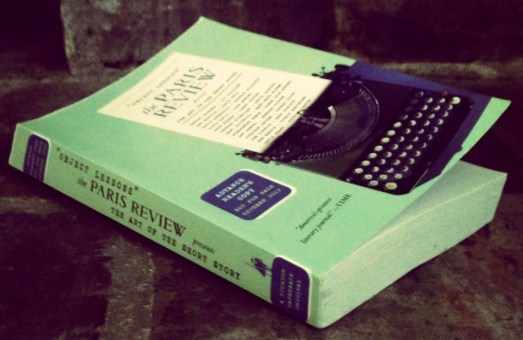
I Review Object Lessons, Where 20 Contemporary Authors Select and Introduce 20 Short Stories from The Paris Review

20120902-135314.jpg

Object Lessons anthologizes 20 stories published in the Paris Review over the past fifty years. “It is not a greatest hits anthology,” advises the brief editor’s note, “Instead, we asked twenty masters of the genre to choose a story from the Paris Review archives—a personal favorite—and to describe the key to its success as a work of fiction.” Hence, we get Ann Beattie introducing Craig Nova’s “Another Drunk Gambler,” Amy Hempel introducing Bernard Cooper’s “Old Birds,” and Sam Lipsyte introducing Mary Robinson’s “Likely Lake.”

Most of the introductions are short—most are fewer than three pages—and each author approaches his or her selection differently. Ben Marcus, prefacing “Several Garlic Tales,” tells us that, “Donald Barthelme was a magician of language, and it would be most respectful, perhaps even ethical, not to look too closely into the workings of his magic.” Marcus proposes a few approaches to find meaning in Barthelme’s surreal tale, but never over-explicates. In contrast, Lydia Davis’s surprisingly long intro to Jane Bowles’s “Emmy Moore’s Journal” is a sentence-to-paragraph close reading; Davis interrogates Bowles’s diction and syntax and concludes her little essay by situating Bowles’s (underappreciated) place in the canon. Davis’s insights are compelling, but one wonders if they wouldn’t be better appreciated after reading the story.

Davis also appears as author of one of the selected stories—Ali Smith picks Davis’s excellent number “Ten Stories from Flaubert.” Smith’s intro is wonderful, explaining the genesis of “Ten Stories,” which “came about when Davis (who is also a translator) was working on a a new translation of Madame Bovary and reading through Flaubert’s letters to his friend and lover Louise Colet.” I’m a huge fan of Lydia Davis, whose work defies easy definition. Smith wonders about her selection: “Are they translations? Are they by Flaubert? Are they by Davis?” The questions are better than answers.

Occasionally an author veers close to spoiling the story he introduces, as does Jeffrey Eugenides when he gracelessly steps all over Denis Johnson’s already-much-anthologized classic “Car Crash While Hitch Hiking.” Elsewhere, Jonathan Lethem mashes and minces misplaced metaphors in his confusing and forgettable introduction to Thomas Glynn’s story “Except for the Sickness I’m Quite Healthy Now. You Can Believe That.” Lethem’s sloppy, unrestrained attempt to dazzle is regrettable. He’s like the warm-up act that tries too hard to show up the headliner and winds up falling on his face.

For the most part though, the introductions simply allow readers new ways to see a story they’ve perhaps read before, as in Aleksandar Hemon’s preface to Jorge Luis Borges’s “Funes the Memorious” or David Means’s preface to Raymond Carver’s “Why Don’t You Dance.” Means suggests that “A great story is like an itch that has to be scratched eternally . . . We’re left with more questions than answers, and more answers than questions; therefore, the paradoxical quality of a good story is that it seems to give us everything we need and yet not quite enough to fulfill a sense of having been shown a full life.” Surprisingly good is Dave Eggers’s intro to James Salter’s “Bangkok,” which reads almost like a loose riff of notes that a harried but talented adjunct might bring to his Creative Writing 101 workshop. Eggers showcases keen intuition about Salter’s narrative coupled with an eagerness that makes one want to read the story.

And what about those stories? If I’ve focused more on the introductions than the stories themselves, it’s perhaps because I’ve taken for granted that the selections are solid for an anthology. Sure, any reader might have his or her gripes, but the range of talent here is undeniable, and the spectrum of stories is satisfying. Object Lessons would make a fine addition to the syllabus of any beginning writing course, and any young person interested in honing her craft could do worse than attending the examples collected here. To be clear, Object Lessons is in no way some master course in How to Write a Short Story, but it does provide the most valuable writer’s tool—good reading.

The Ring Game — Agency and Chance in Season Four of The Wire

I. In his essay “All in the Game” at The Oxonian Review of Books, Clif Marks points out that

Before the opening credits of the first episode, The Wire introduces its main themes of capitalism, violence, and decay, as well as the trope of the game. The murder of Snot Boogie over an alleyway dice game is the problem of urban America writ small, and The Wire spends the next five seasons elaborating the theme on a progressively broader canvas.

II. As Marks suggests, the scene explicating Snot Boogie’s robbing the dice game—the opening of The Wire—somehow encapsulates the entire series. Here’s the scene:

III. Later in “All in the Game,” Marks analyzes the way The Wire uses “the game” as a dominant formalizing conceit. I’ll quote at length:

The first institutions so portrayed are the police department and the drug trade, which is aptly called “the game” by all of its participants and those in the world surrounding it. At every level the game provides certain goals to its players who are governed by strictly enforced rules of conduct. The drug trade is organised in the form of a bureaucratic hierarchy, and even spawns its own particular ideology through which participants justify their own actions, and interpret and evaluate the acts of others.

The “game” operates as a metaphor for all institutions. In addition to its role as adversary in the drug game, the police department is also the setting for a second game of career advancement, which is entirely controlled by appearances. Crime statistics must be shown to be dropping, whether or not there is any real effect, and anything which might embarrass the higher-ups must be concealed. Likewise, educators’ teaching strategies are largely controlled by the need to perform on standardised state testing on which their funding, and local control of the school, depends. Thus, the explicit aims of public institutions are subverted by internal games that they set up. Even well-intentioned cops and teachers are forced to play bureaucratic games in order to survive in their organisations.

IV. I’ve spent points I-III of this essay trying to contextualize what anyone who’s seen The Wire probably already knows—namely, The Wire can be understood as a series of games folded into one ultimate game—the game—where the rules, the players, and the stakes are repeatedly displaced. I think that Marks’s essay is a particularly salient analysis of the costs that institutions and individuals alike incur playing such a game, and the extractions above, along with the first clip of The Wire might entice anyone who hasn’t seen the show to check it out. It’s great. In fact, it’s as great as everyone says it is.

The following points of this essay will trace a game piece that slips through various players’ hands in season four of The Wire. My argument is that “the game” is not merely an operational metaphor for the institutions depicted in The Wire, but an inescapable ideology that permeates every aspect of The Wire’s universe. Put another way, it’s not possible to not play “the game.” And while it is possible to affect change in “the game”—even to change its rules—individual agency is always susceptible to chance or chaos (or fate, if you prefer), which most likely comes in the form of some other player’s assertion of agency.

There are significant spoilers in the rest of this essay; I suggest not reading anymore if you haven’t yet seen The Wire but intend to see it at some point.

V. In season four, a large ring catches the eye of several players. This game piece changes hands through instances of both agency and chance. A compilation of all the ring exchanges exists as one YouTube clip, but I’m going to belabor the point by handling one exchange at a time (hat tip to Read Jack for having already organized these clips and making my work easier):

VI. Old Face Andre to Marlo:

The ring initially belongs to Old Face Andre (the verb “belongs” should be placed under suspicion, of course). “I’ve had it for a long time now; it’s got some sentimental values,” he reports to Marlo, who immediately and coldly dismisses sentiment, demanding instead, “What’s the real value?” Andre, already owing a debt to Marlo, tries to deflect the conversation by claiming he doesn’t know the ring’s appraised value. Marlo, a sinister bully, says “I’ll find out for you” before essentially forcing Andre to hand over the ring that had so much “sentimental value” to Andre.

Marlo’s promise is ironic beyond his (not-so) coded intention to steal the ring from Andre: He will, in some way, become an arbiter for the “real value” of the ring.

VII. Let’s step outside of the ring narrative for a moment to consider Marlo’s question again: “What’s the real value?”

The ring is a wholly appropriate game piece to illustrate the strange contours of the game in The Wire precisely because of its apparent superfluity. Let’s contrast the ring with another symbolic item from The Wire, the nailgun that Snoop buys in the opening scene of season four:

Besides delivering the horror/comedy axis that seems to mark all of Snoop’s scenes, the nailgun purchase also demonstrates some basics of capitalism. The nailgun, in contrast with the ring, is not superfluous. Furthermore, not only can the nailgun’s value be fixed, so too can the services of the home store employee (“You earned that bump like a motherfucker”). So even when Snoop appears to break the rules of the store’s game, she’s actually reifying the essential rules of the game by paying appropriately for goods and services.

In contrast, the ring’s value isn’t so much constituted by the game (like the nailgun’s value)—instead, the ring’s value constitutes the rules of the game itself. We can see this ideological operation more clearly in the ring’s transfer from Marlo to Omar.

VIII. Marlo to Omar:

Omar robs the card game (need I remark the meta-structure here?). Marlo says that the money being stolen is his money, to which the Robin Hood figure retorts, “Money ain’t got no owners, only spenders.” This is clearly one of the rules of the game, although by rules what I really mean to say is structuring properties, a structuring property that Omar demonstrates by robbing the card game. Tellingly, Omar repeats Marlo’s gesture in his attraction to the ring, which arrests his attention momentarily.

IX. Omar to Officer Walker:

Dirty Officer Walker (perhaps the most evil character in season four) arrests Omar for the convenience store murder Marlo’s outfit has staged. Omar insists there are “rules to this here game”; Walker repeats “Rules?” and throws Omar violently to the ground. By apparently breaking the rules of the game, Officer Walker of course demonstrates the existence of such rules. Omar is not the first to observe that Walker is in violation of the rules to the game. However, there is no authority for the players to appeal to—the game is the authority.  Hence, the game is self-regulatory (it cannot be otherwise), and Officer Walker’s rule-breakings will be punished.

X. Officer Walker to Michael:

The boys at the heart of season four (I wrote about them earlier) humiliate Walker by throwing paint on him. Michael repeats the same gesture of arrested (if brief) attention when his gaze falls on the ring. Significantly, he unmasks himself at the same moment he steals the ring—from a police!—suggesting the revelation of true/new identity at this moment.

Let’s backtrack:

When Marlo takes the ring from Andre, the act isn’t so much a theft as it is an assertion of agency, or, more to the point, an infringement on Andre’s capacity to assert agency in the game. When Omar takes the ring from Marlo he commits the robbery unmasked and unashamed, confident in his identity as a strong player. When Walker takes the ring from Omar he does so in the confident ease conferred upon him by his mask of authority (his uniform) and his false morality (his badge).

When Michael takes the ring from Walker he signals a decision to play the game fully (and not just through a surrogate like Chris). Brash and unmasked, his bold move echoes Omar’s bold card game robbery, foreshadowing his eventual ascendancy to independent agent.

XI. Marlo sees Michael possesses the ring:

So the ring moves through an ellipse of sort, orbiting past Marlo, who seems stunned (okay, as close as Marlo gets to stunned) that Michael possesses it. Maybe this is because he thinks Michael took it from Omar, although this seems unlikely—what he really perceives is the strength of Michael’s agency to hold on to something that he himself has lost. What perhaps signals Michael’s strongest power is his apparent willingness to give the ring up to Marlo. I intuit perhaps a bit too much here, but I imagine that Michael, who we know wishes to earn his way in the world, is likely eager to repay Marlo as quickly as possible for the various debts he owes him—his accommodations, a contract murder, etc. Unlike Andre who hems, haws, and equivocates, Michael asserts the right to give and in this way retains power (of a sort) in the scene. Put another way, Michael has realized the “real value” of the ring—namely, the “real value” is slippery, unfixed, and contingent upon the ring’s relationship to other players.

XII. The various transfers of the ring in season four of The Wire illustrate a convincing and realistic take on relationships of value and power. The game is ideology itself, always external, uncentered, and changing, ultimately offering no fixed meaning. Sure, common consensus might exist for a time, a lifespan even, but the rules of the game are always subject to change simply by the fact that they can be understood to be rules—and it’s the players themselves who change the rules (players don’t usually bother to tell other players that they’ve changed the rules, of course). The characters who most strongly assert agency in The Wire tend to be highly individualistic and thus in conflict with institutions. And this might be The Wire’s central insight into institutions—that institutions are, at their ideological core, monolithic teams of players bound to outdated or ineffective or even cannibalistic self-imposed rules. It’s the agents who attempt to impose upon or infringe or cheat or revise these rules who succeed in the game—but only for a time. Because it’s not possible to win the game.

XIII. Let’s end by taking up the notion of chance. Why shoot dice? Why play poker? These games impose both risks and rewards; they allow players to assert agency through skill. But such games are also subject to an apparent force operating outside of the game—chance. An apparently random or meaningless death might be the strongest signal of the role of chance in the game, and The Wire often used an apparently chance or circumstantial death as a means to open another level of game play. Examples of such deaths include the floater in season two, Pryzbylewski mistakenly shooting another officer in season three, and the state’s witness who dies from a ricochet in season four. And yet The Wire functions here as a sort of panopticon, a omnipresent viewing machine that allows the viewer an impossible view of how the game (which is to say the structuring principals of The Wire itself) supersedes chance; chance is not actually outside of the game, but another constituting element of the game. There is no outside of the gameOr, as Omar succinctly puts it, “It’s all in the game.”

Children Left Behind (I Riff on Season Four of The Wire)

1. I’ve been rewatching David Simon’s Baltimore epic The Wire, generally regarded as one of the best if not the best, TV series ever. I’ve been watching with my wife, who’s never seen the show before. I’m going to riff on a few of the themes of season four of The Wire here, and there will be spoilers.

If you’ve never seen The Wire and you think that some day you want to see it (it’s as good as everyone says it is, so you should want to see it) you shouldn’t read this post because of the spoilers.

2. Season four of The Wire takes education as its central subject. Specifically, it examines the different ways in which personal circumstance and chance (and maybe fate) intersect with institutions. The simplest example of one of these institutions might be Edward J. Tilghman Middle School, but there are other institutions too—the city’s political core, including the Mayor and his advisers, the police and their various detention centers, and even the criminal organizations that foster their own trainees.

3. Season four gives us four eighth graders to care about. The first episode of the season, “The Boys of Summer,” establishes these characters as they prepare to head from childhood into a more complex—and violent—world:

Childish joy and youthful agitation mixes with real territorial violence here; everything that follows in the season shades this scene with a bleak irony.

4. Season four presents a series of possible mentor relationships, wherein various principal characters contend to steward, foster, educate, or otherwise help these four kids turn into four men.

Roland Pryzbylewski, one-time detective-cum-fuck-up, becomes the teacher Mr. Presbo. He idealistically tries to help the four kids, who all take his class together. Parallel to Pryzbylewski’s efforts in the classroom are Dennis “Cutty” Wise’s efforts in the boxing gym; he hopes to take these kids off the corners as well. Initially, Presbo fosters Randy and Dukie while Cutty tries to make headway with Namond and Michael.

As the season develops, different mentors present themselves for each of the kids. Almost all fail.

Cutty loses whatever inroads he had on mentoring Michael, who comes under the tutelage of the dark assassin Chris. Tellingly, Michael enlists Chris in killing off his brother Bug’s father; the assassination is Oedipal.

Mr. Presbo helps Dukie in real and meaningful ways, making sure that the indigent child has clean clothes and a place to shower, but also showing him a kind of loving respect wholly absent in his relationship with “his people,” hopeless, horrible drug addicts. However, after Dukie is promoted to high school early, Mr. Presbo realizes that he will have to limit his involvement with the boy. He sees that there will always be another Dukie to come along, and that he can’t “keep” the boy—only steward him for a year or two.

After a series of institutional bungles, Carver tries to protect Randy, but loses him to a group home. The last time we see Randy he receives a savage beating at the hands of his roommates.

5. (I should now bring up Sherrod, a dim bulb of maybe 15 who seems to have dropped out of school years ago. Homeless, he’s “schooled” by Bubbles, who first tries to make him return to Tilghman, and then, seeing the boy won’t go, tries to teach him some basic survival skills. Sherrod ends up dead though, and Bubbles, feeling that the death is his fault (which it is in part), attempts suicide. Another failed mentor.

We can also bring up Bodie, whom McNulty attempts to help, albeit the relationship here is hardly on the mentor/avuncular (which is to say, displaced father/son) axis that the other five boys experience. Still, McNulty tries to steer Bodie to a path that would help absolve the young man’s conscience. The path leads to the young man’s murder).

6. And Namond?

Namond is perhaps the most fascinating figure in season four, at least for me. He’s a spoiled brat, hood rich, the son of infamous Barksdale enforcer Wee-Bey Brice who is doing life for multiple murders. Namond is petulant and mean and immature. He bullies Dukie, yet he doesn’t have the “heart” (in the series’s parlance) to manage selling drugs on his corner, a weakness that comes to harsh light when a child of no more than eight steals his package of drugs. Namond is a mama’s boy, but bullied by an overbearing mother, a woman who encourages him to drop out of school to sell drugs for her own material comfort. He is not made of the same stuff as his father.

Namond is also creative, funny, charismatic, individualistic, and intelligent. Bunny Colvin sees these qualities and sees an opportunity to help—to really help—one person. And here is the moment of consolation in season four. It’s a consolation for Colvin, who has experimented twice now with programs that bucked the institutional path (Hamsterdam in season three; the corner kids project in season four), and perhaps it’s a consolation for Cutty, who is instrumental in connecting Colvin with Wee-Bey. But it’s also a consolation for the audience, who perhaps will concede that one out of four ain’t bad. (Although clearly, three out of four children are left behind).

7. The Wire’s emphasis on Baltimore locations, specific regional dialects, and its use of local, semi-professional actors afforded the show a strong sense of realism. Straightforward shots and short scenes added to this realism. What I perhaps like most about The Wire’s realism is its near-complete lack of musical cues: other than the opening song and closing credits soundtrack, the only music that appears in any scene in The Wire is internal to the scene, i.e., we only hear music if the characters are hearing it (in their cars, on their stereos, etc. — a la rule two of Dogme 95).

The Wire breaks from these formal realistic conventions at the end of each season, using a montage—a device it almost always avoids—overlaid with a song. Here’s the montage from the end of season four:

8. I include the montage as a means to return to point 6, Namond. The images unfold, giving a sense of where our characters (those who survive season four) will go next (the universe of The Wire is never static; our characters are always in motion). The montage settles (about 4:40 in the video above) to rest on Namond, working on his homework, clearly more comfortable if not at ease in his new life with the Colvins. A family embraces on the porch of the house behind the Colvin house, signaling that Namond has finally arrived in an institution that can protect and foster and nourish him—a loving family. A reminder of his old life as a corner boy enters  the scene as the young car thief Donut pulls up, smiling; there’s an implicit offer to return to the corner life here. Then Donut blazes through a stop sign, almost causing a wreck. Namond’s troubled face signals that he’s learned something, but it also twists into a small grin. The shot lingers on the crossroads: open possibility, but also the burden of choice.

9. (Parenthetical personal anecdote that illustrates why season four is, for me, easily the most emotionally affecting entry in The Wire:

For seven years I taught at an inner city high school that was plagued by low test scores, low student interest, and violence. The school’s population was about 95% black, with most students receiving free or reduced lunch. I was still working at this school when I first saw The Wire’s Edward J. Tilghman Middle School, and although the depiction was hyperbolic in places, the general tone of chaos and apathy was not at all unfamiliar to me. There were fights at my school. Brawls. Gang violence. Murders even—student-on-student murders that still haunt me today (these didn’t happen on campus, but they were still our students). I recall one day leaving early—I had fourth period planning and my principal allowed me to leave once a week to attend a graduate school course—and being stunned to see two swat trucks pull up around the school and unload teams of militarized police.

Most of our students were good people trying to get a good education despite very difficult circumstances that were beyond their own control—poverty, unstable family environments, severe deficits in basic skills like reading and math. And most of our teachers were good people trying to help these students as best as they knew how in spite of a draconian, top-heavy management structure that emphasized the  Florida Comprehensive Assessment Test (FCAT) as the end-all be-all of education.

I’m tempted here to rant about tests like the FCAT and legislation like the No Child Left Behind Act, rant about how they drain schools of resources, rob children of a true education, and limit teachers’ and schools’ ability to differentiate instruction—but that’s not the point of this riff.

Probably more productive to let The Wire illustrate. I’ve sat in meetings like this one (I imagine many educators have):

The primary goal of the institution is always to maintain the institution, no matter what the mission statement might be.

What I’m trying to say here is that The Wire’s  Edward J. Tilghman Middle School strikes me as very, very real).

10. I’ll conclude by returning to Namond and Colvin and suggest that this is the closest thing to a happy ending that The Wire could possibly produce. The Wire perhaps boils down to the evils of institutionalism (of any kind); Colvin (and, to be fair, Cutty and Wee-Bey to a certain extent) must take an individualistic response to bypass institutional evils. (In season five, McNulty will carry out an individualistic response to institutional apathy—which is to say practical evil—on a whole new level).

The Wire plainly shows us that life costs, that all decisions cost, and that decisions cost in ways that we cannot calculate or measure or foresee. Namond’s future comes at the cost, perhaps, of Michael, Dukie, and Randy, the children who are left behind. And here is the real evil of a mantra like “no child left behind”—its sheer meaningless as a philosophy inheres in its essentially paradoxical nature, whereby if no single child can be left behind then all children can be left behind—the institution simply redefines or “jukes” what “behind” means. Colvin’s solution, on one hand, is to pragmatically assess the costs and payoffs of managing his interest in education, in being “a teacher of sorts” (as he calls it). (This pragmatic side echoes his Hamsterdam experiment in season three). Colvin’s pragmatism is successful though not only because he realizes his limitations—he cannot help just any child, and certainly not every child—it is also successful because it is tempered in love.

William Beutler Talks with Biblioklept About Mapping David Foster Wallace’s Novel Infinite Jest

For the past few years, D.C.-based artist William Beutler has been mapping the real and fictional locations of David Foster Wallace’s giant novel Infinite Jest in a project called Infinite Atlas, a Google Maps-based guide to over 600 locations described in Infinite Jest. Beutler’s project has sprawled (appropriately) to include several dimensions, including Infinite Map (shown above), which identifies and describes 250 locations from the novel and Infinite Boston, a travel blog of sorts that documents and reflects on Beutler’s Wallace-based trip to Boston. Beutler was kind enough to talk to me about his projects over a series of emails.

Biblioklept: How did the Infinite Atlas project start?

William Beutler: I think, like a lot of long-term projects, I’d point to a few different points of inspiration. The first is just going back and reading Infinite Jest for a second time in 2009, after I’d say it went from being a favorite novel to my actual favorite novel.  I’d also become interested in infographics, I suppose as a kind of art form based on the expression of data—and what better stockpile of data than a thousand-page, encyclopedic novel? I cycled through a lot of ideas, finding that some of them had already been done before, and then finally deciding to focus on geography.

Biblioklept: How did the geography focus come about?

WB: The geography focus owes to a few different things. One is simply that I wasn’t the first to arrive at the idea of creating an infographic based on Infinite Jest, so I had to take that into consideration. Sam Potts, who is the designer of John Hodgman’s books, had released an elaborate graphic drawing connections between the various characters in the novel. I’d been considering that when his came out, but he did that pretty definitively, so I went with one oft he other. And hey, I just like maps. I started my career in political journalism, where districts are always being redrawn, and maps are always being shaded this much red or this much blue, so it was a natural focus in that regard. And there’s always been something I’ve liked about adding a layer of information to geographic features. I don’t know that I could have credibly called myself a geography enthusiast before this—but I have friends who definitely are, and even some who work with GIS professionally. They helped me figure out what I was doing.

Biblioklept: Did you consciously start using Google Maps? Was Google Maps a starting point in and of itself or just a tool?

A shot of Infinite Map in development

WB: Google Maps was probably one of the very last decisions we made. And all the web development was relatively late in the process, starting about early summer of this year. Most of the work before that was simply building the database, which lived in Google Docs for most of this research period. The decision to use Google Maps wasn’t necessarily random, although I had actually made an early conscious decision to not use it. I’d suggested Open Street Maps, partly because I like open source projects, and Foursquare had switched to it, which seemed like a noteworthy endorsement. But my developers said Google Maps was going to be less time-consuming, and less expensive, and I was willing to take this advice.

Biblioklept: Can you talk a bit about how you put the atlas together? What was your approach? How did you start?

WB: In the very early going, it was as simple and painstaking as going page-by-page through the book, scanning each one for proper nouns, and taking notes down in Google Docs. This was myself and another friend who had read the book, Olly Ruff, who is one of the credited editorial advisers. We debated what really counted as a “location”—Orin’s “Norwegian deep-tissue therapist” lives “1100 meters up in the Superstition Mountains,” overlooking Mesa-Scottsdale. So is that one location, or two?And once we realized we had so many locations, this was about the time I realized the original idea, which was just the map, was not going to be the comprehensive accounting for the novel’s locations I had imagined. Once I decided we had to explore an interactive version as well, then we had to decide which locations were just going on the map, and how many. Then we had to figure out where certain locations were actually located, and that was a considerable amount of research as well. Sometimes it was very obvious-—Harvard Square is very easy to find, but some places I didn’t even know were real until I visited Boston. We also had to figure out how to show both the scope of North America alongside the detail of central Boston, and this just took an agonizingly long time. This is where some of my friends who worked with maps for a living proved helpful. The further into this I got, the bigger of a project it kept revealing itself to be. And since the point of no return was never clear, I just kept at it, never entirely sure how long it would all take, until we actually started working with designers.

Biblioklept: How did actually visiting Boston help to inform the project?

WB: About a year into the research, I realized that I was hitting a wall with some of the local details in Boston, which has the greatest concentration of locations of anywhere in the novel. More specifically, the neighborhoods of Allston and Brighton already kind of run together, and then Wallace invented a whole new unincorporated community called Enfield, where most of the primary characters live, and its relationship to Allston-Brighton was very confusing. The trip helped me get a better sense for what was Enfield and what was Brighton, although there’s only textual support for boundary lines to the east and south.Also regarding certain locations, I knew the Brighton Marine hospital complex was the basis for Enfield Marine, and I knew that the hill behind it was where the Enfield Tennis Academy would be, if it existed, but Google Maps and Google Street View have some pretty obvious limitations. So putting boots on the ground was really the only way to be sure about some of these places. I was surprised by some things I found: there’s a “Professional Building” mentioned as being at one intersection when it’s really another, which I had no idea until I walked right up to it. And the Infinite Boston Tumblr simply couldn’t have existed without the trip, but the trip was also absolutely necessary for getting a lot of details right for Infinite Atlas and Infinite Map.

Biblioklept: How long have you been working on the Infinite Boston blog?

WB: The Boston trip was in July 2011, and the notion of doing a Tumblr travelogue to the project was probably in the back of my head at the time, but I didn’t really start thinking about seriously doing it until earlier this year. I’d been sifting through the photos—I came back with about 4,000—since then, and in the spring I started making decisions about what I had acceptable photos of, and what I had enough to write about, then I started planning the sequence in June, and putting together notes in early July. And though I had quite a few entries planned out weeks in advance to begin with, these days I’m finishing them the night before, or up to the last few minutes before publishing.

Biblioklept: The Infinite projects clearly will resonate with fans of Wallace’s novel. What do you hope they take away from your work?

Portrait of the artist

WB: I can’t begin to tell you the number of people who’ve told me they started Infinite Jest, and gave up after making it a surprisingly long way through it. One friend of mine spent the better part of a decade having read to at least page 600 before finally finishing it earlier this year. (He ended up helping out as a backup researcher.) I’ve heard it said that the book doesn’t really start coming together until about 400 pages, and it’s been much too long since I first read it for me to remember, but I know the feeling  of hopelessness that goes along with struggling early in a long novel (I’m still working myself back up to revisiting Gravity’s Rainbow and Europe Central…). I think a project like this can serve as a kind of promise to the uninitiated that there really is something here that people feel very strongly about, that it rewards the effort one must put into it. There’s much more to it than just being a hipster status symbol. And then I think it can help those who are reading it, both to confirm details they may have misread the first time or—better still—to make connections they might never have made without this kind of tool. And of course to visualize it as David Foster Wallace surely did, if they’re so inclined. That said, I’m not sure the Atlas is a resource I would have consulted when I first read the book. I tend to be very spoiler-sensitive, oftentimes purposefully going into a novel or a film or television series trying to know as little as possible. Of course, I know now that Infinite Jest can’t be “ruined” by knowing about a particular story arc, and I’m sure that others so wracked with fear over knowing that two storylines connect, so I hope they’ll find this a useful resource.

Biblioklept: I’m curious if you’ve read Houellebecq’s novel The Map and the Territory?

WB: I have not actually read any Houellebecq; I’m primarily familiar with him for various controversies, and I do remember the allegations that he had plagiarized Wikipedia for The Map and the Territory, and the possibility then that his book would be judged a Creative Commons-licensed work. Anyhow, I am familiar with the map-territory relationship as described by Alfred Korzybski, and Infinite Jest was my introduction to it. I think it’s very relevant here, not that anyone would necessarily mistake the atlas as anything but a supplement to the novel. Actually, one of my early working titles for the project was “Map / Territory,” and the website includes a kind of epigraph, taken from the Eschaton section: “The real world’s what the map here stands for!”

Biblioklept: I figured the Eschaton episode clearly resonated with your project. What sections or characters of IJ stand out as favorites to you?

WB: Believe it or not, Eschaton was one of the last location segments that I added to the Atlas. Early on we’d focused on real places where scenes actually took place, or references to North American locations that fell inside the confines of the map. And Chris Ayers of Poor Yorick Entertainment had already made a pretty nifty Eschaton infographic, so I was hesitant to do too much with that. But it became clear that we were going to take a maximalist approach, and really locate absolutely everything that could be located, so then I went through and included everything from Eschaton as best I could.If I had to name a favorite section, it might be the very last, with Gately and Fackelman holed up with Mt. Dilaudid, avoiding the wrath of Whitey Sorkin. It’s just beautifully written, and for whatever criticisms anyone might still make about the novel lacking a proper ending plot-wise, it makes perfect sense emotionally. In close contention, though, is Gately’s first chapter, about the disastrous burglary in a “wildly upscale part of Brookline” that turns his life around. It’s the first section in the story really that took my breath away—that or I was holding my breath waiting in vain for a paragraph break to exhale. Anyway, the unsurprising answer regarding my favorite character is Don Gately. He’s maybe DFW’s single greatest creation.

Biblioklept: I agree with you on Gately being Wallace’s greatest achievement—I love the sections you mention as well. I think many people who can’t get into IJ probably don’t get to that burglary/toothbrush episode quick enough.

WB: I don’t know, the number of people who have made it to halfway or further and then still give up, just speaking anecdotally, is staggering. I’ve personally given up on much shorter books, which is probably every book I’ve given up on, considering I haven’t bothered to try Imperial or some of Vollmann’s other longer stuff. Plus, it’s not like there isn’t grabby material early on: the “where was the woman who said she’d come” scene with Erdedy is very dense, but I think immediately rewarding in a way some of the Hal and Orin material up front is not. And there’s no way around the fact it’s just a months-long project in a way few novels are.

Biblioklept: Have you had any response from Wallace’s estate about your project?

WB: I haven’t, nor have I solicited any. In development on the project, I had considered reaching out to Bonnie Nadell, but I didn’t really know what I’d be asking. This wasn’t going to be the first infographic project or fan art based on the book, so I didn’t think permission was an issue. A friend had offered to put me in contact with D.T. Max, if I needed, but I didn’t want to bother him, either. The most response I’ve had is two retweets and one reblog from whomever’s running social media for Little, Brown, and it’s more than I would have asked for.

Biblioklept: Do you have another project on the horizon after this one?

WB: To be honest, I’m not even sure I’m totally done with Infinite Jest yet. I’m still writing Infinite Boston on a daily basis through the end of this month, and we’re actually putting in some further refinements on the Infinite Atlas website. Besides that, I’d been editing a very short film when I turned to focus on this, so I’d like to complete that now. And I’m sure this isn’t my last map, either.

Biblioklept: Have you ever stolen a book?

WB: Haha, that’s a great question. And the answer is yes. One that comes to mind in particular I found in a teacher’s lounge in the j-school at the University of Oregon, where I worked and never quite completed my journalism double major. And I don’t have it handy—I’m afraid I’ve left stolen property on a shelf at my parents’ house—but it was called something like The Declining American Newspaper and its publication date could have been no later than 1965. Even when I found it, this was still early days of the Internet. I wasn’t sure whether it was prophetic or preposterous, which is basically why I pocketed it. Less a book, more a conversation piece. Next visit, I’ll try to make partial amends by actually reading it.

Wherein I Suggest Dracula Is a Character in Roberto Bolaño’s Novel 2666

The Self Seers (Death and Man), Egon Schiele

1. Here’s my thesis:

Dracula is a character in Roberto Bolaño’s dark opus 2666.

Specifically, I’m suggesting that Dracula (like, the Count Dracula) is the unnamed SS officer in “The Part About Archimboldi” who hosts a strange party in a Romanian castle.

2. I’m willing to concede that my idea is probably full of holes and more than a little silly, but I think there’s some textual support for such a claim.

3. I’ve already suggested on this blog that 2666 is full of lycanthropic transformations, and in that earlier essay, I linked werewolves to vampires (using the work of mythologist Sabine Baring-Gould).

I also suggested on this blog that 2666 is a dark ventriloquist act, full of forced possessions and psychic hauntings.

It’s a work of mesmerism and transformation—vampire powers. Dracula showing up is a winking sick joke, a satire.

4. In his post “Castle Dracula” at Infinite Zombies, Daryl L. L. Houston connects the many strands of vampirism that run through 2666, suggesting that “Bolaño is using the vampirism in the story, and Dracula in particular, to tie together some of the threads he’s been unwinding pertaining to insiders and outsiders, parasitism and consumption of people, and a sort of larger parasitism of nations.” Hence Aztec blood rituals, the Holocaust, the murder of helpless, marginalized women in Santa Teresa . . .

5. Okay, so back to that thesis. Let’s start with the first appearance of the unnamed SS officer:

At midmorning they came to a castle. The only people there were three Romanians and an SS officer who was acting as butler and who put them right to work, after serving them a breakfast consisting of a glass of cold milk and a scrap of bread, which some soldiers left untouched in disgust. Everyone, except for four soldiers who stood guard, among them Reiter, whom the SS officer judged ill suited for the task of tidying the castle, left their rifles in the kitchen and set to work sweeping, mopping, dusting lamps, putting clean sheets on the beds.

Fairly banal, right? Also, “midmorning” would entail, y’know, sunlight, which is poison for most vampires. Let me chalk this up to the idea that the SS officer is inside the castle, which is sufficiently gloomy and dark enough to protect him (I’m not going to get into any vampire rules that might spoil my fun, dammit!). In any case, hardly noteworthy. Indeed, the SS officer—a butler commanding house chores—seems hardly a figure of major importance.

6. Next, we get the Romanian castle explicitly identified as “Dracula’s castle” and meet the actors for this milieu:

“And what are you doing here, at Dracula’s castle?” asked the baroness.

“Serving the Reich,” said Reiter, and for the first time he looked at her.

He thought she was stunningly beautiful, much more so than when he had known her. A few steps from them, waiting, was General Entrescu, who couldn’t stop smiling, and the young scholar Popescu, who more than once exclaimed: wonderful, wonderful, yet again the sword of fate severs the head from the hydra of chance.

(I love Popescu’s line here).

7. Our principals soon take a tour of castle and environs, led by the SS officer (boldface emphasis is mine):

Soon they came to a crypt dug out of the rock. An iron gate, with a coat of arms eroded by time, barred the entrance. The SS officer, who behaved as if he owned the castle, took a key out of his pocket and let them in. Then he switched on a flashlight and they all ventured into the crypt, except for Reiter, who remained on guard at the door at the signal of one of the officers.

So Reiter stood there, watching the stone stairs that led down into the dark, and the desolate garden through which they had come, and the towers of the castle like two gray candles on a deserted altar. Then he felt for a cigarette in his jacket, lit it, and gazed at the gray sky, the distant valleys, and thought about the Baroness Von Zumpe’s face as the cigarette ash dropped to the ground and little by little he fell asleep, leaning on the stone wall. Then he dreamed about the inside of the crypt. The stairs led down to an amphitheater only partially illuminated by the SS officer’s flashlight. He dreamed that the visitors were laughing, all except one of the general staff officers, who wept and searched for a place to hide. He dreamed that Hoensch recited a poem by Wolfram von Eschenbach and then spat blood. He dreamed that among them they had agreed to eat the Baroness Von Zumpe.

He woke with a start and almost bolted down the stairs to confirm with his own eyes that nothing he had dreamed was real.

When the visitors returned to the surface, anyone, even the least astute observer, could have seen that they were divided into two groups, those who were pale when they emerged, as if they had glimpsed something momentous down below, and those who appeared with a half smile sketched on their faces, as if they had just been reapprised of the naivete of the human race.

Bolaño concludes the crypt passage by highlighting an essential ambiguity that courses throughout the entire “Castle Dracula” episode, a strange axis of horror/humor, romance/banality. What has been revealed in the crypt? We don’t know, of course, but our surrogate Reiter allows us access to a few visions of what might have happened, including terror and fear and cannibalism. (He employs Hawthorne’s escape hatch too—it was all a dream).

The Knight of Death, Salvador Dali

8. Then, supper time:

That night, during dinner, they talked about the crypt, but they also talked about other things. They talked about death. Hoensch said that death itself was only an illusion under permanent construction, that in reality it didn’t exist. The SS officer said death was a necessity: no one in his right mind, he said, would stand for a world full of turtles or giraffes. Death, he concluded, served a regulatory function.

Clearly it’s easy to link any of the dinnertime comments about death to Dracula, but note that the SS officer’s idea that death is a “regulatory function” is terribly banal, is quite literally regular—this idea contrasts with Hoensch’s more poetic notion that death is an illusion (an illusion that the SS officer, if he is in fact Count Dracula, would realize in a perfectly mundane way that foreclosed the necessity of metaphor).

9. Dinner conversation turns to murder—obviously one of the central themes of 2666:

The SS officer said that murder was an ambiguous, confusing, imprecise, vague, ill-defined word, easily misused.

Again, ambiguity: on one hand, sure, an SS officer’s job was in large part about coordinating and executing mass murder. At the same time, we might appreciate that murder is a vague term if people are one’s lunch.

10. Then conversation turns to culture:

The SS officer said culture was the call of the blood, a call better heard by night than by day, and also, he said, a decoder of fate.

I’m pretty sure that this was the moment I started entertaining the fancy that the SS officer might be Dracula.

11. Popescu the intellectual also seems to reconsider the SS officer:

The intellectual Popescu remained standing, next to the fireplace, observing the SS officer with curiosity.

12. Then, they finally riff on Dracula. Significantly, the SS officer believes that Dracula is a good German (bold emphasis mine):

First they praised the assortment of little cakes and then, without pause, they began to talk about Count Dracula, as if they had been waiting all night for this moment. It wasn’t long before they broke into two factions, those who believed in the count and those who didn’t. Among the latter were the general staff officer, General Entrescu, and the Baroness Von Zumpe. Among the former were Popescu, Hoensch, and the SS officer, though Popescu claimed that Dracula, whose real name was Vlad Tepes, aka Vlad the Impaler, was Romanian, and Hoensch and the SS officer claimed that Dracula was a noble Teuton, who had left Germany accused of an imaginary act of treason or disloyalty and had come to live with some of his loyal retainers in Transylvania a long time before Vlad Tepes was born, and while they didn’t deny Tepes a real historical or Transylvanian existence, they believed that his methods, as revealed by his alias or nickname, had little or nothing to do with the methods of Dracula, who was more of a strangler than an impaler, and sometimes a throat slitter, and whose life abroad, so to speak, had been a constant dizzying spin, a constant abysmal penitence.

The SS officer is the noble Teuton. More importantly, we get language that connects Dracula to the murders in Santa Teresa, most of which are stranglings; we also get the idea that Dracula has had a “life abroad”—one outside of time—a life that might see his spirit inhabit and ventriloquize an industrial city in the north of Mexico. (Or not. I know. Look, I’m just riffing here).

We also get the idea of an abyss (this is the structure of 2666), as well as the idea of Dracula as a penitent of sorts.

So, let us recall that early in “The Part About the Crimes,” detective Juan de Dios Martinez is searching for a criminal dubbed The Penitent who desecrates churches and has committed a few murders in the process. He goes to psychologist Elvira Campos for help:

Sacraphobia is fear or hatred of the sacred, of sacred objects, especially from your own religion, said Elvira Campos. He thought about making a reference to Dracula, who fled crucifixes, but he was afraid the director would laugh at him. And you believe the Penitent suffers from sacraphobia? I’ve given it some thought, and I do. A few days ago he disemboweled a priest and another person, said Juan de Dios Martinez.

This is the first mention of Dracula in 2666, and he’s explicitly likened to the Penitent; later, as we see above, Dracula will be explicitly linked to penitence.

(I’m not suggesting that the Penitent is Dracula traveled to Mexico to piss in churches. What I want to say is that Dracula’s dark spirit ventriloquizes the text of 2666).

(I’m also suggesting, again, that 2666 be read intertextaully).

Riding with Death, Jean-Michel Basquiat

13. Our other principals continue to discuss Dracula, but I won’t belabor that discussion (I’d prefer you, dear reader, to return to the text).

I will summarize though: Popescu sees Dracula in nationalistic terms (“a Romanian patriot” who repels the Turks), and General Entrescu goes on a long rant about heroism and villainy and history, culminating in a lengthy digression on Jesus Christ (recall now that Entrescu will be crucified JC-style by his men).

One aside on the SS officer bears mentioning: we learn that “the fastidious SS officer” is the most sober conversant as he “scarcely wet his lips with alcohol.” (Because he’s a vampire who prefers blood! Muahahahaha!)

14. Fast forward a few hours. Our man Reiter, among fellow soldiers, sets out to explore the secret crannies and passageways of Castle Drac and play voyeur:

The room they came to was empty and cold, as if Dracula had just stepped out. The only thing there was an old mirror that Wilke lifted off the stone wall, uncovering a secret passageway.

Dracula’s spirit leaves the room, creating an opening, behind the ever-symbolic mirror. (Muahahahaha!). (2666: Mirror, tunnels, chambers, labyrinths).

They enter the passageway and come first upon our supposed Dracula, the SS officer:

And so they were able to look into the room of the SS officer, lit by three candles, and they saw the SS officer up, wrapped in a robe, writing something at a table near the fireplace. The expression on his face was forlorn. And although that was all there was to see, Wilke and Reiter patted each other on the back, because only then were they sure they were on the right path. They moved on.

15. Dracula, the epistolary novel. Count Dracula, troubled writer of letters, will author the following scenes, his spirit ventriloquizing the principals all: Here, we find Reiter and his homeboy Wilke, lurking in a secret passage, jerking off to werewolf-cum-Jesus-Christ-figure Gen. Entrescu screwing the lovely Baroness Von Zumpe and reciting poetry (emphasis per usual mine):

Then Wilke came on the wall and mumbled something too, a soldier’s prayer, and soon afterward Reiter came on the wall and bit his lips without saying a word. And then Entrescu got up and they saw, or thought they saw, drops of blood on his penis shiny with semen and vaginal fluid, and then Baroness Von Zumpe asked for a glass of vodka, and then they watched as Entrescu and the baroness stood entwined, each with a glass in hand and an air of distraction, and then Entrescu recited a poem in his tongue, which the baroness didn’t understand but whose musicality she lauded, and then Entrescu closed his eyes and cocked his head as if to listen to something, the music of the spheres, and then he opened his eyes and sat at the table and set the baroness on his cock, erect again (the famous foot-long cock, pride of the Romanian army), and the cries and moans and tears resumed, and as the baroness sank down onto Entrescu’s cock or Entrescu’s cock rose up into the Baroness Von Zumpe, the Romanian general recited a new poem, a poem that he accompanied by waving both arms (the baroness clinging to his neck), a poem that again neither of them understood, except for the word Dracula, which was repeated every four lines, a poem that might have been martial or satirical or metaphysical or marmoreal or even anti-German, but whose rhythm seemed made to order for the occasion, a poem that the young baroness, sitting astride Entrescu’s thighs, celebrated by swaying back and forth, like a little shepherdess gone wild in the vastness of Asia, digging her nails into her lover’s neck, scrubbing the blood that still flowed from her right hand on her lover’s face, smearing the corners of his lips with blood, while Entrescu, undeterred, continued to recite his poem in which the word Dracula sounded every four lines, a poem that was surely satirical, decided Reiter (with infinite joy) as Wilke jerked off again.

I contend that the poem is the work of the SS officer, psychic mesmerist, the poet Dracula, a poem no one in the scene can understand, a dark satire that might also be a war poem or a love poem or an elegy, but definitely a dark satire, written in violence and sex and blood, a poem that ventriloquizes not only Entrescu, phallic delivery device, but also the baroness, and also Reiter and Wilke. And perhaps the reader.

16. Where to go after such a climax? Maybe point out that Dracula infects Reiter and Wilke, of whom we learn:

Some of their battalion comrades dubbed them the vampires.

(But better to return I think to our strange figure, the SS officer).

17. Here, his last appearance:

The next morning the detachment left the castle after the departure of the two carloads of guests. Only the SS officer remained behind while they swept, washed, and tidied everything. Then, when the officer was fully satisfied with their efforts, he ordered them off and the detachment climbed into the truck and headed back down to the plain. Only the SS officer’s car—with no driver, which was odd—was left at the castle. As they drove away, Reiter saw the officer: he had climbed up to the battlements and was watching the detachment leave, craning his neck, rising up on tiptoe, until the castle, on the one hand, and the truck, on the other, disappeared from view.

Dracula stays in Dracula’s castle; his spirit, his seed, his blood seeps out.