The Ring Game — Agency and Chance in Season Four of The Wire

I. In his essay “All in the Game” at The Oxonian Review of Books, Clif Marks points out that

Before the opening credits of the first episode, The Wire introduces its main themes of capitalism, violence, and decay, as well as the trope of the game. The murder of Snot Boogie over an alleyway dice game is the problem of urban America writ small, and The Wire spends the next five seasons elaborating the theme on a progressively broader canvas.

II. As Marks suggests, the scene explicating Snot Boogie’s robbing the dice game—the opening of The Wire—somehow encapsulates the entire series. Here’s the scene:

III. Later in “All in the Game,” Marks analyzes the way The Wire uses “the game” as a dominant formalizing conceit. I’ll quote at length:

The first institutions so portrayed are the police department and the drug trade, which is aptly called “the game” by all of its participants and those in the world surrounding it. At every level the game provides certain goals to its players who are governed by strictly enforced rules of conduct. The drug trade is organised in the form of a bureaucratic hierarchy, and even spawns its own particular ideology through which participants justify their own actions, and interpret and evaluate the acts of others.

The “game” operates as a metaphor for all institutions. In addition to its role as adversary in the drug game, the police department is also the setting for a second game of career advancement, which is entirely controlled by appearances. Crime statistics must be shown to be dropping, whether or not there is any real effect, and anything which might embarrass the higher-ups must be concealed. Likewise, educators’ teaching strategies are largely controlled by the need to perform on standardised state testing on which their funding, and local control of the school, depends. Thus, the explicit aims of public institutions are subverted by internal games that they set up. Even well-intentioned cops and teachers are forced to play bureaucratic games in order to survive in their organisations.

IV. I’ve spent points I-III of this essay trying to contextualize what anyone who’s seen The Wire probably already knows—namely, The Wire can be understood as a series of games folded into one ultimate game—the game—where the rules, the players, and the stakes are repeatedly displaced. I think that Marks’s essay is a particularly salient analysis of the costs that institutions and individuals alike incur playing such a game, and the extractions above, along with the first clip of The Wire might entice anyone who hasn’t seen the show to check it out. It’s great. In fact, it’s as great as everyone says it is.

The following points of this essay will trace a game piece that slips through various players’ hands in season four of The Wire. My argument is that “the game” is not merely an operational metaphor for the institutions depicted in The Wire, but an inescapable ideology that permeates every aspect of The Wire’s universe. Put another way, it’s not possible to not play “the game.” And while it is possible to affect change in “the game”—even to change its rules—individual agency is always susceptible to chance or chaos (or fate, if you prefer), which most likely comes in the form of some other player’s assertion of agency.

There are significant spoilers in the rest of this essay; I suggest not reading anymore if you haven’t yet seen The Wire but intend to see it at some point.

V. In season four, a large ring catches the eye of several players. This game piece changes hands through instances of both agency and chance. A compilation of all the ring exchanges exists as one YouTube clip, but I’m going to belabor the point by handling one exchange at a time (hat tip to Read Jack for having already organized these clips and making my work easier):

VI. Old Face Andre to Marlo:

The ring initially belongs to Old Face Andre (the verb “belongs” should be placed under suspicion, of course). “I’ve had it for a long time now; it’s got some sentimental values,” he reports to Marlo, who immediately and coldly dismisses sentiment, demanding instead, “What’s the real value?” Andre, already owing a debt to Marlo, tries to deflect the conversation by claiming he doesn’t know the ring’s appraised value. Marlo, a sinister bully, says “I’ll find out for you” before essentially forcing Andre to hand over the ring that had so much “sentimental value” to Andre.

Marlo’s promise is ironic beyond his (not-so) coded intention to steal the ring from Andre: He will, in some way, become an arbiter for the “real value” of the ring.

VII. Let’s step outside of the ring narrative for a moment to consider Marlo’s question again: “What’s the real value?”

The ring is a wholly appropriate game piece to illustrate the strange contours of the game in The Wire precisely because of its apparent superfluity. Let’s contrast the ring with another symbolic item from The Wire, the nailgun that Snoop buys in the opening scene of season four:

Besides delivering the horror/comedy axis that seems to mark all of Snoop’s scenes, the nailgun purchase also demonstrates some basics of capitalism. The nailgun, in contrast with the ring, is not superfluous. Furthermore, not only can the nailgun’s value be fixed, so too can the services of the home store employee (“You earned that bump like a motherfucker”). So even when Snoop appears to break the rules of the store’s game, she’s actually reifying the essential rules of the game by paying appropriately for goods and services.

In contrast, the ring’s value isn’t so much constituted by the game (like the nailgun’s value)—instead, the ring’s value constitutes the rules of the game itself. We can see this ideological operation more clearly in the ring’s transfer from Marlo to Omar.

VIII. Marlo to Omar:

Omar robs the card game (need I remark the meta-structure here?). Marlo says that the money being stolen is his money, to which the Robin Hood figure retorts, “Money ain’t got no owners, only spenders.” This is clearly one of the rules of the game, although by rules what I really mean to say is structuring properties, a structuring property that Omar demonstrates by robbing the card game. Tellingly, Omar repeats Marlo’s gesture in his attraction to the ring, which arrests his attention momentarily.

IX. Omar to Officer Walker:

Dirty Officer Walker (perhaps the most evil character in season four) arrests Omar for the convenience store murder Marlo’s outfit has staged. Omar insists there are “rules to this here game”; Walker repeats “Rules?” and throws Omar violently to the ground. By apparently breaking the rules of the game, Officer Walker of course demonstrates the existence of such rules. Omar is not the first to observe that Walker is in violation of the rules to the game. However, there is no authority for the players to appeal to—the game is the authority.  Hence, the game is self-regulatory (it cannot be otherwise), and Officer Walker’s rule-breakings will be punished.

X. Officer Walker to Michael:

The boys at the heart of season four (I wrote about them earlier) humiliate Walker by throwing paint on him. Michael repeats the same gesture of arrested (if brief) attention when his gaze falls on the ring. Significantly, he unmasks himself at the same moment he steals the ring—from a police!—suggesting the revelation of true/new identity at this moment.

Let’s backtrack:

When Marlo takes the ring from Andre, the act isn’t so much a theft as it is an assertion of agency, or, more to the point, an infringement on Andre’s capacity to assert agency in the game. When Omar takes the ring from Marlo he commits the robbery unmasked and unashamed, confident in his identity as a strong player. When Walker takes the ring from Omar he does so in the confident ease conferred upon him by his mask of authority (his uniform) and his false morality (his badge).

When Michael takes the ring from Walker he signals a decision to play the game fully (and not just through a surrogate like Chris). Brash and unmasked, his bold move echoes Omar’s bold card game robbery, foreshadowing his eventual ascendancy to independent agent.

XI. Marlo sees Michael possesses the ring:

So the ring moves through an ellipse of sort, orbiting past Marlo, who seems stunned (okay, as close as Marlo gets to stunned) that Michael possesses it. Maybe this is because he thinks Michael took it from Omar, although this seems unlikely—what he really perceives is the strength of Michael’s agency to hold on to something that he himself has lost. What perhaps signals Michael’s strongest power is his apparent willingness to give the ring up to Marlo. I intuit perhaps a bit too much here, but I imagine that Michael, who we know wishes to earn his way in the world, is likely eager to repay Marlo as quickly as possible for the various debts he owes him—his accommodations, a contract murder, etc. Unlike Andre who hems, haws, and equivocates, Michael asserts the right to give and in this way retains power (of a sort) in the scene. Put another way, Michael has realized the “real value” of the ring—namely, the “real value” is slippery, unfixed, and contingent upon the ring’s relationship to other players.

XII. The various transfers of the ring in season four of The Wire illustrate a convincing and realistic take on relationships of value and power. The game is ideology itself, always external, uncentered, and changing, ultimately offering no fixed meaning. Sure, common consensus might exist for a time, a lifespan even, but the rules of the game are always subject to change simply by the fact that they can be understood to be rules—and it’s the players themselves who change the rules (players don’t usually bother to tell other players that they’ve changed the rules, of course). The characters who most strongly assert agency in The Wire tend to be highly individualistic and thus in conflict with institutions. And this might be The Wire’s central insight into institutions—that institutions are, at their ideological core, monolithic teams of players bound to outdated or ineffective or even cannibalistic self-imposed rules. It’s the agents who attempt to impose upon or infringe or cheat or revise these rules who succeed in the game—but only for a time. Because it’s not possible to win the game.

XIII. Let’s end by taking up the notion of chance. Why shoot dice? Why play poker? These games impose both risks and rewards; they allow players to assert agency through skill. But such games are also subject to an apparent force operating outside of the game—chance. An apparently random or meaningless death might be the strongest signal of the role of chance in the game, and The Wire often used an apparently chance or circumstantial death as a means to open another level of game play. Examples of such deaths include the floater in season two, Pryzbylewski mistakenly shooting another officer in season three, and the state’s witness who dies from a ricochet in season four. And yet The Wire functions here as a sort of panopticon, a omnipresent viewing machine that allows the viewer an impossible view of how the game (which is to say the structuring principals of The Wire itself) supersedes chance; chance is not actually outside of the game, but another constituting element of the game. There is no outside of the gameOr, as Omar succinctly puts it, “It’s all in the game.”

Children Left Behind (I Riff on Season Four of The Wire)

1. I’ve been rewatching David Simon’s Baltimore epic The Wire, generally regarded as one of the best if not the best, TV series ever. I’ve been watching with my wife, who’s never seen the show before. I’m going to riff on a few of the themes of season four of The Wire here, and there will be spoilers.

If you’ve never seen The Wire and you think that some day you want to see it (it’s as good as everyone says it is, so you should want to see it) you shouldn’t read this post because of the spoilers.

2. Season four of The Wire takes education as its central subject. Specifically, it examines the different ways in which personal circumstance and chance (and maybe fate) intersect with institutions. The simplest example of one of these institutions might be Edward J. Tilghman Middle School, but there are other institutions too—the city’s political core, including the Mayor and his advisers, the police and their various detention centers, and even the criminal organizations that foster their own trainees.

3. Season four gives us four eighth graders to care about. The first episode of the season, “The Boys of Summer,” establishes these characters as they prepare to head from childhood into a more complex—and violent—world:

Childish joy and youthful agitation mixes with real territorial violence here; everything that follows in the season shades this scene with a bleak irony.

4. Season four presents a series of possible mentor relationships, wherein various principal characters contend to steward, foster, educate, or otherwise help these four kids turn into four men.

Roland Pryzbylewski, one-time detective-cum-fuck-up, becomes the teacher Mr. Presbo. He idealistically tries to help the four kids, who all take his class together. Parallel to Pryzbylewski’s efforts in the classroom are Dennis “Cutty” Wise’s efforts in the boxing gym; he hopes to take these kids off the corners as well. Initially, Presbo fosters Randy and Dukie while Cutty tries to make headway with Namond and Michael.

As the season develops, different mentors present themselves for each of the kids. Almost all fail.

Cutty loses whatever inroads he had on mentoring Michael, who comes under the tutelage of the dark assassin Chris. Tellingly, Michael enlists Chris in killing off his brother Bug’s father; the assassination is Oedipal.

Mr. Presbo helps Dukie in real and meaningful ways, making sure that the indigent child has clean clothes and a place to shower, but also showing him a kind of loving respect wholly absent in his relationship with “his people,” hopeless, horrible drug addicts. However, after Dukie is promoted to high school early, Mr. Presbo realizes that he will have to limit his involvement with the boy. He sees that there will always be another Dukie to come along, and that he can’t “keep” the boy—only steward him for a year or two.

After a series of institutional bungles, Carver tries to protect Randy, but loses him to a group home. The last time we see Randy he receives a savage beating at the hands of his roommates.

5. (I should now bring up Sherrod, a dim bulb of maybe 15 who seems to have dropped out of school years ago. Homeless, he’s “schooled” by Bubbles, who first tries to make him return to Tilghman, and then, seeing the boy won’t go, tries to teach him some basic survival skills. Sherrod ends up dead though, and Bubbles, feeling that the death is his fault (which it is in part), attempts suicide. Another failed mentor.

We can also bring up Bodie, whom McNulty attempts to help, albeit the relationship here is hardly on the mentor/avuncular (which is to say, displaced father/son) axis that the other five boys experience. Still, McNulty tries to steer Bodie to a path that would help absolve the young man’s conscience. The path leads to the young man’s murder).

6. And Namond?

Namond is perhaps the most fascinating figure in season four, at least for me. He’s a spoiled brat, hood rich, the son of infamous Barksdale enforcer Wee-Bey Brice who is doing life for multiple murders. Namond is petulant and mean and immature. He bullies Dukie, yet he doesn’t have the “heart” (in the series’s parlance) to manage selling drugs on his corner, a weakness that comes to harsh light when a child of no more than eight steals his package of drugs. Namond is a mama’s boy, but bullied by an overbearing mother, a woman who encourages him to drop out of school to sell drugs for her own material comfort. He is not made of the same stuff as his father.

Namond is also creative, funny, charismatic, individualistic, and intelligent. Bunny Colvin sees these qualities and sees an opportunity to help—to really help—one person. And here is the moment of consolation in season four. It’s a consolation for Colvin, who has experimented twice now with programs that bucked the institutional path (Hamsterdam in season three; the corner kids project in season four), and perhaps it’s a consolation for Cutty, who is instrumental in connecting Colvin with Wee-Bey. But it’s also a consolation for the audience, who perhaps will concede that one out of four ain’t bad. (Although clearly, three out of four children are left behind).

7. The Wire’s emphasis on Baltimore locations, specific regional dialects, and its use of local, semi-professional actors afforded the show a strong sense of realism. Straightforward shots and short scenes added to this realism. What I perhaps like most about The Wire’s realism is its near-complete lack of musical cues: other than the opening song and closing credits soundtrack, the only music that appears in any scene in The Wire is internal to the scene, i.e., we only hear music if the characters are hearing it (in their cars, on their stereos, etc. — a la rule two of Dogme 95).

The Wire breaks from these formal realistic conventions at the end of each season, using a montage—a device it almost always avoids—overlaid with a song. Here’s the montage from the end of season four:

8. I include the montage as a means to return to point 6, Namond. The images unfold, giving a sense of where our characters (those who survive season four) will go next (the universe of The Wire is never static; our characters are always in motion). The montage settles (about 4:40 in the video above) to rest on Namond, working on his homework, clearly more comfortable if not at ease in his new life with the Colvins. A family embraces on the porch of the house behind the Colvin house, signaling that Namond has finally arrived in an institution that can protect and foster and nourish him—a loving family. A reminder of his old life as a corner boy enters  the scene as the young car thief Donut pulls up, smiling; there’s an implicit offer to return to the corner life here. Then Donut blazes through a stop sign, almost causing a wreck. Namond’s troubled face signals that he’s learned something, but it also twists into a small grin. The shot lingers on the crossroads: open possibility, but also the burden of choice.

9. (Parenthetical personal anecdote that illustrates why season four is, for me, easily the most emotionally affecting entry in The Wire:

For seven years I taught at an inner city high school that was plagued by low test scores, low student interest, and violence. The school’s population was about 95% black, with most students receiving free or reduced lunch. I was still working at this school when I first saw The Wire’s Edward J. Tilghman Middle School, and although the depiction was hyperbolic in places, the general tone of chaos and apathy was not at all unfamiliar to me. There were fights at my school. Brawls. Gang violence. Murders even—student-on-student murders that still haunt me today (these didn’t happen on campus, but they were still our students). I recall one day leaving early—I had fourth period planning and my principal allowed me to leave once a week to attend a graduate school course—and being stunned to see two swat trucks pull up around the school and unload teams of militarized police.

Most of our students were good people trying to get a good education despite very difficult circumstances that were beyond their own control—poverty, unstable family environments, severe deficits in basic skills like reading and math. And most of our teachers were good people trying to help these students as best as they knew how in spite of a draconian, top-heavy management structure that emphasized the  Florida Comprehensive Assessment Test (FCAT) as the end-all be-all of education.

I’m tempted here to rant about tests like the FCAT and legislation like the No Child Left Behind Act, rant about how they drain schools of resources, rob children of a true education, and limit teachers’ and schools’ ability to differentiate instruction—but that’s not the point of this riff.

Probably more productive to let The Wire illustrate. I’ve sat in meetings like this one (I imagine many educators have):

The primary goal of the institution is always to maintain the institution, no matter what the mission statement might be.

What I’m trying to say here is that The Wire’s  Edward J. Tilghman Middle School strikes me as very, very real).

10. I’ll conclude by returning to Namond and Colvin and suggest that this is the closest thing to a happy ending that The Wire could possibly produce. The Wire perhaps boils down to the evils of institutionalism (of any kind); Colvin (and, to be fair, Cutty and Wee-Bey to a certain extent) must take an individualistic response to bypass institutional evils. (In season five, McNulty will carry out an individualistic response to institutional apathy—which is to say practical evil—on a whole new level).

The Wire plainly shows us that life costs, that all decisions cost, and that decisions cost in ways that we cannot calculate or measure or foresee. Namond’s future comes at the cost, perhaps, of Michael, Dukie, and Randy, the children who are left behind. And here is the real evil of a mantra like “no child left behind”—its sheer meaningless as a philosophy inheres in its essentially paradoxical nature, whereby if no single child can be left behind then all children can be left behind—the institution simply redefines or “jukes” what “behind” means. Colvin’s solution, on one hand, is to pragmatically assess the costs and payoffs of managing his interest in education, in being “a teacher of sorts” (as he calls it). (This pragmatic side echoes his Hamsterdam experiment in season three). Colvin’s pragmatism is successful though not only because he realizes his limitations—he cannot help just any child, and certainly not every child—it is also successful because it is tempered in love.

William Beutler Talks with Biblioklept About Mapping David Foster Wallace’s Novel Infinite Jest

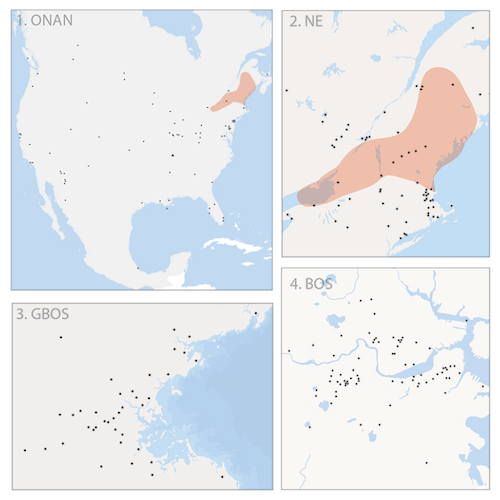
For the past few years, D.C.-based artist William Beutler has been mapping the real and fictional locations of David Foster Wallace’s giant novel Infinite Jest in a project called Infinite Atlas, a Google Maps-based guide to over 600 locations described in Infinite Jest. Beutler’s project has sprawled (appropriately) to include several dimensions, including Infinite Map (shown above), which identifies and describes 250 locations from the novel and Infinite Boston, a travel blog of sorts that documents and reflects on Beutler’s Wallace-based trip to Boston. Beutler was kind enough to talk to me about his projects over a series of emails.

Biblioklept: How did the Infinite Atlas project start?

William Beutler: I think, like a lot of long-term projects, I’d point to a few different points of inspiration. The first is just going back and reading Infinite Jest for a second time in 2009, after I’d say it went from being a favorite novel to my actual favorite novel.  I’d also become interested in infographics, I suppose as a kind of art form based on the expression of data—and what better stockpile of data than a thousand-page, encyclopedic novel? I cycled through a lot of ideas, finding that some of them had already been done before, and then finally deciding to focus on geography.

Biblioklept: How did the geography focus come about?

WB: The geography focus owes to a few different things. One is simply that I wasn’t the first to arrive at the idea of creating an infographic based on Infinite Jest, so I had to take that into consideration. Sam Potts, who is the designer of John Hodgman’s books, had released an elaborate graphic drawing connections between the various characters in the novel. I’d been considering that when his came out, but he did that pretty definitively, so I went with one oft he other. And hey, I just like maps. I started my career in political journalism, where districts are always being redrawn, and maps are always being shaded this much red or this much blue, so it was a natural focus in that regard. And there’s always been something I’ve liked about adding a layer of information to geographic features. I don’t know that I could have credibly called myself a geography enthusiast before this—but I have friends who definitely are, and even some who work with GIS professionally. They helped me figure out what I was doing.

Biblioklept: Did you consciously start using Google Maps? Was Google Maps a starting point in and of itself or just a tool?

A shot of Infinite Map in development

WB: Google Maps was probably one of the very last decisions we made. And all the web development was relatively late in the process, starting about early summer of this year. Most of the work before that was simply building the database, which lived in Google Docs for most of this research period. The decision to use Google Maps wasn’t necessarily random, although I had actually made an early conscious decision to not use it. I’d suggested Open Street Maps, partly because I like open source projects, and Foursquare had switched to it, which seemed like a noteworthy endorsement. But my developers said Google Maps was going to be less time-consuming, and less expensive, and I was willing to take this advice.

Biblioklept: Can you talk a bit about how you put the atlas together? What was your approach? How did you start?

WB: In the very early going, it was as simple and painstaking as going page-by-page through the book, scanning each one for proper nouns, and taking notes down in Google Docs. This was myself and another friend who had read the book, Olly Ruff, who is one of the credited editorial advisers. We debated what really counted as a “location”—Orin’s “Norwegian deep-tissue therapist” lives “1100 meters up in the Superstition Mountains,” overlooking Mesa-Scottsdale. So is that one location, or two?And once we realized we had so many locations, this was about the time I realized the original idea, which was just the map, was not going to be the comprehensive accounting for the novel’s locations I had imagined. Once I decided we had to explore an interactive version as well, then we had to decide which locations were just going on the map, and how many. Then we had to figure out where certain locations were actually located, and that was a considerable amount of research as well. Sometimes it was very obvious-—Harvard Square is very easy to find, but some places I didn’t even know were real until I visited Boston. We also had to figure out how to show both the scope of North America alongside the detail of central Boston, and this just took an agonizingly long time. This is where some of my friends who worked with maps for a living proved helpful. The further into this I got, the bigger of a project it kept revealing itself to be. And since the point of no return was never clear, I just kept at it, never entirely sure how long it would all take, until we actually started working with designers.

Biblioklept: How did actually visiting Boston help to inform the project?

WB: About a year into the research, I realized that I was hitting a wall with some of the local details in Boston, which has the greatest concentration of locations of anywhere in the novel. More specifically, the neighborhoods of Allston and Brighton already kind of run together, and then Wallace invented a whole new unincorporated community called Enfield, where most of the primary characters live, and its relationship to Allston-Brighton was very confusing. The trip helped me get a better sense for what was Enfield and what was Brighton, although there’s only textual support for boundary lines to the east and south.Also regarding certain locations, I knew the Brighton Marine hospital complex was the basis for Enfield Marine, and I knew that the hill behind it was where the Enfield Tennis Academy would be, if it existed, but Google Maps and Google Street View have some pretty obvious limitations. So putting boots on the ground was really the only way to be sure about some of these places. I was surprised by some things I found: there’s a “Professional Building” mentioned as being at one intersection when it’s really another, which I had no idea until I walked right up to it. And the Infinite Boston Tumblr simply couldn’t have existed without the trip, but the trip was also absolutely necessary for getting a lot of details right for Infinite Atlas and Infinite Map.

Biblioklept: How long have you been working on the Infinite Boston blog?

WB: The Boston trip was in July 2011, and the notion of doing a Tumblr travelogue to the project was probably in the back of my head at the time, but I didn’t really start thinking about seriously doing it until earlier this year. I’d been sifting through the photos—I came back with about 4,000—since then, and in the spring I started making decisions about what I had acceptable photos of, and what I had enough to write about, then I started planning the sequence in June, and putting together notes in early July. And though I had quite a few entries planned out weeks in advance to begin with, these days I’m finishing them the night before, or up to the last few minutes before publishing.

Biblioklept: The Infinite projects clearly will resonate with fans of Wallace’s novel. What do you hope they take away from your work?

Portrait of the artist

WB: I can’t begin to tell you the number of people who’ve told me they started Infinite Jest, and gave up after making it a surprisingly long way through it. One friend of mine spent the better part of a decade having read to at least page 600 before finally finishing it earlier this year. (He ended up helping out as a backup researcher.) I’ve heard it said that the book doesn’t really start coming together until about 400 pages, and it’s been much too long since I first read it for me to remember, but I know the feeling  of hopelessness that goes along with struggling early in a long novel (I’m still working myself back up to revisiting Gravity’s Rainbow and Europe Central…). I think a project like this can serve as a kind of promise to the uninitiated that there really is something here that people feel very strongly about, that it rewards the effort one must put into it. There’s much more to it than just being a hipster status symbol. And then I think it can help those who are reading it, both to confirm details they may have misread the first time or—better still—to make connections they might never have made without this kind of tool. And of course to visualize it as David Foster Wallace surely did, if they’re so inclined. That said, I’m not sure the Atlas is a resource I would have consulted when I first read the book. I tend to be very spoiler-sensitive, oftentimes purposefully going into a novel or a film or television series trying to know as little as possible. Of course, I know now that Infinite Jest can’t be “ruined” by knowing about a particular story arc, and I’m sure that others so wracked with fear over knowing that two storylines connect, so I hope they’ll find this a useful resource.

Biblioklept: I’m curious if you’ve read Houellebecq’s novel The Map and the Territory?

WB: I have not actually read any Houellebecq; I’m primarily familiar with him for various controversies, and I do remember the allegations that he had plagiarized Wikipedia for The Map and the Territory, and the possibility then that his book would be judged a Creative Commons-licensed work. Anyhow, I am familiar with the map-territory relationship as described by Alfred Korzybski, and Infinite Jest was my introduction to it. I think it’s very relevant here, not that anyone would necessarily mistake the atlas as anything but a supplement to the novel. Actually, one of my early working titles for the project was “Map / Territory,” and the website includes a kind of epigraph, taken from the Eschaton section: “The real world’s what the map here stands for!”

Biblioklept: I figured the Eschaton episode clearly resonated with your project. What sections or characters of IJ stand out as favorites to you?

WB: Believe it or not, Eschaton was one of the last location segments that I added to the Atlas. Early on we’d focused on real places where scenes actually took place, or references to North American locations that fell inside the confines of the map. And Chris Ayers of Poor Yorick Entertainment had already made a pretty nifty Eschaton infographic, so I was hesitant to do too much with that. But it became clear that we were going to take a maximalist approach, and really locate absolutely everything that could be located, so then I went through and included everything from Eschaton as best I could.If I had to name a favorite section, it might be the very last, with Gately and Fackelman holed up with Mt. Dilaudid, avoiding the wrath of Whitey Sorkin. It’s just beautifully written, and for whatever criticisms anyone might still make about the novel lacking a proper ending plot-wise, it makes perfect sense emotionally. In close contention, though, is Gately’s first chapter, about the disastrous burglary in a “wildly upscale part of Brookline” that turns his life around. It’s the first section in the story really that took my breath away—that or I was holding my breath waiting in vain for a paragraph break to exhale. Anyway, the unsurprising answer regarding my favorite character is Don Gately. He’s maybe DFW’s single greatest creation.

Biblioklept: I agree with you on Gately being Wallace’s greatest achievement—I love the sections you mention as well. I think many people who can’t get into IJ probably don’t get to that burglary/toothbrush episode quick enough.

WB: I don’t know, the number of people who have made it to halfway or further and then still give up, just speaking anecdotally, is staggering. I’ve personally given up on much shorter books, which is probably every book I’ve given up on, considering I haven’t bothered to try Imperial or some of Vollmann’s other longer stuff. Plus, it’s not like there isn’t grabby material early on: the “where was the woman who said she’d come” scene with Erdedy is very dense, but I think immediately rewarding in a way some of the Hal and Orin material up front is not. And there’s no way around the fact it’s just a months-long project in a way few novels are.

Biblioklept: Have you had any response from Wallace’s estate about your project?

WB: I haven’t, nor have I solicited any. In development on the project, I had considered reaching out to Bonnie Nadell, but I didn’t really know what I’d be asking. This wasn’t going to be the first infographic project or fan art based on the book, so I didn’t think permission was an issue. A friend had offered to put me in contact with D.T. Max, if I needed, but I didn’t want to bother him, either. The most response I’ve had is two retweets and one reblog from whomever’s running social media for Little, Brown, and it’s more than I would have asked for.

Biblioklept: Do you have another project on the horizon after this one?

WB: To be honest, I’m not even sure I’m totally done with Infinite Jest yet. I’m still writing Infinite Boston on a daily basis through the end of this month, and we’re actually putting in some further refinements on the Infinite Atlas website. Besides that, I’d been editing a very short film when I turned to focus on this, so I’d like to complete that now. And I’m sure this isn’t my last map, either.

Biblioklept: Have you ever stolen a book?

WB: Haha, that’s a great question. And the answer is yes. One that comes to mind in particular I found in a teacher’s lounge in the j-school at the University of Oregon, where I worked and never quite completed my journalism double major. And I don’t have it handy—I’m afraid I’ve left stolen property on a shelf at my parents’ house—but it was called something like The Declining American Newspaper and its publication date could have been no later than 1965. Even when I found it, this was still early days of the Internet. I wasn’t sure whether it was prophetic or preposterous, which is basically why I pocketed it. Less a book, more a conversation piece. Next visit, I’ll try to make partial amends by actually reading it.

Wherein I Suggest Dracula Is a Character in Roberto Bolaño’s Novel 2666

The Self Seers (Death and Man), Egon Schiele

1. Here’s my thesis:

Dracula is a character in Roberto Bolaño’s dark opus 2666.

Specifically, I’m suggesting that Dracula (like, the Count Dracula) is the unnamed SS officer in “The Part About Archimboldi” who hosts a strange party in a Romanian castle.

2. I’m willing to concede that my idea is probably full of holes and more than a little silly, but I think there’s some textual support for such a claim.

3. I’ve already suggested on this blog that 2666 is full of lycanthropic transformations, and in that earlier essay, I linked werewolves to vampires (using the work of mythologist Sabine Baring-Gould).

I also suggested on this blog that 2666 is a dark ventriloquist act, full of forced possessions and psychic hauntings.

It’s a work of mesmerism and transformation—vampire powers. Dracula showing up is a winking sick joke, a satire.

4. In his post “Castle Dracula” at Infinite Zombies, Daryl L. L. Houston connects the many strands of vampirism that run through 2666, suggesting that “Bolaño is using the vampirism in the story, and Dracula in particular, to tie together some of the threads he’s been unwinding pertaining to insiders and outsiders, parasitism and consumption of people, and a sort of larger parasitism of nations.” Hence Aztec blood rituals, the Holocaust, the murder of helpless, marginalized women in Santa Teresa . . .

5. Okay, so back to that thesis. Let’s start with the first appearance of the unnamed SS officer:

At midmorning they came to a castle. The only people there were three Romanians and an SS officer who was acting as butler and who put them right to work, after serving them a breakfast consisting of a glass of cold milk and a scrap of bread, which some soldiers left untouched in disgust. Everyone, except for four soldiers who stood guard, among them Reiter, whom the SS officer judged ill suited for the task of tidying the castle, left their rifles in the kitchen and set to work sweeping, mopping, dusting lamps, putting clean sheets on the beds.

Fairly banal, right? Also, “midmorning” would entail, y’know, sunlight, which is poison for most vampires. Let me chalk this up to the idea that the SS officer is inside the castle, which is sufficiently gloomy and dark enough to protect him (I’m not going to get into any vampire rules that might spoil my fun, dammit!). In any case, hardly noteworthy. Indeed, the SS officer—a butler commanding house chores—seems hardly a figure of major importance.

6. Next, we get the Romanian castle explicitly identified as “Dracula’s castle” and meet the actors for this milieu:

“And what are you doing here, at Dracula’s castle?” asked the baroness.

“Serving the Reich,” said Reiter, and for the first time he looked at her.

He thought she was stunningly beautiful, much more so than when he had known her. A few steps from them, waiting, was General Entrescu, who couldn’t stop smiling, and the young scholar Popescu, who more than once exclaimed: wonderful, wonderful, yet again the sword of fate severs the head from the hydra of chance.

(I love Popescu’s line here).

7. Our principals soon take a tour of castle and environs, led by the SS officer (boldface emphasis is mine):

Soon they came to a crypt dug out of the rock. An iron gate, with a coat of arms eroded by time, barred the entrance. The SS officer, who behaved as if he owned the castle, took a key out of his pocket and let them in. Then he switched on a flashlight and they all ventured into the crypt, except for Reiter, who remained on guard at the door at the signal of one of the officers.

So Reiter stood there, watching the stone stairs that led down into the dark, and the desolate garden through which they had come, and the towers of the castle like two gray candles on a deserted altar. Then he felt for a cigarette in his jacket, lit it, and gazed at the gray sky, the distant valleys, and thought about the Baroness Von Zumpe’s face as the cigarette ash dropped to the ground and little by little he fell asleep, leaning on the stone wall. Then he dreamed about the inside of the crypt. The stairs led down to an amphitheater only partially illuminated by the SS officer’s flashlight. He dreamed that the visitors were laughing, all except one of the general staff officers, who wept and searched for a place to hide. He dreamed that Hoensch recited a poem by Wolfram von Eschenbach and then spat blood. He dreamed that among them they had agreed to eat the Baroness Von Zumpe.

He woke with a start and almost bolted down the stairs to confirm with his own eyes that nothing he had dreamed was real.

When the visitors returned to the surface, anyone, even the least astute observer, could have seen that they were divided into two groups, those who were pale when they emerged, as if they had glimpsed something momentous down below, and those who appeared with a half smile sketched on their faces, as if they had just been reapprised of the naivete of the human race.

Bolaño concludes the crypt passage by highlighting an essential ambiguity that courses throughout the entire “Castle Dracula” episode, a strange axis of horror/humor, romance/banality. What has been revealed in the crypt? We don’t know, of course, but our surrogate Reiter allows us access to a few visions of what might have happened, including terror and fear and cannibalism. (He employs Hawthorne’s escape hatch too—it was all a dream).

The Knight of Death, Salvador Dali

8. Then, supper time:

That night, during dinner, they talked about the crypt, but they also talked about other things. They talked about death. Hoensch said that death itself was only an illusion under permanent construction, that in reality it didn’t exist. The SS officer said death was a necessity: no one in his right mind, he said, would stand for a world full of turtles or giraffes. Death, he concluded, served a regulatory function.

Clearly it’s easy to link any of the dinnertime comments about death to Dracula, but note that the SS officer’s idea that death is a “regulatory function” is terribly banal, is quite literally regular—this idea contrasts with Hoensch’s more poetic notion that death is an illusion (an illusion that the SS officer, if he is in fact Count Dracula, would realize in a perfectly mundane way that foreclosed the necessity of metaphor).

9. Dinner conversation turns to murder—obviously one of the central themes of 2666:

The SS officer said that murder was an ambiguous, confusing, imprecise, vague, ill-defined word, easily misused.

Again, ambiguity: on one hand, sure, an SS officer’s job was in large part about coordinating and executing mass murder. At the same time, we might appreciate that murder is a vague term if people are one’s lunch.

10. Then conversation turns to culture:

The SS officer said culture was the call of the blood, a call better heard by night than by day, and also, he said, a decoder of fate.

I’m pretty sure that this was the moment I started entertaining the fancy that the SS officer might be Dracula.

11. Popescu the intellectual also seems to reconsider the SS officer:

The intellectual Popescu remained standing, next to the fireplace, observing the SS officer with curiosity.

12. Then, they finally riff on Dracula. Significantly, the SS officer believes that Dracula is a good German (bold emphasis mine):

First they praised the assortment of little cakes and then, without pause, they began to talk about Count Dracula, as if they had been waiting all night for this moment. It wasn’t long before they broke into two factions, those who believed in the count and those who didn’t. Among the latter were the general staff officer, General Entrescu, and the Baroness Von Zumpe. Among the former were Popescu, Hoensch, and the SS officer, though Popescu claimed that Dracula, whose real name was Vlad Tepes, aka Vlad the Impaler, was Romanian, and Hoensch and the SS officer claimed that Dracula was a noble Teuton, who had left Germany accused of an imaginary act of treason or disloyalty and had come to live with some of his loyal retainers in Transylvania a long time before Vlad Tepes was born, and while they didn’t deny Tepes a real historical or Transylvanian existence, they believed that his methods, as revealed by his alias or nickname, had little or nothing to do with the methods of Dracula, who was more of a strangler than an impaler, and sometimes a throat slitter, and whose life abroad, so to speak, had been a constant dizzying spin, a constant abysmal penitence.

The SS officer is the noble Teuton. More importantly, we get language that connects Dracula to the murders in Santa Teresa, most of which are stranglings; we also get the idea that Dracula has had a “life abroad”—one outside of time—a life that might see his spirit inhabit and ventriloquize an industrial city in the north of Mexico. (Or not. I know. Look, I’m just riffing here).

We also get the idea of an abyss (this is the structure of 2666), as well as the idea of Dracula as a penitent of sorts.

So, let us recall that early in “The Part About the Crimes,” detective Juan de Dios Martinez is searching for a criminal dubbed The Penitent who desecrates churches and has committed a few murders in the process. He goes to psychologist Elvira Campos for help:

Sacraphobia is fear or hatred of the sacred, of sacred objects, especially from your own religion, said Elvira Campos. He thought about making a reference to Dracula, who fled crucifixes, but he was afraid the director would laugh at him. And you believe the Penitent suffers from sacraphobia? I’ve given it some thought, and I do. A few days ago he disemboweled a priest and another person, said Juan de Dios Martinez.

This is the first mention of Dracula in 2666, and he’s explicitly likened to the Penitent; later, as we see above, Dracula will be explicitly linked to penitence.

(I’m not suggesting that the Penitent is Dracula traveled to Mexico to piss in churches. What I want to say is that Dracula’s dark spirit ventriloquizes the text of 2666).

(I’m also suggesting, again, that 2666 be read intertextaully).

Riding with Death, Jean-Michel Basquiat

13. Our other principals continue to discuss Dracula, but I won’t belabor that discussion (I’d prefer you, dear reader, to return to the text).

I will summarize though: Popescu sees Dracula in nationalistic terms (“a Romanian patriot” who repels the Turks), and General Entrescu goes on a long rant about heroism and villainy and history, culminating in a lengthy digression on Jesus Christ (recall now that Entrescu will be crucified JC-style by his men).

One aside on the SS officer bears mentioning: we learn that “the fastidious SS officer” is the most sober conversant as he “scarcely wet his lips with alcohol.” (Because he’s a vampire who prefers blood! Muahahahaha!)

14. Fast forward a few hours. Our man Reiter, among fellow soldiers, sets out to explore the secret crannies and passageways of Castle Drac and play voyeur:

The room they came to was empty and cold, as if Dracula had just stepped out. The only thing there was an old mirror that Wilke lifted off the stone wall, uncovering a secret passageway.

Dracula’s spirit leaves the room, creating an opening, behind the ever-symbolic mirror. (Muahahahaha!). (2666: Mirror, tunnels, chambers, labyrinths).

They enter the passageway and come first upon our supposed Dracula, the SS officer:

And so they were able to look into the room of the SS officer, lit by three candles, and they saw the SS officer up, wrapped in a robe, writing something at a table near the fireplace. The expression on his face was forlorn. And although that was all there was to see, Wilke and Reiter patted each other on the back, because only then were they sure they were on the right path. They moved on.

15. Dracula, the epistolary novel. Count Dracula, troubled writer of letters, will author the following scenes, his spirit ventriloquizing the principals all: Here, we find Reiter and his homeboy Wilke, lurking in a secret passage, jerking off to werewolf-cum-Jesus-Christ-figure Gen. Entrescu screwing the lovely Baroness Von Zumpe and reciting poetry (emphasis per usual mine):

Then Wilke came on the wall and mumbled something too, a soldier’s prayer, and soon afterward Reiter came on the wall and bit his lips without saying a word. And then Entrescu got up and they saw, or thought they saw, drops of blood on his penis shiny with semen and vaginal fluid, and then Baroness Von Zumpe asked for a glass of vodka, and then they watched as Entrescu and the baroness stood entwined, each with a glass in hand and an air of distraction, and then Entrescu recited a poem in his tongue, which the baroness didn’t understand but whose musicality she lauded, and then Entrescu closed his eyes and cocked his head as if to listen to something, the music of the spheres, and then he opened his eyes and sat at the table and set the baroness on his cock, erect again (the famous foot-long cock, pride of the Romanian army), and the cries and moans and tears resumed, and as the baroness sank down onto Entrescu’s cock or Entrescu’s cock rose up into the Baroness Von Zumpe, the Romanian general recited a new poem, a poem that he accompanied by waving both arms (the baroness clinging to his neck), a poem that again neither of them understood, except for the word Dracula, which was repeated every four lines, a poem that might have been martial or satirical or metaphysical or marmoreal or even anti-German, but whose rhythm seemed made to order for the occasion, a poem that the young baroness, sitting astride Entrescu’s thighs, celebrated by swaying back and forth, like a little shepherdess gone wild in the vastness of Asia, digging her nails into her lover’s neck, scrubbing the blood that still flowed from her right hand on her lover’s face, smearing the corners of his lips with blood, while Entrescu, undeterred, continued to recite his poem in which the word Dracula sounded every four lines, a poem that was surely satirical, decided Reiter (with infinite joy) as Wilke jerked off again.

I contend that the poem is the work of the SS officer, psychic mesmerist, the poet Dracula, a poem no one in the scene can understand, a dark satire that might also be a war poem or a love poem or an elegy, but definitely a dark satire, written in violence and sex and blood, a poem that ventriloquizes not only Entrescu, phallic delivery device, but also the baroness, and also Reiter and Wilke. And perhaps the reader.

16. Where to go after such a climax? Maybe point out that Dracula infects Reiter and Wilke, of whom we learn:

Some of their battalion comrades dubbed them the vampires.

(But better to return I think to our strange figure, the SS officer).

17. Here, his last appearance:

The next morning the detachment left the castle after the departure of the two carloads of guests. Only the SS officer remained behind while they swept, washed, and tidied everything. Then, when the officer was fully satisfied with their efforts, he ordered them off and the detachment climbed into the truck and headed back down to the plain. Only the SS officer’s car—with no driver, which was odd—was left at the castle. As they drove away, Reiter saw the officer: he had climbed up to the battlements and was watching the detachment leave, craning his neck, rising up on tiptoe, until the castle, on the one hand, and the truck, on the other, disappeared from view.

Dracula stays in Dracula’s castle; his spirit, his seed, his blood seeps out.

A Rambling Riff on the Age of the Amateur, Book Review Ethics, and Adam Johnson’s The Orphan Master’s Son

1.There’s been a lot of hubbub (at least in my particular echo chamber) the past few weeks about book reviews and the ethics of book reviews:

Too nice?

Too mean?

Just fine?

What about straight-up buying a book review?

And what about when authors get involved, via social media, in calling out reviewers?

2. A sloppy synthesis of what I’ve linked to above might be:

The traditional position of the serious book critic is perhaps being undermined via social media in the hands of well-meaning amateurs.

3. I’m not sure that I exactly agree with the statement above.

4. Still, we live in the Age of the Amateur.

(Saturday Night Live parodied this phenomena in a sketch called “You Can Do Anything!” that hits nail on head).

5. (SNL also unintentionally documented what happens when an amateur is given a forum beyond her untested abilities).

6. I suppose I could spend a few paragraphs parsing the delicate distinctions between literary criticism and book reviews and awarding fucking stars on Amazon or Goodreads, but I think you, gentle reader, probably get all that already.

7. (I consider myself an amateur book reviewer with an interest in but no pretension to literary criticism. I don’t intend to write about myself, but I do feel like I should clarify this).

8. (I know I just said that I don’t intend to write about myself, but again, perhaps germane:

I don’t read a lot of book reviews, especially contemporary book reviews. I mean, I hardly ever read contemporary book reviews. If I’m planning to review the work, a contemporary review may poison any pretense of objectivity I have.

With the occasional new major release, it’s almost impossible not to get a fix on some critical consensus—and I always scan of course.

I usually read a handful of reviews of a book I’m reading after I’ve drafted a review.

And I read lots of old reviews. Lots.

Again, maybe germane to all of this).

9.  But I’m riffing out all over the place. Let me get to the point. Let’s return to the second part of Point 2:

The traditional position of the serious book critic is perhaps being undermined via social media in the hands of well-meaning amateurs.

Is this true? I don’t know, exactly. A few points to consider:

Literary criticism has existed via two more-or-less stable forms for about a century now: Academic scholarship and popular media.

Academic scholarship tends to be highly-specialized and literally inaccessible for most people. I think academic scholarship and research about literature is important and I don’t want to knock it all—but most of it simply isn’t exposed to, let alone absorbed by, a reading public.

Popular media—magazines and newspapers—is clearly in a transitional phase. A lot of this boils down to the dissemination of new technologies, the advent of the so-called “citizen journalist,” and the oligarchization of mass media. Journalism, as taught in journalism school, prescribed a set of methods and ethics that seem frankly quaint when set against the internet and 24hr cable networks. How book reviews fit—if they fit at all—into the emerging paradigm of popular media is hard to say.

10. Obviously, one model for how book reviews/lit crit fits into the emerging paradigm of popular media  is Goodreads, which I really don’t know much about to be honest. Another is Amazon, which has so many problems I don’t even begin to know how to start. Both of these sites use star ratings though, which has always struck me as probably the worst critical model available.

11. (I got an email recently about Riffle, a new service “powered by the Facebook social graph and loaded with expert curated recommendations.” I mean, how’s that for a shudder down the metaphorical spine?)

12. (Re: Point 11—What is it with this term “curator”? Is it synonymous with: “I produce no original content”?)

13. So, to return to the pretense that I have a point:

I’ve written about 300 reviews on this site. Most for books, some movie reviews, and a few other things as well (uh, malt liquor). I didn’t really know what I was doing in the beginning—I mean, I wasn’t even intending to review books. I was just writing about books I’d pilfered, pinched. Stolen. (The name of the site was its mission statement).  At some point I started making critical judgments, trying to, you know, recommend books that I loved to people who I hoped would love them also.

And at some point I came across John Updike’s rules for reviewing books.

I’m not an Updike fan—wasn’t then, amn’t now—but his rules resonated with me, and I made a point of reading his criticism, which is generally excellent.

In short, I’ve tried to follow his rules.

14. (To clarify: A simple thesis for this whole riff: I think book reviewers need to follow some kind of aesthetic, ethical rubric, one that accounts for subjectivity in an objective way—and I think Updike’s list is great).

15. Updike’s first rule is his best:

Try to understand what the author wished to do, and do not blame him for not achieving what he did not attempt.

This one seems fairly straightforward, but is abused all the time, whether it’s Kakutani at the NYT pretending YA is not YA, or a reviewer at Book Kvetch lamenting that a metaphor-laced experimental novel isn’t a science textbook.

(I might have abused Updike’s first rule myself, but I’m not going to ransack the archives for self-incrimination).

16. Updike’s first rule is so graceful because it allows for a sliding scale of sorts, a range of possibilities beyond the critic’s own highly-subjective taste.

Put another way, it’s very easy to say, “I loved it” or “I hated it,” but Updike’s first rule places the onus of critical imagination on the reviewer. The responsible reviewer has to understand his or her audience (or at least has to try to understand his or her audience).

17. The subjective can’t be removed from reviews of course—nor should it be. I think the balancing act here might be described as taste.

18. I’ve occasionally broken some of Updike’s rules, especially when I super hated a book (usually #s 2 &3–didn’t bother to cite text—actually, I’ve done this repeatedly),

19. Sometimes a book confuses my approach to criticism.

20. Hence, Adam Johnson’s novel The Orphan Master’s Son, which I reviewed in hardback a few months ago, and which is now available in trade paperback, and which I will use now as some sort of loose illustration for whatever point there is in this ramble:

20120724-194425.jpg

21. (Okay. So, normally I photograph reader copies (and other books I obtain) and run a little blurb—usually the publisher’s copy or another review—and I was gonna do this with The Orphan Master’s trade paperback (citing my own review in this case), but the post lingered, thoughts accrued around it as I glommed onto all the ideas reverberating around my little echo chamber re: this whole riff. I bring this up in the recognition that a post purporting to address in some way the ethics of book reviewing should point out that the publisher in question (e.g. this blog, e.g. me) regularly posts what amounts to a kind of advertisement for forthcoming books).

22. So why The Orphan Master’s Son?

I use it as example (barring info re: Point 21 for a moment) of a book that didn’t do what I wanted the book to do.

Here’s the end of my review:

 Toward the end of The Orphan Master’s Son, I began imagining how the novel might read as a work divorced from historical or political reality, as its own dystopian blend—what would The Orphan Master’s Son be stripped of all its North Korean baggage? (This is a ridiculous question, of course, but it is the question I asked myself). I think it would be a much better book, one that would allow Johnson more breathing room to play with the big issues that he’s ultimately addressing here—what it means to tell a story, what it means to create, what it means to love a person who can not just change, but also disappear. These are the issues that Johnson tackles with aplomb; what’s missing though, I think, is a genuine take on what it means to be a North Korean in search of identity.

I think my review of The Orphan Master’s Son was/is fair, but it didn’t—couldn’t—exactly capture how I felt about the book: a mix of disappointment and admiration.

23. To be clear, I took pains to clarify that I thought highly of Johnson’s prose and that I thought most readers would really dig his book.

I gave it, I suppose, a mixed review, which is almost like giving it a negative review.

24. But I didn’t give it a mixed review to be nice—I tempered my criticisms with the knowledge that any attack I made on The Orphan Master’s Son was really a way of defining my own aesthetic tastes. Let me cite Updike’s fifth rule:

 If the book is judged deficient, cite a successful example along the same lines, from the author’s ouevre or elsewhere. Try to understand the failure. Sure it’s his and not yours?

Ultimately, my problem with The Orphan Master’s Son boils down to me wanting Johnson to have written a different book. I feel like I have plenty of reasonable reasony reasons for wanting a different book—first and foremost Johnson’s prowess as proser and storyteller—but that’s no way to review a book. From my review:

I should probably clarify that I think many people will enjoy this novel and find it very moving and that the faults I found in its second half likely have more to do with my taste as a reader than they do Johnson’s skill as a writer, which skill,  again I’ve tried to demonstrate is accomplished.

25. Let me end here in repetition (and, perhaps, here in the safety of these parentheses point to how riffing in a rambling wine-soaked list somehow frees me from actually coherently writing about any of the things I promised to—or maybe it doesn’t—which is of course its own ethical ball of worms) by restating a basic answer to some of the basic problems of amateurism:

Book reviewers need to follow some kind of aesthetic, ethical rubric, one that accounts for subjectivity in an objective way.

Fifty Shades of Louisa May: A Loving Biography Masquerading as a Smutty Novelty Book

20120818-173921.jpg

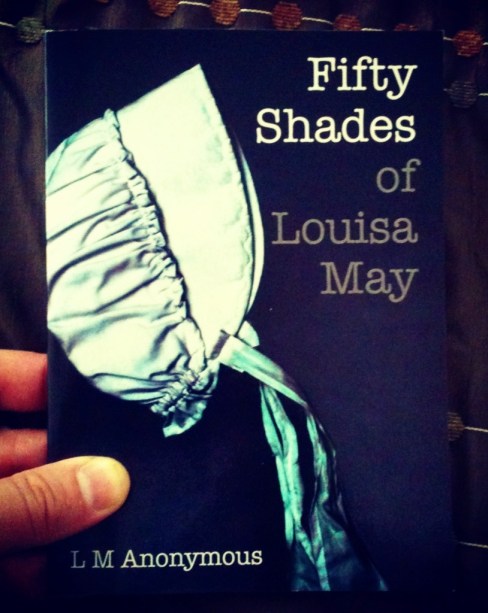
Fifty Shades of Louisa May by L.M. Anonymous, is , to all appearances, the kind of cheeky send-up that E.L James’s Fifty Shades of Grey hardly deserves. Satire has the strange, paradoxical power to somehow dignify its target after all, or at least point out how the thing being satirized is, you know, worth actually talking about. However, Louisa May has no proximity to Fifty Shades of Grey, other than the window dressing of its cover and its title, both of which exist somewhere on the thin line between clever and crass. Sure, Louisa May has its share of sex scenes (most are more ridiculous than erotic), but this slim little book is, at its core, really a loving biography of novelist Louisa May Alcott.

The conceit is that Alcott, dipping into her secret vice of a midnight bottle of Madeira, decides to a pen a memoir (that she intends to burn) of her “carnal episodes, some amusing, others touching, but all rife with the sighs and heavings of Love’s labours.” (How the “X-rated woodcuts” that accompany each chapter made their way into the book remains unclear; I suspect that they follow the tradition established in the mashup Pride and Prejudice and Zombies). Organized roughly around Alcott’s difficult life with her transcendentalist parents and their transcendentalist friends, each chapter of Louisa May culminates in an erotic episode, albeit one that our heroine usually witnesses as voyeur and not participant. These episodes tend to involve other transcendentalist figures. In one inspired vignette, Louisa May sneaks out of her house to follow Herman Melville to the Old Manse, where she watches him watch Sophia and Nathaniel Hawthorne get it on:

I heard a small groan from Mr. Melville’s beech tree and saw that his own garments now circled his ankles and he was busily engaged in the art of Onan, his slitted eyes on his mentor, beard shivering with concentration. I looked away quickly—even in my youth I knew that such solitary activity must remain unwitnessed.

The Hawthornes let out a quivering scream, Nathaniel’s voice as high pitched as his wife’s as he rose from his chair to finish the work that his wife had begun. Thus spent, Sophia lay back in his arms. The ever-fastidious Mr. Hawthorne reached out with one hand to set to reordering his manuscript pages.

Mr. Melville let out a low hoot and sent a frothy fusillade across the yard to strike the windowglass with a furious splash.

“Look, my Dove, it appears to be raining,” Sophia said.

The episode is obviously more comical than erotic, its style—indeed the style of the entire book—a strange mashup of Alcott’s own rhythms and the diction of Victorian smut. There’s something joyously silly in the way L.M. Anonymous throws together various transcendentalists into would-be erotic interludes; when our heroine describes Fruitlands founder Charles Lane jacking off by moonlight, the whole thing feels like a big dirty in-joke for those of us who love this period of American history and literature. And sure, the jokes can be very crude—here’s Henry David Thoreau, nature lover:

20120818-173927.jpg

L.M. Anonymous (“a well-known writer who prefers the cloak of anonymity to the vulgar embrace of rude fame,” according to the back of the book) seems to know his/her history (and attending rhetorical styles) fairly well. I’d have to guess that the author is, if not an Alcott scholar, then at least a passionate enthusiast—because what stands out most about Fifty Shades of Louisa May isn’t the smut but the internal conflicts of our narrator Louisa May.

In Anonymous’s imagination, Alcott is an embittered soul who has never forgiven her father for his foolishness, nor gotten over the fact that she’s the sole source of income for the Alcotts. She badmouths her books as unserious trash, bemoaning that she could do more:

Too often I have found myself diminished by the company of Famous Men to praise them. Had I been but relieved of the burden of supporting the entire legions of Alcotts with my earnings, I could have written novels and poems to equal their best—of that I am most confident. Instead of greatness, I lingered at the Trough of Rubbish too long, achieving only a shining of tin, not the glimmering of gold. But it is too late for me to be concerned with such matters. Time sorts out all writers, revealing each for what they truly were. I only hope that I shall be remembered as much for what I did not achieve as for what I did.

There’s so much tenderness here: Anonymous’s love and respect for his/her subject is plain. The author also seems to write through the book, through the narrator in this passage, as if acknowledging, in some metatextual move, the book’s own novelty status, pointing out that the book, a shaky Grey cash-in, is in some way a part of the Trough of Rubbish, but also that there’s more here too.

I read Fifty Shades of Louisa May in one short sitting, and found it at times amusing, if not especially erotic. I was prepared to to write it off as a silly novelty book—which perhaps it is—but there’s also a real love—and understanding—for Louisa May Alcott that comes through here. Who is it for? I’m not really sure. I’m going to guess that Fifty Shades of Grey fans will be disappointed, and fans of Little Women and its sequels will find their beloved tome trashed by Alcott herself (or at least her character). The book might work best as a primer to the American Renaissance, although I’m not sure which professor would be brash enough to stick this on her syllabus. My hope would be that Grey fans might find in Louisa May an inroad into better writers; at minimum though, they’ll at least be exposed to prose far superior to E.L. James’s trough of rubbish.

Fifty Shades of Louisa May is new in trade paperback from OR Books.

“What’s Outside the Window?” (Roberto Bolaño’s The Savage Detectives Revisited)

Untitled (Desert Landscape) by Salvador Dali

Biblioklept has already published two reviews of Roberto Bolaño’s big novel The Savage Detectives.

In the first review, from 2008, I suggested that the book was technically impressive but ultimately “unmoving.” In the second review, from 2010, Dave Cianci argued that my first review “was unfair and premature.”

I tend to agree with Cianci’s criticism of my early review, although in my defense I struggled with a first reading of The Savage Detectives because I was ignorant of the history of Latin America, Central America, and Mexico, a history that provides much of the context for the Bolañoverse. I was like the auditor in The Savage Detectives who listened as Ulises Lima

reeled off a story that I had trouble following, a story of lost poets and lost magazines and works no one had ever heard of, in the middle of a landscape that might have been California or Arizona or some Mexican region bordering those states, a real or imaginary place, bleached by the sun and lost in the past, forgotten, or at least no longer of the slightest importance here . . .  A story from the edge of civilization . . .

The citation above more or less pins down some of the problems first time readers to Bolaño might have with The Savage Detectives. More so than the rest of his oeuvre, Detectives dwells on “lost poets and magazines and works no one had ever heard of.” These poets and writers are mixed in with famous poets (like Octavio Paz, who appears as a character in one segment), and parsing the various characters’ attitudes toward these writers can be a perplexing challenge, and at times a turn off.

And it’s not just the names of poets and writers that can addle a reader: Many of Bolaño’s narrators share an obsessive compulsion to name every avenue, street, or alley they walk on or past, details that become frankly boring over an extended period. It’s a novel of names and places: canonizing, map-making.

Why the map-making? Because this is a book about being lost. Its first section is titled “Mexicans Lost in Mexico.” Notice how many times the word “lost” crops up in the citation above. Indeed, The Savage Detectives is not only about what it means to be lost, but also about what it means to lose—one’s friends, one’s group, one’s country, one’s mind. It’s a book about exiles.

Maybe, dear reader, you’re looking for a bit of plot summary, a morsel at least—that is, maybe you haven’t read The Savage Detectives and you want to know if you should or shouldn’t. I suggest reading Cianci’s review in that case. In any case, I don’t suggest starting Bolaño with The Savage Detectives (although I’m sure plenty of folks might disagree with me here). A better starting place might be the short story collection Last Evenings on Earth. Or really just jump into the beast at the abyssal heart of the Bolañoverse, 2666.

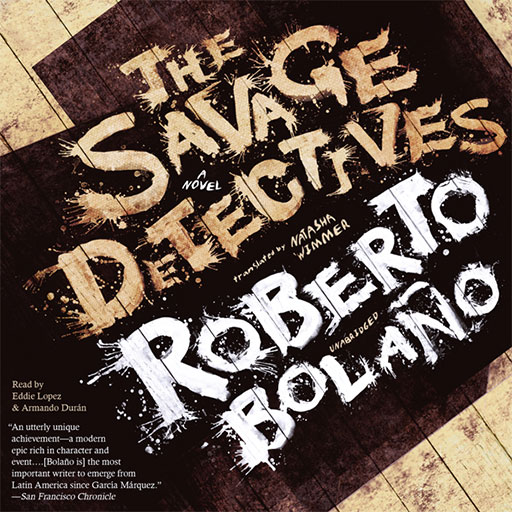
I reread 2666 this summer and immediately knew I had to reread The Savage Detectives, knew I had to parse some of what I missed in my first “unfair and premature” reading. I ended up checking out Blackstone Audio’s recording of the book, featuring the voice talents of Eddie Lopez and Armando Duran.

The audio production is excellent: Lopez, surely a very young man, reads the narratives of Juan García Madero that bookend the central section, “The Savage Detectives,” which is read with a startling depth of range by Duran. Lopez’s García Madero comes across as the naïve pretender to cynicism, the would-be artist faking a life of romance. In Duran’s handling, the myriad characters in the middle of the novel come to life with humor and pathos. He animates the characters, showcasing the irony and pain and sadness and small moments of lunatic joy that erupt in the book. The Savage Detectives makes for a surprisingly excellent audiobook. (Quick note anticipating a query those familiar with the novel may have: The cryptic pictograms that show up late in the novel are included in the audiobook; they displayed on my iPod in tandem with their sections, and I imagine they would pop up on any player with a screen).

I enjoyed The Savage Detectives much, much more this second time. I still found parts of it boring (perhaps purposefully boring, but boring nonetheless), and the episodes I enjoyed most on the first reading (the duel, the cavern, the Liberian segment, the Israeli prison, the campers in Spain) were the ones I enjoyed the most on the second round. Better equipped for this reading, I appreciated the riches of Detectives, the way its fragments, intertextual, metatextual, reach out through the Bolañoverse to couple with other fragments, other texts.

My metaphors above are all wrong—the texts don’t reach or couple—the reader does this work, this reaching, this coupling, this detecting.

In my first reading, not up to playing detective, I surely blew through this passage near the end of the novel, a passage that ripples with strange significance for anyone puzzling over 2666:

And Cesárea said something about days to come, although the teacher imagined that if Cesárea had spent time on that senseless plan it was simply because she lived such a lonely life. But Cesárea spoke of times to come and the teacher, to change the subject, asked her what times she meant and when they would be. And Cesárea named a date, sometime around the year 2600. Two thousand six hundred and something. And then, when the teacher couldn’t help but laugh at such a random date, a smothered little laugh that could scarcely be heard, Cesárea laughed again, although this time the thunder of her laughter remained within the confines of her own room.

Here we have lost poet Cesárea Tinajero, object of the savage detectives’ quest, holed up in her room in Santa Teresa, the central setting for the murders of 2666, a map of a factory (a maquiladora, like the ones the murdered women work at in 2666?) pinned to her wall; here we have Cesárea Tinajero, who keeps “a switchblade with a horn handle and the word Caborca engraved on the blade” by her side, believing she is “under threat of death.” Cesárea Tinajero is prophet to the horrors at the core of 2666.

2666’s Benno von Archimboldi twins Cesárea Tinajero. Just as a quartet of savage detectives search for Tinajero, so to a quartet of literary critics seek out the lost Prussian writer. (Archimboldi even shows up a few times in The Savage Detectives, albeit under the pseudopseudonym “J.M.G. Arcimboldi,” identified as a “Frenchman,” the author of The Endless Rose, his second novel in 2666). Cesárea Tinajero is also repeated in 2666’s Florita Almada, a psychic medium who not only testifies to, but also tries to stop, the unrelenting violence in Santa Teresa.

I suppose I could keep teasing out these intertextual meetings. I could point out that Detectives character Joaquín Font winds up in an insane asylum babbling about fate (fate and insanity being two major themes of 2666). I could point out that Auxilio Lacouture, narrator of Bolaño’s novella Amulet, gets to tell her story in miniature in Detectives. I could point out that the central figures (“central” is not the right word of course) of Detectives, Arturo Belano and Ulises Lima are everywhere in the Bolañoverse—even unnamed, it is clear that one of the duo fathers the bastard Lalo Cura, one of the good detectives of 2666. But what would be my point in elaborating detail after detail here? Or, and perhaps this is the real question I mean to ask here—is a full reading of The Savage Detectives ultimately dependent on intertextual relationships with other Bolaño books?

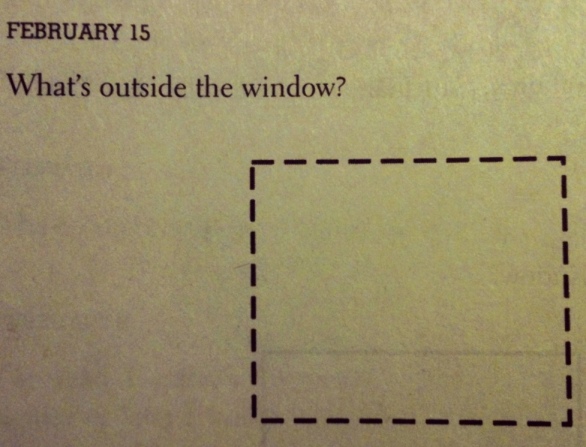
Maybe a better way to finish here is to hash out the last few pages of the novel, which find our narrator García Madero driving around Sonora with Lupe, on the run from the law (maybe). The last few entries of the book—in diary form—are simply a list of place names, obscure places in the Sonora desert the pair presumably drive to. García Madero takes up the mantle of exile and reads Cesárea Tinajero’s notebooks, which perhaps influence him—the last three entries of Detectives feature pictographic riddles that recall Tinajero’s visual poem “Sion.” Here is the final entry, which is also the final page of the book—

20120819-152744.jpg

I suppose there are plenty of answers to Bolaño’s final riddle. What’s outside the window? Abyssvoiduncertainty. Aporia. And also: Possiblityopennessfreedom. Certainty. And also: The perforated suggestions of a shape, lines to guide our scissors, form. And also: It’s to be taken literally, a literal dare to the reader to get up, to look out, to see. I could probably keep going.

If we know Bolaño’s detective games, we know that the mysteries are really labyrinths, mazes where we might get trapped and go insane. (The Savage Detectives is in large part a novel that outlines the risks—mental, physical, emotional—of literature). How do I read the gaps in the visual riddle? The gesture is visual ambiguity, paradox. The dashes open to void and close to make form; they define yet are indefinite; the window is there and is not there. So what we’re left with is a way of seeing, or at least an invitation to a way of seeing, which is to say a way of reading. So, if you like—and I like—what’s outside the window is the rest of the Bolañoverse—or at least an offer to play detective.

I Riff on Clarice Lispector’s Novella The Hour of the Star, a Strange Work of Pity, Humor, Terror, and Abjection

20120814-170735.jpg

1. How to go about this?

A starting place:

Clarice Lispector’s 1977 novella The Hour of the Star is a superb collection of sentences.

2. But what do I mean by this ridiculous statement? I mean isn’t that what all or most writing amounts to–a “collection of sentences”?

What I mean then is that Lispector’s sentences prickle and tweak and glare, launch off in strange angles from each other as if they were building out narratives in disparate, separate tones, moods, colors.

3. Another way to say this: the writing is strange, marvelous, uncanny. The good weird.

4. Or maybe I should let Lispector’s narrator say it:

Remember that, no matter what I write, my basic material is the word. So this story will consist of words that form phrases from which there emanates a secret meaning that exceeds both words and phrases.

(Our narrator repeatedly invokes the power of “the word,” but I’ll linger on the way those words string together in sentences).

5. And yes, our narrator is a “he.” Clarice Lispector the ventriloquist. Early in the book the narrator says that the tale could only come from “a man for a woman would weep her heart out.”

6. I’ll be frank: I don’t know how to unpack all the ventriloquizing here, the layering between Lispector and her narrator Rodrigo S.M., who relates the sad tale of  Macabéa (a typist!), indigent slum-dweller, no talent and no beauty.

7. Narrator Rodrigo S.M. seems unsure himself how to unpack the tale. He spends almost the first fifth of the book dithering over actually how to begin to start to commence:

I suspect that this lengthy preamble is intended to conceal the poverty of my story, for I am apprehensive.

And a page or two later:

I am scared of starting. I do not even know the girl’s name. It goes without saying that this story drives me to despair because it is too straightforward. What I propose to narrate sounds easy and within everyone’s grasp. But its elaboration is extremely difficult. I must render clear something that is almost obliterated and can scarcely be deciphered. With stiff, contaminated fingers I must touch the invisible in its own squalor.

8. (I promise to pick back up on that squalor and whatever invisible might be at the end of this riff).

9. The Hour of the Star: The story is thin, the plot is a shell, a threadbare ancient trope, as brave Rodrigo S.M. repeatedly tells us.

10. The plot is archetypal even. The orphan girl in the big city. Cinderella who imagines the ball, or tries to imagine the ball. Etc.

11. So here’s a proper plot summary, c/o translator Giovanni Pontiero (who surely deserves large praise heaped at his feet (or a location of his choice) for his poetic translation):

The nucleus of the narrative centres on the misfortunes of Macabéa, a humble girl from a region plagued by drought and poverty, whose future is determined by her inexperience, her ugliness and her total anonymity. Macabéa’s speech and dress betray her origins. An orphaned child from the backwoods of Alagoas, who was brought up by the forbidding aunt in Maceió before making her way to the slums of Acre Street in the heart of Rio de Janeiro’s red-light district. Gauche and rachitic, Macabéa has poverty and ill-health written all over her: a creature conditioned from birth and already singled out as one of the world’s inevitable losers.

Her humdrum existence can be summarized in few words: Macabéa is an appallingly bad typist, she is a virgin, and her favorite drink is Coca-Cola. She is a perfect foil for a bullying employer, a philandering boy friend, and her workmate Glória, who has all the attributes Macabéa sadly lacks.

12. A dozen things that The Hour of the Star may or may not be about: Poverty, storytelling, lies, illusions, abjection, resistance, agency, self, class, power, romance, fate.

13. But let’s get back to those words the narrator is braggin’ on:

Another angle at approaching The Hour of the Star: Its page of thirteen alternate titles, which act as a prose-poem descriptor for the novella:

20120814-170352.jpg

14. And some sentences:

The first provides a context. The second tells us everything about Macabéa. The third tells us everything about her awful, venal “boy friend” Olímpico:

For quite different reasons they had wandered into a butcher’s shop. Macabéa only had to smell raw meat in order to convince herself that she had eaten. What attracted Olímpico, on the other hand, was the sight of a butcher at work with his sharp knife.

15.  Macabéa, our primary, and Olímpico a distant second. But also Rodrigo S.M. (and a few others):

The story—I have decided with an illusion of free will—should have some seven characters, and obviously I am one of the more important.

16. (Again though, how to parse Rodrigo from Clarice Lispector . . .)

17. So maybe in one of his (her) parenthetical intrusions (but how can they be intrusions?). From late in the novella:

 (But what about me? Here I am telling a story about events that have never happened to me or to anyone known to me. I am amazed at my own perception of the truth. Can it be that it’s my painful task to perceive in the flesh truths that no one wants to face? If I know almost everything about Macabéa, it’s because I once caught a glimpse of this girl with the sallow complexion from the North-east. Her expression revealed everything about her . . .)

Solipsism? Hubris? Humor? Irony?

Truth?

18. But I want to say something about how funny this novella, but I don’t know how to say it, or I’m not sure how to illustrate it, how to support such a claim with text—how does one support a feeling, a vibe, a phantom idea? Is The Hour of the Star actually funny? Or am I a sick man? Why did I chuckle so much?

19. I think, re: 18, I think that it must be a mild streak of sadism, or an identification with the narrator’s flawed empathy, his raw presentation of a pathetic, abject heroine, a heroine whose heroism can only manifests in strange eruptions of self-possession, minor triumphs of the barest self-assertions.

20. Perhaps an illustration, re: 18/19—a lengthy one maybe, but indulge me (or, rather, indulge yourself):

At this point, I must record one happy event. One distressing Sunday without mandioca, the girl experienced a strange happiness: at the quayside, she saw a rainbow. She felt something close to ecstasy and tried to retain the vision: if only she could see once more the display of fireworks she had seen as a child in Maceió. She wanted more, for it is true that when one extends a helping hand to the lower orders, they want everything else.; the man on the street dreams greedily of having everything. He has no right to anything but he wants everything. Wouldn’t you agree? There were no means within my power to produce that golden rain achieved with fireworks.

Should I divulge that she adored soldiers? She was mad about them. Whenever she caught sight of a soldier, she would think, trembling with excitement: is he going to murder me?

Can you feel the shifts here? A distressing Sunday, a hungry Sunday (“without mandioca”); its strange happiness; an ecstasy that repeats a childhood vision; the desire for more, to rise above one’s allotment (The Right to Protest, or, She Doesn’t Know How to Protest); the limits of words, of language. An unexpected, seemingly irrelevant anecdote. A rare dip into our heroine’s consciousness.

21. There’s a certain absurdity here, a methodical absurdity, of course. There’s a rhythmic certainty to the prose—a sense of aesthetic uniformity—but the content jars against it, the meaning spikes out in subtly incongruous jags that form some other shape. Folks say folks say Lispector echoes Kafka in this way. (I’m reminded of Robert Walser’s sentences too).

22. But I’ve shared enough to give you a sense of Lispector’s style, a taste anyway, right?

What about the book’s claim, its viewpoint, its thesis?

23. Okay, so it’s right there upfront in the  book’s fifth paragraph, delivered early enough when the reader is suitably perplexed, looking for some kind of narrative inroad, not looking necessarily for a theme or a message or what have you:

Even as I write this I feel ashamed at pouncing on you with a narrative that is so open and explicit. A narrative, however from which blood surging with life might flow only to coagulate into lumps of trembling jelly. Will this story become my own coagulation one day? Who can tell? If there is any truth in it—and clearly the story is true even though invented—let everyone see it reflected in himself for we are all one and the same person . . .

24. Let’s not misunderstand the last sentiment as some hippy-dippy bullshit: Let’s go back to: “I must touch the invisible in its own squalor.”

25. That squalor is the abject, the filth, the not-me, the other, signified most strongly in waste, blood, filth, vomit, the corpse.

26. The gesture of The Hour of the Star is to make visible—in sentences, in words, in language—the invisible in its own squalor.

27. Highly recommended.

Unknown Pleasures (I Riff a Bit on Marcel Proust’s Swann’s Way)

20120809-105603.jpg

1. I was an undergrad in college when I first tried to read Marcel Proust. It was one of those things I did on my own, which is another way of saying that none of his writing was ever assigned to me; neither do I recall any of his writings even appearing in any of the anthologies I was assigned in high school; neither do I recall any of his writings appearing in any of the anthologies I’ve used as a teacher.

2. My initial interest in Proust, late in high school, when the name alone seemed so damn romantic, was aroused, like most people I’ll bet, by the fact that this guy basically wrote one long book, a book that seemed to have at least three names, not counting the names of the individual books and book-length chapters in those individual books.

3. But, like I said, I didn’t try to read Proust until college when I checked out the first volume from the university library. I think it might have actually been a compendium of two or more books that make up the Recherche. Anyway, I can’t recall much, except that I slugged it out through that interminable first chapter, “Combray,” getting absolutely nothing out of it.

4. Since then I’ve read a lot about Proust and his writing, enough to perhaps understand that my first foray into Swann’s Way was probably not from the best angle. I was into decidedly different stuff then—lots of the American postmodernists, English and Irish modernists, etc.—and Proust’s modernism was totally lost on me.

5. Re: Point 4: Perhaps a better way to put it would be to borrow Harold Bloom’s notion that strong/strange writers so assimilate their readers that the readers can no longer see the strangeness/strength. I was assimilated.

6. Wandering through the used book store I frequent, I spotted Lydia Davis’s translation of Swann’s Way and snapped it up, not because of any real interest in trying Proust again but because of a fannish devotion to Davis, or the idea that Davis would make Proust accessible.

7. (A brief fantasy I had as my hand hovered over the book, before my hand touched the book:

I imagined that Davis had turned Swann’s Way into a series of her own vignettes, that she had parsed and ventriloquized Proust, that her translation would be akin to “Ten Stories from Flaubert.”

This is not the case).

8. (While I’m being parenthetical: This riff started as a “books acquired” post, a post where I take a lousy photograph to document a new book that somehow arrives at Biblioklept World Headquaters. But I read so much of Swann’s Way that the original idea riffed out into this thing. Actually, go ahead and skip Point 8, if you haven’t already. Sorry).

9. The day after buying Davis’s translation I read “Combray” over two short airline trips.

10. Or should it be Combray?—it seems like a self-contained novel.

11. The opening paragraphs of “Combray” are an amazing and strange meditation on sleeping, or rather going to sleep, filled with wonderful little digressions. They are a simultaneously alienating and inviting way to open a book.

Proust writes—

Sometimes, as Eve was born from one of Adam’s ribs, a woman was born during my sleep from a cramped position of my thigh. Formed from the pleasure I was on the point of enjoying, she, I imagined, was the one offering it to me. My body, which felt in hers my own warmth, would try to find itself inside her, I would wake up.

Such a lovely set of images.

I marked it and moved on without trying to figure out exactly what it might mean.

12. Other moments are more lucid, penetrating, insightful:

Even the very simple act that we call “seeing a person we know” is in part an intellectual one. We fill the physical appearance of the individual we see with all the notions we have about him, and of the total picture that we form for ourselves, these notions certainly occupy the greater part.

“Combray” is full of these wonderful, subtle moments, and it includes some of the finest passages on reading and the transformative powers and pleasures of reading that I’ve encountered.

13. The phrase “unknown pleasures” pops out early in the book—is this where Joy Division got the album name?

14. Proust seems to hit on the idea of unknown pleasures again and again, speculative pleasures, idealized pleasures.

15. Introduced to the writer Bergotte by Swann and Bloch, the young narrator muses:

One of these passages by Bergotte, the third or fourth that I had isolated from the rest, filled me with a joy that could not be compared to the joy I had discovered in the first one, a joy I felt I was experiencing  in a deeper, vaster, more unified region of myself, from which all obstacles and partitions had been removed.

The passage concludes with the narrator deciding that he has accessed the “‘ideal passage’ by Bergotte,” an idealization through which he finds his mind “enlarged.”

16. Cataloging the meditations on unknown pleasures in the book would take forever though, and I’m just riffing here.

17. (Although I do love and will thus bring up a late passage where the narrator longs to walk in the woods with “a peasant girl,” one like a “local plant” (!), through which he will access new and individual and unknown pleasures, “Obscurely awaited, immanent and hidden. . . “).

18. Stray note: Swann is described as having a “Bressant-style” haircut, which the end notes describe as “a crew cut in front and longer in the back.” Is this not known colloquially as a mullet? Am I to understand that Swann sports a Kentucky waterfall?

19. Proust’s greatest strength in “Combray” seems to be his ability to move from the physical to the metaphysical, from object to memory. And then back again.

20. An empty statement: The writing is beautiful.

21.  Still, there’s something irksome about the narrator (Marcel?): I stopped writing “mama’s boy” in the margin after the third such notation.

22. Re: Point 21: Is this why I never stuck it out with Proust? Is this why, despite acknowledging “The writing is beautiful,” I am not particularly inclined to see what happens next? (And next and next and next . . .)

23. Re: Point 22: I think here of Cormac McCarthy’s assertion in a 1992 New York Times interview that Proust is “not literature” because it doesn’t “deal with issues of life and death.” McCarthy’s quote may or may not be out of context (not here; here it’s in perfectly sound context. I’m talking about proper context in the interview, which is to say that he may or may not have been riffing off the cuff).

24. Okay, from the McCarthy interview:

 His list of those whom he calls the “good writers” — Melville, Dostoyevsky, Faulkner — precludes anyone who doesn’t “deal with issues of life and death.” Proust and Henry James don’t make the cut. “I don’t understand them,” he says. “To me, that’s not literature. A lot of writers who are considered good I consider strange.”

25. Maybe I bring it up because I’ve read so much of McCarthy and the heroes on his list above and find them so compelling, find the protagonists and antagonists so compelling, and while Proust’s narrator is hardly repellent, I find myself occasionally wanting to give him a wedgie.

26. (Never having had the desire to give Ishmael a wedgie, or the underground man a wedgie, or Lucas Beauchamp a wedgie, or Cornelius Suttree a wedgie).

27. Okay. The sentiment I’ve just expressed seems cruel.

28. The same sensitivity I find occasionally overbearing in the narrator is exactly what makes so many of the passages and insights in the text so extraordinary.

29. The narrator is some kind of specialized receptive organic instrument, a psyche keenly attuned to the physical world who mediates that world through emotion, memory, psychological projection—language.

30. The narrator is some kind of membrane but also a self, his articulations winding from reader to self through memory to the natural world, to its phenomena, and back through desire, thought, anticipation, idealization, all back through memory again, back to the reader again. And if tracing these articulations is exhausting, the process also undeniably yields unknown pleasures.

I Review City of Glass, A Comic Book Doppelgänger of Paul Auster’s Postmodern Detective Novel

Paul Auster’s 1985 novel City of Glass explores doubling, shadowing, and what it means to wear another person’s skin, so it’s fitting that the book has its own doppelgänger in the form of a graphic novel by Paul Karasik and David Mazzucchelli (maestro Art Spiegelman served as catalyst and counselor). I should admit upfront that although I’ve read a few of Auster’s books, I haven’t read City of Glass, considered by many to be his masterpiece. I have read Mazzucchelli’s excellent novel Asterios Polyp (and plenty of stuff by overseer Spiegelman), so the adaptation intrigued me. I wasn’t disappointed. I read Karasik and Mazzucchelli’s City of Glass in one brisk sitting and thoroughly enjoyed it. What’s it about?

Okay, so there’s this novelist, Quinn (“rhymes with twin”), who, after the death of his wife and son, takes up writing boilerplate detective novels under the pseudonym William Wilson. Late in the book, Quinn (if he’s still Quinn at that point, which I’ll get to) identifies the pseudonym with the “real” name of NY Mets center fielder (and future coach) Mookie Wilson—but savvy readers will also recognize “William Wilson” as the name of an Edgar Allan Poe story about a man haunted by a doppelgänger of himself to the point that he goes insane. In the Poe story, Wilson and his doppelgänger (whose name is, of course, William Wilson as well) share the same birthday, January 19th, which also happens to be E.A. Poe’s birthday (and my brother’s too, although that is not germane to this review). Auster is clearly working from Poe’s story, although he never announces this explicitly (at least not in the comic-bookization). Arthur Hobson Quinn, for example, wrote an exhaustive biography of Poe (published in 1941). Crossing from the real to the fictional, from authorial to character, Auster inserts himself into the story from its outset. At the beginning of the book, protagonist Quinn gets a mysterious call, like something out of the noir novels he writes:

20120728-125217.jpg

Bored, or perhaps ventriloquized by a force he doesn’t understand, Quinn takes up the identity of detective Paul Auster and agrees to take on a case for Peter Stillman, a man who, as a boy, suffered feralization at the hands of his insane father, who hoped to discover the Ur-language of god through the boy. Stillman’s monologue is one of the highlights of the book, showcasing the malleability of language—and also, significantly, the malleability of speakers:

20120728-125225.jpg

Stillman hires Quinn/Auster to track his father, also named Peter Stillman (Peter is also the name of Quinn’s dead son). Actually, it’s Stillman the Younger”s wife/speech pathologist who hires Quinn/Auster; she’s certain that Stillman the Elder, freshly released from a mental asylum, will return to harm his son.

Quinn/Auster slides into the role of Max Work, his noir novel protagonist—or, perhaps more accurately, William Wilson’s noir protagonist—and begins tracking Stillman the Elder (or a version of Stillman the Elder—I won’t spoil the novel’s strangest, most maddening metaphysical gambit here). And, predictably, as Quinn/Auster/Wilson/Work  shadows Stillman Sr., he morphs into yet another doppelgänger:

20120728-125233.jpg

Quinn/Auster/Wilson/Work eventually confronts Stillman, and the pair have a series of fascinating conversations about language, Milton, Humpty Dumpty, and the Tower of Babel. The motifs and themes are telegraphed fairly straightforward here, but also communicated through a lens of madness that comes to dominate the book’s third act—an act that initiates in a meeting between Q/A/W/W and the “real” Paul Auster, a writer who’s working on an essay about the authorship of Don Quixote. The Don Quixote conversation is perhaps too overt, the sort of postmodern cleverness that I increasingly find a big turnoff, but it’s not clumsy or awkward. Still, there’s something mildly irritating about an author tipping his hand and then showing you how he’s tipping his hand.

The third act of City of Glass feels compressed, rushed even, and will definitely disappoint readers who wandered in for a detective stories, hoping for concrete answers and a neat and tidy plot. However, the book’s themes of fantasy and reality, play and work, sanity and madness, and character and author are rich if frustrating in their circuitousness. Mazzucchelli’s art is evocative and fitting, recalling at times the rough-hewn pop art of Raymond Pettibon and the traditional prowess of masters like Kirby and Eisner. (I’ll bring up Spiegelman again too, who introduces the volume. A friend of Auster’s, he brokered the project and oversaw its development, and his work as a creative director here is evident in the book’s cohesion). I imagine fans of Auster’s New York Trilogy, of which City of Glass is the first book, will be interested in checking this one out. Having come first to the graphic novel, I now look forward to reading its doppelgänger, Paul Auster’s City of Glass. Good stuff.

In Which I Review the Cloud Atlas Film Trailer

I liked David Mitchell’s novel Cloud Atlas.

I reviewed it here in some detail, but here’s a brief overview:

Mitchell’s Cloud Atlas comprises six sections, each interrupted by the next section (with the exception of the sixth section), and then commenced again in reverse order (a simpler way to think of this might be a schema: 1-2-3-4-5-6-5-4-3-2-1). Sections 1-6 move forward chronologically and, significantly, each section represents a new literary trend. (Again, perhaps a schema with illustrating examples would work better here; for more detail, check out my review: 1: Melville-2: Modernism-3: Airport novel-4: Contemporary novel (Roth?)-5: Dystopian sci-fi (post-Orwell, shades of PKD)-6: Post-apocalyptic (language games, à la Russell Hoban’s Riddley Walker)). In short, Cloud Atlas is an exercise in several genre styles, glommed onto a few ideas cribbed from Nietzsche: eternal recurrence, master/slave relationships, will to power, all that jazz. Ultimately—and more interestingly, I think—Cloud Atlas is an exercise in postmodernism-as-genre, a sort of critique perhaps (intentional or not), brought into even greater relief when one examines Mitchell’s novels Black Swan Green (a coming of age story) and The Thousand Autumns of Jacob de Zoet (a straight-up historical romance), which are, again, genre exercises.

This leads me up to the film adaptation of Cloud Atlas, the long trailer for which dropped today.

I would embed the goddamn trailer, but it’s been blocked on YouTube and other similar sites by Warner Brothers, who apparently have absolutely no idea how publicity works.

You can watch the trailer here.

[Update] Here’s the trailer:

Did you watch it? Okay. I’m gonna riff a little:

I know that trailers have to advertise films to a wide range of potential audience members, and that often leads to overwrought musical cues and lines pulled out of context and big flashing words in all caps, but damn, this is cheeseball stuff. Mitchell’s Cloud Atlas is a subtle book (at times), one that works best when the readers are allowed to do most of the work. The trailer suggests spectacle over nuance, bombast over substance. But again—just a trailer.

Not that the Wachowskis—who are directing and writing and producing (along with Tom Tykwer, whose films Run Lola Run and Perfume I recall enjoying)—-are known for restraint.

And, while I’m bringing up the Wachowskis: They are most famous for their visual inventiveness (these are the guys who did The Matrix), but great looking films don’t necessarily mean much. I mean, the last film they did was Speed Racer (okay, Cloud Atlas looks a lot more restrained than that fiasco, but still, these guys have major problems with storytelling).

Now, based on the trailer, the filmmakers seem to have done some significant rewrites. In Mitchell’s novel, each section (or sections 1-5, at least), exists as a narrative of some kind—fictional narratives, in a few cases. Each protagonist comes to find him or herself echoing or tracing or otherwise repeating or prefiguring the protagonist of another narrative—but there’s always the recognition of the textuality (and hence, metatextuality) to this patterning. Put another way, these are all characters in stories that are awfully familiar to us, and Mitchell strives to make the reader aware of this textuality: it’s a thoroughly postmodern move. 

The film seems to connect the characters in two ways: 1, it seems to use actors across separate roles (this could work) and 2, it seems to have characters from previous segments interact with each other across segments. I might be misreading the trailer when it comes to point 2 here, but I think that having characters actively puncture the nested narratives of Cloud Atlas is a bad idea. And, even if I am misreading this, the film clearly imposes a unifying style across the narratives—sure the dystopian sci-fi scenes will have different set dressing, etc., than the Pacific journal narrative scenes—but take note of how all the scenes seem to follow a unified visual sensibility. The joy of Mitchell’s novel is the way he plays with, parodies, adores (etc.) the narrative styles he’s reworking. For example, Half-Lives: The First Luisa Rey Mystery reads like a bad airport mystery (or at least a mediocre one). I was hoping that the filmmakers would attempt to do something similar with the film—actually play with the concept of genre, actually manipulate and amplify the distinct genre conventions at work in Mitchell’s book. Which, maybe they do. Again, I know: it’s just a trailer.

But it’s an awfully slick, shiny trailer.

Okay, perhaps I’m griping too much. All the characters seem to be there, and the casting doesn’t seem terrible. My curiosity is piqued, admittedly, but mostly because I want to know how the filmmakers will handle the nested narratives (also: how long will the movie be?). In any case, I’m sure this will be one of those movies where people sigh and say, “Yeah, the book is way better.”

Intertexuality and Structure in Roberto Bolaño’s 2666

I had been reading William T. Vollmann’s enormous book Imperial. I bought the book in paperback and then put an illicit copy on my Kindle (this riff is not about the ethics of that move). It’s just easier to read that way, especially at night. At some point in Imperial, probably at some mention of coyotes or polleros—smugglers of humans—I felt a tug in the back of my brain pan, a tug that wanted to pull up Roberto Bolaño’s big big novel 2666—also on my Kindle (also an illicit copy, although I bought the book twice).

This is how I ended up rereading 2666 straight through. It was unplanned.

Like many readers, I aim to reread more than I actually end up rereading.

Truly excellent novels are always better in rereading: richer, fuller, more resonant. Sometimes we might find we’ve thoroughly misread them. (Imagine my horror rereading Lolita in my twenties to discover the vein of evil throbbing through it). Sometimes we find new tones that seemed impossible on the first run through. (I’ve read Blood Meridian at least once a year since the first time I read it, and it keeps getting funnier and funnier). Most of the time, rereading confirms the greatness of the novel, a greatness inhabiting the smallest details. (I’m looking at you Moby-Dick).

Even a riff should have a thesis, and here’s mine:  2666 has a reputation for being fragmentary and inconclusive—and in some ways, yes, of course it is—but a second full reading of 2666 reveals a book that is cohesive, densely allusive, and thematically precise.

Rereading is one way of stepping back to see the bigger picture that  Bolaño twists together from smaller fragments. Rereading reveals the intertextual correspondences between the books of 2666 (the five books proper, the “Parts,” of course, but also the texts, invented or real, that those books house).

2666 is also a book about writing.

Earth, Giuseppe Arcimboldo

To wit: “The Part About Archimboldi,” the fifth and final book of 2666, the book that features Benno von Archimboldi, the writer at the heart of 2666—this final chapter sews together many of the book’s (apparently) loose threads.

Two problems with the point above:

A. Benno von Archimboldi (aka Hans Reiter) is not at the heart of 2666 but rather a shadowy trace slipping through the margins, a ghost-presence that’s always there, but not generative or muscular like a heart. (I’m not sure exactly what I mean by this).

B. “The Part About Archimboldi” most decidedly does not sew together all the loose threads: That’s the reader’s job (or task or pleasure or plight or burden).

And so then: “2666 is also a book about writing”): 2666 is also a book about reading: A book about reading as detective work.

Who are the heroes of 2666?

They are all detectives of some kind, literal or otherwise.

Literary critics. Journalists. Philosophers. Psychologists. Psychics and fortune tellers. Police detectives. Private detectives. An American sheriff. A rogue politician. Poets. Publishers. Parents. Searchers.

Archimboldi shows up in the first book of 2666, “The Part About the Critics”; the eponymous critics, literary detectives are searching for him.

How does Archimboldi show up?

Inside a story (the Frisian lady’s) inside a story (the Swabian’s) (inside the story of “Critics,” which is inside the story of 2666).

The Frisian lady asks:

“Does anyone know the answer to the riddle? Does anyone understand it? Is there by chance a man in this town who can tell me the solution, even if he has to whisper it in my ear?”

And Archimboldi answers. He’s a reader, a detective.

Swinging back to the previous point: 2666 is a book about writing, and it shares the postmodern feature of calling attention to its own style and construction, yet it never does this in an overtly clever or insufferable fashion: It’s far more sly.

Water, Giuseppe Arcimboldo

What is the construction or shape of 2666?

A straightforward answer: Five books in an intertextual conversation that seem to loop back around, where the last book prefigures the first book in a strange circuit.

Some possible metaphorical answers:

A void (“Voids can’t be filled,” Archimboldi says).

A labyrinth (the word labyrinth appears 14 times in Wimmer’s translation of 2666).

A mirror (61 times).

An abyss (22 times)

An asylum (43 times; madhouse appears 5 times).

How does Bolaño slyly announce or criticize or puncture his style in 2666?

In Ignacio Echevarria’s “Note to the First Edition” of 2666, he tells us that:

Among Bolaño’s notes for 2666 there appears the single line: “The narrator of 2666 is Arturo Belano.” And elsewhere Bolaño adds, with the indication “for the end of 2666”: “And that’s it, friends. I’ve done it all, I’ve lived it all. If I had the strength, I’d cry. I bid you all goodbye, Arturo Belano.”

Belano is Bolaño’s alter ego, a trace who slips and sails and ducks through the Bolañoverse (he also shows up unnamed in 2666 with his partner Ulises Lima; they manage to father a bastard son, Lalo Cura).

So Belano who narrates 2666 (how?!) is Bolaño: Okay: So? Now?

I suggested earlier on Biblioklept that 2666 is a grand ventriloquist act, a forced possession, a psychic haunting. Bolaño channels Belano who channels detectives, journalists, poets, writers. Readers.

The channeling is metatextual or intertextual, a series of transpositions between the various narrators and protagonists and readers (detectives all).

The passage that I see most frequently cited from 2666 points to its intertextuality.

The passage is likely frequently cited because

A) Ignacio Echevarria cites it in his note at the beginning of 2666 and

B) it describes Bolaño’s project in 2666, both internally (the book as a strange beast, with intertextual readings within its five (plus) parts), and also externally (intertextually against the canon). Here is the passage (from “The Part About Amalfitano”):

One night, while the kid was scanning the shelves, Amalfitano asked him what books he liked and what book he was reading, just to make conversation. Without turning, the pharmacist answered that he liked books like The Metamorphosis, Bartleby, A Simple Heart, A Christmas Carol. And then he said that he was reading Capote’s Breakfast at Tiffany’s. Leaving aside the fact that A Simple Heart and A Christmas Carol were stories, not books, there was something revelatory about the taste of this bookish young pharmacist, who in another life might have been Trakl or who in this life might still be writing poems as desperate as those of his distant Austrian counterpart, and who clearly and inarguably preferred minor works to major ones. He chose The Metamorphosis over The Trial, he chose Bartleby over Moby-Dick,he chose A Simple Heart over Bouvard and Pecuchet, and A Christmas Carol over A Tale of Two Cities or The Pickwick Papers. What a sad paradox, thought Amalfitano. Now even bookish pharmacists are afraid to take on the great, imperfect, torrential works, books that blaze paths into the unknown. They choose the perfect exercises of the great masters. Or what amounts to the same thing: they want to watch the great masters spar, but they have no interest in real combat, when the great masters struggle against that something, that something that terrifies us all, that something that cows us and spurs us on, amid blood and mortal wounds and stench.

At the risk of belaboring or repeating the last point: Bolaño, ever the canon-maker, the list maker, situates 2666, his final work (he knows it’s his final work) along with “the great, imperfect, torrential works, books that blaze paths into the unknown,” a book that struggles “against that something, that something that terrifies us all, that something that cows us and spurs us on, amid blood and mortal wounds and stench.”

Air, Giuseppe Arcimboldo

So some metatextual moments that, read intertextually, perhaps (perhaps!) work to outline that “unknown,” that “something” of 2666:

Near the end of “The Part About Crimes,” a culminating moment, where a female journalist (NB: a female journalist is the first murder victim in “Crimes”) reads the work of the poet/journalist Mercado:

Hernandez Mercado’s style wavered between sensationalism and flatness. The story was riddled with clichés, inaccuracies, sweeping statements, exaggerations, and flagrant lies. Sometimes Hernandez Mercado painted Haas as the scapegoat of a conspiracy of rich Sonorans and sometimes Haas appeared as an avenging angel or a detective locked in a cell but by no means defeated, gradually cornering his tormentors solely by dint of intelligence.

A description of the style of “The Part About the Crimes”: “The story was riddled with clichés, inaccuracies, sweeping statements, exaggerations, and flagrant lies.”

And, from “The Part About Archimboldi,” a moment where some critics read Ivanov’s novel Twilight and assess it:

Professor Stanislaw Strumilin read it. It struck him as hard to follow. The writer Aleksei Tolstoy read it. It struck him as chaotic. Andrei Zhdanov read it. He left it half finished. And Stalin read it. It struck him as suspect.

These are internal criticisms of 2666.

Another moment from Ansky’s journal that seems to describe “The Part About the Crimes,” 2666, and the Bolañoverse in general:

He mentions names Reiter has never heard before. Then, a few pages on, he mentions them again. As if he were afraid of forgetting them. Names, names, names. Those who made revolution and those who were devoured by that same revolution, though it wasn’t the same but another, not the dream but the nightmare that hides behind the eyelids of the dream.

While I’m using Ansky’s journal as a pseudo key for the intertextual labyrinth of 2666, let me grab this nugget:

Only in chaos are we conceivable.

(I added the note “thesis” in the electronic margin).

Or another description of the novel, couched in a description of history:

. . . history, which is a simple whore, has no decisive moments but is a proliferation of instants, brief interludes that vie with one another in monstrousness.

Another description of 2666 can be found in Bubis’s description of Archimboldi’s second novel:

Lüdicke had yet to come off the presses when Mr. Bubis received the manuscript of The Endless Rose, which he read in two nights, after which, deeply shaken, he woke his wife and told her they would have to publish this new book by Archimboldi.

“Is it good?” asked the baroness, half asleep and not bothering to sit up.

“It’s better than good,” said Bubis, pacing the room.

Then he began to talk, still pacing, about Europe, Greek mythology, and something vaguely like a police investigation, but the baroness fell back asleep and didn’t hear him.

The names of the novels here also suggest something about the structure of 2666The Endless Rose suggests an eternal loop, as does Lüdicke, which etymologically suggests ludic, recursively playful . . . (Again, I’m just riffing here).

Another description of Archimboldi’s writing, which is of course a description of Bolaño’s 2666:

The style was strange. The writing was clear and sometimes even transparent, but the way the stories followed one after another didn’t lead anywhere: all that was left were the children, their parents, the animals, some neighbors, and in the end, all that was really left was nature, a nature that dissolved little by little in a boiling cauldron until it vanished completely.

Fire, Giuseppe Arcimboldo

Archimboldi’s name is some sort of secret key to the novel. He invents the name, of course, seemingly on the spot. (Invents is not the right word—rather, he synthesizes the name, cobbles it together from his readings. The name is intertextual).

The last name he appropriates from the painter Arcimboldo, whose paintings are instructive in understanding the structure of 2666, a narrative that comprises hundreds of internal discrete narratives that define the shape of the larger picture.  The first name?

“They called me Benno after Benito Juarez,” said Archimboldi, “I suppose you know who Benito Juarez was.”

The dark heart of 2666, site of “Crimes,” is Santa Teresa, a transparent stand-in for Ciudad Juarez.

(Florita Almada, psychic medium and honest detective of “Crimes” channels Benito Juarez, the shepherd boy who became the president of Mexico; I’m tempted to quote here at some length but resist).

Re: Above: I foolishly suggested that Archimboldi’s name is some sort of secret key. I don’t think there is a secret key. Just reading. Rereading.

I seem to be focusing a lot on “The Part About Archimboldi” in this riff. I riffed about the first three books here, and “The Part About Crimes” here.

But, still dwelling on “Archimboldi,” there’s a moment in it where an old alpine hermit confesses to murdering his wife by pushing her into a ravine. In some way his confession seems to answer all the puzzles of “Crimes,” all the unresolved abysses, all the falls (literal and metaphorical).  How can I justify this claim? How does a man confessing to a murder in a remote German border town in the 1950s answer the murders in Mexico in the 1990s? Or any of the other murders in the book? I suppose it’s a thematic echo, not a solution. Sweating late at night, reading past midnight, the moment struck me as larded with significance. I’m losing whatever thread I had . . .

So to end—how to end? Perhaps I’ll raid my first review of 2666, from January, 2009—surely I must have remarked on the end of the book, or on its apparent inconclusiveness—

—and so I did. And I don’t know if I can do better than this: 

Readers enthralled by the murder-mystery aspects of the novel, particularly the throbbing detective beat of “The Part About The Crimes,” may find themselves disappointed by the seemingly ambiguous or inconclusive or open-ended ending(s) of 2666. While the final moments of “The Part About Archimboldi” dramatically tie directly into the “Crimes” and “Fate” sections, they hardly provide the types of conclusive, definitive answers that many readers demand. However, I think that the ending is perfect, and that far from providing no answers, the novel is larded with answers, bursting at the seams with answers, too many answers to swallow and digest in one sitting. Like a promising, strangely familiar turn in the labyrinth, the last page of the book invites the reader back to another, previously visited corridor, a hidden passage perhaps, a thread now charged with new importance . . . 2666 is a book that demands multiple readings.

It was a good suggestion three years ago and I’ll take it up again.

I Review Neal Stephenson’s Zany, Prescient Novel Snow Crash (And Comment on the Impending Film Adaptation)

Neal Stephenson’s 1992 novel Snow Crash opens with an extended scene in which the book’s protagonist races to deliver a pizza on time for the mafia. The scene is thrilling and ridiculous, establishing the book’s frenetic, ironic tone and painting a rough outline of Snow Crash’s milieu. Like  many sprawling works of speculative fiction, Snow Crash is more interested in rendering its milieu in vibrant, hyperkinetic color than it is concerned with delivering plot and character development. Snow Crash’s plot is the sort of joyfully convoluted careening mess that makes a reviewer (okay, this reviewer) shudder at the thought of having to successfully paraphrase, so I’m not even going to make an earnest effort. Let’s get to that milieu and the cartoon characters who inhabit it.

Snow Crash is set in the early 21st century, primarily in Los Angeles, which is no longer part of the United States. Actually, there isn’t much of a United States to speak of, really—and not even a municipal Los Angeles, per se. Instead, the terrain is totally privatized. Privatized roads, privatized spaces. People (who can afford to) live in franchised burbclaves protected by hired mercenaries or private militias or robots that keep out the undesirables. (The white folks who live in New South Africa want “racial purity,” while some franchise nations, like Mr. Lee’s Greater Hong Kong are open to anyone who can trade information). Authority is for sale. Conditions are so laissez-faire that the Mafia is truly a Legitimate Business now (complete with their own CosaNostra Pizza University). In fact, all business is legitimate; several times in Snow Crash, a character will refer to “the old days when they had laws.” Without regulation, hyperinflation is the norm; the homeless use trillion-dollar bills to light their campfires.

There’s a hard-edged griminess to the world Stephenson conjures in Snow Crash, but the book is never grim or dour, and instead embraces the anarchic-capitalism it proposes. Perhaps this is because Stephenson’s heroes are such radically exceptional people. The book’s hero is named Hiro Protagonist, the kind of Pynchonian goof that characterizes Snow Crash’s zany tone. Hiro meets the book’s other protagonist, a fifteen year old blonde who goes by Y.T. (“Yours Truly,” although most of the folks tend to hear “whitey”). Y.T. is a Kourier, a skateboarding delivery person who harpoons vehicles to catch a free ride. She helps Hiro deliver that pizza in the opening scene and the two team up after Hiro gives her his business card. It reads: “Last of the Freelance Hackers  / Greatest swordfighter in the world  / Stringer, Central Intelligence Corporation. Specializing in Software related Intel. (Music, Movies & Microcode.)” Did I neglect to mention that Hiro carries two samurai swords with him wherever he goes?

Hiro’s pretty handy with those swords, but his real skill is hacking, and he spends a good deal of time in the Metaverse, a virtual reality-based internet space where avatars go to bars and chat and sell &c. It’s sort of like a mix between Facebook and World of War Craft. In 1992 (earlier, I suppose), Stephenson’s way ahead of the curve. Here, he describes avatars:

Your avatar can look any way you want it to, up to the limitations of your equipment.  If you’re ugly, you can make your avatar beautiful.  If you’ve just gotten out of bed, your avatar can still be wearing beautiful clothes and professionally applied makeup.  You can look like a gorilla or a dragon or a giant talking penis in the Metaverse.  Spend five minutes walking down the Street and you will see all of these.

There are plenty of passages like this, where Stephenson pegs some aspect of internet culture ten years before it actually happens. (I couldn’t help but think about Wikipedia during Hiro’s conversations with a program called Librarian). It’s probably fair to say that the Wachowskis lifted as much from Snow Crash as they did from William Gibson’s cyberpunk trilogies.

While I’m there, I might as well lazily point out that Snow Crash would fit neatly at home on a shelf with Neuromancer or Mona Lisa Overdrive. There’s also a heavy dose of Philip K. Dick weirdness in Snow Crash, particularly when the book settles into its major metaphysical plot about ancient Sumerian gods and goddesses and linguistic viruses and the Tower of Babel. Stephenson’s Snow Crash is zanier than William Gibson’s dark depictions or Dick’s mindmelted milieux, and it would hardly do to call what he does here light—but there is something joyful, playful about his satire. I invoked Pynchon earlier and I’ll do it again; parts of Snow Crash also reminded me of David Foster Wallace’s opus Infinite Jest. Both IJ and SC obsess over the minutest details of speculative technologies and how people might react to such technologies. This is often what sets Snow Crash heads and shoulders above run of the mill cyberpunk. In just one instance, Stephenson parodies the language of bureaucratic speech at length; Y.T.’s mom, who works for what’s left of the Federal Government, is subjected to a memo about toilet paper usage that goes on for pages. The passage is hilarious, and adds absolutely nothing to the plot development—it simply helps to flesh out the contours of the world that Stephenson has imagined.

All of this detailed imagining unfortunately comes at the expense of a plot that only coheres through massive exposition dumps. About a third of the way into the novel, the major conflict is finally established, but only through a dialog between Hiro and the Librarian that reads almost like a catechism. As the book reaches its climax, Hiro actually explains what’s going on to a few of the other major characters—and the reader, of course. It’s a cringe-worthy moment, the sort of rhetorical weakness that smacks of genre fiction; even worse, the plot’s action ultimately hangs on some fairly basic hoary old tropes that wouldn’t be unfamiliar to anyone who’s ever played a video game. The book lags under a juvenile obsession with weapons and badassery in general. And the book’s resolution . . . well, let’s just say that Stephenson sticks the ending, but it all feels too pat and too slight after the dazzling weight of the world that he’s established. Still, at its finest, Stephenson’s prose is zippy, shining, hilarious stuff, and his employment of multiple character perspectives moves the book with an addictive energy. Snow Crash is beach reading for folks who like some humor with their dystopia.

A film adaptation of Snow Crash is supposedly going into production soon, with British director Joe Cornish taking charge. I liked Cornish’s last film Attack the Block, and Snow Crash clearly has a highly-imagistic, cinematic feel to it—but I think a film is not the way to go. Simply put, Snow Crash is too big, too larded with characters and details (so many that I failed to touch on in this review) to translate well onscreen. I think an eight part miniseries on HBO (or a similar network) would be perfect, even if it came at the expense of special effects—-a miniseries would give the filmmakers time to build Stephenson’s nuanced world. I’m afraid otherwise we’ll get a travesty like the adaptation of The Golden Compass, or something like The Hunger Games film, where all but the most basic plot points are elided. But I suppose a miniseries is not as lucrative as a blockbuster film. I hope the filmmakers at least split the book in two. In any case, I’ll be interested to check out the results.

Historian Willard Sterne Randall Talks to Biblioklept About His New Biography of Ethan Allen

Ethan Allen is perhaps most noted for leading the Green Mountain Boys on a daring raid to take Fort Ticonderoga from the British. Willard Sterne Randall’s biography Ethan Allen: His Life and Times reveals and explores much more to the Vermont statesman than many fans of American history are likely aware of. Randall also makes good on the promise of the second part of his book’s subtitle, painting the Revolutionary and post-Revolutionary years in keen detail. Randall was kind enough to talk to me about his book (which is new in a trade paperback edition from Norton) via email.
Randall has written many books on the American colonial and Revolutionary periods, including biographies of Thomas Jefferson, George Washington, Alexander Hamilton, and Benedict Arnold.  He lives in Vermont, where he teaches American history at Champlain College. Check out his website.

Biblioklept: You’ve written books about George Washington and Thomas Jefferson, figures who obviously bear considerable influence on American history. Ethan Allen is a less-remarked upon figure. What made you want to tell his story?

Will Randall: When I moved to Vermont thirty years ago after a journalism career, I ran into Ethan Allen’s name everywhereon a ferry, a federal firing range, an old cavalry fort, streets and highways, a bowling alleybut if you asked people what they knew about him, invariably it was with a chuckle and a sign of tippling or a wink and they’d say, “Ole Ethan, that drunk” or “that scoundrel.” Other than that, he knew he had captured a fort with the Green Mountain Boys (their names and his were always run together), but beyond one day at the beginning of the Revolution, they knew nothing.

As I worked on other biographies of more patrician and recognizable revolutionaries, I kept running into Allen’s name. The editors of a new compendium on the American Enlightenment asked me to do a profile of Allen as philosopher: turned out Allen was the first published American Deist philosopher. My son wrote a thesis in college on the precedents of the Union’s treatment of POW’s in the Civil War: turned out it was the treatment of Ethan Allen as a prisoner of the British in the Revolution. Treatment of the British: turned out Allen wrote a memoir of his captivity under horrible conditions for nearly three years as he was shunted by ship from Canada to England to Bermuda to Halifax to New York, etc., while George Washington laid down the law that, as Allen was treated, so would be British prisoners. That narrative turned out to be the second-best-selling book of the Revolution, only behind Tom Paine. And so it went, with virtually every Founding Father in one way or another interacting with Allen while he beat off, with four
volumes and scores of pamphlets of highly-charged words and weapons from clubs and daggers to the heavy artillery that drove the British out of Boston and saved Washington’s army, anyone who tampered with Vermont, which was virtually his creation. That, I decided, warranted a book.

Biblioklept: Allen often comes across as a sort of mythical frontiersman—you note in your prologue that he “projects himself as a populist frontier philosopher on horseback.” How accurate is this reputation?

WR: I think he fills his own bill. He was so popular that some 10,000 people braved February weather in Vermont to come to his funeral (out of a population of 80,000. He spoke for the poor who couldn’t make it in other more hierarchical New England colonies and, after revolting in Massachusetts, fled to Vermont, where he protected them. All his adult life, he took on, in person and in writing, the Puritan theocracy, selling virtually everything he had to attack their Old Testament religion in publishing 1,500 copies of a book, of which only about 200 copies survived the flames of a suspicious fire. While most other Founders prospered from the RevolutionMonticello, Mount Vernon, etc.Allen chose to live out his days in a one-and-a-half story log house with the best view of his beloved Green Mountains and Lake Champlain. There, giving Voltaire’s name to one of his sons, he raised cattle and scribbled away, signing himself, “Clodhopper Philosopher” that the philosophes of Paris read in their salons on the eve of the French Revolution. And what finally killed him: according to a toxicologist I consulted, too much applejack mixed with rum in a “flowing bowl” of punch he consumed liberally in one last party with his Green Mountain Boys.

Biblioklept: At the beginning of Ethan Allen, you point out that there are few books or credible biographies of your subject. I’m curious how this impacted the composition of the book—was it frustrating? Liberating?

WR: Actually, it was liberating. It forced me to employ all the investigative techniques I had learned and made me read as widely as I have with any other Founding Father, following the research wherever it led me.

Biblioklept: Have you ever stolen a book?

WR: Not yet, but they’re getting expensive!

Roberto Bolaño’s Powers of Horror

    Scenes of Rape and Murder, Francisco Goya
  • In Powers of Horror philosopher Julia Kristeva describes the idea with which she’s most closely identified, the abject, the intense horror our subjective psychology—and our bodies—experience when faced with corporeal reality: the edges of our body: filth, vomit, shit, blood, death: the me that is not me. Breakdown of subject and object: abject.
  • Julia Kristeva shows up as a character, a phantom from a photograph in Roberto Bolaño’s story “Labyrinth,” collected in The Secret of Evil, new from New Directions.
  • (Can there be a more Bolañoesque title than “Labyrinth”?)
  • This is ostensibly a review of that Bolaño collection, but I’ll be riffing on some other things.
  • Bolaño created his own genre. His oeuvre, piecemeal and posthumous at times, is nevertheless a complete fiction or discourse of its own. Think of the Bolañoverse like Middle Earth, like Yoknapatawpha County, like dark Narnia with no Aslan to redeem it.
  • The Bolañoverse is abject. Consider the pile of bodies that heap like rubbish in “The Part About the Crimes,” the cruel center of 2666—has ever a book repeated the phrase “vaginally and anally raped” so many times?
  • Kristeva, in Powers of Horror:

The corpse, seen without God and outside of science, is the utmost of abjection. It is death infecting life. Abject. It is something rejected from which one does not part, from which one does not protect oneself as from an object. Imaginary uncanninness and real threat, it beckons to us and ends up engulfing us.

It is thus not lack of cleanliness or health that causes abjection but what disturbs identity, system, order. What does not respect borders, positions, rules. The in-between, the ambiguous, the composite. The traitor, the liar, the criminal with a good conscience, the shameless rapist, the killer who claims he is a savior . . .  Any crime, because it draws attention to the fragility of the law, is abject, but premeditated crime, cunning murder, hypocritical revenge are even more so because they heighten the display of such fragility.

    Sex Murder, Otto Dix
  • But I promised to remark upon The Secret of Evil; I used the term “review” even.

A few things:

It’s a beautiful book (I mean the physical book itself; the cover, the design). The name is perfect.

Much of what’s collected here is perhaps unfinished—-scraps, riffs, bits of tales, sketches.

But also:

Much of what’s here is finished, or, more to the point, much of what’s here—scratch that, all of what’s collected in The Secret of Evil—fits into the Bolañoverse, fleshes it out, or stretches it, or condenses it maybe (let me have my paradoxes, will you?).

  •  Bolaño’s friend (and literary executor) Ignacio Echevarría puts it aptly in his introduction to The Secret of Evil:

 Bolaño’s work as a whole remains suspended over the abysses that it dares to sound. All his narratives, not just The Secret of Evil, seem to be governed by a poetics of inconclusiveness. The eruption of horror seems to determine the interruption of the storytelling; or perhaps it is the other way around: the interruption of the telling suggests the imminence of horror.

  • I have been slowly, slowly rereading my way through 2666, edging my way into it in the latest of hours. I’m nearing the end, or the end of “The Part About Archimboldi,” and what I find most remarkable upon rereading is how precise, how tight it seems this time, how each book seems to answer to the other. (Take, for instance the female politician who, at the end of “The Part About the Crimes,” seems to peer through a strange mirror into the future (past?) to see the English critic Norton, who, in “The Part About the Critics,” in turn gazes into (the same?) mirror at a woman—not herself but surely the politician. Or take another instance: The visitations to madhouses made by peripheral characters to even more peripheral characters: artists, suspects, lovers, poets, teachers. Or take all the abysses. Or the labyrinths. Or mirrors. Or dreams. Or murders. Maybe I’m tipping into a simple recitation of motifs and themes now).
  • But no, what I want to remark on is how The Secret of Evil is part and parcel of the  Bolañoverse, how it answers backward and forward and throughout  Bolaño’s “poetics of inconclusiveness,” his “eruption[s] of horror.” Fragments like “The Secret of Evil” and “Crimes,” with their journalist heroes and noir lighting seem to dance around the same central mysteries that pulse through 2666. The strange literary criticism of “Vagaries of the Literature of Doom” and “Scholars of Sodom” answers not only to “The Part About the Critics,” but to the entire course of  Bolaño’s work as well. And continuing—
  • Of course Arturo Belano appears in The Secret of Evil, as does his erstwhile partner Ulisses Lima. How could they not? They roam the Bolañoverse beyond their own narrative proper, The Savage Detectives (that is what detectives do), even popping up (unnamed) in 2666 where they father (both of them figuratively and one of them literally) that other savage detective, Lalo Cura.
  • And then (back to The Secret of Evil) there’s “The Colonel’s Son,” a sketch of a zombie film, a B-movie, shades of Robert Rodriguez’s Planet Terror (recall that Rodriguez is given a vague credit for a surreal porno horror film that plays in “The Part About Fate” in 2666). “The Colonel’s Son” shows  Bolaño’s poetics of inconclusiveness at their sharpest. Our narrator describes a terrible film he sees on late night TV, only he misses the beginning, so we are without context, without rationale or reason for the awful onslaught that happens. There’s a labyrinth, 0f course, a dark twisting complex of passageways that hide secrets under a military facility, and then a twin labyrinth, a sewer system. There’s love, familial and romantic. There are Kristevan bodies, zombies, corpses infected with life (or is it the other way around). There’s horrific indeterminancy.
  • I remarked on Bolaño’s powers of horror back in the spring, making a bizarre argument that 2666 was somehow a werewolf story. 2666 and the Bolañoverse in general is crawling with all kinds of monsters though.

    The Murderer, Franz Stuck
  • I’ve used the word Lynchian repeatedly when writing about Bolaño, in reference to the American film director David Lynch—whose name is in fact directly evoked in 2666, in “The Part About Fate.” In his essay “David Lynch Keeps His Head,” David Foster Wallace provides a succinct description of David Lynch’s powers of horror, a description that I believe applies to Bolaño as well:

Characters are not themselves evil in Lynch movies—evil wears them. This point is worth emphasizing. Lynch’s movies are not about monsters (i.e. people whose intrinsic natures are evil) but about hauntings, about evil as environment, possibility, force. This helps explain Lynch’s constant deployment of noirish lighting and eerie sound-carpets and grotesque figurants: in his movies’ world, a kind of ambient spiritual antimatter hangs just overhead. It also explains why Lynch’s villains seem not merely wicked or sick but ecstatic, transported: they are, literally, possessed.

  • The Bolañoverse is darkly haunted, comically haunted, savagely haunted, haunted by history and the present as well. The crimes of the Nazis, maddeningly, expertly elided in “The Part About Archimboldi” extend in “The Part About the Crimes” to Santa Teresa, fictional stand-in to real-life murder capital Juarez—and Nazism percolates out into neo-fascism, into the horrific confessions in By Night in Chile or the art-terror of Distant Star, or to the absurdity of Nazi Literature of the Americas. Throughout it all though, Bolaño crafts his powers of horror not so much through evil individuals (although they are easy to find there) but through, to use Wallace’s term, “evil as environment.”
  • How often do the characters in 2666 look out on the desert in a horror approaching madness?
  • And then madness, too, madness as a type of possession, but also madness as a kind of inescapable outcome, or madness as even a type of salvation, the sense that we might end up mad or dead (murder or suicide).
  • Let me try to connect these last few points in a citation from late in “The Part About the Crimes,” a few lines from our female politician trying to find justice for her friend Kelly who soon learns about the extensive victimization of women in Santa Teresa:

As I learned about other cases, however, as I heard other voices, my rage began to assume what you might call mass stature, my rage became collective or the expression of something collective, my rage, when it allowed itself to show, saw itself as the instrument of vengeance of thousands of victims. Honestly, I think I was losing my mind. Those voices I heard (voices, never faces or shapes) came from the desert. In the desert, I roamed with a knife in my hand. My face was reflected in the blade. I had white hair and sunken cheeks covered with tiny scars. Each scar was a little story that I tried and failed to recall. I ended up taking pills for my nerves.

We see here the descent into madness, the rage of it all, the violence of the landscape, the great ventriloquist act of insanity.

  • Bolaño, master ventriloquist, authors the heteroglossic Bolañoverse with an abyssal void at its invisible center. His characters wish to speak some kind of truth or name or answer to this void, but it exists outside of the realm of language, of possibility, accessible instead only in dreams or nightmares or mirrors or strange transmissions, psychic or otherwise. It’s terrifying, of course.
  • But it’s a mistake to cast Bolaño as some kind of malevolent puppet master, confounding his ventriloquized characters and driving them mad (not to mention his poor readers!). Perhaps it’s instructive to dip into Kristeva again, who gives us the deject to go with her abject. From Powers of Horror:

The one by whom the abject exists is thus a deject who places (himself), separates (himself), situates (himself), and therefore strays, instead of getting his bearings, desiring, belonging, or refusing. Situationist in a sense, and not without laughter—since laughing is a way of placing or displacing abjection.

. . . wishing to know his abjections is not at all unaware of them. Often, moreover, he includes himself among them, casting within himself the scalpel that carries out his separations. . . the space that engrosses the deject, the excluded, is never one, nor homogeneous, nor totalizable, but essentially divisible, foldable, and catastrophic. A deviser of territories, languages, works, the deject never stops demarcating his universe whose fluid confines—for they are constituted of a nonobject, the abject–constantly questions his solidity and impel him to start afresh. A tireless builder, the deject is in short a stray.

  • Bolaño the exile. Bolaño the stray.
  • This riff has swollen now, ballooned up, mutated; I can no longer wrangle the rest of my outline into cohesion at this point. Save it for later.
  • I’ll try to end more sensibly, or at least more practically. The Secret of Evil is not some grand intertextual key that unlocks the secret of the Bolañoverse; the “secret” in the title is not a revelation but a synonym for “mystery”. Fans will find some sharp moments here, but it’s not a good starting place for those unfamiliar with his writing (try Last Evenings on Earth or Distant Star). For completists only—but completists will find dark joy here.

I Audit Hilary Mantel’s Bring Up the Bodies (Part 3 of 3)

Portrait of Thomas Cromwell, Hans Holbein the Younger

(Parts one and two for those who care).

I suppose one sign of a great book is that it leaves you wanting more, and as Bring Up the Bodies arrived smoothly and precisely to its end, I found myself wanting more—more of those impeccable period details, more shots of London crowds gathering to ogle corpses, more of Henry VIII’s pretzel logic—but most of all, more time in Thomas Cromwell’s mind, which is the supreme pleasure of the book. Mantel’s restraint pays off, although a glance at Bring Up the Bodies hardly seems restrained: it’s 432 pages in hardback, or 24 hours in the audiobook version I listened to. I usually shudder when a review copy of 400 pages shows up at Biblioklept World Headquarters. It seems to me that most books of 400 pages could be improved dramatically if the author cut 200 pages—or added 600 more. And surely Mantel could have added 600 or 700 pages to the story of Henry’s offing the Boleyn siblings. The material is just that rich. But Mantel knows what she’s doing here, and the book she delivers is balanced and thorough and engaging and, as I said, leaves the reader wanting more, leaves us anticipating the trilogy’s conclusion, The Mirror and the Light.

Mantel’s ability to express Cromwell’s keen intelligence reanimates the Tudor saga, which I frankly could give a rat’s ass about on its own. Okay, the plot is fascinating, but much of history fascinates. What’s remarkable is the manner by which Mantel channel’s Cromwell’s mind. His brain is always at work, and Mantel shows us that brain at work. It would be a mistake to suggest that Bring Up the Bodies has no prose style, but it’s difficult to describe the style—Mantel elides authorial intrusion; her free indirect style stays close to Cromwell’s perceptions, but she knows when to move her camera out, knows when to show her audience a shot of his face or a gesture of his hand when he receives some piece of information or imparts some command. She rarely tells us what Cromwell is thinking, instead allowing us to go through the cognitive process with him.

And that cognitive process never rests. There’s a remarkable passage near the end of the book that ties together so many of the book’s themes and images. I would quote in full but I listened to the audio, so I’ll have to paraphrase (forgiveness, please). Cromwell is busy making arrangements for the executions of Boleyn and the men accused of sleeping with her, and his mind turns somehow to imagery of gristle and bone and fat—and he wonders what the ancient Greek pagans and Hebrews of the bible did with the meat from their sacrifices—Surely they didn’t waste the meat, surely they gave it to the poor, he thinks. Cromwell figures Boleyn as a sacrifice and then converts that sacrifice into a concern for the common people of the commonwealth.

Of course, it’s a mistake to see Cromwell’s motivations as absolutely pure. The revenge plot of Bring Up the Bodies unfolds so smoothly that the reader (okay, this reader) is slow to catch on, to see how delicately and expertly Cromwell snares those who brought down his beloved mentor Cardinal Wolsey. His control is so precise (Mantel’s control is so precise) that he refuses to tip his hand to himself, let alone the schemers around him, let alone the reader.

Still, Bring Up the Bodies concludes with an uneasy Cromwell, a man already looking for solace in grandchildren, in some kind of futurity, in a life (in a rare metatextual gesture on Mantel’s part) on paper, a figure marked in ink and words. He’s too perceptive—too sharp a reader—not to see the writing on the wall, even if that wall is some years out, even if that writing is still malleable and undefined. Cromwell has controlled the myriad political, familial, and personal circumstances that surround the wishes of his prince, King Henry, but he knows that it’s only a matter of time before his favor falls.

Bring Up the Bodies is a fantastic sequel to Wolf Hall, picking up the reins in media res, yet never resting on that first book’s tropes (“Choose your prince”; “Arrange your face”), but rather absorbing them and then adding to them. Mantel has given those of us not particularly interested in historical fiction a great reason to read some, although dithering about genre seems silly here. Ultimately, she gives us a powerful, character-driven story, a story that we think we already know, but understand anew in her retelling. Recommended.

Some Annotations on the First Sentence of William Gaddis’s Last Novel, Agapē Agape

20120627-145321.jpg

1. Let’s start with the what:

Agapē Agape is the last novel by William Gaddis, that underread titan who gave us The Recognitions and J R. Agapē Agape was published in 2002, four years after Gaddis’s death. Agapē Agape is 96 pages in my Penguin Classics edition (the font is rather large, too)—almost exactly one-tenth the length of The Recognitions in my Penguin Classics edition, which is 956 pages (and in a smaller font).

2. And why?

Let’s say I’ve struggled with this review, perhaps more than I struggled with writing about J R (which I did here and here) or The Recognitions (which I did here and here), which seems nonsensical because those books are so big and this one is so short. But that’s a surface argument.

See, Agapē Agape is dense. It seems to compact and condense all of Gaddis’s themes and ideas and motifs into this little book that’s uranium heavy, too dense to allow for line breaks or paragraph breaks or indentations, let alone chapters. It’s one big block of text.

3. And so—

After reading the book twice I’ve marked every page (which is exactly like marking no pages), and at this point the only way that I can find to discuss it (I know there must be others) is to annotate the opening paragraph, its first sentence, really—which of course isn’t really a paragraph or a sentence in the traditional grammatical sense—I mean, there are a set of clauses, some fused sentences, perhaps a comma splice or two—but what marks it as a discrete sentence is that it’s punctuated by a question mark, a tiny caesura before the next onslaught of words. (Some of Agapē Agape’s sentences go on for pages).

4. The style of Agapē Agape recalls Thomas Bernhard, who Gaddis’s narrator accuses of having plagiarized the book that the narrator has yet to write. The accusation (ironic, purposefully, of course) points to Agapē Agape’s concern for synthesis, for transmitting some clear thesis statement out of the muddle of Western culture. Agapē Agape tries to suss out that muddle and as such is larded with discussions of Plato, Nietzsche, Melville, Hawthorne, Byron, Freud (“Sigi”!), Bach, Caesar, Joyce, Pulitzer, Tolstoy, Frankenstein, Huizinga, Pound, Philo T. Farnsworth, player-pianos . . . It overwhelms the narrator; it overwhelms the reader. But enough dithering—

5. —here is the opening sentence:

No but you see I’ve got to explain all this because I don’t, we don’t know how much time there is left and I have to work on the, to finish this work of mine while I, why I’ve brought in this whole pile of books notes pages clippings and God knows what, get it all sorted and organized when I get this property divided up and the business and worries that go with it while they keep me here to be cut up and scraped and stapled and cut up again my damn leg look at it, layered with staples like that old suit of Japanese armour in the dining hall feel like I’m being dismantled piece by piece, houses, cottages, stables orchards and all the damn decisions and distractions I’ve got the papers land surveys deeds and all of it right in this heap somewhere, get it cleared up and settled before everything collapses and it’s all swallowed up by lawyers and taxes like everything else because that’s what it’s about, that’s what my work is about, the collapse of everything, of meaning, of values, of art, disorder and dislocation wherever you look, entropy drowning everything in sight, entertainment and technology and every four year old with a computer, everybody his own artist where the whole thing came from, the binary system and the computer where technology came from in the first place, you see?

6. “No but you see I’ve got to explain all this because I don’t, we don’t know how much time there is left and I have to work on the, to finish this work of mine while I,”

Ulysses ends with a “Yes”; Agapē Agape begins with a “No.” This is a deeply negative book, cruel almost, bitter, caustic, acidic, but also erudite, funny, and even charming. We see right away the narrator—surely a version of Gaddis himself—concerned with the ancient problem of communication, the problem that occupied Plato and every philosopher since: “I’ve got to explain all this.” We also see here the same stream-of-consciousness technique here that Joyce used so frequently in Ulysses (putting aside Gaddis’s denials of a Joyce influence)—the suspended referent, the unnamed (the unnameable?): “I have to work on the, to finish this work of mine while I”—while I what? Still can? Still live? From the outset, Agapē Agape is a contest against time, death, and entropy.

7. “why I’ve brought in this whole pile of books notes pages clippings and God knows what, get it all sorted and organized”

Synthesis, synthesis, synthesis. Making books out of other books. Plugging literature into other literature. I am quite content to go down to posterity as a scissors-and-paste man, said someone once. And then others said it again. And then I cited it here, now.

I’m reminded here of a list that Gibbs (erstwhile Gaddis stand-in in J R) keeps in his pocket, a scrap paper crammed with ideas, fragments, citations:

Is it possible to get it sorted?

Recall now Gaddis’s hero Ezra Pound. From Tom McCarthy’s essay on synthesis, “Transmission and the Individual Remix”:

With the Cantos, he kept up this furious enterprise for five whole decades, ramping its intensity up and up until the overload destroyed him, blew his mind to pieces, leaving him to murmur, right toward the end: “I cannot make it cohere.”

It is the reader’s job to make Agapē Agape cohere.

8. “when I get this property divided up and the business and worries that go with it”

Agapē Agape may be said to have a few formalizing plots beyond its object of synthesizing Western culture vis-à-vis art and entertainment.

One of these formalizing elements is the idea of an old man divvying up his property to his daughters. Oh, hey, King Lear anyone? What’s most interesting to me about this plot (okay, more of a motif really) is that it’s the only allusive device that the narrator doesn’t remark upon. We have a narrator who’s trying to control all these notes and clippings, all these scraps of culture, a narrator with a sharp (if distracted intelligence) who nevertheless fails to remark upon the fact that his personal circumstances echo the great dismal swan song of English literature. King Lear: madness, unraveling, degeneracy, death, entropy.

9. “while they keep me here to be cut up and scraped and stapled and cut up again my damn leg look at it, layered with staples like that old suit of Japanese armour in the dining hall feel like I’m being dismantled piece by piece,”

Another formalizing element in Agapē Agape are the health issues the narrator faces, presumably a series of surgeries that involve at least one of his legs. The motif of surgeries, of transplants, and implants runs throughout The Recognitions and J R as well. In The Recognitions we get poor Stanley’s mother’s amputated leg, another strange reliquary trace floating through the text. In J R, we get Cates prepped for a heart transplant, yet another organ transferral for this massive man. There’s the idea here of borrowed parts, that humans might not be “natural,” cohesive entities but rather a collection of parts that may be swapped out. Again, synthesis in the face of break down; the surgeon as entropy repairman.

10. “houses, cottages, stables orchards and all the damn decisions and distractions I’ve got the papers land surveys deeds and all of it right in this heap somewhere, get it cleared up and settled before everything collapses and it’s all swallowed up by lawyers and taxes like everything else because that’s what it’s about,”

Here, the personal, the concrete, the immediate, and the real tips into what Gaddis took to be the grand subject of his corpus—collapse, chaos, entropy. Spelled out clearly in the next line:

11. “that’s what my work is about, the collapse of everything, of meaning, of values, of art, disorder and dislocation wherever you look, entropy drowning everything in sight,”

I don’t think commentary from me is necessary here. Instead, let me share a quote from Gibbs in J R, ranting to his young students:

Before we go any further here, has it ever occurred to any of you that all this is simply one grand misunderstanding? Since you’re not here to learn anything, but to be taught so you can pass these tests, knowledge has to be organized so it can be taught, and it has to be reduced to information so it can be organized do you follow that? In other words this leads you to assume that organization is an inherent property of the knowledge itself, and that disorder and chaos are simply irrelevant forces that threaten it from the outside. In fact it’s the opposite. Order is simply a thin, perilous condition we try to impose on the basic reality of chaos . . .

12. “entertainment and technology and every four year old with a computer, everybody his own artist where the whole thing came from, the binary system and the computer where technology came from in the first place, you see?”

The age of the amateur. Paint-by-numbers. Everyone wants to write a novel but no one wants to read one. Etc. When the narrator grumbles “where technology came from in the first place,” he means entertainment. That’s one thesis in Agapē Agape: that the technological progress we so value, that so underwrites the march of our grand civilization has its roots in toymaking and child’s play.

13. The novel that follows this addled, rattled opening line is remarkable for its brilliance, its cruelty, but most of all its sheer verbal force. Gaddis showed a mastery of voice in J R, a heteroglossic novel of speech, speech, speech, a grand dare to any reader, I suppose. Agapē Agape is even more stripped down, the monologue of a dying voice, a voice that’s been too-long ignored and under-appreciated. I don’t know if something so sad, so personally sad can be called perfect, but I can’t think of a more appropriate or fitting final statement from Gaddis.