2. Every time I read Moby-Dick it seems funnier and sadder. Richer. Thicker.
3. I cobbled together my reading over different media and spaces: I listened to William Hootkins‘ outstanding unabridged audiobook version, and then reread on my Kindle key passages I’d mentally underlined; I then checked those passages against the copy of Moby-Dick I annotated the hell out of in grad school.
4. I posted some of my favorite excerpts of Moby-Dick here on Biblioklept because I knew that I wouldn’t be able to write about the book—not really—that I wouldn’t be able to handle all of its language. (My riff on Olson’s book obsesses over Olson’s ability to write after Melville and Melville’s ability to write after Shakespeare).
5. Really, in posting so many fragments of Moby-Dick, I suppose that I’ve attempted to abrogate any kind of critical duty to describe the book under discussion in terms of its own language.
6. Point 5 is really a way of saying: Moby-Dick, like any sublime work of literature, is a self-defining, self-describing, and even self-deconstructing text.
7. Or, another way of making such a claim:
Let me (mis)appropriate Samuel Beckett’s description of Finnegans Wake and contend that the description fits Moby-Dick just as aptly:
Here form is content, content is form. You complain that this stuff is not written in English. It is not written at all. It is not to be read – or rather it is not only to be read. It is to be looked at and listened to. His writing is not about something, it is that something itself.
8. So here circumnavigate back to my own recent reading and auditing of the book:
Hootkins’ audio recording would make a great starting point for anyone (unnecessarily) daunted by Melville’s big book. He performs the book, commanding his audience’s attention. He unpacks the humor that might otherwise hide from untuned 21st century ears; he communicates the book’s deep, profound sorrow. His Ishmael is perceptive, clever, generous. His Stubb, hilarious. His Ahab a strange philosophical terror.
After listening to Hootkins on my commute, I’d return to key passages on my Kindle, and then finally review the notes I wrote in the cheap hardback Signet edition I read in grad school.
But why bring this up?
9. I don’t know.
Maybe: Unpacking Moby-Dick is too hard, too much—would require its own book, a book that would cite the entirety of Melville’s book.
But discussing the book this way seems a disservice to potential readers; it’s as if we would cloak the book in a mystic veil.
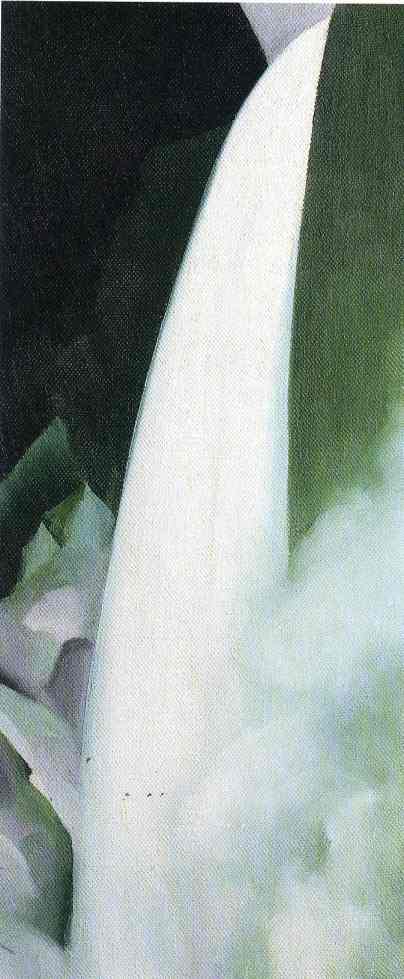
White Figure, Wassily Kandinsky
10. If I have a point to all of this: Moby-Dick is wonderful, funny, moving, engaging; a genre-bender that tackles philosophy, history, science; an adventure tale; a psychological novel brimming with ideas, allusions—but one delivered in sonorous, poetic language. It’s good, great, grand. Read it, if you haven’t. Reread it.
11. So I’ve failed to even try to begin to attempt to pretend to describe the plot.
Here: Ishmael, depressed, suicidal perhaps, decides to go to sea. To go whaling.
He tries to measure the whale, and by measuring the whale, maybe measure the world. But this is not really possible, certainly not in language. Certainly not in first-person perspective.
In Chapter 86, “The Tail,” Ishmael tells us:
The more I consider this mighty tail, the more do I deplore my inability to express it. At times there are gestures in it, which, though they would well grace the hand of man, remain wholly inexplicable. … Dissect him how I may, then, I but go skin deep. I know him not, and never will. But if I know not even the tail of this whale, how understand his head? much more, how comprehend his face, when face he has none? Thou shalt see my back parts, my tail, he seems to say, but my face shall not be seen. But I cannot completely make out his back parts; and hint what he will about his face, I say again he has no face.
(I don’t suppose I need to remark that Melville here lets one mighty tail stand in for another mighty tale—a tale he cannot face).
12. “Call me Ishmael”: our protagonist hails us.
But these famous opening lines aren’t really the beginning of the book. First we have the section titled “Extracts,” and before that “Etymology.” The first entry on the etymology of the whale, from Hackluyt, warns us not to leave out “the letter H, which almost alone maketh up the signification of the word.”
Whaling. Hailing. Wailing.
The whiteness of the whale.
The witness of the wail.
13. How, just how, does Ishmael witness? How does he manage to tell this story? Did I obsess over this in earlier readings? I don’t think so—I was too concerned with absorbing the what and the why of the story to closely attend the how of its telling.
14. The novel begins in standard first-person point-of-view territory, Ishmael guiding us through Manhattan, New Bedford, Nantucket—but by the time he’s boarded the Pequod and set out into the wide watery world, this first-person perspective transcends the limits of physics: Our narrator not only attends the private conversations of Ahab, his mates, his harpooners, his men—but also the very interior of those men, their minds, their dreams, their imaginations.
Is Ishmael a ghost?
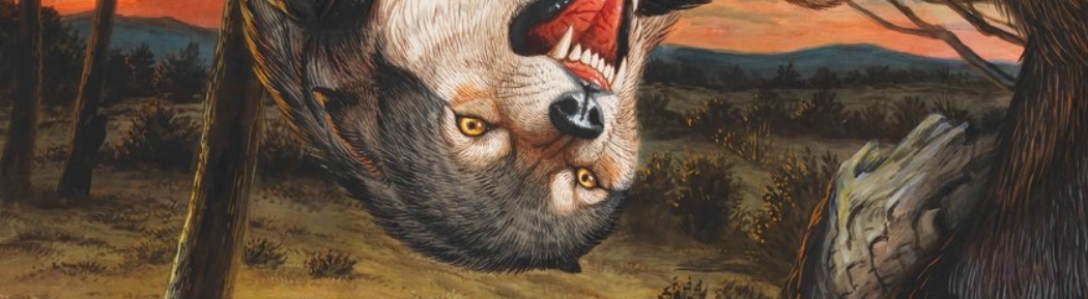
Leviathan-Job 40-21, Salvador Dali
15. And to return to Ahab for a moment: My god, what a voice! His infecting, addicting insanity. His agon with Moby Dick, with the sun, with himself.
16. And Starbuck: Starbuck comes across weaker and weaker each time I read the book. We’re to believe he’s a man of convictions, but he moves in half-measures. In his final moments he tries to match or feign or approximate Ahab’s insanity: tragicomedy.
17. And Stubb: Despite his cruelties, he may be my favorite character in the book.
18. While I’m riffing: Is there a novel more phallic in the American canon than Moby-Dick? All that sperm: All that life-force.
19. This is maybe what Moby-Dick is about: Life-force. The attempt to to resurrect and die and resurrect again. The coffin that serves as life-buoy. The life-line that connects men that might also be their death. A counterpane to counter pain. A condensation of oppositions.
A yarn, a rope, a series of knots, layered, layering, self-contextualizing.
An attempt to put into language what cannot be put into language.
20. Twenty points: Maybe too long for the “short riff” promised in the title, but also surely too short to even begin to start to approach to pretend to say something adequate about the novel. So a parting thought: Moby-Dick is better—richer, fuller, deeper—each time I read it, and I look forward to reading it again.
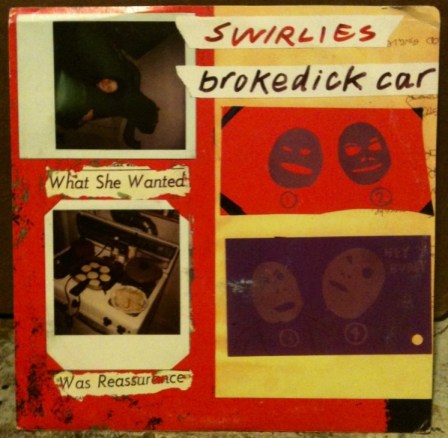
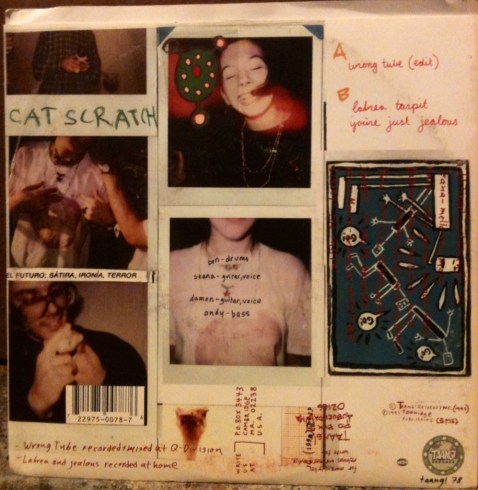
In my estimation, The Swirlies were the greatest indie rock band of the 1990s to never really make it big—and by “make it big” I mean indie rock big—Sebadoh big, Superchunk big. They made two stellar albums of shoegazed-influenced dream pop, Blonder Tongue Audio Baton (1993), and They Spent Their Wild Youthful Days in the Glittering World of the Salons (1996). These albums are crammed with fuzzy four-track recorder experiments, folky half-songs, and a handful of truly stellar, muscular, dream pop songs that would fit nicely on any mixtape between jams from My Bloody Valentine and Stereolab. One such song is “Wrong Tube,” the a-side to this Taang! Records 7″ purporting to be the Brokedick Car EP (it’s not the full EP, which has two other songs).
“Wrong Tube” was a staple in my ’86 Camry’s tape deck for years, and I still love it today. I haven’t listened to this 7″ in years—I almost certainly bought it because of the blue vinyl (and, ashamedly, certain completist tendencies). The guitars are crunchy, swerving, swirly, guitarists Seana Carmody and Damon Tutunjian attacking their tremolo bars with abandon and trading verses as the band crashed through in a high tempo. I still find the final moments of the song exhilarating, as one of the guitars hammers out a sweet melody in the highest register as Carmody harmonizes along. Somehow the entire version of the song doesn’t fit on the 7″, which is a shame I guess. B-sides “Labrea Tarpit” and “You’re Just Jealous” are a forgettable experiment followed by a forgettable ditty.
Before mp3s, we used to buy these things called seven-inches, small disks of vinyl, usually played at 45rpm, usually offering an a-side with the band or singer’s single, and backed with (b/w) a b-side offering a song (or songs!) that probably wouldn’t be on the album. A lot of times, 7″s would consist of songs that wouldn’t be on any album. Or that would be it for the band—just the one 7″. I bought many, many of these little disks between 1992 and 1999, and I still have three boxes full of them gathering dust in a utility room.
Anyway, new feature: I’ll pull out one each Sunday, listen to it, photograph it, share some thoughts on it, etc.
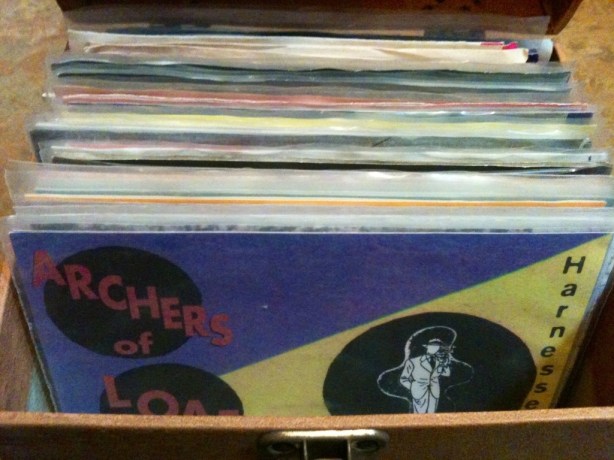
For this week, I pulled out the closest box and then pulled out the first 7″ in the stack: Archers of Loaf’s 1995 single for “Harnessed in Slums,” b/w “Telepathic Traffic.”
“Harnessed in Slums” is the second track from the band’s second album, 1996’s album Vee Vee.
Vee Vee came out shortly after the 1995 EP Vs. the Greatest of All Time, which I think might be the Archers’ best work—or at least, that’s how I remember it. Anyway, I loved this early arc of the band’s career, which kicked off with Icky Mettle, a basically perfect glob of nineties indie rock.
I haven’t listened to Archers of Loaf in years. I lost interest in what the band was doing by the late nineties, and like many of the albums I listened to thousands of times in my teens, I find their music too intertwined in intense memories and feelings to listen to again. I have a hard time extricating the psychic detritus of my youth from certain albums.
The crunchy warbled opening of “Harnessed in Slums” brought back a strange rush of the past. I remembered seeing the band—on a school night!—in support of Icky Mettle. My friend Wayne brought a paper headband to the show and guitarist Eric Johnson wore it through most of the set. They gave us the set list (on a paper plate) and autographed stuff. I wonder if they thought it was weird that we wanted their autographs—I think it’s weird now. (By the time I was 17 I had almost no interest in talking to anyone in a band, let alone getting an autograph).
“Harnessed in Slums” is a perfect Archers track, poppy, proggy, fake-sloppy, a punk anthem channeled through the crunchy trademark sound of the 1990s NC Triangle. Weirder and darker than Superchunk, tighter and more metallic than Pavement, Archers of Loaf hit a not-too-sweet spot somewhere between prog virtuosity and DIY punk aesthetic. The lyrics are bizarre, maybe meaningless, a shout-along that could have come from a Burroughs cut up (“I want waste / We want waste / They want waste / Slaves want waste”; “Strip the color from the meat of my eye”).
The b-side is “Telepathic Traffic,” a jam that swells with acoustic guitars and snaky, snarly guitar lines—there’s almost something crime noir about the song. It’s sinister anyway. Eric Bachmann’s opening barks are almost comical, as if he’s imitating some British post-punk hero, before clustering into a pogoing chorus. “Telepathic Traffic” bears a few too many conventions that can become tiresome over an album—the track slows and speeds up unnecessarily when it should plow straight ahead (or perhaps just get faster).
Listening to these tracks again doesn’t make me want to pull out Icky Mettle as much as it makes me want to check out Erich Bachmann’s latest stuff. Has he mellowed out? Added more/different instrumentation? Complicated or simplified his sound? I remember being perplexed by his 1995 solo album Barry Black, which I recall having chamber arrangements. Maybe I should check it out.
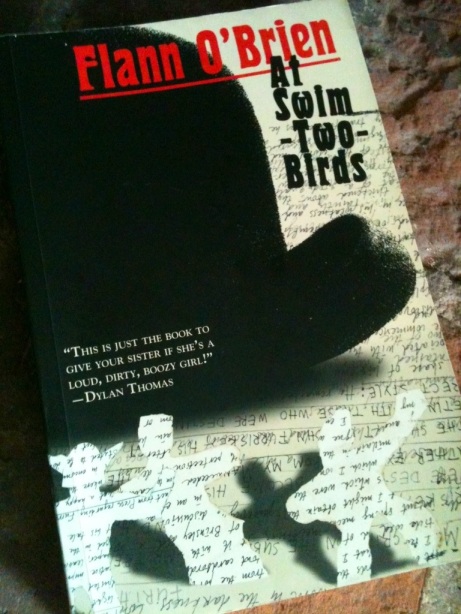
The vibrant force of storytelling in Flann O’Brien’s excellent first novel At Swim-Two-Birds threatens to overwhelm reader and narrator alike—and what a strange joy it is to be overwhelmed. This novel overflows with stories; its plot threads twist into each other, break out of each other, erupt into new ideas, characters, riffs, sketches. First published in 1939—the same year as James Joyce’s Finnegans Wake—At Swim-Two-Birds seems light years ahead of its time—indeed, this is a book that is still ahead of its time.
Summarizing At Swim-Two-Birds is difficult but worth attempting. We have an unnamed narrator, a student living with his uncle who doesn’t think much of how his nephew spends his time. Our narrator likes to imbibe large quantities of porter and wax philosophical with his friends about his literary projects. These projects, our narrator’s riffs and scribblings, begin to take on lives of their own: they intersect, overlap, intermarry, degenerate and regenerate.
The book’s opening paragraph announces the novel’s intention to disregard the classical unities of action, place, and time:
Having placed in my mouth sufficient bread for three minutes’ chewing, I withdrew my powers of sensual perception and retired into the privacy of my mind, my eyes and face assuming a vacant and preoccupied expression. I reflected on the subject of my spare-time literary activities. One beginning and one ending for a book was a thing I did not agree with. A good book may have three openings entirely dissimilar and inter-related only in the prescience of the author, or for that matter one hundred times as many endings.
First, we meet “Pooka MacPhellimey, a member of the devil class,” a hobgoblin of Irish folklore (he turns out to be a thoughtful and polite fellow). Then, there’s John Furriskey, who “was born at the age of twenty-five and entered the world with a memory but without a personal experience to account for it.” Furriskey is the literary creation of another of the narrator’s literary creations, one Dermot Trellis, a grumpy old man who writes Westerns; Trellis (an author, it’s worth reiterating) is the eventual antagonist of the novel, the target for all of the other characters’ vengeance. The third opening offers up Finn Mac Cool, “a legendary hero of old Ireland.”
Much of the early part of At Swim-Two-Birds features Finn Mac Cool holding forth on all matters Irish in wonderfully baroque and hyperbolic passages. Here’s a snippet (a long one!), featuring Finn on the ideal man:
When pursued by a host, he must stick a spear in the world and hide behind it and vanish in its narrow shelter or he is not taken for want of sorcery. Likewise he must hide beneath a twig, or behind a dried leaf, or under a red stone, or vanish at full speed into the seat of his hempen drawers without changing his course or abating his pace or angering the men of Erin. Two young fosterlings he must carry under the armpits to his jacket through the whole of Erin, and six arm-bearing warriors in his seat together. If he be delivered of a warrior or a blue spear, he is not taken. One hundred head of cattle he must accommodate with wisdom about his person when walking all Erin, the half about his armpits and the half about his trews, his mouth never halting from the discoursing of sweet poetry. One thousand rams he must sequester about his trunks with no offence to the men of Erin, or he is unknown to Finn. He must swiftly milk a fat cow and carry milk-pail and cow for twenty years in the seat of his drawers. When pursued in a chariot by the men of Erin he must dismount, place horse and chariot in the slack of his seat and hide behind his spear, the same being stuck upright in Erin. Unless he accomplishes these feats, he is not wanted of Finn. But if he do them all and be skillful, he is of Finn’s people.
It’s hard not to feel something of Joyce in the passage (I’m particularly reminded of the Cyclops episode of Ulysses), and O’Brien’s narrator name-checks Joyce (along with Aldous Huxley) in the first few pages of the book. The narrator’s comically mechanical and precise descriptions also recall Joyce. Joyce and O’Brien drew from the same well of mythology, but O’Brien more keenly attunes his focus on Irish legend and folklore in At Swim-Two-Birds, while Joyce’s project skews to archetypes. Similarities and divergences aside, there’s something strangely fitting about O’Brien’s Finn Mac Cool dreaming his way into other characters’ lives in At Swim-Two-Birds, as if this Finn is the psychic twin of Joyce’s Finn.
Indeed, such a reading would fit neatly into our young narrator’s ideas about the function of character in literature:
Characters should be interchangeable as between one book and another. The entire corpus of existing literature should be regarded as a limbo from which discerning authors could draw their characters as required, creating only when they failed to find a suitable existing puppet. The modern novel should be largely a work of reference. Most authors spend their time saying what has been said before – usually said much better. A wealth of references to existing works would acquaint the reader instantaneously with the nature of each character, would obviate tiresome explanations and would effectively preclude mountebanks, upstarts, thimble-riggers and persons of inferior education from an understanding of contemporary literature.
This decree strikes me as wonderfully post-postmodernist. That the “modern novel should be largely a work of reference” finds its suitable echo over half a century later in the note-card novels of David Markson (and other reality smugglers). The citation above serves as a metatextual description of At Swim-Two-Birds itself: O’Brien’s narrator framing the various tales that erupt in the novel, but also undoing the frames, allowing his characters to converge, to tell their own stories (and within those stories characters tell other stories…).
In its finest moments (of which there are many), At Swim-Two-Birds operates on an ad hoc logic that it creates and describes in motion, a kind of improvised dream response pattern. Most books, particularly postmodern books, teach the reader how to read them—that is, most novels provide keys, hints, and reading rules early enough in the text to allow perceptive readers to interpret (subjectively, of course) what the novel is doing. O’Brien’s novel in toto, with its discontinuities, gaps, eruptions, and juxtapositions, paradoxically is its own discrete, unified key.
But I seem to be getting bogged down in a bit of literary theory, which is not my intent at all.
Instead, let me draw attention to a wonderful extended jaunt in the middle of At Swim-Two-Birds where the Pooka MacPhellimey enters into an ersatz quest with the Good Fairy, two cowboyish thugs (or thuggish cowboys) named Slug and Shorty, the poet Jem Casey, and the mad King Sweeny. This ragtag band sets out to bequeath gifts to the forthcoming child of Miss Lamont (the creation of a creation of a creation). These episodes unfold in comic bravado, their slapstick rhythms recalling the manic but precise energy of Buster Keaton and Charlie Chaplin and the linguistic brio of the Marx brothers. This miniature picaresque is tempered in sweet pathos for poor crazy Sweeny who must be plied forward with the promise of a feast. The poor man, broken, starving, and living solely on watercress, falls into despair. What eventually moves him? The force of language:
And getting around the invalid in a jabbering ring, they rubbed him and cajoled and coaxed, and plied him with honey-talk and long sweet-lilted sentences full of fine words, and promised him metheglin and mugs of viscous tarblack mead thickened with white yeast and the spoils from hives of mountain-bees, and corn-coarse nourishing farls of wheaten bread dipped in musk-scented liquors and sodden with Belgian sherry, an orchard and a swarm of furry honey-glutted bees and a bin of sun-bronzed grain from the granaries of the Orient in every drop as it dripped at the lifting of the hand to the mouth, and inky quids of strong-smoked tabacca with cherrywood pipes, hubble-bubbles, duidins, meerschaums, clays, hickory hookahs and steel-stemmed pipes with enamel bowls, the lot of them laid side by side in a cradle of lustrous blue plush, a huge pipe-case and pipe-rack ingeniously combined and circumscribed with a durable quality of black imitation leather over a framework of stout cedarwood dovetailed and intricately worked and made to last, the whole being handsomely finished and untouched by hand and packed in good-quality transparent cellophane, a present calculated to warm the cockles of the heart of any smoker. They also did not hesitate to promise him sides of hairy bacon, the mainstay and the staff of life of the country classes, and lamb-chops still succulent with young blood, autumn-heavy yarns from venerable stooping trees, bracelets and garlands of browned sausages and two baskets of peerless eggs fresh-collected, a waiting hand under the hen’s bottom. They beguiled him with the mention of salads and crome custards and the grainy disorder of pulpy boiled rhubarb, matchless as a physic for the bowels, olives and acorns and rabbit-pie, and venison roasted on a smoky spit, and mulatto thick-tipped delphy cups of black-strong tea. They foreshadowed the felicity of billowy beds of swansdown carefully laid crosswise on springy rushes and sequestered with a canopy of bearskins and generous goatspelts, a couch for a king with fleshly delectations and fifteen hundred olive-mellow concubines in constant attendance against the hour of desire. Chariots they talked about and duncrusted pies exuberant with a sweat of crimson juice, and tall crocks full of eddying foam-washed stout, and wailing prisoners in chains on their knees for mercy, humbled enemies crouching in sackcloth with their upturned eye-whites suppliant. They mentioned the leap of a fire on a cold night, long sleeps in the shadows and leaden-eyed forgetfulness hour on hour – princely oblivion. And as they talked, they threaded through the twilight and the sudden sun-pools of the wild country.
I’ve perhaps overshared here, let our characters babble on too long—but the verbal dexterity of the passage above illustrates O’Brien’s rhetorical force, the force he lends his characters in order that they should move their insane and desperate friend forward. There’s a sublime alchemy at work here, where imagination turns into words and words turn into food and drink.
I also fear these big chunks of text I’ve pulled from At Swim-Two-Birds don’t highlight O’Brien’s extraordinary talent at rendering speech. The dialogue in this novel is hilarious but nuanced, its ironies rarely if ever remarked upon by intrusive attributions. That O’Brien’s narrator’s characters (and their characters…) speak through the layers of texts adds to the book’s juxtapositions.
These juxtapositions will perhaps confuse or even alienate many readers. At Swim-Two-Birds can be read as an attack on the classical unities of action, place, and time. O’Brien’s novel is a send-up of stability, order, and tradition. Some of the novel’s best moments are its strangest indulgences, as when O’Brien (or his narrator) gives the novel over to citations from imaginary antique texts, or allows his characters to indulge in a seemingly endless recitation of obscure facts, or satirizes the moral dangers of tea-tasting. These moments seem to erupt from nowhere, bizarre, wonderful, joyous.
At Swim-Two-Birds lacks the cohesion of theme and voice that characterizes O’Brien’s other masterpiece, The Third Policeman, but this is hardly a deficiency. At Swim-Two-Birds is one of those rare books that actually deserves to be called dazzling, a critic’s crutch-word that mars too many blurbs. Its dazzle derives from its rhetorical force, its humor, and its openness to experiment with not just the novelistic form, but the form of storytelling itself. And it’s here that O’Brien’s novel is most real—he captures the strangeness of storytelling, its mutability, its crazy rhythms. Ultimately, this is a novel unconcerned with providing pat answers and clear solutions. I loved this book, loved reading it—and then immediately rereading it. I’ll let O’Brien get the last word:
Answers do not matter so much as questions, said the Good Fairy. A good question is very hard to answer. The better the question the harder the answer. There is no answer at all to a very good question.
In fact, it’s such a bad idea that it’s probable someone has already done it. Or considered doing it but had the good sense to refrain.
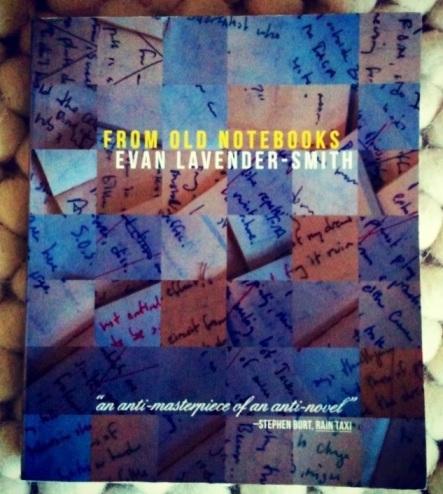
From Old Notebooks as the presentation of a subject through his daily jotting downs.
To clarify: All block quotes—like the one above—belong to Evan Lavender-Smith’s From Old Notebooks.
Which I read twice last month.
And am writing about here.
From Old Notebooks: A Novel: An Essay.
From Old Notebooks: An Essay: A Novel.
From Old Notebooks blazons its anxiety of influence: Ulysses, Infinite Jest, Nietzsche, Wittgenstein. Shakespeare.
Joycespeare.
References, critiques, ideas about Joyce, DFW, Wittgenstein, Nietzsche repeatedly evince in From Old Notebooks—and yet David Markson, whose format E L-S so clearly borrows, is evoked only thrice—and not until page 74 (this in a book of 201 pages):
I count David Markson’s literary-anecdote books among the few things I want to read over and over again, yet I have no idea whether they are actually any good. They’re like porn for English majors.
And then again on page 104:
If David Markson hadn’t written his literary-anecdote novels, would I have ever thought to consider F.O.N. a novel? Would I have ever thought to write such a book?
(I should point out that the page numbers I cite are from Dzanc Book’s first edition of From Old Notebooks; Dzanc’s 2012 printing puts the book back in print).
Like Markson’s anti-novels (Reader’s Block, This Is Not a Novel, Vanishing Point, The Last Novel), E L-S’s F.O.N. is constantly describing itself.
There may be some question as to F.O.N.’s status as fiction, poetry, philosophy, nonfiction, etc., but hopefully there will be no question about its status as a book.
Is E L-S’s book postmodern? Post-postmodern?
Perhaps there is nothing quintessentially postmodern about the self-reflexivity, fragmentation and pastiche of F.O.N., if only because all of it follows from form.
From Old Notebooks as a document constantly performing its self-critique:
If there were a Viking Portable Lavender-Smith containing an abridgment of F.O.N., I would be very interested to read it, because there’s no reason that the total value of the book wouldn’t be gained, through editorial happenstance, with much greater efficiency.
From Old Notebooks as a document of authorial anxiety.
A reader could make a case that there are a number of elidedtexts within or suggested by From Old Notebooks, including the one that gives the author the authority to write such a book.
F.O.N. is also a generative text, bustling with ideas for short stories, novels, plays, films, pamphlets, somethings—it is E L-S’s notebook after all (maybe). Just one very short example—
Novel about a haunted cryonics storage facility.
F.O.N.’s story ideas reminded me of my favorite Fitzgerald text, his Notebooks.
Reading From Old Notebooks is a pleasurable experience.
Personal anecdote on the reading experience:
Reading the book in my living room, my daughter and wife enter and begin doing some kind of mother-daughter yoga. My wife asks if they are distracting me from reading. I suggest that the book doesn’t work that way. The book performs its own discursions.
I shared the tiniest morsel here of my family; E L-S shares everything about his family in F.O.N.:
I know that the reconciliation of my writing life and my family life is one of the things that F.O.N. is finally about, but I can’t actually see it in the book; I don’t imagine I could point to an entry and say, Here is an example of that.
It would be impossible for me not to relate to the character of the author or novelist or narrator of F.O.N. (let me call him E L-S as a simple placeholder): We’re about the same age, we both have a son and a daughter (again of similar ages); we both teach composition. Similar literary obsessions. Etc. After reading through F.O.N. the first time I realized how weird it was that I didn’t feel contempt and jealousy for what E L-S pulls off in F.O.N.—that I didn’t hate him for it. That I felt proud of him (why?) and liked him.
There are moments where our obsessions diverge; the E L-S of F.O.N. is preoccupied with death to an extent that I simply don’t connect to. He:
1) Think always about sex. 2) Have a family. 3) Think always about death.
I:
1) Think always about sex. 2) Have a family. 3) Think always about sex.
But generally I get and feel and empathize with his descriptions of his son and daughter and wife.
And his work. Big time:
Getting up the motivation to grade student essays is like trying to pass a piece of shit through the eye of a needle.
Or
I have perfected my lecture after giving it for the third time, but my fourth class never gets to realize it because my voice is hoarse and I’m so tired from giving the same lecture four times in one day, so their experience of my perfect lecture at 8-9:40 PM is of approximately equal value to that of my students receiving my imperfect lecture at 8-9:40 AM, as well as my students at 2:30-3:55 and 5:30-7:10—and it all evens out to uniform mediocrity in the end.
The novel is not jaded or cynical or death-obsessed though (except when it is).
What E L-S is trying to do is to remove as much of the barrier between author and reader as possible:
Contemporary authors who construct a thick barrier between themselves and their readers such that authorial vulnerability is revealed negatively, i.e., via the construction of the barrier.
Perhaps my suggestion that E L-S tries to remove the barrier is wrong. Maybe instead: E L-S’s F.O.N. maps the barrier, points to the barrier’s structure, does not try to deny the barrier, but also tries to usher readers over it, under it, through its gaps—-and in this way channels a visceral reality that so much of contemporary fiction fails to achieve.
I really, really liked this book and will read it again.
News that J.J. Abrams will direct the seventh Star Wars film almost broke the internet yesterday. It’s easy to see why anyone who nerds out over franchise properties would take interest. After all, Abrams helmed the 2009 big-screen reboot of Star Trek, a film that shook the camp and cheese from the franchise’s previous films, replacing it with hip humor, thrilling action, and lots and lots of lens flare. Abrams’s sequel, Star Trek Into Darkness is perhaps the most anticipated franchise film of the year.
I won’t speculate whether an Abrams Star Wars film will be successful or not—you probably wouldn’t want me to, because I hold the extreme minority opinion that Lucas’s Revenge of the Sith is a deeply profound and moving work of cinema art—but I do think that the choice to hand the next big film in the Star Wars franchise over to Abrams represents the worst in corporate thinking. This goes beyond the playground logic of Abrams swiping all the marbles—he gets both the “Star” franchises!—what it really points to is the bland, safe commercial mindset that guides the corporations who own these franchises. J.J. Abrams is a safe bet. I can more or less already imagine the movie he’ll make.
Star Wars: A New Hope came out in 1977, perhaps at the exact moment that the innovations of the “New Hollywood” movement crested (before Heaven’s Gate crashed the whole damn thing in 1980). The films of this decade—Badlands, The Godfather films, Bonnie & Clyde, Chinatown, Nashville, Dr. Strangelove, etc.—helped to redefine film as art; they also captured and illustrated a zeitgeist that’s almost impossible to define. And while plenty of filmmakers today continue in this spirit, their films are often pushed into the margins. The Hollywood studio system is tangled up in big budget spectacle. I have no problem with this, but at the same time I think that there’s something sad in it all—in the bland safety of having Abrams turn out Star Wars and Star Trek films—it all points to a beige homogeneity.
The problem I’m talking about is neatly summed up by Gus Van Sant in a 2008 interview with The Believer:
So, there were some projects I never really could get going, and one of them was Psycho. It was a project that I suggested earlier in the ’90s. It was the first time that I was able to actually do what I suggested. And the reason that I suggested Psycho to them was partly the artistic appropriation side, but it was also partly because I had been in the business long enough that I was aware of certain executives’ desires. The most interesting films that studios want to be making are sequels. They would rather make sequels than make the originals, which is always a kind of a funny Catch-22.
They have to make Bourne Identity before they make Bourne Ultimatum. They don’t really want to make Bourne Identity because it’s a trial thing. But they really want to make Bourne Ultimatum. So it was an idea I had—you know, why don’t you guys just start remaking your hits.
Lately it seems that the studios trip over themselves to reboot their franchises—the latest Spider-Man film (the one you probably forgot existed) being a choice example of corporate venality. In a way, it’s fascinating that Sam Raimi, something of an outsider director, was allowed to do the first Spider-Man films at all. Of course, now and then a franchise film (or potential franchise film) winds up in the hands of an auteur—take Harry Potter and the Prisoner of Azkaban, for example. Alfonso Cuarón’s third entry in the franchise can stand on its own (it certainly saved the franchise from the tepid visions of Chris Columbus). Even stranger, take Paul Verhoeven’s films RoboCop and Starship Troopers. These films were brilliant subversive satires, and what did Hollywood do to the movies that came after them? These franchises devolved into flavorless, flawed, run of the mill muck.
Of course, entertainment conglomerates have good (economic) reasons to “protect” their product. David Lynch’s Dune remains one of the great cautionary tales in recent cinema history. What could have reinvigorated “New Hollywood” instead proved a disastrous flop.Dune never panned out as the blockbuster franchise that it could have been; instead, it gets to hang out in a strange limbo, greeting newer arrivals like Chris Weitz’s atrociousadaptation of The Golden Compass and Andrew Stanton’s underrated John Carter from Mars. It’s actually sort of surreal that we even got a Dune film by David Lynch, complete with Kyle MacLachlan, Brad Dourif, Jack Nance, and fucking Sting.
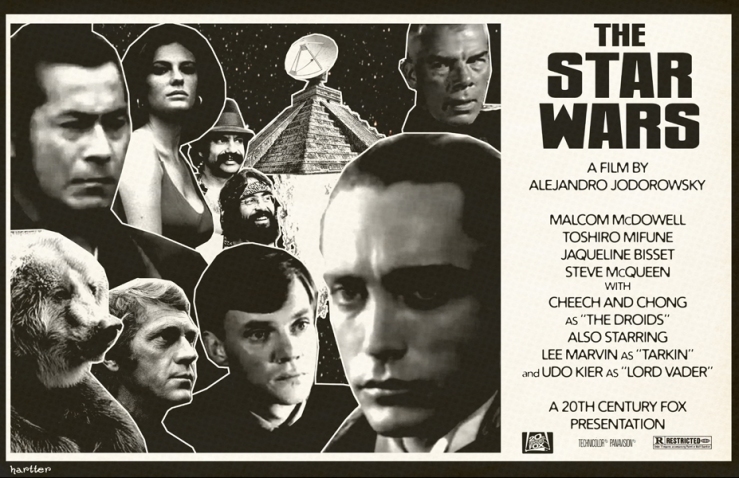
What’s even weirder is that Alejandro Jodorowsky tried to adapt Dune, working with artists H.R. Geiger and Moebius. (Jodorowsky also planned to involve Orson Welles, Mick Jagger, and Karlheinz Stockhausen among others in the film). What a Jodorowsky Dune film might have looked like is a constant source of frustrated fun for film buffs.
But what about a Star Wars film by Jodorowsky? What might that look like?
Most Hollywood franchises revere the illusion of stability in the property—the idea of a constancy of character throughout film to film. Even a franchise like the James Bond films, with its ever-rotating leads, tries to create the guise of a stable aesthetic along with narrative continuity. I would love to see something closer to the Alien franchise, the only line of films I can think of where each film bears the distinctive mark of its respective filmmaker; even if I don’t think Fincher’s Alien 3 is a particularly good film, at least it feels and looks and sounds like a Fincher film and not a weak approximation of a Cameron blockbuster or a stock repetition of Scott’s space horror (and Jeunet’s Resurrection—how weird is that one!).
But back to Bond for a moment—wouldn’t it be great to see Wes Anderson do James Bond, but as a Wes Anderson film? Or Werner Herzog? Or Cronenberg? What would Jane Campion do with Bond? (I’m tempted to add Jim Jarmusch, but he already made an excellent James Bond film called The Limits of Control). I’d love to see a range of auteur versions of the franchise. (Similarly, I’ve recently been fascinated by the way certain cult artists render major corporate franchise characters, like Dave Sim doing Iron Man, or Moebius doing Spider-Man, or Jaime Hernandez doing Wonder Woman). Obviously this fantasy will never happen—the auteur would have to have complete control—a Coen brothers’ Bond film would have to be first and foremost a Coen brothers film, not a 007 film—but hey, just like with Hartter’s posters, it’s fun to pretend.
Imagine a year of James Bond movies, one a month, featuring different directors, actors, studios, production designs. 007 films from Spike Lee, Tarantino, Almodavar, Lynne Ramsay, Lynch, Wong Kar Wai.
What would a Wong Kar Wai James Bond film look like?
What would a Wong Kar Wai Star Wars film look like?
I don’t know. I imagine it would be beautiful and moody and at times impressionistic. I imagine its narrative would tend toward obliqueness. I imagine it might infuriate die-hard fans (I imagine this last part with a big grin). I imagine that it would easily be the most human Star Wars film.
But beyond that, it’s hard to imagine what a Wong Kar Wai Star Wars film might look and sound and feel like because his films are powerful and moving and evoke the kind of imaginative capacity that marks great art, great original and originating art. Put another way, I can’t really imagine what a Wong Kar Wai Star Wars film would look like—which is precisely why I’d love to see one.
At the home of some good friends this past weekend, reclined nicely in a warm armchair, the warmth of various ales coursing through me, I picked off the shelf by my right hand a crumbling first edition of Modern Library’s A Comprehensive Anthology of Modern Poetry, edited by Conrad Aiken. I opened at random and found a small and perhaps undue joy that my stochastic flipping led to sections 10 and 11 of Song of Myself—maybe my favorite parts of Walt Whitman’s longassed poem.
Do you recall these bits? The trapper’s wedding? The runaway slave? The twenty-eight bathers and the woman who spies on them? I read them aloud to the room, ostensibly to the people in the room, but maybe just to myself. Walt Whitman’s storytelling is at its best when he moves most away from himself, when he puts on different hats, wears different ears, strolls around America a bit. I love his free verse in spite of—or even maybe because of—its swollen scope, its tendency toward bombast or even hamminess. O Walt! Get over yourself!—but not really, never change! Song of Myself is one of my favorite novels, or one of my favorite epics, or one of my favorite monologues—whatever it is, it’s one of my favorites (especially taken with doses of Emily Dickinson’s strange potions).
I don’t really know a lot about poetry, despite teaching the study of it in certain literature survey classes.
But hang on, it seems I was telling a story, or at least teasing out an anecdote, or at least going somewhere with all this: So, after riffling through the anthology a bit more, my friend says, Hey, if you want to read some really terrible poetry, check out that book to your right. Here is the book:
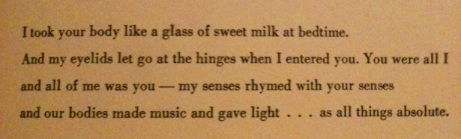
I had never heard of Walter Benton or his (unintentionally) hilarious volume This Is My Beloved until that moment. So what is it? Combining the worst elements of Whitmanesque free verse with a downright silly conceit that these are diary entries, This Is My Beloved attempts to be the erotic record of a passionate love affair. Benton tries to keep his language sultry, sexy, and sensuous without veering into pornography, but the results are bizarre and grotesque. Here’s an entire page as evidence:
“Your breasts are snub like children’s faces”?!
“…your lips match your teats beautifully”?!
And my favorite: “The hair of your arm’s hollow and where your thighs meet / agree completely, being brown and soft to look at like a nest of field mice.” A nest of field mice! Women love to be complimented on their matching pits and pubes, followed by a simile comparing said regions to a rodent’s hovel.
Indeed, Benton loves animal similes for his lady—later he writes: “Yes, your body makes eyes at me from every salient, / promises warm, lavish promises— / curved, colored . . . finished in a warm velvet like baby rabbits.”
But it’s not just the rabbits and mice that are gross. Lines like “We had loved hard—it’s all over your throat and hair” are simply queasy, bad writing. Or this nugget: “The white full moon like a great beautiful whore / solicits over the city, eggs the lovers on / the haves . . . walking in twos to their beds and to their mating. / I walk alone. Slowly. No hurry. Nobody’s waiting.”
Or this snippet:
It’s just really, really bad—I mean, at least when Henry Miller is gross, he’s deeply, earnestly gross, abject even, depraved perhaps (recall the famous lines: “I have set the shores a little wider. I have ironed out the wrinkles. After me you can take on stallions, bulls, rams, drakes, St. Bernards. You can stuff toads, bats, lizards up your rectum. You can shit arpeggios if you like, or string a zither across your navel”).
So, to return to my little story, we read most of Benton’s book aloud, doubling over laughing at times at just how wonderfully awful it is. And, wiping the tears from my eyes, I went to my trusty dusty iPhone to do a little background research—surely the world knew of this awful, awful poetry? Surely folks were getting the same giggly fun as happy we from poor Benton’s lurid verse?
And here, really, comes the occasion for this post, the real reason I write: It turns out that folks love this book—in a sincere, earnest, serious way. No fewer than four audio recordings were made of the book, all set to music (the most famous seems to be by Arthur Psyrock); the book has near-perfect five star review averages on both Amazon and Goodreads; and, perhaps most shocking of all, the book has been continuously in printsince it was first published in 1949—it’s in its 34th edition (prestigious hardback with prestigious deckle edges, by the way). And of course you can buy an ebook version! (Unlike, say, Georges Perec’s Life A User’s Manual). Even worse, hack crooner Rod McKuen cites Benton as a major influence, so we have that to thank him for as well.
I don’t know. Am I wrong? Is Benton’s stuff actually good? I mean, I’ll concede that I enjoyed reading the book, but only inasmuch as it made me laugh so much. I don’t know. I already admitted I don’t know much about poetry. (As I write this, I pause to watch and listen to Richard Blanco read his inauguration poem “One Day”; I have no idea if it’s good or not). Benton’s verse seems so hammy, clumsy, indelicate; too earnest, too priapic, tripping over its own boners. It reads like a bad cribbing of Whitman and Miller, with an occasional lift from Hemingway. Even worse, it strikes me as amateurish, as the sort of thing that a teen might scrawl in his Moleskine only to cringe at later before hiding it somewhere. I just can’t believe that this book has been in continual publication from a major house (Knopf) for more than a half-century.
But maybe I’m misreading. Maybe I’m cynical. Maybe the poem is beautiful and profound and not icky solipsistic dreck. But I doubt it.
A few years ago, The New York Times ran a little wisp of an article describing the pleasures many readers take in reading “the moldy, dog-eared paperbacks found on the shelves and bedside tables of summer guest rooms.” The article features writers explaining how, staying somewhere, they reach for books they’d normally never pick up, like Wells Tower describing how he ended up reading The Bridges of Madison County. Like most ardent readers, I take a book (or two or three, or, more recently, a Kindle loaded with hundreds) with me anywhere I’m going to stay a night—but I’ll invariably read something I find in the room I’m staying if possible.
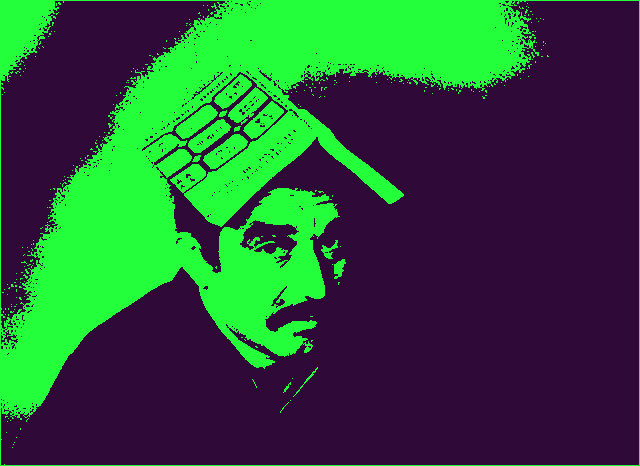
Sometimes I’ll end up reading something terrible—once, staying at a beachfront condo, I read an entire serialized Annie Oakley novel even though it was awful. Other times a stay prompts me to pick up a book I’d never reach for in my civilian life. For example, in a cabin in the Blue Ridge Mountains a few years ago I read a naturalist field guide for the area, written and published in the 1950s. More often than not, guest room reading leads me to read much faster and stay up reading much longer than I normally would, simply because I’m trying to finish the book before I leave. This is how I read Gabriel Garcia Marquez’s Memories of My Melancholy Whores in one long sitting (the book was my uncle), and how I ate up John Barth’s novel The End of the Road in friend’s mother’s childhood room—the book was hers, she had lots of cool books, and I wished I could’ve read more.
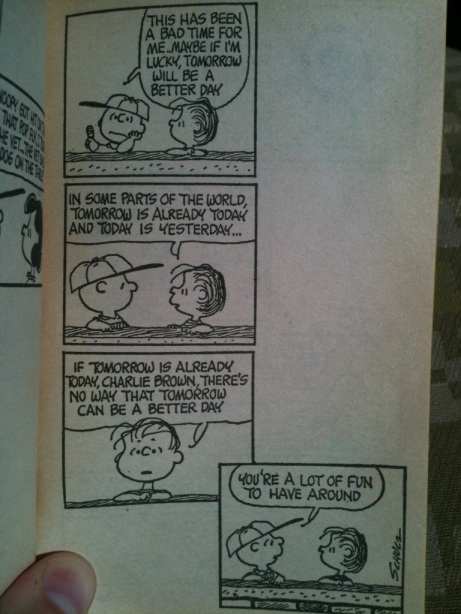
The other night, staying with some longtime friends, I reached for a brittle yellowed Peanuts collection on the nightstand by my bed. There were a few volumes of prose and poetry there, but Charles M. Schulz’s comics seemed more likely to make it through the haze of half a dozen beers. Plus, I’ve always loved Peanuts. I read the book entire, an arc beginning with the gang heading off to summer camp and ending, more or less, with Snoopy’s failed attempts at writing.
Like many kids, I grew up with Peanuts, reading Schulz’s work in the paper and also in collected volumes that my grandparents would give me (my grandfather was an especially big fan). The comics were often funny—not funny like my favorite at the time, Gary Larson’s The Far Side to be sure—but they were just as often full of melancholy or even despair, a despair that was mediated, but not necessarily assuaged by, the consolations of friendship.
I read as gently as possible, trying (and not always succeeding) to prevent any more pages from falling out of the collection. I mentally bookmarked several panels and a few entire strips to photograph the next day to maybe share on the blog. The next morning it occurred to me that I own almost a half dozen Peanuts collections—but I probably hadn’t picked them up in years. And I suppose this is one of the strange pleasures of guest room reading—that it might reintroduce us to an old favorite—but that seems like too pat a conclusion to me. I’ve found over the years that I’m just as likely to remember an awful book I read at random as a guest—and that for some reason the experience of reading someone else’s books—in a guest room, at a river house, in a cabin, at a hostel—is somehow always heightened. I don’t have a distinct explanation, other than the very obvious and simple one that I usually read in the same few places—a chair in my living room, a couch, my office, the bed, the bath, my back porch—and that reading other people’s texts in unfamiliar places estranges what I think of as reading—and that estrangement is invigorating. And pleasurable.
Nathaniel Hawthorne’s tale “The Birth-Mark” — or is it “The Birthmark”? — has been a favorite story of mine for years despite (or maybe because of) its being so damn symbolically overdetermined.
Or perhaps you want a quick summary—a refresher—okay:
Aylmer, “a man of science,” has this totally hot wife Georgiana—only she’s got a birthmark on her cheek, a small red mark that resembles a tiny hand—and it drives our scientist mad—so mad that he determines to make her perfect by removing the mark. Tragic ending ensues.
One of the reasons I like “The Birth-Mark” so much is that it so clearly limns the futility of idealism.
Aylmer’s driving desire for mastery over Nature (echoing Shelley’s Frankenstein): the desire to “lay his hand on the secret creative force and perhaps make new worlds.”
The word “God” does not appear in “The Birth-Mark.”
But of course gods and creators are repeatedly invoked.
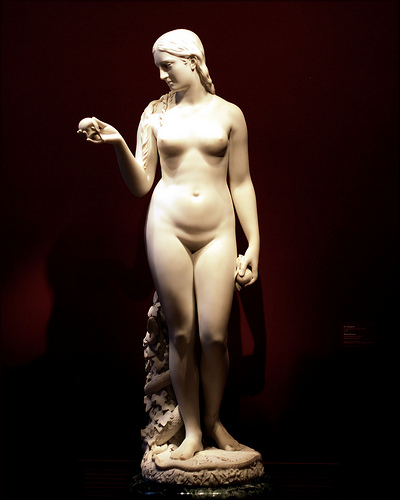
One such creator is Hawthorne’s friend Hiram Powers, whose sculpture Eve Tempted is invoked (invoking that other creator, the one who made a garden . . . )
Eve Tempted, Hiram Powers
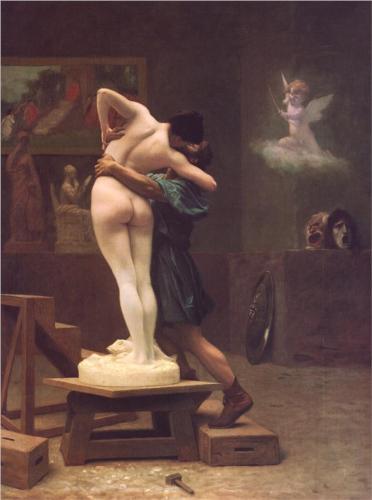
And Pygmalion—
Pygmalion and Galate, Jean-Leon Gerome
Aylmer, having convinced his wife that he’ll erase her mark: “Even Pygmalion, when his sculptured woman assumed life, felt not greater ecstasy than mine will be!”
Aylmer’s plan is shameful. It’s based on an obsessive misreading of the symbolism of his wife’s birthmark. We’re told that Aylmer “select[s] it as the symbol of his wife’s liability to sin, sorrow, decay, and death, Aylmer’s sombre imagination was not long in rendering the birthmark a frightful object, causing him more trouble and horror than ever Georgiana’s beauty, whether of soul or sense, had given him delight.”
He’s a very poor reader. His judgments are overawed by idealism.
Georgiana asks him: “Cannot you remove this little, little mark, which I cover with the tips of two small fingers?”
On one level, Georgiana is offering her husband the opportunity to play doctor with her, to get rid of the mark that’s driving him mad—but I think there’s an ironic second meaning at work here as well. I think she’s suggesting that he remove his perception of the mark, his reading of the mark. That he change his attitude.
Hawthorne’s homeboy Herman Melville, in his big book Moby-Dick, has Ishmael point out—in a simple, charming, homey way—that there is no simply no ideal purity available to us:
We felt very nice and snug, the more so since it was so chilly out of doors; indeed out of bed-clothes too, seeing that there was no fire in the room. The more so, I say, because truly to enjoy bodily warmth, some small part of you must be cold, for there is no quality in this world that is not what it is merely by contrast. Nothing exists in itself. If you flatter yourself that you are all over comfortable, and have been so a long time, then you cannot be said to be comfortable any more.
13. Actually, even though we’re told he’s brilliant, it turns out that Aylmer is not the transcendent scientist he’d like to be. In a scene that almost edges into comedy (just a dab to give this tragedy dimension), Georgiana reads
a large folio from her husband’s own hand, in which he had recorded every experiment of his scientific career, its original aim, the methods adopted for its development, and its final success or failure, with the circumstances to which either event was attributable. The book, in truth, was both the history and emblem of his ardent, ambitious, imaginative, yet practical and laborious life. He handled physical details as if there were nothing beyond them; yet spiritualized them all, and redeemed himself from materialism by his strong and eager aspiration towards the infinite. In his grasp the veriest clod of earth assumed a soul. Georgiana, as she read, reverenced Aylmer and loved him more profoundly than ever, but with a less entire dependence on his judgment than heretofore. Much as he had accomplished, she could not but observe that his most splendid successes were almost invariably failures, if compared with the ideal at which he aimed. His brightest diamonds were the merest pebbles, and felt to be so by himself, in comparison with the inestimable gems which lay hidden beyond his reach. The volume, rich with achievements that had won renown for its author, was yet as melancholy a record as ever mortal hand had penned. It was the sad confession and continual exemplification of the shortcomings of the composite man, the spirit burdened with clay and working in matter, and of the despair that assails the higher nature at finding itself so miserably thwarted by the earthly part. Perhaps every man of genius in whatever sphere might recognize the image of his own experience in Aylmer’s journal.
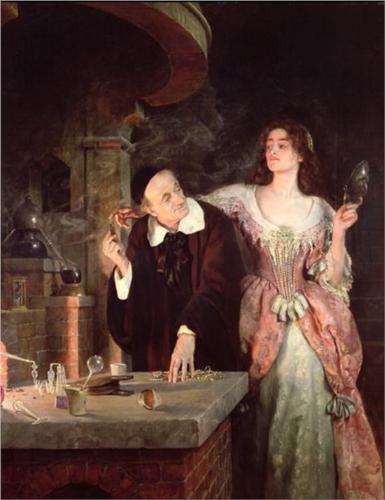
I should clarify, perhaps, that Georgiana reads the journal as she waits out Aylmer’s experiments in his laboratory.
The Laboratory, John Collier
Oh, gosh, I almost forgot—there’s a third player in this piece, Aminadab, Aylmer’s manservant/lab assistant, who’s described throughout the text (usually by Aylmer) as “clod,” “man of clay,” “human machine,” “earthly mass,” “thing of the senses” — he’s the pure-material to contrast Aylmer’s (would-be) pure-spirit. Although he’s not described as hunchbacked I can’t help but see him that way, this Igor to a Hollywood Frankenstein. And he laughs.
Aminadab laughs at Aylmer’s folly. Here is the conclusion of this story:
Alas! it was too true! The fatal hand had grappled with the mystery of life, and was the bond by which an angelic spirit kept itself in union with a mortal frame. As the last crimson tint of the birthmark—that sole token of human imperfection—faded from her cheek, the parting breath of the now perfect woman passed into the atmosphere, and her soul, lingering a moment near her husband, took its heavenward flight. Then a hoarse, chuckling laugh was heard again! Thus ever does the gross fatality of earth exult in its invariable triumph over the immortal essence which, in this dim sphere of half development, demands the completeness of a higher state. Yet, had Alymer reached a profounder wisdom, he need not thus have flung away the happiness which would have woven his mortal life of the selfsame texture with the celestial. The momentary circumstance was too strong for him; he failed to look beyond the shadowy scope of time, and, living once for all in eternity, to find the perfect future in the present.
17. I won’t comment any further on the story, other than to suggest that the final two lines—in bold above—seem perfectly sensible and wonderfully wise to me. I think Wittgenstein may have been approaching a similar idea some eighty years later in his Tractatus Logico-Philosophicus:
Death is not an event in life: we do not live to experience death. If we take eternity to mean not infinite temporal duration but timelessness, then eternal life belongs to those who live in the present. Our life has no end in the way in which our visual field has no limits.
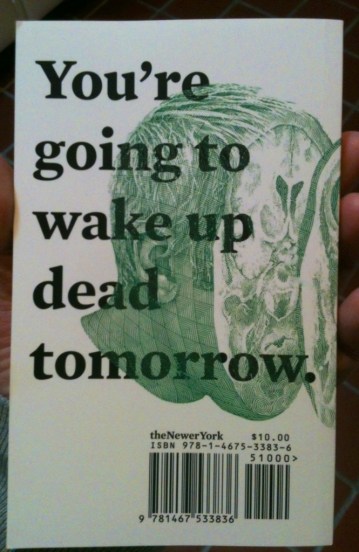
TheNewerYorkis a new little magazine or journal or whatever you want to call it, featuring short fiction, poetry, art, lists, labels, fake reviews, and other stuff. Issue #2, clocking in at just over 80 pages fits neatly into a man’s jacket pocket and can be read in queues or at red lights or in between other readings or discreetly during end of semester faculty meetings. (I’m pretty sure you could read it in other occasions but I didn’t). You can see the front cover above; here’s the back cover, featuring this worrisome promise:
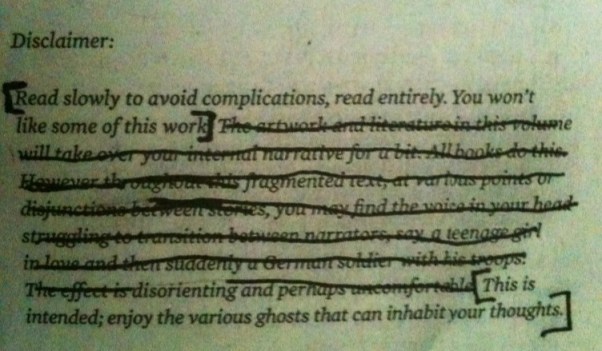
Maybe the best way to summarize (what I take to be) theNewerYork’s aesthetic/literary mission is to show off the issue’s disclaimer (which is preceded by a fancy Foucault quote):
“You won’t like some of this work” seems like a fair warning, but theNewerYork is more hit than miss, starting with its excellent opener, ‘The Thank You War” by Elliot L. Ackerman, a four-paragraph flash that tackles how would-be patriotic citizens bungle human relationships with returning soldiers. Also very good is Jamie Grefe’s list “Over Thirteen,” which is a lovely little horror story that makes meaningful use of the reader’s imagination. Another list, Bruce Harris’s “Nearly A Dozen Things Sherlock Holmes Never Said” made me laugh (sample: “Watson, you’re right.”)
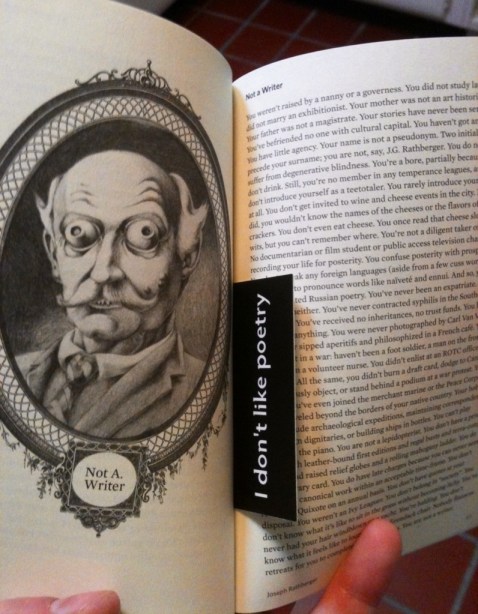
One of my favorite pieces in the volume is “Not a Writer” by Joseph Rathberger (indexed as “A Put Down”). You can see it below, filling up a page; you can also see the art that precedes it and the nifty bookmark that comes with the issue:
Most of the art in the issue is black and white and all of it is varied (in style and in quality). Here is Food Poop by Shaina Yang:
TheNewerYork’s willingness to showcase experimentation in what goes on paper for people to look at and read is both a strength and a weakness. Most of the pieces succeed, even when they shouldn’t (why is a Google translation from “Baby Got Back” from English to Latin and then back into English so funny?). The pieces in the issue that don’t succeed fail on their own terms: half-formed or poorly executed ideas, the occasionally gimmicky experiment, and, thankfully more rarely, pieces that feel too imitative. But like I said, most of the texts in theNewerYork’s second issue succeed, which is to say they entertain or amuse or baffle or occasionally move the reader. What I like most about theNewerYork is its spirit, which is daring and experimental without the heavy robes of irony that often cloak these sorts of operations. A promising beginning.
2. There are seven Maqroll novellas; I’ve read the first three. They are excellent.
3. Let me steal from Cianci’s review. He describes Maqroll the Gaviero as
a fleshed-out character, as well as the embodiment of an ideal: the knife fighters and Viking poets idolized by Borges, a mixture of Robinson Crusoe, Sam Spade, and Don Quixote. He indulges fantasy but prepares for disappointment. He lives between lawlessness and acceptability.
4. The Gaviero—the lookout—is a picaro, a roguish but poetical sailor. Mutis’s book is picaresque, carnivalesque, a river—or maybe a maze—of storytelling.
5. This is maybe what Maqroll is about: storytelling. Each Maqroll novella is framed as another’s story, or a found document—you know this trick, you’ve read Borges, right?
6. The book is crammed with stories, stories that lead to other stories, that recall other stories, that tell their own stories—or cover over other stories.
7. A line that might instructively illustrate point 6: In Ilona Comes with the Rain, Mutis unpacks the life of a minor character, a sea captain named Wito. Consider his opening gambit:
His life deserves an entire book. It was so full of adventures, some of which he hurried over as if they were hot coals, that one became lost in their labyrinthine complexity.
The life described here could just as well be the Gaviero’s.
8. Well of course, that’s what Mutis is doing, channeling and conveying and expressing Maqroll’s life, a life of picaresque adventures (and titular misadventures), of loss and gain, of love and despair, drinking, sailing, scheming and plotting—a life full of allusions and hints and digressions. Mutis’s technique is marvelous (literally; he made this reader marvel): he gives us an aging (anti-)hero, a hero whose life is overstuffed with stories and mishaps and feats and enterprises and hazards; he gives us one strand of that life at a time in each novella—but then he points to the other adventures, the other serials of Maqroll that we would love to tune into if only we could.
9. To illustrate point 8: Consider Maqroll in Un Bel Morir, doing some time in prison: His consciousness floats to other prisons, other countries: Afghanistan, British Columbia: And then we get those stories, miniature epics—and nested within them, their own characters tell stories.
10. There’s a wonderful timelessness to Maqroll, a sense that the adventures exist somehow before the postmodern world, that they belong to the pulp fictions of jungle adventure…
11. (Indeed, re: point 10: In Ilona, we find one character who is unstuck in time, taking a Naopleonic lover during a transcontinental voyage…)
12. I’ve already noted the Borgesian quality of Mutis’s tales, brought up their picaresque scope (a la Cervantes), so let me lazily compare Mutis to others: let me note the sprawl of his storytelling, which recalls García Márquez—only more compact, more precise. Let me suggest that there’s something of Kafka in there too—indeed, the first novella, The Snows of the Admiral seems to me a reworking of “Before the Law.” (The tale is also conspicuously quixotic; tilting at windmills and all that). Conrad of course, but also something of Melville—the grand (Moby-Dick) and the sly (The Confidence Man). And hell, also something of Edgar Rice Burroughs’s high adventure, or even, dare I say it, the better parts of the Indiana Jones films.
13. Lazy as I am, I’ve failed to quote Mutis at any length—a shame, because it’s wonderful prose (translated by Edith Grossman, by the way). So here’s a little morsel—one that I think captures why we tell stories—from the appendix to Un Bel Morir, the last of the three novellas I read; before I offer it up I’ll conclude my riff by saying how happy I am that there are four more of these Maqroll novellas to read:
All the stories and lies about his past accumulating until they formed another being, always present and naturally more deeply loved than his own pale, useless existence composed of nausea and dreams.
There are only a handful of forthcoming titles that I know about right now that I’m looking forward to reading next year: story collections from Sam Lipsyte (The Fun Parts) and George Saunders (Tenth of December), and a new novel from William Gass calledMiddle C. I’m also hoping Keith Ridgway’sHawthorn and Childwill finally get a US release, because I’d like to read it too.
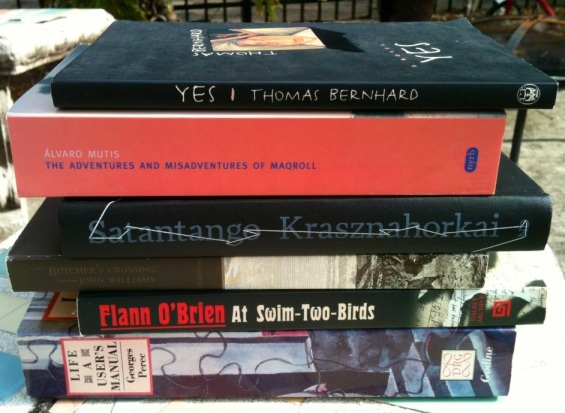
There are a few newish books that I didn’t read in 2012 that I’ll try to catch up to this year—Ben Marcus’s The Flame Alphabet, László Krasznahorkai’s Satantango, and Laurent Binet’s HHhH.
I do not currently possess any of these books.
I also look forward to reading Evan Lavender-Smith’s From Old Notebooks, back in print again from Dzanc (who I am sure will get the copy I ordered to me any day now).
At the top of my list though are the books I’m currently reading: Alvaro Mutis’s Maqroll novellas and Flann O’Brien’s At Swim-Two-Birds.
Stuff I’ve been saying I’ll read for a few years now that I hope to get to:
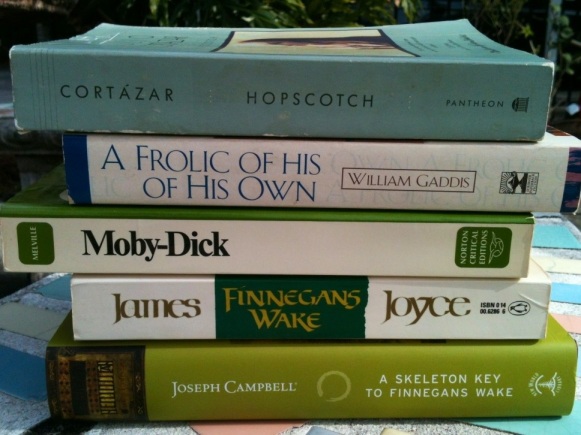
Cortazar’sHopscotch, John Williams’s Butcher’sCrossing,Gombrowicz’sFerdydurke, and, at the top of the heap, Georges Perec’s Life A User’s Manual.
I have a few books by Thomas Bernhard that I’ll probably get into this year (when I feel called to a misanthropic monologue), and I’ll gobble up anything else by Barry Hannah that I can get my mitts on. I read William Gaddis’s “big books” last year, but I still haven’t read A Frolic of HisOwn, which I’ve heard is superior to Carpenter’s Gothic.
I’ll reread Moby-Dick this year (or at least listen to William Hootkins’s brilliant audio version) and I’ll probably end up rereading some book that I hadn’t planned to at all (this happened with 2666 and The Savage Detectives this year—who knows? I haven’t read Gravity’s Rainbow since college, and I haven’t reread Infinite Jest in full, and I’d love to go through Suttree again . . . ).
I dipped my toe into Finnegans Wake this year—I’ve found reading it on the Kindle late at night and then going through Joseph Campbell’sSkeleton Keythe next morning is rewarding—and I’ll probably keep at it in 2013. Maybe I’ll make it to chapter 3.
But enough of my rambling—What books do you, dear reader, look forward to in 2013?
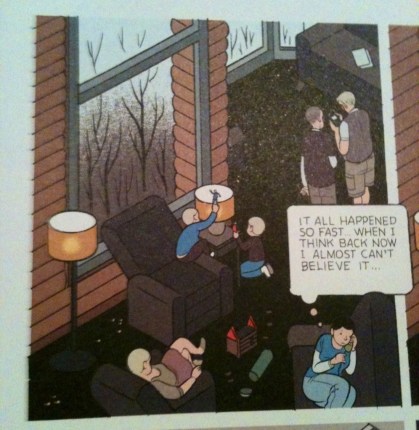
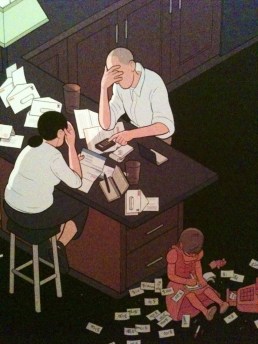
As seems to be the case more often than not in this series of write-ups on reading Chris Ware’s Building Stories, I’ve taken the title from the first line of the first panel (below); you can see the scale of this chapter in folded broadside in the pic above (which also reveals the heart of this episode).
This particular episode focuses again on Lonely Girl/Married Mom/The Amputee, who has slowly emerged as the protagonist of Ware’s novel. Here, she deals with the news of her father’s illness, an event that brings her back to her childhood home repeatedly. The motif of homes and buildings evinces again too, of course—it’s a subtle but omnipresent device in Building Stories:
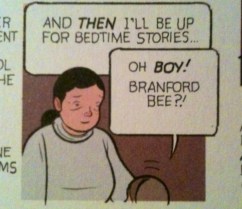
And as always, Ware’s genius shows in the way he conveys so much truth in the smallest detail. Below he illustrates Lonely Girl’s disconnected relationship with her architect husband in just a panel:
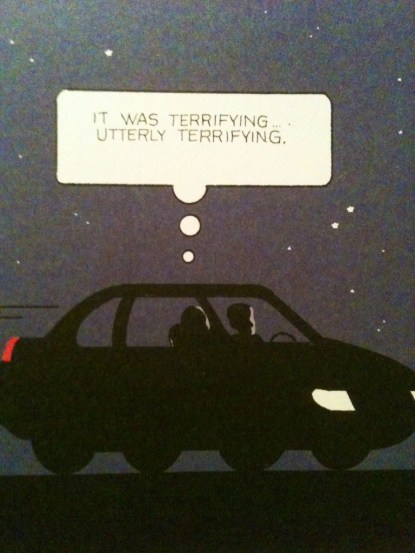
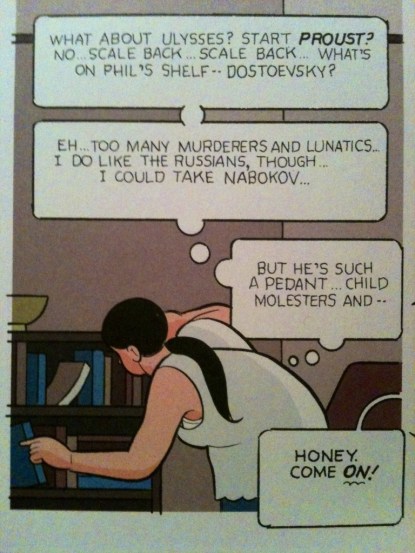
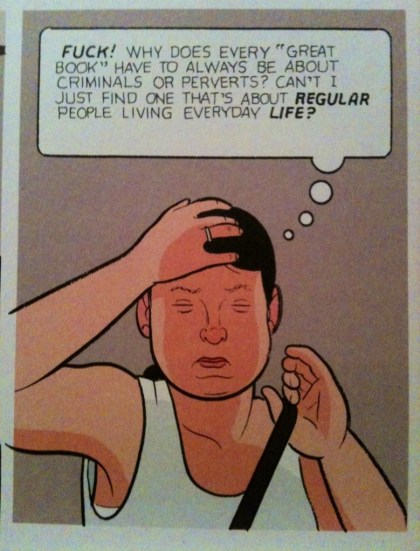
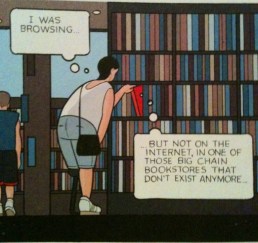
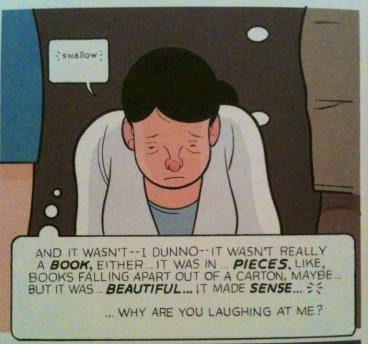
“It All Happened So Fast” is a fair name for this chapter—Ware’s panels illustrate the way that our lives (and the narrativizing of those lives) can become radically compressed, how our memories fail us, how seemingly trivial details anchor themselves to the emotional strata of our personalities even as concrete fact slips away. Still, another title could come from this panel:
I’ll close this out by offering three panels that strike me as so utterly real, so wonderfully truthful, that I won’t bother to comment further:
Dmitry Samarov is an artist and writer who lives and works in Chicago. After graduating from the School of the Art Institute of Chicago in 1993, Dmitry drove cabs for twelve years. He captured his years as a taxi driver in the stories and art of his first book Hack, which was released last year from the University of Chicago Press. Hack also exists as a blog where Dmitry continues to share his stories.
I first became aware of Dmitry’s work via Twitter; I’d been posting images of readers and books for the past year—one a day—and was thrilled to find his series of bookshelf paintings and his figure paintings. Dmitry was kind enough to talk with me over a series of emails about his art, his writing, and why you’re not likely to see any space vampire paintings from him anytime soon.
You can see more of his work at his website—or better yet, check out one of his upcoming shows if you can: “Dmitry Samarov: Bookshelf Paintings” opens January 11th, 2013, at the Harold Washington Library in downtown Chicago, and “Pictures from a Chicago Cab” opens at the University of Central Missouri on January 23rd.
Books #6 by Dmitry Samarov
Biblioklept: Why do you paint?
Dmitry Samarov: Making pictures is how I talk to the world. I can’t remember ever not doing it. I got in trouble for doodling in 1st Grade back in the Soviet Union and haven’t looked back since. Trying to catch a bit of the way the light changes as the day wears on or the manner in which a girl looks inward as she reads a book or how paperbacks and hardcovers on a shelf lean on each other, all these small moments and many others have occupied my time. Making marks on a surface is a way to record my time here and to show others what I saw. When I do it right they’re able to see something of what they know in my pictures.
Writing about painting is always ultimately futile—the reason one paints something is because he can’t say it and probably vice versa too—but we just can’t seem to help it, can we?
Biblioklept: You bring up your paintings of book shelves and readers—I’m particularly interested in these. Can you talk about how you approach painting figures who are reading? What’s your process? How is painting a reading figure different from a portrait where the figure gazes at the viewer?
DM: I’ve never liked posing sitters. When I paint portraits or figures they are usually friends or family rather than protagonists in a narrative I have in mind, so I like them to choose what they’re doing. If you’re gonna be sitting for an hour or two what’s more natural than to read a book? There aren’t many people who are able to just sit for long periods and when they do it creates a tension. You can see it in Lucian Freud’s great portraits, those people are weary from sitting in his dingy, gray studio. I prefer to paint people in repose—not to the point of pretending that they’re not being looked at—but neither like a bug being examined under glass. Readers are wrapped up in their own inner state rather than working to express some message an artist might be trying to impose. This is as close as I know how to portray a person as they are rather than as I’d like them to be.
Beth by Dmitry Samarov
Biblioklept: So then, for the most part, I’m guessing you don’t photograph the subject and work from that photograph to create the painting. How does painting the sitter “live” (for lack of a better term—if there is one, please let me know!) differ from working from something like a photograph?
DM: I always prefer to work from life. The only things that are from photographs, sketches, or memory are my illustrations and some commissioned pieces. What’s always interested me is looking out at the world and making marks in reaction to what I see. Working from photographs doesn’t allow me to do that. They’re frozen and unnatural. Life never stops the way it does in a photograph. A drawing or painting can acknowledge the passage of time, the light changing, and many other things much better. But, of course, I’m very biased about this.
To me a picture should be a collection of many moments. It’s made in the space between the subject and the artist’s eyes and mind. It’s a conversation, a back-and-forth. I can’t have that same conversation with a photograph or even with one of my own memories for that matter.
Biblioklept: I think your paintings show the energy of that conversation. Can you talk a bit about your book paintings? When did you start painting images of book shelves? Are the shelves your own?
DM: I started doing the book paintings about fifteen years ago and return to them every few years. I think I was looking for a way to do still-life without setting anything up. I like the way the books lean against each other, the crevices formed in the gaps between them, and the way the overall structure and character of a shelf changes over time as books are removed and replaced. It’s also always been funny to me to be painting the outsides of books so much of what a book is is contained between the covers.
The shallow space of a bookshelf also offers a different kind of challenge than the kind of vantage points I usually gravitate to. At times it becomes an almost abstract arrangement of shapes. Despite all that, these are my bookshelves and I have read most of these books. It’s just one more way to engage with them and who wouldn’t want that?
Biblioklept: I’ve tried to photograph all of my bookshelves this year as part of a project on the site and it’s turned out to be much more difficult than I imagined—the way the light hits differently textured covers, and so on.
Since we’ve been talking about books and paintings of books and readers, I’m curious about paintings that you love (or hate) of readers and books—are there any particular paintings that come to mind?
DM: I like a lot of the 19th Century trompe l’oeil paintings by Harnett, Peto, et al. There’s a new thing lately of painting bookshelves with every title clearly visible. I think it’s a kind of showing-off, of letting people know how learned or in-the-know you are. I’m not a fan of that. I use text in some of my paintings but it’s often for visual reasons, if the color of the lettering on a particular spine contrasts in an interesting way with the book next to it, say, I may emphasize that. It’s always in the service of the entire picture rather than some sort of status report. Also the hand-painted Penguin paperback covers.: cute but pretty quickly forgettable.
Mistaken by Dmitry Samarov
Biblioklept: Let’s talk about the intersection of your writing and your illustration. First, I’m curious about Hack. The University of Chicago Press put out a collection of your stories (with illustrations) under that name last year, but you also have earlier versions of Hack in old school zine form, as well as a blog that features new writing. I’m curious how you think of Hack—do you think of it as an ongoing project? A book? A blog? A persona even?
DM: Hack started as a zine around 2000 as a way for me to make sense of my three years driving a cab in Boston (1993-1997). It was called Hack because the license to operate a taxi in Boston was called a Hackney Carriage License and they used to call cabbies hacks in the old days. It was my first attempt at writing outside of school homework assignments and there really wasn’t much writing, it was mostly pictures. Those pictures were a challenge too because, as I’ve said, I work primarily from direct observation and the only way to do these were from memory. These illustrations were made to work together with the words, not to stand on their own and that has continued to be the case through the whole history of Hack.
I started driving a taxi in Chicago in 2003 and revived Hack as a blog late in 2006. To my surprise, it got notice pretty quickly from some in the local press—Whet Moser, then of the Chicago Reader especially—-and my high school pal John Hodgman mentioning it in a magazine didn’t hurt either. That got it noticed by a publicist at University of Chicago Press named Levi Stahl. He bought a copy of my self-published compilation (see the third one down) and eventually pitched Hack as a book to his employers. They published it in October 2011.
I stopped driving last summer and spent a couple of months putting together a second book. It’s all ready to go. I’m just waiting for a publisher to snap it up. The new one expands on a lot of the themes of the first book and spans my entire cab career, from 1993 to 2012. I’m a much better writer from having gone through the editing process on the first book and from the sheer amount of writing in various venues that I’ve done over the last few years.
I don’t know that Hack is/was a persona but it’s certainly gotten me more attention than anything else I’ve done.
Biblioklept: When you were working on the pieces for Hack, did you start with the illustrations or the words?
DM: The illustrations were always first. They were my way into the writing. I went over the phrases I’d use as I was working on the pictures. That’s the way it goes to this day for the most part. I always have been and always will be a painter first.
“You Know Where I’m Going” by Dmitry Samarov
Biblioklept: The pieces of Hack I’ve read seem to channel the stories of your passengers—there’s a lucid straightforwardness about them that I like. How conscientious of style are you when you’re writing? How much do you edit?
DM: I edit a lot. I use as few words as possible. It’s evolved over time of course. When I started I leaned really heavily on ellipses as a transitional device. I cribbed that from Celine’s Death on the Installment Plan. Editing the entries for the first book cured me of that. In general the cab stories take their inspiration from Nelson Algren’s advice to just go out into the streets and listen to the way people speak and to write that down as simply as possible.
At it’s best my writing tries to do what my painting does: to relay what I see and here out in the world. I try my best to stay out of the way because everything out there is so much more interesting than anything I could ever dream up.
Celine by Dmitry Samarov
Biblioklept: You know, I almost referenced Celine in my last question, because the ellipses are clearly a major stylistic device in your self-published version of Hack (and also because I dig your painting Celine). You bring up Algren—what other writers do you admire?
DM: Algren is a real touchstone because he introduced me to Chicago a few years before I even arrived here in 1990 to attend the School of the Art Institute. There are many others. I love Joseph Mitchell’s Up in the Old Hotel and Luc Sante’s Kill All Your Darlings as models for ways of writing different sorts of personal essays. William Gaddis’s books, especially JR, for the way he captures American speech and Cormac McCarthy, especially Suttree, for descriptions of physical environment.
Lately I’ve been looking into forgotten local authors a lot and writing about them at Writers No One Reads. A sense of specific place is very important to me.
I don’t have any aspirations to write fiction but usually, as long as it’s rooted in reality, I’ll probably read it.
Vachel Lindsay by Dmitry Samarov
Biblioklept: You’ve returned to the idea of reality a few times in our conversation, and your paintings and illustrations seem to evoke a strong sense of place. Why is depicting real scenes important to you? I’m guessing we won’t see a series of space vampires from Dmitry Samarov anytime soon . . .
DM: Writers and painters who use space vampires, fantastic worlds, etc. probably just have more imagination than me. Or perhaps the everyday world doesn’t provide them with enough inspiration or subject-matter to say what they need to say. I don’t have that problem. For me just looking out the window for a moment as I type this gives a glimpse of a thousand paintings I could try to paint. What’s out there is within my scope of vision is as limitless as outer space must be to sci-fi writer or a dream must be to a fantasist. The few times I’ve tried to resort to my imagination I’ve found it at once limiting, hopelessly random, and sadly wanting. How could I choose one thing rather than another and what would it matter? There are still many choices to be made when working from what’s before me but it doesn’t feel random and meaningless in the same way. It’s more that I’m pushing against something that’s actually there and it’s pushing back at me.
But maybe I’ll switch to space vampires after I get bored with reality.
Biblioklept: Do you paint or draw every day? Do you write every day?
DM: I try to paint, draw, or write something most days. It’s a much better day when I have than when I haven’t, that’s for sure. The internet has made it possible to share every stray scrap that one comes up with and I’m probably guilty of putting too much out there for others to see, but I’ve always thought of all my work as being public, that part that’s for me is just the doing. After I’m done, it has to sink or swim on its own and for that viewers and readers are needed. The internet is like a big messy studio where (hopefully) over time all the false starts and failures will be forgotten, ignored, or swept away and the worthwhile things will have whatever life they deserve. What I’m trying to say is that most of hat I do is probably crap but that maybe there’s some value in sharing it with others and letting them judge rather than holding things close and only showing them the ones that I’m convinced are good. In any case it’s nearly impossible to say right after finishing a picture whether it’ll speak to people or is just a rehash of something done before or a waste of time I’ve somehow convinced myself to push on with. I hope in twenty or thirty years to look back and be able to say that I’ve made a couple of things that were worthwhile.
Biblioklept: So do you find it hard to judge or evaluate your own work?
DM: Not at the time I’m doing it. I throw away plenty. But with the benefit of, say, a year or five or ten, things I thought weren’t bad turn out to look awful and occasionally, vice versa. As a rule though, I think once I’ve decided to let something out into the world it’s no longer my job to evaluate it. If I thought enough of it not to burn or paint over it it has to try to survive on its own steam.
Martina by Dmitry Samarov
Biblioklept: What are you working on right now?
DM: Well, I finished a second book of illustrated cab stories. It’s called WHERE TO? More Stories from a Hack and covers from when I first drove in Boston in 1993 until the summer of 2012 when I gave my last cab ride. It goes deeper into the inner workings of the cab industry, the people who take cabs, attempts to answer why I decided to drive a cab in the first place. I’m still looking for a publisher for it.
I’ve been writing and illustrating occasional baseball-related pieces for Chicago Side’ssports section, working on illustrations for various other projects, and finishing up my first book review for the Chicago Tribune’s literary supplement, Printers Row, on a recently-reissued forgotten novel called Diversey. Also I have two art shows coming up in January and another in February. On January 11th, “Dmitry Samarov: Bookshelf Paintings” opens at the Harold Washington Library in downtown Chicago. On January 23rd, “Pictures from a Chicago Cab” opens at the University of Central Missouri.
All that and doing my best not to have to go back to a day-job. I haven’t driven a cab in about five-and-a-half months and have really gotten to love not having to leave the house much.
Biblioklept: Have you ever stolen a book?
DM: I used to steal ’em all the time. I had a good scam going when I was school changing price-tags on expensive art books, getting $100 ones for $20 and such. I used to steal a lot of things. I wrote a whole thing about it for The Handshake.
Biblioklept: Can you talk about a particular book you remember stealing?
DM: I stole this beautiful Giacometti book from Powell’s sometime in the early-90s and wound up having to sell it at Myopic Books in the late-90s for much less than it was worth when I was broke and between jobs. I’ve sold off tons of great books and records over the years. I’m neither the most careful collector nor blessed with much foresight as to what might or might not be valuable in the future.
“Disconnect,” one of the longer episodes in Chris Ware’s novel Building Stories, serves as a reminder of Ware’s strength as a prose writer. Wordiness tends to kill illustrated storytelling, at least in my estimation. Sure, there are exceptions—Joe Sacco and Harvey Pekar come to mind—but in general, I think comics are at their best when thought and word bubbles are uncluttered (or nonexistent). Ware clearly understands the economy of his medium, and some of Building Stories’ finest moments have been wordless ones where Ware constructs the story in pure imagery. We can see so much of the plot and themes of “Disconnect” in this full page, for instance:
But Ware also packs plenty of storytelling into his prose in “Disconnect,” where he continues the story of Lonely Girl, who it’s probably better to now call Married Mom—I still think of her as Lonely Girl though, after first really meeting her in “September 23rd, 2000,” an episode ostensibly narrated by her diary. “Disconnect” is a second diary of sorts, her internal narration guiding us subtly through episodes in her life over a series of years. “Disconnect” focuses on LG/MM raising her young daughter against the backdrop of a strained marriage.
Lonely Girl/Married Mom’s observations ring particularly true. She points out that “When your children aren’t around, you miss them with every fiber of your being—but when they are, you just want to get them to bed so you can go read the news or something,” an observation simultaneously profound, disturbing, and banal. When our heroine recalls how her relationship to her pet cat changed after her child was born, I also saw shades of myself: “The day we brought Lucy home, almost to the minute, all applied personality to Miss Kitty evaporated, and we saw her for what she was—an animal—and an animal who we were beholden to feed and house, with, suddenly it seemed, little to offer in return.”
Through Lonely Girl/Married Mom, Ware paints a portrait of modern disconnection and alienation, and, even as we sympathize with the heroine, Ware also allows us to see through her—or rather, to see what she can’t see, or to see what she refuses to see. The effect is an irony that tips into small, banal tragedy.
Ware’s prose is usually overshadowed by his gifts as a draftsman, an architect—he’s the builder of Building Stories, a fact that this chapter alludes to, both internally, intertextually, and metatextually. We learn, for example, that Branford the Bee is a story within a story:
This nesting of stories emerges in the final part of “Disconnect,” wherein our aged narrator—addressing her grown daughter—relates a dream:
The scene culminates so beautifully that it brought a little tear to my eye. Most postmodern novels contain (often more than once) their own descriptions, and Building Stories is no exception:
And yet what we see here isn’t postmodern cleverness or empty gimmickry, but the evocation of dream and imagination and desire and creation—the spirit of the book, of what it means to build stories. Reading the final panels of “Disconnect,” I immediately recalled the epigraph to Building Stories (it’s on the interior of the box lid, by the colophon and dedication):