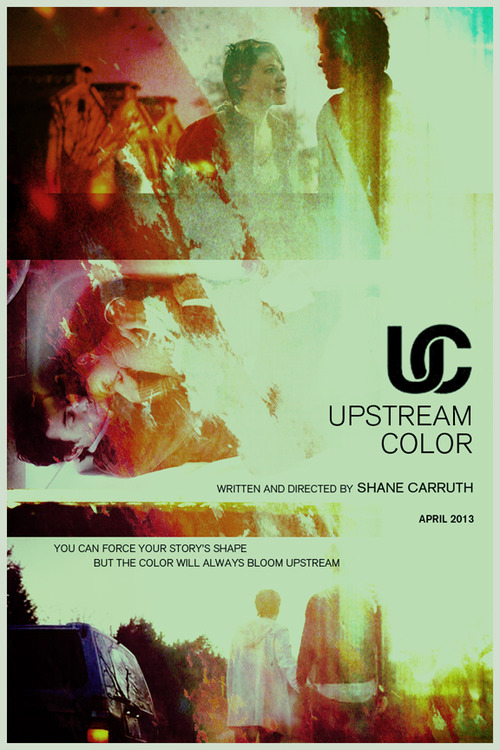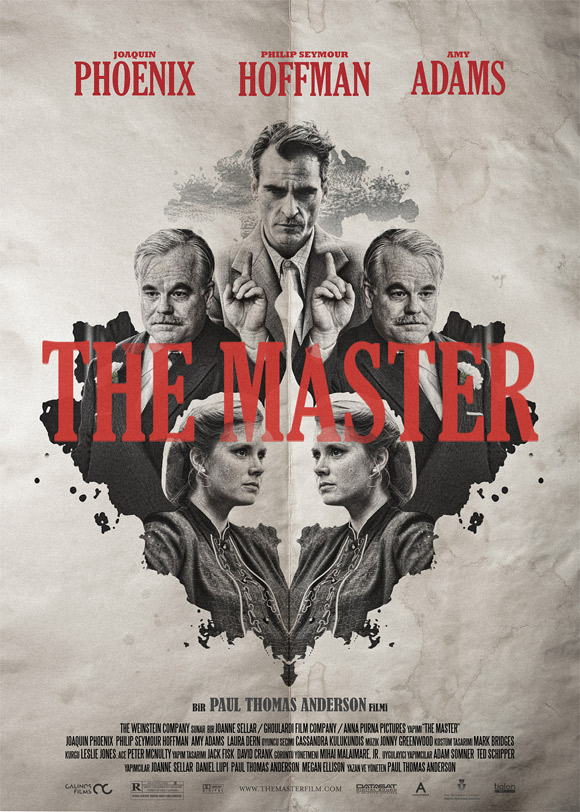
1. I managed to avoid reading anything about Shane Carruth’s new film Upstream Color before I saw it.
I just knew that this was the guy who did Primer, this was his new film, and I wanted to see it because Primer was so strange and engaging.
2. Two immediate responses after viewing Upstream Color:
i). The desire to see Upstream Color again and
ii). The desire to read what other people thought about Upstream Color.
3. (My wife and I, reading the credits, pausing the credits, reassessing the film against the backdrop of the credits, arguing about the film, discussing the film, etc.).
4. I think it’s better that if you have any interest at all in Upstream Color that you just see it cold [update/warning: the comments section of this post is full of spoilers]. But I know that 100 minutes is an investment of time, so maybe you’d like some kind of précis or at least description. So, a loose attempt, which surely will devolve into fragments and references:
Upstream Color is a sci-film, sort of.
Or maybe its a mystery film about ethics and biology.
Maybe a nature film, sort of.
Henry David Thoreau’s Walden.
Worms—parasites.
Theft.
Pigs.
Shades of Philip K. Dick, David Cronenberg, Terence Malick, but also something utterly original.
Mind control.
Trauma.
Ambient music.
Orchids.
Sampling nature.
Memory.
Swimming.
Drowning.
Creation: knitting, paper chains, music, seeds, life, children, etc.
A film that can and should be described as poetic.
It’s a love story, too.
5. It occurs to me that there’s a trailer for the film. I haven’t seen it yet. Should we watch it?
6. Does that do it for you? I don’t know how to do this anymore. Recommend things. I don’t know, the trailer makes the film perhaps look more pretentious than it is. It isn’t pretentious. It isn’t even confusing—just perplexing, haunting, troubling.
7. (Wanted: Quinoa Valley Record Co., complete discography).
8. My take on Upstream Color, spoiler-free, supporting-detail-free:
The film is about agency, about drive, about how the characters (and, implicitly, us, we, the audience, who identify with the characters on the screen) may be driven by something beyond us, something controlling us like a parasite (internal) or from afar like a ventriloquist (external). That even when we do assert agency the effect, the fallout, the shape lays beyond us, upstream.
9. (This morning, my wife telling me about her dream, a nightmare that our young daughter had ingested hallucinogenic mushrooms, clearly a response to the film).
10. I haven’t done a good job of really saying anything about the film. So, lazily:
I think Caleb Crain provides a perceptive and persuasive reading of the film in his essay “The Thoreau Poison.” He reads the film through the American transcendentalists, particularly Thoreau, of course, but also Emerson and Hawthorne.
There’s also a piece at Slate by Forrest Wickman that perhaps over-explicates but nonetheless offers perspective, including elements of Carruth’s own take.
11. (I will avoid Carruth’s explanation of the film until I’ve seen it a second time. Maybe I’ll avoid his explanation forever).
12. A take on Upstream Color that I don’t quite buy into (the take is my own): The film perhaps invites us to find metaphysical entities in two of its secondary characters, both of whom exert influence (creative and destructive) over the primary characters. Something something godlike, something something devillike.
I like that the film offers this simple duality and then crushes it, shows something far more complicated, suggests a cycle far more strange.
13. (White orchid. Blue orchid. Yellow orchid).
14. Upstream Color features minimal dialogue and nothing approaching traditional exposition, but we still learn about its characters, come to feel for them, feel their desires and traumas. The film is cerebral and philosophical, but it’s also emotional, offering an aesthetic that sublimely overwhelms the viewer.
15. Carruth wrote, produced, directed, scored, photographed, cast and starred in Upstream Color. (I’m sure he did a lot of other stuff too). He also distributed the film himself. The entire filmmaking process was untouched by the Hollywood system. There’s so much hope for film as an art form in this knowledge.
16. Parting thoughts: See Upstream Color. Resist imposing whatever film grammar you usually bring with you to the movies. Resist the temptation to see the film as a puzzle to figure out. See Upstream Color.
I’m tempted to say that Carl Shuker’s novel Anti Lebanon is full of twists, but twists isn’t the right word—it’s more like the novel’s trajectory repeatedly escapes the reader’s expectations, driving into increasingly alien terrain.
Anti Lebanon begins as a somewhat traditional novel focused on Leon Elias, “thirty years old, East Beiruti Greek Orthodox.” Leon has dropped out of university, leaving his degree in hydrogeology unfinished. Leon has since taken a job as the security guard of an abandoned amusement park, a symbolic stand-in for Lebanon’s tourist economy. The Arab Spring has destabilized Lebanon, leaving its Christian population in a precarious position as Hezbollah dominates the government—and the streets. After dropping out of school, Leon creates an experimental short film, In the anti Lebanon, a film “about his family and his sister and their history” — a history of mixed cultures (Leon’s mother is Japanese) and pain (his sister, a soldier, was assassinated).
The early parts of Anti Lebanon seem to set the stage for a fairly conventional novel with strong political overtones, one that explores Leon’s guilt over his sister’s violent death and his conflicted place as a sensitive and artistic soul who’s the son an infamous warrior, all set against the backdrop of Christian Lebanon in the tumult of the Arab Spring. But then Shuker takes us other places. Lots of other places.
The crucible for this change comes after a night of drinking ends in violence and theft. I don’t want to spoil too much—this is a novel that constantly had me rereading entire passages, asking, Wait, what?—but let’s just say Leon, complicit in a crime, ends up moving a body by motorcycle. Let me share some of Shuker’s prose in a passage that reveals the novel’s major metaphysical gambit:
This time there was no crash and it probably was the alcohol but the pain of the thing’s biting was gristly and sharp and also distant and allied with the shock of the fall so he rode though it for it seemed several dozen feet— the most important thing was not to fall again. He came to a controlled halt, stopped the bike, and then over his shoulder punched the thing’s face several times, his knuckle hitting soft then hitting helmet, and it bit again and this time harder and it stung and went deeper, a popping sound or feeling in his neck that suddenly got desperately deep and he punched again and then he rolled violently and writhed in the grasp of the thing they had created and he fell over deliberately, twisting so as to topple over sideways upon and hurt and stop the thing, and he hit the ground landing on its arm and this dislodged the biting helmeted head and he pulled up its hands and wriggled away over the concrete like his sister palming herself away from her disappeared foot and he scrambled up, and the thing just lay there inert and still, wired to the scooter in a position absurd, all tied up and crooked and ruined and wrong. He stood and held his hot neck looking at the fallen boy and then knew that someone else was there.
Is Leon now a vampire? The novel answers this question clearly even as it refuses to explain or define what, exactly, being a vampire means. Anti Lebanon at times threatens to become an allegory of Mideast politics and history, using vampirism as its major trope, but then Shuker shifts us into new, weird territory. An appropriately Borgesian chapter titled “Labyrinth” moves Leon and the reader into a propulsive engine of dream logic; we’re never quite sure exactly what is happening as Leon gives over to dark, primal violence.
Such violence inheres from history and geography and mythology. It’s worth sharing another passage at length to see how Shuker traces these contours, plunging character and reader into history’s strange tangles. Here, vampire Leon drinks a guard’s lifeblood—the beginning of an oblique spree—and tunnels into mythos, plumbing the history of his land to arrive at his sister’s murder:
Semi-unhinged single Christian men, living alone in brutalist concrete boxes on the borderlands with their rage and a shrieking TV, a simonized gun and a cross on the wall, were approached and made use of. Aries, Andromeda, and Perseus slowly wheeled across the dead guard’s sunglasses. Christian snipers took positions around Mar Mikhael overlooking Electricité du Liban. A secret. Leon, labyrinthine, tunneled from shadow to shadow. The criminal and the victim alike return to the scene of the crime. Would the Israelis come? The taste of blood was hot: There was juniper, vetyver, and chypres too, copper drying down to a powder, wealth and breadth of deathless rivers in endless cycle, over centuries, aeons, untouched and untouchable: Nahr al Kalb, the dog river, collecting on its rock walls the signatures of dead empires: the steles of Ramses II, Nebuchadnezzar, Napoleon III and Caracalla, General Gouraud and The XXI British Army Corps with Le Détachement Français de Palestine et Syrie occupied Beirut and Tripoli: October 1918 AD; and Nahr Ibrahim, the blood river, which flows red: iron-rich soil rusting, seeding red anemones of the rebirth along its banks. The land still bearing the imprint of its creator, still running with the blood of Adonis in cascades; cataracts of rust. The march crossed the exact point on the Green Line where the Black Saturday ID checkpoints were erected once upon a time and to cross was to have your ID checked for religion and your throat cut in the passenger seat, watched over by Phalange HQ, past Makhlouf’s sandwich store— his weakness, his frailty. He told her about the last shot, what he alone saw: that the assassin didn’t even look as he ruined her; as he ruined him.
From here—well, let’s just say that Leon goes, and that the book moves into a picaresque rhythm, erupting with Bolañoesque moments of horror and strange shifts into the unreal (there’s a moment at the end of an episode in Israel that confounded everything I’d read so far in the book, the effect approaching alterity). It would spoil too much of Anti Lebanon to delineate all its movements; suffice to say its unsettling shifts are grounded in motifs of dogs, water, film, art, crashes, the peri, the vampire.
Shuker’s book isn’t for everyone. Those looking for a classic Gothic horror or a sexy vampire romp will likely be disappointed (and probably confused). Shuker also throws his reader into the metaphorical deep end of Mideast politics and history, offering little exposition that might help explain some of the complexity. There’s a trust in the reader there that I admire (even as I often headed to Wikipedia to learn about Lebanon’s civil wars, the Druze, its relationship to Syria, Palestine, Israel…). That trust is best returned to the author—a trust to follow him where he goes, because frankly you won’t be able to see ahead. Anti Lebanon is unpredictable, strange, and very rewarding.
1. Listening to someone’s dreams is usually pretty boring. Reading about someone’s dreams is even worse.
Except when it’s not, of course.
2. Perec, describing his dream journal La Boutique Obscure:
I thought I was recording the dreams
I was having; I have realized that it was
not long before I began having dreams
only in order to write them.
These dreams—overdreamed, overworked,
overwritten—what could I then
expect of them, if not to make them into
texts, a bundle of texts left as an o)ering
at the gates of that “royal road” I still
must travel with my eyes open?
4. The dreams in La Boutique Obscure, rendered in fairly concrete prose (Perec avoids analysis), were recorded between 1968-1972.
5. I’ve been slowly reading the essays and riffs and lists collected in Perec’s Species of Spaces and Other Pieces over the past few years. There’s something wonderful about picking the book up at random and finding some little quip or note (or entire essay) that illuminates some fascinating aspect of what we might initially take to be a dull topic.
La Boutique Obscure works the same way.
6. Sample:
7. Many of the elements that we see in Dream No. 24 / “Cats” run throughout the collection: Friends, doors, streets, houses, apartments, disasters, performances, lists, etc. etc. Note also Perec’s refusal to analyze or contextualize or otherwise attempt to make meaning out of the dream.
8. My favorite pieces in the collection are the ones that convey more plot—adventures, chases, fragments of films and plays—but there’s also pleasure in Perec’s shortest pieces, which often resemble imagist poems—like “The stone bridge”:
9. A good review, a responsible review, might try to situate Perec’s dream journal against his role as Oulipo gamesmaster, or set the entries against Perec’s biography, or maybe compare it to other dream journals. Or maybe even try to tackle it as a novel, or a novelish book.
10. But I’m more interested in the aesthetic experience of reading La Boutique Obscure. The book is fun, distracting, and divergent. Perec’s refusal to interpret his dreams leaves plenty of space for the reader to make his own connection—and if need be, interpretations—but to be clear, the same banal anxieties that inform our own dreams are what Perec traces the contours of in La Boutique Obscure. The book’s greatest strength is its imagery, its evocation of place, space, movement. To fault it for lacking depth would be to entirely miss the point.
11. Reading La Boutique Obscure provides another nagging reminder that I have yet to read Life A User’s Manual.
2. It’s actually about as faithful an adaptation as one could expect.
3. A major deviation from the novel:
The filmmakers (the Wachowskis and Tom Tykwer) of Cloud Atlas chop up and rearrange the novel’s six sections such that each section’s individual arc (e.g. exposition, climax, dénouement, etc.) runs concurrently with the other narrative arcs—like braided strands—whereas the novel nests them—like matryoskha dolls.
It’s very clear why the filmmakers would wish to use a more traditional grammar, but the effect is often more taxing than rewarding—the work’s themes of eternal recurrence are overstated (yet somehow underdeveloped), pressed repeatedly on the viewer. There’s little breathing room.
4. Another (possible) deviation from Mitchell’s novel:
The filmmakers cast their company (including Tom Hanks, Halle Berry, Jim Broadbent, and Hugo Weaving) in multiple roles, so that each actor portrays a new character in each section. Mitchell’s novel played with the idea of eternal recurrence subtly, using a comet-shaped birthmark as a linking signifier. The film adaptation overloads the theme, creating the impression of a system that simply doesn’t inhere through the plot unless the viewer chooses to impose it (granted, certain actors tend to be cast in villainous roles or heroic roles—but there isn’t a coherent system of correspondences between the actors and the characters, despite what snippets of dialog would wish the viewer to believer).
5. The biggest problem with casting actors across a variety of roles:
The effect is extremely distracting—especially when actors are playing characters across gender or across race (especially the film’s notorious use of “yellow face,” which is problematic on many levels, not the least of which is that the make-up and prosthetics just look awful—and the part of the yellow face that’s worst to me (and perhaps the least-remarked-upon) is the awful fake “Asian” accents that the white actors use, with mangled intonations, etc. Disastrous).
The gambit may have worked (only may) if the filmmakers had cast actors who could actually pull it off. Denis Lavant, Tilda Swinton, and Gary Oldman all come to mind as actors who inhabit their roles to such a degree that the character transcends them (in plainer language: Gary Oldman is excellent at not looking like Gary Oldman). Tom Hanks—well, Hanks is wonderful at balancing charm with profound gazes—but he looks just like Tom Hanks in every damn scene he’s in, whether he’s playing a contemporary British gangster (maybe the low point of the film) or a post-apocalyptic tribesman (which, let me just shoehorn this in here real quickly—I imagined the Zachry of the novel to be like, much, much younger than mid-fifties). Halle Berry looks like Halle Berry, even in white face. And Hugo Weaving doing his Nurse Ratchet impression…well, leave it alone, leave it alone.
6. One thing the film does very well:
Stylized action sequences. We might expect this—the Wachowskis gave us The Matrix trilogy—but I was surprised at how well these moments fit into the film. There must have been a temptation to wedge shootouts and battles and cool cityscape sequences into the film, but these pockets of action are used sparingly, effectively buoying the film.
7. Another thing the film does well:
Explore the themes of slavery (and slave-master dynamics) that are central to Mitchell’s text.
8. The biggest thematic short-coming of the Cloud Atlas film:
Its muddled handling of eternal recurrence. In my review of Mitchell’s novel, I suggested that the book was overtly investigating the relationship between Nietzsche’s concept of eternal recurrence and his infamous and often misunderstood übermensch. Granted, the film does posit history as a cycle of domination and submission, and also suggests that figures who wish to break or disrupt or upset this cycle will be assassinated or martyred—but the film elides the novel’s Nietzschean impulses in favor of New Age contours. There’s a broad, hippy-dippy streak of faux-spiritualism to the film that’s too syrupy to swallow. (In full disclosure, dear reader—I prefer a healthy dose of bitter with any sweets).
9. Another problem:
The music. It’s not that the score by director Tom Tykwer and two collaborators is bad—it’s fine, I suppose—it’s that the filmmakers rely too heavily on music to stitch their story strands together. The effect is at times simultaneously dulling and claustrophobic.
10. An extension of the previous point:
This is perhaps the biggest shortcoming of Cloud Atlas: Its compression. The film runs to an epic three hours, but somehow feels rushed.
There’s not enough space for characters to develop, and because the film has created a system through which characters are essentially reiterations of previous “selves,” the changes that the characters do undergo seem like fore drawn conclusions. Perhaps the most drastic example comes in the fabricant Sonmi-451. She’s an emblematic character to the narrative, a messianic figure, and her catechism provides the novel’s perhaps strongest exploration of what it means to be human and free. While the film hardly botches the Sonmi-451 segment, it doesn’t devote enough time to showing her revolutionary arc.
11. I know, I know—the film is already three hours, and here I am asking for more.
Suggestion: Cloud Atlas might have been much stronger as a twelve part miniseries, giving its characters and themes room to breathe and grow.
Another suggestion: Cloud Atlas as a one-man theatrical show starring, I don’t know, Gary Oldman (?). 75 minutes tops.
12. My criticisms might seem overly nitpicky, and to be clear, they are from the perspective of someone who read and enjoyed the book first. Still, I hate to fault the Wachowskis and Tykwer for their ambition, scope, technical prowess, and, oddly, their restraint. The film is far more focused and coherent than it has any right to be and its themes come through clearly. The filmmakers show a deep respect for Mitchell’s novel as well as the film’s audience while at the same time offering their own personal interpretation of the source material. When Cloud Atlas stumbles or outright fails, it does so on its own terms—which is why I think the film ultimately succeeds.
“For me, the litmus test is always language,” George Saunders told Charlie Rose in a recent interview. “If the sentences are kind of jangly and interesting, then I know how to proceed.”
Saunders composes stories syntactically: his themes and plots and characters emerge from the right jangle, the right discordant note that simultaneously pleases and disturbs. This technique shows in his latest collection Tenth of December, a showcase for Saunders’s estimable verbal prowess and a reminder that he is one of America’s preeminent satirists.
Tenth of December also reveals some of Saunders’s limitations, the biggest of which is that he seems to write the same few stories again and again. Granted, these stories are sharp, funny, puncturing criticisms of American life—satires of corpocracy and the ways commerce infests language (and hence thought); satires of how late capitalism engenders cycles of manufactured desire and very-real despair; satires, ultimately, of how we see ourselves seeing others seeing us in ways that we don’t wish to be seen. Perhaps Saunders writes the same plots repeatedly because he thinks we need to read them repeatedly—and there’s certainly pleasure and humor and pathos in Tenth of December—but there isn’t any territory explored here that would be unfamiliar to anyone who read CivilWarLand in Bad Decline or Pastoralia.
Take “Escape from Spiderhead,” one of the stronger entries in December. This is pure Saundersville, a story nudging weirdly into a skewed future that might come too-true too soon. Said spiderhead is a prison command center where wardens subject their inmates to language and desire experiments, using drugs like “Verbaluce™, VeriTalk™, ChatEase™” (lord does Saunders love incaps) to manipulate the prisoners’ minds and bodies alike (all with consent, of course).
The story is a biting and often painful exploration of how our desires and actions might be constrained and controlled by others. It’s also an excellent excuse for Saunders to flex some of those verbal muscles of his:
He added some Verbaluce™ to the drip, and soon I was feeling the same things but saying them better. The garden still looked nice. It was like the bushes were so tight-seeming and the sun made everything stand out? It was like any moment you expected some Victorians to wander in with their cups of tea. It was as if the garden had become a sort of embodiment of the domestic dreams forever intrinsic to human consciousness. It was as if I could suddenly discern, in this contemporary vignette, the ancient corollary through which Plato and some of his contemporaries might have strolled; to wit, I was sensing the eternal in the ephemeral.
“Escape from Spiderhead” is one of several tales in Decemberthat ultimately posit selflessness and empathy as a metaphysical escape hatch, an out to all the post-postmodern awful. It’s a near-perfect little story, which is why it’s too bad when Saunders essentially repeats it (right down to the Verbaluce™/amplified language conceit) in “My Chivalric Fiasco.” (Perhaps “My Chivalric Fiasco” was necessary though; it provides the sole “weird theme park” story requisite to any Saunders collection).
An equal to “Spiderhead” is “The Semplica Girl Diaries,” the collection’s strongest condemnation of how capitalism engenders bizarre ethical positions within families, between neighbors—and even countries. The longest story in the collection, “The Semplica Girl Diaries” purports to be a harried middle class father’s diary, a conceit which gives Saunders plenty of space to jangle.
Our poor narrator just wants to keep up with the Joneses, a serious character flaw that often results in hilarious hyperbole. He takes his family to the birthday party of his daughter’s classmate. This classmate’s family is wealthy, perfect, glowing, healthy, innovative, happy:
Just then father (Emmett) appears, holding freshly painted leg from merry-go-round horse, says time for dinner, hopes we like sailfish flown in fresh from Guatemala, prepared with a rare spice found only in one tiny region of Burma, which had to be bribed out, and also he had to design and build a special freshness-ensuring container for the sailfish.
Set against such a pristine backdrop our hapless narrator’s own life seems stressful and shabby:
Household in freefall, future reader. Everything chaotic. Kids, feeling tension, fighting all day. After dinner, Pam caught kids watching “I, Gropius,” (forbidden) = show where guy decides which girl to date based on feeling girls’ breasts through screen with two holes. (Do not actually show breasts. Just guy’s expressions as he feels them and girl’s expression as he feels them and girl’s expression as guy announces his rating. Still: bad show.) Pam blew up at kids: We are in most difficult period ever for family, this how they behave?
I love how Saunders works I, Gropius in there—his dystopian touches work best when they are simultaneously over-the-top (idea) and graceful (delivery of idea). These moments of humor don’t deflate the extreme anxieties that “The Semplica Girl Diaries” produces; rather, the humorous, hyperbolic eruptions add to what turns out to be a horror story.
Like the narrator of “The Semplica Girl Diaries,” the eponymous would-be hero of “Al Roosten” is painfully attuned to how others might/do see him. “Al Roosten” is one of several of December’s exercises in how we see others seeing us (set against the backdrop of how we desire others to see us, etc.). The story starts at a charity auction where local businessmen are being auctioned off (including Roosten’s rival Donfrey—an echo of Emmett) and then heads precisely nowhere (or rather, remains entirely in poor Roosten’s skull). First paragraph:
Al Roosten stood waiting behind the paper screen. Was he nervous? Well, he was a little nervous. Although probably a lot less nervous than most people would be. Most people would probably be pissing themselves by now. Was he pissing himself? Not yet. Although, wow, he could understand how someone might actually—
That sentence-interrupting final dash precedes the intrusion of the “real,” phenomenological world into Roosten’s consciousness. There’s much of James Thurber’s “Walter Mitty” in “Al Roosten”—and, indeed, much of Mitty in Saunders generally—perhaps because Saunders’s jangles lead him to explore the strange gaps between thought and action, reality and imagination. It’s worth sharing a few paragraphs of Saunders’s technique:
Frozen in the harsh spotlight, he looked so crazy and old and forlorn and yet residually arrogant that an intense discomfort settled on the room, a discomfort that, in a non-charity situation, might have led to shouted insults or thrown objects but in this case drew a kind of pity whoop from near the salad bar.
Roosten brightened and sent a relieved half wave in the direction of the whoop, and the awkwardness of this gesture—the way it inadvertently revealed how terrified he was—endeared him to the crowd that seconds before had been ready to mock him, and someone else pity-whooped, and Roosten smiled a big loopy grin, which caused a wave of mercy cheers.
Roosten was deaf to the charity in this. What a super level of whoops and cheers. He should do a flex. He would. He did. This caused an increase in the level of whoops and cheers, which, to his ear, were now at least equal in volume to Donfrey’s whoops/cheers. Plus Donfrey had been basically naked. Which meant that technically he’d beaten Donfrey, since Donfrey had needed to get naked just to manage a tie with him, Al Roosten. Ha ha, poor Donfrey! Running around in his skivvies to no avail.
We can note here the transitions between what the world sees (in those first two paragraphs) to how Roosten sees the world seeing him. This is Saunders at perhaps his finest, showcasing a meticulous control of free indirect style; Roosten is simultaneously pathetically endearing and loathsome. He is attractive and repellent precisely because we understand him—what it is to see him, but also what it is to be seen in the way he is being seen.
The titular story, which closes the collection, also offers a Walter Mittyish figure, a “pale boy with unfortunate Prince Valiant bangs and cublike mannerisms” who sneaks off into the woods to fantasize about the Lilliputian “Nethers” who might try to kidnap his crush Suzanne (whom he’s never addressed, of course). “Somewhere there is a man who likes to play and hug, Suzanne said,” the poor boy imagines. Again, this is Saundersville, where we laugh out loud and then reprimand ourselves for our cruelty and then engage, empathize, say, Hey kid, I’ve been there too…
“Tenth of December” is a sort of rewrite of two stories from Pastoralia, “The End of FIRPO in the World” and “The Falls.” I suppose I don’t mind, but I wish that Saunders’s jangles might lead him to new plots. Despite its rehashing of these earlier stories, “Tenth of December” delivers possibly the strongest case for empathy-as-transcendence in the collection. Our boy gets a shot at actually living up to his haircut—he’ll valiantly help a suicidal terminally ill man, who will, in turn, help him. What the story illustrates best though is how impulse precedes action and action precedes thought, how action can be shot through with memory:
He was on his way down before he knew he’d started. Kid in the pond, kid in the pond, ran repetitively through his head as he minced. Progress was tree to tree. Standing there panting, you got to know a tree well. This one had three knots: eye, eye, nose. This started out as one tree and became two.
Suddenly he was not purely the dying guy who woke nights in the med bed thinking, Make this not true make this not true, but again, partly, the guy who used to put bananas in the freezer, then crack them on the counter and pour chocolate over the broken chunks, the guy who’d once stood outside a classroom window in a rainstorm to see how Jodi was faring with that little red-headed shit who wouldn’t give her a chance at the book table, the guy who used to hand-paint birdfeeders in college and sell them on weekends in Boulder, wearing a jester hat and doing a little juggling routine he’d—
There’s that dash again. Dare I liken it to the dashes of Poe, of Dickinson? Maybe, maybe not.
I’ve shared some highlights of December, which I believe outweigh its weaker spots, unremarkable pieces like “Puppy,” a transparent exercise in how class in America inheres through a system of seeing/not-seeing others, or “Exhortation,” an amusing but forgettable memorandum that reads like Saunders-doing-Saunders.
“Home” is really the only story I would’ve left out of December. It’s the story of a war veteran trying to reintegrate into a society that flatly reiterates “Thank you for your service” while doing precisely nothing to actually thank the vet. Saunders’s sentiments are clearly in the right place, but the story rings false and hollow, its authorial anger overriding the humanity of its characters. At its worst moments, “Home” gives us a world of shuffling grotesques whose quirks preëmpt any possibility for genuine pathos. Saunders, usually in command of language, seems strained here. And it’s not a strain of venturing into new territory; no, all of Saunders’s tricks and traps are on display here (including an unexplained/unexplored substance called MiiVOXmax). Perhaps that’s the problem. Perhaps there’s too much of the author in the story.
And maybe that’s why I like the short, visceral two-paragraph perfection of “Sticks” so much–it seems freer, sharper. At fewer than four hundred words it’s easily the shortest piece in the collection (and the shortest thing I’ve read by Saunders). “Sticks” condenses the harried middle class hero of almost every Saunders tale into one ur-Dad, stunning, sad, majestic. It’s also the oldest story in the collection, originally published by Harper’s in 1995, which means it predates the publication of all his other collections. I don’t know why Saunders included it in December but I’m glad he did. It breaks up some of his rut.
That rut, by the way, is a pleasure to roll through—a fast, funny pleasure, but a pleasure nonetheless. Saunders is very good at highlighting our culture’s ugly absurdities, and he usually does so with moving pathos. And if his jangly sentences are their own raison d’être, then so be it. They are harmonious and sour, soaring and searing. Recommended.
Evan Lavender-Smith is an American writer who has published two books, Avatar and From Old Notebooks.
I really really really like his anti-novel (or whatever you want to call it) From Old Notebooks, which has recently been reissued by the good people at Dzanc Books.
Evan talked with me about his writing, his reading, and other stuff over a series of emails. He was generous in his answers and I very much enjoyed talking with him.
Evan lives in New Mexico with his wife, son, and daughter. He has a website. Read his books.
Biblioklept: Do you know that first editions of From Old Notebooks are going for like three hundred dollars on Amazon right now?
ELS: Here at the house I have a whole drawer full of them. That’s how I’m planning to pay for the kids’ college.
Biblioklept: I read that Cormac McCarthy won’t sign his books anymore because he has this reserve of signed editions that are for his son to sell and corner the market on. Or I think I read that.
Speaking of your kids: the parts in From Old Notebooks about them are some of my favorites, perhaps because the moments you describe seem so real to me, or that I relate so strongly to the feelings that you express. (My own kids, a daughter and son, are about the same age as your kids are in the book). Is it weird if I ask how your kids are?
ELS: Glad to hear some of that stuff resonates with you. No, I don’t think it’s weird. I believe the book even sort of self-consciously anticipates a certain reader’s empathetic engagement with it. There’s that passage somewhere, for example, in which we get something like an interview answer, something like “The real Evan Lavender-Smith has never made it past the first section of Ulysses, the real Evan Lavender-Smith has no children,” which I think maybe winks at the possibility of that type of readerly engagement. So no, it’s encouraging to hear that parts of the book seemed to work for you. My kids are great, by the way. Sofia’s at her violin lesson, Jackson’s doing an art project with his mom.
Biblioklept: The faux-interview answers crack me up. I think we’ve all done that in some way—that we go through these little experiments of interviewing ourselves, performing ourselves, imagining how others perceive us. You write your own obituary; at one point we get: ” ‘With my first book I hope to get all the cult of personality stuff out of the way’.” You remark that you don’t put dates on anything as “an act of defiance” against your “literary executors.” Moments like these seem simultaneously ironic and sincere.
I’m curious as to how closely you attended to these disjunctions—From Old Notebooksseems incredibly, I don’t know, organic.
ELS: At a certain point I became very aware that I was performing some version or versions of myself in the book, and I think the book tries to find ways of grappling with problems I perceived as bound up with that performance. One way was to insist on a narrative tone or mode somewhere in between irony and sincerity, or to regularly oscillate between or conflate these competing modes. Something like “I am the greatest writer in the history of the world!” might later be countered by “Gosh, my writing really blows, doesn’t it?”; or “My kids are so beautiful, I love them so much,” might be followed by “I wish those little fuckers were never born.” While the function of this variability is, in From Old Notebooks, probably mostly an apology or a mask for a kind of subjectivity I worry might come off as cliche and naive, that particular representation of the thinking subject — cleaved, inconsistent, heterogeneous — does strike me as truer of human experience and perception than the more streamlined consistency of expression and behavior we tend to associate with the conventional narratological device called “character.” When I try to look deep down inside myself, to really get a handle on my thinking, for example, or on my understanding of truth, I end up facing a real mess of disjunctive, contradictory forces competing for my attention. For me — and likely for the book, as well — the most immediate figure for this condition might be the confluence of sincerity and irony, the compossibility of taking a genuine life-affirming pleasure in, and exhibiting a kind of cynical hostility toward, the fact of my own existence.
Biblioklept: That contest between sincerity and irony seems present in many works of post-postmodern fiction. It’s clearly a conflict that marks a lot of David Foster Wallace’s stuff. You invoke Wallace a number of times in From Old Notebooks, but the style of the book seems in no way beholden to his books. Can you talk about his influence on you as a reader? A writer?
ELS: Wallace hugely influenced the way I think about any number of things. I think his most immediate influence on my writing is this blending of hieratic and demotic modes of language when I’m dealing with pretty much anything that requires the serious application of my writing mind; the hip nerdiness of his language was and still is very empowering to me. He made it seem super cool to geek out on books — “The library, and step on it,” says Hal in Infinite Jest — and back in high school and college that example was so vital for me, as someone entirely too obsessed with being both cool and well read. He served to guide my reading of other writers in a way that only John Barth and Brian Evenson have come close to matching; I poured over his essays for names, then went to the library and checked out and read all the books he mentioned, then reread his essays. His fiction’s most common subject matter — addiction, depression, the yearning for transcendence, the incommensurability of language and lived experience, problems of logic vis-a-vis emotion, metafiction’s values and inadequacies — all of this stuff hit very close to home. To my mind there’s little doubt that Infinite Jest is the best English-language novel published in the last 25 years. His advocacy for David Markson has got to be up there among the greatest literary rescue missions of the 20th century. In “Good Old Neon” he wrote what may be the most haunting long short story since “The Death of Ivan Ilych.” He galvanized young writers everywhere right when the internet was taking off and unwittingly served as a touchstone for emerging online literary communities that thrive today. I think for a lot of young writers, myself included, he was, maybe next to the emergence of the internet, the most important force in the language’s recent history. The list goes on and on. And also he helped me out personally, providing encouragement and advice that was so generous and inspiring. I was extremely troubled by his suicide and wasn’t able to write much or think about much else for quite a while.
With all that said, there are some things he says that bother me a bit. The synthesis of art and entertainment he espouses as it pertains to the role of the writer in the age of television — which I think in many ways corresponds to his striving for a new aesthetic in which the cerebral effects associated with 60s and 70s postmodernist fiction are complemented by or synthesized with the more visceral effects associated with 70s and 80s realist fiction — strikes me now as existing very much in opposition to what I believe in most passionately about writing: that it can and in the most important cases should exist in a state of absolute opposition to our entertainments. I’ve come to better appreciate, years after reading Wallace, the writing of people like Woolf and Beckett and Gaddis, those writers who are uncompromising in their vision of narrative art’s most radical and affecting possibilities and who necessarily, I believe, pay very little attention to any sort of entertainment imperative. The books I love most make me feel things strongly, and think things strongly, but rarely do they entertain me. If I want to be entertained, I know exactly where to go: a room without books. I’ve come to think of certain books as my life’s only source of intellectual solace; when I’m not despairing over the futility of everything under the sun, that unflagging commitment to a truly rigorous and uncompromising art that I perceive in a writer like Beckett seems to me a matter of life and death, just as serious as life can ever get. When Wallace talks that shit about art and entertainment, or about the need to add more heart or greater complexity of character to Pynchon or whatever, it makes me feel like I want to throw up. I heard him say once in an interview that he felt he couldn’t write the unfiltered stuff in his head, that it would be too radical or something, and the admission really upset me; it felt like in some serious way he had allowed his projection of an imaginary target audience’s desire to determine the form of his writing. I often feel something similar in the essays; I find many of them to be merely entertaining. I suppose I often judge the essays in relation to the fictions, which I find far superior in their attempt to overcome the strictures and conventions of language and form. Wallace was always at his best, to my reading, when he was really bearing down — when he was at his most difficult.
But no doubt he’s been monumentally important to me, more so than any other recent fiction writer, and in more ways than I can name. There’s something in From Old Notebooks where the methodical awkwardness and wordiness of so many of his sentences is likened to the affectation of bumping up against the limits of language. That’s probably what I take away from him more than anything: when I sit down at the laptop to face the language, I often feel myself struggling with the words as well as struggling to demonstrate that I’m struggling with the words. That’s pure Wallace: word-by-word, letter-by-letter self-consciousness. (There’s another thing in From Old Notebooks about how I’m always talking shit because I care for him so deeply … which is why the paragraph before this one). Continue reading “An Interview with Evan Lavender-Smith”→
Exodus is the third entry in a trilogy that Lars Iyer began with Spurious and Dogma.
What happens in Exodus?
Not much (but also maybe everything—like all sorts of philosophical investigations and intellectual adventure and despair and potential revolution and symbolic death, etc.).
If you’ve read Spuriousand Dogma you’d expect this.
There is a quest though in Exodus, a quest that feels more visceral, more real, cuts closer to the bone than in the first two entries.
What is this quest?
Do our heroes W. and Lars vanquish despair? Figure out Kafka?
Do they save humanity (or at least the humanities department)?
Do they finally cast the One Ring into Mount Doom?
(They go on a lecture tour).
II. Quest
What is the connection between Kierkegaard and capitalism?: that’s our question, W. says. What does Kierkegaard tell us about the despair of capitalism?
And
‘The true and only virtue is to hate ourselves’, W. says, reading from his notebook.
And, perhaps more specifically
Of course, they’re going to close all humanities courses in British universities, W. says . . . They’re simply going to marketise education, W. says. They’re simply going to turn the university over to the free market. They’re going to submit philosophy to the forces of capitalism . . .
And
Imagine it! Two plastic cups of Plymouth Gin might usher in the reign of peace, W. says.
And
There are no jobs in philosophy — everyone knows that. No jobs in academia!
And etc.
III. The Call to Adventure
This is our last tour, W. says. He feels that strongly. Something’s going to happen. Something’s about to happen. . . Why does he feel such a sense of dread?
IV. The Road of Trials
Gin, Deleuze, Kafka, Kierkegaard, gin, Blade Runner, Guy Debord, postgraduate students, linguistic stupidity, anxiety over what Alan Badiou is doing right this very minute, gin, Gandhi, Marx, the blogosphere (so-called), Bartleby, Moses, God, logical-mathematical stupidity, the Talmud, gin, bodily-kinesthetic stupidity, cheap food, the Thames, Oxford, Rosenzweig, interpersonal stupidity, gin, Bela Tarr, Manchester, Wikipedia, gin, intrapersonal stupidity, Beckett, Gombrowicz, Middlesex, Weil, naturalistic stupidity, Abraham and Isaac, Old Europe, sports science students, moral stupidity, Solomon Maimon, gin, Plato (turning in his grave), public houses, existential stupidity, Kant, a friend from Taiwan, a plenary speaker, sartorial stupidity, gin, Krasznahorkai, blowing a great horn to have the horde come running (like that guy in Anchorman), a Dostoevskian innocence or a Grossmanian selflessness, religious stupidity, Master/Blaster as a metaphor for the mind-brain problem, Canadian laughter in the glittering light (etc.), Essex Postgraduates, gin, gin, gin, job security, painting-and-decorating stupidity, hangovers, posh people eating lunch in the sun, settling for cans of Stella from the trolley, philosophy of walking, gin, romantic stupidity, gin, culinary stupidity, gin, stupidity stupidity.
Revolution!
V. The Magic Flight
Alcohol makes people speak, that’s its greatness, W. says. It makes them religious, political, even as it shows them the impossibility of religion and the impossibility of politics. Drinking carries you through despair, W. says. Through it, and out beyond it, if you are prepared to keep drinking right all through the night.
VI. Apotheosis
W. dreams of the profound slumber from which we would rise reborn, ready for the morning, ready for work. He dreams of the great day that would follow our night of rest, and of the great ideas that would flash above us like diurnal stars.
How is it still alive in him, the belief that he might wake into genius?, W says. How is it that he still believes, despite everything, that he is a man of thought?
VII. Freedom to Live
Thought is the hangman, our hangman, W. says. Thought has its nooses ready just for us.
VIII. Cult Fiction
Judgment, evaluation, criticism: Exodus—the Spurious Trilogy, if that’s what we’ll call it—has reserved its own special place in the world of cult fiction. These novels (if they are in fact novels) perform their own deconstruction. They delineate metacognition. They frustrate. They are simultaneously sad and funny, and even a little bit scary, at least if you earn your bread by academicizin’.
They frustrate. Wait, do I repeat myself? Very well then, I repeat myself.
These novels dissect the problems of philosophy against the backdrop of late capitalism, but part of this dissection is also the covering up of the dissection: the fear, the failure, the despair, the doom. (Hence the anesthesia, the gin). So that the novels seem to be a series of references, contours, quirks, loops of dialog, declamations, insults . . . That the novels take their own central subject as the failure to mean, to communicate—and then perform these failures: deferral, delay, intellectual suspense. And that these suspensions replace the furniture and sets of the traditional novel, etc. Maybe I’m failing to mean. I’ve anesthetized myself a bit, I do admit.
I get it. I mean, that’s maybe what I mean, or hope to mean to say about these novels: That meaning is hard, that saying meaning doing thinking is hard; that thinking after, against, beyond other thinkers is hard, painful, produces despair, dread, etc. Maybe that’s why I like these novels. Because I think that maybe I get them even as I doubt that I do get them.
IX. An Idea
Publisher Melville House might consider putting all three of these books into one epic volume.
X. A Question
Do the eagles ever show up to fly W. and Lars out of Mordor?
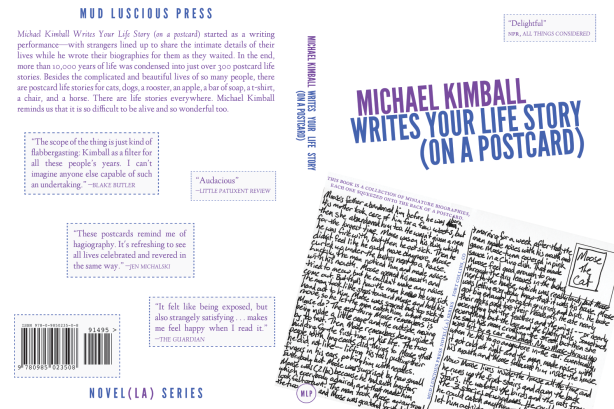
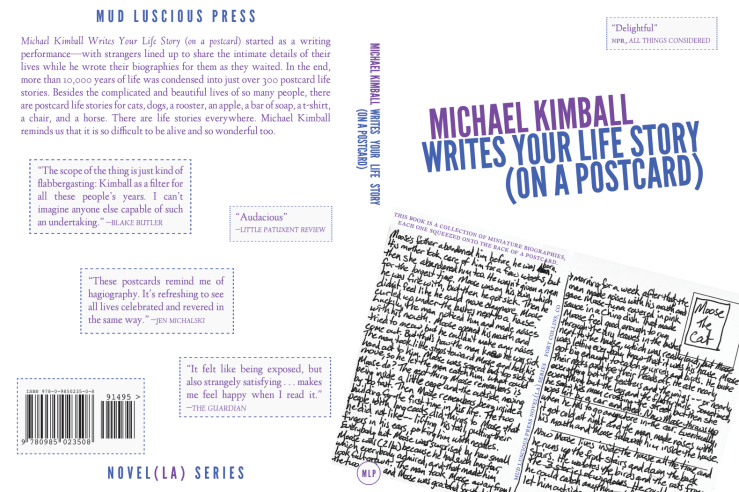
“I never expected strangers to tell me so much about themselves, so many things they have never told anybody else, but I found an unexpected intimacy in the postcard life story project,” writes Michael Kimball in the introduction to his new book, the aptly titled Michael Kimball Writes Your Life Story (On a Postcard). Kimball continues: “It tapped into something human and humane. I was continually amazed by what people told me.”
Kimball’s respect for the people whose stories he is telling comes through in his spare but descriptive prose, an economical rhetoric undoubtedly necessitated by the confines of his small canvasses. When I interviewed Kimball about the project, he told me:
There are difficult things at different stages of the process. The first difficult thing is asking the right questions for the particular participant. The second difficult thing is being representative when condensing what I’ve been told. The third difficult thing is writing small enough to squeeze six hundred words or so onto a single postcard.
Through that asking, condensing, and squeezing, Kimball distills his subject’s lives into compact but moving stories.
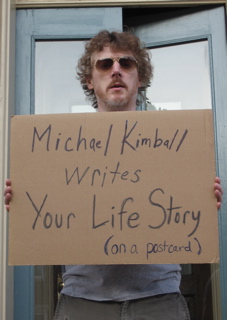
Michael Kimball Writes Your Life Story (On a Postcard) began as a performance piece at the Transmodern Performance Festival and then continued as a blog. Kimball eventually wrote over three hundred postcards; over fifty of these are collected in the new book. A not-insubstantial number of these are devoted to the biographies of contemporary writers, including folks like Tao Lin,Matt Bell, and Blake Butler:
By 4 years old, Blake was performing considered monologues, crazy dances, music videos, and both sides of talk shows. It’s all on video (his mother will show you, if you want). Despite these performances, Blake was a fat child by the 4th grade. He liked comic books and video games. By 10th grade, he weighed 250 pounds and felt disregarded. His bedroom walls were covered with pictures of women that he tore out of magazines at the grocery store and took home.
There’s also a first-person POV bio of Edgar Allan Poe, the last few paragraphs of which I can’t help sharing:
In 1831, my foster father and I had a terrible disagreement, after which I was court-martialed and kicked out of West Point. In 1834, my foster father died and did not leave me any of his money. To console myself, I married my 14-year-old cousin, Virginia Clemm.
For years, I published poems and stories and criticism, but it did not make me happy or money. In 1837, I was fired from a newspaper job for drinking. After that, I published a novel, but that didn’t help much either. Readers are sick. That’s why Virginia got tuberculosis and died in 1847. I was so lonely and so cold. I could not stop drinking.
It was 1849 when I stopped in Baltimore. I remember going down in the street, and, later, two hazy men taking me someplace white. I don’t remember dying, but I was glad I didn’t have to keep trying.
The mix of empathy and humor we see here resonates throughout the collection, whether Kimball is telling the life story of a U.S. President, or an ex-crack addict who met his wife at an all-you-can-eat buffet, or a rooster. Kimball handles his subjects with an intense honesty appropriate to the often tragic trajectory these tales take—even a piece like “Red Delicious Apple,” which takes metaphysical license of a sort, leads to a sad end:
The first thing Red Delicious Apple remembered was being a flower and the way the birds sounded in the trees. Later, Apple remembered the wind and losing his petals. Apple wanted to jump down after them, but stayed on the branch, in the tree. … Not long after that, Hand delivered Apple to the teeth. Apple could feel the teeth cutting through his skin and into his meat, what was left of his insides turning brown. Afterward, he sickened, softened. The last thing Apple remembered was the trashcan, the lid, the rotting darkness.
Or the fate of “Chair”:Chair thought, Wood and glue.
Chair thought, Next time, I’m letting go.
Chair cracked. He broke one of his legs and then his back.
Chair thought, That didn’t even hurt.
Update : Chair was thrown into a dumpster.
But perhaps I bring up “Chair” and “Red Delicious Apple” because their tragic contours are easier to allude to quickly than many of the biographies here, which often involve missing parents, mental illness, and suicidal thoughts, all delivered in the spare, striking prose that the confines of Kimball’s project necessitate. The stories are sometimes shocking and sometimes sad and usually very moving. As the titular anonym of “G” suggests, “tragedy can be beautiful.”
Michael Kimball Writes Your Life Story (On a Postcard) is new from Mud Luscious Press.
Michael Kimball’s latest book Michael Kimball Writes Your Life Story (On a Postcard) had its genesis in a performance piece at the Transmodern Performance Festival a few years back: Michael interviewed people for a few minutes and then crammed their biographies onto postcards. The project soon evolved into a blog, where Michael interviewed hundreds of people of all ages from around the world. The work is now collected in a book from Mud Luscious Press that features over fifty of the biographies, including the life stories of several contemporary writers, one dead U.S. President, a rooster, a T-shirt, a few cats, Edgar Allan Poe, and Michael himself.
In addition to Michael Kimball Writes Your Life Story (On a Postcard), Michael is the author of Big Ray, Us, Dear Everybody, and The Way the Family Got Away. He still holds the Meryl S. Colt Elementary School record for the 600-yard dash. Check out his website.
Michael was kind enough to talk to me about this latest book over a series of emails.
Biblioklept: What’s the hardest thing about writing someone’s life story on a postcard?
Michael Kimball: There are difficult things at different stages of the process. The first difficult thing is asking the right questions for the particular participant. The second difficult thing is being representative when condensing what I’ve been told. The third difficult thing is writing small enough to squeeze six hundred words or so onto a single postcard.
Biblioklept: When you started the project, it was a planned performance piece of sorts, but your description of it at the beginning of the book makes it seem rather off-the-cuff. Did you have a plan for the questions you would ask? How did the questions change as the project progressed?
MK: That first performance was definitely off-the-cuff. I had no idea what I was going to ask people and how I was going to write their life stories on a postcard. I mostly started with something pretty open-ended and then asked more specific questions about whatever I was told. As the project progressed, I developed a set of starter questions that elicited basic information and then asked more specific questions from there. Basically, I considered whatever I was being told to be important and then asked more questions about it.
Biblioklept: You interviewed people by email, in phone, in person — how did howyou were doing the interview affect the process? Did you prefer one way over the other?
MK: I preferred the in-person interviews. There was a different kind of intimacy with those and there are a bunch of people I interviewed that way who are now friends. Of course, that wasn’t practical for lots of the interviews, since most people lived so far away from me. And the method did influence the process. With the phone interview and in-person interviews I was taking notes as fast as I could, but that was never fast enough. With the email interviews, it was easier for people to give me more detailed answers. Also, since I had the full text of their answers, I could use more of their language.
Biblioklept: Did you prefer to use as much of the subject’s language as possible? Maybe I’m getting into what you described as “the second difficult thing” — how much of yourself do you see in the pieces? I think there’s clearly a voice, a tone that unifies the pieces . . . I’m curious how much of the process was crafting or editing or revising or repurposing the subject’s original language…
MK: I tried to use the participant’s language wherever I thought it gave some sense of the person. At times, I thought of like using third-person close narration. Besides that, I was trying to be as objective as possible and I think that gave the life stories a certain consistency of tone. Clearly, I tend to write sentences a certain way, but beyond that I tried to keep myself out of it.
Biblioklept: What about pieces like “Chair” or “T-Shirt” — how did they come about?
MK: The first non-person one I wrote was Red Delicious Apple, which popped into my head almost fully formed, which happened because I used to almost always have apples on my desk, which just meant that I spent a lot of time with apples. But writing Red Delicious Apple opened up a lot of possibilities and so T-Shirt is written about my favorite t-shirt and Chair was written about a chair I once broke. And I have a great affection for animals, so I loved writing ones like Moose the Cat, Sammy the Dog, and Abby the Horse.
Biblioklept: You wrote over three hundred postcards. How did you choose which ones you would include in the book?
MK: The book would have been over seven hundred pages long if I had included all the postcard life stories, but it was difficult leaving any of them out. So, ultimately, it came down to trying to showing the range of the postcard life stories, which is why nearly every one I wrote about a non-human made it into the book.
Biblioklept: How did the Poe biography come about?
MK: That was for Gigantic’sGigantic America issue. They asked me to write one of the great American bios that they printed on special card inserts and I suggested Poe, who had just had some anniversary of his life or his death.
Biblioklept: Several pieces in Life Story are about contemporary writers. Was writing about these writers different than writing about anyone else in the collection?
MK: Early on, it was other writers who seemed particularly keen on the project — Adam Robinson, Karen Lillis, Elizabeth Ellen, Elizabeth Crane, Blake Butler, etc. I approached every postcard life story the same way, but then let the participant tell me where they wanted to take it. I tried to ask questions that followed their answers.
Biblioklept: I imagine most people who asked to participate in the project were forthcoming with their answers. I’m curious though if you noticed any topics that people avoided or glossed over or maybe required additional prodding from you. Did you ever feel like your part of the interviewing process pushed your subject into uncomfortable territory?
MK: I didn’t realize it until later, but part of what made the project work was that people came to me wanting to tell their life story (rather than me asking them if they wanted it told). Still, there were a few times that people were reluctant to say things. There was one woman who was reluctant to talk about her husband and I couldn’t figure out why, but then they divorced not long after that. And there was one man who didn’t want to talk about his mother because she was really sick. But usually if there was reluctance, it was some kind of abuse or some other horrible thing that had happened to the person. In fact, I was reluctant to talk about the abuse I grew up with in my own postcard life story when it was initially written. In general, I tried to ask the difficult question, but then let the participant decide whether they wanted to answer and how much they wanted to tell me. And with particularly difficult life stories, I always showed the participant what I wrote and asked them if they were OK with it being public before I ever put their postcard life story out into the world.
Biblioklept: Talking about one’s own life clearly has some kind of therapeutic value. Do you think reading about one’s own life carries a similar value?
MK: Since starting the project, I’ve learned there are quite a few therapeutic techniques that involve narrative and telling (or retelling) one’s life story. Part of that process is hearing one’s life story told back or reading about one’s own life. There can be something useful in that perspective and there can be something reassuring about having a manageable version of one’s life story.
Biblioklept: What are you working on now?
MK: I’m very slowly working on two different novels and thinking about a third. I’m not sure if I’ll ever finish any of them.
Biblioklept: Have you ever stolen a book?
MK: I used to steal so many books, especially when I didn’t have the money to keep pace with my reading appetite and I couldn’t find the things I wanted to read in the library. I’ve tried to make up for that by giving away lots of books these days. I stole so many books that I’m not sure I can remember a specific instance. But it was always kind of thrilling and it seemed to make reading all the more exciting. Sometimes, if I didn’t like a book I would sneak it back into the bookstore.
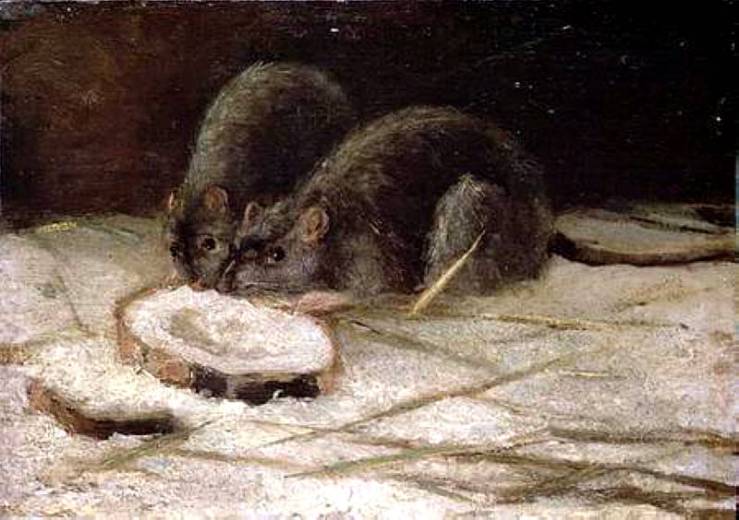
I spent most of this day—Sunday that is—swamping out my garden shed, recently rat-infested. Big wood rats, or river rats as we sometimes call them here, some of us.
This meant sterilizing the whole deal, spraying a bleach solution, wearing appropriate eye and nose and mouth protection, because getting older and having kids I now seem to care about my oh-so-important sensory organs more than I did in my twenties. This meant removing rat feces and a few dead rats. Just fucking gross, really.
I don’t know.
2. Point 1 has almost nothing to do with Ben Marcus’s novel The Flame Alphabet. It’s just that I told myself I’d finally write about it here, after finishing it a few weeks ago and all. The farther out it gets, the harder it is to write about.
3. But really, there is some kind of corollary between my rat business and The Flame Alphabet: Both were repellent experiences. Now, to be fair, the rat purging dealie was wholly repellent and in no way intriguing, whereas Marcus’s book was simultaneously attractive and repellent. The novel’s ugliness hit me hard sometimes, and the final chapters were a sludgy slog.
4. Maybe you’re just like, Hey, c’mon, cut it out with the rats, nobody came here for that, get with the program, tell us the plot:
Okay:
So, language becomes toxic. First in kids, who hold an immunity of some kind, but the toxicity spreads to all elements of language and just kills people and makes them sick &c. In this mix our (reliably unreliable) narrator Sam kinda sorta tries to protect/save/help his family, wife Claire and daughter Esther. He undertakes home experiments, his “smallwork,” and keeps up the old time religion of the forest Jews (you’ll have to read the book for clues to this mysticism; I am too exhausted from rat-swamping to further explicate).
Society falls apart, sort of. (This is one of the major maybe-problems with The Flame Alphabet: There’s this hideous apocalypse underway but there also seems to be authority somewhere, external to the narrative, a government or scientific cadre or just really a they who keep the system moving, bread baking, electricity crackling &c).
There’s our narrator’s nemesis LeBov (the name undoubtedly borrowed from William Labov, who you learned about in your linguistics classes, I’m sure).
Midway through the novel our feckless hero starts new smallwork for Labov. LeBov is my favorite character—whenever he shows up the novel is alchemically invigorated.
Other stuff happens.
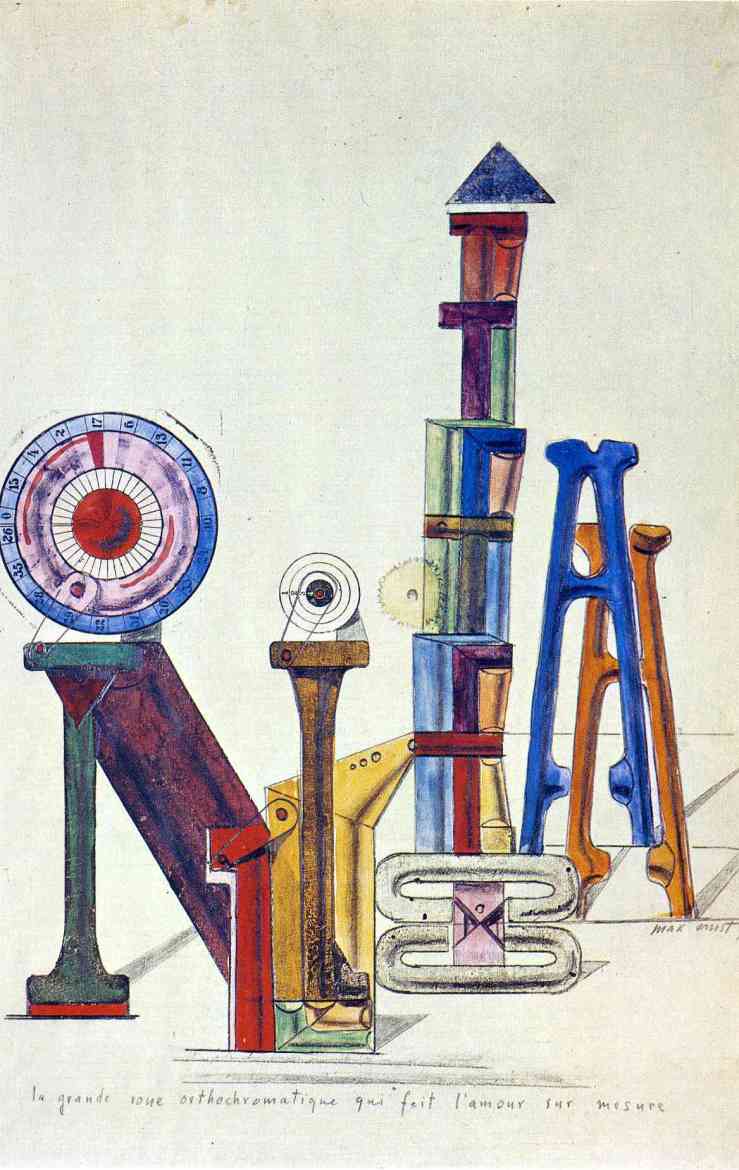
La Grande Roue Orthochromatique…, Max Ernst
5. Really though, The Flame Alphabet is an apocalypse novel, filled with mounds of salt and despair and isolation and probably madness, rarely energized by action, but hardly ponderous.
6. (Here’s a paltry criticism for me to critically make: I wish The Flame Alphabet was shorter. Like significantly shorter. Maybe a novella. Maybe a long short story).
7. Finishing the novel, I sketched out a list, which hey why not just cut and paste here:
Joseph Cornell’s boxes.
Much of J.G. Ballard, especially the stuff in the ’70s and ’80s.
The Residents.
The films of the Brothers Quay.
Charles Burns’s stuff.
Wm. Burroughs, or the idea of Wm. Burroughs.
Joseph Beuys and his goddamn fat and felt.
This is the stuff that The Flame Alphabet reminded me of—this and David Cronenberg’s films, which Jesus, how did they not make the list?
8. I mean, really, I think Ben Marcus has given us a sort of lost Cronenberg film here. Maybe what the book most reminded me of, language plot aside, was Cronenberg’s underrated icky 1999 effort eXistenZ, a film that seems to take place in several worlds at once (including the imaginations of the protagonist and the viewer).
9. Actually, comparing Marcus’s novel to a film is stupid.
Really, I think what The Flame Alphabet most resembles—its best parts, I mean—are directions to some kind of far-out art installation.
Which may be a way of saying The Flame Alphabet is best—or really, I like The Flame Alphabet best—when it recalls Ben Marcus’s older, more “experimental” stuff.
10. To wit:
The practice of language smoking originates in Bolivia but quickly travels north. In Mexico City it is perfected. Words and sentences tested by a delegate in a smoke-filled tube, at the end of which is stationed a sacrificial listener called, for unknown reasons, the bell.
The bell’s brain, when he dies, is pulled and separated into loaves. The loaves are tagged and named. Only drawings survive.
11. Or maybe you want some textual evidence of TFA’s Cronenbergian contours:
Ruptured mattresses littered the floor, sleeping bags with the bottoms kicked through. A brittle pillow bore the facial welt of the last patient who slept here. A man’s work shirt had been chewed, swallowed, spit up in a glaze of bile.
Mesh baggies of hair hung from the ceiling, repelling flies. Possibly the hair attracted them instead.
The Pack, Joseph Beuys
12. Or a Joseph Beuys moment. Our narrator in his language lab:
To test this I created white text on white paper, gray on gray, froze water into text-like shapes and allowed it to melt on select surfaces—slate, wood, felt—which it scarred so gently, you’d need a magnifying glass to spot the writing.
13. And a passage that showcases our narrator’s smallwork as an act of love (of sorts):
On Esther’s final birthday in our house I went to the kitchen to get to work on the cake. There wasn’t much food left in the cupboard, just some pancake mix and a blend of baking powders I’d dumped into a bag. From the meaty, mineral smell I figured this would give a lift to the cake, at least if I got the batter down to room temperature and shocked it into a hot oven so it might have some spring.
For liquids I had an egg and some buttermilk, the custardy sludge from the bottom of the carton.
I could boil the buttermilk to kill off bacteria, then flash freeze it before dumping it into the batter. The egg, too, would need flame, because it was likely spoiled by now.
I broke it into a pan, stifled a gag, then whisked it over a simmer until it frothed up, sputtered, and grew clear again. Mostly it did not congeal. The hardened parts were easy to flick out. When the pan cooled I slid it into the freezer, went to work on sifting the powders.
For sugar I reduced the last of the orange juice until it thickened into a syrup, then whipped in a thread of honey. This would have to do, because I needed the last of the sugar for frosting. I liked to feather it on lightly, then comb it up while hardening it with the medical cold blower, as if the cake had a fright wig.
The frosting I colored silver with a bead of food-grade aluminum.
14. These are all great fragments. Let’s keep going:
15. Desire—need—predicates language:
Presumably if you wanted nothing, you’d have no occasion to speak.
16. And Beckett:
“Failures have their place in our work,” he admitted, after hearing me out. “I’ve had my flirtations with failure. There is a small allure there. I commend you for seeking out failure so aggressively. But this idea people have of failing on purpose, failing better? Look at who says that. Just look at them. Look at them very carefully.”
17. Failure: Failure to imagine (better):
The linguist held forth, smugly dismissing an idea that had recently come into its own. It interested me that the linguist’s inability to imagine something constituted a sound rejection of its possibility.
Hotel Eden, Joseph Cornell
18. And:
We kept believing it couldn’t get any worse, as if our imaginations held sway in the natural world. We should have known that whatever we couldn’t imagine was exactly what was coming next.
19. I think I’ve shared a nice slice of Marcus’s prose. Dude can sling it. Seriously. I think he’s a great writer. I just wish more was stripped away from The Flame Alphabet. Feels overtly novelly at times—I mean, yes, it’s a novel, but this seems to be its biggest weakness: Marcus’s concessions to the form.
20. ( Let me parenthetically insert here what might be my biggest problem with The Flame Alphabet: I felt the ghost of Sam Lipsyte working under its contours. And I love Lipsyte’s stuff, seriously—but I often felt like Marcus was copping Lipsyte’s syntax, rhythms etc. as a means to a more, I dunno, normal narrative.
And while I’m here, in these parentheses, maybe I should direct you to a good and proper and real review. David Winters does a marvelous job at The Millions. And he brings up the Lipsyte thing that I just brought up, but he does a better job parsing the two styles than I.
21. The biggest tussle I had with TFA though is undoubtedly my agon (look how I make myself protagonist!) with its confounding reading rules.
The novel’s overtly parricidal/infantical scope, its estranging metaphors of language and extinctions, its remote anxieties of parenting—all of these pop up like red flags.
I wanted to—no, I set out to––deny the book as an allegory. I sought to resist metaphor, symbolism, analogy. But it’s hard, you know?
22. “Mythology is the lowest temptation,” our narrator tells us at one point.
And then Marcus wedges fairy tales and fables into the mixology.
23. And then our narrator:
I grew so alert to its obvious meanings that they sickened me, leading me to secondary, ironic intentions, disguises of rhetoric I would not normally notice. But soon these, too, felt fraudulent and then I returned to the literal meanings, which had gained more force now that I’d spurned them. That, however, did not last, and by the end the words had shucked their meaning entirely and evolved into a language of groaning, beyond interpretation. Or susceptible to the most obvious interpretation of all.
Language! Language! The problem of language!
24. And hence, what I take to be the book’s thesis, a two-sentence manifesto:
Explanations of any kind, in fact, were simply extinct.
Among the many rhetorical modes that had perished.
25. Does The Flame Alphabet enact its own holocaust, its own perishing; does it self-immolate? I don’t think so—although maybe that’s not what it sets out to do, maybe that’s just what I think it should do. I see a stronger book writhing there under the language, eager to consume some of the unnecessary pages, paragraphs, sentences, words. A book that would consume itself. (This is a silly metaphysical conceit; please move on).
Two Rats, Vincent van Gogh
26. So maybe I’ve knocked on the book a bit, rated it low even, you may perceive, dear reader: Let me be clear then: The Flame Alphabet is the sort of burning ugly vibrant affecting blazing grueling confounding bizarre novels that we need more of. It’s stronger than most of the contemporary stuff out there, definitely the stuff coming from the major houses. And if I seem to pick at it, it’s only because I see in it concessions to a so-called reading public; I wished to see Marcus pull publishing and readers closer to him.
I won’t forget cleaning the dead rats from the shed anytime soon; neither will I forget reading The Flame Alphabet.
1. Ah, 1985. I was just a kid. A young kid. And my folks took me to see Walter Murch’s Return to Oz, an unofficial sequel to The Wizard of Oz.
Return to Ozis a film so bleak and dark and bizarre that its imagery still lives in the nooks of my nightmares.
2. Not that I didn’t enjoyReturn to Oz—to be clear, I did. But it horrified me in ways that surpassed the deep horror I’d experienced viewing the 1939 film The Wizard of Oz.
3. (The green Wicked Witch cackling “I’ll get you my pretty” in The Wizard of Oz being something of a founding moment of horrific horror, a horror amplified by my mother’s tendency to act out the line at weird moments as she tickled me or chased me or picked me up from school).
4. But Return to Oz: this movie is dark. It’s fucked up.
Dorothy gets institutionalized and treated with electroshock therapy. Then she goes to Oz, where she’s pursued by Wheelers, these things that roll around on rollerskate hands and feet, which, you know, should be whimsical, but are instead horrific. Then there’s this cabinet of detached heads, which could have been handled playfully, but no, instead it’s like something out of Hieronymus Bosch. Even Dorothy’s friends are these weird, off-putting versions that don’t match up to the original trio of Scarecrow, Tinman, and Lion. Instead we get Tik-Tok, an android who looks like a swollen pot-bellied C3PO, and Jack Pumpkinhead, a guy with a pumpkin for a head. These friends don’t look human at all (because they aren’t). There’s a quest; they cross a desert; they save the day, etc.
It ends with Dorothy returned, not exactly safely, to aunt and uncle.
5. So Disney made another unofficial sequel, Oz the Great and Powerful, this time from director Sam Raimi (Return’s Murch never directed another film, by the way). Despite his franchise work on the first trilogy of Spider-Man films, Raimi is an auteur who gave us cult classics like Darkman and the Evil Dead trilogy. I loved his last film Drag Me to Hell, which mixed humor with noir and genuine horror.
6. Oz the Great and Powerful is of course doomed, no matter how much money it makes. It’s doomed in the way that The Two Jakes was doomed, or Godfather III was doomed, or Citizen Kane 2: Electric Boogaloo was doomed: There’s no way that it can surpass, let alone stand up next to, the strength of the prototype.
7. Still, I think that if Raimi has brought enough of his own weirdness to the film, we might get a fascinating artifact. My real hope is that there will be a strong streak of Evil Dead 2 in Raimi’s Disney, a streak of bizarre dark weirdness to baffle and disturb a new generation. Hell, maybe I’ll take my kids.
In Yoko Ogawa’s new collection Revenge, eleven stories of fascinating morbidity intertwine at oblique angles. Tale extends into tale: characters, settings, and images float intertextually from chapter to chapter, layering and reticulating themes of death, crime, consumption, and creation. (And revenge, of course. Let’s not forget revenge). Not quite a story cycle or a novel-in-tales, Revenge’s sum is nevertheless greater than its parts. It’s a brisk, engaging read, and as I worked my way to the final story, I already anticipated returning to the beginning to pull at the motifs threading through the book.
The book’s dominant motifs of death and food arrive in the first tale, “Afternoon Bakery,” where a mother tries to buy strawberry shortcakes for her dead son’s birthday—only the baker is too busy bawling to attend to sales. We learn why this baker is crying in “Fruit Juice,” the second story, a tale that ends inexplicably with an abandoned post office full of kiwi fruit. The third story, “Old Mrs. J” (one of Revenge’s stand-outs) perhaps answers where those kiwis came from. More importantly, “Old Mrs. J,” with its writer-protagonist, elegantly introduces the thematic textual instability of the collection. There’s a haunting suspicion here that the characters who glide from one tale to the next aren’t necessarily the silent extras they seem to be on the surface. Our characters, background and fore, are doppelgängers, ghost writers, phantoms.
The penultimate tale “Tomatoes and the Full Moon” lays the ghosting bare. Its protagonist is a magazine writer, whose “articles” really amount to little more than advertising. Staying at a seaside resort, he’s pestered by an old woman, one of the many witches who haunt Revenge. The old woman claims to be a novelist, and points out one of her books in the resort’s library:
Later, in my room, I read ‘Afternoon at the Bakery.’ It was about a woman who goes to buy a birthday cake for her dead son. That was the whole story. I should have gone back to my article, but I read her novel through twice, finishing for the second time at 3:00 a.m. The prose was unremarkable, as were the plot an characters, but there was an icy current running under her words, and I found myself wanting to plunge into it again and again.
The final line is perhaps a description of Revenge’s haunting intertextual program—although to be clear, Ogawa’s plot and characters are hardly “unremarkable,” and her prose, in Stephen Snyder’s English translation, is lucid and descriptive. It’s the “icy current running under her words” that makes Ogawa’s tales stick so disconcertingly in the reader’s psychic gullet. And if her prose is at times “unremarkable,” it’s all in the service of creating a unifying tone. All eleven tales are narrated in first-person, and each narrator is bound to the limits of his or her own language.
These limitations of language bump up against the odd, the spectacular, the alien, as in “Sewing for the Heart”:
She had explained that she was born with her heart outside of her chest—as difficult as that might be to imagine.
The line is wonderful in its mundane trajectory: Our narrator, an artisan bagmaker, witnesses this woman who lives with her heart outside her chest and concedes that such a thing might be “difficult . . . to imagine”! There’s something terribly paltry in this, but it’s also purposeful and controlled: Here we find the real in magical realism.
But this bagmaker can imagine, as we see in an extraordinary passage that moves from the phenomenological world of sight and sound and into the realm of our narrator’s strange desires:
She began to sing, but I could not make out the words. It must have been a love song, to judge from the slightly pained expression on her face, and the way she tightly gripped the microphone. I noticed a flash of white skin on her neck. As she reached the climax of the song, her eyes half closed and her shoulders thrown back, a shudder passed through her body. She moved her arm across her chest to cradle her heart, as though consoling it, afraid it might burst. I wondered what would happen if I held her tight in my arms, in a lovers’ embrace, melting into one another, bone on bone . . . her heart would be crushed. The membrane would split, the veins tear free, the heart itself explode into bits of flesh, and then my desire would contain hers—it was all so painful and yet so utterly beautiful to imagine.
Painful and utterly beautiful: Another description of Revenge.
Sometimes the matter-of-fact tone of the stories accounts for marvelous little eruptions of humor, as in “The Last Hour of the Bengal Tiger”:
At fifteen, I took an overdose of sleeping pills. I must have had a good reason for wanting to kill myself, but I’ve forgotten what it was. Perhaps I was just fed up with everything. At any rate, I slept for eighteen hours straight, and when I woke up I was completely refreshed. My body felt so empty and purified that I wondered whether I had, in fact, died. But no one in my family even seemed to have noticed that I had attempted suicide.
The scene is simultaneously devastating and hilarious, an evocation of abyssal depression coupled with mordant irony. The scene also underscores the dramatic uncertainty that underpins so many of the tales, where the possibility that the narrator is in fact a ghost or merely a character in someone else’s story is always in play.
There’s no postmodern gimmickry on display here though. Ogawa weaves her tales together with organic ease, her control both powerful and graceful. Her narrators contradict each other; we’re offered perspectives, glimpses, shades and slivers of meaning. A version of events recounted differently several stories later seems no more true than an earlier version, but each new detail adds to the elegant tangle. Like David Lynch and Roberto Bolaño, Ogawa traffics in beautiful, venomous, bizarre dread. Like those artists, she offers a discrete world we sense is complete and unified, even as our access to it is broken and discontinuous. And like Angela Carter, Ogawa channels the icy current seething below the surface of our darkest fairy tales, those stories that, with their sundry murders and crimes, haunt readers decades after first readings.
What I like most about Revenge is its refusal to relieve the reader. The book can be grisly at times, but Ogawa rarely goes for the lurid image. Instead, the real horror (and pleasure) of Revenge is the anxiety it produces in the reader, who becomes implicated in the crimes cataloged in the text. Witness to first-person narratives that often omit key clues, the reader plays detective—or perhaps accomplice. Recommended.
Revenge is new in handsome trade paperback from Picador; Picador also released Ogawa’s novel Hotel Iris in 2010.
1. I finally saw Paul Thomas Anderson’s 2012 film The Master last night. I’m going to riff on the film. Fair warning:this riff will contain spoilers—I’ll talk about the film’s final scene, for instance (and if you just want to read about the ending, scroll down to point 23, after the embedded video).
2. The first hour of The Master is probably the best thing PTA has done.
3. The Master begins on a beach somewhere in the South Pacific. These are the final days of WWII. Navy boy Freddie Quell (portrayed by Joaquin Phoenix), solitary from his fellows, pours from a can of the mystic moonshine he brews into a coconut he’s hacked open with a machete. He then drinks the potion and mimes chopping off his hand with the machete. After this, he humps a woman made of sand and jerks off into the ocean.
4. The idyll of the Pacific beach contrasts strongly with Quell’s tortured psyche—it’s clear from the film’s first few moments that he’s borderline deranged, a sex-obsessed alcoholic who was damaged long before the war.
5. Quell is also a profoundly talented chemist (or alchemist) capable of brewing strange cocktails mixed from whatever’s at hand. These potions intrigue Lancaster Dodd (henceforth Master, played by Philip Seymour Hoffman), who samples a flask and asks Quell to brew more. Quell says he’ll make Master something different from that first batch, asking him, “How do you want to feel?”
6. “How do you want to feel?”
This question governs The Master, and the film is at its best when probing and plumbing these depths.
7. Back to my second statement: The first hour or so of The Master is probably the best thing PTA has done. Freddie Quell is an intriguing figure, a desperate madman who recapitulates the crimes of Oedipus where ever he goes.
He is The Misfit of Flannery O’Connor’s story “A Good Man Is Hard to Find,” trying to match faith to the phenomenal world.
He is Jonah, fleeing angry Yaweh, stowing away on a ship.
8. The first scenes of The Master borrow liberally from the Terrence Malick playbook:
The opening scene on the beach strongly recalls the opening of The Thin Red Line, and the subsequent scenes where Quell maybe murders a man and then must run feel like the opening minutes of Days of Heaven.
Like Malick, PTA lets the gorgeous cinematography convey meaning; dialog passes through the background of the film.
9. The dialog begins when Quell meets Master, charismatic leader of “The Cause.” You know of course that Master is based on L. Ron Hubbard, founder of Scientology. It’s worth pointing out that the film isn’t really about Scientology, or cults, or charlatans—although these points are explored, for sure—it’s really about the search for meaning, for stability. For some kind of peace.
10. The friendship—and friendship-as-dialog—between Master and Quell is by far the most compelling part of The Master, and the film’s best scene is a long episode where Master initiates “Processing” with Quell—delving into the man’s founding traumas to purify his spirit. I usually hate to laud actors, but Hoffman and Phoenix are sublime here, fully inhabiting the characters through the scenes deep emotional shifts.
The Master never surpasses this scene.
11. Indeed, the biggest failure of the film is that there’s no moment in its back half that can respond to the Processing scene. The film’s final scene attempts to mirror it in some ways, but the attempt lacks the weight. It’s off balance.
12. I feel the need to preface what I’m about to write by saying very clearly:
Paul Thomas Anderson is an extremely gifted auteur, a filmmaker who has, moreso than perhaps any of his contemporaries, continued in the (anti-)tradition of the New Hollywood films of the seventies. I would rather watch a PTA film than a film by just about anybody.
But:
The guy has a real problem sticking the ending. His films fail to cohere, to transcend the sum of their parts. This might be an editing issue or a plotting issue or something more commercially-driven, like running time. I don’t know.
13. Exceptions to PTA not sticking the ending:
Punch Drunk Love, easily his most concise and focused film, a long short story from a filmmaker who works in sprawling novels.
Possibly Boogie Nights, which sags in the final third but is nevertheless buoyed by an energetic scene featuring Alfred Molina, a mixtape, some cocaine, and fireworks. (This scene is lifted from Robert Downey Sr.’s Putney Swope, by the way).
14. For the most part though, PTA’s films swell outside of the margins that their own narratives establish in the beginning of each film (I’m not sure if this sentence makes sense—what I mean is that the films’ endings fall apart w/r/t the films’ beginnings).
In There Will Be Blood, PTA uses a stunning, violent, unforgettable final moment as a punchline to the film. It’s probably what most of us remember, and it’s certainly a great way to close the epic. Still: When I rewatch Blood, I start to become impatient with the film’s meandering after its thrilling opening hour. I start to anticipate the horrific punchline.
15. The easiest example to point to of PTA’s undisciplined sprawl is Magnolia. I can’t think of a film with a stronger opening that so quickly devolves into Altmanesque chaos. Which is the point, yes, I get—but Magnolia, again, is a PTA film which can’t live up to its first hour. (Again, PTA covers over the back end’s sloppiness with a marvelous final scene).
16. So, to return to The Master: I went into the film with high expectations—hoping that this would be the film by PTA that coheres, that is more than just a collection of fantastic performances and amazing scenes. And for the first hour, I was enthralled: I cared deeply about Freddie Quell, found his strange passions heartbreaking, was moved by his bizarre relationship with Master.
And the film is great—it really is—but it’s not as great as I wanted it to be. (Which, yes, I know, says nothing about the film and everything about me).
17. The film’s seams start to show after the magical sea voyage from California to New York. The first few scenes in New York are fascinating (especially when Master is confronted by a skeptic at a party), but as the The Cause moves back West over land, PTA increasingly relies on montages and shorter scenes that seem like placeholders to cobble together the film’s longer sections.
18. The last truly transcendent scene is where Master sings “I’ll Go No More A-Roving,” and it comes at almost exactly the half-way point of the film’s 138 minute running time.
19. All kinds of interesting stuff happens after the “Roving” scene—and PTA seems content to raise more mysteries than he resolves, which I’m fine with—but a long montage showcasing the different Processing techniques of The Cause sucks the energy right out of the film.
20. What follows is a lot of meandering, a lot of unexplained—or worse, unexplored—moments between characters that shift focus away from the relationship between Master and Quell.
21. Maybe I want a longer edit of The Master.
22. Here’s a 20 minute reel of cut footage:
23. And what about the ending of The Master? As I tried to convey in points 13-15, PTA usually closes with a very strong scene or image. With the exception of There Will Be Blood, I’d argue that the final moments of PTA’s films generally depict moments of love, redemption, or reconciliation. The Master fits into this trend. How so?
24. Okay: So The Master is in some ways formally Oedipal.
Quell’s crimes are two-fold: He kills a man who he says reminds him of his father and he has sex with his aunt. The film leaves open the possibility that both of these crimes—crimes he confesses to Master during Processing—are simply displacements for the more direct sins of killing his real father and fucking his real mother.
The Oedipal tensions that underwrite the film are strongly on display in the relationship between Master and Quell: Master is in love with Quell; Quell needs a father figure. All sorts of weird familial displacements ensue between Master’s family members and Quell.
The Oedipal theme also evinces in the film’s motif of breasts, bellies, and other pregnancy images. While not many of The Cause’s ideas are expressed clearly in The Master, the idea that all founding traumas are recorded in/on the soul is made plain several times. Put another way, all people are subjected to traumas that exist in pre-Oedipal, pre-lingual, pre-conscious states.
Quell wants to return to the womb to correct or ameliorate or avoid these traumas. The impossibility of achieving this desire drives him to self-medicate with his homemade brews and to see sex in everything.
The film ends with Quell having sex with a stranger he picks up in a bar. They laugh heartily—another of the film’s motifs—laughter as a measurement of joy, but also dejection, also hysteria, also fear, also irrationality, also no language, just laughter—they laugh heartily, and in a shot that foregrounds his sex partner’s large breasts, Quell begins Processing her.
25. We then get the film’s last line, delivered with laughter: “Stick it back in, it fell out.”
The referent of the “it” is, on the surface level, Quell’s penis, but it also serves as a substitution for Quell himself, who would like to return to a mother, to start again in a new life. (The scene, a riff on Quell’s first Processing with Master, can also be read as the displaced sexual consummation between the two men).
The film’s final image gives us Quell lying down next to the woman made of sand, her huge breasts erect, dominating the shot; he curls into her, peaceful, serene, fetal. The shot is deceptive: It suggests reconciliation or even redemption, but the memory of peace is just one fragment of Quell’s terribly fragmented life. Significantly, the moment comes from the beginning of the film. If Quell is to be reborn and live again—as Master believes all people are—it is clear that he has not transcended his base animal urges.
When Quell awakes, he awakes to trauma.
26. Having riffed on the film’s end, I think the film is probably better than I gave it credit for earlier. It’s a cold Sunday. I think I’ll watch The Master again.
You remember Harmony Korine, right? The scruffy auteur who gave us the nightmare white trash tornado-disaster cat-killing opus Gummo? The curb-dancing maniac who never got around to putting out that movie where he provoked strangers to beat him up? The guy who broke the Dogme 95 rules on Julien Donkey-Boy, a film featuring a pregnant Chloe Sevigny ice skating to Oval? The guy who stitched Trash Humpers together using VHS decks? The guy who wrote Kids? That guy?
So he has this new movie coming out called Spring Breakers. He wrote and directed the film. It stars James Franco, along with Disney alumni Vanessa Hudgens and Selena Gomez.
Here is the NSFW trailer for Spring Breakers:
I am baffled.
I do not know what to make of this.
Sure, there’s something of Kids in there, but the lurid, saturated cinematography by Benoît Debie (who has worked with Gaspar Noé in the past) has this nauseating MTV/Hype Williams feel to it that seems miles away from Larry Clark’s plain, unadorned style, or Korine’s own patchy VHS buzz.
The film also seems to be a fairly straightforward, character-oriented plot, likely with clear exposition, an arc—all that stuff that Korine was known to dismiss in the past. Now, I’m not saying that Korine should just keep making the same films again and again (not that he’s ever done that, to be clear)—I’m just surprised by the look and feel of Spring Breakers, and how it seems to be marketed.
My gut feeling, which might be entirely wrong, is that Spring Breakers is an expensive prank, a film shot entirely in ironic quotation marks that the viewer will never see because Korine will never call attention to them. (This potentially puts Spring Breakers in the same territory as masterpieces like Road House and RoboCop).
Lead actor James Franco, who is currently pursuing seven PhDs in irony studies and metawhatevers, would seem an ideal fit for such a prank. Additionally, Franco’s begrilled performance as Alien is clearly channeling wunderkind RiFF RaFF, (Mr. RaFF even has a song called “RAP GAME JAMES FRANCO” which contains the genius hook “Non-stop through desert / Salisbury steak sweater”). RiFF RaFF’s shtick is even more bewildering than Spring Breakers; it’s difficult to tell if he’s some kind of art genius doing the Andy Kaufman thing or just a white kid from Houston with a bizarre sense of humor. Or both. Or neither. Either way, there’s something endearingly intriguing about him, whether you’re watching him infiltrate an art show in Miami or claim that his underwear is “moccasins.”
But back to Spring Breakers—it looks awful—but so did the previews for Wild Things, so, you know. And, again, the marketing isn’t the film. Still, it’s hard to get excited about this one.
2. Every time I read Moby-Dick it seems funnier and sadder. Richer. Thicker.
3. I cobbled together my reading over different media and spaces: I listened to William Hootkins‘ outstanding unabridged audiobook version, and then reread on my Kindle key passages I’d mentally underlined; I then checked those passages against the copy of Moby-Dick I annotated the hell out of in grad school.
4. I posted some of my favorite excerpts of Moby-Dick here on Biblioklept because I knew that I wouldn’t be able to write about the book—not really—that I wouldn’t be able to handle all of its language. (My riff on Olson’s book obsesses over Olson’s ability to write after Melville and Melville’s ability to write after Shakespeare).
5. Really, in posting so many fragments of Moby-Dick, I suppose that I’ve attempted to abrogate any kind of critical duty to describe the book under discussion in terms of its own language.
6. Point 5 is really a way of saying: Moby-Dick, like any sublime work of literature, is a self-defining, self-describing, and even self-deconstructing text.
7. Or, another way of making such a claim:
Let me (mis)appropriate Samuel Beckett’s description of Finnegans Wake and contend that the description fits Moby-Dick just as aptly:
Here form is content, content is form. You complain that this stuff is not written in English. It is not written at all. It is not to be read – or rather it is not only to be read. It is to be looked at and listened to. His writing is not about something, it is that something itself.
8. So here circumnavigate back to my own recent reading and auditing of the book:
Hootkins’ audio recording would make a great starting point for anyone (unnecessarily) daunted by Melville’s big book. He performs the book, commanding his audience’s attention. He unpacks the humor that might otherwise hide from untuned 21st century ears; he communicates the book’s deep, profound sorrow. His Ishmael is perceptive, clever, generous. His Stubb, hilarious. His Ahab a strange philosophical terror.
After listening to Hootkins on my commute, I’d return to key passages on my Kindle, and then finally review the notes I wrote in the cheap hardback Signet edition I read in grad school.
But why bring this up?
9. I don’t know.
Maybe: Unpacking Moby-Dick is too hard, too much—would require its own book, a book that would cite the entirety of Melville’s book.
But discussing the book this way seems a disservice to potential readers; it’s as if we would cloak the book in a mystic veil.
White Figure, Wassily Kandinsky
10. If I have a point to all of this: Moby-Dick is wonderful, funny, moving, engaging; a genre-bender that tackles philosophy, history, science; an adventure tale; a psychological novel brimming with ideas, allusions—but one delivered in sonorous, poetic language. It’s good, great, grand. Read it, if you haven’t. Reread it.
11. So I’ve failed to even try to begin to attempt to pretend to describe the plot.
Here: Ishmael, depressed, suicidal perhaps, decides to go to sea. To go whaling.
He tries to measure the whale, and by measuring the whale, maybe measure the world. But this is not really possible, certainly not in language. Certainly not in first-person perspective.
In Chapter 86, “The Tail,” Ishmael tells us:
The more I consider this mighty tail, the more do I deplore my inability to express it. At times there are gestures in it, which, though they would well grace the hand of man, remain wholly inexplicable. … Dissect him how I may, then, I but go skin deep. I know him not, and never will. But if I know not even the tail of this whale, how understand his head? much more, how comprehend his face, when face he has none? Thou shalt see my back parts, my tail, he seems to say, but my face shall not be seen. But I cannot completely make out his back parts; and hint what he will about his face, I say again he has no face.
(I don’t suppose I need to remark that Melville here lets one mighty tail stand in for another mighty tale—a tale he cannot face).
12. “Call me Ishmael”: our protagonist hails us.
But these famous opening lines aren’t really the beginning of the book. First we have the section titled “Extracts,” and before that “Etymology.” The first entry on the etymology of the whale, from Hackluyt, warns us not to leave out “the letter H, which almost alone maketh up the signification of the word.”
Whaling. Hailing. Wailing.
The whiteness of the whale.
The witness of the wail.
13. How, just how, does Ishmael witness? How does he manage to tell this story? Did I obsess over this in earlier readings? I don’t think so—I was too concerned with absorbing the what and the why of the story to closely attend the how of its telling.
14. The novel begins in standard first-person point-of-view territory, Ishmael guiding us through Manhattan, New Bedford, Nantucket—but by the time he’s boarded the Pequod and set out into the wide watery world, this first-person perspective transcends the limits of physics: Our narrator not only attends the private conversations of Ahab, his mates, his harpooners, his men—but also the very interior of those men, their minds, their dreams, their imaginations.
Is Ishmael a ghost?
Leviathan-Job 40-21, Salvador Dali
15. And to return to Ahab for a moment: My god, what a voice! His infecting, addicting insanity. His agon with Moby Dick, with the sun, with himself.
16. And Starbuck: Starbuck comes across weaker and weaker each time I read the book. We’re to believe he’s a man of convictions, but he moves in half-measures. In his final moments he tries to match or feign or approximate Ahab’s insanity: tragicomedy.
17. And Stubb: Despite his cruelties, he may be my favorite character in the book.
18. While I’m riffing: Is there a novel more phallic in the American canon than Moby-Dick? All that sperm: All that life-force.
19. This is maybe what Moby-Dick is about: Life-force. The attempt to to resurrect and die and resurrect again. The coffin that serves as life-buoy. The life-line that connects men that might also be their death. A counterpane to counter pain. A condensation of oppositions.
A yarn, a rope, a series of knots, layered, layering, self-contextualizing.
An attempt to put into language what cannot be put into language.
20. Twenty points: Maybe too long for the “short riff” promised in the title, but also surely too short to even begin to start to approach to pretend to say something adequate about the novel. So a parting thought: Moby-Dick is better—richer, fuller, deeper—each time I read it, and I look forward to reading it again.
In my estimation, The Swirlies were the greatest indie rock band of the 1990s to never really make it big—and by “make it big” I mean indie rock big—Sebadoh big, Superchunk big. They made two stellar albums of shoegazed-influenced dream pop, Blonder Tongue Audio Baton (1993), and They Spent Their Wild Youthful Days in the Glittering World of the Salons (1996). These albums are crammed with fuzzy four-track recorder experiments, folky half-songs, and a handful of truly stellar, muscular, dream pop songs that would fit nicely on any mixtape between jams from My Bloody Valentine and Stereolab. One such song is “Wrong Tube,” the a-side to this Taang! Records 7″ purporting to be the Brokedick Car EP (it’s not the full EP, which has two other songs).
“Wrong Tube” was a staple in my ’86 Camry’s tape deck for years, and I still love it today. I haven’t listened to this 7″ in years—I almost certainly bought it because of the blue vinyl (and, ashamedly, certain completist tendencies). The guitars are crunchy, swerving, swirly, guitarists Seana Carmody and Damon Tutunjian attacking their tremolo bars with abandon and trading verses as the band crashed through in a high tempo. I still find the final moments of the song exhilarating, as one of the guitars hammers out a sweet melody in the highest register as Carmody harmonizes along. Somehow the entire version of the song doesn’t fit on the 7″, which is a shame I guess. B-sides “Labrea Tarpit” and “You’re Just Jealous” are a forgettable experiment followed by a forgettable ditty.
Before mp3s, we used to buy these things called seven-inches, small disks of vinyl, usually played at 45rpm, usually offering an a-side with the band or singer’s single, and backed with (b/w) a b-side offering a song (or songs!) that probably wouldn’t be on the album. A lot of times, 7″s would consist of songs that wouldn’t be on any album. Or that would be it for the band—just the one 7″. I bought many, many of these little disks between 1992 and 1999, and I still have three boxes full of them gathering dust in a utility room.
Anyway, new feature: I’ll pull out one each Sunday, listen to it, photograph it, share some thoughts on it, etc.
For this week, I pulled out the closest box and then pulled out the first 7″ in the stack: Archers of Loaf’s 1995 single for “Harnessed in Slums,” b/w “Telepathic Traffic.”
“Harnessed in Slums” is the second track from the band’s second album, 1996’s album Vee Vee.
Vee Vee came out shortly after the 1995 EP Vs. the Greatest of All Time, which I think might be the Archers’ best work—or at least, that’s how I remember it. Anyway, I loved this early arc of the band’s career, which kicked off with Icky Mettle, a basically perfect glob of nineties indie rock.
I haven’t listened to Archers of Loaf in years. I lost interest in what the band was doing by the late nineties, and like many of the albums I listened to thousands of times in my teens, I find their music too intertwined in intense memories and feelings to listen to again. I have a hard time extricating the psychic detritus of my youth from certain albums.
The crunchy warbled opening of “Harnessed in Slums” brought back a strange rush of the past. I remembered seeing the band—on a school night!—in support of Icky Mettle. My friend Wayne brought a paper headband to the show and guitarist Eric Johnson wore it through most of the set. They gave us the set list (on a paper plate) and autographed stuff. I wonder if they thought it was weird that we wanted their autographs—I think it’s weird now. (By the time I was 17 I had almost no interest in talking to anyone in a band, let alone getting an autograph).
“Harnessed in Slums” is a perfect Archers track, poppy, proggy, fake-sloppy, a punk anthem channeled through the crunchy trademark sound of the 1990s NC Triangle. Weirder and darker than Superchunk, tighter and more metallic than Pavement, Archers of Loaf hit a not-too-sweet spot somewhere between prog virtuosity and DIY punk aesthetic. The lyrics are bizarre, maybe meaningless, a shout-along that could have come from a Burroughs cut up (“I want waste / We want waste / They want waste / Slaves want waste”; “Strip the color from the meat of my eye”).
The b-side is “Telepathic Traffic,” a jam that swells with acoustic guitars and snaky, snarly guitar lines—there’s almost something crime noir about the song. It’s sinister anyway. Eric Bachmann’s opening barks are almost comical, as if he’s imitating some British post-punk hero, before clustering into a pogoing chorus. “Telepathic Traffic” bears a few too many conventions that can become tiresome over an album—the track slows and speeds up unnecessarily when it should plow straight ahead (or perhaps just get faster).
Listening to these tracks again doesn’t make me want to pull out Icky Mettle as much as it makes me want to check out Erich Bachmann’s latest stuff. Has he mellowed out? Added more/different instrumentation? Complicated or simplified his sound? I remember being perplexed by his 1995 solo album Barry Black, which I recall having chamber arrangements. Maybe I should check it out.